When the tribal raiders from Pakistan entered Kashmir in October 1947, the Valley was plunged into chaos. But nowhere was the suffering more concentrated, more haunting, than in Baramulla. For thirteen harrowing days, this serene town at the gateway to the Valley lived through what survivors would later call “thirteen years of hell.”
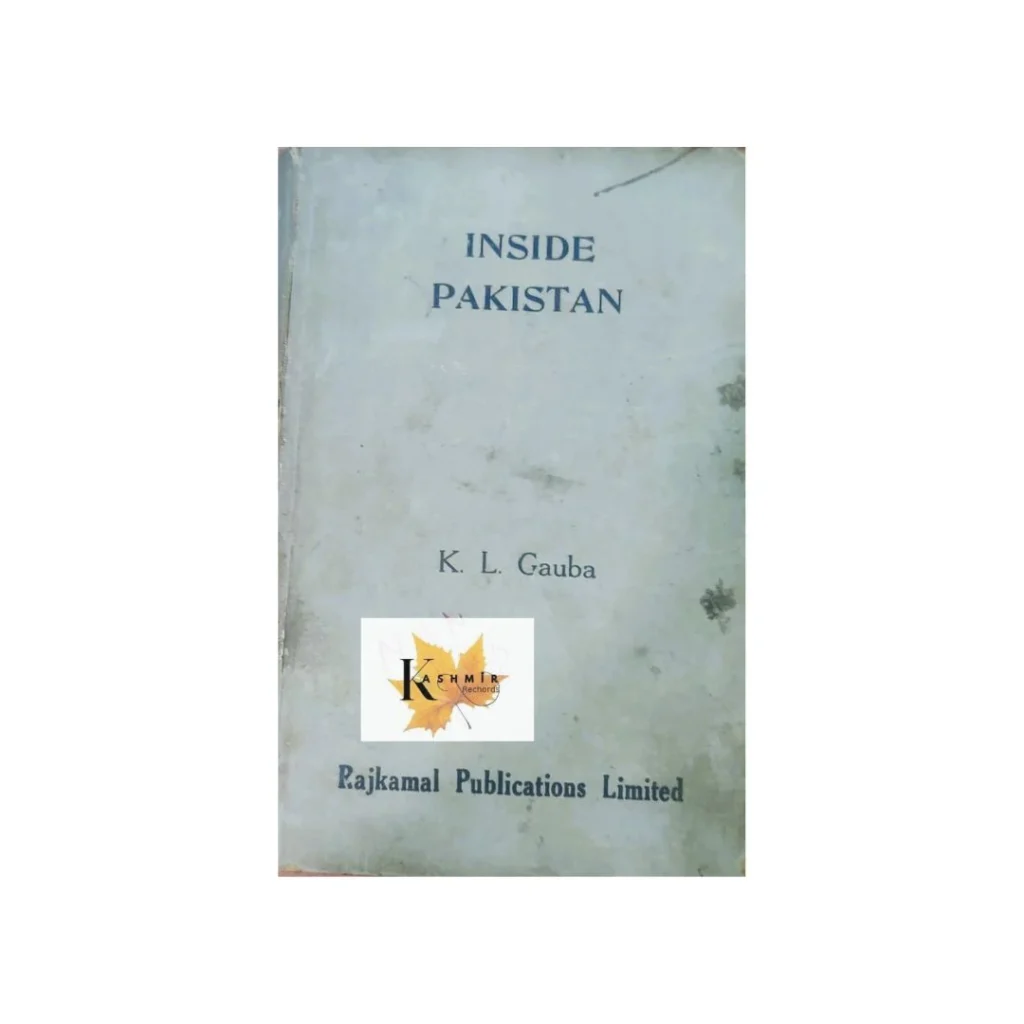
The invaders—armed tribesmen backed by Pakistan—descended upon Baramulla with a fury that spared no one. The town was looted, torched, and left soaked in blood. Hindu, Muslim, Sikh, or Christian—it made little difference to the marauders. Eminent lawyer and author K.L. Gauba, in his book Inside Pakistan (1948), recorded that “the raiders made little distinction between their victims.”
…For thirteen harrowing days, this serene town at the gateway to the Valley lived through what survivors would later call “thirteen years of hell.
A Town Drenched in Blood
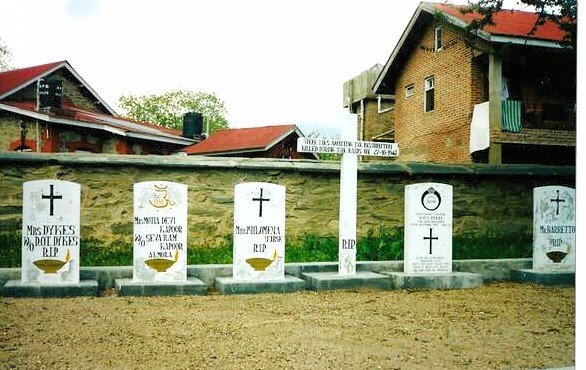
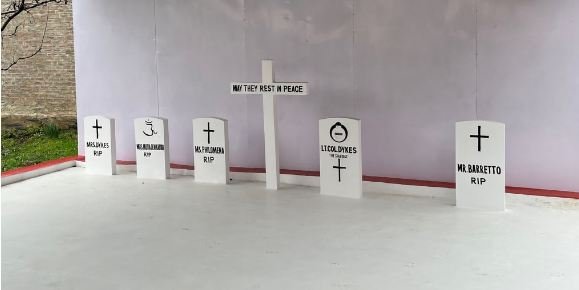
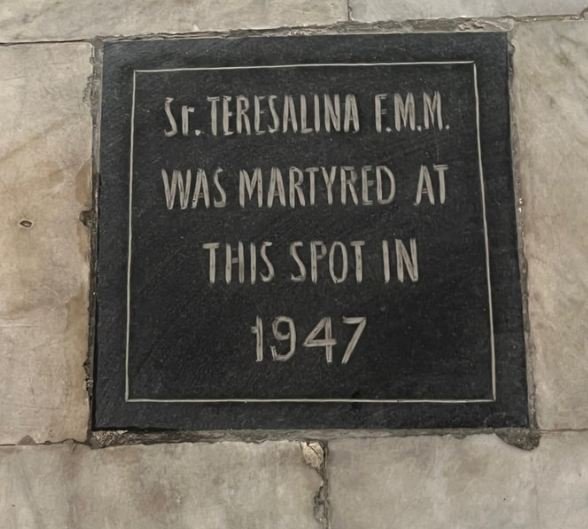
Gauba estimated that over a thousand people were killed in Baramulla alone. Among the slain were Lt. Col. and Mrs. Dykes, four Sisters of Mercy, and a Mother Superior from the Convent of St. Joseph’s. The Dykes’ infant child, Gauba writes with chilling simplicity, “was thrown down a well.”
Even the sacred walls of the mission hospital and convent offered no sanctuary. Captured tribesmen later confessed that the Europeans were killed on the very day the raiders stormed the town. The hospital and post office were destroyed, hostages taken, and every semblance of order obliterated.
The Loot That Never Ended
The assault on Baramulla was led by Major Khurshid Anwar, with Major Mohammed Aslam among his subordinates. Their force, numbering between 3,000 and 5,000, operated in waves—some coming, others leaving—each group looting anew. “The same sections of the town were plundered repeatedly,” Gauba noted.
When the raiders finally fled, nearly a hundred lorries—many bearing license plates from Pakistan’s Frontier Province and Punjab—stood lined up, laden with stolen goods. “There was not a grain of rice or a yard of cloth left,” Gauba lamented.
A Valley Torn by Fire and Fear
The road from Baramulla to Uri was littered with the wreckage of trucks and carts abandoned by the fleeing invaders. Overhead, Associated Press photographer Max Despott saw the devastation firsthand: “More than twenty villages were in flames,” he reported on November 2, 1947. The marauders were moving toward Srinagar, burning and looting everything in their path.
On the propaganda front too, the raiders came prepared. Leaflets printed at Lahore’s Jilani Press were scattered across villages, seeking to sway the local populace with promises and threats. Radio Pakistan was further fueling the fire.
The Mission’s Long Captivity
British journalist Andrew Whitehead, in A Mission in Kashmir, recounts how about eighty survivors—missionaries, locals, and refugees—were held captive for ten days in the hospital’s baby ward. Among them was Father George Shanks, who emerged as the leader of the trapped group, and Sydney Smith of the Daily Express, who had been captured while reporting on the conflict.
Their ordeal ended only when Indian troops liberated Baramulla on November 8, 1947. The invaders fled, leaving behind a shattered town and the echoes of their brutality.
The World Watches in Horror
The global press was quick to document the barbarity. The New York Times correspondent Robert Trumbull wrote on November 10, 1947, that “Baramulla had been stripped of its wealth and its young women.” He reported that 3,000 townspeople—including the Dykes and four European missionaries—had been slaughtered, and that 350 Hindus were locked in a building meant to be set ablaze.
The Times of London on November 11, 1947 noted that the survivors “seemed delighted to welcome the Indian troops.” The horror, however, would remain etched in memory forever.
The Orgy of Violence
As Raghvendra Singh, former Secretary in India’s Ministry of Culture, later wrote, “The raiders turned on everybody that came their way. They started wholesale loot, arson, and orgy. They burnt property of Hindus, Sikhs and Muslims alike. They killed children, old men, and women—and committed rape on every young woman, Hindu, Muslim, or Sikh.”
Baramulla’s suffering became the defining image of Pakistan’s first invasion of Kashmir. The massacre at St. Joseph’s Convent, the killing of missionaries, and the desecration of a place of healing shocked the world’s conscience.
The Forgotten Horror
Today, few remember that Baramulla was the first town in independent India to face a full-scale foreign invasion. It was also the place where humanity itself was tested—and, for thirteen dark days, found wanting.
The raiders failed to capture Srinagar, but they succeeded in revealing the depths of their savagery. Baramulla paid the price—with its people, its peace, and its very soul.
Massacre at St Joseph’s Mission Hospital Baramulla, Kashmir ( Pics source: Internet)
Here is an engaging, respectful, and thought-provoking call to action (CTA) designed to be added right at the very end of your writeup:
Join the Conversation
Have a family story, an archival memory, or a perspective to share regarding the events of October 1947 in Baramulla or the broader history of Kashmir? History lives through the voices and memories of those who remember. We invite you to share your thoughts, personal experiences, or reflections in the comments below. Mail us at: kashmirrechords@gmail.com or support@kashmir-rechords.com
There was a time when the heart of Jammu echoed not with the voices of vegetable vendors or the bustle of shoppers, but with the thunderous footsteps of royal elephants.
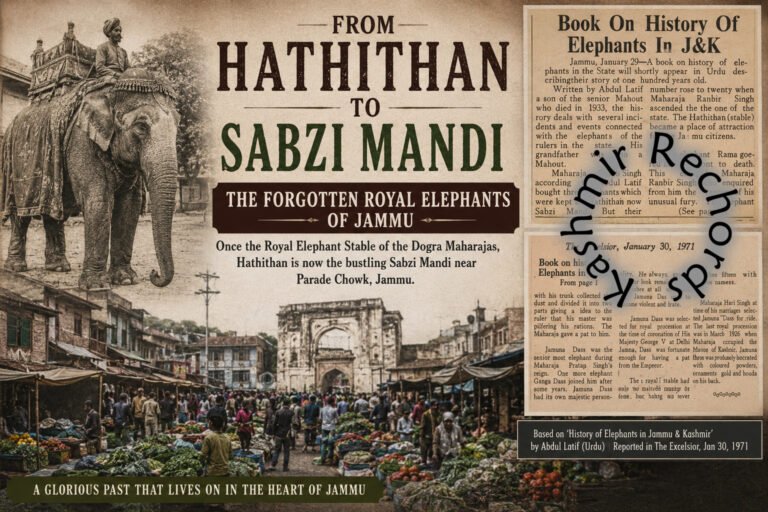
Today, thousands pass through the bustling Sabzi Mandi near Parade Chowk without realizing that the same ground once housed the magnificent Hathithan—the Royal Elephant Stable of the Dogra Maharajas. What survives today is merely a marketplace; what has disappeared is an extraordinary chapter of Jammu’s forgotten heritage.
Urdu Book That Preserved a Vanishing Legacy
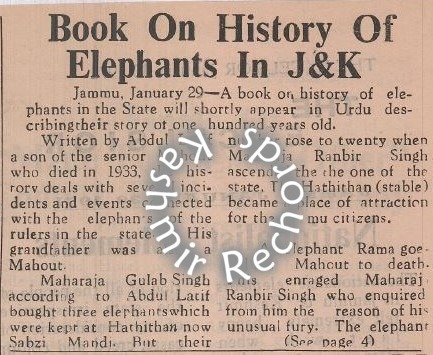
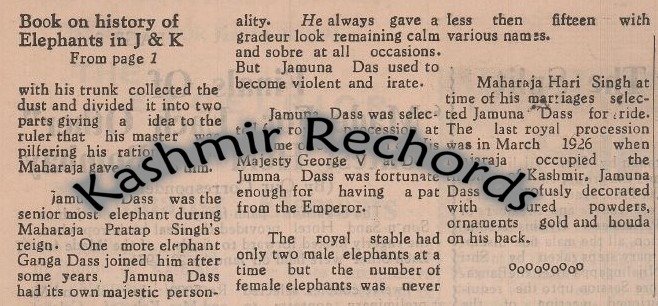
In January 1971, The Excelsiorreported the publication of an unusual Urdu book titled `History of Elephants in Jammu & Kashmir‘, written by Abdul Latif, whose family had served the Dogra rulers for generations. Kashmir Rechords is reproducing the preserved relevant newsclippings for the benefit of esteemed readers.
According to the contents of the newsitem, Latif was not merely narrating history. He was preserving memories inherited from his father and grandfather—both senior Mahouts (elephant keepers) attached to the royal establishment. His work therefore carries the rare authenticity of an eyewitness tradition handed down within the royal stables themselves.
From Hathithan to Sabzi Mandi: The forgotten story of Jammu’s Royal Elephant Stable preserved in Abdul Latif’s rare Urdu book published in 1971.
When Maharaja Gulab Singh Brought Three Royal Elephants
The story begins in 1846, when Maharaja Gulab Singh established the princely State of Jammu and Kashmir.
According to Abdul Latif, the Maharaja brought three elephants into Jammu shortly after founding the State. These majestic animals were housed at Hathithan, strategically located barely a kilometre from the royal Mubarak Mandi Palace.
As successive rulers expanded the royal establishment, the elephant population steadily increased.
By the time Maharaja Ranbir Singh ascended the throne, the number had risen to nearly twenty elephants, reflecting both the prestige and ceremonial grandeur of the Dogra court.
Hathithan: The Stable That Became a Marketplace
Few places in Jammu have undergone such a remarkable transformation. Hathithan was once a sprawling elephant camp where the royal animals lived, trained and prepared for ceremonial occasions. Massive banyan trees provided shade, while experienced Mahouts looked after the prized animals. Today the same site is one of Jammu’s busiest vegetable markets.
According to noted journalist Shiv Chander Sharma, remnants of the original Hathi Khana—including side gates of the old enclosure—still survive, though they are largely overlooked by people who visit the area only to buy vegetables.
Drawing upon Abdul Latif’s rare Urdu work published in 1971, this article revives a forgotten chapter of Jammu’s royal heritage.
Rama: The Elephant That Solved His Own Murder Mystery
Among the most fascinating stories narrated by Abdul Latif is that of an elephant named Rama. In 1870, Rama suddenly killed his Mahout.The incident naturally enraged Maharaja Ranbir Singh, who personally visited the elephant to understand the cause behind the unexpected violence.
What followed sounds almost unbelievable! Instead of attacking the ruler, Rama quietly used his trunk to gather dust from the ground and divide it into two separate heaps.
The Maharaja interpreted this unusual gesture after listening to the Mahouts’ explanation.
The elephant, they believed, was indicating that his keeper had been stealing a portion of the animal’s daily ration.
Rather than acting out of blind rage, Rama’s violence was seen as the tragic consequence of prolonged neglect and mistreatment.
Whether literally true or embellished through oral tradition, the story reflects the remarkable intelligence long attributed to elephants and the close emotional bond between these animals and their keepers.
Jamuna Dass: The Gentle Giant of the Dogra Court
If Rama became famous for his fury, Jamuna Dass became legendary for his dignity. During the reign of Maharaja Pratap Singh (1885–1925), Jamuna Dass was regarded as the senior-most royal elephant.
Abdul Latif in his book describes him as majestic, calm and exceptionally graceful. His imposing appearance itself enhanced the splendour of royal ceremonies. Later another elephant, Ganga Dass, joined the royal stable, but Jamuna Dass remained the pride of the establishment.
The Elephant Chosen by a Maharaja
Perhaps no elephant in Jammu’s history enjoyed greater honour than Jamuna Dass. Whenever Maharaja Hari Singh celebrated his marriages, it was Jamuna Dass who was selected to carry the ruler in royal processions.
The elephant thus became an inseparable part of some of the most important ceremonial occasions of the Dogra dynasty.
The Last Royal Procession
History often ends quietly. The last great appearance of Jammu’s royal elephants came in March 1926, when Maharaja Hari Singh formally ascended the throne.
For the occasion, Jamuna Dass was transformed into a living symbol of royalty. His body was adorned with colourful powders, gold ornaments, and an elaborate howdah mounted on his back.
It was a spectacle that represented not merely the accession of a ruler, but the culmination of an entire royal tradition that had flourished for nearly eighty years. Soon afterwards, changing times gradually ended the ceremonial importance of elephants in the princely State.
More Female Elephants Than Males
An interesting detail recorded by Abdul Latif in his book reveals that the royal stables generally maintained only two male elephants, whereas the number of female elephants was rarely below fifteen.
This suggests that the elephant establishment was carefully managed, possibly with breeding, temperament and ceremonial requirements in mind—details that deserve deeper historical investigation.
A Heritage Buried Beneath Everyday Life
Today, the average visitor to Parade Chowk, Jammu is unlikely to imagine that beneath the crowded vegetable market once stood one of the most important royal elephant establishments in northern India.
The banyan tree, the forgotten gates, the memories preserved by Mahouts, and Abdul Latif’s remarkable Urdu book and the newspaper cuttings of January 1971 together remind us that history often survives not in monuments, but in overlooked corners of our cities.
Jammu’s Hathithan is one such place—a forgotten royal stable hidden in plain sight.
Call-to-Action
Do you have family memories or old photographs of historic Jammu locations? Share your stories in the comments below. You may also contact us at support@kashmir-rechords.com. We will publish your memorable stories to preserve our heritage.
Based on rare newspaper archives, Parliamentary records and contemporaneous reports.
History has an extraordinary way of resurfacing.Sometimes it emerges from forgotten government files. Sometimes from fading photographs. And sometimes, from yellowing newspaper pages that continue to ask uncomfortable questions long after the headlines have disappeared.
One such forgotten chapter lies buried in the archives of 1984, when Jammu & Kashmir witnessed one of the most sensational political controversies of its time—a controversy centred on the alleged links between the then Chief Minister Dr. Farooq Abdullah and leaders of the Kashmir Liberation Front (KLF), the organisation that later came to be widely known as the Jammu & Kashmir Liberation Front (JKLF) and was eventually banned in India under the Unlawful Activities (Prevention) Act.
What transformed those allegations into a national political storm was not an intelligence report, nor a judicial inquiry.It was the persistence of a newspaper.
For nearly five months, Kashmir Times, the then most read and trusted newspaper, pursued the story with uncommon determination. Beginning with a categorical denial by Dr. Farooq Abdullah that he had ever met Amanullah Khan, one of the principal leaders of the ‘Kashmir Liberation Front’, the newspaper responded with a succession of reports, rare photographs, published captions, and documentary references that it said contradicted the Chief Minister’s public stand.
Every denial was followed by another publication. Every explanation invited another question. Every photograph intensified the controversy.
Within weeks, what had begun as a newspaper investigation had travelled beyond the editorial pages of Jammu to the floor of the Indian Parliament, where members sought answers from the Union Government regarding the reports then circulating in the public domain.
More than four decades later, many of those very newspaper pages and photographs continue to survive in archives, private collections and research repositories.
For the first time, Kashmir Rechords reconstructs this extraordinary episode through the original reports that shaped one of the defining political controversies of 1984.
The Denial
The controversy began with an unequivocal public denial.
According to contemporaneous newspaper reports, Chief Minister Dr. Farooq Abdullah denied having ever met Amanullah Khan, described in the reports as the leader of the ‘Kashmir Liberation Front’.
Ordinarily, such a denial might have ended the matter.Instead, it became the beginning of one of the most remarkable investigative campaigns undertaken by a regional newspaper.
Rather than accepting the denial at face value, Kashmir Times turned to documentary material which it said had already appeared in newspapers published from Pakistan-occupied Kashmir.
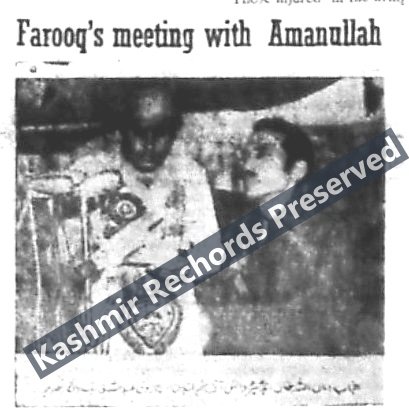
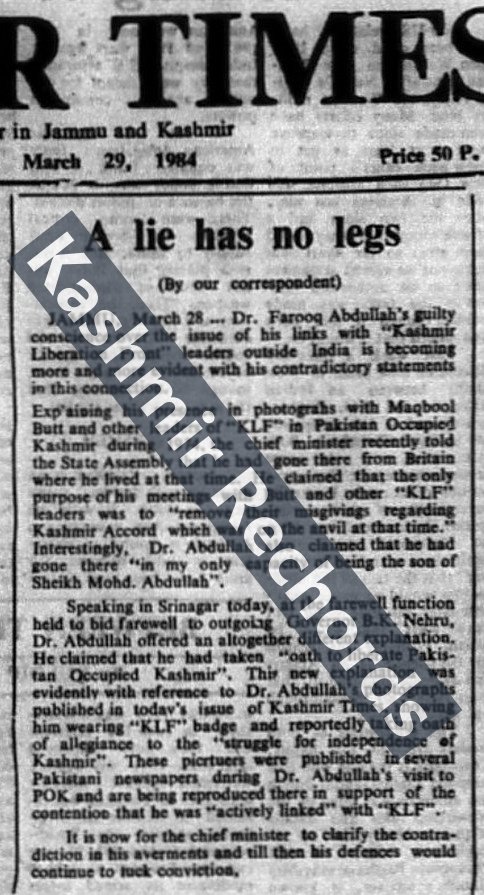
Kashmir Times, March 28, 1984.
The Photograph That Changed the Story
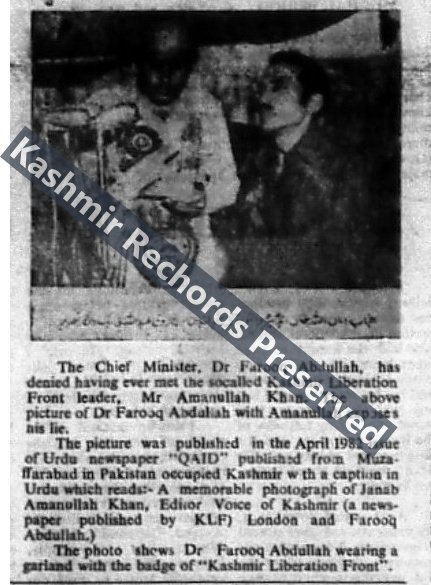
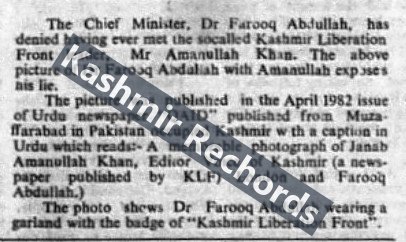
The newspaper’s first major report reproduced a photograph which, according to Kashmir Times, had originally appeared in the April 1982 issue of the Urdu newspaper Qaid, reportedly published from Muzaffarabad, Pakistan Occupied Kashmir.The accompanying report stated that the Urdu caption identified the image as “a memorable photograph” of Amanullah Khan, described as Editor of Voice of Kashmir.
A response from Kashmir Times to the denial of Farooq Abdullah
More significantly, the report asserted that the photograph showed Dr. Farooq Abdullah wearing a garland carrying the badge of the Kashmir Liberation Front.The newspaper argued that the photograph directly challenged the Chief Minister’s denial that he had ever met Amanullah Khan. For Kashmir Times, the story had only begun.
One Photograph Became Many
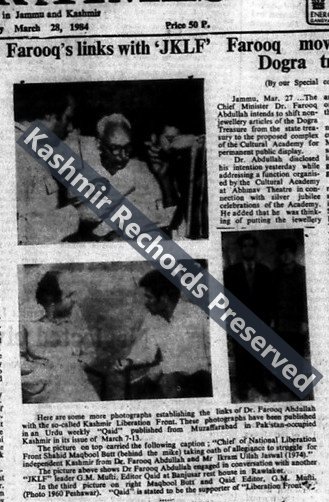
Far from retreating after publishing the first image, Kashmir Times continued its investigation. In subsequent editions, the newspaper reproduced additional photographs which it claimed had also appeared in publications from Pakistan-occupied Kashmir.
One report claimed that the photographs established what it described as Dr. Farooq Abdullah’s links with the ‘Kashmir Liberation Front’. The accompanying caption made even more serious assertions.
According to the report, one of the photographs showed Dr. Abdullah taking an oath of allegiance to the “struggle for independence of Kashmir” before leaders of the Kashmir Liberation Front during a visit to Pakistan-occupied Kashmir.
The report identified those present as including Amanullah Khan and G.M. Mir, identified as Editor of Qaid, which the report described as a supporter of the ‘Liberation Front’.
These were extraordinary claims, prominently published by the newspaper and presented as evidence that, according to Kashmir Times, contradicted the Chief Minister’s public denials.
The Controversy Deepens
As the reports multiplied, so did the political controversy.
Kashmir Times published another strongly worded report under the headline “A Lie Has No Legs,” arguing that the Chief Minister’s explanations regarding the photographs and his visit had changed over time.
Kashmir Times, March 29, 1984.
The newspaper juxtaposed those explanations with the documentary material it had reproduced, contending that the contradictions themselves had become a matter of public concern.
The controversy was no longer confined to newspaper columns.It had become a national political issue.
From the Newsroom to Parliament
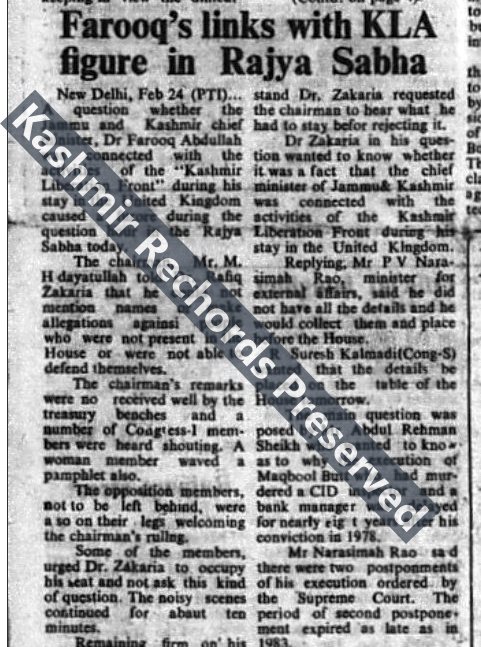
On 24 February 1984, the alleged Farooq Abdullah–KLF connection reached the Rajya Sabha.
Members questioned the Union Government regarding reports of Dr. Abdullah’s alleged contacts with leaders of the Kashmir Liberation Front during his stay in the United Kingdom.
A PTI report, carried by newspapers, regarding Farooq Abdullah’s alleged links with `JKLF’… February 24, 1984.
What had begun as a newspaper investigation had now entered the official proceedings of India’s Parliament.The issue was no longer merely political speculation.It had become a matter of national debate.
The Centre Enters the Picture
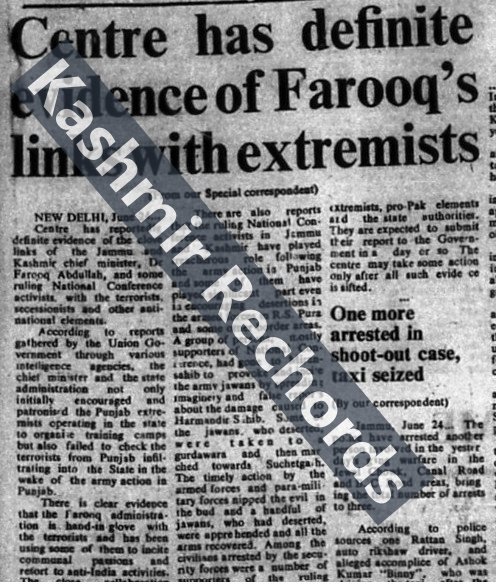
The controversy intensified further in June 1984.Reports quoting Central Government sources claimed that New Delhi possessed “definite evidence” relating to alleged links between Dr. Farooq Abdullah and extremist or pro-Pakistan elements.
Whether those claims were ultimately substantiated remains part of the larger historical debate. What is beyond dispute is that they reflected the rapidly deteriorating relationship between the Centre and the National Conference government in the months preceding the dramatic political developments of July 1984.
A Newspaper That Refused to Retreat
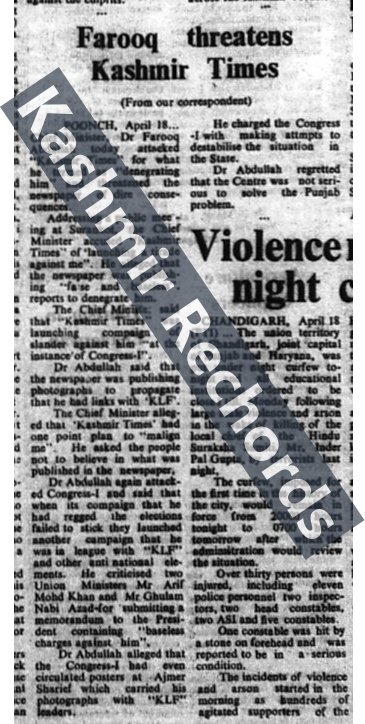
As pressure mounted, Dr. Farooq Abdullah accused Kashmir Times of conducting a campaign against him.The newspaper stood by its reports.
Maintaining that it was reproducing documentary material already available in published sources, it continued to publish further reports, photographs and questions relating to the controversy.
The confrontation became more than a dispute over photographs. It evolved into a defining contest between political authority and investigative journalism.
A Forgotten Chapter Revisited
Forty years later, the controversy has largely disappeared from public memory. The newspaper pages have yellowed. Many of the photographs survive only in fragile archives. Yet they continue to exist. They remain part of the documentary record of one of the most fiercely contested political episodes in the history of Jammu & Kashmir.
Whether one agrees with the conclusions drawn at the time or not, the reports, photographs, Parliamentary proceedings and official responses together form an important archival trail that deserves careful historical examination.
That is precisely what this Kashmir Rechords investigation sets out to do.
The Investigation Continues…
This is only the opening chapter of a comprehensive archival investigation.The complete dossier includes:
The original Kashmir Timesreports published between February and June 1984.
Rare photographs reproduced during the controversy.
The complete chronology of the alleged Farooq Abdullah–KLF/JKLF controversy.
The original Qaid references and published captions.
The Rajya Sabha proceedings and Parliamentary questions.
The Centre’s “definite evidence” claim in context.
The political fallout that culminated in the events of July 1984.
High-resolution reproductions of rare newspaper pages with detailed historical analysis.
Support History. Preserve Archives
Investigations like these require months of locating forgotten newspapers, preserving fragile archives, verifying sources and reconstructing historical events from original documents.
Kashmir Rechords Foundation is committed to preserving this documentary heritage for future generations.If you value serious archival research—grounded in original sources rather than AI-generated narratives—and wish to support investigations that uncover forgotten histories, please consider making a contribution.Your support helps preserve history that might otherwise be lost forever. Contributors will receive access to the complete archival investigation, including all chapters, rare photographs and high-resolution newspaper reproductions.
If you found this investigation valuable, please consider making a contribution. Every contribution, no matter how small, helps preserve history for future generations. You may use our QR Code for the smallest contribution, you would like to make:
EDITORIAL DISCLAIMER
This investigation is an archival reconstruction based on contemporaneous newspaper reports, published photographs, Parliamentary proceedings and other historical records available in the public domain.
Kashmir Rechords reproduces and analyses these materials solely for historical, journalistic, educational and research purposes.
The reports, captions, photographs, statements and allegations discussed herein are presented as they were reported or published at the relevant time in 1984 and should be understood in their historical context. Their inclusion in this investigation should not be construed as an endorsement, verification or independent confirmation of every allegation or claim contained in those contemporaneous sources.This report seeks to document and preserve an important chapter of Jammu & Kashmir’s political history rather than to pronounce upon legal liability or historical guilt.
All original research, compilation, chronology, annotations, editorial analysis, layouts and presentation are the intellectual property of Kashmir Rechords Foundation. Original newspaper pages remain subject to the rights, if any, of their respective publishers and are reproduced, as preserved, only for purposes of historical documentation, research, commentary and public interest in accordance with applicable law.
Unauthorized commercial reproduction of Kashmir Rechords’ original research, annotations, compilations and editorial work is prohibited without prior written permission.
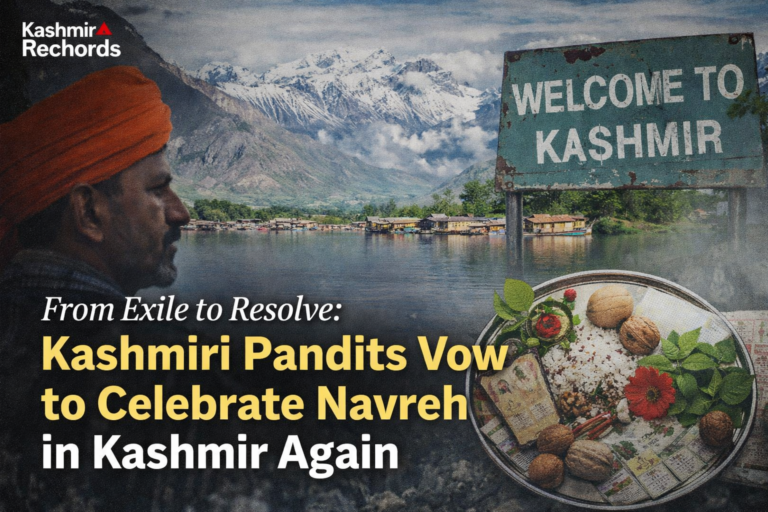
In a stirring reaffirmation of identity, memory and belonging, Kashmiri Pandits across India and the global diaspora have renewed a collective pledge—to return to their roots and celebrate Navreh, the Kashmiri New Year, in Kashmir itself from the coming year onward.
This is not merely a declaration. It is a civilisational assertion shaped by decades of displacement, a promise carried silently across years of exile, now finding voice with renewed conviction.
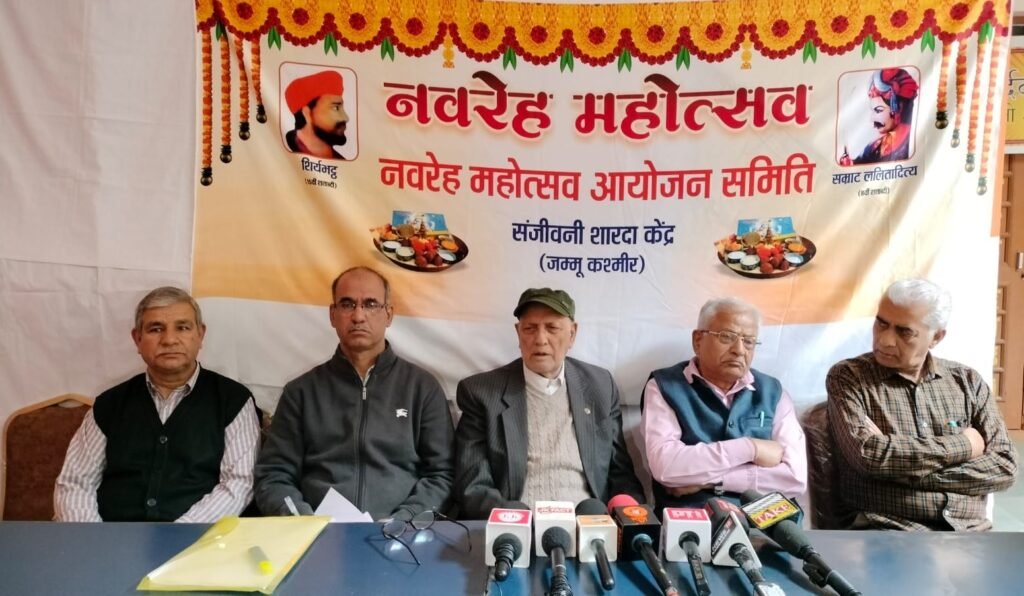
Addressing the media in Jammu on March 18, Convenor Padma Shri Dr. Kashi Nath Pandita described the Navreh Mahotsav as a “poignant homecoming movement”—one that transcends geography. He emphasized that the celebrations will unfold not only in Jammu but across cities in India and beyond, reflecting the shared heartbeat of a scattered yet spiritually anchored community.
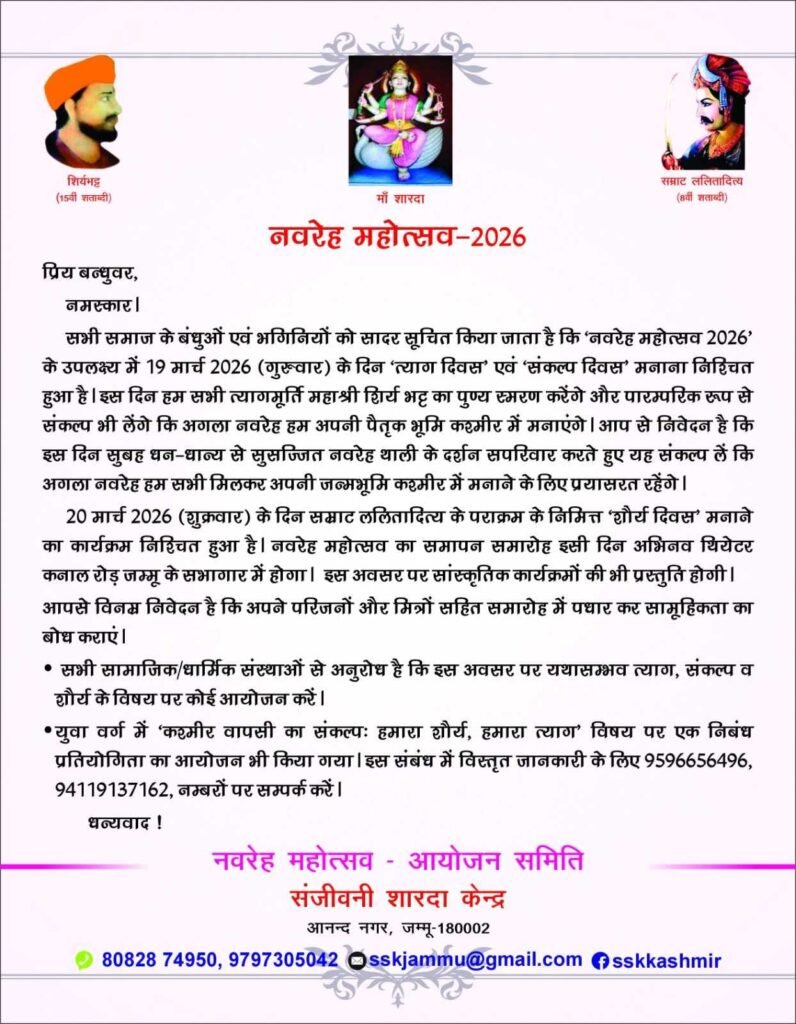
“Navreh is not just the beginning of a calendar year,” Dr. Pandita noted, “it is an awakening—astronomical, cultural and deeply personal.” The festival begins with the sacred ritual of Navreh Thali darshan, symbolising prosperity, knowledge and continuity—values that have endured even in exile.
Kashmiri Pandit leaders during Navreh Mahotsav -2026 press conference at Jammu on March 18, 2026
Yet, this year’s Navreh carries a deeper undertone.
It is a pledge.A pledge that next Navreh will not be marked in displacement, but celebrated on the soil that gave birth to it—Kashmir.
The second day, March 20, will be observed as Shaurya Divas (Vijay Divas), commemorating the unmatched valour and visionary legacy of Samrat Lalitaditya, the 8th-century emperor whose reign symbolised strength, protection and civilisational pride. The day will culminate in a grand closing ceremony at Abhinav Theatre, Jammu, featuring cultural performances, intellectual discourses and tributes to the icons who define Kashmir’s timeless spirit.
Co-Convenor, Padma Shri Brij Lal Bhat underscored the urgency of reclaiming historical consciousness. He called for the inclusion of Acharya Shreya Bhat’s scholarship and Lalitaditya’s legacy in the academic curriculum of JKBOSE, asserting:
“This is our clarion call—to inscribe these icons into the consciousness of future generations.”
Echoing this sentiment, Co-Convenor Piyaray Lal Bhat urged the community to bridge its glorious past with a determined future, inviting every Kashmiri Pandit to reconnect with their sacred homeland—not as a memory, but as a lived reality.
Earlier, at the press conference, Dr. M. K. Bhat, Chairman of Sanjeevani Sharda Kendra (SSK) and Chief Spokesperson of the Navreh Mahotsav Aayojan Samiti–2026, outlined the vision behind the two-day programme. He highlighted that the Samiti—formed in collaboration with multiple socio-cultural organisations—has, since 2021, transformed Navreh Mahotsav into a growing collective movement.
“What began as a cultural observance,” Dr. Bhat noted, “has evolved into a shared resolve—urging Kashmiri Pandits everywhere to celebrate these defining days collectively, wherever they are, while keeping their gaze firmly fixed on Kashmir.”
Now in its sixth edition, Navreh Mahotsav stands not just as a festival—but as a bridge between memory and return, between exile and belonging.
And this year, above all, it stands as a solemn, unambiguous pledge:
That the next Navreh will not be celebrated away from home—but in Kashmir itself.
In a historic and emotional move, Jammu and Kashmir Government has begun issuing Domicile Certificates to the survivors of the 1947 Muzaffarabad and Mirpur massacres. This bold initiative transcends legal formality—it symbolizes justice, reclamation, and a vital step towards integrating all parts of Jammu and Kashmir under India’s control. The issuance of these certificates not only acknowledges the suffering of the survivors but also underscores the government’s determination to reunify the region, long divided by conflict and external occupation.
Bold & Clear: R/o Kotli, Muzaffarabad, Jammu and Kashmir
A Century-Long Journey of Identity and Survival
For the people of Jammu, Kashmir and Ladakh, the journey from the status of State Subject to Permanent Resident and now to Domicile, has been an odyssey spanning nearly a century. It captures the resilience of these communities, transitioning from the British Raj to post-Independence India, and now to Bharat. This latest development is particularly meaningful for the descendants of massacre survivors, whose ancestral homes lie in what is now Pakistan-occupied Kashmir (PoK). For them, the Domicile Certificate is more than a legal document—it is a powerful recognition of their rightful place in modern India.
Recognition of Historical Roots and Suffering
In 2020, the Union Territory (UT) of Jammu and Kashmir issued administrative orders replacing the old State Subject with the new Domicile Certificates, signifying a major shift in the legal recognition of its residents. While the new rules extend eligibility to various categories of individuals—such as those who have served or studied in Jammu and Kashmir—the most profound aspect of this move is its recognition of the survivors of the Mirpur and Muzaffarabadmassacres.
J&K Domicile Certificates to Muzaffarabad Massacre Survivors and their decedents
For the first time, these survivors and their descendants, who lost their ancestral homes during the 1947 invasion, are now officially recognized as domiciles of Jammu and Kashmir. To ensure that more bonafide migrants can reclaim their status, the government in October 2024 had extended the deadline for obtaining Domicile Certificates to May 15, 2025.
Symbolism of the New Certificates
The Domicile Certificates issued to massacre survivors prominently feature the names of their ancestral villages in Muzaffarabad and Mirpur. This is more than symbolic; it reflects the government’s commitment to reclaiming PoK and reintegrating it with India. These certificates, issued under the authority of the J&K Relief and Rehabilitation Commissioner (Migrant), send a clear message: these lands are still an integral part of India.
We, the descendants of Muzaffarabad Massacre Survivors
Political Shift After the Abrogation of Articles 370 and 35A
The political landscape of Jammu and Kashmir changed dramatically after the abrogation of Articles 370 and 35A in August 2019, enabling the central government to fully integrate the region with the rest of India. This has paved the way for decisive actions like the issuance of Domicile Certificates to the survivors of the 1947 Muzaffarabad massacres. The move also aligns with India’s broader strategy to reclaim territories illegally occupied by Pakistan, as enshrined in the Parliament’s 1994 resolution.
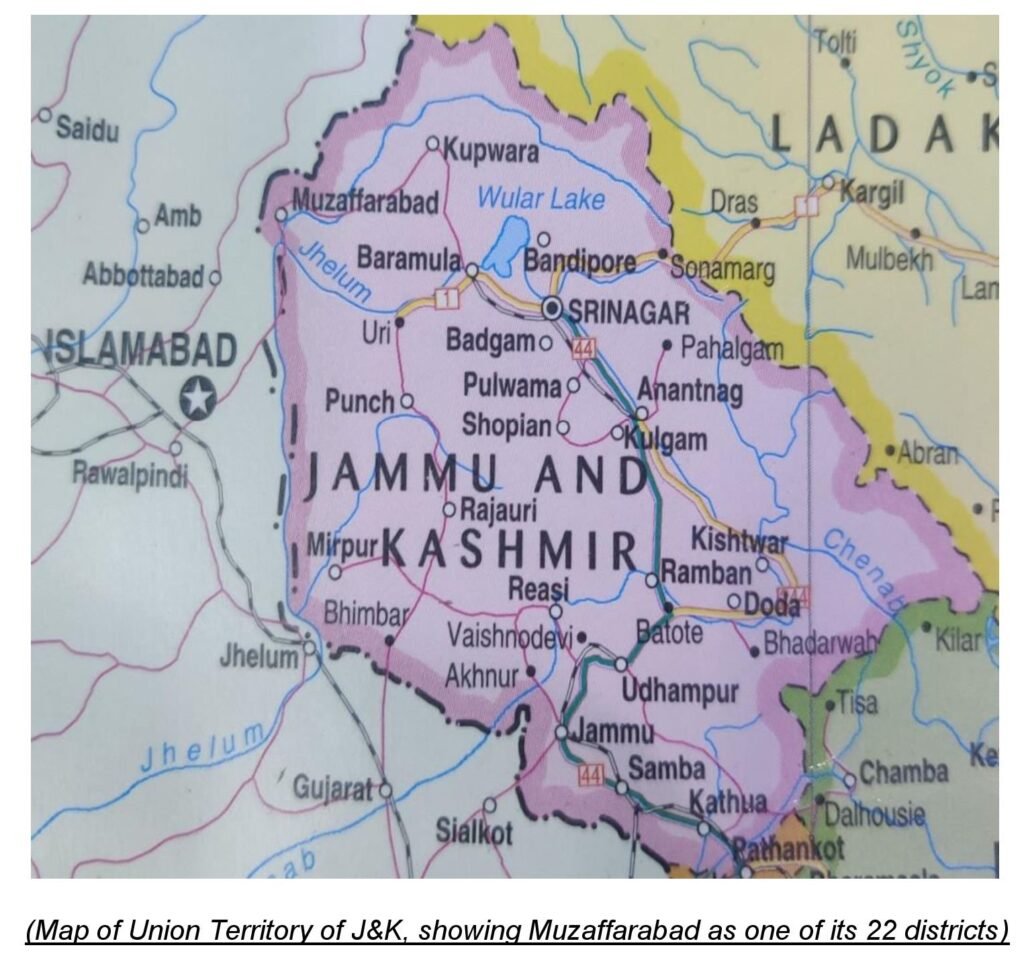
Following this, the Survey General of India released a new political map in 2019, including Muzaffarabad and Mirpur as districts of the Union Territory of Jammu and Kashmir, further asserting that these regions remain part of India.
Reclaiming Lost Territory, Sending a Bold Message
The fall of Muzaffarabad to Pashtun tribes backed by Pakistan on October 22, 1947, marked the beginning of a dark period in Jammu and Kashmir’s history. Thousands were massacred, and survivors were forced to flee, leaving behind homes that they never saw again. Now, with the issuance of Domicile Certificates to their descendants, the Indian government is righting the wrongs of the past. The recognition of these survivors is not only a legal gesture but a bold statement of India’s intent to reunify Jammu and Kashmir.
This move strengthens India’s legal and moral claim to the region while eroding Pakistan’s narrative. By officially recognizing the residents of Muzaffarabad, the government is demonstrating an unwavering commitment to reclaiming Pakistan-occupied Kashmir (PoK).
A Symbol of Justice for Survivors
For the survivors of the massacres and their descendants, these certificates are more than just legal documentation. They are a symbol of justice and recognition, acknowledging their lost homes and heritage. Decades after the tragic events of 1947, the Indian government is addressing their plight, ensuring their ancestral roots are acknowledged and their rights restored.
The 1994 resolution passed by the Indian Parliament clearly calls for Pakistan to vacate the occupied territories. By issuing Domicile Certificates and redrawing the political map without LoC and to include Muzaffarabad and Mirpur in the UT of J&K, the government is making a strong push to achieve this goal.
A Strategic Masterstroke in Geopolitics
In the broader context of international geopolitics, this move sends a powerful message to Pakistan and the global community. It reaffirms India’s stance on PoK and highlights its commitment to reclaiming and integrating all parts of Jammu and Kashmir. By acknowledging the ancestral roots of the massacre survivors, the government is addressing a long-standing historical injustice while making a strategic move to unsettle Pakistan. This calculated masterstroke bolsters pro-India sentiments within PoK and reinforces India’s rightful claim to the region.
* Dr.Rajesh Bhat is a Kashmir-born Journalist, Writer and Researcher, formerly associated with Daily Excelsior, Jammu and The Tribune, Chandigarh. He is the Author of Radio Kashmir in Times of Peace & War.
It sounds incredible but it is a fact that Lanka exists in Kashmir! Situated on the Eastern side of the sprawling Wular Lake, the major portion of this Lanka ( island) is presently submerged in water.
A tip of this Lanka, which is presently seen above water, is now known by the name Zain-Lank, for the reason that Sultan Zain-ul-Abidin is believed to have constructed a mosque near the ruins of a Temple which earlier existed on the island ( then called Sona Lank) but was dismantled by Sikander, the iconoclast.
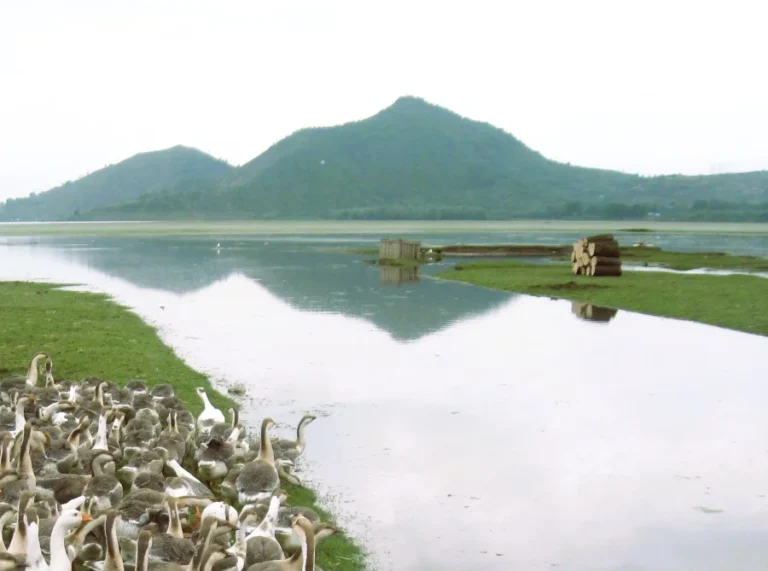
Temple Ruins at Zain Lank, Wular Lake, Kashmir
Unfortunately,hardly any voice has been raised over this very unknown Temple lying in ruins/submerged on this Island (Lanka), in Wular Lake which is connected through Bandipora and Sopore, the two major Towns of North Kashmir.
Zain Lanka on Temple Debris?
According to J&K’s renowned writer, Jyoteeshwar Pathak, the Zeen Lenkh (Zain Lanka) does not find any mention in the Kalhana’s Rajatarangini. In his write-up published in `Kashmir Today’ Magazine ( April-May, 1994) and while quoting Moti Lal Saqi’s Book “Aager Neb’’, mentions that there was no existence of the island before the 12th century AD, but the same was raised in Wular lake with debris of several dismantled temples which used to be in the vicinity of villages around Wular Lake.
Charles Ellison Bate’s Gazetteer of Kashmir provides similar description stating that during the rule of Zain-ul-Abidin (1420-70) the remains of the temples dismantled by Sikander, the iconoclast were thrown into the Lake where an island was developed and given the name Lanka. Historian Anand Koul Bamzai writes that the Island is no other than Sona-Lankh (the golden island), now called Zain Lank.
Jonaraja, the poet laureate in the court of Zain-ul-Abidin provides a significant evidence about this island. According to him, the surroundings around Wular Lake during 9th Century used to present a unique example of archaeology. The stone laden boats were sailed into Mahapadmasar, (the Wular) and the land thus developed was named as Lenkh (Lanka or Island). A royal palace was built in the lake under the supervision of Engineer Suyya, the 9th century engineer who is identified with Suyyapur (Present-day Sopore), Kashmir.
However, Jyoteeshwar Pathak says that an inscription in the Sri Pratap Singh Museum, Srinagar provides an insight in the existence of this island. This inscription refers to the island as the Zain Lank ( Island).
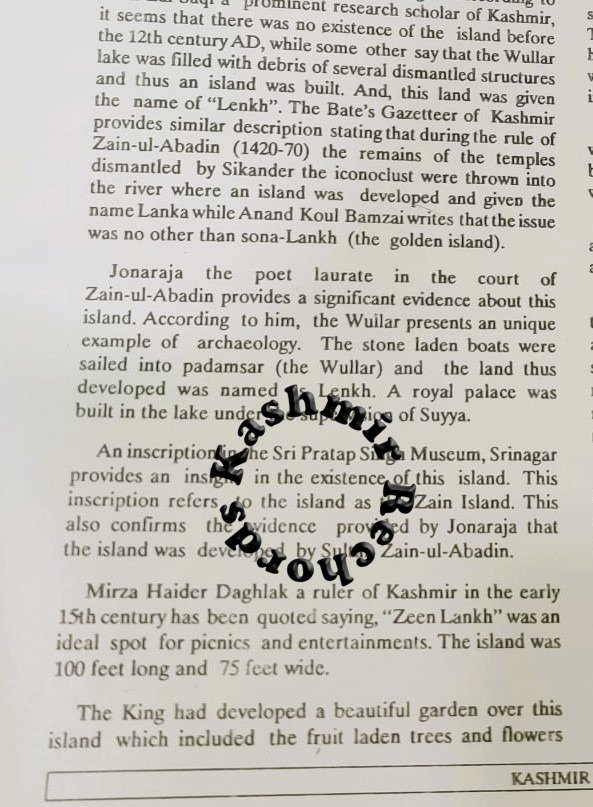
A Page from Kashmir Today ( 1994)– A Publication of Directorate of Department of Information, J&K Government.
Mirza Haider Daghlak, a ruler of Kashmir in the early 15th century has been quoted saying, “Zeen Lankh” was an ideal spot for picnics and entertainments. The island was 100 feet long and 75 feet wide. The King had developed a beautiful garden over this island, which included the fruit laden trees and flowers of several kinds. There was a three storey building on the northern side and a beautiful mosque.
Travellers to Kashmir’s Lanka
François Bernier (1673) in his travelogue provides a detail of the ‘Zain Lankh’. According to him, there was a small hut in the middle of the lake with a small garden adjoining it.
This quadrangle island has perhaps vanished by the time William Moorcroft (1767 – 27 August 1825) visited the site. According to him, the circumference of the island was 300 yard. The structure expected in the island was definitely related to the Indian architectures. These structures are now in a dilapidated stage. He found neither any inscription nor any idol there. The temple pillars were, however, found in the scattered state. There was, however, a quadrangle building on the left side. There were some hutments over the island, which were inhabited by entirely poor people.
Baron Charles Hügel, who visited this site in 1835 AD, writes: “There is a small island near the banks called Lanka. Several experiments on astrology were performed there”. According to him, the mosque built by Hassan Khan and the palaces built by Zain-ul-Abidin are particularly attractive.
Sir Richard Temple visited the place in 1859. According to him, the Lanka is quite an attractive place. The whole of area is full of mud and marsh and it has lost beauty due to submergence in water. The architecture of the temple resembles the ancient temple architecture. These are the remains of mosque built by Sultan Zain-ul-Abidin where the king used to worship in the month of Ramadan.
Present Day Lanka
The island is definitely in a dilapidated condition and requires an urgent attention. There are reports of having thrown the ruins of temple into water in order to pave the way for the construction of a new mosque there. However, some old temple structures and boulders still exist. The Island is an ideal place for the Department of State Archaeology and Archaeological Survey of India (ASI) to help them in waking up from the deep slumber. J&K Government can develop it as a Tourist Spot, while Historians can further dig the debris on which the island lies.
For locals, especially for fishermen, the Island was and is still a safe and protected place whenever anything untoward or unfortunate happens in the Lake area. They protect themselves during storms and high speed winds. They believe that even if the water level rises in the Wular, the island remains afloat.
Kashmiri Pandits have suffered a lot at the hands of tyrants! Even Nature has been cruel towards them!. This is evident from that fact that over 9,000 Kashmiri Pandits, including children and women, had perished on their way to Harmukh Ganga pilgrimage, over 500 years ago in 1516 AD! Harmukh, originally “Haramukuta” is a mountain with a peak elevation of 5,142 metres (16,870 ft), in the present Ganderbal district of Jammu and Kashmir.
There is a mention of this tragic incident in many books and records, but unfortunately, most people are unaware of this catastrophe that had befallen on Kashmiri Pandits!
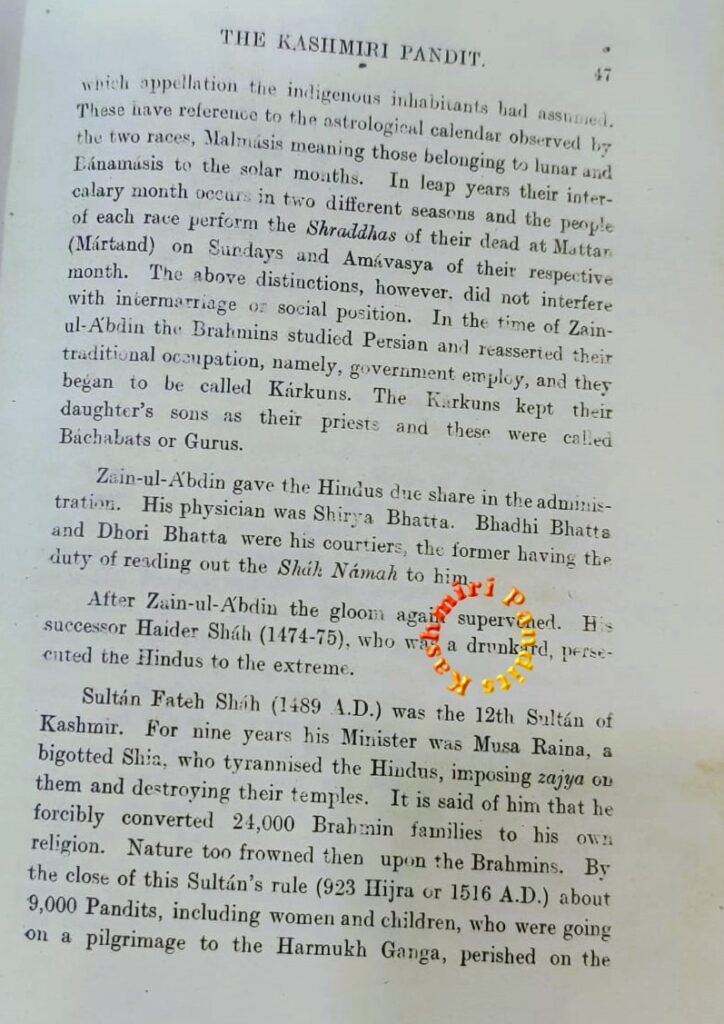
Pandit Anand Koul in his 100 year old book “The Kashmiri Pandit’’ (1924) makes a mention of this tragic incident. The incident had taken place during the reign of Sultan Fateh Shah (1489 A.D.), the 12th Sultan of Kashmir. For nine years, his Minister was Musa Raina, a bigoted Shia, who had tyrannised Hindus, imposing jaziya on them and destroying their temples.
A Double Whammy for Kashmiri Pandits
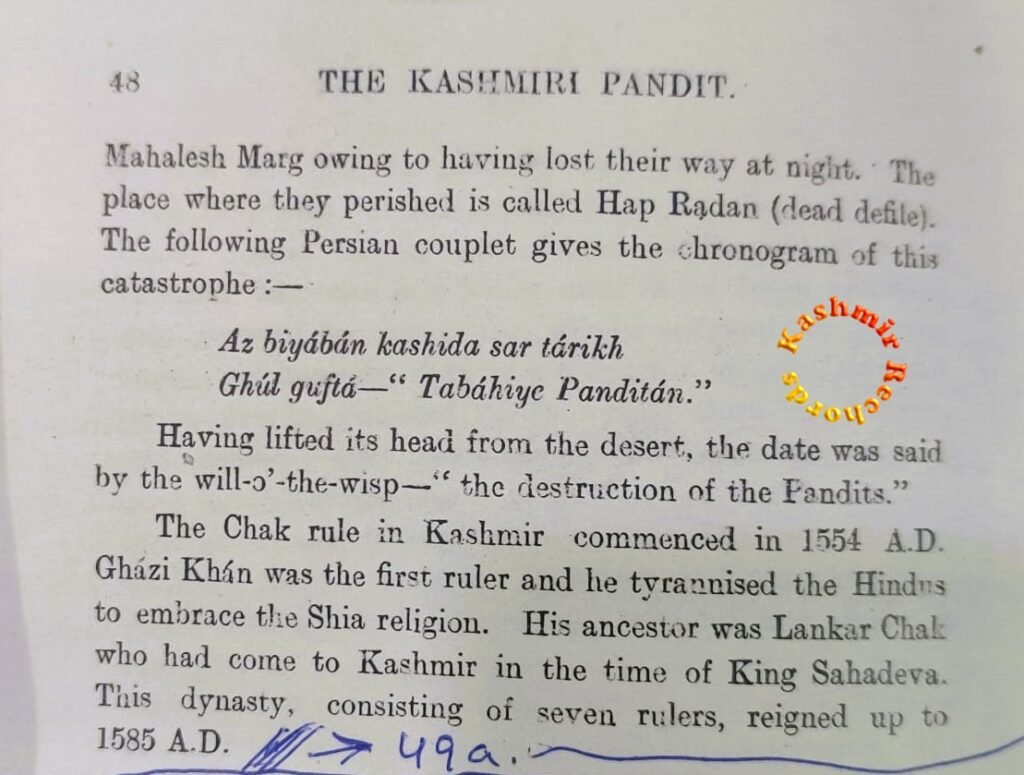
It is said of Musa Raina that he had forcibly converted 24,000 Brahmin families to his own religion. In 1516 AD, about 10,000 Kashmiri Pandits had decided to undertake a pilgrimage to Harmukh Ganga, in order to immerse the ashes of those 800 Hindus who had been massacred during Ashura. However, Nature too resorted to a double whammy when Pandits on a pilgrimage to the Harmukh Ganga, perished at Mahalesh Marg owing to having lost their way at night. According to Anand Koul, the place where they perished is called Hap Radan (dead defile).
Anand Koul quotes the following Persian couplet that gives the chronogram of this catastrophe:-
Az biyábán kashida sar tarikh Ghút guftá “Tabáhiye Panditán.”
—-Meaning “having lifted its head from the desert, the date was said by the will-o’-the-wisp— “the destruction of the Pandits’’.
Poet-historian Suka Pandit too says about this cataclysm. “Ganga was oppressed with hunger, as it was after a long time that she had devoured bones; she surely devoured the men also who carried the bones.” It was in fact after a gap of so many years that Pandits were allowed to go on a pilgrimage to Harmukh Lake, which, however, ended in the most devastating tragedy. Suka Pandit was a Kashmiri poet and historian who wrote Rajatarangini between 1517 and 1596. A student of Prajyabhatta, the work of Suka Pandit is considered a supplement to Kalhana’s Rajatarangini.
Dr Satish Ganjoo, a noted Historian and a Senior Faculty at Central University of Himachal Pradesh, in his research paper “ A Political Study of Ancient Vedic-Saraswat Kashmiri Pandit Society’’, published in June, 2017, also makes a mention of this natural catastrophe that had befallen Kashmiri Pandits over 500 years ago. However, while Pt Anand Koul mentions 1516 AD (923 Hijra) as the year of tragedy, Dr Ganjoo quoted the year of tragedy as 1519.
The Dreaded Tyrant Soma Chandra ( Musa Raina)
The tragedy at Harmukh Lake had occurred as the Kashmiri Pandits who were allowed to perform this pilgrimage after a long time, wanted to perform the religious rites of all those near and dear ones who had been killed during the era of Mir Shamas-ud-Din Iraqi, the founder of Nurbakhshiyyeh Order (Shia sect) who had visited Kashmir Valley twice in 1477 AD and 1496 AD for propagating his faith. He was helped in his “mission’’ by Soma Chandra, the most dreaded tyrant, who had rechristened himself as Malik Musa Raina after converting to Shia Islam.
Not only were the vulnerable Brahmans, even the Sunni Muslims also violently converted to Shia sect by murderous techniques. This dogmatic fanaticism had even crippled the Sunni ruler of Kashmir, Fateh Shah (AD 1510-1517). A khanqah was built at Zadibal, Srinagar by Iraqi, which became the nucleus of Shia concentration.
Burning Sacred Threads of Pandits
In his Book, “ This Beautiful India –Jammu and Kashmir” ( 1977), Dr Sukhdev Singh Chib mentions that Iraqi had even issued orders that everyday about 1500 to 2000 Brahmans be brought to his doorsteps, remove their sacred threads, administer Kalima to them, circumcise them and make them eat beef. These decrees were ferociously and brutally carried out. The Hindu religious scriptures from 7th century AD onwards and about 18 magnificent temples were destroyed, property confiscated and women abused. Thousands of Brahmans had killed themselves to evade this horrific barbarism and thousands migrated to other places, resulting in their third tragic mass exodus from the Valley. Those who stayed behind were not only forced to pay jaziya, but their noses and ears were chopped off.
According to Baharistan – i -Shahi, “Dulucha, a Tartar chief from Central Asia, who had invaded Kashmir with 60,000 strong horsemen, had also inflicted terrible miseries upon the people including the Brahmans.
According to W.R. Lawrence, Brahmans of Kashmir were during those days given three choices—death, conversion or exile. “Many fled, many were converted and many were killed, and it is said that this thorough monarch (Sikandar) burnt seven maunds of sacred threads of the murdered Brahmans”. As for the statement of Lawrence, six maunds of sacred threads of converts and seven maunds of murdered Pandits were burnt. The number of people, to whom these thirteen maunds of sacred threads belonged, might have been tremendously colossal. A mammoth number of the Pandits also went into exile, causing the first disastrous mass exodus of the community. Not only Sikandar- the Butshikan, but Suha Bhatta – the convert, also was responsible for this barbarous, murderous and cruel approach towards Kashmiri Pandits.
The brutal religious persecution of the Kashmiri Pandits has been borne testimony to by almost all the Muslim historians. Hassan, Fauq and Nizam–ud–Din have condemned these excesses in unscathing terms. It was the reign of terror and homicide. Even then, they did not forget their past and rich tradition. As the custodians of their extraordinary cultural heritage, they wrote the illuminating treatises on the stupendous Kashmir Shaivism, colossal literature, splendid art, marvellous music, grammar and medicine.
A recent find by Kashmir Rechords—a rare Urdu directory of Kashmiri Pandits from 1924-1934—has uncovered a forgotten chapter of history, revealing the existence of a “Fire Temple” dedicated to Swami Dhooni Sahib near Gujrat, Pakistan. Built by the Kashmiri Pandit community in Qilladar (Killadar) around 1884, this temple and adjacent school embody their devotion, cultural resilience, and educational values.
(By:Dr.Rajesh Bhat)*
The recent discovery of a rare Urdu directory of Kashmiri Pandits from British India, dated between 1924 and 1934, has revealed a hidden chapter of history, bringing to light an extraordinary story of cultural resilience and devotion. This directory not only showcases the lives of Kashmiri Pandits across British India but also unveils the existence of a unique Temple, built in memory of the revered mystic Swami Dhooni Sahib. This structure stands as a symbol of the community’s enduring spirit and reverence, located near Gujrat city in what is now Pakistan.
Historical Significance of the Dhooni Temple
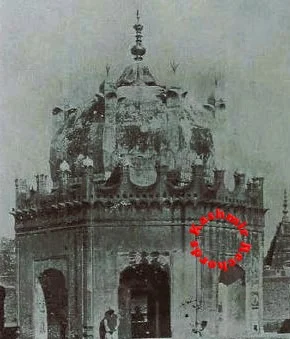
The Dhooni Sahib Temple, or what they now call, “Fire Temple,” is believed to have been constructed around 1884 in the town of Qilladar (also known as Killadar) in Gujrat, Punjab, Pakistan. Adjacent to this sacred structure, the Kashmiri Pandit community also built a school and an inn for travellers—a testament to their commitment to education and hospitality. The temple’s location and purpose hold unique cultural importance, as it was built on a site with natural flames emerging from the earth, which possibly drew mystics like Swami Dhooni Sahib for worship.
In addition to its religious significance, the site highlights the cohesive nature of the Kashmiri Pandit community in preserving their heritage. Despite being scattered across British India, these families maintained strong ties to their roots, even constructing a temple and school far from their homeland to honor their values and spiritual mentors.
Qilladar: A Hub of Heritage and Influence
Qilladar, a town in Gujrat District near the Upper Jhelum Canal, became a cultural and spiritual centre for the Kashmiri Pandits in British India. Its strategic location—close to major cities like Amritsar, Lahore, Sialkot and Jammu—made it a meeting point for communities and travellers alike. The town was historically significant as some of the decedents of Dewan Dena Nath, a prominent Kashmiri Pandit figure in the Sikh Empire’s durbar, continued his legacy of community building by constructing the Fire Temple in Dhooni Sahib’s honor.
Under the governance of Sir Charles Umpherston Aitchinson, then Lt. Governor of Punjab, the Kashmiri Pandit community received support to build the temple. Dewan Dena Nath’s family lineage and the Madan clan, notable Kashmiri Pandits in the region, were instrumental in maintaining the temple and the school complex, which fostered learning and faith for future generations.
Legends and Myths of the `Fire’ Temple
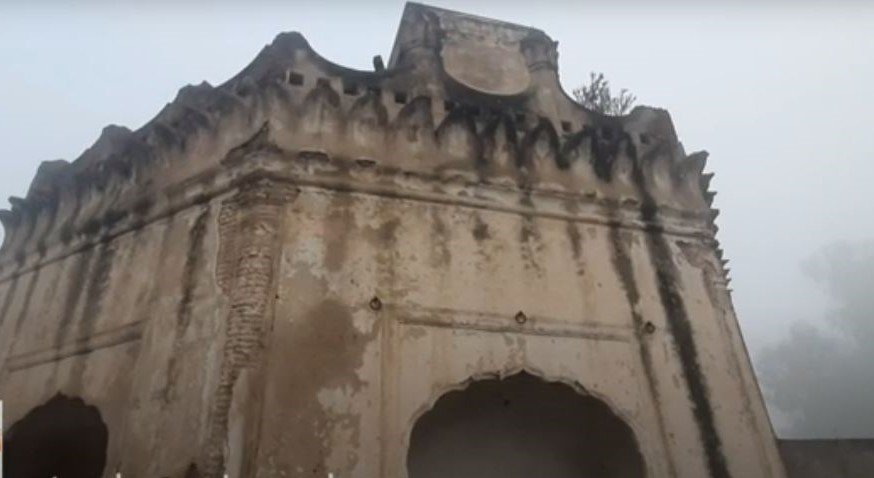
The Dhooni Temple, according to local traditions, is said to be rooted in mystical significance. Stories speak of a perpetual flame emerging naturally from the earth, which may have inspired Dhooni Sahib and other mystics to consider it a sacred site. Sadly, this remarkable heritage site now suffers from encroachment and deterioration, with remnants barely hinting at its former grandeur.
Today, videos and photos of the temple(s) circulated by local Pakistani content creators have sparked interest, though limited historical knowledge has left gaps in understanding the temple’s origin. Misinterpretations have even led to speculation that it might be a Sun Temple, as the word “Dhooni” relates to fire in Hindi. This post of Kashmir Rechords thus aims to dispel these myths by bringing clarity to the temple’s history and role in the Kashmiri Pandit tradition.
Legacy in Peril: The Struggle to Preserve a Heritage Site
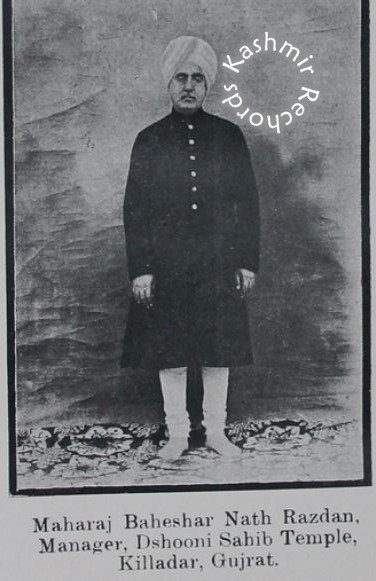
The once-vibrant structures of the Dhooni Sahib Temple and the school complex now stand in a state of disrepair. Maharaj Baheshar Nath Razdan, a Kashmiri Pandit who managed the temple, school, and inn, dedicated years of service to preserving the sanctity of the site. However, the passing of time and the division wrought by the 1947 partition has left this cultural gem largely abandoned.
Although local YouTubers and enthusiasts have made efforts to document the site, the absence of comprehensive historical data has hindered a true appreciation of its value. Kashmir Rechords thus hopes to reconstruct the story of the Fire Temple, school, and the surrounding community to share it with future generations, ensuring that this chapter of Kashmiri Pandit heritage remains in collective memory.
The Present Condition of Dhooni `Fire’ Temple at Qilladar, Gujrat.Pic Courtesy: Ratas Hussain, YouTuber
Rediscovering the Past for Future Generations
With the Urdu directory of Kashmiri Pandits from 1924–1934 now in hand, Kashmir Rechords is embarking on a journey to uncover and share further insights about Kashmiri Pandit life and legacy across British India. This historical document, filled with photographs, family details, and anecdotes, is a window into a rich heritage that extends beyond the geographical boundaries of Kashmir.
Through ongoing research and publications, Kashmir Rechords aspires to illuminate more such hidden stories. The Dhooni Saheb Temple in Qilladar, Gujrat, serves not only as a reminder of Kashmiri Pandit faith and resilience but also as an inspiration for preserving cultural memory, honoring the past while paving the way for future generations to rediscover and cherish their heritage.
* Rajesh Bhat is a Kashmir-born Journalist, Writer and Researcher; formerly associated with Daily Excelsior J&K and The Tribune, Chandīgarh. He is the Author of Radio Kashmir in Times of Peace & War. He can be reached at: raajbhat@gmail.com
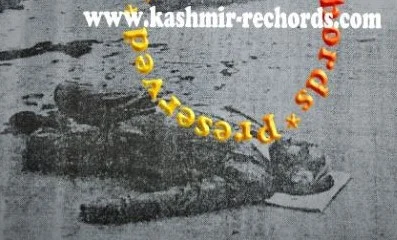
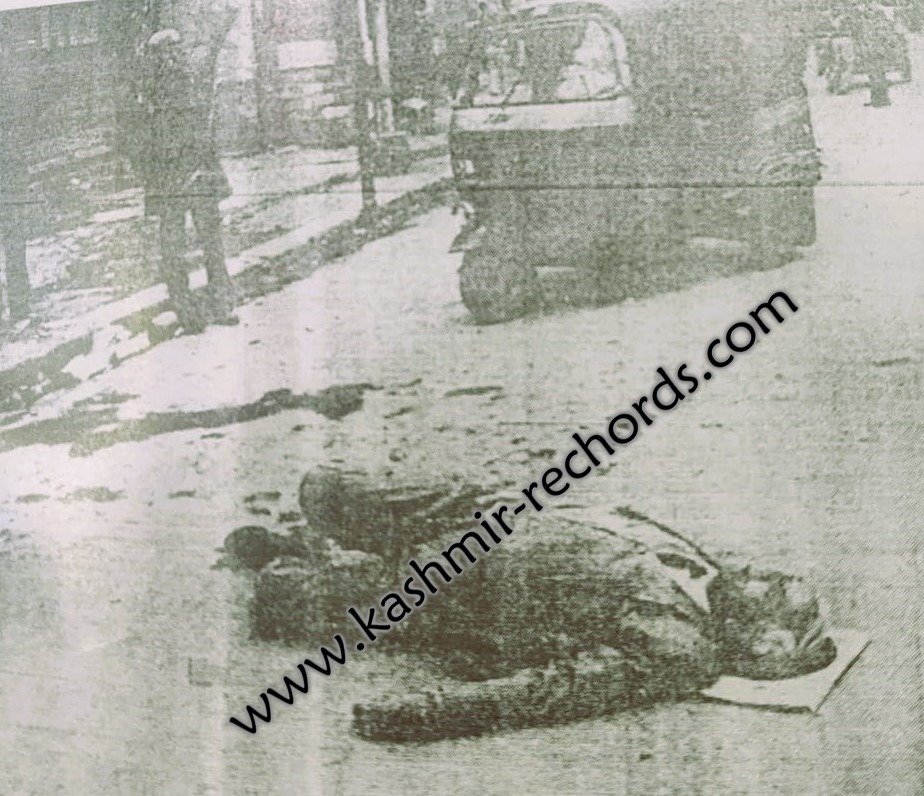
on November 4, 1989, Judge Neelkanth Ganjoo’s body lay unattended—an unsettling reminder of the fear that gripped the valley
Kashmir Rechords’ Tributes
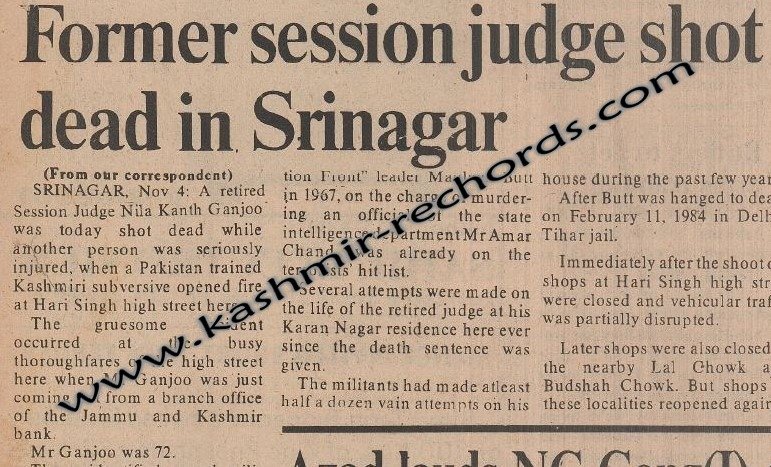
On a crisp November 4 morning in 1989, a figure strolled out of a local Bank on Hari Singh High Street in Srinagar, unaware that these steps would be his last. Judge Neelkanth Ganjoo, a retired yet resolute man of 72, was leaving his last public errand, his life soon to be cut short by a group of terrorists lurking nearby. As they approached him in broad daylight, they brought not only an end to a life devoted to justice but also plunged an entire community of Kashmiri Pandits into fear and sorrow. The tragic irony lies here: the man who had delivered justice to countless others was denied it himself, even 35 years later. His soul, like those of many others, seems to be waiting—crying out for the justice he had once so boldly represented.
Judge Ganjoo’s life, much like his death, was marked by acts of immense courage. He was a Kashmiri Pandit and a towering figure in the judicial world of Jammu and Kashmir. Between 1966 and 1968, he presided over a sensational and deeply polarizing trial: that of Maqbool Butt, co-founder of the Jammu and Kashmir Liberation Front (JKLF), charged with the murder of police constable Amar Chand. The trial ended with Judge Ganjoo pronouncing the death sentence on Butt in August 1968, a decision that would haunt him until his final day. Over the years, attempts on his life became a grim routine, as newspapers of that era reported that no fewer than six attempts had been made at his home in Karan Nagar. Despite the serious threats, he was denied elaborate protection. And on that fateful day of November 4, 1989, his assassins succeeded.
As his lifeless body lay in the street for hours, unmoved and unattended, Srinagar went back to its usual humdrum life. Buses resumed their routes, shops reopened, and people went about their daily business, some averting their gaze, others too terrified to even approach. Eventually, a few brave Policemen risked their own safety to retrieve his body, but even that final act of dignity came too late.
The Soul That Still Cries for Justice
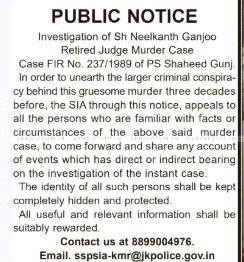
In August 2023, thirty-four years after Judge Ganjoo’s assassination, the Jammu and Kashmir Police’s State Investigation Agency (SIA) issued a public communiqué asking for assistance to solve the case. With promises of protection and rewards for any information, they rekindled hope for answers.
But to the family, this seemed like pouring salt into old wounds. It was, as they put it, “too little, too late.” After so many years of waiting, they feared the renewed investigation might only deepen their pain. After all, decades had passed with the killers evading justice, and the world had moved on, leaving Judge Ganjoo’s family to grapple with their grief alone. More than a year has passed since this public notice was published in newspapers, but no headway has reportedly been met till date.
Judge Ganjoo’s killing was not an isolated tragedy; it was a calculated move to strike fear into the heart of the Kashmiri Pandit community, a second high-profile murder after the assassination of BJP leader Tika Lal Taploo. These targeted killings became part of a larger campaign of terror, aiming to drive the Pandits from their homeland not by choice but by force. Thousands were forced into exile, leaving behind the land their ancestors had cherished for centuries.
The memory of Judge Ganjoo’s assassination still looms like a shadow over the justice system he once upheld. Even now, his soul lingers, echoing through the annals of history, asking for the very justice he had delivered to so many. His was a life committed to principles, bound by duty. And as the valley’s wounds from those dark days remain unhealed, the judge’s silent cry for justice reverberates—a poignant reminder of the forgotten, of a life sacrificed, and a soul still waiting for peace.
In October 1947, as three-year-old Jaswant Singh lay in his grandmother’s arms, he had little idea of the tragedy surrounding him. In a brutal act of violence that would devastate hundreds of Sikh families, including his own, his father, mother, and grandfather were killed in the Muzaffarabad massacre, which swept through the region in a wave of religious persecution and violence. Caught in the turmoil, Jaswant Singh lost nearly everything—except for the steadfast love and protection of his grandmother, Bhani Devi.
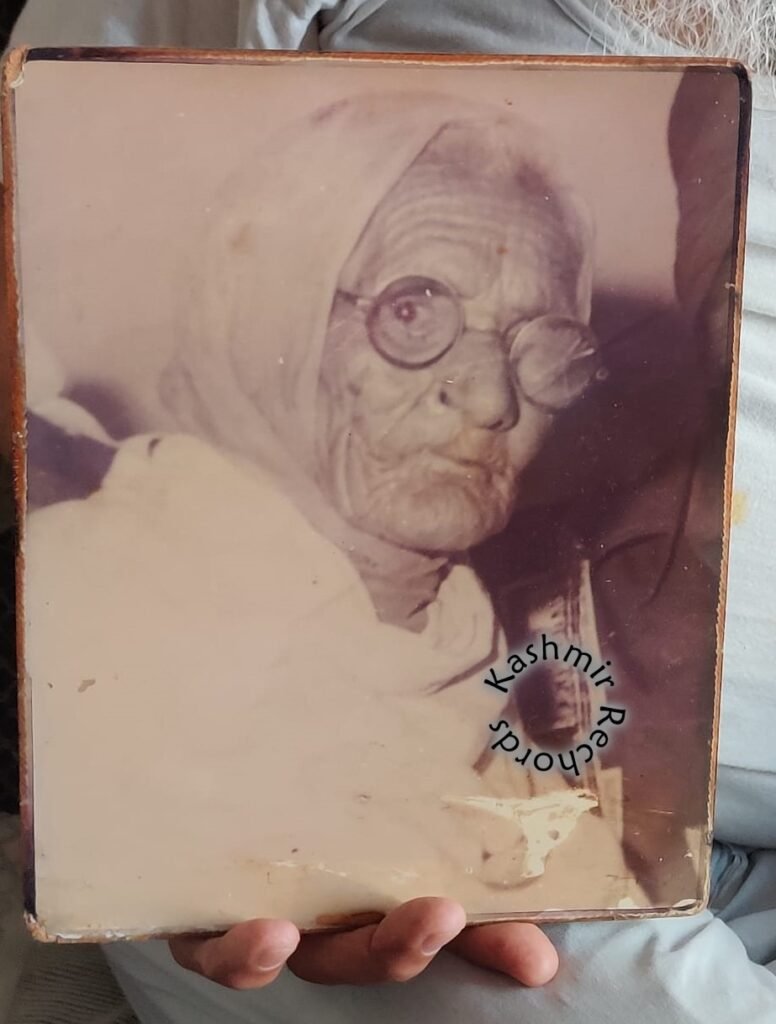
In a display of unwavering courage, Bhani Devi managed to flee with young Jaswant in tow, carrying him through harrowing paths to escape the raiders. This elderly woman, with her only surviving grandchild cradled close, would become his entire world. Though she carried him to safety, she left behind her husband, Subha Singh, and the homeland that had nurtured generations of their family. Clutching a black-and-white photograph of his grandmother Bhani Devi, Jaswant Singh continues to carry her memory and the shared legacy wherever he goes.
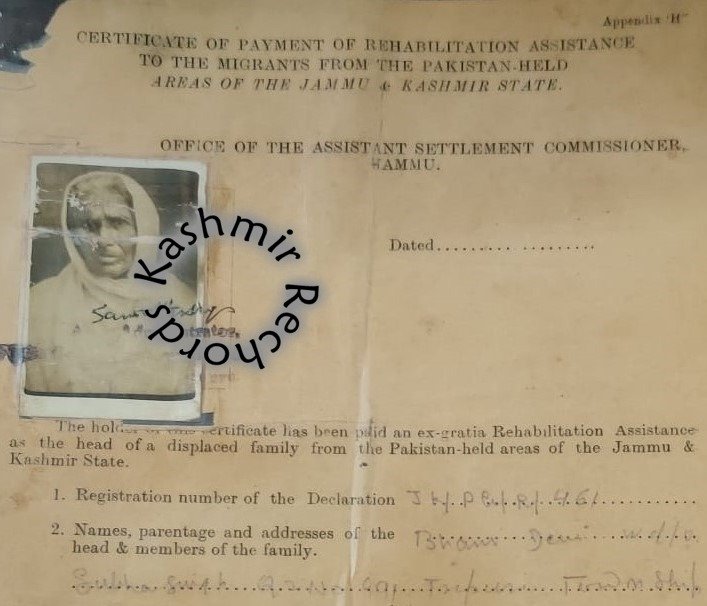
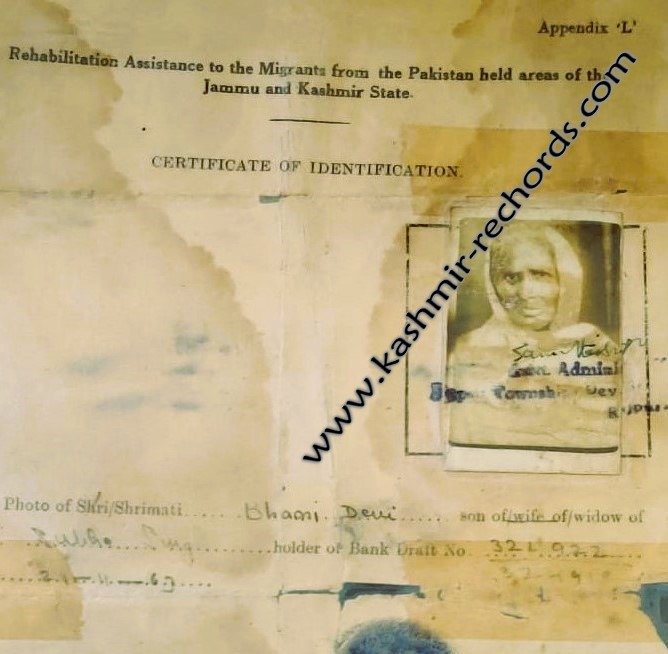
Bani Devi, registered as a Migrant from Pakistan-held -Kashmir in 1960.
Finding Refuge, Rebuilding Lives
The survivor of 1947 Muzaffarabad Massacre–Bani Devi
The journey of Grandmother-Grandson duo was marked by constant struggle, from the makeshift refugee camps of Dharamshala to Bhopal. While they found temporary shelter, Jaswant, Bhani Devi and hundreds of other Sikh families shared an intense yearning to honor the loved ones they’d lost. Finally, in 1956, they found a place of permanent refuge in Patiala, Punjab. Arriving with little more than memories and heartache, these families began to rebuild their lives, starting from scratch.
In Patiala, the State granted them barren lands. Despite their determination, the infertile soil was almost impossible to cultivate, and Bhani Devi, like many others, eventually had to surrender the land. But these resilient families found strength in each other. United in loss, they nurtured a powerful vision: a sacred space where they could remember and honor those left behind in Muzaffarabad, Kotli, and Mirpur.
The Gurudwara: A Sanctuary of Remembrance and Resilience
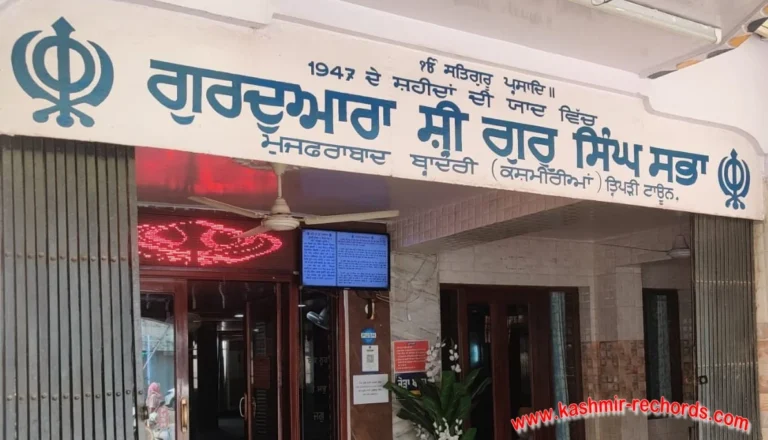
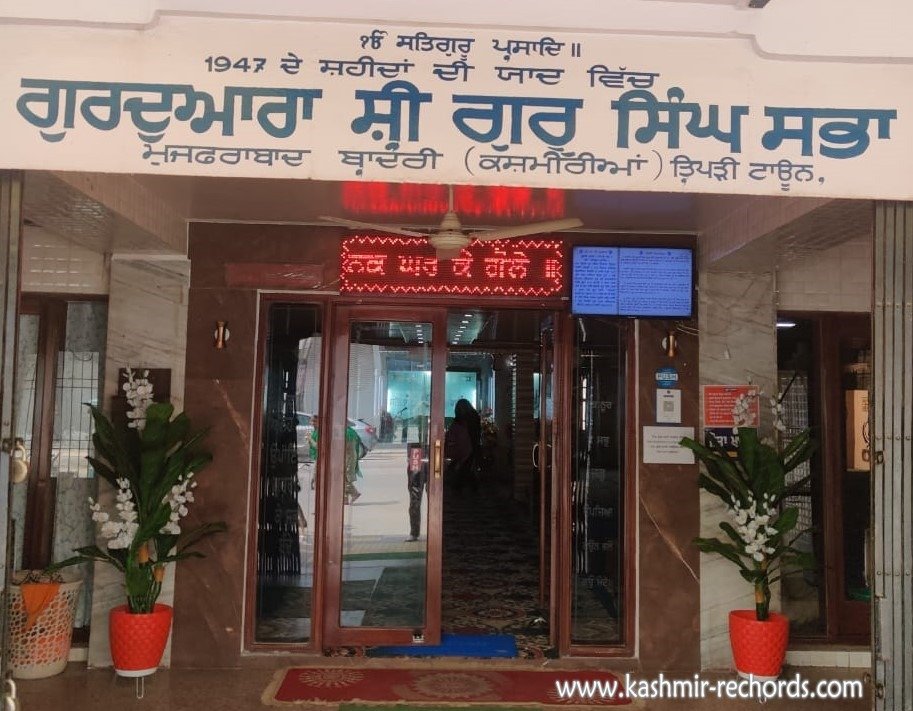
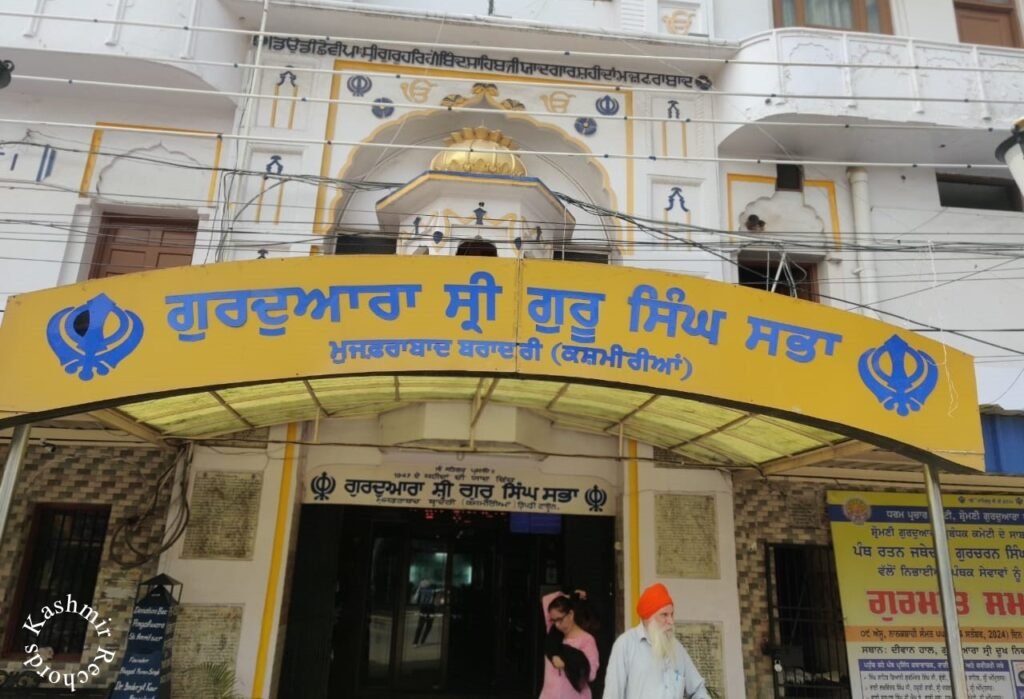
In 1956, with community support, these survivors created Gurudwara Shri Guru Singh Sabha, Muzaffarabad Baradari, in Patiala. Rising tall in the Tripari area, this Gurudwara is much more than bricks and mortar—it stands as a testament to the resilience of a community that, despite devastating loss, held fast to their faith and unity. It serves as a shrine to history, a sanctuary for grief, and a reminder to future generations of the courage it took to survive. (Kashmir Rechords has already carried a detailed story on Shri Gurudwara, Muzaffarabad, Patiala and can be accessed at: https://kashmir-rechords.com/gurudwara-at-patiala-a-beacon-for-the-survivors-of-muzaffarabad-massacre/)
Today, this sacred Gurudwara brings together the descendants of nearly 300 families who endured the Muzaffarabad massacre. Every year, they gather within its walls to share stories, pay respects, and honor the memories of those they lost. For Jaswant Singh and countless others, this Gurudwara is more than a place of worship. It is a sanctuary of resilience, a standing reminder of the spirit’s ability to endure in the face of adversity.
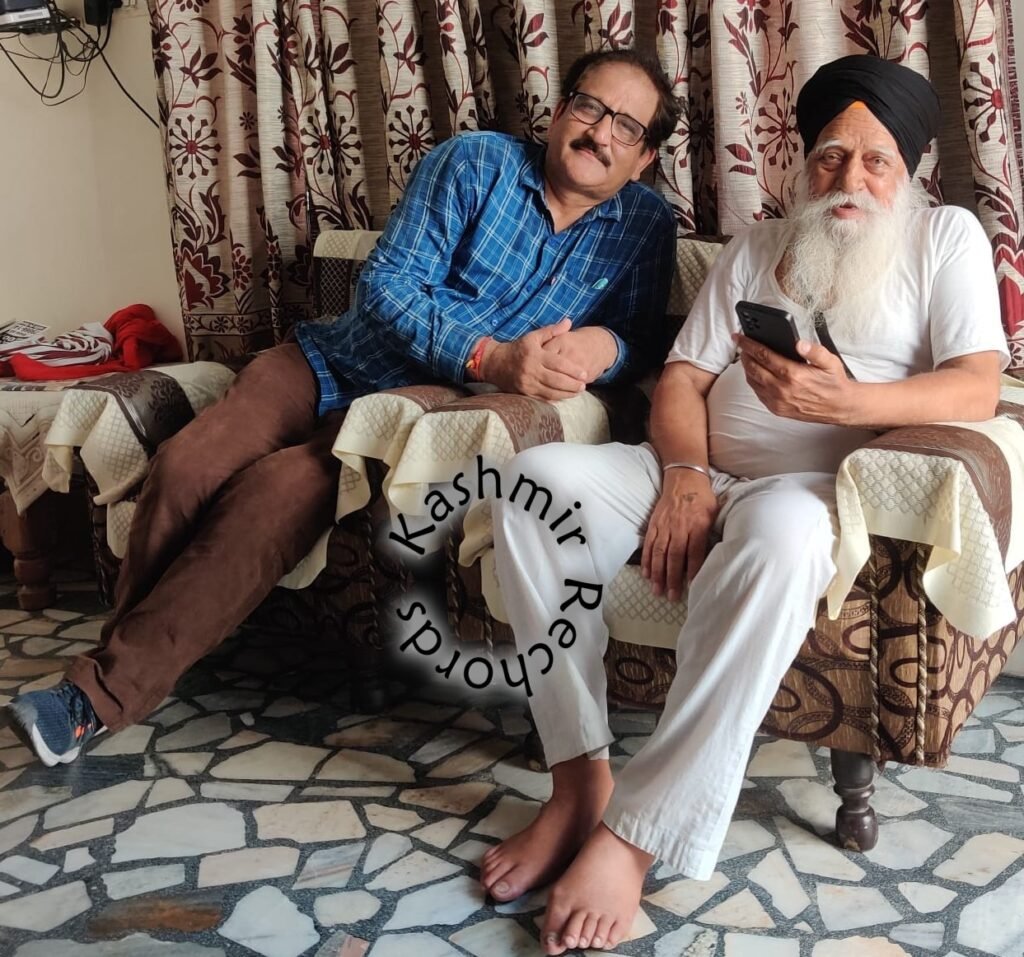
1947 Muzaffarabad Massacre Survivor, Jaswant Singh with the Author.
A Legacy Carried Forward
Jaswant Singh, now in his twilight years, sees the Gurudwara as a reminder not only of the past but of the enduring unity, faith, and remembrance that keep his community strong. As he looks at the photograph of his grandmother, he carries forward not only her memory but also the collective legacy of those who survived with him. Through Gurudwara Shri Guru Singh Sabha, the story of survival, strength, and remembrance lives on, reminding everyone that, no matter the hardship, the human spirit can—and will—endure.
*Dr. Rajesh Bhat is a Kashmir-born Journalist, Writer and Researcher; formerly associated with Daily Excelsior J&K and The Tribune, Chandīgarh. He is the Author of Radio Kashmir in Times of Peace & War.
A 1996 Plan by Prime Minister P.V. Narasimha Rao and Governor Gen K.V. Krishna Rao to Bring Back Exiled Kashmiri Pandits Failed Due to Resistance from Within the Community.
(Kashmir Re’Chords Exclusive)
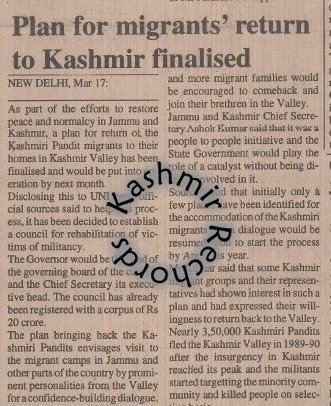
In the early months of 1996, India was on the verge of a bold initiative that could have reshaped the fate of thousands of exiled Kashmiri Pandits. Prime Minister P.V. Narasimha Rao and the then Governor of Jammu and Kashmir, General K.V. Krishna Rao, were working on a meticulously devised plan aimed at facilitating the return of Kashmiri Pandit families, who had to flee the Valley during the violent unrest of the 1990s. The plan was on the brink of being set in motion, with both leaders determined to see it through. However, a surprising and strong resistance from Kashmiri Pandit organizations themselves would eventually stall this historic move.
A Vision for Homecoming
Prime Minister Rao, known for his political astuteness and deep understanding of Kashmir’s complex socio-political landscape, was deeply committed to bringing the Kashmiri Pandits back to their homeland. Supported by General Krishna Rao, the then Governor of Jammu and Kashmir, the plan aimed to restore normalcy in the region through the rehabilitation of those displaced by militancy. The blueprint was prepared over several months of discussions, between October 1995 and February 1996, with the intention of launching the initiative in April of that year.
At the heart of the plan was the establishment of a special Council dedicated to the rehabilitation of victims of militancy. This Council, chaired by the Governor with the Chief Secretary as its executive head, had been registered and equipped with an initial corpus of Rs 20 crore. It laid the groundwork for a phased return of Kashmiri Pandit families to selected, safer areas of the Valley.
Confidence Building and Social Dialogue
The return plan was not just logistical but also strategic in fostering a social dialogue between the migrants and the local communities in Kashmir. Visits to the migrant camps by prominent Valley personalities were envisaged to build trust and pave the way for reconciliation. A few zones in areas like Pulwama, Baramulla, Anantnag, Bandipora and Srinagar were identified as initial points of resettlement, where social interactions could help initiate a broader peace process.
Newspaper reports from March 1996 available with Kashmir Rechords suggest that many Kashmiri Pandits had shown interest in the plan, raising hopes that a peaceful return was possible. According to the then Chief Secretary, Ashok Kumar, the groundwork was laid, and initial responses were encouraging.
Resistance from Within
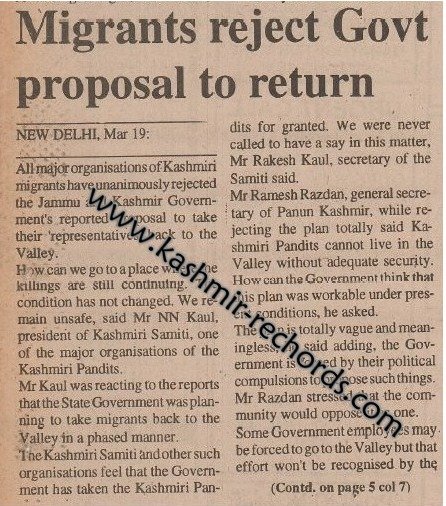
However, despite the careful planning and the personal commitment of Prime Minister Rao and Governor Krishna Rao, the return plan faced an unexpected and vehement rejection from key Kashmiri Pandit organizations. On March 19, 1996, just as the plan was being formalized, major migrant groups unanimously opposed the initiative.
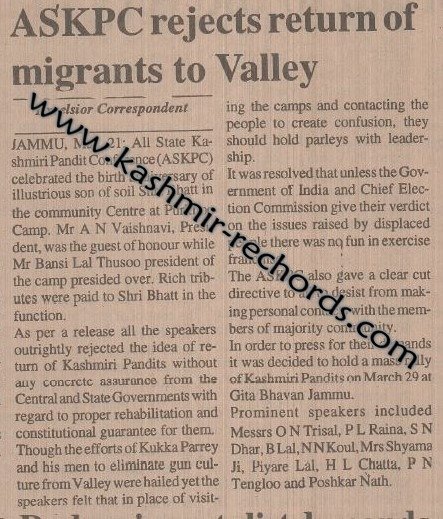
N.N. Kaul, president of the Kashmiri Samiti Delhi, led the charge against the plan, accusing the government of taking Kashmiri migrants for granted. Ramesh Razdan, general secretary of Panun Kashmir, dismissed the move as “vague and meaningless,” while A.N. Vaishnavi, president of the All-State Kashmiri Pandit Conference (ASKPC), issued a “clear cut directive” to all Pandit migrants, urging them to avoid contact with members of the Valley’s majority community.
A Missed Opportunity
As the resistance mounted and the 1996 general elections loomed, the window for implementing the plan rapidly closed. With the change of government in May 1996, P.V. Narasimha Rao’s tenure ended, and with it, the dream of facilitating the return of Kashmiri Pandits faded into the background. Though Rao had been passionate about the issue, the resistance from within the Pandit community itself had made it difficult to proceed.
Now, nearly three decades later, in 2024, the exiled Kashmiri Pandits remain scattered across the country, still awaiting a viable return plan. The opposition from various organizations persists, and the dream of reconciliation and return, envisioned by the two Raos, remains unfulfilled.
The efforts of Prime Minister P.V. Narasimha Rao and Governor Gen K.V. Krishna Rao stand as a poignant reminder of a missed opportunity—one that could have possibly rewritten the history of Kashmir.
The Gurudwara, Shri Guru Singh Sabha, Muzaffarabad Baradari, Kashmirian at Patiala, Punjab is more than a building. It is a monument to the grief, love, and resilience of a community that endured unspeakable horrors. Each year, the descendants of those 300 families gather here to commemorate the victims of the October 1947 Muzaffarabad massacre.
In the heart of Patiala, Punjab, stands a small Gurudwara—an emblem of resilience, remembrance, and hope. This sacred place is not merely a site of worship but a living testament to a story woven in pain, loss, and unyielding courage. It tells the tale of 300 Sikh families from Muzaffarabad and Kotli, whose ancestors once thrived in what is now Pakistan-occupied Jammu and Kashmir. These families lived harmoniously with their land and traditions until the tragic events of October 1947 forever altered their destinies.
The partition of India left deep scars across the subcontinent, and for these families, the impact was especially profound. When Pashtun tribesmen, backed by the Pakistani Army, stormed through the villages of Mirpur, Kotli, and Muzaffarabad, the lives of these Sikh families were irreparably shattered. Their peaceful homes were transformed into battlegrounds, and their loved ones became martyrs in a storm of violence. Thousands of Sikhs and Hindus were mercilessly killed, and women were forced to jump into rivers to escape enslavement and forced conversion.
The Escape from Muzaffarabad
Amidst this horror, around 300 Sikh families of Muzaffarabad and 20 surrounding villages miraculously survived the massacre. Fleeing with nothing but the clothes on their backs and the grief of leaving behind their ancestral lands, they sought refuge in migrant camps, first in Dharamshala and then at Bhopal. Despite their immense loss, they were determined to keep the memory of their fallen loved ones alive.
Rebuilding Lives in Patiala
In 1956, after moving from migrant Camp set up at Bhopal, these survivors finally found solace in Patiala, Punjab, where they began to rebuild their lives. Yet, they did not—and could not—forget their past. In memory of those who were killed, they united to construct a Gurudwara—a sacred place that would forever honor the souls lost in Muzaffarabad, Kotli, and Mirpur.
The Gurudwara Shri Guru Singh Sabha, Muzaffarabad Baradari, Kashmirian at Tripari, Patiala, is more than a building. It is a monument to the grief, love, and resilience of a community that endured unspeakable horrors. Each year, the descendants of those 300 families gather here to commemorate the victims of the October 1947 Muzaffarabad massacre. The retelling of their ancestors’ stories serves not to reopen old wounds but to ensure the sacrifices of their people are never forgotten.
A Beacon of Strength and Memory
This Gurudwara stands as a reminder not just of the partition but of the enduring human spirit in the face of overwhelming loss. For the descendants of these families, their ancestors’ stories are not distant history but a living legacy, shaping their identity and sense of purpose.
As time passes, the physical evidence of the violence in Muzaffarabad and Kotli may fade, but the Gurudwara in Patiala ensures that the memory of those who were killed for their faith remains eternal. It serves as both a silent witness to their suffering and a powerful proclamation of their resilience. Through prayers, tears, and unwavering faith, the survivors of 1947 and their descendants keep the spirit of their homeland alive, forever yearning for the lands they were forced to leave but never truly lost in their hearts.
In the intricate history of Kashmir, many individuals have left indelible marks, though their names may not always be celebrated. One such figure is P.K. Wattal, a Kashmiri Pandit and dedicated civil servant, who played a pivotal role during the early years of Maharaja Hari Singh’s reign as the “Minister-in-Waiting.” His story is one of unwavering commitment, meticulous governance, and a profound sense of duty that provided stability during a crucial period of transition.
A Unique Designation: The “Minister-in-Waiting”
When Maharaja Hari Singh was coronated between February 22 and 28, 1926, he ascended to the throne of a vast and complex princely state. The young ruler, facing immense responsibilities, relied heavily on seasoned administrators to guide him through the intricacies of governance. Among these trusted advisors was P.K. Wattal, who was bestowed with the unique and somewhat curious title of “Minister-in-Waiting.”
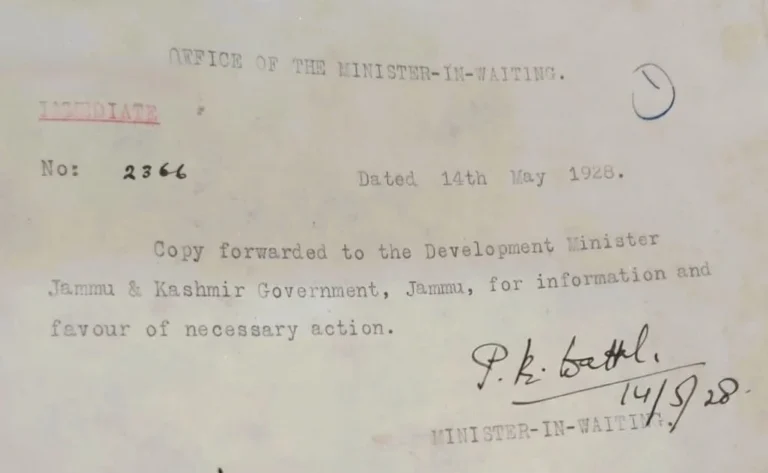
O/o Minister-in-Waiting: P K Wattal
To modern ears, the title may seem quaint, but it signified a role of immense responsibility. Wattal was far from a mere ceremonial figure; he was the backbone of the administration, entrusted with managing the critical affairs of the state during the formative years of Maharaja Hari Singh’s rule. His legendary work ethic meant he often took on the majority of file work and decision-making tasks, ensuring that the young Maharaja was not overwhelmed by the demands of his new position.
A Steady Hand in Uncertain Times
From 1926 to April 1930, Wattal’s tenure as Minister-in-Waiting was marked by his tireless dedication to ensuring the smooth operation of the state’s administration. His meticulous attention to detail provided a strong cushion for Maharaja Hari Singh, who was still acclimating to the responsibilities of leadership. Even when the Maharaja embarked on a European tour in May 1928, records assessed by Kashmir Rechords indicate that Wattal continued to manage the state’s affairs with unwavering diligence, leaving nothing to chance in the ruler’s absence.
Wattal’s commitment to his role did not go unnoticed. His “waiting” period culminated in May 1930, when he was promoted to the position of full-fledged Finance and Development Minister of Jammu and Kashmir. This elevation was a testament to his steadfast dedication to the state and his remarkable ability to manage its complex affairs with precision and skill.
Wattal’s elevation as Finance and Development Minister in 1930.
The Legacy of a Quiet Leader
Though P.K. Wattal’s contributions may not be widely recognized today, they were crucial in shaping the early years of Maharaja Hari Singh’s rule. His role as Minister-in-Waiting, though largely behind the scenes, was instrumental in laying the foundation for the administration’s future successes. Wattal embodied the qualities of a true public servant—dedication, humility, and an unwavering commitment to his duty.
As we reflect on the history of Kashmir’s princely era, it is essential to remember figures like Wattal, whose legacy reminds us that true leadership is not always about being in the spotlight; sometimes, it is about being the steady hand that guides from behind the scenes.
Readers are welcome to add to this story, if they have any inputs, since no one has so far written about Mr P K Wattal all these years !
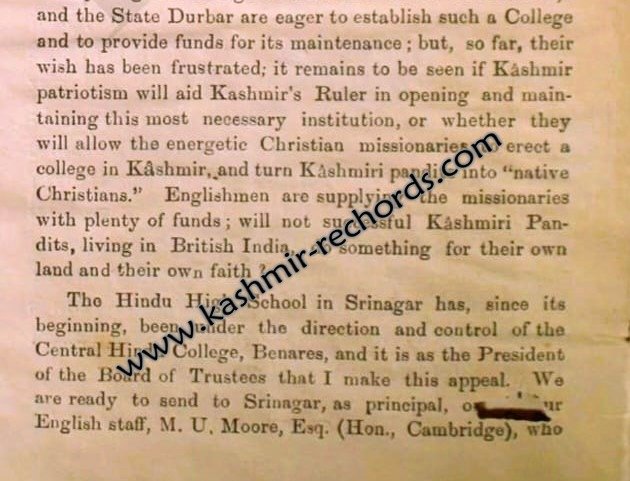
Besant’s letter warned that without swift action, missionaries could seize the opportunity to establish their own college, steering Kashmiri youth away from their cultural roots. “Do you want your children to turn into ‘Native Christians’?
(Kashmir Rechords Exclusive)
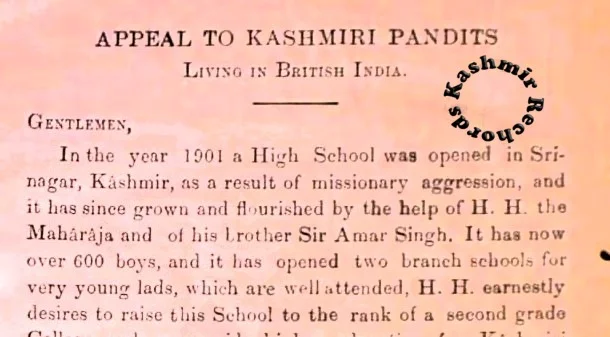
Over 120 years ago, in a powerful and impassioned letter, Annie Besant, President of the Board of Trustees of the Central Hindu College, Benares, made a heartfelt appeal to Kashmiri Pandits living in Undivided India! Her message was clear: rise to the occasion and support the establishment of a Hindu college in Srinagar. “The time has come for Kashmiri Pandits to contribute to the education of their homeland, or risk seeing their youth steered towards foreign ideals by Christian missionaries, flush with funds from English donors,” she warned.
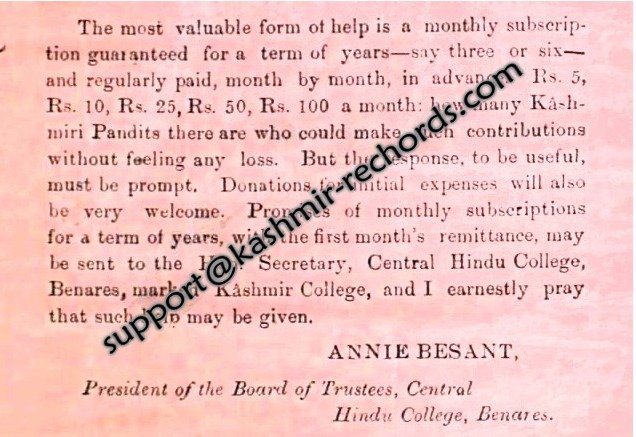
Besant’s letter, published and circulated in major newspapers and journals of the time, was a rallying cry to preserve the cultural and intellectual future of Kashmir. She highlighted the urgent need for funds to elevate the Hindu High School in Srinagar—established in 1901 with the support of Maharaja Pratap Singh and his brother Amar Singh—into a second-grade college. Without this, Kashmiri students had to travel to distant cities like Lahore for higher education, a privilege many could not afford. Kashmir Rechords is in possession of this prized archival letter and is reproducing some of its excerpts here.
Kashmir Education at a Crossroad
At the heart of Besant’s letter was the belief that the educational future of Kashmir was at a critical juncture. The lack of higher education in the Valley meant that non-Kashmiris filled most senior positions in the State, an issue that deeply concerned both the Maharaja and the State Durbar, she warned. To remedy this, they were determined to build and fund a college in Srinagar. However, progress was being stalled, and Besant’s letter sought the active support of the prosperous Kashmiri Pandit community living in British India to make this vision a reality.
Besant’s letter warned that without swift action, missionaries could seize the opportunity to establish their own college, steering Kashmiri youth away from their cultural roots. “Do you want your children to turn into ‘Native Christians’?” she asked in her letter, pointing to the urgent need for preserving the region’s traditions through education.
Annie Besant’s Plan: A Call for Contributions
Besant’s appeal focused on a practical solution: regular financial contributions from Kashmiri Pandits. She outlined the importance of guaranteed monthly subscriptions—whether Rs. 5, Rs. 10, Rs. 25, Rs. 50, or Rs. 100—to ensure the long-term success of the college. “Many of you can afford this without feeling any financial strain,” she reassured, urging the community to act swiftly.
Donations, along with the first month’s subscription, could be sent to the Honorary Secretary of the Central Hindu College, Benaras, clearly marked for the “Kashmir College Fund.” One-time donations for initial expenses were also welcome, but regular support was essential for ensuring the stability of the college in the years to come.
Empowering Kashmir’s Youth
Since its establishment in 1901, the Hindu High School in Srinagar had provided quality education to over 600 boys, with two additional branch schools serving younger students. The Maharaja, eager to promote higher education in his State, had worked tirelessly with the Durbar to raise the status of the school to that of a second-grade college. Yet, without sufficient funds, this vision was under threat.
At the time, Kashmiri students who wished to pursue higher education had no option but to leave the Valley for places like Lahore. For those unable to afford this, higher education remained a distant dream, and the local administration struggled to fill top government positions with qualified Kashmiri candidates. Annie Besant’s appeal came at a crucial moment, urging the community to take control of their own educational destiny.
The Legacy of Annie Besant’s Appeal
Following Besant’s passionate plea, a local managing committee was formed in Srinagar to oversee the efforts to establish the college. There is a mention of the same in her letter. The committee included prominent figures like Dr. Bal Krishna Kaul, Rai Sahab Daya Krishna Kaul (Private Secretary to the Maharaja), Bhavani Das (Revenue Officer), Swami Baldev Ji and H.A. Wilson (Principal of the Srinagar Hindu High School), with Rishivara Mukherji serving as Honorary Secretary.
The Maharaja gladly obliged, and in 1905, the foundation of the Hindu College was laid. Initially operating from two rooms near the present-day Secretariat building, the college was eventually shifted to its permanent site in 1911.
The institution, later renamed Sri Pratap College, became affiliated with Panjab University, Lahore, marking the beginning of higher education in Kashmir. Besant’s efforts, combined with the support of the Kashmiri Pandit community, ensured that the youth of Kashmir could now pursue their academic aspirations without leaving their homeland. The future of Kashmiri education had been secured, and the cultural and intellectual heritage of the Valley was preserved for generations to come.
===
At Kashmir Rechords, we are committed to bringing you unique, untold stories from Jammu & Kashmir, grounded in authenticity and supported by solid evidence. Every write-up is carefully researched, verified through archival materials, documents, letters, photographs, and credible references.
With the unwavering support of our readers, we aim to make Kashmir Rechords a trusted repository of genuine historical insights, striking a meaningful chord with the rich heritage of Kashmir.
Every year on September 14, Kashmiri Pandits observe Martyrdom Day to remember their leaders and loved ones lost in the conflict of 1989-1990. One name often evoked is Pt. Tika Lal Taploo, a prominent Pandit leader whose assassination on September 14, 1989, marked the beginning of a tragic chapter that culminated in the mass exodus of Kashmiri Pandits on January 19, 1990. However, the martyrdom of the community extends far beyond Taploo’s death. The true tragedy lies in the loss of countless Pandits who perished far from their homeland, denied the dignity of being cremated in the sacred land of their ancestors.
For the displaced community, it wasn’t just about losing their homes, but also the final connection to their heritage—the right to rest in their own land.
Rajinder Park: A Refuge for Grief and Last Rites
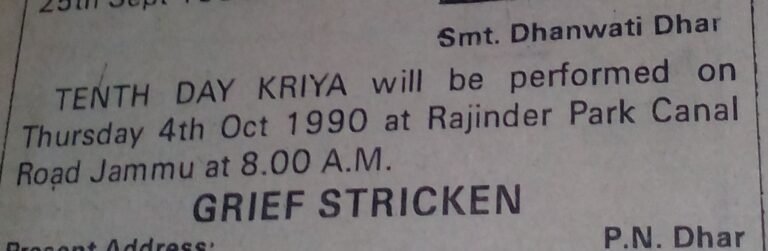
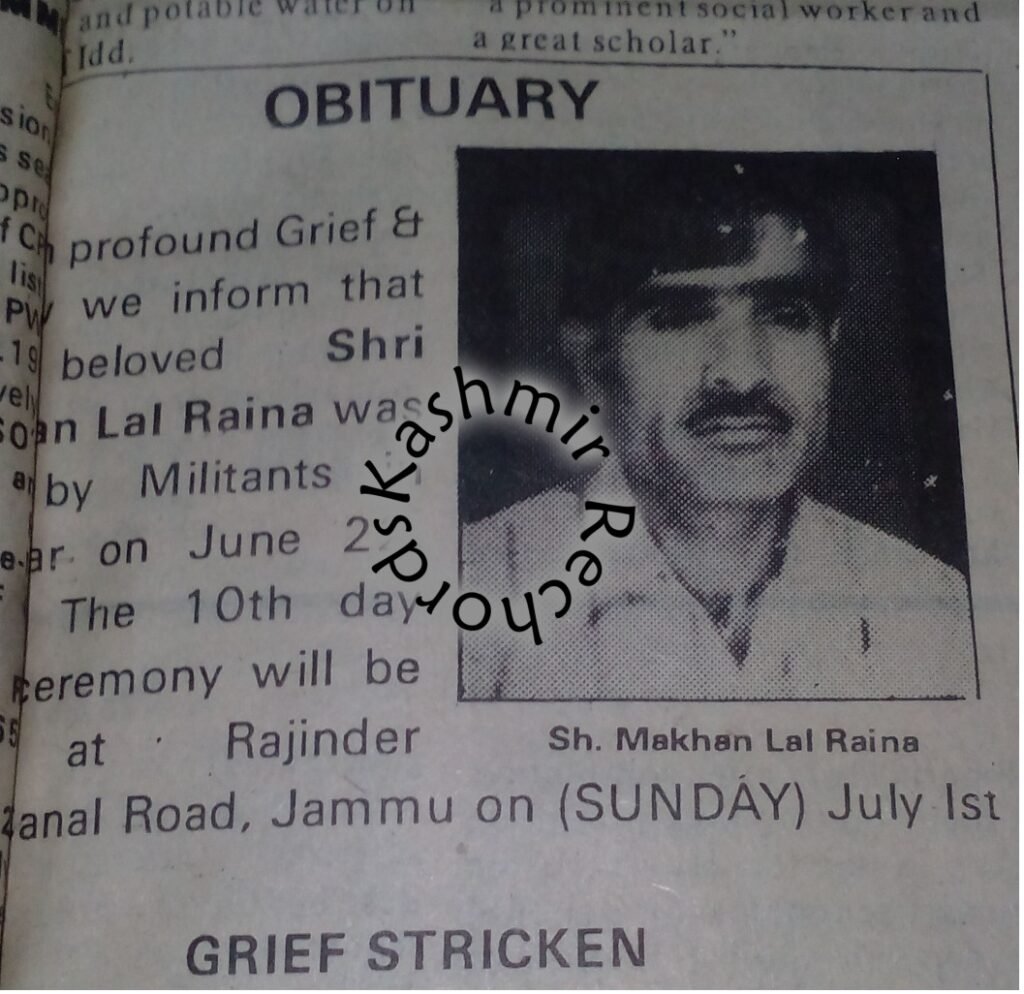
In the early 1990s, the Pandit community, thrust into exile in Jammu, faced an overwhelming dilemma. With no place to gather, no traditional cremation grounds, and a communication vacuum in an era before social media, they were left in disarray. Unlike today, when a death can be shared instantly on platforms like WhatsApp, Kashmiri Pandits relied on local newspapers to spread the heart-breaking news of terrorist killings in Kashmir. The absence of a central address, a shared space for collective grief, further deepened the community’s alienation.
It was in this void that Rajinder Park, located on Jammu’s Canal Road, emerged as an unintended sanctuary. Originally a public space, it transformed into a vital gathering place where Kashmiri Pandits could come together, mourn their dead, and perform the last rites, the Tenth-Day Kriya. Families, who had fled the horrors of their homeland, now found themselves in Rajinder Park, a place that soon became symbolic of their new reality—an exile with no true home.
A Landmark of Resilience
For the older generation of Kashmiri Pandits, Rajinder Park is etched deeply in their memory. It became a witness to their collective sorrow, where the sounds of sobbing and whispered prayers replaced the serenity that once filled the park. It served as a space of solace, where families would honor their deceased and perform rituals, which were traditionally reserved for the sacred Ghats of Kashmir. In the absence of their homeland, Rajinder Park became the place where they could cling to their cultural traditions, even if it was in the heart of an unfamiliar city.
The park played this critical role for years until more formal Tenth Day Kriya Ghats were established at Muthi , Tawi Bridge in Jammu and at the banks of Chenab near Akhnoor Town. Yet, for many in the community, Rajinder Park remains more than a temporary refuge; it is a powerful reminder of those early years of displacement when Kashmiri Pandits were forced to navigate unimaginable grief and loss in exile.
While many of the younger generation may not know its significance, Rajinder Park Jammu stands as a monument to the resilience, sacrifice, and endurance of the Kashmiri Pandit community. For those who lived through the harrowing events of 1990, the park is more than just a physical space—it is a testament to the strength of a people who, even in the depths of despair, found ways to preserve their dignity and cultural identity.
For every Kashmiri Pandit who died far from home, Rajinder Park, Jammu stands as a poignant reminder that their sacrifices, and the shared history of their community, will never be forgotten.
In the rich tapestry of Kashmir’s medical history, few names shine as brightly as that of Dr. Ali Mohammad Jan (1914-1988). Known affectionately as “The Lukmaan of Kashmir,” Dr. Jan’s reputation for diagnosing and treating a wide range of ailments without the use of modern biomedical equipment made him a household name. His legacy continues to resonate in the Valley, a testament to his extraordinary skill and compassion.
But as we celebrate the achievements of Dr. Ali Mohammad Jan, another name, now almost forgotten, calls out from the shadows of the past. This is the story of Dr. Abdul Waahid, the unsung healer of early 20th Century Kashmir whose contributions predate even the birth of Dr. Jan and yet have largely faded from memory.
Long before Dr. Ali Jan became synonymous with medical care in Kashmir, there was Dr. Abdul Waahid. Practicing between 1905 and 1920, Dr. Waahid was the go-to physician for both locals and the many tourists and visitors who flocked to the Valley. A distinguished medical practitioner from London, he brought the latest medical knowledge to a region where advanced healthcare was still a rarity.
His clinic, situated at Amira Kadal in Srinagar, near Dharamshalla was not just a place of healing but a beacon of hope for those in need of advanced medical care. Patients traveled from far and wide, including cities like Lahore and Amritsar, to seek his expertise. Even as Christian missionaries established a strong presence in Kashmir’s healthcare, Dr. Waahid’s practice flourished, a testament to his skill and dedication.
Newspapers and magazines from that era, uncovered by Kashmir Rechords, are filled with advertisements lauding Dr. Waahid’s abilities. Yet, despite his significant contributions, his name has largely faded from public memory, overshadowed by the medical luminaries who followed.
Before the advent of modern medicine, Kashmir’s healthcare was dominated by traditional practices, overseen by Hakims and Barbers. These practitioners relied on their knowledge of herbs and rudimentary surgical techniques to treat the sick. The arrival of Christian missionaries in the mid-19th century, however, marked the beginning of a transformative era in Kashmir’s healthcare—a story that is for some other day.
For those interested in exploring more of Kashmir’s rich medical history and cultural heritage, stay connected with Kashmir Rechords at www.kashmir-rechords.com. Here, you’ll find genuine, authentic anecdotes supported by historical and documentary evidence, each one a chord in the symphony of Kashmir’s past. You can also follow us on @Kashmir_Rec on Twitter and also on Face Book.
In the annals of Kashmir’s rich history, few figures stand out as vividly as Miru Pandit, a man who bridged the ancient wisdom of his homeland with the demands of a changing world. During the Mughal era, as Kashmir’s cultural and intellectual heritage was woven into the fabric of the empire, men like Miru Pandit with his military prowess played a crucial role in preserving and adapting this legacy. His resilience and intellect made him a beacon of his culture, embodying the strength and adaptability of the Kashmiri Pandit community.
Kashmiri Pandits and Mughal Empire
The Kashmiri Pandits were recognized by the Mughals as the “most respectable class,” often attracting the attention of rulers like Akbar, who valued their knowledge and integrity. This high regard is documented in several historical texts on Kashmir, including Pt Jia Lal Kilam’s “History of Kashmiri Pandits.” Although Pandits rarely reached the highest ranks of power, they were often appointed as Peshkars (administrative officials) to the Mughal Subedars. Unlike Muslims, who dominated the army’s upper echelons, Pandits were entrusted with defending volatile border regions—a significant responsibility that highlighted their capability and loyalty. This trust extended to the appointment of Rajput generals to govern Kabul and the military roles assigned to Kashmiri Pandits on the frontiers.
Early Life of Miru Pandit: From Kashmir to Deccan
Miru Pandit’s story begins during the reign of Sikandar (1394-1417 A.D.), when his ancestors migrated from Kashmir to the Bahmani kingdom in South India during Feroz Shah’s rule. Serving as an officer in command of forts in Kamraj province, with his family settled in Ellichpur (Deccan), Miru Pandit eventually left the service of the Golkanda chief and moved to Delhi. There, with the assistance of Hakim Abdul Fateh of Shiraz, he was appointed to a command position in Noor Jehan’s bodyguard.
Miru Pandit’s Bravery in Mughal History
Miru Pandit’s military prowess was brought to the forefront during a pivotal moment in Mughal history. According to “Tarikhi Aqwami Kashmir,” when Mahabat Khan, who had fallen out of favor, captured Emperor Jehangir at Jhelum, Noor Jehan rallied forces to free her husband. In the ensuing conflict, Miru Pandit distinguished himself through his skill and bravery, catching the Emperor’s attention. As a mark of royal favor, Jehangir invited Miru Pandit to return to Kashmir, where he was granted extensive jagirs and made the Governor of Kamraj. His duties included building and supervising forts at strategic locations like Sopore and Baramulla. To man these fortifications, Miru Pandit recruited forces from Muzaffarabad, Uttara Machi (Handwara), and Lolab, earning further rewards from the Mughal overlords for his efficient administration.
Legacy Continues: Bulaqi Pandit and the Defence of Kashmir
The legacy of Miru Pandit continued through his descendants. As noted by author Krishna Dar in the “History of Dar Family,” Bulaqi Pandit, Miru Pandit’s descendant, took charge of defending Kashmir’s borders. By this time, Mughal rule had weakened, and raids by Yagistani tribes had become more frequent and severe. Bulaqi Pandit responded by taking the fight to the enemy’s territory, dealing a crushing blow and securing a truce. The Yagistani leaders swore by the Holy Quran to cease their raids on Kashmir in exchange for the release of prisoners, bringing peace to the region.
Bulaqi Pandit was succeeded by his son, Makund Pandit, who, unfortunately, could not maintain a good relationship with the Subedar of Kashmir. This led to his departure from the Valley. Leaving his family in Kishtwar, he traveled to Delhi, where he presented his grievances to Emperor Mohammad Shah. The Emperor received him warmly, granted him a Khillat (robe of honor), and assigned him to the revenue administration. Although the command of the forts was transferred to another, the Pandits’ connection with the army persisted, with some joining the Sikh and Maratha armies, continuing their tradition of military service.
Mahadeo Pandit in Civil Administration
During the Mughal era, Kashmiri Pandits also held significant positions in civil administration. One notable figure was Pandit Mahadeo, who served as the Peshkar (Chief Minister) to Mughal Subedar Ali Mardan Khan (1650-1657 A.D.). Documents from this period reveal that during Mahadeo’s tenure, the imperial highway from Srinagar to Gujarat was constructed, complete with Caravan Sarais at every stage, making the road wide and easy to traverse.
Enduring Spirit of Kashmir’s Ancient Culture
Miru Pandit and his descendants symbolize the resilience and adaptability of the Kashmiri Pandit community. Despite the challenges and shifting political landscapes, they maintained their integrity and continued to serve with distinction in both military and civil capacities. Their story is a testament to the enduring spirit of Kashmir’s ancient culture, carried forward by those who bore its torch through the storms of time.
In the early 19th century, the picturesque valleys of Kashmir were devastated by a series of merciless famines. Among the many who fled the land in search of survival was a young boy named Sultan Malik. Born into a Rajput Muslim family in Shahabad (Verinag), Kashmir, Sultan’s world was turned upside down when he became an orphan at the tender age of ten. With little more than hope and the guidance of his widowed mother, Sultan joined the exodus to Punjab—a journey that would ultimately lead him to an extraordinary destiny.
The Exodus to Punjab: A New Beginning in Lahore
The migration was fraught with hardship, but it led Sultan and his mother to Lahore, a city undergoing rapid transformation under the rule of Maharaja Sher Singh. Lahore, with its burgeoning construction projects, offered a glimmer of opportunity, though the city’s streets were unforgiving to the impoverished and unskilled. But Sultan was not one to succumb to despair. He was physically strong, with a fierce love for wrestling—a passion that would soon open unexpected doors.
Wrestling into Prominence: A Meeting with Maharaja Sher Singh
Urdu Newspaper and magazines of that era available with www.kashmir-rechords.com reveal that in a twist of fate, Sultan’s prowess in wrestling brought him into the limelight. During a wrestling match organized by Maharaja Sher Singh, the young Kashmiri boy defeated a well-known local wrestler, earning the attention of the Sikh monarch. Impressed by his strength and determination, the Maharaja granted Sultan an audience. It was during this meeting that Sultan shared his struggles in finding work, despite his skills and willingness to toil. Moved by his story, Maharaja Sher Singh awarded him a contract to supply lime (chuna) for the construction of the Lahore Fort—a decision that would alter the course of Sultan’s life.
The Rise of Thekedar Mian Mohammad Sultan
This contract was the foundation upon which Sultan built his future. His integrity and hard work quickly earned him a reputation, and soon he was known as Thekedar Mian Mohammad Sultan. His business thrived, and he became a key figure in the construction of several iconic buildings within Lahore’s walled city. Sultan’s rise from a struggling migrant to a celebrated contractor was nothing short of miraculous, a testament to his resilience and drive.
Legacy Beyond the Sikh Empire: Contributions to British Lahore
The fall of the Sikh Empire did not dim Sultan’s fortunes. The British, recognizing his contributions during the Sikh rule, entrusted him with numerous contracts, including the construction of army colonies and other critical structures. Among his most notable projects were the Lahore Railway Station, Landa Bazaar, Delhi Darwaza, and the grand Sultan Mehal. His work extended beyond mere construction; he built wells in the courtyards of buildings and havelis, acts of charity that endeared him to the people of Lahore.
Lahore Railway Stations constructed by Mian Mohd Sultan in 1859
Acts of Benevolence: Sultan’s Inn and Diplomatic Feasts
In 1853, Sultan built an inn near Delhi Gate, on the highway connecting Lahore and Amritsar. This inn provided much-needed rest to travellers and reinforced Sultan’s reputation as a benefactor. His generosity did not go unnoticed by the elite. In 1869, Sultan hosted a lavish feast for the Afghan monarch, strengthening ties between Lahore and Afghanistan. Seven years later, he welcomed Prince Albert Edward, the Prince of Wales, to Lahore, further solidifying his status as a man of influence and respect.
The Decline of Fortunes: A Legacy Endures
Despite his numerous successes, Sultan’s later years were marked by financial difficulties. After facing significant losses, he was forced to mortgage his properties to Maharaja Ranbir Singh of Jammu and Kashmir in exchange for a debt of five lakh rupees. The Maharaja, in recognition of Sultan’s contributions, granted him a pension, but Sultan never fully recovered. His properties were eventually sold, and his fortunes waned.
Mian Mohammad Sultan passed away on February 4, 1876, in Bama Balla, Lahore, leaving behind no heirs. Yet, his legacy as the builder of Lahore endures. A white stone memorial, erected in his honor during a visit by Lord Hardinge, Governor-General of India, in 1911, stands as a lasting testament to the man who, against all odds, shaped the architectural landscape of Lahore.
In the heart of Kashmir, a unique version of the Ramayana stands as a testament to the region’s rich cultural tapestry. This iconic Kashmiri Ramayana, penned by Pandit Devkar Prakash Bhat and published multiple times between 1910 and 1940 by Ali Mohammad Tajar Kutab (later known as Ali Mohd and Sons) of Habba Kadal, Srinagar, is adorned with exquisite handmade sketches. These sketches, brimming with dedication and devotion, were crafted by two almost forgotten Kashmiri artists: R.C. Wantoo and G. Mohi ul Din.
The Silent Artists Behind the Masterpiece
Much has been written about the Kashmiri Ramayanas, but little is known about R.C. Wantoo, a Kashmiri Pandit and G. Mohi ul Din. Their artistry brought to life the verses of Pandit Devkar Prakash Bhat, portraying the epic tales of Lord Rama with unmatched skill and passion. Their sketches provided visual narratives that complemented the poetic verses, making the stories more vivid and accessible to readers.
Preserving Their Legacy
Kashmir Rechords, is in possession of two editions of this Ramayana, published by Ali Mohd and Sons. These editions feature the names of R.C. Wantoo and G. Mohi ul Din, etched beside their beautiful sketches. In an effort to ensure these artists are not forgotten, Kashmir Rechords is bringing their work to the public domain, hoping that those with knowledge of these artists can provide further insights.
The Kashmiri Ramayana: A Cultural Treasure
The book, titled “Rama Avtar Charit—Luv Kush Charit” and “Ramayan Bazaban Kashmiri” by Pandit Devkar Prakash Saheb Bhat, holds a significant place in Kashmiri literature. Even Sir George Grierson, who edited the summary page of Ramayana into English, did not include the sketches by Wantoo and Mohi ul Din. Over the years, this Ramayana has been reprinted in various languages and scripts, including Kashmiri (Nastalique and Nagri), English, and Hindi. However, the unique handmade sketches by Wantoo and Mohi ul Din have often been missing in these versions.
A Call for Recognition
The history of the Kashmiri Ramayanas is vast. The first known Kashmiri Ramayana, “Shankara Ramayana,” was transcribed from Sharada into Devanagari by Shankar Kanth during the reign of Maharaja Ranbir Singh. This was followed by several other versions, each contributing to the literary heritage of Kashmir. Among these, the “Rama Avtar Charit” by Divakar Prakash Bhat, used by George A. Grierson for his summary page translation work, stands out for its inclusion of Wantoo and Mohi ul Din’s sketches. It is in this book that the famous Kashmiri lines are found:
“Koushaliya Hindeh Gobroo,
Karyo Goore Goore,
Paryo Ram Ramie,
Karyo Goore Goore”
Seeking Contributions
Kashmir Rechords aims to publish a detailed account of the Kashmiri Ramayanas and their various editions in future write-ups. In the meantime, we are seeking information about R.C. Wantoo and G. Mohi ul Din. Those who know about these artists are encouraged to provide genuine inputs to support@kashmir-rechords.comor kashmirrechords@gmail.com. Full credit will be given to contributors, ensuring that the legacy of these remarkable artists is preserved and celebrated.
In a fascinating glimpse into the past, a rare edition of Captain A.H. Bingley’s book “Dogras” provides a detailed account of the valorous Dogra soldiers and their unique recruitment process. The book, originally printed in 1899 at the Central Printing Office in Shimla under the orders of the Government of India, was a comprehensive effort to compile information on the Dogras for their induction into the British Army.
A Cultural Insight into the Dogra Soldiers
Known for their bravery and loyalty, Dogra soldiers were traditionally selected at cultural Melas, fairs and festivals. This method of recruitment was meticulously documented by Captain Bingley, a member of the 7th (Duke of Connaught’s Own) Bengal Infantry. His work not only highlights the military prowess of the Dogras but also delves into their history, customs, culture, and the regions they inhabited, including Jammu and Kashmir, Punjab and parts of Himachal Pradesh.
The book’s significance is further enhanced by its revisions. In 1921, A. B. Longden added to the original text, and later, Dr. Sukhdev Singh Charak included chapters on Dogra art and literature, making it an invaluable resource on Dogra history and culture.
Military Brilliance and Unique Recruitment
Captain Bingley emphasized the Dogras’ exceptional capabilities in mountain warfare, citing numerous expeditions on the Punjab frontier and their distinguished service in the Hunza-Nagar campaign of 1891 and the defence of Chitral. Unlike other conservative Hindus of the time, Dogras were open to sea voyages and foreign service, with many serving in China in 1860.
The book also highlights specific Dogra recruiting grounds, from Akhnoor to Chamba and Kangra, extending to the South and East of the Chenab in Jammu and Kashmir. It mentions territories along the border of Jammu, including Pathankot, Shakargarh, Sialkot, and Zafarwal, and regions like Jasrota and the Ravi Belt, inhabited by both Hindu and Muslim Dogras.
The Melas: A Unique Recruitment Ground
One of the book’s most intriguing revelations is the practice of recruiting Dogra soldiers at local fairs and Melas. These events, with both religious and commercial significance, were organized throughout the year in areas now part of Himachal Pradesh, Punjab, and Jammu and Kashmir. Notable recruitment fairs were held in the Kangra belt, Hoshiarpur area, and Jammu region, including places like Kangra, Jawala Mukhi, Dharmshalla, Parmandal, Mirpur, Ghagwal, Mansar, and Kana Chack.
However, the selection process faced challenges, as it was sometimes difficult to verify the character and antecedents of
recruits. Despite these limitations, this method highlighted the cultural strength and fighting skills of potential soldiers.
Changing Times and Practices
While some of these cultural and commercial fairs continue to be held, the recruitment process has evolved significantly. In the fast-changing modern lifestyle, the traditional practice of selecting soldiers at fairs has faded, replaced by more structured and formal recruitment methods.
Kashmir Rechords, in possession of this rare edition, underscores the historical and cultural importance of Captain Bingley’s work. As the book finds renewed attention, it serves as a testament to the rich legacy and unique traditions of the Dogra soldiers, offering a window into a fascinating chapter of Military history.
Shadipur Kashmir Dashaar, often likened to the revered Purna Kumbh Mela, used to be a unique and ancient festival celebrated by Kashmiri Pandits. Unlike the regularly scheduled Kumbh Melas, the timing of Kashmir’s Dashaar depends on ten specific astronomical and astrological configurations, occurring roughly every 10, 12, 36 or 75 years. Due to these ten celestial combinations, the festival is named “Dashaar,” meaning ten combinations on a single day! This uncertainty in timing has led to the festival entering Kashmiri folklore as “Dahi Veher Dashaar,” literally meaning once in a Blue Moon. The festival is celebrated at the confluence of the Jhelum (Vitasta) and Sindh rivers in Shadipur, present Ganderbal district of Kashmir.
The Chinar Tree at Shadipur, Kashmir.
Historical Insights
During his post-doctoral research at the Jammu and Kashmir Department of Archives and Archaeology at Jammu, this Author stumbled upon a significant file titled “Dashaar Mela at Shadipur-1941”. The festival was last celebrated on June 14, 2016, after a 75-year hiatus, with the previous celebration on June 4, 1941. Historical records upon the perusal of this delicate file revealed that over 100,000 pilgrims had attended the 1941 Dashaar, far exceeding the expected 40,000. An earlier celebration in 1911 saw a cholera outbreak affecting thousands of pilgrims.
Celestial Significance
The festival is celebrated every time in June (Jyeshta) under specific astrological conditions: a Tuesday or Wednesday with the Moon in Virgo and the Sun in Taurus during Ananda Yog. The confluence of the Jhelum and Sindh rivers, known as Prayag Chinar, is considered sacred, akin to the confluence of the Ganges and Yamuna at Prayag in Allahabad. Kashmiri Pandits regard the Sindh stream as the sacred Ganga and Vitasta as another name for the river Yamuna, supported by verses 305-307 in the Nilmata Purana.
The 1941 and 1911 Dashaar
The preserved file, accessed by this Author, mentions that the 1941 festival, falling on June 4, 1941, corresponding to 22nd Jyeshta, 1998 Vikram Samvat, was declared a public holiday in the entire districts of Baramulla, Anantnag, and Muzaffarabad. The Maharaja’s government had allocated Rs 200 for rescue boats and ropes, kept Rs 500 for unforeseen expenses, and deployed 100 Maharaja Guards and Medical Officers from Sumbal and Ganderbal. Over one-lakh pilgrims had participated, far exceeding expectations. This was based on the report of Deputy Chief Security General, who had estimated only 40,000 devotees.
In 1911, the festival faced a terrible cholera outbreak, requiring treatment for 3,063 pilgrims. A 16-year-old Kashmiri Pandit boy, whose identity was not revealed, had lost his life when a boat overturned.
The 2016 Celebration
Passing the Heritage Baton to the Young…. An elderly Kashmiri Pandit with her daughter during 2016 Dashaar festival.
In 2016, the festival celebrated after 75 years, saw elaborate arrangements, including transport, security, and sanitation. Local Muslim residents provided essential supplies and boat services. The Chinar Tree, which was photographed by Fred Bremner in 1905, was in 2016 also surrounded by water on all sides. One had to come to this Chinar tree in a boat and go up some steps to have a commanding view of the confluence. The site, with its Shiva Lingam, has been a place of worship for centuries. Kashmiri Pandits who were incidentally already in Kashmir for Mela Kheer Bhawani of 2016, also participated in the Dashaar festival that year.
The Chinar Tree at Shadipur, Kashmir in 1905, photographed by Fred Bremner.
Cultural and Spiritual Significance
Sh Sanjay Raina
Sanjay Raina, an expert on the traditional and rituals of Kashmiri Pandits, explains,: “The Dashaar festival is always celebrated in the month of June (on 10th Jyeshta Shukla Paksha), either on Tuesday or Wednesday, with Hasta as Nakshatra, Moon in Virgo, and Sun in Taurus during Ananda Yog.” Raina cites the Nirnay Sindhu, Dashaar Nirnay book, and the rare Shadipur Dashaar Nirnay book as sacred texts documenting the festival’s significance.
A page from Shadipur Dashaar Nirnay book
Nirnay Sindu Book, 1901 that makes a mention of Dashaar Festival of Kashmir.
Looking Forward
The exact date of the next Dashaar festival will be determined by astrologers and experts, but it cannot be before June 2026, adhering to the minimum ten-year gap required the celestial combinations to align once more.
(The author is a writer, author, and content creator who has been involved in both print and electronic media for over 35 years)
In a remarkable revelation by Kashmir Rechords, a hidden chapter of Kashmiri Pandit excellence has come to light, showcasing their significant contributions to the banking sector in the early 20th century. Despite facing numerous displacements from their homeland, Kashmiri Pandits have consistently demonstrated their prowess across various fields, including art, culture, history, spirituality, bureaucracy, politics, and administration. This latest discovery underscores their foresight and innovation in banking, a domain where their achievements had remained largely undocumented until now.
A Visionary Banker: Pt. Iqbal Krishan Gurtu
In 1900, a Kashmiri Pandit named Iqbal Krishan Gurtu, B.A, established Kashmiri Bank Limited at Faizabad, then part of the United Provinces. Registered under the Company Act of India, the bank was a trailblazer in the financial industry, introducing concepts that were ahead of their time. Pt. Gurtu, who served as the bank’s secretary, invested a substantial capital of Rs. One lakh and maintained a reserve fund of Rs. 30,000.
Pioneering Banking Practices across Undivided India
Kashmiri Bank Limited Faizabad quickly expanded its operations, setting up sub-offices and commission branches across undivided India, including in prominent cities such as Allahabad, Bombay, Kanpur, Firozpur, Meerut, Lucknow, Delhi, and Lahore. One of the bank’s pioneering initiatives was its unique system of providing interest on term deposits, a concept very rarely introduced elsewhere in India, let alone in the Princely State of Jammu and Kashmir, where the concept of banking finds its mention only in the late 1930s.
The Kashmiri Bank Limited Faizabad offered an attractive interest rate of seven percent on term deposits for one to two years, and half of that rate for deposits kept for six months. Interest payments were meticulously calculated to be paid on the second of January and the First of July, against proper receipts. Kashmiri Bank Limited actively advertised these innovative financial services in leading newspapers of that time, demonstrating the Kashmiri Pandit’s far-reaching vision in banking.
Advertisements from the period, now part of the archival material available withKashmir Rechords, reveal that the bank also kept its interest rates on deposit money floating. Customers were provided with free cheque and passbooks, and the bank accepted currency notes of all denominations for deposit. Additionally, loans against immovable property were issued following attestation and recommendations by reputed and trusted individuals.
An advertisement issued by Pandit Iqbal Krishan Gurtu, Secretary, Kashmiri Bank Limited, Faizabad that appeared in leading newspapers of Lucknow and Allahabad in 1903.
A Mysterious End and a Call for More Information
Despite these significant advancements, detailed records of Kashmiri Bank Limited’s operations beyond 1910 are scarce. The Bank’s advertisements and posters, predominantly in Urdu, cease after this period, leaving the subsequent fate of the bank shrouded in mystery. It is surprising that no one has cared to write on this subject or to take research to its logical conclusion all these years.
Kashmir Rechords, which takes pride in this “breaking news” of the past, thus appeals to its esteemed readers to share any further information. The Kashmiri Bank Limited Faizabad is a testament to the ingenuity and entrepreneurial spirit of the Kashmiri Pandits, a legacy that deserves recognition and celebration.
Celebrating a Legacy
This revelation not only highlights the historical contributions of the Kashmiri Pandits in the banking sector but also serves as an inspiration for future generations to acknowledge and build upon their rich heritage.
* Rajesh Bhat, Ph.D. in Mass Communication and Journalism brings over 35 years of experience as a writer, researcher, and academician in journalism, spanning both print and electronic media. He authored “Radio Kashmir in Times of Peace and War” and has worked with prestigious newspapers and publications including Kashmir Times, Daily Excelsior Jammu, and The Tribune, Chandigarh. Currently, he serves as a Faculty Member at the National Academy of Broadcasting and Multimedia, New Delhi.
Kashmir has been a fertile ground for numerous contributions to the world in various fields, including art, literature, medicine, engineering, history, and academia. This land has produced many great individuals who have left their mark not only on the subcontinent but also on the entire world. Among these notable figures is Koka Pandit Kashmiri, also known as Pt. Kokkoka, a prominent sexologist and Prime Minister of Kashmir of yesteryears.
Koka Pandit and His Magnum Opus
Koka Pandit is credited with writing the “Koka Shastra,” also known to some as “Ratirahasya” (Secrets of Love), a seminal work on sex education and psychological issues. This text, written in Sanskrit in the 11th or 12th century, addresses topics that modern science and education are only beginning to incorporate into curriculums.
Sylvan Levi, a renowned French Sanskrit Scholar (1863-1935), acknowledged Koka Pandit Kashmiri as the originator of Koka Shastra, though the exact date of its composition remains uncertain. Koka Shastra is not just a manual on sexual practices but a comprehensive guide that encompasses psychological and sociocultural aspects of sex and relationships. The text provides insights into medieval Indian society’s understanding of human sexuality, gender roles and interpersonal dynamics. This understanding has influenced subsequent works in the field and continues to be relevant in modern discussions about sex education.
Content and Structure of Koka Shastra
Koka Shastra, often considered Kashmir’s equivalent to the “Kama Sutra,” comprises fifteen chapters (pachivedes) and 800 verses. Unlike the Kama Sutra, which reflects ancient Hindu literature, Koka Shastra is tailored to medieval Indian society and its cultural milieu. The text covers various subjects, including:
1.Different physiques and types of genitals
2. Characteristics of Men and Women at different ages
3. Techniques of hugs and kisses
4. Various stages of love, from weight loss to fainting, and ultimately, death
Pt. Koka’s work also classifies both men and women into four psychophysical types based on appearance and physical features. He explores erogenous zones and days conducive to sexual arousal for both men and women.
Scholarly Acknowledgment and Influence
W. G. Archer, a British civil servant and art historian, noted that Kokkoka’s work focuses on maximizing sexual enjoyment and maintaining a woman’s happiness. Pt. Koka Ram drew from numerous sources, including Nandikeshvara, Gonikaputra, and Vatsyayana, to compile his treatise.
The various translations of Koka Shastra have included illustrations that help convey its teachings visually. These adaptations made the text more accessible and engaging, which is a strategy still used in modern educational materials. The use of artwork in Persian, Urdu and Hindi versions, for example, reflects an understanding of the importance of visual aids in enhancing comprehension and retention of information.
Translations and Global Reach
Over the past 300 years, Koka Shastra has been translated into several languages, including Arabic, Persian, Urdu, Hindi, and Turkish. Notable translations include:
1. “Lazzat Un Nisa“ in Persian, attributed to Ziya Nakhshabi, 18th Century
2. “The Koka Shastra” by Alex Comfort in English (1964)
3. “Koka Shastra (Rati Rahasya)” translated by S. C. Upadhyaya
4 “Asli Kok Shastra’’ (Hindi) by Acharaya Gautam, (1889)
5.``Maha Kok Shastra’’ (Urdu) by Pandit Pyare Lal Sharma (1905)
6.“Kok Shastra’’ (Urdu), J S Sant Singh and Sons.
These translations often incorporated illustrations and commentaries, enhancing the text’s accessibility and appeal. Persian scholar Ziya Nakhshabī added watercolours and gilt typical of 18th-century Mughal art in his version. The first Hindi translation is believed to have been undertaken in the early 17th century, from which later Hindi, Persian, and Urdu versions derived.
Continued Legacy and Research
In the late 19th and early 20th century, many Urdu versions of Koka Shastra were produced for the Urdu-speaking population of undivided India. These versions often included elaborate historical accounts of Koka Shastra and its significance. Many carried hand-made pictures also and gave a full credit to Pt Koka Ram while addressing him as former Prime Minister of Kashmir.
Invitation for Further Contributions
Many concepts from Koka Shastra have found their way into modern literature on sex and relationships. The detailed exploration of different types of physical and emotional interactions provides a foundation that contemporary writers and educators build upon. By recognizing the historical context and contributions of texts like Koka Shastra, modern sex education can draw on a rich tradition of knowledge and integrate it with contemporary scientific understanding.
Kashmir Rechordsintends to further explore to provide an overview of the life and work of Pt. Koka Ram Kashmiri, his motivation and the context in which he had to write Koka Shastra. Since on a home turf, no work has been undertaken on this former Prime Minister of Kashmir, this write-up is thus open to further opinions, additions, and alterations, inviting readers to contribute to the ongoing exploration of this significant historical text.
By continuing to study and appreciate the contributions of historical figures like Pt. Koka Pandit Kashmiri, we can enrich our understanding of human sexuality and improve educational practices for future generations.
Drop your Comments in the Comment Box at the end of this article or write to us at kashmirrechords@gmail.com or support@kashmir-rechords.com
The Erstwhile Princely State of Jammu and Kashmir had the unique distinction of having its own currency notes printed and circulated in 1877 AD during the reign of Maharaja Ranbir Singh.
The State used to issue these notes through its Treasury in 1877 (Samvat 1934). These notes were being issued mainly for the payment to the State Treasuries of Land Revenue and other Government dues. The denominations ranged from a rupee to 1,000 rupees.
These notes used to bear the signatures of many Competent Authorities. In some notes, one finds the name of Diwan Kirpa Ram as the chief signatory, while in a Twenty Rupee note, on its right corner, there is a mention of Mahesh Chander Vishvas in Nagari script.
A Twenty Rupee Currency Note of Princely State of Jammu and Kashmir, printed in 1877. Pic Courtesy: Rezwan Razack, Bangalore, India
Shrikar and Sun Emblem
All these currency notes of the Princely State of Jammu and Kashmir depicted the Sun as an Emblem with the word ‘Shrikar’ written in bold Nagari letters beneath it in the Centre. Once issued, the notes were then stamped with a seal impression below ‘Shrikar’. This Persian seal reads ``Muhre Shrikar Qilimrau Jammun’’, meaning the “Land Revenue Seal of the Dominion of Jammu,” with the date 1934 (Samvat) and the month in the oblong tables on its two sides.
The Notes used to carry six circles— three circles each on the left and right sides in vertical lines. These three circles carried the numeral value in Nastalique, Nagari and Dogri scripts. Beneath the bold word Shrikar’ in Nagari, there is twice a mention of Jammu Kashmir and the date of printing these currency notes in Urdu. However, most of the notes carry the Urdu dateline of “Mah Vaisakh, Samvat 1932’’. All these panels and circles were colored in pale gold and the rest in black.
Printing of Notes in Jammu
Such was the technology available in the State that these Currency Notes were printed in the State itself at Vidyavilas Press, Jammu. The interesting part is that the Dogri inscription is found side by side along with Urdu and Hindi. Also, these currency notes were printed on a Watermark Paper with the words `LESCHALLAS’. The Watermark paper used to be provided by Wiggins Teape Paper Company formed in 1761 in London.
A Ten Rupee Note. Pic Courtesy: Rezwan Razack.
Dimension of Notes
All notes measured roughly 160 mm. x 230 mm with some variation due to the uneven paper cutting. However, the print of the note on the hand-made paper for all denominations was 131 mm x 205 mm.
These currency notes of Jammu and Kashmir ceased to exist after 1947 when the Princely State acceded to the Union of India.
Continuing the tradition of according glory to Persian, the court language of the Mughals in the Indian subcontinent, Kashmiri Pandits have produced marvelous literature in this language, demonstrating their ability to add significance to anything close to their hearts. While Sanskrit was the language traditionally associated with this community, they had no qualms in accepting Persian, showcasing their mastery of this language and further demonstrating their capabilities as writers, poets, and historians. Their adeptness in learning the Persian language resulted in the creation of marvelous “Masnavis” in the tradition of classical Persian poets. Indeed, besides their grand works of literature, works by Kashmiri Pandits are also important sources of history and reflect the thought process of the times they lived in. Through their writings, they provide invaluable insights into the socio-cultural, political and intellectual landscape of their era. Their historical accounts, philosophical treatises, and reflections on society offer a window into the past, helping us understand the events, ideas, and values that shaped the world around them thereby making the works as indispensable sources for historians, researchers, and anyone interested in exploring the complexities of human experience.
Depiction of Sati incident in Kashmir
We are indebted to Rafi Ahmad Masoodi, Educationist, Academician and History Enthusiast who has prompted us at Kashmir Rechords to present a blog for our esteemed readers about the importance of a very valuable Masvani poem titled “Sati Namah” by Pandit Birbal Kachru (1795-1865) born to Daya Ram Kachroo “Khushdil” of Kralyar Rainawari, Srinagar. Essentially part of a historical document titled “Majmu-al Tawareekh. (Collection of Histories), “Sati Namah,” with its depiction of an actual incident in Kashmir during the 1831 period, which the poet blended with his own imagination offers valuable insights into the cultural and historical fabric of the region. Mufti Mudasir, a brilliant and erudite scholar of both English and Persian from Kashmir has translated this Persian Masnavi into English. This aesthetically brilliant and enriched poem found place in the peer-reviewed journal of English literature and Language published by University of Kashmir Srinagar (P-177, ISSN 0975-6574, Vol. 29, Dec.2022).
Alternatively Pt Birbal Kachroo’s pen name was “Vaarastah” (Related or connected to). It adds an intriguing layer of meaning to his identity as a writer connected to his community and heritage. It’s indeed a commendable endeavor to present this important Masnavi as part of Kashmir’s glorious history, and it is hoped that the same will be appreciated by many who are interested in the cultural and literary heritage of the region.
Here we have included some of the pages of the brilliant translation of Pt Birbal Kachrus’s “Sati Namah” by Mufti Mudasir.
* Kanwal Krishan Lidhoo, an accredited translator of Kashmiri, Urdu and Hindi by Sahitya Akademi New Delhi and Indian Institute of Languages Mysore, has remained associated with the institution of All India Radio (AIR) where he worked as Senior most Producer. His books of Translation include “Samay Matrika” , the translation of 10th century Sanskrit classic of the same name by Acharya Ksemendra of Kashmir, Sahitya Akademi New Delhi’s “Hum Kaal Sindhi Afsana Sombran” a Kashmiri translation of Hindi scripted “Samkaleen Hindi Kathayen”, and under publication “Navi Yogikie Vaaeris Dar” a Kashmiri translation of English scripted collection of Punjabi short stories of renowned Punjabi short story writer Mohinder Singh Sarna, Indian Institute of Languages publication “Hindustaenie Falsafekie Khad-o-Khal”, the Kashmiri translation of “Outlines of Indian Philosophy” by world renowned Professor M.Hiriyanna besides a monograph on veteran and doyen of Kashmiri poetry, Makhan Lal Kanwal, (a Sahitya Academy Publication, Delhi)
The genre of Leela poetry in Kashmiri literature is said to have evolved from “Vachun’’ and we notice a boost in this experimentation since late 1750s onwards. It, however, reached its zenith during Krishan Joo Razdan’s time though he explored the `Saguna’’ tradition of Bhakthi to its full potential. He essentially was a “Nirgunvadi’ in his spiritual practice and discipline. Since he was a “Shavite’’, he composed Leelas mostly in honour of Lord Shiva and his one particular Leela “Bel Tai Madal Vene Gulab Pamosh Daste Poozaye Laage Parm Shivas Shiv Nathas Tai….’’ has not only become a part of folk literature of Kashmir but also of world on account of its aesthetic and devotional sensibility. The golden voice of Ustad Mohammad Abdullah Tibat Bakal imparted to it such ethereal beauty and energy that subsequent musical adaptations of the same pale in comparison to Bakal’s rendition.
Bel Tai Madal in Kashmiri Nastalique
The Evergreen Recording
For our esteemed readers it may be added that Tibat Bakal’s presentation was recorded in the Studios of Radio Kashmir, Srinagar and has attained a cult status among the devotees of Lord Shiva in Kashmir. According to Mr Fayyaz Sheheryar, former Director General, All India Radio,this iconic Leela was composed in early sixties by Mohan Lal Aima under the able supervision of the then Programme Producer of Kashmiri Music, Qaisar Qalander.
Mohan Lal Aima
Qaiser Qalandar
Coinciding with Maha Shivratri which is the premier festival of Kashmiri Pandits, the actual beauty of this festival seems to be wedded to the poetic mystical experience by Pt Krishan Joo Razdan (1850-1926) visible in his work Shiv Lagan. This is said to be an evolved adaptation from Urdu translation of “Shiv Puran’’ by the poet. The elements and symbolism of a typical Kashmiri Pandit marriage in his world famous “ Shiv Lagan Leela’’ have been imbued to the best possible outcome. An earlier generation of Kashmiri Pandit women, both young and old, would sing these Leelas and the debvotional tradition would pass on to subsequent generations. However, with the migration, it has come to a sudden halt.
Nevertheless, Tibat Bakal’s rendition of great poet’s “ Bel Tai Madal Vene Gulab Pamosh Daste Poozaye Laage Parm Shivas Shiv Nathas Tai…. still captures the attention and the interest of the young generation . Mr Sheheryar added that Tibat Bakal imbued this Leela with his own devotional element for Lord Shiva and legend has it that Ustad Tibat Bakal would visit the world famous shrine of Mata Kheer Bhawani at Tulmulla to witness the changing colours of the holy spring and seek blessings.
Mohd Abdullah Tibat Bakal ( Left) and Mohan Lal Aima
This Leela with the wonders of ever evolving technology is awaiting further repackaging so as to make it more popular among the youth. However, the original rhythm and the style is not going anywhere.
( Kashmir Rechords Exclusive in connection with International Mother Language Day)
Even as Dogri was included in the Eighth Schedule on December 23, 2003 after a lot of struggle, the fact is that Dogri language and script had been in use as a literary vehicle since the later mediaeval centuries.
The territories presently occupied by the Dogras and their akin people who were passionate about their art, culture and language, have been inhabited by people at least from the early centuries of the Christian era. They left behind traces of art and architecture in stone and stucco and in sculptured material scattered all over the hills from Kangra to the Jehlum. Some of the stone pieces belonging to middle ages, and to much earlier centuries in the case of Chamba, bear inscriptions in Sanskrit, Sharda, conch-shell, and Takari scripts which reveal the prevalence of some literary activity in the Dogra hills much before the Muslim inroads.
Amir Khusrau, a fifteenth century poet-scholar mentions the language of the Dugar in the list of dialects spoken in Northern India. That Dogri in Takari or Landa script had become a vehicle of literary compositions at least as early as the sixteenth century, is amply borne out by inscriptions on Pahari paintings of that century.
Vehicle of Official, Private Correspondence
In his book “Introduction To The History and Culture of the Dogras’’, Dr Sukhdev Singh Charak, an eminent Scholar and Author mentions that during 17th and 18th centuries, Dogri was in extensive use as a vehicle of official and private correspondence and record. A number of official Pattas and agreements have been found in Takari or Dogri script. For instance, Dr Charak quotes a Patta written out by Mian Bhau Singh, the younger son of Raja Jagat Singh of Nurpur, assigning ‘Purohatai’ to one Ganga Purohit of Haridwar. This reads like this:
As per Dr Charak’s book, Kings of the Dugar used to correspond with each other in Dogri and contracted long agreements and treaties in the same language. A number of such letters and treaties exchanged between the rulers of Jammu, Basohli, Jasrota, Bhadarwa, Nurpur, Chamba and Kangra have been discovered. This clearly proves that Dogri language and script had been in use as a literary vehicle since the later mediaeval centuries. “A large number of folk songs and ballads (bars) have come down to us from the middle centuries. But it is strange that the Dogra people to the East of the Ravi did not show much literary activity, nor did they produce any Dogri literature in the present time’’, Dr Charak laments. He, however, makes a mention of Chamba area where Takari script was reformed to include vowel signs and the Dogri or Chamiali was written in that script during the nineteenth century. Contrary to it, in the Dogra territories to the west of the Ravi, a brisk literary activity was clearly visible. A court poet of Ranjit Dev, named Kavi Dev Datt had left behind some Dogri compositions as well as ballads in Bhasha and some works in Sanskrit. His Bhasha and Sanskrit works included Brijraj Panchasike, Datt Sangrah, Bhupat Viyog, Amrit Viyog and Kamal Nain Satotra. He composed his `Krishna Mahima Stotara’ in the reign of Brijraj Dev.
Another literary luminary of the period of Ranjit Dev’s successors and Raja Gulab Singh was the Sanskrit poet-scholar Ganga Ram. A Dogri folk lyric ‘Kandia Barna is attributed to him. Pandit Kaka Ram Shastri kept the tradition of compositions in Sanskrit and Bhasha alive, all it was taken up by the scholars of Maharaja Ranbir Singh’s reign. Although much of the official work was done in Persian during Gulab Singh’s reign but Dogri continued to be the medium of private correspondence and commercial accounts. Some fresh ballads in Dogri, according to the book, were composed during this period, which were woven around the Dogra heroes like Mian Dido, Wazir Ram Singh, Raja Dhian Singh, Zorawar Singh and others.
Literary works under Maharaja Ranbir Singh
While Nurpur, Chamba and Guler presented a few historical works in vernaculars, like Dalipranjani, the Jammu region saw a lively and rich literary activity under the patronage of Maharaja Ranbir Singh when hundreds of manuscripts in Sanskrit, Persian, Hindi and Arabic were collected and translated into Dogri and other languages for the benefit of all communities. Dogri received particular attention of the monarch. Its script was reformed and books were printed in it both in litho and typographic systems. A large number of books on religion, law, philosophy and technical sciences were written or translated into Dogri. Vernacular journalism also saw its beginning during Ranbir Singh’s reign.
Modern Dogri Literature
Dr Charak says the modern Dogri literature is the product of twentieth century and the advent of the new era may be said to have ushered in with the popular songs of Lala Ramdhan and Pt. Hardatt who composed during the first quarter of the present century. Pt. Hardatt’s songs, inspired by a passion for social reform, were printed and swayed the minds of the young generation with similar sentiments. A number of young poets started composing and writing in Dogri and a fresh stream of Dogri literature gushed forth. Many talented poets like Dinoo Bhai Pant, Parmanand Almast, Raghunath Singh Samyal, Ramnath Shastri, Kishan Smailpuri, Swami Brahma Nand and others enriched Dogri literature by their inspiring writings.
Decade of renaissance for Dogri
According to Dr Charak, the period from 1944 to about 1954 can be called a decade of renaissance for Dogri literature which made the Dogras conscious of their culture and their political rights. At the end of this decade it was finally decided to adopt Devanagari script for Dogri instead of the old Takari script popularised by Maharaja Ranbir Singh.
The Book on Dogras makes a mention of the middle of 1960s when a younger generation of Dogra poets and writers sprang up with new aspirations and fresh modes. Several successful experimentalists wrote superb poetry, infused with ecstatic mysticism and rainbow fancy. Madhukar’s Dola Kun Thappia will ever remain an unrivalled composition from an inspired soul. Similarly, Ved Pal Deep’s “Uss Te hein Banjare Lok” is a composition of high water mark which could be attained by any talented Dogri poet. “His “Ghalibite utterances, his sincerity of diction narration of bitter truths of life blended with highly poetic imagery, will ever project him as the Ghalib of Dogri. He is the soul of ghazal as ghazal is his self’’, says Dr Charak. He also praises Padma Sachdev’s innocent reminiscences of the past which touches every heart, “though she lacks much of poetic technique’’. For Dr Charak, Narsing Dev Jamwal, the poet, artist, novelist, possesses a variegated personality, which presents a rare phenomenon in our hills. Charak’s book, written in 1979, further makes a mention of Bandhu Sharma, Tara Smailpuri, Ved Rahi, Yash Sharma Abrol, and Ram Lal Sharma as outstanding poets. He quotes Dr. Karan Singh’s book Shadow and Sunlight, containing English and Hindi translation and notations of tunes of some famous folk songs of the Dogra region, as a noble experiment in the field.
Young Padma Sachdev in the Studios of Radio Kashmir, Jammu.
In this decade, all goners of modern literature were developed. Dogri theatre was evolved and plays like Namun Garn, Sarpanch and Alhar Goli Bir Sipahi were successfully staged. Fiction writing was also tried successfully in Dogri and it started with the publication of Bhagwat Prasad Sathe’s collection of short stories, entitled Pahala Phull. Short stories and novels have been written by Ved Rahi, Narendra Khajuria, Bandhu Sharma, Madan Mohan Sharma, R. K. Abrol, Om Goswami, Chanchal Sharma and Narsing Dev .Prose writing in various forms have also been cultivated, thereby enriching Dogri literature in various ways. Dogri magazines like Nami Chetna, Sheeraza, Phulwari and Hamara Sahitya appeared from time to time.
The attainments of the Dogras in the field of art are, however, more spectacular. While Dogri literature had not been able to go out of regional popularity, Dogra painting won worldwide approbation. Kashmir Rechords will shortly bring out a detailed write-up on Dogra paintings.
Shankha Lipi, also known as “Conch Script” or “Shell Script”, is a term used by scholars to describe ornate spiral characters that are thought to be Brahmi derivatives. The characters resemble conch shells or Shankhas and are found in inscriptions across north-central India dating back to between the 4th and 8th centuries. Interestingly, Shankha Lipi inscriptions have also been found from Akhnoor and Bhaderwah area of Jammu and Kashmir, establishing that in past also, both these towns were active pilgrimage centres.
These ciphered ornate spiral characters assumed to be Brahmi derivative, have tentatively been assigned a new script family. Apart from Akhnoor and Bhaderwah, Shankha Lipi inscriptions have also been found from Bihar, Maharashtra and Karnataka. Prominent sites with shell inscriptions include the Mundeshwari Temple in Bihar, the Udayagiri Caves in central India and Mansar in Maharashtra. Shell inscriptions have also been found in Junagarh, Gujarat, and in Java and Borneo, Indonesia.
Indian Council of Historical Research (ICHR) that is presently promoting and working on a project “Jammu, Kashmir and Ladakh Through the Ages’’ under the initiative of the Ministry of Education, is bringing to the fact the age-old cultural ties of Jammu and Kashmir with the rest of India. Highlighting findings of Brahmi, Shankha Lipi and other scripts from Jammu and Kashmir, is a part of this great initiative.
Script of Devotion
Historians believe that shell (Shankha) inscriptions were engraved on temple pillars, freestanding columns and rock surfaces, the latter generally at sites with prominent cave shrines. The shell script was never used for long records or discursive texts but mostly for denoting names or auspicious symbols or a combination of both. Shell letters have normally been found of the same size or slightly bigger than Brahmi letters, but in some cases they are gigantic, several metres high, as at the Udayagiri Caves.
The archaeological evidences unearthed at Manda, Akhnoor in 1960s point out that Jammu must have had exposure to the earliest system of writing in the sub-continent. The use Shankha Lipi, found on small round stones at Akhnoor, are now lying in the collection of Dogra Art Museum, Jammu. Shell inscriptions have also been found on stone boulders near Bhadarwah.
According to Dr Lalit Gupta, a noted Scholar and Art critic, “since Shankha Lipi, has been used for names and signatures by the pilgrims as record of their visits to famous pilgrimage centers, this affirms the belief that Ambaran (Akhnoor) and Bhadarwah were active centers of pilgrimage in Jammu between 4th to 7th century CE’’.
Study on Shankha Lipi
The first detailed study of shell inscriptions was undertaken by noted academic Richard Salomon. The script is assumed to be a Brahmi derivative, but Salomon observed that shell script has diverged so far from the normal pattern as to be effectively a new script family. Salomon determined that there are a sufficient number of shell characters to represent the syllables of the Sanskrit language, and tentatively assigned sounds to some of characters. Prof B. N. Mukherjee subsequently proposed a system of decipherment based on a few key inscriptions using the assumptions that the script is an ornamental form of the contemporary Brahmi script through the centuries. Most of the Shankha Lipi inscriptions are from the Gupta period and are names of individuals, akin to ornamental signatures, although some predate the Gupta period.
Jammu’s Brahmi Inscriptions
According to Dr Lalit Gupta, post-Mauryan Brahmi inscription was first noticed in 1921 by R.C.Kak, the then Prime Minister of the Princely State of Jammu and Kashmir and an archaeologist of repute. Dated between 3rd to 5th centuries CE by R.C. Kak, the Bathastal inscription is one of the oldest Brahami inscriptions in Jammu region.
Dr Gupta, in one of his write-ups, quotes epigraphist B.K.Kaul Dembi having placed and compared Bathastal cave inscription with coins of Indo-Bactrian kings Agathocles and Pantaleon, Rock inscription of Khanihara, near Dharamshala in Himachal Pradesh and Inscription of Kshatrapa King Sodasa, all belonging to Post-Mauryan Group of 184 BCE to the beginning of Christian era.
Second important inscription in Jammu region is the Bhadarwah Cave Inscription, inscribed inside a cave shrine (called as Gupt Ganga) on the bank of river Neru near Bhadarwah town. According to Dembi, it is perhaps the longest Brahmi inscription in the region and the second oldest Brahmi inscription from the Himalayan Valleys of Chenab region. Brahmi inscription has also been found inscribed on an iron trident at Sudhamahadev Shiva temple.
A piece of tragic history lies buried under picturesque area of Kulgam, Kashmir district’s snow covered Houen Heng (Dog’s Horn) peak, 4200 meters above sea level. Fifty-eight years ago, this day on February 7, 1966, a Fokker F 27 Indian Airline aircraft veered 12 miles off its course, crashing straight into the mountain, claiming all 37 people on board. The flight included a number of top officers of the then Jammu and Kashmir Government!
Houen Heng ( Dog’s Horn) Peak
This Fokker F-27, Series 200, aircraft, PH-SAB, owned by the Schreiner Airways of Holland and operated by the Indian Airlines Corporation on a charter contract had met with a fatal accident shortly before noon on February 7, 1966. The aircraft was on a scheduled flight from Srinagar to Delhi with intermediate stops at Jammu and Amritsar. Soon after taking off from Srinagar for Jammu, it had crashed on a hilltop Houen Heng, killing all the four members of the crew and all 33 passengers on board. The aircraft was completely destroyed.
Fokker F-27 aircraft, PH-SAB, owned by the Schreiner Airways
Probable Plane Crash Cause
According to the Bureau of Aircraft Accidents Archives, the cause of the accident was a navigational error. Capt. Duggal, who was flying the airplane, wanted to take a short cut over the hill. While flying through clouds at an altitude insufficient to ensure safety, Capt Duggal had found himself at a spot, which resembled in its appearance the Banihal Pass. Changes in cloud formation and decreasing visibility had not permitted him a full and clear view of the mountain range, which lay across the route. Thus when he was near the point where it crashed, he thought that he was going to cross Banihal and even sent this message to the airport, unknowing the fact that at that point, he was 12 miles off his track and crashed at a point 12,364 ft above sea level. The enquiry had held Capt Duggal responsible for the haste with an observation that “ a more careful and cautious pilot would, in the circumstances, have made sure of his direction and position by a reference to the Srinagar Airport where, in addition to the VOR, an Automatic Direction Finding facility was available’’.
Erroneous navigation had taken the Captain to a point 12 miles west of his normal route. At this spot, the configuration of the mountain range had a deceptive similarity with the Banihal Pass, and because of this similarity, he hit the mountains of “False Banihal”, which are several thousand feet higher than the true Banihal. The pilot, as per the enquiry report, must have realized his error and his wrong position too late when he saw the high mountain in front of him while emerging from the clouds. He must have even attempted to climb but the aircraft hit the hill about 300 ft below the summit, breaking it into two main pieces which fell on either side of a big rock, while several smaller pieces were broken off and scattered over a considerable area on the hillside.
Houen Heng Peak
A picturesque Houen Heng Valley
The mountaineer’s greatest joy is in climbing mountains. In Pir Panjal range, there are many small and big mountain peaks on it. These include Bramshakri (4500m), Sondir Top (3700m) and infamous Houen Heng (4200m). Since this tragedy, Houen Heng, literally meaning, ‘dog’s horn’ has become a part of Kashmir folklore. People recount a civil society campaign to recover the corpses from their snowy graves, led by a local businessman who had lost his son in the crash. Time stands frozen at the picturesque Houen Heng valley as the plane debris beckon visitors to hear their tale.
Interestingly, Houen Heng is neither the highest peak of district Kulgam nor the Pir Panjal. There are many trekking routes from several places that lead to Houen Heng. The hikers of the Jammu division climb this mountain either from Mohu valley or Gulab Garh. The mountain slope from the valley side is very steep. Other than professional mountaineers, very few can venture to trek on it from the front side.
February 6, 2024 marks the second death anniversary of legendary singer Lata Mangeshkar, who had a musical connection with the erstwhile State of Jammu-Kashmir, for having rendered her melodious voice to several immortal Dogri songs.
Her one of the eternal Dogri songs “Bhalla Sipahiya Dograiya…Rasliyan Rasliyan Dhara…Tera Bada Manda Lagda” dedicated to the Sipahis (soldiers) of Dogra regiment, is in fact played regularly in the barracks of Dogra regiment, considering the fact that the song depicts pain of a woman who is staying away from her Dogra soldier and requesting him to come back home located in the mountains.
A view of old Jammu City and Raghunath Temple Complex
Though over the years, many singers from Jammu and Himachal Pradesh have sung this song in their own way but it was the one sung by Legendary Lata Mangeshkar that still is the most liked and listened for its music and melodious voice, thanks to Padma Sachdev, the poet, who persuaded Lata to sing these songs and thus took Dogri language to great heights.
It is not that Lata Mangeshkar has sung only this song, she has tried with perfection other Dogri songs like “Tu Mallan Tu” that established her immortal connection with the Dogras and Dogri culture.
Apart from Dogri, Lata Mangeshkar has recorded songs in over thirty Indian languages and dialects and a few foreign languages, though primarily in Hindi, Bengali and Marathi.
Lata’s Visit to Jammu
Lata Mangeshkar being interviewed by Rajinder Gupta at Jammu in 1976.
There is a little mention of Lata Mangeshkar’s visit(s) to Jammu and Kashmir. However, records available with Kashmir Rechords trace her one such visit to the City of Temples in January 1976.Radio Kashmir Jammu’s Senior Announcer, Rajinder Gupta had interviewed her—- not for her singing abilities but recording her message on “Bees Nikati Iktisaadi Programme’’ (Twenty Point Programme) launched by the Government of India in 1975. In this interview, Lata Mangeshkar had termed the 20-Point Programme as a bone for the masses as it renewed the Nation’s commitment to eradicate poverty, raising productivity, reducing income inequalities and removing social and economic disparities.
This interview was broadcast on 31 January 1976 at 8.15 pm over Radio Kashmir Jammu, now rechristened as Akashvani Jammu.
Radio Kashmir Jammu’s former Senior Programme Producer, Ravi Magotra, who vividly remembers broadcast of this interview, told Kashmir Rechords that Mr Rajinder Gupta was one such announcer who was associated with Radio Jammu since its inception in 1947. Gupta had later established Urdu Newspaper Shiv Jyoti, published from Jammu.
Kashmir Rechords in its previous five blogs had mentioned Englishman Mr. Winter Bedim’s visit to Jammu and Kashmir in 1847 recorded in the form of daily entries called ‘Roznamcha’ by one Pandit Kanhaya Lal Aashiq Dehalvi and later published in the form of the book under the title Sair-e-Kashmir. In the sixth and final part of the travelogue, we will begin with the visit of Mr. Bedim and party from Srinagar towards Baramulla and onwards with interesting anecdotes and experiences so far unknown to us. Here we begin with the last part of “Sair-e-Kashmir’’ :
On 31st May, 1947, a boat ride again towards the downward course of Jehlum or Vitasta took us to Sumbal which appeared to be about nine kos from Kashmir (read Srinagar). A spring with deep and sizeable volume of water known as Manasbal exists at this place and is said to be an ancient one.
On 1st of June, 1847, we left Sumbal for Mattan. ( Read it Pattan). Part of our journey of five kos by us was completed by boat and the remaining one by horse rides. We came across a shrine devoted to a holy man at Balhalas (A place named Palhalan misspelt as Balhalas). Further at a place called Pattan two very ancient temple structures exist. (Sugandesh temple built by king Kalsa of Kashmir) but nobody was able to provide the details regarding the same.
(The author seems to have been confused about Tappereshwar temple, the ruins of which still lie nearer to Sumbal and resemble those of Martand Surya Mandir. Since the architectural style of this archaeological site with walls enclosing a large body of water with a raised platform roughly gives the impression of a temple similar to Martand sun temple the author thus dubs it as Mattan)
Visit to Baba Rishi Shrine, Gulmarag
On 2nd June, 1847, we set up for a visit to the Ziarat (Shrine) of a very famous and pious man of yore Baba Rishi. This Ziarat is at a distance of some six kos from Pattan. Only men are allowed as the entry of women stands prohibited at this shrine. The attendants at this Ziarat do not marry and a majority of them are the ones whom their parents had willed to be placed in the service at this place. The wishes of having their eldest child as male whenever that gets fulfilled, the parents donate them in the service of this shrine by handing them over to the attendants. Sometimes these children remain there as followers.
On third of June 1847 after having made our way over a distance of approximately one kos towards the mountain top from Baba Rishi we reached Gulmarg. This is an area which is famous for diversely coloured and varied flower types . We also came across un melt snow on these tops.
As of now it being summer snow was still there and at places where there was no snow flowers red, yellow, white and dark seemed to be in full bloom. It seems as if they are getting their nourishment under snow. At that very moment as a ‘guz’ (approximately a metre) of thick snow was being cleared, flowers appeared to grow underneath it.
The amazing thing being that large patches of these diverse coloured flowers are seemingly arranged in beds of their own ilk. For example if the flowers happen to be of darker colour, a whole bed would be filled by these flowers only. The same would go for red and other colours. At this place nature appears to be its best gardener. The experience gathered by the writer at this moment was beyond description.
Visit to Baramulla, Uri
On the fourth June, 1847, we traversed a distance of six kos to reach Baramulla. This is a big town where one can find eatables in abundance. The Deputy Kardar, Mathura Das got sick and thus we were assigned to the care of Kardar Gaddamal. At this place a large bridge has been erected over the river Vitasta which blends perfectly in these wonderful environs. It was suggested that we move to Shankergarh and return via Nowshehra Baramulla as the travel on both these routes will be full of rewarding experience and the visit to the Uri bridge will also be interesting and therefore necessary. Since it was not possible to cross the bridge it was doubly suggested that the accompanying party of attendants would travel to Nowshehra first where it would be waiting for us near Uri bridge. In the meantime after having paid the necessary fare we would be meeting them on the other side of the bridge. The Kardar committed himself to this arrangement of transporting us along with our goods and necessary items.
On 5th of June, 1847 we began our travel to Uri via Yaboo. After having covered a distance of five kos, the journey ended at Shakargarh where we also camped. On the way at a place called Peerni one kos from Uri Sultan Zabardast Khan along with some gifts came to see the Sahab. The place is beset in lovely lush green environs with recurring cascades as well as rivulets .
On sixth June, the journey commenced forward to a place near the Uri bridge. It was difficult to fathom how the bridge would be crossed, but when mazdoors crossed the same deftly along with the baggage on their backs we promptly gathered necessary courage. When every one of them reached the other end only then did I and Sahab (Mr Bedim) venture to cross. At first I had thought of crossing the bridge with my shoes on but after a few steps as my feet gave me trouble I was compelled to hand them over to an accompanying boatman and I with a great difficulty finally began crossing the bridge again. As soon as we reached the middle of this bridge it seemed that its ropes will yield and we will be hurtled down into the fast flowing river underneath. The whole rope structure the moment we set foot on it would dangle so precariously that it would send a shiver down our spine and make us tremble. The experienced fishermen however emboldened us to continue and assured that they are at our disposal should any untoward incident happen. This somehow strengthened our resolve and then with great caution and trepidation we finally did cross the bridge. Now let me make a mention about the bridge.
Ropeway Bridge
The layout of the ropeway bridge has been set out in a manner that its lower portion has been built with some very strong tree bark and so are the supporting ropeways. These both act as horizontal and vertical arms and support structures. Wooden planks have been set for walking at their base. One has to move forward by treading on every such plank. The portion at the lower end of this ropeway structure is very filthy and the side arms somewhat thicker. One has to move forward by holding the side arms by both hands while putting ones best foot forward on the lower connected planks. The ropeway being nearly seventy guz long, the structure dangles at each step giving rise to a tremendous sense of fear. The river which lays some twenty to twenty five metres below moves with such a ferocious speed, its waters roar and splash against its banks higher and higher only to missile many metres into the air appearing to stand as tall as a mountain.
As one’s gaze catches the flow of water below one is paralysed by the thought that the ropeway may yield at any moment. Finally this treacherous ropeway was somehow crossed by us. We were greeted by the attendants along with our advance baggage at the other end. Thereafter we continued our journey by boarding the same carriages that were already arranged for on the designated route towards Uri. At Uri, Raja Nawab Khan came to see Sahab. Some moments in this playful conversation were enjoyed by both.
On the morning of seventh June, 1847, elder brother of Raja Nawab Khan Ataullah Khan came to see Sahab. After exchange of necessary pleasantries and gifts etc. Mutual conversations took place in an atmosphere of camaraderie. After breakfast we left Uri for Baramulla and arrived at Naubahar at a distance of six kos. Some ancient stone structures caught our eye at two or three places along the way. At Naubahar, Raham Dil Khan Kochak, brother of Raja of Naubahar came to see us and disclosed that his elder brother Raja Naubahar being indisposed could not come to see us. The way forward from this place is hilly and the roads are bad.
On eighth of June we journeyed towards Baramulla. At a distance of half a kos we came across some ancient structures attributed to Pandav era. Sahab ( Mr Bedim) drew a drawing of these. The way forward being mountainous there was nothing worth mentioning. These buildings though very old stand tall to this day nevertheless they seem to have yielded at one or two places.
At a place some fifteen kos towards north west of Baramulla known as Sogam it appears that the earth has been set on fire. Sahab decided to inspect this place also.
Visit to Handwara
On ninth June, 1847, we continued our stay at Baramulla and since nothing worthwhile did happen the same did not merit worth entry in the diary. However, I did go out to tour the bazaars and found the shops well stocked with food and other items. Some shortage of grain was however noticed. On tenth of June, 1847, we left Baramulla for a place called Handwara which is at a distance of nine kos from here. The Sun got very hot at a village “Mound” some five kos on the way. Thus we made a brief halt. Towards the afternoon we commenced our journey and arrived at Handwara in the evening. Kardar Radha Krishan was nowhere to be seen; however his attendant did come and explained the former’s absence on account of being busy in connection with the distribution of grains to public.
Visit to Bhadarkali Shrine
On eleventh of June, as we were travelling a distance of some seven Kos, at a place called Nahama we learned that a spring at a distance of further two kos lies at a place called Bhadarkali. We paid a visit to this place. The spring is worth a sight with clean waters bestowed with good digestive power. We spent some moments at this place and as was required and returned to Sogam which stands at a distance of half a kos from this place. The whole earth of this place seems to be scorched though not aflame. Some residents disclosed that some 30 years before the earth here started burning up and since then the same happens after every ten years. Though the same has now stopped, Sahab did inspect this place. The soil does not seem to have been mixed up with any sulphur etc. but some substance does exist which catches fire by coming into contact with air. We nonetheless returned to Bijhama for the night stay. In between Nadir Ali Khan son of Raja Muzaffar Kan came to see us and stayed for the night.
Twelfth June, 1847 was the day for our visit to Pachkote. For this we had to travel a distance of seven kos. As nothing worthwhile came up that could have found its way in the diary nothing was entered. Here some soldiers from Maharaja Gulab Singh’s army are stationed and they do issue warnings against any transgression of law. But they certainly are not able to effectively deal with this. The way to the fort at “Karnah” which stands atop the hill is very steep. A small company of soldiers at Karnah is stationed but the writ of Maharajas soldiers does not run here. This road leads up to Pachkot only. Even though the area is mountainous but it is not insurmountable. The population is lesser and so is the supply of provisions.
On thirteenth of June after travelling some four kos we reached Meelyal. Here we left our stuff and we moved some one and a half kos up to visit “Sotsar” springs. The water is crystal clean and actually sprouts from four independent springs lying side by side. One could, however, gather no information regarding the historicity of this place but nevertheless it definitely turned out to be an interesting place. The residents of Karnah stated that the local king is a nominal one without powers but he does operate from the fort and collects revenue for the Maharaja.. Strangely due to some unknown reasons the Maharaja invaded him. He does command the affiliation of some two thousand soldiers and if need be twenty thousand more soldiers can be called up for service by him. The place is treacherous and no arms are also available. The local king thus stands nowhere in comparison to Maharaja Gulab Singh but he is capable of protecting and defending his honour. The matters of revenue are resolved by splitting the same in equal halves. The land owning class pays half portion of the revenue accruing out of agricultural produce in addition to some money which additionally gets exchanged.
We stayed put at Meelyal on the fourteenth of June 1847 and after finishing the breakfast we went to see a fairly high mountain known as “Koh Darawah” at a distance of four kos. A road with the same name runs through this mountain. Here we roamed to our heart’s fill and enjoyed the vast green spaces with abundant green trees. A strange sight unfolded in front of our eyes. From a distance we witnessed a creature which looked exactly like a golden animal. Its feather like hair was resplendent with luminous golden colours and the rays of sum seemed to emanate and reflect from it. I tried my best to capture it but could not lay my hands on it as it hid in the bushes. Additionally a flower of the size of a human palm existing in extremely right proportions exuding a strong perfume was also witnessed by us.
The beauty of the moment lay in the fact that the whole tract resembles a bouquet of colourful flowers which includes white ones and they all seem to revolve in spirals. Beholding of such a sight wherein every flower is arranged in a very huge bouquet is indeed a divine experience. To cut a long story short the evening here was spent in witnessing this strange and fulfilling spectacle of colours. We naturally drifted into a blissful sleep throught the night.
Visit to Kupwara
We left Meelyal on the fifteenth of June and advancing over a distance of seven kos reached Kupwara in the evening. We stopped at a place called Chitrang in Trehgam where a spring filled with life giving powers was seen in its full glory. Here silk is also produced with the help of its waters and the standard rate for a seer of silk works out to be eight rupees and is slightly less than a kilogram. The silk worms feed voraciously on mulberry leaves, branches and leaves of which are spread out in a field and in a matter of fifteen days only these silkworms achieve an exponential growth. It is here the silk worms set themselves up for humans to produce silk from them. The raw silk develops in the pupa and is later woven as a coil or a pleat bundle. As soon as the weather favouring its development comes to an end the pupae are boiled in hot water and later dried. This is what is known as “Abrasium”. The same afterwards is woven as the silk thread. We left Kupwara on the sixteenth of June and proceeded towards “Lolab” an all pervading mountainous region. And since nothing worthwhile came up nothing could be recorded in the diary.
Zain Lank in Wular lake
On the seventeenth of June 1947 after having left in the morning an uphill distance of about four kos was climbed. The remaining three kos were completed on foot on a highly dilapidated road which took us to Alsoo. (Read Aloosa). We boarded a boat on the next day I.e. the eighteenth June 1847 and left towards a spring in the midst of a large lake known as “Wular” Lake. For the luggage and accessories to reach “Bandipore” we directed the syce to load and proceed from a place called “ Bonakote “ the distance of which from Aloosa is approximately seven kos. In the meantime while taking a joy ride in the Wular Lake we came across an ancient structure in the midst of this lake. This is known as “Lank” (Zain Lank). Following is inscribed on it:-
To be present in the moment in a place like this which is like a mini island like patch in the midst of waters all around it, the depth of which cannot be fathomed and where the view of its banks eludes the eye is an amazing experience. It is said that as many as three hundred sixty villages exist in horizontal as well as vertical plane on its banks. From here we proceeded to Bandipora and after resting for a while we continued on horses to reach Bonakote. Our resolve to proceed further to “Gilgit” and “Gurez” areas got firm. But since rations on this long route are not forthcoming it was decided to arrange the stocking of provisions for about fifteen to sixteen days. Again as nothing of the sort could be found in a village like this, the onus of providing the same fell on Maharaja Gulab Singh’s Kardars who agreed to arrange them .
On account of being indisposed on the nineteenth of June, we preferred to stay at Banakote. Maharaja Gulab Singh’s Kardar Gurudat Singh appeared with rations worth four days for our onward journey and informed that these rations will suffice till Gurez, wherefrom further essentials worth ten days can be acquired for the trip to Jasora. “The rations for onward movement to Gilgit can be picked from Jasora itself.” He said.
The high official from Jasora, Ghulam Wazir accompanied by the Wazir of Gilgit both paid a visit. They were under obligation of presenting certain gifts along with horses to Maharaja at Kashmir (Srinagar). When we tried to enquire about our onward journey they told us that the whole extension to Gilgit from this place onwards is barren and unpopulated. Nothing grows here. Neither the firewood nor any water is available. Water is made by melting ice. Only three villages are known to exist even when Jasore is supposed to include fourteen hamlets of these villages. Similarly the area from Jasore to Gilgit is also spread over three to four huddles of villages which is to say that human habitations are seen at six or seven places only along this route and the population is very scant. It inter alia also suggests that there is no way to acquire any provisions on this long route. Wafadar Gurezwala met us on this occasion. This elderly person used to be a landlord of some area in Gurez but during the time of General Myan Singh he lost his suzerainty.
After leaving Bonakote and crossing an uphill distance of seven kos we reached “Pochi Baaz” in the evening. Nothing but mountains caught up our view. A stream however did run all along. Therefore considering it to be an ideal place to take rest we decided to camp here for the night. There was snow also. No tree or firewood was available. We did try to move into a nearby cliff to get some of it but the same was so dank that it hardly caught fire. I may mention a very interesting incident that took place here. Since the flow of water had been full some moments before and as soon as we finished our meals we required cleaning and washing our crockery, suddenly the stream had run dry. As there was no option we slept in such helpless state. And when morning broke we again noticed the stream full of water. This indeed was amazing. Eventually it became clear that it is actually the snow that feeds this stream and during the night when it is very cold the water freezes to melt again in the mornings and water flow is released again. The whole place is however very cold and the snowfall continues for over ten months.
On twenty first of June, 1947, we moved a distance of ten kos and managed to reach a place called “Dodkho”. No human habitations exist and as prudent it seemed we camped by the side of a big waterfall. The mountainous path is highly treacherous and lays covered with snow. One therefore is forced to walk on foot.
Visit to Gurez Valley
On 22nd June after continuing our trek over five kos we reached “Dobroo” a village in Gurez valley. This valley is home to some four big and three small villages. The locals go in for some sort of agriculture here. However except for a cereal that goes by the name of “Tronya” and some variety of peas nothing else grows around here. Residents of the area use this Tronya to make their bread and consume it along with peas as mentioned. The mighty river Kishenganga flows with full roar at this place with its sweet and cold waters.
A flyover has been built over this river with an extension of a house where some twelve to thirteen soldiers employed in the service of Maharaja Gulab Singh reside . The way forward is hilly and the first village is “Danpora”. Jasora lies some ten kilometres to its west. Taking into consideration the logistics of our onward movement to Gilgit we decided to acquire our provisions for ten more days. At this moment all soldiers who acted as our guards except me bade farewell to Sahab. The locals here speak a language different from Kashmiri and this place seems to be the last frontier of Kashmir valley.
Trip to Dawar, Gilgit
And now begins the trip to the snowy and mountainous area of Gilgit.
The day of twenty third June, 1847 was spent at Dawar and in anticipation of moving to Gilgit the next day, we bid adieu to everybody. Today Garbha Jamaadaar in the employment of Maharaja Sahab presented himself with eight days of rations and left. Tomorrow as Sahab Bahadur will be visiting Gilgit, others will head towards Kashmir (Srinagar).
On account of the rains on 24th we stayed put at Dawar. In the meantime a letter from Lieutenant Taylor addressed to Sahab was received asking the later to relieve Pandit Kanhaya Lal (myself) for directions to report at Srinagar to complete some pending urgent government work. Sahab Bahadur therefore bade goodbye to me and decided to take the services of only six soldiers (deployed at Gurez fort) to accompany him to Gilgit.
On 25th of June, 1847, I along with other employees gathered for moving to Srinagar and left for Dodkho after travelling five kos and spent the night there. On 26th June after having left Dodkho in the morning we arrived at the mountain top “Drethan” and at once I noticed that the mane of my horse had turned white for no apparent reason. Even though I did not happen to see any snow falling, this amazing scene unfolded before my eyes. Considering that I had put on four coats of clothing including my “Choga” (Cloak) and the covering garment over it plus an earmuff which exposed my eyes only to make me see a very short distance in front, I could not notice any snow. It was however given to understand that it indeed was snowing. We all made a huddle and decided to do things on priority. I suggested to them that during such weather disruptions it is always prudent to stay in a safe house and as soon this is over only then should we move further. The moment this snow freezes it turns into stone thereby ceasing all routes of escape. If the narrow passage linking this area to mainland gets frozen we all are going to perish in these harsh locales. Thus as far as possible we need to make an escape from here since it is always the peaks that receive the highest snow in comparison to the valley areas. Everybody understood and appreciated the suggestion and so we fled from this spot. I left my horse and started running and gave directions to my syce to continue the movement on horse as long as the poor animal is able to take him otherwise he should dump it in the first instance there and thereafter run to save his life. Running like this we somehow managed to cover a distance of three kos. Due to intense cold and the pain we had got it was not possible to continue further. After collecting firewood at this place we stoked some fire and warmed ourselves. Now every one of us had got together as planned and we all proceeded to Pochibaag. Fatigued as we were we still discussed whether it was possible to move ahead or not. At this point I intervened and apprehended that the snowfall during the night may not allow us to escape from this place and we may remain dumped here. As nobody listened to me I told them to get lost whereupon they understood the gravity of the situation and agreed to move during the night and thus we made the much needed return journey of seven kos to Bonakote. Immediately I called for one Malik Sahab and ordered him to clear his Hamam where we could spend the night. We all went hungry as the things and other stuff was not received by us. In spite of this, Malik Sahab proved to be a great host. He at once slaughtered a fat sheep. As no utensils for cooking the same lay with us we pierced a branch into it and began barbecuing it with the only available salt. We all had it to our heart’s fill and very little of it was left. Even though it was semi cooked and without the luxury of spices, it tasted so good that one is not able to forget the taste it left in my mouth till this day.
On 27th June 1847, the moment our stuff arrived in the morning we exchanged the coolies and proceeded towards Bandipora which lay at a distance of three kos from here. We dried our wet stuff here.
On 28th after traversing seven kos by boat over Wullar we returned to Sumbal and spent the night there.
On 29th June, 1847 we again reached to Kashmir (Srinagar) and had a meeting with Lieutenant Taylor Sahab who put me up at Sheikhbaagh. I remained there for about two months to complete my governmental assignments. Thereafter I returned to my Board office s at Lahore.
Mention About Kashmir
Some mention about Kashmir is necessary. Kashmir in olden days was known by the name of Srinagar and only ardent pietists lived here. Except for Pandits nobody resided here. They did not know anything about sumptuous food. They depended upon plant life and survived on greens only. No rancour, jealousy or hatred existed among the population. This was a heavenly place. As one poet has put it.:-
In course of time Afghans and other mountainous people conquered it and afflicted much violence on people and desecrated and destroyed their places of worship and forcefully converted them to Islam. As a result only two communities Pandits and Muslims live here. However, Maharaja Ranjeet Singh lead three expeditions to conquer it, only to succeed the fourth time and ensured that Sikhs can move freely inside the territory of Kashmir, a land which is fertile and endowed with a salubrious climate. Thus Sikhs also began to reside in Kashmir. Further when the country came under Maharaja Gulab Singh every community began to live and thrive here.
The river “Vitasta” also known as “Jehlum” in Punjab flows through the city of Srinagar and accommodates the population on its both banks. The houses have been constructed in such a way that their doors or the rooms directly open or extend over its waters. These are often supported by wooden poles which have been embedded into the walls of polished stones of the walls of these houses. The extensions like these act as sitting rooms. People also bathe in such rooms to keep themselves safe from harsh winters and the impairing wind. Many rivulets and streams have been drawn from this river to every Mohalla and locality and market. Smaller boats known as “Shikaras” continuously roam and ferry people in these waters. A water channel even leads into the Dal Lake. As many as seven bridges have been constructed over this river. They are called “Kadal” in Kashmiri. These are “Hameera Kadal” , “Habba Kadal” ,”Aali Kadal” , “Zaina Kadal” , “Fateh Kadal” , “Nawa Kadal” and “Safa Kadal”. Rows upon rows of shops are seen alongside these bridges especially Zaina Kadal. The population of a full Mohalla is accommodated there. Shopkeepers sell every kind of goods in this bazaar. Every house is seen to grow fruit trees and nowhere in the world do these fruits occur. It is learnt that the grapes of Kabul, pomegranate of Qandhar and the apples of Iran are somewhat superior but the variety of fruit that Kashmir grows has no equal anywhere in the world. This is known as “Glass”. It is such a small, sweet and rounded fruit which is red in colour and its softness is such that one cannot feel its peel. The irony is as soon as the fruit gets detached from the tree it attracts larvae to it. Thus it is in the fitness of things to enjoy this fruit as soon as it is plucked otherwise its freshness may be lost within two hours. The clustered fruit contains a thin cuticle which is not more than the dimension of human hair follicle. In the same sweet and refreshing category of fruits, fall mulberry, grapes, apples and pears. These are extraordinary in their own way. The poor use it to sweeten their food items. These fruits in addition to being very tasty are digestible also. Whenever they are consumed after a full meal one gets a voracious appetite within no time. Additionally fruits like apricots, cherries plum and melon are sweet beyond description. One has to eat them to know their taste. And the extraordinary “Pashmina” of Kashmir has attained prominence like the sun and the same applies to everything in Kashmir. Thus the pen cannot make a mention about its grandeur. It is only seen to be believed.
It appears to me that to continue writing about the same will be a waste of time. A man whatever his taste for drinking if he so desires or whatever the religion he professes, he will achieve any goal he intends to set for himself. The solitude peculiar to this place is not found anywhere. The man who is driven to worldly pleasures will find that there is no better place for him to enjoy and if one happens to be poor one can carry on nicely with his life on a small budget. The extraordinary thing about this place is that one can fill one’s tummy with bread and meat on a meagre sum of one and a half rupees. If one intends to sustain oneself on fruits only one can do so without paying a penny. The writer has heard from English travellers that such a place does not exist even in England. The country of Britain thus stands nowhere in comparison to Kashmir.
Now I come to the end of it and hope my esteemed readers of these pages will always pray for my welfare and should they come across any inaccuracies and inconsistencies in them, they may kindly pardon me for the same. These pages have been penned down for travel enthusiasts only and not with the intention to demonstrate any writing capability or competence.
(CONCLUDED)
*N.B: The earlier five episodes of the travelogue can be assessed at:
In the previous five blogs, Kashmir Rechords carried the information about Englishman ( Mr. Bedim’s) 1847 travel to Kashmir via Jammu dated 9th December, to be accessed at: https://kashmir-rechords.com/englishmans-1847-travel-to-kashmir-via-jammu/ and next Englishman’s 1847 travel to Kashmir via Jammu, Rajouri, published on 12th December 2023, to be accessed at: https://kashmir-rechords.com/englishmans-1847-travel-to-kashmir-via-jammu-rajouri/. Part third of this travelogue inside Kashmir valley was published on 30th December 2023 to be accessed at https://kashmir-rechords.com/englishmans-1847-travel-to-kashmir-via-jammu. Part fourth of the travelogue was published on January 14, 2024 to be accessed here at https//Kashmir-rechords.com/englishmans-1847-travel-to-kashmir-via-jammu. Part V of the travelogue :“Englishman’s 1847 visit to Mattan, Anantnag, Srinagar” can be accessed at: https://kashmir-rechords.com/englishmans-1847-visit-to-mattan-anantnag-srinagar/ “Sair-e- Kashmir 1278 AH” is written on the cover of the Book having 41 (forty-one) pages. The travelogue is between the periods of April 1847 to June 1847.
**Kanwal Krishan Lidhoo, an accredited translator of Kashmiri, Urdu and Hindi by Sahitya Akademi New Delhi and Indian Institute of Languages Mysore, is associated with the institution of All India Radio (AIR) where he worked as Senior most Producer. During his career of more than thirty years in AIR, (including Radio Kashmir Srinagar and Radio Kashmir, Jammu), he has produced hundreds of programmes covering a wide range of topics and interests that range from ‘Features’, ‘Dramas’ , ‘Literary Magazines’ , ‘Current Affairs’ and overseen Music recordings. He also has the professional expertise of anchoring Live shows and News.His books of Translation include:1. “Samay Matrika” … Translation of 10th century Sanskrit classic of the same name by Acharya Ksemendra of Kashmir.2.Sahitya Akademi New Delhi’s “Hum Kaal Sindhi Afsana Sombran” a Kashmiri translation of Hindi scripted ” Samkaleen Hindi Kathayen”, and under publication “Navi Yogikie Vaaeris Dar” a Kashmiri translation of English scripted collection of Punjabi short stories of renowned Punjabi short story writer Mohinder Singh Sarna. 3. Indian Institute of Languages publication “Hindustaenie Falsafekie Khad-o-Khal” …The Kashmiri translation of “Outlines of Indian Philosophy” by world renowned Professor M.Hiriyanna.4.The Writer of the Monograph on veteran and doyen of Kashmiri poetry, Makhan Lal Kanwal…. Sahitya Academy Publication, Delhi. Kanwal Krishan Lidhoo is also a short story writer in Kashmiri. In addition, he has presented a number of essays in Kashmiri.
Ever since I took up journalism as my profession in 1982, I had been keenly desirous of paying a visit to Mohand Marg. It did not happen for many years. Eventually, a time came when my dream was realized and on July 2, 2022, I found myself at Wanghat in Kangan area of Kashmir along with a couple of my journalist friends. Wanghat is famous for its historical ruins of Hindu temples and Buddhist viharas. It is a site of archaeological significance. Mohand Marg on the other hand is a place where a Hungarian-born archaeologist Sir Aurel Stein translated the famous Rajtarangani book from Sanskrit to English in the 1930s. Stein had spent many summers at Mohand Marg meadows translating the Rajatarangini.
After covering the distance from Ganderbal to Wanghat in two hours, we met a local contact who was waiting there to receive us. During our discussion about the plan to visit Mohand Marg, the locals were not in favour of our adventure. They said it would be difficult to track 15 km to Mohand Marg, a steep climb with no arrangements for the trekking adventure. In case we made it, the return would take a month. Despite these discouraging signals, I wanted to visit my long-cherished spot.
Visit to Mohand Marg
The local Sarpanch informed us that we were first supposed to reach Anderwan village, the starting point of Mohand Marg. I had heard about Mohand Marg from elders, and later on, I read about its significance. Sir Marc Aurel Stein’s name always made me inquisitive to know why he had chosen this location situated at a height of 11000 feet in the woodland of the Himalayas, to translate Kalhan Pandit’s celebrated history Rajatarangini and add to it footnotes and appendages of unique scholarship.
The British archaeologist Sir Aurel Stein was born on 26 November 1862 in Hungary in a moderate Jewish family. He fell in love with this meadow (Mohand Marg) on his first visit to Kashmir on 8 June 1888, and continued to visit this place till April 1943. Stein spent several summers at Mohan Marg meadows translating the Rajatarangini into English.
After completing his work, Stein erected a memorial at the place to commemorate his achievement. It suffered some damage later. From Mohand Marg, he made four major expeditions to Central Asia in 1900-1901, 1906-1908, 1913-1916, and 1930.
The local Sarpanch who was already briefed by my friends about our mission Mohand Marg, was thus extraordinarily careful to make our adventure a success.
On arriving at Anderwan village on July 3, 2022, we found three horses with their keepers waiting for us. Giving instructions before mounting the horses, the local Sarpanch said we should take Paracetamol tablets and chew onion, otherwise while passing through the woods the fragrance of shrubs could cause dizziness. He had kept eatables like chapatis, vegetables, butter, salted tea, and water bottles with the horse keepers. We started our expedition on horseback at 10 am. Just after completing the two-kilometer trek easily, gradually the uphill journey started on a tortuous route of scattered white stones. Here we were advised by the horse keepers to lean forward to make it easy for the horse to negotiate the narrow curves along the hilly terrain. After covering seven km of uphill terrain in two hours, we reached Jabbad, a small highland where our friends and guides advised us to take some rest and snacks. The young boys accompanying us were college students but doing a part-time job as guides. Before taking snacks, the boys suggested we take Paracetamol tables and onion. I was carrying my medical kit and offered tablets to everyone. However, the boys were reluctant to take the tablets because they were acclimatized to the hilly environment. From Jabbad, the terrain was almost forbidding, but our strength was the company of our boys and our continuous conversation with them. They too were smart to keep our attention away from difficult terrain where horses too get scared while negotiating the narrow treks. Finally, we were thrilled to reach our destination at 12 o’clock, trekking through the lush green meadow of densely lined pine trees. At once, I touched the tri-faced memorial stone with epitaphs in Urdu, English, and Sanskrit on the site of Sir Marc Aurel Stein’s camping ground at Mohand Marg erected in December 2017 by the Kashmir Chapter of INTACH, and the Department of Tourism, Government of Jammu & Kashmir. I felt emotionally sublimated after touching the memorial of a great scholar. I was happy I had at last achieved my decade-old mission of visiting Mohand Marg.
The site is unique in its pristine beauty and solitude, and so close to nature. Our tiredness evaporated in thin air. As we set our feet on the spot we were seeking we felt as if we were on top of the world. I was carrying with me a copy of Rajatarangini, translated by Stein for reference. Here, I found out that he had preferred this location because of its seclusion and the soothing fragrance of pine trees and flowers. The sky was cloudy. We got scared of the rain because there was no shelter anywhere in the vast lush green meadow. However, the clouds disappeared after dropping some raindrops. We were lucky to escape the vagary of nature. The bright sun rays made the meadow more attractive.
Author R. C. Ganjoo at Mohand Marg
Stein’s unfulfilled wish!
Aurel Stein had spent several decades here absorbed in the pristine beauty of nature and in his scholarly exercise. Unfortunately, his last wish remained unfulfilled. He had desired that he should be “cremated” in his beloved Mohand Marg. Stein died of a massive heart attack in Kabul in 1943 at the age of 81. He had never married. He often expressed that the ‘thought of marriage never came to him’. In Aurel Stein’s own words “from the high mountain plateau which my camp once more occupies, almost the whole of Kashmir lies before me, from the ice-capped peaks of the northern range to the long snowy line of the Pir Panjal, a little world of its own, enclosed by mighty mountain ramparts. “
Aurel-Stein-and his group at Mohand Marg-1940.
Pt. Mukund Ram Shastri’s assistance to Stein
In 1899, Pandit Mukund Ram Shastri had assisted Stein in translating Rajatarangini in several ways till his great work was completed. Shastri was asked to give up the teaching job in a Christian missionary, at the request of Aurel Stein. King George V conferred upon him the title of Mahamahopadhyaya in 1912.
Pt. Mukund Ram Shastri
Pandit Mukund Ram Shastri died in 1921, leaving behind his authentic works of scholarship. He was well respected by western scholars. Grierson called him his ‘old friend’. Stein observed, “I shall always be glad to remember him among my friends’”. Dr. Hutzch records, “In him also I hope to have found at once a friend whom I shall never forget. To all those for whom Kashmir is not just a geographical denomination but a repository of learning and ideas, Pandit Mukund Ram Shastri will always be a guiding star.” John Marshall once observed “Pandit Mukund Ram Shastri, about whom I can safely say that there is no Pandit in India of whom I have heard such consistent high praise from all with whom he has come in contact.”
*R. C. Ganjoo is a senior journalist and columnist having more than 40 years experience of covering issues concerning national security, particularly Kashmir. He has worked with several prominent media groups and his articles have been published in many national and international publications. He has co-authored two books– “Operation Khatma’’ and “Farooq of Kashmir’’.
(The views, observations and opinions expressed in above write up are strictly author’s own. Omission if any is regretful and Kashmir Rechords is open to any correction)
(From the Feudal Dogra State through Independent India to the Present-day Naya Bharat)
(By: Dr. S.N. Pandita*)
Introduction
From a State Subject to Permanent Resident and now to a Domicile has been nearly a century-long eventful journey for the natives of Jammu Kashmir and Ladakh as the citizens of India now Bharat. However, given the ethnic cleansing and genocide committed against the minority Pandit community (Hindus) this status now holds very little on ground for the exiled community of the Kashmiri Pandits within the Valley of Kashmir.
Nevertheless, a revisit to the landmark stages of this journey can likely be of some nostalgic interest to the older generation of the exiled KP community in general and for the younger generation, in particular, it is expected to hold some academic and intellectual interest; hence this recall for both the segments of the readers.
(Pic Source: Internet)
Dogra Rule & Outsiders Entering Kashmir
It all began with the advent of the Dogras in Kashmir. Soon after Maharaja Gulab Singh came to the throne of Kashmir in 1846, he appointed Dewan Jawala Shahi, a Khatri from Panjab, as his Prime Minister. With him came a train of Panjabis into the valley. At the time, practically, there were no educated natives who could occupy various positions, both in the higher and lower ranks of administrative machinery in the State, Jawala Shahi inducted many of his qualified Panjabi favourites to occupy such positions.
(Dewan Jawala Shahi who was the Prime Minister of Kashmir in 1846. Picture Courtesy: Punjab Digital Library )
This arrangement continued through Maharaja Gulab Singh’s rule without a murmur even after the Prime Minister was changed.
Following his death in 1857, Maharaja Gulab Singh was succeeded by his son Maharaja Ranbir Singh who continued with this practice with some additional favour to the Bengalis who occupied several key positions particularly in the judiciary of the State until his death in 1885. Next arrived Maharaja Pratap Singh who had both the Panjabis and Bengalis in key positions of his administrative set-up. Such outsiders were commonly called as Gair Mulki. The result was the coming of many outsiders who received extensive land grants, were placed in many positions of trust and authority. Moreover, the commerce was monopolized mostly by the Panjabis and with the waves of Panjabi settlers immigrating into Kashmir the natives found themselves pushed into background, though the process was slow
Awareness, Protest & Agitation
However, the situation changed when two colleges of higher education and learning; the Sri Pratap College in Srinagar in 1905 and the other, the Prince of Wales College, in Jammu, in 1907 were setup that soon turned-out young college educated natives, mostly Kashmiri Pandit (KP) boys in Srinagar and few Dogras from Jammu by sometime about 1912 onwards.
It were these young educated natives of the State who now aspired for employment opportunities in the administrative machinery of Jammu and Kashmir. In a way, the Kashmiri Pandits and the Dogra youth joined hands to press the demand for their share in the State’s administration by way of employment in many suitable positions. The agitation was spearheaded mainly by the Kashmiri Pandits and the Dogras of Jammu. They were first to take to modern education, long before the Kashmiri Muslims became politically active. The main voices of these demands came from the KPs as they felt deprived of their share in the services. The Kashmiri Muslims were not in the picture at this stage.
In 1922, at the instance of Maharaj Kumar Hari Singh, the then Commander-in-Chief of the State Forces and a Senior Member of the State Council and also next in line to the throne constituted a committee to define the term ‘Hereditary State Subject’ and examine the entire question of naturalization in the State.
The heads of all the departments were directed to prepare a list of Mulkies, naturalized Mulkies and non-State Subjects in the State employment. At the time, a circular was also issued that under the signatures of the Maharaja, Pratap Singh, that prohibited a non-State Subject to acquire land in the State. The circular also put a moratorium on the employment of any non-State Subject in the employment of the State without the express permission of the Maharaja.
However, nothing much came out of this exercise without any confirmed official definition of the State Subject. But this nebulous situation forged a greater alliance between the Kashmiri Pandits and the Dogra Sadar Sabha to obligate the Maharaja on defining the term Hereditary State Subject.
In Jammu, the contest came to the fore in the Dogra versus the Panjabi controversy. In Kashmir, the British officers sided with the Kashmiri Pandits against their fight with the outsiders who were mostly Arya Samajis with whom was associated the name of Lala Lajpat Rai. In fact, the Panjabis were an anathema to the British and, hence, their sympathies lay with the Kashmiri Pandits in their just demands.
It was here that Pandit Jia Lal Kilam, Pandit Shanker Koul, Pandit Jia Lal Koul and Pandit Jia Lal Jalali, all of them fresh from college between the years 1922 and 1924 raised the banner of agitation through outside press for securing the rights of the State Subjects. Pandit Jia Lal Kilam organised public meetings and held conferences both in Jammu and Srinagar under the banner of Dogra Sadar Sabha. This banner of revolt forged some sort of vague nationalism and the educated classes both from Jammu and Kashmir felt a kind of common kinship in this cause.
In 1925, an article appeared in Akhbar-i-Aam published by Pandit Gwash Lal Koul from Lahore highlighting the plight of native Kashmiris under the heading Unemployment in Kashmir. For writing this scathing piece against the Dogra Maharaja, a stern action was taken against Pandit Gwash Lal Koul, he galvanized the voice of educated Kashmiri Pandits to take up the matter further through the Indian Press and pleaded with the educated young Kashmiri Pandit men to carry out a relentless agitation for securing their exclusive employment rights to man the state administration.
State Subject Movement & Institution of the Commission
The State Subject Movement had very distinctive features as it amalgamated both the regions of Jammu and Kashmir on the issue. It was in one of the annual conferences of the Dogra Sadar Sabha held in Srinagar in October 1926 that Pandit Jia Lal Kilam moved a resolution demanding that only those persons be termed as Hereditary State Subjects whose ancestors had been residing in the state since the time of Maharaja Gulab Singh and be given preference in employment over those who were merely residing in the State from its formation in 1846.
This paved way to demand the constitution of a committee which was urged to define the term State Subject in the finality and as early as possible. Maharaja Hari Singh appointed a Commission under the chairmanship of General Janak Singh, the then Revenue Minister to define the term. This Commission comprised both the officials and non-officials besides the representatives of the natives and outsiders with broad representation given to all the section of the population of the state including the Kashmiris, the Dogra and the Panjabis.
The First State Subject Notification
The Commission submitted its report in 1927 defining the term State Subject. Following this recommendation, the Private Secretary to Maharaja Hari Singh, P.K. Wattal (Pyare Krishen Wattal) issued a Circular Order dated January 31, 1927 by command of His Highness the Maharaja Bahadur that read:
“His Highness the Maharaja Bahadur has been pleased to command that in future in the case of every new entrant into State Service the authority empowered to make the appointment should certify that he has satisfied himself after due enquiries that the person appointed is a hereditary State subject. Further, that in the absence of such a certificate the Accountant General should not pass the pay bill of such State servant without the definite orders of His Highness in Council to the contrary.
“For the purpose of this order the term “Hereditary State Subject” will be held to mean and include all persons born and residing within the State before the commencement of the reign of His Highness the late Maharaja Gulab Singh Sahib Bahadur and also persons who settled therein before the commencement of Samvat 1942 (1885 AD) and have since been permanently residing therein. The certificate will be given after due enquiries by the Wazir Wazarat in whose charge the candidate for State service resides and the form of such certificate should be submitted by the Accountant General for the approval of His Highness in Council. In the meantime, this order will have effect from the date of issue, namely 31st January 1927.”
The Second State Subject Notification
(The State Subject Certificate makes a mention of a Govt Notification No 84 of the Judicial Department, April 20, 1927.Pic Kashmir Rechords)
A little less than three months later a Government Notification No: 84, of the Judicial Department, to this effect was issued on April 20, 1927 by the Judicial Minister Nazir Ahmed which read:
“ The following definition of the term “State Subject” has been sanctioned by His Highness the Maharaja Bahadur (vide Private Secretary letter No; 2354 dated 31st January 1927, to the Revenue Member of Council) and is hereby promulgated for general information:-
“Class I– All persons born and residing within the State before the commencement of the reign of His Highness the late Maharaja Gulab Singh Bahadur and also persons who settled therein before the commencement of Samvat year 1942 (1885 AD) and have since been permanently residing”.
“Class II– All persons other than those belonging to class I who settled within the State before the close of Samvat year 1968 (1911 AD) and have permanently resided and acquired immovable property therein”.
“Class III – All persons other than those belonging to class I and II permanently residing within the State who have acquired under a Rayatnama any immovable property therein or who may hereafter acquire such property under an Ijazatnama and may execute a Rayatnama after ten years’ continuous residence therein.”
Notes to The Notification
The Notification further carried two Notes and read:
Note (1) “In the matter of grants of State Scholarships, State land for agriculture and house building purpose and recruitment to State Service, State Subject of class I should receive preference over other classes and those of class II over class III subject, however, to the order dated 31st January 1927 of His Highness the Maharaja Bahadur regarding employment of hereditary State subjects in Government service”.
Note (2) “The descendants of the persons who have acquired the status of any class of the State subjects will be entitled to become the State subjects of the same class. For example, if A is declared a State subject of class II his sons and grandsons will ipso facto acquire the same status of class II and not of class I”
The Third State Subject Notification
Subsequently, vide another Notification dated June 27, 1931, one more Class of State Subject and one more qualifying Note was added as Class IV State Subject and Note 3.
The Class IV State subjects were defined as:
“Companies which have been registered as such within the State and which, being companies in which the Government are financially interested or as to the economic benefit to the State or to the financial stability of which the Government are satisfied, have by a special order of His Highness been declared to be State subjects”.
The Note 3 read:
“The wife or a widow of a State Subject of any class shall acquire the status of her husband as State Subject of Class as her husband, so long as she resides in the State and does not leave the State for permanent residence out-side the State”.
State Subject Certificates for Employment Only
Evidently, the State Subject Certificates issued under the Notification dated 31st January 1927 of the Private Secretary to His Highness Maharaja Bahadur Hari Singh became paramount in securing employment in the state Government.
After the establishment of this definition in 1927, every entrant into the State Government service was required to produce a certificate of his being a hereditary State subject of Class I. Such certificates were issued by the Wazir Wazarat in whose jurisdiction the candidate happened to reside.
Curse for Pandits & Boon for Muslims
Parenthetically, it was the Kashmiri Pandits, whose untiring efforts including the agitation “Kashmir for Kashmiris” in the 20s of the last century led to the implementation of the State Subject Law, yet “ultimately the definition proved boon for the majority community”, the Muslims of the State and curse for the Kashmiri Pandits in the following decades because of the vicious communal politics that played out in the post-independence era.
Format & Purpose of Early State Subject Certificates
The earliest State Subject Certificates were simply titled: “Certificate of Hereditary State Subject”. These were essentially issued only for the purpose of employment of the candidate in the State Service. Such certificates expressly stated the name of the candidate and his residential address and also declared his being a candidate for employment in the particular department in which he had or would apply for employment and being a hereditary State Subject of Jammu and Kashmir territory “within the meaning of Private Secretary to His Highness the Maharaja Bahadur’s Notification No: Nil, dated 31st January 1927”.
Such certificates were issued by the Wazir Wazarat on the basis of his enquiries and how he had satisfied himself that the candidate had fulfilled the criterions of the Notification dated 31st January 1927.
The present writer has perused two such certificates extant presently. The first one bears No: 71 issued on November 27, 1929 under the signatures of the then Wazir- Wazarat Sri Ram.
This certificate is issued on the attestations of Prof. Radha Krishen Bhan and Prof. Nand Lal Koul, both Professors at S.P. College, Srinagar and Pandit Jia Lal Kilam, then a Pleader at the Maharaja’s Court who later rose to become the Judge of the High Court of Jammu & Kashmir and came to be famously known as Justice Kilam.
In that sense this certificate is uniquely historical for being issued on the attestation of Pandit Jia Lal Kilam who was the main architect of the State Subject Law as detailed in the earlier parts of this paper.
The second certificate bears the title: “His Highness’ Government, Jammu And Kashmir” is issued on August 12, 1930 under the signature of Wazir Wazarat S.N. Raina. The certificate is issued on two criterions; firstly, on the record of Certificate No: 71 dated November 27, 1929 and also the Wazir Wazarat knew the applicant personally.
However, subsequent to the State Subject Notification dated April 20, 1927 the candidates were also issued certificates of being State Subjects of Class I, II and III within the meaning of the Judicial Department Notification No: 84 dated the 20th April 1927 and Class IV vide Notification dated June 27, 1931. Such certificates allowed the candidate to acquire State land for agriculture and house building purposes and avail State Scholarships for educational purposes.
The fundamental criterion for the issuance of such certificates was that the candidate’s cast was not declared as Non-Agriculturist in Gazette dated June 29, 1934. Presently a State Subject Certificate of Class I category of Hereditary State Subject issued on January 29, 1937 by the Tehsildar Khas, Southern, Srinagar vide office File No; 1305 of 1937 still survives.
Permanent Residency Certificates
These definitions of State Subjects were later adopted and subsumed, essentially unchanged into the term “Permanent Residents” in the Jammu and Kashmir Constitution adopted on November 17, 1956 which came into effect on January 26, 1957 in conjunction to Article 370 of the Indian Constitution adopted on October 17, 1949. All persons who were State Subjects as on May 14, 1954 were deemed as Permanent Residents of the state.
From then onwards, while the validity of the State Subject certificates continued to remain effective a revised certificate of Permanent Residency also came into vogue as defined under Section 6 of the Constitution of Jammu and Kashmir. Such certificates were issued under the signature of Deputy Commissioner of the respective divisions of the state.
State Subject Certificates with Riders Issued to Kashmiri Pandits
( Permanent Resident Certificate issued for the purpose of seeking Government Employment only. Pic: Kashmir Rechords)
By late 70s of the last century, the main criterion on which such certificates were issued to Kashmiri Pandits were for the “Purpose of Training Only”. In the case of the female Kashmiri Pandit holders, an additional rider was put with the remarks “Valid till Marriage” subsequent to the incorporation of Article 35 A in the Indian Constitution adopted in sequel to the 1952 Delhi Agreement reached between Pandit Jawaharlal Nehru, the Prime Minister of India and Sheikh Mohammad Abdullah, the Prime Minister of Jammu and Kashmir on July 24, 1952.
( Permanent Resident Certificate of an unmarried Hindu girl with a rider “Valid Till Marriage”. Pic Source: Internet)
Annulling the State Subject & Permanent Residency Certificates
For subsequent several decades both the State Subject Certificates issued during the Dogra Period of Maharaja Hari Singh and the Permanent Residency Certificates issued thereafter in independent India by the Government of Jammu and Kashmir for the permanent residents of the State remained as valid documents until they were annulled by scraping Articles 370 and 35 A of the Indian Constitution by a Parliamentary Act on August 5, 2019 along with which the State was also bifurcated into two Union Territories, the UT of Jammu and Kashmir and the UT of Ladakh.
Birth of Domicile Certificates
Subsequent, administrative orders issued by the Government of the UT of Jammu and Kashmir replaced the State Subject Certificates and Permanent Residency Certificates with a common Domicile Certificates. According to the laid down rules and prescribed procedures all the holders of the State Subject Certificates and Permanent Residency Certificates were granted Domicile Certificates.
Domicile Certificates to Other Non- Permanent Resident Categories
(Domicile Certificate of Navin Choudhary, a bureaucrat from Bihar who had become J&K’s first non-local domicile in June 2020. Pic Source: Internet)
However, other non-permanent residents of the State, or outsiders have now also been made eligible to become Domiciles of Jammu and Kashmir subject to the laid down new criterions. These include all persons and their family members who serve in Jammu and Kashmir and belong to all the categories of the Indian Civil Services like, IAS, IPS, IFS, IRS etc ; persons and their family members belonging to military and para-military forces; any person who studies in Jammu and Kashmir up to class VII and necessarily has passed Class 10 Examination of any Educational Board be that of State or Central and persons who have a continuous residency of 15 years and more in the Union Territory shall also become eligible for Domicile Certificates of the Union Territory.
Introduction of Watermark Seal in Domicile Certificates of Exiled Kashmiri Pandits
It may be noted that all previously issued State Subject Certificates and Permanent Residency Certificates were issued on normal printed stationary of the Government without any Court of Arms of the Dogra insignia or the State logo of Jammu and Kashmir.
(Domicile Certificate of a Kashmiri Pandit migrant Student, issued by Relief and Rehabilitation Commissioner, Jammu under Clause 4-b. Pic: Kashmir Rechords)
However, the latest Domicile Certificates issued to the members of the exiled Kashmiri Pandit Community bear a printed watermark seal of the lion of the national Ashoka Pillar and the certificates are issued under the signatures of Relief & Rehabilitation Commissioner (Migrant)
State Subject Movement & Trinity of Jia Lals
Looking in retrospect it will be evident to readers that the crusade of awareness, protest and agitation that finally culminated in the promulgation of the State Subject Law was inaugurated by Kashmiri Pandits. However, what appears to be divinely coincidental is the fact that the Movement for State Subject that was started by four Kashmiri Pandits; and three of them were named Jia Lal (Kilam, Koul and Jalali). The fourth one was Shanker Koul.
* Dr S. N Pandita is a noted Author, Writer and Researcher with nine books and about 80 research papers to his credit. He has attended five International and 15 National Conferences; Scores of Seminars, Lectured at SAALG, British Library, London, PRASADA, University of Leicester, UK , Universities of Luton, Leeds, Birmingham, UK & Nehru Centre, London.
Academic qualification: Ph.D. (D. Phil); Bodleian Reader, Oxford. Principal Research Investigator, HLF-KBC Sir Aurel Stein Kashmir Heritage Project, U.K. ;
Awards & Recognition: Atisha Award 2001; Man of The Year-2004, (American Biographical Institute); Listed to 2000 World Intellectuals, 2004 ( International Biographical Centre, Cambridge, UK)
Academic Field : History, Heritage, Culture, Language & Literature of Kashmir.( Inter-Disciplinary & Trans-Disciplinary Studies)
Specialization & Expertise: Collaborative Interface of Scholarship between the Western & Kashmiri Scholars during the 19th and 20th century. (Dogra Period) & Currently Unknown and Defunct Kashmiri Numeral System developed and used during the Dogra Period.
* Dr. S. N Pandita asserts his Copyright on the entire text of the article under the main heading “State Subject to Domicile: The Journey of Indian Citizenship of &K Residents (From the Feudal Dogra State through Independent India to the Present-day Naya Bharat) as its author.
A write-up, published by Kashmir Rechords under the title ``When Snakes, Stones Snowed in Kashmir’(Part 1) generated a lot of interest on various social-media platforms. Most of the esteemed readers of Kashmir Rechordshave expressed their desire to know more about this unprecedented incident, something they had never heard of. For majority of the readers it was a news of the century for them!
While contents of both the files have already been put into public domain, Kashmir Rechords is publishing more documentary evidence to bring home the point that such incidents had really happened more than 100 years ago and are well-documented.
File noting : Fall of Stones from the Heaven
A picture of one such heavy stone that had reportedly come down with snowflakes in 1912 and is currently in possession of Archaeology Department has also been procured for the benefit of our readers.
Pandit Mohan Lal Kashmiri alias Mirza Quli Kashmiri alias Agha Hassan Jan Kashmiri
Pandit Mohan Lal Kashmiri alias Mirza Quli Kashmiri alias Agha Hassan Jan Kashmiri—– sounds interesting! But that is how this polyonymous from Zutshi clan had lavishly lived and typified himself in first half of 19th century as a traveller, a spy, a writer, a diplomat, a polymath, a polyglot and a scholar but ultimately had to spend his last phase of life in obscurity!
In 1845, when Queen Victoria had invited Agha Hassan Jan Kashmiri alias Mirza Quli Kashmiri to the Royal Hall in London, it was to the surprise of all to know that this genius, who was functioning as a spy and had assumed Agha Hassan Jan Kashmiri as pseudonym, declared his real name as Pandit Mohan Lal Kashmiri. This revelation had stunned everyone.
Researches based upon the life and works of Pandit Mohan Lal Kashmiri connect him to the Zutshi Pandits of Kashmir. His ancestor, Pandit Lachdii Ram Zutshi had in fact migrated from Kashmir to live in Delhi during the reign of Emperor Shahjahan. The extended Zutshi family was since then living in Sita Ram Bazar of Delhi where this Polyonymous Mohan Lal was born in 1812.
It was in Delhi English College where this young Mohan Lal under the encouragement of his father Brahm Nath Zutshi (also known as Budh Singh) had received his education in both English and Persian.
Brahm Nath Zutshi had a Sikh mother who would affectionately call him as Budh Singh. This Budh Singh was married to a Pandit wife, who belonged to Kouls of Gwalior and was bestowed by two sons– Pandit Mohan Lal and his younger brother Pandit Kedar Nath. While Mohan Lal had assumed multi-dimensional personality, his younger brother, Kedar Nath, who died in 1855, was a Deputy Collector in Ambala, Punjab Province.
Mohan Lal Kashmiri as a Spy
Fate often acts in strange ways and so did it for Mohan Lal. In 1831, the British East India Company had appointed Sir Alexander Burnes as its chief spy to gather information in the countries lying between India and the Caspian. His deputation was a part of great design of the British to penetrate into Afghanistan, Central Asian Sultanates and Tibet. It was the British Secret Service, which selected through Charles Travelyan, this very brilliant and ambitious student, Mohan Lal Zutshi (Kashmiri) to accompany Sir Alexander Burnes. Having joined the British Secret Service in 1831 at a tender age of 19, Mohan Lal assumed the name of Mirza Quli Kashmiri as the Persian interpreter to Sir Alexander Burnes.
The first task of Pandit Mohan Lal, (now Mirza Quli Kashmiri) was to recruit his agents to bring about defections among the Afghan resistance movement. He accomplished this extraordinary task with great tact and intelligence. Posing himself as a Kashmiri Muslim, Mohan Lal Zutshi had married a girl from the Royal House to facilitate him in spying.
Mohan Lal Kashmiri as a traveller
Both Sir Alexander Burnes and Pandit Mohan Lal explored Central Asia between 1832 to 1834 for procuring political and military intelligence. During his travels, this Kashmiri Pandit, now Mirza Quli Kashmiri would first seek a wife from the influential family of the region so that his matrimonial alliance would provide him with ample protection. Many of his marriages were outcome of sheer compulsions of reaching inner circles of Britishers’ adversaries. He had also married in royal families of Afghanistan and Iran.
After his return from Central Asia, Pandit Mohan Lal published a journal of his tour in 1834. Twelve years later, this work was re-published with the addition of his travels in Europe. At this same time, he had also published a work on the life of Dost Mohammad Khan, the Amir of Kabul, in two volumes.
After his Central Asian tour, Mohan Lal Kashmiri alias Mirza Quli Kashmiri was promoted as the Commercial Agent for the British on the Indus and Political Assistant to Sir Burnes in Kabul. During the first Anglo-Afghan War, he was instrumental in setting up and expanding the British intelligence network in Afghanistan. On November 2, 1841, the residence of Sir Alexander Burnes in Kabul was stormed by a mob and both Alexander and his brother Charles were killed. But Pandit Mohan Lal saved his life by posing himself as Mirza Quli Kashmiri. He was awarded the Order of the Empire and made a Knight of the Persian Lion.
Later, during his interaction with the Shia Muslims of Iran, he had felt highly impressed with Persian history and culture and embraced Islam. It was here he assumed another name to identify himself as Agha Hassan Jan Kashmiri.
In 1843, Mohan Lal retired at the age of 32, disappointed that he had not been properly rewarded for his contributions to the British cause in the First Anglo-Afghan War. He later embarked on a long journey to Egypt, England, Scotland, Ireland, Belgium and Germany. After his European tour in 1846, he published a revised work of his travels in Central Asian countries and Europe.
( Pages from Life and works of `Mohan Lal Kashmiri’ by Hari Ram Gupta, Minerva Book Shop, Lahore- 1943)
Hyderi Begum — Last wife of Mohan Lal Kashmiri
His favourite Wife, Haidri Begum, the last one, was a Shia Muslim and a scholar. During the turmoil in 1857, she maintained a daybook, recording vividly the happenings and events in Delhi describing the atrocities committed by the British on the last Mughal Emperor. Her diary was later seized and confiscated by the British Government in India.
Hyderi Begum as painted by German artist Paul Fischer
Mohan Lal Kashmiri’s later years were spent in obscurity and financial troubles. He became a highly frustrated and isolated person because of his total boycott by his own community members, followed by his death in 1877 at the age of 65. He is believed to have been buried in Delhi in his garden called `Lal Bagh’, near Azadpur. There is no tomb, but only a platform, said to contain the bodies of both Agha Hassan Jan (Mohan Lal) Kashmiri and his favourite wife Hyderi Begum. Hari Ram Gupta, Mohan Lal Kashmir’s biographer, in his book “Life and Works of Mohan Lal Kashmiri’’, gives a detailed account of this unique personality who lived life on his own terms and conditions.
(A page from Life and works of `Mohan Lal Kashmiri’ by Hari Ram Gupta, Minerva Book Shop, Lahore- 1943)
If the records are to be relied upon, there has been a massive decline of Kashmiri Pandits living in Kashmir valley during the past 100 years!
In 1921, the population of Kashmiri Pandits living in Kashmir, as per the 1921 Jammu and Kashmir State Census was 55,052. (Source: “Kashmiri Pandits”, a Book written by Pt Anand Kaul in 1924). Out of this total population of Pandits, 21,635 were living in Srinagar, while as 33,417 were putting up in Mufassils. Male Kashmiri Pandits were more (30,944) in comparison to females(24.108). But this was considered as the most healthy sex ratio. Interestingly, only seven Kashmiri Pandits were gazette officers. That punctures the propaganda that Kashmiri Pandits were the elite or ruling class.
1931 and 1941 Censuses
In 1931, the Kashmiri Pandit population, like other communities had also increased. The total increase in number was, however, only 8056. From 55052 in 1921 it had moved to 63108 in 1931.
According to the 1941 census, there were 78,800 Kashmiri Pandits living in Kashmir Valley. Source: (Evans, Alexander, “A departure from history: Kashmiri Pandits, 1990-2001”. Contemporary South Asia. 11 (1): 19–37).
Srinagar was part of Anantnag District
As per the 1941 Census, Kashmiri Pandits were distributed into two districts of Valley, the Baramulla district, where 12,919 Kashmiri Pandits out of 612,428 total used to live. The other district was Anantnag where they were 7.84 percent of the total population. Interestingly, during those days, Srinagar used to be a part of Anantnag district. Kashmir Valley had only two Districts—- Anantnag and Baramulla. Srinagar formed part of Anantnag and became a separate District only in 1951 A D.
1947:Kashmiri Pandits in Kashmir
Scholar Christopher Snedden in his book “ Understanding Kashmir and Kashmiris” states that the Pandits made up about 6 percent of the total Kashmir Valley’s population in 1947.
Chitralekha Zutshi in her book, Languages of Belonging: Islam, Regional Identity, and the Making of Kashmir (2004), states that by 1950, “population of Kashmiri Pandits declined to five per cent as many Pandits moved to other parts of India due to the uncompensated land redistribution policy, the unsettled nature of Kashmir’s accession to India and the threat of economic and social decline’’
1981 J&K Census
In the 1981 census, the Kashmir Division had 124,078 Kashmiri Pandits. (Source: Evans, Alexander (2002). “A departure from history: Kashmiri Pandits, 1990-2001”. Contemporary South Asia. 11 (1): 19–37). This scholar estimates that by 1990, there would have been 160,000 to 170,000 Pandits living in Kashmir Valley, but following the 1989 insurgency, a “great majority of Pandits felt threatened’’ and left the Kashmir Valley for other parts of India. A large number of Kashmiri Pandit refugees moved to the Jammu Division of the erstwhile Princely State and some to the National Capital Region of India.
In 2011, Kashmir had only 3,400 Kashmiri Pandits
The population of Kashmiri Pandits has declined from an estimated 140,000 in the late 1980s to fewer than 3,400 in 2011 this represents a 98% drop in population. (Source: Essa, Assad, 2 August 2011, Kashmiri Pandits: Why we never fled Kashmir”. aljazeera.com). While revealing the figures of Kashmiri Pandits living in Kashmir in 2011, Aljazeera quoted prominent Kashmiri Pandit leader, Sanjay Tickoo, who had not migrated in 1990.
Such a huge decline in the population of Kashmiri Pandits is often and rightly described as a case of ethnic cleansing. On the sharp decline of the Pandit population, Alexander Evans wonders what kind of society Kashmir becomes in the absence of this already small minority.
During the past over a decade, the Government of India has tried many ways to make the situation conducive for the return of Kashmiri Pandits. A scheme under the Prime Minister Employment Package was also introduced but the return of the community, now scattered, has not fully taken place.
2022 Rajya Sabha Statement
In July 2022, Union Minister of State for Home, Nityanand Rai, told the Rajya Sabha that there are just 6,514 Kashmiri Pandits living in the Kashmir valley. The highest number of Pandits (2,639) live in the Kulgam district.
In continuation of their ethnic cleansing that systematically began during the past century, 12 more Kashmiri Pandits were killed by terrorists in Kashmir in 2020, 2021, and 2022.
Instead of an increase in population during the past 100 years (from 55,052 in 1921), the Kashmiri Pandit community living in Kashmir has been reduced to just 6,514 in 2022! Isn’t it an act of ethnic cleansing?
Who were the famous Bokhari brothers? And what was their connection to Kashmir? These questions can interest only those who have a love for modern broadcasting which inter alia means a love of languages and content creation, an eye for detail and nuances of the human condition and an indomitable will to deal with pressures of all kinds.
Since broadcasting was not initially perceived to be built as a career, governments all over the world recognized its potential to influence public opinion. Resources were invested in it and elaborate hierarchical and bureaucratic structures were created which eventually stifled their creativity. Many an intellectual who rushed to become part of All India Radio, the then latest and premium agency of broadcasting, soon got disillusioned and quickly resigned. The Bokhari Brothers were an exception. They continued to be part of this government structure and curiously were able to turn the tide in favour of nationalist sentiment and supported the freedom movement in disguise when in the majority of the programmes of All India Radio nationalist leaders were invited to present their viewpoint albeit differently. All this was taking place under the watchful eyes of government agencies.
Bokhari Brothers and Baramulla
Bokhari Brothers were born into a family of Peers (Sufi mystics) in Peshawar. Their forefathers had, however, moved to Peshawar from Baramulla town of Jammu and Kashmir. Both had managed to occupy the top posts in All India Radio and were considered the blue-eyed boys of Lionel Fielden, India’s First Controller of Broadcasting. Despite occupying top posts in India, the Bokhari Brothers preferred to be part of the Pakistani establishment after the partition of the sub-continent
Patras Bokhari
The Elder One– Syed Ahmad Shah Bukhari commonly known as (Patras Bukhari (01-11-1898 to 05-12-1958 was a highly popular Pakistani humorist, writer broadcaster and later a diplomat who served as the Permanent Representative of Pakistan to the United Nations. At the time of his death, he was still serving as a Pakistani diplomat but had to be buried in Valhalla Cemetery, New York.
Bokhari Brothers’ connection to Kashmir was through their father’s family while their mother belonged to Hindkowan ethnicity. They tried to remain connected with Kashmir. (Patras Bokhari had also a Kashmiri wife— Zubaida Wanchoo)
The elder brother’s tryst with life finally lead him to United Kingdom where he received his Tripos degree from Cambridge University. In 1927, he returned to Lahore to teach English at Government College Lahore. During pre partition days he got groomed to be part of Muslim intelligentsia of South Asia which spearheaded the movement for Pakistan. During this period he also headed All India Radio and when Pakistan got created he became the country’s envoy to United Nations up to 1958. The legendary urdu poets Faiz Ahmad Faiz, Noon Meem Rashid and Kanhaya Lal Kapoor were among his students. Bokharis were peers ( Sufi mystics). Peer Syed Ahmad Shah Bukhari wrote with the pen name of Patras Bukhari, a name he lifted from his teacher Peter Watkins who taught him English. Peter could not pronounce the name Pir, instead called the elder brother as“Pierre “ a French word which in Greek is known as Patras. The translation of Peter into Greek “Patras” was thus adopted by him as his pen name.
Younger Bokhari
The younger brother Zulfikar Ali Bukhari (06 -07 1904 to 12-07-1975) was a prolific broadcaster first with All India Radio and later with Radio Pakistan. Like his elder brother, he was also a writer, poet and musician and was later made the first Director General of Radio Pakistan. He later addressed himself as “Controller of Broadcasting’’ of Radio Pakistan. He had a profound knowledge of English, Urdu, Persian, Arabic, Pashto and Punjabi.
In Undivided India, the British government had got wind of his expertise and appointed him initially a teacher and later promoted him as head of the Bureau of Translation to train British officers. His professional services were eventually sought to head as a full-fledged Director (Broadcaster) at Delhi station of All India Radio and later became Director of All India Radio Bombay. But at the time of partition, he chose to head Radio Pakistan.
Disillusionment of the Elder Bokhari
Patras Bukhari was an internationalist. The energies of the Bokhari Brothers got stifled in a country that they had pursued to be a harbinger of change in the Muslim world. Soon their disillusionment with whatever was happening in Pakistan became clear to them. Pakistan appeared as a nation to safeguard the power, pelf and privileges of the elite only who apprehended that all these would be snatched away from them in united India and such an establishment was not interested in ameliorating the condition of the common populace of Pakistan. This is a fact that the liberals of Pakistan are grudgingly accepting these days.
The Khankah-e-Moula mosque currently standing on the banks of river Jhelum in Srinagar Kashmir is said to have been built upon the ruins of a Hindu temple dedicated to the Mother Kali. This is not entirely without basis as relevant records and documents confirm the veracity of the same. The grand mosque which obscures any remaining remnants of the temple is believed to have been constructed above the walls of an ancient temple dedicated to goddess Kali sacred to Hindus.
Hindus, especially Kashmiri Pandits continued to perform puja at a spot well below the mosque after the desecration of what used to be a grand and magnificent Kali temple.
There is strong documentary evidence to back this claim and even though many have taken advantage of speculative assumptions to advance their own particular narratives about the existence or non-existence of a Hindu religious site. Unfortunately, that has further complicated the issue.
Longing of the devotees
But the fact remains that Pujas by Kashmiri Pandits continued to have been performed at this place cannot be refuted since contemporary accounts by those who compiled their travelogues in Kashmir have documented the fact that Puja did take place and there used to be a small semblance of a temple, at least some walls draped in Sindoor existed and a token or major Pujas are reported to have been taking place even up to 1990.
Pearce Gervis, author of “ This is Kashmir’’ ( 1954) , published by Cassell and Company Limited London, (on page 20) mentions that within the mosque there is a spring which is sacred to Hindus. Beneath the mosque and right on the water-front, is a Hindu temple, which is much used. It appears to be nothing more than a splash of orange paint upon the stone wall under the water front pathway to the mosque’’. Pearce Gervis has also published a photograph of the same site in the said book, which was clicked in the decade beginning from 1950.
Similarly, in a painting pertaining to the year 1906 by an unknown artist, a proper functional temple is also seen existing on the side of the mosque.
Rai Mridu in her book “Hindu Rulers, Muslim Subjects: Islam, Rights, and the History of Kashmir” (2004) states that local Hindus were involved in various communal disputes and repeated altercations by 1942, agitating for the right to build a temple and lay claim to their ancient shrine at this site which was, however, not acceptable to the majority community of Kashmir.
The Rising Kashmir in its write-up on the same subject titled ”Maha Kali temple co-exists with Khankah’’ (November 19, 2017) also mentions about the practice of Puja taking place at the mosque site where a wall marked with Sindoor existed there.
Noted Kashmiri writer and poet, Zareef Ahmad Zareef quoting Hasan Shah in ‘Encyclopedia of Kashmir’ says that the Brahmins who did not accept Islam were given this place to pray to their goddess Kali. Zareef further mentions that a religious structure continued to exist till 1990 where Kashmiri Pandits would pray and mark their foreheads with Sindoor.
Similarly, Shiri Ram Bakshi, a great scholar of Indian history in one of his famous books, ‘Kashmir Valley and its Culture’ (1997) writes that the shrine of Kali had been converted into Khankah of Mir Syed Ali Hamadani or the Shah-e-Hamadan Masjid. He writes that to this day, its custodians are exceptionally punctilious in cleaning and sweeping the floors of the spring situated within the Khankah. The Pandits, who were allotted a place outside the Khankah premises, continue to offer their worship to the goddess Kali to whom the spring was originally dedicated.
Mother Kali at Sopore Kashmir
While Kali Temple at Srinagar has been in focus on account of its being in the capital city, there are scores of such shrines in Kashmir where Kashmiri Pandits offered Puja on the earmarked portions of the walls of temples converted into mosques. Similarly, a space of the size of a window existed at Shah-e-Hamdan mosque at Khankah Mohalla Sopore Kashmir on the banks of river Jhelum before the present massive structure of the mosque came up after 1990 and since no Kashmiri Pandit resides at Sopore at present, the whereabouts of the Hindu shrine of Kali Temple are not known.
The origin of Kashmiri Panchang, variously called as “ Jantari’’ or “Neshpatra’’ dates back to antiquity. Not only was Kashmir an important centre of spiritual learning but related schools of thought also found a fertile ground to grow.
One such related school of thought that took birth in Kashmir delivered its world class tradition of astrology.
Though Indians have had no love for historiography, the Bhrigu Samhita, the ultimate reference book of the discipline is the testimony to the tradition of predictive astrology being followed in India and incidentally Kashmir, which produced its first historian Kalhana, also makes mentions of a brilliant tradition of astrology prevalent in Kashmir.
Al-Biruni’s Accounts
Even as there are other very important historical documents which testify to the continuity of this important tradition in Kashmir, the most important historic account by a foreigner Al-Biruni in his book “Kitab-ul-Hind” raises this to such an exalted level pertaining to Kashmir that we cannot remain without mentioning some of the observations made by this great historian:-
“I studied the Jantari of Shaka-la (modern Sialkot) pertaining to the year 951 AD. It has come from Kashmir. This Jantari says that Sapt Rishis are staying since many years in Anirudha Moon House which exists in three and one- third degree in the constellation and extends up to 16 and two- third degrees. Saptrishis are still one full `burj’ and 20 degrees forward……. This creates a sense of wonder and no doubt anybody who does not live among Hindus of Kashmir, cannot fathom the concepts and everything they have churned out.’’
This statement of Al- Biruni testifies to the fact that how much learned he himself was about the intricacies of astrology—a school of thought which reached its zenith in Kashmir where Jantris were compiled, formulated and despatched across lands. Kashmiri Panchangs were considered to be the most trustworthy astrological treatises.
Kashmir Panchang’s Gandhaar Connection
Noted Kashmiri scholar and historian, Moti Lal Saqi in his famous book “Aager Neb’’ mentions that `Jantari’’ as a unique product came out of Kashmir only and it is very difficult to accord a date to its origin. Saqi further while referring to Rajtarangni, mentions that it was King Meghwahana who brought and settled Brahmins from Gandhaar and elsewhere in Kashmir’s Bijbehara town around 5th Century AD. It is possible that many astrologers accompanied these Brahmins where they institutionalized this important feature of Kashmir and thus Kashmiri Jantari continues to be named as “Vijeshwar Panchang’’ linked to Bijbehara town. Other notable names in this regard are of Swami Aftab Kak and Shri Kanth Jyotshi, besides others.
Kashmir’s Bijbehara continues to lay its claim on the World famous Panchangs—the Kashmiri Jantaris— although they are presently published from Jammu and elsewhere. Pt Prem Nath Shastri, the great learned Pandit and social reformer did a yeoman’s service to make it available to all and sundry when he pioneered to get it printed for distribution on a large scale some decades back.
Non-Hindus of Kashmir as well as India and the World, also make a bee line for obtaining a copy of this almanac of dates and occasions, both auspicious and otherwise, for round the clock consultations. Sh Omkar Nath Shastri, who is presently the publisher of Vijeshwar Panchang is on record to convey that the year 2024-25 will be 341st issue of the famed Panchang in continuity .
Ghulam Rasool Santosh was Everything in Nothing— a painter, a mystic poet, a writer, a playwright a weaver, a calligrapher and above all a Kashmiri Shaivite.
Born in 1929 as Ghulam Rasool in a Kashmiri Muslim family at Chinkral Mohalla, Habba Kadal, he was forced to give up schooling after his father’s death and as a result took up several odd jobs like silk weaving, signboard painting and white washing walls. Slowly, he returned to painting and joined the Progressive Arts Association in Kashmir started by Sayed Haider Raza who was then mobilizing Kashmiri painters. In 1954, he won a scholarship to study Fine Arts under a celebrated Indian painter, N. S. Bendre in the city of Baroda, Gujarat.
Adding name of his wife Santosh to personify the man- woman union
Around the same time, Ghulam Rasool did what was considered unusual and unacceptable in conservative Kashmiri society. He married his childhood Kashmiri friend, Ms Santosh and assumed her name to become Ghulam Rasool Santosh.
Santosh was greatly influenced by another one of Mother India’s most illustrious painter— S. H Raza, whose Geometric Abstraction revolved around a “Bindu’’ and the concept of “Tantra’’. Santosh was thus influenced by concept of Shiv Darshana. His natural affinity to delve deep into Tantra paintings admittedly produced wonderful results. His paintings centered around the theme of dimensional circles, cubes, triangles and Santosh not only accorded an academic base to these paintings but also explored the hidden spiritual meanings and messages.
These themes mainly revolved around Shiv and Shakti and the inspiration behind these was his utmost devotion for the Universal Mother seated at Hari Parbat, known from the ancient times as `Predumana Peeth’’ or “ `Sharika Peeth’’.
Towards the end, his whole focus was on interpretation of `Shri Chakra’ and its spiritual significance but unfortunately, this could not fructify, as he along with lakhs of Kashmiris had to abandon his homeland.
Considering the current situation, it is unlikely that another Santosh may emerge from Kashmir, as the very soul of Kashmir stands brutalised as on date. But since strange are the ways of the Divine, the seed may lie embedded to sprout in the womb of future.
Santosh’s life and works
In early 1960s, Ghulam Rasool Santosh had studied Tantric (mystical) art and Kashmir Shaivism. In 1964, he adopted this style to create some of the best examples of modern Tantric paintings. His paintings are known for the vibrancy of colours, neat lines, spiritual energy and sensuousness. His paintings have been exhibited in notable international shows. Santosh also wrote plays, poetry and essays in Kashmiri. He was also an authority on Kashmir Shaivism, and was one of the very few people who could read and write the ancient, and almost-extinct, Kashmiri script called Sharda.
Santosh’s canvas represented a Projection of Shunya
According to a booklet brought out by Indian Council for Cultural Relations (ICCR) , Santosh is quoted to have lived with the belief that his canvas represented a projection of Shunya, the void which is incalculable in time and dimension, Anadi and Ananta {without beginning to end}. “The surrounding dark oceans in terms of which you describe the borders of my canvas are the ever unfathomable, unreachable of the fundamental unfathomable, infinite aspects of the fundamental creative force which lies beyond the pale of wisdom, thought and imagination. The canvas itself, therefore, is symbolic as it portrays the omnipresence of infinite in the finite. But space cannot be defined without a minimum of three directions or three lines, which formulate a triangle, which is Mula Trikona. The initial nature of all pervading creative force is Shabda Brahma, primordial sound which is ever and ceaselessly vibrant.”
In search of Inspiration at Amarnath Cave
In 1960, Santosh took a visit to the Amarnath cave in the hope finding inspiration to write an inter-faith romance. However, he came back with an experience of a philosophical tradition that would become the fulcrum of his thought process and embrace his inner sanctum. The 8th century tantric philosophy of Kashmir Shaivism became his leitmotif. He started studying Tantric Art -imagery and philosophy and created his own cosmic corollaries incorporating the cosmic egg form, the vertical symmetry, the ovoid shape as well as the phallic. This why he said: “My paintings are based on the male and female concept of Shiva and Shakti and therefore construed as tantra.”
Kashmir Shaivism had influenced Santosh in terms of colours. It spoke of Prakash Vimarsha as it considered colour a form of light. Therefore, Santosh started treating colour as light. The orange colour in his paintings referenced a connection to tantra in the form of sindoor. Santosh had meditative practices, so deep was his understanding that his paintings reflected those powers of energy. Santosh had over 30 solo shows in India, U.S.A., Canada, Japan, Hong Kong and Singapore, besides exhibiting his paintings in national international group shows.
Honoured with Padma Shri by the President of India, he was also awarded the National Award twice and the Artist of the Year Award in New Delhi in 1984. His works belong to Museums all over the world.
Santosh as a mystic poet
Many few people must be aware of the fact that apart from a painter, Santosh was also a great mystic poet. He wrote an important poem in 1963 `Do Rukh’ (twin faced) which employed the metaphor of one’s eyes being transplanted behind the skull. The poem was symbolic of liberating one’s thought process from the constraints of time, space or dimension on the one hand, and implying on the other than one may have left one’s destination behind.
Santosh at a Mushaira organised by All India Radio.
Santosh loved reciting his poetry over Radio Kashmir. In 1972, he had participated in All India Poetic Symposium at New Delhi. In 1978, he received the Sahitya Akademi award for his collection of poems in Kashmiri, titled ‘Be suakh Ruh’ On March 10, 1997, Santosh left for heavenly abode— away from Kashmir, The same year, he was awarded posthumously Doctorate of Literature (Litt.D.) by University of Jammu
A renovated old house at village Banga Khatkar Kalan some 40 kilometers from Jallandhar, Punjab has assumed the status of no less than that of a shrine. This building which has now been renovated and converted into a museum, has a unique feature, as it houses the items of daily use belonging to Shaheed Bhagat Singh. Apart from iron buckets, utensils, brass glasses, thalis, manjas (Cots), a charkha (spinning wheel) and a typewriter, there is a unique thing on the display….. That is a Kashmiri Samavar!
Served as home to one of the greatest revolutionary and freedom fighter that India has produced, this ancient house on Nawanshahar Banga road has given identity to the rechristened District now known as Shaheed Bhagat Singh Nagar District. The unique feature of this house are the items of daily use which are displayed in cupboards in a manner they existed and were used in the then Punjab.
For Kashmiris especially Pandits and also Muslims, the visit instils a greater degree of pride and love for the Shaheed- e- Azam when they notice an exquisite Samavar made of pure brass adoring the cupboard meant for displaying the items. Interestingly, on its right side is kept a Black and White photograph of adolescent Bhagat Singh with a turban and coat as worn by North Indians during those days. Every Kashmiri can identify with this as our forefathers also put on the same outfit borne by old photographs if at all they happen to be in anyone’s possession.
Brass Samavar makes Kashmiris nostalgic
The Brass Samavar makes the Kashmiri culture come alive in this great house. Nostalgia also grips Kashmiri Pandits when they see this big kettle/tea pot rarely used outside Kashmir to be among the most important part of the heritage called Shaheed-e-Azam Bhagat Singh’s House.
It also throws light on Shaheed- e-Azam’s thought process and the unique aspect of his personality which on one hand was tremendously aware of all the geo-political developments that were prevalent in the region, his love for freedom of India for which he executed the historical strategies and on the other hand Shaheed- e- Azam also possessed a tender heart that accorded a great appreciation to aesthetics, Punjab’s own culture and a great respect for cultures of other parts of India combined with a farsightedness unseen to this day.
There is, however, no known record about this Samavar on display in the museum. Infact, few years back, Punjab’s Tourism department had failed to provide full description of things preserved in the ancestral house of martyr Bhagat Singh at Khatkar Kalan. Former Tourism Minister, Navjot Singh Sidhu, during his visit on October 2, 2017 had directed the department to give full description of things preserved in the ancestral house. A detailed story was carried by Hindustan Times that month along with the photographs of some of the rare items.
In March 2016, when the renovation of the house was being done, the department had appealed to the public to hand over any belongings of the martyr or his family so that they could be preserved. The house, which was in dire need of renovation, was repaired by the department for the first time since 1984 when it was handed to the government by the village panchayat. Before that, the local panchayat used to take care of it. After the renovation, it was opened to the public and many things were kept in the house, but the department had failed to give any descriptions, including that of this unique Kashmiri Samavar on display.
A great civilization like Kashmir must claim and reflect a long tradition of humor in its literature, folk tales, writings and way of life. It definitely lives up to its reputation of that statement. However, the same is not to be equated with high decibel, vulgar and boisterous one that presently sells around us. Like elsewhere in India including in Kashmir this standard is the Rasa, as defined by Bharat Muni in “Natya Shastra”.
Kashmiri humor essentially is the joyful humor. Evidence to back that up exists in plenty. Nilmata being one such compendium, which includes this essential part of joy and mirth in the life of Kashmiris of yore. Unfortunately the period from thirteenth century onwards which has been full of upheavals and changing landscapes does not record any humor. Late Shri Som Nath Bhat Veer, a great researcher and author categorizes the above as “Weeping One” and it is here we see a shift from playfulness, joy and mirth to ‘Satire’. This artistic expression reached its zenith with experiments by Laal Lakhman in his loaded satirical poetry.
Of him it is said that he would instill fear if provoked or antagonized as he could extract satirical humor from any situation. People took great care not to offend him as he could roast anybody with his wit of a hornet’s bite of a satire.
Dr. Baljinath Pandita, the great Shaivite scholar terms him second only to Kshemendra the great polymath of tenth century Kashmir as conveyed by late Som Nath Bhat Veer.
Laal Lakhman’s poetic expression
Laal Lakhman, the great poet was born in Tsavalgam, a small village nearly four kilometers from Kulgam. The acronym Lal is actually the name of his friend who as his colleague would accompany him on revenue collection missions of the government.
Lal Lakhman’s poetry was essentially aimed at reforming the ills of the society which highlighted the corrupt and immoral practices followed by shopkeepers, bread makers, government officials and members of public. Certain critiques however are of the opinion that his language may be considered crude and brass, nevertheless enjoying. An example of his poetical expression taking the situation of a brawl between two neighbors is given vent like below. :-
“Sona Jad te Dam Daessie….Gaanan Manz Ladith Aaessie
Tiklen Kun gayakh faessie….Magh Maesie bozakh Na”
Translated into English, the expression invokes the plight of two families born to Jads and Dassis with golden spoons in their mouths, still they would enter into brawls in cowsheds. Their they were tied to pegs meant for cattle. Listen to this oh readers especially in the month of Magha.
It is said that one day he and his friend Jiya Lal went to see one Tota Ram in village Gudar. Somehow, Laal Lakhman did not enjoy the tea and as such sprouted the satire as follows:-
“Samavar osukh goshey… Tath oas variyuk koshey
Malayi kani traevith haay…… Chet e Toti Gudrenie chai”
‘The Samavar had remained uncleaned in a corner of the house and had gathered a full year’s tea dust……They substituted soot for cream. Enjoy dear friends Tota Gudri’s tea.
This illustrious son of Kashmir unfortunately had no children and is said to have met an uncelebrated and ignominious death in the later part of the previous century even though he was a phenomenon of sorts at one point of time.
There is almost negligible record available in public domain regarding life and works of Laal Lakhman. Except for a small video by Sh M K Raina of Project Zaan, no research work has been conducted on the poetry of this son of the soil. Sh Raina, however, mentions about Laal Lakhman’s famous poem gàdû dêgùl.
Arjun Dev Majboor had also authored a research paper on Lala Lakshman some five decades ago.
Gwasha Lal Kaul was one of the most bold and prominent Journalist Kashmir has ever produced. Besides a historian, he used to publish “The Kashmir Chronicle’’ from Srinagar before 1947, which he had founded in 1939. Kaul, during the same period, was also the President of Kashmir Journalists Association and the founding Editor of “The Kashmir Times (1934) besides a correspondent for A.P.I. and Reuters in 1931.
The Kashmir Chronicle of July 16, 1947
Gwash Lal Kaul
Kashmir Rechords is producing one of the scanned copies of this preserved newspaper, published on July 16, 1947.The newspaper carries an interesting write-up on the right corner of its front page under the heading “Kashmir on Horns of a Dilemma”, with Delhi (July 13 dateline). Remember, on July 16, 1947, Kashmir had neither decided to accede to India nor to Pakistan on the day of publication of this news item—hence the dilemma!
As per the available records, during the period from 1945 to 1947, the erstwhile State of Jammu and Kashmir was publishing 60 newspapers/weeklies/journals, mostly in Urdu and English from Srinagar, Jammu, Mirpur and Muzaffarabad. The Kashmir Chronicle was one of those prominent papers.
According to the noted broadcaster, Peerzada Abdal Mehjoor, this Editor was popularly known as Gwasha Lal (B.A)……for he had completed his graduation in 1927, which was uncommon during those days! More than his journalism capabilities, he was equally recognised as a prominent historian.
Gwasha Lal Kaul’s history book titled “Kashmir now and Then’’ used to be an authentic reference book. The Book was once a part of Kashmir curriculum. Dr Karan Singh wrote its foreword. It is, however, unknown as to why the book was dropped in every seventies.
Abdal remembers Gwasha Lal Kaul as a close friend of his father, Ibn Mehjoor, Both had established an NGO “Kashmir Historical Society “. Dr Abdul Ahad was also its founder member.
Abdal has seen Gwasha Lal very minutely, discussing Kashmir affairs with his father. “Though physically weak, Gwasha Lal was brave with a lion’s heart and tremendously outspoken’’. That is evident from his writings, as he was not sparing even Maharaja’s administration while highlighting the plight of common masses.
Pt. Lok Nath Kaul of Srinagar remembers Gwasha Lal Kaul as being nicknamed as “Gwasha Thackery’’. His references to and quotations from William M. Thackery in most of his conversations with friends and foes had earned him this nickname!
Gwasha Lal Kaul’s professional Journey
1923-1928: Press Representative
1925: President Postmen’s Union.
1928: President ‘Kashmir Youngman’s Club’.
1931: Correspondent A.P.I. and Reuters.
1932: Editor ‘Daily Martand”.
1933: Vice-President S. D. Youngmen’s Association (Yuvak Sabha), Kashmir.
1934: Founder and Editor ‘The Kashmir Times’.
1939: Founder and Editor “The Kashmir Chronicle.
1947: President ‘Kashmir Journalists Association’.
Kashmir with great geo-strategic significance, connecting Indian sub-continent with Central Asia and rest of the world, since ancient times, has served as an economic corridor between South and Central Asia. The three principal highways were facilitating such connections, leading to Khorasan, India and Tibet. The Zojila (11,300 feet.) Pass has been since ages, an important thoroughfare, connecting Kashmir with Ladakh and with Tibet, Turkistan and China. The movement on this Pass used to continue from June to November every year, though top of Zojila remained under snow until end of June.
The Silk Road used to be a major trading route in the first millennium B.C. It connected the kingdom of Kamboja, which is now Afghanistan and Tajikistan, to cities and cultural centers in northern India. The Silk Road extended approximately 6,437 kilometers (4,000 miles) across some of the world’s most formidable landscapes.
Although, the route was not more secure than others, however, it was considered the chief trade route, known as silk route between Kashmir and Central Asia. This Pass gave a unique commercial importance to the erstwhile state as it was traversed by moving traders for transportation of goods over Kashmir and onwards into Kargil, Leh and Central Asia.
Like Kashmir, the passes of Ladakh are equally famous. Categorized into three groups, one among them was the Tibetan Route or Leh-Demchak (Tibet) route, the main communication link between Leh and Tibet, connecting Leh with the Tibetan city of Lhasa. Here, traders had choice depending on the city of destination.
The Karakoram Pass was another important route into Central Asia and a regular means of communication between India and Turkestan.
From Kar-kil to Kargil
In addition, one of the important trans-Kashmir outlets through Zojila was Kargil-Iskardu-Gilgit link road. Kargil was equidistant from Kashmir, Baltistan and Ladakh— hence, its ancient name—Kar-kil meaning equal distance, which later on transformed into Kargil. Gilgit was equally an important trade link between Kashmir and India on one side and Xinjiang China and Central Asia on the other.
Kashmir has maintained commercial and cultural relations with South and Central Asia through these links since ancient times, and served as a trading belt that connected multiple geographic areas. The merchant community that conducted trade between India and Central Asia across Kashmir, was broadly fragmented into two groups, the ‘Andijanese’ or ‘Kashmiris’ and Afghans. Andijanese would traded at Kashgar, which in first quarter of the 19th century, was a bigger city than Yarkand, wherefrom Afghan traders used to operate. (Cambridge history of China. Vol X p 83). The Andijanese also operated at Kokand, Tashkent and Bukhara though their role was considerably smaller at Tibet, Ladakh, Baltistan and Yarkand .
Since Kashmir bordered closely with Central Asia, its capital city, Srinagar, was the hub of trading activity for the Turkish, Tibetan, Ladakhi, Balti and Kashmiri merchants. These traders had rest houses as well as religious Shrines in Kashmir. Cambridge history of China. Vol X).
The erstwhile State of Jammu and Kashmir enjoyed special status in the Indian subcontinent as it offered a direct land access of India to Turkestan, Yarkand, Khotan, and facilitated free movement of diverse goods, merchants, explorers, spies and soldiers across different routes criss-crossing Kashmir. However, the Partition of Indian sub-continent in 1947, emergence of India and Pakistan and the sequential wars between them in 1965 and 1971 on Jammu & Kashmir led to the permanent closure of traditional trans-Ladakh and trans-Gilgit land routes.
Some books about the Silk Route
`India and the Silk Roads’ by Jagjeet Lally
`Silk Route Expedition, Phase III: Leh-Chushul’, written by the University of Kashmir’s Centre of Central Asian Studies.
`Kashmir and Kashghar: A Narrative of the Journey of the Embassy to Kashghar (1873-74)’
Kashmiris of yore (it is hoped that plenty still exist) would be very familiar with the word “Hakim’’, the traditional physician who ran the predominant private and parallel health system of Kashmir actively even up to 1970s, after which we notice a declining trend in people’s attitudes towards acceptance of their traditional line of treatment.
These Hakims would in the eyes of common Kashmiris possess “Daste-e-Shifa’’. Translated into English, it means the curing hand. These Hakims were believed to possess legendry powers and the patients on their deathbeds are reported to have reverted to life by their able hands and talents, something bestowed on them by God Almighty.
During the late 1940s, like so many Europeans, many a traveler took keen interest in Kashmir and began to write new travelogues which paved the way to add information and value to the already existing ones regarding the land of Kashmir and its people.
An Encounter with Hakim Abdul Rehman
In his tremendously famous book “This is Kashmir’’ published by Messrs Cassel and Company Limited, Queen Victoria Street London (1954), the author of the book Pearce Gervis refers to a very interesting encounter with a Kashmiri Hakim Abdul Rehman. In fact, Mr. Gervis got introduced to our Hakim Saheb through one Colonel about whose nationality, the author makes no mention.
This Colonel reposed such faith in the Hakim, that he insisted Abdul Rehman be included as a person of interest in Mr. Gervis’ travelogue.
So, Pearce Gervis writes about the Hakim—Abdul Rehman: “ He wore the voluminous effeminate gown….. On his head was an enormous spotless white turban so big that I might have taken him for a Hindu, had the `Tika’ mark not been present on his forehead.’’
Gervis was made to meet the Hakim through a jumble of intersecting lanes and by-lanes, crisscrossing shabby clusters of huts and was assured into a large hall of a very big house where everybody would be seated cross-legged beside small low-level tables. The walls of this room where adored with Mughal era paintings and this would serve as a big consultation room. The same was proportionally partitioned by curtains to separate the consulting room and the dispensary.
The Colonel confessed that he was indebted to the Hakim Saheb. Some 20 years before (which roughly comes to somewhat late 1930s), this Colonel had actually developed appendicitis. While the doctors had recommended a surgical procedure, he had avoided himself coming under the surgical knife. He was advised to give a vague try with “Dast-e-Shifa” of our Hakim. So, the services of Abdul Rehman were sought who in his very graceful and humble manner brought a bottle of Kashmiri medicine along with him. Next day, when the doctors in the Military Hospital examined the Colonel, he was declared to have been cured of his medical condition, which was naturally, a thing of wonder!
Mr. Gervis writes that when he brought-up the issue of Colonel’s medical condition before Abdul Rehman, he not only testified the same but also claimed to be the descendant of the same Yogi who had cured King Zain-ul-Abedin—the Budshah .So much so for Shri Bhatt’s progeny!
Almost anywhere, usage of certain words pertaining to ghosts and spirits springs up unconsciously in our daily conversation. Many may not know much about them now, thus, let us revisit and try to understand the who is who of these ghosts and spirits in Kashmir.
1.The Jins ( Variously called dgins, Jenie, elves, Devv, Drethaakh, Tasrup etc.) They seem to belong to all sexes and have the power to cast spells of evil and capture the victim subjecting him or her to infinite torture.
2. Yechh is supposed to be one of the aboriginal inhabitants of Kashmir, whose characteristic seems to be that of a heathen. Yechh also has a co-relation with trans-Himalayan diety `Yaksha’.
3.Divath is believed to be the inhabitant of houses. “Wachya Divath’’ is still uttered in Kashmir by one and all, irrespective of religious or other affiliations to curse somebody to deprive him or her the protection of peace and calm, incur losses of all kinds and to get indulged in domestic troubles. It is supposed to mean that one has lost the protection of devtas as some unwanted action on part of the individual may have offended them.
4.Brahm Brahm Chouk belongs to the category of Tasrup. Adolescent boys and girls along with weak and disease-prone individuals come under its spell near Numbals (marshy lands), cremation grounds and graveyards.
5.Whoph Whoph…. When some Kashmiris used to pass by an old dilapidated house, they were often reported to have been held captive by the evil spirits dwelling there. Whoph is thus a term associated with the spirits of these barking dogs and snarling cats.
6.Mushraan is a kind of spirit that appears in a very wretched and dirty countenance of an old fat heathen who pounces upon a victim by giving it a big tight hug and starting a process of decline, disease and wastage of the body of the individual and his resources.
7.Daen or Dyn belongs to the same category of evil spirits as has been known in other parts of the sub-continent.
8. Raantas is the exclusive daen of Kashmir who also finds mention in Afghani, Iranian and Turkish folklore where it is known as `Aal, and Goul’. Its feet are reversed and its eyes exist alongside its nose only.
9.Rihis an undefined female who employs the technique of casting a spell to capture a man with an intention of eating him!
10. Parish is a very beautiful female, perhaps also known as Pari. Its body is supposed to be made of four elements only with the predominance of the fire element and naturally, it is supposed to devour its victim by consummation of fire or make the victim unbelievably restless.
Ghosts, spirits are part of Kashmir language, folklore
Presently belonging to the age of reason which we proudly own as a statement of existence—all this may sound irrational and superstitious but the same continues to be an important part of language and folklore of Kashmir.
Kashmir Rechords has compiled this list after an exhaustive and detailed research on the folklore of Kashmir. Special mention may be made about a very rare book “Keys to Kashmir’’. Author unknown, Lala Rukh Publications, Srinagar, 1953, incorporating an extract of Vigney Godfrey Thomas’ 1848 AD edition titled “Travels in Kashmir, Ladakh, Iskardu’.
We also urge our esteemed readers to share and help us in adding whatever information they have at their disposal regarding the subject.
This meticulously compiled chronological Table of ancient Kashmiri Kings and dynasties (Preserved by Kashmir Rechords) is an extract from the brilliantly researched Book `The Hindu History of Kashmir’ written by H H Wilson ( 1960 edition).
Tight controls on freedom of expression have been a hallmark of the Pakistani government’s policy in Pakistan Occupied Kashmir (PoK). While militant organizations are being given full coverage to propagate their views and disseminate literature, those critical of the Pakistani and PoK government, are facing repression.
The Pakistani government has long limited dissemination of news in Pakistan Occupied Kashmir. That is evident from the fact that there is no locally based news agency. In addition, PoK has just two dailies and equal number of weeklies, being published locally. As compared to PoK, newspapers published from Jammu and Srinagar cities on daily basis are more than 370!
Pakistan Occupied Kashmir has no English newspaper of its own, either published from Muzaffarabad or Mirpur—the two major cities of the occupied territory. Ironically, PoK websites show newspapers like Kashmir Times, Greater Kashmir, Kashmir Reader, Kashmir Observer etc. ( all published from Srinagar), as their publications!
Pakistan’s “Kashmir Affairs Ministry” denies permission to PoK newspapers
People living in PoK largely rely on local editions of Pakistani newspapers for news and information. In order to publish within the territory of PoK, newspapers and periodicals need to be granted permission by the Kashmir Council and the Ministry of Kashmir Affairs in Islamabad. These bodies unlikely grant permission to any proposed publication, which are sympathetic to any discourse on Kashmir and its affairs other than that sanctioned by the Pakistani government. The same rules apply to the publication of books. Members of the press have been complained of the intrusive and coercive policies of the PoK government particularly of the ISI and the Pakistani military.
There have been many instances in PoK when journalists, who did not toe to Government or Army line, were subjected to severe kind of torture. Waheed Kiyani, a local journalist working for the Reuters news agency, was once arbitrarily arrested by the ISI when he was returning from the city of Rawlakote after covering a political meeting.
Book on Mangla Dam banned
The PoK `government’ regularly bans books that it considers to be prejudicial to the “ideology of the State’s accession to Pakistan.” This includes all books that propagate or discuss Kashmiri nationalist discourse with its emphasis on “independence for a united Kashmir’’ or merger with India.
Muhammad Saeed Asad, a self-described `Kashmiri nationalist’, living in PoK, has authored numerous books on Kashmir Affairs. Employed as a Social Welfare Officer in PoK, he was, however, suspended in 2002 for writing a book on the Mangla Dam that had questioned Pakistan’s right to water sources originating in Kashmir.
Pakistan has banned three books written by Saeed Asad for being “anti-state and an attempt to promote nationalist feelings amongst Kashmiris.” These include Shaur-e-Farda, banned in 1996, which comprises letters written by Maqbool Butt to his friends and relatives over a span of two decades. Saeed Asad’s book on the Mangla Dam controversy was banned on November 21, 2002, and a book on the Northern Areas was banned in June 2004.
The government of Pakistan is on the other hand willing to fund books and propaganda to the tune of millions of rupees to propagate its own views and stance. People of PoK are forced to listen to “Azad Kashmir’’ Radio, a subsidiary of the state-controlled Radio Pakistan that is mandated to spread canards against India and Indian State.
Official repression of freedom of expression is not limited to controls and censorship specific to Kashmiri nationalists and journalists. Even local public, if they raise anti-Government voice or try to register their anger, are subjected to harshest punishments and troubles.
In spite of imposing a media blackout, social media is abuzz with videos of angry protesters denouncing Islamabad’s step-motherly treatment of PoK as well as heartrending visuals of people scrambling to get hold of a bag of flour!
The gifted singer whose musical voice echoed the earthly sounds of melody and became synonym with Dogra ethos, Malika Pukhraj (Jammu Wali), will always remain inextricable part of modern Dogra lore as well as the shared legacy of the sub-continent.
Born in 1912, in village Mirpur near Akhnoor, Jammu, Malika Pukhraj needs no introduction! Her journey from Akhnoor to Kanak Mandi, Jammu to Lahore is itself very interesting! Kashmir Rechords is reproducing two of her rarest photographs to bring home the fact that she is, what she used to sing, “ Abhi to Mein Jawan Hoon’’— both in everyone’s thoughts and pictures”.
Jammu Wali Malika Pukhraj had an opportunity to sing during the coronation ceremony of Maharaja Hari Singh as she was bestowed with the honour of being a court singer at the young age of nine. However, her childish act (laughing in Maharaja’s darbar) was the turning point in her life, as the same was viewed as contempt, recalls noted journalist, Lalit Gupta in one of his writeups.
Journey from Jammu to Lahore
According to Gupta, due to some court intrigues, she had to leave Jammu for good at a very young age. At Lahore, she associated herself with All India Radio, Lahore, where she was every time addressed as “Malika Pukhraj Jammu Wali’’. The pictures produced by Kashmir Rechordsdates back to January 1940. Pukhraj must have been 28 at that time!
After partition, Malika Pukhraj lived in old Lahore City where she was married to Shabbir Husain Shah, a Government Officer. She had six children. He daughter– Tahira Syed, having learnt singing under her mother’s strict discipline, also turned out to be a well-known Pakistani singer. Continuing in her style, Tahira re-sung many of her mother’s famous songs, including her Dogri songs.
Malika Pukhraj had visited Jammu for the last time in 1988 along with her daughter Tahira.
All India Radio’s Legend of Voice
In recognition of her contribution to music, she received Pakistan’s Presidential Pride of Performance Award in 1980. But before that, in 1977, All India Radio had awarded her with the ‘Legend of Voice’ award.
Malika Pukhraj died at Islamabad on February 4, 2004, at the age of 90, but her Dogri songs, “nazm” recitations and ghazal renditions live on. She is remembered in the Jammu as a cultural icon and Lahore is still nostalgic with the resonance of her gayaki.
On the top of it—- She was always addressed as “Malika Pukhraj—-Jammu Wali!’’
Shyama Zutshi (1910-1953) and Zaira Wasim (born 23 October 2000) have something in common to share. While Shyama Zutshi was the first Kashmiri girl who joined Hindi films in 1934, Zaira Wasim is perhaps the last from the same cultural background/lineage. Both Shyama and Zaira have remained quite successful and sought after stars but suddenly moved out from films for nearly identical reasons. Shyama Zutshi is believed to have quit films as her fellow Kashmiri Actor, Chander Mohan Wattal used to tell her always to quit acting as the same was “not meant for Kashmiri girls’’. As per some of the statements of Zaira Wasim, Bollywood industry had “conflicted with her religious identity and beliefs’’.
Shyama Zutshi: An actor, freedom fighter
Shyama Zutshi, a Kashmiri pandit, born at Anand Bhawan, Allahabad, after passing her BA examination, had joined Hindi cinema. She had acted in films like Shiv Bhakti (1934), Majnu (1935), Kaarwaan- e- Hayaat (1935) and Khooni Jadugar (1939) and had remained a prominent artist on the panel of All India Radio, Delhi. Her father, Ladli Prasad Zutshi was a freedom fighter. Shyama was admitted to Sacred Heart Convent, Lahore by her mother Lado Rani. Fluent in English, Gujarati, Marathi, Urdu, Kashmiri and Hindi, Shyama Zutshi was also proficient in horse riding and singing.
Her major hit was Karwan-E-Hayat (1935) in which she acted with K. L. Saigal, T. R. Rajakumari, Pahari Sanyal, and Rattan Bai. She became a very successful actor, but with the influence from her elder sister Manmohini, she moved out from films and focused on politics and freedom struggle. Another reason for Shyama Zutshi to quit films was the advice from a fellow Kashmiri actor Chander Mohan Wattal who was a close friend of Zutshi family. Later, Shyama became a Women Congress leader and a frontline freedom fighter influenced by Mahatama Gandhi‘s non-violent struggle along with her mother and three sisters (Chandra Kumari, Manmohini and Janak) . After some time Lado Rani arranged the marriage of Shyama in a well off Chopra family.
Shyama’s father, Ladli Prasad Zutshi was a prominent lawyer in Lahore and was the nephew of Pandit Motilal Nehru. Lado Rani infused the light of patriotism in her daughters by participating in the freedom movement.
Kashmiri actresses Yashodhara Kathju and Zaira Wasim
Once Shyama Zutshi was out, another girl namely Yashodhara Kathju (niece of Pandit Nehru) was next in line of Kashmiri Pandit girls to join the Indian Film Industry. Chander Mohan Wattal tried to ensure that Yashodara alsoleaves the films but this girl was tough. She ignored all requests from Chander Mohan. Yashodhara Kathju acted in many films from 1942 to 1960. Chnderlekha (1948) and Talaaq (1958) were her milestone films. She married a Navy officer Suraj Prakash Chopra and lived a very unnoticed quiet life. The other Kashmiri girl of modern times and National Award-winning actor, Zaira Wasim announced her “disassociation” from the field of acting in 2019. Since then, she has often shared posts on social media in support of her religion
Pakistan Occupied Kashmir (PoK) has its own `constitution’, the so-called “Azad Jammu and Kashmir Interim Constitution Act of 1974’’, and a locally chosen parliamentary form of government. This sort of constitution allows for many of the structures that comprise a self-governing state, including a legislative assembly `elected’ through periodic elections, a `Prime Minister’ who commands the majority in the assembly, an indirectly elected president, an `independent’ judiciary, and local government institutions.
But these provisions are all hollow. Under Section 56 of PoK’s `Jammu and Kashmir Interim Constitution Act’ (which was drafted by the Federal Ministries of Law and Kashmir Affairs in Islamabad), the Pakistani government can dismiss any elected government in PoK irrespective of the support it may enjoy in Muzaffarabad Legislative Assembly. The Interim Constitution Act provides for two executive forums—the “Azad Kashmir Government’’ in Muzaffarabad and the “Azad Kashmir Council’’ in Islamabad.
PoK remains for all intents, purposes under Pakistan’s control
The latter body, presided over by the Prime Minister of Pakistan, exercises paramount authority over the PoK Legislative Assembly, which cannot challenge decisions of the Council. The Council is under the numerical control of the federal government in Islamabad, as in addition to the Pakistani Prime Minister it comprises six other federal ministers, the minister of Kashmir Affairs as the ex-officio member, the `Prime Minister’ of PoK, and six PoK members `elected by the Legislative Assembly’. The interim Constitution Act lists fifty-two subjects—virtually everything of any importance—that are under the jurisdiction of the PoK Council, which has been described as the “supra power” by PoK High Court. Its decisions are final and not subject to judicial review.
Thus, PoK remains for all intents and purposes under Pakistan’s strict control, exercising no real sovereignty of its own. From the outset, the institutional set up in the territory was designed to ensure Pakistan’s control of the area’s affairs. According to the United Nations Commission for India and Pakistan (UNCIP) resolutions, PoK is neither a sovereign state nor a province of Pakistan, but rather a “local authority” with responsibility over the area assigned to it under the Ceasefire Agreement.
Karachi Pact of 1948
The “local authority” or provisional government of PoK, established in October 1947 was handed over to Pakistan under the Karachi Agreement of April 28, 1949. Under this pact, matters related to defense, foreign affairs, negotiations with the UNCIP and coordination of all affairs relating to Gilgit and Baltistan (strategically important territories that now comprise Pakistan’s “Northern Areas” but are claimed by India as part of the state of Jammu and Kashmir), were handed over to Pakistan.
The `Constitution’ of PoK poses major impediments towards genuine democracy as it bars all those parties and individuals from participating in the political process who do not support the idea of Kashmir’s accession to Pakistan and hence precludes all those who are in favor of PoK’s independence from Pakistan .
PoK `PMs’—replaced, dismissed, arrested
Power in PoK is exercised primarily through the Pakistani army’s General Headquarters in Rawalpindi and its corps commander based in the hill station of Murree, two hours by road from Muzaffarabad. During the rule of Pakistan’s first military leader, Ayub Khan (1958-68), President K.H. Khurshid of PoK was forced to resign by a mid-level police official and later jailed in Palandari and Dalai Camp. During Prime Minister Zulfikar Ali Bhutto’s government (1972-77), another president of PoK Sardar Qayyum, was suddenly arrested by a mid-level official of the Federal Security Forces in Muzaffarabad and subsequently dismissed. During General Zia-ul-Haq’s government (1977-88), Brig. Hayat Khan was appointed administrator PoK, a post he held for seven years. When a civilian government was reestablished in Pakistan in 1988, Benazir Bhutto’s swearing in as Prime Minister was shortly followed by the installation of an `elected government’ of Bhutto’s Pakistan People’s Party in PoK. When Bhutto was sacked by the president in 1990, PoK `Prime Minister’ Mumtaz Rathore was “escorted” to Islamabad in a helicopter and made to sign a letter of resignation.
Regarding PoK’s political party landscape, since the early 1990s real decision-making authority and the management of the “Kashmir struggle” has rested firmly with the Pakistani military through the ISI and ISI-backed militant organizations. The Pakistani bureaucracy is the real administrative power, the ISI and the Pakistan army exercise coercive power. And under the constitution, the elected representatives are subservient to the Kashmir Council controlled by Pakistan. High Court and Supreme Court Judges can only be appointed by approval of the Ministry of Kashmir Affairs in Islamabad. The Minister of Kashmir Affairs can dismiss the PoK’s `PM’, as can the Chief Secretary—another Islamabad appointee. Under Article 56, the President of Pakistan can dissolve the Legislative Assembly. Surely, this is truly a unique form of `self-rule’.
Singer Mohammed Rafi, (24 December 1924 – 31 July 1980) needs no introduction. His melodious songs speak about him and his personality! But how many of you know that Rafi, nicknamed as Pheeku, was introduced and groomed to world of music by a Kashmiri Pandit?
Yes,….that is indelible part of Rafi’s life and singing that most of us do not know. It was Pandit Jeevan Lal Matoo, who had traced and groomed Rafi Saheb!
Who was Pt. Jeevan Lal Matoo?
Jeevan Lal Matoo belonged to a pre- Partition family of Kashmiri Pandits settled in Amritsar. A musicologist of the sub-continent, Matoo is known for his two outstanding students— Mohd Rafi and Sitar Maestro Mehmud Mirza. Pt Jeevan Lal’s ancestor—- Pandit Mehta Ram Matoo , a shawl trader , had actually moved to Amritsar city from Kashmir around nineteenth century. One of the members of Matoo family (Kashmiri Lal Matoo) had even donated about one kanal of land inside walled city of Amritsar (Present location Farid Chowk) in 1908 AD for construction of a community centre and a Shiva Temple, now known as Shivala Kashmiri Panditan.
Pt Jeevan Lal Matoo, a vocalist, had a profound knowledge of classical music and was associated with All India Radio (AIR). He had also set-up a community gathering at Shivala Kashmiri Panditan Lahore in Mohalla Sareen area of the city. This community centre for Kashmiri Pandits in Lahore was constructed by Raja Dina Nath Madan, the then Finance Minister in the court of Maharaja Ranjit Singh of Lahore.
Alas! The partition of the country proved to be a great setback for this music genius. He had to migrate to Delhi as a refugee from Lahore, where he joined Delhi Station of AIR. In Delhi, he founded Radio’s first National Orchestra called Akashvani Vadya Vrinda, which was later taken over by Sitar Maestro, Pandit Ravi Shanker who too had joined AIR, New Delhi as Music Director in 1950. Pandit Jeevan Lal Matoo lived in the Independent India’s National Capital unnoticed. In India, he had tried to devote his time and energy to music only .However, he always missed his Lahore. Away from his Lahore, he always felt like in exile at Delhi!
Pt. Jeevan Lal Matoo, who served at AIR, Lahore from 1937 to 1947 and headed the music section, had secretly recorded a live radio broadcast of Khayal and Thumri rendering by Ustad Abdul Waheed Khan in 1947. Music lovers, the world over, remain indebted to this Kashmir legend for these recordings. The purpose for these secret recordings was to please Ustad Waheed Khan, who incidentally happened to be a Guru of Pandit Jeevan Lal Matoo. Matoo was himself a great exponent of Kirana Gharana and had profound knowledge of Punjabi folk and Indian classical music.
Pt Jeevan Lal Matoo was married to Roopwanti Bakaya, daughter of Niranjan Nath Bakaya. Roopwanti died in New Delhi in 1973. Apart from Jawahar Matoo, Pt Jeevan Lal Matoo had another son –Moti Lal Matoo (1927 -2009) who had settled in Canada. Pt Jeevan Lal Matoo was closely related to the family of Justice Ram Narain Dar of Lahore. Kishen Narain Dar, son of Justice Ram Narain Dar served as superintendent of Police J&K, during the rule of Maharaja Hari Singh.
Pt Jeevan Lal’s contribution for All India Radio, Lahore
For AIR, Lahore, Jeevan Lal Matoo brought some noted Punjabi singers— Noor Jahan, Zeenat Begum, Ali Baksh Zahoor, S Mohinder, Assa Singh Mastaana, Vidya Nath Seth, Surinder Kaur, Prakash Kaur and Shiv Dayal Batish as contractual artists. Malika Pukhraj was already well known to him, as she was an approved singer of AIR, Lahore. Film music composers— Amar Nath, Gobind Ram and Dhani Ram were influenced by the music of Pandit Jeewan Lal Matoo. Noted Sitar player Mahmud Mirza was a direct disciple of Pandit Ji. Mohammad Rafi and Mehmud Mirza never forgot Jeevan Lal Matoo. Both would pay glowing tributes to their Guru both in private and public lives. Kartar Singh Duggal, well-known Punjabi writer, who also worked at AIR, Peshawar before Partition, would often say that everyone who rose to become someone in the music world during the early forties in undivided Punjab found himself indebted to Pandit Jeewan Lal Matoo of AIR, Lahore.
Discovering Mohammad Rafi
It was both destined and a chance for both Pt Jeevan Lal Matoo and Mohammad Rafi to meet each other! In 1943, Pt Jeewan Lal Matoo is reported to have gone out of his residence for a haircut at a barber’s shop in Lahore where a new helper (nickname Pheeku—Mohammad Rafi) to the main barber was singing Waris Shah’s `Heer’ in his style. Jeewan Lal Matoo was attracted to the voice quality of the boy whom he invited to AIR, Lahore for audition. The young Rafi cleared the audition in one go. So much was Pandit Jeevan Lal Matoo impressed by the tonal quality of Rafi that he imparted some basic knowledge of classical music to the prospective singer at his residence.
The boy picked up very fast and was soon in the panel of approved artists of AIR, Lahore. Later, Matoo sent Rafi to Ustad Abdul Waheed Khan for regular training. This new singing sensation introduced by Pandit Jeevan Lal Matoo was soon noticed by Lahore’s film Music Director, Shyam Sunder for his new film ‘Gul Baloch’. After Jeevan Lal Matoo’s help and training, this casual helper Pheeku at the Lahore saloon, who later moved to Mumbai, rose to unprecedented heights in the Indian film Industry to be known as Mohammad Rafi, the great singer!
Pakistan Occupied Kashmir (PoK), which is a part of the Union Territory of Jammu and Kashmir, is 13,297 square kilometers in area and is divided into Muzaffarabad and Mirpur divisions. Political map of India also mentions Muzaffarabad and Mirpur as two districts of J&K. However, `authorities’ illegally controlling PoK since 1947, have further subdivided the region into eight administrative districts. These include Muzaffarabad, Neelum, Bagh, Poonch, and Sudhnutti districts of Muzaffarabad division and Mirpur, Kotli, and Bhimber districts of Mirpur district.
Muzaffarabad city is the `territory’s capital’. The population density is 246 persons per square kilometer, while as the literacy rate 60 percent which is higher than in Pakistan.
People of PoK are almost entirely Muslim. However, Islam or its sects are not the principal arbiters of identity in the region. The people comprise not only diverse tribal clans (biradari) but are culturally and linguistically markedly different from the Kashmiris of the central valley of Jammu and Kashmir. Cultural practice in PoK has more in common with Dogras and Punjabis than with the Kashmir valley.
Gujjaras, Mirpuri Jats, Rajputs of PoK
The illegally occupied territory is far from ethnically homogenous. The biradari is the overriding determinant of identity and power relationships within the socio-political landscape. While the Gujjars, numbering close to eight hundred thousand, are possibly the largest such group, historically the two most influential biradaris have been the Sudhans from the southeast (concentrated in Bagh district and Rawalakot subdivision of Poonch district) and the Rajputs who are spread out across the territory. Sudhans and Rajputs number, respectively, a little over and a little under half a million. Almost all of PoK’a politicians and leaders come from one of these two groups.
PoK is also home to approximately three hundred thousand Mirpuri Jats hailing from the southern part of the territory. Though the Mirpuris are the closest geographical and cultural relatives of the Potohari Punjabis, in recent decades they have chosen to define themselves increasingly as Kashmiris. Mirpuris have migrated to the United Kingdom (U.K.) in large numbers and constitute the overwhelming “Kashmiri presence” in that country. There are also a number of other small tribes and sub-tribes.
PoK has its own `Supreme Court’
Pakistan occupied Kashmir has a `parliamentary form of government’. The `president’ of PoK is the `constitutional’ head of the state, while the `Prime Minister’, supported by a `council of Minister’s, is the `chief executive’. PoK has its own self-styled `Supreme Court, High Court, and Legislative Assembly’ comprising forty-nine members, of whom forty-one are directly elected and eight are indirectly elected—the latter comprise a member each from the technocrats, scholars, and overseas Kashmiris, and five women. Under the current constitutional dispensation, twelve of the forty-eight seats in the Legislative Assembly are reserved for `Kashmiri refugees’ settled across Pakistan. Union Territory of J&K, has on the other hand, kept 24 Assembly seats reserved for people of PoK. The areas also has a multi-tiered system of local governance. All key administrative offices are, however, manned by Pakistani officials.
Economic exploitation of PoK
Like other parts of J&K, PoK is also rich with scenic beauty and natural resources. It has many rivers, lakes and streams flowing through it. But this water has been a continuing source of political tension between Kashmiris and Pakistan. The Mangla Dam project, which affects the waters of the Jhelum and Poonch rivers before they flow into Punjab in Pakistan, is a matter of concern as residents of PoK feel that Pakistan has been economically exploiting them.
Once upon a time, precisely in 1915, India was a leading producer of the harmonium! Yet, a quarter-century later, it became `untouchable’, so much so that All India Radio ( later called Akashvani) had to ban it in 1940 and the instrument, with a formal burial, was removed from all of its studious located in undivided India
John Foulds, who headed the Western music wing of All India Radio during its earlier days, believed the harmonium was mute on microtones that were so essential to Indian classical. Lionel Fielden, India’s first broadcasting chief on the request of so many Indian musicians, had to ban the harmonium in 1940 as he too had felt that it (harmonium) was not suitable to the tonal inflections of Indian classical music
AIR banished harmonium on March 1, 1940
Soon after Fielden ordered to ban harmonium, this keyboard instrument was banished and literary thrown away from the studios. Its last rites were symbolically performed at All India Radio Lahore by laying it to rest. Some newspapers of that era, also came out with cartoons and sketches, with other musical instruments telling harmonium “Dafa Ho jao”-(Go to the Hell)
Records available with www.kashmir-rechords.com reveal that historian Ananda Coomaraswami and even Jawaharlal Nehru as a freedom fighter too had found the harmonium `un-Indian’. Thus, the ban on the instrument sustained even after India’s Independence owing to the attitude of Information and Broadcasting Minister BV Keskar, a student of scholarly vocalist VN Bhatkhande. During the Indian independence Movement, both British and Indian scholars condemned the harmonium for embodying an unwelcome foreign musical sensibility
Popularity of Harmonium
Harmonium, developed by French inverter was once very popular musical instrument in the mid-19th century. Considered a cheaper and more durable alternative to organs and harpsichords, as the latter two often finished the long voyage east warped and unplayable, Indian craftsmen had quickly learned to manufacture harmoniums, and soon their compatriots incorporated the instrument into performances of Indian classical music. In comparison to traditional instruments, the harmonium was easy to tune and a cinch to learn to play. However, as the harmonium became a target of `anti-colonialists’, All-India Radio, the influential state-run broadcaster had to ban it from its programs.
Lifting of ban on Harmonium
The ban was loosened in 1970, after critics argued that the harmonium “should not be treated as an ‘untouchable.’
As elites have struggled to cleanse modern Indian music of what they argue is a “foreign” intruder, the masses have used the harmonium as a gateway to an understanding of their musical heritage. Critics opined that harmonium was considered well suited to teaching the fundamentals of Indian musical grammar and to accompanying choral groups—thus needed recognition and not the ban.
Today, the harmonium in India thrives in a range of systems: Hindustani, Carnatic, Qawwali, Ghazal, Bhajans, Church choir and Sikh Gurbani besides several traditional and folk music. Even so, solo harmonium concerts continue to be rare on AIR.
Was Jesus Christ in Kashmir during the “lost” years? Some scholars believe so. Did Jesus visit Kashmir as some books claim? Does a tomb – Rozabal, near Srinagar exists in his name as the story of one Hollywood film tried to project? Are you aware of a Kolkata based filmmaker Subhrajit Mitra who tried to trace Christ’s ‘India trail’ in his film “The Unknown Stories of the Messiah”? Did Christ visit India after his crucifixion? What is your take on all such issues?
Was Jesus buried at Rozabal, Srinagar?
Whatever could be the fact, the Rozabal shrine in downtown Srinagar is an object of curiosity. According to one theory, Jesus did not die at the Cross and was buried here carrying the name of Yuzu Assef. It is believed by some that a wandering mystic (Christ) travelled across India, lived in Buddhist monasteries, spoke against the iniquities of the country’s caste system and lived as a shepherd along the vast banks of the brooks in the beautiful vale of Kashmir.
On a routine visit to the tomb at Rozabal, one is greeted with a green signboard written in Urdu and English referring to it by the name of “Yuz Asaph”. It is situated in the thickly populated locality with a “Martyrs’ graveyard’’ on its one side and a Muslim shrine of Dastagir Sahib in its close vicinity. The Muslim shrine, unlike Rozabal tomb, is frequently visited by devotees. The management of
this Muslim shrine is believed taking care of Rozabal as well.
The period in the life of Christ from the age of 13 to 30 is amazingly vague in the Gospels and other chronicles on his life. However, the theory that he spent those years in Kashmir has provoked a section of the Christian community to term it as total heresy. Who term it just “fantasy and fiction.”
“The very essence of Christianity depends on Christ’s fructification and historically, Saint Helena found the original Cross while digging at the Mount Calvary,’’ some counter, who however opined that Christ may or may not have visited Kashmir but no Christian believes that his tomb exists in the Valley.
What do History Books say about Christ’s Kashmir Sojourn?
Hollywood’s interest in attributing Christ to Kashmir is not the first instance. The theory that Christ’s teachings had roots in Indian traditions has been around for more than a century. In 1894 a Russian doctor, Nicholas Notovitch in his book “The Unknown Life of Christ’’ claimed that while recovering from a broken leg in a Tibetan monastery in Ladakh, he had been shown evidence of Christ’s Indian wanderings. He claimed that he was shown a scroll recording a visit by young Jesus to India and Tibet. In 1908, Francis Younghusband, a traveller to Kashmir mentioned in his book `Kashmir’ about Rozabal and Christ connection.
Aziz Mohd a historian from Kashmir mentions Christ having lived in Ladakh monasteries and Kashmir in his book `Israr-e-Kashmir’.
Fida Hassnain, former director of archaeology, Kashmir, who has written books on the legend of Jesus in India, points out in one of his books that there was extensive traffic between the Mediterranean and India around the time of Jesus’ life.
Aziz Hajni, author of `Jesus Lived in India’ in his 160 page book argues that Jesus survived the crucifixion and travelled to Kashmir and died at a ripe age.
In 1995, a German religious expert, Holger Kersten, claimed that Jesus had been schooled by Buddhist monks to believe in non-violence and to challenge the priesthood. Kersten’s book remains a bestseller in India.
A website on Christ’s tomb in Kashmir claims to have ‘‘historical and well-documented proof’’ to establish that Christ visited Kashmir and has a tomb at Rozabal. Besides the existing works, the website mentions Bhavishya Maha Purana claiming that the manuscript carries the name of Jessu “ the teacher and founder of the religion, who was born miraculously, proclaimed himself the Saviour of the world and survived in Asia, for a long period.’’
J&K Archaeology department’s former Deputy Director opines that archeologically there is no proof of Christ having a tomb in Srinagar. “Kashmir has had a tradition of documenting history since times immemorial. There should have been at least some mention of Rozabal or Christ’s visit to the valley in Pt Kalhana’s Rajatarangini,” which is a point of reference for Kashmir’s history.
K N Pandita, former Director of Central Asian Studies, Kashmir University, is of the opinion that the issue remains an open subject and scholars ought to focus attention on a comprehensive and convincing research. According to him, the word Rozabal comprises two parts; Roza (of Arabic origin Rawzah meaning a garden or a spot) and Bal is a Kashmrised Sanskrit word used as place- suffix meaning where water is close by. “Perhaps the water stream once called mar ran close to present day Rozabal. But I believe that it was a Hindu or Buddhist shrine and later taken over.”
Once the stronghold of the militants, the Khanyar area of Srinagar that has Rozabal as one of the mohallas, however, dons the same everyday look even after so many sophisticated cameras zoom on its highly congested lanes and by lanes. Shopkeepers at Khanyar Chowk are nostalgic of those peaceful days when foreign tourists, mostly Christians in large numbers, would visit Kashmir and Rozabal on summer holidays and would generate employment for some unemployed youth in the city.
Many share that wish every four seasons of Kashmir!
In October 1833, a young Kashmiri traveller entered Ghazni. Operating as a brilliant Persian scholar and covert intelligence operative for the British, he was barely in his twenties when he ventured into one of the most turbulent regions of nineteenth-century Asia—observing rulers, armies, and political intrigues with a confidence unusual for an Indian of his time.
Barely in his twenties, he was already venturing into one of the most turbulent regions of nineteenth-century Asia—observing rulers, armies, political intrigues and the shifting alliances of the Afghan and Central Asian world. A gifted Persian scholar and an exceptionally adaptable traveller, he could move between cultures with a confidence unusual for an Indian of his time.
At Ghazni, he encountered an object that would acquire an extraordinary place in India’s historical memory.
A wooden gate traditionally believed to have belonged to the temple of Somnath was said to have been brought to Ghazni centuries earlier by Sultan Mahmud of Ghazni and incorporated into the tomb complex associated with him.
The young traveller carefully observed what he saw. His name was Mohan Lal Kashmiri.
Daily Excelsior, Jammu , Newspper clipping, March 3, 1996.
Nearly a decade later, the story of those gates would take a dramatic turn.
After the disastrous First Anglo-Afghan War, British forces returned to Ghazni. The gates were removed from Mahmud’s tomb and brought towards India amid an elaborate display of imperial triumph. The British proclaimed that they were returning to India the very gates that Mahmud had carried away from Somnath centuries earlier.
And Mohan Lal Kashmiri who had seen and identified them at Ghazni before they became an imperial trophy, was himself closely associated with the Afghan campaign.
But who was this extraordinary Kashmiri Pandit? How did he reach Ghazni? What exactly did he see there? How did the so-called Somnath gates make their journey from Afghanistan to India—and where are they today?
This is the forgotten story behind the gates.
You may read this related and very fasinating Story also:
The story of the Kashmiri Pandit exodus is usually told through the night of departure—the fear, the abandoned homes and the uncertain journey out of the Valley. But what happened after the migrants reached Jammu in 1990 is another story of suffering, struggle and survival that is slowly disappearing from collective memory.
The newspaper clippings preserved by Kashmir Rechords offer a stark glimpse of those first months of exile in 1990. They show that survival was not merely about finding shelter. Migrants had to struggle for salaries, jobs, leave payments, educational opportunities, admissions, postings, local backlash, banking facilities and even recognition of their basic rights.
And the struggle cut across the entire community.
Government employees sat on relay hunger strikes outside the offices of the Divisional Commissioner. Professors, medical and paramedical employees, police personnel and other government workers joined agitations. Students took to the streets demanding admission and continuation of their studies. There demonstrations, dharnas and hunger strikes lasting seven, ten and even for months together.
One clipping records migrant employees protesting an order directing them to report back to their duties in Srinagar.
Another records employees demanding regular payment of salaries. Yet another reports migrant depositors whose money had become inaccessible. Students protested over seats and examination results. The exclusive photographs also available with Kashmir Rechords, record migrants being lathicharged by police during demonstrations.
One particularly poignant photograph shows migrant employees sitting on a relay hunger strike outside the Divisional Commissioner’s office. Another captures injured migrants following a police lathi-charge.
These were not abstract statistics. These were teachers, doctors, clerks, policemen, students, professionals, traders and ordinary families who had already lost their homes and security—and were now struggling to preserve their livelihoods in exile.
The newspapers of 1990, therefore, preserve something more than news reports. They preserve the atmosphere of those early days of displacement.
For a community that had arrived in Jammu with little preparation for permanent exile, even a delayed salary could become a question of survival.
For a student, the absence of an examination result or admission could threaten an entire academic year. For an employee, an order to return to the Valley could become a deeply troubling proposition in an atmosphere of continuing violence.
But have we forgotten their struggle?
Thirty-six years later, a generation that was raised in exile has moved forward. Many have excelled in education, professions, business, administration and public life.
But somewhere along the way, has the memory of those early years of struggle been lost? Have we forgotten the price paid by those who raised this generation in exile?
How many younger Kashmiri Pandits know that their parents, relatives and elders sometimes had to sit hungry for days, march on the streets, block roads, face police action and fight simply to receive their salaries and secure the future of their children?
These photographs speak without exaggeration. They show a community that had lost its home and then had to struggle, day after day, to make a life in an unfamiliar place.
Look carefully at these faces. Do you recognise your father, mother, uncle, teacher, neighbour or relative? Were you, or someone from your family, part of these agitations?
Look closely at these photographs.Perhaps these photographs will make someone remember a story that has never been told.
Kashmir Rechords invites members of the community to share their memories, photographs, newspaper clippings and personal accounts of those difficult months of 1990.
Because exile is not only the story of why people left Kashmir. It is also the story of how they survived after leaving it.
— Kashmir Rechords | Preserving the memories that history must not forget
More than a century ago, when modern medical education was still in its formative years in India, a young Kashmiri Pandit travelled to Lahore to enter a profession in which very few from his community had ventured.
His name was Pandit Bal Kishen Kaul.
He would go on to become a Surgeon, Medical teacher, author and senior academic at Lahore Medical College; publish a medical textbook in Urdu; participate in the First Indian Medical Congress; and eventually receive the honorific Rai Bahadur.
Yet despite this extraordinary record, his name has largely disappeared from the popular history of both Kashmir and Indian medicine.
The story becomes still more remarkable because a scholarly history of the Kashmiri Pandits identifies Bal Kishen Kaul (1866–1937) as “the first in the community” to become a doctor. The same source records that he served on the staff of Lahore Medical College. s
That makes Dr Kaul a figure of considerable importance in the history of the Kashmiri Pandit community’s entry into modern professional education.
The first doctor of KP community
The evidence currently available with Kashmir Rechords ( www.kashmir-rechords.com) makes this perhaps the most striking aspect of his story.
A study of Kashmiri Pandit history records:
Bal Kishen Kaul (1866–1937) became a doctor—the first in the community—and was on the staff of Lahore Medical College.
The wording is significant. This was not merely a Kashmiri Pandit who happened to practise medicine. He appears in the historical record as a pioneer of modern medicine within the community itself.
For Kashmir Rechords, this is an important discovery because it places a Kashmiri Pandit at the intersection of two major nineteenth-century transformations: the movement of Kashmiri Pandits into modern professional education and the emergence of Western medicine as an organised profession in India.
From Kashmir’s Pandit tradition to Lahore’s Medical world
Bal Krishan Kaul came from the prominent family of Raja Suraj Kaul, whose ancestry lay in Kashmir.
The 1912 Supplement to Who’s Who in India describes the family as belonging to an old Brahmin family of Kashmir and traces the family’s earlier service under the Sikh and British establishments. It identifies Bal Kishen as Suraj Kaul’s eldest son.
The family produced several distinguished sons.
But Bal Kishen chose medicine.
His career subsequently became firmly associated with Lahore. And Lahore, in the late nineteenth century, was no ordinary provincial town. It was developing into one of the great educational and intellectual centres of northern India.
It was here that Kaul built his professional life.
The Surgeon
An alumni of King Edward Medical University having completed MBBS in 1889, Dr Kaul by 1894, was already sufficiently established in the medical profession to present a paper at the First Indian Medical Congress at Calcutta.
The proceedings carry his name prominently: “ABNORMALITIES IN THE HUMAN BODY” By Bal Kishen Kaul, Asst. Surgeon, Lahore.
His paper was not a general essay. It recorded anatomical abnormalities observed in the human body, including observations concerning organs, nerves and anatomical structures.
The Lecturer
His career did not stop at clinical practice. The 1912 Supplement to Who’s Who in India records him as:
“Rai Saheb Bal Kishen Kaul” — Assistant Surgeon and Lecturer, Lahore Medical College.
By 1915, the Indian Biographical Dictionary gives him an even more impressive professional description:
“Senior Assistant Surgeon Rai Sahib Pundit Bal Kishen Kaul, Lecturer and Superintendent, Lahore Medical College.”
The Author: Medicine in Urdu
But Bal Kishan Kaul’s contribution went beyond his hospital and classroom.
In 1897, he produced a medical book in Urdu. The surviving first-edition copy ( a facsimile of which is available with Kashmir Rechords) bears his name in Urdu and carries the date 1897, marked طبعاول — First Edition.
It was printed in Lahore.
This is perhaps the most fascinating part of Kaul’s legacy.
He was trained within the modern medical system, but he chose to communicate medical knowledge through Urdu, making him not merely a doctor but a participant in the development of scientific and medical literature in an Indian language.
And the story did not end there.
1902: Dr Kaul enlarged his medical work
Five years later, Dr Kaul’s book appeared again.
The 1902 edition is explicitly marked: طبعثانی — Second Edition
and: ترمیمواضافہشدہ — Revised and Enlarged
This is an important bibliographical fact.
Dr Kaul went back to his earlier work, revised it and enlarged it.
The two editions—1897 and 1902 ( copies of which are both available with Kashmir Rechords) thus provide a rare opportunity to study how medical knowledge was being presented to Urdu readers at the turn of the twentieth century.
For Kashmir Rechords, the books themselves are more than old medical texts.
They are physical evidence of a Kashmiri Pandit doctor’s intellectual engagement with modern science more than 125 years ago.
The Doctor Who Became a Medical Author
There is an unusual symmetry in Dr Kaul’s career. He was simultaneously:
the doctor — treating patients; the surgeon — identified as an Assistant Surgeon;
the scientist — presenting anatomical observations at the First Indian Medical Congress; the teacher — Lecturer at Lahore Medical College;
the academic administrator — eventually Superintendent; the author — publishing his medical work in Urdu;
and the public intellectual — participating in Lahore’s wider literary and scholarly environment.
A 1911 publication, The Song Divine, even acknowledges “Pandit Dr. Bal Kishen Kaul, R.S.” as the author’s former pupil and present colleague, thanking him for useful suggestions and literary material.
That reference adds another dimension to his personality.
A prominent Kashmiri Pandit in Lahore
Dr Kaul’s professional standing was also reflected in the honours bestowed upon him.
The 1915 Indian Biographical Dictionary lists him as:
“Senior Assistant Surgeon Rai Sahib Pundit Bal Kishen Kaul, Lecturer and Superintendent, Lahore Medical College.”
The 1912 biographical record also places him within the prominent Kaul family of Lahore, Punjab and Kashmir. His father, Raja Suraj Kaul, had held important administrative positions, including service in Kashmir State and membership of the Viceroy’s and Punjab Councils.
History often survives not only in official proclamations, political speeches and government files, but also in invoices, private letters and everyday commercial transactions. Occasionally, such documents illuminate a lesser-known dimension of well-known personalities and reveal connections that conventional political narratives rarely mention.
A set of archival documents from 1945, (facsimile copies of which are available with Kashmir Rechords), brings to light one such episode involving Muhammad Ali Jinnah and H. Habib Joo & Sons, a renowned manufacturing jeweller and craft establishment of Kashmir.
The correspondence concerns silver trays, coffee spoons and sugar tongs—but behind these apparently ordinary objects lies a fascinating glimpse into Kashmir’s pre-Partition commercial world, its sophisticated artisanal traditions and Jinnah’s personal dealings with a Srinagar-based firm.
Habib Joo & Sons: Srinagar’s established craft house
The letterhead of H. Habib Joo & Sons proudly records that the firm was “Established 1840.” It describes the establishment as “Manufacturing Jewellers” and notes that it functioned by appointment to His Highness the Maharaja Bahadur and His Highness Raja Sir Amar Singh, K.C.S.I., of Jammu and Kashmir State.
Its address was given as 3rd Bridge, Srinagar-Kashmir—an area associated with the commercial and artisanal life of the city.
The firm’s advertised activities extended well beyond conventional jewellery. It dealt in goldsmiths’ and silversmiths’ work, enamelling, turquoise-inlaid articles, silver and brass objects, crystal articles, carved walnut-wood furniture and old curios. It also described itself as a collector of silver, medals and diplomas.
The letterhead reflects the range and sophistication of Kashmir’s craft economy before Independence. Such establishments catered not only to local royalty and affluent residents but also to visitors, collectors and customers from different parts of British India.
Among those customers, according to the documents, was Muhammad Ali Jinnah.
The Silver Trays: A Bill from March 1945
On March 20, 1945, H. Habib Joo & Sons issued a bill addressed to:
Mr M. A. Jinnah 10, Aurangzeb Road New Delhi
The bill listed three plain silver trays. The document records the weight of the articles and places the silverwork at approximately Rs. 1,263 and annas four, with additional charges for packing, postage and insurance.
The total amount came to approximately:Rs. 1,283 and annas twelve
Source: `Facsimile on Commercial and Personal Correspondence of M A Jinnah from Jinnah Archives’
The firm also included a guarantee stating that the silver was 96 per cent pure, with the remaining four per cent constituting alloy. It assured the purchaser that if the silver failed to meet the stated standard, the amount would be refunded.
Coffee Spoons, Sugar Tongs for Jinnah
The correspondence continued in May 1945.
In a memo dated May 23, 1945, Habib Joo & Sons informed Jinnah that the firm had despatched a set of ordered silver articles by Indian parcel post. These consisted of:
Twenty-four silver coffee spoons
One pair of sugar tongs
The memo referred to the earlier bill and placed the combined amount at approximately:Rs. 1,391 and annas twelve
Source: `Facsimile on Commercial and Personal Correspondence of M A Jinnah from Jinnah Archives’
The firm requested payment by cheque.
At this stage, the transaction appeared to be a routine exchange between a customer and a specialist craft establishment. However, Jinnah’s response, dated May 31, 1945, transformed the correspondence into a revealing record of customer expectations, craftsmanship and commercial disagreement.
Jinnah’s Sharp Criticism
Writing from Readymoney Lodge, Matheran, Jinnah acknowledged receipt of the parcel containing the silver spoons and sugar tongs.
His reaction was unequivocal.
He informed the firm that the articles were not according to the pattern, design or instructions he had provided. In his view, they were not presentable. He criticised the workmanship as: “Thoroughly rough and bad.”
Jinnah stated that the articles lacked proper finish and that he was returning the spoons and sugar tongs by a separate parcel.
His criticism was not limited to the smaller articles. He also referred to the three silver trays supplied earlier.
Rather than returning the trays, Jinnah proposed having them properly finished at his own expense. He made it clear, however, that he intended to deduct the refinishing charges from the bill, arguing that the agreed price had not been for articles delivered in their existing condition.
The letter is noteworthy for its directness. It records Jinnah not as a political leader addressing a public issue, but as a private customer insisting upon design specifications, quality and workmanship.
It also offers a rare glimpse into the standards expected from a prominent client purchasing specialised Kashmiri craftsmanship.
Srinagar-based firm’s reply
H. Habib Joo & Sons responded on June 8, 1945.
The firm expressed regret that the spoons and sugar tongs had not met Jinnah’s approval. Regarding the trays, however, it referred to an earlier letter dated April, 27, 1945 observing that Jinnah had not indicated at that time that the cost of repolishing would be deducted from the payment.
The firm further pointed out that Jinnah had stated he would send a cheque upon receipt of the coffee spoons.
The letter ended with a polite but unmistakable request for payment:
“An early favour with the remittance is awaited.”
Source: `Facsimile on Commercial and Personal Correspondence of M A Jinnah from Jinnah Archives’
The exchange remained formal and restrained. There was no public confrontation, only a disagreement over quality, finishing costs and the terms of settlement.
Yet, precisely because it was private and practical, the correspondence becomes historically valuable.
A concerned letter from Srinagar
Another letter, dated April 10, 1945, reveals a more personal tone.
Addressed to Jinnah at his New Delhi residence, the firm stated that it had learned through a local newspaper that he had been unwell. It expressed concern about his health and asked about his welfare.
The letter also referred to the firm’s earlier communication of March 20, 1945, enclosing the bill and articles. It suggested that the delay in receiving a response might have been due to Jinnah’s illness.
This brief communication shows that the relationship was not confined to invoices and despatch notes. The firm was attentive to the health of its prominent customer and maintained the courteous style typical of established commercial houses of the period.
Source: `Facsimile on Commercial and Personal Correspondence of M A Jinnah from Jinnah Archives’
The historical setting
The correspondence unfolded during a decisive phase in the history of the subcontinent.
In 1945, the political future of British India was becoming increasingly uncertain. The Second World War had ended; constitutional negotiations were intensifying and political differences between the Indian National Congress and the Muslim League were deepening.
Jinnah’s political engagement with the future of India was central to these developments. Kashmir, meanwhile, was moving towards its own period of political turbulence. The Quit Kashmir movement of 1946, the end of British rule in 1947, Partition and the subsequent conflict over Jammu and Kashmir would dramatically alter the political and social landscape.
But these documents belong to an earlier moment—when Srinagar’s commercial establishments continued to serve customers across British India, when goods travelled by parcel post between Kashmir and the plains, and when personal and commercial relationships crossed the political boundaries that would soon become far more consequential.
The letters, therefore, preserve a small but significant fragment of a disappearing world.
What Happened to the Silver Articles?
The surviving correspondence establishes that:
Three silver trays were supplied to Jinnah.
Twenty-four silver coffee spoons and sugar tongs were dispatched later.
Jinnah returned the spoons and sugar tongs because he considered their design and workmanship unsatisfactory.
He proposed refinishing the trays and deducting the cost from the bill.
Habib Joo & Sons disputed the proposed deduction and requested payment.
What remains unclear is the final outcome.
Did the firm and Jinnah eventually settle the account? Were the trays refinished? Was the payment made in full, or was a deduction accepted? What became of the silver articles after Jinnah’s death in 1948?
The documents presently available do not provide definitive answers.
Such gaps are not unusual in private commercial archives. Bills, letters and receipts are often dispersed among family collections, institutional repositories, auction records and private papers. The disappearance of a business establishment—or the disruption caused by political upheaval—can make the reconstruction of seemingly minor transactions extremely difficult.
An Archival Window into a Vanished Kashmir
The 1945 correspondence between Muhammad Ali Jinnah and H. Habib Joo & Sons does not alter the major political narrative of the subcontinent. Its value lies elsewhere.
It provides an intimate archival window into the commercial and cultural world of Kashmir before Partition—a world in which a Srinagar craft house could receive orders from a major political personality, produce silver articles according to specified designs, despatch them by parcel post and engage in a detailed discussion over finishing and payment.
The silver trays, spoons and sugar tongs may have been modest objects in the larger sweep of history. But the letters surrounding them preserve something far more valuable: evidence of personal interaction, commercial sophistication and Kashmir’s place within the interconnected life of pre-1947 India.
Archival Note
This article is based on surviving bills, memos and correspondence relating to H. Habib Joo & Sons of Srinagar and Muhammad Ali Jinnah. The final settlement of the account and the subsequent fate of the silver articles have not been established from the documents presently examined and available with a free access public library.
Dr Rajesh Bhat is a senior journalist, archivist and dedicated chronicler of Jammu & Kashmir’s history, culture and socio-cultural heritage. His work seeks to bring forgotten documents, untold stories and neglected historical narratives into public discourse through authentic archival sources and documentary evidence.
In the turbulent months after Independence, while Jammu & Kashmir was being transformed by war, accession and political upheaval, another drama was unfolding in Srinagar: the prosecution of Rai Bahadur Pandit Ram Chandra Kak, who had served as Prime Minister of Jammu & Kashmir from June 1945 until August 1947.
A 160-page file of the Ministry of States, Kashmir Branch, preserved in the National Archives of India brings together the complaints, inquiry proceedings, court arguments and correspondence that followed. It is a remarkable record of a former Prime Minister becoming the subject of a criminal prosecution at precisely the moment Kashmir was entering a new political era.
What makes the file particularly important is not merely the charges against R C Kak. It is the extraordinary correspondence surrounding the case—from Sheikh Mohammad Abdullah, Sardar Vallabhbhai Patel, Jawaharlal Nehru and V.P. Menon—and the fact that the same record preserves sharply different interpretations of what the prosecution represented.
Eleven charges after Kak left office
On August 30, 1947, the Maharaja constituted a Special Tribunal after receiving complaints against R C Kak supported by affidavits. The inquiry began soon afterwards. Kak was served notice and eventually appeared through counsel, but his written response described the charges as “baseless and frivolous” and stated that he would not participate in the proceedings.
The Tribunal framed 11 charges, divided into three broad categories.
Six came under what the report termed “nepotism”, including the silk case, customs and sugar-quota matters, an appeal involving Prem Nath Kak, appointments, insurance of State buildings and an air-service contract.
Two concerned land and alleged illegal or dishonest acquisition of property, including land at Dara.
Three were classified as “favouritism”, involving controlled commodities, an appointment and reconstruction of the Ramban Bridge.
The inquiry was not a small administrative exercise. Fifty-one witnesses were examined and 130 documents were marked as exhibits, according to the Tribunal’s report.
The silk case: allegation, counter-evidence
The silk case became one of the central allegations.
The inquiry alleged that R C Kak had interfered with the disposal of government silk in order to benefit his younger brother, Prem Nath Kak, causing a substantial loss to the State. The Tribunal’s report went so far as to say that the matter appeared to go beyond ordinary nepotism.
But the evidence recorded during the subsequent trial presents a more complicated picture.
The Development Minister, Mr Siddiqi, testified that tenders had been invited for surplus silk. Prem Nath Kak had been the only bidder for a particular denier. The minister said Kak had advised that, since tenders had been called, the highest tender for each denier should be accepted. Ultimately, Prem Nath Kak was allotted 2,074 pounds of that particular denier. The witness maintained that the decision had been his and that he had not been improperly influenced by Kak.
The defence went further, arguing that under the State’s constitutional arrangement the silk was under the authority of the Development Minister, not the Prime Minister. Therefore, it contended, the necessary legal element of entrustment for a criminal-breach-of-trust charge was absent.
The archival file thus preserves not one story about the silk transaction, but the allegation, the testimony and the legal argument over what the evidence actually established.
Insurance, land and problem of evidence
A second major allegation concerned the insurance of State property with the New India Assurance Company.
The prosecution alleged that the seven-year contract had been granted without tenders and that Kak’s son, who was employed by the company, benefited.
Yet testimony recorded in the trial stated that the proposal had been discussed by the Council of Ministers, with the Financial Adviser present. The company had offered to formulate a life-insurance scheme for State employees at its own expense if it obtained the State-property insurance business. One witness considered the arrangement beneficial to the State. Another testified that insurance rates for fire and related risks were centrally controlled. The trial record also notes that the prosecution did not establish that Kak’s son received an undue promotion because of the contract.
The Dara land allegation similarly encountered complications in the evidence. The prosecution alleged that Kak obtained land cheaply after promising government jobs to the seller’s sons. But the vendor testified that he had never met Kak, that negotiations had been conducted by Kak’s agent, that the land was inferior and unproductive, and that he regarded the price received as favourable.
Could Prime Minister be tried by Magistrate?
The case soon acquired another dimension: jurisdiction.
Kak’s defence argued that the Special Magistrate had no authority to try a former Prime Minister under the constitutional structure of Jammu & Kashmir. The argument was described as important because the precedent, if accepted, could affect ministers and cabinets beyond Kak’s particular case.
The court rejected that challenge. Its reasoning was that Kak was not being prosecuted merely for performing official functions as Prime Minister, but for alleged offences under Sections 409 and 161 of the Ranbir Penal Code—criminal breach of trust by a public servant and taking illegal gratification.
The constitutional issue, therefore, became part of a much larger question: could actions taken while occupying the highest political office be examined as ordinary criminal offences after the office-holder had left power?
By ruling that Kak was answering for alleged penal code violations rather than sovereign duties, the court effectively severed executive immunity from individual criminal accountability in the newly emerging democratic framework.
Sheikh Abdullah urged restraint
The case then travelled far beyond the courtroom.
On July 1, 1948, Sheikh Mohammad Abdullah wrote to Sardar Patel after learning of V P Menon’s concern over the prosecution. Abdullah argued that he had examined the proceedings and believed Kak was being tried on the older charges. He said proceeding against a man who had occupied the State’s highest office could damage the standing of Jammu and Kashmir government and the Government of India.
Abdullah also put Kak’s earlier political position into context. He wrote that Kak had believed, at the time, that an alliance with Jinnah was necessary to save Kashmir and that he had followed advice from Bhopal and the political officers of the period. Sheikh Abdullah argued that more serious accusations should not be attributed without evidence.
His suggestion was striking: Kak could be allowed to leave for England rather than continue the prosecution.
Patel defended letting the case proceed
Sardar Patel took a different view.
In his correspondence, Patel set out his understanding of the background. He stated that R C Kak had been removed from service in August 1947 and that an inquiry had subsequently been instituted on complaints received by the Maharaja. The Tribunal consisted of a High Court judge and two persons of District and Sessions Judge rank. Patel said the inquiry heard Ministers and senior officials and that the report was subsequently examined by Justice Mehr Chand Mahajan, who, according to Patel’s account, regarded the charges found proved by the Tribunal as proved beyond doubt.
Patel rejected the idea that the case should simply be treated as political retaliation. The prosecution, he said, had already entered the judicial process and could not simply be withdrawn.
The archive does not offer one R.C. Kak story—it preserves the allegations, the defence, the verdict, and the conflicting voices of Kashmir and New Delhi.
The file, therefore, captures a striking disagreement in emphasis: SheikhAbdullah was concerned about the character and consequences of the prosecution; Sardar Patel stressed the inquiry and the judicial process.
When Nehru entered the picture
Another document makes the story still more remarkable.
In a November 17, 1948 letter to the Maharaja, Jawaharlal Nehru wrote that he had no high opinion of R C Kak but did not like the manner in which what he regarded as relatively trivial cases had been brought against him. Nehru said the proceedings had created an impression, rightly or wrongly, of a vendetta.
Nehru noted that Kak had been sentenced to two years’ imprisonment and a fine of Rs 10,000 in one case. He told the Maharaja that he had written to Sheikh Abdullah suggesting that Kak might be released on suitable conditions, including being allowed to leave Kashmir and not return without permission or engage in anti-government propaganda.
The file also preserves a later letter from Kak’s brother, Prem Nath Kak, thanking Patel for his assistance and stating that both brothers were free; Ram Chandra Kak had been released and understood to be free to leave Kashmir.
Convicted, then released
The ending of the case is perhaps its most unusual feature.
In his later representation, R C Kak stated that only six weeks after his conviction, and before the appeal period expired, his entire sentence of two years’ imprisonment and Rs 10,000 fine was remitted by executive order of the Maharaja. He was released, but at the same time served with an externment order requiring him to leave the State after a week.
The Ministry of States’ own subsequent note likewise records the sentence and its being kept in abeyance following intervention by the Prime Minister of India and the Ministry of States, after which Kak was permitted to leave the State.
Kak nevertheless continued to contest the case. In December 1948, he asked Sheikh Abdullah that his appeal be heard by an authority outside Jammu and Kashmir administration and suggested the Chief Justice of India as one possible choice. In January 1949, he submitted the synopsis of his case to V P menon.
A file that refuses a simple verdict
The importance of this archival record lies precisely in its contradictions.
The Tribunal recorded 11 charges, based on 51 witnesses and 130 exhibits. The prosecution alleged misuse of office, favouritism and improper dealings. The defence challenged both the evidence and the court’s jurisdiction. Kak was convicted on at least one charge while, according to his brother’s representation, being acquitted on two others.
Meanwhile, Sheikh Abdullah questioned the prosecution’s necessity, Patel defended the judicial process, and Nehru pressed for Kak’s release under conditions.
The file does not leave history with an easy answer. Instead, it leaves behind something more valuable for an archival journal: the original paper trail of a contested chapter in Kashmir’s transition from princely-state politics to the new order of 1947–48.
And somewhere in that paper trail lies the story of a former Prime Minister who went from occupying the highest political office in Jammu & Kashmir to facing an 11-count inquiry, a criminal trial, a two-year sentence, executive remission and eventual exile from the State—all while the new political leadership of Kashmir and New Delhi argued, in writing, over what should happen to him.
Ultimately, the file stands as a testament to a fractured transition—where legal retribution, political expediency and the nascent friction between Srinagar and New Delhi collided over the fate of one man.
Archival Source
Ministry of States, Government of India, Kashmir Branch — “Trial of Rai Bahadur Pt. Ram Chandra Kak, ex-Prime Minister, Jammu & Kashmir Government,” National Archives of India, 160-page file.
About the Author
Dr Rajesh Bhat is an archival researcher, writer and media professional with a PhD in Journalism and Mass Communication. Formerly associated with Daily Excelsior, The Tribune and Prasar Bharati, he has worked extensively with media archives and historical records. He writes on history, archives, media and the socio-cultural heritage of Jammu & Kashmir.
In the summer of 1931, two cattle-grazers near Naupur village, a few kilometres from Gilgit, stumbled upon something that had remained hidden for more than a millennium.
A piece of wood was protruding from the earth. They began digging. Beneath the mound lay an ancient structure, and inside it, a collection of manuscripts written largely on the fragile bark of the birch tree.
What appeared to be an accidental find was, in fact, one of the most important archaeological discoveries of the 20th century.
The manuscripts would eventually become known as the Gilgit Manuscripts—a corpus of Buddhist texts dating principally from the 5th to 7th centuries CE, and regarded by UNESCO as the oldest surviving manuscripts available in India.
But the story of these manuscripts is not merely a story about Buddhism or ancient literature. It is also a story about Kashmir’s intellectual past, the cultural world of the upper Indus, the upheavals of 1947, and the extraordinary journey of a priceless heritage from Gilgit to Srinagar and eventually to Delhi.
A library hidden beneath the Karakoram
The 1997 Hindustan Timesclipping preserved in the Kashmir Rechords archive provides a remarkable snapshot of how the manuscripts were understood nearly three decades ago.
Its headline read: “Oldest Buddhist manuscripts survive Gilgit cold.”
The Gilgit Manuscripts were airlifted from Srinagar to New Delhi on Jawaharlal Nehru’s orders when Pakistan invaded Jammu & Kashmir in 1947
The report noted that the manuscripts had been airlifted from Srinagar to New Delhi during the 1947–48 conflict after Pakistan’s invasion of Jammu and Kashmir.
It described them as a prized possession of the National Archives of India.
The newspaper estimated the surviving corpus then preserved in Delhi at 3,368 pages of different sizes, containing Buddhist texts on a remarkable range of subjects.
The cold and dry climate of Gilgit, the report observed, had helped preserve the fragile birch-bark leaves for centuries.
Modern scholarship has filled in many more details of this extraordinary story.
The original discovery occurred in 1931 at Naupur, near Gilgit. Archaeological evidence and later research suggest that the structure was associated with a Buddhist establishment, although its precise nature remains debated.
Some scholars have interpreted it as monastic quarters, a Buddhist library or scriptorium, rather than simply a stupa.
What is certain is the extraordinary nature of what was found.
According to UNESCO, the manuscripts were written predominantly on birch bark, using forms of Brahmi script and Buddhist Sanskrit. They contained religious texts, monastic regulations, philosophical material, narratives, medicine and other subjects.
In other words, what had survived was not merely a religious book.It was the remains of an ancient intellectual archive.
Aurel Stein and his announcement
The discovery might have remained a local curiosity had the famous archaeologist and explorer Aurel Steinnot reached Gilgit soon afterwards.
Stein examined the manuscripts and recognised their importance. He subsequently announced the discovery in The Statesman on 24 July 1931.
His description recorded that local boys watching flocks had cleared the timber protruding from a mound and exposed a chamber containing Buddhist objects and manuscripts.
Mounds and the pillars where Gilgit manuscripts were excavated ( Pic Courtesy:https://www.scribd.com/)
Some leaves that remained with villagers eventually made their way into European collections. The British Library today holds, among other fragments, portions of manuscripts containing the Sangharakṣitāvadāna, monastic regulations of the Mūlasarvāstivāda school and portions of the Lotus Sutra.
Thus, almost from the moment of their discovery, the manuscripts began a journey that would scatter parts of this ancient library across several countries and institutions.
The second discovery
The story did not end with the accidental excavation of 1931. In 1938, archaeologist Pandit Madhusudan Kaul Shastri undertook a more systematic excavation at the Naupur site. Further manuscripts were recovered. UNESCO records the Gilgit corpus as having been discovered in three stages: the major discovery in 1931, a second lot in 1938, and a further group associated with the Italian scholar Giuseppe Tucci in 1956.
The history of the manuscripts’ dispersal is complicated. Fragments eventually found their way to Delhi, Srinagar, London, Paris and Karachi, while smaller portions entered other collections. Some leaves had already disappeared into private hands immediately after the first discovery. That dispersal is one of the less celebrated chapters of the Gilgit story.
The manuscripts originally came under the control of the Government of Jammu and Kashmir and were transferred to Srinagar.
Then came 1947.The political map of the region was violently transformed. Gilgit became part of the territory occupied by Pakistan.
The Hindustan Times report of 1997 states that the manuscripts were airlifted from Srinagar to New Delhi under Jawaharlal Nehru’s orders when Pakistan invaded Jammu and Kashmir.
Modern scholarship confirms the broader historical fact that, amid the 1947–48 conflict, the remaining manuscripts were transferred to the National Archives of India in Delhi for protection.
That decision proved enormously consequential. Had the manuscripts remained in a war zone, their survival might have been far less certain.
Instead, a substantial portion of the ancient Gilgit library survived in Delhi.
Today, the National Archives of India holds the major portion of the corpus. UNESCO’s Memory of the World documentation records the National Archives of India and the Sri Pratap Singh Museum as the principal custodial institutions.
What exactly do the manuscripts contain?
This is where the Gilgit discovery becomes much larger than a story about Buddhist archaeology.
The manuscripts preserve texts associated with different strands of Buddhist thought. There are also texts relating to medicine, narratives and other aspects of life and knowledge.
UNESCO describes the corpus as throwing light not only on Buddhist thought but also on the development of Sanskrit and the intellectual traditions of a large part of Asia.
That is why the 1997 Hindustan Times report quoted scholar Lokesh Chandra describing the manuscripts as a key to understanding the relationship between Sanskrit and the Buddhist literature of China, Korea, Japan and Tibet.
The Gilgit manuscripts thus help scholars reconstruct lost stages in the transmission of Buddhist literature across Asia.
The manuscripts also challenge the modern tendency to imagine the upper Indus merely as a remote mountain frontier. In late antiquity, Gilgit occupied a strategic position between the Indian subcontinent, Central Asia and Tibet.
The region was connected to networks of trade, pilgrimage, scholarship and political power.
The rulers generally associated with the period of the manuscripts are the Palola or Palola Śāhis, a dynasty that flourished in Gilgit from roughly the late sixth to early eighth centuries and patronised Buddhist literary and artistic culture.
The manuscript that survived because of Kashmir’s climate
There is something almost poetic about the physical survival of the manuscripts.
Written on birch bark, they should have been extraordinarily vulnerable. Instead, many survived for well over a thousand years.
The dry and cold environment of Gilgit helped preserve them. Some were apparently stored inside wooden boxes within the ancient structure, effectively creating a natural time capsule.
The National Archives’ preservation work later became another chapter in their survival. The 1997 Hindus Times report says thousands of pages had undergone lamination and other conservation measures.
From a forgotten mound to UNESCO’s Memory of the World
For decades, scholars worked to decipher, edit, compare and publish the manuscripts.
Their importance was eventually recognised at the highest international level.
In 2017, UNESCO inscribed the Gilgit Manuscript collection on its Memory of the World Register.
UNESCO describes them as the oldest surviving manuscripts available in India and dates the principal corpus palaeographically to the 5th–6th centuries CE.
The Government of India’s Ministry of Culture similarly describes them as the oldest surviving Buddhist texts in the country, written on birch bark in Gupta and post-Gupta Brahmi scripts.
A discovery made by cattle-grazers in a remote corner of the Karakoram thus became part of the documented memory of humanity.
The history hidden inside the manuscripts
The Gilgit Manuscripts deserve to be remembered not simply because they are old.
They matter because they tell us what Kashmir and the regions around it once were.
They reveal a world in which Buddhist scholars wrote in Sanskrit, monks maintained libraries, medicine and philosophy were studied alongside religious texts, and ideas travelled through the mountains towards Tibet and Central Asia.
They remind us that the history of Kashmir cannot be reduced to the politics of the modern era.
And their journey after 1931 tells another story: how ancient heritage can become vulnerable when political borders change and wars redraw maps.
The myth that ‘Hindu India’ would rise for Kashmiri Pandits
The expectation was understandable: We are Hindus driven out of our homeland; surely the Hindu society of India will stand behind us.
There was sympathy. There was individual generosity. There were organisations and citizens who helped.
But there was no sustained, nationwide mobilisation capable of restoring a displaced community to its homeland.
For many families, exile meant years of camps, financial hardship, professional dislocation and uncertainty.
The myth was not that nobody helped. It was that an entire Hindu society would automatically become the community’s protective shield.
Reality proved more complicated.
The myth that Security Forces’ presence meant protection
The Indian Army was in Kashmir. The Indian State was in Kashmir.
Security institutions were present. Yet a community that had lived there for centuries left in large numbers.
This created a painful distinction between the presence of the State and the protection of a particular community.
There are legitimate explanations for the operational constraints of the Army and the rapidly deteriorating security situation of 1989–90. But explanations do not erase the psychological conclusion many Pandits drew: If the Indian state was present, how did we become refugees in our own country?
The belief that the physical presence of the Indian security apparatus guaranteed their safety was shattered.
The myth that exile would last only a few months
Many left believing they were leaving temporarily. Homes were locked. Properties were left behind. Belongings remained.
The assumption was that normalcy would return and they would go back.
Months became years. Years became decades.
Today, the generation that left is ageing, while generations born outside Kashmir have grown up knowing the Valley largely through memory and family narratives.
Thirty-six years have turned temporary displacement into a generational reality. The word soon has lost its meaning.
The myth that Hindu nationalism would ensure rehabilitation
The Kashmiri Pandit tragedy became one of the most powerful political symbols used by the BJP and the wider Hindu nationalist movement.
Their exodus was repeatedly invoked as evidence of the failures of earlier governments and as a symbol of what had gone wrong in Kashmir.
Then came political power. Article 370 was abrogated in 2019.Yet the fundamental question remains:
Where is the comprehensive, secure and dignified return of the displaced Pandit population?
Governments can point to relief, employment packages, housing and other measures—and these should not be dismissed.
But these are not synonymous with restoring a community to its ancestral social environment.
The uncomfortable lesson is this:Political importance does not necessarily translate into political rehabilitation.
The myth that Pandits were indispensable to India in Kashmir
This was perhaps the most deeply embedded and least discussed assumption.
Because Pandits had historically been prominent in administration, education, government service and professional institutions, many came to see themselves as a principal human face of India in Kashmir.
There was an implicit question: If we leave, who will represent India here?
History supplied an unexpected answer. Indian institutions adapted.
Kashmiri Muslims entered government departments, police, intelligence agencies, administration, education and other institutions of the Indian State in large numbers.
They became civil servants, police officers, teachers, administrators and professionals.
They worked within the system. They represented the Indian State.And they publicly embraced Indian National Symbols.
The Tricolour did not disappear from Kashmir after the Pandit exodus. Indeed, Kashmiri Muslims themselves increasingly participated in flag-hoisting ceremonies, Tiranga programmes and other expressions of Indian nationalism.
The post-2019 period made this particularly more visible.
The lesson was not that Pandits were not Indian. It was that India’s institutional presence in Kashmir did not depend upon Pandits being its exclusive human representatives.
That was a profound myth to lose.
The myth that Kashmiriyat would protect them
Kashmiri Pandits and Muslims shared language, food, folklore, customs and geography.
This created a powerful faith in what was coined as Kashmiriyat.
But 1990 demonstrated the limits of culture as a guarantee of security.
There were individual Muslims who protected, warned, sheltered and helped Pandit neighbours. Their stories deserve to be remembered.
But individual solidarity could not prevent the larger political and social collapse. Shared culture could create bonds. It could not, by itself, stop organised political violence.
Kashmiriyat survived only as an idea. Its claim to be a sufficient protection did not.
The myth that once India knew, India would act
For years, the Kashmiri Pandit experience remained marginal in India’s mainstream consciousness.
Then The Kashmir Files changed that.
Millions encountered the Pandit narrative, many for the first time. The silence had been broken.
But another assumption quickly emerged: Now that India knows, surely something will happen.
Yet awareness did not rebuild homes.
A film could create recognition; it could not recreate a lost social ecosystem.
Public outrage could produce political attention; it could not, by itself, produce a sustainable return.
The tragedy became more visible. The underlying problem remained.Being heard is not the same as being rehabilitated.
The myth that time would automatically heal displacement
Time was expected to make things easier. Instead, it created a new problem.The first generation remembers Kashmir. The second remembers their parents’ Kashmir. The third may inherit the identity without inheriting the lived experience.
Language weakens. Neighbourhood connections disappear. Properties change hands. The social landscape changes.
The paradox is cruel: The longer the exile, the stronger the memory of home can become—and the harder physical return can become.
The myth that success outside Kashmir solved the problem
Kashmiri Pandits rebuilt. They educated their children. They entered professions.They succeed ed across India and around the world.
That resilience is one of the remarkable stories of the post-1990 generation.But success outside Kashmir should not be confused with rehabilitation in Kashmir.
A family can prosper elsewhere and remain displaced. A child can become successful in Delhi and still inherit a lost homeland.
A better house outside Kashmir does not automatically replace the ancestral home.Survival is not restoration. Economic mobility is not return.
Ultimately, the true test for the Kashmiri Pandit community lies beyond the metrics of economic mobility or legal redress. As the generational anchor shifts from lived memory to inherited narrative, the challenge is to forge an identity that neither remains trapped in the permanence of refugeehood nor dilutes its distinct heritage into mere nostalgia. Preserving this unique civilizational thread requires transforming the pain of displacement into a living, evolving culture—ensuring that the story of Kashmir is carried forward not just as a chronicle of loss, but as an enduring testament of resilience for the generations yet to come.
Editor’s Note
This article is not intended to suggest that the myths discussed here are the only ones that were shattered. Kashmir’s history is layered, contested and often viewed through very different lived experiences.
Do you believe there are other myths about Kashmiri Pandits, Kashmir or the post-1990 experience that were shattered by events? We invite our readers to share them in the comments section. Thoughtful disagreement, additional evidence and alternative perspectives are all welcome.
If you believe a particular myth deserves a detailed examination backed by facts, documents, personal experience or historical evidence, we would also welcome a full-length article on the subject.
Kashmir Rechords believes that difficult histories become meaningful only when they are examined from multiple perspectives. If there is another myth you believe needs to be questioned, tell us—and, if you wish, tell us the story behind it.
Disclaimer
The views and opinions expressed in this article are those of the author and are based on the author’s interpretation and understanding of the subject. They are personal to the author and do not necessarily reflect the views, opinions or position of the Kashmir Rechords Foundation.
There was a time when Bollywood did not need Switzerland to create romance.It had Kashmir.
A shikara gliding across Dal Lake, a houseboat against the mountains, the snowfields of Gulmarg, the meadows of Pahalgam and the gardens of Srinagar became part of the visual vocabulary of Hindi cinema.
For generations of Indians, much of their first experience of Kashmir came not from a journey to the Valley but from a cinema screen.
But Kashmir’s relationship with cinema began much before the familiar era of Shammi Kapoor and Sharmila Tagore. And, as the archives of Kashmir Rechords reveal, the story is considerably richer than Bollywood simply coming to Kashmir to shoot songs.
It is a story of forgotten Kashmiri actors, pioneering filmmakers, lost films, packed cinema halls, silence and now a remarkable revival.
Shyama Zutshi: a Kashmiri woman enters Bollywood
One of the earliest chapters belongs to Shyama Zutshi.
As Kashmir Rechords documented in its archival feature on her, Zutshi entered Hindi cinema in 1934, appearing in films such as Shiv Bhakti, Majnu, Karwan-e-Hayat and Khooni Jadugar.
Karwan-e-Hayat brought her into the company of major names including K. L. Saigal, T. R. Rajakumari and Pahari Sanyal.
Her story, however, was not simply one of cinematic success. She eventually left films and became involved in the freedom movement and Congress politics.
Kashmir Rechords also records the story of another Kashmiri woman, Yashodhara Kathju, who entered films in the 1940s and continued working into the 1960s. Their stories are a reminder that Kashmir’s association with Indian cinema was never merely geographical. Kashmiris themselves were part of the industry.
Pamposh: Kashmir and India’s colour revolution
Perhaps the most extraordinary forgotten episode is Pamposh. In 1951–52, filmmaker Ezra Mir brought a film unit to Kashmir to make Pamposh, a pioneering colour production. The film was an experiment in proving that a full-colour feature could be produced, processed and printed in post-Independence India.
And Kashmir provided the perfect laboratory. Dal Lake, houseboats, lotus flowers, gardens, mountains and the extraordinary natural light of the Valley became part of this technological experiment.
As Kashmir Rechords has documented, Pamposh has a special place in Indian film history as the first colour feature domestically produced and processed in post-Independence India.
Its cinematographer was Italian C. F. Marconi, while the music was credited to Mohan Lal Aima and Cecil Mendoza.
The film even travelled to Cannes. And yet there is a remarkable irony.The colour film itself has been lost.
No known colour print survives. What remain are photographs, publicity material, newspaper reports, a poster and archival fragments.
Kashmir Rechordshas also preserved a 1953 Blitz photograph of Ezra Mir with an unidentified young Kashmiri girl associated with the production — carefully leaving her identity unresolved rather than turning speculation into fact.
A pioneering film was made in Kashmir. Its memory survived. Its print did not.
Then Bollywood discovered its dream Kashmir
By the 1960s, Kashmir had become something much larger than a convenient location.
It had become Bollywood’s dream landscape.
Junglee (1961), Phir Wohi Dil Laya Hoon (1963), Kashmir Ki Kali (1964), Jab Jab Phool Khile (1965), Jaanwar (1965) and Aarzoo (1965) helped establish the formula.
And nobody embodied that era quite like Shammi Kapoor. He danced in the snow, sang beside the lake and raced through the Valley’s landscapes with an exuberance that became inseparable from the popular image of Kashmir.
Then came films such as Bobby, Aap Ki Kasam, Kabhi Kabhie, Noorie and Silsila.
Kashmir was no longer merely appearing in Hindi films. It had become a character in them.
When cinema began renaming Kashmir
Cinema did something else: it entered the landscape itself.
The location associated with Sunny Deol and Amrita Singh’s Betaab eventually became popularly known as Betaab Valley.
The phenomenon says something about the power of cinema.
The filmmakers came looking for Kashmir. But the films left behind names, memories and associations that became part of Kashmir itself.
Kashmir’s own stalwarts
The Valley also sent its artists in the opposite direction — towards India’s larger cultural and cinematic world.
Dina Nath Zutshi, whose story has been revisited by Kashmir Rechords, moved from radio into Hindi cinema. He is remembered among other things for his performance as Halim Mirza in M. S. Sathyu’s Garm Hava.
His journey also intersected with that of Om Prakash, another major performer associated with Jammu & Kashmir.
Then there was Jeevan — Omkar Nath Dhar, born in Srinagar, who became one of Hindi cinema’s most recognisable character actors and villains.
Raaj Kumar, born Kulbhushan Pandit and from a Kashmiri Pandit family, became another towering presence in Hindi cinema.
And from Srinagar came filmmaker Vidhu Vinod Chopra, whose later career would make him one of India’s most influential filmmakers and producers.
Kashmir’s cultural contribution to Indian cinema therefore extended far beyond locations. It included actors, filmmakers, broadcasters, writers, musicians and theatre personalities.
Kashmir was not simply being photographed. It was participating.
When Bollywood posters covered Kashmir
Kashmir Rechords‘archival work on Bollywood posters and Chal Chal Re Naujawan offers another glimpse into the era.
Film posters were once part of the Valley’s everyday visual landscape — on walls, tongas, lorries and public spaces.
Cinema was not an abstract industry operating somewhere in Bombay. Its stars were visible. Its posters were everywhere.
And its films were being watched in crowded theatres.
In 1990 Kashmir screens went dark
As militancy intensified, cinema halls became targets. By the end of the 1980s, theatres across the Valley had closed.
Kashmir Rechords’ account of “1990: When Cinema Fell Silent in Kashmir!” recalls a Valley that had once had more than 20 cinema halls in Srinagar and other towns.
The closure was much more than the loss of entertainment.
The cinema hall had been a social institution — a place where families went together, young people gathered and audiences shared the same popular culture as people elsewhere in India.
Then the shutters came down. For an entire generation, cinema became something remembered by parents rather than experienced as an ordinary part of life.
The failed return
There was an attempt to reopen the cinemas in the 1990s.
Regal, Neelam and Broadway reopened in Srinagar. But the experiment did not last.
In 1999, Regal cinema was attacked with grenades during a screening. The reopening effort collapsed, and the Valley’s cinema culture remained largely dormant.
The irony was extraordinary: Bollywood continued making films about Kashmir, but Kashmiris themselves had almost nowhere to watch them in Kashmir.
Bollywood’s Kashmir changed
As security conditions deteriorated, filmmakers increasingly looked elsewhere. Ooty, Manali and other locations substituted for Kashmir.
Switzerland and other foreign destinations increasingly supplied Bollywood with the mountains and snow that Kashmir had once provided.
And the Kashmir seen on screen changed. The romantic Valley of Kashmir Ki Kali and Jab Jab Phool Khile gradually gave way to a Kashmir of conflict, militancy, soldiers and political uncertainty.
Films such as Roja, Dil Se, Mission Kashmir, Yahaan and later Haider reflected different dimensions of this changed reality.
The camera had not completely abandoned Kashmir. But the Kashmir seen through the camera had changed.
Then the camera began returningThe revival was gradual. Filmmakers began coming back to Jammu & Kashmir, and the old cinematic relationship slowly revived.
One of the most symbolic returns was Yash Chopra’s Jab Tak Hai Jaan (2012).
Kashmir had been central to Chopra’s cinematic imagination for decades. His final film brought the Valley back into his visual world.
The symbolism was difficult to miss.
The filmmaker who had done so much to turn Kashmir into Bollywood’s great romantic landscape had returned to shoot there once again.
And then cinema itself returned
The revival eventually moved beyond film shoots. In 2022, Srinagar entered a new multiplex era after decades without a functioning mainstream cinema culture.
For the first time in years, Kashmiris could once again go to a modern theatre and watch newly released Hindi films on the big screen.
Bollywood posters also began returning to the Valley. The distinction is important.
For decades Bollywood had come to Kashmir to make films. Now films were coming to Kashmir to be watched.
From film location to film destination
The next phase is more ambitious.
Government film policies have sought to attract productions, simplify permissions and encourage film tourism and local participation.
The objective is no longer merely to bring a Mumbai film unit to Kashmir for a few days.
The larger ambition is to create a film ecosystem — involving actors, technicians, writers, production crews, local businesses, training and eventually more films originating from Jammu & Kashmir itself.
That would represent a fundamental change. Kashmir would cease to be merely a backdrop. It could become a centre of filmmaking.
2026: Kashmir hosts the world
And now comes perhaps the most striking chapter.
From September 7 to 10, 2026, Jammu & Kashmir is hosting its first International Film Festival of Jammu & Kashmir — IFFJK.
Under the theme “Rang-e-Cinema”, the festival includes international competition, feature films, documentaries, shorts, regional cinema and a dedicated J&K Select section.
Films from more than 40 countries are being screened, with about 135 films selected for the festival. The symbolism could hardly be stronger.
A place that once had more than 20 cinema halls. A place where cinema fell silent in 1990. A place that spent decades without a functioning film culture is now inviting the world to come and watch films in Kashmir.
From Pamposh to IFFJK
The journey can almost be read as a cinematic timeline.
1934: Shyama Zutshi enters Hindi cinema.
1951–52: Ezra Mir shoots Pamposh in Kashmir, using the Valley as the setting for a pioneering colour-film experiment.
1960s–80s: Bollywood’s golden Kashmir era — Junglee, Kashmir Ki Kali, Jab Jab Phool Khile, Bobby, Noorie, Silsila and many others.
1989–90: cinema halls close and Kashmir’s public cinema culture disappears.
1990s–2000s: Kashmir increasingly becomes a cinematic landscape of conflict.
2012 onwards: major productions begin returning.
2022: modern cinema returns to Srinagar.
2026: Kashmir hosts an international film festival.
It is not merely a history of films.
It is a history of Kashmir’s relationship with the outside world — and with itself.
The camera has come home
There is something poetic about Kashmir’s cinematic journey.
Once, Bollywood came to Kashmir and taught India to see the Valley through songs.
Then the cameras left. The cinema halls closed. The posters disappeared. The screens went dark.
Now the cameras are returning. The cinema halls are returning. And in 2026, an international film festival has arrived.
Perhaps the most significant change is that Kashmir no longer has to remain merely Bollywood’s beautiful backdrop.
It can become a place where filmmakers come not only to shoot mountains, lakes and snow, but to discover people, histories and stories.
From Shyama Zutshi to Shammi Kapoor; from Ezra Mir’s Pamposh to Yash Chopra’s Kashmir; from crowded cinema halls to three decades of silence; from lost film archives to a new international festival — the story has travelled a long way.
Kashmir has been a frame for Indian cinema for nearly a century. Perhaps the time has come for Kashmir to become the storyteller.
Most of us know that the erstwhile State of Jammu & Kashmir had its own currency. But how many know that it also had its own postage stamps and postal system?
The Dogra state began issuing its own postal stamps in 1866, during the reign of Maharaja Ranbir Singh — part of a wider tradition among several princely states of maintaining their own postal arrangements.
The story, however, is much bigger than the stamps themselves.
Its postal history encompasses different issues, cancellations and markings associated with Jammu, Kashmir and Ladakh, revealing a communications network that stretched across an extraordinarily difficult geographical landscape.
They were evidence of a functioning state.
(Postal stamps from many regions, including Jammu, Ladakh, Kashmir, Gilgit)(A Collage of Postal stamps)
These were not merely pieces of paper.
Stamps that carried the imprint of a State
The old Dogra postal stamps, cancellation seals, dies and printing plates provide glimpses into how the administration communicated across its territory.
A cancellation could identify a particular post office. A seal could establish the existence of a postal centre. A stamp could reveal the administrative system under which a letter travelled.
And the geographical spread of these markings — from Jammu and Kashmir to places such as Gilgit, Skardu and Leh — offers a fascinating picture of the reach of the Dogra postal network.
But much of this history might have remained scattered and forgotten had one remarkable Jammu & Kashmir scholar not gone looking for it.
B. P. Sharma: The Man Who Went Looking
In August 1981, a newspaper report carried the headline:“Rare Postal Seals, Stamps Recovered”
At the centre of the story was B. P. Sharma, then President of the Dogri Research Institute and already known for his extraordinary knowledge of Jammu & Kashmir.
Sharma had undertaken extensive research into the old postal system and had studied 136 postal cancellation and special seals used by different post offices.
More remarkably, he preserved impressions of the seals he examined.
The newspaper reproduced examples of some of the earliest cancellation stamps of the J&K State Post Offices, including markings associated with: Gilgit • Skardu • Sialkot • Kashmir
Sharma did not stop with cancellation marks.He also examined postage-stamp dies, printing plates, revenue stamps and telegraph stamps.
He recorded the use of Dogri and Persian in postal markings and examined material preserved in the Pratap Museum, Srinagar. This was no ordinary philatelic exercise. Sharma was attempting to reconstruct the physical evidence of a postal administration that had disappeared decades earlier.
Foreign Scholar who came looking for Dogra Post
And then came another extraordinary chapter.
In September 1981, a newspaper reported on Frits Staal, a professor from the University of California, Berkeley, who had come to Jammu & Kashmir to research the postal system of the Dogras.
Staal had already visited Jammu the previous year to collect material for his research.
But he wanted more than documents and stamps. He wanted to understand how the postal system actually worked.
So he travelled into the mountains. He went to Ladakh and Zanskar, travelling on foot through the terrain over which Dogra postal runners had once carried mail.
He studied the mountain passes and routes because the story of the Dogra post could not be fully understood without understanding the extraordinary landscape through which the mail travelled.
He was also learning Dogri, in part to understand the old postal markings and inscriptions.
Two Researchers, One Forgotten History
There is something remarkable about the coincidence.
In the same period that B. P. Sharma was recovering old seals, stamps, dies and printing material, Frits Staal was travelling through Jammu & Kashmir to reconstruct the operation of the Dogra postal system.
One was recovering the physical evidence. The other was tracing the routes and working of the system.
One possessed decades of local knowledge. The other brought an international scholarly interest to a little-known subject.
And their paths crossed. B. P. Sharma contributed to Staal’s important work, The Stamps of Jammu & Kashmir, published in 1983.
Thus, a foreign scholar’s study of Dogra philately also carried the contribution of a remarkable Jammu & Kashmir researcher whose knowledge of the region had earned him the description “Walking Encyclopaedia of Jammu and Kashmir.”
When a Stamp Becomes History
The Dogra postal system eventually passed into the Imperial Indian postal administration in 1894. The state’s own postal stamps disappeared from regular use. But the evidence survived.
In stamps.In cancellations.In seals.In dies and plates.In old documents.And, importantly, in the memory and research of people like B. P. Sharma.
Look at an old Dogra stamp today and it may appear to be little more than a collector’s item.But behind that tiny piece of paper lies a much larger story:
A state with its own postal administration; a network extending across Jammu, Kashmir and Ladakh; postal runners crossing formidable mountain passes; and scholars decades later trying to reconstruct how the entire system worked.
A Question for Our Readers
We often discover history in monuments, books and official records. But sometimes history survives in something as small as a postage stamp. So here is a question for our readers:
Did you know that Jammu & Kashmir had its own postal stamps and postal system more than 150 years ago?
Did you know that B. P. Sharma studied 136 of its old postal cancellation and special seals?
And did you know that a foreign scholar travelled on foot through Ladakh and Zanskar to understand how the Dogra postal system actually functioned?
What is your reaction to this little-known chapter of Jammu & Kashmir’s history?
Did you, or someone in your family, ever come across old Dogra stamps, postal covers or seals?
Tell us in the comments. Your recollection may itself be a piece of history.
KASHMIR RECHORDS Bringing forgotten pages of Jammu & Kashmir’s history back into the public record.
There are moments in history when a political leader says something in the heat of a legislative debate that reveals more than years of political speeches.
For Kashmiri Pandits, one such moment came on September 26, 1981, when Sheikh Mohammad Abdullah, then Chief Minister of Jammu and Kashmir, spoke in the Legislative Assembly about their representation in government services and professional institutions. (Kashmir Rechords is the first to bring to light a chapter of history that has remained largely unexplored, unreported and outside public discourse).
Sheikh Abdullah’s argument was stark: Kashmiri Pandits had, he said, “for historical reasons” come to occupy a dominant position in State services. Their “one-sided” representation, he declared, was being corrected.
He favoured community-wise representation based on population in each district, so that every community could receive an “equitable share.”
That statement deserves to be examined closely—not merely as an administrative proposal, but as a window into how Sheikh Abdullah viewed the Kashmiri Pandit community.
For critics of his policy, the disturbing implication was obvious: instead of asking who was best qualified for a government position, the State would increasingly ask how many members of a particular community already occupied such positions.
In other words, merit appeared to be giving way to community arithmetic.
Chief Minister’s words in the Assembly
The contemporary newspaper report is unusually revealing.
Sheikh Abdullah acknowledged that Kashmiri Pandits had historically occupied a prominent place in State services. But rather than defending the principle of open competition, he said that this “one-sided” representation was being corrected.
He favoured representation “community-wise” according to population.
He further argued that his government could have abruptly ended Kashmiri Pandits’ representation but preferred a gradual changeover.
That last phrase is important.
It means that the policy was not one of instant exclusion. Shaikh Abdullah was not calling for Pandits to be removed from government service merely because they were Pandits.
But it does reveal something else:He regarded their existing representation as something that had to be reduced or redistributed.
And the mechanism he proposed was not simply better education, wider recruitment or equal competition.
It was community-wise representation according to population.
That is precisely where the question of merit arises.
When did community become more important than the individual?
Imagine two equally qualified candidates appearing for a government post.
Under a purely merit-based system, the State asks:Who is more qualified?
Under Abdullah’s proposed community-wise approach, another question enters: How many people from each community are already represented?
That may be defended as affirmative action or correction of historical deprivation. But it is no longer a system based exclusively on individual merit. And that is why the 1981 statement deserves serious scrutiny.
The issue is not whether Kashmiri Muslims had historically suffered discrimination. They undoubtedly had. The issue is whether the remedy for that discrimination should have been to treat Kashmiri Pandit representation itself as an imbalance requiring correction. That is a very different proposition.
The “dominant Pandit” narrative
To understand Sheikh Abdullah’s thinking, one must go back to the narrative he developed about Kashmiri Pandits.
In Flames of the Chinar, his chapter devoted specifically to the community is titled:“The Role of Kashmiri Pandits”
He begins by acknowledging their importance:
“On Kashmir’s political canvas, the Kashmiri Pandits occupy a prominent place; no description of Kashmir can be complete without an account of their achievements.”
But almost immediately he adds that although they constituted a “microscopic minority,” their influence was widespread. Then comes the much harsher formulation: “In fact, during different periods of history they were used as instruments of tyranny.”
This is not simply a historical observation about particular individuals.
Sheikh Abdullah constructs a broad narrative in which Kashmiri Pandits, because of their education and administrative presence, became associated with the ruling establishment that governed the Muslim majority.
That narrative became important because it supplied a historical justification for what Abdullah was saying in 1981.
But were Kashmiri Pandits really the “ruling class”?
Here a distinction is essential.
There is abundant historical evidence that Kashmiri Pandits were disproportionately represented in certain branches of administration, particularly clerical and revenue work.
But disproportionate representation is not synonymous with political sovereignty.
The Dogra Maharaja was the ruler. The Pandit clerk was not.
The Dogra state was a monarchy headed by the Dogra ruling family of Jammu.
Kashmiri Pandits were recruited extensively into clerical, revenue and other administrative positions, partly because sections of the community had acquired educational and linguistic qualifications that made them suitable for such employment.
The famous statistics about Pandit employment,, therefore, require context.
A community could be over-represented in government employment while still being a tiny, economically diverse minority, containing clerks, teachers, small employees and ordinary families alongside a much smaller number of successful professionals.
To convert occupational concentration into the image of an all-powerful “Pandit establishment” is therefore a substantial political simplification.
Even Sheikh’s own examples expose the problem
There is an extraordinary irony in Flames of the Chinar.
When Sheikh Abdullah wants to demonstrate the achievements of Kashmiri Pandits, he invokes some of the most celebrated names associated with the community:
“With their superb capabilities, the Pandits can serve as a bridge between Kashmir and the rest of the country.”
There is, however, a crucial geographical and social qualification.
Several of these personalities belonged to the Kashmiri Pandit diaspora that had established itself outside the Valley generations earlier.
Sarshar’s literary career was centred in Lucknow. Chakbast was born in Faizabad and grew up in Lucknow. Tej Bahadur Sapru was born in Aligarh and became one of India’s most eminent lawyers at Allahabad.
Motilal Nehru was born in Agra and built his legal and political career outside Kashmir.
These men unquestionably demonstrate the extraordinary intellectual achievements of Kashmiri Pandits.
But they cannot be used as straightforward evidence of the socio-economic position of the ordinary Kashmiri Pandit living in Kashmir.
That distinction is often lost in the political narrative.
The Pandit who became a symbol of “privilege”
This is perhaps the most important transformation to examine.
The ordinary Kashmiri Pandit could be:
a clerk; a teacher; a schoolmaster; a small government employee;
a priest; a shopkeeper; a professional; or simply an ordinary villager.
Yet the community’s historic success in education and government employment could be aggregated into a single political category: “Pandit representation.”
Once that happened, the achievements of the community’s most successful members could become evidence against the community as a whole.
The question became not: “Is this individual qualified?”
but: “Has this community already had too much?”
That is the fundamental danger of community-based political arithmetic.
September 1981: the policy becomes explicit
This is why Sheikh Abdullah’s Assembly statement is so important.
By 1981, the argument had moved beyond historical criticism.
The Chief Minister was speaking about actual recruitment to government services and professional institutions. He said the historical “one-sided” representation of Kashmiri Pandits was being corrected.
He advocated community-wise representation according to population.
And he preferred a “gradual changeover.”
That language is significant. It suggests that Abdullah did not envisage a dramatic purge. Rather, the system would be progressively altered.
And in such a system, the community that had previously enjoyed a disproportionate presence would inevitably see its share decline. The process did not require exclusion. It required changing the rules of representation.
Was this affirmative action—or communal preference?
That is the question history must confront honestly.
Supporters could—and did—argue that the policy was necessary because Muslims had been deprived for generations.
But there is another legitimate question: Why should the child of a Kashmiri Pandit clerk be held responsible for the historical privileges, if any, enjoyed by another Pandit several generations earlier?
Likewise:
Why should the child of a poor Kashmiri Muslim be denied an opportunity merely because his community had historically been represented in greater numbers?
A genuinely just system has to deal with both problems.
It must correct historical deprivation without transforming inherited community identity into inherited guilt or inherited entitlement.
That is where merit becomes indispensable.
Sheikh Abdullah’s autobiography makes 1981 speech even more revealing
The Assembly speech was made in 1981.
The autobiographical manuscript was completed in 1982, shortly before Abdullah’s death, and later appeared in English as Flames of the Chinar.
That sequence is important. The autobiography was not the youthful Sheikh Abdullah speaking in the emotional atmosphere of the 1930s.
It was the retrospective account of a veteran politician looking back over the history of Kashmir.
And what does he say about Pandits?
He acknowledges their achievements—but repeatedly returns to the idea that they had acquired an influence disproportionate to their numbers.
He writes about their role under different rulers.
He recounts their opposition to Muslim recruitment. He discusses the Roti Agitation. He criticises sections of the community for opposing the Quit Kashmir movement.
He portrays their political alienation from the National Conference as connected to their fear that democracy would empower the Muslim majority.
Thus the 1981 speech was not an isolated administrative remark. It appears to have rested on a much deeper political conception of the Pandit community.
Yet Abdullah also claims to have protected the Pandits
A fair account must include this.
In the same chapter, Abdullah says that when tribal raiders invaded Kashmir in 1947, the National Conference gave:
“priority to the defence of the Kashmiri Pandits and their shrines.”
He presents this as evidence of his movement’s commitment to communal harmony.
This makes the historical picture more complicated.
Abdullah cannot accurately be portrayed as someone who simply wanted Pandits driven out of Kashmir. His own account contradicts that.
He wanted them to remain part of Kashmir.
He praised their achievements. He described them as capable of serving as a bridge between Kashmir and India.
But he simultaneously believed that their historical position in administration was excessive and needed correction.
That is a much more nuanced—and perhaps more uncomfortable—conclusion.
The “ivory tower”
Sheikh Abdullah’s concluding advice to the Pandits is equally revealing.
He asks them to: “step out of their ivory tower of exclusiveness and walk into the mainstream.”
But who defined the mainstream?
And why were Kashmiri Pandits, one of Kashmir’s oldest communities, being asked to enter a mainstream as though they had historically stood outside it?
This is where the politics of Kashmiriyat becomes complicated.
If Kashmiri Pandits were an integral component of Kashmir’s historical civilisation, then their numerical smallness could not logically make their culture, heritage or belonging proportionately smaller.A minority does not become less Kashmiri because it is a minority.
Paradox of Sheikh Abdullah
Perhaps the most revealing way to understand Sheikh Abdullah’s position is to place his own words against each other.
He called the Pandits a:“microscopic minority”, but said their influence was widespread.
He described their historical role as that of: “instruments of tyranny”
yet acknowledged their extraordinary accomplishments.
He said they possessed: “superb capabilities” and could be a:
“bridge between Kashmir and the rest of the country.”
But in the Assembly he described their representation in State services as: “one-sided” and advocated: “community-wise representation”
based upon population.
This is not a simple story of hatred. It is a story of political ambivalence.
From Pandit achievement to Pandit liability
And that may ultimately be the most consequential aspect of Abdullah’s approach.
A community’s educational success can be celebrated.
But once that success is converted into a political argument that the community has become “dominant,” its achievement itself can become a reason for reducing its institutional representation.
That is where the line between affirmative action and communal preference becomes blurred.
And that is why the 1981 Assembly debate deserves to be revisited.
The question is not whether Muslims deserved greater representation.
They did.
The question is whether greater representation for the historically disadvantaged had to come at the expense of the principle that a qualified individual should be judged primarily on merit rather than community arithmetic.
History’s unanswered question
Sheikh Abdullah’s defenders may argue that his policy was an attempt to undo generations of Muslim exclusion.
His critics may see it as a calculated political strategy to consolidate Muslim-majority power.
Both interpretations deserve examination. But the primary evidence permits one conclusion that cannot easily be dismissed:
By 1981, Sheikh Abdullah was openly advocating a system in which community and population would play a determining role in representation in government services and professional institutions, while explicitly identifying Kashmiri Pandits’ historically disproportionate representation as something that needed to be corrected.
Whether one calls that social justice, affirmative action, communal balancing or institutional sidelining depends partly on one’s political interpretation.
But one thing is certain: It was not a purely merit-based philosophy.
And that is why the September 1981 speech deserves to be placed at the beginning of any serious examination of Sheikh Abdullah’s attitude toward Kashmiri Pandits.
His autobiography, completed the following year, then provides the historical narrative through which he himself sought to explain why he thought that way.
Kashmir Rechords takeaway
The story of Kashmiri Pandits cannot honestly be written as though they were an all-powerful community that ruled Kashmir.
Nor can the genuine educational and administrative discrimination suffered by Kashmiri Muslims under Dogra rule be denied.
The historical truth lies somewhere more complicated.
Kashmiri Pandits were a tiny minority who achieved a remarkable concentration in education, clerical employment and the professions. That achievement was gradually transformed into a political narrative of disproportionate “dominance.” Under Sheikh Abdullah, that narrative became the basis for advocating community-wise redistribution of State opportunities.
The tragedy is that a Kashmiri Pandit could consequently come to be judged not merely as an individual, but as a representative of a community whose historical “share” was considered excessive.
And when community arithmetic enters the selection of individuals, merit inevitably ceases to be the sole measure.
That is the uncomfortable question Sheikh Abdullah’s own words leave behind:
Was Kashmir correcting a historical wrong—or replacing one form of inequality with another?
Kashmir Rechords believes the answer should be sought not in political slogans, but in the words of Sheikh Abdullah himself, the contemporary record of the Assembly, and the actual statistics of State employment.
The story of the Kashmiri Pandit exodus is often told backwards.
It begins in 1990, when a large section of the Valley’s Pandit community left their homes amid killings, threats, intimidation and an atmosphere of fear.
The explanation then often moves to 1987—the Assembly elections widely alleged to have been rigged, the political disillusionment that followed, and the subsequent rise of militancy.
All of that is an important part of the story. But it is not the whole story.
For if 1987 is treated as the point at which everything changed, it can inadvertently create another impression: that Kashmir was otherwise peaceful, that its minorities were secure, and that their troubles began only after the ‘rigged’ elections.
The experience of Anantnag tells us to look further back.
1982.
Four years before the infamous communal violence of 1986 and five years before the disputed 1987 polls, Anantnag was already witnessing violent political mobilisation and attacks on minority-owned businesses.
In March 1982, an anti-liquor agitation that began with picketing and demands for prohibition escalated into clashes, looting and damage to liquor shops.
A contemporary Times of India report by special correspondent V. K. Dethe, published after he was sent to Srinagar to report on the agitation, carried the headline: “Administration failed in Anantnag”
The report said that the agitation had assumed a “communal colour” and noted that of the four liquor shops in Anantnag, three were owned by Kashmiri Pandits. The shops were attacked and liquor bottles smashed, in addition to other retail and grocery shops belonging to Kashmiri Pandits
Another contemporary Kashmir Times report used even more striking language:
“COMMUNAL, SECESSIONIST ELEMENTS HAVE FREE PLAY IN ANANTNAG”
The same newspaper record spoke of the political mobilisation surrounding the agitation and the activities of separatist elements.
A subsequent report recorded renewed disturbances, arrests of activists associated with the People’s League and Jamaat-e-Islami, and attempts to extend the anti-liquor campaign to Srinagar. It also described the People’s League as pro-Pakistan.
The point is not that every person who participated in the anti-liquor agitation was communal or separatist.
Nor does a newspaper report describing an organisation as pro-Pakistan, by itself, establish direction from Pakistan.
The point is simpler—and historically important:
These political currents, communal anxieties and minority insecurities were already visible in Anantnag in 1982. They did not suddenly appear after 1987.
Even Indian Express carried the main-lead story in its March 10, 1982, quoting PTI.
1984
The archival newspaper clipping dated May 31, 1984 challenges one of the most frequently repeated narratives about the origins of the Kashmir conflict. A common perception is that Kashmir’s troubles began with the 1987 Assembly elections, followed by the rise of militancy and, ultimately, the forced exodus of the Kashmiri Pandit community in 1990. However, this archival evidence also indicates that communal targeting and violence against the minority community predated 1987.
The report explicitly mentions that Kashmiri Pandit temples were attacked and that attempts were made to set them on fire. It states that the All State Kashmir Pandit Association protested these attacks and referred to assaults on temples and other religious places. The report also records widespread violence across Srinagar, Anantnag, Baramulla and other areas, curfews, police firing, destruction of property, and attacks on public transport.
Then came 1986
If 1982 was a warning, 1986 was far more devastating.
In February 1986, communal violence erupted in Anantnag and adjoining areas of South Kashmir. Kashmiri Pandit homes, shops and religious places and temples were attacked, looted, burnt or damaged. The violence was serious enough to contribute to the fall of the G. M. Shah government and the imposition of Governor’s Rule.
The significance of 1986 is difficult to overstate when viewed from the perspective of what happened four years later.
A view of a temple damaged in Anantnag riots of 1986.
For many Pandit families, 1986 was not 1990—but it was no longer possible to believe that nothing had changed.
Recent scholarship based on fieldwork among displaced Pandits records that many respondents remembered 1986 as the point at which they first sensed a fundamental change in the ground reality. And Anantnag was at the centre of it.
Then came 1987
The following year brought the Assembly elections.
The alleged rigging of the elections, particularly the treatment of opposition candidates associated with the Muslim United Front, became a major political rupture. The events that followed are widely regarded as an important factor in the emergence and growth of militancy.
A scene from 1987 Kashmir election rally.
But there is a distinction worth making.1987 elections may have been a turning point. It was not necessarily the starting point.
By the time Kashmir went to the polls in 1987, Anantnag’s minorities had already experienced:
1982 — attacks on minority-owned liquor shops amid an anti-liquor agitation.
1984 & 1986 — major communal violence and attacks on minority homes, businesses and religious places.
1987 — disputed elections and the political crisis that followed.
1989–90 — armed militancy, targeted killings, threats and the mass migration of Kashmiri Pandits.
The sequence matters.
It does not diminish the importance of 1987. It simply prevents us from turning 1987 into a historical curtain that hides everything that happened before it.
What do you remember?
This is where the newspaper archive ends—and where memory begins.
The clippings tell us what journalists reported. But they cannot tell us everything.
Were you in Anantnag in 1982?
Do you remember the liquor agitation? The shops that were attacked?
The people who led the protests? The police response? The atmosphere in the town?
Did you or your family witness the communal violence of 1986?
Do you remember the homes, shops or temples that were attacked?
Do you remember families leaving temporarily—or beginning to think about leaving?
Do you remember what people were saying about the changing atmosphere in Anantnag before the 1987 elections?
And perhaps most importantly: What do you remember that the newspapers did not report?
Kashmir Rechords invites readers from Anantnag and elsewhere who witnessed these events—or whose parents and relatives did—to share their memories, photographs, letters, documents and newspaper cuttings.
A name. A shop. A village. A date. A conversation.
Even a small recollection may help reconstruct a chapter that has largely disappeared from public memory:1982. 1984.1986. 1987. 1990.
Perhaps the history of Anantnag—and of Kashmir—needs to be read not through one date, but through the spaces between them.Tell us what you remember.
In April 1981, Srinagar witnessed an extraordinary Income-Tax operation that began as a raid on business establishments and soon turned into a confrontation involving crowds, the Police, the Farooq Abdullah episode, the Jammu & Kashmir High Court—and eventually the Supreme Court.
The operation had begun secretly and was described as the first of its kind in Kashmir.
According to an April 22, 1981 newspaper report preserved in the Kashmir Rechords archive, Income-Tax and Revenue Enforcement officials, accompanied by a CRPF contingent and equipped with metal detectors, arrived in Srinagar and raided several business establishments. The raiding party had reportedly checked into the Broadway Hotel before beginning the operation.
Gold, foreign currency, cash, goods and what the report described as “incriminating documents” were seized.
The raids begin: A contemporary report describes a “well-planned and secret” Income-Tax operation in Srinagar, with several business establishments searched and gold, foreign currency, goods and documents seized. The report also records the attack on the raiding party and the trouble that followed Farooq Abdullah’s arrival
When the raid turned violent
The operation soon ran into trouble.
According to the April 22 report, trouble began after Dr Farooq Abdullah arrived at one of the premises being searched. A crowd gathered and members of the raiding party were attacked.
As many as 20 members of the raiding party were reported injured, including two women officials. Some were subsequently taken for treatment.
Kashmir Rechords has preserved the contemporary photograph of the injured Income-Tax sleuths—an extraordinary visual record of an episode that quickly became much bigger than a tax raid.
The report said that some seized documents were snatched, some were burnt and others thrown into the Dal Lake. Similar trouble was reported at other locations, including Hari Singh High Street and Zainakadal.
The raiding party was eventually forced to withdraw from some premises.The human cost of the confrontation was considerable.
The photograph shows three of the injured officials identified in its original caption as P. B. Khanna, K. C. Mathur and P. K. Chauhan. Khanna and Mathur are seen in wheelchairs, while Chauhan has a dressing on his forehead.
The human cost of the raids: Income-Tax officers P. B. Khanna, K. C. Mathur and P. K. Chauhan, photographed after returning to New Delhi following the Srinagar clashes. Khanna and Mathur are seen in wheelchairs, while Chauhan has a dressing on his forehead. Kashmir Times, May 28, 1981.
The caption records that they had been assaulted by mobs in Srinagar during the raids and had returned to New Delhi before being photographed.
The following day, April 23, 1981, the issue reached Parliament.
A report quoting the Union Finance Minister said that the Income-Tax authorities had acted under Section 132 of the Income-Tax Act and that officials had been attacked after Farooq Abdullah’s visit to one of the premises. The Minister said cash, foreign currency and other material had been seized. Farooq Abdullah denied involvement.
The Centre responds: The Finance Minister says cash, foreign currency and incriminating documents were seized during the Srinagar raids, while the government alleges that the attack on the raiding party began after Farooq Abdullah’s visit. Farooq denies involvement.
Diaries and ‘foreign links‘
But the raids were producing more revelations.
April 25, 1981 report carried the striking headline: “Seized Diaries Reveal Foreign Links.” It said diaries recovered during the searches were being examined for references to transactions involving Kashmir, Saudi Arabia, Iran and Iraq. The report also alleged that the records indicated manipulation of accounts and possible concealment of income.
The financial scale of the investigation was also beginning to emerge.
The same report suggested that tax evasion of around ₹5 crore might ultimately be established. Within a month, that figure had increased.
“Foreign links” emerge: A report says Union Home Ministry officials were examining diaries seized during the raids for details of suspected foreign-money transactions and alleged links involving Kashmir and other countries.
A May 29, 1981 report stated that preliminary scrutiny of documents and books seized from carpet dealers had established tax evasion of more than ₹7.5 crore. It also reported the discovery of unaccounted jewellery worth more than ₹6 lakh in six bank lockers belonging to carpet dealers. Four lockers in Bombay and one in Srinagar, it said, were still to be opened.
The figures mount: A report says preliminary scrutiny of seized documents and books had established tax evasion of more than ₹7.5 crore among carpet dealers, besides unaccounted jewellery worth more than ₹6 lakh.
Constitutional Challenge of 1981 Srinagar Income Tax Raids
The raid did not end with the seizure of documents. It moved into the courtroom.
On May 20, 1981, the Jammu & Kashmir High Court admitted a writ petition challenging the constitutional and legal validity of the Income-Tax raids.
The petition was filed by about 12 leading businessmen whose premises had been raided. Their counsel, the eminent constitutional lawyer A. K. Sen, argued that Section 132 of the Income-tax Act—the search-and-seizure provision used by the authorities—was not applicable to Jammu & Kashmir.
The petitioners alleged that the action was: ultra vires, illegal, arbitrary and mala fide. They sought the return of their seized documents and goods and asked the court to restrain the Income-Tax Department from taking further action.
J&K High Court puts brakes on the raids
On May 21, 1981, the Jammu & Kashmir High Court stayed further proceedings against the Srinagar business houses whose premises had been raided.
The court also directed the Income-Tax Department to return seized goods which were mentioned in the petitioners’ account books, provided the petitioners furnished security in the form of immovable property for their value.
The matter reached the Supreme Court
The Union of India and the Income-Tax Department challenged the Jammu & Kashmir High Court’s order in the Supreme Court of India. The government argued that the High Court’s order had brought the investigation to a standstill.
The report stated that Income-Tax officials had carried out searches in April 1981 at eleven properties in Srinagar, Bombay, Delhi and Jaipur, and had seized valuables besides documents allegedly indicating concealment of crores of rupees by dealers and mill operators.
The Supreme Court vacation judge, Justice A. D. Koshal, issued notice and made the matter returnable within two weeks.
The raids enter the courtroom: The Jammu & Kashmir High Court admits a petition challenging the constitutional and legal validity of the Income-Tax raids on several Srinagar business houses.
Thus, what had begun in Srinagar in April 1981, as a secret Income-Tax operation had, within weeks, become a much bigger battle—over money, seized records, political influence and the constitutional reach of the tax authorities in Jammu & Kashmir.
And perhaps the most evocative evidence of that turbulent April day is not a figure or a court order. It is the photograph of the injured tax sleuths preserved by Kashmir Rechords.
They had arrived in Srinagar looking for hidden wealth. They left with injuries—and a raid that had opened a much larger question about law, power and Kashmir.
Kashmir Rechords Archive Note
This feature is based exclusively on contemporary newspaper clippings preserved in the Kashmir Rechords archive. Figures and allegations are reproduced as reported at the time and should not be construed as subsequent judicial findings.
Help Keep Kashmir’s History Alive
Kashmir Rechords is built on deep research, painstaking archival work and the time spent unearthing material that might otherwise remain forgotten. In an age increasingly driven by reels, quick content and AI-generated narratives, preserving original records and keeping the tradition of serious research alive matters more than ever.
If you value this work, please contribute whatever you can. No contribution is too small. Your support helps us continue searching archives, retrieving forgotten material and bringing Kashmir’s documented past back to readers.
Scan the QR code given here to contribute and help keep Kashmir’s true stories alive.