
By Dr. Rajesh Bhat*
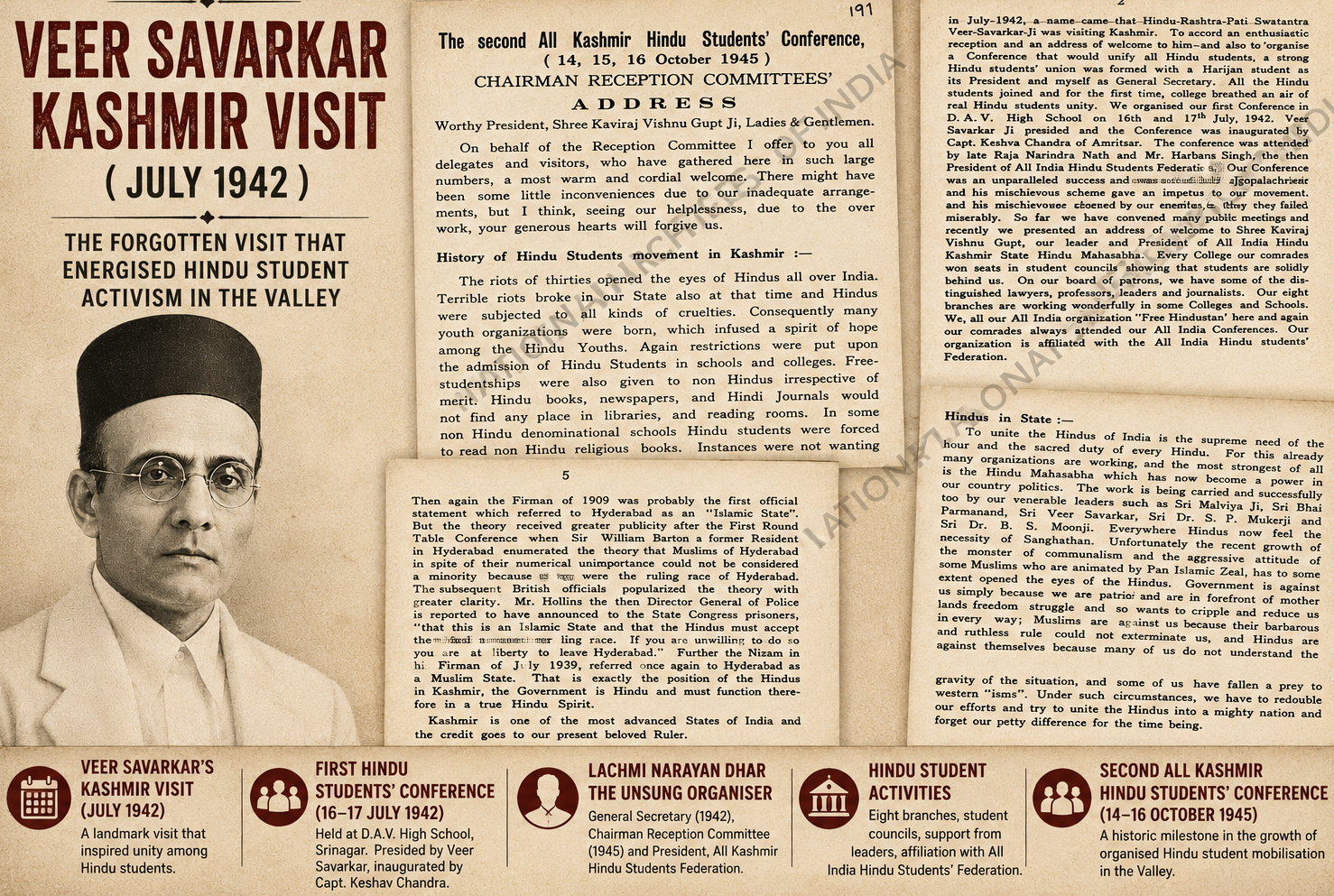
The summer of 1942 witnessed a little-known yet historically significant chapter regarding Veer Savarkar in Kashmir—a visit to Srinagar by the then President of the Hindu Mahasabha. While historians have extensively chronicled Savarkar’s national political role, his Kashmir tour and its influence on the emerging Hindu student movement in the Valley remain largely absent from mainstream narratives.
Newly examined archival material, preserved and placed in the public domain by the National Archives of India, including the proceedings of the Second All Kashmir Hindu Students’ Conference (October 14–16, 1945) and the address delivered by its Reception Committee Chairman, Lachmi Narayan Dhar, helps reconstruct this forgotten chapter of Kashmir’s socio-political history. The documents, assessed by Kashmir Rechords, not only shed light on Savarkar’s visit but also reveal the remarkable role played by a little-known Kashmiri activist whose contributions have remained largely unrecognised.
Kashmir’s Political Climate
The 1930s and early 1940s were years of intense political ferment in Jammu and Kashmir. The communal disturbances of 1931 and the subsequent political mobilisations profoundly affected the outlook of Kashmiri Hindu youth. A growing sense of insecurity, coupled with concerns regarding educational opportunities and political representation, encouraged young Hindus to organise themselves.
According to Lachmi Narayan Dhar’s address to the Second All Kashmir Hindu Students’ Conference in 1945, restrictions on Hindu students in educational institutions, perceived discrimination in scholarships and appointments, and increasing communal tensions created an atmosphere that encouraged collective action. Dhar records that the first attempt to establish a Hindu Students Federation emerged in 1938. Another student organisation followed in 1939 after tensions erupted at Sri Pratap College.
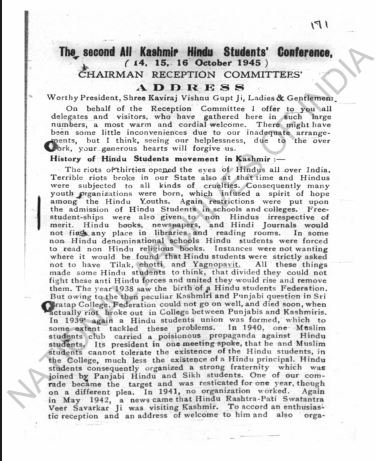
The movement gained further momentum in 1940 when Hindu students reacted to what Dhar described as anti-Hindu propaganda within educational institutions. These developments laid the foundation for a broader student mobilisation that would soon receive a major boost from an unexpected source.
When News of Savarkar’s Visit Reached Kashmir
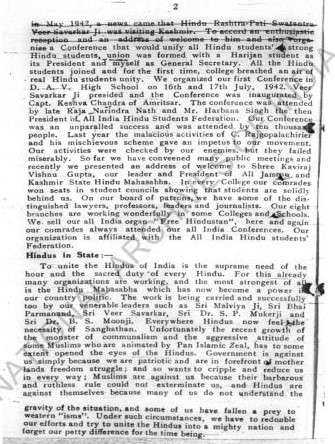
The turning point came in May 1942 when news spread that Swatantrya Veer Savarkar would be visiting Kashmir in the month of July 1942. At the time, Savarkar was among the most influential political figures associated with the Hindu Mahasabha and commanded considerable attention among Hindu youth across the country.
One of the individuals most deeply involved in preparing for the visit was a Kashmiri Pandit, Lachmi Narayan Dhar, who would later emerge as a central figure in Kashmir’s Hindu student movement. In his 1945 address, Dhar recalls how the anticipation surrounding Savarkar’s arrival inspired Kashmiri Hindu students to create a broad-based organisation capable of uniting Hindu youth across educational institutions.
Describing the developments, Dhar wrote:
“A strong Hindu Students’ Union was formed with a Harijan student as its President and myself as General Secretary.”
The statement is significant because it demonstrates that the organisers consciously sought to project social inclusiveness and broader community participation within the movement. At a time when caste divisions remained prevalent across India, the election of a“ Harijan’’ student as President reflected a deliberate attempt to present a united front.
The Forgotten Architect: Lachmi Narayan Dhar
The story of Savarkar’s Kashmir visit cannot be told without acknowledging the pivotal role played by Lachmi Narayan Dhar, one of the overlooked figures of pre-Independence Kashmir.
The archival record identifies him as General Secretary of the Hindu Students’ Union in 1942, Chairman of the Reception Committee of the Second All Kashmir Hindu Students’ Conference in 1945, President of the All Kashmir Hindu Students Federation, and a member of the Working Committee of the All India Hindu Students Federation with M.A LLB as his qualification.
Dhar was not merely an organiser. He is believed to have served as a bridge between local Kashmiri concerns and broader all-India Hindu student networks. His speeches reveal a leader deeply involved in educational reform, social mobilisation and political awareness among Hindu youth. The archival records further suggest that he maintained close contact with national leaders and played a crucial role in connecting Kashmiri students with wider national movements.
First Hindu Students’ Conference: A Landmark Gathering
The organisational work undertaken in preparation for Savarkar’s visit culminated in what appears to have been the First Hindu Students’ Conference in Kashmir. Held on 16–17 July 1942 at D.A.V. High School, Srinagar, the conference was presided over by Veer Savarkar and inaugurated by Captain Keshav Chandra of Amritsar.
According to the 1945 conference proceedings, the gathering of 1942 conference had attracted several distinguished personalities, including Raja Narindra Nath and Harbans Singh, then President of the All India Hindu Students Federation, besides numerous leaders from Punjab and Kashmir.
Lachmi Narayan Dhar described the event as an “unparalleled success” attended by nearly 10,000 people—an extraordinary figure considering the communication and transportation limitations of the period.
The conference represented one of the earliest organised attempts to connect Kashmiri Hindu students with wider all-India student and socio-political networks. It also demonstrated the growing confidence of a generation of Kashmiri Hindu youth determined to engage with national developments.
Building a Student Movement Across Kashmir
The momentum generated by the 1942 conference did not dissipate after Savarkar’s departure. Instead, it appears to have strengthened and expanded.
The proceedings of the Second All Kashmir Hindu Students’ Conference reveal that by 1945 the organisation had established eight active branches across educational institutions. It enjoyed representation in student councils and had attracted the patronage of lawyers, professors, journalists and public leaders. It was also affiliated with the All India Hindu Students Federation, linking Kashmir’s student movement to a wider national framework.
These developments indicate that the movement had evolved far beyond a single conference or personality-driven initiative. It had become an organised platform addressing educational, social and political issues affecting Hindu youth.
Savarkar’s Influence on Kashmiri Hindu Youth
The archival records indicate that Savarkar’s influence on Kashmiri Hindu students was both ideological and organisational. His visit encouraged student unity across districts, greater participation in public life, educational activism and closer engagement with national political debates.
The language employed in the 1945 conference proceedings clearly reflects the concerns that dominated sections of Hindu public discourse during the final years of British rule. Opposition to the Pakistan demand, apprehensions regarding communal politics and debates over constitutional arrangements featured prominently in the discussions. Savarkar’s call for Hindu consolidation appears to have found a receptive audience among sections of Kashmiri Hindu youth who felt politically vulnerable amid rapidly changing circumstances.
A Forgotten Chapter Deserving Wider Recognition
Today, as historians revisit the lesser-known dimensions of pre-1947 Kashmir, the story of Veer Savarkar’s visit, the pioneering efforts of Lachmi Narayan Dhar and the rise of organised Hindu student activism deserves greater scholarly attention.
The surviving conference proceedings provide a rare window into a generation of young Kashmiris who sought to shape their future at a time when the destiny of the entire subcontinent hung in the balance. They also bring into focus the contributions of individuals like Lachmi Narayan Dhar, whose role in mobilising and organising Hindu students in Kashmir has largely remained outside mainstream historical narratives.
The events of 1942 and the years that followed demonstrate that student activism in pre-Independence Kashmir was far more organised, connected and politically aware than commonly understood. As more archival material comes to light, the story of these young activists—and the leaders who inspired them—promises to add important new dimensions to the history of Jammu and Kashmir.
[To be continued… Kashmir Rechords will soon publish a detailed account of the Second All Kashmir Hindu Students’ Conference (1945), its resolutions, speeches, delegates and historical significance.]
*Dr. Rajesh Bhat is a veteran media professional, researcher and author with a Ph.D. in Journalism and Mass Communication. He has devoted considerable effort to documenting the overlooked socio-cultural, historical and archival narratives of Jammu & Kashmir. He is a co-founder of the Kashmir Rechords Foundation.