
(Kashmir Rechords Exclusive)
History often remembers wars, treaties and political speeches. Yet, hidden within the pages of a rare 1963 history book lies an extraordinary account of patriotism that has almost vanished from public memory.
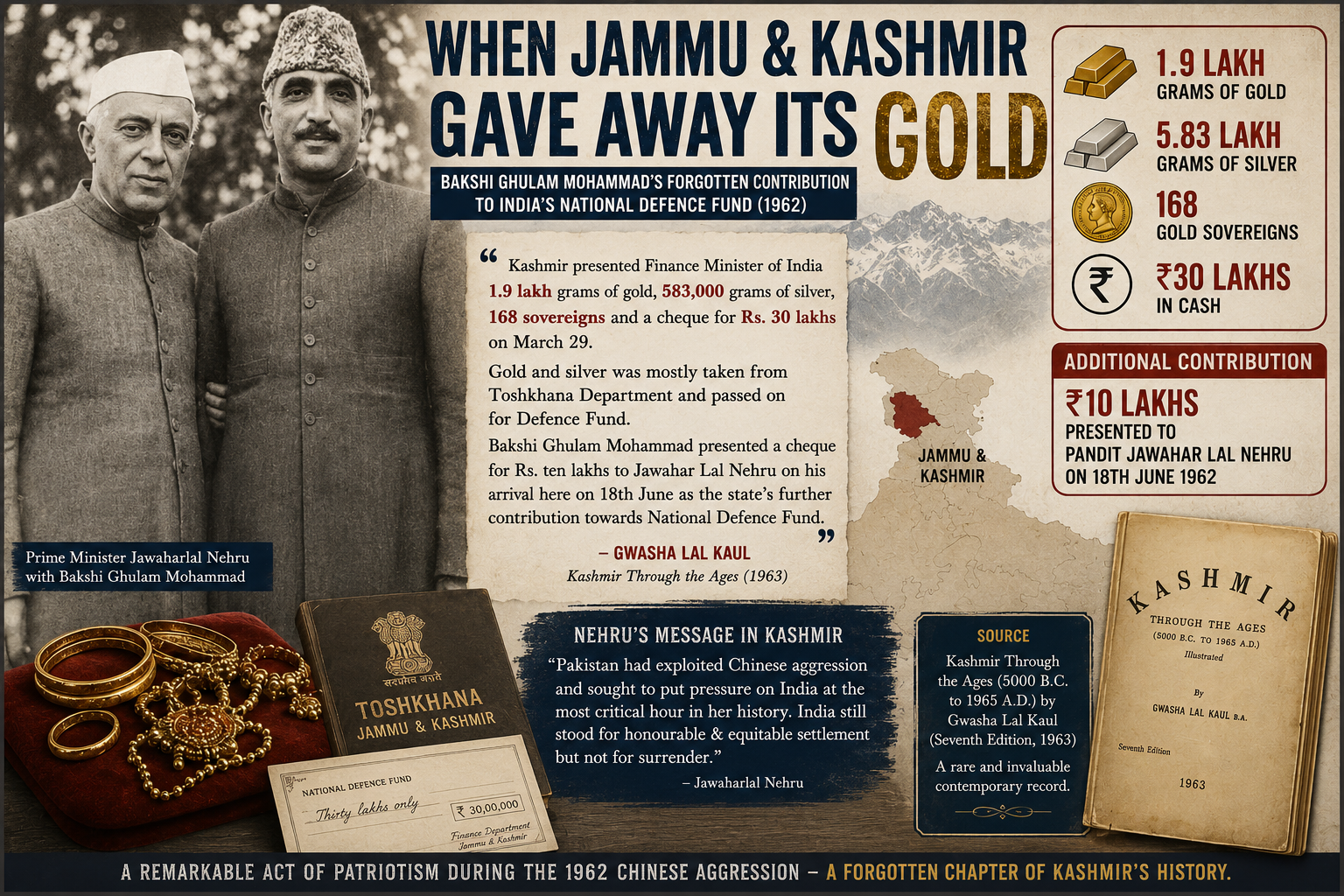
During the national emergency triggered by the Chinese aggression of 1962, the erstwhile State of Jammu & Kashmir made a remarkable contribution to India’s National Defence Fund—not merely in cash, but in gold and silver from the State Treasury itself.
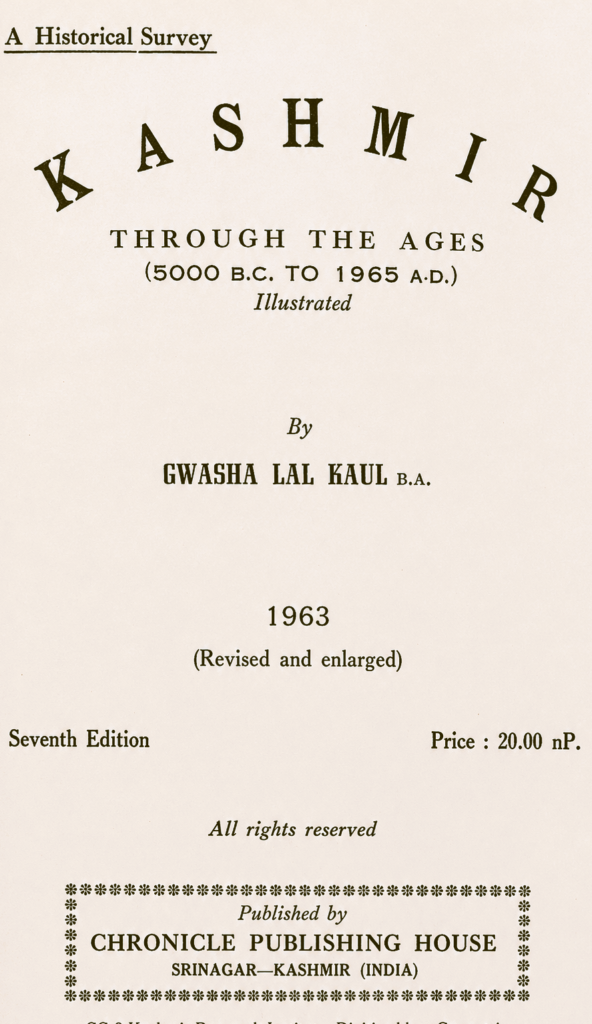
The account appears in Gwasha Lal Kaul’s rare volume Kashmir Through the Ages (5000 B.C. to 1965 A.D.), a work that has become increasingly difficult to find today. Unlike many later narratives, Kaul was not writing decades after the events. He was documenting contemporary history as someone who had personally witnessed the transformation of Jammu & Kashmir during the first two decades after Independence.
A Veteran Journalist Turned Historian
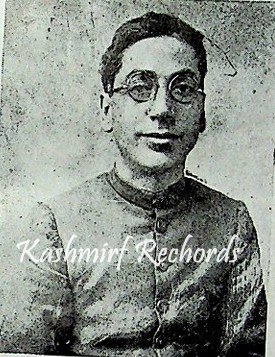
Gwasha Lal Kaul was no ordinary author. Long before writing this historical survey, he had established himself among Kashmir’s foremost journalists. He founded The Kashmir Times in 1934 and The Kashmir Chronicle in 1939, served as the President of the Kashmir Journalists’ Association, worked as correspondent for Reuters and the Associated Press of India, later became Director of News at Radio Kashmir and subsequently served in the Information Department of Jammu & Kashmir before returning to journalism. His book therefore combines the perspective of a historian with that of an eyewitness journalist.
Gold, Silver, Cash for the Nation
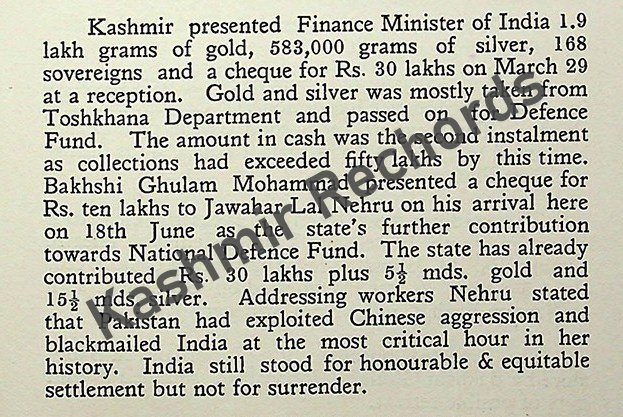
Kaul records that on 29 March, 1963 Jammu & Kashmir presented to the Finance Minister of India:
- 1.9 lakh grams of gold
- 5.83 lakh grams of silver
- 168 gold sovereigns
- A cheque of ₹30 lakh
The precious metals, he notes, were largely drawn from the Toshakhana Department and transferred to the National Defence Fund.
The financial contribution did not end there. Kaul further records that collections within the State had already crossed ₹50 lakh. Consequently, Bakshi Ghulam Mohammad later presented another cheque of ₹10 lakh to Prime Minister Jawaharlal Nehru during the latter’s visit to Jammu & Kashmir on 18 June, 1963 as an additional contribution to the National Defence Fund.
According to the author, the State had by then contributed ₹30 lakh; an additional ₹10 lakh, 5½ maunds of gold, 15½ maunds of silver, thus making it one of the most significant contributions made by any Indian state during that period.
Nehru’s Message in Kashmir
Kaul also preserves an important contemporary statement delivered by Prime Minister Jawaharlal Nehru while addressing workers during the visit. According to the book, Nehru observed that Pakistan had attempted to exploit Chinese aggression and had sought to pressure India at one of the most critical moments in its history. Despite these challenges, he reiterated that India remained committed to an honourable and equitable settlement, “but not for surrender.”
A Forgotten Chapter
Today, discussions about Jammu & Kashmir’s post-Independence history are frequently dominated by politics, conflict and constitutional developments. Yet, this episode reminds us that there was also a period when the State mobilised its financial resources—including gold and silver preserved in the Toshakhana—to support India’s national defence during a moment of external aggression.
It is a chapter that rarely finds mention in school textbooks, public commemorations or contemporary discourse.
Why This Story Matters
The significance of this episode lies not merely in the amount donated, but in what it represented. At a time when India was reeling from the 1962 Chinese invasion, Jammu & Kashmir publicly demonstrated solidarity through a substantial financial contribution that combined State resources with public collections. It reflected the political climate of the early 1960s, the functioning of the National Defence Fund, and the willingness of the State government under Bakshi Ghulam Mohammad to participate visibly in the national effort.
More Hidden Gems in Gwasha Lal Kaul’s Book
This single volume is a treasure trove for historians because it goes far beyond kings and dynasties. These scattered references, often occupying just a few paragraphs, provide fertile ground for reconstructing the social, economic and political history of Jammu & Kashmir in the decades immediately after Independence. Each deserves to be researched further using contemporary newspapers, government reports and Assembly debates.
Kashmir Rechords’ Note
Rather than treating Kashmir Through the Ages merely as another history book, it should be read as a primary contemporary source compiled by one of Kashmir’s pioneering journalists. Its value lies not only in its account of ancient history but also in preserving countless details of everyday governance, development, economics and public life in Jammu & Kashmir during the 1950s and early 1960s—details that have largely escaped modern historical writing.