
By: Dr. Rajesh Bhat*
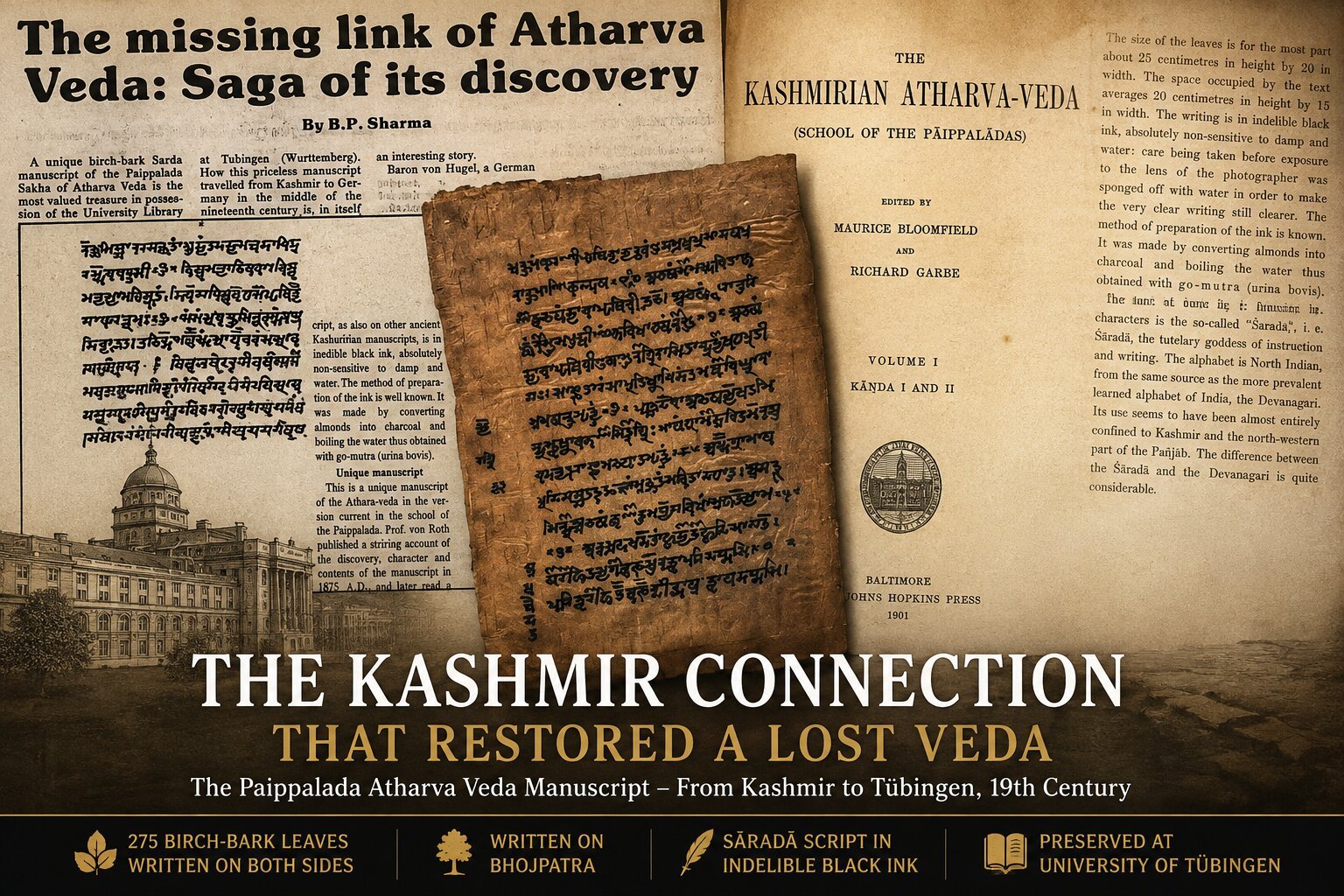
When veteran journalist and historian B.P. Sharma wrote The Missing Link of Atharva Veda: Saga of its Discovery in the Kashmir Times on September 1, 1988, he was not merely recounting the story of an ancient manuscript. He was documenting one of the greatest scholarly discoveries associated with Kashmir—one that fundamentally altered modern understanding of Vedic literature.
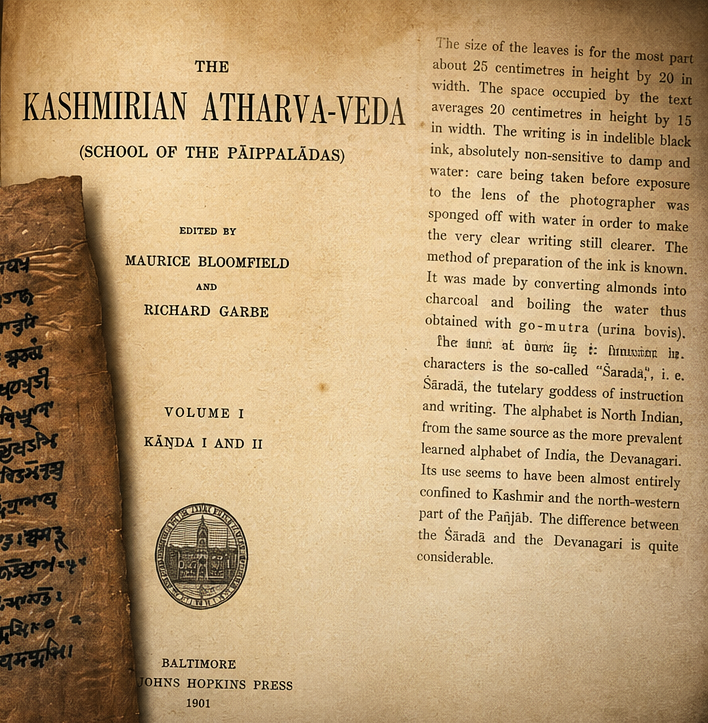
Nearly four decades later, B P Sharma’s account can now be corroborated in remarkable detail through the digitised edition of The Kashmirian Atharva-Veda (School of the Pāippalādas), published in 1901 by the Johns Hopkins Press under the editorship of Maurice Bloomfield and Richard Garbe, reproduced directly from the original birch-bark manuscript preserved at the University Library of Tübingen, Germany. The 1,088-page publication, now available through Google Books, stands as one of the most important documentary records of Kashmir’s contribution to world scholarship.
The Lost Branch of the Fourth Veda
For centuries, scholars recognised two principal recensions (Śākhās) of the Atharva Veda:
- the Śaunakīya, which remained in circulation; and
- the Paippalāda, long believed to have disappeared.
European Indologists knew of the Paippalāda recension only through scattered references in ancient commentaries. No complete manuscript was available, making it one of the greatest unresolved questions in Vedic philology.
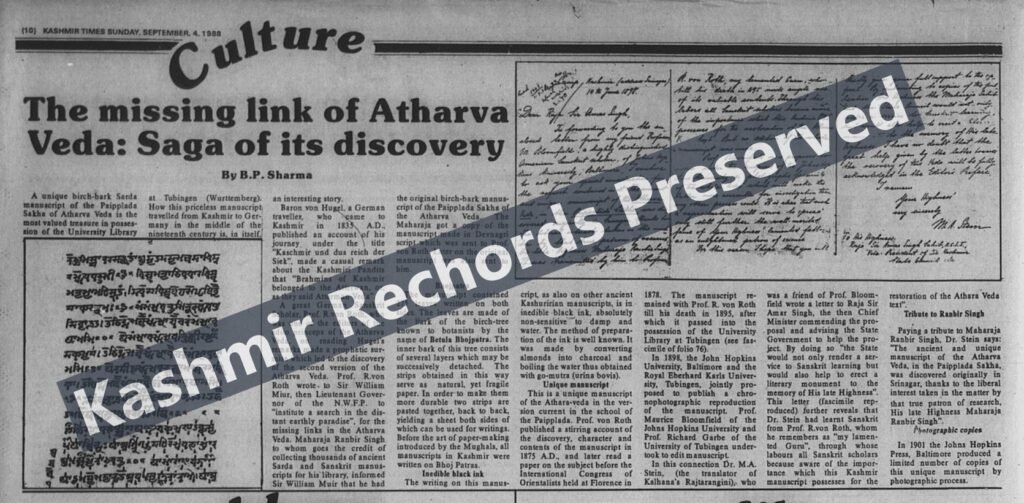
B.P. Sharma, fondly remembered as ‘Walking Encyclopaedia of J&K’’, accurately described it as the “missing link” in Atharva Vedic studies—a description entirely consistent with the historical record preserved in Bloomfield and Garbe’s monumental publication.
Baron von Hügel’s Observation that Changed Vedic Studies
The story begins in 1833, when Austrian-German traveller Baron Charles von Hügel visited Kashmir. During his travels he recorded an intriguing statement made by Kashmiri Pandits—that they followed what they pronounced as the “Alterman Veda,” rather than the Atharvan tradition known elsewhere in India.
Although seemingly anecdotal, this observation caught the attention of the eminent German Sanskrit scholar Professor Rudolf von Roth, who suspected that Kashmir might still preserve an otherwise lost recension of the Atharva Veda.
B P Sharma’s article recounts this episode, and the introductory chapters of The Kashmirian AtharvaVeda confirm that von Hügel’s observation became one of the earliest clues leading scholars towards Kashmir’s manuscript tradition.
Maharaja Ranbir Singh’s Search for the Manuscript
The most significant contribution, however, came from Maharaja Ranbir Singh (1857–1885). According to Sharma, Sir William Muir, then Lieutenant-Governor of the North-Western Provinces, appealed to the Maharaja to search his vast collection of Sanskrit manuscripts for evidence of the missing recension.
The request was hardly accidental. Maharaja Ranbir Singh had established one of the richest manuscript collections in Northern India, acquiring thousands of Sanskrit, Śāradā and Persian manuscripts from scholars across Kashmir and adjoining Himalayan regions.
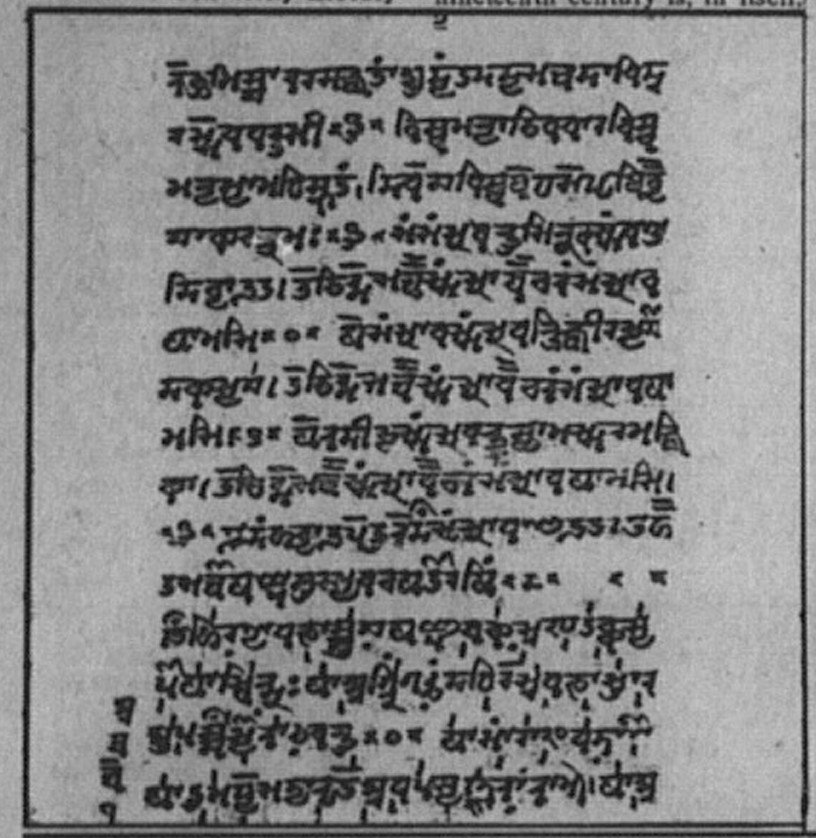
The search proved successful. Among these collections lay a complete Śāradā-script birch-bark manuscript of the Paippalāda recension.Bloomfield and Garbe acknowledge in their publication that the manuscript originated in Kashmir and reached European scholarship through the enlightened patronage of Maharaja Ranbir Singh.
The Devanagari Transcript
One of the most important details mentioned by B P Sharma is that the Maharaja did not immediately despatch the fragile birch-bark manuscript abroad.Instead, scholars first prepared a Devanagari transcript, which was sent to Professor Rudolf von Roth for examination.Only afterwards was the original manuscript forwarded.
This careful process reflects the scholarly seriousness with which the Dogra court treated the manuscript and its preservation.
Written on Kashmir’s Famous Bhojpatra
The manuscript itself represents the finest tradition of Kashmiri manuscript culture.
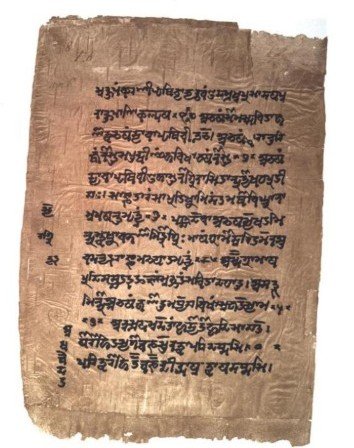
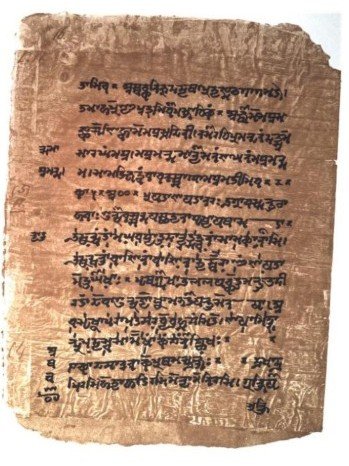
As B P Sharma in his article describes, and as confirmed in the 1901 publication, the manuscript consists of approximately 275 birch-bark folios, written on both sides in the Śāradā script using indigenous black ink. The bark was obtained from the Himalayan Betula utilis (Bhojpatra) tree, whose thin inner bark had served as Kashmir’s principal writing material for centuries before the widespread adoption of paper.
Its survival is itself extraordinary. Birch bark is highly susceptible to humidity and mechanical damage, making the preservation of a complete Vedic recension exceptionally rare.
Rudolf von Roth’s Historic Recognition
Professor Rudolf von Roth quickly realised that the manuscript represented one of the greatest discoveries in Sanskrit studies. His publications announced to the academic world that the supposedly lost Paippalāda Śākhā had survived in Kashmir.
The discovery challenged long-held assumptions regarding the textual history of the Atharva Veda and opened entirely new avenues of comparative Vedic research.
Aurel Stein’s Tribute to Kashmir
Another remarkable episode highlighted by B P Sharma concerns Sir Marc Aurel Stein, whose archaeological work transformed the study of Kashmir’s past.
Stein not only appreciated the manuscript’s textual importance but also wrote to Raja Amar Singh, urging the Jammu and Kashmir administration to support its publication and to honour Maharaja Ranbir Singh’s contribution to Sanskrit scholarship.
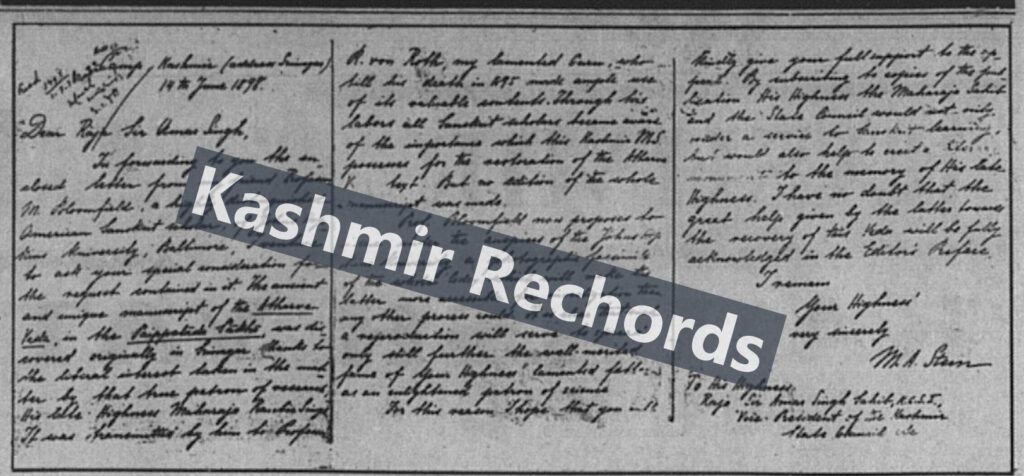
Stein reportedly described the manuscript as indispensable for the restoration of the Atharva Veda, crediting Maharaja Ranbir Singh’s patronage for making the discovery possible.
This correspondence illustrates how nineteenth-century European scholarship acknowledged Kashmir’s own role in preserving India’s classical heritage.
Johns Hopkins, Tübingen Preserve Kashmir’s Legacy
In 1898, Maurice Bloomfield, Richard Garbe and the Universities of Johns Hopkins and Tübingen initiated an ambitious project to reproduce the manuscript by chromophotography, then one of the most advanced methods of documentary reproduction.The resulting publication appeared in 1901 under the title The Kashmirian Atharva Veda.
Rather than merely printing the Sanskrit text, the editors reproduced photographic plates of the original birch-bark folios, enabling scholars worldwide to study the manuscript exactly as preserved in Kashmir. The work remains one of the earliest large-scale photographic reproductions of an Indian manuscript.
Why the Discovery Changed Indology
The publication had profound implications.
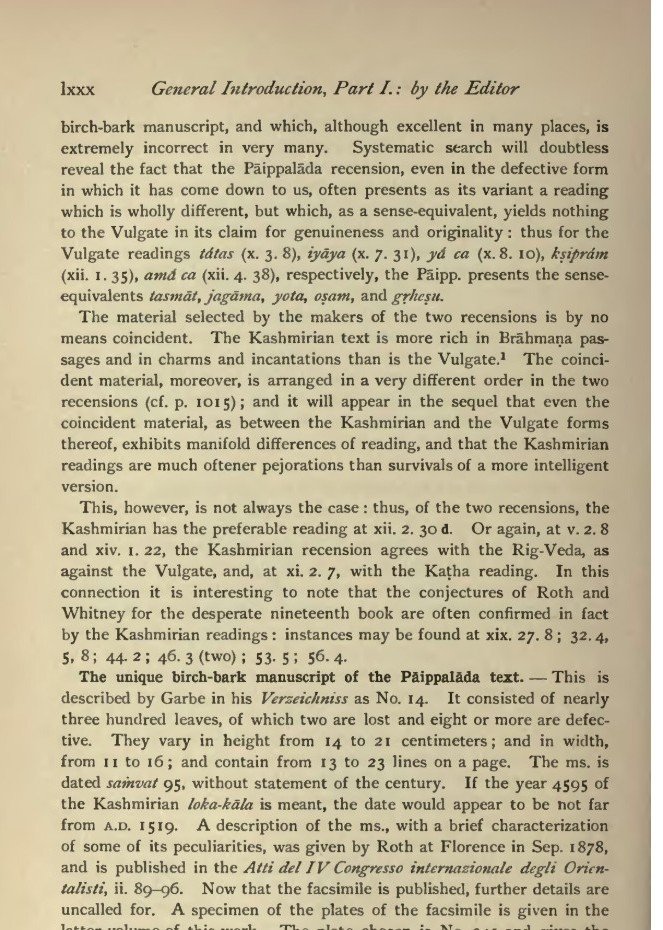
For the first time, scholars could compare the Paippalāda and Śaunakīya recensions of the Atharva Veda in detail. Differences in arrangement, wording and preservation revealed that the Kashmir manuscript preserved an independent textual tradition rather than merely a variant copy.
Maurice Bloomfield later incorporated these findings into his broader studies of the Atharva Veda, acknowledging the Kashmir manuscript as indispensable for reconstructing the textual history of the fourth Veda.
B.P. Sharma’s Enduring Contribution
B.P. Sharma deserves recognition not only for narrating this remarkable story but for introducing it to a wider readership in Jammu and Kashmir at a time when manuscript heritage rarely featured in public discourse.
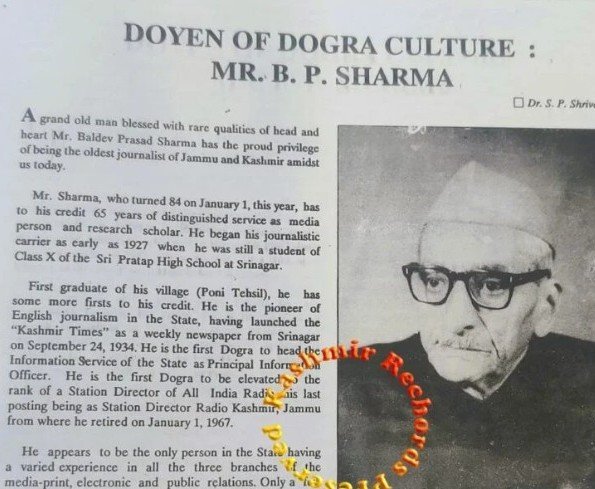
His article anticipated many of today’s efforts to reclaim Kashmir’s intellectual history. Rather than presenting the discovery merely as an episode in European Indology, Sharma correctly placed Kashmir, its Pandit scholars and Maharaja Ranbir Singh at the centre of the narrative.
Today, with The Kashmirian Atharva-Veda freely accessible in digital form through Google Books, readers can verify virtually every major episode recounted in Sharma’s article—from Baron von Hügel’s observations and Rudolf von Roth’s scholarship to Aurel Stein’s correspondence and the pioneering 1901 chromophotographic edition.
The rediscovery of the Paippalāda Atharva Veda was not merely the recovery of an ancient manuscript; it was the restoration of an entire branch of India’s Vedic tradition. The journey of the manuscript—from the manuscript repositories of Srinagar to Tübingen, and from there to one of the most celebrated publications in Oriental studies—stands as a testament to Kashmir’s role as one of the great custodians of India’s civilisational heritage.
Read together, B.P. Sharma’s 1988 Kashmir Times article and Bloomfield and Garbe’s 1901 scholarly edition present a compelling narrative: that the preservation of one of the world’s oldest sacred texts owed as much to the custodianship of Kashmiri scholars and the enlightened patronage of Maharaja Ranbir Singh as it did to the painstaking efforts of European Indologists. Their combined testimony firmly establishes Kashmir not only as a land of spiritual traditions but also as a vital centre in the global history of manuscript preservation and Vedic scholarship.
*Dr. Rajesh Bhat is an eminent journalist, media researcher, and former senior Officer with Prasar Bharati. Holding a Ph.D. in media and strategic studies , he has authored several books—including Radio Kashmir: In Times of Peace & War—and regularly documents the cultural, historical and archival heritage of Jammu and Kashmir.