
Kashmir Rechords Exclusive
Perhaps Muhammad Ali Jinnah was trying to build castles in the air—or, more literally, acquire one of Kashmir’s famous floating residences.
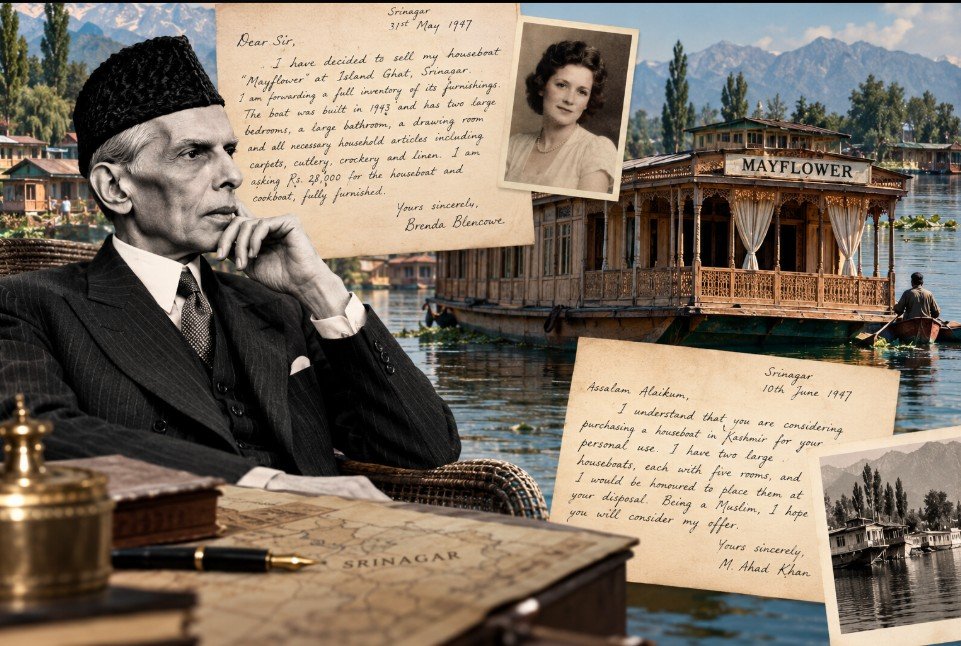
In June 1947, barely two months before the end of British rule in India, Jinnah was receiving correspondence concerning the possible purchase of houseboats in Srinagar. One offer came from Brenda Blencowe, the owner of a furnished houseboat named Mayflower. Another came directly from M. Ahad Khan, a local Kashmiri Muslim who offered Jinnah two houseboats of his own and explicitly invoked their shared religious identity.
The second letter adds a significant dimension to this little-known episode. It was not simply a property owner attempting to sell a houseboat to a prominent prospective buyer. Ahad Khan’s appeal was framed, at least in part, around the fact that both men were Muslims.
Was Jinnah contemplating a residence in a Kashmir that he expected might join Pakistan? The timing makes the question difficult to ignore. Yet the surviving correspondence does not establish that political expectation as his motive, nor does it prove that the proposed purchases were abandoned because Jammu and Kashmir eventually acceded to India.
What the documents establish is that, in the decisive months of 1947, Jinnah was being approached with multiple houseboat offers in Srinagar.
A Kashmiri Muslim who appealed directly to Jinnah
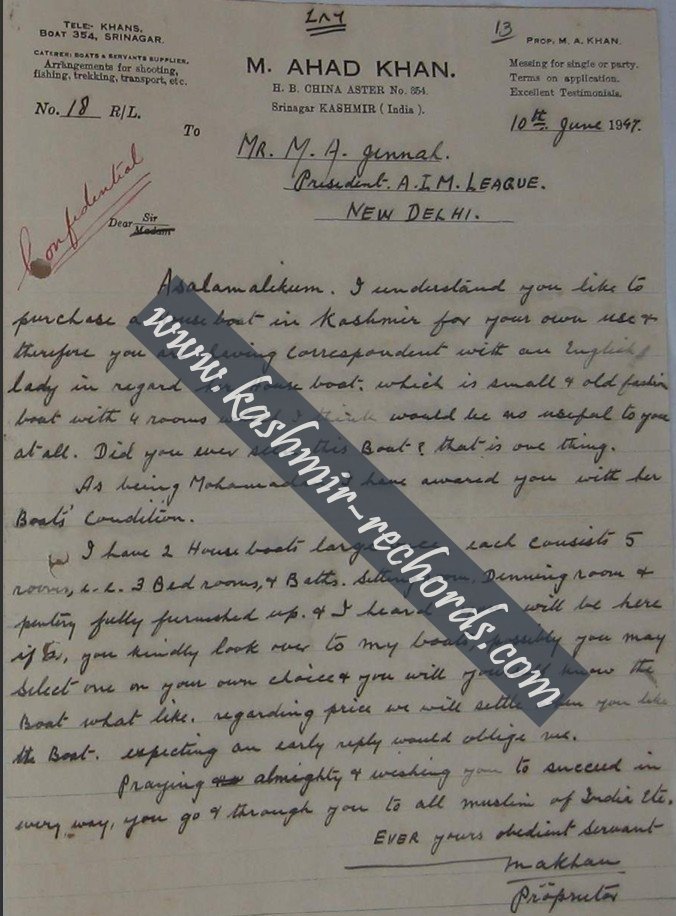
The most revealing document (a facsimile copy of which is preserved by Kashmir Rechords ) is a handwritten letter dated June 10, 1947, addressed to M. A. Jinnah, President of the All-India Muslim League, in New Delhi.
Its author, M. Ahad Khan of Srinagar, opened with the greeting “Assalam Alaikum” and referred to his understanding that Jinnah was contemplating purchasing a houseboat in Kashmir for his personal use.
Ahad Khan then made his own offer.
According to the letter, he possessed two large houseboats, each comprising five rooms. He described their accommodation and furnishings and indicated that the vessels could be considered for Jinnah’s requirements. He wanted to know whether Jinnah had already seen the boats and whether he might be interested in purchasing one of them.
Ahad Khan’s appeal was framed, at least in part, around the fact that both men were Muslims. This was not an incidental detail in the letter. It formed part of the personal appeal through which a local Kashmiri sought to secure the attention and confidence of one of the most consequential political figures of the period.
The most telling aspect of the communication is Ahad Khan’s reference to their shared religious identity. He explicitly invoked being a Muslim while placing the matter before Jinnah.
This was not an incidental detail in the letter. It formed part of the personal appeal through which a local Kashmiri sought to secure the attention and confidence of one of the most consequential political figures of the period.
The letter, therefore, deserves attention in its own right. It records a local property owner approaching the president of the Muslim League, offering his houseboats and invoking a shared Muslim identity in the process.
It does not, however, establish that Jinnah accepted the offer or that the appeal was made on his behalf by any political organisation.
Another offer: Brenda Blencowe’s Mayflower
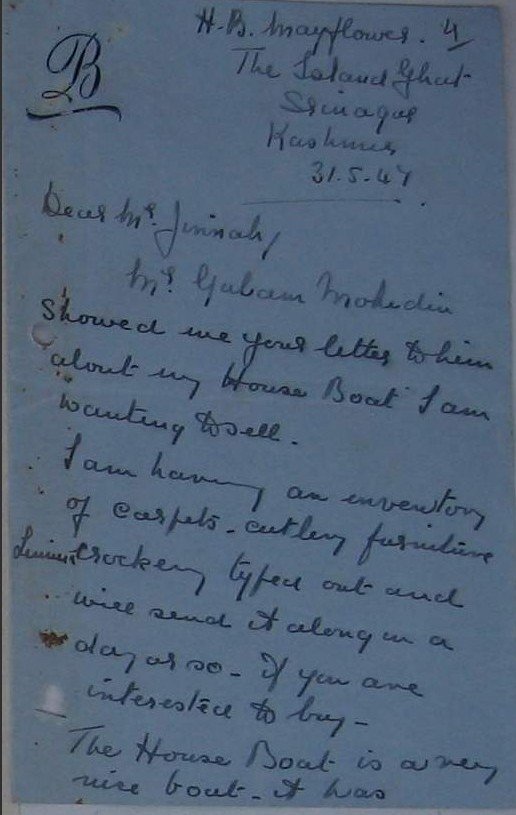
The related documents also contain correspondence concerning a houseboat called Mayflower, owned by Brenda Blencowe at Island Ghat, Srinagar.
In a handwritten letter dated May 31, 1947, Blencowe explained that she wished to sell the vessel and was preparing an inventory of its contents. Her description presented the Mayflower as a substantial furnished residence rather than a modest boat.
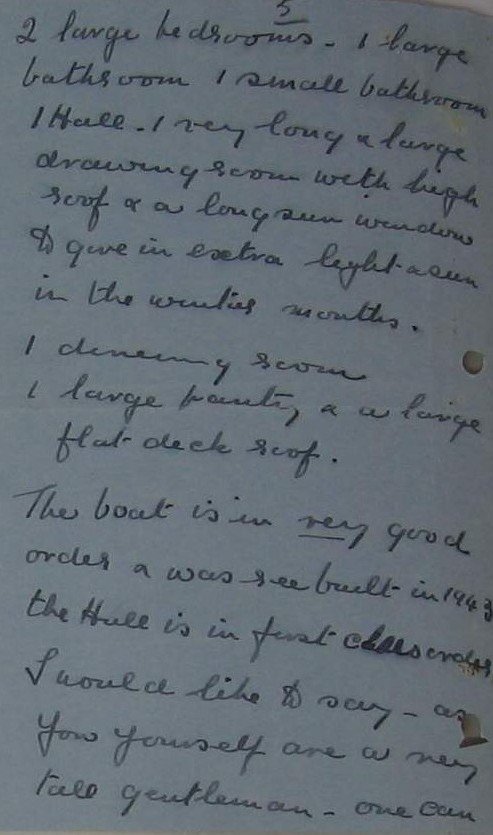
Built in 1943, it had two large bedrooms, a large bathroom, a smaller bathroom, a hall and a spacious drawing room. Blencowe also referred to the boat’s construction, condition and domestic furnishings.
I
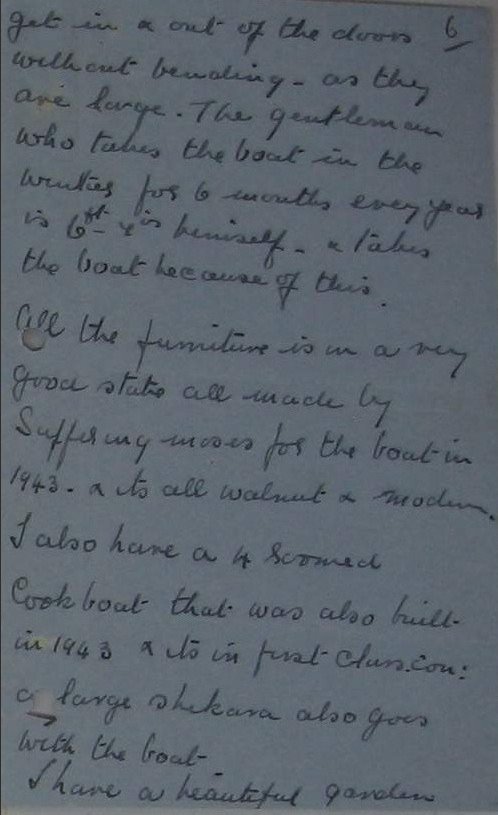
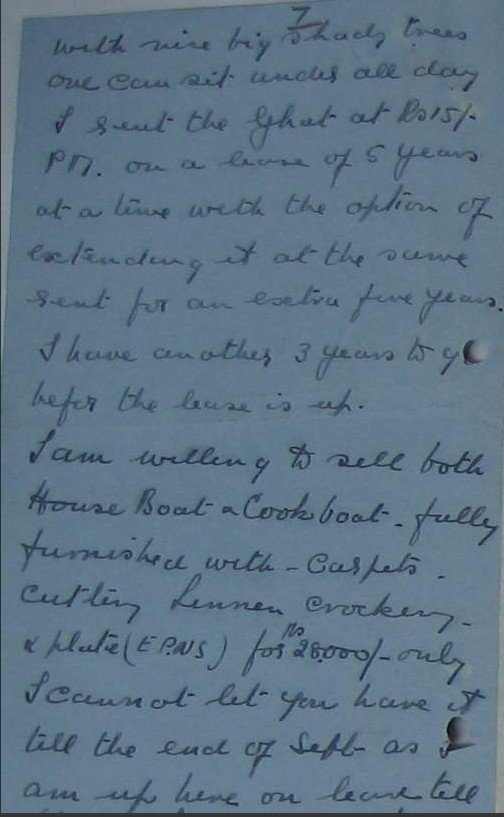
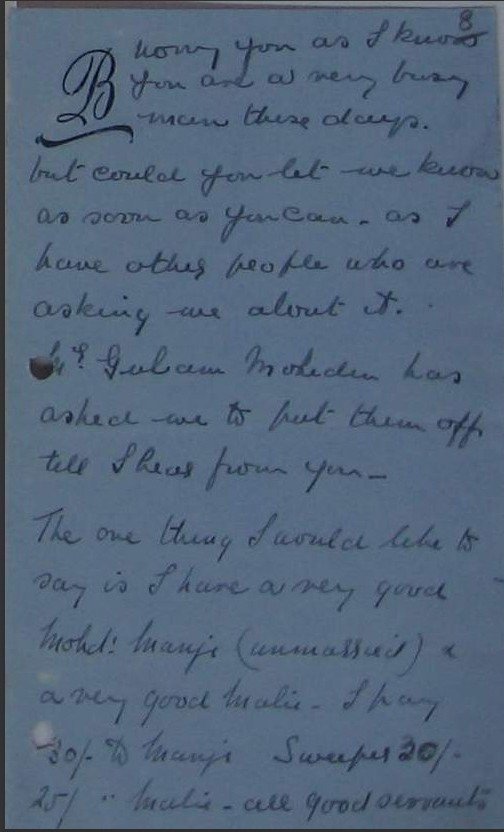
The proposed sale included carpets, cutlery, crockery, linen and other household articles. A cookboat was also included in the offer.
Blencowe quoted Rs 28,000 for the houseboat and cookboat, fully furnished.
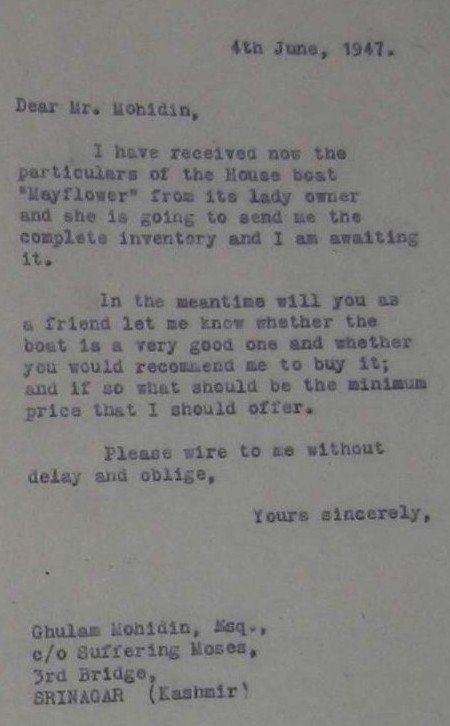
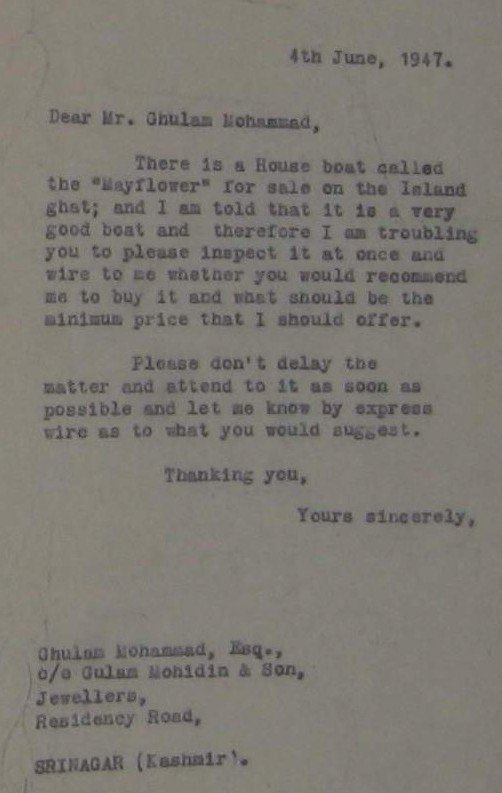
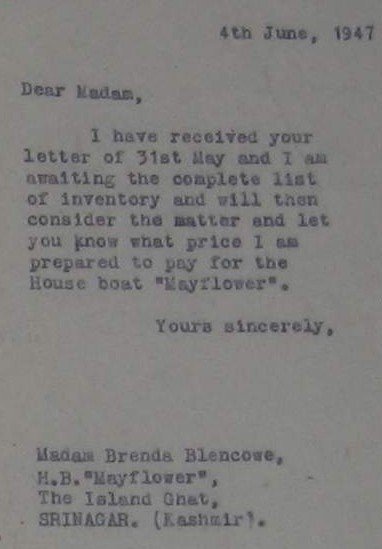
Her correspondence was followed by letters dated June 4, 1947 concerning the preparation of a complete inventory and an assessment of the vessel’s condition. The prospective purchaser wanted advice on whether the Mayflower was a suitable acquisition and what minimum price should be offered.
These letters reveal the practical details of a proposed transaction: the condition of the vessel, its contents, the price and the need for advice before committing to a purchase.
The documents do not establish that Blencowe’s offer was accepted.
Two sellers, one prospective buyer
Read together, the correspondence concerning Ahad Khan’s houseboats and Blencowe’s Mayflower presents a more complete picture of the episode.
Jinnah was being approached through different channels. Blencowe’s letters described a furnished houseboat she wished to sell, while Ahad Khan’s communication directly offered two boats belonging to a local Kashmiri Muslim.
The two approaches were different in tone. Blencowe’s correspondence was principally concerned with the property, its furnishings, inventory and price. Ahad Khan’s letter combined an offer of property with an appeal grounded in shared religious identity.
This contrast is among the most interesting features of the archival record.
It also cautions against treating the episode as a single, straightforward negotiation for one particular vessel. The file preserves multiple offers and inquiries, but does not establish which, if any, Jinnah ultimately preferred.
Was Kashmir expected to become part of Pakistan?
The correspondence acquires a wider significance when placed against the political circumstances of June 1947.
The Partition plan had been announced, British rule was approaching its end, and the Princely States faced decisions about their future relationships with India and Pakistan. Jammu and Kashmir had not yet acceded to either dominion.
Jinnah, as president of the All-India Muslim League, was central to the political developments surrounding Partition. His interest in acquiring a houseboat in Srinagar, therefore, raises a natural question: did he imagine spending time in Kashmir in the expectation that the State might eventually join Pakistan?
Ahad Khan’s explicit reference to their shared Muslim identity makes the question particularly evocative. It demonstrates that the prospective transaction was being presented to Jinnah by a local Muslim in terms that went beyond a purely impersonal commercial approach.
But the distinction between evidence and inference must be maintained. The letter does not state that Jinnah intended to purchase the houseboat because of Kashmir’s anticipated accession to Pakistan. Nor does it establish that Ahad Khan’s offer was connected to an official political strategy.
What happened to the proposed purchases?
The surviving correspondence records inquiries, offers and requests for further particulars. It does not conclusively establish that Jinnah purchased the Mayflower or either of Ahad Khan’s houseboats.
Likewise, it would be premature to claim that the proposals were abandoned specifically because Kashmir acceded to India in October 1947. The absence of a completed transaction in the available papers does not, by itself, establish why the negotiations did not proceed.
The identity and background of Brenda Blencowe also remain insufficiently established by the documents examined here. Her letter confirms her role as the Mayflower’s owner and prospective seller, but does not independently establish her nationality or whether she was a prominent public personality.