
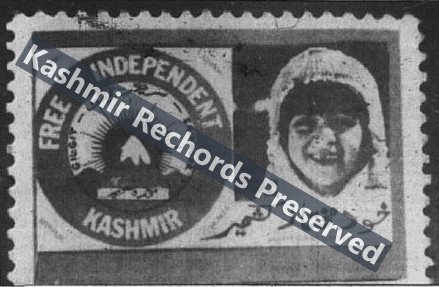
(Kashmir Rechords Exclusive)
SRINAGAR: At the beginning of the armed insurgency in 1989–90, the outlawed Jammu Kashmir Liberation Front (JKLF) sought to project itself as the force that would create an ‘Independent Kashmir’.
The symbolism was extraordinary. Militants reportedly forced people in parts of the Valley to set their watches to Pakistan Standard Time—a powerful psychological assertion that Kashmir was slipping out of India’s control. The practice was also recorded in contemporary official material and raised in Parliament in August 1990.
At the same time, the ‘JKLF’ reportedly looked towards Radio Kashmir Srinagar as a crucial instrument of the emerging struggle. Control of the powerful broadcasting station would have meant control of the microphone through which an alternative political authority could potentially announce itself to millions. But their designs were scuttled.
For a while, the Valley appeared to be witnessing the making of a new political order: Pakistan time on the watches, ‘Azadi’ in the streets and an ‘Independent Kashmir’ as the proclaimed destination.
But Pakistan’s growing support for pro-Pakistan militant organisations, particularly Hizbul Mujahideen, complicated the JKLF’s project. The insurgency increasingly became a contest not only against the Indian State but also over what Kashmir itself was supposed to become—independent or part of Pakistan.
It was amid this contest for political space that the ‘JKLF’ produced one of its most unusual propaganda symbols.
A country on paper
In August 1990, the JKLF, under its Acting ‘Commander-in-Chief’ Javed Ahmad Mir, reportedly brought out a postal-style stamp representing ‘Independent Kashmir’.
The episode was prominently reported in August 23, 1990 issue of Kashmir Times, which also carried a photograph of the stamp.
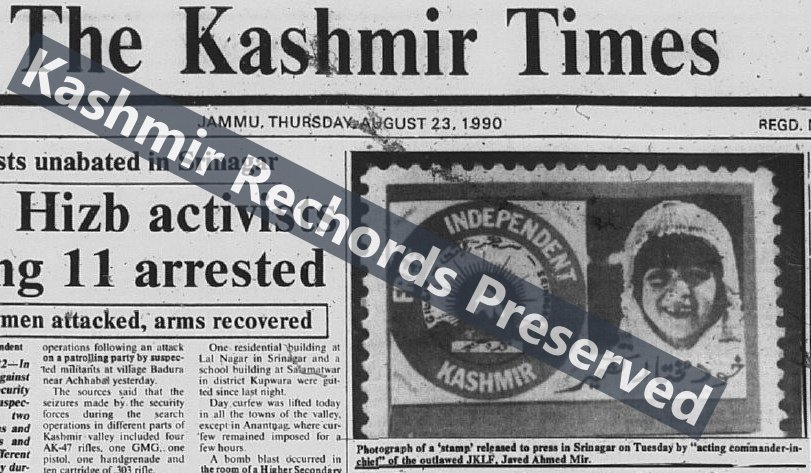
The design was striking: a child, accompanied by the words “FREE INDEPENDENT KASHMIR”, along with the Urdu inscription “Khud-Mukhtaar Kashmir”—self-governing or independent Kashmir.
The symbolism was unmistakable. The child represented the future; the stamp represented the ‘State the JKLF’ claimed it was fighting to create.
But this was not a recognised postage. It was a political/propaganda representation of a state that did not exist.
Yet newspapers gave the symbol a much larger public life. By reproducing the stamp, the press effectively amplified a militant publicity exercise, giving an imagined state the visual trappings of sovereignty.
Irony of the ‘Azadi’ dream
The irony was that while ‘JKLF’ was printing an ‘Independent Kashmir’ on paper and asking people to follow Pakistan time, the Valley was rapidly descending into violence.
Killings, kidnappings, threats and militant diktats spread. Kashmiri Pandits were driven into exile, while ordinary Kashmiris—Muslim and Hindu alike—were caught in a conflict whose human cost would last for decades.
A clock could be changed. A Radio Station could be targeted. A stamp could be printed. But an ‘Independent Kashmir’ could not be created through symbols
The stamp, therefore, survives as more than a philatelic curiosity. It is an archival snapshot of how the ‘JKLF’ attempted to manufacture the imagery of Statehood before possessing the institutions of a state.
The stamp promised a country. History delivered a conflict.
Lesson for Kashmir’s youth
For the youth of Kashmir, the episode remains a sobering lesson in how political emotions can be harnessed to sell impossible dreams. Pakistan and ‘JKLF’ projected competing visions—one of Kashmir’s socalled merger with Pakistan, the other of an ‘Independent Kashmir’—while thousands of young people were drawn into a conflict whose promises could never overcome the political, military and geopolitical realities surrounding Jammu and Kashmir. The dream of defeating a country of India’s scale and establishing a new State through militancy proved unattainable, while its pursuit brought violence, displacement, lost opportunities and generations of uncertainty. The lesson of history is that Kashmiris paid an enormous price for dreams that armed movements could promise, but could never deliver.
Average Kashmiri was sold a dream that was never attainable. It is rumored in certain circles that the central government had all but given up on Kashmir. Government of India did not take up any steps to secure place for Kashmiri Pandits banished from Kashmir. This signal strengthened resolve of separatists who vehemently opposed any effort to rehabilitate Kashmiri Pandits. These separatists were soon joined by mainstream politicians. A farce was created by these anti nationals that they were not against the return of Kashmiri Pandits but they return to same places where their houses were just burned and where they were beaten, raped and maimed. In other words go back to lion’s den. This was adding salt to wounds. Again government of India remained still and yielded more space to murderer separatists. Yes there were good Muslims who were muzzled to stay mute amidst thus wholsale campaign to deliver Kashmir to the Islamic state of Pakistan.
Romesh khardori