
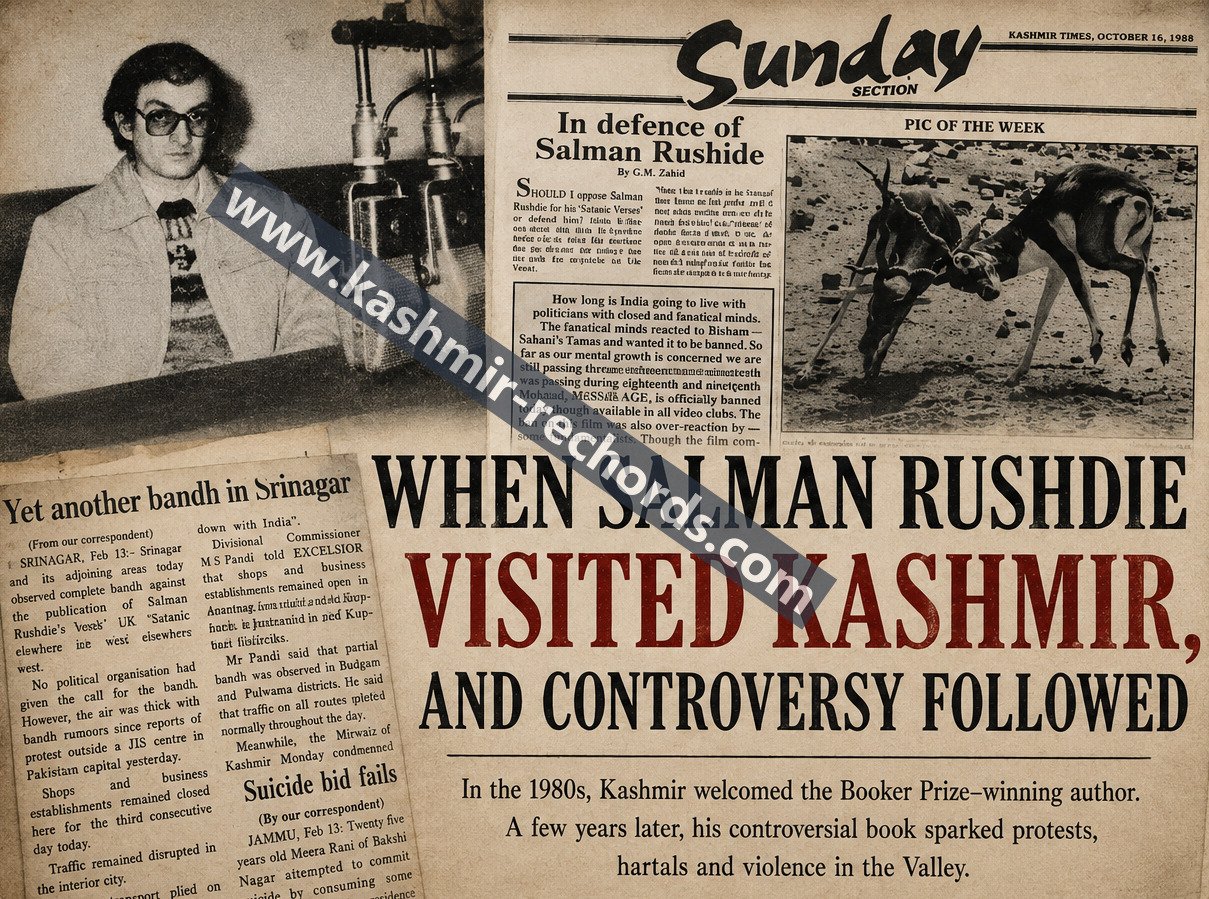
(Kashmir Rechords Exclusive)
Today, the name Salman Rushdie evokes memories of one of the most controversial episodes in modern literary history. For many, it is inseparable from The Satanic Verses, worldwide protests, a fatwa, and decades of security threats that followed.
Yet few remember that years before the controversy engulfed his life, Rushdie was welcomed in Kashmir as an internationally acclaimed novelist, interviewed by Radio Kashmir Srinagar, and greeted warmly by students at one of the Valley’s most prestigious colleges.
That forgotten chapter, preserved today through rare photographs and newspaper archives, tells the story not only of Salman Rushdie but also of a Kashmir that was intellectually vibrant, culturally confident and deeply connected with the world of ideas.
A Booker Prize Winner in Kashmir
It was May 1983.Salman Rushdie had already achieved international fame after winning the Booker Prize for his landmark novel Midnight’s Children, a work widely regarded as one of the finest novels written in English in the twentieth century. The novel had brought India and its complex history to the forefront of world literature, making Rushdie one of the most celebrated writers of his generation.
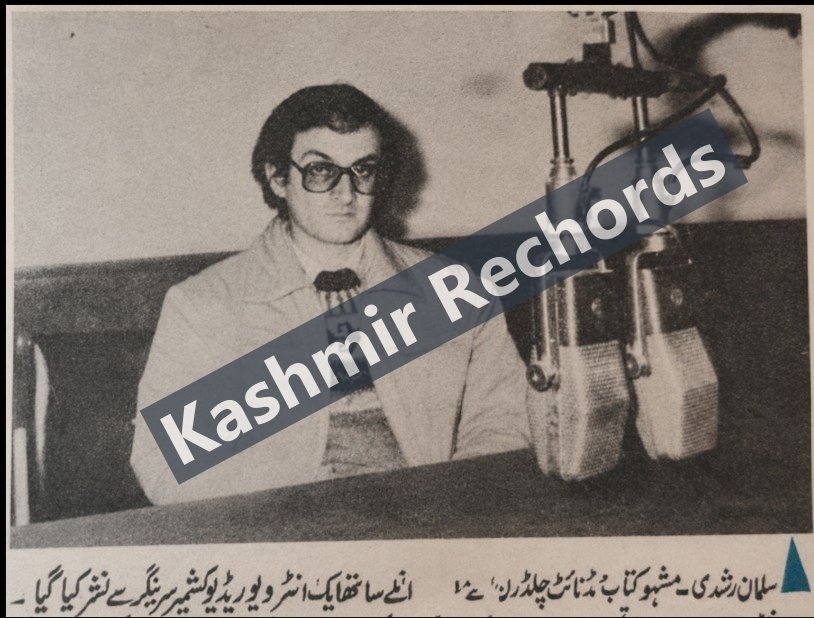
During his visit to Kashmir that year, Rushdie was interviewed at Radio Kashmir Srinagar, where he spoke about Midnight’s Children, literature and contemporary writing.
Among the rare archival treasures preserved by Kashmir Rechords is a remarkable photograph showing Rushdie seated before the microphones inside the studios of Radio Kashmir. It is more than a photograph—it is visual testimony to an era when Kashmir welcomed some of the world’s leading literary voices into its premier broadcasting institution.
Rushdie’s visit extended beyond the radio station.
He also visited the historic Sri Pratap (SP) College, Srinagar, where he interacted with students and members of the faculty. His visit generated considerable enthusiasm among young readers, and the college later published photographs of the interaction in its annual magazine. Those images remain an enduring reminder of a Kashmir where internationally acclaimed writers could freely engage with students and scholars.
When Rushdie sat before the Radio Kashmir microphones in 1983, he wasn’t a figure of global political storm—he was celebrated as a master storyteller reconnecting world literature with South Asian history
The Valley that Rushdie encountered in 1983 was known not merely for its breathtaking beauty but also for its thriving literary culture. Radio Kashmir regularly hosted distinguished writers, poets, musicians and intellectuals, while colleges and universities served as centres of lively academic and cultural exchange.
Few could have imagined that within a few years everything would change.
A Book That Shook the World
On 26 September 1988, Rushdie’s novel The Satanic Verses was published in the United Kingdom.
Almost immediately, sections of the Muslim community across the world objected to passages they considered offensive to Islam. Demonstrations began in several countries, and the controversy rapidly crossed national boundaries.
Concerned about possible disturbances, the Government of India became the first government in the world to prohibit the import of the book on 5 October 1988, citing concerns over public order.
At that stage, however, Kashmir’s response was not entirely one of condemnation.
Kashmir’s Intellectual Response
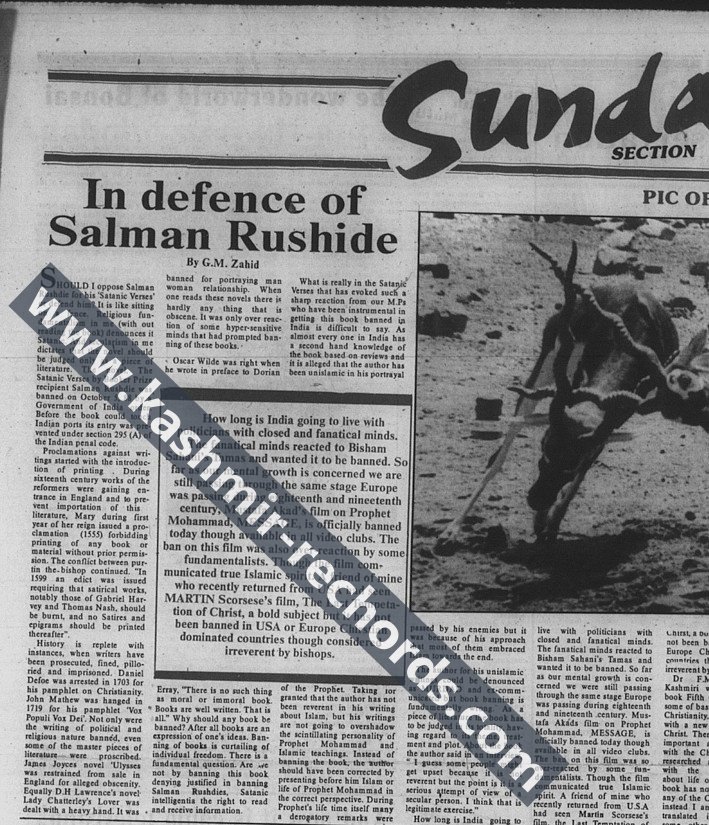
Among the archival holdings of Kashmir Rechords is the Sunday, October 16, 1988 edition of the Kashmir Times, carrying a remarkable article by eminent Kashmiri writer G. M. Zahid titled “In Defence of Salman Rushdie.”
Published at a time when the controversy was still unfolding, Zahid’s article offered a thoughtful defence of Rushdie and reflected Kashmir’s long tradition of intellectual debate. It demonstrated that even amid growing international criticism, there remained voices in the Valley that believed literature should be debated through ideas rather than emotion.
Today, that newspaper clipping has become an important historical document. It reminds us that Kashmir’s literary community did not react uniformly and that public opinion was still evolving.
From Literary Debate to Public Agitation
The controversy, however, soon moved far beyond literature.
As protests intensified across several Muslim-majority countries, the issue acquired powerful religious and political dimensions. Public demonstrations grew larger, emotions became stronger and governments across the world found themselves confronted with an increasingly volatile situation.
The turning point came in February 1989, when Ayatollah Ruhollah Khomeini issued a fatwa calling for Rushdie’s death. The controversy instantly became a global crisis.Its impact was felt in Kashmir as well.
In February 1989, the Valley witnessed widespread strikes, hartals and demonstrations against Salman Rushdie and The Satanic Verses. Thousands participated in protests across Srinagar and elsewhere.
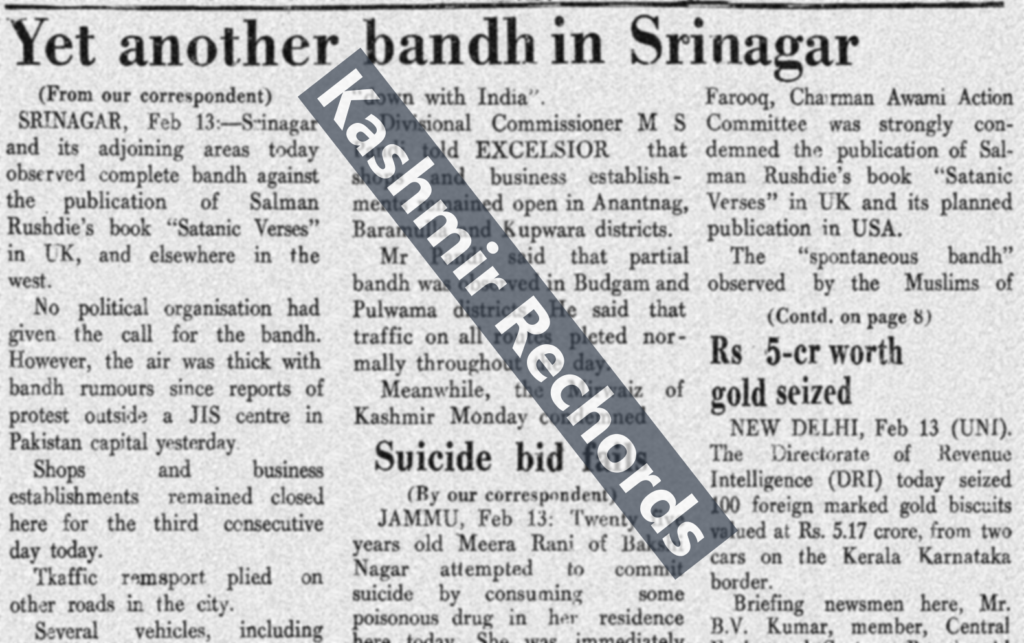
The demonstrations turned violent. During clashes with the authorities, one civilian lost his life and many others were injured, marking one of the most significant public agitations in Kashmir over an international issue. Newspapers of the time carried dramatic reports of shutdowns, processions, public anger and escalating law-and-order concerns.The transformation was extraordinary.
Within less than six years, the same author who had discussed literature inside Radio Kashmir Srinagar and interacted with students at SP College had become the focus of mass protests in the very Valley that had once welcomed him.
A Kashmir That Changed Forever
The Rushdie episode coincided with one of the most turbulent periods in Kashmir’s modern history.Only months later, the Valley descended into armed insurgency. The institutions that had once celebrated literature, culture and open dialogue found themselves operating under the shadow of violence and uncertainty. International writers no longer travelled freely to Kashmir. Public discourse changed, and the atmosphere that had encouraged intellectual engagement steadily disappeared.
The rare photograph of Salman Rushdie at Radio Kashmir Srinagar, the pages of the SP College annual magazine documenting his visit, the Kashmir Times article “In Defence of Salman Rushdie” and the newspaper reports chronicling the February 1989 protests together tell a compelling story of a society in transition.
These archives are not simply about Salman Rushdie.They are about Kashmir itself.
They remind us that before conflict came to dominate headlines, Kashmir was a place where celebrated writers were welcomed, books were discussed on public radio, students engaged with world literature and newspapers accommodated differing viewpoints—even on the most contentious issues.
For Kashmir Rechords, preserving these forgotten fragments is an effort to recover a chapter of history that deserves to be remembered in all its complexity. Together, they capture the remarkable journey of one celebrated author—and the equally remarkable transformation of a Valley whose intellectual landscape changed forever within the span of a few short years.