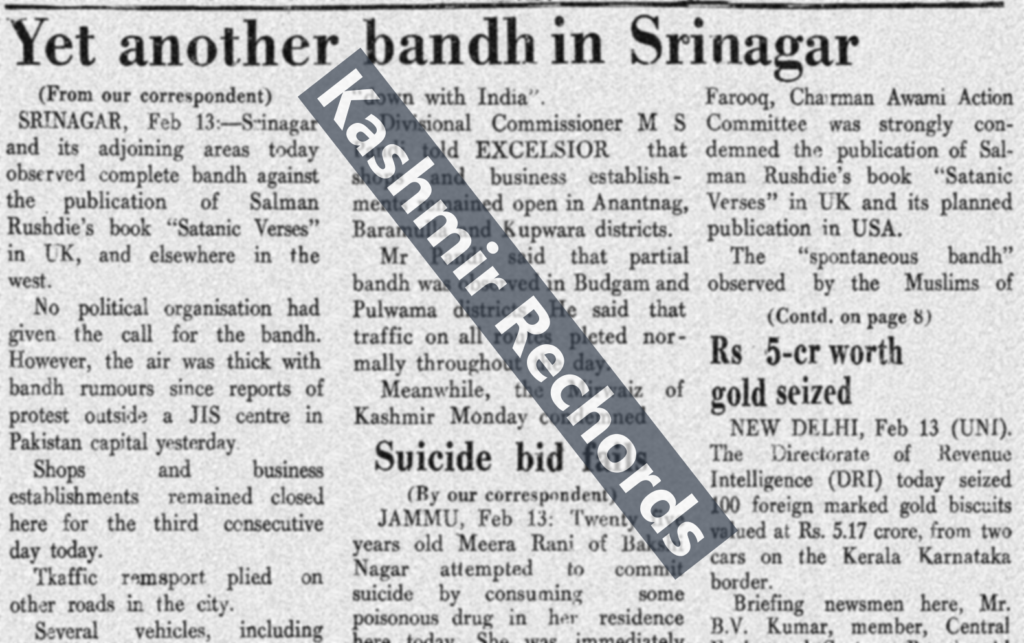
There are places where rumours travel fast. And then there is Kashmir.
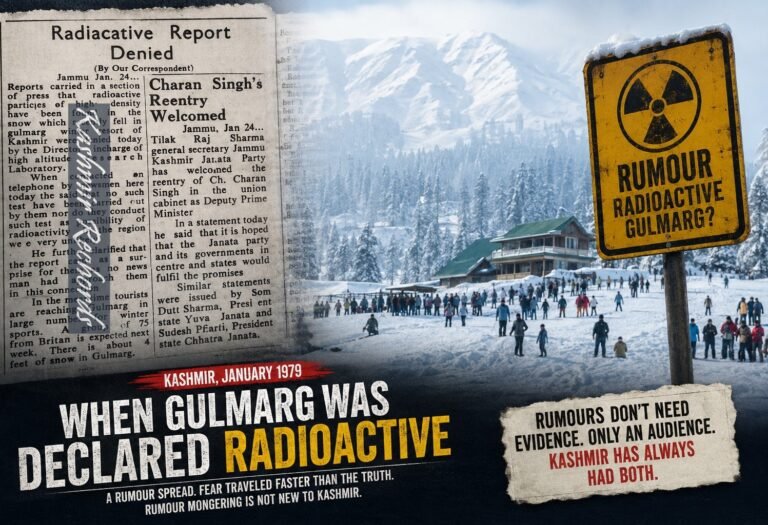
In January 1979, a bizarre rumour began circulating in the Valley: Gulmarg was witnessing the presence of radioactive substances. Snow that had recently fallen over the famed winter resort was said to possess “radioactive properties”. The story was alarming enough to find its way into sections of the press, creating apprehension at a time when Gulmarg was drawing tourists for its winter sports.
The scare became serious enough for the authorities to issue a denial.
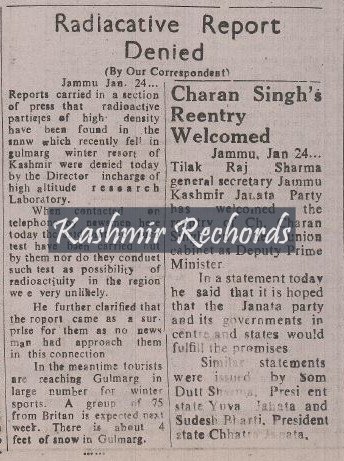
A preserved Kashmir Rechords newspaper report dated January 24, 1979, headlined “Radioactive Report Denied,” recorded that reports had appeared claiming that radioactive properties had recently been found in the snow at Gulmarg. The report said the matter had been referred to the Director of the High Altitude Research Laboratory.
But when journalists contacted the authorities, the claim was dismissed.The possibility of radioactivity, they were told, was “ridiculous” and “very unlikely”.
There was, however, an inconvenient reality for the rumour: Gulmarg was teeming with tourists. Winter visitors were arriving in large numbers, and a British group of about 75 tourists was reportedly expected the following week.
A radioactive Gulmarg was hardly the kind of news anyone in the tourism business would welcome. Yet rumours rarely wait for laboratory reports. They run ahead of facts.
From a whisper to a panic
The Gulmarg episode was not an isolated curiosity. It belonged to a much older Kashmiri tradition in which information—real, distorted or entirely fabricated—has often travelled through informal networks faster than it could be verified.
The phenomenon has been recorded by chroniclers, travellers and historians for centuries.
Historian Khalid Bashir, in Kashmir: Looking Back in Time, writes about what he describes as the Kashmiri tendency to romanticise rumours and exaggeration. The phenomenon is not simply about telling tall tales. At various points in Kashmir’s history, rumour has also functioned as a political instrument—something capable of creating fear, influencing public opinion and pushing a particular narrative.
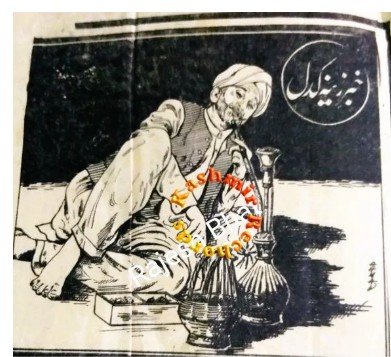
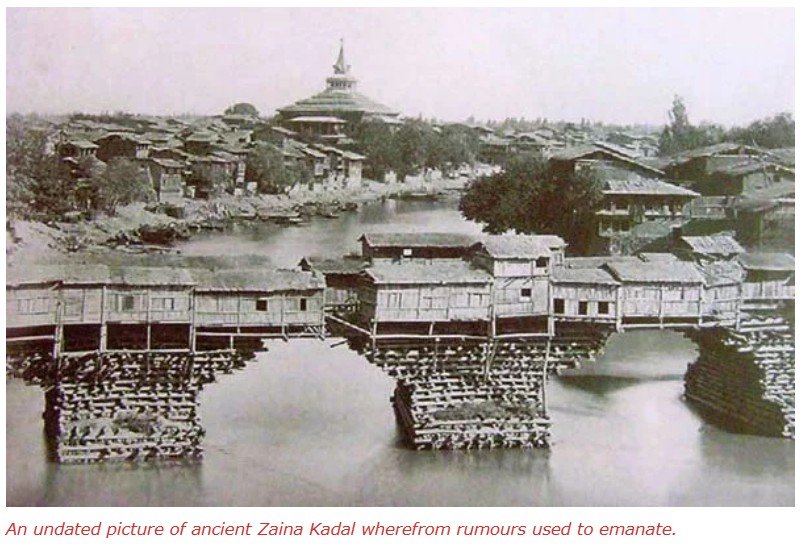
The old Kashmiri expression “Khabar Zaina Kadal” itself became almost synonymous with unreliable news.
“Khabar Zaina Kadal” was a regular column in Srinagar-based newspapers, chronicling and debunking the rumours doing the rounds in Kashmir
Zaina Kadal, the fourth bridge over the Jhelum in Srinagar, was traditionally regarded as a place where news and rumours were exchanged and embellished. As the saying went, information could emerge there and acquire a life of its own before anyone had bothered to establish whether it was true.
Sir Walter Roper Lawrence, the British settlement officer who spent years in Kashmir, wrote about this phenomenon in The Valley of Kashmir. He noted that although the wise knew that the reports emanating from Zaina Kadal were false, many others believed them—and that such reports caused considerable misery in the countryside.
In other words, fake news was not born with social media.Kashmir had its own version of it long before newspapers, radio, television and smartphones.
The rumour that made people flee a hill
One of the more remarkable examples came in 1935, when a newspaper reportedly carried a story attributed to a supposedly eminent geologist named Robert Macfield warning that Shankaracharya Hill would erupt between July 15 and August 15.
There was just one problem. The celebrated geologist apparently did not exist. The report nevertheless created panic. People began leaving their homes for safer places until another newspaper exposed the story as a cruel joke. The rumour had achieved its purpose before the truth caught up.
The same pattern appears repeatedly in Kashmir’s history: a whisper, an embellishment, fear—and finally a scramble for verification.
Even a ‘frightful creature’ lived in the Jhelum
British missionary and educationist Tyndale Biscoe encountered another extraordinary example. A rumour had spread that a “frightful creature” inhabited the Jhelum. People became frightened and stopped bathing in the river or carrying out their normal activities along its banks.
Biscoe did not respond with a philosophical lecture on misinformation. He made his students confront the rumour. He reportedly took his 130 students into the Jhelum and made them swim.The creature, needless to say, did not surface.
‘Tarr’: when rumour becomes a political weapon
The Kashmiri word “tarr”, used for fabrication or the spreading of news and rumour, acquires a more serious significance when placed in the political history of the Valley.
Rumours were not always born out of innocence, amusement or ignorance. They could be deliberately manufactured. That makes the 1979 Gulmarg episode particularly interesting. It may have been nothing more than an absurd piece of rumour-mongering.
But it demonstrated the extraordinary power of an unverified claim: snow could suddenly become radioactive, a tourist destination could become dangerous and ordinary people could be transformed into carriers of a story whose origin nobody could identify.
The ghosts, the polio drops,the food packets
Kashmir would witness many more episodes of rumour-driven anxiety.
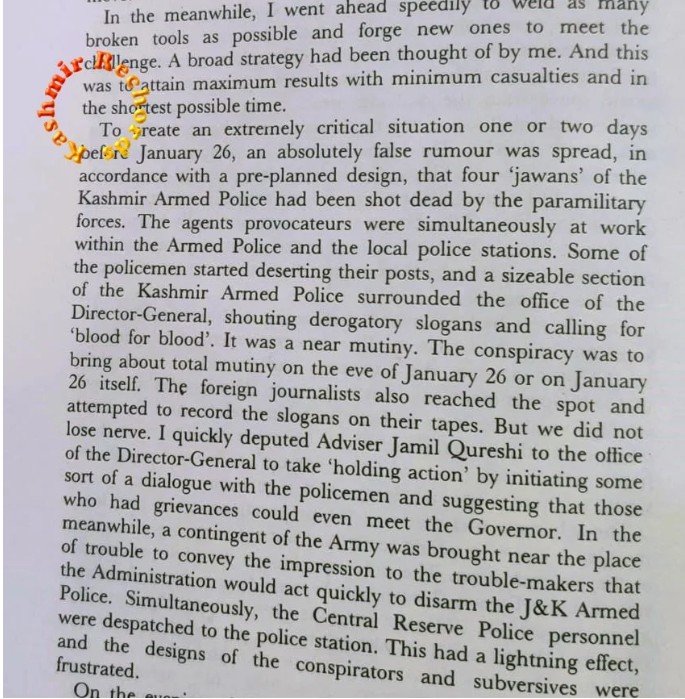
In 1990, during the turmoil, Governor Jagmohan wrote in My Frozen Turbulence in Kashmir about rumours being used to undermine and frustrate the administration.
A page from “ My Frozden Turbulance in Kashmir”, making a mention of January 26, 1990 rumour.
At one point, rumours circulated that food packets being distributed by the Army contained material that would cause frigidity among women and impotence among men, supposedly as part of a conspiracy to reduce the Muslim population.
The administration was compelled to counter the rumour in a rather extraordinary fashion: police and paramilitary personnel were instructed to eat the food and drink the water themselves to demonstrate that it was safe.
Then came the “Balaie” scare of 1993—ghost-like entities were said to be attacking people.
There had been similar scares before, including the 1977 rumour about “Naar-e-Tschour” and stories that members of the Jan Sangh were moving around and setting houses on fire.
And decades later, on January 17, 2016, another rumour caused widespread alarm when parents rushed their children to hospitals after being told that polio drops administered earlier that day were lethal.
Different decades. Different rumours.The same psychology.
Kalhana had seen it coming
Perhaps the most fascinating part of this story is that Kashmir’s romance with rumours is not a modern phenomenon.
References to the Valley’s propensity for circulating and believing rumours can be traced back centuries.
The historian Kalhana, writing his Rajatarangini, recorded the importance of rumour in Kashmir’s social and political life. Later scholars also noticed the same characteristic.
James P. Ferguson, in Kashmir: An Historical Introduction, while referring to Kalhana, noted how easily rumours in Kashmir could be manufactured and spread—from bathhouses along the river, shops and places of worship.
The locations changed. The mechanism did not. Once it was the riverbank, the shop, the mosque, the temple or Zaina Kadal.
Today it may be a WhatsApp group or social-media post. The rumour simply travels faster.
Kashmir and the politics of fear
There is, however, a danger in treating all such episodes merely as amusing examples of Kashmiri folklore.
Rumours can be harmless. They can also be devastating. They can empty streets, send people fleeing, destroy reputations, deepen communal suspicion, undermine institutions and create panic where none existed before.
That is why the history of rumour in Kashmir deserves to be studied not merely as a curiosity but as a social and political phenomenon.
The Gulmarg scare of 1979 reminds us that long before the age of viral videos and social-media forwards, fear itself could go viral.
A rumour needed no laboratory. No evidence. No author. It only needed people willing to repeat it. And Kashmir, for centuries, has supplied the perfect ecosystem for the whispered word to become accepted wisdom.
Perhaps that explains the perennial Kashmiri refrain:
“Khabar kya chuk karun?” — Who knows what they are planning?
Sometimes, the answer was simple. Sometimes, it was a lie. And sometimes, by the time the truth arrived, the rumour had already done its work.
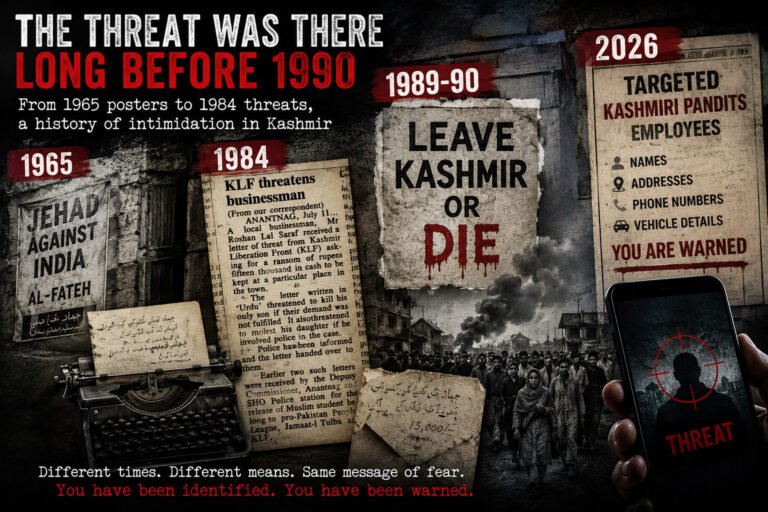
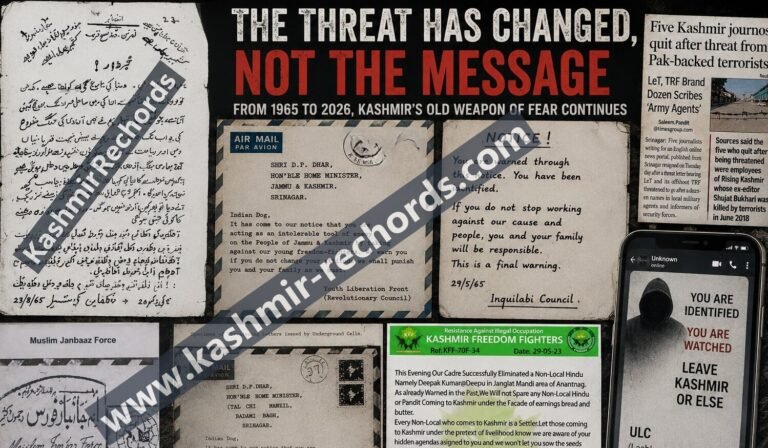
The recent wave of threats against Kashmiri Pandit employees, reported in August 2026, is disturbing not just for its immediate menace, but for its chilling echoes of Kashmir’s past
A recent purported threat poster, attributed to the United Liberation Council (ULC), reportedly named Kashmiri Pandit employees and carried personal details, including addresses and vehicle numbers. While the authenticity of the poster is still being verified by security agencies, the fact that those named have sought protection—and that the matter has prompted calls for an official response—underlines the continuing psychological power of such threats.
But the history of threatening letters and posters in Kashmir did not begin in 1989.
As Kashmir Rechords recently documented, the history of threatening posters in Kashmir stretches back to 1965, proving that these intimidation tactics were weaponized decades before the mass exodus of 1989-90
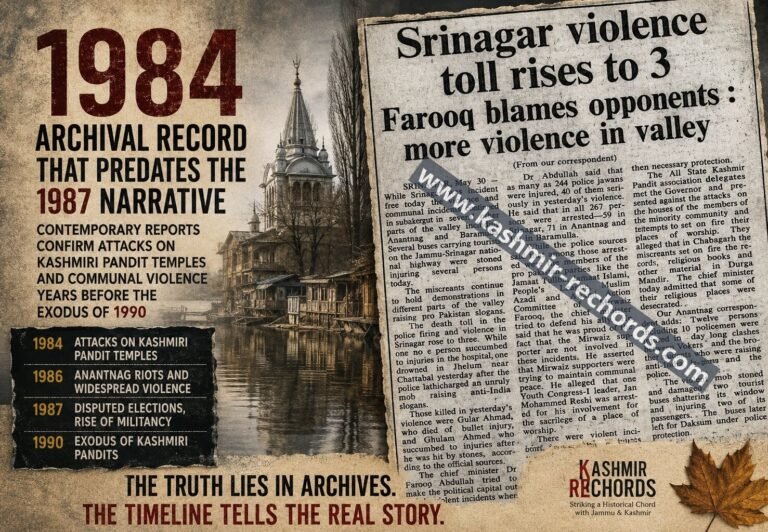
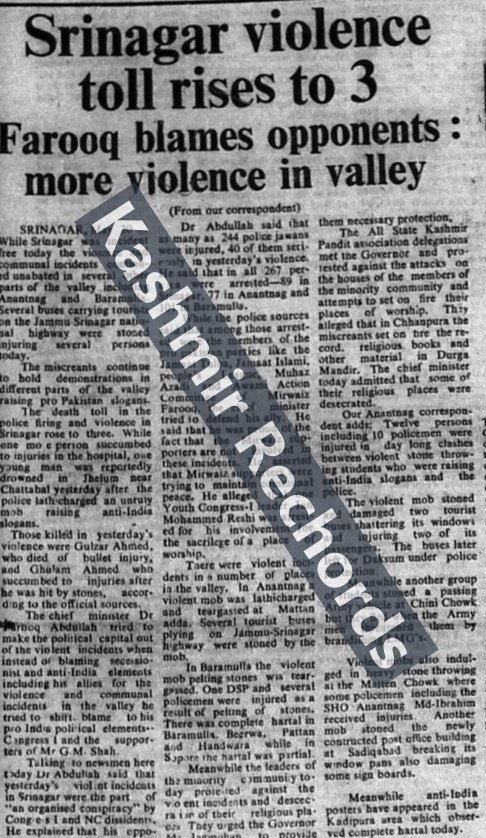
While working further on that historical trail, Kashmir Rechords came across yet another remarkable piece of evidence—this time from July 1984.
It is significant precisely because 1984 was not 1990. There was no mass uprising, no widespread armed insurgency and no war-like situation in the Valley. Kashmir was, by and large, being projected and perceived as a normal and peaceful place.
Yet, beneath the surface of that supposedly normal Kashmir, the intimidation of Kashmiri Pandits was already taking root. In July 1984, a prominent businessman in Anantnag was targeted.
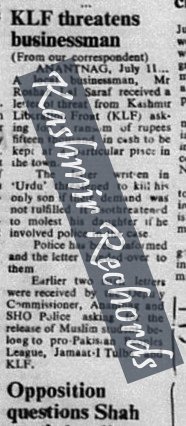
An archival newspaper clipping dated July 11, 1984, preserved in the Kashmir Rechords archive, reports that local businessman Roshan Lal Saraf received a threatening letter from the Kashmir Liberation Front (KLF). The organisation was referred to in contemporary usage in connection with what would later be known as the Jammu and Kashmir Liberation Front (JKLF).
The demand was stark: Rs 15,000 in cash, to be left at a specified place in Anantnag.
But the letter was not merely a ransom note.
Written in Urdu, it threatened to kill Saraf’s only son if the demand was not met. It went further, warning that his daughter would be molested if he approached the police.
Saraf did not submit. He informed the police and handed the threatening letter over to them. The incident was reported by newspapers of the time.
There was another revealing detail in the report.
First came the warning. Then came the identification of the target. Then came the threat to the individual—or to those closest to him. And behind it all was the same demand: submit, comply or face consequences.
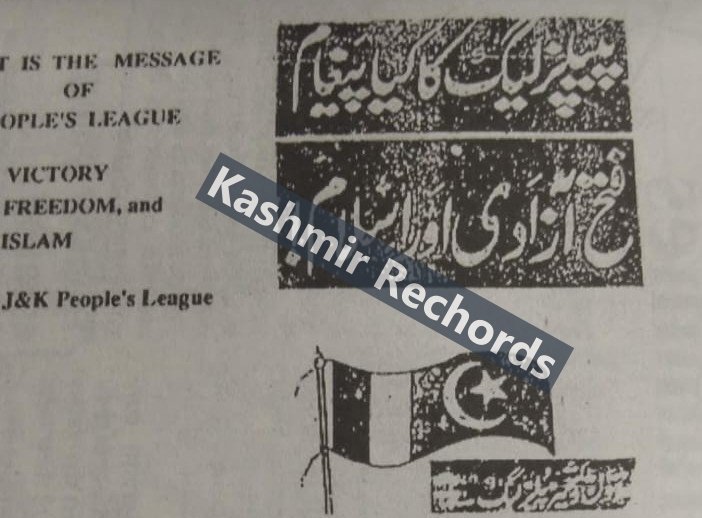
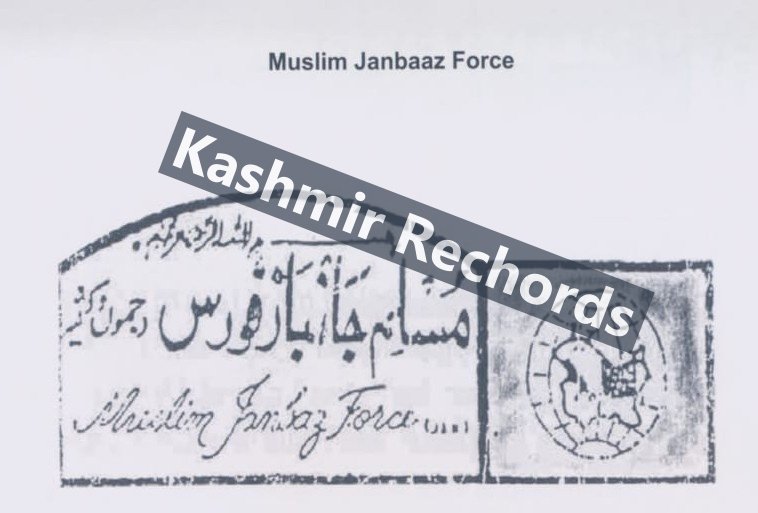
Two similar letters had already been received by the Deputy Commissioner, Anantnag, and the SHO of the local police station, demanding the release of a Muslim student associated with the pro-Pakistan People’s League, Jamaat-i-Tulba and KLF.
That detail is important because it places the Saraf threat within a broader atmosphere of coercion and political intimidation. At the same time, the targeting of a Pandit businessman and the explicit threats against his children demonstrate how intimidation could enter the private lives of Kashmiri Pandit families even during a period that is often retrospectively described simply as “normal Kashmir.”
The newspaper report, therefore, deserves to be read not merely as an isolated ransom story, but as an archival window into the changing political climate of Kashmir.
It shows that the vocabulary of intimidation was already there years before 1989-90: the threatening letter, the identification of a target, the demand for compliance, the threat of death and the use of family members to exert pressure.
And the trail goes back further still.
As Kashmir Rechords has documented, 1965 witnessed the circulation of threatening and militant posters in Kashmir, including material associated with the underground Al-Fateh movement and other pro-Pakistan networks. Historical accounts record the appearance of Jehad posters and the arrest of an Al-Fateh activist in October 1965 for putting them up. Other material from that period also records threatening and inflammatory posters aimed at officials, politicians and influential individuals.
Seen together, 1965 and 1984 acquire a new significance.
The point is not to suggest that every organisation, every poster or every threat belonged to the same campaign. They did not. The political circumstances, organisations and intensity of violence were different.
What persisted was something more fundamental: the method of intimidation.
First came the warning.
Then came the identification of the target.
Then came the threat to the individual—or to those closest to him.
And behind it all was the same demand: submit, comply or face consequences.
In 1965, the threat could be pasted on a wall or electricity pole. In 1984, it could arrive as a letter.
By 1989-90, threatening posters and letters became part of a much wider campaign of intimidation that accompanied targeted killings and ultimately contributed to the mass displacement of Kashmiri Pandits.
And in 2026, the same psychological weapon can be delivered through a digital poster carrying names, addresses, telephone numbers and vehicle details.
The technology has changed. The political landscape has changed. The organisations have changed.
But the language of intimidation has proved remarkably persistent.
The 1984 case of Roshan Lal Saraf is therefore more than an obscure newspaper clipping. It is a small but significant piece of evidence from a period that is often remembered only through the lens of Kashmir’s later descent into militancy.
It reminds us that the warning signs existed before 1989.
The year 1990 did not invent the threat. It transformed an existing vocabulary and method of intimidation into something vastly more organised, widespread and lethal.
That is why the latest threats should not be viewed in isolation.
They belong to a longer and deeply troubling history—from the threatening posters of 1965, to the letter sent to a Pandit businessman in Anantnag in 1984, to the posters, threats and targeted killings surrounding 1989-90, and now to the digital threats confronting Kashmiri Pandits in 2026.
The medium may have changed. The fear it seeks to create is very old.
On September 23, 1988, a year and more than a month before Judge Neelkanth Ganjoo was assassinated in Srinagar, terrorists came to his doorstep.
They did not come secretly.
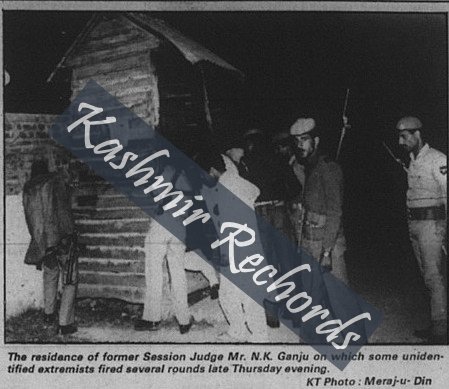
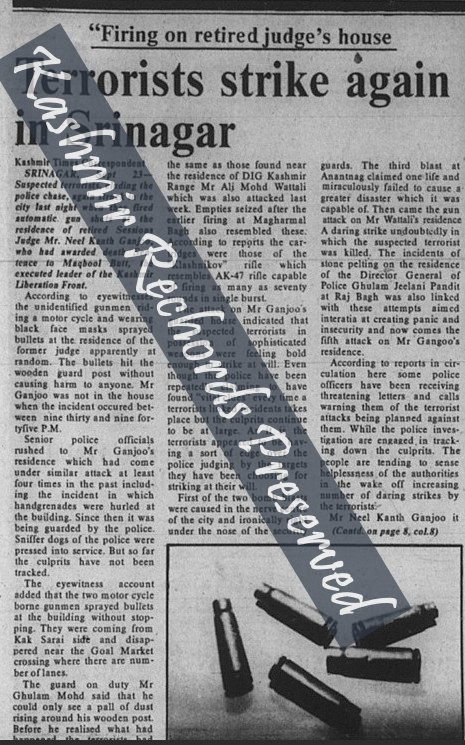
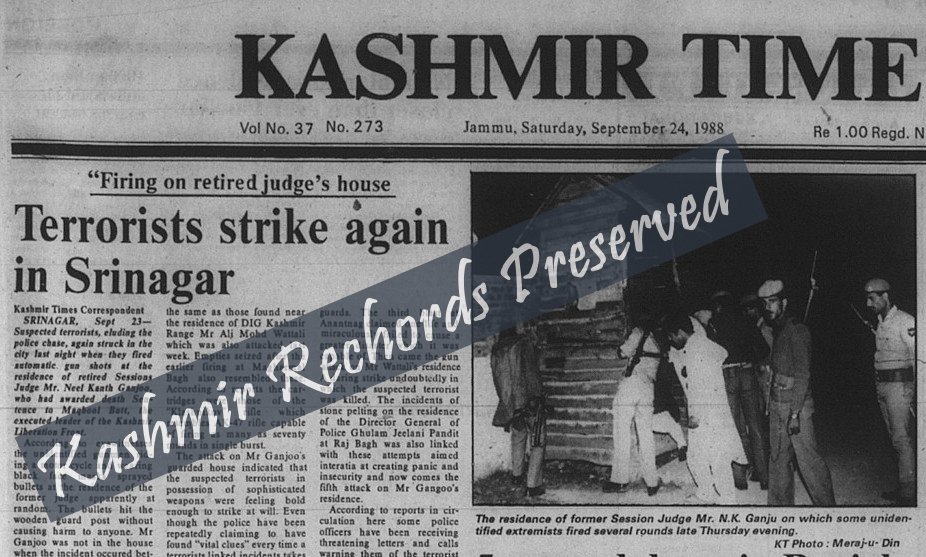
According to a contemporary report published by Kashmir Times on September 23, 1988, (copy of the same preserved by Kashmir Rechords, unidentified gunmen riding a motorcycle had opened automatic fire at the residence of the retired Sessions Judge in Srinagar. Judge Ganjoo was not inside the house when the firing began.
The bullets struck the wooden guard post outside the residence. Fortunately, nobody was injured. But the significance of the attack lay far beyond the bullets that missed their intended target.
The newspaper reported that senior police officials rushed to Neelkanth Ganjoo’s residence, which had already come under attack at least four times earlier also. On one previous occasion, hand grenades had been hurled at the building. The report further stated that the residence had been guarded by police since that earlier attack and that sniffer dogs had been pressed into service.
Yet the attackers had returned.And this time, they came with automatic weapons.
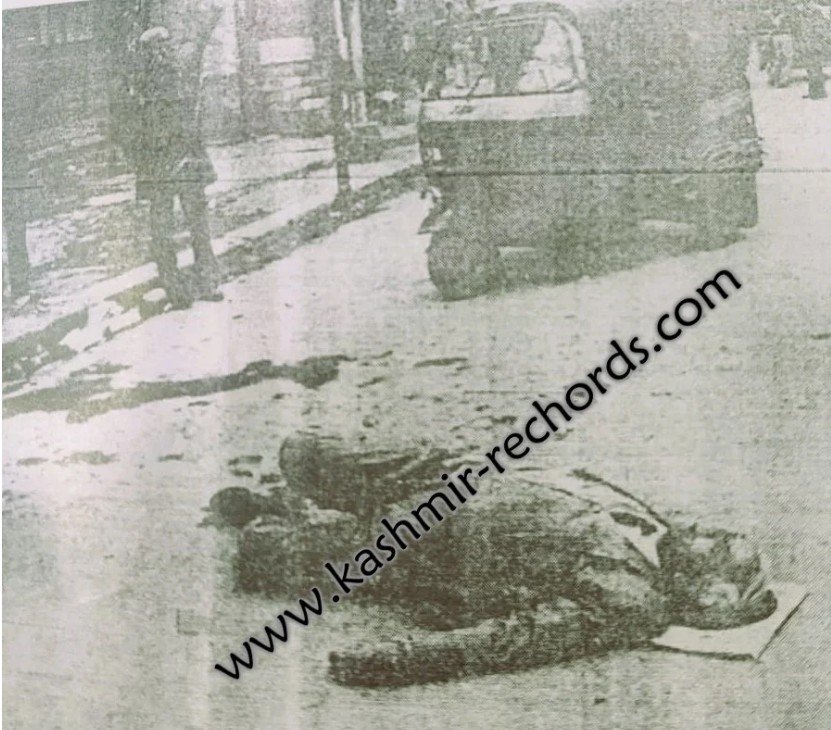
Neelkanth Ganjoo Srinagar attack 1988
The headline in the Kashmir Times was stark: “Terrorists strike again in Srinagar.” The smaller line above it was even more specific: “Firing on retired judge’s house.”
The eyewitness account published alongside the headline said that two men on a motorcycle, wearing black face masks, sprayed bullets at the building without stopping. They had apparently come from the Kak Sarai side and disappeared near the Goal Market crossing.
The guard on duty, identified in the report as Ghulam Mohammad, said he could only see a pall of dust rising around his wooden post before he realised what had happened.
The implication was unmistakable: there was police protection, but the presence of a guard did not prevent the gunmen from reaching the house, firing at it and escaping.
The newspaper also reported that the empties recovered from the scene resembled those found after an earlier firing at Magharmal Bagh. According to the report, the cartridges were from a “Kalashnikov” rifle, capable of firing as many as seventy rounds in a single burst.
This was therefore not merely a warning shot.It was an armed attack on the residence of a man whose life had already been repeatedly threatened.
A target already under protection
Perhaps the most important detail in the 1988 report is not the firing itself, but what had happened before it. The authorities already knew that Judge Ganjoo was being targeted.
That raises an uncomfortable question.If a retired judge had already survived repeated attacks, if grenades had previously been thrown at his residence, if police protection had been considered necessary, and if the attackers continued to return—how adequately was the threat being assessed and neutralised?
The September 1988 report provides no evidence that Judge Ganjoo was completely without security. On the contrary, it explicitly says that police guards were posted there.
But it provides equally striking evidence that the security arrangement was proving ineffective. The attackers were able to approach the residence, open automatic fire and disappear.
The fifth attack—and still no breakthrough
The Kashmir Times report described the September 23, 1988 attack as at least the fifth assault on Ganjoo’s residence.
It also placed the attack in a wider pattern of escalating terrorism in Srinagar. It also gives significant inputs that situation in Kashmir had already deteriorated even in September 1988! This is evident from the fact that the newspaper report observes that terrorists appeared to have gained an “edge over the police” by choosing their targets and striking when they wished. It referred to attacks elsewhere in the Valley and noted the growing sense of helplessness among people as the authorities struggled to track down the perpetrators.
Ganjoo’s house was, therefore, not an isolated incident.It was part of a deteriorating security environment in which known targets were being repeatedly attacked.
The newspaper’s account is especially revealing because it was published while Neelkanth Ganjoo was still alive. It was not written retrospectively after his assassination. It recorded, in real time, the fact that a retired judge who had already survived several attempts on his life remained vulnerable.
From attempted killing to successful assassination
The warning contained in that September 1988 newspaper report would acquire a chilling significance thirteen months later.
On November 4, 1989, the terrorists succeeded.
Three gunmen confronted Ganjoo in the Hari Singh High Street area of Srinagar and shot him at close range in broad daylight. Contemporary and later accounts identify his judicial role in the Maqbool Butt case as the central motive associated with the assassination. (Read more about his legacy and the aftermath: The Judge Who Stood for Justice, Now Awaits His Own) Judge Ganjoo had presided over Butt’s trial in the 1960s and had sentenced him to death in August 1968 for the murder of police officer Amar Chand. The sentence was subsequently upheld by the Supreme Court.
A newspaper clipping that changes the chronology
For years, the story of Judge Neelkanth Ganjoo has understandably been remembered primarily through the horrifying images of November 4, 1989—the retired judge being gunned down in broad daylight.
But this September 23, 1988 clipping changes the chronology.
It shows that the assassination had a long prelude. Judge Ganjoo had already been attacked repeatedly. His home had already been subjected to grenade attacks. Police had already been deployed. Sniffer dogs had already been used. The attackers had already demonstrated their ability to reach him.
And on September 23, 1988, they came again. They fired automatic weapons at his residence. They missed him. He survived. For another thirteen months, he remained alive.
Then, on November 4, 1989, the terrorists found him outside the protection of his residence and killed him in the heart of Srinagar.
The 1988 newspaper report therefore deserves to be read not merely as an account of another terrorist attack, but as an early warning preserved in print.
It records a threat that was already visible.
It records a target who had already been repeatedly chosen.
It records security that was already in place—but apparently unable to stop the attackers.
And, in retrospect, it records something even more tragic:
Justice Neelkanth Ganjoo survived the warning. The system did not prevent the eventual killing.
More than three decades later, the State Investigation Agency reopened the murder case and sought information from the public in 2023 to uncover what it described as the “larger criminal conspiracy” behind Ganjoo’s assassination.
The September 23, 1988 newspaper clipping now adds another important piece to that historical record.
It shows that the question was never simply who eventually killed Justice Ganjoo.There is also a deeper historical question:
How did a man whose life had already been repeatedly targeted, whose residence had already been attacked and whose security had already been considered necessary remain vulnerable long enough for the terrorists to finally succeed?
Kashmir, August 1953. The political drama surrounding Jammu & Kashmir in 1953 was not confined to the larger questions of accession, autonomy and the struggle for political power. Beneath the grand political rhetoric lay another story—one of appointments, promotions, influence and alleged patronage.
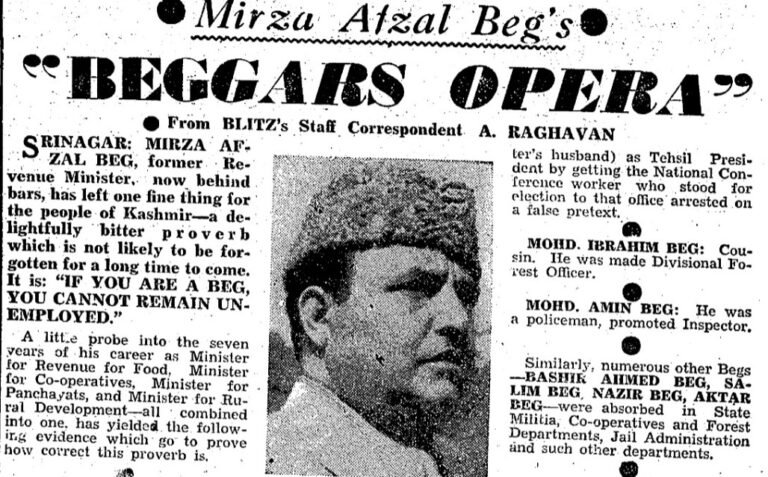
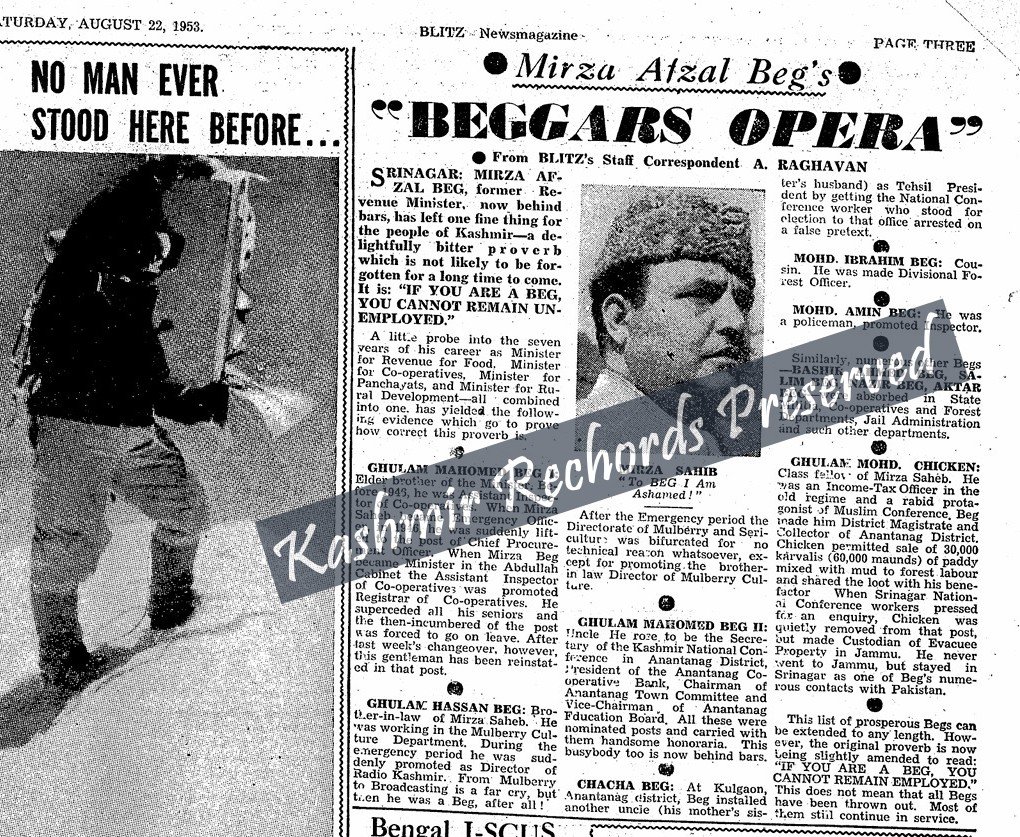
A remarkable report published in the Blitz issue of 22 August 1953, under the provocative headline “Beggar’s Opera”, turned its attention to the alleged influence of the family and associates of Mirza Afzal Beg, then a prominent Minister in Sheikh Abdullah’s government.
The report opened with a bitter proverb attributed to the situation:‘If you are a Beg, you cannot remain unemployed’
It was clearly written as satire. But behind the sarcasm was a serious allegation: that government employment and positions of influence had allegedly become accessible to people because of their family connection with a powerful political figure.
Mirza Afzal Beg’s family tree in the Administration
The Blitz veteran correspondent, A. Raghavan, claimed that a closer examination of the careers of people described as relatives or associates of Mirza Afzal Beg revealed a striking pattern.
One of the examples cited was Ghulam Mohamed Beg, described as the Minister’s elder brother. According to the report, he had been an Assistant Inspector of Cooperatives before the political changes of the late 1940s. The newspaper alleged that he subsequently rose to the position of Chief Procurement Officer and later became Registrar of Cooperatives, allegedly superseding senior officers.
From Mulberry to Broadcasting
Another relative, Ghulam Hassan Beg, described as Beg’s brother-in-law, was said to have been working in the Mulberry Culture Department. The report claimed that during the Emergency period he was promoted as Director of Radio Kashmir.
The newspaper’s sarcasm was unmistakable:“From Mulberry to Broadcasting is a far cry, but then he was a Beg, after all!”
The point was not merely that a person had changed departments. The allegation was that political proximity could make otherwise unlikely career movements possible.
Full Report of Blitz, Page 3 , August 22, 1953
The uncle who held several positions
The report then turned to Ghulam Mohamed Beg II, identified as an uncle.
According to the article, he occupied or was associated with a remarkable collection of positions in Anantnag. The list included the secretaryship of the Kashmir National Conference in the Anantnag district, presidency of the Anantnag Cooperative Bank, chairmanship of the Anantnag Town Committee and vice-chairmanship of the Anantnag Education Board.
The Blitz alleged that these were nominated positions and that the individual received honoraria from them.
Once such a system takes root, merit becomes secondary to connection
In other words, the newspaper was portraying something more consequential than one questionable appointment. It was suggesting the creation of a network of political influence, stretching from the party organisation into cooperative institutions, local bodies and educational administration.
Relatives spread across the machinery of Govt
The report continued with a catalogue of people carrying the surname Beg.
Mohd. Ibrahim Beg, described as a cousin, was said to have been made a Divisional Forest Officer.
Mohd. Amin Beg, according to the report, had been a policeman who was subsequently promoted to Inspector.
It further named Bashir Ahmed Beg, Salim Beg, Nazir Beg and Akhtar Beg, alleging that they had found positions in institutions and departments including the State Militia, Cooperatives, Forest Department and Jail Administration.
Whether every allegation made by the newspaper was correct is a matter for archival verification. But the very existence of such a detailed contemporary report is historically significant. It shows that allegations of nepotism and political patronage were already being publicly discussed in Jammu & Kashmir in 1953.
Political and family power
The most disturbing aspect of the report was that it did not stop with government employment. It alleged that political influence could also be used to control local political competition.
The article referred to another relative in connection with the National Conference organisation and alleged that a rival worker who stood for election to a party position was arrested on what the newspaper described as a false pretext.
This allegation, if corroborated through official records, would demonstrate something much larger than ordinary nepotism: the alleged use of state or political machinery to protect a local patronage network.
That is why this forgotten clipping deserves attention today.
Ghulam Mohammad Chicken episode
The newspaper also singled out Ghulam Mohammad Chicken, described as a class fellow of Mirza Sahib.
According to the report, Chicken had been an Income-Tax officer during the earlier regime and was portrayed as a strong opponent of the Muslim Conference. The Blitz alleged that he subsequently became District Magistrate and Collector of Anantnag.
The report made serious allegations concerning the disposal of paddy and the sharing of proceeds with forest labour, claiming that National Conference workers eventually pressed for an enquiry and that Chicken was removed from the post.
It further alleged that he was subsequently made Custodian of Evacuee Property in Jammu but remained in Srinagar.
These are particularly serious accusations and should be treated strictly as claims made by the 1953 newspaper, not as established facts unless supported by administrative records, enquiry reports or other independent contemporary sources.
The bigger question: what happened to merit?
The real historical significance of the Blitz article lies beyond the individual names.
The emerging political order in Jammu & Kashmir had promised ordinary people a new beginning. The old feudal and autocratic structures were supposed to give way to a system based on popular representation, equality and social justice.
But the newspaper was asking an uncomfortable question:
What happens when the people who come to power in the name of the common man begin creating their own circles of privilege?
The accusation was that political power had allegedly begun reproducing itself through relatives, friends, party workers and loyalists.
A government office could become a source of patronage. A cooperative institution could become a political base. A nominated local position could become a source of influence. A departmental promotion could become a reward for proximity.
And once such a system takes root, merit becomes secondary to connection.
The irony of 1953
The timing makes the article even more fascinating.
The report appeared on August 22, 1953, only thirteen days after Sheikh Abdullah was removed from the premiership. Mirza Afzal Beg, the central figure in the article, had been Sheikh Abdullah’s Revenue Minister. Contemporary records confirm that Beg was a prominent member of Abdullah’s government.
The political crisis of August 1953 was therefore unfolding simultaneously with a public debate about the functioning of the administration itself. Contemporary correspondence preserved in the Nehru Archive also records serious internal conflicts within the Jammu & Kashmir government during this period.
This makes the Blitz clipping more than an amusing old newspaper cutting.
It is a contemporary window into how politics and administration were being perceived at the time.
Lesson for today’s generation
For today’s generation, the lesson is not that every person named in the article was guilty of nepotism. Nor should an old newspaper allegation be transformed into historical fact merely because it fits a modern political argument.
The lesson is more fundamental.
Political slogans can promise revolution, equality and empowerment. But institutions are ultimately judged by what happens to jobs, promotions, public money and administrative power.
The history of Jammu & Kashmir should, therefore, not be remembered only through speeches, political movements and competing narratives about India, Pakistan or independence.
It should also be examined through the mundane records of government—who was appointed, who was promoted, who received nominated positions, who was removed, who benefited and whose relatives entered the system.
That is where political rhetoric meets ordinary life.
And the Blitz report of August 22, 1953 leaves behind a particularly uncomfortable question:
Did the people of Jammu & Kashmir replace one system of privilege with another—or did the new political class genuinely create the merit-based, democratic administration it had promised?
More than seven decades later, that question deserves to be answered not through political speeches, but through the archives.
Editorial Disclaimer
Kashmir Rechords is reproducing and presenting this story solely as an archival record of a report published in Blitz on August 22,1953, with the intention of bringing a little-known historical document to the notice of readers who may not have been aware of it. Kashmir Rechords does not independently vouch for the truth or accuracy of the allegations contained in the original report, nor does its publication imply endorsement of, or attribution of any motive to, any individual or organisation mentioned therein. Readers are encouraged to view the material in the historical and journalistic context of the period in which it was originally published.
There is a remarkable story buried in the early history of Indian cinema — a story in which Kashmir played a starring role in India’s journey into colour filmmaking.
More than seven decades ago, filmmaker Ezra Mir brought a film crew to Kashmir to make Pamposh, an ambitious feature designed to demonstrate that India could produce, process and print a full-colour feature film domestically.
Shot on location in Kashmir in 1951–52, using Belgian Gevacolor film stock and processed at Bombay’s newly established Film Centre laboratory, Pamposhacquired a landmark position in Indian cinema. Contemporary publicity described it as the “first full colour feature film to be produced, processed and printed in this country.” Recent scholarship describes it as the first colour feature film domestically produced and processed in postcolonial India.
This needs one historical qualification. India had experimented with colour much earlier, including Sairandhri (1933) and Kisan Kanya (1937). Those films, however, are now considered lost. Pamposh‘s particular distinction is that it was the first colour feature domestically produced and processed in post-Independence India.
And here lies the extraordinary irony: The film made to demonstrate colour has itself lost its colours.
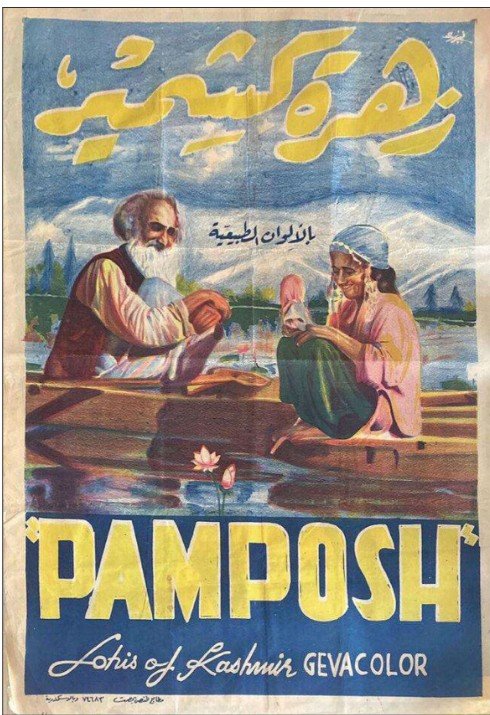
No colour print of Pamposhis now known to survive. The National Film Archive of India reportedly has no visual material from the film. What survives instead are photographs, a poster, music, newspaper and magazine references, paper ephemera and memories.
For Kashmiris, therefore, Pamposhis not simply a forgotten film.It is a lost visual memory of Kashmir.
Kashmir’s vibrant natural palette—its lakes, gardens, and sunlight—provided the perfect setting to demonstrate the capabilities of the new Gevacolor film stock
When Kashmir became India’s colour laboratory
In the early 1950s, colour filmmaking in India was still technologically difficult and expensive.
Bombay filmmakers often had to send exposed colour negatives abroad for processing. In 1952, Film Centre in Bombay became the first colour laboratory in Asia and the first outside Europe and the United States, according to the recent research.
Its establishment was an important technological step for the young Republic.But a new laboratory needed to prove itself.
Producer Ambalal J. Patel, who was closely associated with Film Centre and was India’s agent for Belgian Gevacolor, decided to demonstrate the laboratory’s capabilities through a feature film.
That film became Pamposh.The choice of Kashmir was inspired.
If you wanted to demonstrate colour, where could you find a more spectacular natural palette? The green of the valley.The blue waters of Dal Lake.Lotus flowers. Gardens. Mountains. Houseboats and of course Sunlight.Kashmir offered almost everything a colour cinematographer could desire.
Researchers Kirsty Sinclair Dootson and Poorvi Gaur, in their detailed 2025 study published in BioScope: South Asian Screen Studies, explain that Pamposhwas conceived as a demonstration film for Film Centre’s new colour-processing facilities. Kashmir was chosen both for its landscape and for climatic conditions considered closer to those for which Gevacolor had been designed.Kashmir was not merely the setting. It was part of the experiment.
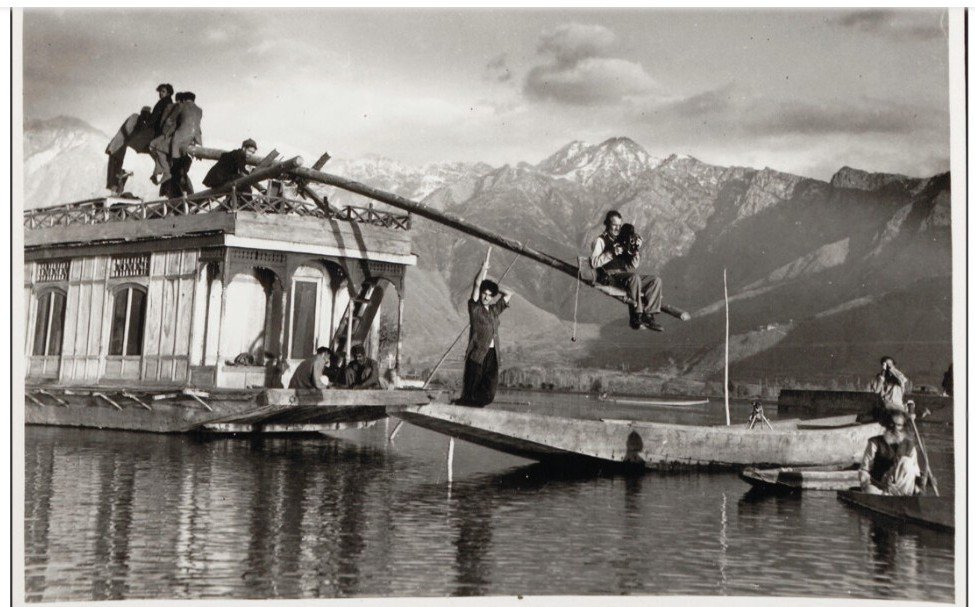
Pamposh Production Team in Dal Lake.1951-52
Ezra Mir arrives in Kashmir
The man chosen to direct the experiment was Ezra Mir, one of the pioneering figures of Indian cinema.
Born Edwyn Myers in Calcutta in 1903, Mir had worked as an actor and Editor in the United States before returning to India and directing feature films.
He subsequently became deeply involved in documentary filmmaking.
By the time he came to Kashmir, he had acquired an important reputation as a filmmaker with a strong documentary sensibility. He later became Chief Producer of Films Division in 1956.
That background matters. Pamposh was a fiction film, but it was made with an unusual insistence on real locations and naturalism.
According to the research, Mir reportedly “walked around the lake for weeks for atmosphere and inspiration” before developing the film.
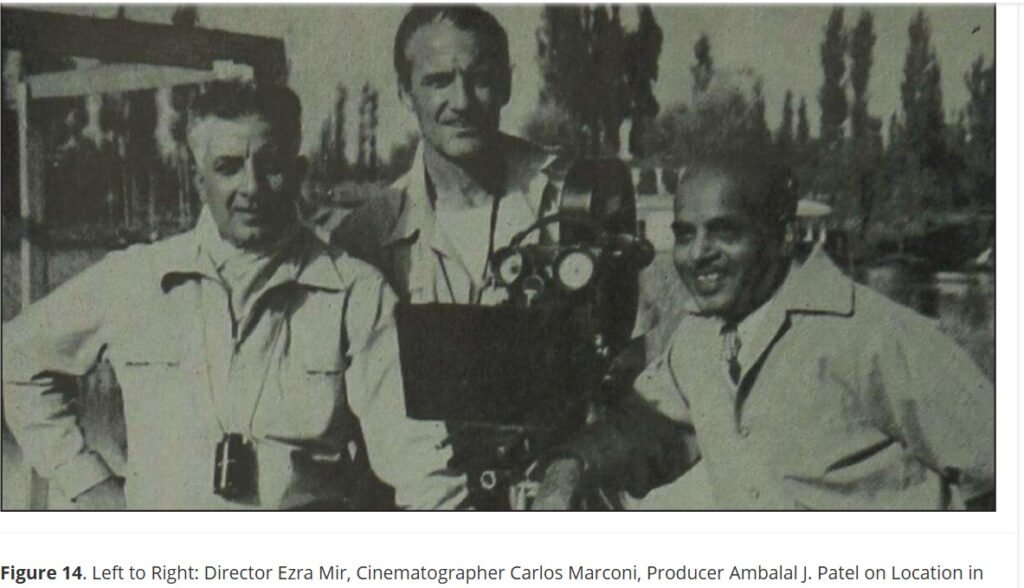
The cinematography was handled by Italian cameraman Carlos Marconi.
Producer Ambalal J. Patel, director Ezra Mir and Marconi became the central figures behind the Kashmir production.
And Kashmir itself became their studio.
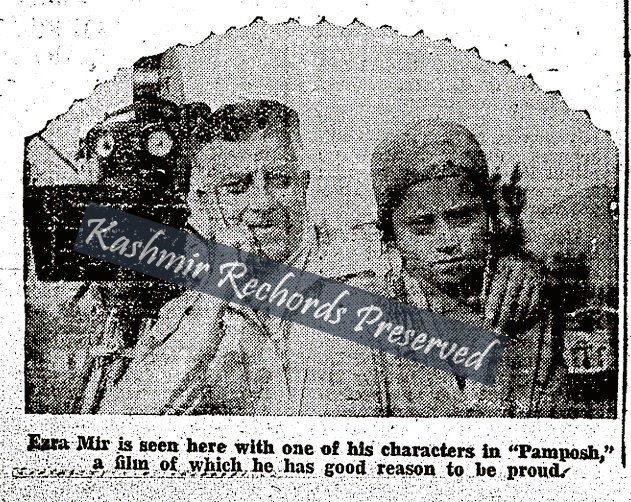
A rare 1953 photograph: Ezra Mir with a mysterious Kashmiri girl
Among the surviving traces of Pamposh,Kashmir Rechords possesses a particularly valuable contemporary record.
The January 24, 1953 issue of Blitz carried a photograph of Ezra Mir sitting beside a young girl dressed in Kashmiri robes and garments.
Director Ezra Mir with one of his characters in Pamposh. Published in Blitz, January 24, 1953.
The Blitz caption does not identify the girl by name.That is important.
There is, therefore, no basis for automatically identifying her as Mogli, the film’s central child character, even though the film’s surviving records identify Mogli as a local non-actor of the same name.
What the photograph does establish is equally valuable: in January 1953, Ezra Mir and a young Kashmiri-attired girl connected with Pamposh were being presented to the public while the film was still fresh in the public eye.For Kashmir Rechords, this is not merely an illustration.It is contemporary primary-source evidence
And perhaps the unidentified girl herself is another lost thread waiting to be recovered. Who was she? Was she an actor? Was she a local participant in the production? Was she playing one of the unnamed characters? Did her family know that her photograph had appeared alongside Ezra Mir in a national publication?
The archive leaves the question open.
Shooting Kashmir in the real world
The filmmakers wanted Pamposhto look like Kashmir — not a studio version of Kashmir. The production was shot on location between 1951 and 1952.Dal Lake became the principal stage.
Houseboats became locations.Boats became camera platforms.The crew had to cope with the practical difficulties of filming on water while handling equipment and colour stock.
One particularly important photograph shows Ezra Mir, Carlos Marconi and Ambalal J. Patel together on location in Kashmir. The image was reproduced by Dootson and Gaur from Frederick Foster’s 1954 account.
For today’s Kashmir, such a photograph has value far beyond cinema history.It records how Kashmir looked to a film crew in the early 1950s.
The story of Mogli
Behind the technological experiment was a deeply human story. The central character was Mogli, a mute orphan girl who lived around Dal Lake.
According to the surviving research, Mogli was played by a local non-actor of the same name. She became the adopted daughter of Kassim, a poor houseboat owner, and lived with his wife and biological daughter Naseem.
Mogli earns a meagre living selling flowers. She finds comfort in nature — birds, butterflies, frogs and fish — and in the mysterious Old Man of the Lake, played by Siddiq Chellah.
He tells her stories about the Frog King, who lives in a magical underwater kingdom where kindness rules and suffering does not exist.
But Mogli’s real life is far less magical.Her foster mother mistreats her and blames the child for the family’s misfortunes.
Then comes tragedy!
For Kashmiris, Pamposh is not simply a forgotten film. It is a lost visual memory of Kashmir.
After a fire on the family houseboat, Mogli leaves in her canoe, determined to find the mythical kingdom of the Frog King. She disappears.
Her family and the Old Man search for her, but find only her doll. Mogli is presumed drowned.The irony is striking.
A story about a child disappearing into the waters of Dal Lake was itself eventually to disappear into the waters of history.
Why the name Pamposh?
The title has an unmistakable Kashmiri resonance. Pamposh means lotus. The lotus is inseparable from the imagery of Kashmir’s lakes, particularly Dal Lake.
It was, therefore, an appropriate title for a film whose story unfolded among lotus blooms and whose principal purpose was to demonstrate the possibilities of colour.
The surviving research notes that contemporary promotional material celebrated Kashmir’s flowers and gardens as ideal subjects for the new Gevacolor process.
A Kashmiri musical connection
The Kashmir connection did not end with the scenery.
The official Cannes Film Festival archive credits Mohan Lal Aima and Cecil Mendoza with the music of Pamposh. Aima’s name gives the film an important Kashmiri cultural dimension.
The valley was not simply being photographed as a beautiful landscape; a Kashmiri musician was associated with its musical identity as well.
Yet the precise nature of Aima’s contribution remains an area deserving further research. Did he compose original music?Did he incorporate Kashmiri melodies?
Were songs from the film recorded separately? Are any recordings, manuscripts or family papers still available? These are questions that Kashmir Rechords believes deserve investigation.
From Dal Lake to Cannes
After its Kashmir production, Pamposh travelled far beyond India.
The official Cannes archive records Pamposh: Fleur de Lotus as a 1954 Indian feature film in competition.
It identifies:
Director: Ezra Mir Screenplay: Ezra Mir Cinematography: C. F. Marconi Music: Mohanlal Aima and Cecil Mendoza.
The Cannes record also lists the principal cast, including Savitri, Ravi Vinod, Pandit Kaul, Mogli, Siddiq Chella, B. Billimoria and Violet Smith.
Thus the journey of Pamposh can be traced in three words:Kashmir. Bombay. Cannes.
For a film made on the waters of Dal Lake in the early 1950s, that was an extraordinary journey.
Cruel irony: the colour film that lost its colours
Today, Pamposh is considered a lost film. The recent scholarly investigation found that no colour materials from the film have survived. The National Film Archive of India holds no visual material on it, while surviving traces exist in other forms.
Yet fragments have survived in European collections.
The Cinémathèque française holds publicity stills.
The British Film Institute holds production material.
The researchers also found a surviving Pamposh poster and other paper ephemera.
And so we have an extraordinary situation:
We have photographs of a film that we can no longer watch.
Even more ironically, a film created to demonstrate colour is now remembered principally through black-and-white photographs and printed material.
The photographs that survived
The recent SAGE study by Kirsty Sinclair Dootson and Poorvi Gaur has brought together some of the most important surviving visual traces of Pamposh.
Kashmir Rechords is grateful to the authors and SAGE Publications for making this scholarship accessible and for documenting these rare images.
Among the most evocative are:
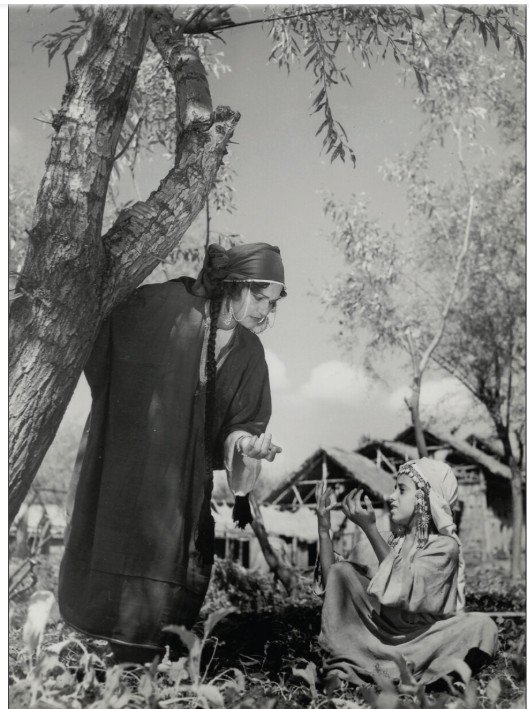
The Pamposh publicity stills preserved by the Cinémathèque française;
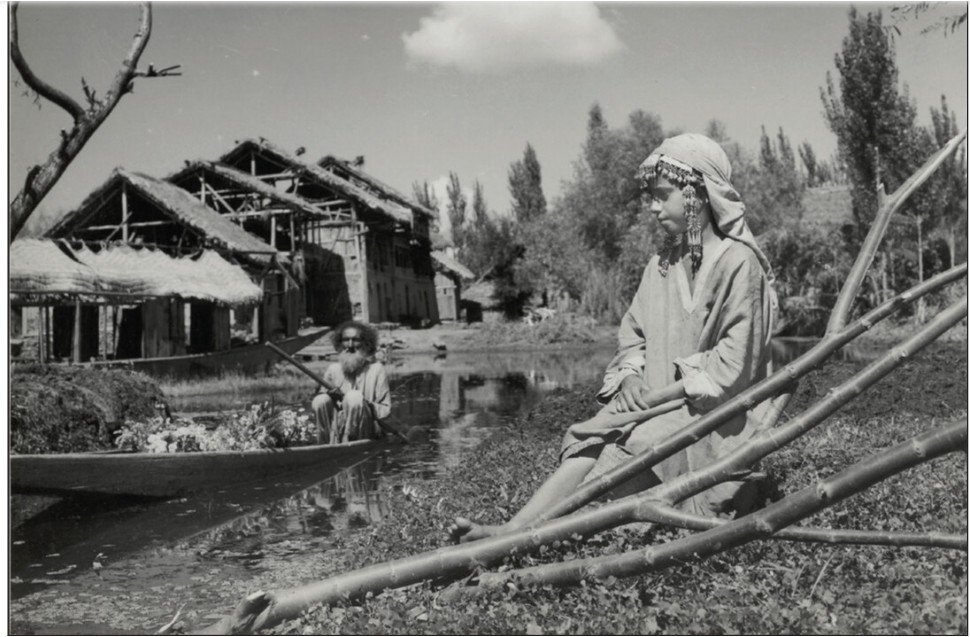
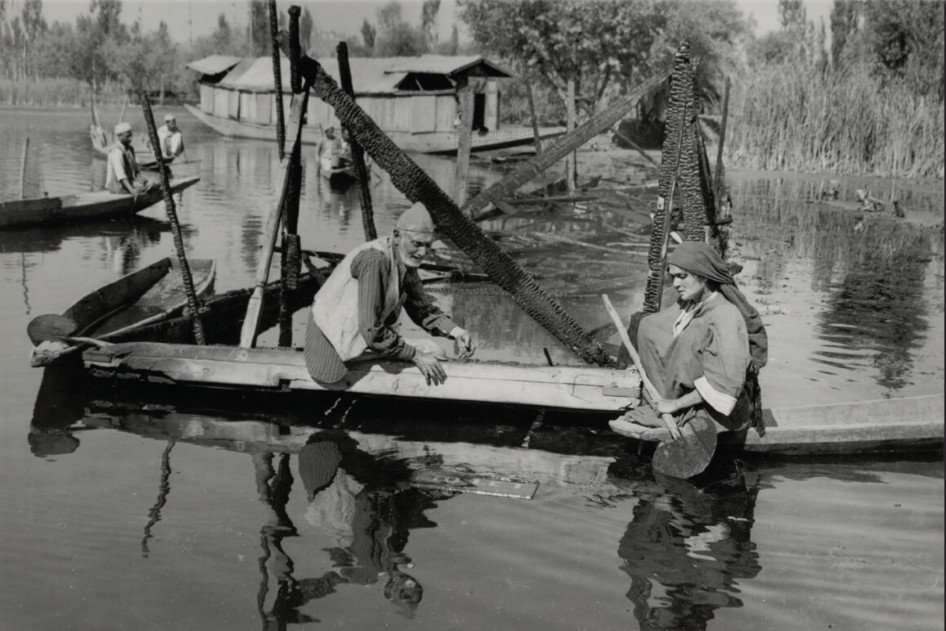
The image of Mogli and the Old Man of the Lake;
Photographs showing the houseboat fire and its aftermath;
and the production photograph of Ezra Mir, Carlos Marconi and Ambalal J. Patel in Kashmir.
Image credit: From Dootson & Gaur, “A History of Colour Cinema That Can Account for Indian Cinema: The Bombay Film Laboratory, Kashmir’s Climate and Gevacolor’s Pamposh,” BioScope: South Asian Screen Studies, 2025, SAGE Publications; original archival collection credited by the authors.
The Cinémathèque française stills are specifically identified in the SAGE article as “Collection La Cinémathèque française, all rights reserved.”
A film made at a turning point in Kashmir’s history
There is yet another reason Pamposh deserves attention.
The film was made in 1951–52, only a few years after the events of 1947 and during a period when Kashmir’s political future remained intensely contested.
The recent SAGE study goes beyond film history and argues that the choice of Kashmir was connected not only to climate and scenery but also to a wider ideological effort to strengthen India’s claims to Kashmir amid the geopolitical conflict over the region.
This is an interpretation offered by the researchers, and it should be read as such.
But it adds another layer to the film. Pamposh can simultaneously be understood as:
a pioneering colour experiment; a showcase for India’s new film-processing capabilities; a story of a Kashmiri child; a portrait of Dal Lake;
a record of early-1950s Kashmir; an international film that reached Cannes; and a cultural document shaped by the politics of its time.
That complexity makes it far more interesting than a forgotten film title in an old catalogue.
Did Kashmiris get to see it?
There is evidence that Pamposh was screened in Kashmir itself.
This raises questions that remain largely unexplored. How did Srinagar audiences receive Pamposh? Did they recognise the locations? Did they recognise the people?
What did Kashmiris think of hearing Kashmiri dialogue in an Indian feature film?
Did local newspapers review it? How many shows were held? And did anyone in Srinagar preserve photographs, tickets, advertisements or programmes?
For Kashmir Rechords, these questions are as important as the film’s journey to Cannes.
Was Pamposh India’s first colour film?
This is where historical precision matters.
It would be inaccurate to say simply that Pamposh was the first colour film ever made in India.
India had colour experiments before it.
But Pamposh holds a more specific and equally important distinction:
It was the first colour feature film domestically produced and processed in post-Independence India.
The SAGE study describes it as having this “privileged status”, while contemporary press coverage called it the first full-colour feature film to be produced, processed and printed in the country.
And that milestone has a remarkable Kashmir connection.
One of the foundational moments in India’s post-Independence colour cinema was created on the waters and shores of Kashmir.
Could the lost film still be found?
“Lost” does not always mean destroyed. Sometimes it means untraced.
A print, negative, foreign-language version, duplicate or fragment could still conceivably exist in a private collection, foreign archive, old distributor’s vault or uncatalogued repository.
Even if the complete film never resurfaces, fragments may. A song. A photograph. A pressbook. A cinema ticket. A newspaper advertisement. A letter. A personal album.
A film reel. Each could restore another piece of the story.
Kashmir Rechords appeals for the missing pieces
Kashmir Rechords would particularly like to hear from readers who may possess any material connected with Pamposh or Ezra Mir.
The unidentified girl in the 1953 Blitz photograph is one such unanswered question.
Perhaps someone will recognise her. Perhaps her family has a photograph. Perhaps another newspaper carried her name. Sometimes history survives in the memories of ordinary families long after official archives have forgotten it.
Pamposh was not simply a film made in Kashmir. It was one of the earliest attempts to put Kashmir itself — its lake, landscape, people and colours — onto the moving screen at a crucial moment in India’s cinematic history.
The film is gone. The colours are gone. But the search need not end.
Perhaps one day, the lost colours of Pamposh will return to Kashmir.
Sources and acknowledgements
Primary archival source: Blitz, 24 January 1953 — photograph and caption: “Ezra Mir with one of his characters in Pamposh, a film of which he has good reason to be proud.” Photograph supplied from the Kashmir Rechords archival collection.
Principal scholarly source: Kirsty Sinclair Dootson and Poorvi Gaur, “A History of Colour Cinema That Can Account for Indian Cinema: The Bombay Film Laboratory, Kashmir’s Climate and Gevacolor’s Pamposh,”BioScope: South Asian Screen Studies, Volume 16, Issue 1, 2025. The article was first published online on 11 May 2025 and is Open Access.
Official film record: Festival de Cannes, Pamposh (Pamposh: Fleur de Lotus), 1954. The official Cannes archive records the director, screenplay, cinematography, music and cast.
Image acknowledgement: Kashmir Rechords acknowledges the research and archival work of Kirsty Sinclair Dootson and Poorvi Gaur and SAGE Publications, whose 2025 study has brought together rare surviving visual and documentary traces of Pamposh.
Where images reproduced in the SAGE article originate from third-party collections, the original archive/rightsholder also stand credited. The SAGE article identifies, among others, Collection La Cinémathèque française, the British Film Institute and Fotomuseum Antwerp/Agfa-Gevaert Historical Collection as sources for its figures.
*Dr. Rajesh Bhat is a veteran journalist, broadcaster, author and media researcher with over three decades of experience. A Ph.D. in Journalism and Mass Communication, he began his career with Kashmir Times and later served as Special Correspondent with Daily Excelsior, heading its Kashmir Desk during the peak years of militancy. He also contributed on art, culture and heritage to The Tribune. He later served with All India Radio/Prasar Bharati. He is the author of Radio Kashmir in Times of Peace & War and writes extensively on Kashmir’s history, culture, media and archival heritage.
There are stories history records. There are others history owes itself the duty to recover. The story of Din Mohammad Jagir belongs to the second category.
In official records of the Government of India, he is simply “Shri Mohammad Din Jagir, Jammu and Kashmir — Padma Shree, 1966, Social Work.” Behind those few words, however, lies an extraordinary and almost forgotten episode of the 1965 India-Pakistan war.
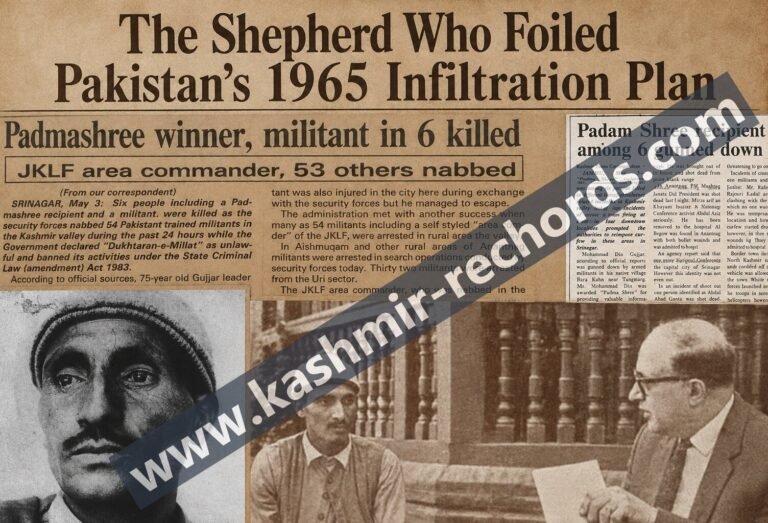
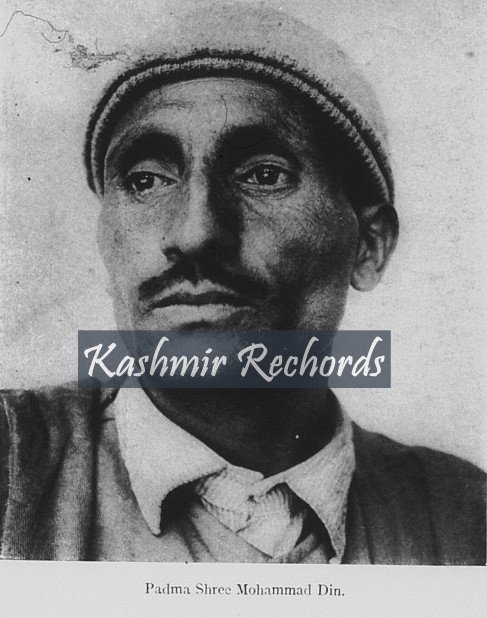
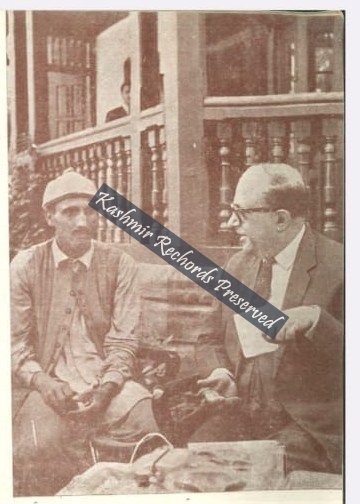
Mohammad Din Jagir, the Gujjar shepherd whose timely intelligence thwarted Pakistan’s Operation Gibraltar in 1965. (Kashmir Rechords Archive)
The shepherd who exposed Operation Gibraltar
Mohammad Din was a Gujjar shepherd from the Tangmarg-Gulmarg area of Kashmir. On August 5, 1965, as Pakistan launched Operation Gibraltar, he encountered armed infiltrators who had crossed into Kashmir to mingle with the local population, win support, create an uprising and prepare the ground for Pakistan’s military intervention.
According to 1960s records available with Kashmir Rechords, Mohammad Din, (Also written as Din Mohammad) was among the first Kashmiris to detect the infiltrators. They sought his assistance in arranging Kashmiri clothing so they could disguise themselves and move among the local population. They offered him money. He refused to cooperate and decided to inform the authorities.
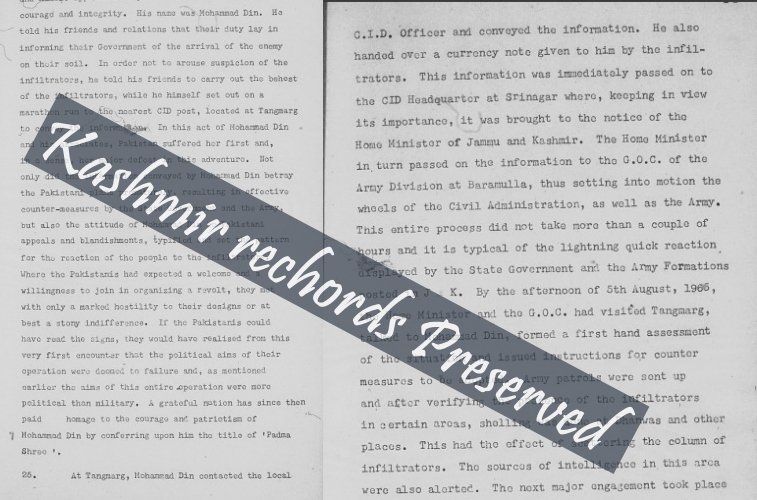
He took the information to the local CID officer at Tangmarg, who passed it to CID headquarters in Srinagar. Because of its gravity, the information reached the Home Minister of Jammu and Kashmir, who conveyed it to the GOC of the Army Division at Baramulla.
Archival document detailing Mohammad Din’s crucial role in detecting and reporting Pakistani infiltrators during the 1965 war. (Kashmir Rechords Archive)
By the afternoon of August 5, 1965, the Home Minister and Army GOC had reached Tangmarg and met Mohammad Din. Army patrols were despatched, the presence of infiltrators was verified, and shelling was undertaken at Dhanwas and other locations, scattering the infiltrating column. The intelligence network was alerted.
Pakistan’s carefully planned covert operation had been exposed almost at its inception.
Mohammad Din had struck the first blow—not with a weapon, but with information.
Pakistan’s plans betrayed prematurely
Operation Gibraltar depended on secrecy. Thousands of trained infiltrators had crossed into Jammu and Kashmir to sabotage installations, disrupt communications, attack strategic targets and, above all, ignite a popular uprising against India.
Instead of the mass uprising Pakistan anticipated, information about infiltrators began reaching Indian authorities. The contemporary account preserved by Kashmir Rechords says Mohammad Din’s information “betray[ed] the Pakistani plans prematurely,” enabling the State Government and Army to take effective counter-measures.
Pakistan had expected local support. Instead, it encountered hostility—or, as the account describes it, “a stony indifference.”
That was the beginning of the failure of Operation Gibraltar.
From shepherd to Padma Shri
India did not forget Mohammad Din immediately. In 1966, the Government of India conferred upon him the Padma Shri for Social Work. The 1966 Padma Awards Gazette records: “Shri Mohammad Din Jagir, Jammu and Kashmir.”
A man from a nomadic pastoral community, without a powerful institutional position or prominent public profile, had performed an act of national importance and received national recognition.
Yet history did not preserve his story with the same care.
The account by D. P. Dhar describes him after the honour returning to his vocation of tending cattle, apparently unaffected by the recognition.
Twice received by Indira Gandhi
According to a Kashmir Times report of May 4, 1990, preserved by Kashmir Rechords, Indira Gandhi had visited Mohammad Din’s house twice during her tenure as Prime Minister. Chief Minister, G M Sadiq too had met the saviour of Kashmir in 1965. Kashmir Rechords is reproducing here an exclusive photograph of Chief Minister Sadiq with Din Mohammad.
Mohammad Din (left) in conversation with the then Chief Minister of Jammu and Kashmir, G.M. Sadiq, following his heroic actions. (Kashmir Rechords Archive)
Then came 1990
Twenty-five years after 1965, Kashmir had changed dramatically. The Valley had entered an era of armed militancy.
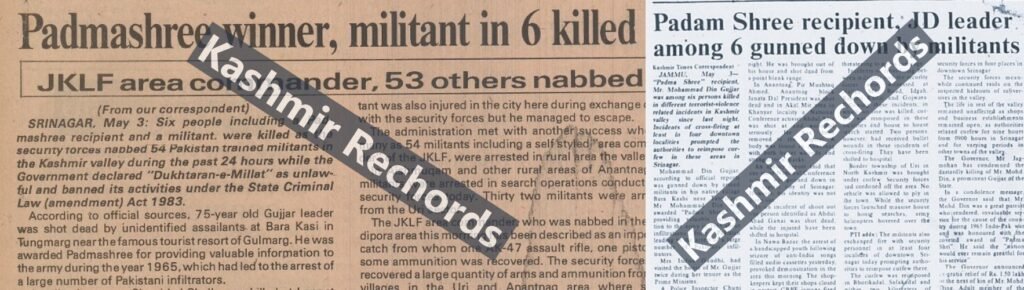
On Friday, May 4, 1990, the Kashmir Times and Daily Excelsior carried reports of Mohammad Din’s death at the hands of militants.
According to the reports, he was shot dead by armed militants in his native village at Barz Kani, near Tangmarg, in the Gulmarg area.
May 4, 1990 news clippings from the Kashmir Times and Daily Excelsior reporting the tragic killing of Mohammad Din by militants. (Kashmir Rechords Archive)
The irony was cruel. In 1965, Pakistan sent infiltrators into Kashmir to create an uprising. Mohammad Din detected them, refused their inducements, informed the authorities and helped expose their presence. His information triggered the response of the State Government and Army. The infiltrators were engaged and scattered, and the Pakistani plan began to unravel.
India honoured him with the Padma Shri. He met Indira Gandhi twice.
In 1990, when militancy had engulfed Kashmir, Mohammad Din himself became its victim.
The man who had once helped defend Kashmir against Pakistan’s covert assault could not be saved from the violence that later consumed the Valley.
He was killed—and then, in an even greater tragedy, almost erased from memory.
A hero reduced to a forgotten line
The official Padma database still carries his name. The 1966 Gazette still carries his name. Historical accounts of Operation Gibraltar occasionally mention him.
But the fuller story is barely known: the shepherd, the infiltrators, the money they offered him, the journey to Tangmarg, the CID officer, the message to Srinagar, the Home Minister, the Army GOC, the counter-operation, the Padma Shri, the meetings with Indira Gandhi, his return to tending cattle, his killing in 1990—and finally, the silence.
It is this silence that makes the surviving documents important.
Kashmir Rechords brings back the missing pieces
Kashmir Rechords has attempted to reconstruct the timeline of Mohammad Din Jagir’s life and sacrifice.
Its archive preserves his photographs and the May 1990 newspaper clippings reporting his killing. Alongside them is the written account of his role in 1965, describing how he detected the infiltrators, carried the information to the authorities, handed over the currency note they had given him and helped set the civil and military machinery into motion.
Taken together, these documents tell a story that deserves to be restored to Kashmir’s historical memory.
Not as propaganda. Not as mythology. But as an archival record of what one ordinary man did at an extraordinary moment.
Despite his extraordinary efforts, for which he lost his life 25 years after the 1965 war, Din Mohammad continues to be the forgotten son of Kashmir.
“Where do you live?” “What is your address?” “Where is your hometown?”
Almost every Kashmiri Pandit who has lived outside Kashmir over the past 36 years has faced these seemingly simple questions. And each time, they carry a deeper meaning.
I may be living in, or even owning, a house, flat or property anywhere in India or elsewhere in the world. But the real predicament remains: To which part of the country do I associate my identity? Which address truly feels like home? Where do I belong?
This question has followed us for 36 years
In 1990, lakhs of Kashmiri Pandits were uprooted from the Valley. Most of us arrived in Jammu—a place geographically close to Kashmir, yet worlds apart in language, climate, culture and food habits, particularly for those who had never lived outside the Valley before the exodus.
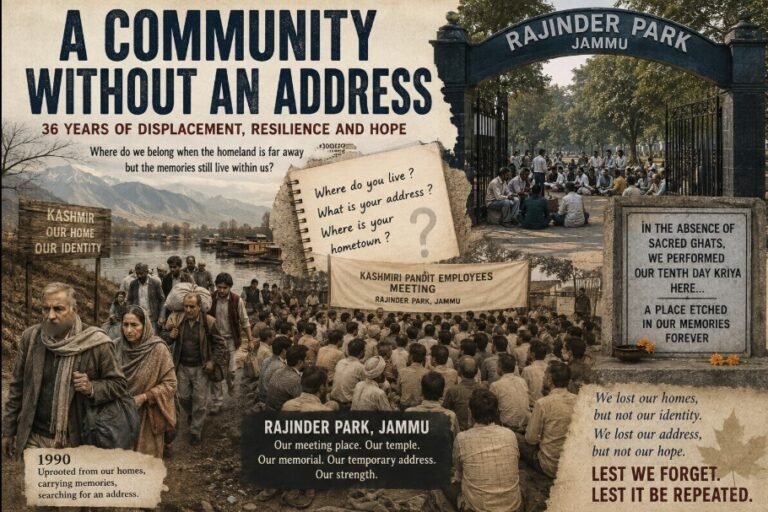
And then, almost unexpectedly, Rajinder Park in Jammu emerged as a new landmark—a temporary address for a community that had suddenly lost its permanent one.
For thousands of Kashmiri Pandits, Rajinder Park became much more than a park. It became a meeting place, a temple, a centre of community life and, at times, a memorial to a lost world.
For the older generation, Rajinder Park is etched in memory not for its trees or surroundings, but for the grief that gathered there. In the absence of the sacred cremation ghats of Kashmir, families came to the park to perform the tenth-day kriya of their departed loved ones.
But Rajinder Park also witnessed another struggle—the struggle to rebuild lives through paperwork.
Government records, relief packages, service matters, transfers, adjustments, accommodation in camps and countless other problems of displacement had to be discussed and resolved. Enormous meetings were held there. Government employees from different departments and public-sector organisations began forming associations. Colleagues who had been scattered overnight found one another again.
In those days, communication itself was a luxury. There were no mobile phones, no WhatsApp groups and often no reliable way of knowing where a relative, friend or colleague had landed. Rajinder Park became the place where people searched for people.
Separated families reunited there. Friends met after months. Former colleagues rediscovered one another. Information travelled from one person to another, often becoming the only lifeline available to a displaced community.
When Rajinder Park became a symbol of resilience
It represented a community that had lost its homes but refused to lose its identity; a people who had been uprooted but continued to preserve their traditions, relationships and dignity.
For those who lived through 1990, Rajinder Park is therefore not merely a physical space. It is a chapter in the collective memory of displacement—a reminder of how a community without an address created one for itself, however temporarily.
The park gave us an address when we had lost one.
Thirty-six years later, the question still remains: Where do we belong?
Perhaps the answer lies not merely in a house, a city or a postal address. Perhaps it lies in the memory of a homeland, in the bonds of a community and in the continuing hope of returning to a place that still lives within us.
Let us not forget the past. For, as the old saying reminds us, those who do not remember the past are condemned to repeat it.
And perhaps Rajinder Park deserves to be remembered—not simply as a park in Jammu, but as the first address of a displaced community that had suddenly lost its own.
About the Author
*R. K. Tickoo is a retired senior Prasar Bharati officer and veteran broadcaster. He served at Radio Kashmir, Srinagar and Jammu, on key assignments and later at the Directorate General, All India Radio, New Delhi. His writings draw upon his professional experience, personal memories and close understanding of Kashmir’s history, society and the lived experience of the Kashmiri Pandit community.
Do you have memories of gathering at Rajinder Park? Share your stories in the comments below or email us to help preserve this history.
The latest threats against Kashmiri Pandit employees in Kashmir are not a new phenomenon. For the young Pandit employees recruited under the Prime Minister’s Package, who have lived under threats for years, the latest warning carries a frightening historical echo. Some of their generation have already been killed in the post-Article 370 era—notably government employee Rahul Bhat, shot dead inside his office in Chadoora in May 2022.
Their parents and relatives know this fear all too well. They had witnessed the same sequence in 1989-90—threats, warning letters, posters, targeted killings and intimidation—before thousands of Kashmiri Pandit families were forced to abandon their homes and migrate from the Valley.
But the history of this threat culture goes back even further.
The warning was there before 1990
Archival and historical accounts in possession of Kashmir Rechords indicate that the use of threatening posters, underground propaganda and warning communications was already visible during the turbulent years following 1965. The Al-Fateh phase subsequently gave such underground activity a more organised character. Former police officer A.M. Watali’s account records the use of Jehad posters and the arrest of an Al-Fateh activist in October 1965 for putting them up. Other historical material on Al-Fateh records the circulation of “Red Kashmir” posters directed at government officials, politicians and influential individuals in the mid-1960s.
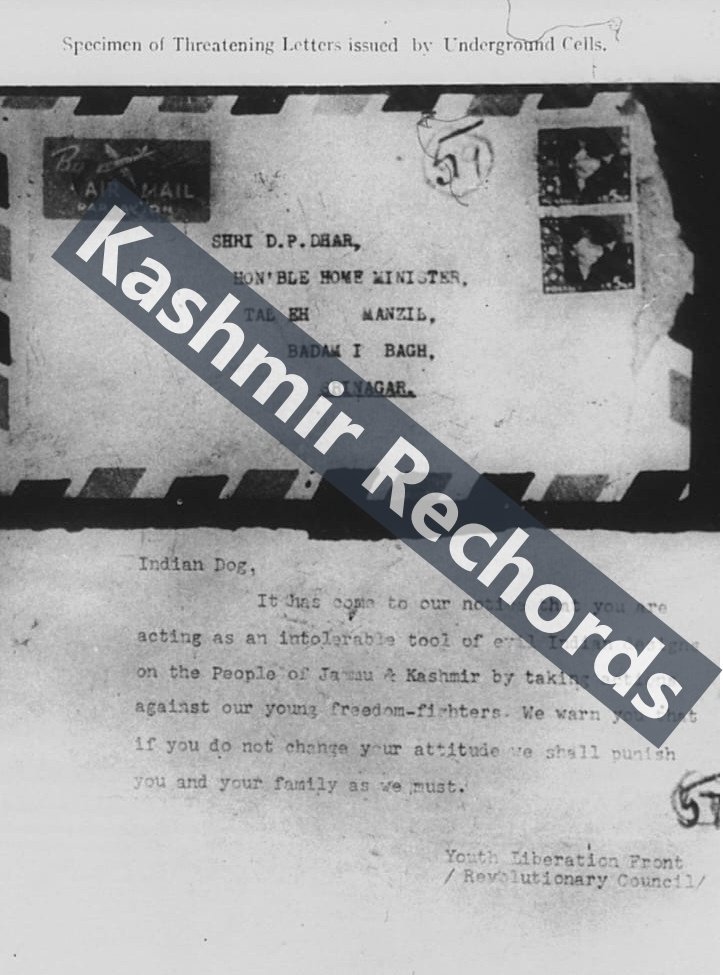
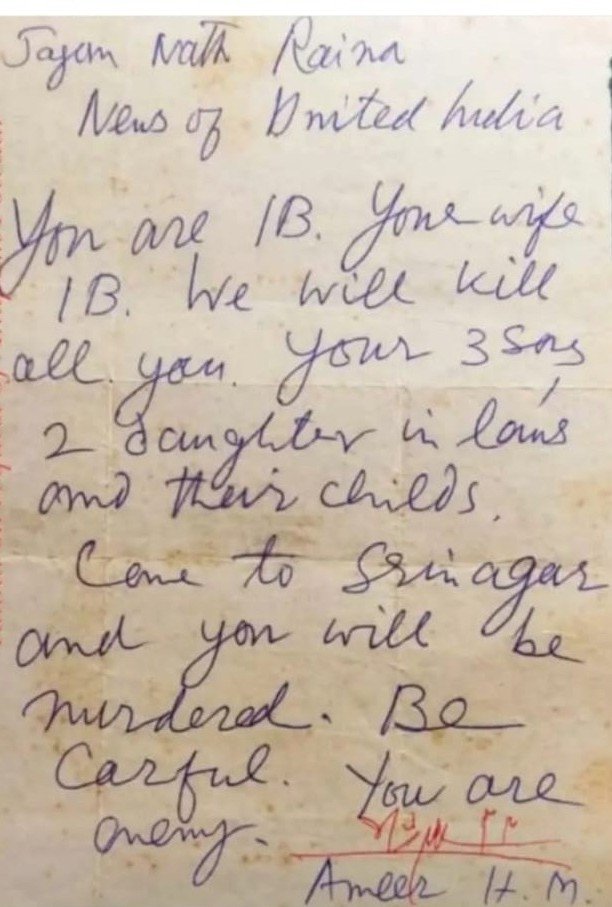
Even D. P. Dhar, then one of the most prominent political figures of Jammu and Kashmir and the State’s Home Minister, was not spared threatening and abusive communications. The episode is significant because it demonstrates that intimidation through written warnings was not born with the insurgency of 1989.
When D.P Dhar and his family were threatened!
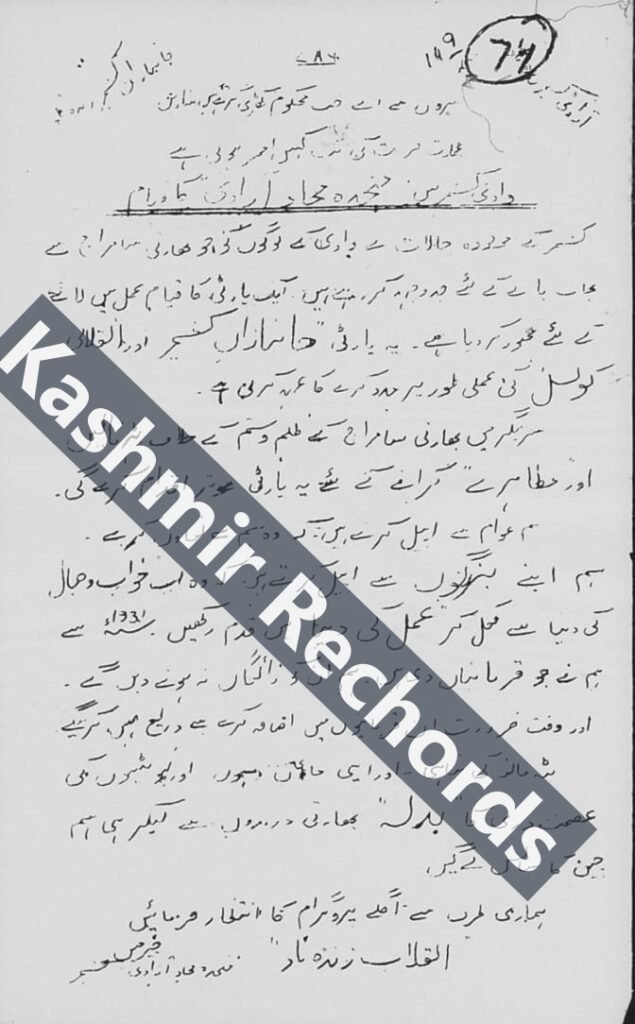
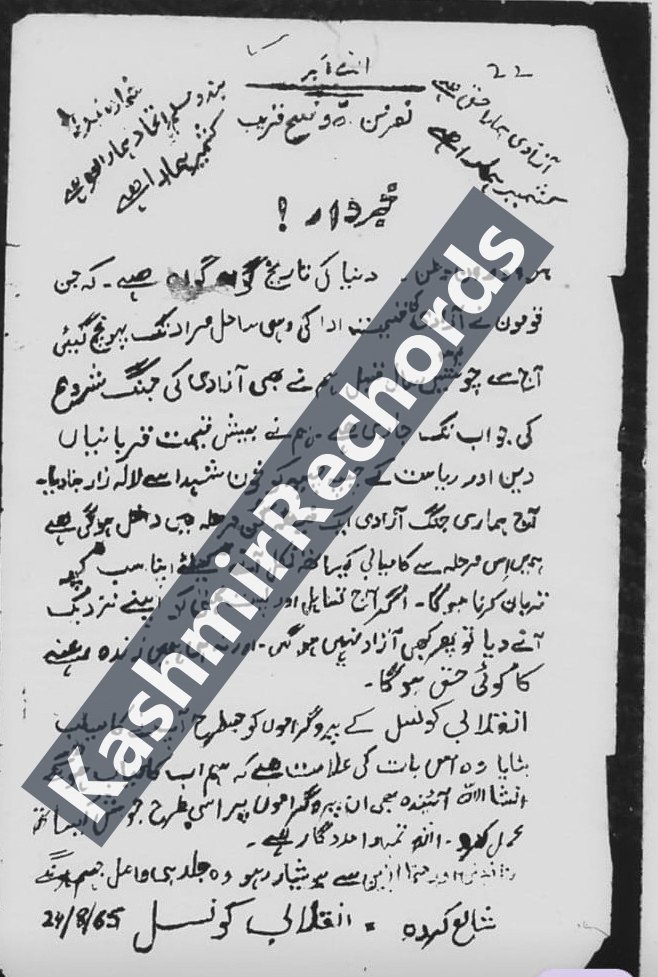
The modus operandi was simple: write it, type it, cyclostyle it or print it—and put it where people would see it. Posters were pasted on walls and electricity poles; letters were delivered to homes and offices; names were circulated and warnings issued.
The purpose was psychological.Make the person feel watched. Make the family afraid. Make the community believe that the threat could become a bullet.
A specimen of Threatening Posters in circulation in Kashmir during 1965-66
1989-90: When the warning became violence
By 1989-90, the old method of 1965 acquired a far more lethal dimension. Threatening letters and posters operated alongside assassinations, militant slogans and targeted killings. The objective was no longer simply to frighten an individual. It was to create an atmosphere in which an entire community and nationalist individuals began questioning whether they could safely remain in Kashmir.
The mass migration of Kashmiri Pandits cannot, therefore, be understood only through the number of people killed. The cumulative effect of threats, killings and intimidation created a climate of fear that ultimately pushed the community out of its ancestral homeland.
Threatening posters and letters in 1990
Article 370 changed. The threat did not disappear
The abrogation of Article 370 in 2019 fundamentally changed Jammu and Kashmir’s Constitutional and administrative structure. But the threat culture did not vanish.
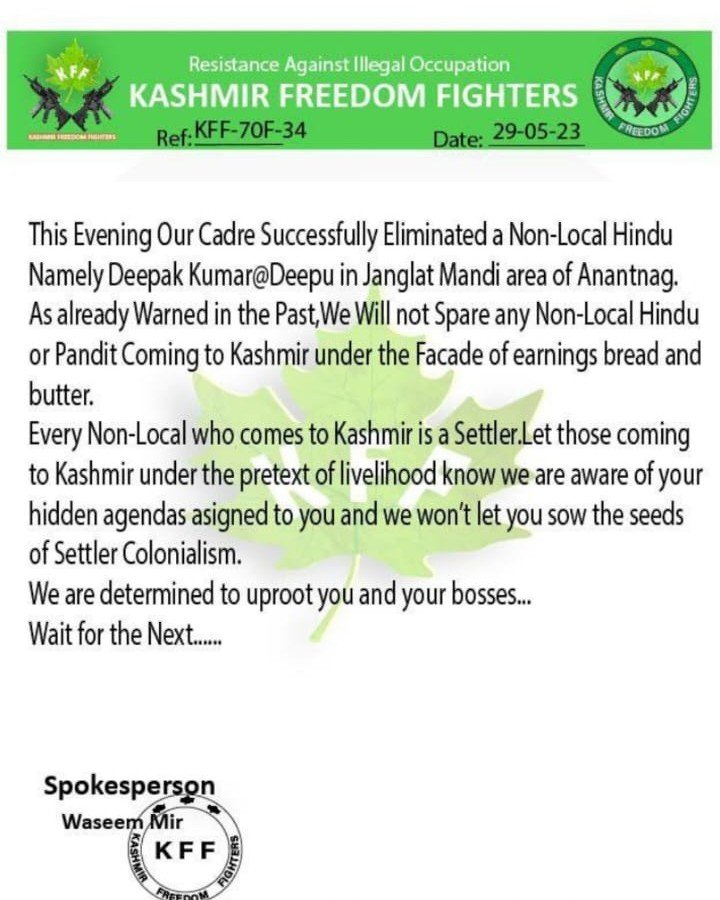
In the post-Article 370 period, Kashmiri Pandit employees again became targets. Threat posters and warnings have continued to surface. In 2023, non-locals and Kashmiri Pandits were again threatened.
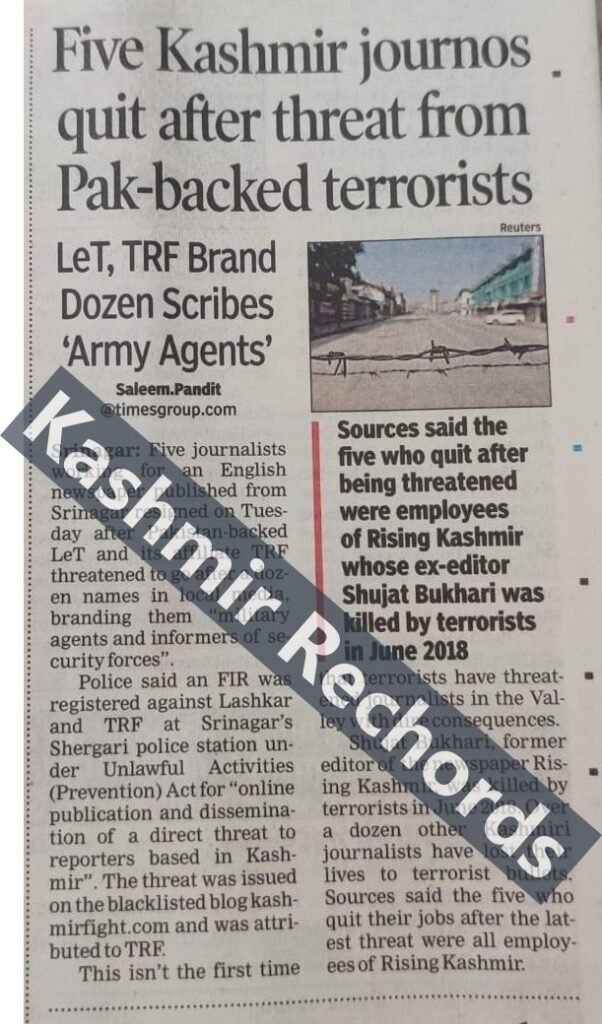
Again in February 2026, purported terror posters triggered fresh concern among Kashmiri Pandits, with community representatives demanding stronger preventive security measures. Even local journalists too faced these threats, before and after Article 370 abrogation. In November 2022, five Kashmiri journalists had to quit their job as dozens of Kashmiri journalists were branded as “Army Agents’’ by “The Resistance Front’’ (TRF) and LeT.
Times of India, November 2022
And now, in August 2026, a purported letter attributed to the United Liberation Council (ULC), linked in reports to Lashkar-e-Taiba, has named six Kashmiri Pandit government employees and claimed to possess details including their phone numbers and information about their families. Authorities have responded with heightened security and precautionary measures, including asking affected employees to work from safer locations or remain away from their workplaces temporarily.
Only the medium has changed
This is perhaps the most disturbing continuity.
In 1965, the threat could be handwritten. In the Al-Fateh era, it could be cyclostyled or printed.In 1989-90, it appeared on walls and electricity poles and arrived as letters and warnings. Today, it comes through digital posters, social media, online communications and mobile phones.
The poster has changed, the technology has changed, but the weapon remains the same—fear.”
The technology has changed. The message has not.
It remains a message of identification, intimidation and displacement: you have been noticed, you are being watched, and you are not safe.
For the young Pandit employees working in Kashmir today, therefore, the latest threat is not merely a new incident. It is an echo of what their parents and grandparents experienced even before 1990.
The paper has disappeared. The poster has gone digital. But the weapon remains the same: fear.
And the history of Kashmir shows that when threats are allowed to become normal, the distance between a warning and a killing can become frighteningly short.
Editor’s Note
Those interested in knowing more about some of the Al-Fateh episodes, including the history of its sleeper cells, the locations where threatening posters were prepared, typed or reproduced, and the individuals and networks involved in their production and circulation, may contact Kashmir Rechords for archival and research assistance.
SRINAGAR: At the beginning of the armed insurgency in 1989–90, the outlawed Jammu Kashmir Liberation Front (JKLF) sought to project itself as the force that would create an ‘Independent Kashmir’.
The symbolism was extraordinary. Militants reportedly forced people in parts of the Valley to set their watches to Pakistan Standard Time—a powerful psychological assertion that Kashmir was slipping out of India’s control. The practice was also recorded in contemporary official material and raised in Parliament in August 1990.
At the same time, the ‘JKLF’ reportedly looked towards Radio Kashmir Srinagar as a crucial instrument of the emerging struggle. Control of the powerful broadcasting station would have meant control of the microphone through which an alternative political authority could potentially announce itself to millions. But their designs were scuttled.
For a while, the Valley appeared to be witnessing the making of a new political order: Pakistan time on the watches, ‘Azadi’ in the streets and an ‘Independent Kashmir’ as the proclaimed destination.
But Pakistan’s growing support for pro-Pakistan militant organisations, particularly Hizbul Mujahideen, complicated the JKLF’s project. The insurgency increasingly became a contest not only against the Indian State but also over what Kashmir itself was supposed to become—independent or part of Pakistan.
It was amid this contest for political space that the ‘JKLF’ produced one of its most unusual propaganda symbols.
A country on paper
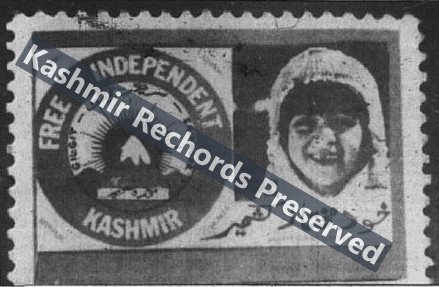
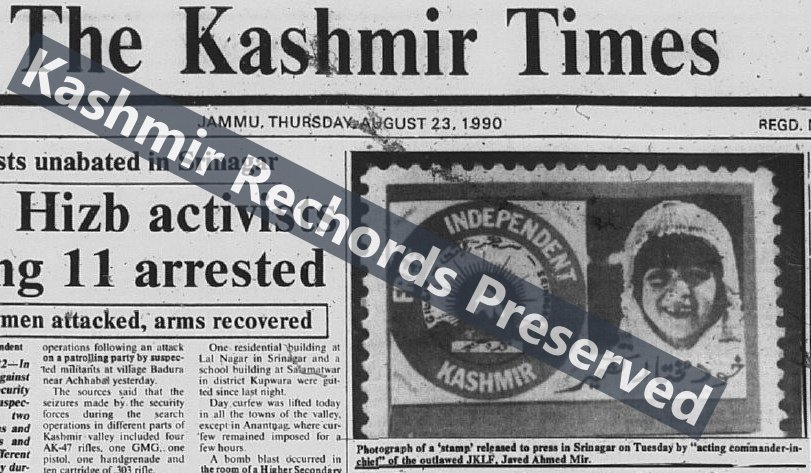
In August 1990, the JKLF, under its Acting ‘Commander-in-Chief’ Javed Ahmad Mir, reportedly brought out a postal-style stamp representing ‘Independent Kashmir’.
The episode was prominently reported in August 23, 1990 issue of Kashmir Times, which also carried a photograph of the stamp.
The design was striking: a child, accompanied by the words “FREE INDEPENDENT KASHMIR”, along with the Urdu inscription “Khud-Mukhtaar Kashmir”—self-governing or independent Kashmir.
The symbolism was unmistakable. The child represented the future; the stamp represented the ‘State the JKLF’ claimed it was fighting to create.
But this was not a recognised postage. It was a political/propaganda representation of a state that did not exist.
Yet newspapers gave the symbol a much larger public life. By reproducing the stamp, the press effectively amplified a militant publicity exercise, giving an imagined state the visual trappings of sovereignty.
Irony of the ‘Azadi’ dream
The irony was that while ‘JKLF’ was printing an ‘Independent Kashmir’ on paper and asking people to follow Pakistan time, the Valley was rapidly descending into violence.
Killings, kidnappings, threats and militant diktats spread. Kashmiri Pandits were driven into exile, while ordinary Kashmiris—Muslim and Hindu alike—were caught in a conflict whose human cost would last for decades.
A clock could be changed. A Radio Station could be targeted. A stamp could be printed. But an ‘Independent Kashmir’ could not be created through symbols
The stamp, therefore, survives as more than a philatelic curiosity. It is an archival snapshot of how the ‘JKLF’ attempted to manufacture the imagery of Statehood before possessing the institutions of a state.
The stamp promised a country. History delivered a conflict.
Lesson for Kashmir’s youth
For the youth of Kashmir, the episode remains a sobering lesson in how political emotions can be harnessed to sell impossible dreams. Pakistan and ‘JKLF’ projected competing visions—one of Kashmir’s socalled merger with Pakistan, the other of an ‘Independent Kashmir’—while thousands of young people were drawn into a conflict whose promises could never overcome the political, military and geopolitical realities surrounding Jammu and Kashmir. The dream of defeating a country of India’s scale and establishing a new State through militancy proved unattainable, while its pursuit brought violence, displacement, lost opportunities and generations of uncertainty. The lesson of history is that Kashmiris paid an enormous price for dreams that armed movements could promise, but could never deliver.
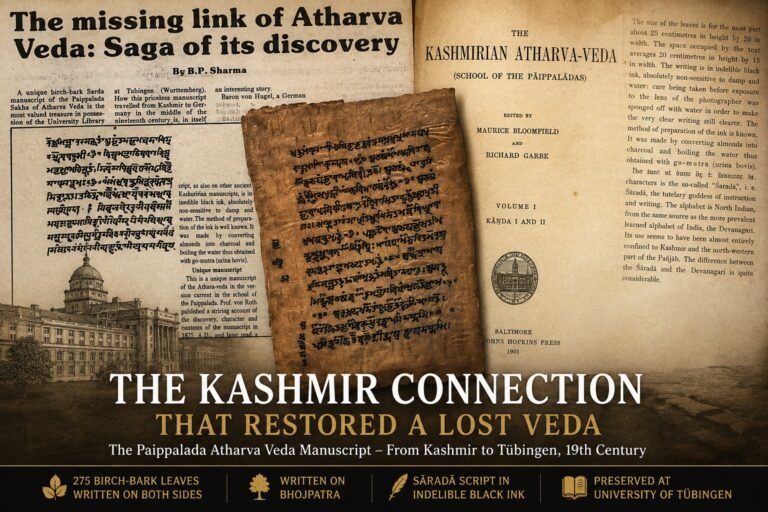
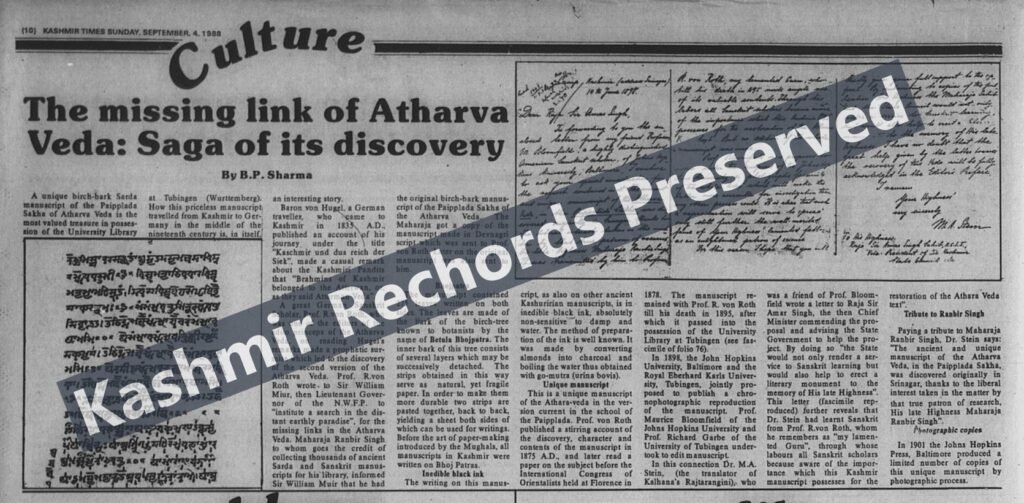
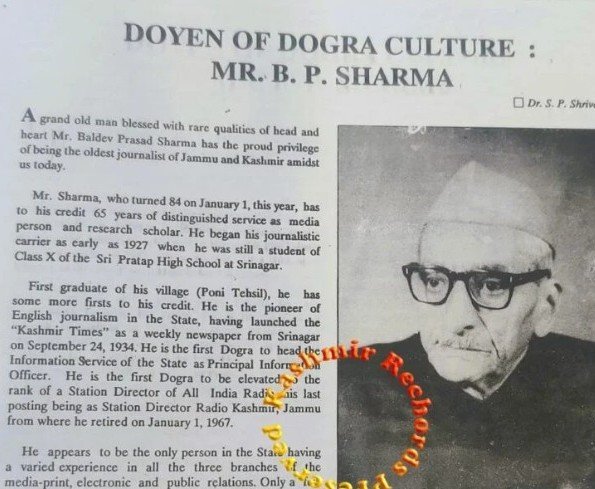
When veteran journalist and historian B.P. Sharma wrote The Missing Link of Atharva Veda: Saga of its Discovery in the Kashmir Times on September 1, 1988, he was not merely recounting the story of an ancient manuscript. He was documenting one of the greatest scholarly discoveries associated with Kashmir—one that fundamentally altered modern understanding of Vedic literature.
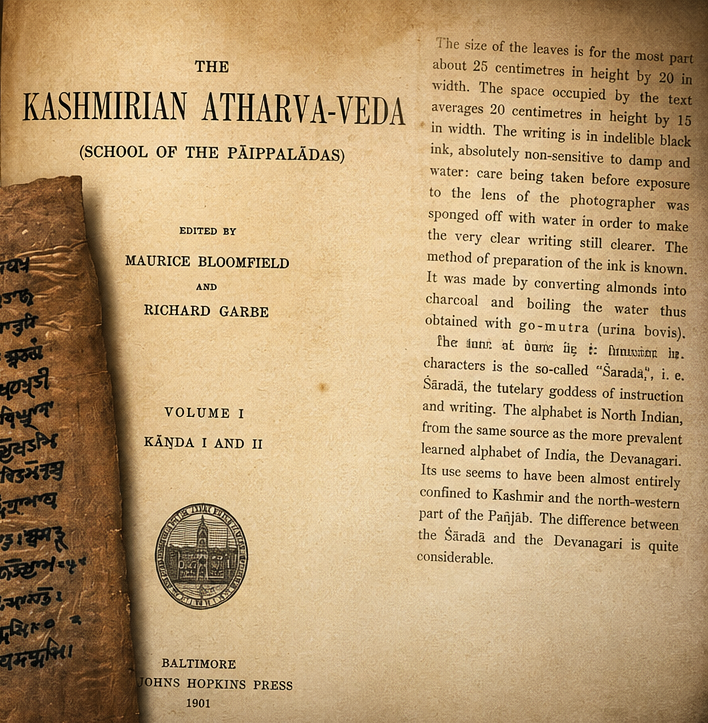
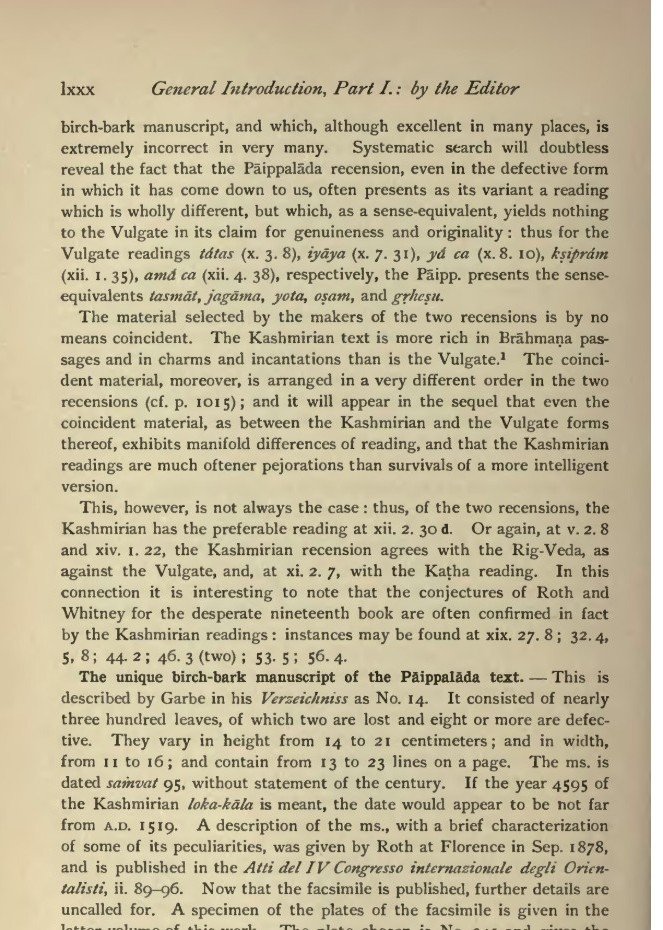
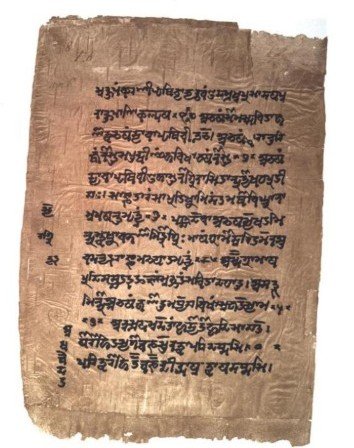
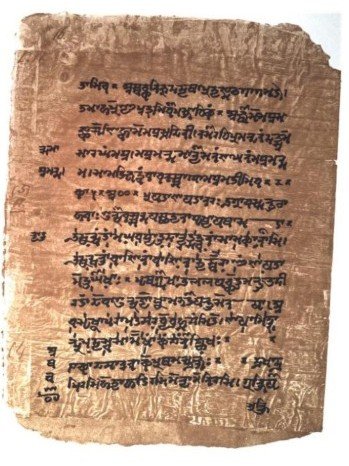
Nearly four decades later, B P Sharma’s account can now be corroborated in remarkable detail through the digitised edition of The Kashmirian Atharva-Veda (School of the Pāippalādas), published in 1901 by the Johns Hopkins Press under the editorship of Maurice Bloomfield and Richard Garbe, reproduced directly from the original birch-bark manuscript preserved at the University Library of Tübingen, Germany. The 1,088-page publication, now available through Google Books, stands as one of the most important documentary records of Kashmir’s contribution to world scholarship.
The Lost Branch of the Fourth Veda
For centuries, scholars recognised two principal recensions (Śākhās) of the Atharva Veda:
the Śaunakīya, which remained in circulation; and
the Paippalāda, long believed to have disappeared.
European Indologists knew of the Paippalāda recension only through scattered references in ancient commentaries. No complete manuscript was available, making it one of the greatest unresolved questions in Vedic philology.
B P Sharma’s detailed article on “The Missing Link of Atharva Veda: Saga of its Discovery”, published in Kashmir Times in September 1988.
B.P. Sharma, fondly remembered as ‘Walking Encyclopaedia of J&K’’, accurately described it as the “missing link” in Atharva Vedic studies—a description entirely consistent with the historical record preserved in Bloomfield and Garbe’s monumental publication.
Baron von Hügel’s Observation that Changed Vedic Studies
The story begins in 1833, when Austrian-German traveller Baron Charles von Hügel visited Kashmir. During his travels he recorded an intriguing statement made by Kashmiri Pandits—that they followed what they pronounced as the “Alterman Veda,” rather than the Atharvan tradition known elsewhere in India.
Although seemingly anecdotal, this observation caught the attention of the eminent German Sanskrit scholar Professor Rudolf von Roth, who suspected that Kashmir might still preserve an otherwise lost recension of the Atharva Veda.
B P Sharma’s article recounts this episode, and the introductory chapters of The Kashmirian AtharvaVeda confirm that von Hügel’s observation became one of the earliest clues leading scholars towards Kashmir’s manuscript tradition.
Maharaja Ranbir Singh’s Search for the Manuscript
The most significant contribution, however, came from Maharaja Ranbir Singh (1857–1885). According to Sharma, Sir William Muir, then Lieutenant-Governor of the North-Western Provinces, appealed to the Maharaja to search his vast collection of Sanskrit manuscripts for evidence of the missing recension.
The request was hardly accidental. Maharaja Ranbir Singh had established one of the richest manuscript collections in Northern India, acquiring thousands of Sanskrit, Śāradā and Persian manuscripts from scholars across Kashmir and adjoining Himalayan regions.
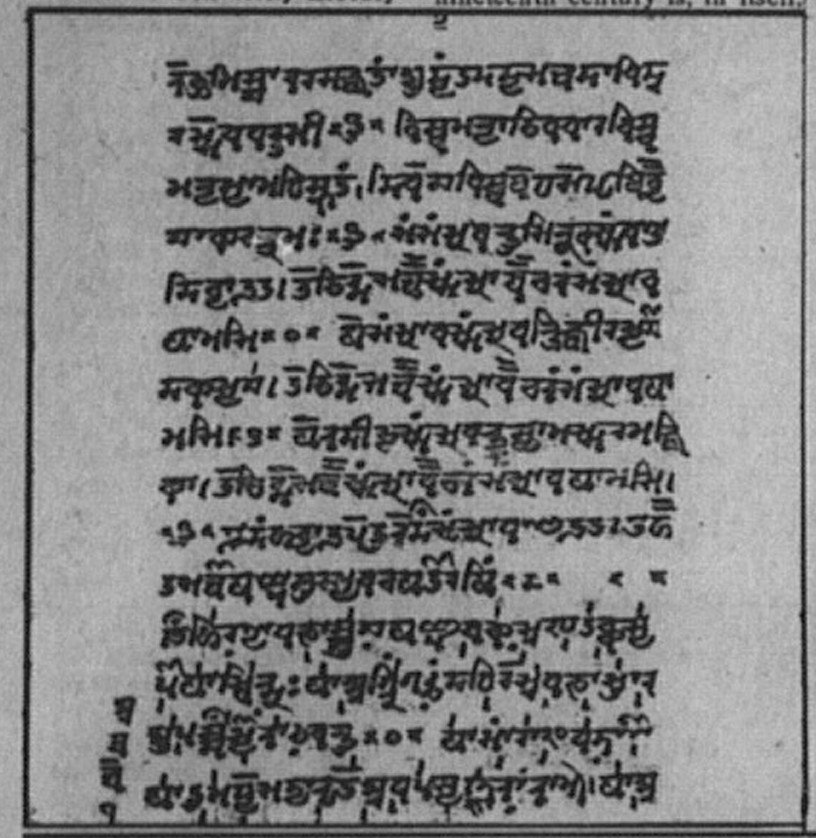
The search proved successful. Among these collections lay a complete Śāradā-script birch-bark manuscript of the Paippalāda recension.Bloomfield and Garbe acknowledge in their publication that the manuscript originated in Kashmir and reached European scholarship through the enlightened patronage of Maharaja Ranbir Singh.
The Devanagari Transcript
One of the most important details mentioned by B P Sharma is that the Maharaja did not immediately despatch the fragile birch-bark manuscript abroad.Instead, scholars first prepared a Devanagari transcript, which was sent to Professor Rudolf von Roth for examination.Only afterwards was the original manuscript forwarded.
This careful process reflects the scholarly seriousness with which the Dogra court treated the manuscript and its preservation.
Written on Kashmir’s Famous Bhojpatra
The manuscript itself represents the finest tradition of Kashmiri manuscript culture.
As B P Sharma in his article describes, and as confirmed in the 1901 publication, the manuscript consists of approximately 275 birch-bark folios, written on both sides in the Śāradā script using indigenous black ink. The bark was obtained from the Himalayan Betula utilis (Bhojpatra) tree, whose thin inner bark had served as Kashmir’s principal writing material for centuries before the widespread adoption of paper.
Its survival is itself extraordinary. Birch bark is highly susceptible to humidity and mechanical damage, making the preservation of a complete Vedic recension exceptionally rare.
Rudolf von Roth’s Historic Recognition
Professor Rudolf von Roth quickly realised that the manuscript represented one of the greatest discoveries in Sanskrit studies. His publications announced to the academic world that the supposedly lost Paippalāda Śākhā had survived in Kashmir.
The discovery challenged long-held assumptions regarding the textual history of the Atharva Veda and opened entirely new avenues of comparative Vedic research.
Aurel Stein’s Tribute to Kashmir
Another remarkable episode highlighted by B P Sharma concerns Sir Marc Aurel Stein, whose archaeological work transformed the study of Kashmir’s past.
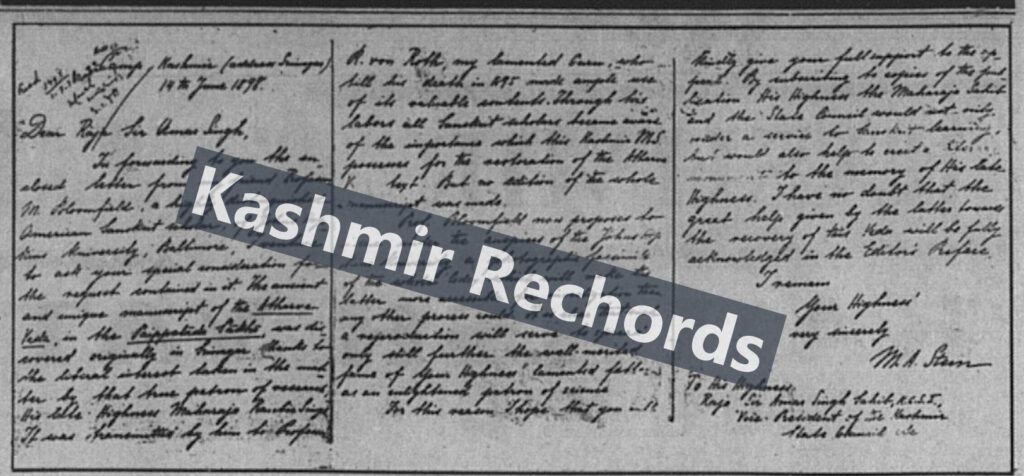
Stein not only appreciated the manuscript’s textual importance but also wrote to Raja Amar Singh, urging the Jammu and Kashmir administration to support its publication and to honour Maharaja Ranbir Singh’s contribution to Sanskrit scholarship.
Sir Aurel Stein’s letter to Raja Amar Singh
Stein reportedly described the manuscript as indispensable for the restoration of the Atharva Veda, crediting Maharaja Ranbir Singh’s patronage for making the discovery possible.
This correspondence illustrates how nineteenth-century European scholarship acknowledged Kashmir’s own role in preserving India’s classical heritage.
Johns Hopkins, Tübingen Preserve Kashmir’s Legacy
In 1898, Maurice Bloomfield, Richard Garbe and the Universities of Johns Hopkins and Tübingen initiated an ambitious project to reproduce the manuscript by chromophotography, then one of the most advanced methods of documentary reproduction.The resulting publication appeared in 1901 under the title The Kashmirian AtharvaVeda.
Rather than merely printing the Sanskrit text, the editors reproduced photographic plates of the original birch-bark folios, enabling scholars worldwide to study the manuscript exactly as preserved in Kashmir. The work remains one of the earliest large-scale photographic reproductions of an Indian manuscript.
Why the Discovery Changed Indology
The publication had profound implications.
For the first time, scholars could compare the Paippalāda and Śaunakīya recensions of the Atharva Veda in detail. Differences in arrangement, wording and preservation revealed that the Kashmir manuscript preserved an independent textual tradition rather than merely a variant copy.
Maurice Bloomfield later incorporated these findings into his broader studies of the Atharva Veda, acknowledging the Kashmir manuscript as indispensable for reconstructing the textual history of the fourth Veda.
B.P. Sharma’s Enduring Contribution
B.P. Sharma deserves recognition not only for narrating this remarkable story but for introducing it to a wider readership in Jammu and Kashmir at a time when manuscript heritage rarely featured in public discourse.
His article anticipated many of today’s efforts to reclaim Kashmir’s intellectual history. Rather than presenting the discovery merely as an episode in European Indology, Sharma correctly placed Kashmir, its Pandit scholars and Maharaja Ranbir Singh at the centre of the narrative.
Today, with The Kashmirian Atharva-Veda freely accessible in digital form through Google Books, readers can verify virtually every major episode recounted in Sharma’s article—from Baron von Hügel’s observations and Rudolf von Roth’s scholarship to Aurel Stein’s correspondence and the pioneering 1901 chromophotographic edition.
The rediscovery of the Paippalāda Atharva Veda was not merely the recovery of an ancient manuscript; it was the restoration of an entire branch of India’s Vedic tradition. The journey of the manuscript—from the manuscript repositories of Srinagar to Tübingen, and from there to one of the most celebrated publications in Oriental studies—stands as a testament to Kashmir’s role as one of the great custodians of India’s civilisational heritage.
Read together, B.P. Sharma’s 1988 Kashmir Times article and Bloomfield and Garbe’s 1901 scholarly edition present a compelling narrative: that the preservation of one of the world’s oldest sacred texts owed as much to the custodianship of Kashmiri scholars and the enlightened patronage of Maharaja Ranbir Singh as it did to the painstaking efforts of European Indologists. Their combined testimony firmly establishes Kashmir not only as a land of spiritual traditions but also as a vital centre in the global history of manuscript preservation and Vedic scholarship.
*Dr. Rajesh Bhat is an eminent journalist, media researcher, and former senior Officer with Prasar Bharati. Holding a Ph.D. in media and strategic studies , he has authored several books—including Radio Kashmir: In Times of Peace & War—and regularly documents the cultural, historical and archival heritage of Jammu and Kashmir.
The archival newspaper clipping dated May 30–31, 1984 challenges one of the most frequently repeated narratives about the origins of the Kashmir conflict. A common perception is that Kashmir’s troubles began with the 1987 Assembly elections, followed by the rise of militancy and, ultimately, the forced exodus of the Kashmiri Pandit community in 1990. However, archival evidence indicates that communal targeting and violence against the minority community predated 1987.
The report explicitly mentions that Kashmiri Pandit temples were attacked and that attempts were made to set them on fire. It states that the All State Kashmir Pandit Association protested these attacks and referred to assaults on temples and other religious places. The report also records widespread violence across Srinagar, Anantnag, Baramulla and other areas, curfews, police firing, destruction of property, and attacks on public transport. These developments occurred three years before the 1987 elections.
Circa May 1984: When Temples in Kashmir were attacked!
This archival evidence should not be interpreted as proving a single cause for the later insurgency, but it does demonstrate that communal intimidation and attacks on Kashmiri Pandit religious sites were already taking place in 1984. The subsequent 1986 Anantnag riots, during which numerous temples and Hindu properties were attacked, further deepened the sense of insecurity among the minority community. Yet, despite these repeated incidents, Kashmiri Pandits largely remained in the Valley, hoping that the situation would improve.
The crisis reached its tragic culmination only in 1990, when escalating militancy, targeted killings, intimidation, and threats triggered the mass exodus of the Kashmiri Pandit community from their ancestral homeland.
In other words, the archival record suggests a more complex chronology than the simplified narrative that everything began in 1987. The sequence reflected in contemporary reports is:
1984: Attacks on Kashmiri Pandit temples and growing communal violence, as documented in contemporary newspapers.
1986: The Anantnag riots and widespread attacks on temples and minority properties.
1987: A disputed election, followed by a rapid escalation of armed militancy.
1990: The mass exodus of Kashmiri Pandits.
These archival records underscore that the vulnerability of the Kashmiri Pandit community was evident years before the 1990 exodus, and that understanding the conflict requires examining the full historical sequence rather than reducing it to a single turning point.
History is often remembered through wars fought on one’s own soil. Yet Kashmir witnessed another phenomenon—equally tragic but far less documented. For decades, international political and religious events repeatedly ignited protests in the Valley, even when those events had no direct connection with Jammu and Kashmir. The emotional response was immediate; the consequences were local.
An extensive examination of contemporary newspaper archives by Kashmir Rechords reveals a striking historical pattern. From the execution of Pakistan’s former Prime Minister Zulfikar Ali Bhutto in 1979 to the desecration of Jerusalem’s Al-Aqsa Mosque in 1986, from the American bombing of Libya to the Salman Rushdie controversy in 1989, Kashmir repeatedly became a theatre where distant events played out violently. In many cases, it was the Valley’s minorities—Kashmiri Pandits and Christians in particular—who paid the price for conflicts and controversies in which they had no role.
1979: Kashmir Reacts to Pakistan’s Internal Crisis
The first major example emerged in March-April 1979, when Pakistan’s former Prime Minister Zulfikar Ali Bhutto exhausted his legal remedies after the Supreme Court of Pakistan upheld his death sentence.Even before Bhutto’s execution, Kashmir witnessed protests.
An archival report dated March 25, 1979 records a hartal in Srinagar following the rejection of Bhutto’s review petition. Protesters took to the streets against General Zia-ul-Haq‘s military regime despite the fact that the controversy concerned Pakistan’s internal judicial process.The situation worsened after Bhutto was executed on 4 April 1979.
A newspaper dated 6 April 1979 carried the alarming headline:
“Four More Killed By Police Firing In Kashmir – Violent Demonstrations Against Execution of Bhutto.”
According to the report, police firing across Kashmir raised the death toll to seven persons within two days. Massive demonstrations paralysed Srinagar, Shopian, Sopore, Anantnag and several other towns.
The archives describe:violent clashes with police;attacks on government buildings;road blockades;extensive stone-pelting;attempts to storm public offices;widespread shutdowns.
Most significantly, the report records that shops and business establishments belonging to sections of the Muslim community perceived to support General Zia or the Jamaat-e-Islami were attacked and looted. Their only perceived offence was ideological association with Pakistan’s ruling establishment.The Valley had erupted—not over a local issue—but over Pakistan’s domestic politics. Even Christian Community of Kashmir was targetted , forcing Sheikh Abdullah to say that while Pakistan took an ugly decision, why are we burning houses and Churches here?
1986: Jerusalem Burns, Kashmir Shuts Down
Seven years later, another international event triggered a similar reaction.Reports of the desecration of the Al-Aqsa Mosque in Jerusalem in February 1986 produced one of the largest protest movements witnessed in Kashmir during that decade.
Archival newspapers carried headlines including:
“Hartal, Demonstrations in Kashmir Towns.”
“Valley-wide Protest Against Desecration of Al-Aqsa Mosque.”
Entire towns observed shutdowns. Demonstrations spread through Srinagar, Baramulla, Sopore, Kupwara, Pulwama, Shopian, Anantnag and Handwara.
Crowds shouted slogans against Israel and the United States while clashes with police left several personnel injured.
For many Kashmiris, Al-Aqsa represented not merely a mosque but an emotional symbol of the Islamic world.Yet the repercussions did not stop with protest marches.
An Already Explosive Atmosphere
The Al-Aqsa demonstrations unfolded against the backdrop of mounting communal tension inside Kashmir.
Within days, the Valley witnessed the Anantnag riots of February 1986, during which numerous temples, houses and commercial establishments belonging to Kashmiri Pandits were attacked.
Although historians attribute those riots to a combination of political, communal and local factors, the archival timeline demonstrates how international religious developments further inflamed an already combustible atmosphere.Once again, the victims were local.
Libya Bombed, Christians in Kashmir Guarded
Barely two months later, another international conflict reverberated through Kashmir. Following the United States’ bombing of Libya in April 1986, newspapers reported that security across Kashmir had been substantially tightened.
The report specifically stated that police protection had been reinforced around:churches,Christian missionary institutions and educational establishments run by missionaries.
The administration feared that anger directed against the United States could spill over onto local Christian institutions.
The irony could hardly have been greater. Kashmir’s Christians had absolutely no connection with Washington’s foreign policy.
Yet they required police protection because events unfolding in North Africa were expected to provoke unrest in Kashmir.
The newspaper itself recalled that similar precautionary measures had earlier been necessary during the Al-Aqsa protests.
1988: Mourning General Zia
History then produced another paradox.When General Zia-ul-Haq, the very military ruler blamed by protesters for Bhutto’s execution, died in an air crash on August 17, 1988, parts of Kashmir again witnessed mourning processions and demonstrations.
The same Valley that had erupted against him nine years earlier now observed public grief over his death.
The episode illustrated how political developments across the border continued to evoke powerful emotional responses inside Kashmir, often resulting in law-and-order challenges requiring heavy deployment of security forces.
1989: Salman Rushdie and Local Backlash
The publication of Salman Rushdie’s The Satanic Verses triggered protests across much of the Muslim world.Kashmir was no exception.
During demonstrations in February 1989, two ancient temples belonging to the Kashmiri Pandit community—one at Fateh Kadal and another at Ganpatyar in Srinagar—were attacked.Neither the temples nor the Kashmiri Pandit community had any connection with the author or the publication.
Nevertheless, local minorities once again became targets during protests over an international controversy.
A Disturbing Historical Pattern
Viewed together, these archival reports reveal an unmistakable pattern.
Whenever a major political or religious event occurred abroad:Pakistan executed Bhutto or Jerusalem witnessed controversy over Al-Aqsa 0r America bombed Libya or Salman Rushdie published a controversial novel, Kashmir often responded with: shutdowns,demonstrations,violent confrontations,attacks on public property,heightened communal tension and the deployment of additional security around minority places of worship.
The emotional geography of Kashmir frequently extended far beyond its physical borders. Unfortunately, the consequences often fell upon neighbours who had nothing whatsoever to do with those distant events.
Pattern Has Not Entirely Disappeared
The archives also resonate with more recent developments.Following the escalation of tensions involving Iran, sections of Kashmir again organised demonstrations expressing solidarity with the country. Public reports documented campaigns collecting humanitarian assistance, including cash as well as donations of gold and silver, intended for relief efforts associated with Iran.
Expressions of solidarity with international causes have long formed part of Kashmir’s political culture. The historical record, however, also serves as a reminder of the dangers of allowing distant conflicts to translate into local intimidation or communal polarisation.
The Forgotten Lesson of the Archives
The newspaper clippings preserved by Kashmir Rechords tell a story that extends beyond individual protests.
They document a recurring historical phenomenon in which international events repeatedly shaped Kashmir’s internal social and political climate. They also reveal a sobering truth: the burden of those distant conflicts was often borne by innocent local communities.
Whether it was Kashmiri Pandits whose temples came under attack after the Rushdie controversy, Christians whose churches required police protection after the bombing of Libya, or ordinary citizens caught in violence following Bhutto’s execution, the archives show that international passions frequently translated into local insecurity.
Understanding this history does not diminish the right of people to express solidarity with causes beyond their borders. Rather, it highlights the importance of ensuring that such expressions never become a pretext for violence against fellow citizens who bear no responsibility for events unfolding thousands of kilometres away.
As these forgotten newspaper reports remind us, history’s most enduring lesson is that when global conflicts are imported into local society, it is often the innocent who pay the highest price.
About the Author
Dr. Rajesh Bhat is a veteran journalist, broadcaster, author, media archivist and independent researcher with over three decades of experience in Journalism and Public Broadcasting. He holds a Ph.D. in Journalism and Mass Communication and began his career in print journalism, serving with the Kashmir Times before joining Daily Excelsior as a Special Correspondent, where he headed the newspaper’s Kashmir Desk during the peak years of militancy in the Valley. During the same period, he also contributed extensively on art, cultureand heritage to The Tribune.
He later transitioned to electronic media, serving in Prasar Bharati in various broadcasting capacities. Dr. Bhat is the co-founder of the Kashmir Rechords Foundation, a registered non-profit organization dedicated to preserving the archival, cultural and socio-political history of Jammu and Kashmir. His research draws extensively on contemporary newspaper archives, official records and other primary historical sources to document forgotten narratives and present evidence-based accounts of Kashmir’s past.
Today, the name Salman Rushdie evokes memories of one of the most controversial episodes in modern literary history. For many, it is inseparable from The Satanic Verses, worldwide protests, a fatwa, and decades of security threats that followed.
Yet few remember that years before the controversy engulfed his life, Rushdie was welcomed in Kashmir as an internationally acclaimed novelist, interviewed by Radio Kashmir Srinagar, and greeted warmly by students at one of the Valley’s most prestigious colleges.
That forgotten chapter, preserved today through rare photographs and newspaper archives, tells the story not only of Salman Rushdie but also of a Kashmir that was intellectually vibrant, culturally confident and deeply connected with the world of ideas.
A Booker Prize Winner in Kashmir
It was May 1983.Salman Rushdie had already achieved international fame after winning the Booker Prize for his landmark novel Midnight’s Children, a work widely regarded as one of the finest novels written in English in the twentieth century. The novel had brought India and its complex history to the forefront of world literature, making Rushdie one of the most celebrated writers of his generation.
During his visit to Kashmir that year, Rushdie was interviewed at Radio Kashmir Srinagar, where he spoke about Midnight’s Children, literature and contemporary writing.
Among the rare archival treasures preserved by Kashmir Rechords is a remarkable photograph showing Rushdie seated before the microphones inside the studios of Radio Kashmir. It is more than a photograph—it is visual testimony to an era when Kashmir welcomed some of the world’s leading literary voices into its premier broadcasting institution.
Salman Rushdie in the Studios of Radio Kashmir, Srinagar ( May 1983), talking about his book ‘Midnight’s Children’
Rushdie’s visit extended beyond the radio station.
He also visited the historic Sri Pratap (SP) College, Srinagar, where he interacted with students and members of the faculty. His visit generated considerable enthusiasm among young readers, and the college later published photographs of the interaction in its annual magazine. Those images remain an enduring reminder of a Kashmir where internationally acclaimed writers could freely engage with students and scholars.
When Rushdie sat before the Radio Kashmir microphones in 1983, he wasn’t a figure of global political storm—he was celebrated as a master storyteller reconnecting world literature with South Asian history
The Valley that Rushdie encountered in 1983 was known not merely for its breathtaking beauty but also for its thriving literary culture. Radio Kashmir regularly hosted distinguished writers, poets, musicians and intellectuals, while colleges and universities served as centres of lively academic and cultural exchange.
Few could have imagined that within a few years everything would change.
A Book That Shook the World
On 26 September 1988, Rushdie’s novel The Satanic Verses was published in the United Kingdom.
Almost immediately, sections of the Muslim community across the world objected to passages they considered offensive to Islam. Demonstrations began in several countries, and the controversy rapidly crossed national boundaries.
Concerned about possible disturbances, the Government of India became the first government in the world to prohibit the import of the book on 5 October 1988, citing concerns over public order.
At that stage, however, Kashmir’s response was not entirely one of condemnation.
In Defence of Salman Rushdie: An article that was published in Kashmir Times on October 16, 1988.
Kashmir’s Intellectual Response
Among the archival holdings of Kashmir Rechords is the Sunday, October 16, 1988 edition of the Kashmir Times, carrying a remarkable article by eminent Kashmiri writer G. M. Zahid titled “In Defence of Salman Rushdie.”
Published at a time when the controversy was still unfolding, Zahid’s article offered a thoughtful defence of Rushdie and reflected Kashmir’s long tradition of intellectual debate. It demonstrated that even amid growing international criticism, there remained voices in the Valley that believed literature should be debated through ideas rather than emotion.
Today, that newspaper clipping has become an important historical document. It reminds us that Kashmir’s literary community did not react uniformly and that public opinion was still evolving.
From Literary Debate to Public Agitation
The controversy, however, soon moved far beyond literature.
As protests intensified across several Muslim-majority countries, the issue acquired powerful religious and political dimensions. Public demonstrations grew larger, emotions became stronger and governments across the world found themselves confronted with an increasingly volatile situation.
The turning point came in February 1989, when Ayatollah Ruhollah Khomeini issued a fatwa calling for Rushdie’s death. The controversy instantly became a global crisis.Its impact was felt in Kashmir as well.
In February 1989, the Valley witnessed widespread strikes, hartals and demonstrations against Salman Rushdie and The Satanic Verses. Thousands participated in protests across Srinagar and elsewhere.
Another Hartal in Kashmir ( February 13, 1989) against publication of Salman Rushdie’s controversial book ‘Satanic Verses’
The demonstrations turned violent. During clashes with the authorities, one civilian lost his life and many others were injured, marking one of the most significant public agitations in Kashmir over an international issue. Newspapers of the time carried dramatic reports of shutdowns, processions, public anger and escalating law-and-order concerns.The transformation was extraordinary.
Within less than six years, the same author who had discussed literature inside Radio Kashmir Srinagar and interacted with students at SP College had become the focus of mass protests in the very Valley that had once welcomed him.
A Kashmir That Changed Forever
The Rushdie episode coincided with one of the most turbulent periods in Kashmir’s modern history.Only months later, the Valley descended into armed insurgency. The institutions that had once celebrated literature, culture and open dialogue found themselves operating under the shadow of violence and uncertainty. International writers no longer travelled freely to Kashmir. Public discourse changed, and the atmosphere that had encouraged intellectual engagement steadily disappeared.
The rare photograph of Salman Rushdie at Radio Kashmir Srinagar, the pages of the SP College annual magazine documenting his visit, the Kashmir Times article “In Defence of Salman Rushdie” and the newspaper reports chronicling the February 1989 protests together tell a compelling story of a society in transition.
These archives are not simply about Salman Rushdie.They are about Kashmir itself.
They remind us that before conflict came to dominate headlines, Kashmir was a place where celebrated writers were welcomed, books were discussed on public radio, students engaged with world literature and newspapers accommodated differing viewpoints—even on the most contentious issues.
For Kashmir Rechords, preserving these forgotten fragments is an effort to recover a chapter of history that deserves to be remembered in all its complexity. Together, they capture the remarkable journey of one celebrated author—and the equally remarkable transformation of a Valley whose intellectual landscape changed forever within the span of a few short years.