
(Kashmir Rechords Exclusive)
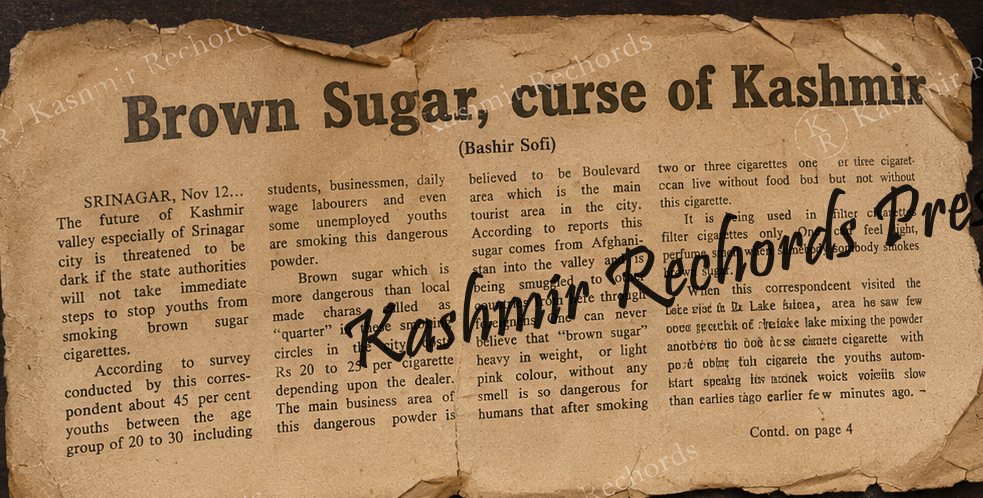
The archival newspaper clipping from 1984 reads today with an uncomfortable familiarity. Long before heroin, synthetic narcotics and cross-border drug networks became regular headlines, the report, published in a leading newspaper of Jammu and Kashmir had already sounded an alarm: brown sugar had entered Kashmir’s social fabric, affecting students, unemployed youth and urban pockets of Srinagar.
At the time, the concern appeared local and limited. Drug abuse was not yet viewed as a strategic challenge, nor was addiction understood as a public health and security issue. The warning remained largely confined to reportage and public concern.
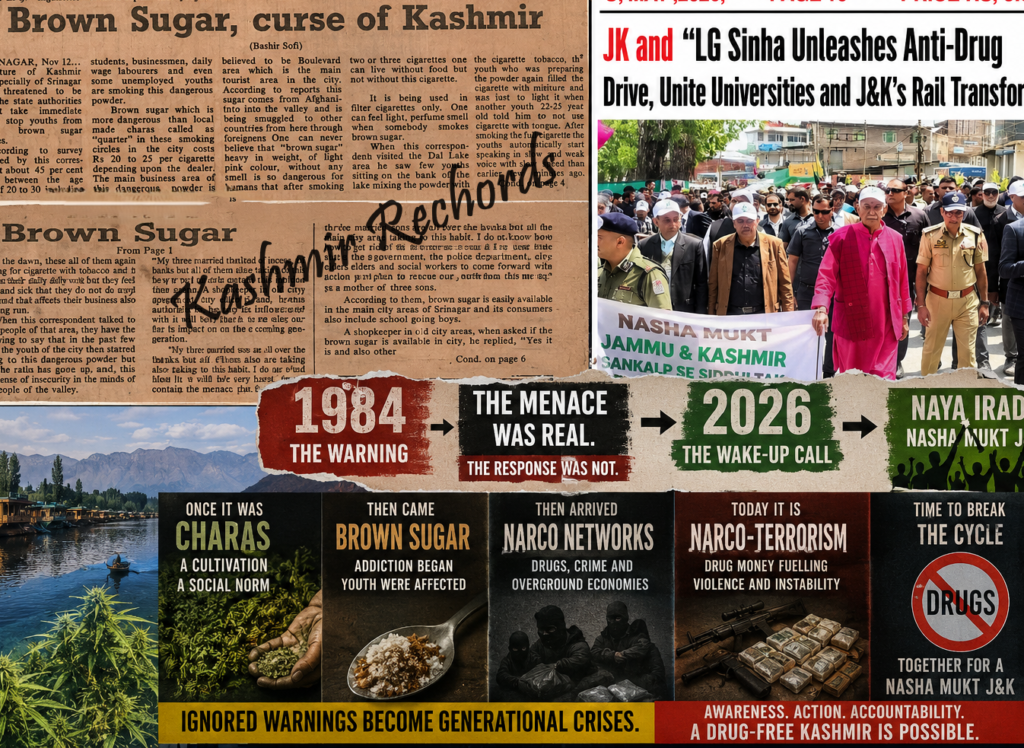
More than four decades later, Jammu and Kashmir has launched one of its most visible anti-drug campaigns in recent memory.Lieutenant Governor Manoj Sinha’s Nasha Mukt Jammu Kashmir Abhiyaan, including public marches in Srinagar, Pulwama and elsewhere, has framed the issue not merely as addiction but as a wider social and security challenge.
But the uncomfortable question remains:
If the signs were visible in 1984, did the region underestimate the scale of what was coming?
Historically, parts of Kashmir’s rural economy had episodic and limited familiarity with cannabis and charas cultivation, often treated as local law-and-order issue rather than a gateway to organised narcotics networks. What appears to have changed in recent decades is not merely consumption—but the nature of supply, trafficking and dependency.
Today’s concern is qualitatively different.
Reports and official statements increasingly speak of heroin abuse, injectable drug use, rising treatment demand and growing concern over organised trafficking networks. Estimates discussed in public policy circles and parliamentary discourse have described substance abuse as a serious social challenge in Jammu and Kashmir.
That evolution is where the term narco-terrorism enters the conversation.
In recent years, security agencies in Jammu and Kashmir have publicly reported operations describing alleged links between narcotics smuggling and terror financing, including seizures and arrests under what authorities termed narco-terror investigations.
That does not mean every case of addiction or every drug user is connected to terrorism. Most addiction cases are public-health and social crises. But the concern expressed by authorities is that trafficking channels can sometimes overlap with criminal and security networks.
Read through that lens, the 1984 clipping becomes more than an archival curiosity.
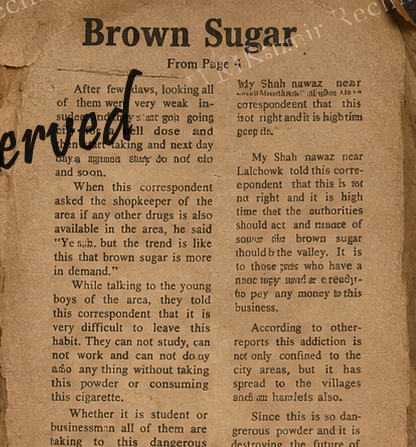
It begins to look like an early warning.
Back then, the fear was that youth would lose direction.
Today, the fear is broader: that addiction destroys families, drains communities, creates illicit economies and, in the worst cases alleged by investigators, feeds networks far removed from the individual user.
The anti-drug movement underway in Jammu and Kashmir therefore carries a message beyond enforcement:
History’s ignored warnings become tomorrow’s emergencies.
And perhaps that is what makes the old headline feel so contemporary: “Brown Sugar, Curse of Kashmir.”