
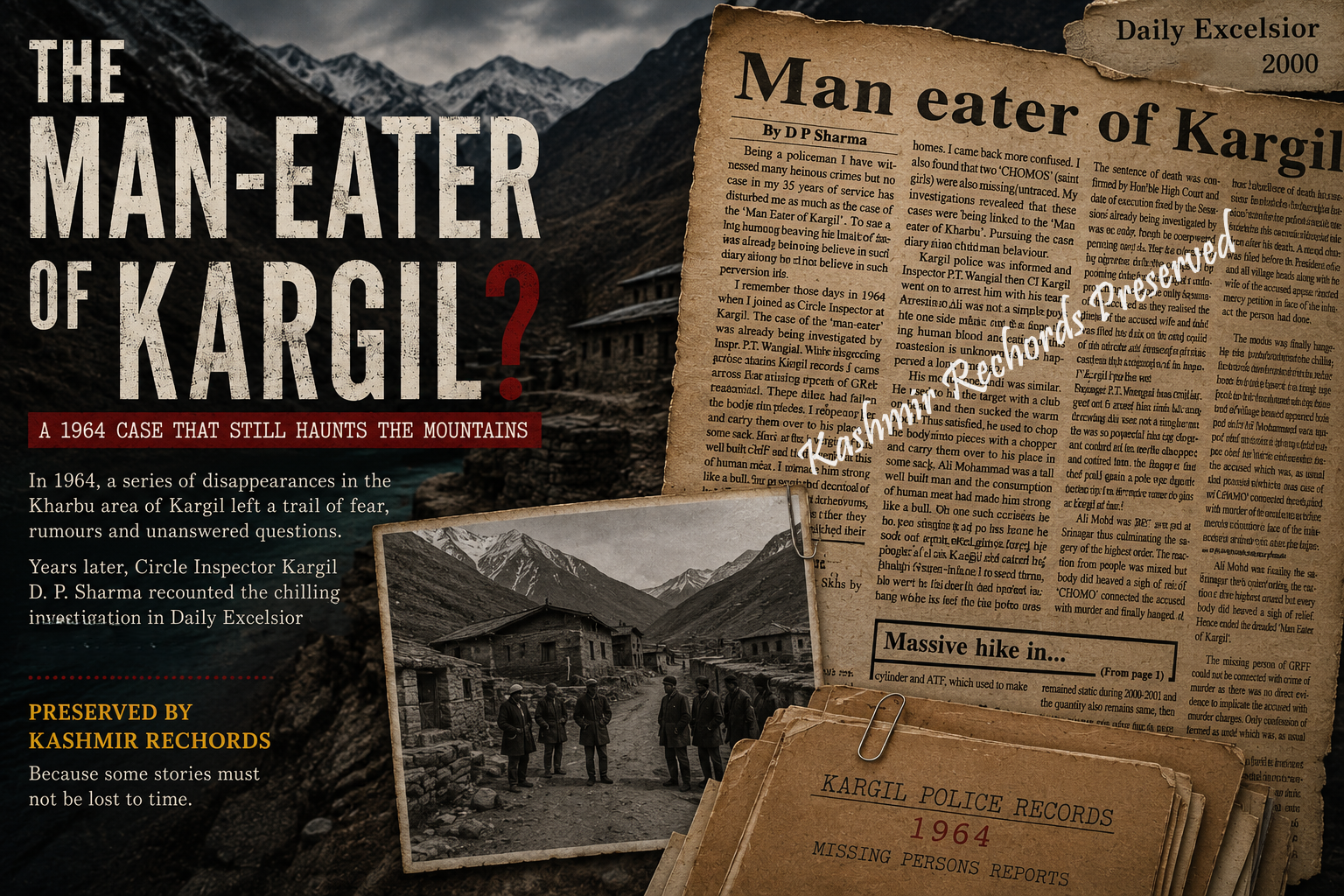
(Kashmir Rechords Exclusive)
There are some stories that belong to history.
And then there are stories that survive only because somebody saved a yellowing newspaper clipping before time erased it.
This is one of them.
In the archives preserved by Kashmir Rechords lies an unusual account published in Daily Excelsior in 2000—a recollection written by D. P. Sharma, who served as Circle Inspector, Kargil in 1964.
What he narrated was not folklore. Not a campfire legend. Not something he had merely heard.
He presented it as an episode from his years in uniform.
And even today, more than six decades later, it raises a question that refuses to settle:
Did Kargil once witness a case so strange that people still hesitate to speak of it openly?
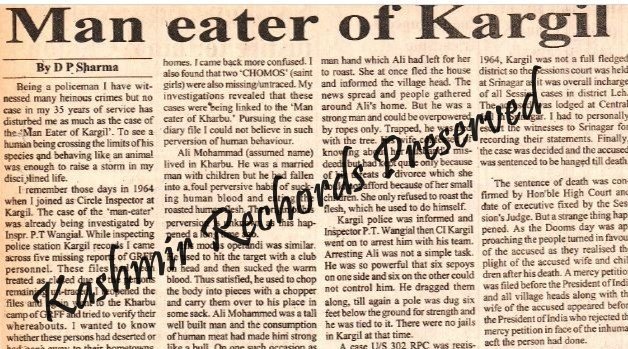
Kargil in 1964 was not the Kargil people know today.
Roads vanished in winter. Villages lived in silence for weeks. News travelled by people, not by networks.
For a Police Officer posted there, the work was difficult enough.But then came something harder to explain.
People disappeared.
At first, perhaps it seemed ordinary—someone gone away, someone lost in terrain, someone delayed. Then another. And another.
Files were opened. Questions asked. Answers did not come.
Yet among villagers, a different explanation had already begun to circulate.
They spoke cautiously. Not because they feared the police. Because they feared sounding unbelievable.
Some said the missing had not merely disappeared. Some said someone was taking them.
And what followed those whispers was even more unsettling.
Years later, D. P. Sharma would write that among all the crimes and incidents he had encountered during decades in service, one particular case disturbed him more than any other.
That line alone makes one pause. Police officers see tragedy. They see violence.
But what kind of case remains with a man long after retirement?
What happened in Kharbu that stayed in memory for decades? What caused old missing files to gain new meaning? And what discovery inside an ordinary household reportedly changed everything?
The newspaper account eventually offers answers.
But perhaps not all stories should be read only for their ending.
Sometimes the real story lies elsewhere— in the silence of villages, in the difficulty of investigating in another era and in the uncomfortable possibility that extraordinary events do not always happen in extraordinary places.
Sometimes they happen quietly. In places where mountains keep secrets.
Today, because Kashmir Rechords preserved that old newspaper page, readers can return to it and decide for themselves:
Was this one of Kashmir’s strangest forgotten criminal cases? Or a story that history itself has never fully explained?
The clipping still exists. The questions still remain.