
(Kashmir Rechords Exclusive Report)
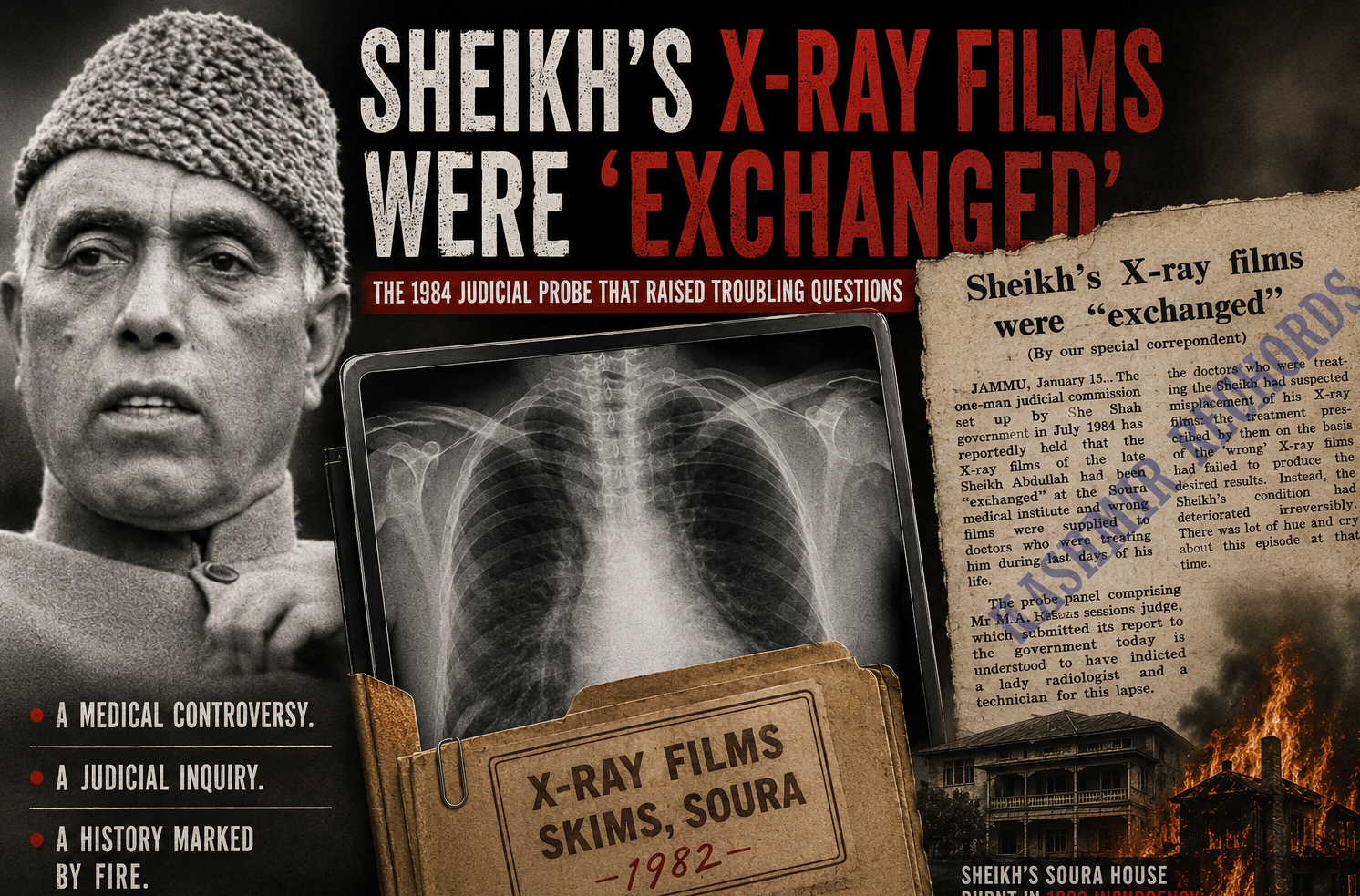
Few episodes in Kashmir’s political history have generated as much intrigue as the controversy surrounding the alleged exchange of X-ray films belonging to Sheikh Mohammad Abdullah during the final days of his life. Long before the insurgency engulfed the Valley, a Judicial Commission appointed by the government of Ghulam Mohammad Shah reportedly examined startling allegations that the medical records of the “Sher-e-Kashmir” had been tampered with at Srinagar’s Soura Medical Institute.
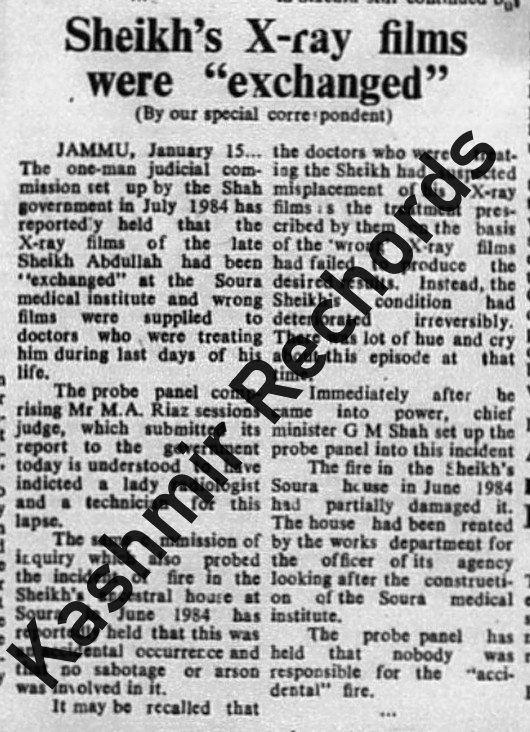
A newspaper report published in Kashmir Times on January 15, 1986, under the headline “Sheikh’s X-ray films were ‘exchanged'”, brought the controversy into the public domain and revealed details that raised serious questions about one of Kashmir’s most sensitive episodes.
The Final Illness of the Lion of Kashmir
When Sheikh Abdullah passed away on September 8, 1982, Kashmir lost its most influential political figure of the twentieth century. His prolonged illness during the last phase of his life had been closely monitored not only by doctors but also by political associates and family members.
As the years passed, whispers began circulating that something unusual had occurred during his treatment at the Sher-i-Kashmir Institute of Medical Sciences (SKIMS), Soura. The allegations centered on X-ray films that doctors had reportedly relied upon while treating the veteran leader.
The matter gained enough significance that it eventually attracted the attention of a judicial commission.
Shah Govt’s Judicial Commission
According to the newspaper report, preserved by Kashmir Rechords, the one-man Judicial Commission established by the G.M. Shah government in July 1984 investigated claims that Sheikh Abdullah’s X-ray films had been “exchanged” at the Soura medical institute.
The Commission, headed by Sessions Judge, Mr M.A. Riaz, reportedly examined evidence suggesting that the films available to doctors during Sheikh Abdullah’s treatment may not have been the correct ones.
The report stated that doctors who had treated Sheikh Abdullah suspected that the X-rays shown to them were not genuine and that the wrong films had been supplied during a critical stage of treatment.
More significantly, the report stated that doctors treating Sheikh Abdullah believed that the wrong films prevented them from obtaining the desired diagnostic results and that his medical condition deteriorated irreversibly thereafter
If true, such an error would have been far more than a routine administrative lapse. In an era when diagnostic imaging was among the most important tools available to physicians, incorrect X-ray films could potentially affect medical assessment and treatment decisions.
Commission’s Findings
The newspaper account claimed that the Commission’s report was expected to indict a Lady Radiologist and a Technician for what was described as a lapse involving the X-ray films.
More significantly, the report stated that doctors treating Sheikh Abdullah believed that the wrong films prevented them from obtaining the desired diagnostic results and that his medical condition deteriorated irreversibly thereafter.
The allegations were explosive.
The implication was not necessarily that anyone had deliberately sought to harm Sheikh Abdullah, but that a serious breakdown had occurred within the medical system entrusted with the care of Kashmir’s most prominent political leader.Even decades later, the full details of the Commission’s findings remain largely absent from public discourse, leaving historians and political observers with more questions than answers.
The Mysterious Fire at Soura
The controversy did not end with the X-ray films.
The same Judicial Commission also investigated another incident that added further mystery to the affair—a fire at Sheikh Abdullah’s residential house in Soura in June 1984.
According to the report, the Commission, however, concluded that the fire was accidental and that there was no evidence of sabotage or arson. The fire reportedly caused partial damage to the house.
Yet the coincidence of a fire occurring amid growing controversy over Sheikh Abdullah’s medical records inevitably fuelled speculation in political circles.
The Flames of 1990
As the insurgency erupted across Kashmir in 1989–90, violence engulfed institutions, government buildings, private properties and symbols associated with different political traditions.
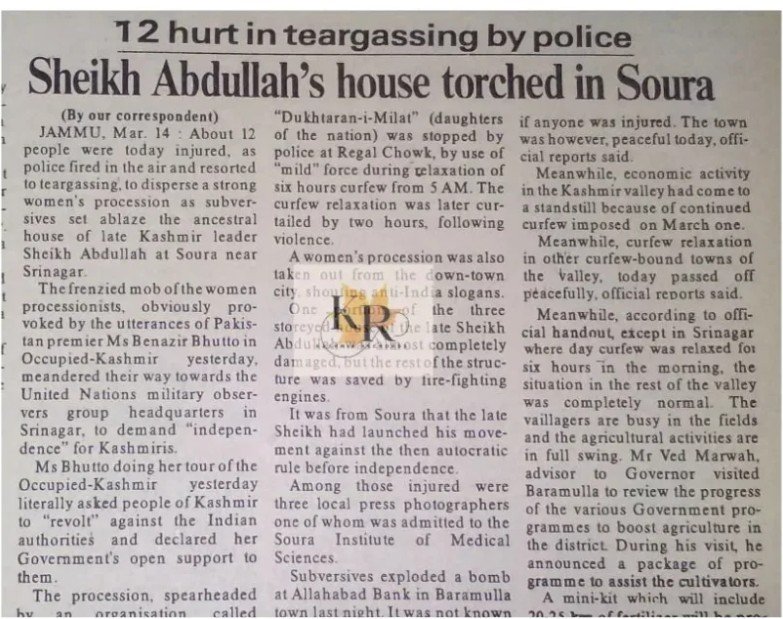
In that turbulent period, Sheikh Abdullah’s Soura residence itself was burnt by militants on March 14, 1990. Jammu and Kashmir’s another leading newspaper, Daily Excelsior had carried the story. The same has been preserved by Kashmir Rechords and is reproduced here:
An Unanswered Historical Question
Nearly four decades after the Judicial Commission’s findings were reported, the controversy surrounding Sheikh Abdullah’s X-ray films remains one of the lesser-known mysteries of Kashmir’s political history.
Were the films genuinely exchanged? Was it merely medical negligence? Did the episode materially affect Sheikh Abdullah’s treatment?
Why did the issue fade from public discussion despite the seriousness of the allegations?
The available records leave historians with fragments rather than definitive answers.
What remains undeniable is that the episode reflected the intense political atmosphere of the mid-1980s, when even the medical treatment of Kashmir’s most iconic leader became the subject of judicial scrutiny.
Today, the story survives as a forgotten footnote in the larger narrative of Kashmir—a tale involving medicine, politics, judicial inquiry and a historic house that would later be consumed by the flames of insurgency.
Disclaimer:
This article is based on information published at the time by two prominent newspapers of Jammu and Kashmir and on archival newspaper clippings preserved by Kashmir Rechords. While preparing this historical feature, Kashmir Rechords has relied upon these contemporaneous reports and archival materials in good faith. The article is intended solely for historical documentation, research and public interest purposes. Kashmir Rechords does not independently verify or endorse the findings, conclusions, allegations or opinions contained in the original reports and reproduces them for their archival and historical value.