
(Kashmir Rechords Exclusive)
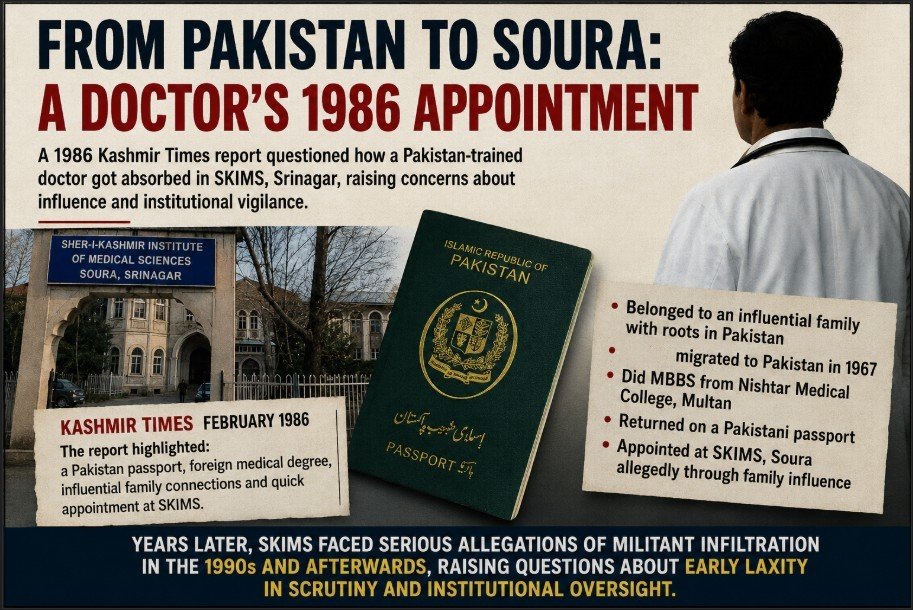
In February 1986, official appointments and professional credentials were expected to undergo rigorous scrutiny. Yet, a report published by the Kashmir Times that month exposed a case that appeared to defy all standard administrative procedures.
The story revolved around one Manzoor Ahmed, a doctor whose journey from Pakistan to a government medical institution in Srinagar raised serious questions about influence, verification of qualifications and administrative standards.
The report centered on a single, controversial appointment. The newspaper questioned how a doctor, holding a Pakistani Passport, had managed to secure a position at the Sher-i-Kashmir Institute of Medical Sciences (SKIMS), Soura, Srinagar despite concerns surrounding the recognition of his qualifications and the circumstances of his return to Kashmir
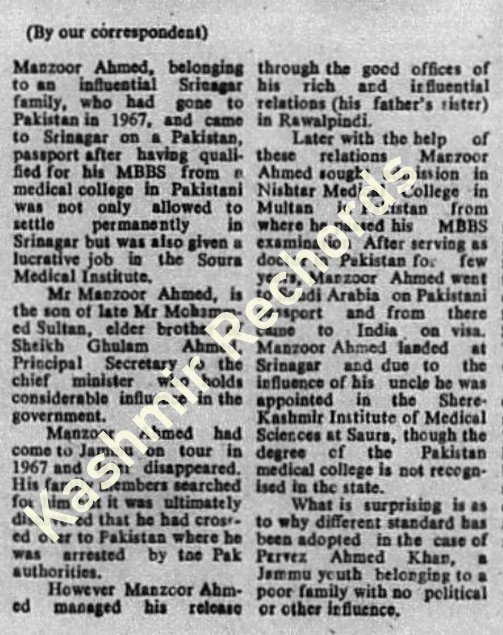
According to the archival report, preserved by Kashmir Rechords, Manzoor Ahmed belonged to an influential Srinagar family, had migrated to Pakistan in 1967, and Manzoor himself pursued medical education there. After obtaining an MBBS degree from a medical college in Pakistan, he reportedly returned to Srinagar on a Pakistani Passport!
Ordinarily, such circumstances would have invited close scrutiny from authorities. Yet, the report claimed that not only was he allowed to settle in Srinagar, but he also managed to secure employment at the prestigious Sher-i-Kashmir Institute of Medical Sciences (SKIMS), Soura.
Role of Family Influence
The newspaper report attributed this remarkable transition largely to family connections. It noted that Manzoor Ahmed was related to influential figures within the political and administrative establishment. His father’s brother, Sheikh Ghulam Ahmed, was serving as Principal Secretary to the Chief Minister, a position carrying considerable influence within the government.
The report further stated that after completing his medical studies at Nishtar Medical College, Multan, and working as doctor for some years in Pakistan and later in Saudi Arabia ( on Pakistani Passport), Manzoor returned to India on a visa. Soon thereafter, he was appointed at SKIMS, Soura, Srinagar despite concerns reportedly being raised regarding the recognition status of the Pakistani medical qualification he possessed.
The 1986 Kashmir Times report appears less like an isolated controversy and more like an early warning about the dangers of influence overriding institutional vigilance
A Different Standard?
What made the episode controversial was the comparison drawn by the newspaper itself. The report questioned why different standards appeared to have been applied in the case of Manzoor Ahmed while, according to the newspaper, another youth from Jammu, Pervez Ahmed Khan, allegedly faced difficulties despite coming from a modest background and lacking political influence.
The article suggested that access, connections and family standing may have played a decisive role in enabling Manzoor Ahmed’s absorption into a premier government medical institution.
Questions Left Behind
The Kashmir Times report did not merely narrate the story of one doctor’s appointment. It raised broader concerns about transparency in public recruitment, recognition of foreign medical qualifications and the extent to which influence could shape official decisions.
The report remains a revealing snapshot of the concerns that surrounded governance and institutional accountability in Jammu and Kashmir during the mid-1980s. Within a few years, Kashmir entered the vortex of militancy. As the insurgency expanded after 1989, investigators, journalists and security agencies increasingly examined how various institutions had become vulnerable to ideological, political and militant influence. Hospitals and medical networks did not remain untouched by this transformation.
Over the decades, numerous reports, investigations, and arrests revealed that sections of Kashmir’s medical fraternity had, at different times, become entangled in the wider conflict. Some doctors were accused of aiding militants, some were investigated for ideological links, while others faced allegations relating to recruitment networks, logistics, financing, or providing covert support. At the same time, many medical professionals remained dedicated to their duties, often working under extreme pressure and threat.
The larger concern was never about medicine itself. It was about institutions. The question repeatedly raised was whether political patronage, weak scrutiny and influential networks had gradually eroded safeguards that should have protected public institutions from infiltration of any kind.
Seen against that backdrop, the 1986 Kashmir Times report appears less like an isolated controversy and more like an early warning about the dangers of influence overriding institutional vigilance.
Today, the February 1986 report survives not merely as an account of one doctor’s appointment, but as a historical document reflecting deeper anxieties about governance, accountability and institutional integrity in Kashmir during the years immediately preceding the insurgency