
(Kashmir Rechords Tribute)
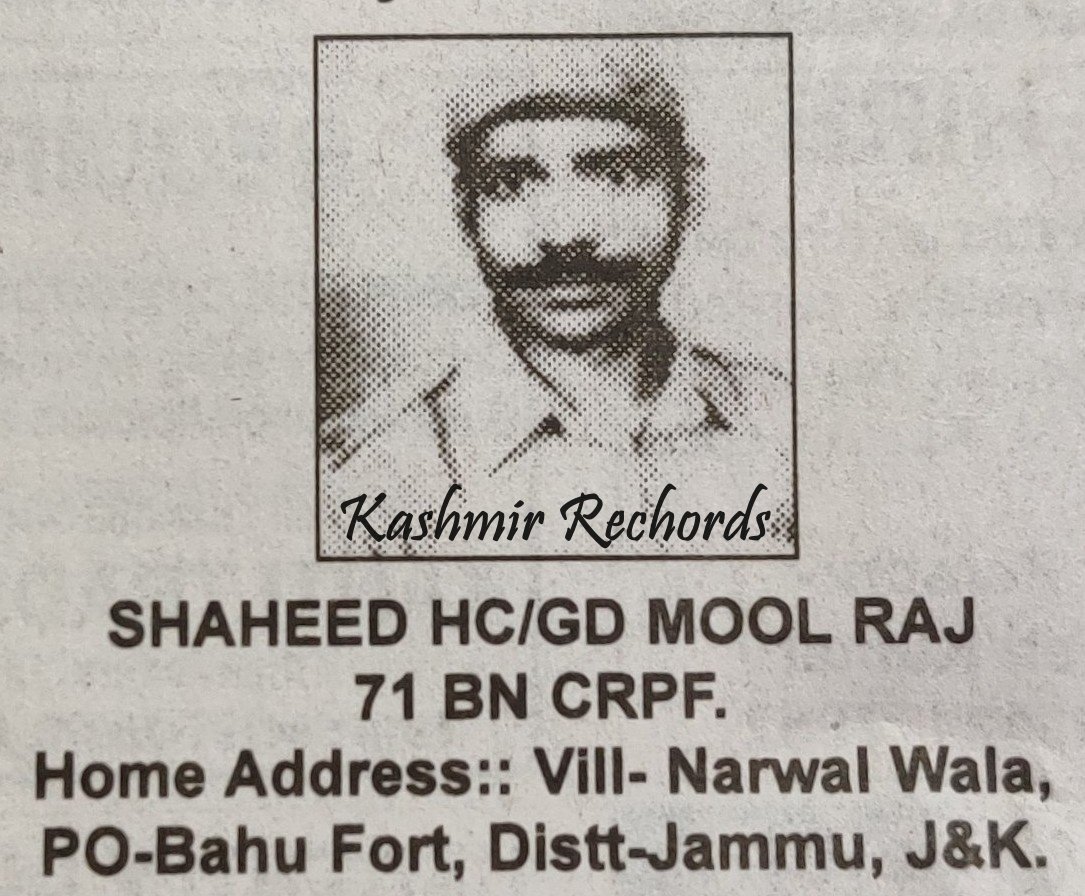
On a modest printed page, slightly worn by time, a grainy photograph stares back—young, composed and unaware of the destiny that would soon seal his name into the roll of honour. The text beneath it is simple, almost stark:
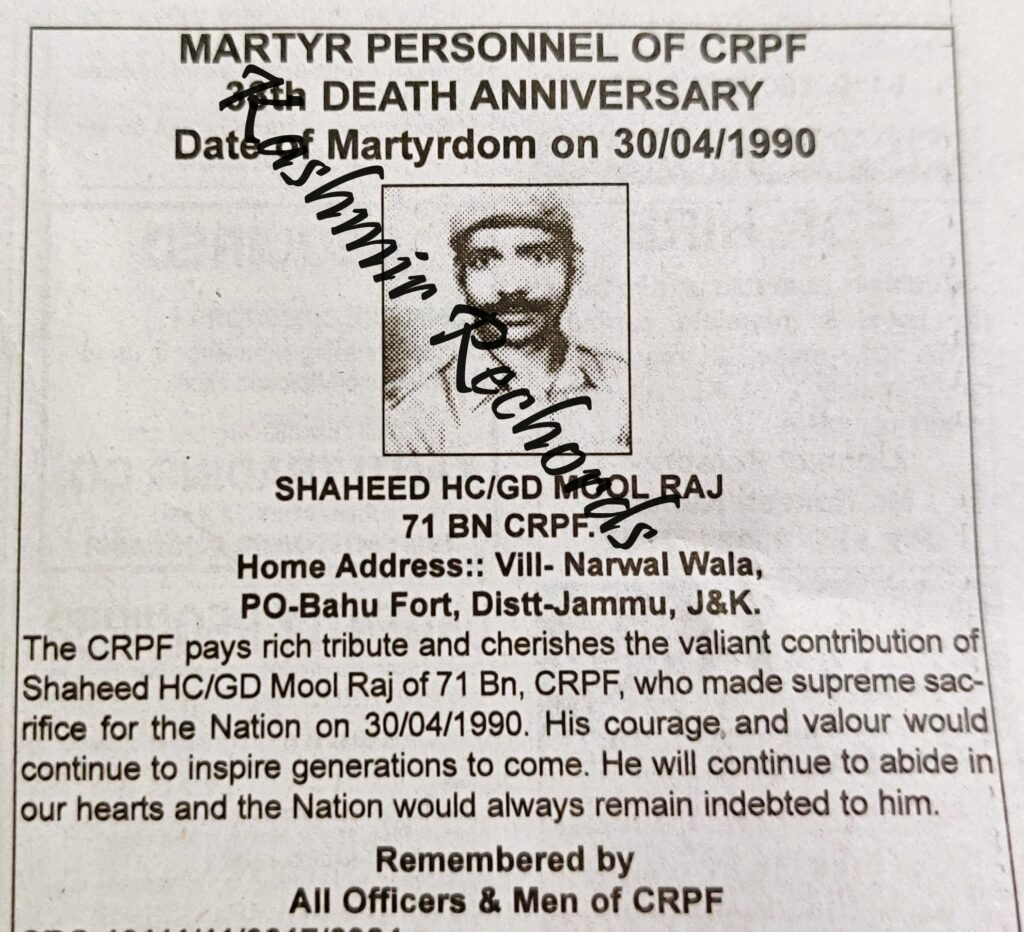
Shaheed HC/GD Mool Raj, 71 Battalion, CRPF.
Date of Martyrdom: 30 April 1990.
There are no grand embellishments. No elaborate citations. Just a life reduced to a few lines—and yet, behind those lines lies a story that once pulsed with courage, duty, and belonging.
A Son of the Soil
Mool Raj hailed from Narwal Wala, near Bahu Fort in Jammu—a region that has given countless sons to the Nation’s service. Like many from his generation, his journey into the Central Reserve Police Force (CRPF) was not merely employment; it was a calling shaped by discipline, modest ambition and a quiet sense of patriotism.
He was not a figure of headlines. Not a decorated officer commanding battalions. He was a Head Constable—one among thousands—standing on the frontlines in 1990 descended into one of the most turbulent phases of insurgency.
The Year of Fire
The spring of 1990 was not gentle in Kashmir. It was a time when uncertainty had turned into violence and fear had begun to dictate everyday life. Security forces were stretched thin, often navigating hostile terrain—both geographical and psychological.
On 30 April 1990, Mool Raj laid down his life in the line of duty.
There are no vivid public records detailing the exact moment of his sacrifice—the chaos of those days swallowed many such stories whole. But what remains certain is this: he died protecting the idea of a Nation at a time when that idea was being violently challenged.
A Tribute in Print, A Silence in Memory
The tribute in the image speaks with institutional dignity:
“His courage and valour would continue to inspire generations to come… the Nation would always remain indebted to him.”
It is a promise often made. Yet, as decades pass, the weight of that promise begins to thin.
Thirty-six years later, Mool Raj’s name is no longer spoken in public discourse. His story is not part of textbooks, nor does it echo in televised debates. His memory survives in fragments—archival notices, fading documents and perhaps in the hearts of those who once knew him.
The Quiet Fate of Many
Mool Raj’s story is not an exception—it is a pattern.
Across India, especially in regions like Jammu & Kashmir, countless personnel and civilians as well, who stood firm during the insurgency years now exist only as names on plaques, files or commemorative advertisements. They were neither the first nor the last to fall, but each carried a world within them—families, dreams and identities that rarely find space in collective remembrance.
Remembering Beyond Ritual
To remember Mool Raj is not merely to acknowledge a death anniversary—it is to restore context to a life.
He was not just a uniformed man in a conflict zone. He was a resident of Jammu, a product of its soil, a representative of its resilience. He belonged to a time when ordinary men were called upon to face extraordinary circumstances—and did so without expectation of recognition.
A Fading Photograph, An Unfading Question
That small photograph in the tribute—blurred, monochrome—asks a quiet question:
How long does a Nation remember its unnamed protectors?
For Mool Raj, the answer lies somewhere between official remembrance and public forgetfulness. Yet, as long as his story is told—even in fragments—he is not entirely lost.
Perhaps remembrance does not always reside in grand memorials. Sometimes, it survives in a single page, a rediscovered image, or a retold story—bringing back, even briefly, a life that once stood guard while others slept in peace.