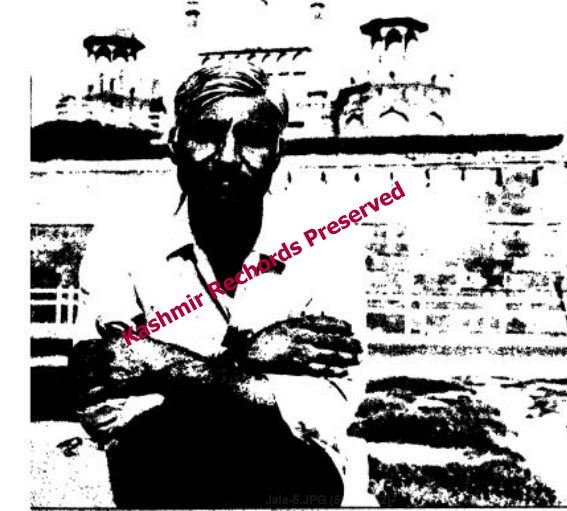
Ghulam Ahmad Mehjoor is celebrated, quoted, canonised—and rightly so. He is Kashmir’s “Poet of Revolution,” the lyrical conscience of a society in transition. His words continue to echo across generations, his name etched into textbooks, stamps and cultural memory.
But here lies the uncomfortable question:
Why does history remember Mehjoor—but forget the woman who made Mehjoor possible?
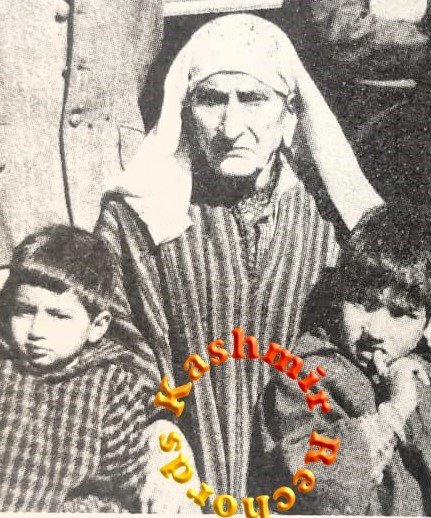
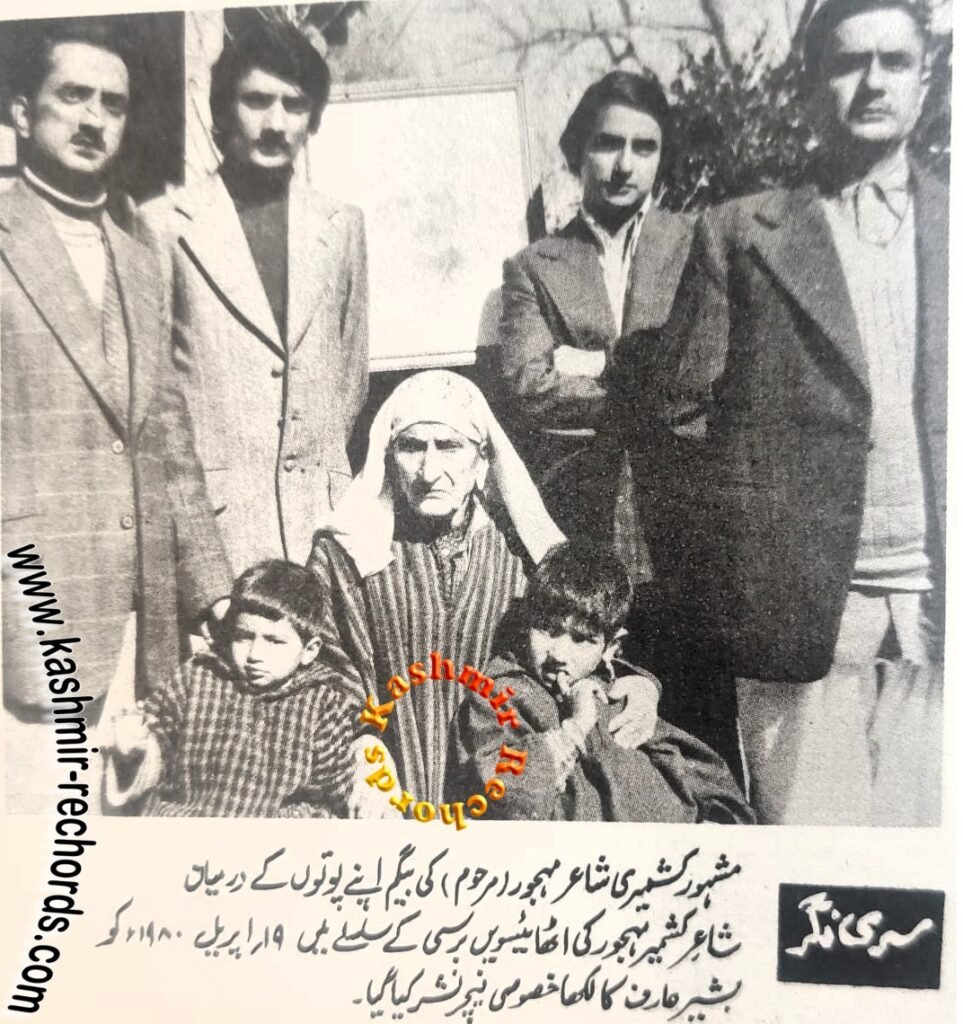
Her name was Mehtab Begum. And history has almost forgotten her.
The Myth of the Lone Genius
We are often sold a convenient myth—that great men rise on talent alone. That genius is self-sustaining. That poetry flows untouched by the burdens of daily life.
But reality is far less romantic.
Ghulam Ahmad Mehjoor was not living in some idyllic poetic bubble. He was a Patwari, constantly on the move—traversing remote terrains, enduring harsh conditions, sometimes even going without food or shelter. His own letters admit as much.
So the real question is: Who held the world together while the poet wandered through it?
The answer is simple, yet inconvenient for mainstream narratives: Mehtab Begum
While Mehjoor wrote about revolution and romance, she lived the far harsher reality:
Running a household in prolonged absence
Managing uncertainty, finances and social pressures
Absorbing the emotional cost of a life lived on the margins
She did not write poetry. She enabled it.
She was not visible in literary circles. She made literature possible.
Call it what it is—she was the infrastructure behind the poet’s legacy.
It is not that Mehtab Begum never existed in public memory. There was a moment—brief, almost accidental—when her voice surfaced.
In 1980, All India Radio’s Srinagar station, then called Radio Kashmir Srinagar, aired a special feature on Mehjoor’s 28th death anniversary.
Written by Bashir Aarif, it included a rare recorded conversation with Mehtab Begum herself. This special feature was broadcast on April 19, 1980.
And then—silence.
No follow-up. No institutional effort to preserve or promote her story. No attempt to integrate her into Mehjoor’s narrative.
The Archival Failure We Don’t Talk About
Let us be blunt.
If that 1980 recording is lost—as is feared—it is not just an archival lapse. It is a cultural failure.
This represents a failure of institutions like All India Radio and a significant lapse by literary historians. Furthermore, it highlights a collective oversight by Kashmir’s own intellectual class
Because what was lost was not just audio—it was perspective.
The perspective of a woman who lived history, but was never allowed to narrate it.
Rewriting the Narrative
Mehjoor will—and should—remain a towering figure in Kashmir’s literary tradition.
But continuing to celebrate him without acknowledging Mehtab Begum is not just incomplete—it is intellectually dishonest.
History does not just erase by omission. It erases by habitual neglect.
The Final Word
If Mehjoor was the voice of Kashmir, then Mehtab Begum was its unheard heartbeat.
And perhaps it is time we asked:
How many more Mehtab Begums lie buried beneath the weight of “great men” in our history?
Until we answer that, our understanding of the past will remain—not just partial—but profoundly flawed.
Readers are encouraged to post their comments, make their opinion at the end of this write-up, below
More than three decades later, the story of 1990 in Kashmir is no longer just history—it is a contested narrative.
Between denial on one side and dramatized portrayals on the other, the documented truth risks being overshadowed. Increasingly, public perception is shaped not by records, but by selective retellings, including cinematic interpretations that simplify a deeply complex tragedy.
This work departs from both extremes. It relies on archival documentation and first-hand reporting, restoring focus on what was recorded when events actually unfolded.
1990: Widespread Violence, Unequal Impact
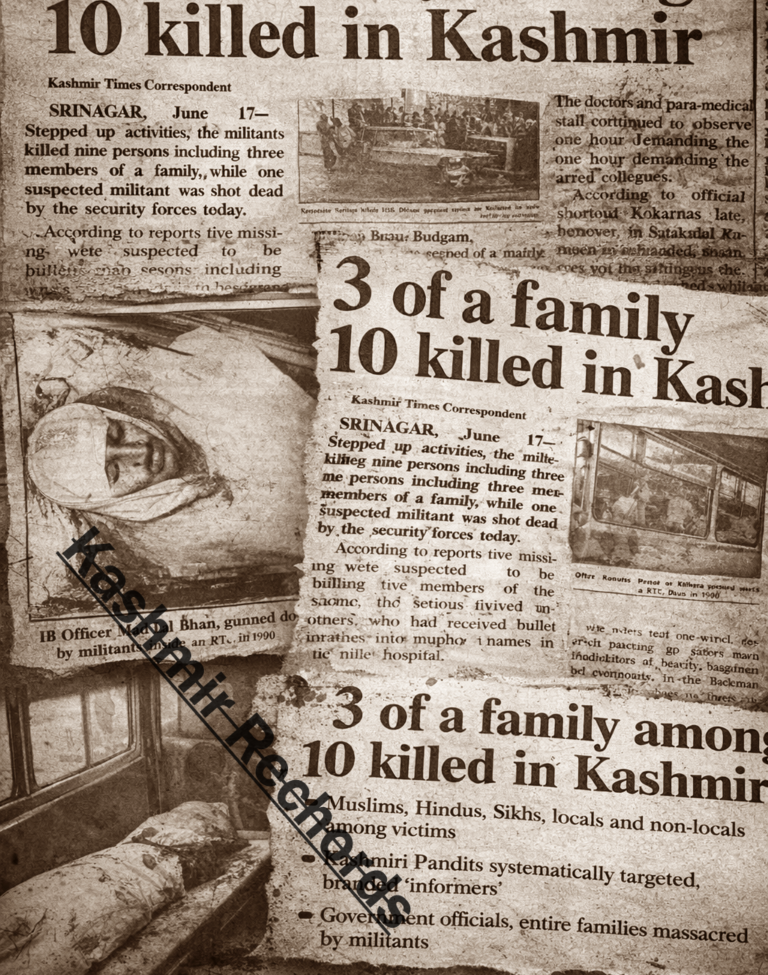
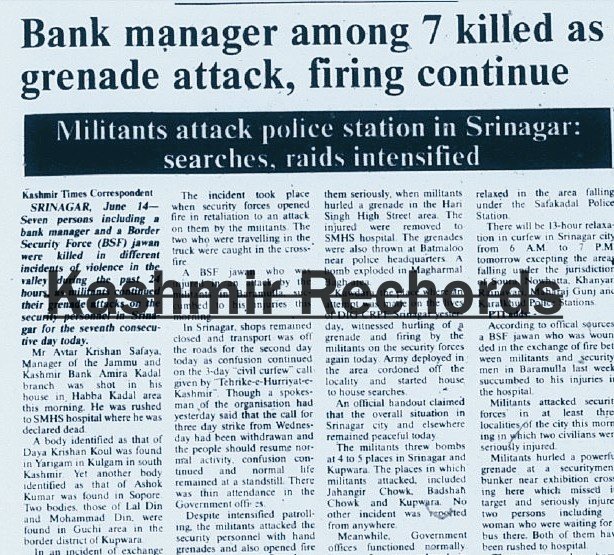
The violence of 1990 spared no community. Muslims, Hindus, Sikhs, locals and outsiders—all suffered in an atmosphere where fear dictated life.
However, archival patterns consistently point to one hard truth:
Kashmiri Pandits were disproportionately and systematically targeted.
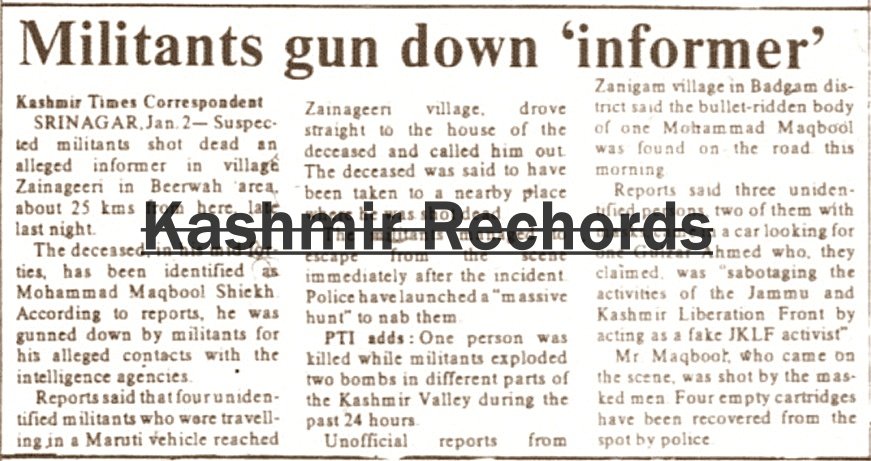
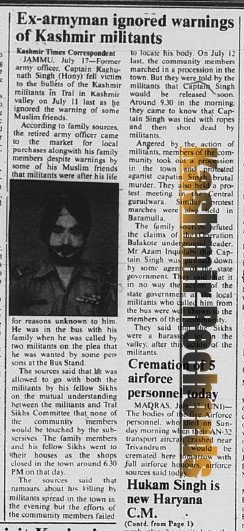
Frequently labelled as “informers” or “Indian agents,” many were attacked irrespective of their actual roles.
Recognizing this does not negate other suffering—it grounds the narrative in evidence.
Archival Method: Why This Account Matters
This reconstruction is based on:
contemporaneous newspaper reports
cross-verification across ideological lines
documented incidents rather than retrospective claims
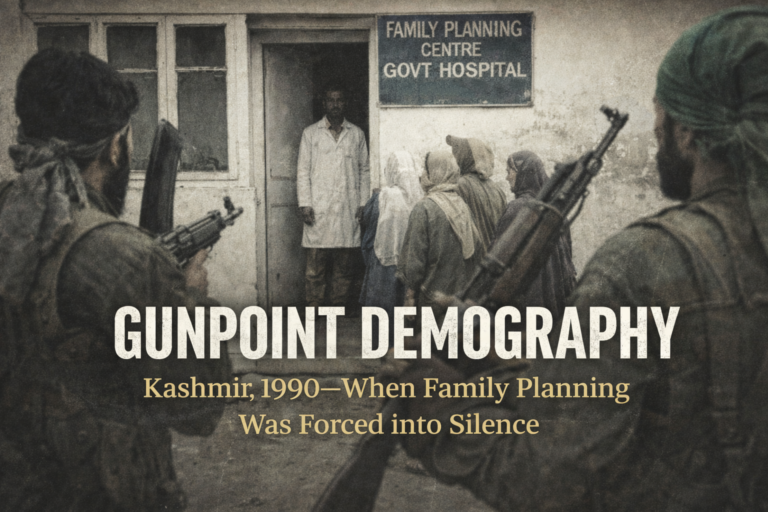
In the winter of 1990, as the world watched the mass exodus of Kashmiri Pandits and the collapse of civil administration, a darker, more intimate engineering was taking place behind closed doors. While cinema halls were being padlocked and beauty parlors shuttered, another target was marked by the militants: the Kashmir 1990 family Planning.
This wasn’t just ideological talk—it was a campaign enforced at the barrel of a gun.
At Gunpoint: The Ban on Birth Control
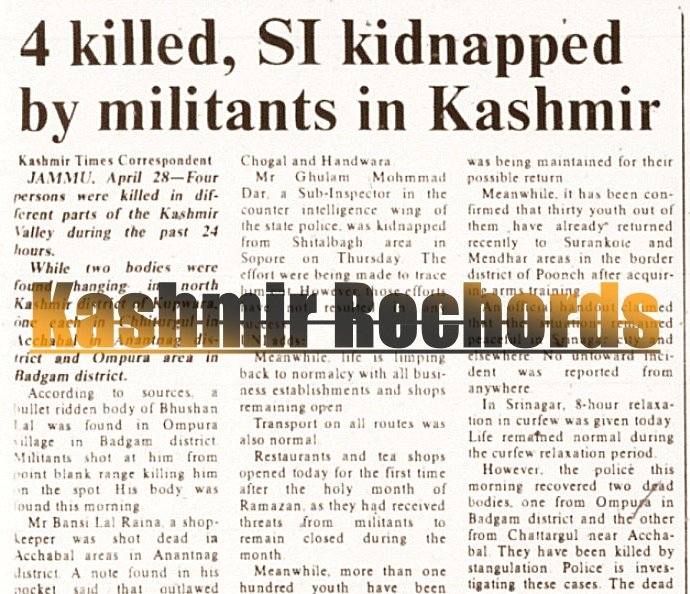
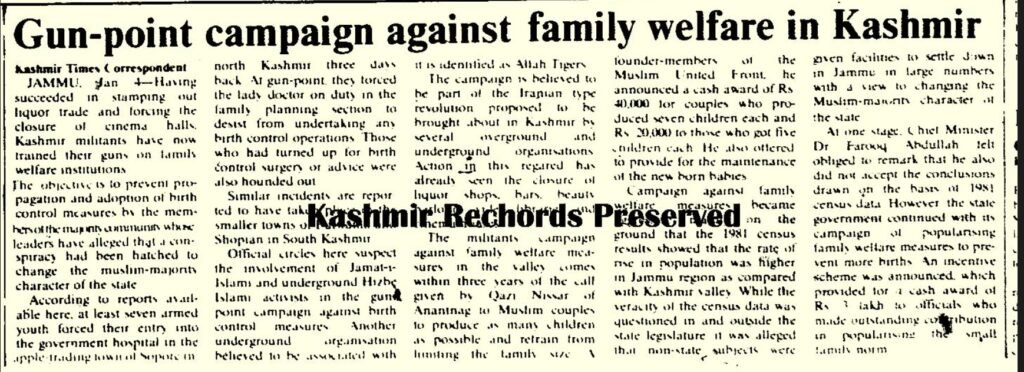
Archival records unearthed by Kashmir Rechords reveal a startling headline from a January 1990 edition of Kashmir Times: “Gun-point Campaign Against Family Welfare in Kashmir.” The report documents a chilling reality. In towns like Sopore, Shopian and Pulwama, armed militants didn’t just target political opponents; they targeted hospital wards. In one instance, a lady doctor in Sopore was threatened at gunpoint and forced to stop all birth control procedures immediately. Patients seeking reproductive medical advice were chased out of clinics.
January 1990 newspaper clipping of Kashmir Times, that speaks everything about Family Planning and Cash for More Children!
Cash for Children: The MUF Incentive
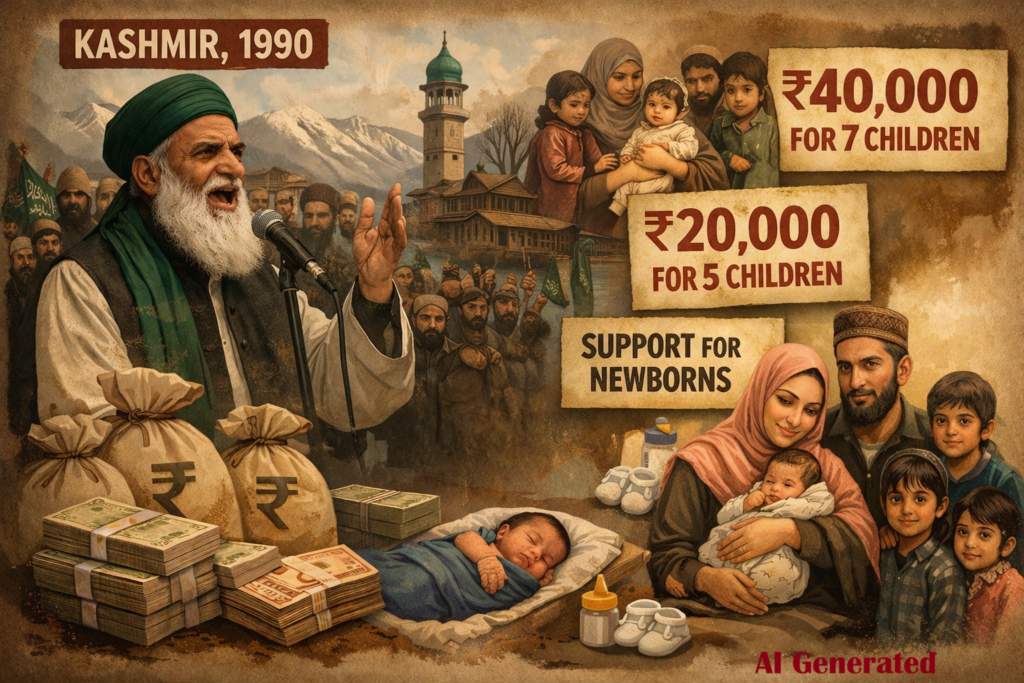
The campaign used a “Carrot and Stick” approach. While hospitals were under siege, religious and separatist leaders were offering financial rewards for larger families:
₹40,000 for couples with seven children.
₹20,000 for those with five children.
Guaranteed support for the upbringing of newborns.
Separatist Leaders like Qazi Nissar of Anantnag and figures associated with the Muslim United Front (MUF) framed population growth as a “sacred duty” to “protect’’ the demographic character of the Valley.
A State Divided: Policy vs. Dictate
Ironically, this was happening while the J&K Government was aggressively pushing a “small family” norm, offering incentives of up to ₹2 lakh for officials who popularized family planning.
Caught in the middle were ordinary Kashmiri Muslims. For many, the choice to plan their family became a dangerous political act. Those who wished to limit their family size often had to flee to Jammu in secret just to access basic medical procedures, living in constant fear of being labelled “traitors” to the cause.
Why This History Matters Today
The 1990 campaign against family planning is a stark reminder that conflict doesn’t just happen on the streets—it happens in the most private spheres of human life. As modern debates over Kashmiri identity and demographics continue to boil, looking back at these archival truths isn’t just about history; it’s about understanding the deep-rooted anxieties that still shape the region today.history, the Valley witnessed not just an exodus of minorities, but the quiet engineering of a demographic narrative—one that has largely escaped public discourse.
In an extraordinary outpouring of emotion and transnational solidarity, Kashmir has once again transformed into a theatre where faith, politics and identity intersect in powerful, unpredictable ways.
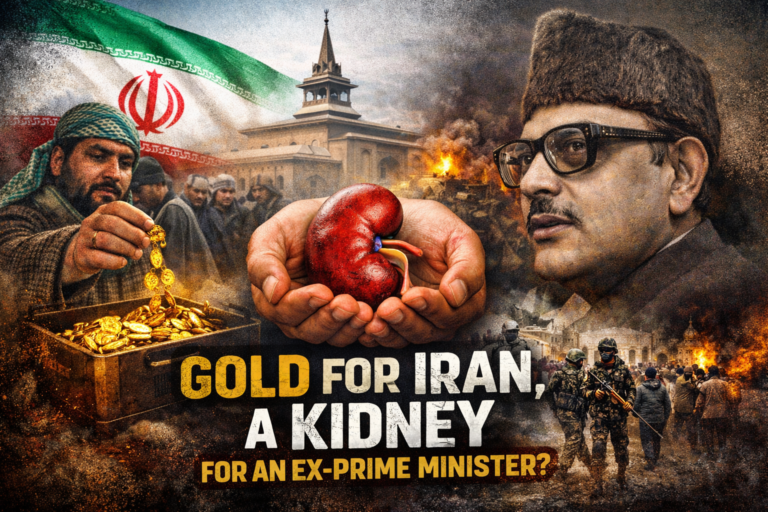
From the narrow lanes of Budgam to the revered shrines of Srinagar, a striking phenomenon is unfolding—Kashmiris donating cash, gold, heirlooms and even personal belongings to support Iran amid the ongoing West Asian conflict.
At one level, this is charity. At another, it is symbolism—deeply rooted in a shared sense of religious identity and global Muslim consciousness.
But if one scratches beneath the surface, Kashmir’s history reveals that such emotional mobilisations are not new. What is truly astonishing, however, is how this same emotional intensity once manifested in a direction that defies conventional narratives.
Kidney for V P Singh, Gold for Iran
In 1997, a story quietly surfaced—but shook the national conscience.
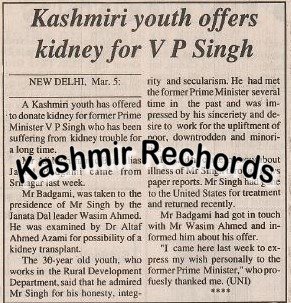
A young Kashmiri man from Budgam, the very district today witnessing large-scale donations for Iran, made an offer that stunned the country:
👉 He was willing to donate one of his kidneys to former Prime Minister V. P. Singh.
Yes—the same V. P. Singh whose tenure is widely regarded as one of the most turbulent phases in Kashmir’s history.
At a time when Singh was bed-ridden at Apollo Hospital, acting as the sole bridge between warring political factions, an unexpected offer of life came from a place then defined by conflict: Budgam, Kashmir
The Journey of Devotion
According to reports carried by the credible United News of India (UNI):
The youth, around 30 years old, travelled from Srinagar to New Delhi in early March 1997
He underwent medical evaluation by a reputed doctor for a possible transplant
He was employed in the Rural Development Department
But what truly caught attention was not the act—it was the reason behind it.
“Honesty, Integrity, Secularism” — The Youth’s Words
Speaking to journalists at the time, the young man expressed deep admiration for V. P. Singh, citing:
His honesty
His integrity
His commitment to secularism
He claimed to have met V P Singh several times and said he was deeply impressed by the former Prime Minister’s concern for the poor, downtrodden and minorities.
The Paradox That Demands Reflection
This episode raises a deeply uncomfortable, yet fascinating question:
👉 Why would a Kashmiri youth offer his kidney to a leader whose tenure saw Kashmir descend into chaos?
During Singh’s prime ministership (1989–90):
Militancy escalated sharply
The infamous Rubaiya Sayeed kidnapping shook the nation
Governance in Kashmir collapsed
The tragic exodus of Kashmiri Pandits unfolded
And yet, years later, a young man from the Valley saw in him not a failed crisis manager—but a symbol of integrity and secular politics.
Kashmir’s Emotional Compass: Faith, Identity, or Something Deeper?
Fast forward to today:
Donations for Iran reflect religious solidarity beyond borders
The 1997 kidney offer reflected personal faith in an individual’s character
Both episodes, though vastly different, underline a common thread:
👉 Kashmir responds not just politically—but emotionally, symbolically, and often unpredictably.
A Question for the Reader
Do you recall this youth? Do you know his name? Or more importantly:
👉 What do you think compelled him to make such an extraordinary offer?
Was it:
Genuine admiration?
A political statement?
Or a reflection of Kashmir’s complex emotional psyche?
Join the Conversation
We invite you to share your views, memories, or insights:
Was it a rogue statement… a political misadventure… or something far more calculated?
Nearly three decades later, a chilling question still lingers over the political corridors of 1997: Was there ever a serious attempt—formal or informal—to “hand over” Pakistan-Occupied Kashmir (PoK) to Pakistan in the name of “everlasting peace” in Jammu and Kashmir?
Archival inputs accessed by Kashmir Rechords reveal that what unfolded in early 1997 was not an isolated gaffe—but a political tremor that shook Parliament, embarrassed the Centre and ignited nationwide outrage.
The Chhindwara Bombshell
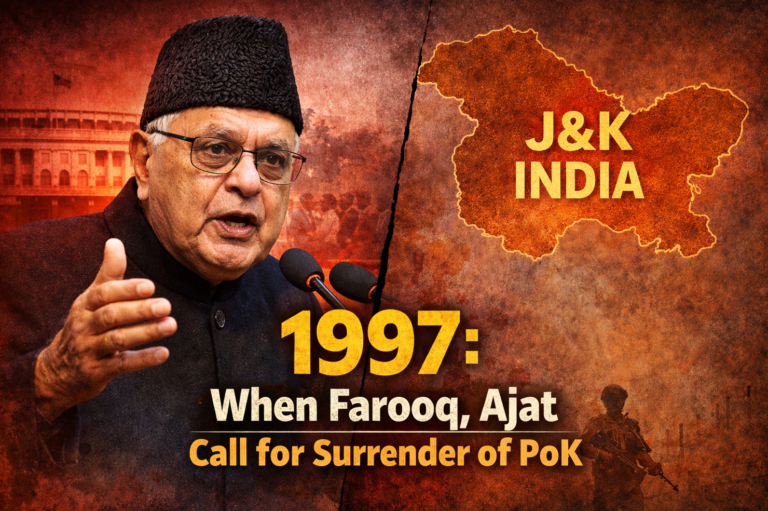
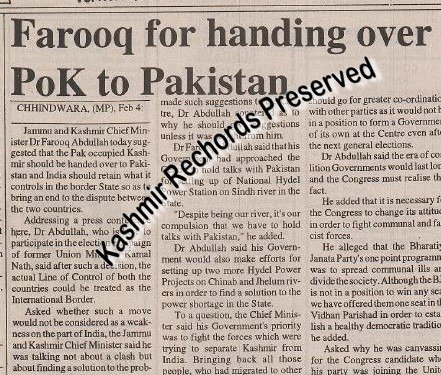
On February 4, 1997, during an election rally in Chhindwara, Madhya Pradesh, then Jammu & Kashmir Chief Minister Dr. Farooq Abdullah dropped a political bombshell.
He suggested that India should consider “handing over PoK” to Pakistan.
The remark was not just controversial—it cut directly against India’s long-standing sovereign position.
The Chhindwara Remark That Sparked a Storm
The ‘Scripted Echo’? Ajatshatru Singh Steps In
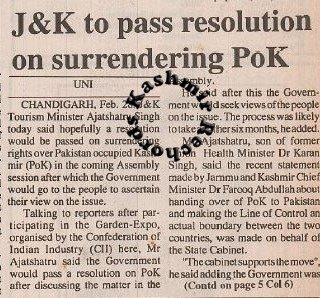
Barely weeks later, on February 28, 1997, J&K’s Tourism Minister Ajatshatru Singh escalated the situation.
At a press conference in Chandigarh, he declared that the J&K Government would soon move a resolution in the State Assembly to surrender PoK.
Was this coincidence—or coordination?
Ajatshatru Singh’s Statement: Coincidence or Coordination?
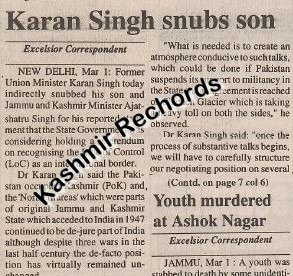
The controversy deepened because Ajatshatru Singh was no ordinary politician. He belonged to the Dogra royal lineage, the son of Dr Karan Singh, who swiftly rebuked his son the very next day, terming the statement highly irresponsible.
When Father snubbed his son over surrendering PoK remark
Delhi on Edge: Parliament Reacts
The statements triggered a political storm in New Delhi.
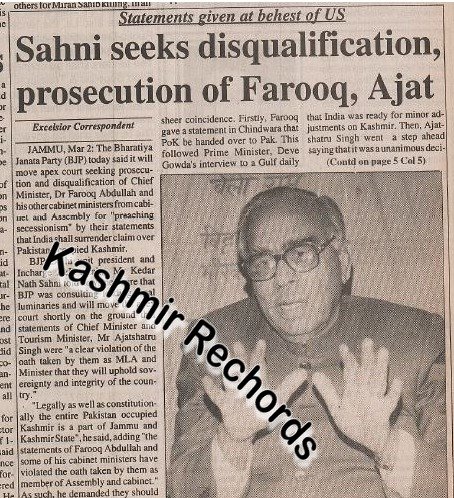
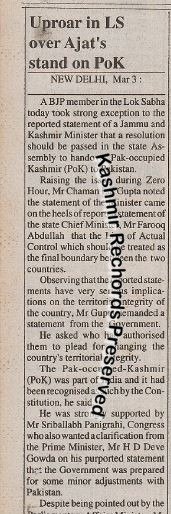
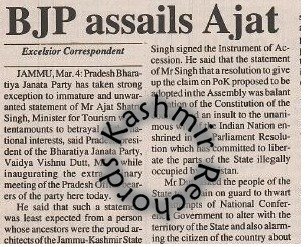
The Bharatiya Janata Party (BJP moved aggressively, accusing both leaders of “preaching secessionism.” Its Delhi unit chief, Kedar Nath Sahni who ushed to Jammu, later at a press conference on March 2, 1997, demanded the “Disqualification and Prosecution’’ of both Farooq Abdullah and Ajatshatru Singh.
BJP reaction on PoK controversy
Inside Parliament, the issue further exploded.
On March 3, 1997, BJP MP Chaman Lal Gupta raised the matter during Zero Hour, warning of serious implications for India’s territorial integrity.
In Jammu, BJP MLA Vaid Vishno Dutt also slammed the statement as “illogical.”
Centre’s Embarrassment—and Swift Rejection
The controversy placed the Central Government in a deeply awkward position.
Prime Minister H. D. Deve Gowda, who shared cordial ties with Farooq Abdullah, was forced into damage control.
Key voices in the Union Government moved quickly.
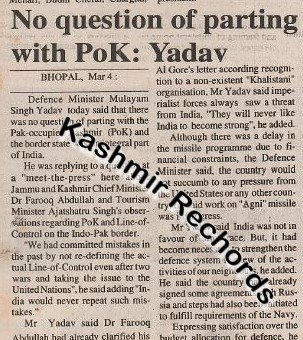
Defence Minister Mulayam Singh Yadav declared in Bhopal: “There is no question of parting with PoK.”
External Affairs Minister I. K. Gujral also distanced the Centre from the remarks.
The message was unambiguous: India’s position was non-negotiable.
Defence Minister Mulayam Singh’s PoK statement
The 1994 Resolution: A Direct Contradiction
What made the 1997 statements even more explosive was their direct contradiction to a unanimous Parliamentary stand.
On February 22, 1994, under Prime Minister P. V. Narasimha Rao, Parliament had passed a historic resolution asserting:
Jammu & Kashmir is an integral part of India.
Pakistan must vacate all territories under illegal occupation (PoK).
Any interference would be firmly countered.
Against this backdrop, the 1997 remarks appeared not just controversial—but politically incendiary.
Calculated Trial Balloon—or Political Misfire?
The key question remains unresolved: Was this a trial balloon floated to test public sentiment? Or was there quiet encouragement from certain quarters? Or was it simply a miscalculated political gamble that collapsed under public backlash?
The sequence—Farooq’s statement followed by Ajatshatru’s escalation—has led many observers to suspect coordination rather than coincidence.
A Pattern That Never Fully Disappeared
Political analysts note that this was not an isolated episode.
Over the years, Farooq Abdullah has made similar remarks:
Suggesting the Line of Control be converted into an international border
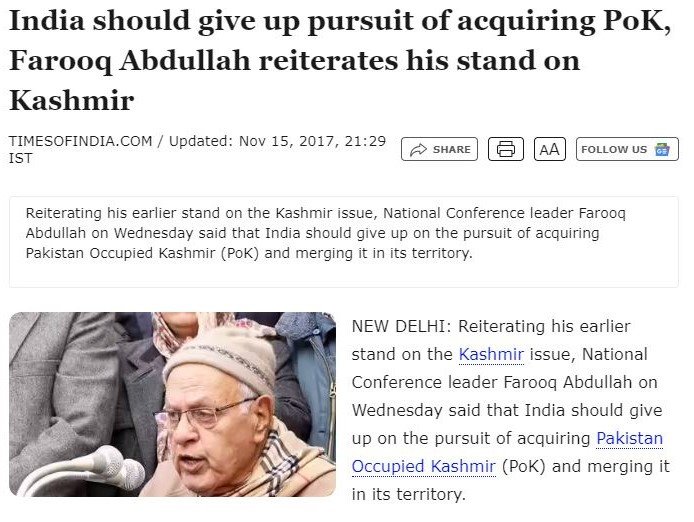
Stating in November 2017 that India should “give up pursuit of PoK”
Each time, the remarks triggered debate—but never quite erased the memory of 1997.
The Unanswered Question
Nearly 30 years later, the episode still raises an unsettling possibility:
Was 1997 merely a political misstep—or a glimpse into a line of thinking that briefly surfaced at the highest levels?
The archives do not offer a definitive answer. But they do confirm one thing:
👉 For a brief moment, the idea of “surrendering PoK” was not just whispered—it was spoken aloud, defended and then fiercely rejected.
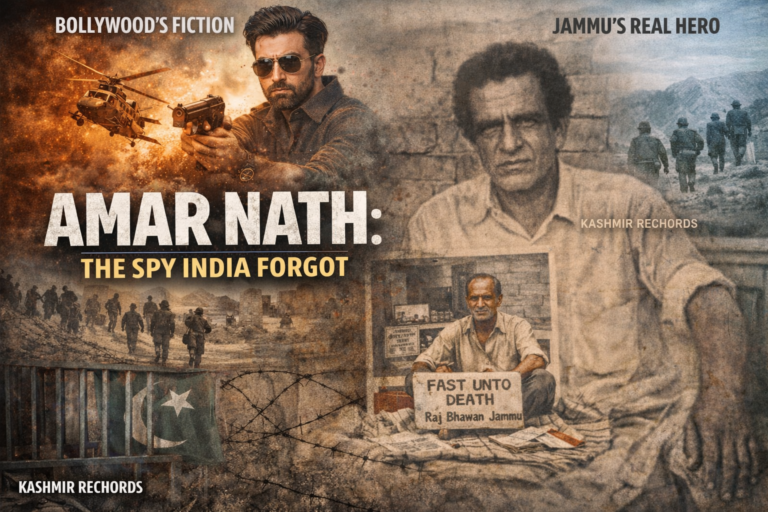
While Bollywood celebrates fiction, have we forgotten Amar Nath of Jammu & Roshan Lal Jalla of Kashmir?
(Kashmir Rechords Exclusive)
Cinema loves its spies—men of steel who slip across borders, endure torture and return to a grateful nation. Films like Dhurrandhar romanticize the world of espionage as a theatre of courage, sacrifice and silent victories.
As Dhurrandhar Part 2stands released on March 19, 2026, with Ranveer Kapoor once again stepping into the shoes of a daring cross-border spy, cinema will celebrate courage in shadows—slick, stylized and ultimately reassuring.
On screen, the spy always returns. In reality, some never truly come back.
Long before Bollywood discovered the drama of espionage, Jammu and Kashmir had already lived their own Dhurrandhars—not scripted, not celebrated and not even acknowledged.These were the real Dhurrandhars.
Amar Nath: The Spy Who Returned to Be Forgotten
In the early 1980s, a young ex-serviceman from Jammu—Amar Nath—crossed into Pakistan, not once but repeatedly, on missions that would never officially exist.
He went because the nation asked him to. He returned because he survived.
Each time, he brought back intelligence that mattered. Each time, he slipped quietly into anonymity—no medals, no citations, only the next instruction and the unspoken promise that the country stood behind him.
Until the day it didn’t.
Captured during one such mission, Amar Nath spent nearly a decade in Pakistani prisons. Tortured, broken, yet unyielding—his body became a map of suffering, scars he would later call his “medals.”
But the real blow came after his release.
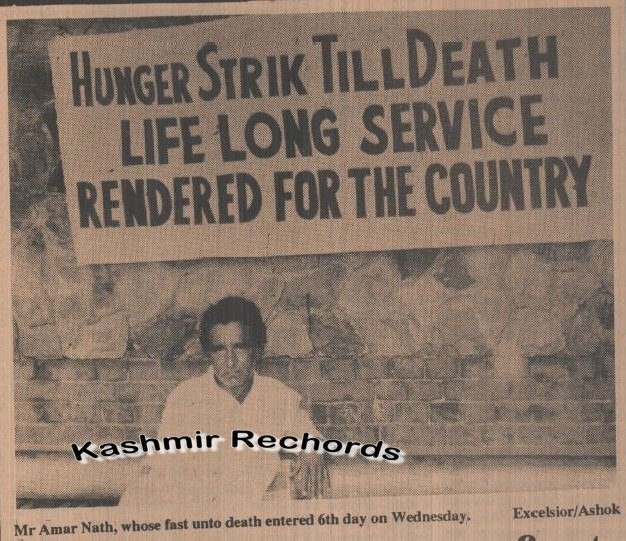
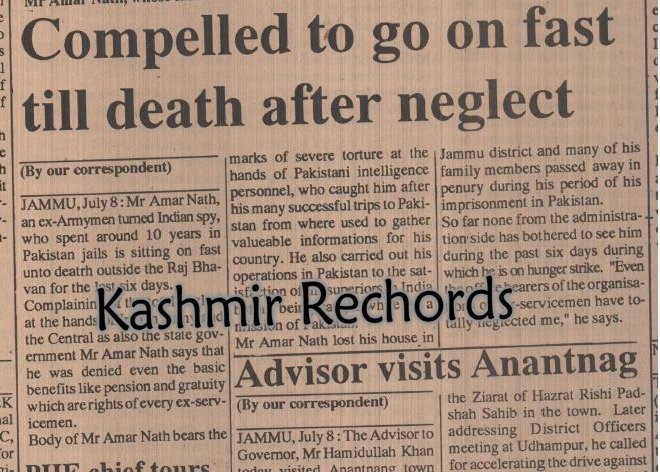
In July 1992, outside Raj Bhawan Jammu, this man—who had risked everything for the nation—sat on a fast unto death, pleading not for glory, but for recognition. For survival.
Denied even his basic entitlements as an ex-serviceman—pension, gratuity, dignity—Amar Nath spoke openly to journalists about betrayal. The system he had served refused to acknowledge him. Even former colleagues chose silence.
He had crossed borders for India. Now he could not cross the distance between neglect and justice within it.
Homeless, having lost family and shelter during his incarceration, Amar Nath lived on the margins—until public outrage briefly forced the administration to act. He was picked up.
And then, he vanished from public memory.
Unconfirmed whispers suggest he may have been quietly “handled,” given some subsistence. But officially, like his missions—he ceased to exist.
Roshan Lal Jalla: Kashmir’s Silent Sentinel
If Amar Nath’s story unsettles, Roshan Lal Jalla’s story devastates.
Recently chronicled by Kashmir Rechords, Jalla—a Kashmiri intelligence operative—was captured in 1972 while returning from a mission across the border. What followed were fifteen years of disappearance inside Pakistani prisons. Fifteen years of interrogation cells. Fifteen years of calculated brutality.
He was beaten, electrocuted, stabbed while unconscious. His mind bore wounds deeper than his body. Yet through it all—he did not betray his mission.
Back home, tragedy unfolded in parallel. His wife, Santosh, died waiting. His father, Jia Lal Jalla, passed away without closure .His young son, Rajesh, grew up in absence and uncertainty.
Only his mother, Roopawati Jalla of Rainawari, Srinagar, kept knocking on doors that rarely opened.
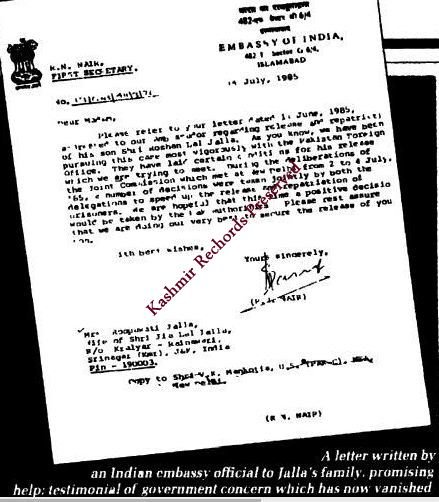
A letter dated July 14, 1985, from the Indian Embassy in Pakistan confirmed what the system would later deny—that the State knew who Roshan Lal Jalla was, and where he was.
When he was finally released in 1987 as part of a prisoner exchange, he returned not to honour—but to indifference. No rehabilitation. No pension.No recognition.
Like Amar Nath, he too had been used, then erased.
Cinema will move on. Audiences will applaud. Another spy film will follow.
But somewhere in the forgotten margins of history lies Amar Nath and Roshan Lal, the men who once crossed into enemy territory for their country and then vanished . Amar Nath or Roshan Lal Jalla were not characters. They were commitments.
And perhaps, remembering them is not an act of charity—it is an overdue act of justice.
Some heroes don’t die in war. They disappear in neglect.
And perhaps the real question is not why Bollywood tells these stories—but why it never tells these ones.
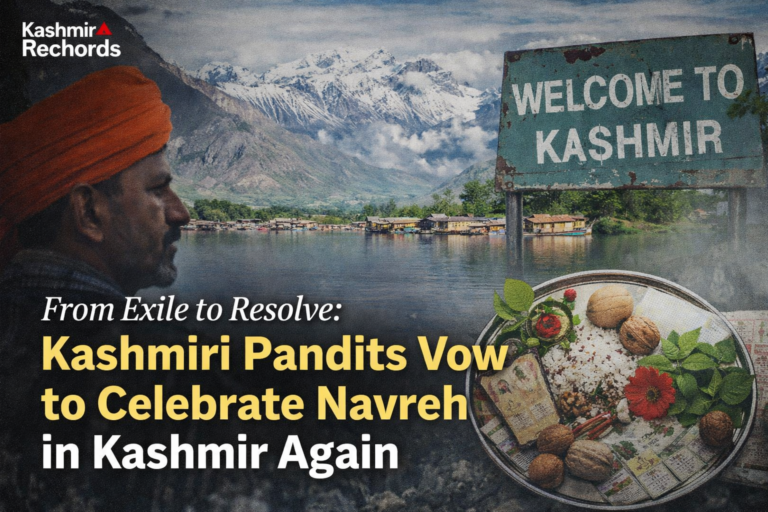
In a stirring reaffirmation of identity, memory and belonging, Kashmiri Pandits across India and the global diaspora have renewed a collective pledge—to return to their roots and celebrate Navreh, the Kashmiri New Year, in Kashmir itself from the coming year onward.
This is not merely a declaration. It is a civilisational assertion shaped by decades of displacement, a promise carried silently across years of exile, now finding voice with renewed conviction.
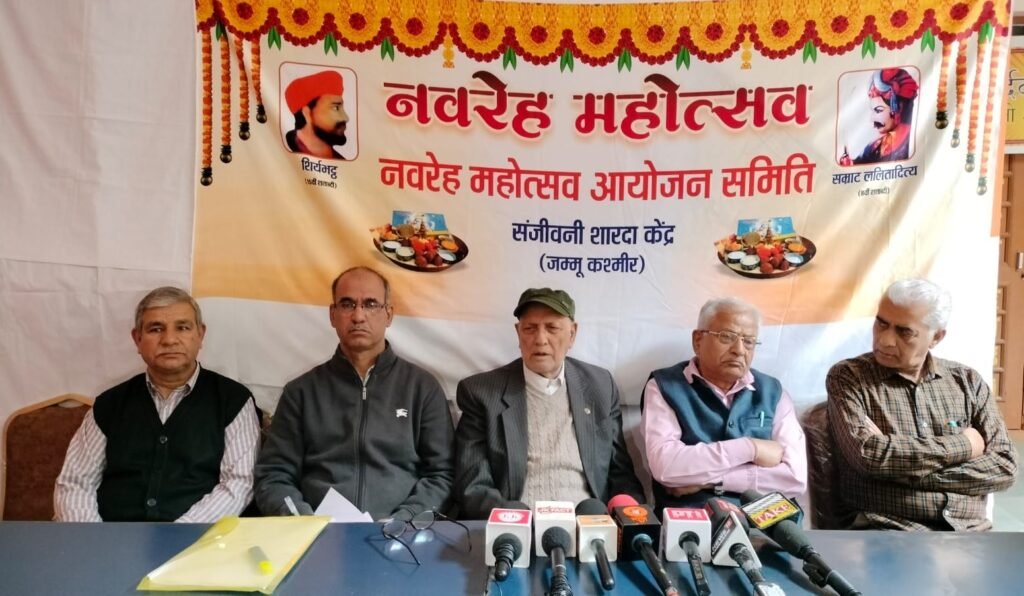
Addressing the media in Jammu on March 18, Convenor Padma Shri Dr. Kashi Nath Pandita described the Navreh Mahotsav as a “poignant homecoming movement”—one that transcends geography. He emphasized that the celebrations will unfold not only in Jammu but across cities in India and beyond, reflecting the shared heartbeat of a scattered yet spiritually anchored community.
“Navreh is not just the beginning of a calendar year,” Dr. Pandita noted, “it is an awakening—astronomical, cultural and deeply personal.” The festival begins with the sacred ritual of Navreh Thali darshan, symbolising prosperity, knowledge and continuity—values that have endured even in exile.
Kashmiri Pandit leaders during Navreh Mahotsav -2026 press conference at Jammu on March 18, 2026
Yet, this year’s Navreh carries a deeper undertone.
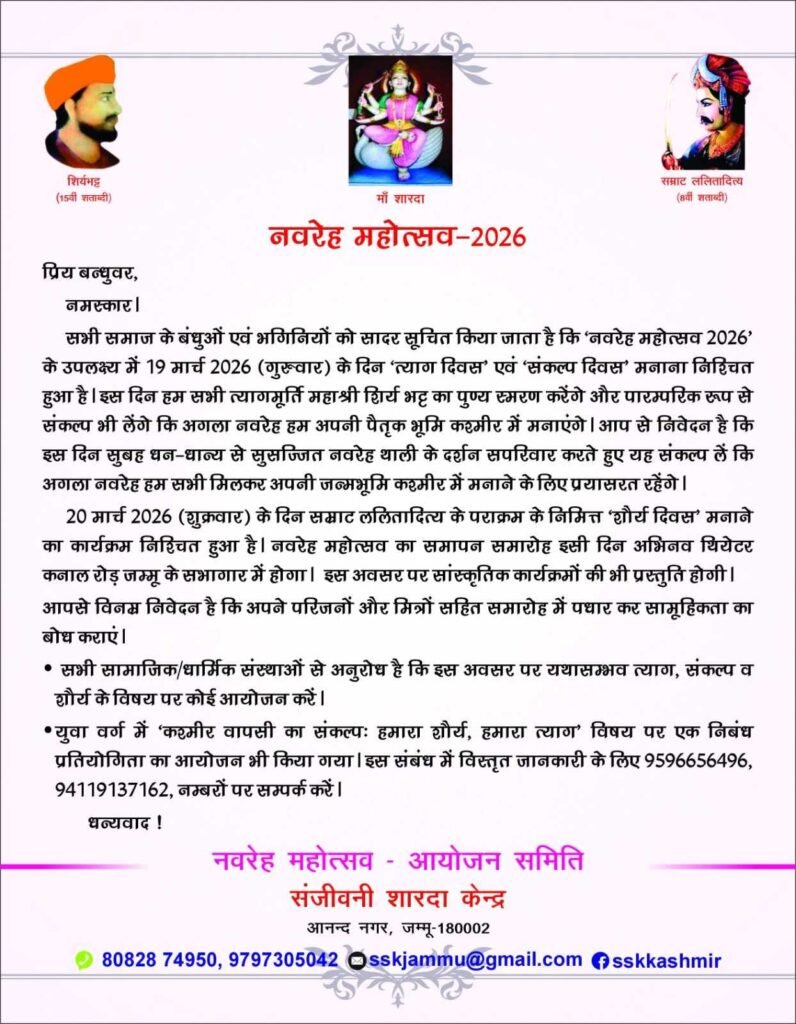
It is a pledge.A pledge that next Navreh will not be marked in displacement, but celebrated on the soil that gave birth to it—Kashmir.
The second day, March 20, will be observed as Shaurya Divas (Vijay Divas), commemorating the unmatched valour and visionary legacy of Samrat Lalitaditya, the 8th-century emperor whose reign symbolised strength, protection and civilisational pride. The day will culminate in a grand closing ceremony at Abhinav Theatre, Jammu, featuring cultural performances, intellectual discourses and tributes to the icons who define Kashmir’s timeless spirit.
Co-Convenor, Padma Shri Brij Lal Bhat underscored the urgency of reclaiming historical consciousness. He called for the inclusion of Acharya Shreya Bhat’s scholarship and Lalitaditya’s legacy in the academic curriculum of JKBOSE, asserting:
“This is our clarion call—to inscribe these icons into the consciousness of future generations.”
Echoing this sentiment, Co-Convenor Piyaray Lal Bhat urged the community to bridge its glorious past with a determined future, inviting every Kashmiri Pandit to reconnect with their sacred homeland—not as a memory, but as a lived reality.
Earlier, at the press conference, Dr. M. K. Bhat, Chairman of Sanjeevani Sharda Kendra (SSK) and Chief Spokesperson of the Navreh Mahotsav Aayojan Samiti–2026, outlined the vision behind the two-day programme. He highlighted that the Samiti—formed in collaboration with multiple socio-cultural organisations—has, since 2021, transformed Navreh Mahotsav into a growing collective movement.
“What began as a cultural observance,” Dr. Bhat noted, “has evolved into a shared resolve—urging Kashmiri Pandits everywhere to celebrate these defining days collectively, wherever they are, while keeping their gaze firmly fixed on Kashmir.”
Now in its sixth edition, Navreh Mahotsav stands not just as a festival—but as a bridge between memory and return, between exile and belonging.
And this year, above all, it stands as a solemn, unambiguous pledge:
That the next Navreh will not be celebrated away from home—but in Kashmir itself.
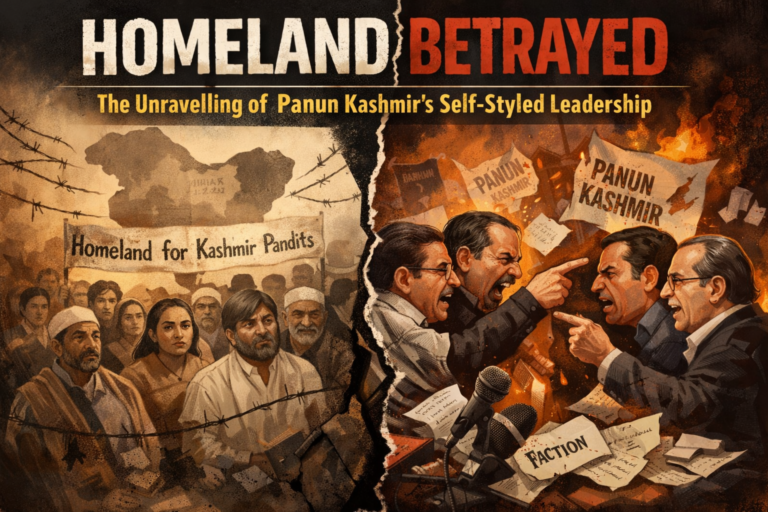
From a people’s movement to a theatre of egos, how opportunism hollowed out one of the most emotive causes of displaced Kashmiri Pandits
What began as a collective cry for dignity and return has, over the decades, been reduced to factional infighting, self-promotion and public mudslinging. The latest war of words within Panun Kashmir is not an aberration—it is the inevitable outcome of a long history of internal decay.
(Kashmir Rechords Exclusive)
The recent spectacle of charges and counter-charges among the so-called “leadership” of Panun Kashmir should surprise no one who has witnessed the organisation’s journey from within. This is not a sudden fall from grace—it is a slow, predictable collapse rooted in the very origins of its leadership structure.
The idea of a separate homeland for Kashmiri Pandits was not conceived by power-seekers. It was born in the bleak aftermath of the 1990 exodus—shaped by the fears, aspirations and survival instinct of an uprooted community. It was raw, organic and deeply collective. But before it could crystallize into a credible movement, it was appropriated—captured by individuals who saw in it not a mission, but an opportunity.
What followed was the systematic conversion of a sacred cause into a platform for personal ascendancy.
For the ordinary Kashmiri Pandit, the idea of homeland remains an article of faith. But for sections of its self-appointed lifetime leadership, it became a ladder—one climbed through titles, factions and perpetual reinvention. Over the years, the movement has witnessed cycle of splits and reunifications, permutations and combinations of self-styled Chairmen, Conveners and Core Groups—each claiming legitimacy, each undermining the other.
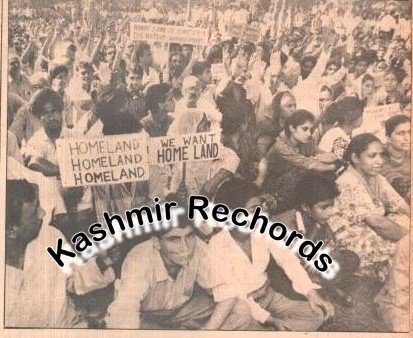
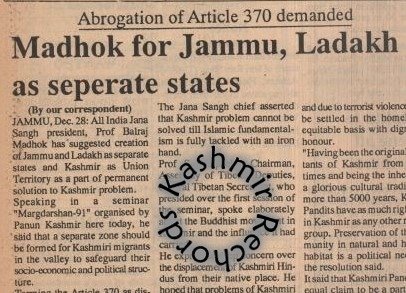
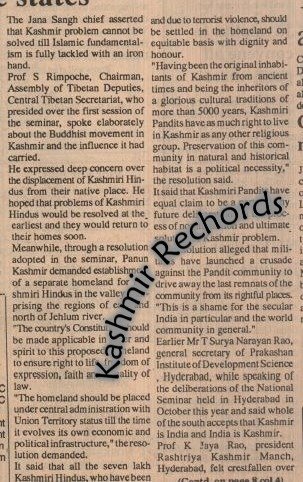
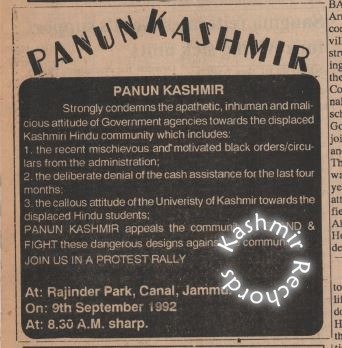
Kashmir Rechords has, over time, gathered substantial documentary evidence—press statements, press coverages, advertisements, posters—that point to an inconvenient truth: the cracks within Panun Kashmir’s leadership were present even before the much-cited Margdarshan of December 28, 1991. That event, often projected as a moment of unity, in fact deepened internal rivalries. The presence of Balraj Madhok did little to bridge differences; if anything, it exposed competing ambitions.
When Jan Sangh president Balraj Madhok chaired Margdarshan-91
Margdarshan Resolutions of Dec 1991
The fragmentation that followed was both swift and farcical. Multiple factions emerged, each branding itself differently—Movement, Moment and other semantic inventions—more invested in optics than outcomes. The diaspora, particularly non-resident Kashmiri Pandits, were drawn into this confusion, emotionally invested but strategically misled.
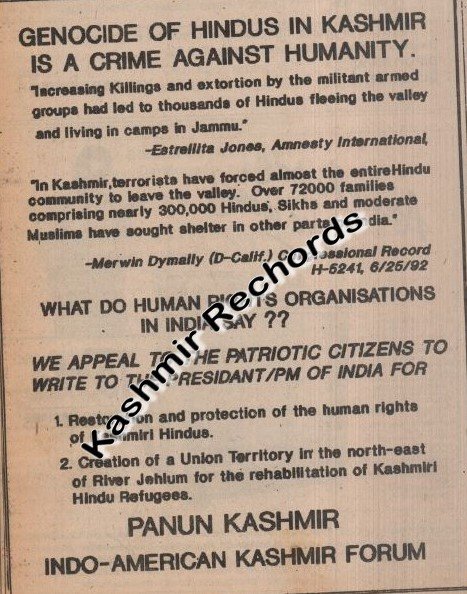
Even Indo-American Kashmir Forum was let down by power seekers!
Symbolism replaced substance. Heads were tonsured in camps to signal sacrifice. Conferences were staged under grand titles. Newspaper was launched with fanfare and quietly abandoned. Its Editors changed multiple times.These acts, far from strengthening the cause, reduced it to episodic performances.
With time, the leadership’s contradictions became impossible to conceal. Allegations gave way to counter-allegations. Parallel protests, parallel offices and parallel claims to authority became the norm. What was once a unified demand splintered into competing narratives—each louder, none credible.
The Initial split: When one faction of Panun Kashmir organised a Separate function in September 1992!
Half-baked slogans like “Ikjutt” with Jammu and Ladakh leadership surfaced periodically, only to collapse under the weight of mistrust. The movement, if it could still be called one, degenerated into a collection of factions—its leaders increasingly resembling keyboard warriors engaged in public feuds.
The latest episode, where one faction has branded another “anti-national,” is not merely unfortunate—it is revealing. It reflects a moral descent where the language of patriotism itself is weaponized for intra-group rivalry. This is the lowest ebb.
And yet, it is also a moment of clarity.
For what stands exposed today is not just the failure of individuals, but the betrayal of an idea. A cause rooted in pain, displacement and civilizational continuity was reduced to a battleground of egos and ambitions.
The tragedy of Panun Kashmir is not that it faced opposition from outside. It is that it was hollowed out from within.
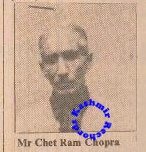
A lawyer, administrator, sportsman and patriot, Lala Chet Ram Chopra governed Jammu during the turbulent months of Partition and the tribal invasion of 1947, yet his remarkable life remains largely absent from public memory.
(Kashmir Rechords Exclusive)
History often remembers the loudest names but quietly forgets those who stood firm in moments of crisis. Among such overlooked figures is Lala Chet Ram Chopra, the last Governor of Jammu under the princely rule of Maharaja Hari Singh — a man whose life spanned law, administration, sports, public service and wartime sacrifice.
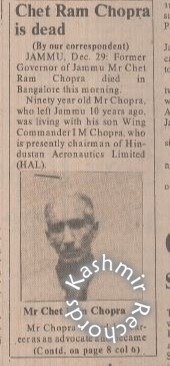
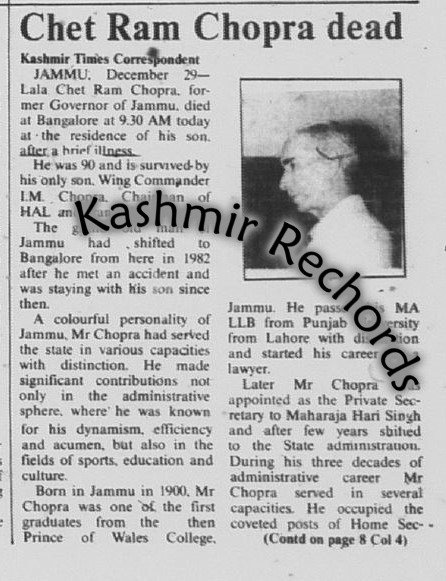
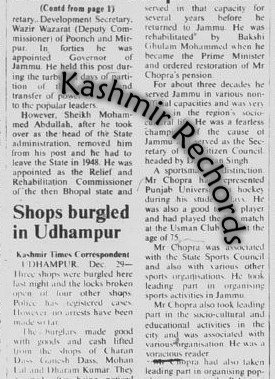
Despite holding one of the most crucial positions during the most turbulent period in Jammu and Kashmir’s history, very little about him survives in the public domain today, except an obituary, which was published in two local dailies of Jammu at the time of his death in December 1990. His legacy remains overshadowed by the political controversies of 1947, often reducing a complex life to selective accusations while ignoring decades of public service.
Yet archival records and contemporary reports dug up by Kashmir Rechords portray Mr Chopra as a multi-dimensional personality — an able lawyer, a tough administrator, a sportsman, a public intellectual and a devoted patriot.
From Jammu’s Classrooms to Lahore’s Law Halls
Born in Jammu in 1900, Chet Ram Chopra belonged to a generation that witnessed the transition of Jammu and Kashmir from a princely State into a region caught in the vortex of Partition.
He was among the first graduates of the historic Prince of Wales College, Jammu . After completing his graduation, he proceeded to Lahore where he obtained his Master of Laws (MLB) from Punjab University, graduating with distinction.
Armed with legal training and intellectual discipline, Chopra had begun his career as a lawyer, but destiny soon drew him into public administration.
A Trusted Hand in the Dogra Administration
Mr Chopra’s administrative abilities quickly caught the attention of the State leadership. He was appointed Private Secretary to Maharaja Hari Singh, placing him at the heart of the Dogra administration.
Over the next three decades, he had served the State in several important positions, gaining a reputation for efficiency, discipline and administrative acumen.
Among the key posts he held were:
Home Secretary of the State
Development Secretary
Wazir Wazarat (Deputy Commissioner) of Poonch
Wazir Wazarat of Mirpur
His administrative career culminated in 1946, when he was appointed Governor of Jammu — one of the most powerful positions in the State administration at a time when political tensions were rapidly escalating across the subcontinent.
Governor During the Storm of 1947
As Governor, Chet Ram Chopra found himself governing Jammu during one of the most volatile periods in the region’s history.
The year 1947 brought the trauma of Partition and soon after the tribal invasion of Jammu and Kashmir backed by Pakistan in October 1947, which ultimately led to the historic accession of the state to India under Maharaja Hari Singh.
During this chaotic period, Jammu witnessed widespread violence and demographic upheaval. Like many officials involved in administering the region during those tumultuous months, Chopra became a controversial figure in later narratives of the period.
Certain groups accused him of playing a controversial role in the Jammu disturbances of 1947, including allegations that he had signed “forced migration orders.” However, these accusations were often found politically motivated and unsupported by conclusive documentary evidence. But he had to pay price for these accusations.
When Sheikh Mohammad Abdullah assumed power as head of the State administration, Chopra was removed from his post and eventually left Jammu and Kashmir in 1948.
Years Away: Service in Bhopal
Despite the setback, Mr Chopra continued his public service outside the State.
He was appointed Relief and Rehabilitation Commissioner in the erstwhile Bhopal State, where he worked for several years helping manage the enormous humanitarian crisis created by Partition.
His administrative experience proved valuable in handling the challenges of refugee rehabilitation — one of the most pressing issues of newly independent India.
Return to Jammu and Public Life
Mr Chopra eventually returned to Jammu after intervention by Bakshi Ghulam Mohammad, who ordered the restoration of his pension and rehabilitation.For nearly three decades thereafter, he remained deeply involved in Jammu’s civic life.
He served as Secretary of the Citizen Council, an influential body headed by Dr. Karan Singh, and emerged as a fearless advocate of Jammu’s public causes.
The Sportsman and the Scholar
Beyond administration, Chet Ram Chopra was also known for his passion for sports and intellectual pursuits. During his student days, he had represented Punjab University in hockey and later became an accomplished tennis player.
In a remarkable testament to his lifelong love for sport, he reportedly played his last tennis match at the Usman Club in Jammu at the age of 75.He also remained associated with the State Sports Council and several other sports organisations, playing a significant role in promoting sporting culture in Jammu.
At home, he was known as a voracious reader and a deeply thoughtful man with wide intellectual interests.
A Family of Soldiers
Mr Chopra’s patriotism was not merely rhetorical.
He actively encouraged his sons to join the Indian Army, a decision that came at a profound personal cost.
His second son, Major M. M. Chopra, laid down his life in the 1965 Indo-Pak War, becoming one of the many soldiers from Jammu who sacrificed their lives defending the country.
Even in his later years, Mr Chopra remained actively involved in mobilising public support during the wars of 1965 and 1971, helping organise assistance for soldiers and families of war heroes.
The Final Years
After suffering an accident in 1982, the ageing administrator had moved from Jammu to Bengaluru to live with his son, Wing Commander I. M. Chopra, who was then Chairman of the Hindustan Aeronautics Limited (HAL).
The grand old man of Jammu passed away quietly at Bengaluru on December 29, 1990, at the age of 90.
A Life Waiting to Be Reassessed
Lala Chet Ram Chopra’s life reflects the complexities of Jammu and Kashmir’s transition from princely rule to modern politics.
He was administrator, sportsman, civic leader, father of soldiers and Governor during one of the most turbulent chapters in the region’s history.
Yet today, he remains largely absent from mainstream historical narratives.
Perhaps the time has come for historians and scholars, especially of Jammu and Kashmir to revisit the life of this forgotten administrator — not through the narrow prism of political accusations, but through a balanced examination of his long and multi-dimensional public service.
For history is rarely as simple as its most repeated stories. And sometimes, the most important figures are the ones quietly forgotten.
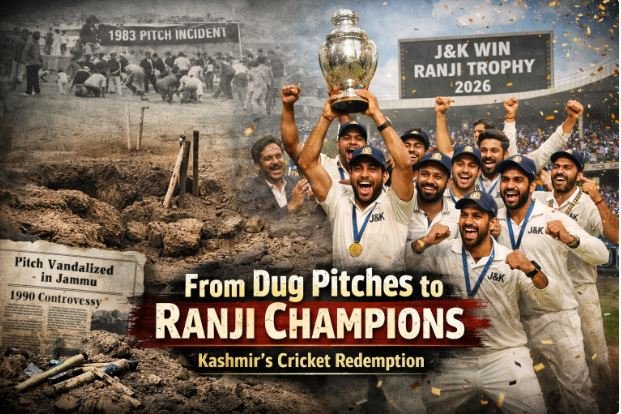
On February 28, 2026, cricket in Jammu and Kashmir witnessed a moment that generations of players and fans had only dreamed about. After a 67-year wait, the team lifted its first-ever Ranji Trophy title, defeating eight-time champions Karnataka cricket team in the 2025-26 final at KSCA Stadium.
The final ended in a draw, but Jammu & Kashmir’s commanding 291-run first-innings lead sealed the championship — a historic triumph in the Ranji Trophy.
Yet the journey to this glory was far from smooth. It was a road marked by controversy, political turbulence and two infamous episodes of pitch-digging that once tarnished the image of cricket in the region.
A Title Won After Decades of Turbulence
For decades, Jammu and Kashmir possessed what many cricket experts considered ideal natural conditions for fast bowling — cool climate, lively wickets and vast playing fields in Srinagar and Jammu.
Yet the region never managed to translate this advantage into consistent cricketing success.
Political instability, administrative challenges and lack of sustained national exposure kept the State on the margins of India’s cricketing map. But perhaps nothing damaged the reputation of the region’s cricket more than the two notorious incidents of pitch vandalism that occurred in 1983 and 1990 at Srinagar and Jammu respectively.
The First Shock: Srinagar Pitch Vandalism in 1983
On October 13, 1983, Srinagar hosted its first international One Day International at the Sher-i-Kashmir Stadium. The match, involving the India national cricket team, ended in controversy when twelve individuals allegedly vandalized the pitch during the lunch break.
The incident shocked the cricketing world. It instantly pushed Kashmir into international headlines — but for the wrong reasons.
Instead of celebrating the Valley’s entry onto the global cricket stage, the focus shifted to security concerns and the vulnerability of sporting events in the region.
If the 1983 incident was damaging, the second episode proved even more humiliating.
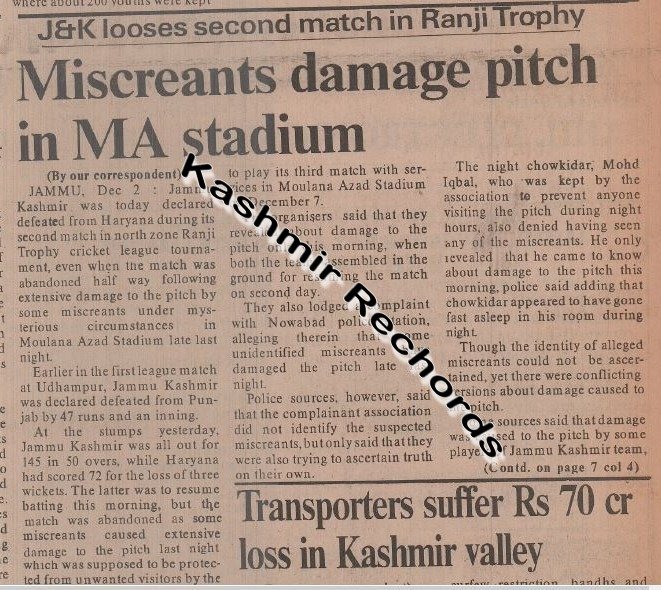
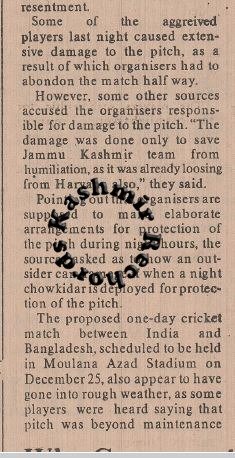
In December 1990, during a Ranji Trophy match between Jammu & Kashmir and Haryana, the pitch at M. A. Stadium Jammu was mysteriously dug up.
Newspaper reports from the time — now preserved by Kashmir Rechords— suggested the pitch may have been deliberately damaged to avoid an impending defeat against Haryana.
But the move backfired spectacularly.
Instead of saving the hosts from defeat, the match was awarded to Haryana, leaving Jammu and Kashmir cricket facing national embarrassment.
The timing could not have been worse. Jammu was preparing to host another One Day International between India and Bangladesh on December 25, 1990. The pitch controversy cast a shadow over the entire effort. The venue was ultimately shifted.
Newspaper reports preserved by Kashmir Rechords from December 1990 suggest that the pitch at M. A. Stadium Jammu was allegedly damaged to avoid an impending defeat against Haryana. The move, however, backfired, leading to the match being awarded to Haryana and further damaging Kashmir’s cricketing reputation.
For cricket lovers in the region, it was a double blow: The team lost the match and the region lost credibility as a venue for major cricket events.
How J&K Lost Its Cricketing Stage
The consequences of these controversies were long-lasting. While Jammu and Kashmir possessed picturesque stadiums and favourable playing conditions, national cricket authorities gradually shifted international fixtures elsewhere.
Neighbouring Dharamshala in Himachal Pradesh — once considered a relatively minor cricketing centre — emerged as a premier venue. The Himachal Pradesh Cricket Association Stadium eventually became one of India’s most scenic international cricket venues.
Many observers believe that had law-and-order conditions remained stable and the pitch controversies never occurred, major cricket events might have continued to be staged in Srinagar and Jammu instead.
A Long Wait Finally Ends
Over the decades, the waters of the Jhelum River and Tawi River have flowed on, carrying with them memories of missed opportunities and damaged reputations. But the triumph of February 28, 2026 marks a symbolic turning point.By lifting the Ranji Trophy after a 67-year wait, Jammu & Kashmir have not merely won a championship — they have rewritten a painful chapterintheir sporting history.
Pitches that were once dug in despair have finally been replaced by a foundation for hope.
Timeline: Kashmir Cricket’s Journey from Controversy to Glory
1983 – International Debut Turns Controversial During the first One Day International in Srinagar at Sher-i-Kashmir Stadium, the pitch was vandalized during the lunch break on October 13, 1983, triggering global attention and controversy.
1990 – Ranji Trophy Pitch Digging In December 1990, the pitch at M. A. Stadium was mysteriously dug during a Ranji Trophy match between Jammu and Kashmir cricket team and Haryana cricket team, resulting in the match being awarded to Haryana.
1990s–2010s – Lost Opportunities Because of security concerns and instability, international and major domestic matches gradually shifted away from Kashmir. Meanwhile, nearby Dharamshala in Himachal Pradesh emerged as a major cricket venue.
2026 – Historic Redemption On February 28, 2026, the Jammu and Kashmir cricket team finally lifted their first-ever Ranji Trophy, defeating Karnataka cricket team in the final at KSCA Stadium.
From Al-Aqsa to Gaza and Iran, how global Muslim causes have repeatedly spilled onto the streets of the Valley
(Kashmir Rechords Exclusive)
When tensions flare in the Middle East, Kashmir often feels the tremors!
The latest disruptions in the Valley following the escalating confrontation involving Iran, Israel and the United States—and the killing of Iran’s supreme leader Ayatollah Ali Khamenei—may appear sudden to many observers. Yet for those familiar with Kashmir’s history, such reactions are neither unusual nor unprecedented.
For decades, events unfolding thousands of miles away—in Palestine, Iran, Iraq, Saudi Arabia, Pakistan and even Europe—have periodically triggered protests in Kashmir. These demonstrations are often articulated in the language of “Islamic solidarity and global Muslim identity”, but their consequences have frequently been intensely local.
Ironically, the fallout has often been borne by local minorities, particularly Kashmiri Pandits, who historically faced intimidation, attacks on homes and damage to temples despite having no connection whatsoever with the events that triggered the protests.
A Pattern Rooted in the Valley’s Political Memory
Kashmir’s streets have long responded to events far beyond the Valley’s mountains.
From the 1931 agitation to protests over conflicts in the Middle East, controversies in Europe and wars involving Muslim Nations, the Valley has repeatedly witnessed demonstrations triggered by developments abroad.
At times, the protests took violent turns, with minority neighbourhoods and religious places becoming targets, while security forces struggled to restore order.
The psychology of these protests has often revealed striking contradictions.
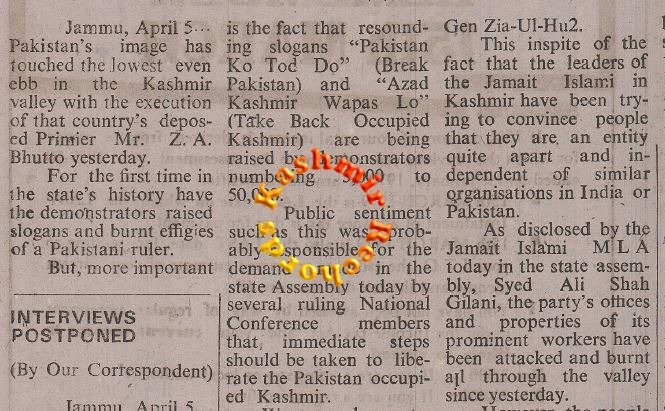
In April 1979, when Pakistan’s former Prime Minister Zulfikar Ali Bhutto was executed, demonstrations erupted in Kashmir condemning Pakistan’s military ruler General Zia-ul-Haq, with protesters shouting the slogan “Zia Koon”—the one-eyed Zia……“ Pakistan Murdabad.
Bhutto Executed and Kashmir, for a change, turns anti-Pakistanis!
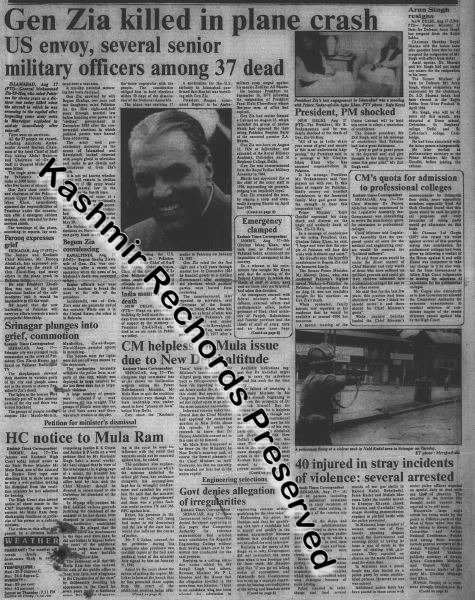
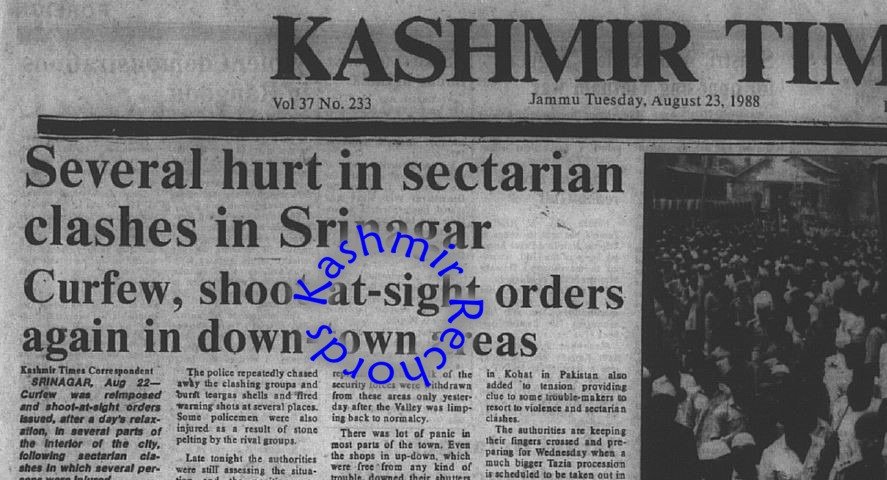
Yet when Zia himself died in a mysterious plane crash in 1988, sections of the Valley mourned his death and blamed the United States for the incident.
The Front Page lead news:Zia killed in Plane Crash and 40 injured in Srinagar! ( Right 3 Column News)
Similarly, when Iran maintained friendly relations with the United States during the Shah’s era, Iranian affairs rarely triggered protests in Kashmir. But after the 1979 Iranian Revolution, tensions involving Iran often sparked anti-American demonstrations in the Valley.
1969: The Al-Aqsa Agitation
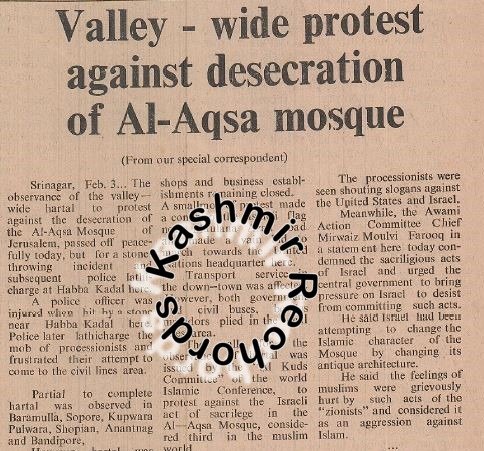
One of the earliest examples of Kashmir reacting to international developments occurred in August 1969, when a fire broke out at the Al-Aqsa Mosque in Jerusalem.
Although the incident took place thousands of kilometres away, protests erupted in parts of Kashmir. Demonstrations were organised condemning the alleged desecration of the mosque, reflecting the Valley’s growing emotional engagement with global Islamic issues.
The episode established a pattern that would repeat itself many times over in the decades to come.
1986: The Anantnag Riots
Perhaps the most devastating fallout of such mobilization occurred in February 1986, following communal tensions triggered by developments again linked to Al-Aqsa Mosque, national politics and religious controversies.
Large-scale violence broke out in Anantnag and several other towns, where numerous Hindu temples, homes and businesses belonging to Kashmiri Pandits were attacked or destroyed during the coming days.
The riots marked a turning point in the Valley’s communal relations and foreshadowed the turbulent years that would follow.
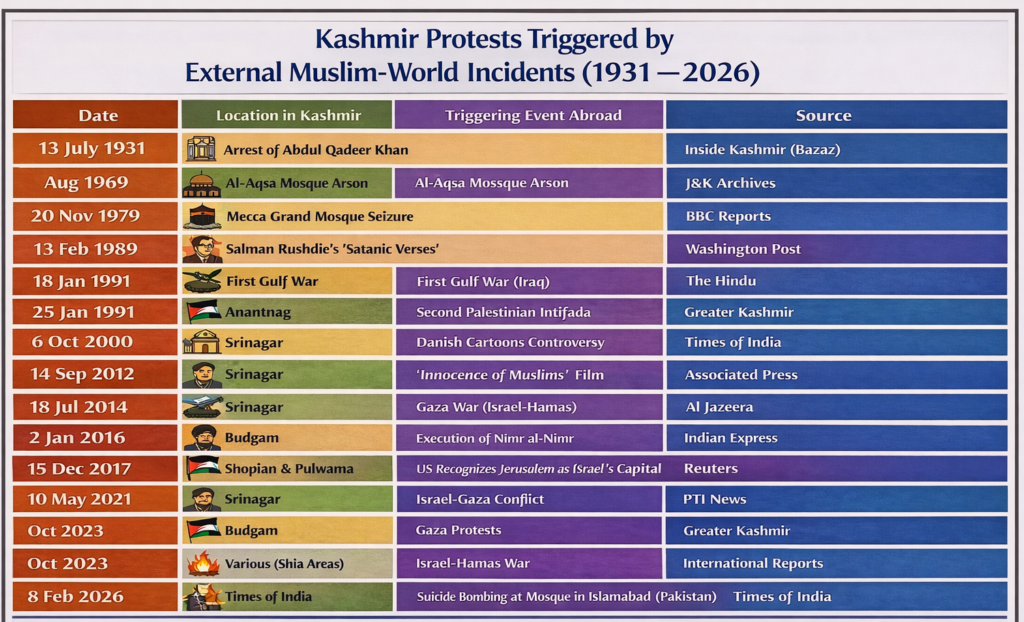
Major Kashmir Protests Triggered by Global Events
Over the decades, several incidents have demonstrated how global developments can spark unrest in Kashmir. Kashmir Rechords has tried to club them
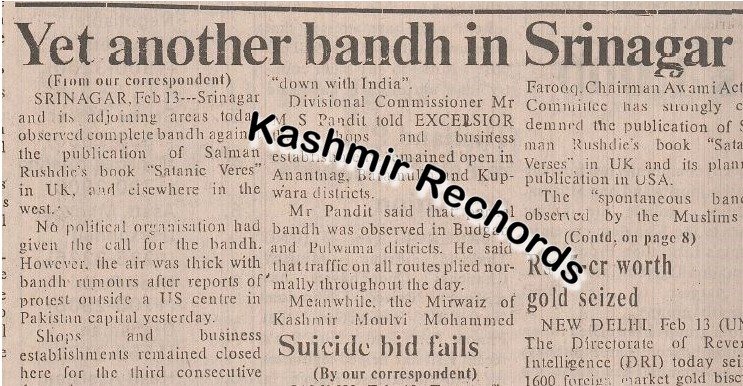
1989 – Salman Rushdie Controversy
The publication of The Satanic Verses led to massive protests on February 13, 1989 in Srinagar. Clashes with police left one person dead and over 100 injured, while minority religious sites were damaged.
1991 – The First Gulf War
When the United States launched military operations against Iraq after its invasion of Kuwait, demonstrations erupted across the Valley on January 18, January 25 and February1, 1991. Protesters burned American flags and raised slogans supporting Iraq.
2000–2001 – Second Palestinian Intifada
Israeli-Palestinian clashes triggered “solidarity” protests in Kashmir on October 6, 2000, October 13, 2000 and April 15, 2001.
2006 – Danish Cartoons Controversy
The publication of cartoons depicting Prophet Muhammad in European newspapers triggered widespread demonstrations on February 10 and February 17, 2006, followed by a Valley-wide strike on March 3, 2006.
2012 – “Innocence of Muslims” Film
An film produced in the United States sparked protests across Kashmir on September 14 and 15, 2012.
2014 – Gaza War
During the Israel-Hamas conflict, thousands marched in Kashmir on July 18, July 25 and August 1, 2014, waving Palestinian flags.
2016 – Execution of Nimr al-Nimr
Saudi Arabia’s execution of Shia cleric Sheikh Nimr al-Nimr triggered demonstrations between January 2 and 4 ,2016, particularly among Shia groups.
2021 – Israel-Gaza Conflict
Fresh fighting in Gaza led to protests in Srinagar, Shopian and Pulwama on May 10 and 14, 2021.
Understanding the Mobilization
Researchers studying Kashmir’s political sociology identify several recurring factors behind these demonstrations:
• Friday prayers often serve as mobilization points. • Protests are frequently triggered by issues affecting the global Muslim community (Ummah). • Palestine-related developments generate the strongest emotional response. • Religious or separatist networks often play a role in mobilizing crowds.
The Local Cost of Global Passions
While protest remains a democratic right, Kashmir’s experience illustrates a troubling pattern: demonstrations triggered by distant events often turn inward, targeting local communities.
Minorities—have historically borne the brunt of such unrest. Security forces too have frequently faced violent confrontations while attempting to restore order.
Even ordinary Kashmiri Muslims have suffered when shutdowns and clashes disrupted daily life.
An Echo Chamber of the Muslim World
From the 1931 agitation to protests over Al-Aqsa, Middle East wars, European cartoons and American films, Kashmir has repeatedly acted as an echo chamber for global Muslim politics.
The paradox remains stark: while the causes of these protests lie far beyond the Valley, their consequences are felt within Kashmir’s own fragile social fabric.
And as the latest tensions demonstrate, the Valley’s long history of reacting to distant conflicts continues to shape its present.
While it can be duly acknowledged that Muslims of Kashmir, especially the Shia community has a right to organise protests and express solidarity with the unfortunate killing of Ayatollah Ali Khamenei, the incidents of violent intimidation cannot be accepted as the global events anywhere have layered complexion and contours.
How Swami Sant Dev, once banished by Maharaja Hari Singh, returned to inspire dreams of ruling up to Lahore before Kashmir’s accession to India.
(Kashmir Rechords Exclusive)
History often remembers wars, treaties and signatures. But sometimes, history turns on whispers.
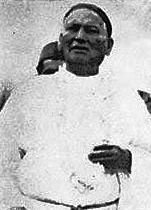
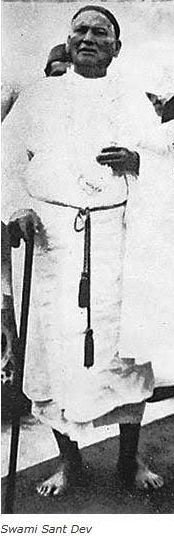
In the turbulent years before Jammu and Kashmir acceded to India, a mysterious priest — Rajguru Swami Sant Dev — re-entered the life of Maharaja Hari Singh and altered the psychological landscape of a kingdom standing at the edge of destiny.
What makes the story compelling is not merely influence — but rejection, disappearance and an astonishing return.
The First Fall: Banished by a Sceptic King
Swami Sant Dev had risen to prominence during the reign of Maharaja Pratap Singh. Pratap Singh, deeply inclined toward mysticism, kept astrologers and swamis close. Sant Dev became Rajguru and was treated with full state protocol — cars sent to receive him, elaborate arrangements for his comfort, official communications addressed to him as Swami Sant Dev Ji Maharaj.
Then came 1925.
Pratap Singh died. Hari Singh ascended the throne.
Unlike his uncle, Hari Singh was modern, disciplined and in the words of his own son, “far from being a religious man.” One of his early acts was decisive — he banished the Swamis and Gurus who had flourished under the previous regime. Sant Dev was sent away.
It seemed the curtain had fallen.
The Vanishing Act — And the Return
For nearly two decades, Sant Dev faded into obscurity. No one knew his origins. No one knew his true age. Some claimed he was over a hundred. Some even whispered he was a British plant. Nothing was proven.
Then, in 1944, he reappeared.
By 1946, he had not merely returned — he had re-established himself as Rajguru to the very ruler who had once expelled him.
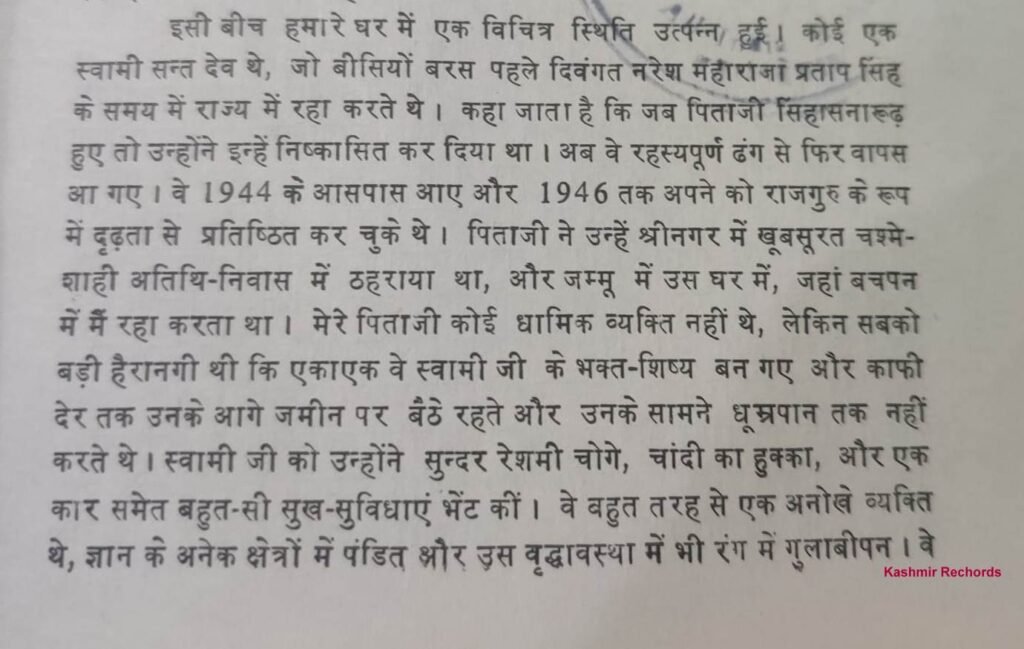
From May 1946 until October 1947, he lived within palace compounds in Srinagar. He was given the beautiful Chashma Shahi guest house and a residence in Jammu. The Maharaja who once banished him now offered him silk robes, a car and royal hospitality.
The transformation stunned the court.
Hari Singh used to now sit on the ground before him for long hours. He would not smoke in his presence. He became, in effect, a disciple.
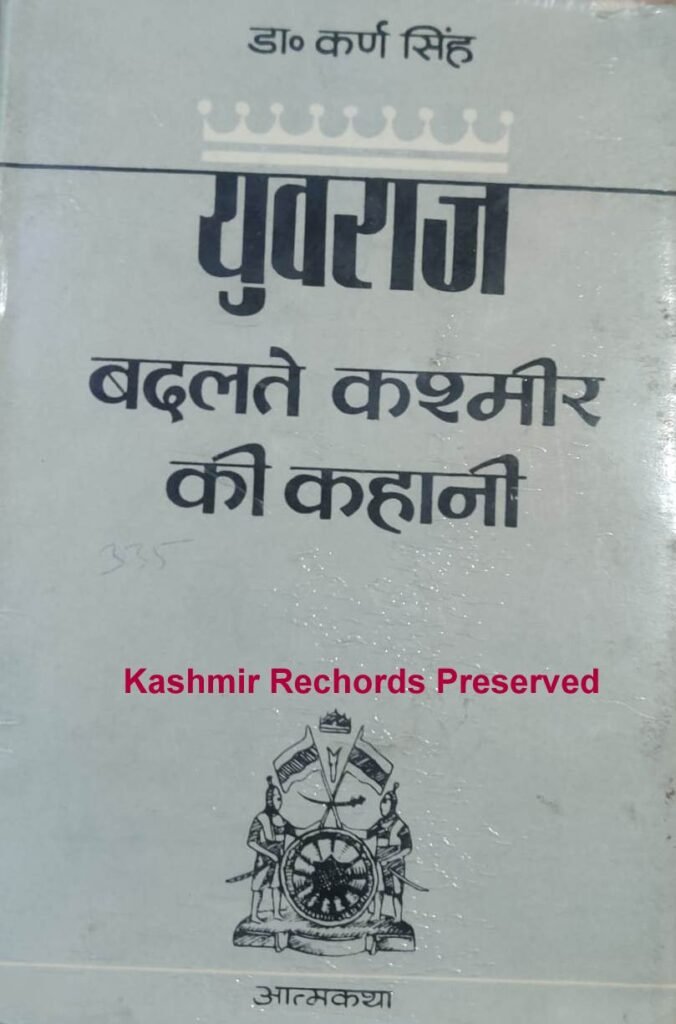
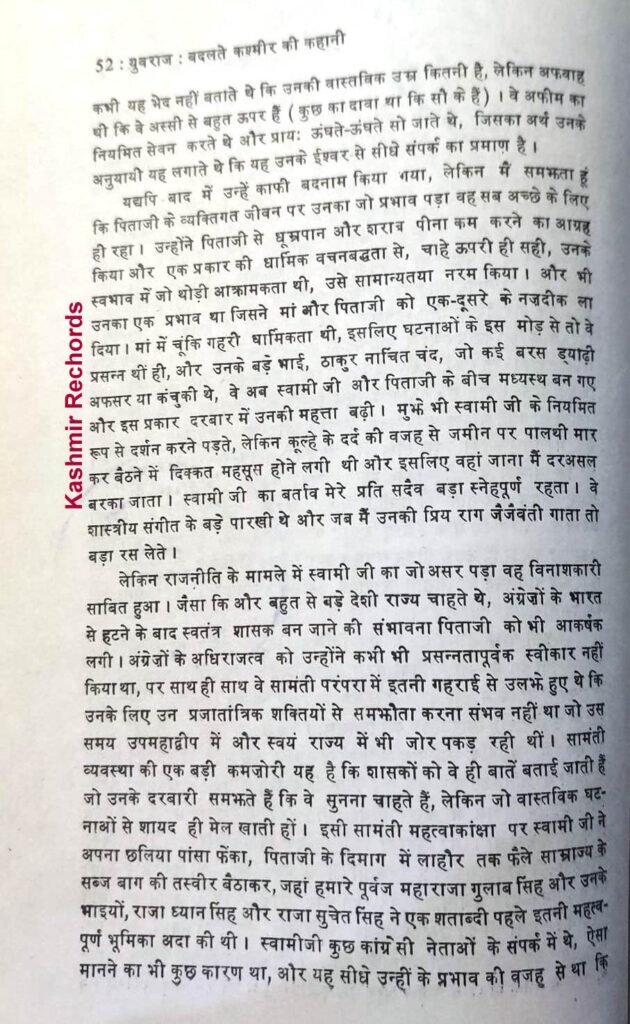
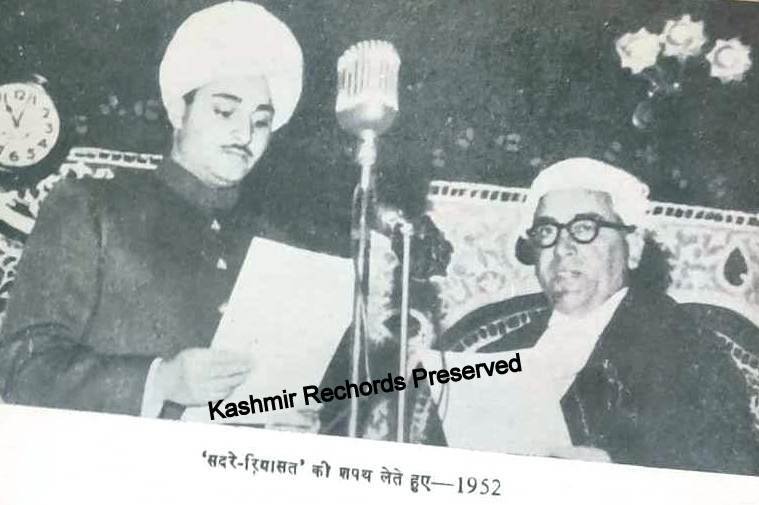
Even his son, Karan Singh, watched in disbelief. Dr Karan Singh later expressed bewilderment in his autobiography Heir Apparent (Hindi edition: Yuvraj: Badalte Kashmir Ki Kahani).
The Prophecy of Lahore
What changed?
According to Dr. Karan Singh’s widely read autobiography, Heir Apparent, Sant Dev convinced the Maharaja that destiny held extraordinary promise.
He writes:
“The Swami had convinced my father that luck was smiling on him and that he would become the sovereign of an extended kingdom sweeping down to Lahore.” (Heir Apparent: An Autobiography, Oxford, 1989, p. 37)
In the Hindi edition, Yuvraj: Badalte Kashmir Ki Kahani, the sentiment carries similar weight — the Swami assuring the Maharaja that his fate was grand, that he was destined to rule a vast and expanded realm.
For a ruler standing at the crossroads of 1947 — when British paramountcy was ending and princely states were to choose between India, Pakistan, or independence — such words were intoxicating.
Independence was no longer merely a political option. It became a vision. A destiny. A promise of Lahore.
The greener pastures were not metaphorical — they were geographical.
Rasputin in the Palace
Tall, pink-complexioned, and commanding even in advanced age, Sant Dev cultivated an aura of mystique. He was rumoured to possess occult powers. He loved luxury, the company of women and was said to consume opium.
In whispered comparisons, he became Kashmir’s version of Grigori Rasputin — the Russian faith-healer whose influence over Tsar Nicholas II was blamed for imperial catastrophe.
And like Rasputin, Sant Dev’s power was psychological.
He did not command armies. He commanded imagination.
Pages fromYuvraj: Badalte Kashmir Ki Kahani
The Dream Collapses
But destiny did not follow prophecy.
In October 1947, tribal raiders from Pakistan invaded Kashmir. The fragile dream of an independent kingdom “sweeping down to Lahore” shattered under the weight of invasion and urgency.
Hari Singh signed the Instrument of Accession to India.
The greener pastures faded into the smoke of war.
Gradually, as events overtook aspiration, the Maharaja is believed to have realised that Sant Dev’s claims were exaggerated. The aura dimmed. The influence waned.
Once again, the Swami receded into obscurity — as mysteriously as he had appeared and reappeared.
The Irony of Power
The irony is profound.Hari Singh — the rational ruler who had banished mystics — later became deeply influenced by one who offered him a vision of imperial expansion. The sceptic became a believer. The exile became Rajguru.
And in that arc of rejection, disappearance and return lies one of the most fascinating psychological subplots of Kashmir’s accession.
History records the signature on the Instrument of Accession.
But behind that signature was a ruler who, for a fleeting moment, believed he might rule all the way to Lahore.
And behind that belief stood a mysterious Swami — who appeared, disappeared and reappeared — leaving behind a legend that still lingers in the annals of Kashmir’s past.
A Question That Lingers
Was Sant Dev a mystic, a manipulator, or merely a man who understood the psychology of kings?
Did his whispered promises of sovereignty shape Kashmir’s hesitation at a decisive moment in subcontinental history?
Or was he simply a dramatic footnote in a much larger tragedy?
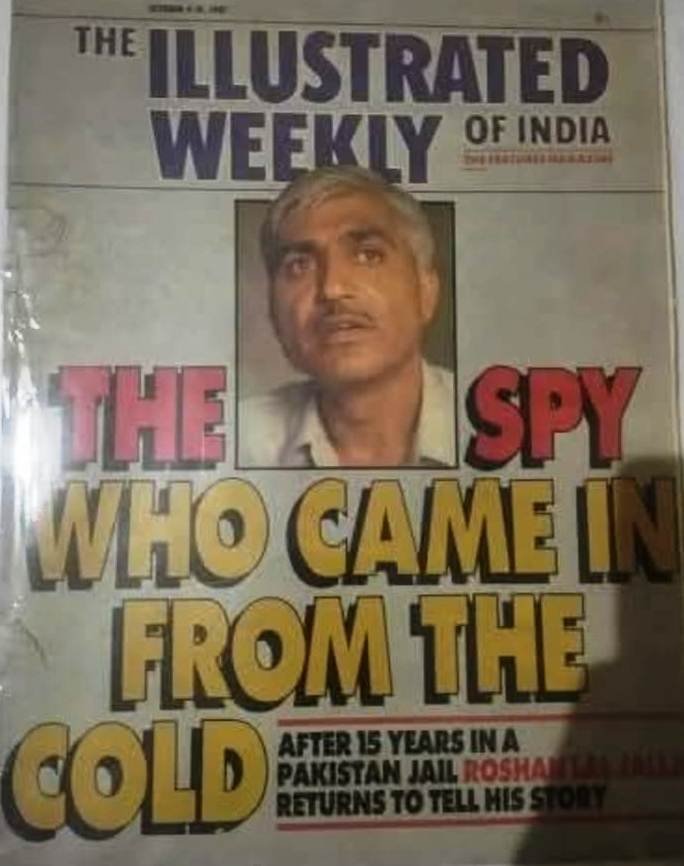
Roshan Lal Jalla, a Kashmiri intelligence operative, spent 15 years in Pakistani prisons after being captured in 1972. Tortured, disowned, and denied rehabilitation upon his return, his story was documented by The Illustrated Weekly of India and preserved by Kashmir Rechords.
(Kashmir Rechords Exclusive)
Cinema loves its spies—silent men slipping across borders, bruised but unbroken, returning home to gratitude and glory. Films like Dhurrandhar remind audiences that espionage is a game of shadows, courage and sacrifice. But long before the camera found such stories, Kashmir had already lived one—raw, unresolved and devastatingly real Dhurandhar.
In the late 1960s, Roshan Lal Jalla, a young man from Kashmir, crossed into Pakistan on a mission that was never meant to be acknowledged. He went once in 1969, again in 1970 and once more during the 1971 war. Each time, he returned quietly, having done exactly what the Nation had asked of him. There were no medals, no citations—only fresh instructions and an unspoken assurance that the country stood behind him.
That illusion collapsed in 1972
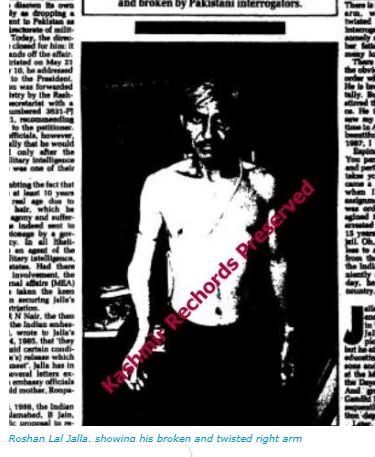
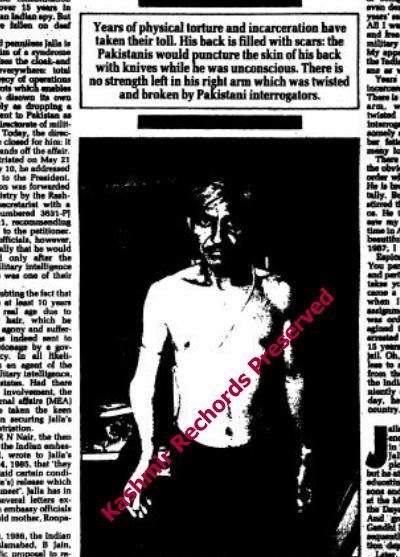
While attempting to return to India, Jalla was captured near the India–Pakistan border. What followed were fifteen years of disappearance—years swallowed by Pakistani prisons, interrogation cells and a system designed not just to extract information, but to erase the human being who possessed it. He was beaten, subjected to electric shocks, stabbed while unconscious, his right arm twisted and broken. The scars never healed, and neither did the damage to his mind. Yet through it all, Jalla did not betray his mission.
Roshan Lal Jalla, showing his broken and twisted right arm
Back home, life unravelled in parallel. His wife Santosh died waiting. His father, Jia Lal Jalla, passed away without knowing whether his son would ever return. His three year son Rajesh grew up without stability or proper education. Only his mother, Roopawati Jalla, living in Kralyar, Rainawari in Srinagar, continued to knock on doors that rarely opened. A letter dated July 14, 1985—from the Indian Embassy in Pakistan—acknowledged that officials were in touch with her while efforts were being made for her son’s release. It was proof, quietly filed away, that the State knew exactly who Roshan Lal Jalla was.
When he was finally released in 1987 as part of an exchange of prisoners, Jalla expected little—but not what awaited him. There was no rehabilitation, no official recognition, no pension. The very agency that had sent him across hostile territory multiple times refused to acknowledge him. He had returned from fifteen years of torture only to discover that, in the eyes of his own country, he no longer existed.
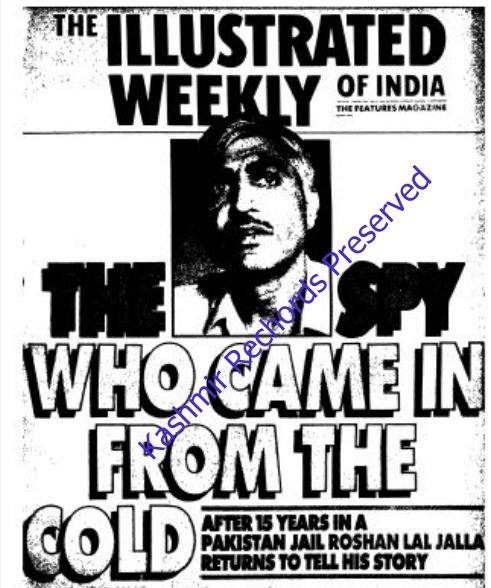
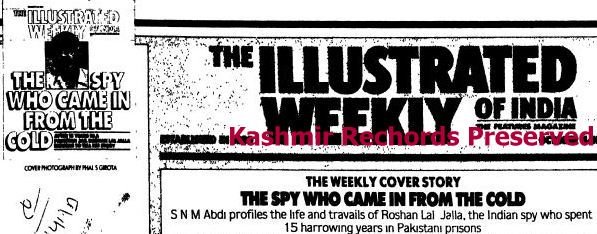
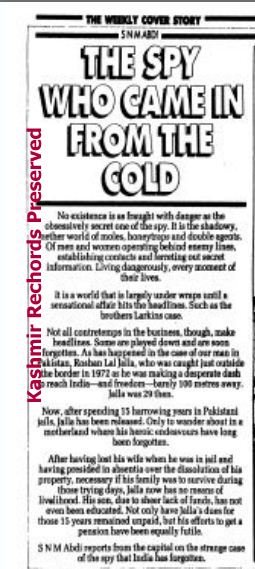
His story might have vanished entirely if it were not documented by The Illustrated Weekly of India, which published a haunting profile titled “The Spy Who Came In From the Cold.” Veteran journalist S. N. M. Abidi, after a five-hour interview, described Jalla as a “hapless victim” of an intelligence syndicate—used when useful, discarded when inconvenient. The article recorded not just his words, but his wounds: knife marks on his back, a broken arm, prematurely grey hair and a haunted stare that spoke of years spent between hope and despair. It also cited testimonies from human rights organisations in Pakistan describing systematic physical torture in jails—details chillingly mirrored on Jalla’s body. The article identifies the agency and the person who used to be in touch with Jalla and later the same very officer disowned him. The article also mentions a particular code jalla was assigned and how he had possessed an Identity Card of Pakistani Rangers designed himself as ‘Sub Inspector” under a Muslim name.
“I gave the best years of my life to the nation,” Jalla told the magazine. He did not ask for honours or compensation. All he pleaded for was survival—medical treatment in a military hospital, a modest pension to live with dignity. He wrote to the Home Ministry. He petitioned even the President of India. Nothing came.
It is here that Kashmir Rechords steps in—not as a narrator, but as a custodian of truth. By retrieving, preserving, and placing in the public domain the rare scanned issue of The Illustrated Weekly of India, Kashmir Rechords has restored visibility to a man whom history had pushed into the margins. The archive does not embellish Jalla’s suffering; it simply allows his own words, scars and silences to speak again—decades later, to a generation that never knew such a spy existed.
Roshan Lal Jalla narrating his story of torture and neglect to S N M Abdi.
After the mass exodus of Kashmiri Pandits, Jalla drifted away from the Valley he had once served so fiercely. According to Ravinder Pandita, President of the All India Kashmiri Samaj and a fellow Rainawarian, Jalla spent his final years somewhere near Bhimtal, battling illness, obscurity and disillusionment. In August 2021, he died quietly—without recognition, without closure.
Kashmir Rechords, by preserving and reproducing some portion of this rare issue of The Illustrated Weekly of India, does more than archive history—it restores dignity to a man the Nation then forgot.
If Bollywood celebrates fictional spies, Roshan Lal Jalla reminds us of the cost borne by real ones—men who returned not to applause, but to abandonment.
Some heroes don’t die on the battlefield. They die waiting to be remembered. And sometimes, remembering them is the least a Nation can do.