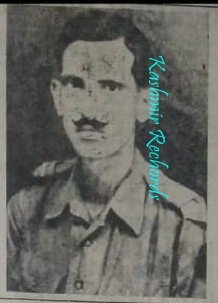
In the dusty archives of old newspapers lies the story of a soldier whose courage once made Jammu proud and whose name deserves remembrance even today — Jemadar Prakash Singh, a decorated warrior of the Jammu and Kashmir State Forces who earned one of the British Empire’s highest gallantry honours, the Victoria Cross.
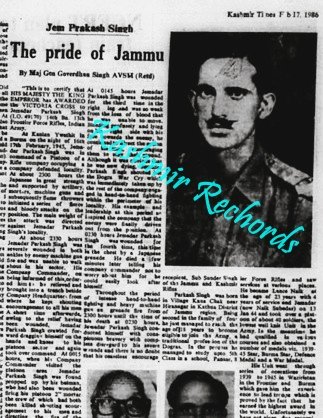
A rare feature published in Kashmir Timeson February 17, 1986, described him as “The Pride of Jammu,” and rightly so. The article, written by Maj Gen Goverdhan Singh, AVSM (Retd), revisited the extraordinary bravery of a man born in a humble Dogra family but destined to enter military history.
Rare 1986 newspaper article on Jemadar Prakash Singh of Jammu
A Soldier Forged in the Hills
Prakash Singh hailed from the rugged belt of Jammu province, a region long known for producing hardy soldiers with an instinctive sense of loyalty and sacrifice. Raised amidst difficult terrain and modest means, he joined the Jammu and Kashmir State Forces at a young age, when the Princely State maintained its own military establishment under Maharaja Hari Singh.
The article notes that Prakash Singh was not born into privilege. Like countless Dogra youth of that era, the Army became both his livelihood and his calling. Yet what distinguished him from others was his fearless temperament and his refusal to abandon comrades even in the face of certain death.
Baptism by Fire
During the Second World War, soldiers from Jammu and Kashmir served in some of the harshest battlefields across Asia and Europe. It was in one such theatre of war that Jemadar Prakash Singh displayed the courage that would immortalise him.
According to the account, enemy fire had pinned down troops, casualties were mounting and communication lines had almost collapsed. Amid exploding shells and relentless gunfire, Prakash Singh reportedly led from the front, rallying his men and refusing to retreat.
Though wounded, he continued fighting and reorganising his troops under intense enemy attack. His leadership not only saved lives but helped prevent a collapse of the position.
His actions were described as acts of “conspicuous bravery and devotion to duty” , the kind of battlefield courage that soldiers remember long after wars end.
The Victoria Cross
For his gallantry, Jemadar Prakash Singh was awarded the Victoria Cross, the highest wartime decoration for valour in the British Empire. The honour placed him among an elite fraternity of warriors whose bravery transcended nationality, rank, or background.
For Jammu, it was a moment of immense pride. A son of the soil had earned global recognition through sheer courage.
Yet, as decades passed, his story slowly faded from public memory.
A Hero History Almost Forgot
The 1986 article lamented how younger generations even of that time,knew little about such heroes. While grand narratives of war often focus on famous generals or political leaders, countless soldiers like Prakash Singh quietly disappeared into obscurity despite their immense sacrifices.
The article also carried photographs of surviving family members and associates, attempting to reconnect society with the memory of a forgotten hero.
The Dogra Tradition of Valor
There is a visible sense of urgency — a fear that if such stories were not preserved, an entire chapter of Jammu’s martial heritage might vanish.
Prakash Singh’s life represented more than individual heroism. He symbolised the larger Dogra military tradition — a culture of discipline, endurance and sacrifice that had shaped the history of Jammu and Kashmir for generations.
Why His Story Still Matters?
Today, when conversations about Jammu and Kashmir often revolve around politics and conflict, stories like that of Jemadar Prakash Singh remind us of another legacy — one of service, honour and courage.
The old newspaper clipping may have yellowed with age, but its message remains timeless:
Heroes are forgotten only when societies stop telling their stories.
Readers are welcome to provide more inputs about Jemadar Prakash Singh, especially those who knew him personally or lived in his vicinity. Many such unsung heroes may still remain buried in local memories and forgotten archives around us. It is the collective responsibility of society to remember, document and honour our heroes before their stories disappear forever.
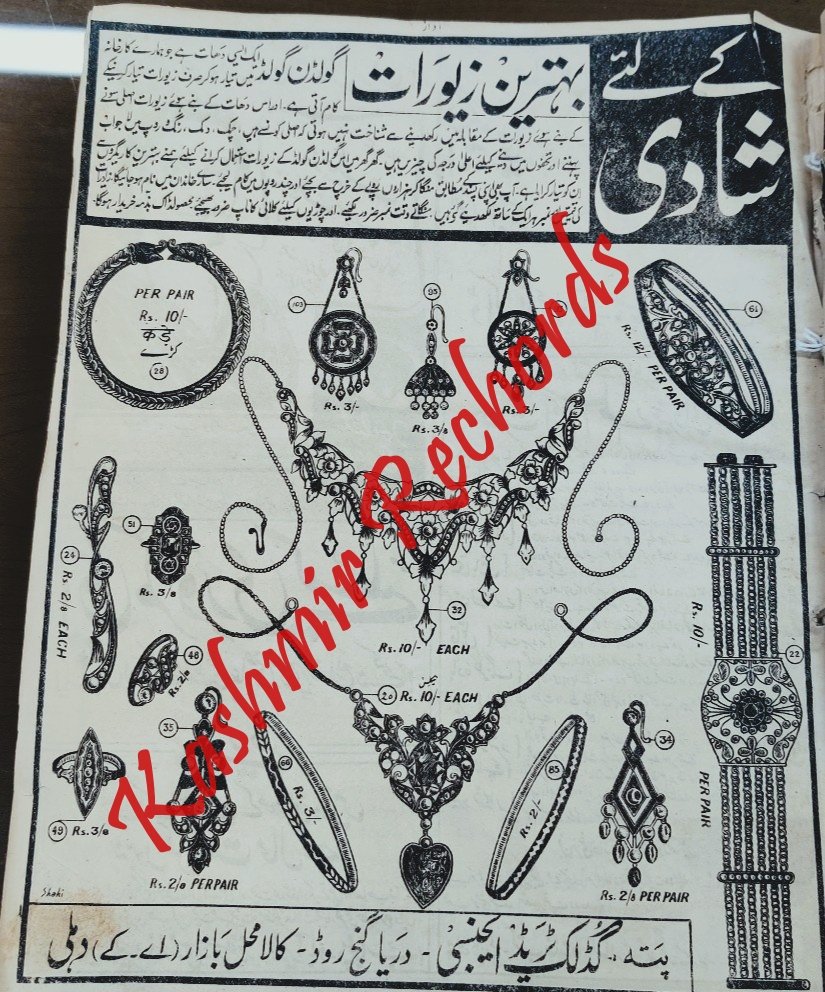
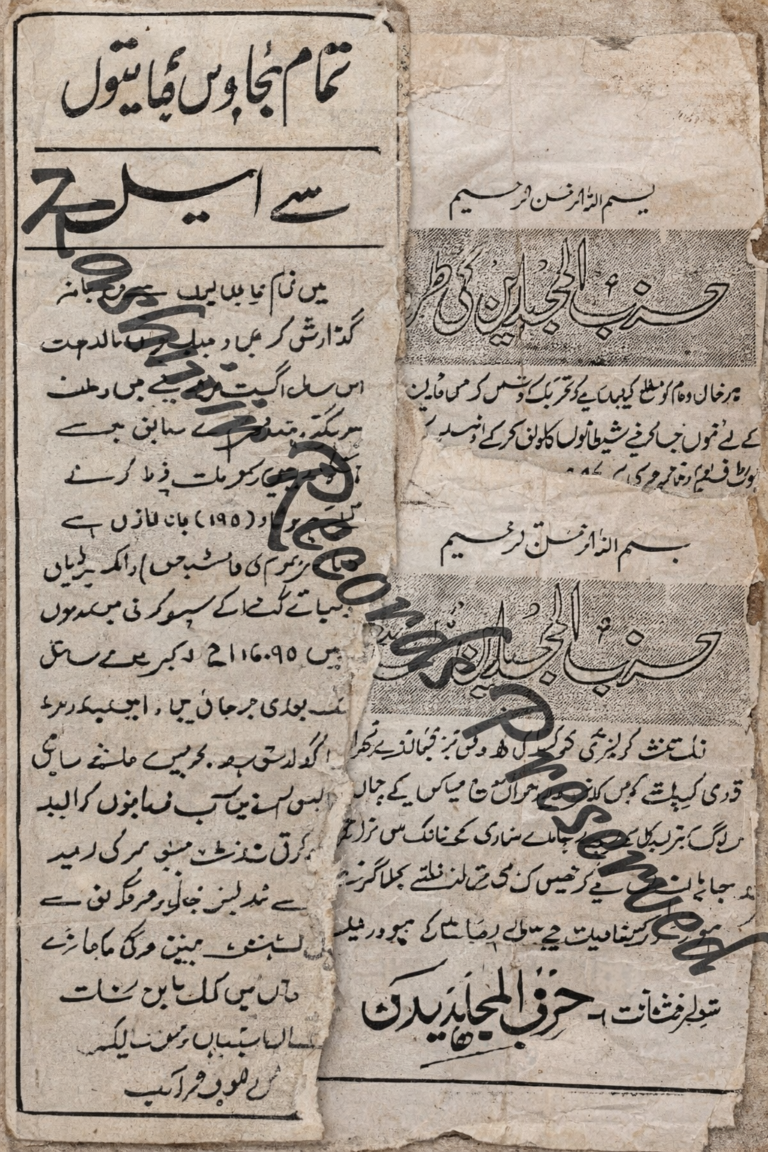
Long before luxury malls, branded jewellery chains and digital payment counters transformed India’s retail culture, the bazaars of Delhi carried a charm rooted in craftsmanship, tradition and aspiration. A surviving 1936 Urdu advertisement from Delhi’s Darya Ganj market offers a fascinating glimpse into that world — a time when jewellery was marketed not as an investment commodity, but as an essential ornament of celebration, beauty and social prestige.
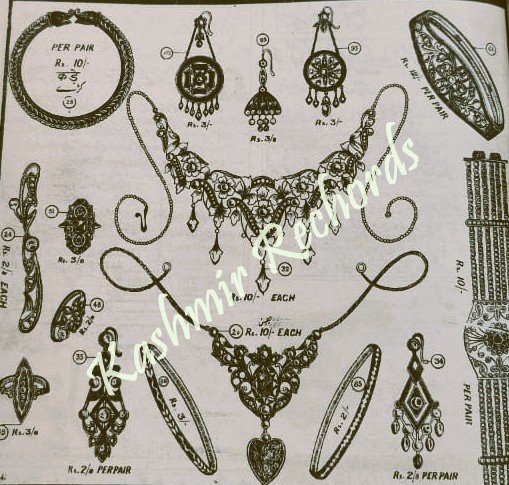
The advertisement, issued under headline Shadi Ke Liye Behtareen Zevraat Golden Gold by Good Luck Trader Agency Darya Ganj Road near Delhi’s historic Kala Mahal Bazar ( A.K) area, reflects the thriving urban commercial culture of pre-Independence India. Printed in elegant Urdu typography, the notice promises “the finest ornaments for weddings” and displays a variety of jewellery pieces ranging from necklaces and bangles to earrings and decorative bridal ornaments. Prices mentioned in the advertisement — Rs. 2, Rs. 3, Rs. 10 and Rs. 12 per pair — today appear astonishingly modest, yet in 1936 they represented carefully budgeted purchases for middle-class and aspirational families.
The advertisement is significant for another reason: it reveals how Delhi’s jewellery trade functioned nearly ninety years ago. Shops competed through craftsmanship, design and affordability. The emphasis was on “ready-made ornaments,” suggesting the emergence of modern retail culture where customers could walk into a shop and choose from displayed collections rather than relying solely on custom orders from traditional goldsmiths.
Interestingly, many of the ornaments illustrated in the advertisement appear ornate yet lightweight, indicating that imitation, plated or low-gold-content jewellery already had a flourishing market. This is particularly relevant in contemporary India, where Prime Minister Narendra Modi has repeatedly urged citizens to reduce excessive dependence on physical gold purchases. His appeals have often focused on discouraging the hoarding of imported gold, which places pressure on foreign exchange reserves and contributes little to productive economic growth.
Seen through that lens, the 1936 advertisement becomes historically revealing. Even in pre-Independence Delhi, jewellers were not exclusively selling heavy gold assets. They marketed affordability, decorative appeal and fashion-conscious design. Jewellery was closely linked to weddings, cultural identity and aesthetics rather than solely to wealth accumulation.
The Darya Ganj of 1936 was itself an evolving commercial district. Located near the walled city , it had become a bustling centre for traders, printers, publishers and artisans. Urdu newspapers and magazines frequently carried such advertisements aimed at Delhi’s growing educated middle class. The language of the advertisement reflects refinement and persuasion, inviting customers to personally inspect the craftsmanship and “modern styles” available at the establishment.
The visual layout of the advertisement also deserves attention. Every ornament is carefully numbered and priced, almost resembling an early illustrated catalogue. This indicates how rapidly urban retailing techniques were modernising even under colonial rule. In an era without television, radio commercials or social media campaigns, such newspaper advertisements served as powerful tools of aspiration.
Today, when discussions around gold often revolve around investment, inflation hedging and imports, this fragile 1936 advertisement reminds us of an older India — an India where jewellery shops in Delhi’s crowded lanes catered to emotions more than economics; where wedding ornaments symbolised joy, status and artistry; and where Urdu advertising blended poetry, persuasion and commerce into a uniquely subcontinental marketplace culture.
Contrast between 1936 and present-day India
In the Delhi of that era, families visited bazaars personally, examined jewellery under lantern-lit or early electric shops, negotiated prices and relied upon the reputation of neighbourhood craftsmen. Urdu advertisements in newspapers played the role that online marketing algorithms and influencer campaigns play today. The market was intimate, localised and deeply human.
In Digital India, the marketplace has become virtual. Consumers compare gold rates in real time on mobile apps, invest through UPI-linked platforms and purchase certified digital gold without entering a physical market. Wedding jewellery itself is increasingly influenced by online catalogues, AI-generated designs and social media trends.
Yet despite these technological revolutions, one emotional thread remains unchanged across generations: gold still carries symbolic value in Indian society. Whether bought from a small Darya Ganj shop in 1936 or now through a smartphone wallet, gold continues to signify aspiration, security, celebration and social continuity.
The old Urdu advertisement from Darya Ganj therefore represents far more than a commercial notice. It captures a transitional chapter in India’s economic and cultural history — an era when traditional craftsmanship met emerging urban consumerism. Viewed today, it becomes a bridge between two Indias: the bazaar economy of handwritten ledgers and the digital economy of QR codes and online investments.
Readers, historians, jewellery experts and collectors are invited to identify and name the various ornaments illustrated in the 1936 advertisement. Their inputs and observations may be shared with Kashmir Rechords at: support@kashmir-rechords.com or kashmirrechords@gmail.com
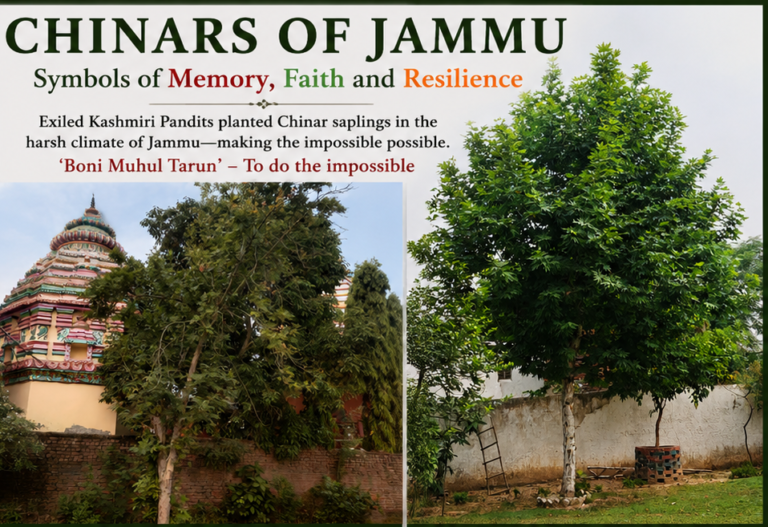
There is an old Kashmiri expression: “Boni Muhul Tarun”— literally, “to pierce a Chinar tree with a pestle.” In common usage, it refers to attempting the impossible, to undertaking a task so difficult that it defies logic itself.
History, however, has strange ways of turning metaphors into reality.
For the exiled Kashmiri Pandit community living in Jammu after the migration of the 1990s, the impossible became deeply personal. Torn away from their homeland, temples, rivers and memories, many among them carried with them not just pain and nostalgia, but also saplings of the mighty Chinar — the tree that for centuries has symbolised Kashmir’s soul.
And then they did what nature itself seemed unwilling to permit.
A Chinar Grown in Exile—
They planted Chinars in Jammu.
Not in the cool breeze of Srinagar, nor in the moist landscapes of the Valley where the Chinar rises effortlessly in regal splendour, but in the unforgiving heat of Jammu — amid rocks, boulders, dusty winds and temperatures hostile to the very survival of the tree.
Yet the Chinars survived.
Trees of Memory in Exile
In areas like Bantalab and Anand Nagar Jammu, where displaced Kashmiri Pandits recreated replicas of their ancient shrines and deities, they also planted Chinar saplings brought from Kashmir.
The act was far more than horticulture.It was memory taking root.It was exile refusing to surrender.
In the compounds of temples and community centres, the Chinar became an emotional bridge between the lost homeland and the harsh realities of displacement. Every surviving leaf carried echoes of Kashmir.
Ironically, these fragile Chinars of Jammu began growing at a time when even the mighty Chinars of Kashmir were increasingly facing threats from urbanisation, land encroachment and neglect.
The House Called “3 Chinars”
Among those who nurtured this emotional inheritance is Ravinder Kaul, internationally acclaimed theatre and art critic with deep Kashmiri roots.
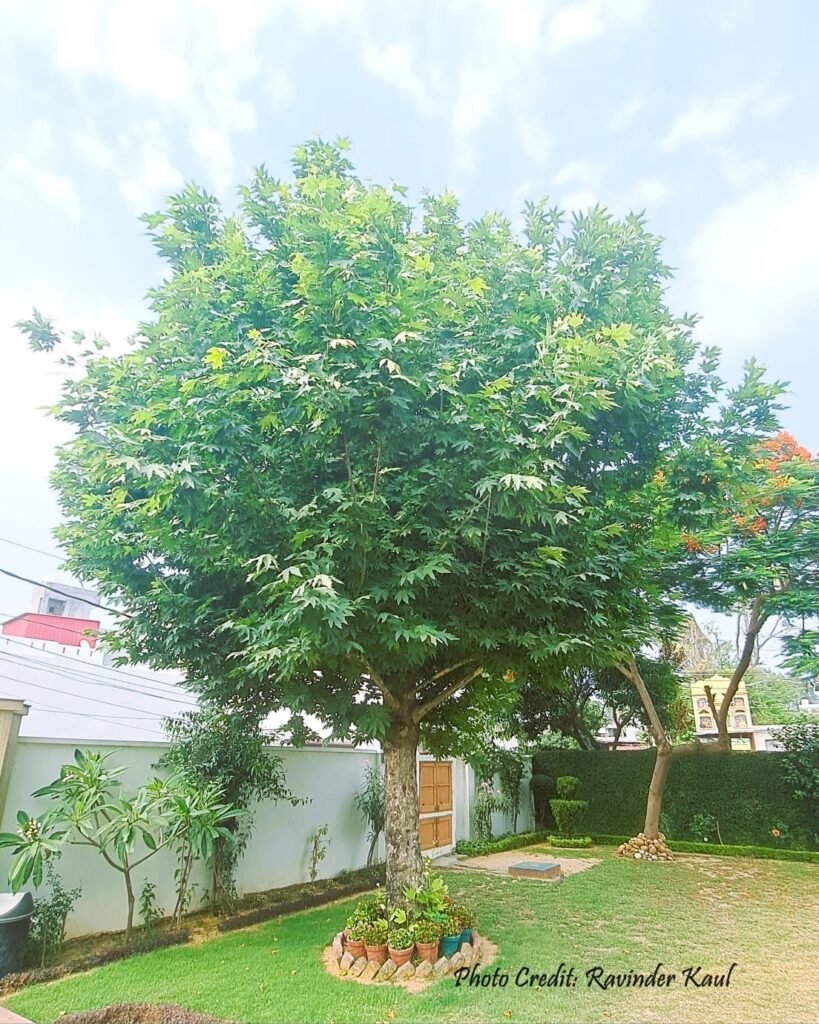
Years ago, Kaul brought four Chinar saplings from Kashmir and planted them in his Greater Jammu residence. Only three survived. But survival itself was victory.About the fourth one—perhaps that the Jammu heat was simply too much for it.
The surviving trees now stand tall inside his compound, and Kaul named his residence “3 Chinar” after them.
Recalling his lifelong association with the tree, Kaul told Kashmir Rechords:
“The first Chinar trees that I saw in Jammu were on the banks of the Ranbir Canal in the late 1970s when I was studying at Jammu University’s old campus. I am not sure whether they survive today. Later, in 2010, when I bought land in Greater Jammu, I brought four saplings from Srinagar and planted them on the four corners of my lawn. Only three survived. I named my home ‘3 Chinars’.”
His story mirrors the larger story of displaced Kashmiri Pandits themselves — survival against hostile odds, though diminished from what once was.
Solitary Sentinels of a Lost Homeland
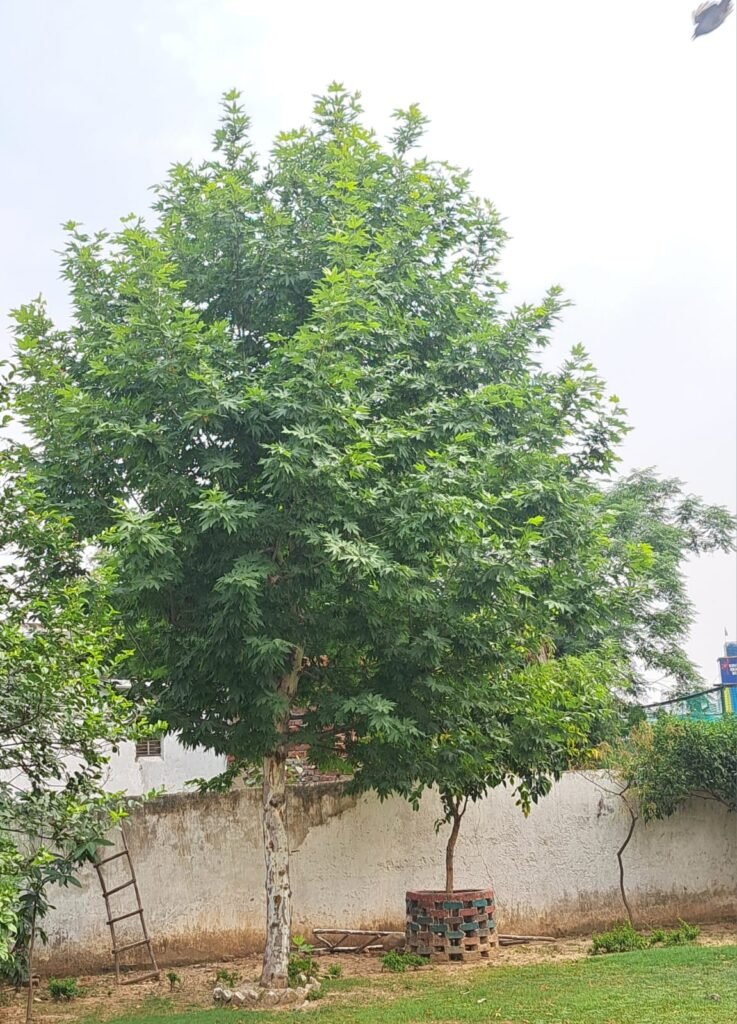
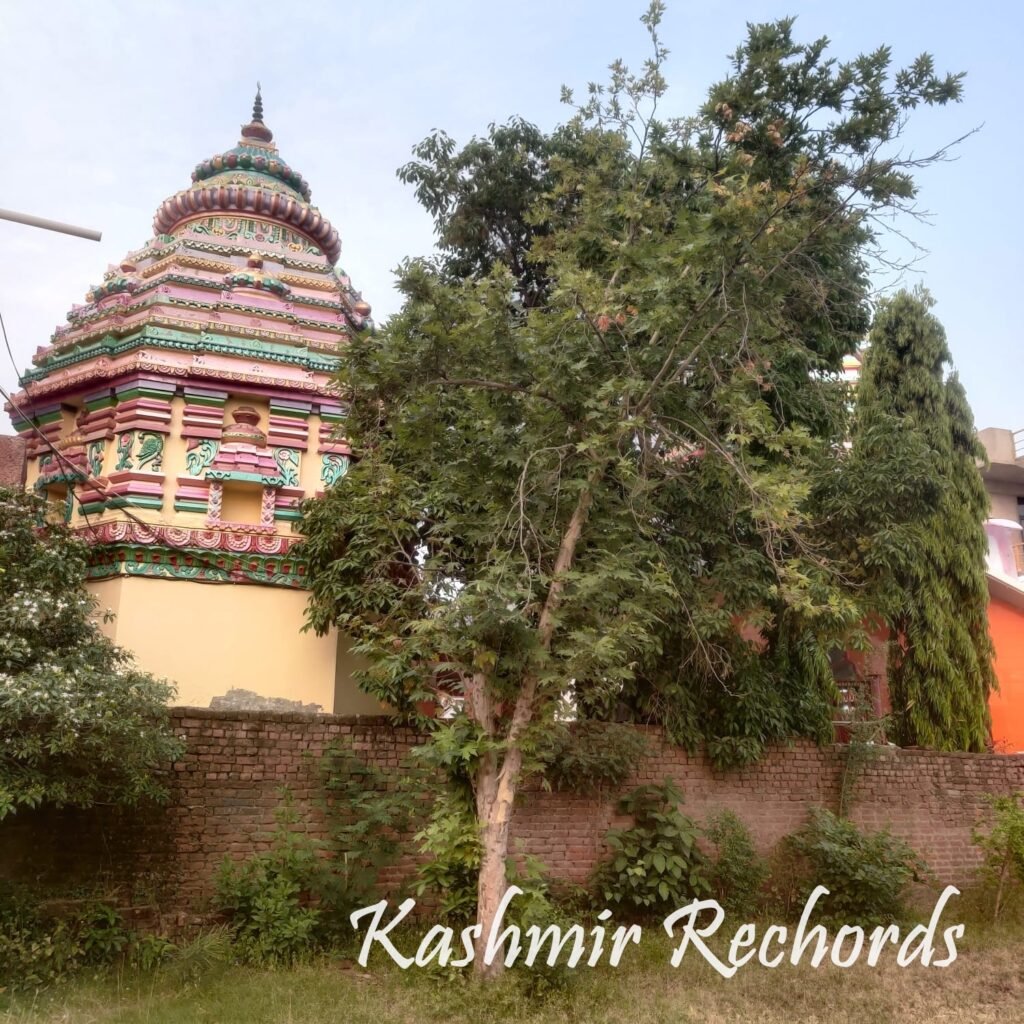
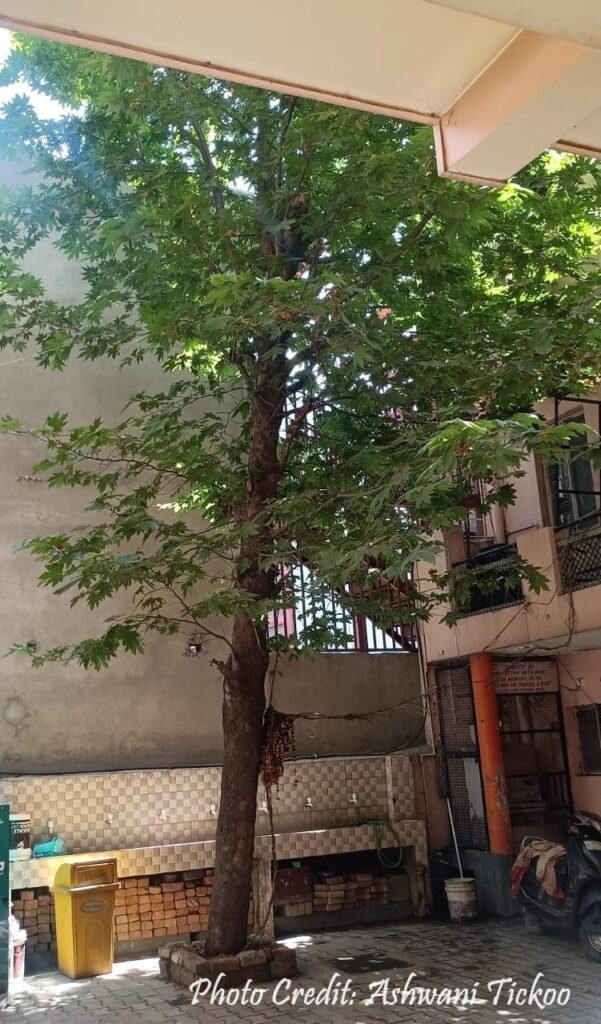
In the Shiv Temple complex of Bantalab, Jammu, bordering the famous replica shrine of Mata Sharda, stands a solitary Chinar tree planted after migration by displaced Kashmiri Pandits.
A solitary Chinar at Shiv Mandir, Bantalab, Jammu. In the background is famous Sharda Mandir, Bantalab, Jammu, built by Kashmiri Pandits
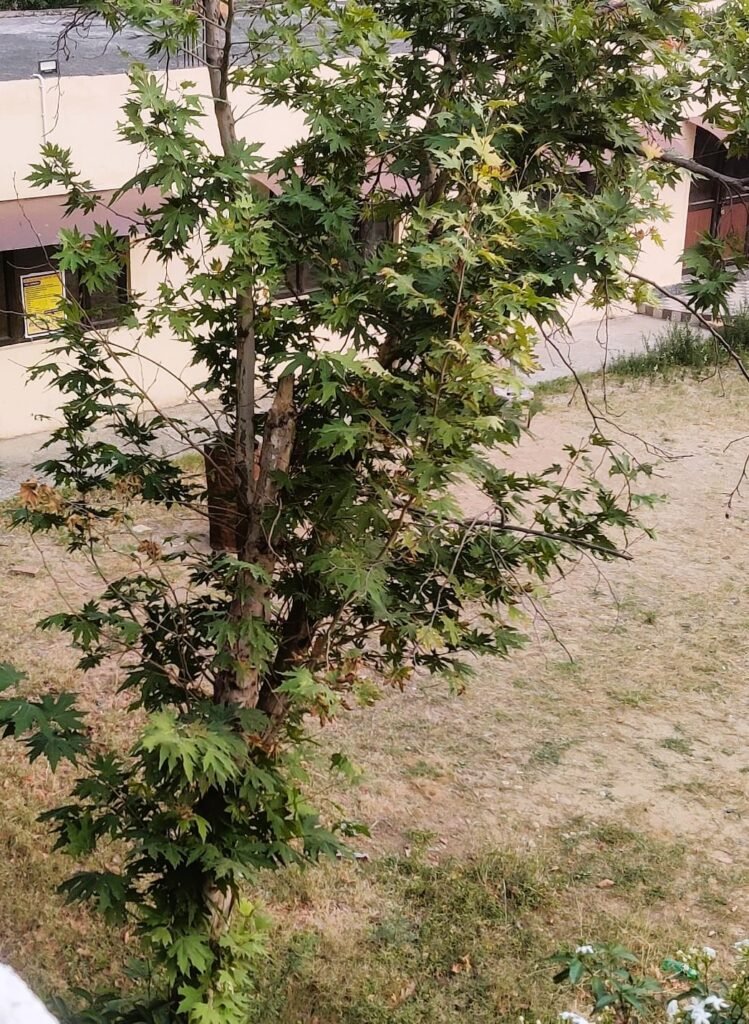
Another lonely Chinar survives in the compound of Sanjeevani Sharda Kendra in Anand Nagar Bohri, Jammu, carefully nurtured by members of the community.
These are not ordinary trees. They are living memorials.
A solitary Chinar Tree at Sanjeevani Sharda Kendra, Bohri Jammu.
They carry within their bark the grief of exile and the stubborn refusal to forget Kashmir’s cultural and spiritual landscape.
Former Jammu and Kashmir Bank employee Ashwani Tickoo, now settled in Durga Nagar Jammu after migration from Wadwan in Budgam, Kashmir, recalls seeing Chinars at several places across Jammu region:
“If I remember correctly, I have seen Chinar trees alongside the Canal on Bhagwati Nagar road. I have also seen Chinars in Udhampur and on the roadside while travelling from Rajouri to Shahdara Sharief shrine’’
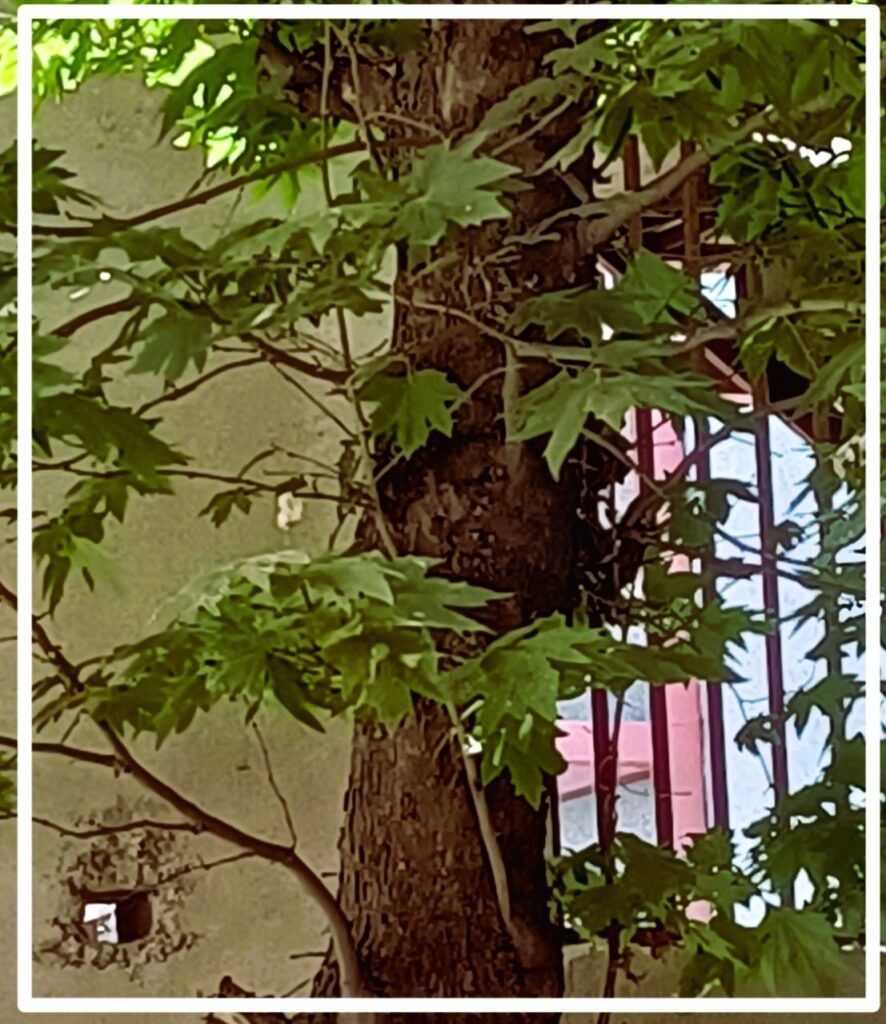
Even near Vijaypur, a local hotelier fascinated by the majesty of the Chinar planted four saplings near famous spot Thandi Khui. Three survived.
Chinar at Thandi Khui , Vijaypur, Jammu
At University of Jammu too, students recall spotting a few Chinar trees inside the campus.
Like the Exiles Themselves
But the Chinars of Jammu tell another story too.
Unlike the towering Chinars of Kashmir, whose trunks appear immortal and whose canopies dominate landscapes, the Jammu Chinars remain comparatively fragile. Their roots struggle in alien soil. Their trunks are weaker. Their growth is uncertain.
And perhaps that is why they resemble the exiled community that planted them.
Like displaced Kashmiri Pandits, these Chinars survive — but not in the fullness and grandeur they once knew in their natural habitat.
They endure. They resist. They remain suspended between memory and survival. And perhaps that is the deepest meaning of “Boni Muhul Tarun.”
For in Jammu, the impossible was not merely attempted. It was made to live.
Readers’ Participation Invited
Kashmir Rechords invites readers from Jammu and elsewhere to share information, memories, locations and photographs of surviving Chinar trees in Jammu city, particularly those planted after the migration of Kashmiri Pandits.
The effort aims to document this little-known living heritage and turn it into a collective people’s archive of memory, exile and resilience. Contributors whose information and photographs are used in future updates of the story will be given due credit and acknowledgement.
*Dr Rajesh Bhat is a writer, broadcaster and media professional known for his deeply researched human-interest narratives on Kashmir’s history, culture, heritage and displaced communities. Through archival exploration, oral histories and ground-level documentation, he has consistently highlighted lesser-known facets of Kashmiri civilisational memory, particularly relating to Kashmiri Pandits, cultural institutions, forgotten personalities and endangered heritage. His writings often blend historical depth with emotional storytelling, bringing alive stories of exile, resilience and identity from Jammu and Kashmir.
As All India Radio marks ninety years of its journey, the occasion ought to have been one of celebration, reflection and renewed commitment to national service. For decades, AIR was not merely a broadcaster; it was the voice of India’s conscience, culture and sovereignty. From war bulletins during 1965 and 1971 to educational programming, patriotic music and grassroots outreach, AIR once served as a strategic bridge between the Indian State and its people, especially in sensitive border regions.
Yet, at a time when Information Warfare has become one of the most potent tools in modern conflict, a disturbing reality stares the Nation in the face: India’s own public broadcaster appears to have systematically weakened itself in the very regions where its presence was most crucial.
The tragedy is not merely administrative decline. It is the collapse of strategic vision.
The Vacuum Along the Borders
Over the past several years, major relay centres and transmission units of AIR in border areas have either been shut down, weakened or rendered ineffective. Many stations that once served remote and strategically sensitive populations in Jammu and Kashmir, Punjab, North-East or Western border gradually lost manpower, local programming capacity and institutional importance.
This retreat has occurred precisely when hostile propaganda machinery across the border has intensified.
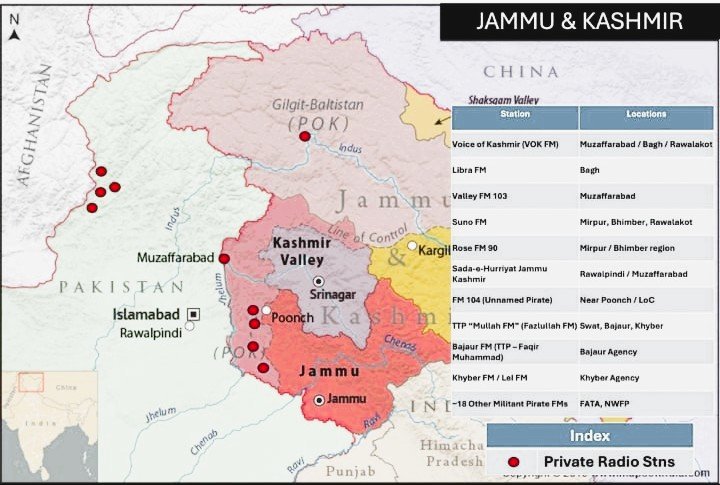
The map tells a disturbing story: Pakistani radio stations spread extensively across PoK.
Pakistan, understanding the continuing relevance of radio in mountainous and border terrains, has aggressively expanded its broadcasting footprint in areas, particularly facing Jammu and Kashmir. Reports and monitoring by listeners in frontier belts indicate that more than twenty FM and medium-wave stations are actively functioning across the border, relentlessly transmitting anti-India narratives, communal rhetoric, psychological warfare content and political propaganda directed at Indian listeners.
These broadcasts frequently target India’s democratic institutions, security forces, and leadership, including Prime Minister Narendra Modi. The intent is unmistakable: influence minds, create alienation and sustain psychological pressure in sensitive regions. On the other hand, India has just two radio Stations at Poonch and Kathua, with no Programme Staff to counter enemy propaganda!
The alarming question is: where is India’s counter-voice?
Silence from the Indian Side
There was a time when AIR’s border stations acted as a cultural and psychological shield. Through local languages, regional music, development-oriented discussions, patriotic programming and credible news bulletins, AIR countered misinformation organically and effectively.
Today, many of these stations function without even permanent content staff. In all border areas, skeletal staffing patterns have reduced stations to mere transmission units rather than vibrant public communication centres. Ironically, there is either a single or not a single Content Creator posted in Stations falling in border areas of Jammu and Kashmir, Punjab, Rajasthan and India’s North-East.
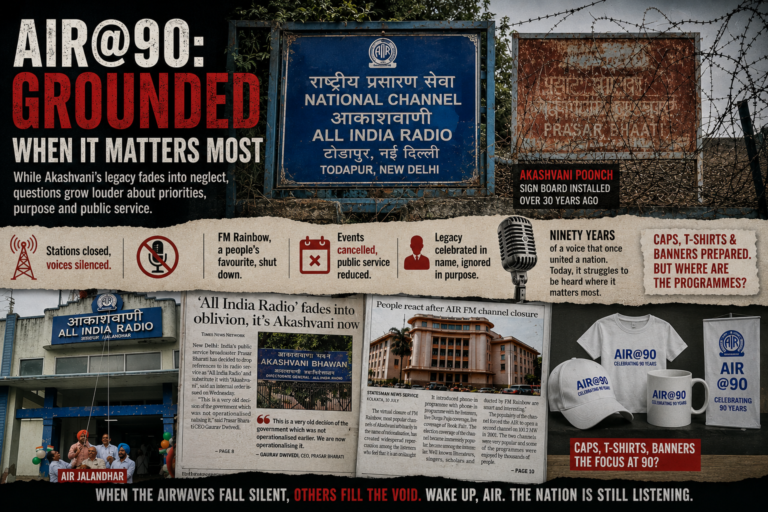
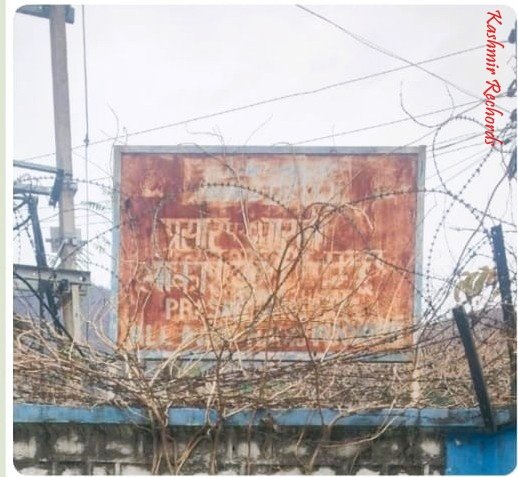
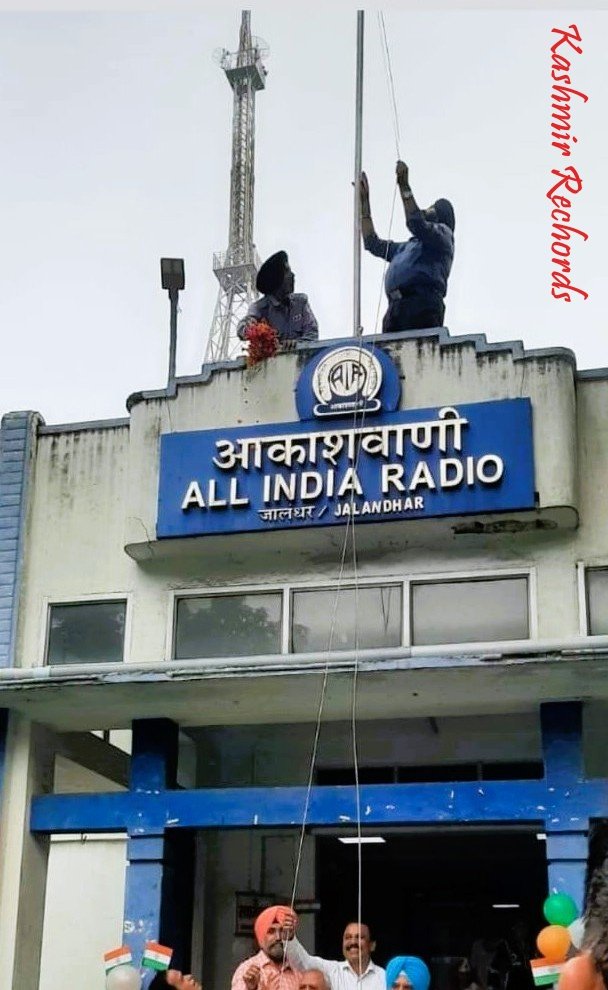
AIR Poonch’s fading signboard symbolises the slow erosion of public broadcasting in a sensitive border region.AIR Jalandhar — a legacy station surviving on skeletal staffing and mounting institutional neglect.
This institutional hollowing-out has created a dangerous vacuum.
``In strategic communication, silence is never neutral. When one side withdraws, the other side occupies the space”.
The result is visible in border belts where foreign broadcasts are often received more clearly and more consistently than Indian public broadcasting. This is not merely a broadcasting failure; it is a national security concern.
AIR@90: Caps, Banners, T-Shirts Instead of Content!
Ironically, at a time when the institution should have been introspecting over its shrinking reach and declining strategic relevance, the focus appears to have shifted towards optics and ceremonial branding.
Instead of debating how to restore transmission strength in border regions, revive local programming, recruit permanent programme staff, or counter hostile propaganda, enormous energy is visibly being spent on anniversary symbolism — caps, T-shirts, banners, logos, slogans, stage-managed events and publicity exercises under the AIR@90 banner.
The contradiction is glaring.
A broadcaster facing perhaps the gravest credibility and relevance crisis in its history appears more occupied with merchandise than mission.
The tragedy is not that AIR is celebrating ninety years; it deserves to. The tragedy is that the celebrations appear disconnected from the existential challenges confronting public broadcasting in India.
For listeners in border belts who can hear hostile broadcasts more clearly than India’s own national voice, commemorative banners offer little reassurance.
For understaffed stations struggling without content creators, producers, or field correspondents, anniversary caps cannot substitute institutional revival.
And for citizens concerned about narrative warfare against India, symbolic branding exercises without strategic broadcasting reforms appear painfully hollow.
The Closure of the National Channel
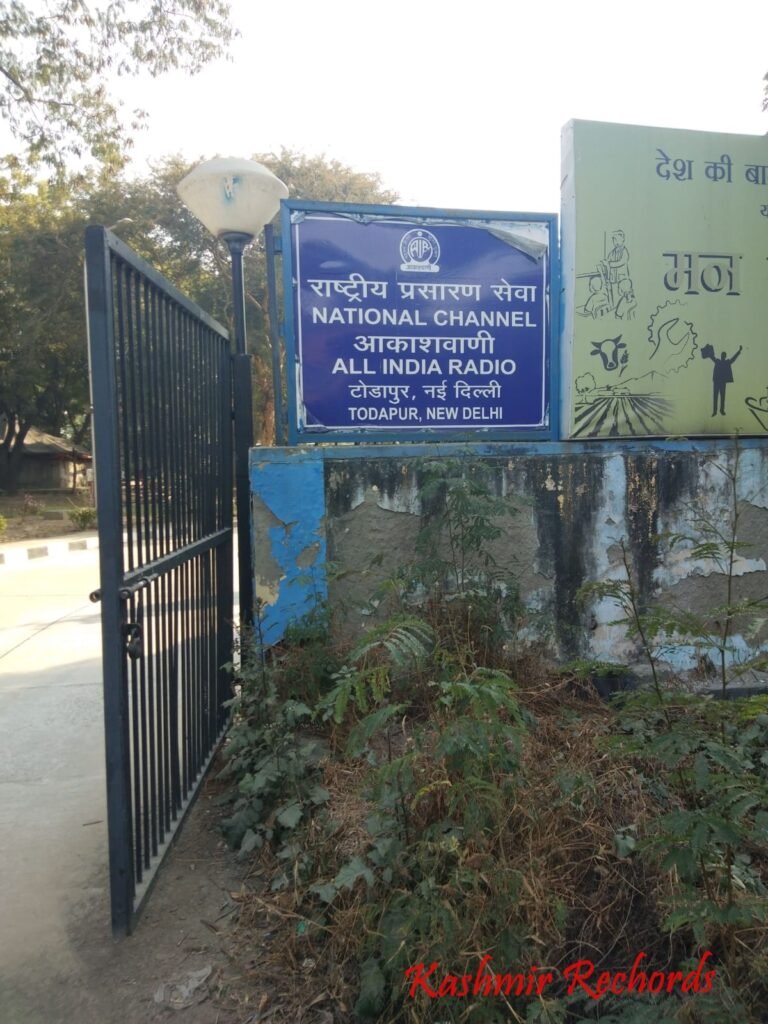
Among the most controversial decisions was the shutting down of AIR’s iconic National Channel — once a powerful nighttime service that connected distant parts of India through news, culture, music and national integration programming.
The National Channel had immense strategic value. Its long-range transmission reached border populations, remote villages, truck drivers, soldiers and listeners in areas where private FM networks had little or no presence. It carried the emotional and cultural pulse of India into regions vulnerable to external propaganda.
Its closure raised serious questions among broadcasting veterans and observers.
Not less than an ”anti-national” act: Once vibrant National Channel of All India Radio `Akashvani’
At a time when adversarial nations are investing heavily in narrative warfare, dismantling one of India’s strongest audio platforms appeared not merely shortsighted but deeply self-defeating. Critics argue that the decision reflected a dangerous disconnect between bureaucratic management and geopolitical realities.
Many former AIR professionals believe the National Channel could have been modernized, digitized and strategically repurposed instead of being discontinued.
Public Broadcasting Reduced to Corporate Logic
The deeper problem lies in the transformation of public broadcasting philosophy itself.
AIR was never meant to function solely through commercial metrics or urban entertainment standards. Its mandate was national service. Border broadcasting, rural outreach, linguistic diversity and strategic communication were not profit-making exercises; they were investments in national cohesion.
However, under increasingly centralized and corporatized management structures within Prasar Bharati, decisions often appeared driven by cost-cutting calculations rather than long-term strategic necessity.
Transmission infrastructure was viewed as expenditure rather than strategic capital.
Experienced staff retired without replacement. Contractualization replaced institutional continuity. Local content creation weakened. Regional expertise diminished. Ground realities were ignored.
The consequences are now unfolding in silence across frontier regions.
Radio Still Matters
One of the greatest misconceptions of modern policymakers is the belief that radio has become irrelevant in the digital age.
Border realities prove otherwise.
In difficult terrains, during bad weather, power disruptions, communication blackouts and emergency situations, radio remains the most resilient and accessible medium. Unlike internet-based platforms, radio crosses mountains, reaches isolated communities and functions during crises.
That is precisely why countries engaged in geopolitical conflicts continue to invest heavily in international and border broadcasting.
Pakistan understands this. China understands this!Even global powers continue to maintain strategic radio infrastructure.
Ironically, India, despite having one of the world’s richest public broadcasting legacies, appears to be retreating from this space.
A Question of Accountability
The decline of AIR’s strategic role cannot simply be dismissed as modernization or restructuring. It raises uncomfortable questions about institutional accountability and policy intent.
Why were strategically important services weakened without adequate alternatives?
Why were border stations allowed to become extremely understaffed?
Why was institutional expertise neglected?
Why was the National Channel discontinued despite its unique reach and relevance?
Why are resources being visibly spent on ceremonial branding while core broadcasting infrastructure continues to erode?
And most importantly, who benefits when India voluntarily surrenders its communication space in sensitive regions?
These questions deserve parliamentary scrutiny, national debate and independent review.
The Need for Revival
AIR at 90 should not merely celebrate its glorious past. It must confront its troubled present. India urgently needs a revival plan for strategic public broadcasting, particularly in border and conflict-sensitive areas.The battle for territory today is also a battle for narratives.
A Nation that loses its voice along the borders risks losing much more than frequencies.
Ninety years of AIR represent a monumental chapter in India’s democratic and cultural journey. But anniversaries become meaningful only when institutions possess the courage for introspection.
The real tribute to AIR’s legacy would not be ceremonial slogans, printed caps, promotional T-shirts or oversized banners. It would be the restoration of its original mission: to serve as the authentic voice of India — especially where that voice is needed the most.
For when India’s own airwaves fall silent along the borders, hostile voices do not wait. They take over!.
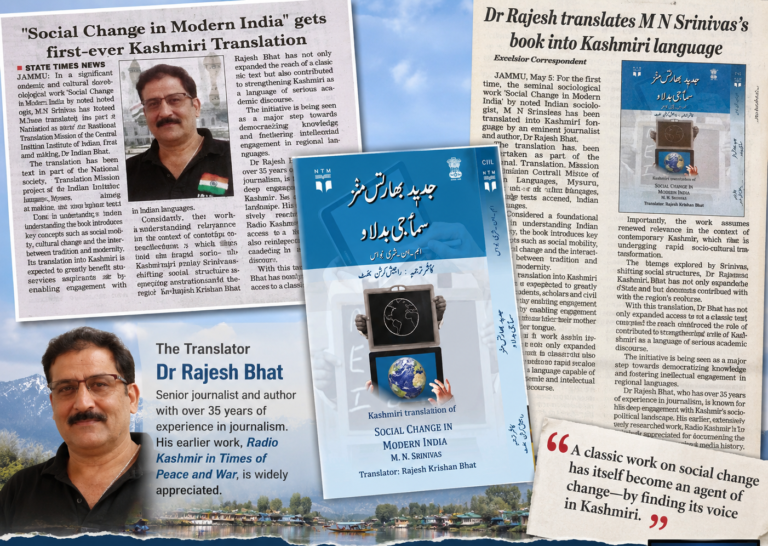
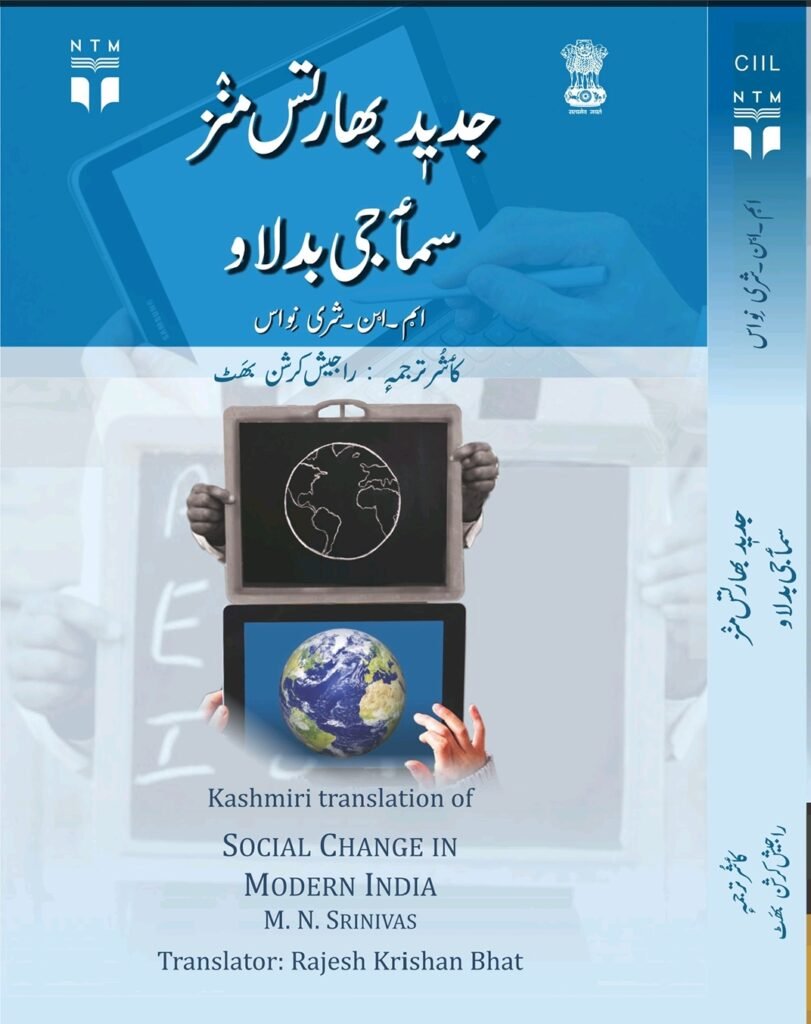
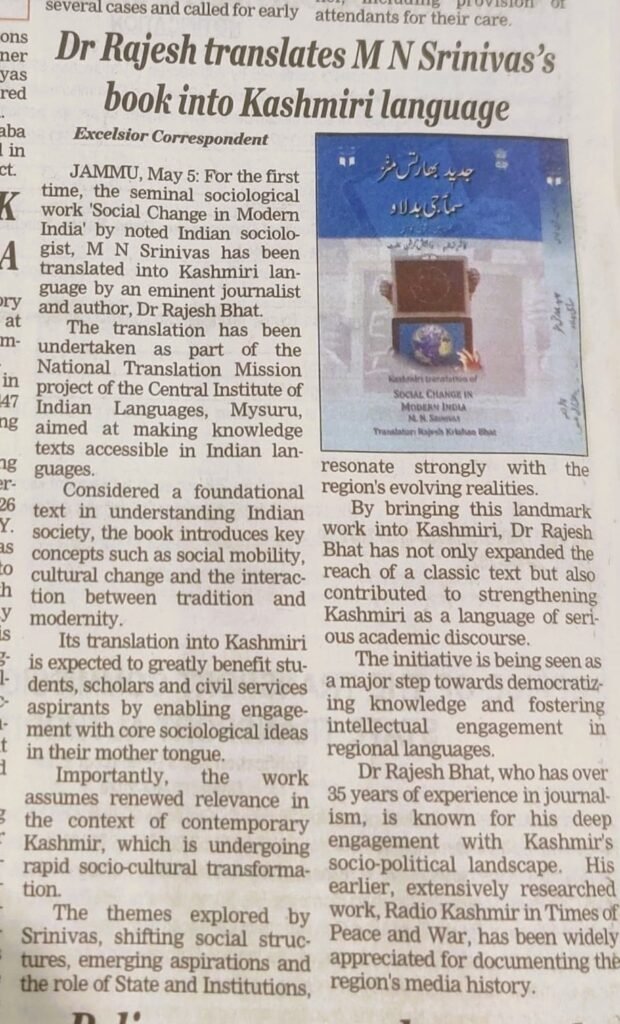
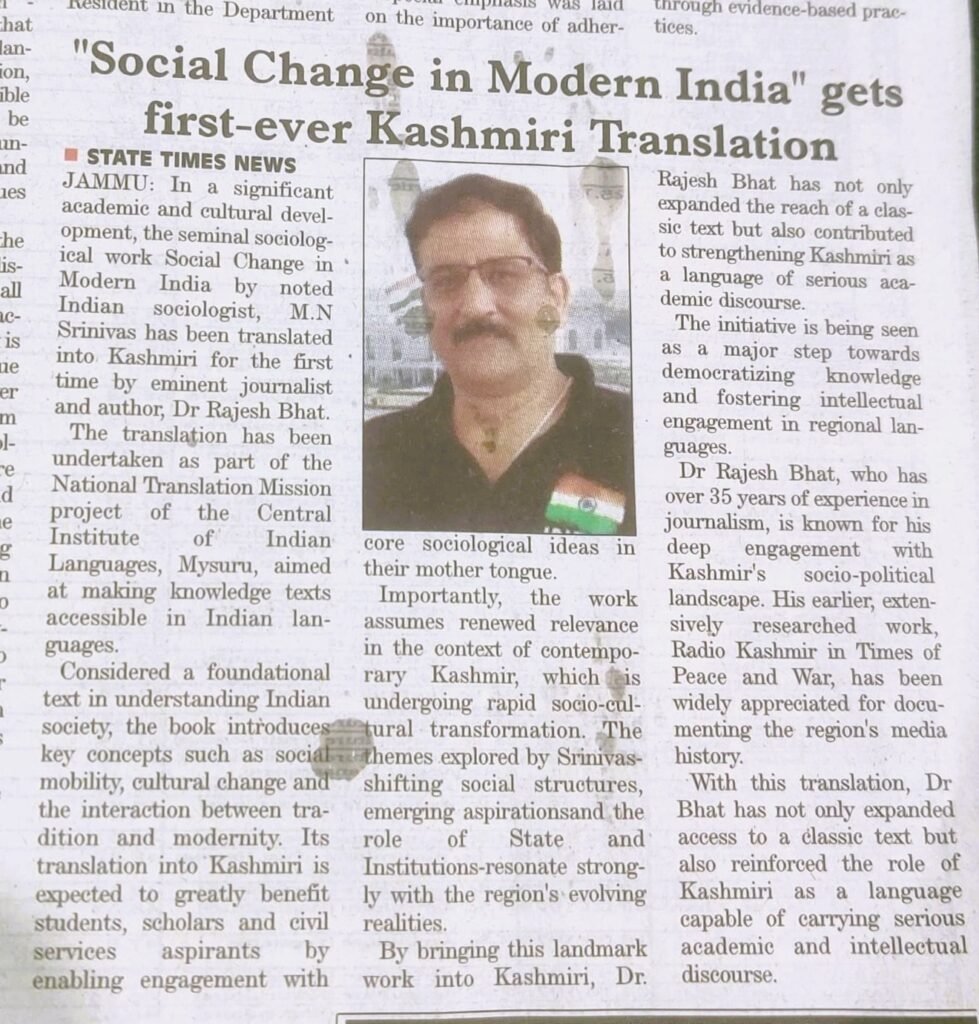
In a significant intellectual and cultural development, the landmark sociological work Social Change in Modern Indiaby noted Indian sociologist M. N. Srinivas has been translated into Kashmiri for the first time by senior journalist and author Dr Rajesh Bhat under the National Translation Mission of the Central Institute of Indian Languages.
Widely regarded as one of the most influential books on Indian society, the work introduced seminal concepts such as Sanskritization, Westernisation and Social Mobility, fundamentally shaping the understanding of social change in modern India.
The translation assumes particular relevance in contemporary Kashmir, where society continues to negotiate rapid social and cultural transformation. By making this foundational text available in Kashmiri, the effort is expected to benefit students, scholars and civil services aspirants while also strengthening Kashmiri as a language of serious academic discourse.
Dr Rajesh Bhat, who has over 35 years of experience in journalism and research-based writing, is known for his deep engagement with Kashmir’s socio-political landscape. His earlier work, Radio Kashmir in Times of Peace and War, had also received wide appreciation.
Prominently covered by Daily Excelsior.State Times, Jammu, Dated May 6, 2026
Notably, the translation and the achievement have been widely covered by prominent newspapers across Jammu and Kashmir as well as electronic media, underlining the importance of the work in the region’s academic and cultural landscape.
Originally published in the mid-20th century, Social Change in Modern India transformed the study of Indian society. Srinivas moved away from static, textbook descriptions and instead presented India as a dynamic, evolving social organism, shaped by forces such as mobility, power, tradition and modernity.
The task of translating a dense sociological text is no ordinary one. It requires not just linguistic skill, but conceptual clarity and cultural sensitivity.
In translating Srinivas, one finds that Dr. Bhat has ensured that the text remains faithful to its intellectual rigor while becoming accessible to Kashmiri readers.
Understanding Change While Living It
Kashmir today is not just witnessing change—it is negotiating it, questioning it and shaping it. In such times, a book like Social Change in Modern India does not remain confined to classrooms; it becomes a tool for reflection.
Through its Kashmiri translation, that tool is now in the hands of the people it can serve most meaningfully.
And perhaps that is the true achievement of this effort: A classic work on social change has itself become an agent of change—by finding its voice in Kashmiri.
On his death anniversary, Jagmohan remains one of the most contested—and perhaps most misunderstood—figures in Kashmir’s modern history.
What if the story told for decades is only half the truth?
A Governor Once Welcomed by Thousands
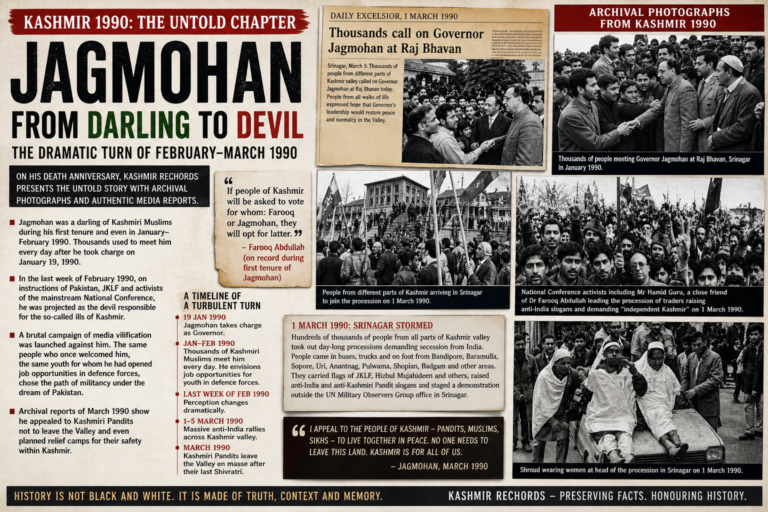
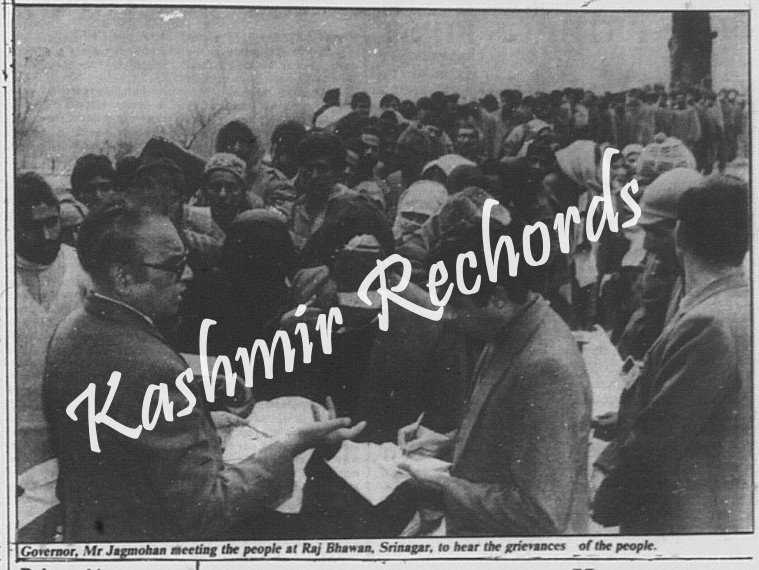
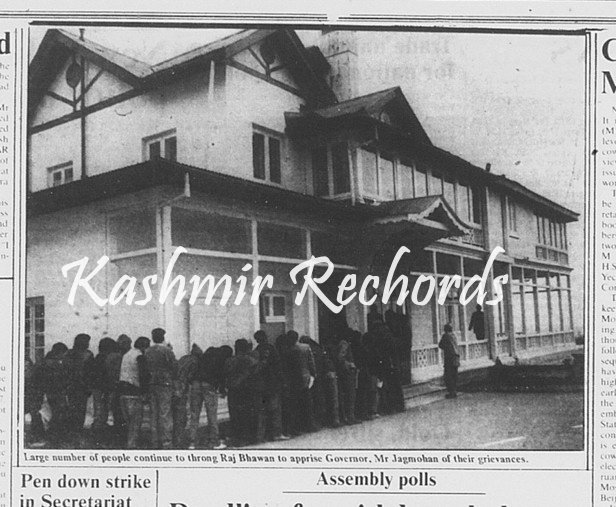
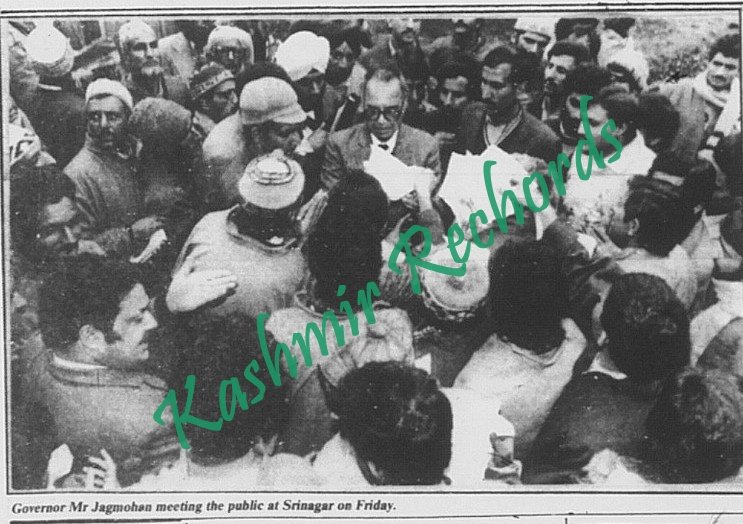
In January 1990, as Jagmohan assumed charge on January 19, an unusual spectacle unfolded across the Valley. Contrary to later narratives, thousands of Kashmiri Muslims thronged to meet him, day after day.
Archival records and rare photographs accessed by Kashmir Rechords reveal a striking reality: Jagmohan was not initially seen as an adversary—but as a firm, accessible administrator capable of restoring order amid chaos.
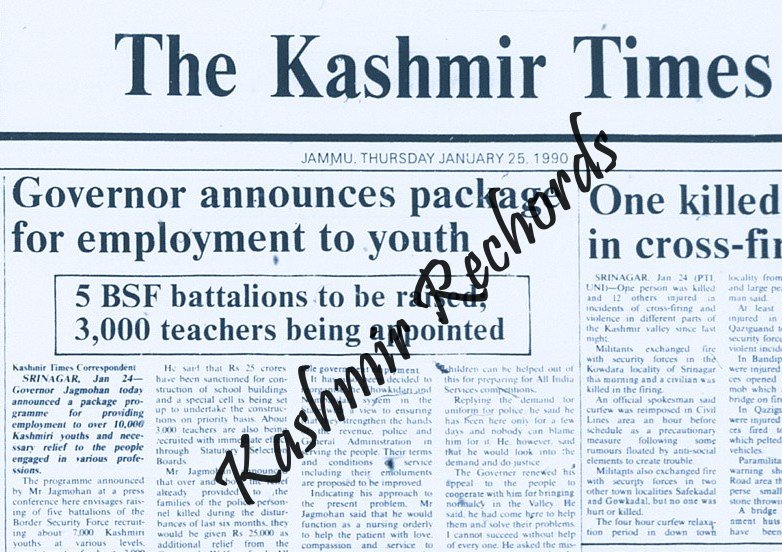
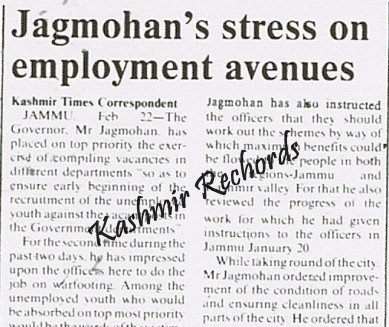
During these early weeks, he even explored employment avenues for Kashmiri youth in defence services, signalling a strategy of integration rather than confrontation.
The Sudden Shift: February 1990
Then, almost abruptly, something changed.
By the last week of February 1990, the perception of Jagmohan among large sections of Kashmiri Muslims underwent a dramatic reversal. The same man who drew crowds now began to be portrayed as the embodiment of repression.
This transformation did not occur in isolation.
Archival accounts point to a period of intense political mobilisation, marked by:
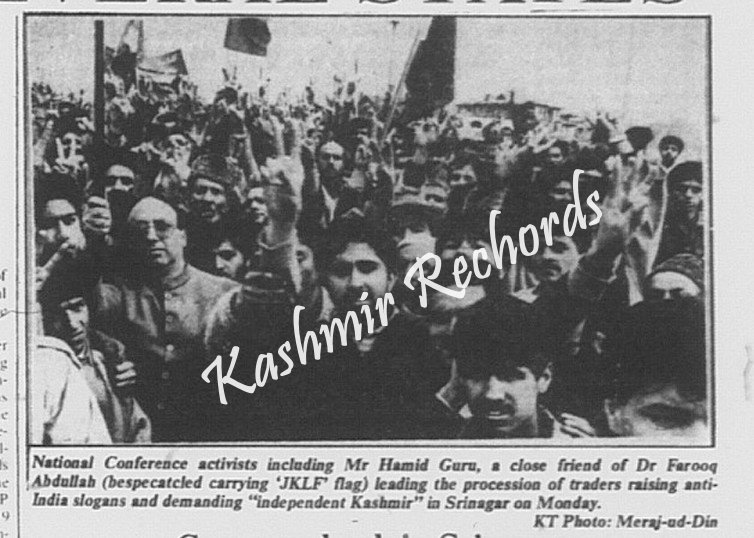
Massive anti-India demonstrations
Organised rallies across towns and villages
Escalating militant influence
A charged atmosphere shaped by cross-border rhetoric
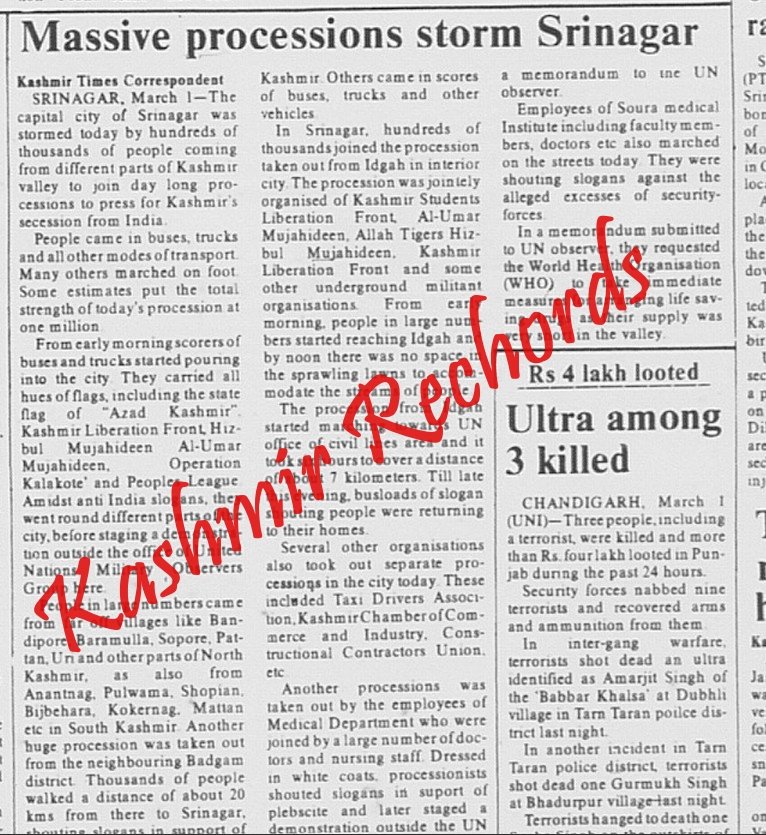
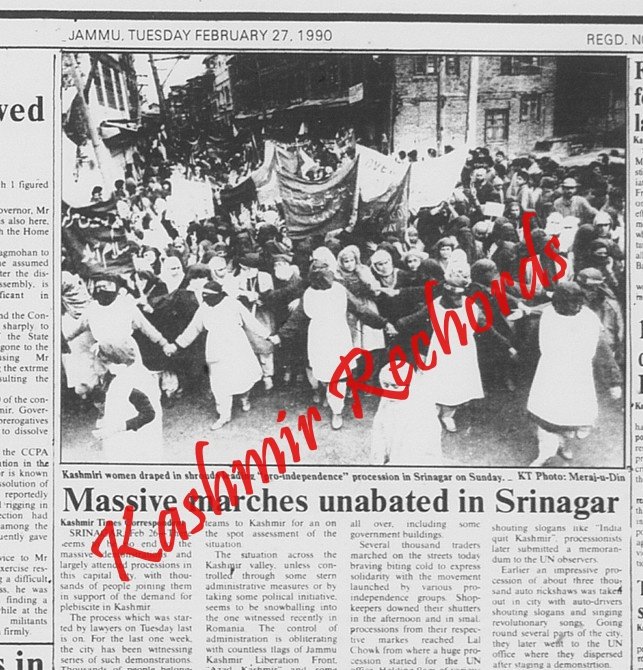
One such moment came on March 1, 1990, when hundreds of thousands marched through Srinagar, raising slogans for secession and gathering outside the United Nations observers’ office after hours-long processions.
The Valley, by then, was no longer in transition—it was in upheaval.
The Vilification Phase
It was during this volatile period that a sustained narrative began to take shape.
Sections of local media and political actors increasingly framed Jagmohan as responsible for the unfolding crisis—including, eventually, the mass migration of Kashmiri Pandits.
Yet, archival reports from the same time tell a more complicated story:
Jagmohan appealed to Pandits not to leave the Valley
He urged those who had left to return
Plans were discussed for relief and security arrangements within Kashmir itself
These actions raise a critical question: Was the man accused of engineering the exodus actually trying to prevent it?
A Tale of Two Legacies
For Kashmiri Pandits, Jagmohan became—and remains—a figure of protection, a Governor who acted when the system appeared paralysed.
For many Kashmiri Muslims, however, he came to symbolise state excess and coercion—a perception that endured long after 1990.
Between these two sharply divided memories lies a contested historical space, where facts, emotions, politics and narratives intersect.
The Four-Month Governor and a 36-Year Debate
Jagmohan’s second tenure lasted just over four months—from January 19 to May 26, 1990.
Yet, more than three decades later, debates around his role continue to dominate discussions, often amplified through partial recollections, political positions, and social media echo chambers. The question persists: How does a man go from being publicly welcomed to permanently vilified within weeks?
Revisiting 1990 Through Evidence
Kashmir Rechords, through its access to rare archival newspapers, photographs and contemporaneous reports, attempts to revisit that turning point—not through hearsay, but through documented evidence long absent from public discourse.
This is not merely a story about Jagmohan. It is a story about how narratives are constructed, reshaped and sustained over generations.
History, especially in Kashmir, is rarely linear. It is layered, contested and often uncomfortable.
On his death anniversary, Jagmohan stands not just as a figure of the past—but as a reminder that truth, in times of conflict, is often the first casualty—and the last to be recovered.
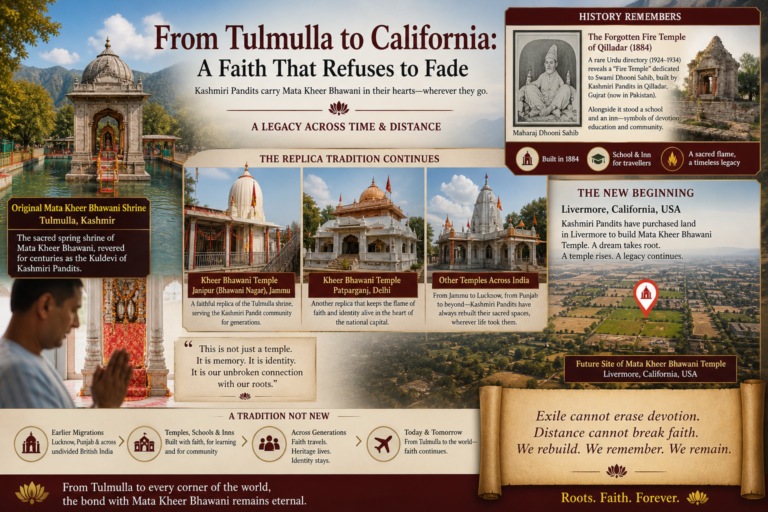
In April 2026, thousands of miles away from Kashmir, a quiet yet deeply symbolic act unfolded in Livermore, California. The Kashmiri Pandit diaspora acquired nearly 60 kanals of land to build a temple dedicated to Mata Kheer Bhawani—their revered Kuldevi. A Bhumi Pujan marked not just the beginning of construction, but the continuation of a centuries-old civilisational instinct: to carry faith, memory and identity across geographies.
This is not new. Nor is it merely ritual. It is history repeating itself.
A Pattern Older Than Exile
The emotional and spiritual bond between Kashmiri Pandits and Mata Kheer Bhawani runs deep—rooted in the sacred spring shrine at Tulmulla in Kashmir. But whenever distance has intervened, devotion has adapted.
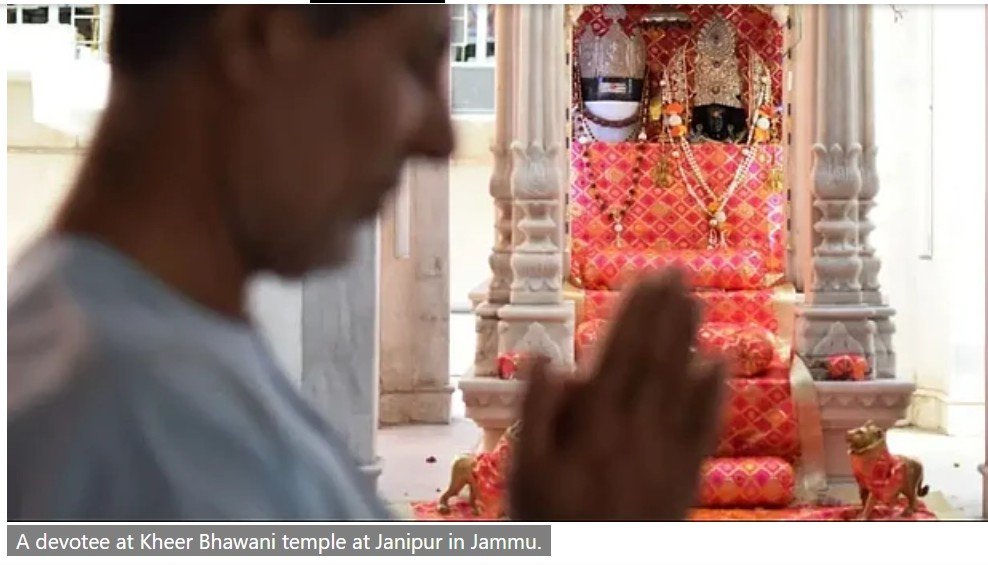
Replicas of this shrine already stand in Bhawani Nagar, Janipur Jammu), other parts of Jammu and Patparganj (Delhi). Today, that sacred geography is expanding into the United States.
Yet, to see this as a post-1990 phenomenon alone would be to misunderstand the community’s past.
Even during earlier migrations—into Lucknow, Punjab, and across undivided British India—Kashmiri Pandits recreated their sacred spaces. Temples were not just places of worship; they were anchors of identity.
The Forgotten Temple of Qilladar(Pakistan)
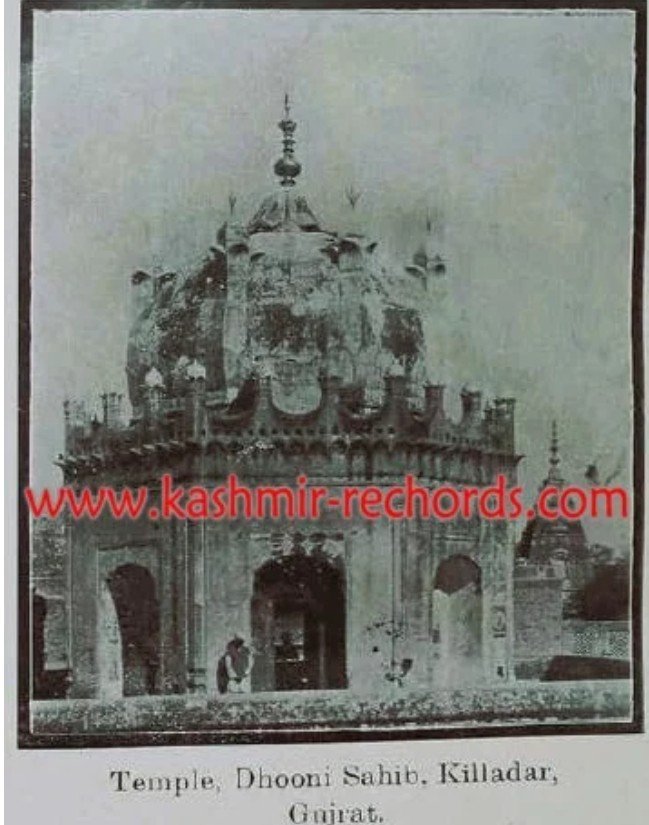
A remarkable rediscovery by Kashmir Rechords adds weight to this historical continuity. A rare Urdu directory (1924–1934) has revealed the existence of a “Fire Temple” dedicated to Swami Dhooni Sahib, built around 1884 in Qilladar, also written as Killadar (now in Pakistan).
This temple was not built in Kashmir—but by Kashmiris.
Readers may read about it by clicking the link provided alongwith this writeup.
Alongside it stood a school and an inn, reflecting a community that carried not only its gods but also its values—education, hospitality and collective life. The site, believed to sit atop natural flames, became both a spiritual and cultural landmark.Even then, far from their homeland, Kashmiri Pandits were reconstructing belonging.
Whether it is the Kheer Bhawani temple in Jammu, the Sharika shrine at Paloura, Jammu or now the upcoming temple in California, these replicas are not attempts to replace the original. They are acts of remembrance.
They reflect a worldview where sacredness is not confined to geography but carried through consciousness. In exile, these structures become bridges—between past and present, homeland and diaspora.
The sentiment is simple yet profound: If we cannot return to our shrines, we will recreate them—faithfully, lovingly, wherever we are.
Exile, Identity, Unbroken Chord
For a community that has faced repeated displacements—from pre-Partition migrations to the mass exodus of the 1990s—these temples represent far more than religion.
They signify continuity. They embody a refusal to forget. They speak of a people who may live in exile, but refuse to be spiritually uprooted.
From the fire-lit sanctum of Qilladar, now in Pakistan, to the upcoming temple in Livermore, the story remains unchanged: Kashmiri Pandits rebuild not because they have lost—but because they remember.
A Living Testament
The land purchased in California is not just real estate. It is memory made visible.
It tells future generations that identity can travel, devotion can endure and exile need not mean erasure.
Because for Kashmiri Pandits, the bond with their deities—and their homeland—is not broken by distance.
It is simply… rebuilt.
Keep These Stories Alive…
Every story we share at Kashmir Rechords is not just history—it is memory, pain, resilience and a voice that refuses to fade away. You won’t find such real and credible stories anywhere.
Behind every archived clipping and forgotten narrative lies a community’s struggle to be remembered. But preserving or narrating these stories is not easy—and we cannot do it alone.
Your financial support, no matter how small it might be, will not just be a donation—it will be a gesture of remembrance, a stand for truth and a lifeline for our continued work.
Help us keep these voices alive. Help us survive.
If these stories have touched you, we humbly request you to KINDLY contribute anything to support Kashmir Rechords.
Donate to Kashmir Rechords Foundation, a Darpan registered NGO (UP/2025/0830873)
Bank Details:
KASHMIR RECHORDS FOUNDATION (Regd) Acct No: 0274010100003893 Jammu and Kashmir Bank. IFSC: JAKA0CHAWRI
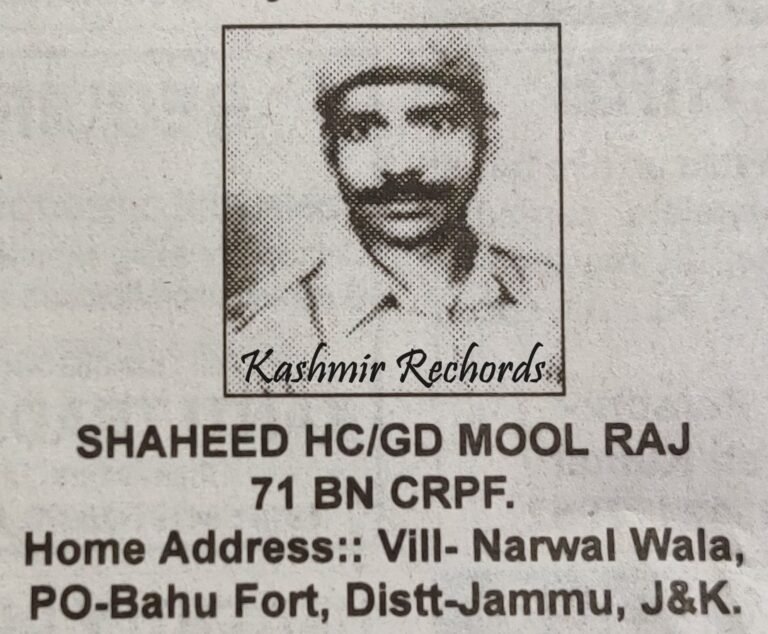
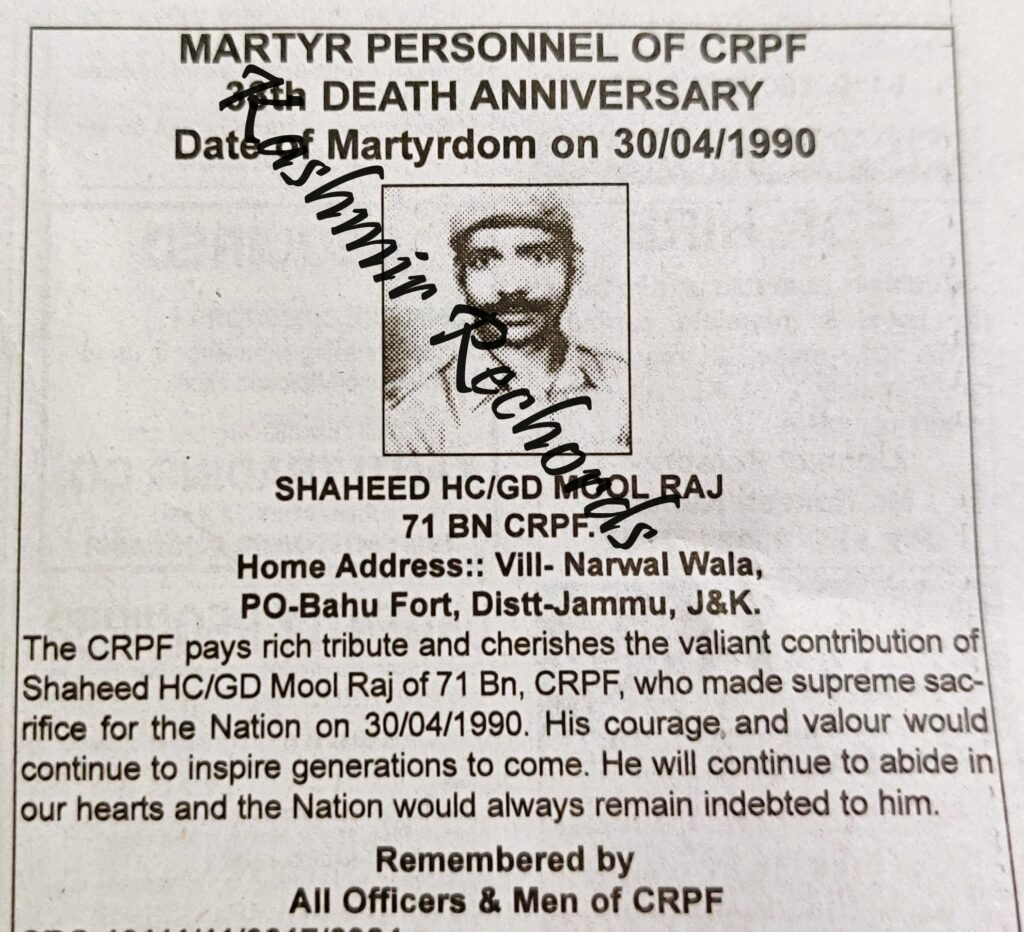
On a modest printed page, slightly worn by time, a grainy photograph stares back—young, composed and unaware of the destiny that would soon seal his name into the roll of honour. The text beneath it is simple, almost stark:
Shaheed HC/GD Mool Raj, 71 Battalion, CRPF. Date of Martyrdom: 30 April 1990.
There are no grand embellishments. No elaborate citations. Just a life reduced to a few lines—and yet, behind those lines lies a story that once pulsed with courage, duty, and belonging.
A Son of the Soil
Mool Raj hailed from Narwal Wala, near Bahu Fort in Jammu—a region that has given countless sons to the Nation’s service. Like many from his generation, his journey into the Central Reserve Police Force (CRPF) was not merely employment; it was a calling shaped by discipline, modest ambition and a quiet sense of patriotism.
He was not a figure of headlines. Not a decorated officer commanding battalions. He was a Head Constable—one among thousands—standing on the frontlines in 1990 descended into one of the most turbulent phases of insurgency.
The Year of Fire
The spring of 1990 was not gentle in Kashmir. It was a time when uncertainty had turned into violence and fear had begun to dictate everyday life. Security forces were stretched thin, often navigating hostile terrain—both geographical and psychological.
On 30 April 1990, Mool Raj laid down his life in the line of duty.
There are no vivid public records detailing the exact moment of his sacrifice—the chaos of those days swallowed many such stories whole. But what remains certain is this: he died protecting the idea of a Nation at a time when that idea was being violently challenged.
A Tribute in Print, A Silence in Memory
The tribute in the image speaks with institutional dignity:
“His courage and valour would continue to inspire generations to come… the Nation would always remain indebted to him.”
It is a promise often made. Yet, as decades pass, the weight of that promise begins to thin.
Thirty-six years later, Mool Raj’s name is no longer spoken in public discourse. His story is not part of textbooks, nor does it echo in televised debates. His memory survives in fragments—archival notices, fading documents and perhaps in the hearts of those who once knew him.
The Quiet Fate of Many
Mool Raj’s story is not an exception—it is a pattern.
Across India, especially in regions like Jammu & Kashmir, countless personnel and civilians as well, who stood firm during the insurgency years now exist only as names on plaques, files or commemorative advertisements. They were neither the first nor the last to fall, but each carried a world within them—families, dreams and identities that rarely find space in collective remembrance.
Remembering Beyond Ritual
To remember Mool Raj is not merely to acknowledge a death anniversary—it is to restore context to a life.
He was not just a uniformed man in a conflict zone. He was a resident of Jammu, a product of its soil, a representative of its resilience. He belonged to a time when ordinary men were called upon to face extraordinary circumstances—and did so without expectation of recognition.
A Fading Photograph, An Unfading Question
That small photograph in the tribute—blurred, monochrome—asks a quiet question:
How long does a Nation remember its unnamed protectors?
For Mool Raj, the answer lies somewhere between official remembrance and public forgetfulness. Yet, as long as his story is told—even in fragments—he is not entirely lost.
Perhaps remembrance does not always reside in grand memorials. Sometimes, it survives in a single page, a rediscovered image, or a retold story—bringing back, even briefly, a life that once stood guard while others slept in peace.
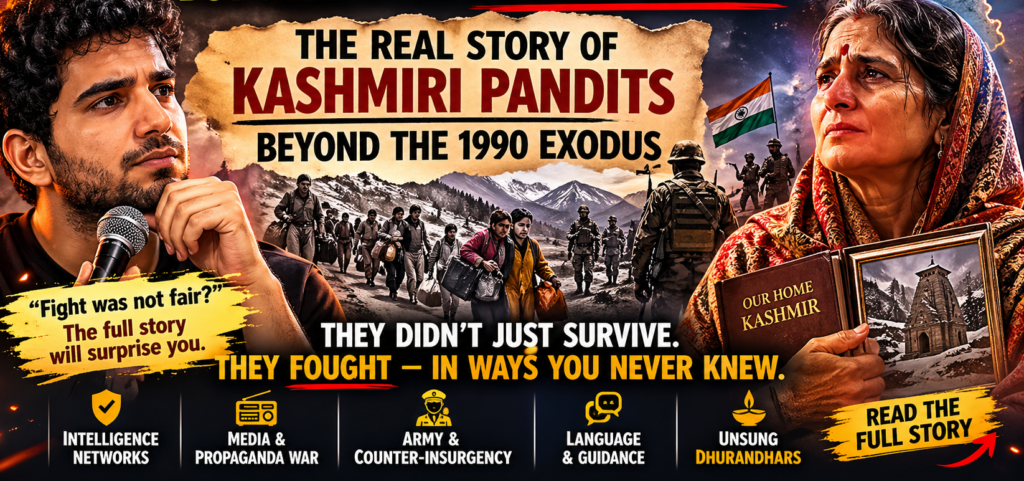
There is something uneasy about history being compressed into a punchline—especially when that history involves the Kashmiri Pandit resistance, a story of blood, exile and silent resilience
Samay Raina, a gifted comedian of a new India, recently stepped into that uneasy terrain. His remark—that Kashmiri Pandits “only fight when the fight is fair”—was perhaps intended to provoke thought, maybe even empathy. Instead, it opened the floodgates to a familiar and troubling chorus: that Kashmiri Pandits “ran away,” that they “did not fight,” that theirs was a story of retreat, not resistance.
But history, particularly the story of the Kashmiri Pandit exodus, is not a stage for convenient one-liners.
The Fight That Was Not Seen
Yes, many left in 1990. But not all. And more importantly, those who left did not stop fighting. They fought differently.
Not with slogans or street battles, but through institutions, intelligence and endurance:
They rebuilt shattered intelligence networks, even as many among them were targeted and killed.
They stood by the Indian State and its agencies, irrespective of which government was in power.
They countered propaganda, a far more insidious weapon than bullets in a proxy war.
They continued to serve in broken institutions, keeping alive the skeletal framework of India’s presence in the Valley.
This was not the absence of courage. This was courage, redefined under siege.
A Story Closer to Home
There is an irony that makes Samay Raina’s statement feel incomplete.
His own father, Rajesh Raina, chose to move back to Kashmir during those fraught years—working with All India Radio and Doordarshan when many others, including employees from different communities, stepped away.
That too was a frontline. Not of guns, but of voice, narrative and national presence.
If that is not fighting, what is?
Beyond the Visible Battlefield
The narrative that Kashmiri Pandits did not fight collapses when confronted with uncomfortable truths:
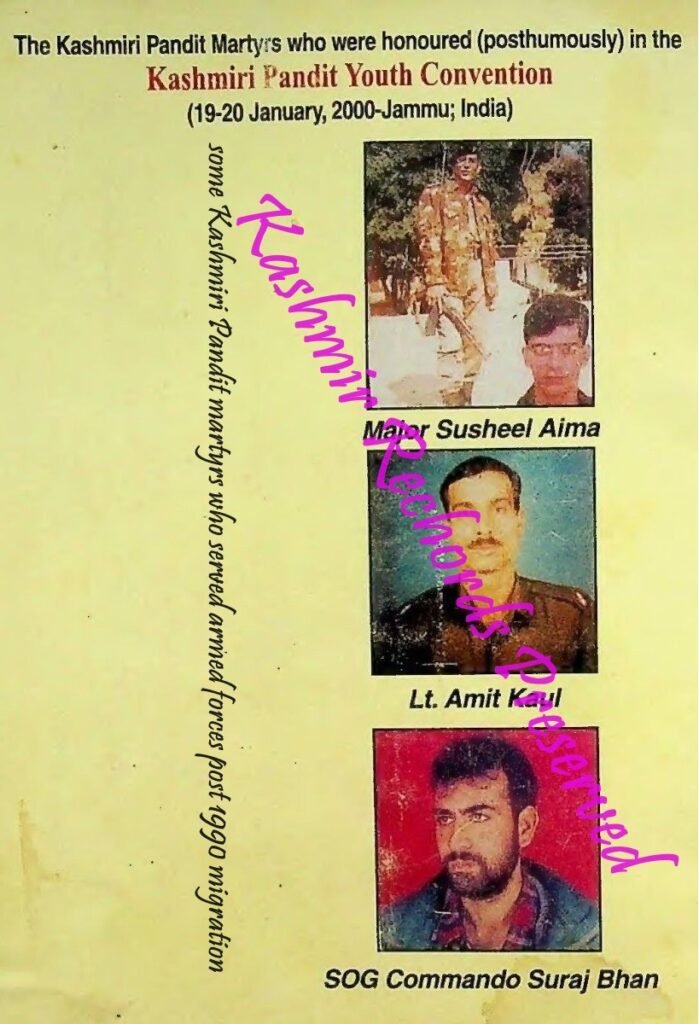
Many joined the armed forces and security agencies.
Some became language experts, helping Indian forces navigate an unfamiliar linguistic and cultural terrain.
Others worked quietly as guides, informants and strategists in counter-insurgency operations.
Countless individuals resisted through media, administration and civil networks.
Their names are not shouted from rooftops. Perhaps because their work demanded silence. Perhaps because history has not yet caught up with their sacrifices.
But they existed—and they mattered.
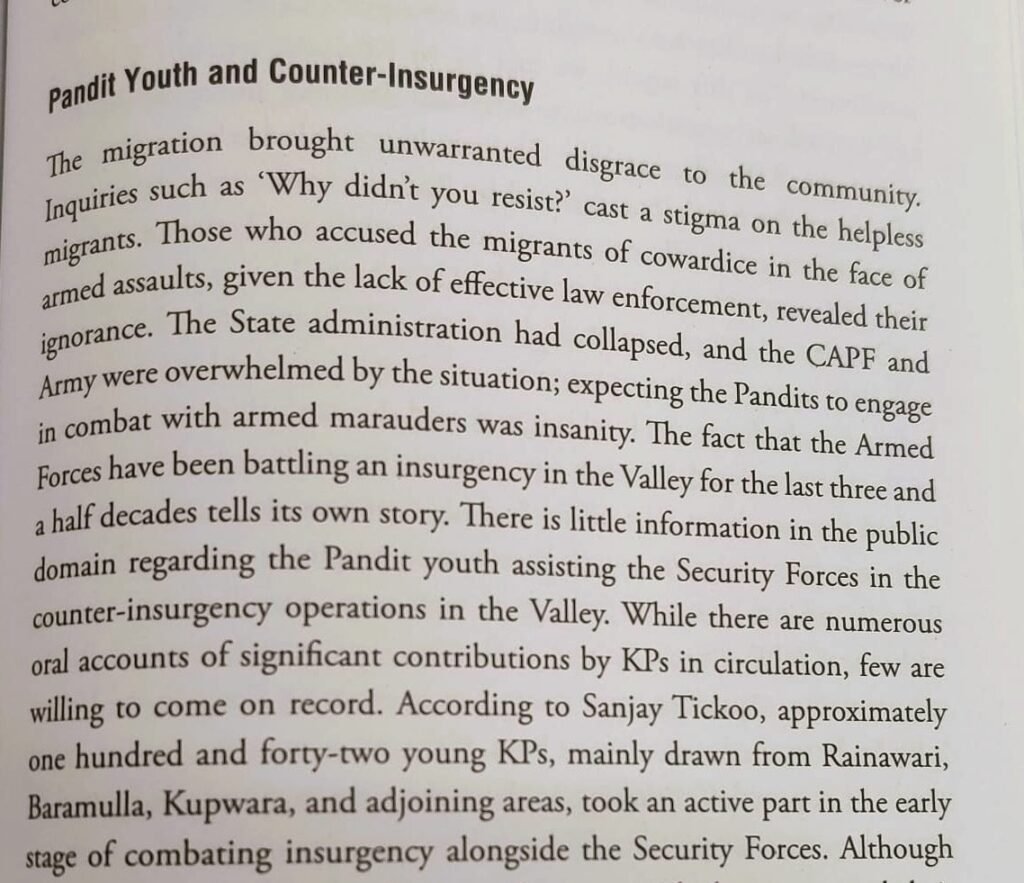
Yoginder Kandhari, a seasoned Army veteran, dedicates an entire chapter in his book on the Kashmir insurgency to “Kashmiri Pandit Youth and Counter-Insurgency,” highlighting the often-overlooked role played by Pandit youth in supporting operations during one of the most turbulent phases in the Valley.
A Page from `Kashmir Insurgency’
The Problem with Simplification
To say “the fight was not fair” is not entirely wrong. But to stop there is to miss the essence of what followed.
Because when a fight is not fair, you do not always pick up a sword. Sometimes, you choose to survive, regroup and resist in ways that history struggles to record.
Reducing that to a matter of “no choice” risks sounding—not just incomplete—but childish in its understanding.
A Message to the Echo Chamber
More troubling than the remark itself were those who seized upon it— the keyboard warriors were quick to label an entire community as cowardly.
They forget:
👉 It was this very community that refused to convert even at the edge of the sword. 👉 It was this community that absorbed displacement without dissolving identity. 👉 It was this community that continued to fight—quietly, persistently and often invisibly.
Stories Yet to Be Told
There are stories here—of courage without spectacle, of resistance without applause.
Stories of real “Dhurandhars”—strategists, survivors, silent warriors, Posts and Telegraph Officials, Official Mediamen, Intelligence Officials, etc
Perhaps one day, filmmakers like Aditya Dhar will bring them to light. Not as footnotes, but as central characters in India’s modern history.
And perhaps then, even comedians will find better material— not in half-truths, but in the full weight of lived experience.
In the End
Humour has power.But so does History.
And when the two intersect, what is needed is not just wit— but depth, memory and responsibility.
An Appeal:Keep These Stories Alive…
Every story we share at Kashmir Rechords is not just history—it is memory, pain, resilience and a voice that refuses to fade away. You won’t find such real and credible stories anywhere.
Behind every archived clipping and forgotten narrative lies a community’s struggle to be remembered. But preserving or narrating these stories is not easy—and we cannot do it alone.
Your financial support, however even very small, is not just a donation—it is a gesture of remembrance, a stand for truth and a lifeline for our continued work.
Help us keep these voices alive. Help us survive.
If these stories have touched you, we humbly request you to KINDLY contribute and support Kashmir Rechords.
Donate to Kashmir Rechords Foundation:
Bank Details:
KASHMIR RECHORDS FOUNDATION (Regd) Acct No: 0274010100003893 Jammu and Kashmir Bank. IFSC: JAKA0CHAWRI
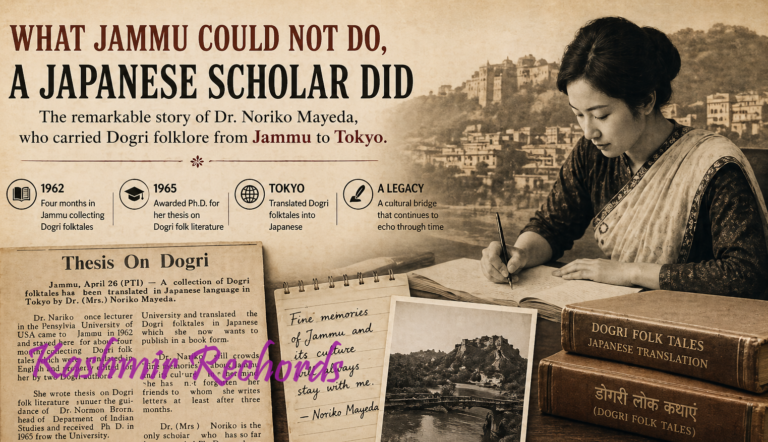
At a time when Dogri lived in the voices of its people but not in the pages of serious scholarship, when its own custodians failed to document it for the world, a young woman from faraway Japan stepped in to do what many closer home did not.
Her name was Noriko Mayeda.
In the early 1960s, she arrived not as a tourist, but as a seeker—drawn by a language, a culture, and a tradition that even its native landscape had not fully recorded.
A Stranger Who Listened When Others Didn’t
Kashmir Rechords brings to light a striking and uncomfortable truth—one that many in Jammu may find both surprising and introspective.
In 1962, Dr. Mayeda spent nearly four months in Jammu, patiently collecting Dogri folktales—stories that had survived centuries through memory, yet remained absent from formal documentation.
While the region lived these stories, it took an outsider to recognize their urgency.
Working with local Dogri writers of the time, she translated these oral narratives into English and refined them into a structured body of work—turning fragile memory into enduring record.
A Thesis That India Overlooked
Under the mentorship of Norman D. Brown at the University of Pennsylvania, she transformed her fieldwork into a doctoral thesis on Dogri folk literature.
In 1965, she earned her Ph.D.—a rare and pioneering academic milestone for a language (Dogri) that was still fighting for recognition even within its own homeland.
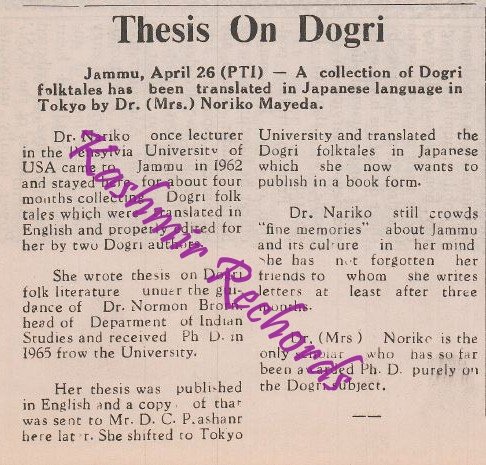
That same year, Press Trust of India (PTI) carried her story from Jammu (April 26, 1965). Local newspapers reproduced it, acknowledging—however briefly—the significance of her work.
Today, that moment survives only in fading newsprint, preserved by Kashmir Rechords.
Taking Dogri Where It Had Never Reached
Dr. Mayeda did not stop at documentation.
She carried Dogri across continents—to Tokyo—where she translated its folktales into Japanese. Her effort was not merely academic; it was cultural diplomacy in its purest form.
Through her, the voice of Jammu found listeners in a land thousands of miles away.
A Bond That Distance Could Not Break
Years after leaving India, she continued to remember Jammu—not as a research site, but as a lived experience.
She wrote letters to friends she had made, recalling what she called “fine memories” of its people and culture. In her heart, Jammu was not left behind—it was carried forward.
Uncomfortable Legacy
Dr. Noriko Mayeda remains one of the very few scholars—perhaps the only one of her time—to earn a Ph.D. solely dedicated to Dogri.
And yet, her name is scarcely remembered in the very region whose stories she preserved.
It is a quiet irony of history:
What many in Jammu did not record, a Japanese scholar did. What was taken for granted here, was treasured elsewhere.
Long before globalization made cultural exchange fashionable, Noriko Mayeda ensured that Dogri would not remain confined to fading voices.
She gave it a written form, a global presence, and a dignity that still resonates.
❤️For Kashmir Rechords
If you value such forgotten histories, support Kashmir Rechords, a registered NGO with Government of India. Your contribution helps reclaim stories that time—and sometimes society—chooses to forget.
Behind every archived clipping and forgotten narrative lies a struggle to be remembered. But preserving these stories is not easy—and we cannot do it alone.
Your support, no matter how small is it, is not just a donation—it is a gesture of remembrance.
Please consider donating to our bank account. Every contribution matters.
Donate to Kashmir Rechords Foundation:
Bank Details:
KASHMIR RECHORDS FOUNDATION (Regd) Acct No: 0274010100003893 Jammu and Kashmir Bank. IFSC: JAKA0CHAWRI
The early 1990s marked one of the most painful chapters in the history of Kashmir. As violence escalated across the Valley, the mass migration of Kashmiri Pandits in 1990 left an entire community uprooted, disoriented and largely unsupported by the administration of the time. Amid fear, uncertainty, and displacement, a remarkable yet often overlooked episode unfolded—an appeal to the global conscience.
In the immediate aftermath of their exodus, Kashmiri Pandits found themselves scattered across Jammu and other parts of India, grappling with loss of home, livelihood and identity. With little institutional backing and no cohesive leadership, members of the community began organizing themselves under emerging platforms.
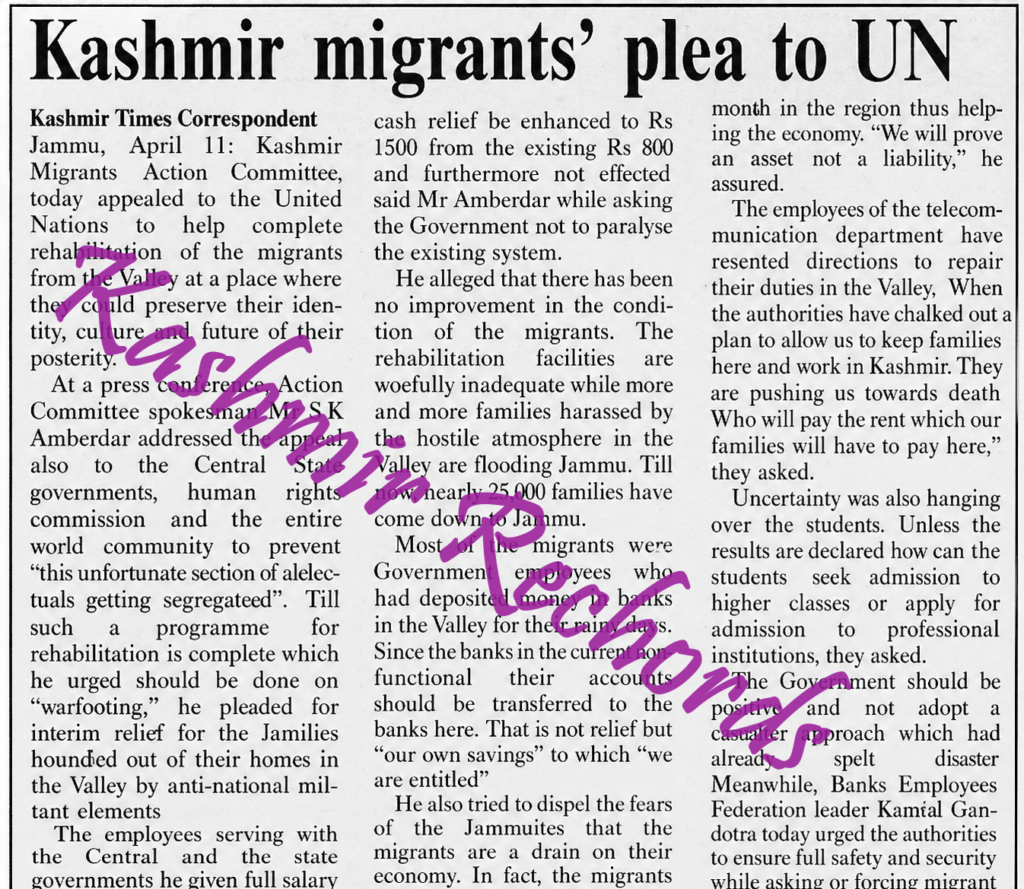
One such collective, the Kashmir Migrants Action Committee, became an early voice of resistance and representation. In April 1990, this group made a bold and unprecedented move—they appealed to the United Nations and Amnesty International, seeking intervention for their rehabilitation and protection.
April 11, 1990: A Forgotten Appeal
At a press conference held on April 11, 1990, the committee formally urged global bodies to ensure the safe and dignified rehabilitation of displaced Kashmiri Pandits. Their demand was clear: resettle the community in a secure environment within Kashmir where their cultural identity and future generations could be preserved.
Speaking on behalf of the committee, Surinder Ambardar—who would later rise to become a Member of the Legislative Council (MLC)—called upon the Central and State governments, human rights organizations and the international community to act swiftly.
He warned against the “segregation of an unfortunate section of intellectuals” and emphasized that rehabilitation must be carried out on a “war footing.” Until such measures were implemented, he demanded immediate interim relief for families forced out of their homes by militant violence.
Economic Misconceptions and Ground Realities
At a time when sections of Jammu’s population believed that the influx of migrants was straining local resources, Ambardar sought to counter the narrative. He pointed out that displaced Pandits were contributing approximately ₹6 crore per month to the regional economy—an assertion aimed at reshaping public perception and reducing hostility.
Rising Tensions and Renewed Warnings
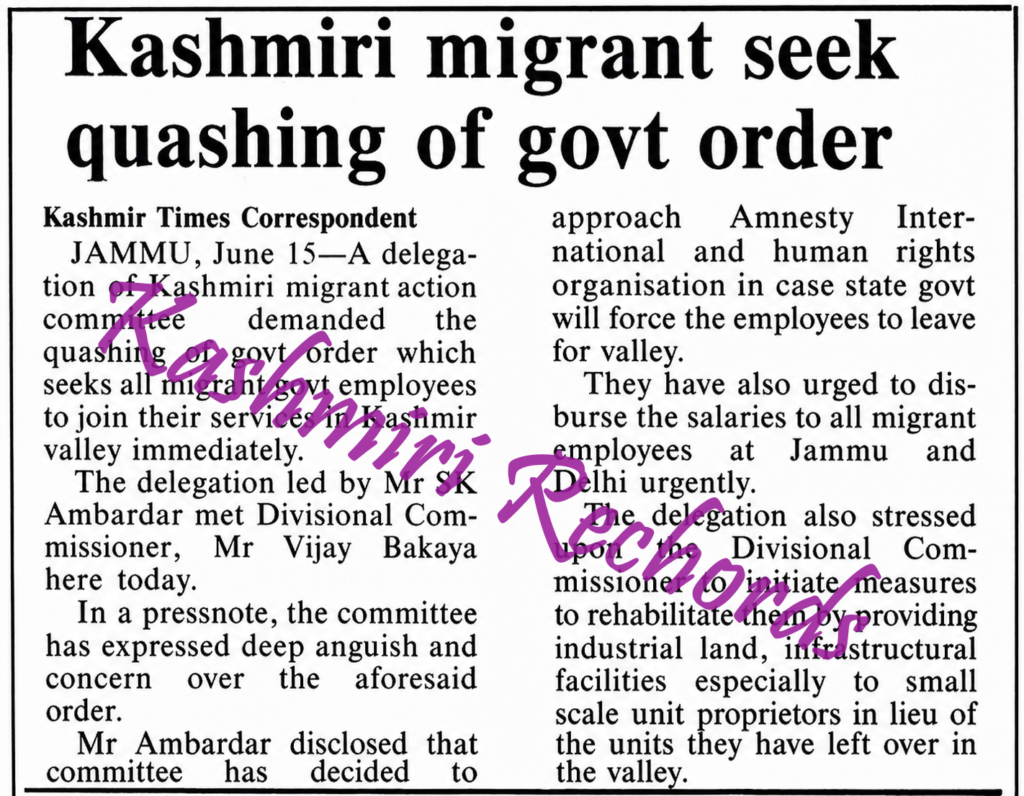
By June 1990, tensions escalated further when the government ordered migrant employees to return to their posts in the Valley. The directive triggered widespread anxiety among displaced workers who feared for their safety.
Leading a delegation once again, Ambardar met then Divisional Commissioner Vijay Bakaya and warned that if the order was enforced, the community would approach international human rights bodies, including Amnesty International.
The Silence That Followed
Despite these early efforts—memorandums, press conferences and appeals to global institutions—the issue of international intervention was soon subdued. The reasons remain unclear. Over time, many who had initially championed these demands transitioned into mainstream politics, with some attaining influential legislative positions.
Others who continued advocating for a separate homeland within Kashmir either diluted their stance or became entangled in political compromises, leaving the community’s aspirations fragmented.
Three Decades Later: A Lingering Question
More than 36 years have passed since that fateful summer of 1990. While a few individuals managed to leverage the circumstances for personal or political gain, the broader condition of Kashmiri Pandits remains a subject of concern.
The early appeals to the United Nations and Amnesty International now lie buried in archival press clippings—preserved memories of a time when a displaced community, stripped of everything, turned to the world for justice and recognition.
This forgotten episode raises uncomfortable yet important questions: Why did the demand for international intervention fade so quickly? What changed between the cries of 1990 and the political realities that followed? And most crucially—has justice truly been served?
As history continues to be revisited and rewritten, the voices from those early days of exile deserve to be heard again—not just as a record of suffering, but as a reminder of resilience and the search for dignity.
An Appeal:Keep These Stories Alive…
Every story we share at Kashmir Rechords is not just history—it is memory, pain, resilience, and a voice that refuses to fade away. You won’t find such real and credible stories anywhere.
Behind every archived clipping and forgotten narrative lies a community’s struggle to be remembered. But preserving these stories is not easy—and we cannot do it alone.
Your support, however small, is not just a donation—it is a gesture of remembrance, a stand for truth, and a lifeline for our continued work.
Help us keep these voices alive. Help us survive.
If these stories have touched you, we humbly request you to KINDLY contribute and support Kashmir Rechords.
Please consider donating to our bank account. Every contribution matters.
Donate to Kashmir Rechords Foundation:
Bank Details:
KASHMIR RECHORDS FOUNDATION (Regd) Acct No: 0274010100003893 Jammu and Kashmir Bank. IFSC: JAKA0CHAWRI
“In the name of Allah, the Most Gracious, the Most Merciful…” The words appeared at the top of a poster—formal, almost pious. But what followed was not a prayer. It was an order.
In the early 1990s, Kashmir was not merely passing through unrest—it was living under a parallel authority. Militants, particularly the Hizbul Mujahideen, had begun to dictate not just politics or ideology, but the rhythms of everyday life. Movement, speech, even personal choices—nothing was untouched.
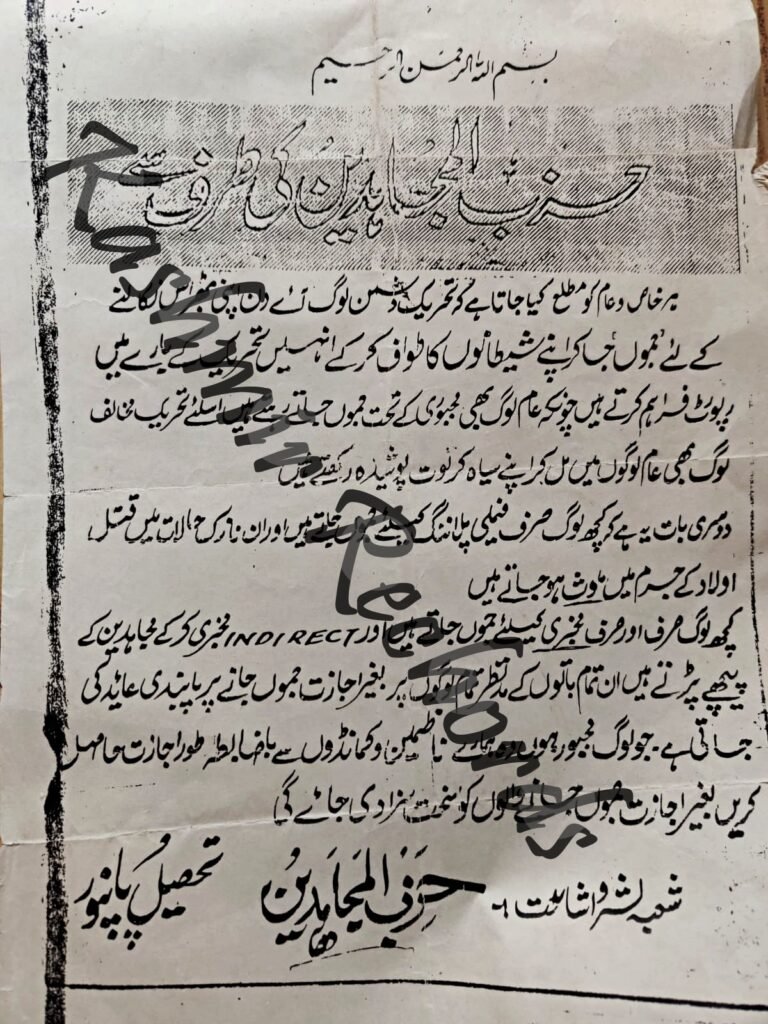
A reproduced militant poster from 1990s Kashmir warning residents against visiting Jammu.
A Valley Where Leaving Required Permission
Across towns and villages, posters were pasted on walls, electric poles and shop shutters. The message was unmistakable: no one could leave the Valley for Jammu without permission.
Travel, once routine, had become an act of defiance.
Those who dared to step out without approval risked being branded informers—collaborators with Indian forces. And in those times, such labels were often a death sentence.
One such poster, circulated widely in places like Pampore, warned Kashmiri Muslims against travelling to Jammu. It alleged that those crossing the Valley were secretly passing information to security agencies. The language was stark, the warning severe: stop—or face consequences.
The message went further. It declared that the ”conflict was not just the responsibility of militants, but of every individual in Kashmir”. ”Anyone seen as supporting Indian forces, in any manner, would be treated as a traitor.”
Even Personal Lives Came Under Scrutiny
The posters did not stop at movement. They intruded into the most intimate corners of life.
Kashmiri Muslim Women were accused of travelling to Jammu for family planning procedures—an act the posters described as “killing children in the womb.” The diktat was clear: such actions were unacceptable.
Residents were instructed to seek permission from local “Area Commanders” before travelling. Cooperation with Indian forces was forbidden. Support for the militant cause was expected—not requested.
In a Valley where fear travelled faster than news, compliance became a survival instinct.
A Kashmiri Pandit Son’s Appeal in Print
Amid this atmosphere of control and fear, one small newspaper clipping tells a story that is both haunting and deeply human.
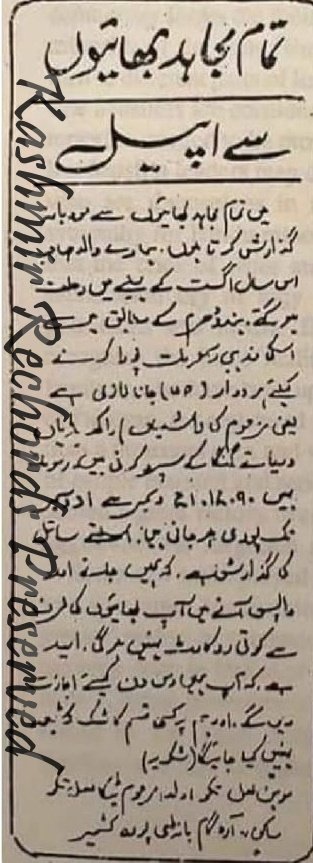
Mohan Lal Tikoo publically seeks permission to perform last rites of his father at Haridwar.
It is the story of Mohan Lal Tikoo, a Kashmiri Pandit from Aragam in Bandipore, Kashmir—one of the few who had chosen to stay back even as his community left Kashmir en masse.
In December 1990, grieving the loss of his father, Tikoo faced a dilemma no son should ever encounter: He needed permission to perform his father’s last rites.
With no other avenue available, he turned to the only authority that seemed to matter at the time—the militants themselves.
His appeal appeared in the Urdu daily Srinagar Times on December 11, 1990. It was not a protest. It was a plea.
He wrote that, according to Hindu tradition, he was duty-bound to carry his father’s ashes to Haridwar and immerse them in the sacred Ganga. He requested permission to leave the Valley between December 21 and December 31, 1990 assuring that he would return, and cause no disturbance.
It was a deeply personal request—yet it had to be made publicly, almost like a petition for mercy.
In that moment, grief was secondary. Permission was everything.
When Authority Extended to Birth Itself
The reach of militant diktats extended even further—to the question of life itself.
At the time, voices aligned with the broader separatist sentiment openly opposed family welfare measures. Calls were made for larger families, framed as part of a larger struggle.
There were even reports of financial incentives being announced—cash rewards for couples with five or seven children. Promises were made to support the upbringing of newborns.
In a conflict where identity and numbers were seen as strength, even childbirth became political. Kashmir Rechords has already carried a detailed story on it : Kashmir 1990: When Militants Banned Family Planning at Gunpoint which can be read in our full report here:
The posters have faded. The ink has blurred. The walls that once carried them have long been repainted.
But the stories remain.
They speak of a time when ordinary people navigated extraordinary pressures—when leaving home required approval, when mourning required permission, and when silence often meant survival.
The clipping of Mohan Lal Tikoo is not just a document. It is a reminder—of how deeply conflict can enter the personal, and how, even in the harshest times, humanity finds a way to speak… even if only through a newspaper column.
There was a time—not too long ago—when Kashmir queued up for dreams.
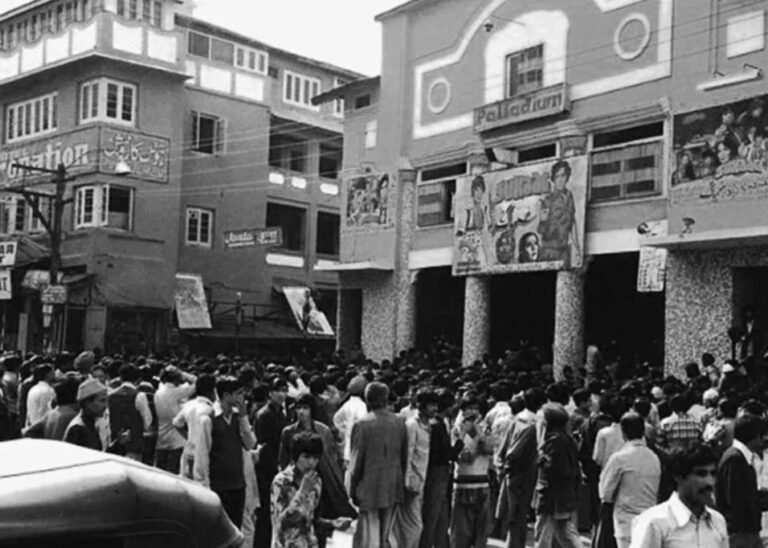
Long before the crackle of gunfire replaced laughter, cinema halls across Srinagar pulsed with life. From Lal Chowk to Down Town or to Residency Road; to towns like Anantnag to Sopore or Baramulla, over 20 theatres screened Bollywood blockbusters and Hollywood hits. Tickets were sold in black. Beauty parlours thrived. Evenings belonged to stories.
And then, in the winter of 1989, the screen went dark.
The Countdown to Silence
By mid-December 1989, something had shifted. Cinema halls—once bursting at the seams—began receiving threats. Anonymous calls. Letters. Warnings.Within weeks, fear replaced festivity.
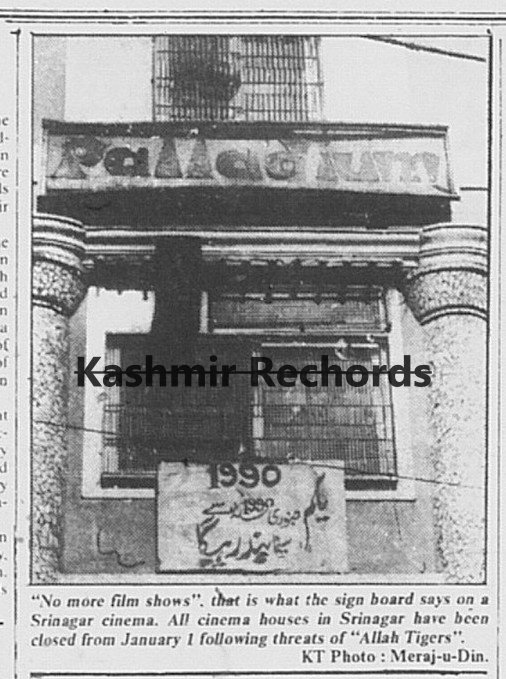
On January 1, 1990, Kashmir woke up to an announcement that would define generations: All cinema halls were closed. Indefinitely.
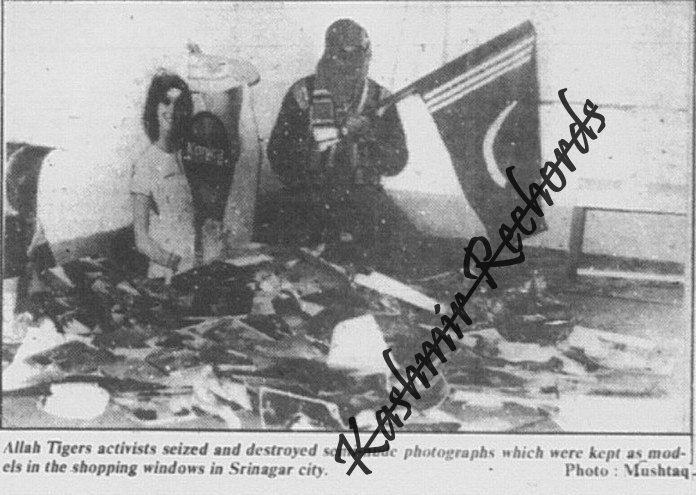
At the centre of this diktat was the militant outfit ‘‘Allah Tigers”, tasked with enforcing a new social order—one that declared cinema, music and visual culture “un-Islamic.”
Heavy locks appeared on theatre gates. Screens went blank. Kashmir’s cultural heartbeat stopped overnight.
A Society Stripped of Leisure, Livelihood
The closure wasn’t symbolic—it was devastatingly real.
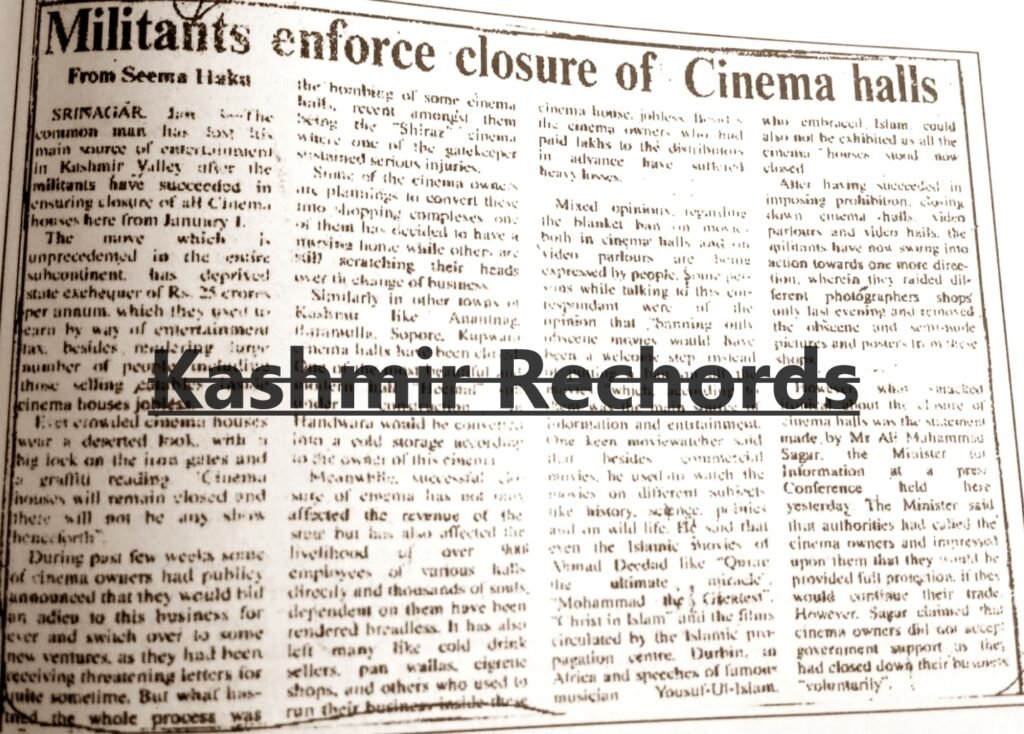
According to archived reporting from Srinagar by senior journalist Seema Hakhu (January 3, 1990), preserved by Kashmir Records :
Over 900 cinema employees lost their jobs
Thousands of small vendors—tea stalls, cigarette sellers, ticket agents—lost income
The state exchequer suffered massive losses from entertainment tax
But beyond economics, something deeper was lost: the right to joy.
Cinema halls were not just buildings—they were social spaces, emotional outlets and cultural connectors. Their disappearance left a vacuum quickly filled by fear.
Dateline Srinagar: January 3, 1990 …. A story on the closure of Cinema Hall in Kashmir, published by Kashmir Times
Palladium to Ruins: The Fall of Icons
At the heart of Srinagar stood the legendary Palladium Cinema—a symbol of Kashmir’s early embrace of modern entertainment.
Established around 1932, it was among the Valley’s first theatres. It had once screened India’s earliest talkie, Alam Ara. Its final curtain call? The 1989 blockbuster Tridev.
Some kilometres away from it, the iconic Broadway Cinema screened its last film—Yateem.It was a title that would later feel hauntingly prophetic; as the curtains fell, the valley’s vibrant cultural life was effectively orphaned for the next three decades.
Because from that moment, Kashmir’s cinema—and perhaps its society—became “orphaned.”
From Entertainment to Enforced Ideology
Militancy did not merely shut theatres—it attempted to redefine society.
Cinema posters were torn down
Modelling images were banned
Shops displaying photographs were attacked
Threats extended to anyone associated with visual culture
Even attempts to adapt—screening religious or educational films—failed. Audiences had already retreated into fear.
Many cinema halls were later converted into shopping complexes or were occupied by security forces or turned into interrogation centers
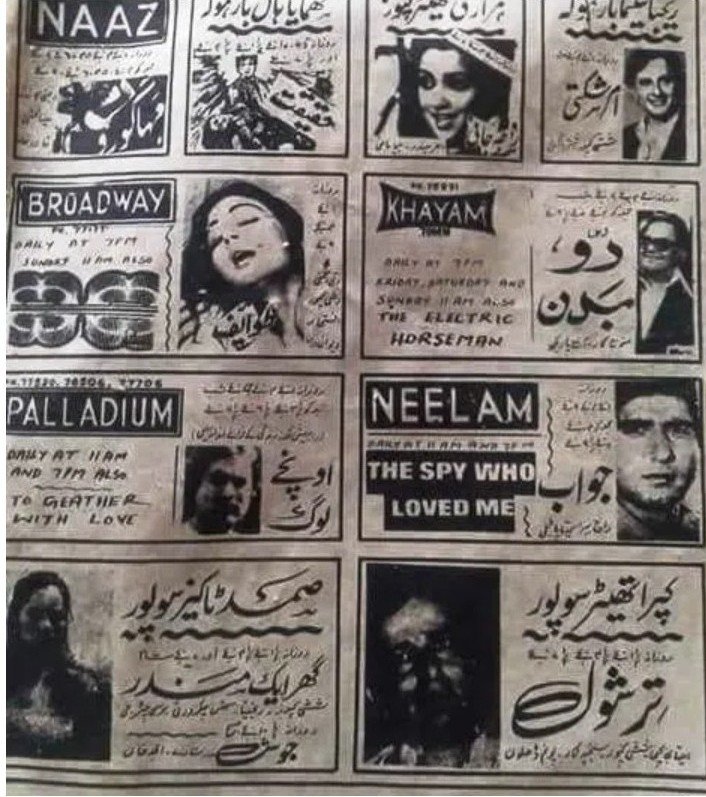
A vintage newspaper page that gives details of bollywood thrillers screened in Cinema Halls of Srinagar and Sopore.
The Spark Before the Fire
Ironically, cinema itself had once stirred political consciousness.
In 1985, the film Lion of the Desert, depicting Libyan resistance leader Omar Mukhtar, was screened at Regal Cinema. Incidentally, Regal was unique as the only theatre in Srinagar that also housed a bar, highlighting just how much the “social order” shifted in Kashmir after the 1990 ban.
The audience drew parallels with Sheikh Abdullah. The emotional response was immediate—and explosive. Slogans were raised. Posters torn. A narrative had begun forming.
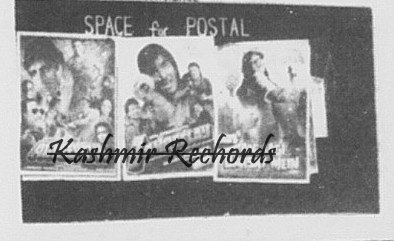
Space for Postal (Posters)…Kashmiri style!
Within four years, that narrative would transform into armed insurgency.
A Pattern of Cultural Targeting
Cinema in Kashmir had faced violence even earlier.
Following the 1963 Hazratbal relic incident, mobs burned down theatres like Regal and Amresh. But 1990 was different.
This time, it wasn’t spontaneous outrage—it was systematic erasure.
The Long Silence—and a Hesitant Return
For nearly three decades, Kashmir had no public cinema culture.
An entire generation grew up without:
Movie halls
Shared cultural spaces
The simple ritual of watching films together
Only after 2022, with the opening of new multiplexes, did cinema cautiously return.
But the question remains: Can a culture erased for 30 years truly be revived?
Today, debates rage about Kashmir’s past—what was reported, what was ignored and what is being rediscovered.
The closure of cinema halls is not just a footnote. It is evidence.
Evidence that: Society was reshaped through fear; Culture was targeted, not collateral damage and Silence was enforced—not chosen .
The story of Kashmir’s cinema is not about films.It is about freedom—to gather, to celebrate, to imagine.
When the lights went out in 1990, it wasn’t just cinema that died.It was a way of life.