
Kashmir Rechords Editorial Desk
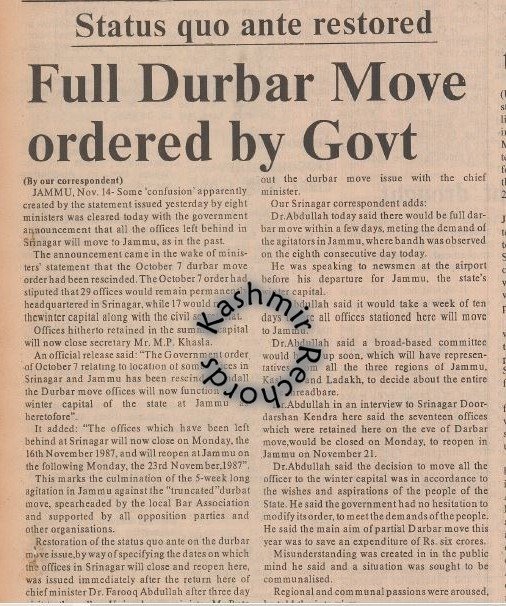
Even as the erstwhile State of Jammu and Kashmir was still recovering from the communal unrest of February 1986 — when riots that began in Anantnag rippled through both the Valley and Jammu — another storm brewed the following year. On October 7, 1987, the the State government of Dr. Farooq Abdullah dropped a political bombshell: the historic Darbar Move, a 19th-century tradition that had symbolically bound the two regions, was to be disbanded in the name of “money saving and administrative efficiency.”
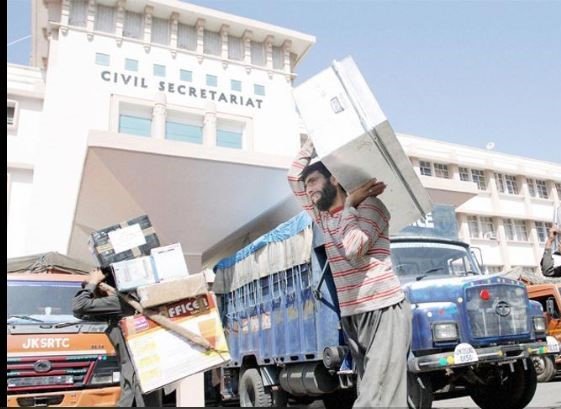
The announcement rekindled deep regional fault lines. Jammu erupted in anger; the Valley watched cautiously. The Move — a twice-yearly shifting of the State’s civil secretariat and government offices between Srinagar (summer capital) and Jammu (winter capital) — was not merely a logistical exercise. For over a century, it had embodied `administrative parity and emotional unity ‘between two culturally distinct halves of the state.
Introduced under Dogra rule in the 1870s, the Darbar Move had a practical origin: harsh Kashmiri winters made Srinagar inaccessible, prompting the Maharajas to shift governance to Jammu. Over time, it evolved into a ritual that represented equitable governance — the government in both capitals, every year, like a pendulum of shared belonging. Traders, hoteliers, transporters, and clerks across regions waited for it with hope, knowing the Move meant seasonal livelihood and inter-regional mingling.
1987: When Efficiency Met Emotion
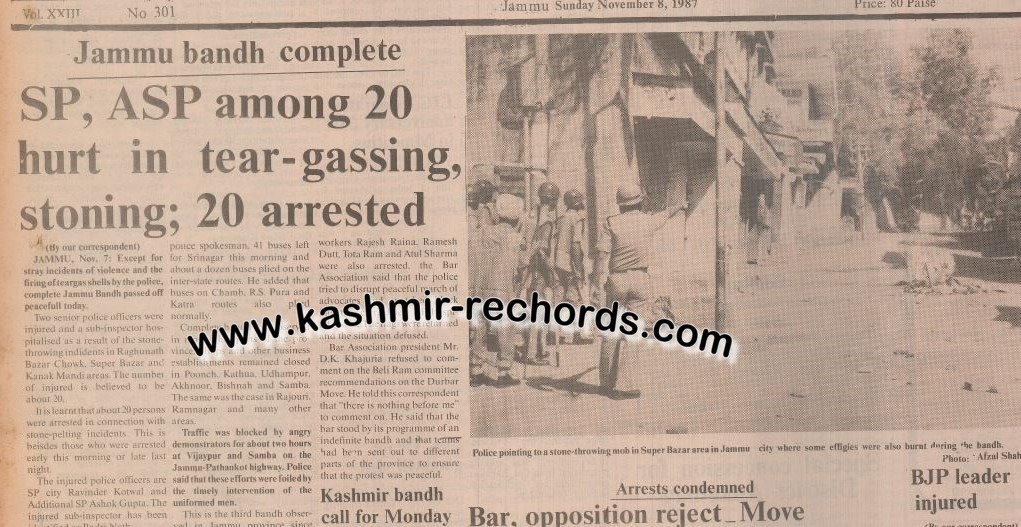
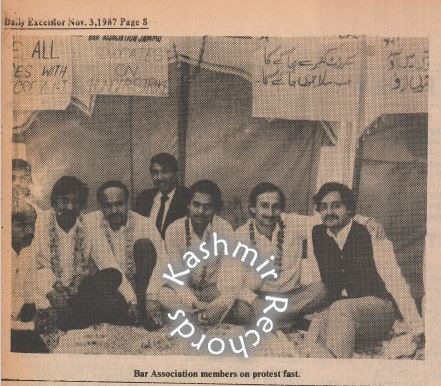
In 1987, the government’s plan to make Srinagar the permanent capital and keep a few departments permanently stationed in Jammu triggered one of the fiercest regional agitations in J&K’s history. The Jammu Bar Association spearheaded the protests, joined by the Bharatiya Janata Party and other pro-Jammu groups.
For weeks, Jammu witnessed bandhs, rallies, court arrests, and lathi-charges. Lawyers took to the streets; public meetings turned massive. Even the Valley’s lawyers launched a parallel agitation, echoing Jammu’s sentiment of perceived neglect.
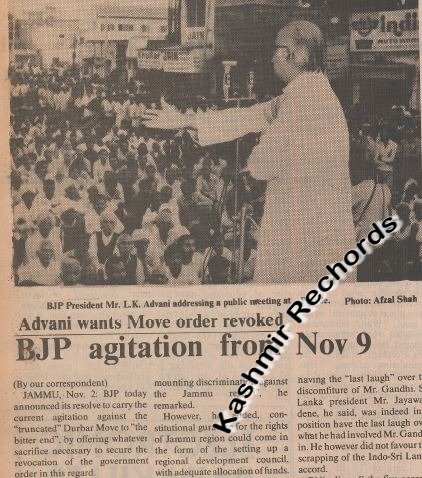
The agitation drew national attention. Lal Krishna Advani, then BJP president, camped in Jammu, while Union Home Minister Buta Singh rushed to the region to defuse tensions. Eventually, the Centre intervened, directing the State to withdraw the October 7, 1987 order. Farooq Abdullah’s government had to retreat — a recognition that administrative logic could not override emotional equity.
The episode etched a political lesson that endures: efficiency arguments falter when they collide with regional pride and livelihood concerns.
2019–2021: The Digital Era and a Familiar Divide
Fast forward to August 5, 2019 — the abrogation of Article 370 transformed J&K’s political map into a Union Territory. Amid this tectonic shift came a new rationale to end the Move: digital governance.
By 2020, as the COVID-19 pandemic raged, the Darbar Move was suspended. The Lieutenant Governor’s administration, citing e-office digitisation, declared that physical file transfers were obsolete. In June 2021, it formally abolished the 149-year-old practice, estimating an annual saving of ₹200 crore.
But the announcement reopened old wounds. Jammu’s traders and civil society groups protested, lamenting both the economic loss and the symbolic erosion of equality. Unlike 1987, there was no mass agitation under central rule — yet the hurt simmered. For Jammu, the Move’s end was the loss of a ritual that validated its political parity. For the Valley, reactions were mixed; some saw logic, others saw politics.
2025: Return of the Ritual
Just as the memory of the Move had begun to fade, October 2025 brought another twist. The newly elected government, led by Chief Minister Omar Abdullah, announced the restoration of the biannual Darbar Move, citing it as a gesture of regional balance and a fulfillment of electoral promises.
The decision sparked jubilation in Jammu. Marketplaces buzzed with celebration; social media flooded with posts of “justice restored.” Traders hailed it as an economic revival; employees saw it as a return to normalcy. The Valley, however, responded with measured silence — some questioning whether reviving a costly ritual aligned with modern governance priorities.
Analysts observed that beyond nostalgia, the Move’s revival carried political undertones — a statement of inclusivity, but also an appeal to sentiment.
A Bridge of Unity or a Mirror of Division?
Every phase of the Darbar Move — from the 1987 agitation to the 2021 abolition and now the 2025 revival — underscores how deeply this tradition is interwoven with J&K’s socio-political psyche. Each decision about it has split opinion, mobilised emotions, and redefined the contours of Jammu–Kashmir relations.
Yet beneath the politics lies a truth worth remembering: the Darbar Move, despite its cost and inconvenience, served as a living bridge. It brought two culturally and climatically distinct regions under one administrative rhythm — fostering cross-regional ties, seasonal livelihoods, and a rare sense of shared governance.
Whether seen as an outdated burden or a cherished bond, the Darbar Move continues to remind the people of Jammu and Kashmir that unity is often carried not in files or offices, but in the traditions that make a diverse land feel like one.