The year was 1987. Kashmir was simmering. The scars of the Anantnag riots of 1986 — when shrines and temples of Kashmiri Pandits were vandalized — were still fresh. The State’s law and order machinery was in disarray, shaken further by the controversial closure of the Darbar Move in October that year. Amid this charged atmosphere, the small, vulnerable community of Kashmiri Pandits once again found itself caught in the crossfire of growing communal overtones.
And then, one day in November, tragedy struck — quietly, cruelly and almost unnoticed.
A young man, only 25, was murdered in broad daylight in an old Srinagar locality.
But who was this youth? And why does almost no one remember him today?
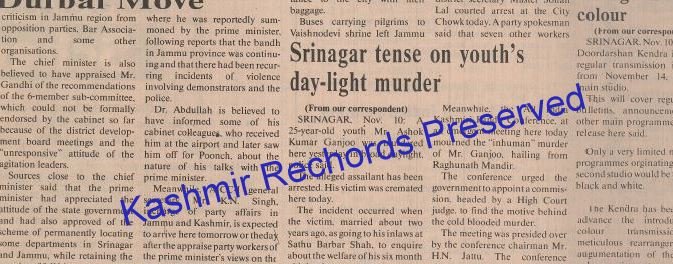
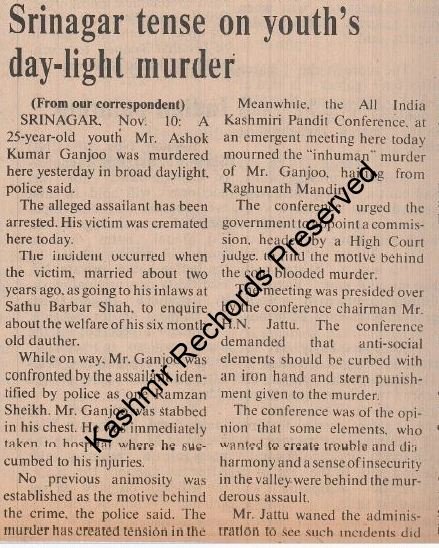
Kashmir Rechords recently unearthed a forgotten newspaper clipping dated November 10, 1987, reporting the brutal killing of Ashok Kumar Ganjoo, a young Kashmiri Pandit who had married just two years earlier. The report mentioned that Ashok Ganjoo was on his way to his in-laws’ home at Sathu Barbar Shah, concerned about the well being of his six-month-old daughter, when he was attacked.
According to the newspaper, the assailant — later identified by the police as Ramzan Sheikh — confronted Ashok Ganjoo on the road and stabbed him in the chest. He was rushed to the hospital but succumbed to his injuries soon after.
Police said there was no prior enmity between the two. No clear motive was established.
But for the Kashmiri Pandit community, the message was chillingly clear.
Srinagar was tense that evening. The shock rippled through the narrow lanes of the old city and the small Pandit households that were already living in fear. The All India Kashmiri Pandit Conference (AIKPC) convened an urgent meeting under the chairmanship of H.N. Jattu, condemning what they called an “inhuman” act. They demanded a Judicial Commission headed by a High Court judge to probe the murder.
That was nearly four decades ago.
Whether such a Commission was ever set up, or what became of the investigation, remains a mystery. No public record traces what happened to the accused. No answers were ever made known.
What remains today is a haunting silence — and the fading memory of a young man whose death, in hindsight, seemed like a grim prelude to what awaited the entire community just two years later.
Was the killing of Ashok Kumar Ganjoo a random crime? Or was it, as some in the community later feared, a forewarning — a “test dose” — before the larger tragedy of 1990?
History may never tell us for sure. But somewhere in the forgotten pages of a 1987 newspaper, his name still speaks — a silent reminder of a time when the storm was only beginning to gather.
Few people remember that November 7, 1947 marks one of the most decisive days in India’s post-Independence history — the Battle of Shalateng! Fought on the misty outskirts of Srinagar, this fierce engagement between Indian soldiers and tribal raiders supported by Pakistan and her Army, proved to be the turning point in the first Indo-Pakistani War (1947–48).
In just a few hours of intense combat, Indian forces not only saved Srinagar from certain capture but also secured the very accession of Jammu and Kashmir to the Indian Union, signed only a few days before this battle.
The Shadow Before the Storm
The story began weeks earlier, on October 22, 1947, when thousands of tribal raiders — mainly Pathans from Pakistan’s North-West Frontier Province — swept into Kashmir. With the connivance of Pakistani authorities, they advanced swiftly through Muzaffarabad, Uri and Baramulla, plundering villages, killing civilians, and creating terror in their wake.
With his forces overwhelmed, Maharaja Hari Singh signed the Instrument of Accession on October 26, 1947, bringing Jammu and Kashmir formally into the Indian Union. Within 24 hours, Indian aircraft began airlifting troops to defend Srinagar, as the enemy closed in.
The first units of 1 Sikh Regiment landed at Srinagar airfield on October 27, 1947, establishing a crucial defensive base. Yet, the enemy remained dangerously close — their next objective was to storm Srinagar itself.
Prelude to Shalateng: The Battle of Budgam
The first major confrontation took place at Budgam on November 3, 1947, where Indian forces halted the tribal advance, safeguarding the Srinagar airfield — the city’s only lifeline for reinforcements and supplies.
Aerial patrols the following days reported alarming news: large enemy concentrations near Shalateng, barely 10 km from Srinagar. It was clear that a decisive clash was imminent — one that would determine the fate of the Valley.
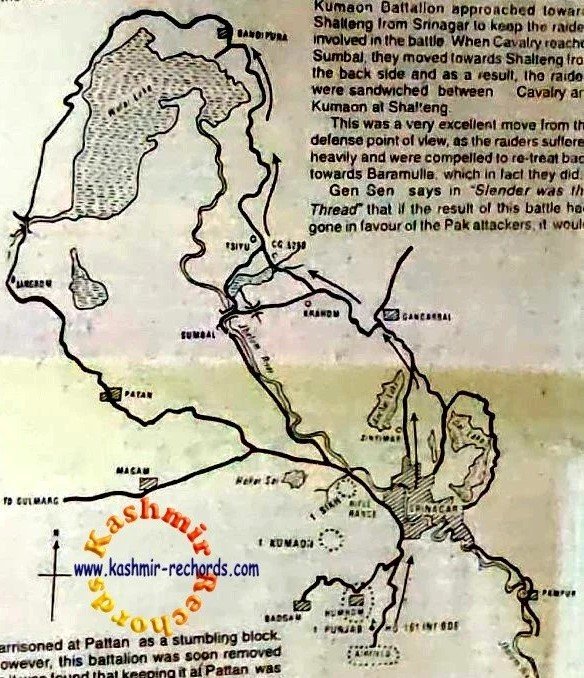
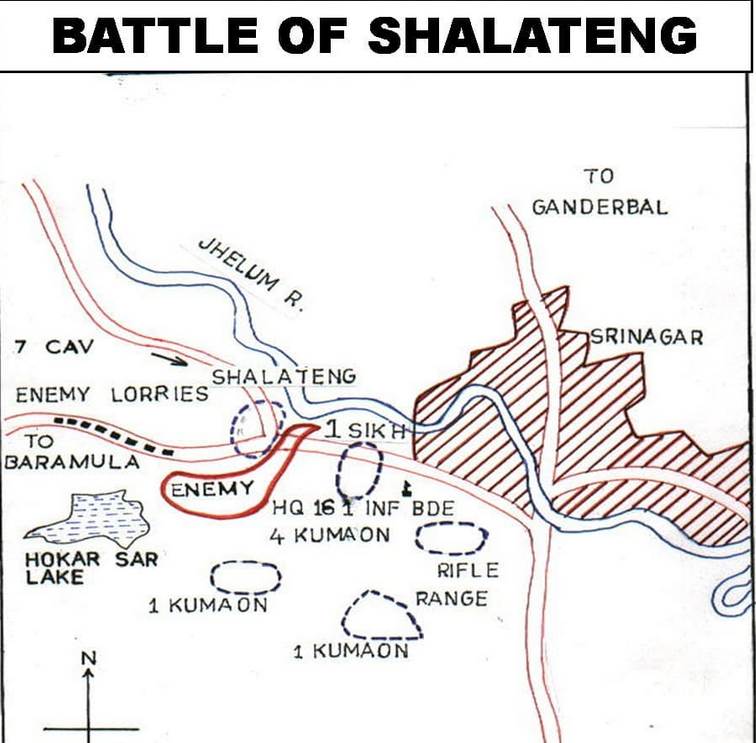
At dawn on November 7, 1947, the Indian Army struck back with precision and resolve. Under the leadership of Lt. Gen. L.P. Sen, commander of the 161 Infantry Brigade, Indian troops launched a meticulously planned Pincer Attack on the enemy.
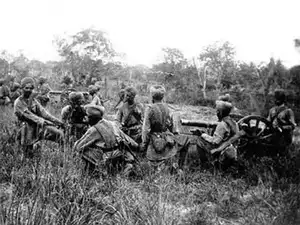
1 Sikh, 1 Kumaon and 4 Kumaon Regiments spearheaded the frontal assault. Armoured cars of the 7th Light Cavalry, secretly maneuvered through Sumbal via Ganderbal, struck from the rear. Spitfire aircraft of the Royal Indian Air Force (RIAF) strafed enemy positions from the skies, scattering their formations.
Completely taken by surprise, the Pakistani tribal forces — which included regular soldiers in disguise — were trapped between advancing Indian units. What followed was a rout. Over 600 raiders were killed, hundreds fled in panic, abandoning lorries, arms and ammunition on the battlefield.
By nightfall, Indian troops had pushed through to Pattan town. The next morning, they reached Baramulla, and within a week, the entire stretch up to Uri was recaptured. The tide of the war had decisively turned.
“Slender Was the Thread” — The Commander’s Own Words
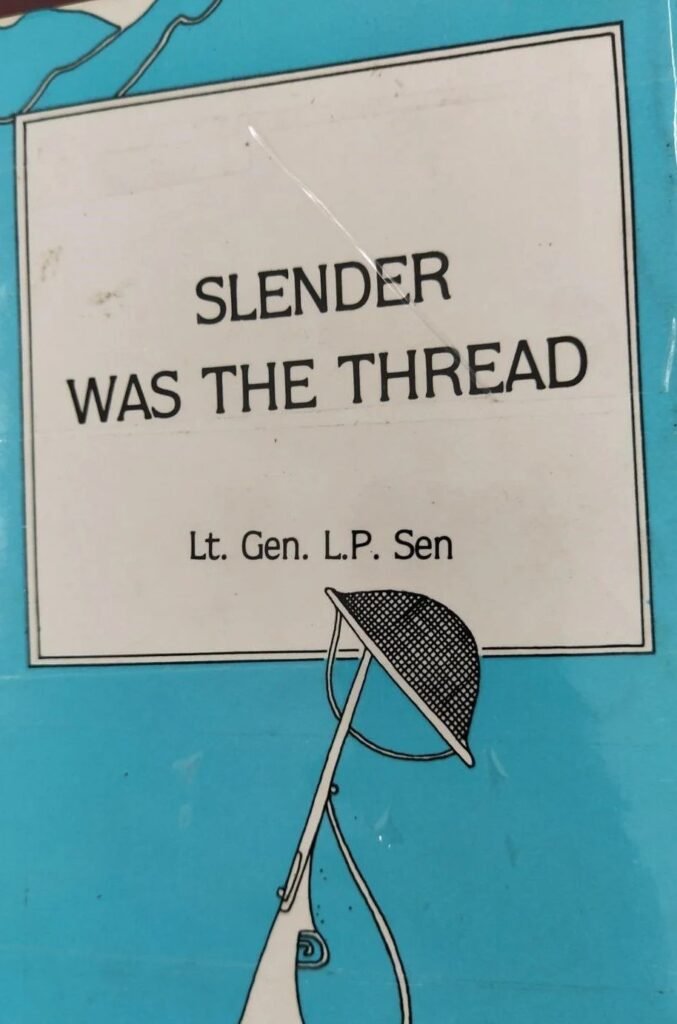
In his celebrated memoir, “Slender Was the Thread,” Lt. Gen. L.P. Sen recounts the tense, chaotic days when Kashmir’s fate hung by a thread. He notes that the entire counteroffensive at Shalateng lasted barely 20 minutes from the command ‘Go!’ — yet its outcome altered the history of the subcontinent.
The battle also underscored the collaboration between Indian military forces and local Kashmiri support, which was instrumental in the success of this operation. The Battle of Shalateng also remains a powerful symbol of the determination, strategy and sacrifice that defined India’s early years of independence, embodying a legacy of resilience and tactical prowess. He credits Sheikh Mohammad Abdullah‘s National Conference workers for suggesting and guiding the cavalry’s redeployment through Sumbal, a move that proved crucial in outflanking the enemy.
When Srinagar Slept, History Awoke
Curiously, as the battle raged only a few kilometers away, most residents of Srinagar , according to the book remained unaware of the decisive encounter unfolding in their backyard. The city’s calm was deceptive; the outcome of that unseen battle determined whether Srinagar would fall to invaders or stand free. When news of victory reached the city, joy and relief swept across the Valley. For the first time in weeks, Kashmiris dared to hope again. Thus The Battle of Shalateng was not merely a military engagement — it was the moment that saved Kashmir. The triumph secured Srinagar, ensured the safe landing of reinforcements and provided India the breathing space to consolidate its hold over the Valley.
Had the outcome been different, as Gen. L. P Sen himself admitted, “it would have been nearly impossible to save Kashmir.” In his own words “The thread was slender — but it held. And with it, held the fate of Kashmir”
The battle also exposed the direct involvement of Pakistan’s regular troops among the so-called tribal invaders — a fact that shaped the trajectory of the conflict and the politics of the region for decades to come.
While countless battles fought on Indian soil are etched in public memory, the Battle of Shalateng remains a forgotten gem of courage and strategy. It deserves its place alongside India’s greatest military victories — not merely for its tactical brilliance, but for what it meant to the soul of a newly independent nation.
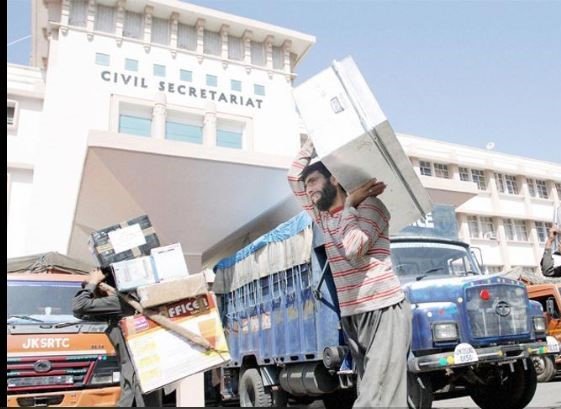
Even as the erstwhile State of Jammu and Kashmir was still recovering from the communal unrest of February 1986 — when riots that began in Anantnag rippled through both the Valley and Jammu — another storm brewed the following year. On October 7, 1987, the the State government of Dr. Farooq Abdullah dropped a political bombshell: the historic Darbar Move, a 19th-century tradition that had symbolically bound the two regions, was to be disbanded in the name of “money saving and administrative efficiency.”
The announcement rekindled deep regional fault lines. Jammu erupted in anger; the Valley watched cautiously. The Move — a twice-yearly shifting of the State’s civil secretariat and government offices between Srinagar (summer capital) and Jammu (winter capital) — was not merely a logistical exercise. For over a century, it had embodied `administrative parity and emotional unity ‘between two culturally distinct halves of the state.
Introduced under Dogra rule in the 1870s, the Darbar Move had a practical origin: harsh Kashmiri winters made Srinagar inaccessible, prompting the Maharajas to shift governance to Jammu. Over time, it evolved into a ritual that represented equitable governance — the government in both capitals, every year, like a pendulum of shared belonging. Traders, hoteliers, transporters, and clerks across regions waited for it with hope, knowing the Move meant seasonal livelihood and inter-regional mingling.
1987: When Efficiency Met Emotion
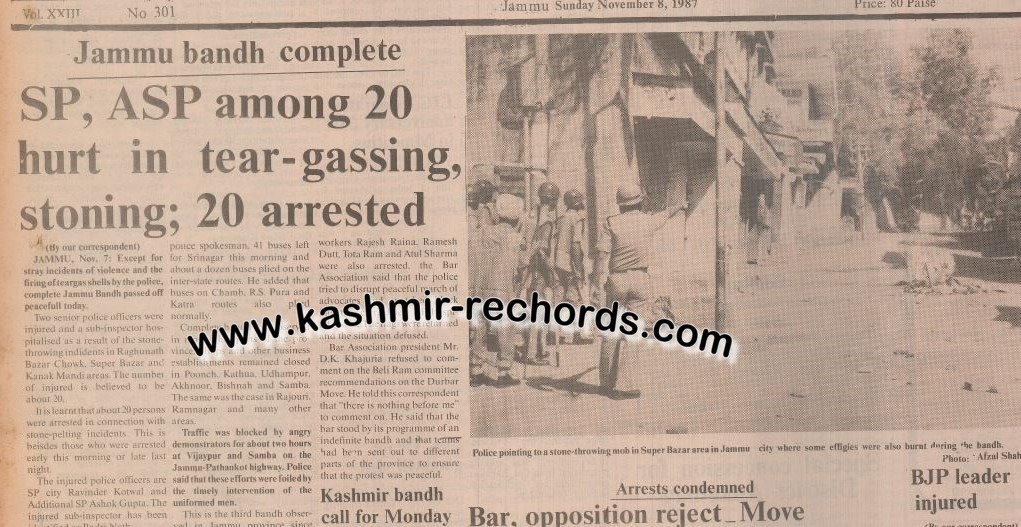
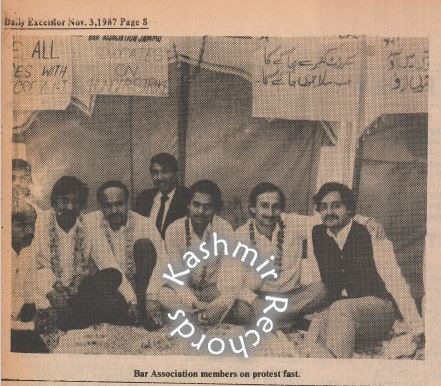
In 1987, the government’s plan to make Srinagar the permanent capital and keep a few departments permanently stationed in Jammu triggered one of the fiercest regional agitations in J&K’s history. The Jammu Bar Association spearheaded the protests, joined by the Bharatiya Janata Party and other pro-Jammu groups. For weeks, Jammu witnessed bandhs, rallies, court arrests, and lathi-charges. Lawyers took to the streets; public meetings turned massive. Even the Valley’s lawyers launched a parallel agitation, echoing Jammu’s sentiment of perceived neglect.
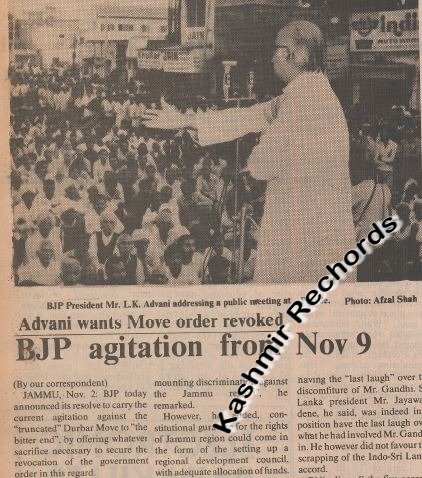
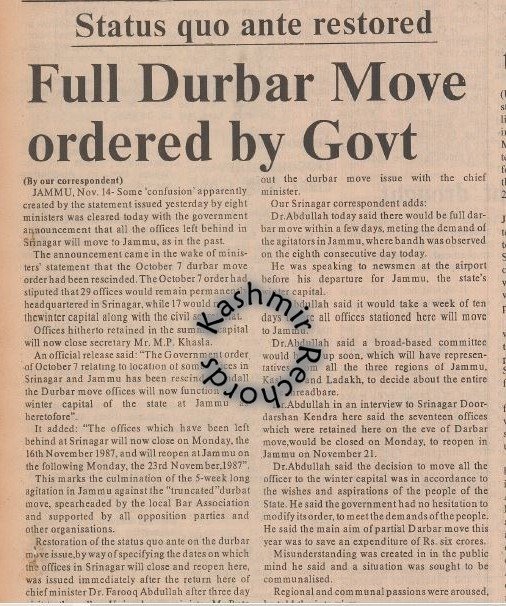
The agitation drew national attention. Lal Krishna Advani, then BJP president, camped in Jammu, while Union Home Minister Buta Singh rushed to the region to defuse tensions. Eventually, the Centre intervened, directing the State to withdraw the October 7, 1987 order. Farooq Abdullah’s government had to retreat — a recognition that administrative logic could not override emotional equity.
The episode etched a political lesson that endures: efficiency arguments falter when they collide with regional pride and livelihood concerns.
2019–2021: The Digital Era and a Familiar Divide
Fast forward to August 5, 2019 — the abrogation of Article 370 transformed J&K’s political map into a Union Territory. Amid this tectonic shift came a new rationale to end the Move: digital governance. By 2020, as the COVID-19 pandemic raged, the Darbar Move was suspended. The Lieutenant Governor’s administration, citing e-office digitisation, declared that physical file transfers were obsolete. In June 2021, it formally abolished the 149-year-old practice, estimating an annual saving of ₹200 crore.
But the announcement reopened old wounds. Jammu’s traders and civil society groups protested, lamenting both the economic loss and the symbolic erosion of equality. Unlike 1987, there was no mass agitation under central rule — yet the hurt simmered. For Jammu, the Move’s end was the loss of a ritual that validated its political parity. For the Valley, reactions were mixed; some saw logic, others saw politics.
2025: Return of the Ritual
Just as the memory of the Move had begun to fade, October 2025 brought another twist. The newly elected government, led by Chief Minister Omar Abdullah, announced the restoration of the biannual Darbar Move, citing it as a gesture of regional balance and a fulfillment of electoral promises.
The decision sparked jubilation in Jammu. Marketplaces buzzed with celebration; social media flooded with posts of “justice restored.” Traders hailed it as an economic revival; employees saw it as a return to normalcy. The Valley, however, responded with measured silence — some questioning whether reviving a costly ritual aligned with modern governance priorities.
Analysts observed that beyond nostalgia, the Move’s revival carried political undertones — a statement of inclusivity, but also an appeal to sentiment.
A Bridge of Unity or a Mirror of Division?
Every phase of the Darbar Move — from the 1987 agitation to the 2021 abolition and now the 2025 revival — underscores how deeply this tradition is interwoven with J&K’s socio-political psyche. Each decision about it has split opinion, mobilised emotions, and redefined the contours of Jammu–Kashmir relations.
Yet beneath the politics lies a truth worth remembering: the Darbar Move, despite its cost and inconvenience, served as a living bridge. It brought two culturally and climatically distinct regions under one administrative rhythm — fostering cross-regional ties, seasonal livelihoods, and a rare sense of shared governance.
Whether seen as an outdated burden or a cherished bond, the Darbar Move continues to remind the people of Jammu and Kashmir that unity is often carried not in files or offices, but in the traditions that make a diverse land feel like one.
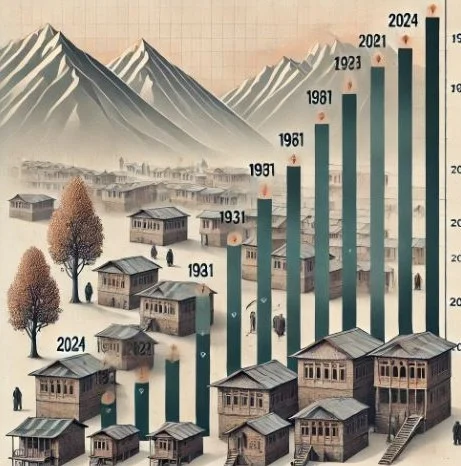
If the records and Census Reports are to be relied upon, over the past century, the Kashmiri Pandit community has witnessed a staggering decline in its population within the Kashmir Valley, a change so profound that it is often described as a case of ethnic cleansing.
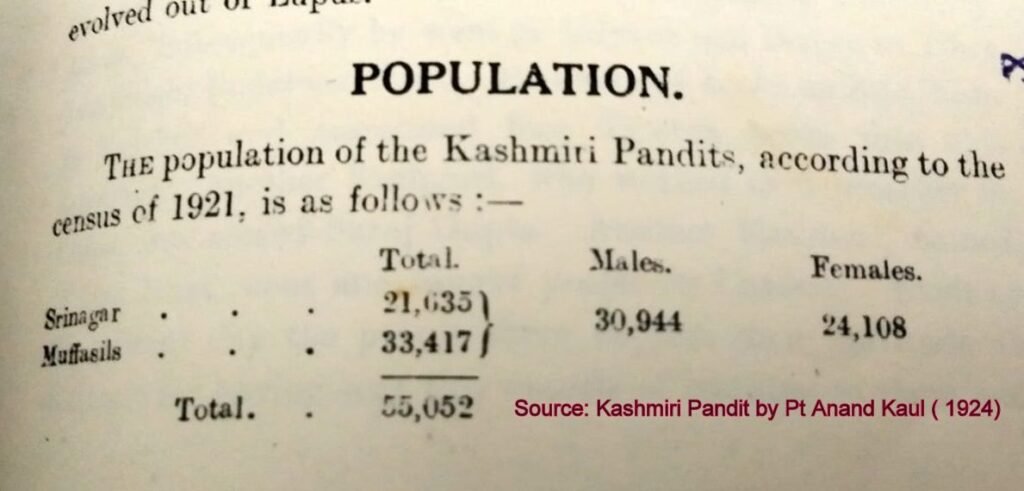
In 1921, the Jammu and Kashmir State Census recorded 55,052 Kashmiri Pandits residing in the Valley, as noted in Pt. Anand Kaul’s 1924 book Kashmiri Pandits. Of this number, 21,635 lived in Srinagar, while 33,417 were spread across rural areas. Despite their modest population, they maintained a healthy sex ratio with 30,944 males and 24,108 females. Far from the “elite ruling class” narrative, only seven Pandits held gazetted positions in Government jobs at that time!
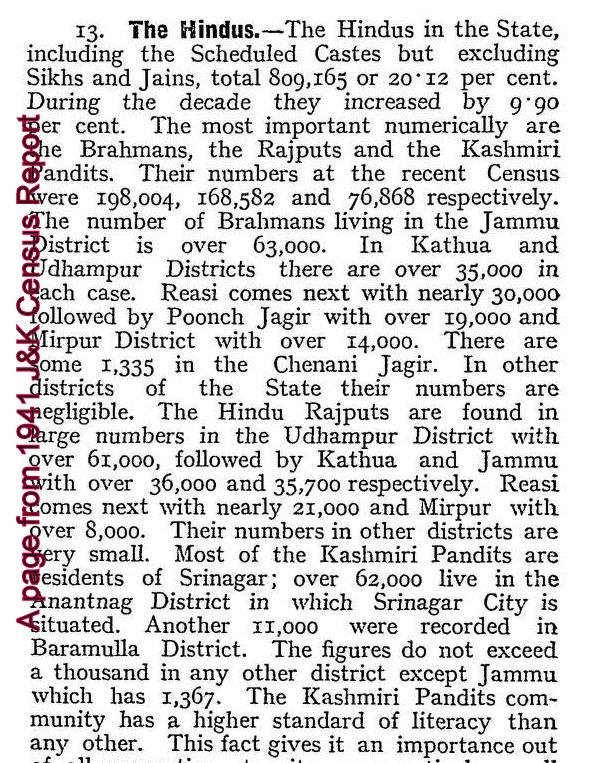
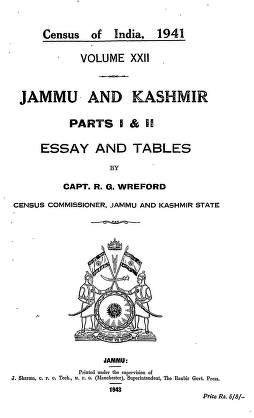
The records assessed by Kashmir Rechords reveal that by 1931, the population grew to 63,108, marking a modest increase of 8,056 over a decade. The 1941 census recorded total number of 78,800 Kashmiri Pandits living in the Valley, distributed across the two existing districts: Baramulla and Anantnag. Interestingly, Srinagar , housing a significant portion of the Kashmiri Pandit population, was a part of Anantnag district until 1951.
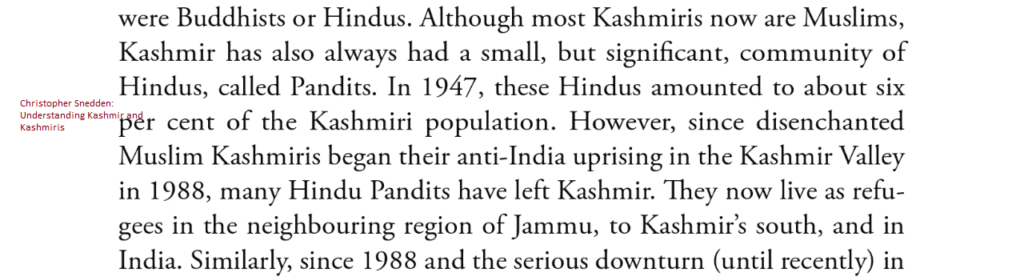
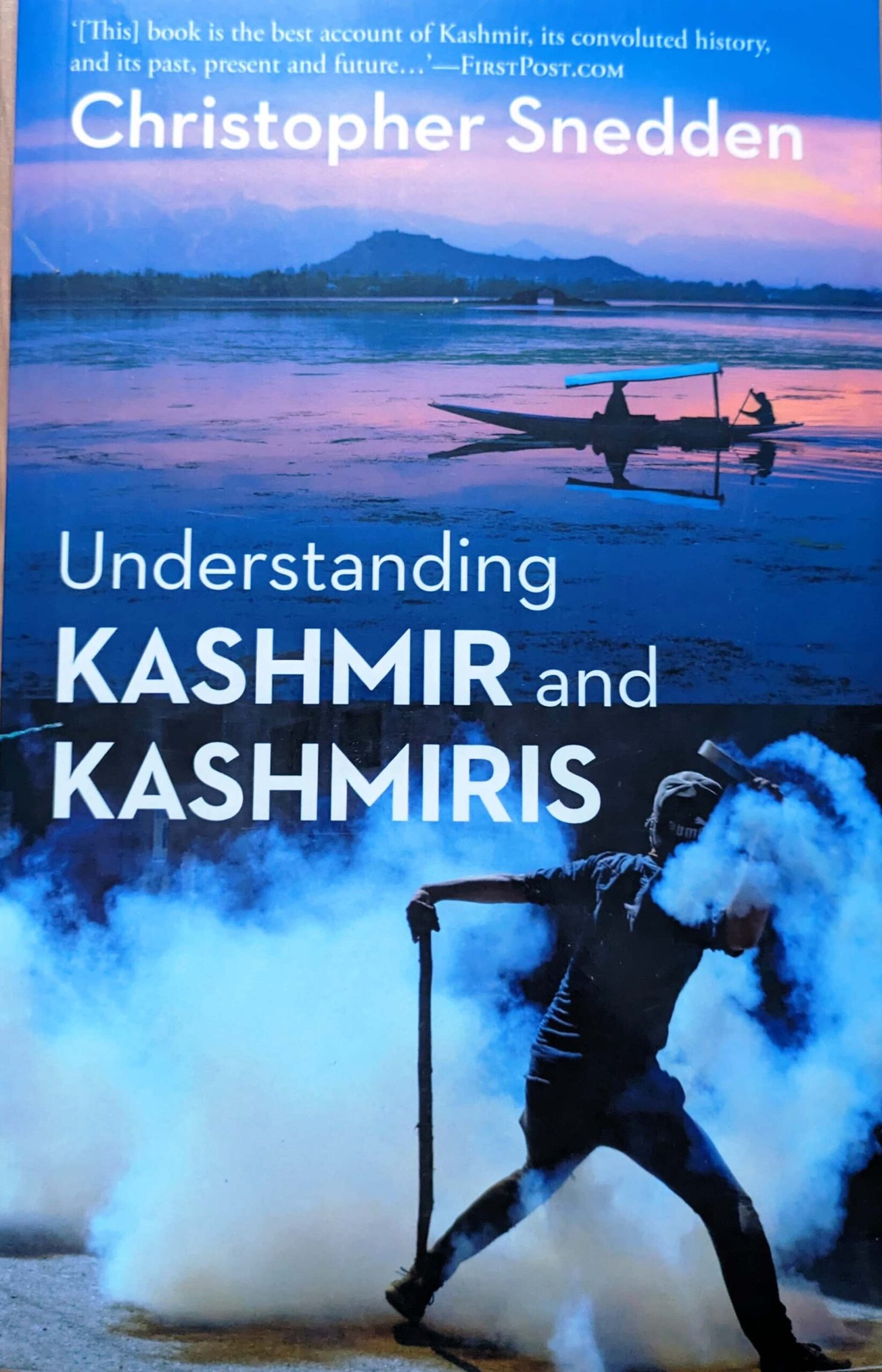
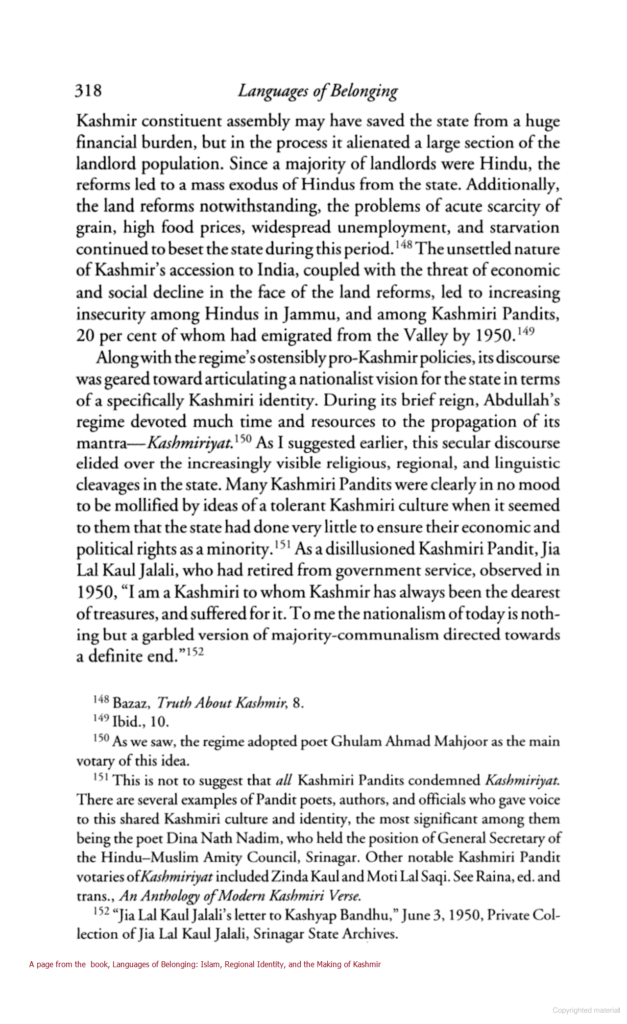
As per historian Christopher Snedden, Kashmiri Pandits made up about 6% of the Valley’s population in 1947. However, post-independence policies such as land redistribution and socio-political upheaval led many to further migrate to other parts of India. By the 1950s, their proportion fell to just 5% of the Valley’s population, says Christopher Snedden in his book “Understanding Kashmir and Kashmiris”.
Exodus and Ethnic Cleansing
The 1981 census checked out by Kashmir Rechords, recorded 124,078 Kashmiri Pandits in the Valley. By 1986 ( Anantnag riots) and late 1980s, as insurgency gripped Kashmir, threats and targeted violence against Pandits forced an overwhelming majority to flee. An estimated 140,000 to 170,000 Pandits left their ancestral homes in Kashmir, seeking refuge in Jammu, Delhi, and beyond.
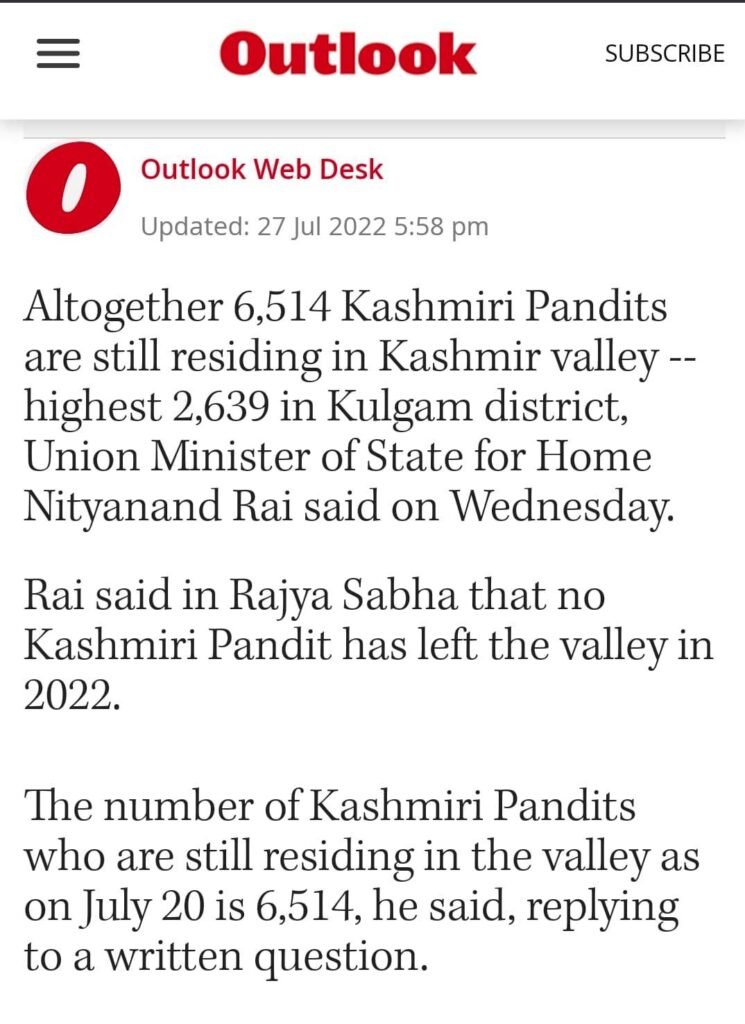
What followed was a catastrophic demographic collapse! By 2011, fewer than 3,400 Kashmiri Pandits remained in the Valley—a 98% drop from the late 1980s. The 2022 statement by the then Union Minister of State for Home Affairs, Nityanand Rai on the Floor of the House, revealed that this number had risen marginally to 6,514, with the highest concentration (2,639) in Kulgam district. Despite government efforts, including employment packages under the Prime Minister’s initiative, the dream of a large-scale return remains unfulfilled.
Amid the exodus, a handful of Pandits all these years chose to stay, weathering threats and violence. Yet, their existence was marred by continued violence. Apart from earlier massacres, even between 2020 and 2022, over 12 more Kashmiri Pandits were killed by terrorists, a stark reminder of the dangers they still face!
A Community on the Brink
The disappearance of Kashmiri Pandits from the Valley raises profound questions about the future of Kashmir’s social fabric. As Alexander Evans observes, the loss of this small yet significant minority leaves a void, changing the character of the region forever.
Over a century, the population of Kashmiri Pandits in the Valley has plummeted from 55,052 in 1921 to a mere 6,514 . This decline is not just a statistic but a testament to the trials of a community uprooted from its homeland. Their story is one of survival, resilience and a longing to return to the land of their ancestors.
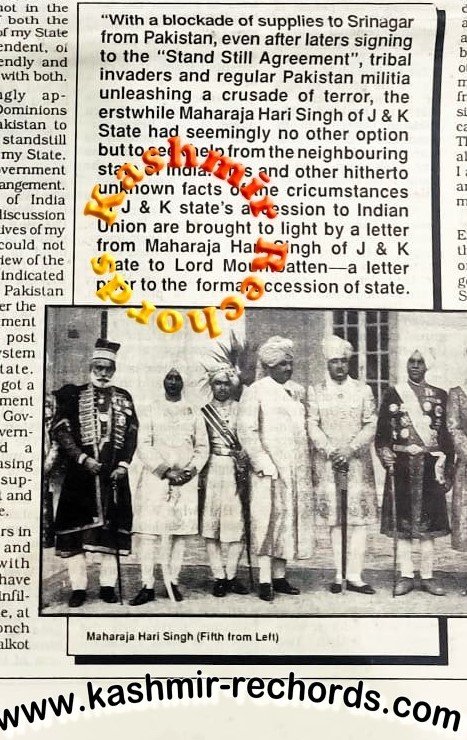
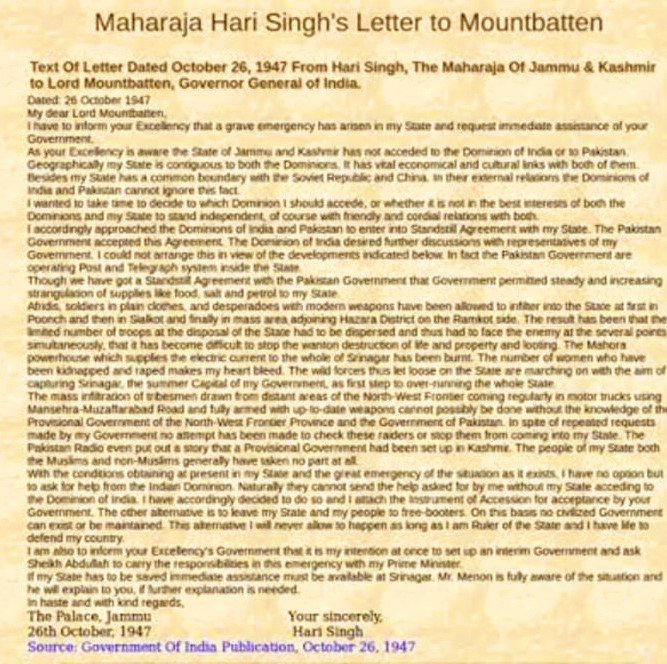
Following the October 1947 tribal raid on the Princely State of Jammu and Kashmir, Maharaja Hari Singh acceded to the Indian Union after signing the Instrument of Accession with India. Along with the accession documents, Maharaja Hari Singh had also written a letter to Lord Mountbatten, the last Viceroy of India. The letter, written on October 26, 1947 was, however, addressed to Lord Mountbatten in the capacity of the first Governor General of free India. (Lord Mountbatten had taken over as first Governor General of India after August 15, 1947 till June 21, 1948)
Kashmir Rechords is reproducing excerpts of the historic letter, written “In Haste’’ by Maharaja Hari Singh to Lord Mountbatten. In the letter, Maharaja Hari Singh touches upon issues like Standstill Agreement, Pakistani tribals’ mass infiltration into Jammu and Kashmir from many areas, burning of Mahora Power House, kidnapping and raping of women-folk by Pakistani-backed raiders. The Maharaja regrets that in spite of his repeated requests, “no attempts were made to check these raiders or stop them from coming into my State’’.
`I have no option but to ask for help from India’
In his letter addressed to Lord Mountbatten, Maharaja Hari Singh mentions that he had “no option but to ask for help from the Indian Dominion’’. ”Naturally, they cannot send the help asked for by me without my State acceding to the Dominion of India. I have accordingly decided to do so and I attach the Instrument of Accession for acceptance by your Government. The other alternative is to leave my State and my people to free-looters. On this basis, no civilized Government can exist or be maintained. This alternative I will never allow to happen as long as I am Ruler of the State and I have life to defend my country’’.
In a historic and emotional move, Jammu and Kashmir Government has begun issuing Domicile Certificates to the survivors of the 1947 Muzaffarabad and Mirpur massacres. This bold initiative transcends legal formality—it symbolizes justice, reclamation, and a vital step towards integrating all parts of Jammu and Kashmir under India’s control. The issuance of these certificates not only acknowledges the suffering of the survivors but also underscores the government’s determination to reunify the region, long divided by conflict and external occupation.
Bold & Clear: R/o Kotli, Muzaffarabad, Jammu and Kashmir
A Century-Long Journey of Identity and Survival
For the people of Jammu, Kashmir and Ladakh, the journey from the status of State Subject to Permanent Resident and now to Domicile, has been an odyssey spanning nearly a century. It captures the resilience of these communities, transitioning from the British Raj to post-Independence India, and now to Bharat. This latest development is particularly meaningful for the descendants of massacre survivors, whose ancestral homes lie in what is now Pakistan-occupied Kashmir (PoK). For them, the Domicile Certificate is more than a legal document—it is a powerful recognition of their rightful place in modern India.
Recognition of Historical Roots and Suffering
In 2020, the Union Territory (UT) of Jammu and Kashmir issued administrative orders replacing the old State Subject with the new Domicile Certificates, signifying a major shift in the legal recognition of its residents. While the new rules extend eligibility to various categories of individuals—such as those who have served or studied in Jammu and Kashmir—the most profound aspect of this move is its recognition of the survivors of the Mirpur and Muzaffarabadmassacres.
J&K Domicile Certificates to Muzaffarabad Massacre Survivors and their decedents
For the first time, these survivors and their descendants, who lost their ancestral homes during the 1947 invasion, are now officially recognized as domiciles of Jammu and Kashmir. To ensure that more bonafide migrants can reclaim their status, the government in October 2024 had extended the deadline for obtaining Domicile Certificates to May 15, 2025.
Symbolism of the New Certificates
The Domicile Certificates issued to massacre survivors prominently feature the names of their ancestral villages in Muzaffarabad and Mirpur. This is more than symbolic; it reflects the government’s commitment to reclaiming PoK and reintegrating it with India. These certificates, issued under the authority of the J&K Relief and Rehabilitation Commissioner (Migrant), send a clear message: these lands are still an integral part of India.
We, the descendants of Muzaffarabad Massacre Survivors
Political Shift After the Abrogation of Articles 370 and 35A
The political landscape of Jammu and Kashmir changed dramatically after the abrogation of Articles 370 and 35A in August 2019, enabling the central government to fully integrate the region with the rest of India. This has paved the way for decisive actions like the issuance of Domicile Certificates to the survivors of the 1947 Muzaffarabad massacres. The move also aligns with India’s broader strategy to reclaim territories illegally occupied by Pakistan, as enshrined in the Parliament’s 1994 resolution.
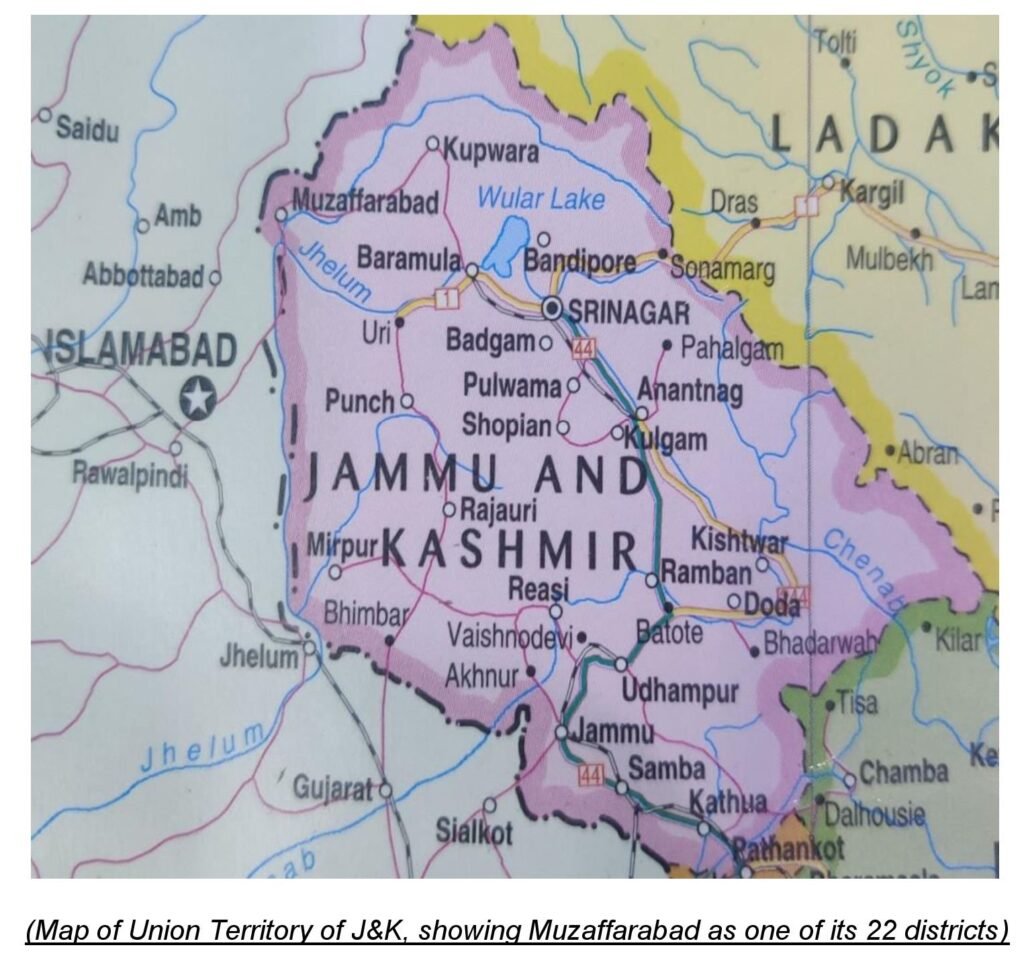
Following this, the Survey General of India released a new political map in 2019, including Muzaffarabad and Mirpur as districts of the Union Territory of Jammu and Kashmir, further asserting that these regions remain part of India.
Reclaiming Lost Territory, Sending a Bold Message
The fall of Muzaffarabad to Pashtun tribes backed by Pakistan on October 22, 1947, marked the beginning of a dark period in Jammu and Kashmir’s history. Thousands were massacred, and survivors were forced to flee, leaving behind homes that they never saw again. Now, with the issuance of Domicile Certificates to their descendants, the Indian government is righting the wrongs of the past. The recognition of these survivors is not only a legal gesture but a bold statement of India’s intent to reunify Jammu and Kashmir.
This move strengthens India’s legal and moral claim to the region while eroding Pakistan’s narrative. By officially recognizing the residents of Muzaffarabad, the government is demonstrating an unwavering commitment to reclaiming Pakistan-occupied Kashmir (PoK).
A Symbol of Justice for Survivors
For the survivors of the massacres and their descendants, these certificates are more than just legal documentation. They are a symbol of justice and recognition, acknowledging their lost homes and heritage. Decades after the tragic events of 1947, the Indian government is addressing their plight, ensuring their ancestral roots are acknowledged and their rights restored.
The 1994 resolution passed by the Indian Parliament clearly calls for Pakistan to vacate the occupied territories. By issuing Domicile Certificates and redrawing the political map without LoC and to include Muzaffarabad and Mirpur in the UT of J&K, the government is making a strong push to achieve this goal.
A Strategic Masterstroke in Geopolitics
In the broader context of international geopolitics, this move sends a powerful message to Pakistan and the global community. It reaffirms India’s stance on PoK and highlights its commitment to reclaiming and integrating all parts of Jammu and Kashmir. By acknowledging the ancestral roots of the massacre survivors, the government is addressing a long-standing historical injustice while making a strategic move to unsettle Pakistan. This calculated masterstroke bolsters pro-India sentiments within PoK and reinforces India’s rightful claim to the region.
* Dr.Rajesh Bhat is a Kashmir-born Journalist, Writer and Researcher, formerly associated with Daily Excelsior, Jammu and The Tribune, Chandigarh. He is the Author of Radio Kashmir in Times of Peace & War.
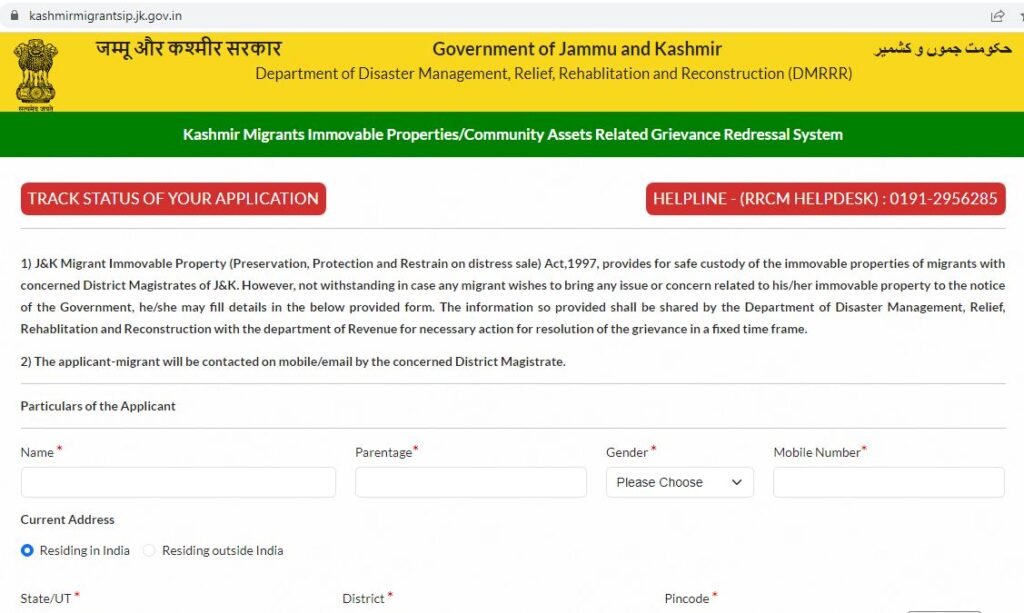
When governments talk about Digital Governance and Citizen Service, citizens expect results — not deceit. But in Jammu and Kashmir, the official website created to help displaced Kashmiri Pandits reclaim their properties has turned into a symbol of betrayal and bureaucratic arrogance.
The Kashmir Migrants Immovable Properties/Community Assets Related Grievance Redressal System — grandly launched under the Department of Disaster Management, Relief, Rehabilitation and Reconstruction (DMRRR) — stands today as one of the most shameless failures of the administration.
A Portal That Won’t Even Let You Complain
The tragedy begins the moment a migrant tries to file a grievance.
The site (https://kashmirmigrantsip.jk.gov.in/)demands an OTP verification on the applicant’s email before a complaint can be submitted. But the OTP never arrives. Ever.
The result? Hundreds of Kashmiri Pandits spend hours filling out their personal and property details — only to realize that they can’t even submit their complaints. The process ends midway, locked behind a non-existent OTP.
This is not a glitch. It’s a deliberate negligence, a mockery of an already battered community.
For a government that claims to stand by displaced Kashmiri Pandits, this “portal”, e-Service developed and hosted by Jammu and Kashmir e-Governance Agency (JaKeGA), is a cruel joke —a bureaucratic black hole designed to absorb pain and deliver nothing.
Bogus Helpline, Hollow Promises
The deception doesn’t stop there. The so-called helpline number —0191-2956285 — is dead. Invalid. Non-functional.
No official responds. No technical team exists. No acknowledgement ever comes.
The site claims that “the applicant will be contacted by the concerned District Magistrate.” But no migrant has ever received a call, an email, or even a token response.
It’s all false assurance, sugar-coated in government logos and press releases.
When Technology Becomes Tyranny
Digital platforms were meant to make governance transparent. In Jammu and Kashmir, they’ve become instruments of indifference.
A website that stops citizens from filing complaints is not a service — it is state-sponsored silence.
When officials create such portals for optics and forget them the next day, it’s not inefficiency — it’s dishonesty.
This portal has not just failed to serve its purpose; it has blocked access to justice. It stands as a digital monument to everything that is wrong with governance — unaccountable, faceless and devoid of empathy.
Accountability: The Word Bureaucrats Fear Most
Has anyone in the DMRRR ever verified how many migrants tried to file a complaint? How many managed to submit one? How many were resolved?
No answers. No reports. No accountability.
The bureaucrats who designed and abandoned this website will continue to draw their salaries, untouched by the anguish of those they were supposed to serve.
For the displaced Kashmiri Pandit, every failed OTP is another reminder that the system is designed to forget them.
Behind every attempt to log in is a story — of a man or woman clinging to a memory of their home, their courtyard, their orchard now under someone else’s control.
To ask for help and receive nothing — not even a functional website — is not just negligence. It is moral bankruptcy.
Governance is not about launching portals. It’s about keeping promises. When promises are replaced with no OTPs and dead helplines, governance becomes mockery.
What Must Be Done — Now
If there is still a shred of sincerity left in the system, the government must act immediately:
* Fix the portal and make the OTP system functional.
* Verify and activate the helpline with real human operators.
* Audit every technical and administrative aspect of the site.
* Publish quarterly data showing how many complaints were filed, processed and resolved.
* Ensure that officials responsible for this failure are named and held accountable.
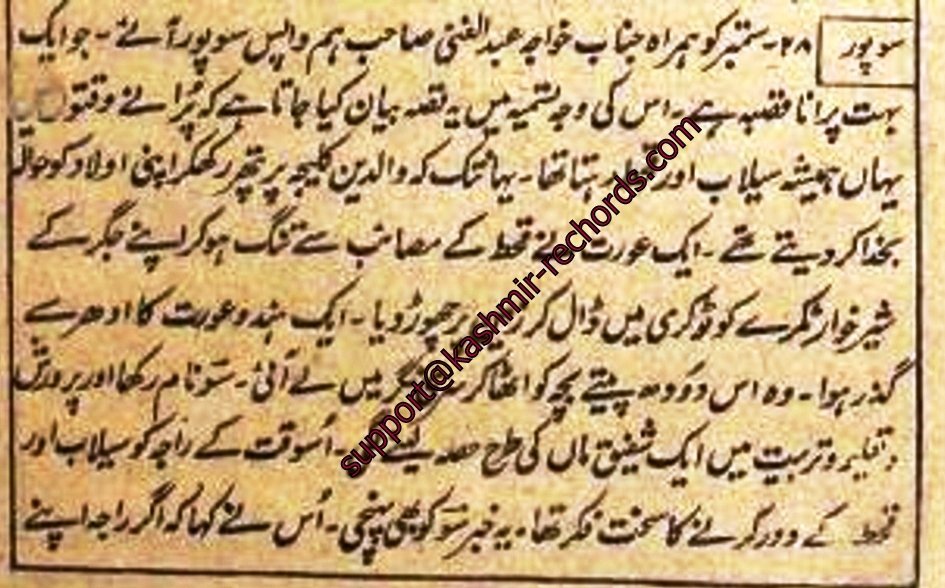
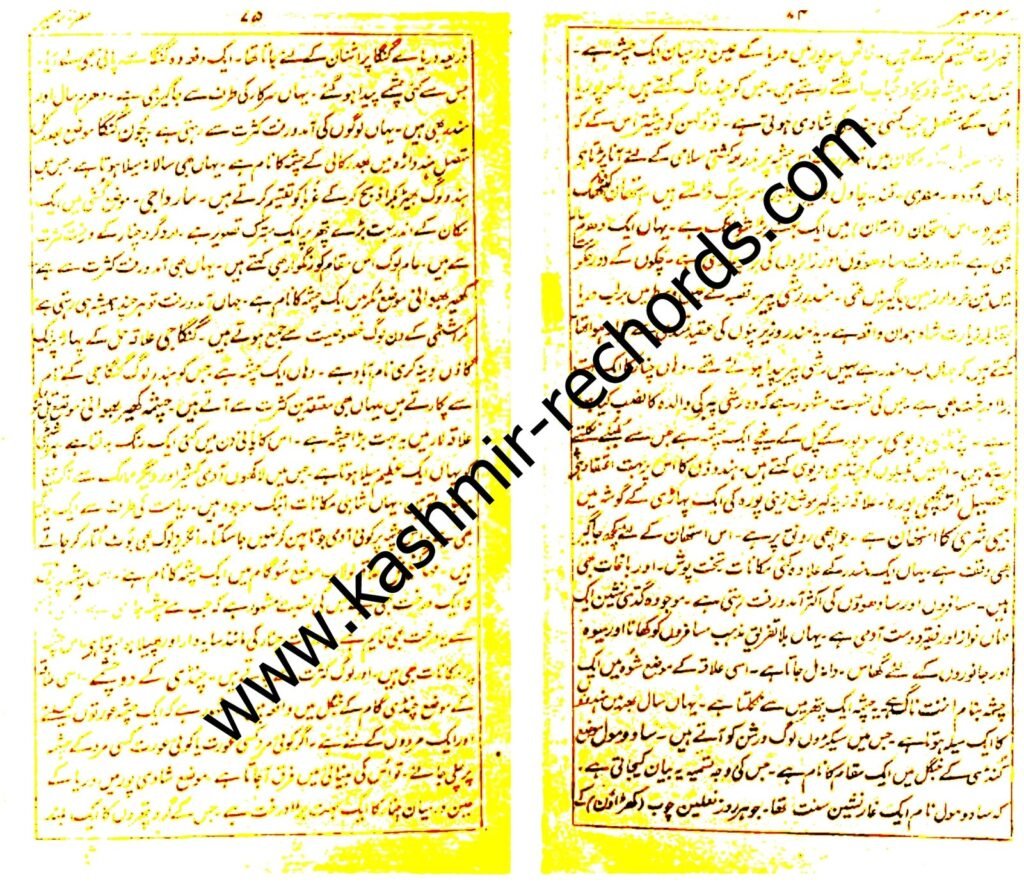
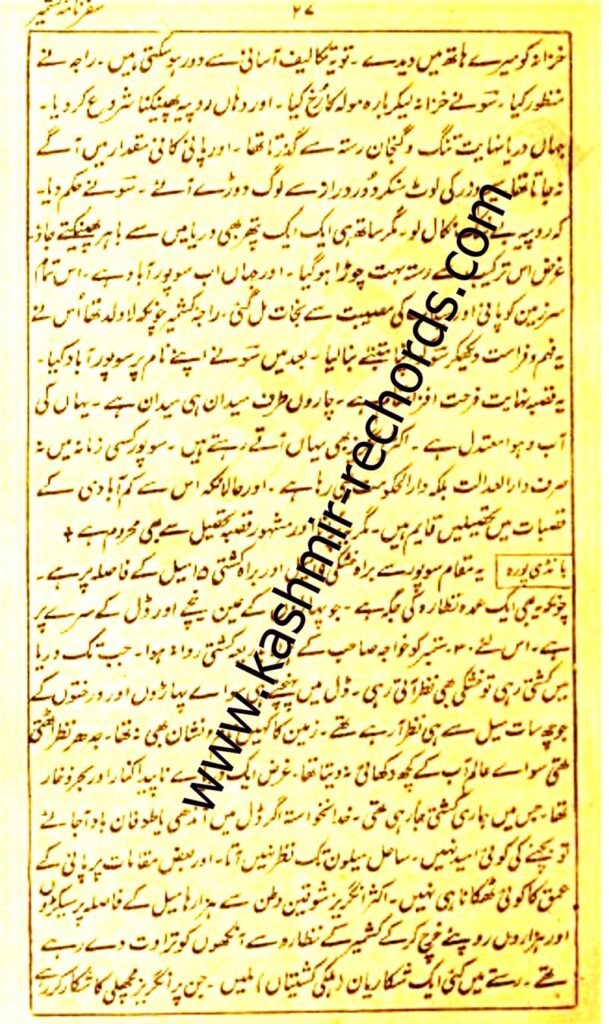
The northern part of Kashmir is rich in shrines and temples historically significant to the Kashmiri Pandits. These sacred structures, once documented by Kashmiri Muslim scholars and travelers a century ago, have largely been forgotten by contemporary historians and writers. However, thanks to the meticulous work of Mohammad Din Fauq, a celebrated writer and journalism pioneer, the legacy of these shrines is not entirely lost.
During his visit to Kashmir in December 1907, Fauq, born in 1877 in Sialkot, then part of the Jammu Province, extensively documented the temples and shrines of Kashmiri Pandits in North Kashmir. Despite passing away in Lahore in 1945, his connection to Kashmir remained unwavering, and his works continue to shed light on the region’s rich cultural and historical heritage.
Fauq’s Pioneering Documentation
Fauq’s travelogue, “Kashmir Safarnama,” of 1907 is a treasure trove of information on ancient Hindu shrines that once adorned Kashmir’s landscape. Hailing from the Dar clan, with ancestral roots in Hardu Shiva, and Sopore, Fauq’s detailed accounts of these shrines offer invaluable insights.
In his “Kashmir Safarnama, of 1907, “ Fauq meticulously records numerous ancient Hindu shrines, such as:
Nandkeshwar Temple, Seer Jagir, Sopore: Known for animal sacrifices by devotees.
Chander Naag, Sopore: A unique site in the Jehlum River near Sopore, where Kashmiri Pandits traditionally take their brides to pay obeisance.
Bhairav Temple, Sopore: Referred to by Fauq as “Kantak Bhairav,” housing a large historical Shivlingam.
Resh Peer Temple, Sopore: Constructed under the direction of Wazir Pannun, a devout follower of Saint Resh Peer.
Chandi Devi Tirath, Sopore: A notable spring in the Jehlum River beneath the Sopore bridge.
Historical Shrines in Baramulla, Kupwara
In his travelogue, Fauq also documents various other shrines, including:
Bomai Shree and Shiva Shrines, Zainagir, Sopore: A significant stop for pilgrims on their way to Sharda at Teetwal.
Koti Tirath and Gosain Taing, Baramulla: Temples encircling a sacred spring and a historical site along the Baramulla–Uri road.
Shrines in Kupwara: Including the Kandi Kupwara temple and Dharamshala, the famous Bhadarkali temple, and Shadipora (Shardapur) Safapora, known as Kashmir’s Prayag.
A Legacy of Preservation
Fauq’s work extends beyond just “Kashmir Safarnama.” He authored over a hundred books, including “Mukammil Taareekhe Kashmir,” “Taareekhe Aquame Kashmir,” and “Tazkira E Sultan Zainul Abedin.” These writings have played a crucial role in documenting and preserving Kashmir’s cultural and historical heritage.
As Kashmiri Pandits strive to reclaim their historical shrines, Mohammad Din Fauq’s meticulous documentation remains invaluable. His unbiased and detailed accounts ensure that the rich civilizational heritage of Kashmir, so deeply cherished by its people, will endure for generations to come.
Signing of the Instrument of Accession by Maharaja Hari Singh of the then Princely State of Jammu and Kashmir on October 26, 1947 was the worst shock for Pakistan and that country is still not able to reconcile to this fact!
Even on the day of accession, huge displeasure was witnessed by Pakistani media, who used the choicest of invectives against one and all, especially targeting Maharaja Hari Singh, India and Sheikh Mohd Abdullah.
When Consternation Swept Pakistan
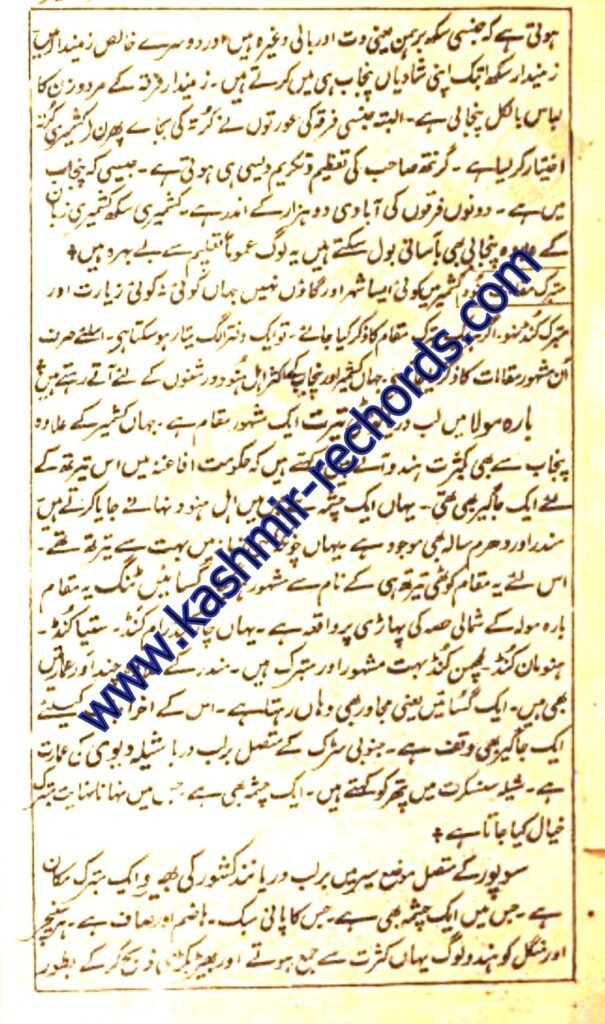
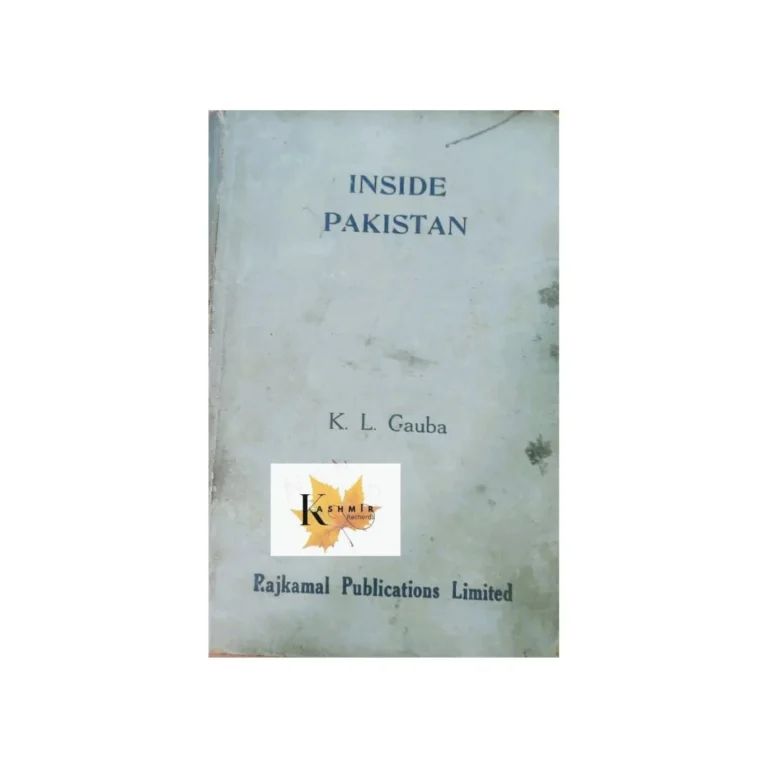
Eminent lawyer and writer, K L Gauba in his famous Book “Inside Pakistan’’ (1948) says following the news of accession of Jammu and Kashmir with the Indian Dominion, “consternation swept Pakistan’’. “I remember the day at Lahore High Court Bar Association. I have never seen longer and more dismal countenances. The faces that had a glow of Pride while Shahami Gate and Rang Mahal were on fire, were no longer lit with Pakistan pride’’, Gauba gives the first-hand account of that day in Pakistan.
Ferocious write-ups against India
A Page from Inside Pakistan
Gauba mentions how ferocious articles flowed from the press rooms under the caption “Treachery’’, and “Pakistan Times’’ taking the leading role through its series of editorials “denouncing’’ the accession that had come as a rude shock for Pakistani military establishment and her leadership.
Kashmir Rechordsis reproducing one of the Editorials of “Pakistan Times’’, carried by K L Gauba in his book “Inside Pakistan’’.
Even greater wrath was stored for Sheikh Abdullah. “Pakistan Times” in another editorial had mentioned: “The author of the `Quit Kashmir’ Movement has suddenly been converted to the slogan of `Do not Quit Kashmir’, and the Dogra House that was yesterday the worst enemy of the Kashmiri people has now become, in the Sheikh’s eyes, its only saviour’’.
Sheikh Abdullah was accused of “maneuvering himself into a position where the only role he can play is to help in the butchery of his own people and be an ineffective second fiddle to the Maharaja and his helpers from abroad’’.
The Pakistani Press had accused both Nehru’s Government and the leader of the National Conference “guilty of treachery’’. In its journey of 76 years, Jammu and Kashmir has moved ahead and progressed leaps and bounds, but the Pakistani media all these years continues to spit venom against India with the same intensity and frustration.
A new storm is sweeping through Jammu and Kashmir’s literary and cultural circles. The spark? A centuries-old question: Where lies Habba Khatoon, the poetess whose verses once made mountains weep?
For generations, Kashmiris have revered Habba Khatoon as the “Nightingale of Kashmir” — a poetess whose songs of love and longing transcended time. But now, her grave has become the subject of a fierce debate — one that pits oral tradition against archival records, romantic legend against historical fact.
The Bihar Connection: Shad Ramzan’s Visit Reignites Old Beliefs
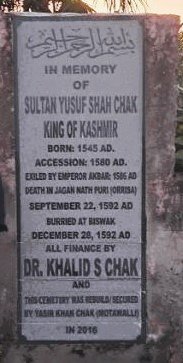
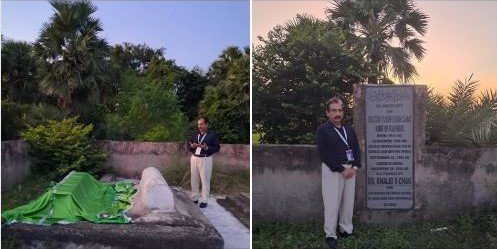
The latest chapter began when noted Kashmiri writer and academic Professor Shad Ramzan, during his recent visit to Biswak, Bihar, posed beside the graves believed to belong to Yousuf Shah Chak, the last independent ruler of Kashmir, and his wife — said to be Habba Khatoon.
Shad Ramzan at Biswak, Bihar, where Yousuf Shah Chak and Habba Khatoon are claimed to have been buried.
Shad’s social media post, describing the visit as “of great historical significance,” noted that Yousuf Shah was exiled to Bihar by Emperor Akbar after the Mughals annexed Kashmir. There, in Biswak, a village still home to families bearing the surname “Chak,” the descendants of Yousuf Shah are said to live on — preserving a living link to Kashmir’s royal past.
According to this version, the exiled ruler was eventually reunited with his beloved Habba Khatoon in Bihar, where the two lived their final years together and now rest side by side.
“I visited the place on 27 September 2025, accompanied by my friend Satish Vimal,” Shad wrote, calling it “a moment of rediscovery for Kashmiri history.”
Counterclaims: The Scholar’s Rebuttal and the Weight of Evidence
Not everyone agrees. Veteran broadcaster and cultural historian Peerzada Abdal Mehjoor has strongly dismissed these claims as “romantic myth-making.”
“For centuries, Habba Khatoon’s poetry has defined Kashmiri identity,” Mehjoor wrote. “But myths and misconceptions continue to cloud her real story.”
Drawing upon historical chronicles of the 16th and 17th centuries — including Persian records and local Kashmiri accounts — Mehjoor points out that no document mentions any woman named Habba Khatoon as Yousuf Shah Chak’s wife. Chroniclers of that time, known for meticulous detail, listed royal wives and consorts with precision. Their silence, he argues, is itself telling.
Equally firm is his stance on her grave’s location: “Habba Khatoon lies buried at Athwajan, on the outskirts of Srinagar.”
Editorial Note – Kashmir Rechords
The ongoing debate over Habba Khatoon’s grave — whether at Athwajan, Kashmir, or Biswak, Bihar — reflects the tension between folklore and historical scholarship. Drawing from archival materials, including the 1963 Archives Department expedition, Yousuf Taing’s 1977 article, and recent field visits by Shad Ramzan and Satish Vimal, this feature aims to preserve the spirit of inquiry surrounding one of Kashmir’s greatest cultural icons.It seems to be, however, ironical that certain forces are or have been creating controversies regarding Kashmir’s women poets .These include Arinmal ,Habba Khatoon and even the great Lall Ded has not been spared.!Whom do the deliberate and manufactured controversies regarding women poets of Kashmir serve? That seems to be a very fair and poignant question.
He cites photographic evidence from the early 1950s — showing Sheikh Mohammad Abdullah and the legendary poet Ghulam Ahmad Mahjoor inspecting the newly built structure over Habba Khatoon’s grave, constructed under Mahjoor’s supervision.
“The Biswak grave often mistaken for hers,” Mehjoor clarifies, “actually belongs to Yousuf Shah’s real wife — the mother of his son, Yaqoob Chak.”
The 1963 Discovery: When History First Knocked on Biswak’s Door
Interestingly, this is not the first time Biswak’s graves came under scholarly scrutiny. Archival records reveal that in 1963, a team from the Jammu & Kashmir Archives Department, led by Sahebzada Hassan Shah, visited Bihar to locate manuscripts related to Kashmir’s history. The team — comprising Mohammad Amin Ibn Mahjoor, Mohammad Amin Rafiqi, Ghulam Rasool Bhat, and Ramji Dhar — also inspected the “Chak Mazaar” in Biswak.
Photographs of that visit, preserved by the historian’s family, confirm the existence of Yousuf Shah’s grave — but make no mention of any grave belonging to Habba Khatoon.
“How then,” asks Shakeel Rehman, son of one of the researchers, “did Habba Khatoon’s grave suddenly appear at the site in 1976, when Mohd Yousuf Taing persuaded Sheikh Abdullah to visit Biswak?”
The question continues to haunt scholars and enthusiasts alike.
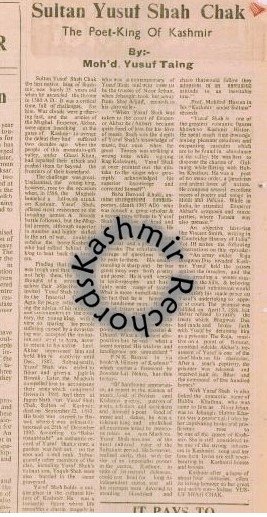
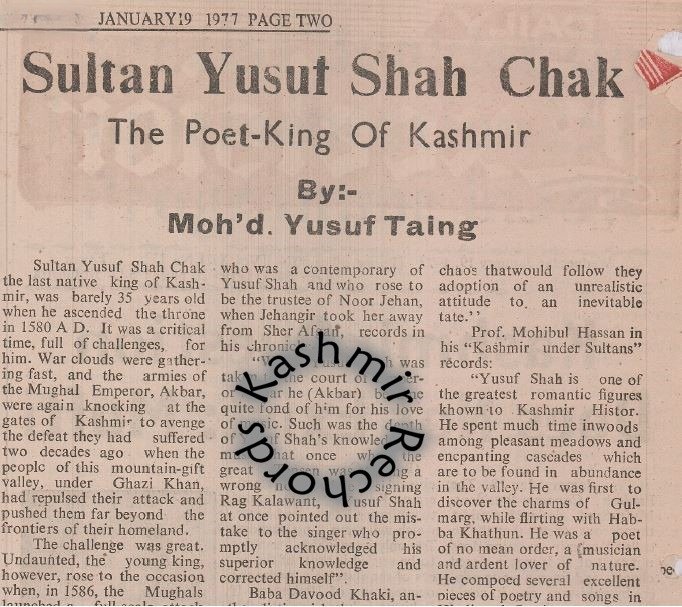
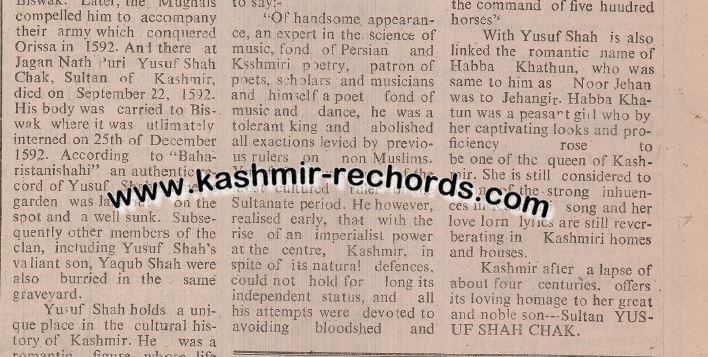
A detailed writeup on Yusuf Shah Chak and Habba Khatoon, written by M.Y Taing on January 19, 1977
Taing’s Testimony: A 1977 Reaffirmation
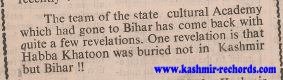
Adding another twist, Kashmir Rechords has unearthed a valuable document — a detailed article written in January 1977 by Mohammad Yousuf Taing, former Secretary of the J&K Cultural Academy. Taing, who had himself visited Biswak decades earlier, confirmed that the grave of Habba Khatoon was indeed found beside that of Yousuf Shah Chak, along with the grave of his son.
This testimony, though conflicting with other historical evidence, keeps the debate alive — suggesting that perhaps, like her verses, Habba Khatoon’s resting place transcends simple certainty.
Taing’s Account: A Different Lens
Self-Explanatory—January 1977 News!
Taing’s conclusion reignited the theory that Habba Khatoon, like the Mughal empress Noor Jehan, was not just a royal consort but a woman who redefined femininity through intellect and art.
Just as Noor Jehan became the creative and political force beside Jehangir, Habba Khatoon — if indeed Yousuf Shah’s queen — turned her sorrow into song. Her transformation from the peasant girl Zoon of Pampore to the poetess Habba Khatoon mirrors Noor Jehan’s rise from Mehr-un-Nissa to the most powerful woman of her empire.
Both women, separated by decades but united in destiny, embodied the rare fusion of beauty, intellect, and creative spirit that reshaped their worlds.
Fact, Fiction, Power of Poetry
For historians, the debate is about documentation; for Kashmiris, it is about devotion.
Did Habba Khatoon, the poet-queen of longing, truly share her final resting place with the exiled king who loved her? Or is the romance of their reunion in Bihar merely a poetic echo of her own verses — a fable woven by time?
As cultural voices clash over archives, photographs and oral traditions, one truth stands unchallenged: Habba Khatoon’s poetry needs no myth to shine.
Her songs — of separation, resilience and the ache of lost freedom — remain Kashmir’s living heartbeat. Whether her grave lies by the Jhelum in Athwajan or in the distant soil of Biswak, her soul forever belongs to the Valley she immortalized in verse.
Meet J N Zutshi—the first Director General of Radio Kashmir who also held the post of the Secretary, J&K State Information & Broadcasting. Zutshi is credited to have set up two Radio Stations in Jammu and Kashmir—first at Jammu on December 1, 1947 and then at Srinagar on July 1, 1948. All he had to do through these two Radio Stations, was to counter the malicious Pakistani propaganda against India especially from Pakistani’s notorious underground Radio Station–“ Radio Trarkhal’’.
Archival file on Radio Kashmir
There is a separate file on the establishment of Radio Kashmir that has been preserved in the archival section of the Department of Archives and Museums at Jammu. A detailed study of the file reveals many interesting facts.
J. N. Zutshi was the first Director-General of Radio Kashmir, who also held the post of the Secretary, State Information and Broadcasting Ministry. He was the one to recruit the staff for Radio Jammu. Zutshi’s contemporary was P. C. Choudhery, who was the Director-General of All-India Radio in 1947-48.
The proposal to establish a State-run Radio Station was taken by Maharaja Hari Singh on November 15, 1947, and within two weeks, the Station was established with the active support of Government of India when Sardar Vallabh Bhai Patel was also looking after the portfolio of the Union Ministry of Information and Broadcasting.
In his first-ever radio speech from Jammu (on December 1, 1947 at 6.30 pm), the Maharaja Hari Singh had justified his decision to accede to the Union of India. A number of national and foreign newspapers, which had their representatives in Srinagar and Jammu, carried his speech quite prominently. J N Zutshi was the person, who had ensured that the speech goes on air uninterrupted from the two classrooms of a local School where Radio Kashmir Jammu was initially set-up.
Selection of Staff for Radio Kashmir
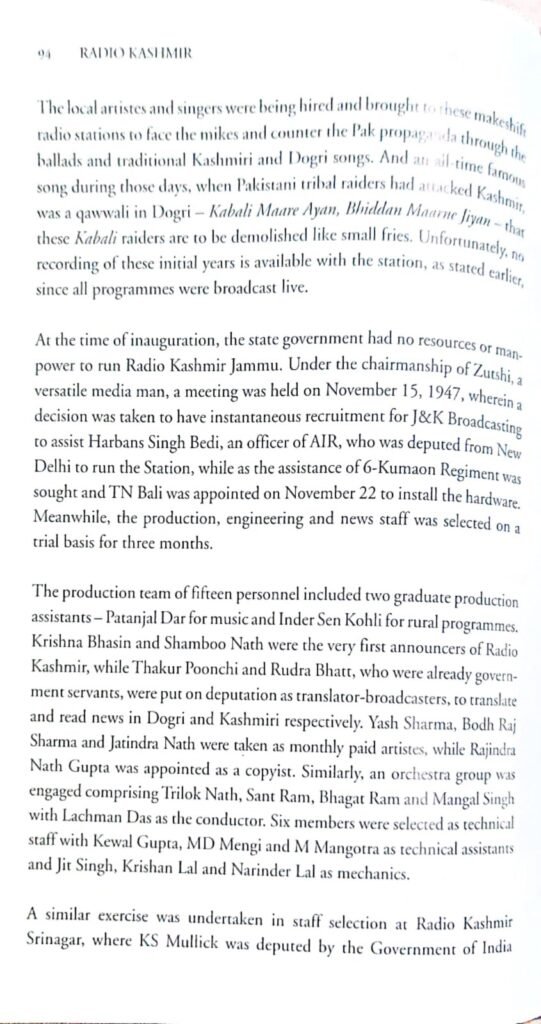
On the instructions of J N Zutshi, local artistes and singers were being hired and brought to these makeshift radio stations (both at Jammu and Srinagar) to face the mikes live and counter the Pak propaganda through the ballads and traditional Kashmiri and Dogri songs. There was no provision for recording.
At the time of inauguration, the State Government had no resources or man- power to run Radio Kashmir. Under the chairmanship of Zutshi, a versatile media man, a meeting was held on November 15, 1947, wherein a decision was taken to have instantaneous recruitment for J&K Broadcasting to assist Harbans Singh Bedi, an officer of All India Radio (AIR), who was deputed from New Delhi, while as further engineering assistance of 6-Kumaon Regiment was sought. TN Bali was appointed on November 22, 1947 to install the hardware. Meanwhile, the production, engineering and news staff was selected on a trial basis for three months.
A page from a Book–`Radio Kashmir in Times of Peace and War’
The production team of fifteen personnel included two graduate production assistants-Patanjal Dar for music and Inder Sen Kohli for rural programmes. Krishna Bhasin and Shamboo Nath were the first announcers of Radio Kashmir, while Thakur Poonchi and Rudra Bhatt, who were already government servants, were on the orders of Zutshi, put on deputation as translator-broadcasters, to translate and read news in Dogri and Kashmiri respectively. Yash Sharma, Bodh Raj Sharma and Jatindra Nath were taken on contract as monthly paid artistes, while Rajindra Nath Gupta was appointed as a copyist. Similarly, an orchestra group was engaged comprising Trilok Nath, Sant Ram, Bhagat Ram and Mangal Singh with Lachman Das as the conductor. Six members were selected as technical staff with Kewal Gupta, MD Mengi and M Mangotra as technical assistants and Jit Singh, Krishan Lal and Narinder Lal as mechanics. A similar exercise was undertaken in staff selection at Radio Kashmir Srinagar, where KS Mullick was deputed by the Government of India.
Zutshi’s proximity to Sheikh Abdullah
Apart from being the first Director General of Radio Kashmir, J N Zutshi had also setup the Field Publicity Organisation of J&K Government that was equipped with mobile vans and loud speakers. These vans used to move in different parts of Jammu and Kashmir presenting to the common man entertainment as well as political awareness. For his proximity to Sheikh Mohd Abdullah, Zutshi as a gifted writer, used to write all his speeches and later for Bakshi Ghulam Mohd.
J N Zutshi and Sheikh Mohd Abdullah leaving for New York in December 1949 to present India’s case in United Nations on Kashmir
It was on December 13, 1949 that Sheikh Mohammad Abdullah as Prime Minister of Jammu & Kashmir and member of the Indian Delegation, accompanied by J.N. Zutshi left New Delhi for New York to assist N.N. Rau, India’s Permanent representative with the U.N in presenting India’s case before the Security Council.
From 1947 to 1953, all-important political documents of Jammu and Kashmir were drafted by Zutshi and he enjoyed Sheikh’s full confidence. It was because of his proximity to Sheikh Abdullah that Zutshi was also imprisoned in 1953 for some time.
From Radio Kashmir to AIR to Akashvani
Radio Kashmir, which started functioning as a State Department under J N Zutshi, was later fully merged with All India Radio in April 1954. The Institution had, however, retained the identity as “Radio Kashmir’’ to meet the specific strategic requirements of the country, the details of which are exhaustively covered in a well-researched book ``Radio Kashmir in Times of Peace and War’’. However, in October 2019, the name “Radio Kashmir’’ was abruptly dropped and both Srinagar and Jammu Stations were first prefixed as `All India Radio’ and then in 2023, as `Akashvani’.
Radio Kashmir in Times of Peace and War ( Stellar Publications, 2018)
The Intelligence Bureau (IB), India’s internal intelligence agency, reputed to be the oldest such organization had suffered major causalities in Kashmir Valley in 1990, beginning from January 2. On January 27, when the world observes International Holocaust Remembrance Day, it is an opportunity to reassert Nation’s commitment to human rights and to commemorate the sacrifices of its intelligence officials that are not discussed in the public domain. The intelligence inputs provided by these unsung heroes are vital for the nation’s security and protection. Therefore, it is important for their sacrifices to be recognised and honoured.
There are many heart-wrenching stories of officials of the Intelligence Bureau (IB) who made supreme sacrifice in the line of duty while exposing the Pakistan-sponsored terrorism in Jammu and Kashmir. Their sacrifices may have remained hidden from the public eye to ensure the secrecy of the organisation. But it is necessary to tell the present generation all that what had happened during the initial phase of militancy in Kashmir.
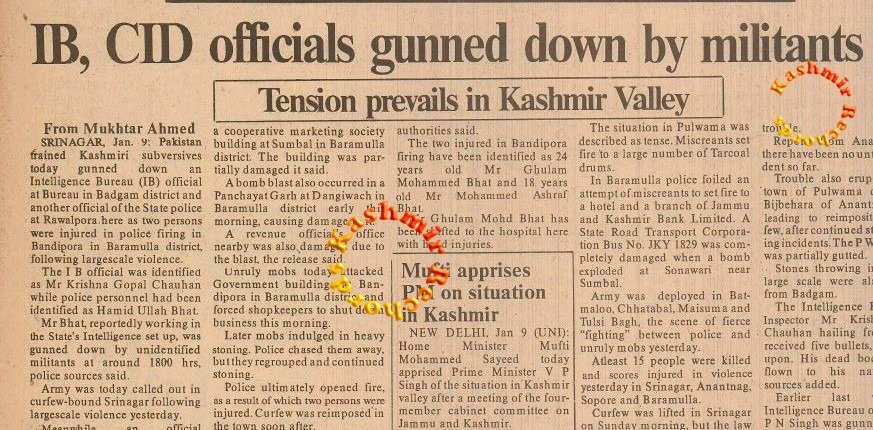
Beeru town in the Budgam district of Kashmir, was known to be a stronghold of the fundamentalist militant groups. That is why the work done by Krishan Gopal Chouhan, 37, a Sub-Inspector of the Intelligence Bureau (IB) was considered valuable.
Chouhan ran a one-man operation in this town. His success had already been noticed by the militants. On January 8, 1990, his luck ran out. A man in the Pheran was stalking Chouhan in the bustling street of Beeru. He pulled out a Kalashnikov from his Pheran and shot IB Official five times.
A few hours after Chouhan’s death, terrorists had struck again. This time killing Inspector Hameedullah Bhat of the State’s counter-espionage cell in Srinagar’s Rawalpora locality. Bhat was the fourth state intelligence man killed by terrorists. Since September 1989, militants had killed several civilians also, accused them of being informers.
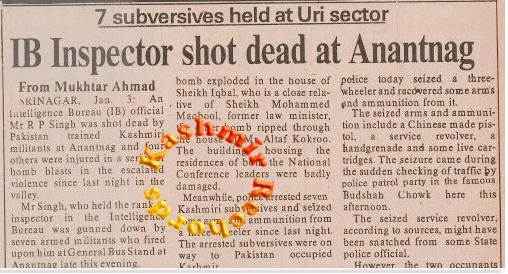
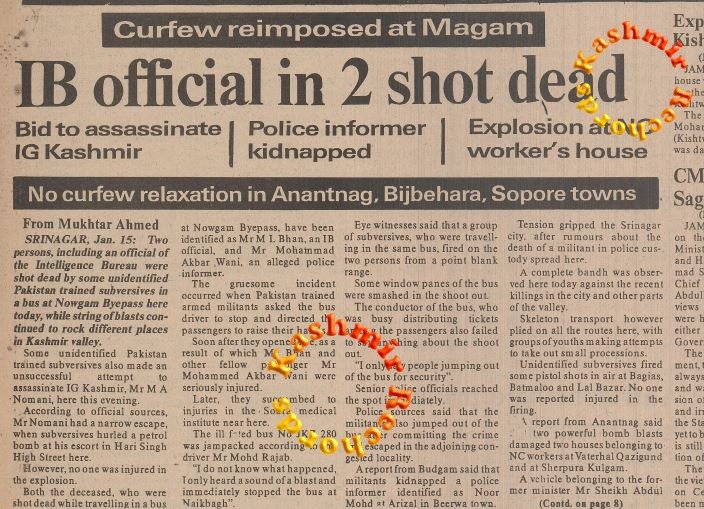
With the death of Chouhan, the IB had lost its second field operative within a week. Earlier, on January 2, 1990, R.N.P. Singh, Assistant Central Intelligence officer at Anantnag, was shot dead. More such killings of IB officials unfortunately continued in early 1990.
Behind each death was a horrifying tale that causes a shudder in the spine. One such heart-breaking story was that of Tej Krishen Razdan, a Technical Officer in IB, Gupkar Road, Srinagar. He was killed by a Pakistan trained Kashmiri terrorist in Srinagar. During the time of this incident, terrorism was at its peak in the Valley and the state administration was paralysed. But the grim and haunting situation did not deter the official to render his duty. On February 14, 1990, he visited his residence at Badyar to see his ailing parents. While on his return, he used public transport. But at the mini-bus terminal point Gowkadal, Srinagar, he was forced to disembark from the vehicle and shot down by two unknown youths. Later, his blood-socked body was dragged from the bus stop to Red Cross Chowk, Maisuma Bazar and left at the roadside for public view. The nearby shopkeepers and onlookers were unmoved watching enemy forces robbing an Indian official of his life and dignity. On receiving the information, a police jeep from the Police Control Room came to pick up the body. As the driver came near the body, he asked for help from the people around the spot for lifting the body and placing it in the police vehicle. None of them came forward and the driver was forced to drag the body to the vehicle. At the police control room, the body was handed over to the bereaved family for the last rites.
R.M.P.Singh who was posted as IB officer in Anantnag District of the Kashmir valley was shot by Manzoor Darzi, a terrorist belonging to the Jammu and Kashmir Liberation Front (JKLF) at the main bus stand. The official was returning home in the evening with groceries for the family who were staying in government quarters. He succumbed to the bullets on the footpath of the main road. His bullet-riddled body sprawled on the ground with no immediate medical aid. Instead of saving the life of an Indian official, locals in the market area were seen in jubilation.
On January 15, 1990, Moti Lal Bhan was the fourth IB official targeted by the JKLF militant outfit. On that fateful day, Bhan had left for office along with his son and boarded the Khanda shuttle bus service on Natipora’s side. Three youth, led by Bitta Karate, barged into the coach and ordered Bhan to get down from the bus. He protested and argued. A co-passenger intervened not to force Bhan to get down from the bus. In a fit of anger, one of the intruders pulled the trigger of the gun and shot the co-passenger Mohd Akbar Wani on the spot and a pall of gloom and panic spread among other commuters in the shuttle bus. Soon after, they fired upon Bhan in the head at point-blank range. Not a single person in that bus came to the rescue of Bhan and the co-passenger who lost his life defending him. The fault of Bhan was that he had handled the operation of apprehending Abdul Ahad Waza, a Pakistan trained Kashmiri Terrorist.
In yet another incident the same year, Rafiq Ahmed Wani of ShalaKadal, Srinagar who was working as a Security Assistant in IB was gunned down at his home when he had come on leave from Assam to celebrate Eid with his parents.
Pakistan-sponsored terrorism had already surfaced in the Kashmir with the occurrences of stray bomb blasts in the valley. The alarming one was the attack at the residence of the then DIG, Kashmir A.M.Watali. In the month of December 1989, after Rubaiya Sayeed was kidnapped some of the known IB field officers were threatened by JKLF terrorists.
Warning signals ignored
It is true that many of the warning signs were ignored by those concerned. The ground reports from IB and other sister agencies active in the Jammu and Kashmir, about the Kashmiri youth crossing over the border to undergo arms training in ISI run camps in Pakistan Occupied Kashmir (PoK) were adequately available with the Central government. The events of violence, bomb blasts, and sudden firing at the vintage crossing, and selective killing of Hindu minorities were providing proofs the spread of terrorism in the valley. The silence of the local populace and inaction of the state apparatus was rendering inadvertent support to the terrorists in the valley. It was simmering in the majority community that these gun-wielding terrorists claiming to fight for Azadi of Kashmir from India should be supported by all the community members. Participation in every religious congregation was rising, mostly on Fridays, purposely to remain abreast about the `struggle of Kashmir insurgency’.
Unfortunately, the Indian government could not understand the magnitude of the hostile situation that was growing in the valley. It kept ignoring the signs and classified them as law-and-order problems.
The killings can also be traced back to the imprudent decision of the IB headquarters in organising a one-day DG conference in mid of 1989 at Centaur Hotel, Srinagar. This exposed the workings of the IB department in the valley. Farooq Abdullah, the then CM was the chief guest of the conference. Without calibrating on the pros and cons of the situation in a sensitive region, the conference failed to strengthen the national security apparatus and also ignored the enemy’s strategy of sneaking into the system. All the conference did was to gravely compromise the functioning of IB and make its officials the first to be on the hit list of terrorists in the Kashmir region.
IB was eyesore for political leadership in Kashmir
It is also pertinent to mention here that the presence of IB was always an eyesore for political leadership in Kashmir. The design for an“ independent Kashmir’’ got exposed in an interview of Late Sheikh Abdullah to two foreign correspondents, Michael Davidson and Ward Price, in January 1949. IB sleuths were alerted to get the details of the interview given by the late Sheikh through his own contacts. The information about IB inquiring into the details of the meeting with foreign journalists, reached Sheikh Abdullah, who got annoyed. IB Director B M Maullik shared the incident with late Gopalaswami Ayyangar, Senior Minister in charge of Kashmir affairs, in New Delhi. But, the reaction to the IB report shared with Ayyangar was quite unexpected. The IB official posted in the Valley was given marching orders from Kashmir, for the reasons only known to Ayyangar.
It became known later that Ayyangar’s objective was to placate Abdullah for political reasons. However, Abdullah showed some reservations on replacement of IB officer in the valley. Again, Ayyangar had to use his good office in convincing Sheikh Abdullah to keep IB officers stationed in the valley. During this time, Sardar Patel had disclosed to the IB Director that he did not trust Abdullah. Maharaja Hari Singh was in touch with Patel and had informed him about the hidden agenda of Sheikh Abdullah.
Aversion towards IB’s role in the valley had started since independence but came to the fore when Late Mirza Afzal Beigh and G Parthasarthy talks in 1972-73 began and during the talk, late Sheikh Abdullah insisted on total winding off IB from the state.
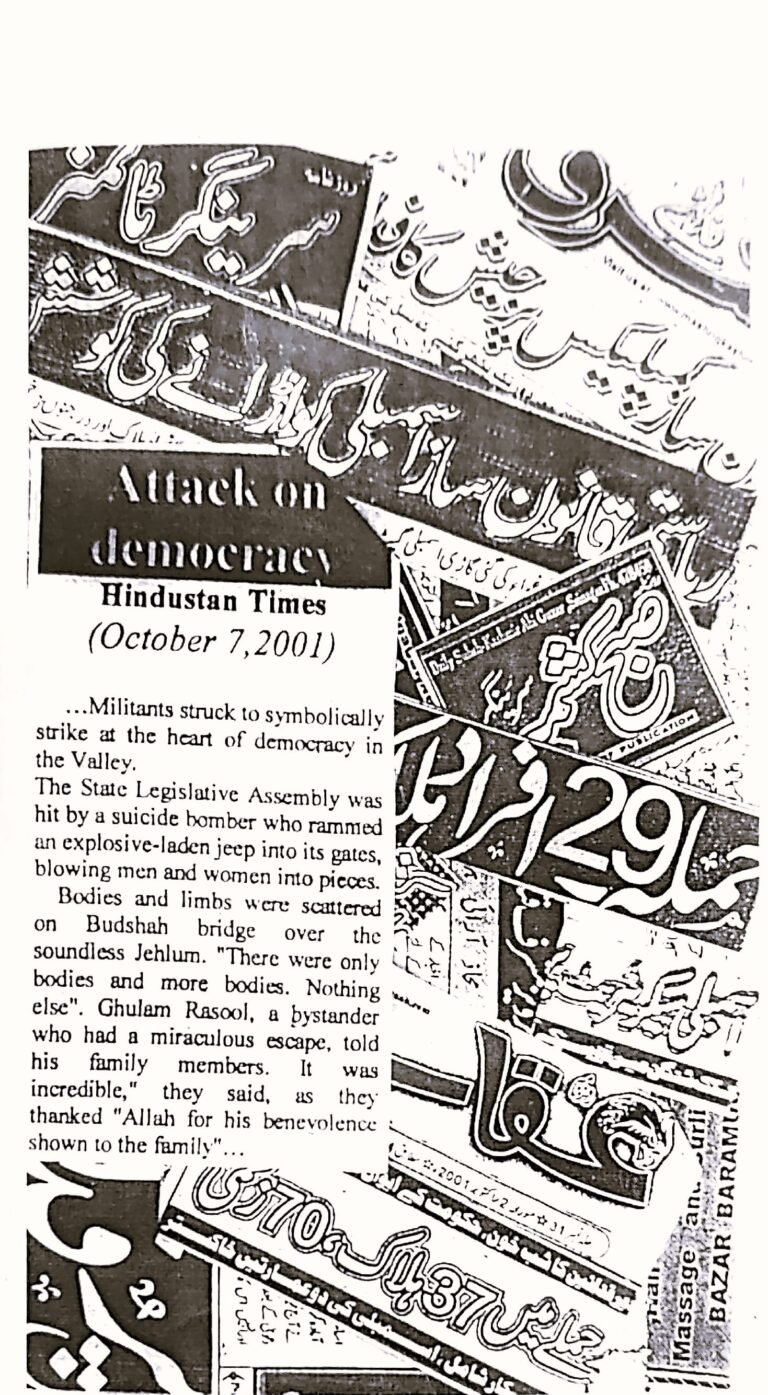
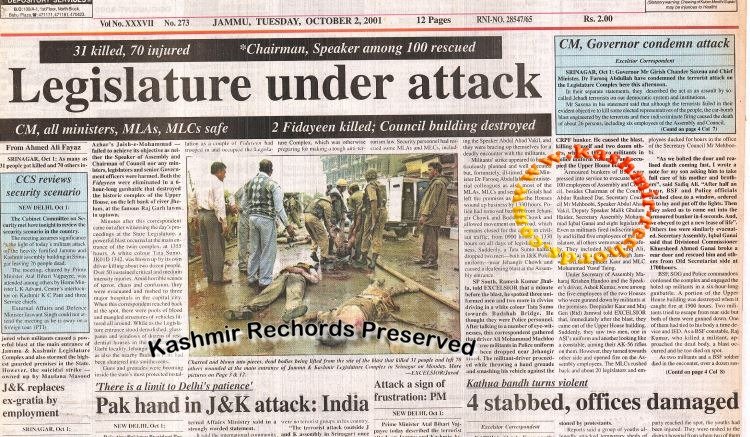
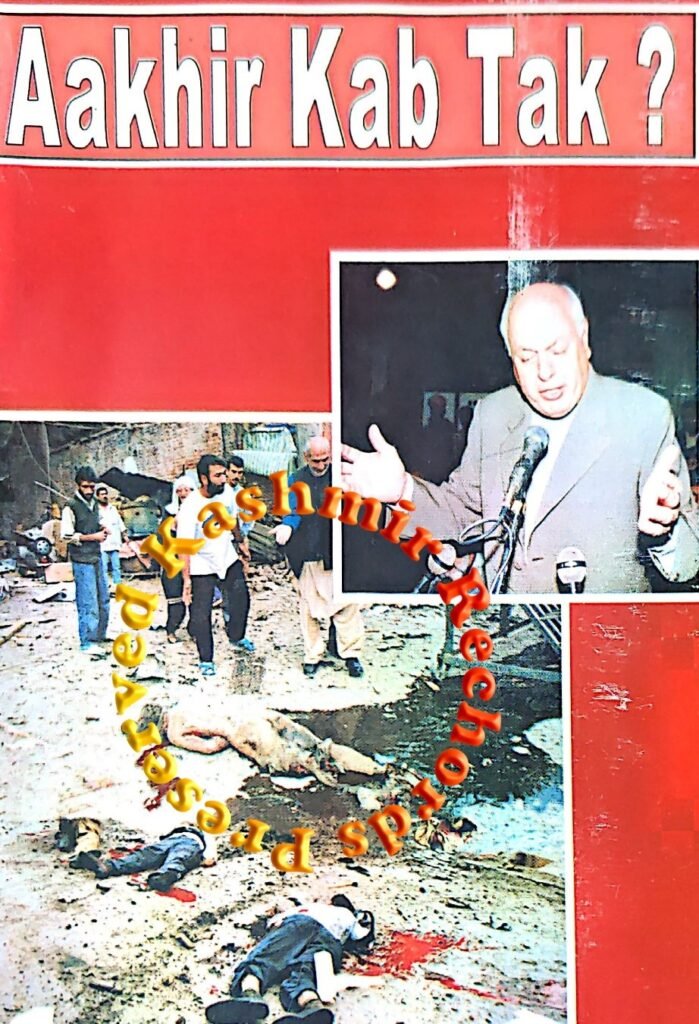
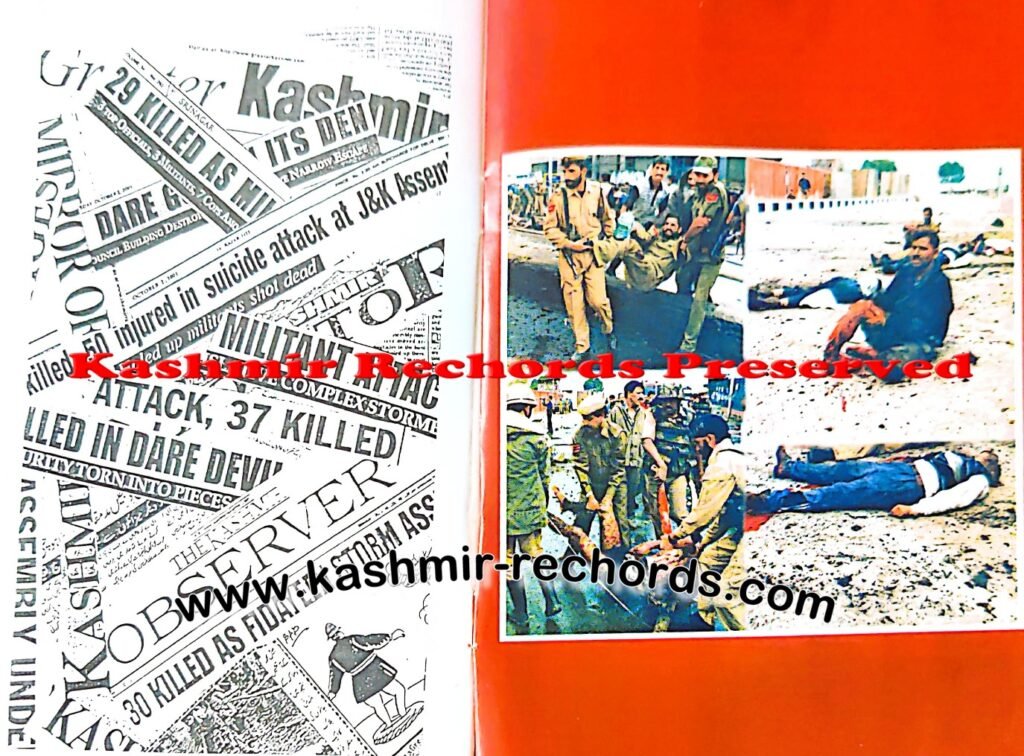
On October 1, 2001, Jammu and Kashmir Assembly was attacked in the worst ever strike by Pakistan-backed terrorists who killed about 38 innocent Kashmiris, including four security personnel on duty and injured scores of other passers-by. It was exactly 72 days after Srinagar Assembly attack that an identical attack was attempted on Parliament of India the same year on December 13. While Parliament attack anniversary is being held every year to remember all those who lost their lives in guarding the Temple of Democracy, people in Jammu and Kashmir seem to have forgotten the lethal attack on the Legislative Assembly Complex by anti-national elements who used a four-wheeler loaded with explosives, rammed it into the main gate with three “fidayeen’’ suicide bombers,
Pakistan’s involvement
Terrorist outfit “Jaish-e-Mohammed’’ had claimed responsibility for the attack that had unnerved one and all. It was during the Prime Ministership of Sh Atal Bihari Vajpayee that Indian Foreign Ministry had issued a strongly worded statement aimed clearly at the Government of Pakistan. “India cannot accept such manifestations of hate and terror from across its borders,” said the statement.
Aakhir Kab Tak?
Two days after the attack, in his address to the Legislators on October 3, 2001, the sobbing Chief Minister, and Dr Farooq Abdullah had expressed his helplessness and called for reprisal attacks on Pakistan to bomb the militant training camps there. “Aakhir Kab Tak’’—(How long) was Chief Minister’s poser to Home Minister Lal Krishan Advani as the State was “ running out of patience’’.
Kashmiris, irrespective of their caste, creed or religion have suffered immensely during the time when militancy was at its peak. Thanks to the present leadership at the Centre that all such incidents have now become the thing of the past. However, the Government cannot lower its guard. The enemy may be on the prowl.
Gory scenes
Kashmir Rechords is bringing out some of the gory pictures of that fateful day (October 1, 2001) to remind the readers how terrorism causes destruction, mayhem and causalities. It also is an indicator that terrorists can resort to any act in order to meet their nefarious designs. In the instant case, they had disguised as security personnel to hijack a vehicle 10 minutes before carrying out the attack.
Among those killed, included a school- going girl. Five Assembly employees, including a Deputy Secretary and an Under Secretary had also lost their lives in this deadly attack. About 125 persons were inside the Assembly when the terrorists had struck.