Home Blog Page 24

India- Australia Cricket Series of 1964 and Kashmir Press

Cricket in every season and every year is a religion in India! Ever since its advent in the sub-continent, people have always exhibited their interest to know and discuss about the game and its players through different forms of communication, platforms and medium. Prior to the visual coverage of the game, people would solely rely on Radio commentary or some specific magazines devoted to Cricket. Kashmir Press was not lagging behind in providing coverage to the “gentle man’s’’ game

Radio’s first Cricket Commentary

The first known cricket commentary on the radio is believed to have taken place in England during the 1921 Ashes series between England and Australia. The British Broadcasting Company (BBC) had just been formed, and they decided to cover the cricket matches as part of their broadcast schedule.

In India, Cricket commentary on Radio had begun in 1948-49 when All India Radio (AIR) assigned a panel of commentators for India’s first home series.  Henry “Blowers” Blofeld was the first cricket commentator of AIR. Prior to that, BBC had two five-minute segments for the Indian audience for the 1946 tour— Abdul Hamid Sheikh in Hindi, and a young John Arlott in English.

Listening to commentary on a Radio set was a luxary. Those who could not afford used to rely on newspaper or magazines who would cover the game after it was sover.

  Cricket Coverage and Kashmir Press

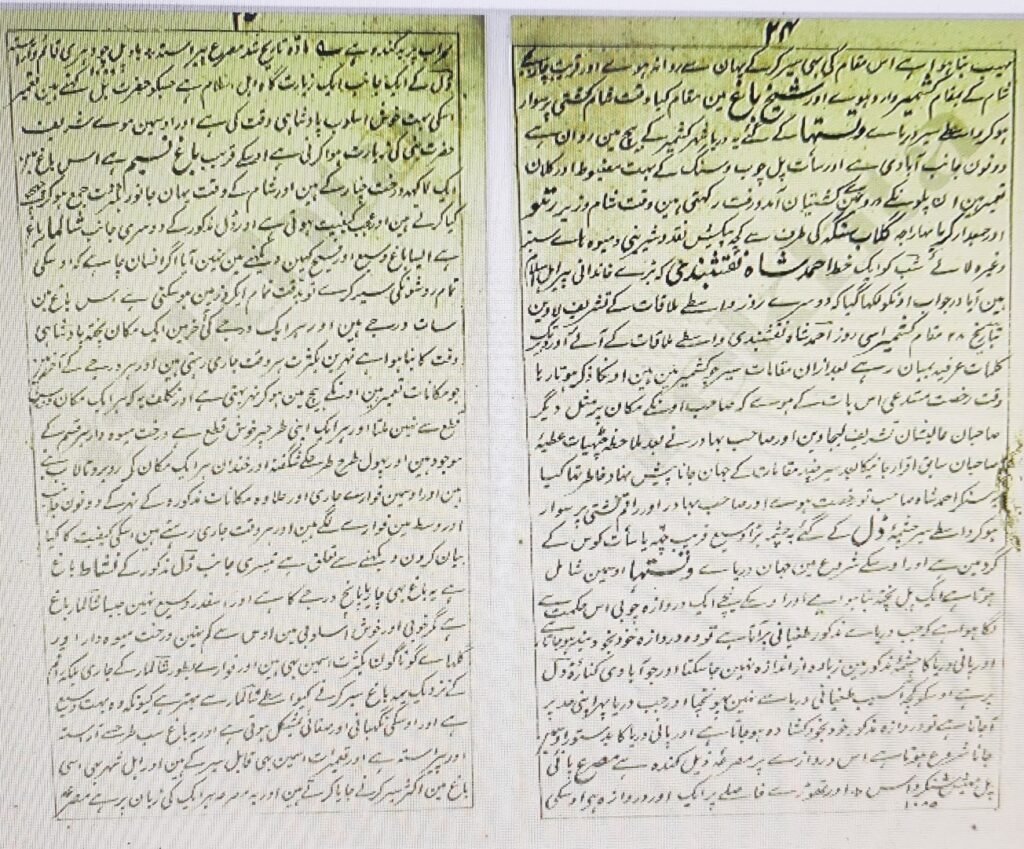
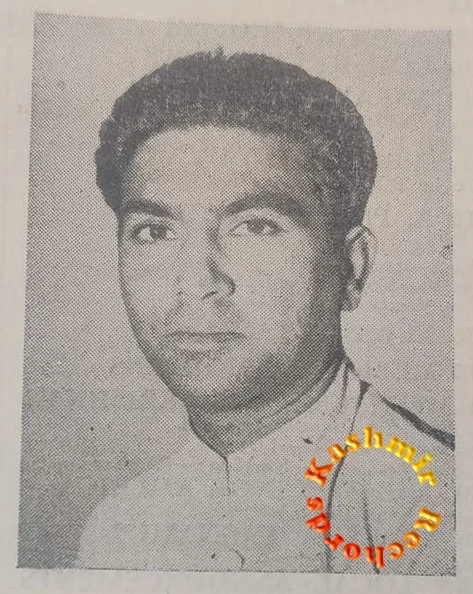
Prior to 1990, Kashmir Press was religiously publishing Cricket related news items, besides the schedule of the radio commentaries. Kashmir Rechords, from its archives, is reproducing a picture of one such cricket match of yesteryears, printed by an Urdu magazine! It was the first test match of 1964 series between India and Australia, played at Corporation Stadium in Madras (Now Chennai) between 2 October to 7 October 1964. The five-day match was won by Australia, who scored 211 and 397 runs. India scored 276 and 193 runs. MV Nagendra and Samar Roy (Both Indians) were the Umpires for this match.

Urdu magazines of that era, had covered the event and also given commentary timing of two  other matches of the same series, played later at Bombay ( Mumbai)  and Calcutta ( Kolkata). Players like Salim Durrani, Nadkarni, and Hanumant Singh formed the playing squad for India.

Bob Simpson was captaining the Australian team. Other prominent players of Australian squad were Norm O’Neill, Peter Burge, Brian Booth, Johnny Martin, Ian Redpath, Tom Veivers and Graham McKenzie.

 The Australian national cricket team had played three Test matches in India against the India national cricket team in 1964. The three-Test series was drawn, with the Australians taking the first Test (Madras), the Indians winning the second (Bombay), and the third match at Calcutta was drawn.

     The second test was held in Mumbai from October 10–15. The third test was held in Calcutta from October 17–22. 

Kashmir’s silk route

0

Kashmir with great geo-strategic significance, connecting Indian sub-continent with Central Asia and rest of the world, since ancient times, has   served as an economic corridor between South and Central Asia. The three principal highways were facilitating such connections, leading to Khorasan, India and Tibet. The Zojila (11,300 feet.) Pass has been since ages, an important thoroughfare, connecting Kashmir with Ladakh and with Tibet, Turkistan and China. The movement on this Pass used to  continue from June to November every year, though top of Zojila remained under snow until end of June.

The Silk Road used to be a major trading route in the first millennium B.C.  It connected the kingdom of Kamboja, which is now Afghanistan and Tajikistan, to cities and cultural centers in northern India. The Silk Road extended approximately 6,437 kilometers (4,000 miles) across some of the world’s most formidable landscapes.

  Although, the route was not more secure than others, however, it was considered the  chief trade route, known as silk route between Kashmir and Central Asia. This Pass gave a unique commercial importance to the erstwhile state as it  was traversed by moving traders  for transportation of goods over Kashmir and onwards into Kargil, Leh and Central Asia.

Like Kashmir, the passes of Ladakh are equally  famous. Categorized into three groups, one among them was the Tibetan Route or Leh-Demchak (Tibet) route, the main communication link between Leh and Tibet, connecting Leh with the Tibetan city of Lhasa. Here, traders had choice depending on the city of destination.

The Karakoram Pass was another  important  route into Central Asia and a regular means of communication between India and Turkestan.

From Kar-kil to Kargil

In addition, one of the important trans-Kashmir outlets through Zojila was Kargil-Iskardu-Gilgit link road. Kargil was  equidistant from Kashmir, Baltistan and Ladakh— hence, its ancient name—Kar-kil meaning equal distance, which later on transformed into Kargil.   Gilgit was equally an important  trade link between Kashmir and India on one side  and Xinjiang China and Central Asia on the other. 

Kashmir has maintained commercial and cultural relations with South and Central Asia through these links since ancient times, and served as a trading belt  that connected multiple geographic areas. The merchant community that conducted trade between India and Central Asia across Kashmir, was broadly fragmented into two groups, the ‘Andijanese’ or ‘Kashmiris’ and Afghans. Andijanese would traded at Kashgar, which in first quarter of the 19th century, was a bigger city than Yarkand, wherefrom Afghan traders used to operate. (Cambridge history of China. Vol X p 83). The Andijanese also operated at Kokand, Tashkent and Bukhara though their role was considerably smaller at Tibet, Ladakh, Baltistan and  Yarkand .

  Since Kashmir bordered closely with Central Asia, its capital city, Srinagar, was the hub of trading activity for the Turkish, Tibetan, Ladakhi, Balti  and Kashmiri merchants. These traders had rest houses as well as religious Shrines in Kashmir. Cambridge history of China. Vol X).

The erstwhile State of Jammu and Kashmir enjoyed special status in the Indian subcontinent as it offered a direct land access of India to Turkestan, Yarkand, Khotan, and facilitated free movement of diverse goods, merchants, explorers, spies and soldiers across different routes criss-crossing Kashmir. However, the Partition of Indian sub-continent in 1947, emergence of India and Pakistan and the sequential wars between them in 1965 and  1971 on Jammu & Kashmir led to the permanent  closure of traditional trans-Ladakh and trans-Gilgit land routes.

Some  books about the Silk Route

  • `India and the Silk Roads’ by Jagjeet Lally
  • `Silk Route Expedition, Phase III: Leh-Chushul’, written by the University of Kashmir’s Centre of Central Asian Studies.
  • `Kashmir and Kashghar: A Narrative of the Journey of the Embassy to Kashghar (1873-74)’
  • `Buddhism on the Silk Route’

Abdul Rehman—Kashmir’s Hakim of Shri Bhatt’s progeny

Kashmiris of yore (it is hoped that plenty still exist) would be very familiar with the word “Hakim’’, the traditional physician who ran the predominant private  and parallel health system of Kashmir actively even up to 1970s, after which we notice a declining trend in people’s attitudes towards acceptance of their  traditional line of treatment.

   These Hakims would in the eyes of common Kashmiris possess  “Daste-e-Shifa’’. Translated into English, it means the curing hand. These Hakims were believed to possess legendry powers and the patients on their deathbeds are reported to have reverted to life by their able hands and talents, something bestowed on them by God Almighty.

During the late 1940s, like so many Europeans, many a traveler took keen interest in Kashmir and began to write new travelogues which paved the way to add information and value to the already existing ones  regarding the land of Kashmir and its people.

  An Encounter with Hakim Abdul Rehman

In his tremendously famous book “This is Kashmir’’  published by Messrs Cassel and Company Limited, Queen Victoria Street London (1954), the author of the book Pearce Gervis  refers to  a very interesting encounter  with a Kashmiri Hakim Abdul Rehman. In fact, Mr. Gervis got introduced to our Hakim Saheb through one Colonel about whose nationality,  the author makes no mention.

       This Colonel   reposed such faith in the Hakim, that he insisted Abdul Rehman be included as a person of interest in Mr. Gervis’ travelogue.

So, Pearce Gervis writes about the Hakim—Abdul Rehman: “ He wore the voluminous effeminate gown….. On his head was an enormous spotless white turban so big that I might have taken him for a Hindu, had the `Tika’ mark not been present on his forehead.’’

Gervis was made to meet the Hakim through a jumble of intersecting lanes and by-lanes, crisscrossing shabby clusters of huts and was assured into a large hall of a very big house where everybody would be seated cross-legged beside small low-level tables. The walls of this room where   adored with Mughal era paintings and this would serve as a big consultation room. The same was proportionally partitioned by curtains to separate the consulting room and the dispensary.

 The Colonel confessed that he was indebted to the Hakim Saheb. Some 20 years before (which roughly comes to somewhat late 1930s), this Colonel had actually developed appendicitis. While the doctors had recommended   a surgical procedure,  he had avoided himself coming under the surgical knife. He was advised to give a vague try with “Dast-e-Shifa” of our Hakim. So, the services of Abdul Rehman were sought who in his very graceful and humble manner brought  a bottle of Kashmiri medicine  along with him. Next day, when the doctors in the Military Hospital examined the Colonel, he was declared to have been cured of his medical condition, which was naturally, a thing of wonder!

    Mr. Gervis writes that when he brought-up the issue of Colonel’s medical condition  before  Abdul Rehman, he not only  testified the same but also claimed   to be the descendant of the same Yogi who had cured  King Zain-ul-Abedin—the Budshah .So much so for Shri Bhatt’s progeny!

Who is who of ghosts and spirits in Kashmir?

By Kanwal Krishan Lidhoo

Almost anywhere, usage of certain words pertaining to ghosts and spirits springs up unconsciously in our daily conversation. Many may not know much about them now, thus, let us revisit and try to understand  the who is who of these ghosts and spirits in Kashmir.

1.The Jins ( Variously called dgins, Jenie, elves, Devv, Drethaakh, Tasrup etc.) They seem to belong to all sexes and have the power to cast spells of evil and capture the victim subjecting him or her to  infinite torture.

2. Yechh is supposed to be one of the aboriginal inhabitants of Kashmir, whose characteristic seems to be that of a heathen.  Yechh also has a co-relation with trans-Himalayan diety `Yaksha’.

3.Divath is believed to be the inhabitant of houses. “Wachya Divath’’ is  still uttered  in Kashmir by one and all, irrespective of religious or other affiliations  to curse somebody to deprive  him or her  the protection of peace and calm, incur losses of all kinds and to get indulged in domestic troubles. It is supposed to mean that one has lost the protection of devtas as some unwanted action on part of the individual may have offended them.

4.Brahm Brahm Chouk belongs to the category of Tasrup. Adolescent boys and girls along with weak and disease-prone individuals come under its spell near Numbals (marshy lands), cremation grounds and graveyards.

5.Whoph Whoph. When some Kashmiris used to pass by an old dilapidated house, they were often reported to have been held captive by the evil spirits dwelling there. Whoph is thus a term associated with the spirits of these barking dogs and snarling cats.

6.Mushraan is a kind of spirit that appears in a very wretched and dirty countenance of an old fat heathen who pounces upon a victim by giving it a big tight hug and starting a process of decline, disease and wastage of the body of the individual and his resources. 

7.Daen or Dyn belongs to the same category of evil spirits as has been known in other parts of the sub-continent.

8. Raantas is the exclusive daen of Kashmir who also finds mention in Afghani, Iranian and Turkish folklore where it is known as `Aal, and Goul’. Its feet are reversed and its eyes exist alongside its nose only.

9.Rih is an undefined female who employs the technique of casting a spell to capture a man with an intention of eating him!

 10. Parish is a very beautiful female, perhaps also known as Pari. Its body is supposed to be made of four elements only with the predominance of the fire element and naturally, it is supposed to devour its victim by consummation of fire or make the victim  unbelievably restless.

Ghosts, spirits are  part of Kashmir language, folklore

Presently belonging to the age of reason which we proudly own as a statement of existence—all this may sound irrational and superstitious  but the same continues to be  an important part of language and folklore of Kashmir.

Kashmir Rechords has compiled this list after an exhaustive and  detailed research on the folklore of Kashmir.  Special mention may be made  about  a very rare book “Keys to Kashmir’’. Author unknown, Lala Rukh Publications, Srinagar, 1953, incorporating an extract of  Vigney Godfrey Thomas’ 1848 AD edition titled “Travels in Kashmir, Ladakh, Iskardu’. 

 We also urge our esteemed readers to share and help us in adding whatever information they have at their disposal regarding the subject.

`Mahabharata’—Kashmir’s last peaceful TV serial

By: B Revti

`Mahabharata’, a Hindi-language epic television serial based on the ancient Sanskrit epic Mahabharata, is perhaps the last television serial which the Kashmiris watched back then, when the peace of the bygone era still prevailed.

  The original airing, which consisted of a total 94 episodes, were broadcast from October 2, 1988 to 24 June 1990 on Doordarshan. Majority of Kashmiri Pandits had left Kashmir by March 1990.  Even as the battle between good and evil was shown on a small screen, Kashmir had surely by then turned into Karukheshtra of other kind.

Mahabharat Episode number-52

     Produced by B. R. Chopra and directed by his son, Ravi Chopra, the Music for Mahabharata   was composed by Raj Kamal, with an able  scripting by Pandit Narendra Sharma and  Rahi Masoom Raza.

Each episode used to be of 40–46 minutes long with a title song that consisted of lyrical content and two verses from the Bhagavad Gita.  The title song and verses rendered by Mahendra Kapoor were followed by a narration by Harish Bhimani as a personification of Time, detailing the current circumstances and highlighting the spiritual significance of the content of the episodes.

  The Wheel of Time never stops!

Monumental Chronology of Hindu rulers and dynasties of Kashmir.

(A necessary reference material)

First Period

Second & Third Period

Fourth & Fifth Period

This meticulously compiled chronological Table of ancient Kashmiri Kings and dynasties (Preserved by Kashmir Rechords) is an extract from the brilliantly researched Book `The Hindu History of Kashmir’ written by H H Wilson ( 1960 edition).

Sheikh Abdullah fighting his own legacy—where did he err?

As per the current trend throughout the world, we are witnessing the legacy of leaders having  lead political movements and  put on a high pedestal being demolished and blown to Smithereens.

    The aura once associated with Sheikh Mohd Abdullah, the “Mehboob’’ leader `Sher-i-Kashmir’ for Kashmiris, is fighting to safeguard his own legacy, 41 years after his death, (September 8, 1982), as the socio-political discourse of Kashmir has changed drastically over the years.

The revolutionary iconic leader, social reformer and the harbinger of Naya Kashmir—all combined into one, who literary implemented the slogan “Land to the Tiller’’, empowered Kashmiri Muslims with free Universal Education, positions, businesses   and enabled them to better their conditions at the expense of Indian largesse.

 An esteemed and important member of the Constitution Committee, Sheikh Mohd Abdullah, who inspired awe and tremendous respect   even up to the point of devotion  in the hearts of Kashmiris, however, seems to fight for his legacy in the changed history of Jammu and Kashmir post 1990s.

  In life as well as in death, he remained tall—so much so that  the whole Indian Nation mourned his demise. History was created when both the President and the Prime Minister  flew to Srinagar to attend to his last rites on the Banks of world-famous Dal lake, where his grave stands  guarded  presently by an elaborate security set-up following several attempts to desecrate the same by the very Kashmiris who had once emotionally treasured his name in their hearts. Even a modicum of respect for the great Sheikh by observing December 5 (his birthday) as a Public Day was done away with in 2019 and  the  so-called Sher-e-Kashmir medals are now history.

The astute political awareness of Kashmiris is certainly that the great Sheikh built in them but he is also the most denigrated one for which Kashmiris as well as rest of the Nation have to ponder over.  

Over Century old  Bhagavad Gita translation by Annie Besant

(Kashmir Rechords Desk)

No other personality has come close to the persona of Shri Krishna who combined in himself all the attributes of an ideal human being and whose life projected the radiance of all the colours that the Universe could design.

 The greatest in childhood, greatest as a warrior, householder and a King and the Ultimate as the Lord of Yoga (Yogeshwara).

 Kashmir Rechords takes pride in bringing to our esteemed readers a pocket size rare edition of Shrimad Bhagatwat Gita “The Lord’s Song’’, published by noted nationalist, Sh Ganapathi Agraharam Annadhurai Ayyar Natesan (G. A. Natesan) who was an Indian writer, journalistpublisherpolitician and freedom fighter from the erstwhile Madras Presidency.

Bhagavad Gita “The Lord’s Song’’,  1908 edition,  was authored by none other than the founder of Theosophical Society of India, Madam Annie Besant, who is equally remembered as the First women President of Indian National Congress. Besant was a  British socialisteducationist, theosophistwomen’s rights  and a campaigner for Indian nationalism

 On the other hand, G A. Natesan   was the founder and proprietor of G. A. Natesan & Co. Madras, which took a lead in publishing nationalist books, the most prominent among whom was The Indian Review.

Kashmir Rechords also requests the interested parties to help in the preservation of this extremely rare book written by a very rare devotee of Shri Krishna.

Kashmir’s respect for teachers

Dr Sarvepalli Radhakrishnan, a teacher of world repute, a greatly respected scholar, who dominated the philosophical discourse during his time, even though he belonged to the Southern State of Tamil Nadu, commanded a great respect throughout the country.

 The Urdu Press in Kashmir, particularly, would devote central space to this illustrious son of India and people even to this day, continue to harbour great sentiment for him besides getting enlightened by this  scholar President. Independent India celebrates his birthday as Teacher’s Day. Kashmir Rechords, from its archives, is reproducing these sentiments Kamal Ahmad Siddique’s write-up published on 22nd November 1963 bears testimony to this

No India or Hindustan—Bharat only !

Rashtriya Swayamsevak Sangh (RSS) chief Mohan Bhagwat’s recent suggestion asking people not to use the word “India” and instead use “Bharat”, has already generated heat and dust  in both India and I.N.D.I.A.  While some high profile dignitaries have already taken a cue from Bhagwat’s speech in avoiding INDIA,  the word BHARAT is right now  viral, notwithstanding the fact that Hindi and Urdu media  have already been using this word since decades  for our Country, like our neighbor—Pakistan who is also addressing us as Bharat—  now a  viral word !   

 Kashmir Rechords in the meantime located J Sai Deepak’s book `India That is Bharat’   from its library.  The book is arigorous survey of India’s political history since the Papal Bull of 1493 and a topical one to discuss right now!

        India That is Bharat: Book Review

The Book touches upon issues like colonisation of India so much so that scholars from the West interpreted everything about India from a Christian perspective.  In addition to Colonialist, Deepak discusses Bharat’s Civilization and Constitution.

 The Book lays the foundation for its sequels by covering the period between the Age of Discovery, marked by Christopher Columbus’ expedition in 1492, and the reshaping of Bharat through a British-made constitution-the Government of India Act of 1919. This includes international developments leading to the founding of the League of Nations by Western powers that tangibly impacted this journey. It also puts forth the concept of Middle Eastern coloniality, which preceded its European variant and allies with it in the context of Bharat to advance their shared antipathy towards the Indic worldview.

Naming India as Bharat

The Book discusses the presence of ‘India, that is Bharat’ in Article 1 of the Constitution, besides the Resolution adopted by the Constituent Assembly on 22 January 1947. In addition to the above-proposed amendments with respect to constitutionally naming the country as Bharat, the insertion of Part 1-A to the Constitution  after Part 1 was proposed by Shibban Lal Saksena, which have also been touched upon by the author.
Kalidasa and Bharat

The Book also talks about the most celebrated and world-famous poet Kalidasa, who had used `Bharat’ in his immortal work depicting the story of his two great characters-King Dushyanta and his queen Shakuntala. The son born of them was named ‘Bharat’ and his Kingdom was known as ‘Bharat’. The Book questions as to why “ we are reluctant to accept from the core of our heart the word ‘Bharat Varsha’ as the name of our country’’.

Like Mohan Bhagwat,  it says that “  We must know that this name (India)  was given to our country by foreigners who having heard of the riches of this land were tempted towards it and had robbed us of our freedom in order to acquire the wealth of our country. If we, even then, cling to the word ‘India’, it would only show that we are not ashamed of having this insulting word which has been imposed on us by alien rulers.

The Book mentions that ‘Bharat’ or ‘Bharat Varsha’ is and has been the name of our country for ages according to our ancient history and tradition and in fact this word inspires enthusiasm and courage. The author sumps up his work with a Shaloka from Brihadaranyakqa Upanishad…. “Om, lead us from the unreal to the real; Lead us from darkness to light; Lead us from death to immorality; Om Peace, Peace, Peace’

Drinking of wine was quite popular in ancient Kashmir!

Kashmir Rechords Desk

Dr. Sunil Chandra Ray’s ``Early History and Culture of Kashmir’’ gives an interesting account of Kashmir history, society and the life of the people, besides their food and drinking habits. According to the author `drinking of wine seems to have been quite popular in early Kasmira’’ (page number 206)

   There is  also the reference of the same in Kalhana’s Chronicle of the kings of Kasmira, where “we meet with a large number of personages who are addicted to drinking’’. The drinking of wine, far from being forbidden, has been specially recommended on ceremonial occasions in the Käśmiri Purana. Dr Ray says that Juices from grape and sugarcane, both of which grew in the valley, were distilled into spirituous liquors. The wine, cooled and perfumed with flowers, was appreciated as a delicious drink.    Of drinks other than alcoholic, Kalhana mentions a kind of cold sweet drink (tuhina sarkaram) which was taken with great delight in hot summer days

Book Review: Early History and Culture of Kashmir 

The book gives a general survey of the history of Kashmir down to 1338, when the throne was seized by the upstart Sahamera, who became the first Muslim Sultan of Kashmir under the name of Shams ud-din. The book, first published in 1957, includes a folding map of ancient Kashmir and some photographs, makes a mention of the Bharata Natya Shastra— an ancient treatise on the arts, originated in Kashmir. It has influenced dance, music, and literary traditions in Indian culture.

Published at Calcutta by U. N. Dhur & Sons Private Ltd, Dr. Ray’s “Early History and Culture of Kashmir’’ is an outstanding piece of research on a very important region of India.

Kashmir and Kingdom of Kuchi

The conversion of intermediate kingdom of Kuchi seems to have been the work of Kashmirian scholars. We know from the life of Kumarajiva that it was customary for youngmen of Kuchi to be sent to Kashmir for higher learning. Through Kuchi and Khotan the influence of Kashmirian scholars spread to China and in the list of learned monks from India preserved in the records of China, those from Kashmir, hold a high place.

  The book makes a mention of Buddhism, Saivism and Sanskrit learning that had flourished in the valley and produced a remarkably rich culture until the Muslim conquest overturned the social structure of Kashmir. The integration of Kashmir life was so complete that one of his most remarkable books that Kshemendra, who was himself a Saivaite, produced was on the Avadanas of the Buddha, a classic in later Buddhist literature.

Dr. Ray, through this book, brings out some unique characteristics of Kashmir history. Not only does he give a connected narrative of Kashmir’s political evolution based on all available sources, literary, archaeological, numismatic, foreign allusions etc. but brings out the cultural, religious and social development of the people of the valley.

40 years ago, Opposition conclave was held in Kashmir.

By B. Revti

Like 2023 Opposition parties’ Conclaves being held at  places like Patna,  Bengaluru or Mumbai, forty years ago one such , similar Opposition `Unity’ Conclave was organised  at Srinagar, in October 1983 by then Chief Minister, Dr. Farooq Abdullah!

  Opposition stalwarts like Badal, Biju Patnaik, Jagjivan Ram, N.T Rama Rao etc, representing 17 parties, were found together in a bid to `show resistance’ to former Prime Minister, Indira Gandhi. Andhra Pradesh Chief Minister N.T Rama Rao was the architect of opposition unity.

   The same modus operandi   is now being adopted by present day opposition (INDIA) in an unsuccessful  bid  to take on Prime Minister, Narendra Modi.

   In 1983, Mrs Gandhi was the first to take the wind out of the Srinagar conclave. On the day the participants were drawing up a fire-spewing resolution against the Centre, she dismissed the Darbara Singh government—-, a move that was welcomed by the entire country – much to the conclave’s embarrassment.


      Srinagar Opposition Conclave & 1983 India us West Indies ODI  


Apart from Opposition Conclave held in Srinagar in October 1883, in the same month and same year, Kashmir was again in the news!  The first One Day International (ODI) cricket match was played at Sher-i-Kashmir Stadium in Srinagar on October 13, 1983. India played the West Indies but spectators digging the pitch during the lunch interval affected the match due to the protests.

      It was considered a “deliberate’’ move by Farooq Government only to embarrass Indira Gandhi.  Farooq Abdullah had to pay for it when he was dismissed as Chief Minister of Jammu and Kashmir on July 2, 1984.

As against 372 in J&K, PoK has just four newspapers!

Tight controls on freedom of expression have been a hallmark of the Pakistani government’s policy in Pakistan Occupied Kashmir (PoK). While militant organizations are being given full coverage to propagate their views and disseminate literature, those critical of the Pakistani and PoK government, are facing repression.

The Pakistani government has long limited dissemination of news in Pakistan Occupied Kashmir.  That is evident from the fact that there is no locally based news agency. In addition, PoK has just two dailies and equal number of weeklies, being published locally. As compared to PoK, newspapers published from Jammu and Srinagar cities on daily basis are more than 370!  

 Pakistan Occupied Kashmir has no English newspaper of its own, either published from Muzaffarabad or Mirpur—the two major cities of the occupied territory. Ironically, PoK websites show newspapers like Kashmir Times, Greater Kashmir, Kashmir Reader, Kashmir Observer etc. ( all published from Srinagar), as their publications!  

Pakistan’s “Kashmir Affairs Ministry” denies permission to PoK newspapers

 People living in PoK largely rely on local editions of Pakistani newspapers for news and information.   In order to publish within the territory of PoK, newspapers and periodicals need to be granted permission by the Kashmir Council and the Ministry of Kashmir Affairs in Islamabad. These bodies unlikely grant permission to any proposed publication, which are sympathetic to any discourse on Kashmir and its affairs other than that sanctioned by the Pakistani government.  The same rules apply to the publication of books. Members of the press have been complained of the intrusive and coercive policies of the PoK government particularly of the ISI and the Pakistani military.

There have been many instances in PoK when journalists, who did not toe to Government or Army line, were  subjected to severe kind of torture. Waheed Kiyani, a local journalist working for the Reuters news agency, was once arbitrarily arrested by the ISI when he was returning from the city of Rawlakote after covering a political meeting.

Book on Mangla Dam banned

The PoK `government’ regularly bans books that it considers to be prejudicial to the “ideology of the State’s accession to Pakistan.” This includes all books that propagate or discuss Kashmiri nationalist discourse with its emphasis on “independence for a united Kashmir’’ or merger with India.    

 Muhammad Saeed Asad, a self-described `Kashmiri nationalist’, living in PoK, has authored numerous books on Kashmir Affairs.  Employed as a Social Welfare Officer in PoK, he was, however, suspended in 2002 for writing a book on the Mangla Dam that had  questioned Pakistan’s right to water sources originating in Kashmir.

  Pakistan has banned three books written by Saeed Asad for being “anti-state and an attempt to promote nationalist feelings amongst Kashmiris.”  These include Shaur-e-Farda, banned in 1996, which comprises letters written by Maqbool Butt to his friends and relatives over a span of two decades. Saeed Asad’s book on the Mangla Dam controversy was banned on November 21, 2002, and a book on the Northern Areas was banned in June 2004.

 The government of Pakistan is on the other hand willing to fund books and propaganda to the tune of millions of rupees to propagate its own views and stance. People of PoK are forced to listen to   “Azad Kashmir’’ Radio, a subsidiary of the state-controlled Radio Pakistan that is mandated to spread canards against India and Indian State. 

 Official repression of freedom of expression is not limited to controls and censorship specific to Kashmiri nationalists and journalists. Even local public, if they raise anti-Government voice or try to register their anger, are subjected to harshest punishments and troubles.

 In spite of imposing a media blackout, social media is abuzz with videos of angry protesters denouncing Islamabad’s step-motherly treatment of PoK as well as heartrending visuals of people scrambling to get hold of a bag of flour!