Indian Railways with the completion of construction of all tunnels on Udhampur-Srinagar-Baramulla (USB) Rail Link is finally going to fulfill the long and cherished dream of Dogra Rulers to connect the two diverse regions of their much–loved State, Jammu and Kashmir, which they governed with missionary zeal.
Northern Railways, in a press handout on December 21, 2023 has emphatically made clear that the tunnel links between Katra and Reasi stations stand successfully completed and thus the all-weather railway link is going to be functional anytime. The same undoubtedly is a proud accomplishment considering the difficult geo-physical contours including the rugged terrain which presented a real and formidable challenge. Also, the fact that all this stands completed in a record time to the best of international safety norms is no mean achievement. The construction of the 18-km stretch of this ambitious and vital project in Kashmir Valley between Qazigund and Anantnag was already completed in 2009.
Maharaja’s Cherished Dream
It was Maharaja Pratap Singh who first stressed the importance of exploring the possibility of a railway line connecting Jammu and Srinagar in 1898 but financial constraints and non-availability of technical know-how during his time scuttled his dream project for well over a century.
Jammu-Suchetgarh-RS Pura Train
A railway link, however, did exist between Sialkot and Jammu which in fact was an extension of North Western Railways from Suchetgarh of the Sialkot District to the Jammu city. The work on this Railway line commenced in October 1888 and the line was declared open for traffic on 13th March, 1890. It shows the earnestness of the then rulers to bring Jammu and Kashmir on the railway map of pre-partitioned India, but in 1947, as the State stood disconnected from the Indian rail grid, the necessity of a new railway line from Pathankot to Jammu was urgently felt. The same was finally completed in 1972.
The Sialkot Connection
The remnants of Jammu-Sialkot railway line existed till recent times which included old Railway Station building at Bikram Chowk, Jammu and has now been replaced by Kala Kendra Complex. Nowadays, the Transport Yard, which has come into existence and is utilized for parking heavy trucks and other vehicles besides housing the workshop complex for JKSRTC Buses, is actually the part of this erstwhile railway station. However, the remnants of Railway Station Building at R S Pura do exist up to the present but the structure stands in a dilapidated condition.
R S Pura Railway Station on then Sialkot-Jammu Rail Line
When Lahore was Railway’s North Western Hqrs
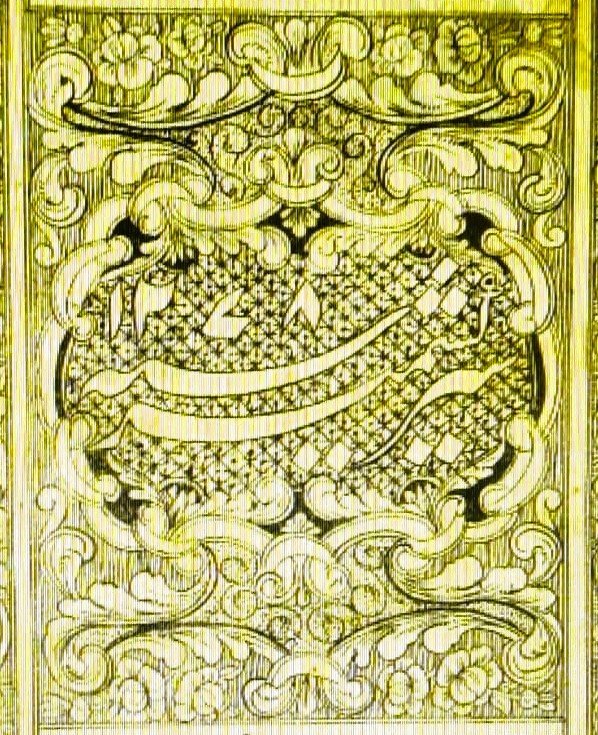
The fact that Kashmir always stood as an important tourist destination in the scheme of the Railway Department even before 1939 is well documented in history. This is when North Western Railway Headquarters functioned from Lahore. Kashmir Rechords is reproducing a document to this effect for the benefit of our esteemed readers. The document in Urdu besides listing railway fares and accompanied road travel packages to Srinagar highlights the role of famous firm with pan-India presence—- Mesers N D Radha Krishan and Sons Railway Out Agents. The firm incidentally still stands rooted in the popular imagination of J&K’s Public. It is clear that the Department of Railways was aware of the Tourist potential and was active in encouraging tourist footfall in Kashmir. Attractive tour packages in this regard are clearly discernible in this document dated November 1939.
Since Government of India has been actively boosting joint ventures and projects and encouraging public-private participation in this regard, private firms are increasingly making their presence felt, be it the upkeep of railway stations or catering services. Considering that it becomes imperative for Indian Railways to further come up with attractive and competitive tour packages on the lines of private airlines to rope in as many tourists as possible, the necessary integral requirements to develop tourist infrastructure and assorted facilities will generate infinite employment opportunities and further augment this core sector of J&K’s economy.
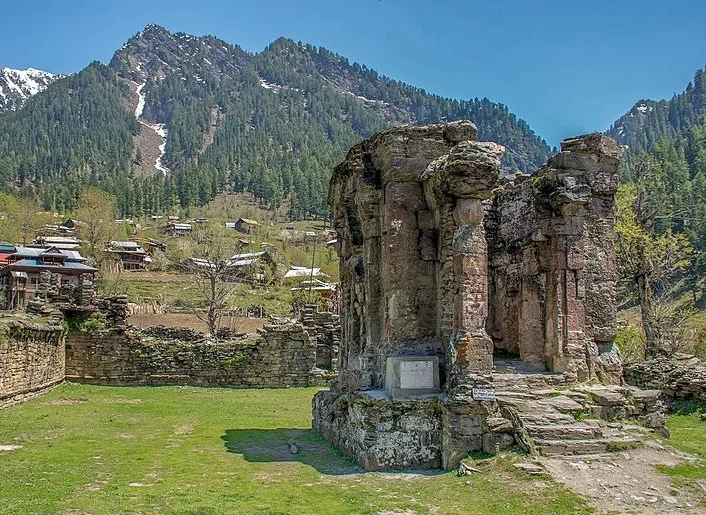
At the moment when this blog is being written, Sharda temple along with the area annexed over large swathes of breathtakingly beautiful and spiritual place stands ruined beyond recognition, but between sixth and twelfth century period it was the crowning glory of India in terms of being a prominent centre of Vedic and Buddhist learning and produced the educational wealth in addition to the supply of a continuous stream of accomplished and erudite scholars across the Indian landmass and beyond to China, Tibet and central Asia .
A photograph of Sharda Peetha in 1940 by British Archaeologist Sir Aurel Stein with a Kashmiri Pandit standing at the entrance
Although much has been written on the subject but renewed interests by scholars continue to generate valuable research material in respect of Sharda Peetha, which stands as a destroyed temple in Pakistan Occupied Kashmir presently but had the honour of the title of one of the most exalted universities of ancient India. The fact that it developed the unique library in the whole of India where in order to access the contents of higher learning, sacred manuscripts and other such repository of esoteric knowledge one had to undertake a series of complex qualifying tests to determine the worth of seeking such knowledge. A mention about the same is made by those who visited this jewel in the crown of Kashmir and accordingly are the stuff of legends in this regard.
Sahana Singh, a scholar in her Book ” The Educational Heritage of India—-How an Ecosystem of Learning was Laid to Rest” (Notion Press) mentions that “Given that ancient Indians attached so much value to learning, it should not come as a surprise that they had a meaningful rite of passage to mark graduation of students called ‘Samavartana’ or ‘Snana’’.
There seems to have been a remarkable mobility of students and teachers across the Universities of ancient India. Sahana makes a mention of professors in Nalanda such as Sthiramati and Gunamati who had earlier established Valabhi University in the west. “Dinnaga and Dharmapala, two famous scholars of Nalanda were both natives of Kanchipuram in the south. Ratnavajra, a noted professor at Vikramshila hailed from Kasmira (Kashmir) and many of the learned people of yore travelled to centres of excellence in their areas of interest’’.
She adds:“ In presence of fellow students, teachers and invited guests, the graduating student at Sharda Peetha and elsewhere would offer his guru (Teacher) the guru dakhshina (offering) after which the guru would recite the “Snataka Dharma” i,e Graduate Code of Conduct from Taittiriya Upanishad followed by a ‘Homa’(Fire ritual) and ‘Snana’ (the Bathing Ritual). A typical Snataka Dharma recitation would be:-
“Never deviate from Truth.
Never deviate from Dharma.
Never neglect your Well Being
Never neglect your Health
Never neglect your Worldly Activities.
Never neglect your “Svadhyaya” .. the Self Introspection and” Pravachana”… the Proclamations of the Vedic knowledge”.
Sharda Script
Sharda Peetha university had the unique distinction of devising the Sharda script. To set the script as a standard for reposting every kind of knowledge ranging from literature to Philosophy, Mathematics, Aesthetics, Astronomy, Medicine, Tantra, Architecture and all the rest of it must have been a daunting task and mission of the stuff of legends of yogis. Sharda script derived from “Brahmi” had the unique role in popularising these knowledge systems across the mainland India and beyond into China, Tibet and central Asia.
The university produced scholars of repute who created dynamic shifts during the period they became instruments of such positive change and set the paradigm for any socio religious activity. This script also known as “Shaardaaakhsharani” are the sacred alphabets of Sharada or Saraswati, the goddess of learning also known as “Naarada and Vaagdevi”.
Saqi’s Insights
According to the noted Kashmiri writer and historian, Moti Laal Saqi in his book “Aager Naeb’’, the first printed material in China was the Indian treatise “Vajjra Cheddika …Prājña- Paramitta Sutra” famously known as “Diamond Sutra”. Kumarjiva of Kashmir who is known to have been a faculty member of this great spiritual heritage institution had the honour to translate it into Chinese. Other scholars associated with Sharada Peetha are Ratnavajra, a noted professor of Vikramshila University, Thonmi Shambhota (7th century A.D), the translator of Sanskrit Buddhist texts into Chinese and Vateshwara, the first Mathematician from Kashmir besides scores of others. The same has also been corroborated by PNK Bamzai in his voluminous work on History of Kashmir. Further research from Chinese annals is, however, bound to throw much light on many hidden and unreported such glorious names.
The Sharada Peeth at present may lie in ruins in Pakistan occupied Kashmir, but on it depends the very soul and beauty of what we call the Unending India.
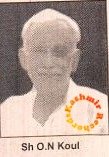
Very few young journalists in Jammu and Kashmir know about Mr O. N. Koul, one of the most respected journalists who had a mastery over Economics and knew well his job of both reporting and editing. The first elected President of Press Club of Jammu and the former Media Advisor to Jammu and Kashmir Chief Minister, Mr O. N. Koul was a witness to most of the post-partition history and had sounded about the initial outbreak of militancy before it had actually raised its ugly head in Kashmir.
Born on January 6, 1937 at Rainawari, Srinagar, Mr O N Koul died on May 8, 2011 at the age of 74 in New Delhi. With a bachelor’s degree in Arts from University of Jammu & Kashmir, Mr Koul had later joined Delhi School of Economics for his post-graduation. He was appointed a lecturer in a college at Jaipur, Rajasthan but he shortly returned to Srinagar to pursue journalism as his career.
Best Editor
Those who have worked with Mr O N Koul know how brilliant he was in the art of editing and writing editorials on Kashmir affairs. He would never waste words. He had a mastery over length and contents of the text and would ensure that the news item was in the right style for the intended audience.
His initial job in 1960 was sub-editing Kashmir Post that Mr Ved Bhasin was editing. After Ved Bhasin’s resignation in 1963, Mr Koul had replaced him. In October 1964, in a swift turn of events, when the then Chief Minister Ghulam Mohd Sadiq arrested Bakshi Ghulam Mohammed and also banned Kashmir Post, Mr Koul too was arrested and kept behind the bars for three months.
After that, Mr Koul worked for a number of newspapers and news agencies, including United News of India (UNI). However, having Economics as his background, The Economic Times had become his identity.
During the same period and when militancy was at its peak, Mr O N Koul first worked for Daily Excelsior and later for Kashmir Times and Himalayan Mail as Executive Editor.
This author too had an opportunity to work under him as a Cub Reporter in 1989-90 at Daily Excelsior where Mr Koul baptized and ensured his colleagues to know the distinction between a comment, an analysis and a news and rarely permitted anybody to create a cocktail of the three. He would often say that Journalists should learn from a “Pansari’’, who sells things in “Chattak’’ or “Chattang’’ and not in “Seer’’ or kilograms.
Considered as one of the finest editors, Mr Koul, who was heading Daily Excelsior’s newsroom when Kashmir was boiling, never permitted anything un-newsy to become a news. In March 1989, when Mr Koul was in Srinagar, he had an inkling about militancy. He, like others in Srinagar, had received the threatening phone calls.
A by-line story of Mr O.N.Koul, published in March 11, 1989 edition of Daily Excelsior, Jammu.
Media Advisor
When Dr Farooq Abdullah was Chief Minister during the period from 1996 to 2002, Mr Koul was chosen his Media Adviser for a period of two years. It was after this assignment that he suffered a paralytic stroke in Jammu in 2002 from which he could not recover fully. Later, he was shifted to Delhi for treatment where he breathed his last on May 8, 2011.
Mr O N Koul, Dr Farooq Abdullah and the Author. ( Picture: Late Ashok Sodhi)
The path-breaking judgement of the Supreme Court of India in regard to the Article 370 has a great significance in a historical context. The Apex court deserves compliments for ultimately relieving our current and future generations of the severe socio-political and psychological migraine that we suffered for the last seven decades on account of Article 370 of the Indian constitution. This migraine contained severe convulsions of headaches of various nature that gave perpetual pain all along, wittingly and unwittingly.
Prime Minister, Narendra Modi, in his recent column on the historic judgement calls this migraine as the mind-set of “duality”. He writes, “Unfortunately, due to centuries of colonisation, most notably economic and mental subjugation, we became a confused society of sorts. Rather than taking a clear position on very basic things, we allowed duality, leading to confusion. Sadly, Jammu and Kashmir became a big victim of such a mind-set. At the time of independence, we had a choice of making a fresh start for national integration. Instead, we decided to continue with the confused society approach even if it meant ignoring the long-term national interests”.
Unanimous Judgement
The unanimous judgement of the highest court (delivered on 11 December 2023) on all issues related to the abrogation of Article 370 brought the Nation out of the constitutional duality for ever. It is historic in the sense that it brings to an end the facade of Article 370 being a “permanent article”. Though it was classified as a temporary provision by the Constitution of India itself, textually and contextually, yet political leaders made attempts to mislead the people on this account. They aroused passion and sentiments among the people all these decades giving them to believe that it was related to their so-called honour and dignity.
A false notion was created not only by the politicians of various hues but also by some noted legal professionals and ‘experts’ as well that Jammu & Kashmir retained some kind of a `sovereignty’ even after the Accession of the State to the Union of India. Having an eye upon the political harvest, it was hidden from the public gaze that Article 370 was an example of asymmetric federalism. While the existence of the said Article in the constitution was misused to nurture, propagate and promote the separatist and parochial agenda, hardly was it made known to the people that the purpose of the Article 370 was to slowly bring J&K at par with the other states.
With the surreptitious inclusion of Article 35A, by virtue of Article 370, a wall of hatred was raised in 1954 to further multiply human rights violations upon the common citizens of India in the J&K state. A separate constitution of J&K, a separate symbol and a separate flag added to the duality of mind-set that gave rise to sub-nationalism oriented politics in the State. People were divided into classes and thus deprived of their fundamental rights. Article 35A was the classic example of the violations of Article 16, 19, 20 and 21 which also came to the fore during the hearing of the case in the Apex Court.
It is also noteworthy that while the Court declared that the President of India had no necessity of any consultations with the state legislature/state constituent assembly to bring to an end the existence of Article 370, it also held that resorting to Article 367 by the government was ultravires of the constitutional scheme. This is a clear-cut guideline for the governments to desist from taking such an action in future. Upholding the decision of the Parliament in regard to the formation of the Ladakh Union Territory was welcomed by all and directions in regard to the state status and elections in the J&K state have also been greeted by the people with a sense of purpose.
It is ironic that the plaintiffs on the one hand were talking of democracy and on the other hand demanded permanence based on the crown that is long gone. These plaintiffs belong to the same legacy that takes pride in launching “Quit-Kashmir movement” against the Maharaja of Jammu and Kashmir in 1946. They would always love to apply the rules of the game selectively. In this context, the following para in the judgement assumes significance that brings to an end not only the debate about the superiority of the Indian constitution but also the questions related to sovereignty:
“On 25 November 1949, a proclamation was issued for the state of Jammu and Kashmir by Yuvraj Karan Singh. The declaration in this proclamation that the Constitution of India would not only supersede all other constitutional provisions in the State which were inconsistent with it but also abrogate themselves what would have been attained by an agreement of merger. With the issuance of the proclamation, paragraph 8 of the Instrument of Accession ceased to be of legal consequence. The 9 proclamation reflects the full and final surrender of sovereignty by Jammu & Kashmir, through its sovereign ruler, to India -to her people who are sovereign”.
Opening up new vistas
When it was said that the current and future generations of J&K would feel relieved of a big headache consequent upon the judgement of the apex court, it also meant that it opened new vistas for the nationalistic and public welfare politics in Jammu and Kashmir for all. Our beloved Prime Minister echoed the same sentiment in his article in this manner, “today, every child born in Jammu, Kashmir and Ladakh is born with a clean canvas, where he or she can paint a future full of vibrant aspirations. Today, the dreams of the people are no longer prisoners of the past but are possibilities of the future. After all, development, democracy and dignity have replaced disillusionment, disappointment and despondency”.
It is time to express deep gratitude to the Supreme Court of India and the honourable judges who created history and brought to an end the most painful chapter of India’s post-independence era in regard to Jammu and Kashmir. The idea of Truth & Reconciliation Commission in the judgement needs a deeper thought and should invite the attention of the government and the civil society to take it to the logical conclusion. The victims of terrorism need to be provided ‘accessible relief’ and the Commission can play a positive role in this direction.
The judgement must have also provided a great solace to the souls of our great national and regional icons who campaigned and struggled against Article 370 (earlier 306A) and the ideology connected with it throughout their life. Besides others, they prominently included Dr. Shyama Prasad Mukherjee, Dr. B. R. Ambedkar, Moulana Hasrat Mohani, Rafi Ahmed Kidwai, Balraj Madhok, Atal Bihari Vajpayee, Pt. Premnath Dogra and Adv. Tika Lal Tapiloo. It was late Dr. Mukherjee who laid down his life in Kashmir while protesting against the Article 370 and the then prevalent ‘permit-based entry system’ in Jammu & Kashmir.
Those who have been advocating for the continuance and ‘permanent’ character of Article 370 need to know what Pt. Nehru said about the permanent nature of the constitutional provisions and laws. He, in his address during the debate on Article 368 in the Constituent Assembly of India, observed, “While we want this Constitution to be as solid and as permanent a structure as we can make it, nevertheless there is no permanence in constitutions. There should be a certain flexibility. If you make anything rigid and permanent, you stop a nation’s growth, the growth of a living, vital, organic people. Therefore, it has to be flexible … while we, who are assembled in this House, undoubtedly represent the people of India, nevertheless I think it can be said, and truthfully, that when a new House, by whatever name it goes, is elected in terms of this Constitution, and every adult in India has the right to vote – man and woman – the House that emerges then will certainly be fully representative of every section of the Indian people. It is right that House elected so – under this Constitution, of course, it will have the right to do anything – should have an easy opportunity to make such changes as it wants to”.
This author had brought some important concerns before the apex court in regard to its a few judgements earlier. The first was in the year 2017 in context of the Court’s rejecting the case of probe into the excesses committed against the exiled Kashmiri Pandit community in Kashmir at the hands of the religious-fundamentalist and terrorist regime. The second was in reference to the judgement delivered on the Tripple Talaq issue in 2018. The third one was regarding the decision about Sabarmalai, Kerala and the developments connected with it in 2019. In all earlier communications to the Supreme Court of India, this author as the human rights defender, senior law abiding and conscious citizen of the country made a sincere attempt to tell the apex court as to where, in the eyes of the people, it went wrong or right.
Hope for Bright Future
This time by an endorsement of the legislative action of 5th August 2019 of the Parliament, the highest court has earned further honour and respect in the hearts and minds of the people of the nation at large. It created a strong hope afresh that the people of Jammu and Kashmir have a bright future ahead. Political differences apart, we have a common destiny to achieve the unachievable so far as peace, prosperity and purpose are concerned. The Apex court has well established that the constitution of India in the background of our great Indian civilization is the guiding star for all of us. The Supreme Court and the judges of the constitution bench deserve our thanks and gratitude and we express that wholeheartedly….!
*(The author is a senior BJP and KP leader, author and columnist and can be reached at ashwanikc2012@gmail.com.)
Article 370 is a history now. The self-inflated jinni now stands permanently closed in the bottle much to the consternation of those who would want this jinn to be continuously worshipped, even to the extent of consigning Kashmir to the flames. But the jinn has found peace now after it stands exorcised.
Nevertheless , the ‘unique’ position it trumpeted to accord to Kashmir for the past so many years will definitely continue…albeit differently.
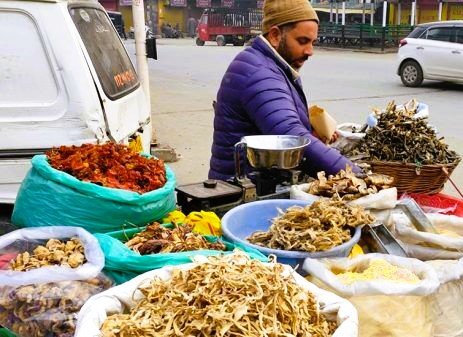
Did you folks get it right…? We mean dry vegetables and other such assortments. “Hokhie Sinniey”, “Aanchaar” “Gaaeriey” (Water chestnuts), “Bum” (Water Lily rhizome), “Hund” (Dandelion), “Pambechie” (Lotus Seeds), “Hoggard” (Dried fish) etc.
Brand `Koshur’
The brand `Koshur’ in its new avatar will synergize and direct its energy towards rebuilding itself after clearing the debris that the jinni has left in its wake.
Kashmiris will, however, not relinquish the practice of according special status to anybody who comes from any State of mainland India while addressing him or her as `Punjeab’ or `Madreas’. For Kashmiris, every Indian used to be either a Punjabi or a Madrasi. The same applies to goods and services that found their way into Kashmir. Punjeab Gaad (Fish), `Punjeab Wangun’ (Brinjal), `Punjeab Palakh’ (spinach), `Punjeab Chhan’ (Carpenter) etc will continue to be part of Kashmiri’s vocabulary. Now, of late, the nomenclature seems to have changed to Bihari. Any mason, a labourer, a plumber or a barber from any State working in Kashmir presently is a Bihari for a Kashmiri. And this uniqueness we Kashmiris so cherish is never going to go away with the abrogation of Article 370. The indigenous items according a unique peculiarity to Kashmir will also continue to thrive and these include Koshur Thool (Egg), Koshur Wangun (Brinjal), Koshur All (Bottle Gourd), Koshur Varimoth, mong (Moong), Koshur Kath (Sheep), Koshur Shawls, and many more, including typical Kashmiri dry vegetables (“Hokh Sinnie’).
The fetish for the hygienic diet may give these “Hokh Sinnie” a bad press in the eyes of the Gen Zee; nevertheless, it is not going anywhere. It will thrive not only in Kashmir but wherever Kashmiris have moved lock stock and barrel. The nostalgia associated with these continues to make people get their mouths watered and admittedly, it is a fetish even now. The usual scene of Kashmiri migrants making a beeline and jostling for space inside the scrum formed around the not so familiar shopkeeper in their locality selling these items has to be seen to be believed. Nowadays not many negotiations over the price take place. This is a free for all situation. “Jhuth Gav Padshah” (Might is Right) rule applies here. Not a shred of “Koshur Haakh” is left. Be that any variety. Every item listed above makes our mouth water.
Nobody goes into the nutritional component of these strange looking objects but for Kashmiris, it is a delicacy as well as a novelty beyond description. Kashmiris will continue to have a penchant for their beloved “Hokh Syun”. They may not dangle the strings of these items for drying nowadays openly and in full view of public… a scene which was a common one before the times Kashmir was showcased as a cradle of peace etc. etc. The process of drying these vegetables, fruits and what not dangling along the walls in the dry Sun presented a riot of colours adoring windows, doors and entrances. New mansions now consider this practice not so cool. But all this is to stay for some time.
Food for Thought
Now, coming back to health fads, it may be mentioned that `Hokh Syuen’ fall under the category of “Synergy Foods’’ and in combination, they provide wonderful results. For example, (1) dried Bottle Gourd and White Gram, also dried green beans, (2) dried fish and dried tomatoes and radish, (3) dried Brinjal and dried Bottle Gourd and dried beans, (4) red beans and turnip, (5) Bum and Hoggard (dried fish) etc. The Hakims of yore would prescribe this for patients who were convalescing.
To sum it up all we are reminded of modern polymath Nassim Nicholos Taleb. While advocating in favour of widening the scope and meaning of Rationalism he comes up with the argument that whatever survives the test of time should supersede every prevalent and informed opinion. One’s grandmother may have had many a trick up her sleeve while preparing your choicest dishes. These tricks may have remained unveiled for a long time but continue to remain sturdily rational and themselves are a testimony to the fact that tested knowledge survives and evolves overtime into a jewel. …”Hokh Syun” has all the justification to get defined under this unique category.
Kashmir Rechordsin its blog dated 09/12/2023 highlighted the contents of a historical travelogue of 1847 written by Pandit Kanhaya Lal Aashiq Dehalvi titled `Sair-e-Kashmir’. The copy of the travelogue, which is written in old style Urdu and in Nastalique script, was made available to us by Rafi Ahmad Masoodi Sahab of Sopore who is an Educationist, Writer and and a historian.
Part first of the blog was shared with readers under the title “Englishman’s 1847 travel to Kashmir via Jammu’’. The blog brought out the vivid and poignant details of the history of that period. The same can be assessed here: https://kashmir-rechords.com/englishmans-1847-travel-to-kashmir-via-jammu/
Leaving Jammu for Rajouri
The Part II of the travelogue in the form of daily entries in a diary called ‘Roznamcha’ also contains immensely useful information and details about the onward journey to Kashmir undertaken by one Englishman Mr. Winter Bedim and Pandit Kanhaya Lal Aashiq Dehalvi and it goes like this:–
The party left Jammu on 25th of April, 1847, crossed the river Chenab at Akhnoor and traversed their path through what the writer calls “Kohistani llaqa”…. the mountainous region. The ‘Roznamcha’ makes the mention of places like “Daab”, “Bhimber”, “Rah Koh” “Sayal Soi” and finally Rajouri. The officialdom of Maharaja Gulab Singh comprising of Diwan Gurudita Mal, Kochak Diwan, Karam Chand and Jamadar Charitoo welcomed them and took care of all their needs. The Roznamcha reveals that three parts of land at Rajouri yield ‘Brinj” and the remaining one fourth produces wheat and barley. Rajouri town is mentioned as an impressive one with bustling trade activity.
(Picture courtesy: Rekhta,https://www.rekhta.org)
People’s Poor State of Health
The party finally leaves Rajouri town on or around the morning of 1st May 1847 and crosses Thana Mandi around second May 1847. Mr Dehalvi reveals that it has a sizeable number of Kashmiri speaking population but in terms of health people are prone to cold, cough related infections and extreme debility and exhaustion was noticed on account of high malnutrition. The party upon onward journey reached Behram Gulla from whereupon they proceeded to cross what the writer of the `Roznamcha’ calls “Rattan Paanchaal” peak and is said to be at a height of about nine thousand feet from sea level. There is a `Mazar’ in memory of a great saint in this area. This saint has a large following.
In the relatively low-lying area between two mountainous ridges is situated Behram Gulla. Gulla as per the local lingo signifies a pass or a passage. A chowki installed on the orders of Maharaja Gulab Singh collects tribute or levy in the form of following goods with their declared quantity as follows:-
SALT………………………………………………………… = Four (Mounds)
PARCHA SAFED (probably white Latha)…………… = Nine (Mounds)
WHITE SUGAR…………………………………………… = Four (Mounds)
No other good or trade item passes across this mountainous pass.
(Picture courtesy: Rekhta,https://www.rekhta.org)
The party is said to have continued its trek across this vast mountainous area coming across infinite number of water bodies, rivulets, nullahs, cascades etc through this perilous territory with a miniature town and its minuscule population namely ‘Poshan’. However, the onward journey could not be made due to accumulated snow and to circumvent the challenge as many as fifty `mazdoors’ (labourers) were called out to clear out the way forward at a feverish speed even through the night and thus the travel continued in the full moonlight, the `Roznamcha’ reveals. This part of the Pir Panchal range is at about a height of more than twelve thousand feet. A Sarai does exist at a distance of one `kos’ at a place called Ali Abad. The `Roznamcha’ mentions about the spending of night in a `Sarai’. The writer of the travelogue was so unnerved by the cold at this place that he goes on record to mention that even the bonfire they made at these heights caught cold.
Trekking through Heerpur
After a proper rest, the party continued its downward trek through Heerpur where they were received by Diwan Gobind and one Lala Jendyal. The town has been mentioned as having a sizable population and all kinds of eatables are said to be available.
The party left Heerpur on seventh of May 1847 for Shahabad in Devsar Pargana and upon reaching there, they exclaimed! Lo and behold! Glimpse of the great Aharbal Aabshaar (Cascade) was before them. “It indeed is a miracle of God where a rainbow gets formed on the splashes created by the downward fall of this great water fall”. The writer of the travelogue, however, here also comes across a weak population with minimum resources to combat the usual prevalent diseases of debility, exhaustion and infections. The `Badda Sahab” i, e Winter Bedim is reported to have distributed some medicines he had brought along with him among these people. ………………. (TO BE CONTINUED)
——–
*Kanwal Krishan Lidhoo, an accredited translator of Kashmiri, Urdu and Hindi by Sahitya Akademi New Delhi and Indian Institute of Languages Mysore, is associated with the institution of All India Radio (AIR) where he worked as Senior most Producer. During his career of more than thirty years in AIR, (including Radio Kashmir Srinagar and Radio Kashmir, Jammu), he has produced hundreds of programmes covering a wide range of topics and interests that range from ‘Features’, ‘Dramas’ , ‘Literary Magazines’ , ‘Current Affairs’ and overseen Music recordings. He also has the professional expertise of anchoring Live shows and News.
His books of Translation include:
1. “Samay Matrika” … Translation of 10th century Sanskrit classic of the same name by Acharya Ksemendra of Kashmir.
2.Sahitya Akademi New Delhi’s “Hum Kaal Sindhi Afsana Sombran” a Kashmiri translation of Hindi scripted ” Samkaleen Hindi Kathayen”, and under publication “Navi Yogikie Vaaeris Dar” a Kashmiri translation of English scripted collection of Punjabi short stories of renowned Punjabi short story writer Mohinder Singh Sarna.
3. Indian Institute of Languages publication “Hindustaenie Falsafekie Khad-o-Khal” …The Kashmiri translation of “Outlines of Indian Philosophy” by world renowned Professor M.Hiriyanna.
Kanwal Krishan Lidhoo is also a short story writer in Kashmiri. In addition, he has presented a number of essays in Kashmiri
We are highly indebted to Rafi Ahmad Masoodi Sahab, Educationist, Writer, Historian and a distinguished Academician, originally from Sopore, Kashmir who has made available to us the copy of a historical travelogue from Lahore to Srinagar via Jammu region. The name of the book is “Sair-e- Kashmir” (Travel to Kashmir) written by Pandit Kanhaya Lal Aashiq Dehalvi, probably a Kashmiri who goes on record to mention that he published the accounts of these travelogues for the benefit of those who are interested to visit Kashmir. The book has originally been written in old style Urdu language (Nastalique) and has been recast in the same font.
Pandit Kanhaya Lal Aashiq Dehalvi being a Kashmiri Pandit is testified by the details of a critical study on the same topic published by Dr. Sumaira Ijaz of Department of Urdu of Sargodha University Punjab.
The book is actually a compendium of daily entries of his accounts in his diary during a travel, which was undertaken by him along with an Englishman named Mr. Winter Bedim, which he calls ‘Roznamcha’ in 1847. Pandit Kanhaya Lal Aashiq was a resident of Akbarabad Sialkot (now in Pakistan) who sought employment in the office of the then British Agent in Lahore, some Colonel Lawrence due to his proficiency in English language. Thus, he wrote this travelogue also for the Englishman, with whom he had travelled to Kashmir via Jammu. “Sair-e- Kashmir 1278 AH” is written on the cover of the Book having 41 (forty-one) pages. The travelogue is between the period of April 1847 to June 1847.
Pandit Dehalvi’s entries in his accounts refer to the year 1847 and make fascinating study besides carrying invaluable information from a historical perspective. The entries are poignant and vivid as far as they conjure up the images of daily life in places he travelled.
The journey is said to have begun from Lahore on 5th of April 1847 A.D. The party of Englishman, Pandit Dehalvi along with a posse of orderlies marched from Lahore through Gujranwala, Wazirabad Jamgi etc and finally halted at Bari Brahmana on the morning of Jammu on 22nd April.
Pandit Kanhaya Lal Aashiq Dehalvi writes:
“In the morning of 22nd April, we reached Badyal Brahmana. Arjan Singh, an official of Maharaja Gulab Singh’s court accompanied by one Choudhari Bishan and three other Zamindaars presented themselves in service to receive us. It was very cloudy and fierce dust storms raged all around.
We reached Jammu city on 23rd of April, 1847 which is a very beautiful place on the banks of river Tawi and its entry is being made through the Gummat gate. The door is not so strong; however, the structure is on a raised ground. In fact, the whole city has been built on a raised ground. Though no settlements were seen in or around the gate, we were however lead along a path by one Sokha Singh to Maharaja Gulab Singh’s palace for our further stay. In the meantime, Wazir Zorawar Singh accompanied by Deewan Jwala Sahay and Deewan Karamchand along with other associates arrived for a meeting with the Maharaja Sahib. I was to act as the translator between Mr. Bedim and Jawala Sahai. The Englishman enquired as to where from could he proceed towards Kashmir. He was advised to seek a route other than Banihal. Even though some semblance of a road does exist but the same was not fit to be travelled as, it is clad under heavy snow at this time of the year. Instead, the Englishman was asked to proceed through Rajouri which was a better option and he did the same.
`Roznamcha’ about Jammu City
Pandit Dehalvi’s `Roznamcha’ about Jammu city, however, presents a mixed picture. According to him, the houses and shops are of a very low height, dingy and the city structure is unplanned with narrow lanes and by lanes. However, the palace and the structure of the dwellings of nobility are grand. “The people are highly hospitable, sincere and loving” he goes on to mention. The party is said to have proceeded on 24th April towards the Bahu Fort. Pandit ji is on record to note that the fort is endowed with a big gun what he calls “Zarb-E-Kalan” Tope and as many as seventeen smaller guns known as “Zarb-E-Khurd” (Smaller guns) (Page (7) of the Book.). The fort is visualised as a very strong one, which appears to be inaccessible due to overgrown bushes and is at a formidable height from the town”
Family Tree of Maharaja Gulab Singh
Pandit Kanhaya Lal Ashiq Dehalvi has also included the family tree of Maharaja Gulab Singh. He also makes a mention about Maharaja Ranbir Singh, the heir apparent whom he calls ‘ Tika Sahib’ and also Mian Jawahar Singh eldest son of Raja Dhyan Singh, who accompanied them to Bahu Fort.
Family Tree of Maharaja Ghulab Singh. (Picture courtesy: Rekhta,https://www.rekhta.org/ebooks)
(This is the first part of the series in which we are highlighting the travelogue titled “Sair-e Kashmir” written by Pandit Kanhaya Lal Aashiq Dehalvi in 1847. Part second of the blog will shortly highlight the details based on the onward historical journey to Kashmir valley).
* Kanwal Krishan Lidhoo, an accredited translator of Kashmiri, Urdu and Hindi by Sahitya Akademi New Delhi and Indian Institute of Languages Mysore, is associated with the institution of All India Radio (AIR) where he worked as Senior most Producer. During his career of more than thirty years in AIR, (including Radio Kashmir Srinagar and Radio Kashmir, Jammu), he has produced hundreds of programmes covering a wide range of topics and interests that range from ‘Features’, ‘Dramas’ , ‘Literary Magazines’ , ‘Current Affairs’ and overseen Music recordings. He also has the professional expertise of anchoring Live shows and News.
His books of Translation include:
1. “Samay Matrika” … Translation of 10th century Sanskrit classic of the same name by Acharya Ksemendra of Kashmir.
2.Sahitya Akademi New Delhi’s “Hum Kaal Sindhi Afsana Sombran” a Kashmiri translation of Hindi scripted ” Samkaleen Hindi Kathayen”, and under publication “Navi Yogikie Vaaeris Dar” a Kashmiri translation of English scripted collection of Punjabi short stories of renowned Punjabi short story writer Mohinder Singh Sarna.
3. Indian Institute of Languages publication “Hindustaenie Falsafekie Khad-o-Khal” …The Kashmiri translation of “Outlines of Indian Philosophy” by world renowned Professor M.Hiriyanna.
Kanwal Krishan Lidhoo is also a short story writer in Kashmiri. In addition, he has presented a number of essays in Kashmiri.
Throughout history, there have been countless individuals whose remarkable contributions have been overlooked, overshadowed or forgotten. These unsung heroes, often marginalized due to one reason or the other, have made significant impacts on society, yet their stories have remained largely untold. Such unsung heroes even exist in Jammu and Kashmir and very few are aware of their contribution—for the reason that nothing substantial has unfortunately been written about them.
While much is being written on already established personalities of Jammu and Kashmir, it is time to shine a light on these overlooked figures, acknowledging their invaluable contributions and ensuring their place in the annals of history. Kashmir Rechords has decided to find such unsung heroes who have been marginalized but deserve recognition for their resilience and contributions to their communities and beyond.
In our last issue of “ Unsung Heroes’’, we tried to highlight the contribution of Kanwal Kishore Jalla, a noted singer from Kashmir who has remained underrepresented in historical records. Today, we pay our respect to Vasudev Reh, a Kashmiri poet of a Progressive Movement.
A Progressive Poet, Musician
Born in 1926, Vasudev Pandita, ‘Reh’ of Batapora Sopore Kashmir, was a famous poet of Kashmiri Language. He had, unfortunately lost his eyesight due to small pox when he was a child. His brothers helped him learn almost all things necessary for his daily life. He was educated informally by his brothers to help him in passing Matriculation examination. He later obtained a degree of Prabhakar and side by side studied music.
According to A K Chetan, a noted writer and poet from Sopore town, Vasudev Reh had also opened “Vitasta Music School’’ within his home premises where he used to train students in music. For his unique style of Kashmiri poetry, Producers of then Radio Kashmir, Srinagar used to invite him often for various music mushairas. His brother, Som Nath Pandita always used to accompany him for his recordings and recitations of his poems.
Vasudev Reh at a poetic symposium in the company of Amin Kamil and Ghulam Rasool Santosh
Chetan says people would always want Reh to recite his most famous piece of poetry like,” Subhan Shaman Hosha Hosh ” ! His poetry was a blend of both Sofiana and Philosophy with a mystic touch. Incidentally, his younger brother, Raghunath “Kastoor’’ was also a noted Kashmiri poet from Sopore, Kashmir. Reh is also known for his collection of poetry ‘Shab Gardun’ (The Night Watchman).
Kashmir Rechords appeals to all its esteemed readers, who might be knowing such unsung heroes to contact us with authentic details and send the same on kashmirrechords@gmail.com or support@kashmir-rechords.com. We promise to publish them with due credit to the contributors by amplifying the stories of these unsung heroes. Such stories honour their legacies, inspire future generations, and strive for a more inclusive and accurate understanding of history. It is imperative that we actively preserve the stories of those who have been marginalized, ensuring that their contributions are no longer consigned to the shadows of history.
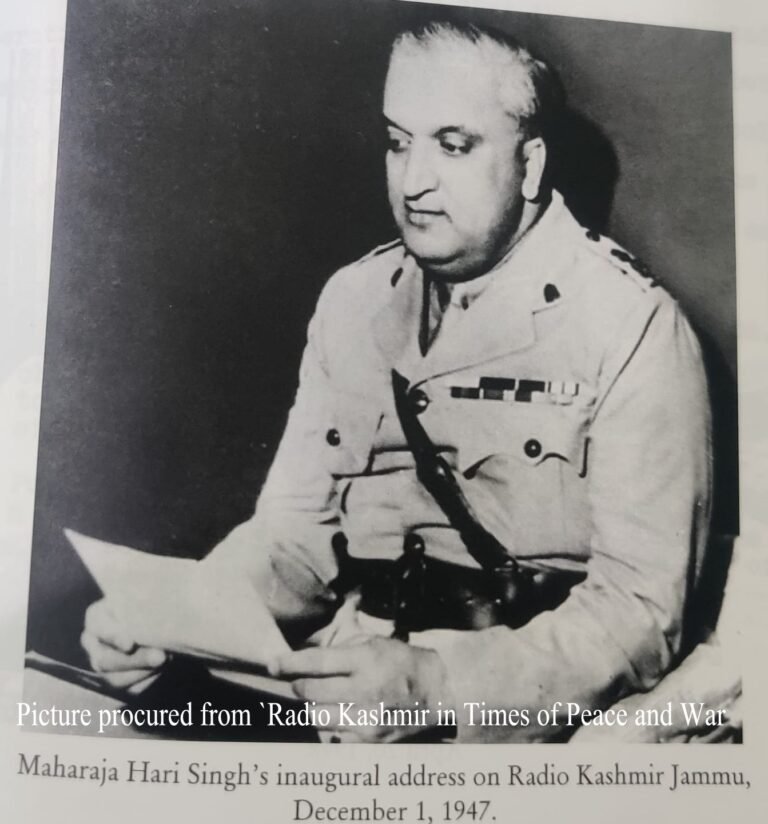
It was on December 1, 1947 at 6.30 pm that Radio in the erstwhile Princely State of J&K started functioning from Jammu. Maharaja Hari Singh, who had acceded to Indian Dominion the same year on October 26, was the first person to make the historic speech from the makeshift Studios set up in Ranbir High School. Incidentally, It was also his last Radio speech!
The news agency — Associated Press of India (API) formed in British India, had next day ( December 2) carried and circulated Maharaja Hari Singh’s inaugural speech. The Maharaja had justified his decision to accede to the Indian Dominion. He had also extended his gratitude to Prime Minister Jawahar Lal Nehru, Home and I&B Minister, Sardar Vallabh Bhai Patel and Defence Minister, Sardar Baldev Singh for their help in coming to the rescue of the people of his State.
Maharaja Hari Singh had also all praise for Sheikh Mohd Abdullah, “the leader of the courage’’ and his Prime Minister, Mehr Chand Mahajan “whose advise was of greatest value to him.’’
On the occasion, the Maharani of Jammu and Kashmir had also spoken from Jammu Radio and appealed Kashmiris not to get panicky in the face of the crisis through which they were passing.
Kashmir Rechords is reproducing the transcribed speech of both Maharaja Hari Singh and Maharani of the Princely State.
Maharaja’s Inaugural Radio Speech
“Jammu, Dec 2: Inaugurating Jammu broadcasting service yesterday the Maharaja of Kashmir said that he was speaking at a time when severe fighting was going on at several fronts between the aggressors and the armies of the Kashmir state and of the Indian Dominion. He appealed to his people to have faith and courage and meet the crisis with strength and hope’’
“The Maharaja added: “A new chapter is being written in the history of my people, the people of the state. Momentous decisions have been taken. We have acceded to the Indian Dominion. We had to take this historic decision in a state of emergency owing to acts of aggression committed on our integrity’’
“My Government had no direct means of stating the true fact before our people or the public at large. By the kindness of the Government of the Indian Dominion to which government we are indebted in several ways, I am today speaking from the Radio Station at Jammu”.
“I wish to take this opportunity of conveying the thanks of my people and my Government and myself of the Indian Dominion for all their help rendered to us in our greatest hour of need. To Pandit Jawahar Lal Nehru, Sardar Vallabhbhai Patel and Sardar Baldev Singh, I wish to convey our gratitude. It is known to my people that it is my earnest desire that the act of establishing responsible Government in the State should be promulgated so that the new constitution may begin to function as early as possible’’
“I am glad that amongst my people there is in the person of Sheikh Abdullah, at the moment a leader of courage who has given a hope to them at this critical puncture point. I am confident that in collaboration with my Prime Minister, Mr. Mahajan whose advise has been of the greatest value to me in the hour of crises they will work for peace and prosperity.’’
“I wish to say that officers and other ranks of my Army have fight with exemplary bravery in spite of the adverse circumstances and against exceedingly heavy odds. This, I am sure that they will continue to do’’.
Maharani’s Appeal to Kashmiris
“Jammu, Dec. 2. The Maharani of Jammu and Kashmir in broadcast from Jammu Radio yesterday asked Kashmiris not to get panicky in the face of the crisis through which they were passing but meet it coolly and calmly. She appealed to them to maintain peace and thereby serve the state and said that where the Muslims were in a majority, they should protect the Hindus and Sikhs and where Hindus and Sikhs were in majority they should protect the Muslims –A.P.I’’
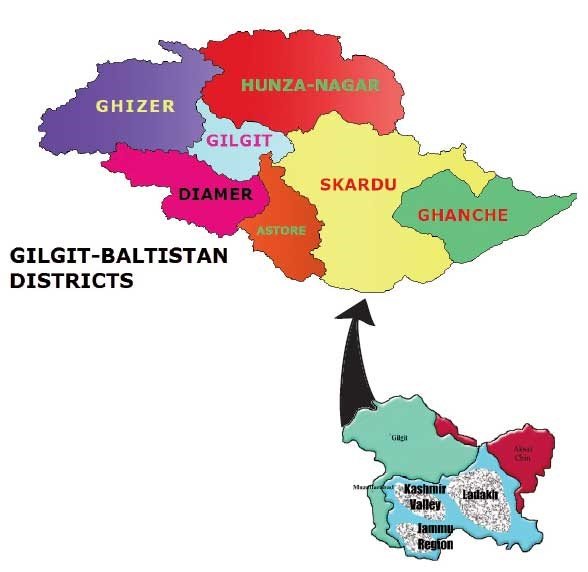
Whenever and wherever the future of Gilgit- Baltistan (now under the illegal occupation of Pakistan) region is discussed, naturally Jammu & Kashmir is linked with it. The Gilgit Baltistan (GB) is an part of erstwhile Jammu & Kashmir State. But, due to political blunders, the region got bracketed as a disputed territory.On August 1, 1947, the colonial British India Gilgit returned Gilgit (leased to it for sixty years) to Maharaja of Jammu and Kashmir. It was then merged with Ladakh. It was declared as third Northern Areas Territory Province as mentioned in UNCIP resolution (Gilgit Baltistan and Ladakh –GBL). Two other provinces were Jammu and Kashmir. Gilgit- Baltistan area was approximately 63,650 square miles, Jammu province approx. 12,700 Sq. miles and Kashmir province was smallest 8000 sq. miles. British had understood the importance of this area in guarding the frontiers and boundaries of India. British were active in the area before the 1830s. In 1870, they had completely tightened their grip over it. They used the region for intrigues to rule the Subcontinent.
Brig Ghansara Singh—Governor of Gilgit
Maharaja of Jammu and Kashmir, Hari Singh had appointed Brigadier Ghansara Singh as the Governor of Gilgit. Brigadier Ghansara Singh, in his prison diary of Astore (Gilgit), has held responsible both the then Jammu and Kashmir government and the then Central government for the fall of Gilgit.
This writer, while interviewing Brig Ghansara Singh in Jammu in 1987, was told, “No protective units for this far-flung mountainous area were deployed. In 1947, it had a weak brigade. Only two companies of 6th J&K Infantry were sent. One of the companies was commanded by one Muslim trained commander Capt Hussain. This commander started hobnobbing with Pakistan.”
Before Ghansara Singh’s departure for Gilgit, he was briefed by Pt. Sham Lal, the then Political Secretary. However, he was sent alone to take over the whole of the Gilgit administration. A number of questions are thus raised. Why was Ghansara Singh sent with no civil officer along with him? Why was budgetary support not provided to him at the time of change of guards? Why he was not armed with judicial powers?
During a conversation with Brigadier Ghansara Singh, he recalled, “On my arrival in Gilgit, the general impression gathered was that the British officer did not like the change. But the Gilgit public was highly pleased with the transfer of power. They welcomed the change but were surprised to find me all alone before them.”
He said “ his suggestions to address the grievances of the scouts officers and civil employees were not considered in time in Srinagar. As a result, there was discontentment amongst the employees’’.
In 1987, Brigadier Ghansara Singh said, “the two British officers of the Gilgit Scouts, Major W.A. Brown and Captain A.S. Mathieson, whose services had been retained by the State, were responsible to involve Muslim officers posted in Gilgit. ”The predominantly Muslim civil employees of the Government of Gilgit turned pro-Pakistan and supported the demands of the Scouts for special pay and other concessions for serving the Jammu & Kashmir State.
Brig Ghansara Singh said that with no authority from the government, he just promised them to recommend their case with sympathetic consideration to the government. He said, “it was pity, that the civil employees of the Jammu and Kashmir State were not paid any allowance during their stay in Gilgit. I had made repeated requests to Jammu and Kashmir government through Dr Wanger and the Political Agent of Gilgit Khan Mohd Alam. But there was no positive response’’.
A Hero’s Nightmare
* Ist Aug 1947: Last British Political Agent Lt. Col. Roger Bacon lowered British Union Jack from Gilgit Residency. Governor Brig. Ghansara Singh hoisted tricolour of the Maharaja of Jammu and Kashmir.
*4th Aug 1947: revolt started at Yasin. Lt. Col Becon imprisoned some of the leading men of Yasin.
* 22nd Oct 1947: (Tribal invasion in Kashmir) PoK government was formed under President Sardar Ibrahim Khan.
*24th Oct 1947 Sheikh Mohd Abdullah took over as head of interim government in Srinagar.
*26th Oct 1947: Maharaja’s accession to India of Jammu and Kashmir State including Gilgit-Baltistan.
*31st Oct 1947: As soon as Maharaja Hari Singh acceded to India, Major W.A. Brown got the Gilgit Scouts to surround the residency and, after a short gun battle, he imprisoned Governor Ghansara Singh. Brown then informed Peshawar about the accession of Gilgit to Pakistan.
* 31st Oct- 1st Nov 1947: (Intervening night, 2 am) about 100 Gilgit scouts led by Major W A Brown, Lieutenant (later Col) Ghulam Haider Khan and Sub. Major Babur Khan surrounded Brig Ghansara Singh’s official bungalow.
In the morning Pt Mani Ram, Naib Tehsildar and a police Inspector told him that scouts officers had asked him to surrender within 15 minutes. If he did not surrender, all non-Muslims and civil officials would be shot dead as they wanted to establish Pakistan in Gilgit. In case the offer was accepted, they would safely sent to Bunji, about 54 kms from Gilgit on Srinagar road.
Raja Noor Ali Khan and Sukh Dev Singh also requested Brig Singh to accept the terms and return to Bunji Battalion Headquarters.
* Ist Nov 1947: At 8.45 Brig Ghansara Singh was imprisoned by Sub Major Babur Khan, of the Scouts and was shifted from his official bungalow to one of the tiny rooms in Gilgit Scouts lines.
* 3rd Nov 1947: Flag hoisting was performed at Gilgit in Scouts line by Major Brown where all civil officers, of the state except Brig Singh, were called and saluted the Pak flag. Lt. Col Abdul Majid Khan and Sub Major Babur Khan put before him a typed telegram to sign, in which it was written that charge of Gilgit had been handed over to the Gilgit Government. Interim government in Gilgit was installed under the presidentship of Raja Shah Rias Khan. Col Mirza Hassan Khan appointed as head of Revolutionary Council. Lt (later Col) Ghullam Haider, who was quartermaster of Gilgit Scouts, was appointed as commissioner in interim Government.
Brig Ghansara Singh was kept in one room for three months continuously. There was one WC and no bathroom in it. He could not take bath for three months, as there were no water arrangements. His servants, Sardar Makhan Singh, his son Rohan Singh and one Sansar Singh were lodged with him in the same room. He was not allowed to get out of his room. He did not see the Sun. There was one skylight in his room where from he could see whether it was a day or night. During daytime, he was all alone whereas his orderlies were allowed to sit outside in the sun.
He was deprived of books and newspapers. His orderly had one Ramayan, which he would read all the day. In the morning, he would get his meals at 11.00 am and in the evening at 5.00 pm. After dark, his orderlies were not permitted to go outside to bring his food. His orderlies were under strict surveillance and not allowed to talk or contact anybody.
At 7 pm the guard commander would lock up the room and none could go out even to answer the call of nature. Days and nights were very cold. There was no arrangement to keep the room warm. With his limited money, he had managed to buy five seers of fuel to warm themselves, in the morning and evening. No officer or any man would come to enquire about his difficulties during his detention period. He had to purchase all edibles from his own pocket for himself as well as to feed his servants. No exercise and good food told upon his health and he grew weak and lean. Many a times when all alone he would think of committing suicide by a razor blade he had kept with him. But he thought it would be a cowardice act on the part of a soldier who could not face the hardship he was put to.
After three months, one day Mir and Hunza’s younger brother quietly visited him in the evening as Hunza Scout guard was on duty that day. He saw him locked up in one room. He promised that he would relate this to the Mirs and Raja. After a fortnight he was shifted to another quarter where he could sit in the Sun. Major Anwar, the Brigade Major in Gilgit shifted him to other place where he could see the sunrise and sun set after weary three months.
*June 1948: Dr Wanger of the International Red Cross Society, accompanied by Political Agent (PA) and Col Jilani visited him. Brig Singh was sick at that time. Dr Wanger told him that he could write letters to his relatives. After this one PA would once in a month visit his quarter and enquire about his difficulties. He would prepare a list of his needs for ordinary items. He arranged milk for him and money from the balance of his pay to defray his expenses. It was now more than 8 months that he had not gone for a walk.
One day he requested to go out of for a walk in the garden only a hundred yards away from the walled compound. He was permitted for walking after about nine months stay inside the four walls.
Release from captivity
Brig Ghansara Singh was released on 1st June 1949 at Suchetgarh (Jammu). After his release, Ghansara Singh returned to Kashmir but was treated like an outcast by Sheikh Mohd Abdullah and was deprived of his job. However, Maharaja Hari Singh came to his rescue and made him the honorary president of the Dharmarth Trust.
In 1967, he contested the Lok Sabha election on a Congress ticket and won with majority of 57000 votes. But within nine days he resigned to make room for Dr. Karan Singh. In 1972, he was elected a member for the J&K Legislative Council and became the acting chairman of the Council. However, he did not accept any remuneration. Brig. Ghansara Singh, during his long career, was decorated with the OBE and was also conferred the title of the title of Rao Bahadur by the British. Brig. Ghansara Singh was born on March 26, 1892 at village Raipur, Jammu. On 22 January 1991, he passed away at the age of 99.
*R. C. Ganjoo is a senior journalist and columnist having more than 40 years’ experience of covering issues concerning national security, particularly Kashmir. He has worked with several prominent media groups and his articles have been published in many national and international publications. He has co-authored two books– “Operation Khatma’’ and “Farooq of Kashmir’’.
A write-up, published by Kashmir Rechords under the title ``When Snakes, Stones Snowed in Kashmir’(Part 1) generated a lot of interest on various social-media platforms. Most of the esteemed readers of Kashmir Rechordshave expressed their desire to know more about this unprecedented incident, something they had never heard of. For majority of the readers it was a news of the century for them!
While contents of both the files have already been put into public domain, Kashmir Rechords is publishing more documentary evidence to bring home the point that such incidents had really happened more than 100 years ago and are well-documented.
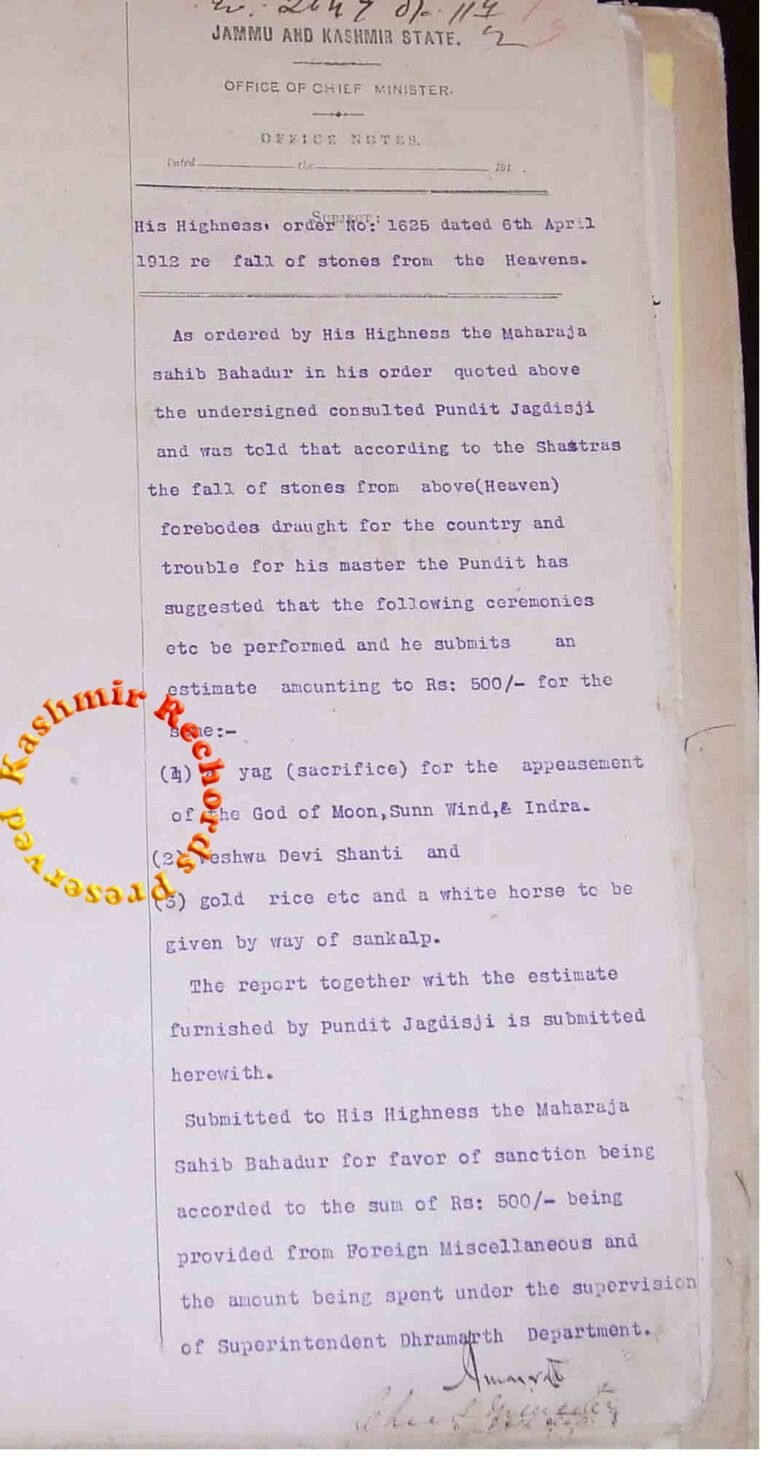
File noting : Fall of Stones from the Heaven
A picture of one such heavy stone that had reportedly come down with snowflakes in 1912 and is currently in possession of Archaeology Department has also been procured for the benefit of our readers.
Ever heard of snakes or stones snowing? No! then go through this snowy story. No fairy tale but buried in the archives is a part of the recent history of Kashmir, supported by documentary evidence.
The two phenomenal incidents when snakes and stones came dangling along with snowflakes in Kashmir, took place during the reign of Maharaja Pratap Singh, a highly devout and God-fearing King. The Government of Jammu and Kashmir is in possession of the precious documents pertaining to these two extraordinary incidents when stones and snakes had “descended from heaven’’ in two South Kashmir villages.
Worried Maharaja
The worried Maharaja, shaken by these ominous happenings, foresaw a terrible calamity that was in the days to come on him and his Subjects. He had immediately summoned the Official Head Priest to find the way out and to ward off any bad effect associated with this event of apocalyptic proportions.
When this writer, during his Ph.D. work approached the J&K Department of Archives, Archeology and Museums in 2009, little did the writer know that he had laid his hands on a very vital and important aspect of Kashmir’s history or that matter such a strange and unique event seen anywhere in the world. The files titled “ Fall of Stones’’ and “ Fall of Snakes from Heaven” have become the centre of attention for researchers and the common people as well.
December 1912—when stones snowed in Shopian
On scrutiny, the files reveal that it was in December 1912 when people of Shopian had complained of having noticed stones falling in their village along with snow. When the matter was brought to the notice of Maharaja Pratap Singh, the fear-stricken king immediately ordered his official priest Pandit Jagdish Ji to assess the situation and suggest remedial measures. The Priest had recommended a yagya to appease the gods of the Sun, Indra and Moon. Besides, the Maharaja was asked to donate gold, rice, and a white horse in a bid to ward off any bad omen.
The Maharaja through his order number 1625, dated April 6, 1912, had immediately sanctioned rupees 500 for the purpose of undertaking the yagya and all other related ceremonies through his Department of Religion, called Dharamarth Trust.
Fall of Snakes from Sky
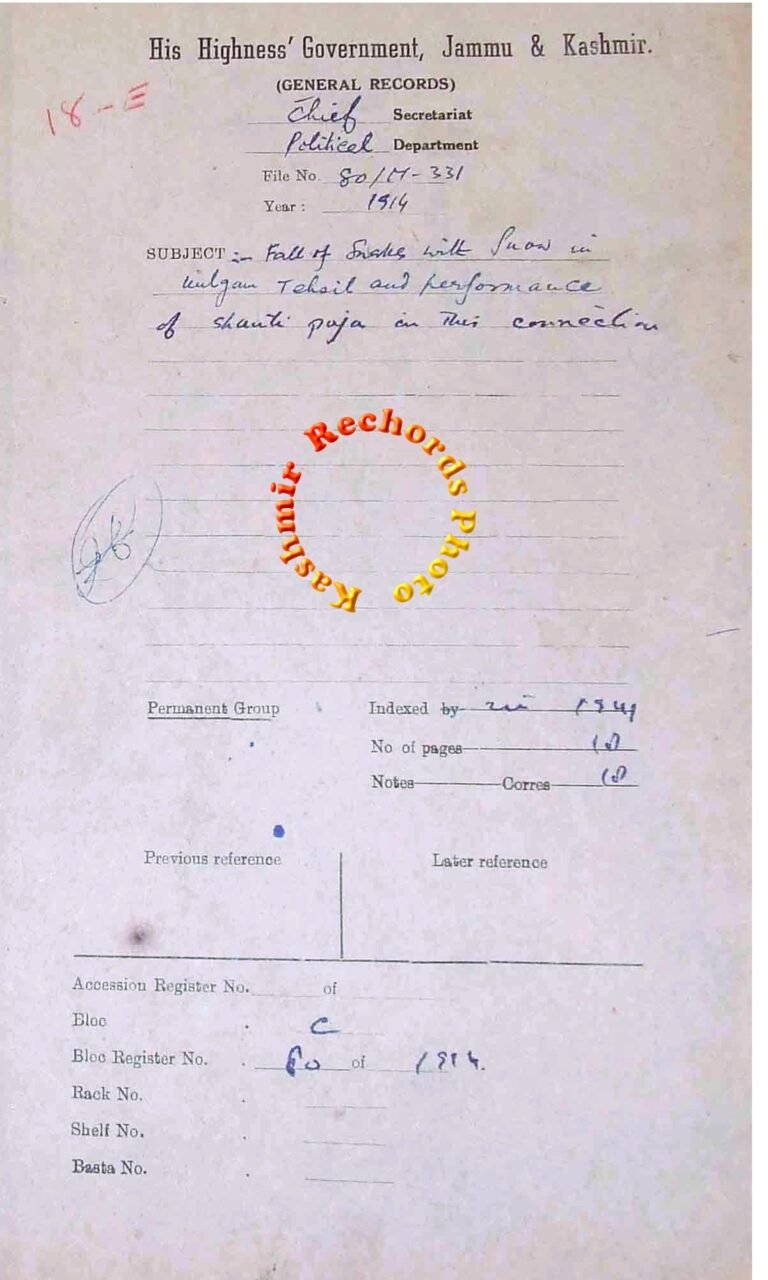
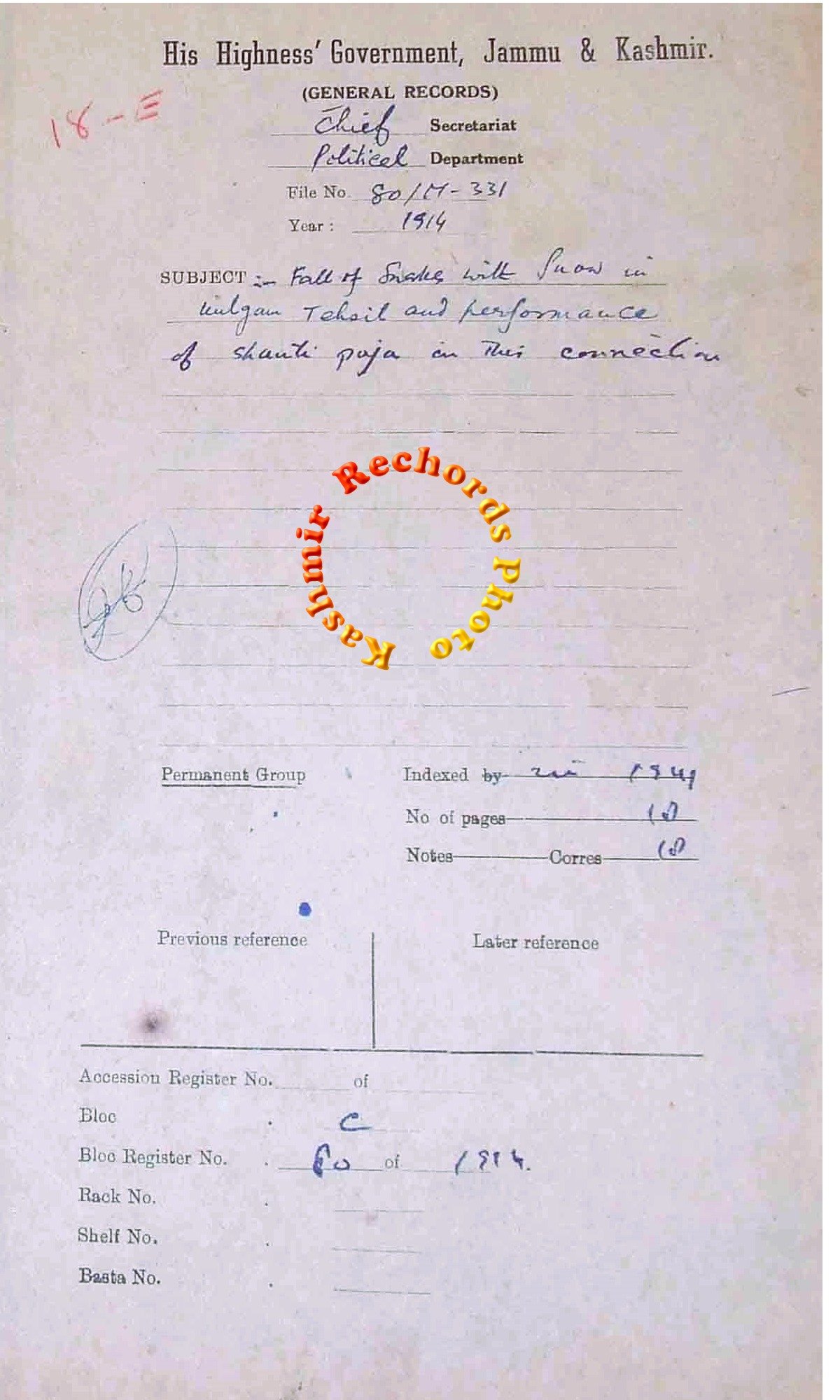
Kashmir had witnessed another such unnatural phenomenon again during the kingship of Maharaja Pratap Singh. Two years after ``Fall of Stones’’, it was now the turn of snakes to descend with the snow. It was March 1914, when the incident took place in Kulgam tehsil of South Kashmir.
The Maharaja was again sounded and Pandit Jagdish Ji had foreseen war like situation in near future. The panic-stricken Maharaja was advised to undertake “Shanti Paath’’ which burdened State exchequer by rupees 338 and one Anna. The file that belonged to the then “Political Department of General Chief Secretariat’’, carries all the notings mentioning the detail of items and materials to be used for performing oblations to gods. Call it a coincidence or otherwise, it was after the incident of the “ falling of snakes’’ that World War I had broken out in 1914!
Incidentally, the Department of Archeology, Archives and Museums is in possession of one such heavy stone that had reportedly come down with snowflakes in 1912. This stone is presently lying in the Shri Pratap Museum in Srinagar. Maharaja Pratap Singh, as the officials have noted, despatched this stone to be displayed prominently in this museum as a souvenir as well as a reminder of evil deeds of man.
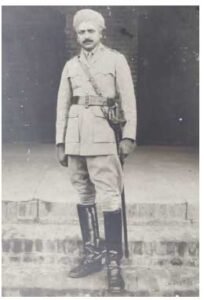
Capt Diwan Singh, known as ADC to Maharaja Hari Singh, the last ruler of Princely State of Jammu and Kashmir shall always be remembered for his loyalty, bravery and dedication.
When Maharaja Hari Singh left his Princely State in June 1949 in virtual exile, Capt Diwan Singh had accompanied him to Bombay. Later, he resigned his Commission, sacrificed his Army career to serve Maharaja Hari Singh until his last breath in 1961.
Born on 25 December 1919 in the border village of Pallanwala in tehsil Akhnoor of district Jammu, Diwan Singh had initially received his Primary education from his native village and then at Maharaja Hari Singh High School, Akhnoor. After passing his Matriculation examination from GGS Khalsa Labana High School, Tanda, Senate Hall Lahore in 1938, he had joined the State Forces in accordance with the tradition of his family. He was enrolled in the state forces on January 24, 1941 as Second Lieutenant. Later, Maharaja Hari Singh sent him to the Indian Military Academy, Dehradun, for training on state expenses. After the completion of his course, he became Lieutenant in 1942 and achieved the rank of Captain in 1947.
In March 1948, during the Poonch seize, he captured sensitive enemy piquet Pir Margo Gagzee with just two men later named Raghu Pratap Hill. Again, in December 1948, as company commander, he grappled with the attacking enemy whole night. Beating the raiders successfully he reverted the attack in Poonch. In this military operation, he was seriously wounded by the grenade splinters. For his commendable services in the Poonch sector, he was honoured with two gallantry awards. Later, after his recovery, he joined the Maharaja’s office as ADC. When Maharaja Hari Singh left Jammu and Kashmir in June 1949, Capt Diwan Singh was his ADC and being a faithful officer, he accompanied him to Bombay.
Great Votary of Education
Popularly known as `Capt Saheb’, Diwan Singh was a great votary of education. After returning to Jammu after Maharaja’s demise, he had dedicated his life to social work. He took keen interest in the development of DAV Agriculture Collegiate School Nagbani for which Maharaja had donated 500 Acres of his Stud Farm land. He was member of all India DAV working committee and Chairman of Nagbani School Management Committee. He was director of J&K Bank for a long stretch, President of Amar Kshatriya Rajput Sabha from 1965 to 67, President of J&K Hockey Federation and life member of Bombay Turf Club. He was bestowed with Dogra Rattan Award on 27 October 2006.
A great Dogra warrior, a promising personality and a saintly figure he left for heavenly abode on 27 October 2014, coinciding with Infantry Day.
Storehouse of information
Capt Diwan Singh was privy to so many inside decisions/happenings during the crucial days of October 1947.He used to narrate it so eloquently that one felt privileged and left more and more enlightened. In one of his interviews with veteran journalist R. C. Ganjoo in 1994, Capt Diwan Singh revealed that Maharaja Hari Singh had declared at a round-table conference held in 1931 that he wanted his State to be merged with India. In this very interview, Capt Diwan Singh had also talked about reasons for delayed Accession, Nehru’s stubbornness besides Maharaja-Sheikh trust-deficit.
Kashmir Rechords is thankful to Sh R C Ganjoo for sharing a copy of the interview, published in Sunday Mail (Oct 3-Nov 5) 1994 edition. The same is reproduced here.