
(Kashmir Rechords Exclusive)
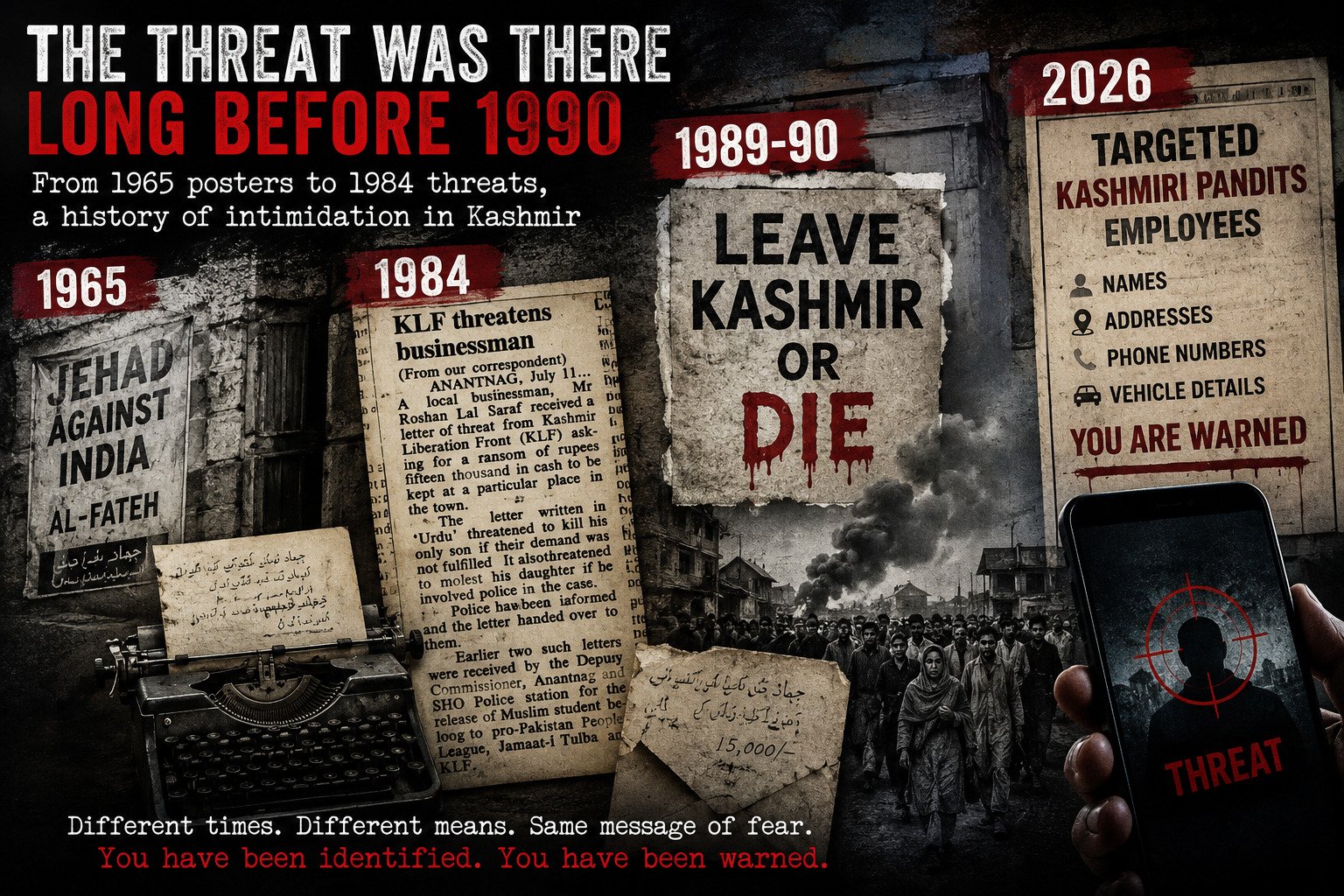
The recent wave of threats against Kashmiri Pandit employees, reported in August 2026, is disturbing not just for its immediate menace, but for its chilling echoes of Kashmir’s past
A recent purported threat poster, attributed to the United Liberation Council (ULC), reportedly named Kashmiri Pandit employees and carried personal details, including addresses and vehicle numbers. While the authenticity of the poster is still being verified by security agencies, the fact that those named have sought protection—and that the matter has prompted calls for an official response—underlines the continuing psychological power of such threats.
But the history of threatening letters and posters in Kashmir did not begin in 1989.
As Kashmir Rechords recently documented, the history of threatening posters in Kashmir stretches back to 1965, proving that these intimidation tactics were weaponized decades before the mass exodus of 1989-90
Read here: Threatening Posters and Kashmiri Pandits in Kashmir
While working further on that historical trail, Kashmir Rechords came across yet another remarkable piece of evidence—this time from July 1984.
It is significant precisely because 1984 was not 1990. There was no mass uprising, no widespread armed insurgency and no war-like situation in the Valley. Kashmir was, by and large, being projected and perceived as a normal and peaceful place.
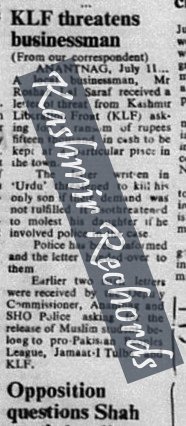
Yet, beneath the surface of that supposedly normal Kashmir, the intimidation of Kashmiri Pandits was already taking root. In July 1984, a prominent businessman in Anantnag was targeted.
An archival newspaper clipping dated July 11, 1984, preserved in the Kashmir Rechords archive, reports that local businessman Roshan Lal Saraf received a threatening letter from the Kashmir Liberation Front (KLF). The organisation was referred to in contemporary usage in connection with what would later be known as the Jammu and Kashmir Liberation Front (JKLF).
The demand was stark: Rs 15,000 in cash, to be left at a specified place in Anantnag.
But the letter was not merely a ransom note.
Written in Urdu, it threatened to kill Saraf’s only son if the demand was not met. It went further, warning that his daughter would be molested if he approached the police.
Saraf did not submit. He informed the police and handed the threatening letter over to them. The incident was reported by newspapers of the time.
There was another revealing detail in the report.
First came the warning.
Then came the identification of the target.
Then came the threat to the individual—or to those closest to him.
And behind it all was the same demand: submit, comply or face consequences.
Two similar letters had already been received by the Deputy Commissioner, Anantnag, and the SHO of the local police station, demanding the release of a Muslim student associated with the pro-Pakistan People’s League, Jamaat-i-Tulba and KLF.
That detail is important because it places the Saraf threat within a broader atmosphere of coercion and political intimidation. At the same time, the targeting of a Pandit businessman and the explicit threats against his children demonstrate how intimidation could enter the private lives of Kashmiri Pandit families even during a period that is often retrospectively described simply as “normal Kashmir.”
The newspaper report, therefore, deserves to be read not merely as an isolated ransom story, but as an archival window into the changing political climate of Kashmir.
It shows that the vocabulary of intimidation was already there years before 1989-90: the threatening letter, the identification of a target, the demand for compliance, the threat of death and the use of family members to exert pressure.
And the trail goes back further still.
As Kashmir Rechords has documented, 1965 witnessed the circulation of threatening and militant posters in Kashmir, including material associated with the underground Al-Fateh movement and other pro-Pakistan networks. Historical accounts record the appearance of Jehad posters and the arrest of an Al-Fateh activist in October 1965 for putting them up. Other material from that period also records threatening and inflammatory posters aimed at officials, politicians and influential individuals.
Seen together, 1965 and 1984 acquire a new significance.
The point is not to suggest that every organisation, every poster or every threat belonged to the same campaign. They did not. The political circumstances, organisations and intensity of violence were different.
What persisted was something more fundamental: the method of intimidation.
First came the warning.
Then came the identification of the target.
Then came the threat to the individual—or to those closest to him.
And behind it all was the same demand: submit, comply or face consequences.
In 1965, the threat could be pasted on a wall or electricity pole. In 1984, it could arrive as a letter.
By 1989-90, threatening posters and letters became part of a much wider campaign of intimidation that accompanied targeted killings and ultimately contributed to the mass displacement of Kashmiri Pandits.
And in 2026, the same psychological weapon can be delivered through a digital poster carrying names, addresses, telephone numbers and vehicle details.
The technology has changed. The political landscape has changed. The organisations have changed.
But the language of intimidation has proved remarkably persistent.
The 1984 case of Roshan Lal Saraf is therefore more than an obscure newspaper clipping. It is a small but significant piece of evidence from a period that is often remembered only through the lens of Kashmir’s later descent into militancy.
It reminds us that the warning signs existed before 1989.
The year 1990 did not invent the threat. It transformed an existing vocabulary and method of intimidation into something vastly more organised, widespread and lethal.
That is why the latest threats should not be viewed in isolation.
They belong to a longer and deeply troubling history—from the threatening posters of 1965, to the letter sent to a Pandit businessman in Anantnag in 1984, to the posters, threats and targeted killings surrounding 1989-90, and now to the digital threats confronting Kashmiri Pandits in 2026.
The medium may have changed. The fear it seeks to create is very old.