
(Kashmir Rechords Exclusive)
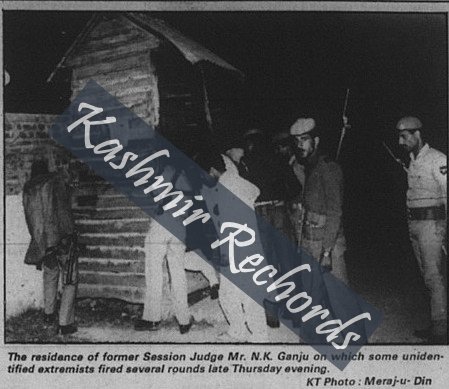
On September 23, 1988, a year and more than a month before Judge Neelkanth Ganjoo was assassinated in Srinagar, terrorists came to his doorstep.
They did not come secretly.
According to a contemporary report published by Kashmir Times on September 23, 1988, (copy of the same preserved by Kashmir Rechords, unidentified gunmen riding a motorcycle had opened automatic fire at the residence of the retired Sessions Judge in Srinagar. Judge Ganjoo was not inside the house when the firing began.
The bullets struck the wooden guard post outside the residence. Fortunately, nobody was injured. But the significance of the attack lay far beyond the bullets that missed their intended target.
The newspaper reported that senior police officials rushed to Neelkanth Ganjoo’s residence, which had already come under attack at least four times earlier also. On one previous occasion, hand grenades had been hurled at the building. The report further stated that the residence had been guarded by police since that earlier attack and that sniffer dogs had been pressed into service.
Yet the attackers had returned.And this time, they came with automatic weapons.
Neelkanth Ganjoo Srinagar attack 1988
The headline in the Kashmir Times was stark: “Terrorists strike again in Srinagar.” The smaller line above it was even more specific: “Firing on retired judge’s house.”
The eyewitness account published alongside the headline said that two men on a motorcycle, wearing black face masks, sprayed bullets at the building without stopping. They had apparently come from the Kak Sarai side and disappeared near the Goal Market crossing.
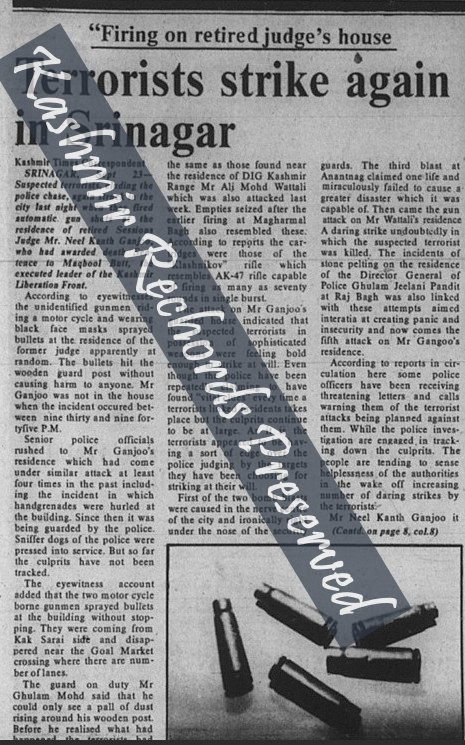
The guard on duty, identified in the report as Ghulam Mohammad, said he could only see a pall of dust rising around his wooden post before he realised what had happened.
The implication was unmistakable: there was police protection, but the presence of a guard did not prevent the gunmen from reaching the house, firing at it and escaping.
The newspaper also reported that the empties recovered from the scene resembled those found after an earlier firing at Magharmal Bagh. According to the report, the cartridges were from a “Kalashnikov” rifle, capable of firing as many as seventy rounds in a single burst.
This was therefore not merely a warning shot.It was an armed attack on the residence of a man whose life had already been repeatedly threatened.
A target already under protection
Perhaps the most important detail in the 1988 report is not the firing itself, but what had happened before it. The authorities already knew that Judge Ganjoo was being targeted.
That raises an uncomfortable question.If a retired judge had already survived repeated attacks, if grenades had previously been thrown at his residence, if police protection had been considered necessary, and if the attackers continued to return—how adequately was the threat being assessed and neutralised?
The September 1988 report provides no evidence that Judge Ganjoo was completely without security. On the contrary, it explicitly says that police guards were posted there.
But it provides equally striking evidence that the security arrangement was proving ineffective. The attackers were able to approach the residence, open automatic fire and disappear.
The fifth attack—and still no breakthrough
The Kashmir Times report described the September 23, 1988 attack as at least the fifth assault on Ganjoo’s residence.
It also placed the attack in a wider pattern of escalating terrorism in Srinagar. It also gives significant inputs that situation in Kashmir had already deteriorated even in September 1988! This is evident from the fact that the newspaper report observes that terrorists appeared to have gained an “edge over the police” by choosing their targets and striking when they wished. It referred to attacks elsewhere in the Valley and noted the growing sense of helplessness among people as the authorities struggled to track down the perpetrators.
Ganjoo’s house was, therefore, not an isolated incident.It was part of a deteriorating security environment in which known targets were being repeatedly attacked.
The newspaper’s account is especially revealing because it was published while Neelkanth Ganjoo was still alive. It was not written retrospectively after his assassination. It recorded, in real time, the fact that a retired judge who had already survived several attempts on his life remained vulnerable.
From attempted killing to successful assassination
The warning contained in that September 1988 newspaper report would acquire a chilling significance thirteen months later.
On November 4, 1989, the terrorists succeeded.
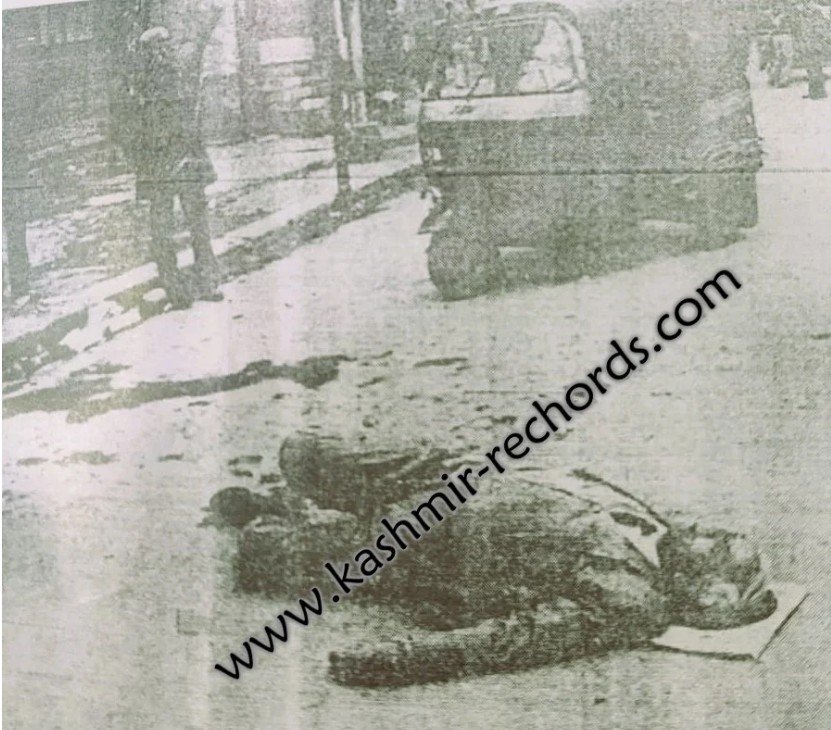
Three gunmen confronted Ganjoo in the Hari Singh High Street area of Srinagar and shot him at close range in broad daylight. Contemporary and later accounts identify his judicial role in the Maqbool Butt case as the central motive associated with the assassination. (Read more about his legacy and the aftermath: The Judge Who Stood for Justice, Now Awaits His Own)
Judge Ganjoo had presided over Butt’s trial in the 1960s and had sentenced him to death in August 1968 for the murder of police officer Amar Chand. The sentence was subsequently upheld by the Supreme Court.
A newspaper clipping that changes the chronology
For years, the story of Judge Neelkanth Ganjoo has understandably been remembered primarily through the horrifying images of November 4, 1989—the retired judge being gunned down in broad daylight.
But this September 23, 1988 clipping changes the chronology.
It shows that the assassination had a long prelude. Judge Ganjoo had already been attacked repeatedly. His home had already been subjected to grenade attacks. Police had already been deployed. Sniffer dogs had already been used. The attackers had already demonstrated their ability to reach him.
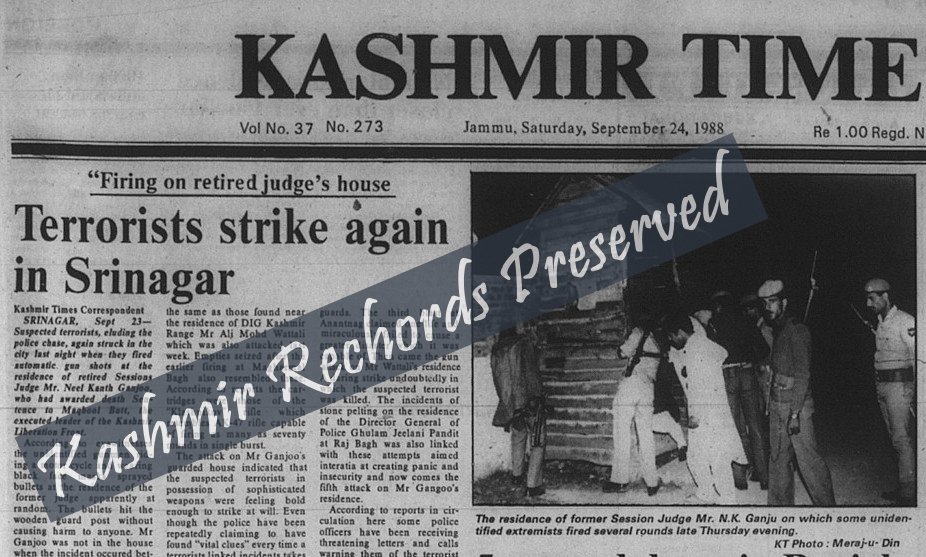
And on September 23, 1988, they came again. They fired automatic weapons at his residence. They missed him. He survived. For another thirteen months, he remained alive.
Then, on November 4, 1989, the terrorists found him outside the protection of his residence and killed him in the heart of Srinagar.
The 1988 newspaper report therefore deserves to be read not merely as an account of another terrorist attack, but as an early warning preserved in print.
It records a threat that was already visible.
It records a target who had already been repeatedly chosen.
It records security that was already in place—but apparently unable to stop the attackers.
And, in retrospect, it records something even more tragic:
Justice Neelkanth Ganjoo survived the warning. The system did not prevent the eventual killing.
More than three decades later, the State Investigation Agency reopened the murder case and sought information from the public in 2023 to uncover what it described as the “larger criminal conspiracy” behind Ganjoo’s assassination.
The September 23, 1988 newspaper clipping now adds another important piece to that historical record.
It shows that the question was never simply who eventually killed Justice Ganjoo.There is also a deeper historical question:
How did a man whose life had already been repeatedly targeted, whose residence had already been attacked and whose security had already been considered necessary remain vulnerable long enough for the terrorists to finally succeed?
For a deeper look into the legacy of Justice Ganjoo and the long wait for closure, read our extensive coverage here:https://kashmir-rechords.com/search-for-judge-neelkath-gangoos-murderers-after-34-years/