
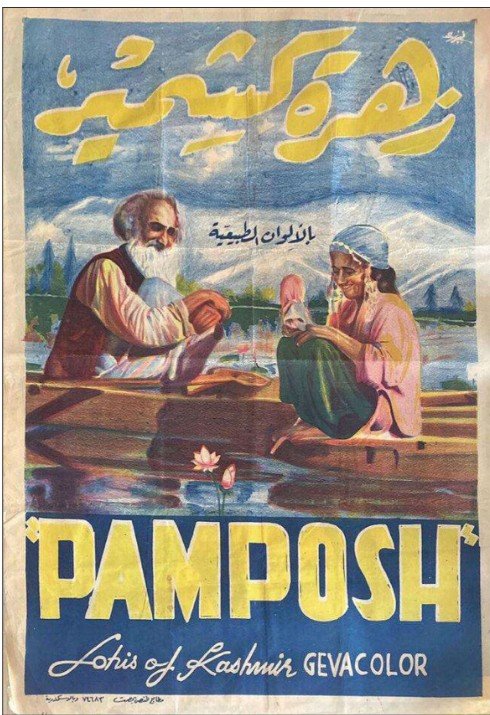
(By: Dr. Rajesh Bhat)*
There is a remarkable story buried in the early history of Indian cinema — a story in which Kashmir played a starring role in India’s journey into colour filmmaking.
More than seven decades ago, filmmaker Ezra Mir brought a film crew to Kashmir to make Pamposh, an ambitious feature designed to demonstrate that India could produce, process and print a full-colour feature film domestically.
Shot on location in Kashmir in 1951–52, using Belgian Gevacolor film stock and processed at Bombay’s newly established Film Centre laboratory, Pamposh acquired a landmark position in Indian cinema. Contemporary publicity described it as the “first full colour feature film to be produced, processed and printed in this country.” Recent scholarship describes it as the first colour feature film domestically produced and processed in postcolonial India.
This needs one historical qualification. India had experimented with colour much earlier, including Sairandhri (1933) and Kisan Kanya (1937). Those films, however, are now considered lost. Pamposh‘s particular distinction is that it was the first colour feature domestically produced and processed in post-Independence India.
And here lies the extraordinary irony: The film made to demonstrate colour has itself lost its colours.
No colour print of Pamposh is now known to survive. The National Film Archive of India reportedly has no visual material from the film. What survives instead are photographs, a poster, music, newspaper and magazine references, paper ephemera and memories.
For Kashmiris, therefore, Pamposh is not simply a forgotten film.It is a lost visual memory of Kashmir.
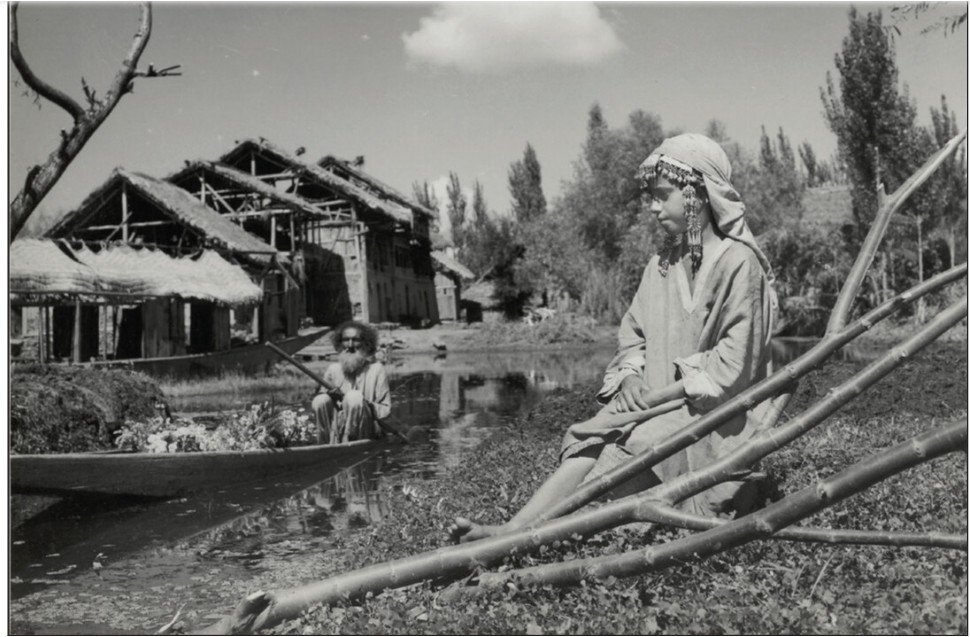
When Kashmir became India’s colour laboratory
In the early 1950s, colour filmmaking in India was still technologically difficult and expensive.
Bombay filmmakers often had to send exposed colour negatives abroad for processing. In 1952, Film Centre in Bombay became the first colour laboratory in Asia and the first outside Europe and the United States, according to the recent research.
Its establishment was an important technological step for the young Republic.But a new laboratory needed to prove itself.
Producer Ambalal J. Patel, who was closely associated with Film Centre and was India’s agent for Belgian Gevacolor, decided to demonstrate the laboratory’s capabilities through a feature film.
That film became Pamposh.The choice of Kashmir was inspired.
If you wanted to demonstrate colour, where could you find a more spectacular natural palette? The green of the valley.The blue waters of Dal Lake.Lotus flowers. Gardens. Mountains. Houseboats and of course Sunlight.Kashmir offered almost everything a colour cinematographer could desire.
Researchers Kirsty Sinclair Dootson and Poorvi Gaur, in their detailed 2025 study published in BioScope: South Asian Screen Studies, explain that Pamposh was conceived as a demonstration film for Film Centre’s new colour-processing facilities. Kashmir was chosen both for its landscape and for climatic conditions considered closer to those for which Gevacolor had been designed.Kashmir was not merely the setting. It was part of the experiment.
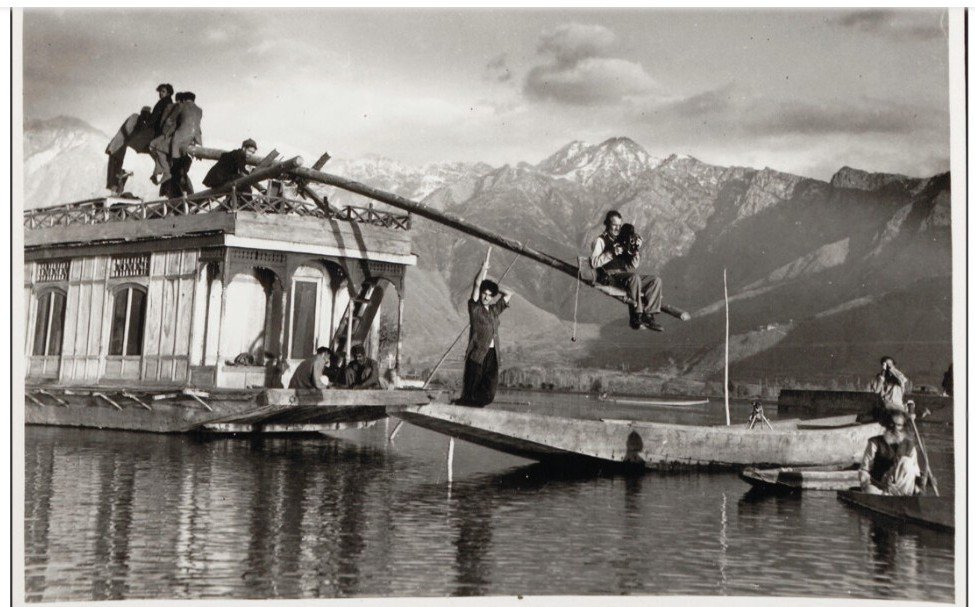
Ezra Mir arrives in Kashmir
The man chosen to direct the experiment was Ezra Mir, one of the pioneering figures of Indian cinema.
Born Edwyn Myers in Calcutta in 1903, Mir had worked as an actor and Editor in the United States before returning to India and directing feature films.
He subsequently became deeply involved in documentary filmmaking.
By the time he came to Kashmir, he had acquired an important reputation as a filmmaker with a strong documentary sensibility. He later became Chief Producer of Films Division in 1956.
That background matters. Pamposh was a fiction film, but it was made with an unusual insistence on real locations and naturalism.
According to the research, Mir reportedly “walked around the lake for weeks for atmosphere and inspiration” before developing the film.
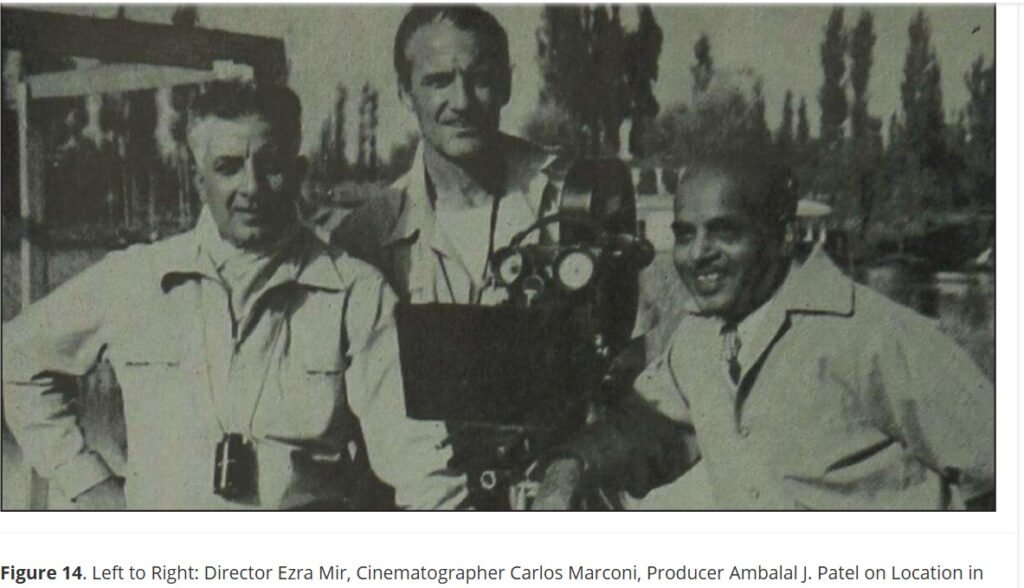
The cinematography was handled by Italian cameraman Carlos Marconi.
Producer Ambalal J. Patel, director Ezra Mir and Marconi became the central figures behind the Kashmir production.
And Kashmir itself became their studio.
A rare 1953 photograph: Ezra Mir with a mysterious Kashmiri girl
Among the surviving traces of Pamposh, Kashmir Rechords possesses a particularly valuable contemporary record.
The January 24, 1953 issue of Blitz carried a photograph of Ezra Mir sitting beside a young girl dressed in Kashmiri robes and garments.
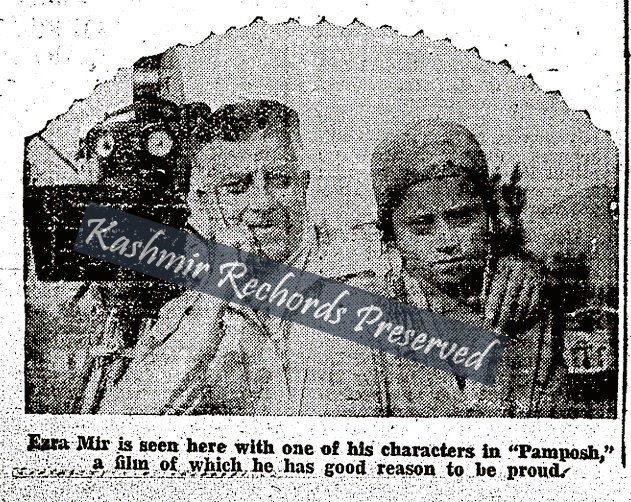
The Blitz caption does not identify the girl by name.That is important.
There is, therefore, no basis for automatically identifying her as Mogli, the film’s central child character, even though the film’s surviving records identify Mogli as a local non-actor of the same name.
What the photograph does establish is equally valuable: in January 1953, Ezra Mir and a young Kashmiri-attired girl connected with Pamposh were being presented to the public while the film was still fresh in the public eye.For Kashmir Rechords, this is not merely an illustration.It is contemporary primary-source evidence
And perhaps the unidentified girl herself is another lost thread waiting to be recovered. Who was she? Was she an actor? Was she a local participant in the production? Was she playing one of the unnamed characters? Did her family know that her photograph had appeared alongside Ezra Mir in a national publication?
The archive leaves the question open.
Shooting Kashmir in the real world
The filmmakers wanted Pamposh to look like Kashmir — not a studio version of Kashmir. The production was shot on location between 1951 and 1952.Dal Lake became the principal stage.
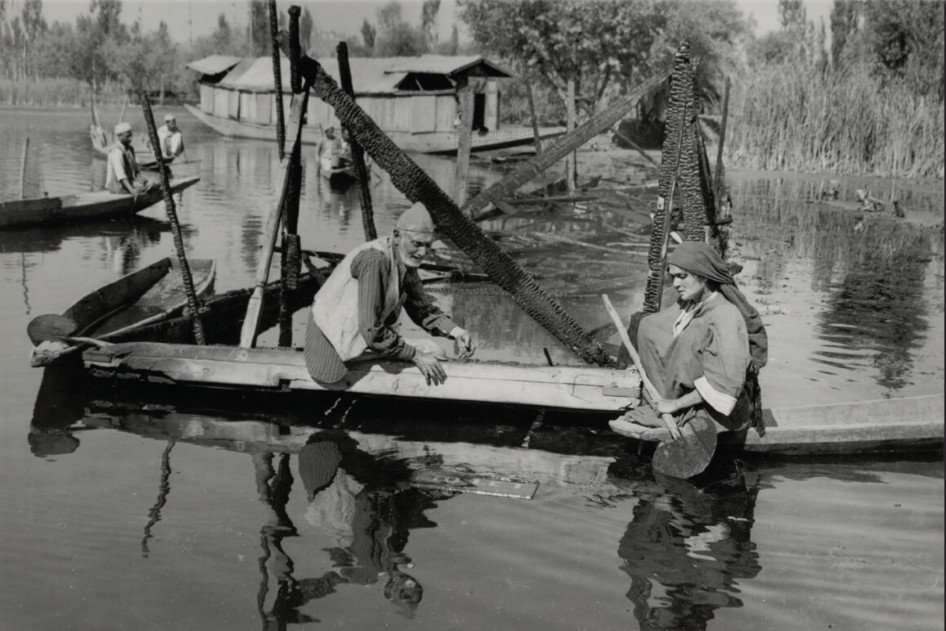
Houseboats became locations.Boats became camera platforms.The crew had to cope with the practical difficulties of filming on water while handling equipment and colour stock.
One particularly important photograph shows Ezra Mir, Carlos Marconi and Ambalal J. Patel together on location in Kashmir. The image was reproduced by Dootson and Gaur from Frederick Foster’s 1954 account.
For today’s Kashmir, such a photograph has value far beyond cinema history.It records how Kashmir looked to a film crew in the early 1950s.
The story of Mogli
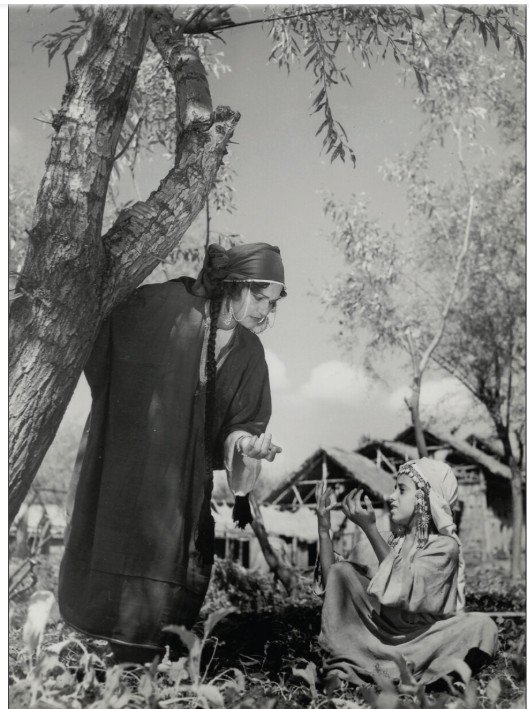
Behind the technological experiment was a deeply human story. The central character was Mogli, a mute orphan girl who lived around Dal Lake.
According to the surviving research, Mogli was played by a local non-actor of the same name. She became the adopted daughter of Kassim, a poor houseboat owner, and lived with his wife and biological daughter Naseem.
Mogli earns a meagre living selling flowers. She finds comfort in nature — birds, butterflies, frogs and fish — and in the mysterious Old Man of the Lake, played by Siddiq Chellah.
He tells her stories about the Frog King, who lives in a magical underwater kingdom where kindness rules and suffering does not exist.
But Mogli’s real life is far less magical.Her foster mother mistreats her and blames the child for the family’s misfortunes.
Then comes tragedy!
For Kashmiris, Pamposh is not simply a forgotten film. It is a lost visual memory of Kashmir.
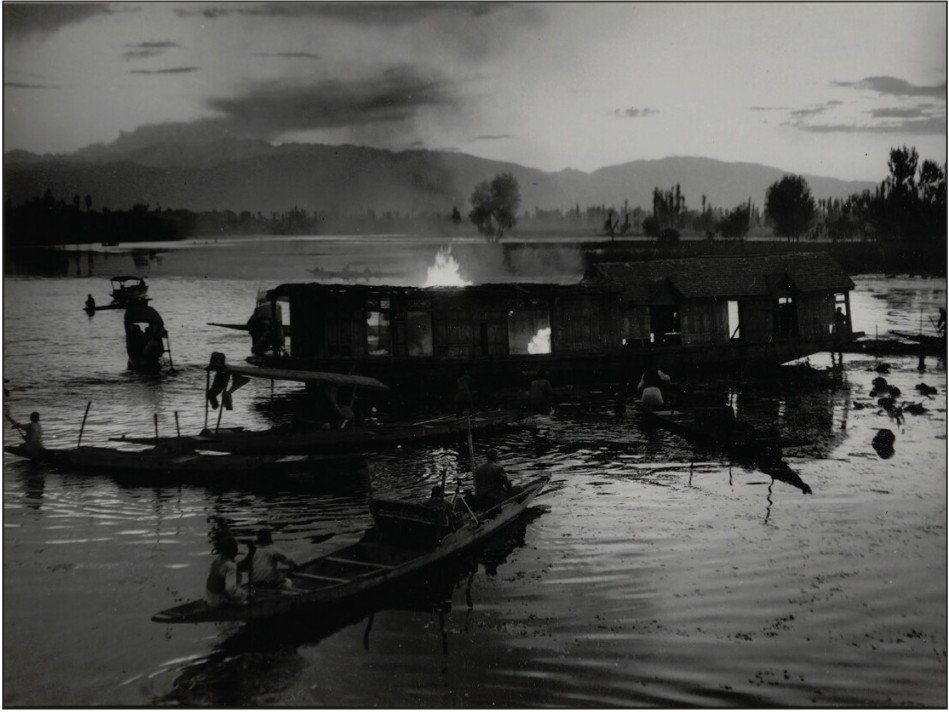
After a fire on the family houseboat, Mogli leaves in her canoe, determined to find the mythical kingdom of the Frog King. She disappears.
Her family and the Old Man search for her, but find only her doll. Mogli is presumed drowned.The irony is striking.
A story about a child disappearing into the waters of Dal Lake was itself eventually to disappear into the waters of history.
Why the name Pamposh?
The title has an unmistakable Kashmiri resonance. Pamposh means lotus. The lotus is inseparable from the imagery of Kashmir’s lakes, particularly Dal Lake.
It was, therefore, an appropriate title for a film whose story unfolded among lotus blooms and whose principal purpose was to demonstrate the possibilities of colour.
The surviving research notes that contemporary promotional material celebrated Kashmir’s flowers and gardens as ideal subjects for the new Gevacolor process.
A Kashmiri musical connection
The Kashmir connection did not end with the scenery.
The official Cannes Film Festival archive credits Mohan Lal Aima and Cecil Mendoza with the music of Pamposh. Aima’s name gives the film an important Kashmiri cultural dimension.
The valley was not simply being photographed as a beautiful landscape; a Kashmiri musician was associated with its musical identity as well.
Yet the precise nature of Aima’s contribution remains an area deserving further research. Did he compose original music?Did he incorporate Kashmiri melodies?
Were songs from the film recorded separately? Are any recordings, manuscripts or family papers still available? These are questions that Kashmir Rechords believes deserve investigation.
From Dal Lake to Cannes
After its Kashmir production, Pamposh travelled far beyond India.
The official Cannes archive records Pamposh: Fleur de Lotus as a 1954 Indian feature film in competition.
It identifies:
Director: Ezra Mir
Screenplay: Ezra Mir
Cinematography: C. F. Marconi
Music: Mohanlal Aima and Cecil Mendoza.
The Cannes record also lists the principal cast, including Savitri, Ravi Vinod, Pandit Kaul, Mogli, Siddiq Chella, B. Billimoria and Violet Smith.
Thus the journey of Pamposh can be traced in three words:Kashmir. Bombay. Cannes.
For a film made on the waters of Dal Lake in the early 1950s, that was an extraordinary journey.
Cruel irony: the colour film that lost its colours
Today, Pamposh is considered a lost film. The recent scholarly investigation found that no colour materials from the film have survived. The National Film Archive of India holds no visual material on it, while surviving traces exist in other forms.
Yet fragments have survived in European collections.
The Cinémathèque française holds publicity stills.
The British Film Institute holds production material.
The researchers also found a surviving Pamposh poster and other paper ephemera.
And so we have an extraordinary situation:
We have photographs of a film that we can no longer watch.
Even more ironically, a film created to demonstrate colour is now remembered principally through black-and-white photographs and printed material.
The photographs that survived
The recent SAGE study by Kirsty Sinclair Dootson and Poorvi Gaur has brought together some of the most important surviving visual traces of Pamposh.
Kashmir Rechords is grateful to the authors and SAGE Publications for making this scholarship accessible and for documenting these rare images.
Among the most evocative are:
- The Pamposh publicity stills preserved by the Cinémathèque française;
- The image of Mogli and the Old Man of the Lake;
- Photographs showing the houseboat fire and its aftermath;
- and the production photograph of Ezra Mir, Carlos Marconi and Ambalal J. Patel in Kashmir.
Image credit:
From Dootson & Gaur, “A History of Colour Cinema That Can Account for Indian Cinema: The Bombay Film Laboratory, Kashmir’s Climate and Gevacolor’s Pamposh,” BioScope: South Asian Screen Studies, 2025, SAGE Publications; original archival collection credited by the authors.
The Cinémathèque française stills are specifically identified in the SAGE article as “Collection La Cinémathèque française, all rights reserved.”
A film made at a turning point in Kashmir’s history
There is yet another reason Pamposh deserves attention.
The film was made in 1951–52, only a few years after the events of 1947 and during a period when Kashmir’s political future remained intensely contested.
The recent SAGE study goes beyond film history and argues that the choice of Kashmir was connected not only to climate and scenery but also to a wider ideological effort to strengthen India’s claims to Kashmir amid the geopolitical conflict over the region.
This is an interpretation offered by the researchers, and it should be read as such.
But it adds another layer to the film. Pamposh can simultaneously be understood as:
a pioneering colour experiment; a showcase for India’s new film-processing capabilities; a story of a Kashmiri child; a portrait of Dal Lake;
a record of early-1950s Kashmir; an international film that reached Cannes; and a cultural document shaped by the politics of its time.
That complexity makes it far more interesting than a forgotten film title in an old catalogue.
Did Kashmiris get to see it?
There is evidence that Pamposh was screened in Kashmir itself.
A Kashmir-focused account records a screening at Amresh Cinema in Lal Chowk, Srinagar, and recollections of seeing the film there.
This raises questions that remain largely unexplored. How did Srinagar audiences receive Pamposh? Did they recognise the locations? Did they recognise the people?
What did Kashmiris think of hearing Kashmiri dialogue in an Indian feature film?
Did local newspapers review it? How many shows were held? And did anyone in Srinagar preserve photographs, tickets, advertisements or programmes?
For Kashmir Rechords, these questions are as important as the film’s journey to Cannes.
Was Pamposh India’s first colour film?
This is where historical precision matters.
It would be inaccurate to say simply that Pamposh was the first colour film ever made in India.
India had colour experiments before it.
But Pamposh holds a more specific and equally important distinction:
It was the first colour feature film domestically produced and processed in post-Independence India.
The SAGE study describes it as having this “privileged status”, while contemporary press coverage called it the first full-colour feature film to be produced, processed and printed in the country.
And that milestone has a remarkable Kashmir connection.
One of the foundational moments in India’s post-Independence colour cinema was created on the waters and shores of Kashmir.
Could the lost film still be found?
“Lost” does not always mean destroyed. Sometimes it means untraced.
A print, negative, foreign-language version, duplicate or fragment could still conceivably exist in a private collection, foreign archive, old distributor’s vault or uncatalogued repository.
Even if the complete film never resurfaces, fragments may. A song. A photograph. A pressbook. A cinema ticket. A newspaper advertisement. A letter. A personal album.
A film reel. Each could restore another piece of the story.
Kashmir Rechords appeals for the missing pieces
Kashmir Rechords would particularly like to hear from readers who may possess any material connected with Pamposh or Ezra Mir.
The unidentified girl in the 1953 Blitz photograph is one such unanswered question.
Perhaps someone will recognise her. Perhaps her family has a photograph. Perhaps another newspaper carried her name. Sometimes history survives in the memories of ordinary families long after official archives have forgotten it.
Pamposh was not simply a film made in Kashmir. It was one of the earliest attempts to put Kashmir itself — its lake, landscape, people and colours — onto the moving screen at a crucial moment in India’s cinematic history.
The film is gone. The colours are gone. But the search need not end.
Perhaps one day, the lost colours of Pamposh will return to Kashmir.
Sources and acknowledgements
Primary archival source:
Blitz, 24 January 1953 — photograph and caption: “Ezra Mir with one of his characters in Pamposh, a film of which he has good reason to be proud.” Photograph supplied from the Kashmir Rechords archival collection.
Principal scholarly source:
Kirsty Sinclair Dootson and Poorvi Gaur, “A History of Colour Cinema That Can Account for Indian Cinema: The Bombay Film Laboratory, Kashmir’s Climate and Gevacolor’s Pamposh,” BioScope: South Asian Screen Studies, Volume 16, Issue 1, 2025. The article was first published online on 11 May 2025 and is Open Access.
Official film record:
Festival de Cannes, Pamposh (Pamposh: Fleur de Lotus), 1954. The official Cannes archive records the director, screenplay, cinematography, music and cast.
Image acknowledgement:
Kashmir Rechords acknowledges the research and archival work of Kirsty Sinclair Dootson and Poorvi Gaur and SAGE Publications, whose 2025 study has brought together rare surviving visual and documentary traces of Pamposh.
Where images reproduced in the SAGE article originate from third-party collections, the original archive/rightsholder also stand credited. The SAGE article identifies, among others, Collection La Cinémathèque française, the British Film Institute and Fotomuseum Antwerp/Agfa-Gevaert Historical Collection as sources for its figures.
*Dr. Rajesh Bhat is a veteran journalist, broadcaster, author and media researcher with over three decades of experience. A Ph.D. in Journalism and Mass Communication, he began his career with Kashmir Times and later served as Special Correspondent with Daily Excelsior, heading its Kashmir Desk during the peak years of militancy. He also contributed on art, culture and heritage to The Tribune. He later served with All India Radio/Prasar Bharati. He is the author of Radio Kashmir in Times of Peace & War and writes extensively on Kashmir’s history, culture, media and archival heritage.