
(Kashmir Rechords Exclusive)
There are stories history records. There are others history owes itself the duty to recover. The story of Din Mohammad Jagir belongs to the second category.
In official records of the Government of India, he is simply “Shri Mohammad Din Jagir, Jammu and Kashmir — Padma Shree, 1966, Social Work.” Behind those few words, however, lies an extraordinary and almost forgotten episode of the 1965 India-Pakistan war.
The shepherd who exposed Operation Gibraltar
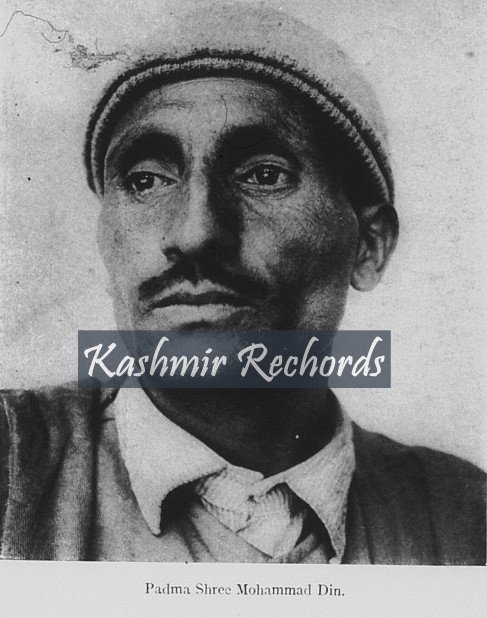
Mohammad Din was a Gujjar shepherd from the Tangmarg-Gulmarg area of Kashmir. On August 5, 1965, as Pakistan launched Operation Gibraltar, he encountered armed infiltrators who had crossed into Kashmir to mingle with the local population, win support, create an uprising and prepare the ground for Pakistan’s military intervention.
According to 1960s records available with Kashmir Rechords, Mohammad Din, (Also written as Din Mohammad) was among the first Kashmiris to detect the infiltrators. They sought his assistance in arranging Kashmiri clothing so they could disguise themselves and move among the local population. They offered him money. He refused to cooperate and decided to inform the authorities.
He took the information to the local CID officer at Tangmarg, who passed it to CID headquarters in Srinagar. Because of its gravity, the information reached the Home Minister of Jammu and Kashmir, who conveyed it to the GOC of the Army Division at Baramulla.
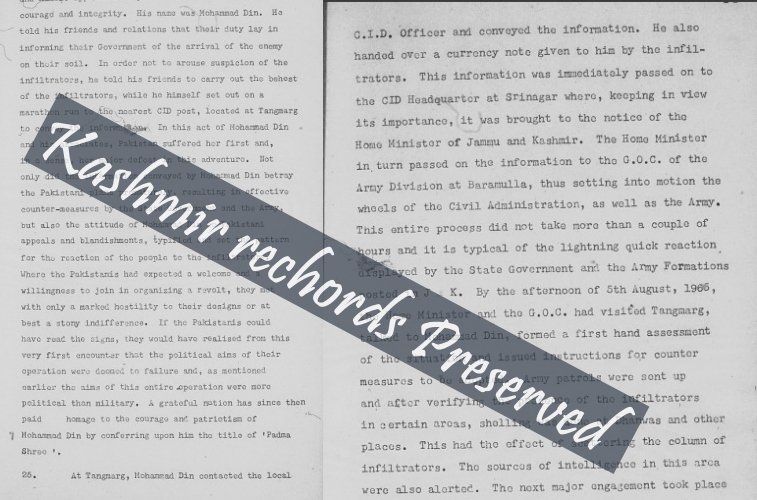
By the afternoon of August 5, 1965, the Home Minister and Army GOC had reached Tangmarg and met Mohammad Din. Army patrols were despatched, the presence of infiltrators was verified, and shelling was undertaken at Dhanwas and other locations, scattering the infiltrating column. The intelligence network was alerted.
Pakistan’s carefully planned covert operation had been exposed almost at its inception.
Mohammad Din had struck the first blow—not with a weapon, but with information.
Pakistan’s plans betrayed prematurely
Operation Gibraltar depended on secrecy. Thousands of trained infiltrators had crossed into Jammu and Kashmir to sabotage installations, disrupt communications, attack strategic targets and, above all, ignite a popular uprising against India.
Instead of the mass uprising Pakistan anticipated, information about infiltrators began reaching Indian authorities. The contemporary account preserved by Kashmir Rechords says Mohammad Din’s information “betray[ed] the Pakistani plans prematurely,” enabling the State Government and Army to take effective counter-measures.
Pakistan had expected local support. Instead, it encountered hostility—or, as the account describes it, “a stony indifference.”
That was the beginning of the failure of Operation Gibraltar.
From shepherd to Padma Shri
India did not forget Mohammad Din immediately. In 1966, the Government of India conferred upon him the Padma Shri for Social Work. The 1966 Padma Awards Gazette records: “Shri Mohammad Din Jagir, Jammu and Kashmir.”
A man from a nomadic pastoral community, without a powerful institutional position or prominent public profile, had performed an act of national importance and received national recognition.
Yet history did not preserve his story with the same care.
The account by D. P. Dhar describes him after the honour returning to his vocation of tending cattle, apparently unaffected by the recognition.
Twice received by Indira Gandhi
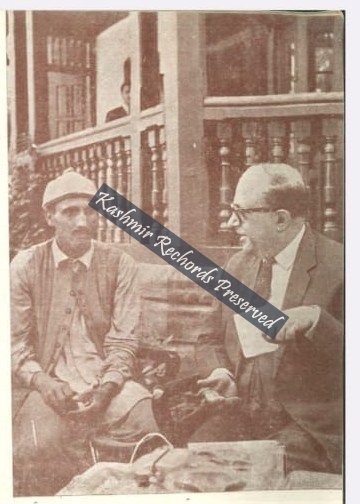
According to a Kashmir Times report of May 4, 1990, preserved by Kashmir Rechords, Indira Gandhi had visited Mohammad Din’s house twice during her tenure as Prime Minister. Chief Minister, G M Sadiq too had met the saviour of Kashmir in 1965. Kashmir Rechords is reproducing here an exclusive photograph of Chief Minister Sadiq with Din Mohammad.
Then came 1990
Twenty-five years after 1965, Kashmir had changed dramatically. The Valley had entered an era of armed militancy.
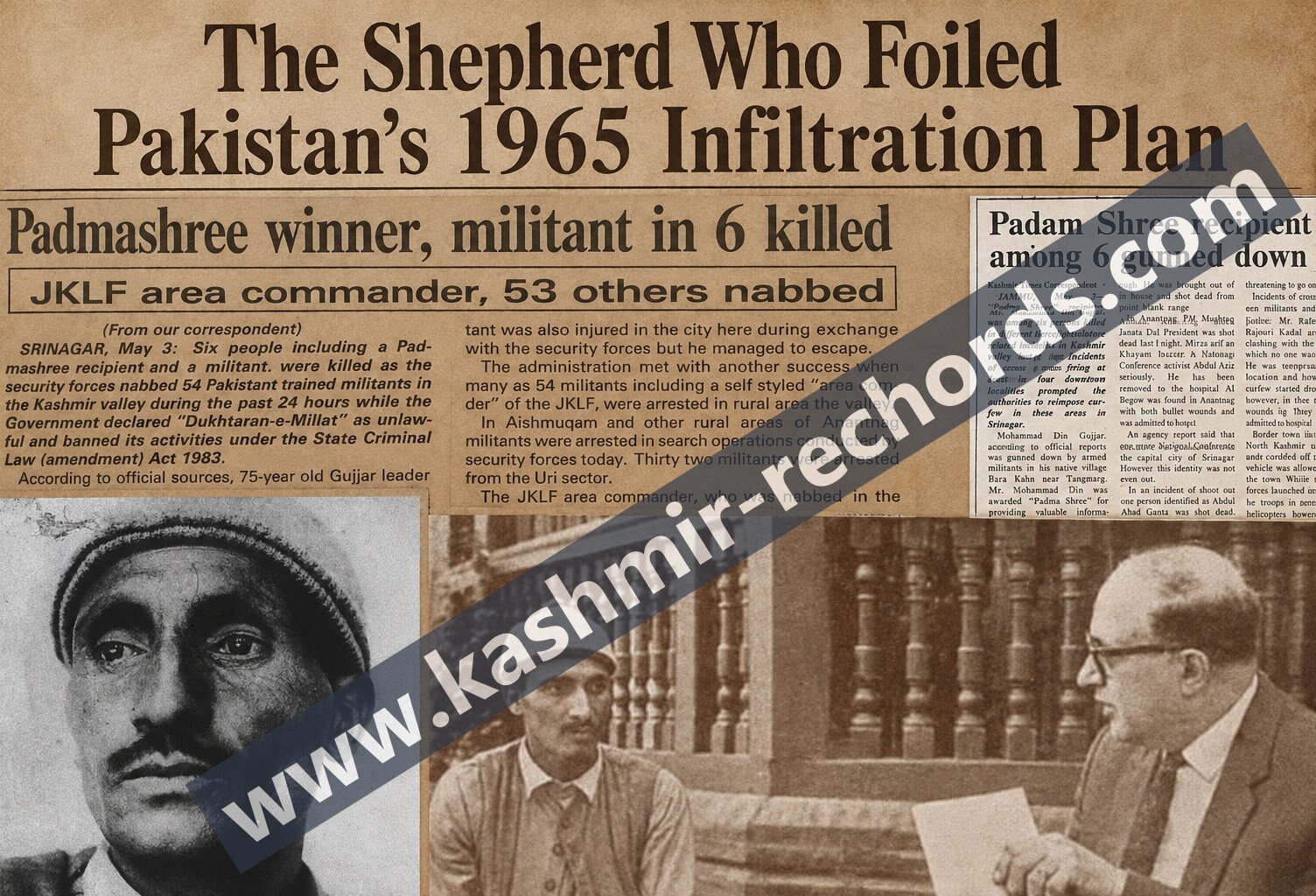
On Friday, May 4, 1990, the Kashmir Times and Daily Excelsior carried reports of Mohammad Din’s death at the hands of militants.
According to the reports, he was shot dead by armed militants in his native village at Barz Kani, near Tangmarg, in the Gulmarg area.
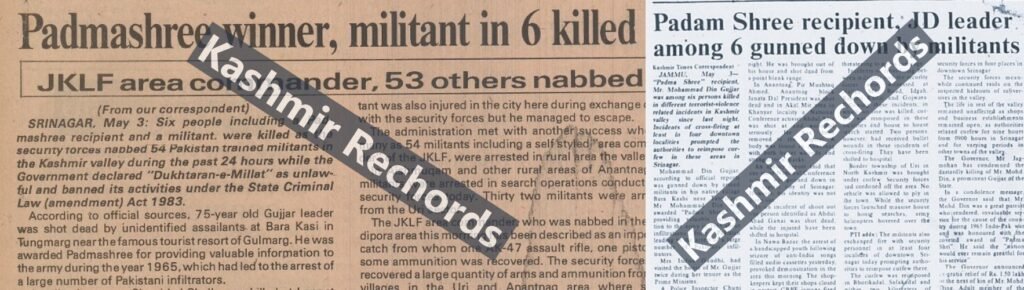
The irony was cruel. In 1965, Pakistan sent infiltrators into Kashmir to create an uprising. Mohammad Din detected them, refused their inducements, informed the authorities and helped expose their presence. His information triggered the response of the State Government and Army. The infiltrators were engaged and scattered, and the Pakistani plan began to unravel.
India honoured him with the Padma Shri. He met Indira Gandhi twice.
In 1990, when militancy had engulfed Kashmir, Mohammad Din himself became its victim.
The man who had once helped defend Kashmir against Pakistan’s covert assault could not be saved from the violence that later consumed the Valley.
He was killed—and then, in an even greater tragedy, almost erased from memory.
A hero reduced to a forgotten line
The official Padma database still carries his name. The 1966 Gazette still carries his name. Historical accounts of Operation Gibraltar occasionally mention him.
But the fuller story is barely known: the shepherd, the infiltrators, the money they offered him, the journey to Tangmarg, the CID officer, the message to Srinagar, the Home Minister, the Army GOC, the counter-operation, the Padma Shri, the meetings with Indira Gandhi, his return to tending cattle, his killing in 1990—and finally, the silence.
It is this silence that makes the surviving documents important.
Kashmir Rechords brings back the missing pieces
Kashmir Rechords has attempted to reconstruct the timeline of Mohammad Din Jagir’s life and sacrifice.
Its archive preserves his photographs and the May 1990 newspaper clippings reporting his killing. Alongside them is the written account of his role in 1965, describing how he detected the infiltrators, carried the information to the authorities, handed over the currency note they had given him and helped set the civil and military machinery into motion.
Taken together, these documents tell a story that deserves to be restored to Kashmir’s historical memory.
Not as propaganda. Not as mythology. But as an archival record of what one ordinary man did at an extraordinary moment.
Despite his extraordinary efforts, for which he lost his life 25 years after the 1965 war, Din Mohammad continues to be the forgotten son of Kashmir.