
By R. K. Tickoo*
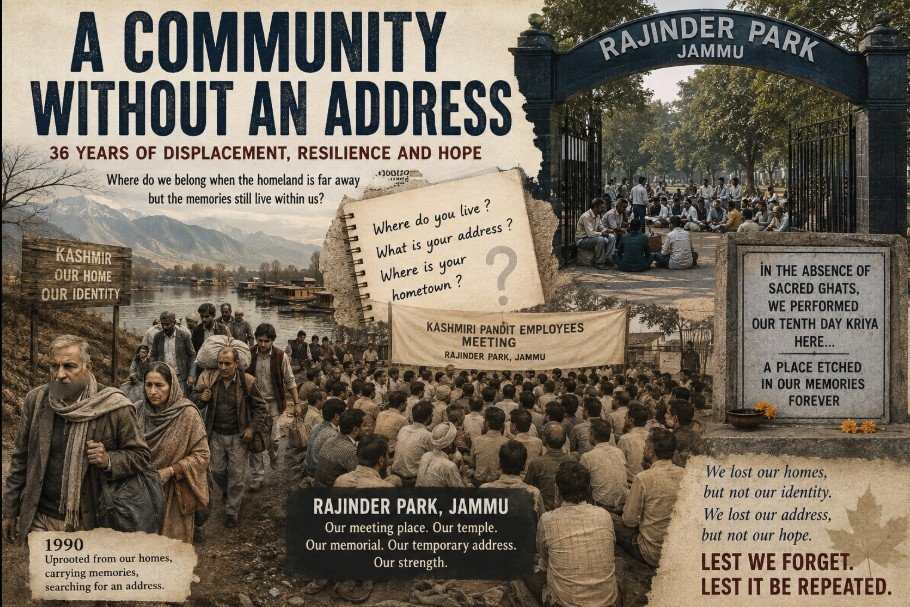
“Where do you live?”
“What is your address?”
“Where is your hometown?”
Almost every Kashmiri Pandit who has lived outside Kashmir over the past 36 years has faced these seemingly simple questions. And each time, they carry a deeper meaning.
I may be living in, or even owning, a house, flat or property anywhere in India or elsewhere in the world. But the real predicament remains: To which part of the country do I associate my identity? Which address truly feels like home? Where do I belong?
This question has followed us for 36 years
In 1990, lakhs of Kashmiri Pandits were uprooted from the Valley. Most of us arrived in Jammu—a place geographically close to Kashmir, yet worlds apart in language, climate, culture and food habits, particularly for those who had never lived outside the Valley before the exodus.
And then, almost unexpectedly, Rajinder Park in Jammu emerged as a new landmark—a temporary address for a community that had suddenly lost its permanent one.
For thousands of Kashmiri Pandits, Rajinder Park became much more than a park. It became a meeting place, a temple, a centre of community life and, at times, a memorial to a lost world.
For the older generation, Rajinder Park is etched in memory not for its trees or surroundings, but for the grief that gathered there. In the absence of the sacred cremation ghats of Kashmir, families came to the park to perform the tenth-day kriya of their departed loved ones.
But Rajinder Park also witnessed another struggle—the struggle to rebuild lives through paperwork.
Government records, relief packages, service matters, transfers, adjustments, accommodation in camps and countless other problems of displacement had to be discussed and resolved. Enormous meetings were held there. Government employees from different departments and public-sector organisations began forming associations. Colleagues who had been scattered overnight found one another again.
In those days, communication itself was a luxury. There were no mobile phones, no WhatsApp groups and often no reliable way of knowing where a relative, friend or colleague had landed. Rajinder Park became the place where people searched for people.
Separated families reunited there. Friends met after months. Former colleagues rediscovered one another. Information travelled from one person to another, often becoming the only lifeline available to a displaced community.
When Rajinder Park became a symbol of resilience
It represented a community that had lost its homes but refused to lose its identity; a people who had been uprooted but continued to preserve their traditions, relationships and dignity.
For those who lived through 1990, Rajinder Park is therefore not merely a physical space. It is a chapter in the collective memory of displacement—a reminder of how a community without an address created one for itself, however temporarily.
The park gave us an address when we had lost one.
Thirty-six years later, the question still remains: Where do we belong?
Perhaps the answer lies not merely in a house, a city or a postal address. Perhaps it lies in the memory of a homeland, in the bonds of a community and in the continuing hope of returning to a place that still lives within us.
Let us not forget the past. For, as the old saying reminds us, those who do not remember the past are condemned to repeat it.
And perhaps Rajinder Park deserves to be remembered—not simply as a park in Jammu, but as the first address of a displaced community that had suddenly lost its own.
About the Author
*R. K. Tickoo is a retired senior Prasar Bharati officer and veteran broadcaster. He served at Radio Kashmir, Srinagar and Jammu, on key assignments and later at the Directorate General, All India Radio, New Delhi. His writings draw upon his professional experience, personal memories and close understanding of Kashmir’s history, society and the lived experience of the Kashmiri Pandit community.
Do you have memories of gathering at Rajinder Park? Share your stories in the comments below or email us to help preserve this history.