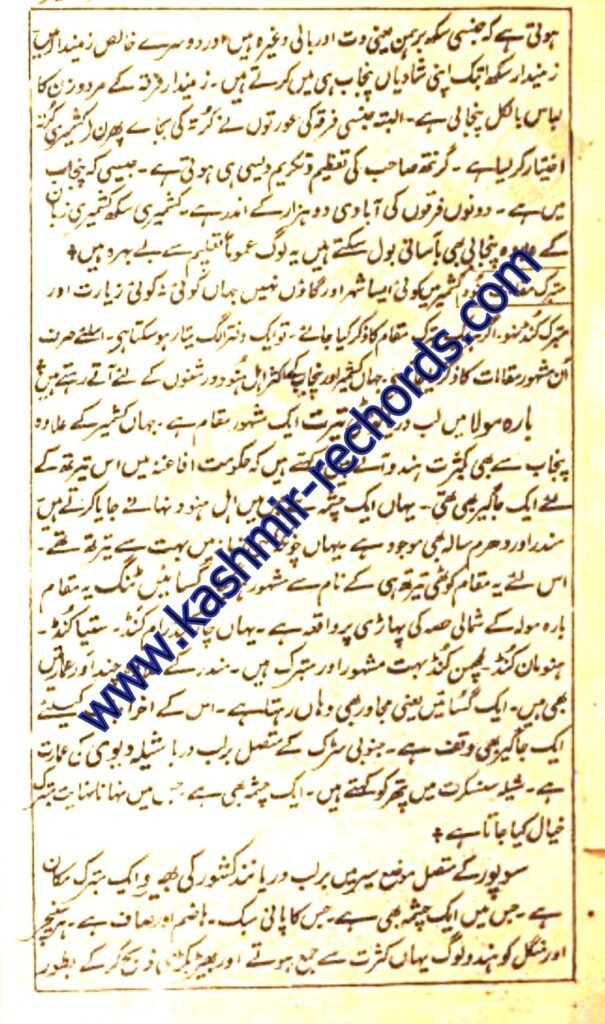
The northern part of Kashmir is rich in shrines and temples historically significant to the Kashmiri Pandits. These sacred structures, once documented by Kashmiri Muslim scholars and travelers a century ago, have largely been forgotten by contemporary historians and writers. However, thanks to the meticulous work of Mohammad Din Fauq, a celebrated writer and journalism pioneer, the legacy of these shrines is not entirely lost.
During his visit to Kashmir in December 1907, Fauq, born in 1877 in Sialkot, then part of the Jammu Province, extensively documented the temples and shrines of Kashmiri Pandits in North Kashmir. Despite passing away in Lahore in 1945, his connection to Kashmir remained unwavering, and his works continue to shed light on the region’s rich cultural and historical heritage.
Fauq’s Pioneering Documentation
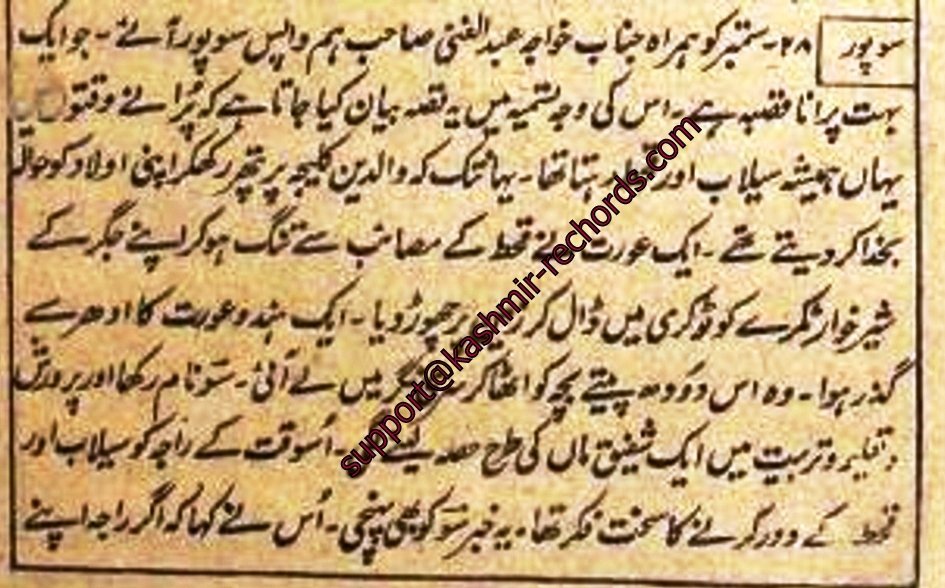
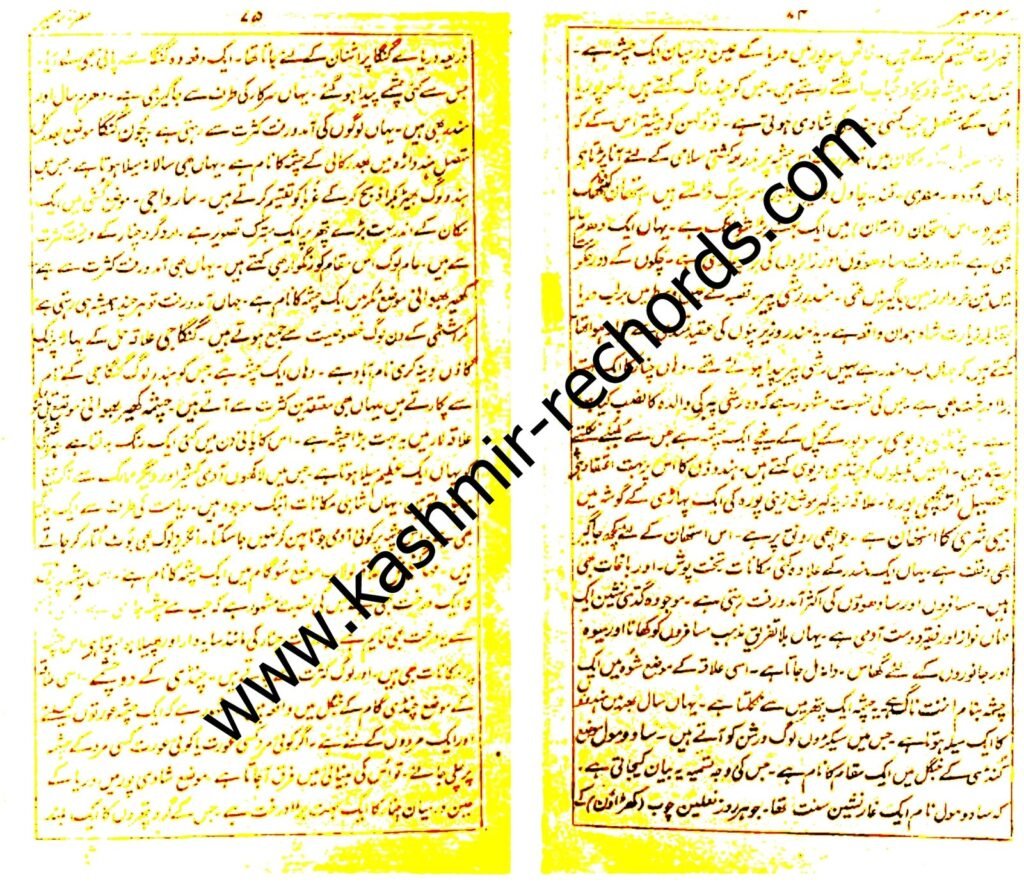
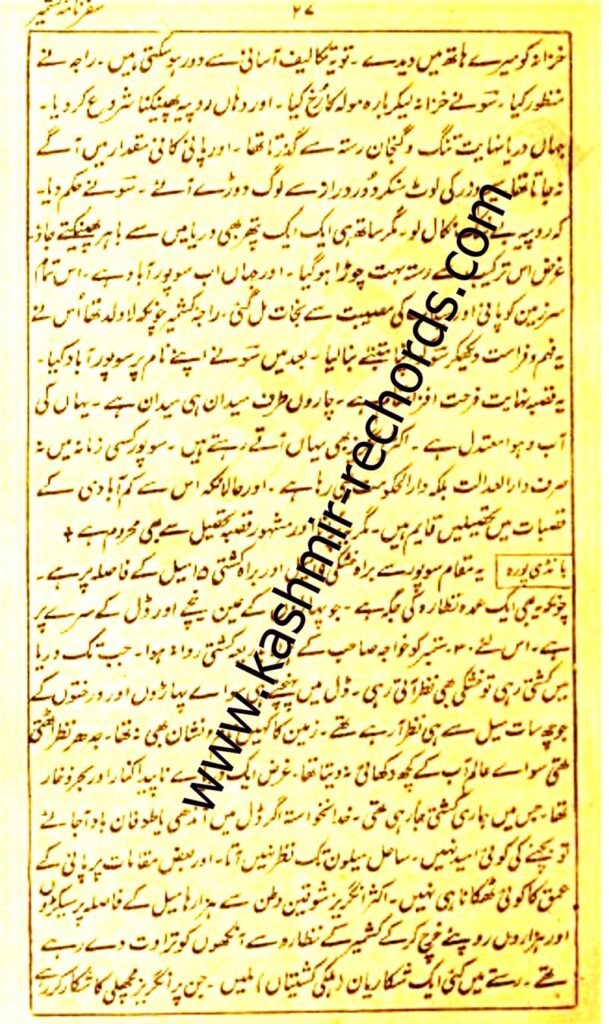
Fauq’s travelogue, “Kashmir Safarnama,” of 1907 is a treasure trove of information on ancient Hindu shrines that once adorned Kashmir’s landscape. Hailing from the Dar clan, with ancestral roots in Hardu Shiva, and Sopore, Fauq’s detailed accounts of these shrines offer invaluable insights.
In his “Kashmir Safarnama, of 1907, “ Fauq meticulously records numerous ancient Hindu shrines, such as:
Nandkeshwar Temple, Seer Jagir, Sopore: Known for animal sacrifices by devotees.
Chander Naag, Sopore: A unique site in the Jehlum River near Sopore, where Kashmiri Pandits traditionally take their brides to pay obeisance.
Bhairav Temple, Sopore: Referred to by Fauq as “Kantak Bhairav,” housing a large historical Shivlingam.
Resh Peer Temple, Sopore: Constructed under the direction of Wazir Pannun, a devout follower of Saint Resh Peer.
Chandi Devi Tirath, Sopore: A notable spring in the Jehlum River beneath the Sopore bridge.
Historical Shrines in Baramulla, Kupwara
In his travelogue, Fauq also documents various other shrines, including:
Bomai Shree and Shiva Shrines, Zainagir, Sopore: A significant stop for pilgrims on their way to Sharda at Teetwal.
Koti Tirath and Gosain Taing, Baramulla: Temples encircling a sacred spring and a historical site along the Baramulla–Uri road.
Shrines in Kupwara: Including the Kandi Kupwara temple and Dharamshala, the famous Bhadarkali temple, and Shadipora (Shardapur) Safapora, known as Kashmir’s Prayag.
A Legacy of Preservation
Fauq’s work extends beyond just “Kashmir Safarnama.” He authored over a hundred books, including “Mukammil Taareekhe Kashmir,” “Taareekhe Aquame Kashmir,” and “Tazkira E Sultan Zainul Abedin.” These writings have played a crucial role in documenting and preserving Kashmir’s cultural and historical heritage.
As Kashmiri Pandits strive to reclaim their historical shrines, Mohammad Din Fauq’s meticulous documentation remains invaluable. His unbiased and detailed accounts ensure that the rich civilizational heritage of Kashmir, so deeply cherished by its people, will endure for generations to come.
Signing of the Instrument of Accession by Maharaja Hari Singh of the then Princely State of Jammu and Kashmir on October 26, 1947 was the worst shock for Pakistan and that country is still not able to reconcile to this fact!
Even on the day of accession, huge displeasure was witnessed by Pakistani media, who used the choicest of invectives against one and all, especially targeting Maharaja Hari Singh, India and Sheikh Mohd Abdullah.
When Consternation Swept Pakistan
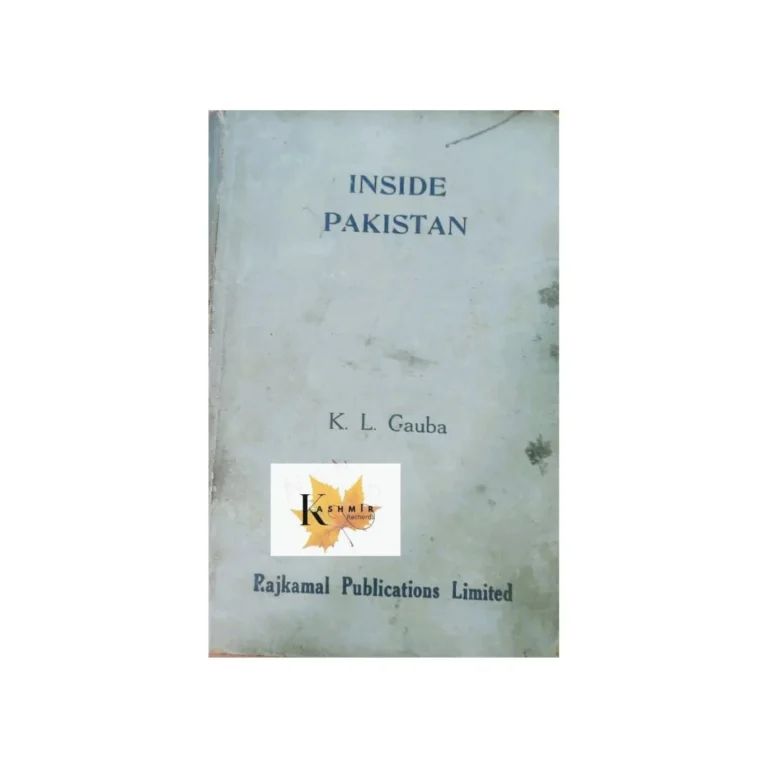
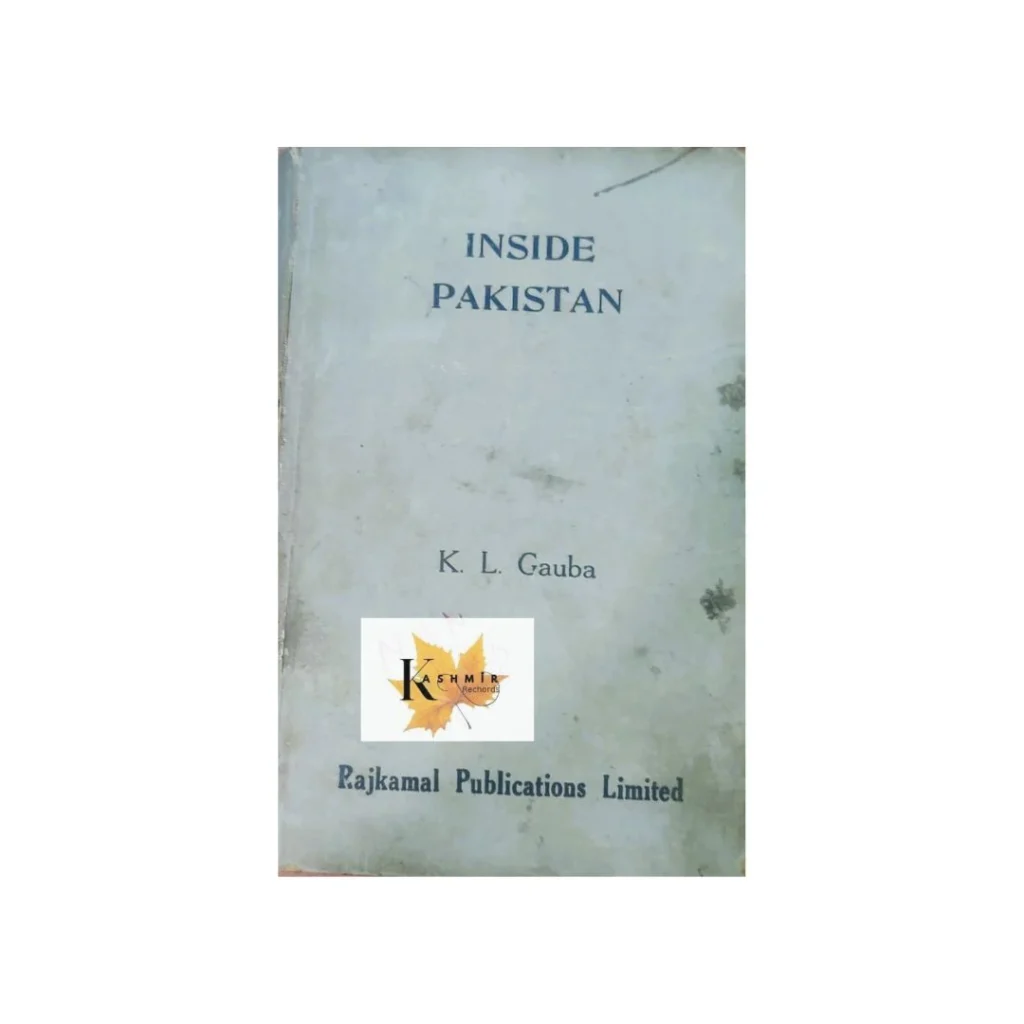
Eminent lawyer and writer, K L Gauba in his famous Book “Inside Pakistan’’ (1948) says following the news of accession of Jammu and Kashmir with the Indian Dominion, “consternation swept Pakistan’’. “I remember the day at Lahore High Court Bar Association. I have never seen longer and more dismal countenances. The faces that had a glow of Pride while Shahami Gate and Rang Mahal were on fire, were no longer lit with Pakistan pride’’, Gauba gives the first-hand account of that day in Pakistan.
Ferocious write-ups against India
A Page from Inside Pakistan
Gauba mentions how ferocious articles flowed from the press rooms under the caption “Treachery’’, and “Pakistan Times’’ taking the leading role through its series of editorials “denouncing’’ the accession that had come as a rude shock for Pakistani military establishment and her leadership.
Kashmir Rechordsis reproducing one of the Editorials of “Pakistan Times’’, carried by K L Gauba in his book “Inside Pakistan’’.
Even greater wrath was stored for Sheikh Abdullah. “Pakistan Times” in another editorial had mentioned: “The author of the `Quit Kashmir’ Movement has suddenly been converted to the slogan of `Do not Quit Kashmir’, and the Dogra House that was yesterday the worst enemy of the Kashmiri people has now become, in the Sheikh’s eyes, its only saviour’’.
Sheikh Abdullah was accused of “maneuvering himself into a position where the only role he can play is to help in the butchery of his own people and be an ineffective second fiddle to the Maharaja and his helpers from abroad’’.
The Pakistani Press had accused both Nehru’s Government and the leader of the National Conference “guilty of treachery’’. In its journey of 76 years, Jammu and Kashmir has moved ahead and progressed leaps and bounds, but the Pakistani media all these years continues to spit venom against India with the same intensity and frustration.
A new storm is sweeping through Jammu and Kashmir’s literary and cultural circles. The spark? A centuries-old question: Where lies Habba Khatoon, the poetess whose verses once made mountains weep?
For generations, Kashmiris have revered Habba Khatoon as the “Nightingale of Kashmir” — a poetess whose songs of love and longing transcended time. But now, her grave has become the subject of a fierce debate — one that pits oral tradition against archival records, romantic legend against historical fact.
The Bihar Connection: Shad Ramzan’s Visit Reignites Old Beliefs
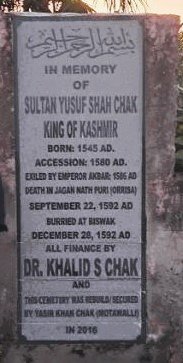
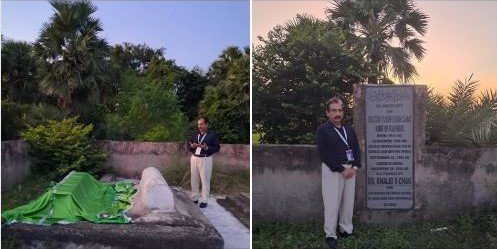
The latest chapter began when noted Kashmiri writer and academic Professor Shad Ramzan, during his recent visit to Biswak, Bihar, posed beside the graves believed to belong to Yousuf Shah Chak, the last independent ruler of Kashmir, and his wife — said to be Habba Khatoon.
Shad Ramzan at Biswak, Bihar, where Yousuf Shah Chak and Habba Khatoon are claimed to have been buried.
Shad’s social media post, describing the visit as “of great historical significance,” noted that Yousuf Shah was exiled to Bihar by Emperor Akbar after the Mughals annexed Kashmir. There, in Biswak, a village still home to families bearing the surname “Chak,” the descendants of Yousuf Shah are said to live on — preserving a living link to Kashmir’s royal past.
According to this version, the exiled ruler was eventually reunited with his beloved Habba Khatoon in Bihar, where the two lived their final years together and now rest side by side.
“I visited the place on 27 September 2025, accompanied by my friend Satish Vimal,” Shad wrote, calling it “a moment of rediscovery for Kashmiri history.”
Counterclaims: The Scholar’s Rebuttal and the Weight of Evidence
Not everyone agrees. Veteran broadcaster and cultural historian Peerzada Abdal Mehjoor has strongly dismissed these claims as “romantic myth-making.”
“For centuries, Habba Khatoon’s poetry has defined Kashmiri identity,” Mehjoor wrote. “But myths and misconceptions continue to cloud her real story.”
Drawing upon historical chronicles of the 16th and 17th centuries — including Persian records and local Kashmiri accounts — Mehjoor points out that no document mentions any woman named Habba Khatoon as Yousuf Shah Chak’s wife. Chroniclers of that time, known for meticulous detail, listed royal wives and consorts with precision. Their silence, he argues, is itself telling.
Equally firm is his stance on her grave’s location: “Habba Khatoon lies buried at Athwajan, on the outskirts of Srinagar.”
Editorial Note – Kashmir Rechords
The ongoing debate over Habba Khatoon’s grave — whether at Athwajan, Kashmir, or Biswak, Bihar — reflects the tension between folklore and historical scholarship. Drawing from archival materials, including the 1963 Archives Department expedition, Yousuf Taing’s 1977 article, and recent field visits by Shad Ramzan and Satish Vimal, this feature aims to preserve the spirit of inquiry surrounding one of Kashmir’s greatest cultural icons.It seems to be, however, ironical that certain forces are or have been creating controversies regarding Kashmir’s women poets .These include Arinmal ,Habba Khatoon and even the great Lall Ded has not been spared.!Whom do the deliberate and manufactured controversies regarding women poets of Kashmir serve? That seems to be a very fair and poignant question.
He cites photographic evidence from the early 1950s — showing Sheikh Mohammad Abdullah and the legendary poet Ghulam Ahmad Mahjoor inspecting the newly built structure over Habba Khatoon’s grave, constructed under Mahjoor’s supervision.
“The Biswak grave often mistaken for hers,” Mehjoor clarifies, “actually belongs to Yousuf Shah’s real wife — the mother of his son, Yaqoob Chak.”
The 1963 Discovery: When History First Knocked on Biswak’s Door
Interestingly, this is not the first time Biswak’s graves came under scholarly scrutiny. Archival records reveal that in 1963, a team from the Jammu & Kashmir Archives Department, led by Sahebzada Hassan Shah, visited Bihar to locate manuscripts related to Kashmir’s history. The team — comprising Mohammad Amin Ibn Mahjoor, Mohammad Amin Rafiqi, Ghulam Rasool Bhat, and Ramji Dhar — also inspected the “Chak Mazaar” in Biswak.
Photographs of that visit, preserved by the historian’s family, confirm the existence of Yousuf Shah’s grave — but make no mention of any grave belonging to Habba Khatoon.
“How then,” asks Shakeel Rehman, son of one of the researchers, “did Habba Khatoon’s grave suddenly appear at the site in 1976, when Mohd Yousuf Taing persuaded Sheikh Abdullah to visit Biswak?”
The question continues to haunt scholars and enthusiasts alike.
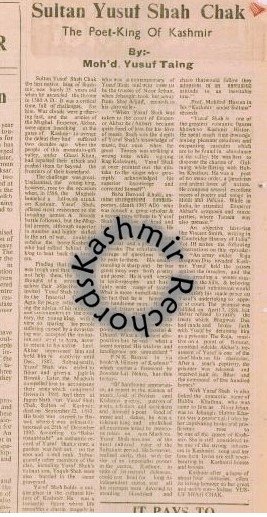
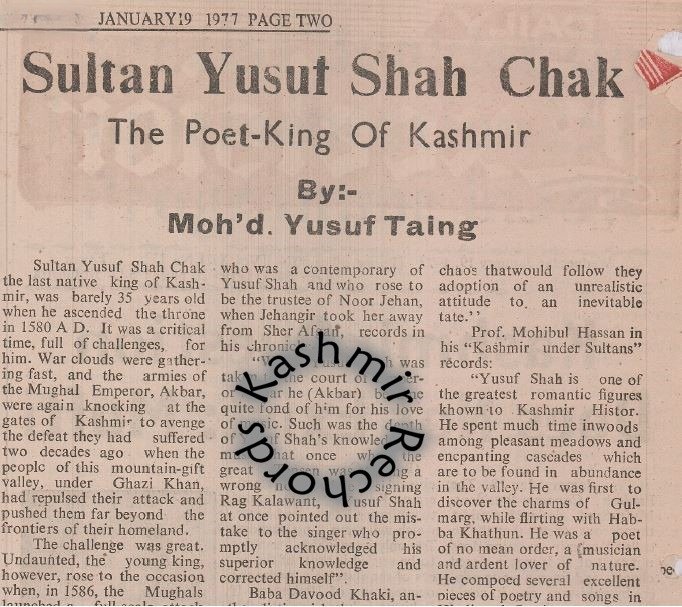
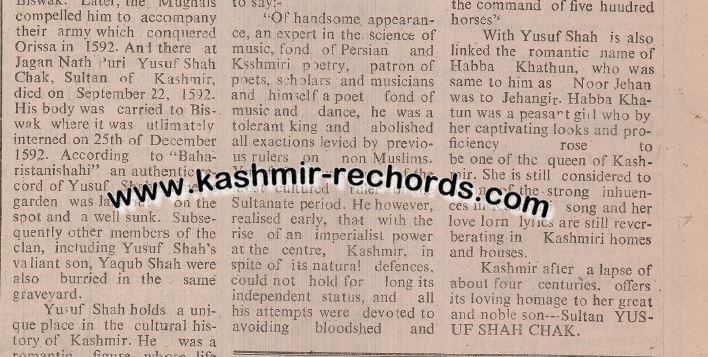
A detailed writeup on Yusuf Shah Chak and Habba Khatoon, written by M.Y Taing on January 19, 1977
Taing’s Testimony: A 1977 Reaffirmation
Adding another twist, Kashmir Rechords has unearthed a valuable document — a detailed article written in January 1977 by Mohammad Yousuf Taing, former Secretary of the J&K Cultural Academy. Taing, who had himself visited Biswak decades earlier, confirmed that the grave of Habba Khatoon was indeed found beside that of Yousuf Shah Chak, along with the grave of his son.
This testimony, though conflicting with other historical evidence, keeps the debate alive — suggesting that perhaps, like her verses, Habba Khatoon’s resting place transcends simple certainty.
Taing’s Account: A Different Lens
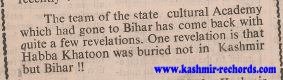
Self-Explanatory—January 1977 News!
Taing’s conclusion reignited the theory that Habba Khatoon, like the Mughal empress Noor Jehan, was not just a royal consort but a woman who redefined femininity through intellect and art.
Just as Noor Jehan became the creative and political force beside Jehangir, Habba Khatoon — if indeed Yousuf Shah’s queen — turned her sorrow into song. Her transformation from the peasant girl Zoon of Pampore to the poetess Habba Khatoon mirrors Noor Jehan’s rise from Mehr-un-Nissa to the most powerful woman of her empire.
Both women, separated by decades but united in destiny, embodied the rare fusion of beauty, intellect, and creative spirit that reshaped their worlds.
Fact, Fiction, Power of Poetry
For historians, the debate is about documentation; for Kashmiris, it is about devotion.
Did Habba Khatoon, the poet-queen of longing, truly share her final resting place with the exiled king who loved her? Or is the romance of their reunion in Bihar merely a poetic echo of her own verses — a fable woven by time?
As cultural voices clash over archives, photographs and oral traditions, one truth stands unchallenged: Habba Khatoon’s poetry needs no myth to shine.
Her songs — of separation, resilience and the ache of lost freedom — remain Kashmir’s living heartbeat. Whether her grave lies by the Jhelum in Athwajan or in the distant soil of Biswak, her soul forever belongs to the Valley she immortalized in verse.
Meet J N Zutshi—the first Director General of Radio Kashmir who also held the post of the Secretary, J&K State Information & Broadcasting. Zutshi is credited to have set up two Radio Stations in Jammu and Kashmir—first at Jammu on December 1, 1947 and then at Srinagar on July 1, 1948. All he had to do through these two Radio Stations, was to counter the malicious Pakistani propaganda against India especially from Pakistani’s notorious underground Radio Station–“ Radio Trarkhal’’.
Archival file on Radio Kashmir
There is a separate file on the establishment of Radio Kashmir that has been preserved in the archival section of the Department of Archives and Museums at Jammu. A detailed study of the file reveals many interesting facts.
J. N. Zutshi was the first Director-General of Radio Kashmir, who also held the post of the Secretary, State Information and Broadcasting Ministry. He was the one to recruit the staff for Radio Jammu. Zutshi’s contemporary was P. C. Choudhery, who was the Director-General of All-India Radio in 1947-48.
The proposal to establish a State-run Radio Station was taken by Maharaja Hari Singh on November 15, 1947, and within two weeks, the Station was established with the active support of Government of India when Sardar Vallabh Bhai Patel was also looking after the portfolio of the Union Ministry of Information and Broadcasting.
In his first-ever radio speech from Jammu (on December 1, 1947 at 6.30 pm), the Maharaja Hari Singh had justified his decision to accede to the Union of India. A number of national and foreign newspapers, which had their representatives in Srinagar and Jammu, carried his speech quite prominently. J N Zutshi was the person, who had ensured that the speech goes on air uninterrupted from the two classrooms of a local School where Radio Kashmir Jammu was initially set-up.
Selection of Staff for Radio Kashmir
On the instructions of J N Zutshi, local artistes and singers were being hired and brought to these makeshift radio stations (both at Jammu and Srinagar) to face the mikes live and counter the Pak propaganda through the ballads and traditional Kashmiri and Dogri songs. There was no provision for recording.
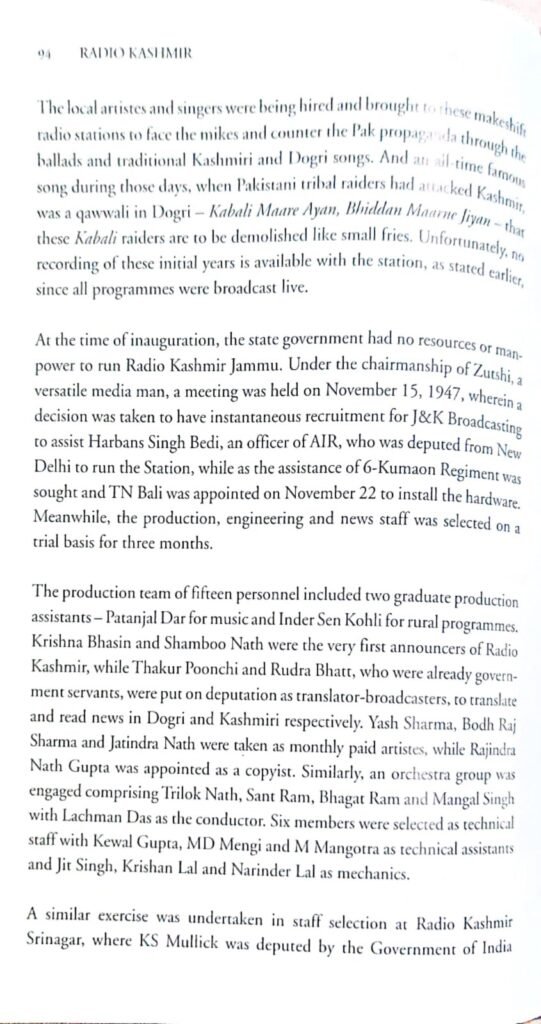
At the time of inauguration, the State Government had no resources or man- power to run Radio Kashmir. Under the chairmanship of Zutshi, a versatile media man, a meeting was held on November 15, 1947, wherein a decision was taken to have instantaneous recruitment for J&K Broadcasting to assist Harbans Singh Bedi, an officer of All India Radio (AIR), who was deputed from New Delhi, while as further engineering assistance of 6-Kumaon Regiment was sought. TN Bali was appointed on November 22, 1947 to install the hardware. Meanwhile, the production, engineering and news staff was selected on a trial basis for three months.
A page from a Book–`Radio Kashmir in Times of Peace and War’
The production team of fifteen personnel included two graduate production assistants-Patanjal Dar for music and Inder Sen Kohli for rural programmes. Krishna Bhasin and Shamboo Nath were the first announcers of Radio Kashmir, while Thakur Poonchi and Rudra Bhatt, who were already government servants, were on the orders of Zutshi, put on deputation as translator-broadcasters, to translate and read news in Dogri and Kashmiri respectively. Yash Sharma, Bodh Raj Sharma and Jatindra Nath were taken on contract as monthly paid artistes, while Rajindra Nath Gupta was appointed as a copyist. Similarly, an orchestra group was engaged comprising Trilok Nath, Sant Ram, Bhagat Ram and Mangal Singh with Lachman Das as the conductor. Six members were selected as technical staff with Kewal Gupta, MD Mengi and M Mangotra as technical assistants and Jit Singh, Krishan Lal and Narinder Lal as mechanics. A similar exercise was undertaken in staff selection at Radio Kashmir Srinagar, where KS Mullick was deputed by the Government of India.
Zutshi’s proximity to Sheikh Abdullah
Apart from being the first Director General of Radio Kashmir, J N Zutshi had also setup the Field Publicity Organisation of J&K Government that was equipped with mobile vans and loud speakers. These vans used to move in different parts of Jammu and Kashmir presenting to the common man entertainment as well as political awareness. For his proximity to Sheikh Mohd Abdullah, Zutshi as a gifted writer, used to write all his speeches and later for Bakshi Ghulam Mohd.
J N Zutshi and Sheikh Mohd Abdullah leaving for New York in December 1949 to present India’s case in United Nations on Kashmir
It was on December 13, 1949 that Sheikh Mohammad Abdullah as Prime Minister of Jammu & Kashmir and member of the Indian Delegation, accompanied by J.N. Zutshi left New Delhi for New York to assist N.N. Rau, India’s Permanent representative with the U.N in presenting India’s case before the Security Council.
From 1947 to 1953, all-important political documents of Jammu and Kashmir were drafted by Zutshi and he enjoyed Sheikh’s full confidence. It was because of his proximity to Sheikh Abdullah that Zutshi was also imprisoned in 1953 for some time.
From Radio Kashmir to AIR to Akashvani
Radio Kashmir, which started functioning as a State Department under J N Zutshi, was later fully merged with All India Radio in April 1954. The Institution had, however, retained the identity as “Radio Kashmir’’ to meet the specific strategic requirements of the country, the details of which are exhaustively covered in a well-researched book ``Radio Kashmir in Times of Peace and War’’. However, in October 2019, the name “Radio Kashmir’’ was abruptly dropped and both Srinagar and Jammu Stations were first prefixed as `All India Radio’ and then in 2023, as `Akashvani’.
Radio Kashmir in Times of Peace and War ( Stellar Publications, 2018)
The Intelligence Bureau (IB), India’s internal intelligence agency, reputed to be the oldest such organization had suffered major causalities in Kashmir Valley in 1990, beginning from January 2. On January 27, when the world observes International Holocaust Remembrance Day, it is an opportunity to reassert Nation’s commitment to human rights and to commemorate the sacrifices of its intelligence officials that are not discussed in the public domain. The intelligence inputs provided by these unsung heroes are vital for the nation’s security and protection. Therefore, it is important for their sacrifices to be recognised and honoured.
There are many heart-wrenching stories of officials of the Intelligence Bureau (IB) who made supreme sacrifice in the line of duty while exposing the Pakistan-sponsored terrorism in Jammu and Kashmir. Their sacrifices may have remained hidden from the public eye to ensure the secrecy of the organisation. But it is necessary to tell the present generation all that what had happened during the initial phase of militancy in Kashmir.
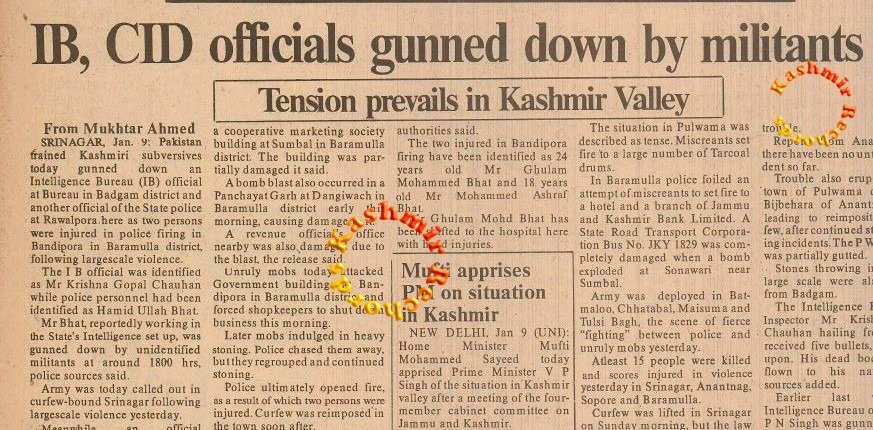
Beeru town in the Budgam district of Kashmir, was known to be a stronghold of the fundamentalist militant groups. That is why the work done by Krishan Gopal Chouhan, 37, a Sub-Inspector of the Intelligence Bureau (IB) was considered valuable.
Chouhan ran a one-man operation in this town. His success had already been noticed by the militants. On January 8, 1990, his luck ran out. A man in the Pheran was stalking Chouhan in the bustling street of Beeru. He pulled out a Kalashnikov from his Pheran and shot IB Official five times.
A few hours after Chouhan’s death, terrorists had struck again. This time killing Inspector Hameedullah Bhat of the State’s counter-espionage cell in Srinagar’s Rawalpora locality. Bhat was the fourth state intelligence man killed by terrorists. Since September 1989, militants had killed several civilians also, accused them of being informers.
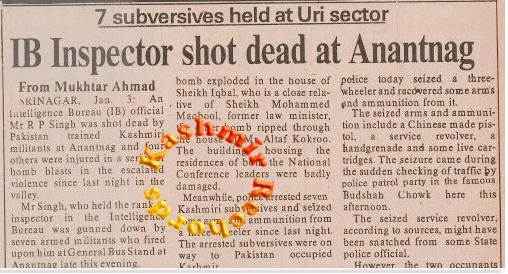
With the death of Chouhan, the IB had lost its second field operative within a week. Earlier, on January 2, 1990, R.N.P. Singh, Assistant Central Intelligence officer at Anantnag, was shot dead. More such killings of IB officials unfortunately continued in early 1990.
Behind each death was a horrifying tale that causes a shudder in the spine. One such heart-breaking story was that of Tej Krishen Razdan, a Technical Officer in IB, Gupkar Road, Srinagar. He was killed by a Pakistan trained Kashmiri terrorist in Srinagar. During the time of this incident, terrorism was at its peak in the Valley and the state administration was paralysed. But the grim and haunting situation did not deter the official to render his duty. On February 14, 1990, he visited his residence at Badyar to see his ailing parents. While on his return, he used public transport. But at the mini-bus terminal point Gowkadal, Srinagar, he was forced to disembark from the vehicle and shot down by two unknown youths. Later, his blood-socked body was dragged from the bus stop to Red Cross Chowk, Maisuma Bazar and left at the roadside for public view. The nearby shopkeepers and onlookers were unmoved watching enemy forces robbing an Indian official of his life and dignity. On receiving the information, a police jeep from the Police Control Room came to pick up the body. As the driver came near the body, he asked for help from the people around the spot for lifting the body and placing it in the police vehicle. None of them came forward and the driver was forced to drag the body to the vehicle. At the police control room, the body was handed over to the bereaved family for the last rites.
R.M.P.Singh who was posted as IB officer in Anantnag District of the Kashmir valley was shot by Manzoor Darzi, a terrorist belonging to the Jammu and Kashmir Liberation Front (JKLF) at the main bus stand. The official was returning home in the evening with groceries for the family who were staying in government quarters. He succumbed to the bullets on the footpath of the main road. His bullet-riddled body sprawled on the ground with no immediate medical aid. Instead of saving the life of an Indian official, locals in the market area were seen in jubilation.
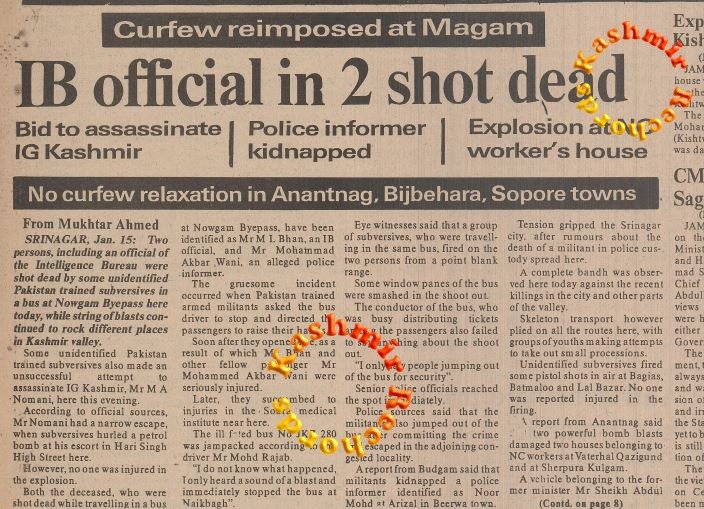
On January 15, 1990, Moti Lal Bhan was the fourth IB official targeted by the JKLF militant outfit. On that fateful day, Bhan had left for office along with his son and boarded the Khanda shuttle bus service on Natipora’s side. Three youth, led by Bitta Karate, barged into the coach and ordered Bhan to get down from the bus. He protested and argued. A co-passenger intervened not to force Bhan to get down from the bus. In a fit of anger, one of the intruders pulled the trigger of the gun and shot the co-passenger Mohd Akbar Wani on the spot and a pall of gloom and panic spread among other commuters in the shuttle bus. Soon after, they fired upon Bhan in the head at point-blank range. Not a single person in that bus came to the rescue of Bhan and the co-passenger who lost his life defending him. The fault of Bhan was that he had handled the operation of apprehending Abdul Ahad Waza, a Pakistan trained Kashmiri Terrorist.
In yet another incident the same year, Rafiq Ahmed Wani of ShalaKadal, Srinagar who was working as a Security Assistant in IB was gunned down at his home when he had come on leave from Assam to celebrate Eid with his parents.
Pakistan-sponsored terrorism had already surfaced in the Kashmir with the occurrences of stray bomb blasts in the valley. The alarming one was the attack at the residence of the then DIG, Kashmir A.M.Watali. In the month of December 1989, after Rubaiya Sayeed was kidnapped some of the known IB field officers were threatened by JKLF terrorists.
Warning signals ignored
It is true that many of the warning signs were ignored by those concerned. The ground reports from IB and other sister agencies active in the Jammu and Kashmir, about the Kashmiri youth crossing over the border to undergo arms training in ISI run camps in Pakistan Occupied Kashmir (PoK) were adequately available with the Central government. The events of violence, bomb blasts, and sudden firing at the vintage crossing, and selective killing of Hindu minorities were providing proofs the spread of terrorism in the valley. The silence of the local populace and inaction of the state apparatus was rendering inadvertent support to the terrorists in the valley. It was simmering in the majority community that these gun-wielding terrorists claiming to fight for Azadi of Kashmir from India should be supported by all the community members. Participation in every religious congregation was rising, mostly on Fridays, purposely to remain abreast about the `struggle of Kashmir insurgency’.
Unfortunately, the Indian government could not understand the magnitude of the hostile situation that was growing in the valley. It kept ignoring the signs and classified them as law-and-order problems.
The killings can also be traced back to the imprudent decision of the IB headquarters in organising a one-day DG conference in mid of 1989 at Centaur Hotel, Srinagar. This exposed the workings of the IB department in the valley. Farooq Abdullah, the then CM was the chief guest of the conference. Without calibrating on the pros and cons of the situation in a sensitive region, the conference failed to strengthen the national security apparatus and also ignored the enemy’s strategy of sneaking into the system. All the conference did was to gravely compromise the functioning of IB and make its officials the first to be on the hit list of terrorists in the Kashmir region.
IB was eyesore for political leadership in Kashmir
It is also pertinent to mention here that the presence of IB was always an eyesore for political leadership in Kashmir. The design for an“ independent Kashmir’’ got exposed in an interview of Late Sheikh Abdullah to two foreign correspondents, Michael Davidson and Ward Price, in January 1949. IB sleuths were alerted to get the details of the interview given by the late Sheikh through his own contacts. The information about IB inquiring into the details of the meeting with foreign journalists, reached Sheikh Abdullah, who got annoyed. IB Director B M Maullik shared the incident with late Gopalaswami Ayyangar, Senior Minister in charge of Kashmir affairs, in New Delhi. But, the reaction to the IB report shared with Ayyangar was quite unexpected. The IB official posted in the Valley was given marching orders from Kashmir, for the reasons only known to Ayyangar.
It became known later that Ayyangar’s objective was to placate Abdullah for political reasons. However, Abdullah showed some reservations on replacement of IB officer in the valley. Again, Ayyangar had to use his good office in convincing Sheikh Abdullah to keep IB officers stationed in the valley. During this time, Sardar Patel had disclosed to the IB Director that he did not trust Abdullah. Maharaja Hari Singh was in touch with Patel and had informed him about the hidden agenda of Sheikh Abdullah.
Aversion towards IB’s role in the valley had started since independence but came to the fore when Late Mirza Afzal Beigh and G Parthasarthy talks in 1972-73 began and during the talk, late Sheikh Abdullah insisted on total winding off IB from the state.
When the tribal raiders from Pakistan entered Kashmir in October 1947, the Valley was plunged into chaos. But nowhere was the suffering more concentrated, more haunting, than in Baramulla. For thirteen harrowing days, this serene town at the gateway to the Valley lived through what survivors would later call “thirteen years of hell.”
The invaders—armed tribesmen backed by Pakistan—descended upon Baramulla with a fury that spared no one. The town was looted, torched, and left soaked in blood. Hindu, Muslim, Sikh, or Christian—it made little difference to the marauders. Eminent lawyer and author K.L. Gauba, in his book Inside Pakistan (1948), recorded that “the raiders made little distinction between their victims.”
A Town Drenched in Blood
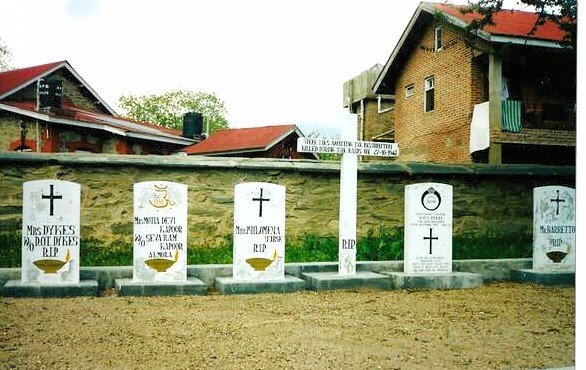
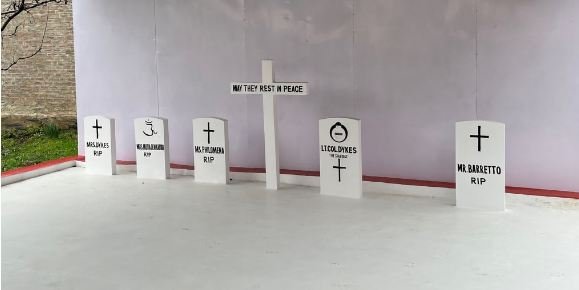
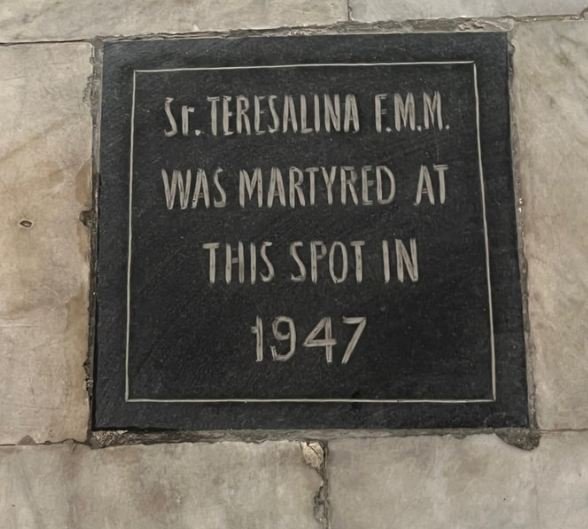
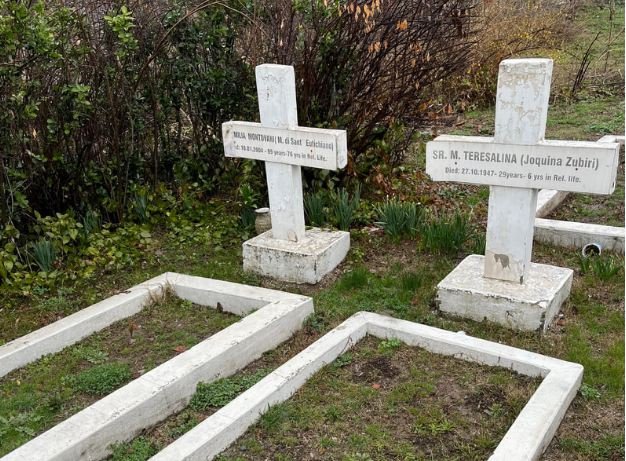
Gauba estimated that over a thousand people were killed in Baramulla alone. Among the slain were Lt. Col. and Mrs. Dykes, four Sisters of Mercy, and a Mother Superior from the Convent of St. Joseph’s. The Dykes’ infant child, Gauba writes with chilling simplicity, “was thrown down a well.”
Even the sacred walls of the mission hospital and convent offered no sanctuary. Captured tribesmen later confessed that the Europeans were killed on the very day the raiders stormed the town. The hospital and post office were destroyed, hostages taken, and every semblance of order obliterated.
The Loot That Never Ended
The assault on Baramulla was led by Major Khurshid Anwar, with Major Mohammed Aslam among his subordinates. Their force, numbering between 3,000 and 5,000, operated in waves—some coming, others leaving—each group looting anew. “The same sections of the town were plundered repeatedly,” Gauba noted.
When the raiders finally fled, nearly a hundred lorries—many bearing license plates from Pakistan’s Frontier Province and Punjab—stood lined up, laden with stolen goods. “There was not a grain of rice or a yard of cloth left,” Gauba lamented.
A Valley Torn by Fire and Fear
The road from Baramulla to Uri was littered with the wreckage of trucks and carts abandoned by the fleeing invaders. Overhead, Associated Press photographer Max Despott saw the devastation firsthand: “More than twenty villages were in flames,” he reported on November 2, 1947. The marauders were moving toward Srinagar, burning and looting everything in their path.
On the propaganda front too, the raiders came prepared. Leaflets printed at Lahore’s Jilani Press were scattered across villages, seeking to sway the local populace with promises and threats. Radio Pakistan was further fueling the fire.
The Mission’s Long Captivity
British journalist Andrew Whitehead, in A Mission in Kashmir, recounts how about eighty survivors—missionaries, locals, and refugees—were held captive for ten days in the hospital’s baby ward. Among them was Father George Shanks, who emerged as the leader of the trapped group, and Sydney Smith of the Daily Express, who had been captured while reporting on the conflict.
Their ordeal ended only when Indian troops liberated Baramulla on November 8, 1947. The invaders fled, leaving behind a shattered town and the echoes of their brutality.
The World Watches in Horror
The global press was quick to document the barbarity. The New York Times correspondent Robert Trumbull wrote on November 10, 1947, that “Baramulla had been stripped of its wealth and its young women.” He reported that 3,000 townspeople—including the Dykes and four European missionaries—had been slaughtered, and that 350 Hindus were locked in a building meant to be set ablaze.
The Times of London on November 11, 1947 noted that the survivors “seemed delighted to welcome the Indian troops.” The horror, however, would remain etched in memory forever.
The Orgy of Violence
As Raghvendra Singh, former Secretary in India’s Ministry of Culture, later wrote, “The raiders turned on everybody that came their way. They started wholesale loot, arson, and orgy. They burnt property of Hindus, Sikhs and Muslims alike. They killed children, old men, and women—and committed rape on every young woman, Hindu, Muslim, or Sikh.”
Baramulla’s suffering became the defining image of Pakistan’s first invasion of Kashmir. The massacre at St. Joseph’s Convent, the killing of missionaries, and the desecration of a place of healing shocked the world’s conscience.
The Forgotten Horror
Today, few remember that Baramulla was the first town in independent India to face a full-scale foreign invasion. It was also the place where humanity itself was tested—and, for thirteen dark days, found wanting.
The raiders failed to capture Srinagar, but they succeeded in revealing the depths of their savagery. Baramulla paid the price—with its people, its peace, and its very soul.
Massacre at St Joseph’s Mission Hospital Baramulla, Kashmir ( Pics source: Internet)
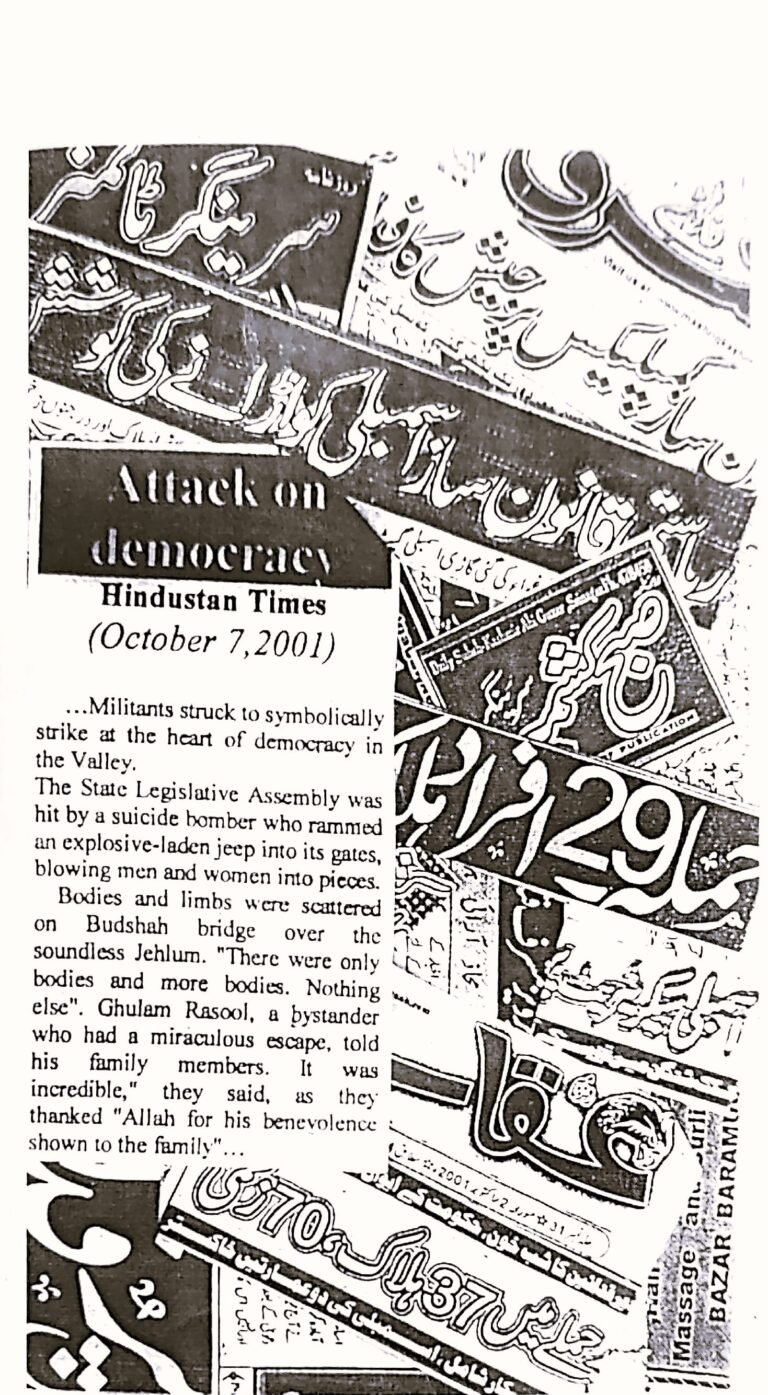
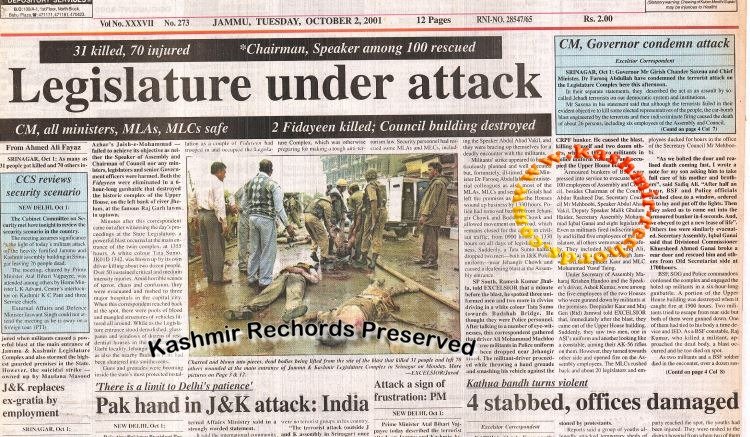
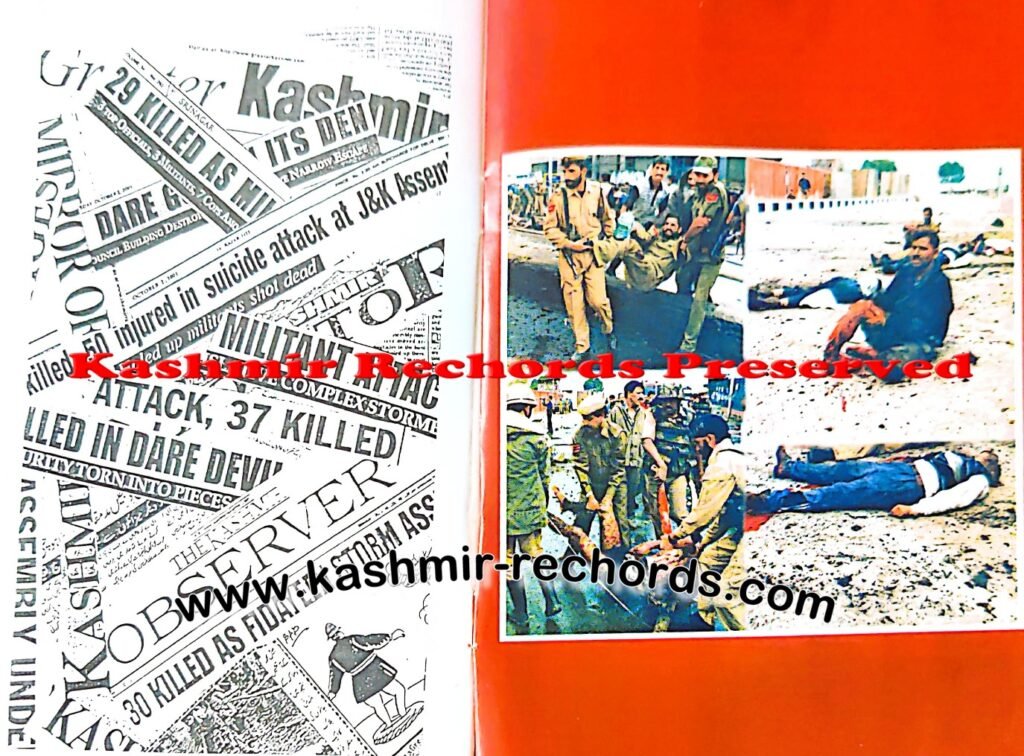
On October 1, 2001, Jammu and Kashmir Assembly was attacked in the worst ever strike by Pakistan-backed terrorists who killed about 38 innocent Kashmiris, including four security personnel on duty and injured scores of other passers-by. It was exactly 72 days after Srinagar Assembly attack that an identical attack was attempted on Parliament of India the same year on December 13. While Parliament attack anniversary is being held every year to remember all those who lost their lives in guarding the Temple of Democracy, people in Jammu and Kashmir seem to have forgotten the lethal attack on the Legislative Assembly Complex by anti-national elements who used a four-wheeler loaded with explosives, rammed it into the main gate with three “fidayeen’’ suicide bombers,
Pakistan’s involvement
Terrorist outfit “Jaish-e-Mohammed’’ had claimed responsibility for the attack that had unnerved one and all. It was during the Prime Ministership of Sh Atal Bihari Vajpayee that Indian Foreign Ministry had issued a strongly worded statement aimed clearly at the Government of Pakistan. “India cannot accept such manifestations of hate and terror from across its borders,” said the statement.
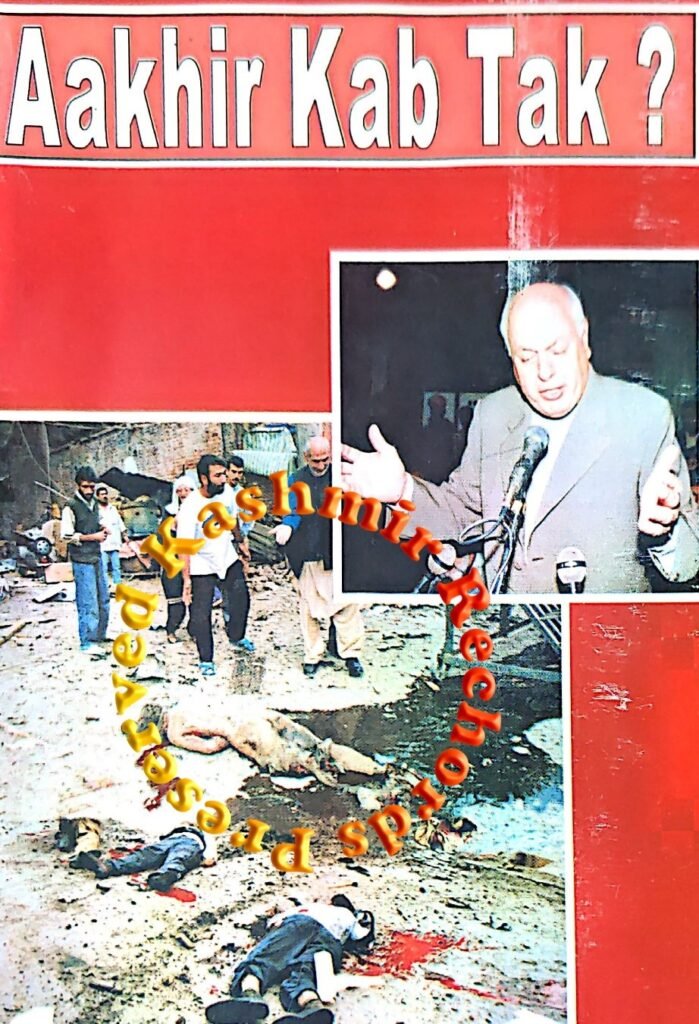
Aakhir Kab Tak?
Two days after the attack, in his address to the Legislators on October 3, 2001, the sobbing Chief Minister, and Dr Farooq Abdullah had expressed his helplessness and called for reprisal attacks on Pakistan to bomb the militant training camps there. “Aakhir Kab Tak’’—(How long) was Chief Minister’s poser to Home Minister Lal Krishan Advani as the State was “ running out of patience’’.
Kashmiris, irrespective of their caste, creed or religion have suffered immensely during the time when militancy was at its peak. Thanks to the present leadership at the Centre that all such incidents have now become the thing of the past. However, the Government cannot lower its guard. The enemy may be on the prowl.
Gory scenes
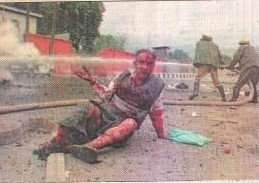
Kashmir Rechords is bringing out some of the gory pictures of that fateful day (October 1, 2001) to remind the readers how terrorism causes destruction, mayhem and causalities. It also is an indicator that terrorists can resort to any act in order to meet their nefarious designs. In the instant case, they had disguised as security personnel to hijack a vehicle 10 minutes before carrying out the attack.
Among those killed, included a school- going girl. Five Assembly employees, including a Deputy Secretary and an Under Secretary had also lost their lives in this deadly attack. About 125 persons were inside the Assembly when the terrorists had struck.
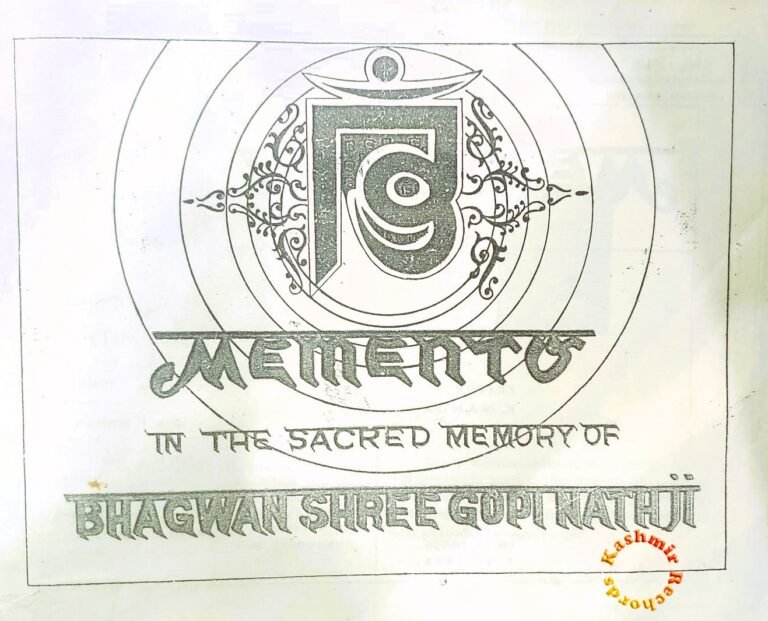
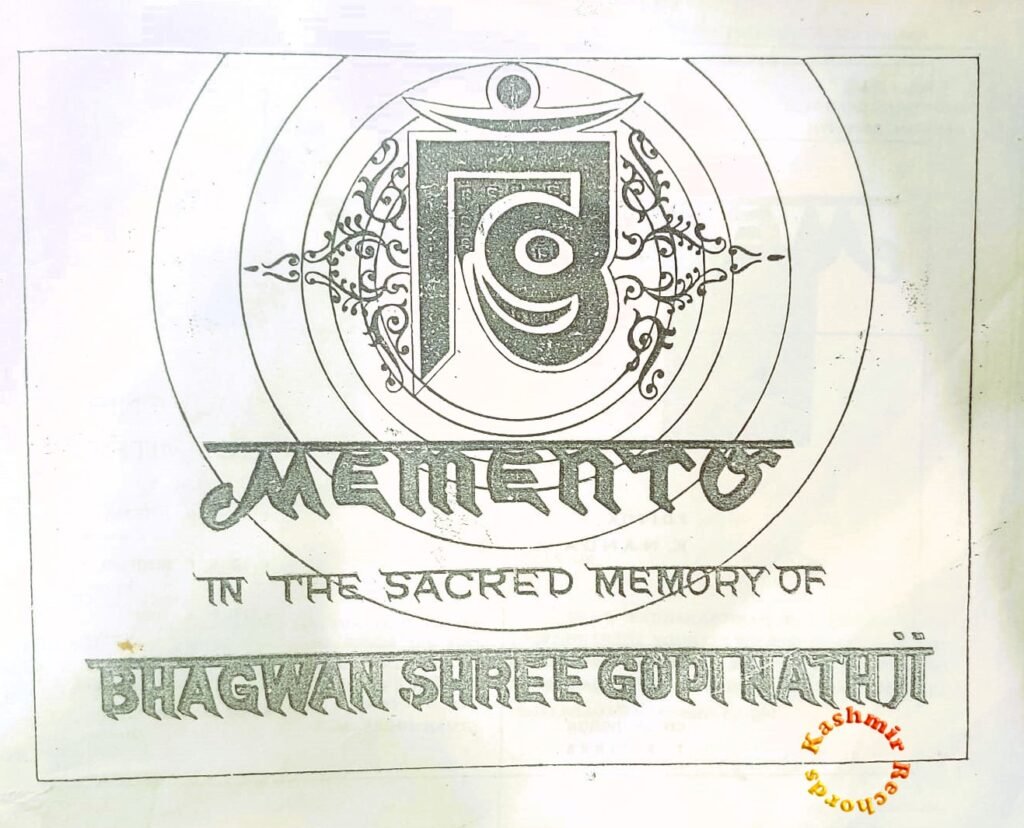
It was in mid 1974 when a rare souvenir was published by K Nanda, Editor from Birla Nagar, Gwalior Madhya Pradesh in memory of Bhagwan Gopi Nath Ji of Kashmir. Kashmir Rechords has managed to get a photocopy of this memento.
The preface of this 52 page memoir carries then President V V Giri’s `Good Wishes’, besides `Blessings’ of Dr S Radhakrishnan, another former President of India.
The publication carries rare photographs of Bhagwan Gopi Nath Ji, facsimile of two Omkar symbols in Sharda, in Bhagwan Gopi Nath Ji’s own handwriting, besides life and history of some other Hindu and Muslim saints of Kashmir.
In his introductory page, the Editor gives details about the souvenir while referring to an article on `Saints of Kashmir’, hoping that readers will find the same “interesting and informative’’.
For those associated with the spiritual activities of Shri Bhagwan ji, an exclusive article on his philosophy has been written and interpreted by S. N. Fotedar, one of the disciples of Bhagwan Gopi Nath Ji .
Kashmir Rechordswill try to bring more details about this memento in its future blogs and write-ups.
For Archival pictures and material on demand, contact Kashmir Rechords