Legends like Sunil Gavaskar and Imran Khan are icons. It is entirely another matter while the former continues to hog limelight and is deftly active on the field in his new avatar as an internationally cherished cricket commentator, the latter for reasons best known to Pakistani Army has landed him in jail. Both have had a brilliant chemistry between them on and off the field. Even though both are heroes to the world of cricket, the fate has landed Imran Khan in dire straits despite his best intentions to take his country out of the mess it presently finds in, while Sunil Gavaskar is continuing to add value to his role as cricket legend. Both are loved by people of Kashmir so much so in the controversy surrounding the first one day international cricket match between India and West Indies at Amar Singh Cricket Club Srinagar on 13th October, 1983, Gavaskar was deliberately shown the posters of Imran Khan!
The Day When Farooq Abdullah courted Controversy
The years 1982 and 1983 shall always be remembered in Kashmir’s History for varied reasons! As Farooq Abdullah was just one year-old Chief Minister, his inability to assess the mood of Kashmiris (deliberately or otherwise) had landed him into a big controversy following the disruptions in the first international cricket match Srinagar had ever hosted. Indian Cricket Board, for the first time had allowed the international one day cricket match to be played between West Indies and India at Sheri-Kashmir International Cricket Stadium, Srinagar, Kashmir. Even though it was no stadium by any definition, but wooden planks were arranged to resemble the spectators’ stands. The outfield, though picturesque, was very short and the blizzard of sixes by West Indies batsmen up and above, beyond the road that made circumambulations around the Amar Singh Cricket ground proved it all.
Every Kashmiri loved Sunil Gavaskar and manic fans were vying to get a glimpse of their hero. The whole stadium cheered so much and welcomed him with such a frenzy the likes of which has not been witnessed since then. Nobody knows how the tide turned and booing by the crowd started. Suddenly a section of the crowd began to behave differently and the mood changed from vivacious to sullen. The pitch was allowed to be damaged and even the weather got the wind of the same and arranged dark clouds at short notice!
Farooq Abdullah as Chief Minister was witness to everything that was taking place in Srinagar. In hindsight many are of the opinion that he should have done something, at least a leadership act that would not have prevented Kashmir from holding subsequent cricket contests. Alas! That was not to be. Prime Minister Indira Gandhi took this very seriously and it is here when she believed that something was not right in Kashmir and she got the impression that secessionist seeds were being sown. Known for not tolerating any nonsense, it was a matter of months before Farooq Abdullah government got the boot and was replaced by his brother- in- law Ghulam Mohammad Shah (Gull Shah).
Runs ’n Ruins
Kashmir did host another ( the 2nd and last) One day Cricket match on September 9, 1986 when India played against Australia at the same venue but that happened under President’s Rule and not under any political regime. Sunil Gavaskar in 1984 wrote in his book “Runs ’n Ruins’’ that “being hooted at after a defeat is understandable, but this was incredible. Moreover, there were many in the crowd shouting pro-Pakistan slogans which confounded us, because we were playing the West Indies and not Pakistan. The team was stunned and could not understand the crowd’s reaction as India had come to the ground as the World Champions!”
The disturbances during 13th October 1983 One Day Cricket Match played at Srinagar, had taken place soon after India had won the World-Cup played in England and Wales (June 25, 1993). Some secessionists back-home must have not digested that. That is why they tried to avenge the West Indian defeat at Lords by digging the pitch at Srinagar the same year on October 13!
Sunny Days are here again
Kashmir since then has turned an entirely new leaf and aspiring cricketers from both Jammu and Kashmir regions are making a name for themselves both in domestic as well as international cricket contests besides a visible presence in IPL and other matches. With more mature and highly educated young people of Jammu and Kashmir who know how to separate rice from chaff, sunny days are here again and at least Cricket Stadium at Jammu is eagerly awaiting a contest somewhere in near future. … Amen to that.
It is World-Cup time again!. Everyone in Kashmir awaits a brilliant performance from every Cricketer. But that was not always the same!
During the past over nine decades, the Indian Air Force has proved its mettle in terms of necessary skills and abilities. When IAF was officially established on October 8, 1932, it had just six Royal Air Force (RAF)-trained officers and 19 Havai Sepoys (air soldiers). It required both men and machinery, as the aircraft inventory consisted of just four Westland Wapiti IIA army co-operation biplanes. Presently, IAF is counted as the fourth largest air force in the world with so many aircraft, fighter squadrons and combat aircraft squadrons.
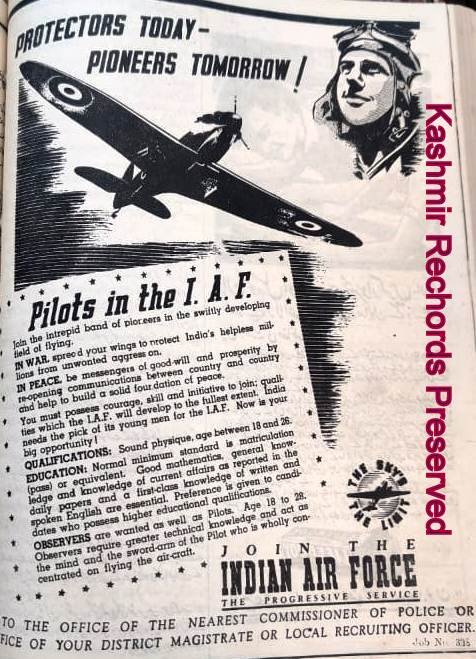
With such a meager force in the initial years, the problems concerning the defense of India were reassessed in 1939 by the Chatfield Committee. It coincided with the beginning of the World War–II during the same year. The Committee, besides other things, had proposed the induction of Pilots and Observers to strengthen the air force in India. It was during this period from 1940 to 1943 that newspapers and magazines used to carry a series of advertisements for the recruitment of Indians into IAF. Matriculation, with a sound physique, was the basic qualification to occupy the cockpit!
Kashmir Rechords is in possession of several advertisements having been printed/published in various newspapers and magazines of India between 1939 to 1943, imploring the youth to make IAF their career. Catchy and well-crated advertisements were there to catch the attention.
Fly with IAF
One such advertisement lured Indian youth aged between 18-28 to fly high up in the skies. The basic qualification for the same was a sound physique with Matriculation as the minimum qualification. Knowledge of written and spoken English was considered to be essential and candidates having higher qualifications were being given preference in the selection process.
Those who intended to join as Observers needed greater technical knowledge in order to act as “the mind and the sword-arm of the Pilot who is wholly concentrated on flying the aircraft’’.
Protectors Today—Pioneers Tomorrow
In another advertisement, those who wanted to join IAF (The Progressive Service) as Pilots should have been good at Mathematics, General Knowledge and Current Affairs.
Candidates were required to visit the office of the nearest District Area Commander or the nearest Commissioner of Police or Technical Recruiting Officer to volunteer for flying duties. Those suited for the job of a Pilot or Observer were later required to undergo thorough training in order to fetch a Commissioned rank for themselves in IAF. The forms for joining IAF as Pilots were available from “ AG 2 (C), Recruiting Directorate, Adjutant-General’s Branch G.H.Q, New Delhi.
The Sky Is The Limit!
The recruitment of Pilots and Observers during this period must have come in handy at a time when India needed IAF soon after her Independence in 1947. On October 27, 1947, (Soon after the signing of the Instrument of Accession), the No.12 Sqn was to initiate the remarkable feat of air-lifting the Ist Sikhs from Palam onto the rough and dusty Srinagar airstrip without planning or reconnaissance as the initial Indian response to the sizeable insurgent forces that were pouring across the border into Jammu and Kashmir. On October 30, 1947, the first Spitfires from the Advanced Flying School at Ambala reached Srinagar and were soon engaged in strafing the raiders beyond Pattan. The fighting continued for 15 months, with heavy IAF involvement throughout this period till the declaration of a Ceasefire in January 1949.
From Sky Is the Limit to “Touch the Sky with Glory”—- Indian Air Force has always shown its courage and resolve, both in times of Peace and War.
In response to the blog dated September 21, 2023 that was carried in Kashmir Rechords regarding the need to preserve the Kashmiri language by Kashmiri Pandits who stand fragmented as part of international diasporas and who are facing the most acute, clear and present danger of their existence when they are allowing to skip conversation in the language of their forefathers to be replaced by a plethora of languages available to them in their new dwellings, we have received a quality write- up by one of the literary giants of Kashmiri language, Sh. Makhan Lal Pandita.
This Kashmiri write-up was forwarded to www.kashmir-rechords.comin the purest Nastalique font and very urgent points have been raised therein which we believe are of immense value to the post nineties generation of Kashmiri Pandits if at all they care for the Kashmiri language. At Kashmir Rechords, We have tried to be most authentic in translating the original manuscript forwarded to our platform and for our esteemed readers we are enclosing the same for fact checking also. Those who are acquainted with Nastaliq script can also read/download the original write-up it here:-
Here is the translated version of Shri Pandita’s Kashmiri write-up:-
“Every literate Kashmiri in daily conversations makes use of many an English word. There can be two reasons that explain the preference of incorporating English words in our daily conversations. Either one doesn’t seem to have complete mastery over the day to day Kashmiri or even if one may have the ability, one’s knowledge about the Kashmiri is shrinking due to the reduced word stock at one’s disposal on account of the same having got abandoned since the same is no longer being used any more. Whatever the situation, one’s psyche seems to have been dominated by the idea that it is fashionable to speak in English.
Enter nineties, everything changed, the ambience and the need for adjustment with the prevailing environment presented itself with the fact that something was out of tune. While in conversation many fumbles would occur. Women especially found it extremely arduous to converse in Hindi and Urdu. “Bijli Daalo” “Pani Pakdo” translation shortcuts for words like “switch on the lights please” and “Collect some water”. These words were coined as amalgams to the closest meanings of the situations as they arose.
English and `Hindi-isation’ of Kashmiri
Vendors in order to lure the customers usually resort to the practice of giving extra green chilly as a top up to the basket of vegetables purchased by the customer. Should they forget to put these extra inducements, the ladies and the old guys alike would come up with an urgent demand “ Mujhe mirchein Daalo “ None the less a hilarious demand when translated even though the import of the demand was acquiring some extra green chilies.. A keen listener will surely come across many such words even today.
A teacher Ghulam Hassan Manto taught us English. After the customary morning prayers, his flawless lectures on diverse topics to us would be in English. We would crave for the attainment of the quality of his English and were eagerly awaiting the day when we would become proficient in English like him. The English language appeared to be full of vitality and energy and the same longing continues to this day. The village people even though they conversed in pure Kashmiri but words like ‘teacher’, ‘news’ etc. would inadvertently come up in their conversations. They also seemed to nurture the opinion that real education only meant to possess the ability to speak in English only. Even though our own generation was endowed with the natural ability and had the wherewithal to converse in native Kashmiri, we also would succumb to the habit of incorporating one or two English words compulsorily even though English had not dominated the discourse the way it has now. In the villages, whenever we tried this the listener would promptly interrupt and admonish us on the ground that while he was conversing in pure Kashmiri we were trying to act over smart by incorporating the unnecessary English words.
I had once proceeded to Delhi to buy certain items for marriage purpose. My cousin who was born and brought up at Delhi accompanied me to Chandi Chowk area to visit some shops who had acquired a certain reputation for selling quality products. Since the items had fixed prices listed on them she bade me not to open my mouth lest they will get the idea that we do not belong to this place. She told me that the shopkeepers would get the impression that we are Kashmiris and we are demanding unrealistic price cuts. The same situation persisted in Jammu. The result was that everyone including the children were forced to encounter the challenge of speaking an alien language and they fumbled a lot while conversing in Hindi. This resulted in putting in focus Hindi only. Inside their homes, these children are unable to cultivate the finenesses to speak in the native Kashmiri language and even if they try, the result is a battered conversation beyond redemption. If we force them to speak in Kashmiri, I think such an action will not yield anything. This is because they do not have the inclination and the prevailing environment is abhorrent to their longing for their native language and thus how are they supposed to converse in Kashmiri? It is believed that a child usually learns something on his own up to the age of five years. It remains embedded in his/her consciousness and becomes his or her mother tongue. Undoubtedly, the mother tongue is the only thing that binds us to our culture. A mature analysis will reveal that those children who do not know and speak in Kashmiri are almost unaware about the Kashmiri culture also. They try to keep pace with the new environment resulting in their getting deviated from Kashmiri language and culture. Should such children somehow stand united or find the opportunity to appreciate the same, still they will never come out of their native field of language and culture.
Inability to converse in mother tongue
The inability on part of our children and others not being able to strike a conversation in the mother tongue is embedded in our consciousness and we do not want our children to face this. The children find the idea of taking up daily conversations in Kashmiri akin to the shrinking field that lacks the attraction to bind them to it. The likely reason being there is a deep connection with the culture of the place. The children including the parents want that their future should not force starvation on them and they should be successful in getting relocated to some other environment where the skills they get equipped with aid them in earning their livelihood. That’s the reason why they somehow want to get over the stage of passing (10+ 2) examination to pursue such technical courses which can provide them jobs and be able to make them earn their livelihood.
Meanwhile it so happened that these children were preferred in admissions to the technical colleges in Maharashtra and they succeeded in attaining some or the other kind of employment that would make them stand on their feet. Many among them made their way to foreign lands. Their elders were happy and in the heart of hearts were elated to explore the opportunity of visiting foreign lands themselves. This became the trend. The companies that employ these children lay emphasis on the need to cultivate a nice and smart personality coupled with excellent communication skills and it is here that the parents think that English language is the key to acquire the same in addition to the technical aptitude for the job. Such capabilities are not dependent on somebody’s goodwill. The field is wide open. The language of the new culture has incorporated Latin, Greek and French in its lingo. The third edition of Oxford Dictionary has incorporated 240 Hindi words (the figure may be more) in its repertoire. It is on account of this attribute it has become the global language. Thus, the parents invest whatever resource they have at their disposal to acquire this capability for their children. We have so far not given thought to the idea that priority should be accorded to cultivate the spirit of striking a conversation in Kashmiri because the same lies elsewhere viz, our children should not suffer hardships.
The Global Challenge
I want to share the awkwardness I faced while speaking in the English during my visit to Canada. I was asked by my son to take my granddaughter from school. Upon reaching the school the Principal came up and very politely asked me what could she do for me? I appeared to strike a fluent conversation with the shopkeepers, milk and grocery men at malls but upon seeing her I got unnerved. Awkward words got sprouted out of my mouth,” My grandmother is a student of your school. She gave me a strangely awkward look. Pat came her reply,” What ?”. I repeated the mistake. She could not fathom anything. She called someone and asked to make out what was being said. I realized my folly. I laughed at myself. “My granddaughter is a student of your school. The world of internet has added its own technical lingo and new experimentations on social media galore. Elders like me are constantly seeking help from our young children. There has been manifold increase in world population which has brought out its own pressures. To be in constant motion to earn is the new mantra with the result that we have forgotten as to who we are. The job market is getting squeezed by the day. The limited jobs that emerge require one to be equipped with English knowing capabilities. These are some of the reasons that have been enumerated to throw light on the fact that why our children are not inclined to strike conversations in their mother tongue. I am sure it will be very hard to understand Parmanand ji or some other such Sufi poet in today’s milieu. They seem to have to do nothing with them.
However, as one’s age advances existential questions come up. The need to go back to one’s roots overpowers the consciousness. The need to come to terms with oneself dominates every other thing. Alas! The mother tongue is not there to get one back to his or her roots. Thus, it is imperative that parents in spite of the challenges they are facing should continue to strike a rapport with their children and converse in Kashmiri. This is the only way to preserve our identity as Kashmiris.
About the Author:
Noted Kashmiri writer, Makhan Lal Pandita, also known in literary circles as `Kashmir’s Prem Chand’, has penned down several works in Kashmir language, besides has a collection of many short stories to his credit. Some of them are Karna Phur (2000), Girdhab (2003), Rambe Ara Bathis Pyeth (2006), Poat Tshaay (2008), Barsali (2010) and Yeli Ba Canada Gowus (2011). J&K Academy of Art, Culture and Languages has awarded Sh Makhan Lal Pandita for his novel Saaz Bonen Hund. Sh Pandita has also written several monologues and Research Papers.
Renowned 11th Century Hindu philosopher and a social reformer from Tamil Nadu, Guru Ramanujacharya had a deep spiritual connect with Kashmir. While composing `Sri Bhasya’, he had travelled to Kashmir to refer to Bodhayana Vritti Grantha on Brahma Sutras. When his most famous work was complete, he had again visited Kashmir to dedicate ‘Sri Bhasya’ to Maa Sharda, the goddess of Learning.
Jammu and Kashmir Lieutenant Governor Manoj Sinha while inaugurating a branch of the Sri Yadugiri Yathiraja Mutt in Srinagar on October 4, 2023, also talked about Ramanujacharya’s Kashmir connection while referring to latters philosophy of ‘Vishishtadvaita’ which preached love, peace, compassion, universal brotherhood and social equality.
Kashmir pilgrimage for Brahma Sutras
In the 11th Century, Guru Ramanujacharya is believed to have visited Kashmir to write “Sri Bhashya” based on Brahma Sutras which was available only in Kashmir.
It is recoded in Tamil literature and religious texts that Guru Ramanujacharya while once going up the Tirupati Hills to offer worship to Lord Srinivasa, remembered he had not fulfilled one of the promises he had made to his departed guru Yamuna, who had instructed him to write a commentary on the Brahma Sutras.
For this work, Ramanujacharya needed to consult the learned commentary on Brahma Sutras written by Bodhayana, the immediate disciple of Vedavyasa. But that great work was available only in Kashmir!
Ramanujacharya and his disciple Kooresha went on foot to Kashmir. Upon receiving them ,the King of Kashmir and his court-scholars were astounded by Ramanuja’s profound knowledge but had expressed their reservations to even permit Ramanujacharya to make a copy of the text.
It was after a long persuasion that Kashmir scholars, who possessed the only copy of this book in their library had allowed Ramanujacharya to merely thumb through the pages of the book. Kooresha is believed to have read it aloud from cover to cover and Ramanujacharya listened in silence. Kooresha understood his master’s predicament. He had a prodigious memory as he was able to make a copy of the whole book by a mere cursory glance at it. The happy guru and his disciple returned to Srirangam, Tamil Nadu.
And then began the composition of Sri Bhashya, the commentary on Bramha Sutras. The guru dictated and the disciple wrote it down. Ramanujacharya later came to be called ‘Sribhashyakara.’
Ramanujacharya’s Second Kashmir visit
After the completion of the work, students of Ramanujacharya wanted to fulfill their teacher’s mission to visit pilgrim centers. They visited distant holy places like Dwaraka and Badari and even reached Kashmir, wherefrom he had got inspiration for the composition of Sri Bhashya.
Here in Kashmir, Mata Sharda– the Goddess of learning is believed to have blessed him by presenting an icon of Hayagreeva.
Hayagreeva is praised as the Lord of Wisdom and deep knowledge. He is believed to be the one who won ignorance and foolishness with his pure knowledge.
Revival of spiritual activities in Kashmir
The Union Territory of Jammu and Kashmir is witnessing a revival of its cultural identity and spiritual traditions which have always promoted the ideals of co-existence of almost all major religions, spiritual streams known to the humankind and gave the ideals of humanism, communal harmony and peace to the world.
The Governor also Inaugurated Jagadguru Sri Ramanujacharya Saraswathi Bhandaram Digital Library and Sri Yadugiri Yathiraja Mutt Branch, Kashmir. On the occasion, Sri Sri Yadugiri Yathiraja Narayana Ramanuja Jeeyar Swami of Sri Yadugiri Yathiraja Mutt said the establishment of the branch and library was an important milestone in Kashmir’s history.
There still seems to be such a consistent compulsion by the people of Jammu and Kashmir to take recourse to weighing and measuring standards of pre 1958 that it refuses to go away from the popular imagination. The terms used are Pau, Seer Mann, Chattang, Tola, Marla, Kanal etc. This applies to increasing as well as decreasing scales also. The elders still use this in their daily business based conversations among themselves. These terms are so much ingrained in their subconscious that it refuses to go away to yield accommodation for new system of weighing and measurement introduced by Government of India way back in October, 1958.
With very limited avenues for publicity of its policy and Programmes and announcements of any changes it intended to bring for information of public, the Government of India had to rely heavily on the national as well as vernacular press, besides publishing relevant and appropriate posters designed by artists.
One such content and publicity material meant for Jammu and Kashmir and Urdu speaking areas found mention in an old document brought out by DAVP (exclusively preserved with www.Kashmir Rechords.com ) is displayed in the blog. Thus we see the recent history getting folded out in a very interesting way.
The advantages of switching over to Metric system are also enumerated exhaustively in this poster material with tag lines like “ Switching to Metric System is Easy….”It will not only improve trading but National Integration also” etc. etc.
For the esteemed readers of our blog it may be mentioned that it became legally binding to implement Metric System in many industries and provinces of India with effect from 1958. However, the change would be admittedly gradual which explains why the old system has held many a men and women captive to this day.
History of Measurement
The history of measurement of weight implements employed in trade and business in India shows such a consistent regard for detail and observance of scrupulousness and creation of standards one cannot but stand in awe of their farsightedness and sense of quality control which they observed in day to day transactions.
With a thriving civilization that goes as far back as more than fifth millennium B.C, the standardization of weights and measures for commodity trade are said to have been decided by trade guilds, consumers and governments and all stakeholders in the most scientific manner. Mughals introduced their own changes of “Ghaz” and “Bhiga” which are still used…. So are `marla’ and `kanal’, After that East India Company brought out the change to some degree till the adoption of Metric system of weights and measures by Government of India in December 1956 with the Standards of Weights and Measures Act which took effect on October 1, 1958.
Old Habits Die Hard
Despite adopting the Metric System of weights and measures, discarding Seer and Mann to measure mass, Gaz and Kos to measure distance; Anna or Chavani to count currency, some old habits die hard, as all these words have already become part of our lexicon.
While we have discarded feet for horizontal distances, restricting it to telling an individual’s physical height, when it comes to describing an area, square feet remains as popular as square meter . We are more comfortable in purchasing a thing in an old system of `Pau’ rather than asking for the same in 250 grams. The thumb rule of addressing the weight of gold or silver is still preferred `Tola’ over 10 grams, the fact that very few know that one Tola of gold is approximately 11.7 grams!
Literature and Old Measurement System
Literature remains wedded to the past. “Miles to go before I sleep” will never be “kilometers to go before I sleep”. Pal Mein Tola, Pal Mein Masha or Na Nav Mann Tel Hoga Na Radha Nache Gi are a few to mention here about the usage of ancient weight measurement introduced in India and South Asia around 1833….. But we continue to use them, at least in our vocabulary and phraseology.
Five septuagenarian Kashmiri migrant teachers and their families have been silently and diligently fighting to get what they claim is their due — salary, gratuity and pension.
The elderly and retired teachers had almost given up on their demands, but the abrogation of Article 370 and the application of Central Laws in J&K gave them hope. The struggle, however, has not ceased, as they say the system is slow and apathetic.
With no support from any quarter, the retired teachers from a prominent public school, National High School, Karan Nagar, Srinagar, have been struggling to get their dues.
Fighting ill health, government apathy and with no civil society to take up their case, the elders have nevertheless not given up on hope. The only fear for them is not official indifference, but that their life is ticking away.
Life is ticking away
Two of their colleagues have passed away and the remaining three are now hoping that before it’s Sunset for them, justice comes their way.
Omkar Nath Ganjoo, 79, Shambu Nath Kachroo, 76 and Ashok Kumar Kaul, 69, are the three out of the five who first took up the fight. The other two included M.K. Dhar, Principal of the school when the forced exodus of Kashmiri Pandits took place, passed away in 2021 at 82; and Roshan Lal Bhat, who breathed his last in September at 74.
They were among those who were forced to flee Kashmir in 1990 when terrorism struck the valley. They were teachers at the National High School, Srinagar. All of them had put in a minimum of 25 years of service in the school and were very popular among the students. Dhar had received the J&K government’s Best Teachers Award in 1980.
As most of the teachers had received threats and were advised to leave by their good Muslim friends and neighbours, in the absence of security and administration, the Kashmiri Pandits had no option but to flee, leaving their job and property. Most of those who fled the valley were hopeful of returning soon, but the situation never improved, and days became years and then decades. The return never happened.
After the initial years of struggle for survival outside Kashmir, the teachers settled in places where their children took up jobs. In the mid-1990s as the situation improved in the valley, local students and teachers returned to National High School, but for these teachers it was never the same.
Having crossed the retirement age, the teachers started their fight for pension, which went on for some years, and finally the school management took a sympathetic view and allowed them a monthly pension out of their Provident Fund.
The amount varied from a mere Rs 700 to Rs 1,000 per month. But even this meagre amount provided the teachers a world of happiness.
It was not just money, but also an acknowledgement of their decades of hard work, which had made the National High School one of the most sought-after schools in Srinagar.
In 2018, the school was taken over by the J&K government and converted into a heritage institution owing to its nearly 100-year-old existence. The teachers had hoped that their dues would be taken care of. But nothing happened. The once-in-a-while payment of Rs 700-1000 also stopped. Letters and pleas fell on deaf ears. The administration was not listening and nobody cared.
Finally, Delhi High Court lawyer Ramesh Wangnoo took up their case and has been fighting ever since. He says, “I was so moved by their story that I decided to help them pro bono. Nobody was ready to even listen to them. I fought with the system and managed to get the administration to acknowledge the PF arrears till the time the school was taken over. They got those arrears last year. The sum was meagre, a few thousands for all of them. That’s it.
“Now I have been fighting for their salaries till superannuation and gratuity, besides a regular pension for them
“Two out of these five have passed away waiting for justice to be done. The other three are also very senior and at the sunset of their lives. I will fight as much as I can. The wives of the other two deserve family pension.”
Wangnoo emphasises that after the abrogation of Article 370, all Central laws are applicable in J&K. “How can the dues, even gratuity, be denied to them?” he asks. “The government owes them. The teachers are not demanding any favours. These are their legal and rightful dues.”
Two of the five teachers already have passed away; for the remaining three, it is a race against time.
While the Indian Nation and international peace loving organisations will be celebrating Mahatma Gandhi’s birthday on October 2 to once again rekindle hope of peace and semblance of human values in an utterly chaotic world beset with conventional and nuclear wars, terrorism, climate change challenges and general sense of despondency for the human race, the day will also be celebrated for another of India’s great son, Lal Bahadur Shastri’s birthday.
Even though the latter’s birthday gets always overshadowed by that of the Father of the Nation, his role as a freedom fighter and a Prime Minister with the cleanest image and the one who rose to the challenges of the times in an era when India’s position in terms of security related environment was precarious, cannot be undermined.
Diminutive size, Tallest Deeds
This diminutive looking leader of the Nation may have been underestimated by the powers that be, but his focus and practical wisdom defied the perceived deficiencies by the enemies of the Nation and won the day for him. Not only did he teach a lesson to a very well equipped enemy that launched aggression on the Nation of India but also those supporting the aggressor.
Thoroughly bred in Gandhian values, Shastri Ji carried himself with the dignity of a man filled with the need for peace and was a living example of Gandhi Ji’s teaching. His strong will was beyond the comprehension of the contemporary world leaders. He was strict as far as honesty and probity in public life was concerned. Neither did he amass wealth, nor did he extend favours to members of his immediate family or relatives. His sense of meeting the formidable challenges head on was legendary.
Rare Photographs
Kashmir Rechords through some of its rare collection of photographs of Lal Bahadur Shastri, the times and the situations he found himself in, pays tributes to this legendary leader.
Through these rare photographs, Kashmir Rechords presents a unique side of personality of the former Prime Minister of India, affectionately called as “ Bharat Ke Lal’’, These photos reveal him as a family man, at times addressing troops, holding meetings and his last journey.
The Khankah-e-Moula mosque currently standing on the banks of river Jhelum in Srinagar Kashmir is said to have been built upon the ruins of a Hindu temple dedicated to the Mother Kali. This is not entirely without basis as relevant records and documents confirm the veracity of the same. The grand mosque which obscures any remaining remnants of the temple is believed to have been constructed above the walls of an ancient temple dedicated to goddess Kali sacred to Hindus.
Hindus, especially Kashmiri Pandits continued to perform puja at a spot well below the mosque after the desecration of what used to be a grand and magnificent Kali temple.
There is strong documentary evidence to back this claim and even though many have taken advantage of speculative assumptions to advance their own particular narratives about the existence or non-existence of a Hindu religious site. Unfortunately, that has further complicated the issue.
Longing of the devotees
But the fact remains that Pujas by Kashmiri Pandits continued to have been performed at this place cannot be refuted since contemporary accounts by those who compiled their travelogues in Kashmir have documented the fact that Puja did take place and there used to be a small semblance of a temple, at least some walls draped in Sindoor existed and a token or major Pujas are reported to have been taking place even up to 1990.
Pearce Gervis, author of “ This is Kashmir’’ ( 1954) , published by Cassell and Company Limited London, (on page 20) mentions that within the mosque there is a spring which is sacred to Hindus. Beneath the mosque and right on the water-front, is a Hindu temple, which is much used. It appears to be nothing more than a splash of orange paint upon the stone wall under the water front pathway to the mosque’’. Pearce Gervis has also published a photograph of the same site in the said book, which was clicked in the decade beginning from 1950.
Similarly, in a painting pertaining to the year 1906 by an unknown artist, a proper functional temple is also seen existing on the side of the mosque.
Rai Mridu in her book “Hindu Rulers, Muslim Subjects: Islam, Rights, and the History of Kashmir” (2004) states that local Hindus were involved in various communal disputes and repeated altercations by 1942, agitating for the right to build a temple and lay claim to their ancient shrine at this site which was, however, not acceptable to the majority community of Kashmir.
The Rising Kashmir in its write-up on the same subject titled ”Maha Kali temple co-exists with Khankah’’ (November 19, 2017) also mentions about the practice of Puja taking place at the mosque site where a wall marked with Sindoor existed there.
Noted Kashmiri writer and poet, Zareef Ahmad Zareef quoting Hasan Shah in ‘Encyclopedia of Kashmir’ says that the Brahmins who did not accept Islam were given this place to pray to their goddess Kali. Zareef further mentions that a religious structure continued to exist till 1990 where Kashmiri Pandits would pray and mark their foreheads with Sindoor.
Similarly, Shiri Ram Bakshi, a great scholar of Indian history in one of his famous books, ‘Kashmir Valley and its Culture’ (1997) writes that the shrine of Kali had been converted into Khankah of Mir Syed Ali Hamadani or the Shah-e-Hamadan Masjid. He writes that to this day, its custodians are exceptionally punctilious in cleaning and sweeping the floors of the spring situated within the Khankah. The Pandits, who were allotted a place outside the Khankah premises, continue to offer their worship to the goddess Kali to whom the spring was originally dedicated.
Mother Kali at Sopore Kashmir
While Kali Temple at Srinagar has been in focus on account of its being in the capital city, there are scores of such shrines in Kashmir where Kashmiri Pandits offered Puja on the earmarked portions of the walls of temples converted into mosques. Similarly, a space of the size of a window existed at Shah-e-Hamdan mosque at Khankah Mohalla Sopore Kashmir on the banks of river Jhelum before the present massive structure of the mosque came up after 1990 and since no Kashmiri Pandit resides at Sopore at present, the whereabouts of the Hindu shrine of Kali Temple are not known.