Home Blog Page 30

 Jammu hosts Kashmir Samanbal – 2024

Jammu based Kashmir Cultural Trust, a charitable organization working for the promotion of national cultural heritage especially of the Union Territory of J&K organised  “Samanbal 2024’’, a two day literary and cultural festival at Writer’s Club of  J&K Academy premises Jammu on January 9 and January 10, 2024. About 50 prominent Kashmiri writers, scholars and cultural personalities from across the country took part in this cultural meet.

All Jammu based literary and cultural organizations actively involved in the proliferation and preservation of Kashmiri language among the migrant population as well as Kashmiri speaking areas of Jammu, viz “Samprati’’, “Naagraad”, “Vomed”, “Young Writers Guild “ and  “Samooh” Theatre and Literary Group registered their presence in this congregation which saw appreciable activity amidst the bone chilling cold that has engulfed Jammu this winter.

Nagri as an alternative script for Kashmiri

On the occasion, eminent Kashmiri scholar, Dr. R.L.Shant revisited the efforts undertaken in 1990s by involving personages and organisations to somehow preserve the inherited value system and heritage through Kashmiri language; be it Kashmiri Shaivism, Abhinavgupt’s philosophy, the scholarly traditions set up by historians like Pandit Kalhana and others and last but not the least Lal Ded’s spiritual output among the scattered diasporas. While pleading for inclusion of Kashmiri literary organizations to be represented in the literary affairs of Sahitya Akademi, he also made a fervent case for inclusion of “Nagri” as an alternative script for Kashmiri language.

Shri Bal Krishan Sanyasi, an eminent poet presented the keynote address. He emphasized the importance of mother tongue in social bonding and insisted that we need to find different ways to work to preserve Kashmiri. Shri Vijay Bakaya, former Chief Secretary of J&K and Ex. MLC who presided over the inaugural function, said unless we speak Kashmiri in our homes we cannot preserve it. He said we need to sensitise the parents to speak Kashmiri with children at home.

Two books, Kashmir: Nirva Sansahitya, edited jointly by Dr Roop Krishen Bhat and Shri M.K Santoshi and a drama book originally by Shakespeare in English and translated into Kashmiri by Dr. Gauri Shankar Raina were released on this occasion. Smt. Promila Kaul ably anchored this session.

Book Release function at Samanbal-2024

Literature in Exile

In the first session while an exhaustive  paper on “Literature in Exile’’ was presented by  noted broadcaster and author, Kanwal Krishan Lidhoo, it was followed by a paper by Shri R.L. Jowhar, presenting therein the details of the books published in exile during the past over three decades.  Historian and Professor of Kashmir University, Farooq Fayyaz,  who chaired the  session, highly appreciated the conceptual insights gathered  by Mentor of Kashmir Rechords, Sh Lidhoo, in his paper on “Literature in Exile’’. Dr. Sudhir Mahajan, eminent theatre personality of Jammu and Director of Samoh Theatre group based in Jammu gave a detailed account of Drama groups of Kashmir and Jammu who have been active for last three decades.

Poet Aseer Kishtwari highlighted the importance of preservation of mother tongue and appreciated Kashmir Cultural Trust for organising such important programmes.

The session was followed by short story readings in Kashmiri. Those who presented their short stories included Shri Makhan Lal Pandita, Shri Avtar Hugami, Dr Gauri Shankar Raina, Shri Rinku Koul and Engineer Vinod, which were highly appreciated.

Remembering Omkar Koul

Day two of the “Samanbal’ 2024 on January, 10, 2024 saw the session presided jointly by Prof Ashok Koul of Brown University Providence USA and Prof P.N.Trisal.

The paper on contribution of Omkar Koul to Linguistics in general was presented by Prof. Aejaz Sheikh, a professor of the Department of Linguistics, University of Kashmir. He elaborated on his contribution to Linguistics in general and said Omkar Koul had published more than 30 books and over 200 research papers. He had collaborated with world famous Linguists like Peter Hook, Braj Kachroo, Kashi Wali, Ruth, Laila Shadmith and Ludmilla Zakharin.

 Next paper was presented by Prof. Rattan Lal Talashi, formerly associated with Kashmir University. He spoke on Omkar Koul’s work and said he was the second scholar after Grierson who worked on this subject. Prof Afaq Aziz, another scholar from University of Kashmir spoke about his life, his education and his autographical work. He said Omkar Koul was a multifaceted personality whose contribution to Kashmiri language and linguistics is unparalleled. Shri Nisar Nadeem presented a review of Omkar Koul’s short stories and said the canvass of his works was global.

The second session was presided by Shri Tej K Rawal, a former broadcaster-poet and Sh. Hasrat Gadda a scholar of repute.  In this session Prof. Veena Gupta, a former Head of Dogri Department of Jammu University spoke about Omkar Koul’s contribution to Dogri and Punjabi languages and his association with Jammu University. Others who spoke about him were Shri Ali Shaida, Shri Amin Bhat, the presidents of Maraz Adbi Sangam and Adbi Markaz Kamraz of the valley of Kashmir ,Prof. Shad Ramzan, Prof Farooq Fayyaz, Poet Aseer Kishtwari and host of other delegates. The Mushaira was third and last session which was presided over by Ali Shaida and Shad Ramzan

Poet Satish Safeer speaking on the occasion of National Seminar on Life and Works of Omkar Koul

A mono-acting presentation was also made by a young and popular artiste Anil Chingari which was appreciated by all. A Kashmiri Mushiara, in which about 25 poets from the entire UT of J&K participated, was the highlight of the programme. Eminent poets like R L Jowhar, A K Naz, Dildar Mohan, Ali Shiada, Shad Ramzan, Afaq Aziz, BK Sanyasi, Santosh Nadaan, Kusum Dhar, Nancy Chetna, Aseer Kishtwari, Piarey Hatash, Nisar Nadeem, Satish Safeer, Engineer Vinod etc. participated. It was the largest Mushiara held in Jammu in recent times.  Ms. Deba Nazeer the youngest short story writer of Valley presented her short story also.

Dr. Roop Krishen Bhat, coordinator of the seminar

The seminar ended with a resolution by delegates from valley that next such seminar on Omkar Koul, the proud son of Kashmir shall be held in the Valley in coming summer. At the end, Dr. Roop Krishen Bhat, Managing Trustee Kashmir Cultural Trust and coordinator of seminar thanked all the participants and stakeholders like J&K Academy of Art Culture, Languages, and Sahitya Academy for their support.

 When Justice Kaul was asked to go back to Kashmir!

Ever heard of lawyers telling a Chief Justice to go back to his homeland? No? But this had happened with Justice Sanjay Kishen Kaul who recently  retired as the senior-most Judge of the Supreme Court.
In  February 2015, when Justice Sanjay Kishen Kaul  was the Chief Justice of Madras High Court,  he was asked by lawyers of Madras to move out of Tamil Nadu and go back to either Delhi or Kashmir, his native place and not to stay put in the Southern State .
 Anguished by slogans raised by lawyers even inside the Madras High Court on February 14, 2015, Chief Justice Sanjay Kishan Kaul had told the lawyers’ fraternity that he was prepared to go back, but was worried about the image of the court.
Times of India in its February 15, 2015 issue had carried a detailed story on this incident. Kashmir Rechords is reproducing the news clipping of that day for the benefit of esteemed readers.
 According to the news item, a section of lawyers were `disappointed’  with the choice of candidates for appointment as judges of the court, to which Chief Justice Kaul had told them that he would not work under threat and would not take instructions from anyone on the matter.
 The court campus had been witnessing rallies, fasts, dharnas and boycotts during the first week of February 2015 over two issues – one, lawyers were upset with a list of nine names forwarded to the Supreme Court for appointment as judges of the High Court; two, law students and sections of lawyers were up in arms against the proposal to shift a Law College.
Justice Sanjay Kishan Kaul (born 26 December 1958) is now a former judge who served as a judge of the Supreme Court of India since 2017 until upon his retirement in 2023. He also served as the first Puisne Judge, the senior-most after the Chief Justice of India. In addition, he has been the ex officio executive chairperson of National Legal Services Authority.

A Native of Srinagar

Justice Sanjay Kishen Kaul, attired in Kashmiri dress `Pheran'
A native of Srinagar, Sanjay Kishan Kaul was born on 26 December 1958 to a Kashmiri Pandit family. His great-great-grandfather, Suraj Kishan Kaul, was the Revenue Minister in the Regency Council of the then Princely State of Jammu and Kashmir. His great-grandfather, Sir Daya Kishan Kaul, was a statesman and diplomat who served as the Finance Minister of Jammu & Kashmir. His grandfather, Raja Upinder Kishen Kaul, had a distinguished career in public service.  Justice Kaul’s brother, Neeraj Kishan Kaul, was also a judge of the Delhi High court.
He had his earlier schooling from New Delhi. Later, Justice Kaul graduated in Economics (Hons.) from Delhi University, studying in St. Stephen’s College, Delhi. He then studied law from University of Delhi.
Before his retirement and as a five-judge Bench of the Supreme Court that upheld the abrogation of Article 370 on December 11, 2023, Justice Kaul had recommended setting up a Truth and Reconciliation Commission, along similar lines as in South Africa, to look into human rights violations by both state and non-state actors in J&K.

Sahitya Akademi’s efforts to preserve Kashmiri Leela

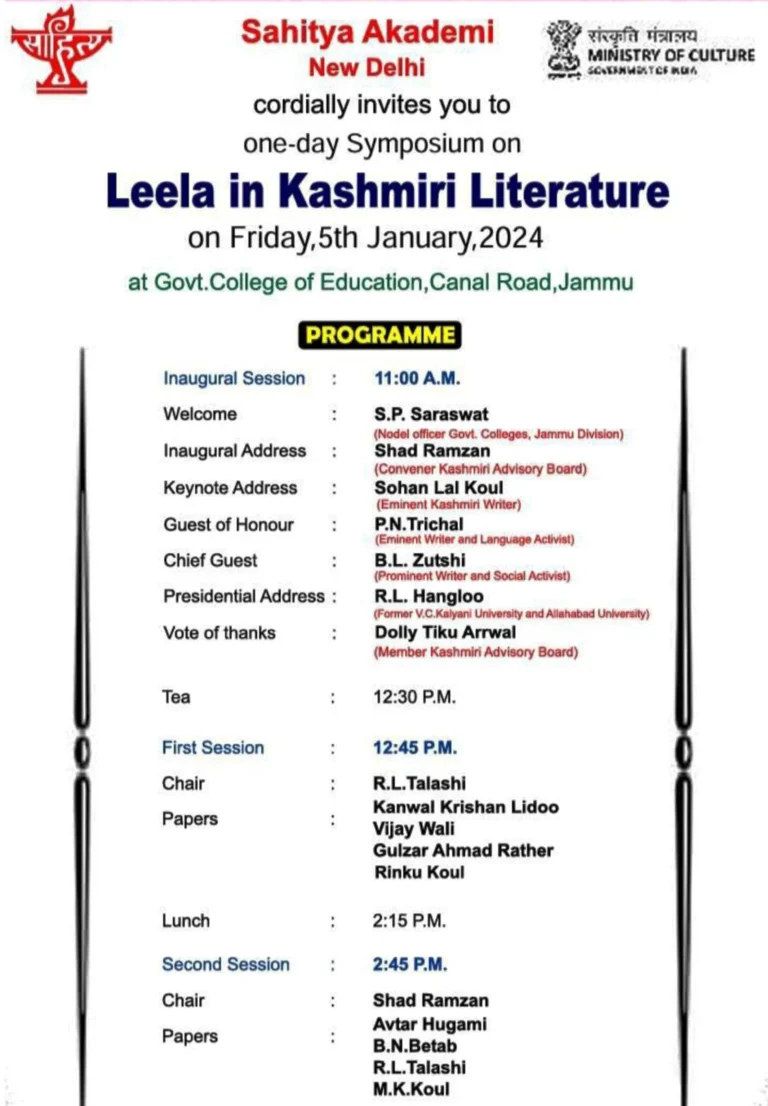
As part of its outreach programme, Sahitya Akademi New Delhi organised an impressive two day function at Jammu (January 5-6, 2024) to incorporate views vis-a-vis the current literary paradigms of Kashmir’s displaced writers community. The meet also carried forward the need to preserve the literary heritage handed over to the communities through “Kashmiri Leela – “the land’s native devotional poetic genre that has assumed spontaneity in the folk culture of Kashmir and an acceptance unsurpassed.

While distinguished guests like Prof. R.L.Hangloo, (Former Vice Chancellor of Kalyani and Allahabad University) an erudite scholar himself of the discipline of History presided over the function, Professor B.L.Zutshi (History, Kashmir and JNU Delhi) was the Chief Guest. Prof. P.N. Trisal was invited as a Guest of Honour.

  In his inaugural address, Convenor Sahitya Akademi Board, Professor Shad Ramzan laid bare the contours of the two-day programme and the objective behind carrying out such an exercise. Since the first day’s programme focused on Kashmiri Leela– an evolutionary tradition of more than one and a half millennia, the speaker’s addresses threw light on the robust activity and output generated under it from the thirteenth century onwards under this genre. Both Hindu and Muslim saint poets of Kashmir utilized this to espouse the ardent spiritual values cherished by the communities in Kashmir.

History of Kashmir Leela

Dr. Sohan Lal Kaul, an eminent writer traced the history of Kashmiri Leela from its very inception. His lecture also threw light on the global trends and a comparative study of this devotional experimentation as the unique identity of Kashmir nurtured by Lalleshwari, Nund Reshi up to the stalwart Leela poets like Master Zinda Koul. Dr. Rattan Talashi, an eminent scholar of Kashmiri highlighted the facets of Kashmiri Leela. Both papers were highly acclaimed

The first session  was presided over by prof. R.L Talashi. Prof.  M.Z. Azurda and Prof. Shad Ramzan were also present in the presidium.

Kashmir Rechords Director, Kanwal Krishan Lidhoo, a noted writer and broadcaster presenting his paper on Kashmiri Leelas

Arjan Dev Majboor’s Contribution

Around evening, the session ‘Nari Chetna’ (Female Awareness) revolved around contribution from Kashmir’s less talked yet equally brilliant segment of society – its women poets of today and yore who held fast to their reins of ancestral style and spontaneous delivery.

  Prominent poets such as Nancy Chetna, Kusum Dhar, Rajni Bahar and Santosh Shah Nadaan presented their recitations. Member Sahitya Akademi advisory board Smt. Dolly Tickoo Arwal herself an accomplished poet presented her story.

The convener Kashmiri Advisory Board along with all the members  thanked Professor Shalini Rana of Govt. College of Education Jammu who provided all the support and logistics to conduct this literary meet.

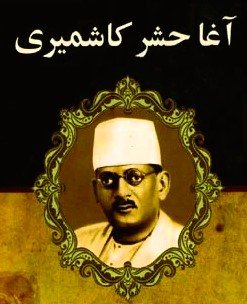
Was Agha Hashar Kashmiri called `Indian Shakespeare’?

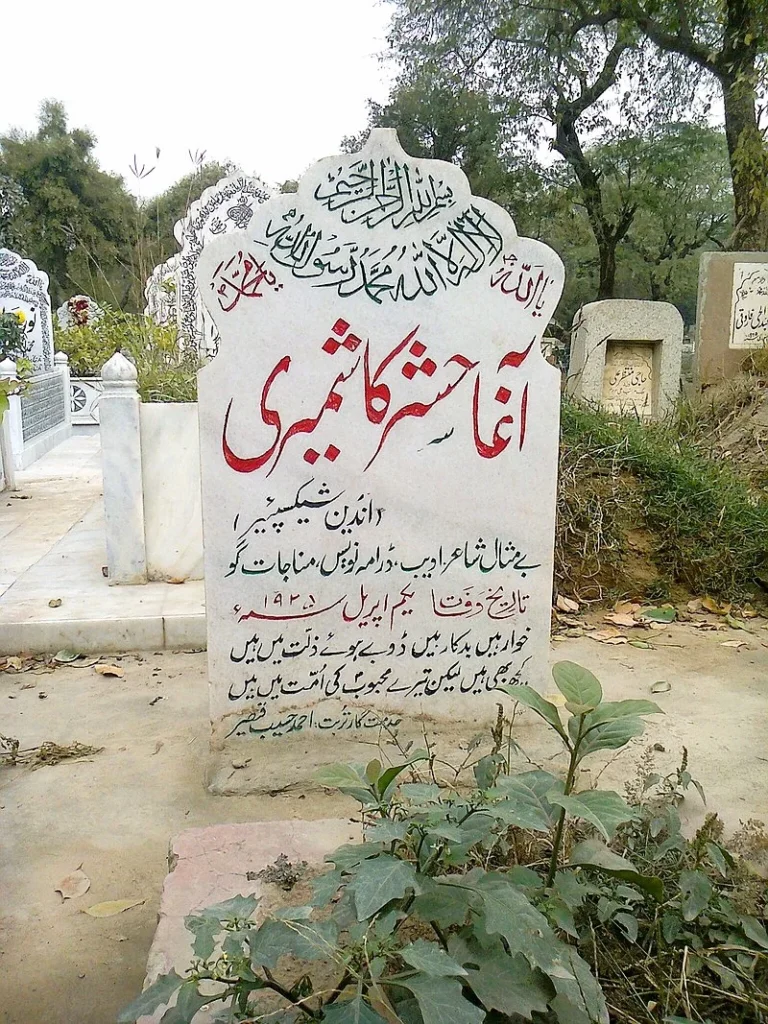
The Indian Shakespeare is often considered Kalidasa, a classical Sanskrit writer, widely regarded as the greatest poet and dramatist in the Sanskrit language. But Agha Hashar Kashmiri is one such poet, dramatist and  an author who carries the epitaph of being the `Indian Shakespeare’ on his gravestone at Lahore where he was laid to rest in 1935.

    Born  in April 1879 as  Agha Muhammad Shah in Banaras State of British India, Agha Hashar  was his penname and “Kashmiri’’ attached to his name  for the reason that his father, Ghani Shah  had migrated from Kashmir to Benares in  mid-19th Century  in search of greener pastures.

Agha Muhammad Shah acquired his early education in Arabic and Persian. Later, he was sent to Jai Narayan Missionary School for further studies. However, he left his education incomplete, as he was inclined towards drama and poetry since his early childhood.

    There is a general belief that no history of Urdu drama can ever be complete without a mention of Agha Hashar Kashmiri’s works. None of his predecessors, contemporaries or even the successors could achieve the kind of respect and inimitable success that came to his share. 

Hashar Kashmiri as a Polyglot

Agha Hashar Kashmiri wrote plays in Urdu, Hindi, and Bangla. Some of these were solely created by him but his more important plays that he based on Shakespeare included Shaheed-e-Naaz, Said-e-Hawas, Safaid Khoon and Khwab-e-Hasti. Some of his plays that drew upon the stories of Ramayana and Mahabharata also proved very popular.

This Kashmiri-origin author, dramatist, poet and a writer remained associated with several theatre companies and each one of them valued his talent. He had a distinction to write plays for Alfred Theatrical Company on an initial salary of Rs 15 per month. “Mureed-e-Shak’’, one of his plays for the company was an adaptation of Shakespeare’s play “The Winter’s Tale’’. It proved to be a  grand success and thus fetched him wages of Rs 40 per month. He then wrote several more adaptations of Shakespeare’s plays.

Agha’s First Publication

Agha Hashar Kashmiri had started composing verse at a young age. He  wrote a play `Aaftaab-e-Mohabbat’ (published in 1897) when he was just 18 upon his moving to Bombay for his career as a playwright there.

“Yahudi Ki Ladki’’ (The Daughter of a Jew) (1913), became a classic in Parsi-Urdu theatre and was adapted several times in the silent film and early talkies eras.

Agha’s most popular plays are `Sita Banbas’, `Bilwa Mangal,’ and `Rustom O Sohrab’, a Persian folk story and tragedy. `Safed Khoon’ (White Blood) is his another notable Shakespeare-inspired plays.

Personal life

Agha Kashmiri  was married to Mukhtar Begum, a classical singer from Calcutta and elder sister of Farida Khanum – a Pakistani singer. With the help of his wife, Agha Kashmiri had introduced actor Rani Begum, daughter of their driver, to the show business. Rani later became an actor and dancer of the Pakistani film industry.

Apart from several books to his credit, Agha Hashar Kashmiri was master of Ghasal writing. His one of the popular ghazals is “Mein Chaman Mein Khush Nahin Hoon, Mere Aur Hain Iiraday”.

Agha Kashmiri died on 1 April 1935 in Lahore, British India.

Hassan Kashmiri—Lucknow’s playwright of yesteryears

Meet Our Unsung Heroes

Meet Ghulam Hassan Kashmiri …an unsung hero from Lucknow whose ancestors had settled in 18th century when Nawab of Awadh Asaf-ud-Daulah shifted base from Faizabad to Lucknow in 1775 and made the city his capital. While shifting his Capital, the Nawab had settled a large group of Kashmiris-both Hindus and Muslims in Lucknow.
 Ghulam Hassan Kashmiri belonged to that Kashmiri Muslim family who too had moved to Lucknow and got settled around Kashmiri Mohalla where Kashmiri Pandit families also set foot on Lucknow’s Soil during the same period.
An able actor and an ace  drama artist, Ghulam Hassan Kashmiri was engaged  with the drama unit of All India Radio’s Lucknow Station since its inauguration on April 2, 1938.   Hassan Kashmiri had an ability and art of writing and producing  radio plays as well.

Theatre Personality

Apart from Lucknow’s famous theatre personality, Ghulam Hassan Kashmiri had also associated himself with a group called  “Dast-e-Kashmiri Wazirganj’’, formed in early 1900s in Maqbara Alia Begum in Golaganj area. This group used to  mourn the events of Karbala and of Imam Husain and his family in a unique way, which is still popular in Lucknow and is a living tradition.
Throughout history, there have been countless individuals whose remarkable contributions have been overlooked, overshadowed or forgotten. These unsung heroes, often marginalized due to one reason or the other, have made significant impacts on society, yet their stories have remained largely untold. Amongst these unsung heroes is Ghulam Hassan Kashmiri of Lucknow, for the reason that nothing substantial has unfortunately been written about him.
 While much is being written on already established personalities of Jammu and Kashmir, it is time to shine a light on these overlooked figures, acknowledging their invaluable contributions and ensuring their place in the annals of history. Kashmir Rechords has decided to find such unsung heroes who have been marginalized but deserve recognition for their resilience and contributions to their communities and beyond.
In our last issues of “ Meet Our Unsung Heroes’’, we tried to highlight the contribution of  Vasudev Reh, a far-sighted poet and Kanwal Kishore Jalla, an unsung Ghazal singer from Kashmir who had remained underrepresented in historical records. Today, we have traced out Ghulam Hassan Kashmiri, who had carved a niche for himself in the art of acting and Radio dramas.
Kashmir Rechords appeals to all its esteemed readers, who might know such unsung heroes to contact us with authentic details and send the same on kashmirrechords@gmail.com or support@kashmir-rechords.com. We promise to publish them with due credit to the contributors by amplifying the stories of these unsung heroes. Such stories honour their legacies, inspire future generations, and strive for a more inclusive and accurate understanding of history. It is imperative that we actively preserve the stories of those who have been marginalized, ensuring that their contributions are no longer consigned to the shadows of history.

  State Subject to Domicile: The Journey of Indian Citizenship of  J&K Residents

 (From the Feudal Dogra State through Independent India to the Present-day Naya Bharat)

(By: Dr. S.N. Pandita*)

Introduction

From a State Subject to Permanent Resident and now to a Domicile has been nearly a century-long eventful journey for the natives of Jammu Kashmir and Ladakh as the citizens of India now Bharat. However, given the ethnic cleansing and genocide committed against the minority Pandit community (Hindus) this status now holds very little on ground for the exiled community of the Kashmiri Pandits within the Valley of Kashmir.
Nevertheless, a revisit to the landmark stages of this journey can likely be of some nostalgic interest to the older generation of the exiled KP community in general and for the younger generation, in particular, it is expected to hold some academic and intellectual interest; hence this recall for both the segments of the readers.
(Pic Source: Internet)

Dogra Rule & Outsiders Entering Kashmir

It all began with the advent of the Dogras in Kashmir. Soon after Maharaja Gulab Singh came to the throne of Kashmir in 1846, he appointed Dewan Jawala Shahi, a Khatri from Panjab, as his Prime Minister. With him came a train of Panjabis into the valley.  At the time, practically, there were no educated natives who could occupy various positions, both in the higher and lower ranks of administrative machinery in the State, Jawala Shahi inducted many of his qualified Panjabi favourites to occupy such positions.
(Dewan Jawala Shahi who was the Prime Minister of Kashmir in 1846. Picture Courtesy: Punjab Digital Library )
This arrangement continued through Maharaja Gulab Singh’s rule without a murmur even after the Prime Minister was changed.
Following his death in 1857, Maharaja Gulab Singh was succeeded by his son Maharaja Ranbir Singh who continued with this practice with some additional favour to the Bengalis who occupied several key positions particularly in the judiciary of the State until his death in 1885. Next arrived Maharaja Pratap Singh who had both the Panjabis and Bengalis in key positions of his administrative set-up. Such outsiders were commonly called as Gair Mulki. The result was the coming of many outsiders who received extensive land grants, were placed in many positions of trust and authority. Moreover, the commerce was monopolized mostly by the Panjabis and with the waves of Panjabi settlers immigrating into Kashmir the natives found themselves pushed into background, though the process was slow

Awareness, Protest & Agitation

However, the situation changed when two colleges of higher education and learning; the Sri Pratap College in Srinagar in 1905 and the other, the Prince of Wales College, in Jammu, in 1907 were setup that soon turned-out young college educated natives, mostly Kashmiri Pandit (KP) boys in Srinagar and few Dogras from Jammu   by sometime about 1912 onwards.
It were these young educated natives of the State who now aspired for employment opportunities in the administrative machinery of Jammu and Kashmir. In a way, the Kashmiri Pandits and the Dogra youth joined hands to press the demand for their share in the State’s   administration by way of employment in many suitable positions. The agitation was spearheaded mainly by the Kashmiri Pandits and the Dogras of Jammu. They were first to take to modern education, long before the Kashmiri Muslims became politically active. The main voices of these demands came from the KPs as they felt deprived of their share in the services. The Kashmiri Muslims were not in the picture at this stage.
In 1922, at the instance of Maharaj Kumar Hari Singh, the then Commander-in-Chief of the State Forces and a Senior Member of the State Council and also next in line to the throne constituted a committee to define the term ‘Hereditary State Subject’ and examine the entire question of naturalization in the State.
The heads of all the departments were directed to prepare a list of Mulkies, naturalized Mulkies and non-State Subjects in the State employment. At the time, a circular was also issued that under the signatures of the Maharaja, Pratap Singh, that prohibited a non-State Subject to acquire land in the State. The circular also put a moratorium on the employment of any non-State Subject in the employment of the State without the express permission of the Maharaja.
However, nothing much came out of this exercise without any confirmed official definition of the State Subject. But this nebulous situation forged a greater alliance between the Kashmiri Pandits and the Dogra Sadar Sabha to obligate the Maharaja on defining the term Hereditary State Subject.
In Jammu, the contest came to the fore in the Dogra versus the Panjabi controversy. In Kashmir, the British officers sided with the Kashmiri Pandits against their fight with the outsiders who were mostly Arya Samajis with whom was associated the name of Lala Lajpat Rai.  In fact, the Panjabis were an anathema to the British and, hence, their sympathies lay with the Kashmiri Pandits in their just demands.
It was here that Pandit Jia Lal Kilam, Pandit Shanker Koul, Pandit Jia Lal Koul and Pandit Jia Lal Jalali, all of them fresh from college between the years 1922 and 1924 raised the banner of agitation through outside press for securing the rights of the State Subjects. Pandit Jia Lal Kilam organised public meetings and held conferences both in Jammu and Srinagar under the banner of Dogra Sadar Sabha. This banner of revolt forged some sort of vague nationalism and the educated classes both from Jammu and Kashmir felt a kind of common kinship in this cause.
In 1925, an article appeared in Akhbar-i-Aam published by Pandit Gwash Lal Koul from Lahore highlighting the plight of native Kashmiris under the heading Unemployment in Kashmir. For writing this scathing piece against the Dogra Maharaja, a stern action was taken against Pandit Gwash Lal Koul, he galvanized the voice of educated Kashmiri Pandits to take up the matter further through the Indian Press and pleaded with the educated young Kashmiri Pandit men to carry out a relentless agitation for securing their exclusive employment rights to man the state administration.

State Subject Movement & Institution of the Commission

The State Subject Movement had very distinctive features as it amalgamated both the regions of Jammu and Kashmir on the issue. It was in one of the annual conferences of the Dogra Sadar Sabha held in Srinagar in October 1926 that Pandit Jia Lal Kilam moved a resolution demanding that only those persons be termed as Hereditary State Subjects whose ancestors had been residing in the state since the time of Maharaja Gulab Singh and be given preference in employment over those who were merely residing in the State from its formation in 1846.
This paved way to demand the constitution of a committee which was urged to define the term State Subject in the finality and as early as possible.  Maharaja Hari Singh appointed a Commission under the chairmanship of General Janak Singh, the then Revenue Minister to define the term. This Commission comprised both the officials and non-officials besides the representatives of the natives and outsiders with broad representation given to all the section of the population of the state including the Kashmiris, the Dogra and the Panjabis.

The First State Subject Notification

The Commission submitted its report in 1927 defining the term State Subject. Following this recommendation, the Private Secretary to Maharaja Hari Singh, P.K. Wattal (Pyare Krishen Wattal) issued a Circular Order dated January 31, 1927 by command of His Highness the Maharaja Bahadur that read:
“His Highness the Maharaja Bahadur has been pleased to command that in future in the case of every new entrant into State Service the authority empowered to make the appointment should certify that he has satisfied himself after due enquiries that the person appointed is a hereditary State subject. Further, that in the absence of such a certificate the Accountant General should not pass the pay bill of such State servant without the definite orders of His Highness in Council to the contrary.
“For the purpose of this order the term “Hereditary State Subject” will be held to mean and include all persons born and residing within the State before the commencement of the reign of His Highness the late Maharaja Gulab Singh Sahib Bahadur and also persons who settled therein before the commencement of Samvat 1942 (1885 AD) and have since been permanently residing therein. The certificate will be given after due enquiries by the Wazir Wazarat in whose charge the candidate for State service resides and the form of such certificate should be submitted by the Accountant General for the approval of His Highness in Council. In the meantime, this order will have effect from the date of issue, namely 31st January 1927.”

The Second State Subject Notification

(The State Subject Certificate makes a mention of a Govt Notification No 84 of the Judicial Department, April 20, 1927.Pic Kashmir Rechords)
A little less than three months later a Government Notification No: 84, of the Judicial Department, to this effect was issued on April 20, 1927 by the Judicial Minister Nazir Ahmed which read:
“ The following definition of the term “State Subject” has been sanctioned by His Highness the Maharaja Bahadur (vide Private Secretary letter No; 2354 dated 31st January 1927, to the Revenue Member of Council) and is hereby promulgated for general information:-
“Class I– All persons born and residing within the State before the commencement of the reign of His Highness the late Maharaja Gulab Singh Bahadur and also persons who settled therein before the commencement of Samvat year 1942 (1885 AD) and have since been permanently residing”.
“Class II– All persons other than those belonging to class I who settled within the State before the close of Samvat year 1968 (1911 AD) and have permanently resided and acquired immovable property therein”.
“Class III – All persons other than those belonging to class I and II permanently residing within the State who have acquired under a Rayatnama any immovable property therein or who may hereafter acquire such property under an Ijazatnama and may execute a Rayatnama after ten years’ continuous residence therein.”

Notes to The Notification

The Notification further carried two Notes and read:
Note (1) “In the matter of grants of State Scholarships, State land for agriculture and house building purpose and recruitment to State Service, State Subject of class I should receive preference over other classes and those of class II over class III subject, however, to the order dated 31st January 1927 of His Highness the Maharaja Bahadur regarding employment of hereditary State subjects in Government service”.
Note (2) “The descendants of the persons who have acquired the status of any class of the State subjects will be entitled to become the State subjects of the same class. For example, if A is declared a State subject of class II his sons and grandsons will ipso facto acquire the same status of class II and not of class I”

The Third State Subject Notification

Subsequently, vide another Notification dated June 27, 1931, one more Class of State Subject and one more qualifying Note was added as Class IV State Subject and Note 3.
The Class IV State subjects were defined as:
“Companies which have been registered as such within the State and which, being companies in which the Government are financially interested or as to the economic benefit to the State or to the financial stability of which the Government are satisfied, have by a special order of His Highness been declared to be State subjects”.
The Note 3 read:
 “The wife or a widow of a State Subject of any class shall acquire the status of her husband as State Subject of Class as her husband, so long as she resides in the State and does not leave the State for permanent residence out-side the State”.

State Subject Certificates for Employment Only

Evidently, the State Subject Certificates issued under the Notification dated 31st January 1927 of the Private Secretary to His Highness Maharaja Bahadur Hari Singh became paramount in securing employment in the state Government.
After the establishment of this definition in 1927, every entrant into the State Government service was required to produce a certificate of his being a hereditary State subject of Class I. Such certificates were issued by the Wazir Wazarat in whose jurisdiction the candidate happened to reside.

Curse for Pandits & Boon for Muslims

Parenthetically, it was the Kashmiri Pandits, whose untiring efforts including the agitation “Kashmir for Kashmiris” in the 20s of the last century led to the implementation of the State Subject Law, yet “ultimately the definition proved boon for the majority community”, the Muslims of the State and curse for the Kashmiri Pandits in the following decades because of the vicious communal politics that played out in the post-independence era.

Format & Purpose of Early State Subject Certificates

The earliest State Subject Certificates were simply titled: “Certificate of Hereditary State Subject”. These were essentially issued only for the purpose of employment of the candidate in the State Service. Such certificates expressly stated the name of the candidate and his residential address and also declared his being a candidate for employment in the particular department in which he had or would apply for employment and being a hereditary State Subject of Jammu and Kashmir territory “within the meaning of Private Secretary to His Highness the Maharaja Bahadur’s Notification No: Nil, dated 31st January 1927”.
Such certificates were issued by the Wazir  Wazarat on the basis of his enquiries and how he had satisfied himself that the candidate had fulfilled the criterions of the Notification dated 31st January 1927.
The present writer has perused two such certificates extant presently. The first one bears No: 71 issued on November 27, 1929 under the signatures of the then Wazir- Wazarat Sri Ram.
This certificate is issued on the attestations of Prof. Radha Krishen Bhan and Prof. Nand Lal Koul, both Professors at S.P. College, Srinagar and Pandit Jia Lal Kilam, then a Pleader at the Maharaja’s Court who later rose to become the Judge of the High Court of Jammu & Kashmir and came to be famously known as Justice Kilam.
In that sense this certificate is uniquely historical for being issued on the attestation of Pandit Jia Lal Kilam who was the main architect of the State Subject Law as detailed in the earlier parts of this paper.
The second certificate bears the title: “His Highness’ Government, Jammu And Kashmir” is issued on August 12, 1930 under the signature of Wazir Wazarat S.N. Raina. The certificate is issued on two criterions; firstly, on the record of Certificate No: 71 dated November 27, 1929 and also the Wazir Wazarat knew the applicant personally.
However, subsequent to the State Subject Notification dated   April 20, 1927 the candidates were also issued certificates of being State Subjects of Class I, II and III within the meaning of the Judicial Department Notification No: 84 dated the 20th April 1927 and Class IV vide Notification dated June 27, 1931. Such certificates allowed the candidate to acquire State land for agriculture and house building purposes and avail State Scholarships for educational purposes.
The fundamental criterion for the issuance of such certificates was that the candidate’s cast was not declared as Non-Agriculturist in Gazette dated June 29, 1934. Presently a State Subject Certificate of Class I category of Hereditary State Subject issued on January 29, 1937 by the Tehsildar Khas, Southern, Srinagar vide office File No; 1305 of 1937 still survives.

Permanent Residency Certificates

These definitions of State Subjects were later adopted and subsumed, essentially unchanged into the term “Permanent Residents” in the Jammu and Kashmir Constitution adopted on November 17, 1956 which came into effect on January 26, 1957 in conjunction to  Article 370 of the Indian Constitution adopted on  October 17, 1949. All persons who were State Subjects as on May 14, 1954 were deemed as Permanent Residents of the state.
From then onwards, while the validity of the State Subject certificates continued to remain effective a revised certificate of Permanent Residency also came into vogue as defined under Section 6 of the Constitution of Jammu and Kashmir. Such certificates were issued under the signature of Deputy Commissioner of the respective divisions of the state.

State Subject Certificates with Riders Issued to Kashmiri Pandits

( Permanent Resident Certificate issued for the purpose of seeking Government Employment only. Pic: Kashmir Rechords)
By late 70s of the last century, the main criterion on which such certificates were issued to Kashmiri Pandits were for the “Purpose of Training Only”. In the case of the female Kashmiri Pandit holders, an additional rider was put with the remarks “Valid till Marriage” subsequent to the incorporation of Article 35 A in the Indian Constitution adopted in sequel to the 1952 Delhi Agreement reached between Pandit Jawaharlal Nehru, the Prime Minister of India and Sheikh Mohammad Abdullah, the Prime Minister of Jammu and Kashmir on July 24, 1952.
( Permanent Resident Certificate of an unmarried Hindu girl with a rider “Valid Till Marriage”. Pic Source: Internet)

Annulling the State Subject & Permanent Residency Certificates

For subsequent several decades both the State Subject Certificates issued  during the Dogra Period of Maharaja Hari Singh and the Permanent Residency Certificates issued thereafter in independent India by the Government of Jammu and Kashmir for the  permanent residents of the State remained as valid documents until  they were annulled by scraping Articles 370 and 35 A of the Indian Constitution by a Parliamentary Act on August 5, 2019 along with which the State was also bifurcated into two Union Territories, the UT of Jammu and Kashmir and  the UT of Ladakh.

Birth of Domicile Certificates

Subsequent, administrative orders issued by the Government of the UT of Jammu and Kashmir replaced the State Subject Certificates and Permanent Residency Certificates with a common Domicile Certificates. According to the laid down rules and prescribed procedures all the holders of the State Subject Certificates and Permanent Residency Certificates were granted Domicile Certificates.

Domicile Certificates to Other Non- Permanent Resident Categories

(Domicile Certificate of Navin Choudhary, a bureaucrat from Bihar who had become J&K’s first non-local domicile in June 2020. Pic Source: Internet)
However, other non-permanent residents of the State, or outsiders have now also been made eligible to become Domiciles of Jammu and Kashmir subject to the laid down new criterions. These include all persons and their family members who serve in Jammu and Kashmir and belong to all the categories of the Indian Civil Services like, IAS, IPS, IFS, IRS etc ; persons and their family members belonging to military and para-military  forces;  any person who studies in Jammu and Kashmir up to class VII and necessarily  has passed Class 10 Examination of  any Educational Board be that of State or Central and persons who have a continuous residency of 15 years and more in the Union Territory shall also become eligible for Domicile Certificates of the Union Territory.

Introduction of Watermark Seal in Domicile Certificates of Exiled Kashmiri Pandits

It may be noted that all previously issued State Subject Certificates and Permanent Residency Certificates were issued on normal printed stationary of the Government without any Court of Arms of the Dogra insignia or the State logo of Jammu and Kashmir.
(Domicile Certificate of a Kashmiri Pandit migrant Student, issued by Relief and Rehabilitation Commissioner, Jammu under Clause 4-b. Pic: Kashmir Rechords)
However, the latest Domicile Certificates issued to the members of the exiled Kashmiri Pandit Community bear a printed watermark seal of the lion of the national Ashoka Pillar and the certificates are issued under the signatures of Relief & Rehabilitation Commissioner (Migrant)

State Subject Movement & Trinity of Jia Lals

Looking in retrospect it will be evident to readers that the crusade of awareness, protest and agitation that finally culminated in the promulgation of the State Subject Law was inaugurated by Kashmiri Pandits. However, what appears to be divinely coincidental is the fact that the Movement for State Subject that was started by four Kashmiri Pandits; and three of them were named Jia Lal (Kilam, Koul and Jalali). The fourth one was Shanker Koul.

* Dr S. N Pandita is a noted Author, Writer and Researcher with nine books and about 80 research papers to his credit. He has   attended five  International and 15 National Conferences; Scores of Seminars, Lectured at SAALG, British Library, London, PRASADA, University of Leicester, UK , Universities of Luton, Leeds, Birmingham, UK  &  Nehru Centre, London.  
 
     Academic qualification: Ph.D. (D. Phil); Bodleian Reader, Oxford. Principal Research Investigator, HLF-KBC Sir Aurel Stein Kashmir Heritage Project, U.K. ;
 
Awards & Recognition:  Atisha Award 2001; Man of The Year-2004, (American Biographical Institute); Listed to 2000 World Intellectuals, 2004 (  International Biographical Centre, Cambridge, UK)
 
Academic Field : History, Heritage, Culture, Language & Literature of Kashmir.( Inter-Disciplinary & Trans-Disciplinary Studies)
 
Specialization & Expertise: Collaborative Interface of Scholarship between the Western & Kashmiri Scholars during the 19th and 20th century. (Dogra Period) &  Currently Unknown and Defunct Kashmiri Numeral System developed and used during the Dogra Period.
 
* Dr. S. N Pandita asserts his Copyright on the entire text  of the article under the main heading “State Subject to Domicile: The Journey of Indian Citizenship of  &K Residents  (From the Feudal Dogra State through Independent India to the Present-day Naya Bharat)  as its  author.

Englishman’s 1847 travel to Kashmir (Part 3)

( By: Kanwal Krishan Lidhoo*)

Kashmir Rechords in its previous blogs dated 9th and 12th December 2023 had mentioned an Englishman’s visit to Jammu and Kashmir in 1847 recorded in the form of daily entries called ‘Roznamcha’ by one Pandit Kanhaya Lal Aashiq Dehalvi and later published under the title Sair-e-Kashmir and we had in two of the previous episodes brought to our readers very significant historical details regarding prevailing socio-political conditions. Not only do these details appeal to the common reader but the students of history also got invaluable insights into the geography and strategic situation of the formative phase of the rule of Dogra kings when they ruled the region called “Jammu Kashmir Ladakh and Tibbet Ha”.

The previous  two blogs carried the information about the travel from Englishman’s 1847 travel to Kashmir via Jammu  dated  9th December 2023, to be accessed  at:https://kashmir-rechords.com/englishmans-1847-travel-to-kashmir-via-jammu/ and  next  Englishman’s 1847 travel to Kashmir via Jammu, Rajouri, published on 12th December 2023, to be accessed at: https://kashmir-rechords.com/englishmans-1847-travel-to-kashmir-via-jammu-rajouri/

The book is a compendium of daily entries of his accounts in his diary during travel, which was undertaken by Pandit Kanhaya Lal Aashiq Dehalvi along with an Englishman named Mr. Winter Bedim. Pandit Kanhaya Lal Aashiq was a resident of Akbarabad Sialkot (now in Pakistan) who sought employment in the office of the then-British Agent in Lahore, Colonel Lawrence due to his proficiency in the English language.  Thus, he wrote this travelogue also for the Englishman, with whom he had traveled to Kashmir via Jammu.  “Sair-e- Kashmir 1278 AH” is written on the cover of the Book having 41 (forty-one) pages. The travelogue is between the periods of   April 1847 to June 1847.

From here we are continuing with the third portion of the travelogue as follows:-

On 9th May, 1947 we reached Kulgam which is at a distance of six kos from Acchabal. We would often come across springs and innumerable water bodies. Since Kulgam is situated in Devsar Pargana on the banks of the river called “Vishaw” the volume and flow of water at this place is very large. One Fatu Chowdhary (probably Fatehdin) came to see us.

On the 10th of May, 1847 we reached “Chowgam” where we camped. At about a distance of four kos lies a spring, rather a geyser that sprouts water at least one meter high into the air. Thus a constant stream of pure and clean water emanates from it. The local population whenever inclined to celebrate their happy occasions do come to the banks of this river and cook their delicacies. The powers of digestion of this water are legendary and are said to be such that one can devour a whole lamb. Due to personal reasons, however, I couldn’t test the powers of these waters. This spring is known as “Vasuk Naag”. On our return, we got caught up in a vicious hailstorm which caused such an indescribable suffering and threw everything into disarray. We got drenched in the rain and hailstorm and since we had no extra pair of clothes with us the cold also pounced on us severely. We did however finally make up to our place during the night where we warmed ourselves thoroughly. In between the” Chowgam” and “ Vasuk Naag” areas, we saw another spring at a place called “Razlu” but it is not as big as “VasukNaag”. At our place, an inherently warm person with a very cheerful disposition who works as a cook came to see us. This man is used to visit Lucknow and other places and has some experience in dealing with foreigners. Though he is Lachhi Ram he is rightly called Lateef. This man divulged the information that whosoever arranges for cooking a lamb doesn’t encounter any problem whatsoever. Our plight during the day may have been the result of the same. I admonished him about the fact that he could have warned us in advance.

Due to continuing rains and hailstorms that ensued we couldn’t move out of  “Chowgam” on the 11th, however, on the 12th of May 1847, we started our journey again and when we were about to reach “Shahbad”  we came across a spring known as “Bararat” and another one nearer to it known as “Kananag”. The locals of the village revealed to us that nearly every single fish residing in the spring is one-eyed which gives the spring its name. But I couldn’t notice any such thing. Later in the day when we were at a distance of about one kos from Shahbad the “Kaardaar” of the Shahbad area Noor Shah accompanied by the local “Kotwal” came to see us. Chats followed all the way to Shahbad and mainly centered on the details of running the administration. Upon reaching Shahbad we later proceeded towards an adjoining place called “Dooru”.

Camping at `Ver Naag’

We camped at this place and later proceeded to “Ver Naag”. The rest of the Indians call it “Beri Naag”. This place has the largest flow of clean water which presents an astonishingly wonderful and pleasing sight. A strong wall has been constructed around its periphery by the orders of King Jahangir. A Persian inscription stands engraved outside this periphery in a small hut.

The inscription mentioned above goes like this.-

“The ruler of the seven lands who is known for his legendary dispensation of justice Emperor  Shahenshah Abul Muzaffar Noor- u- din Jahangir son of legendary king Akbar the Great has in the fifteenth hundredth year visited this spring and on his majesty’s orders only could the work on the wall get completed. It is due to his Majesty King Jahangir King Shah Akbar Shah’s grace that this building has touched the skies. The wise king arranged this foundation around here in `Verinaag’. It is Almighty’s grace that on orders of the ruler of seven worlds such a cascade got built reminding us that the stream originating from heaven brought grace to Kashmir. The mysterious sounds emanating from heavens issuing forth through its waters finds mention in this inscription.”

Later in the day we returned to our abode and spent the night in the company of Noorshah Kaardaar.   (To be continued)

===

*Kanwal Krishan Lidhoo, an accredited translator of Kashmiri, Urdu, and Hindi by Sahitya Akademi New Delhi and Indian Institute of Languages Mysore,  is associated with the institution of All India Radio (AIR) where he worked as a Senior Producer. During his career of more than thirty years in AIR, (including Radio Kashmir Srinagar and Radio Kashmir, Jammu),  he has produced hundreds of programmes covering a wide range of topics and interests that range from ‘Features’, ‘Dramas’ , ‘Literary Magazines’ , ‘Current Affairs’ and overseen Music recordings. He also has the professional expertise of anchoring live shows and News.

His books of Translation include:

1. “Samay Matrika” … Translation of 10th century Sanskrit classic of the same name by Acharya Ksemendra of Kashmir.

2. Sahitya Akademi New Delhi’s “Hum Kaal Sindhi Afsana Sombran” a Kashmiri translation of Hindi scripted ” Samkaleen Hindi Kathayen”, and under publication “Navi Yogikie Vaaeris Dar” a Kashmiri translation of English scripted collection of Punjabi short stories of renowned Punjabi short story writer Mohinder Singh Sarna.

 3. Indian Institute of Languages publication “Hindustaenie Falsafekie Khad-o-Khal” …The Kashmiri translation of “Outlines of Indian Philosophy” by world-renowned Professor M.Hiriyanna.

4. The Writer of the Monograph on veteran and doyen of Kashmiri poetry, Makhan Lal Kanwal…. Sahitya Academy Publication, Delhi  

Kanwal Krishan Lidhoo is also a short story writer in Kashmiri. In addition, he has presented a number of essays in Kashmiri

December 28 and Kashmiri Pandits

December 28 holds an important significance in the history of Kashmiri Pandits following their exodus from Kashmir. It is on this day in 1991 that Panun Kashmir, besides raising other demands, adopted a Margdarshan Resolution for a separate homeland for Kashmiri Hindus within Kashmir. On the same day in 1993, the first ever World Kashmiri Pandit   Conference was held in New Delhi.
All India Jan Sangh President Prof Balraj Madhok was the chief speaker during Margdarshan 1991 seminar where he batted  for separate States for Jammu and Ladakh besides abrogation of Article 370.
While Article 370 has since been abrogated, Ladakh has been carved out as a Union Territory and Jammu is yet to get its due—-so are Kashmiri Pandits craving for a separate homeland!
A demand for a Union territory for Kashmiri Hindus was also raised during the first ever World Kashmiri Pandit Conference held in New Delhi on December 28, 1993. Resolutions like setting up of a Sharda University in exile and setting up of Kashmiri culture data resource base have remained confined to this conference only.
Kashmir Rechords is reproducing the newspaper cuttings of both December 28, 1991 and December 28, 1993 for the benefit of our esteemed readers.