
— Kashmir Rechords Special Research Feature
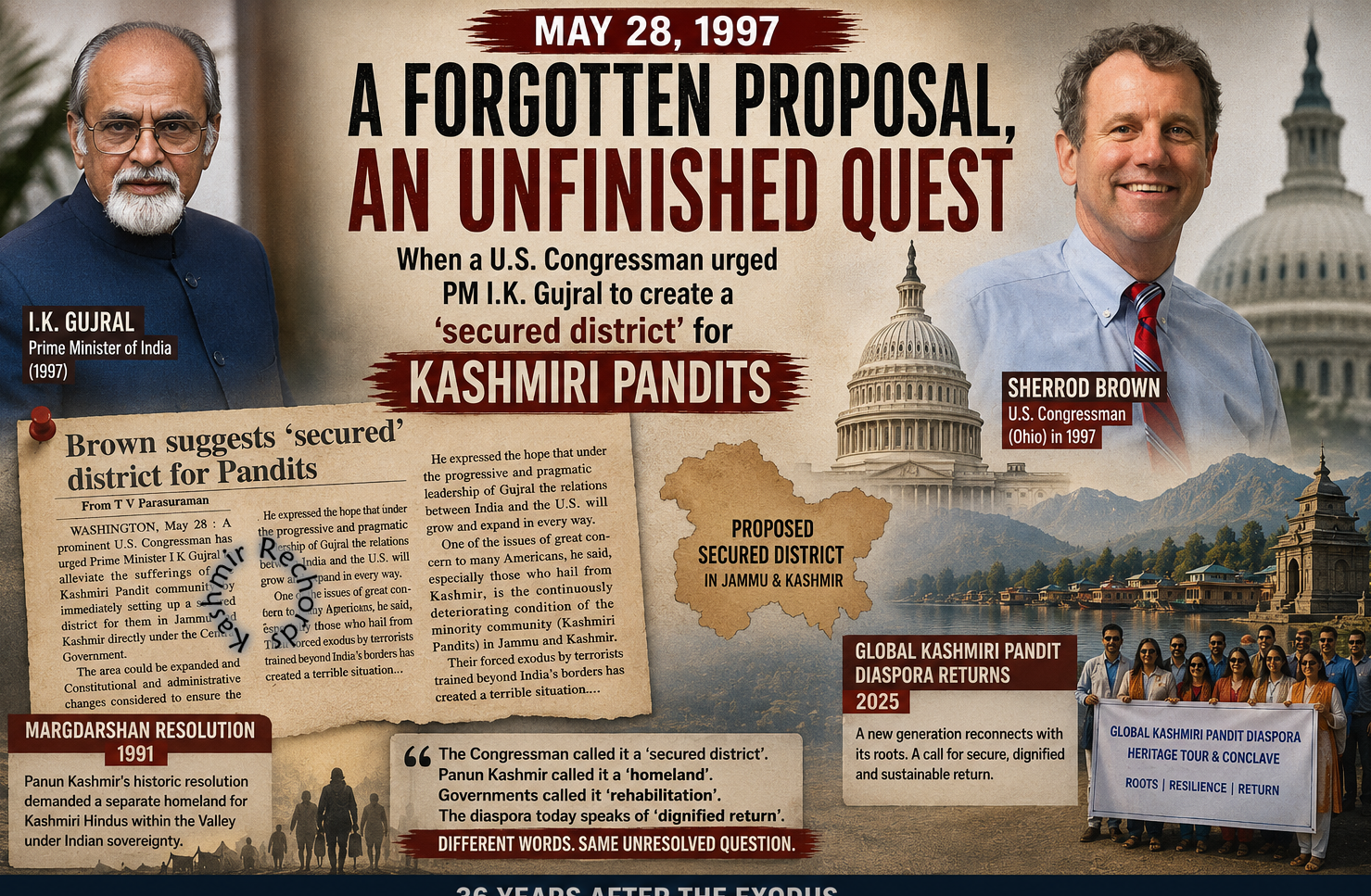
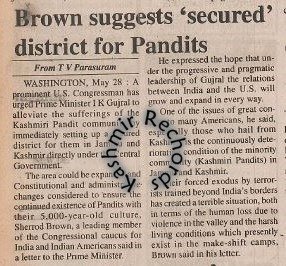
A faded newspaper clipping from May 1997 has resurfaced at a time when the debate surrounding the return, rehabilitation and political future of Kashmiri Pandits is once again gaining attention. The clipping records an extraordinary intervention report with Washington dateline, May 28 wherein U.S. Congressman Sherrod Brown urging the then Prime Minister I.K. Gujral to consider the creation of a “secured district” in Jammu and Kashmir for displaced Kashmiri Pandits.
Nearly three decades later, the proposal remains relevant because it touches upon the central dilemma confronting the community since the 1990 exodus: Can Kashmiri Pandits return merely as individuals, or can they return as a secure and politically protected community? The question has remained unresolved despite the passage of 35 years.
A Forgotten International endorsement
The 1997 report written by veteran journalist T V Parasuram and the newspaper clipping preserved by Kashmir Rechords stated that US Congressman Sherrod Brown had suggested the establishment of a protected district for displaced Pandits and describing the continued inability of the community to return to their homes due to terrorism and insecurity. The proposal was presented as a humanitarian and security-oriented measure rather than a separatist political project.
The timing is significant.
By 1997, the exodus had entered its seventh year. Thousands of families continued to live in migrant camps in Jammu and elsewhere while targeted attacks on the remaining Pandits continued. The Sangrampora massacre would occur the same year, followed by Wandhama in 1998 and Nadimarg in 2003, reinforcing fears regarding the security of minorities in the Valley.
Brown’s proposal reflected a growing realization among observers that the return of Pandits could not be treated merely as a relief-and-rehabilitation issue.
The Shadow of Margdarshan 1991
The US Congressman’s proposal did not emerge in a vacuum.
Six years earlier, in December 1991, Panun Kashmir had adopted `Margdarshan Resolution‘, demanding a separate homeland for Kashmiri Hindus within the Valley under Indian sovereignty, similarly as Brown had pressed for “secured district’’ under Central Government.
The resolution represented the first organized political articulation of the collective trauma experienced by the displaced community.
What Sherrod Brown proposed as a “secured district” bore a striking resemblance to some of the practical objectives underlying the homeland demand, even if the terminology differed.
For homeland advocates, the issue was never simply about houses or compensation. It was about political survival.
Why US Congman take up the issue?
Several factors likely contributed to Brown’s intervention.
The 1990s witnessed global discussions on ethnic cleansing, minority rights and protected communities following conflicts in Bosnia, Rwanda and elsewhere. The disappearance of an entire indigenous minority from Kashmir naturally attracted attention among human rights circles.
Further, the early Kashmiri Pandit diaspora in North America had begun lobbying lawmakers, academics and policy institutions. Although small in number, these groups were highly educated and politically engaged. Their efforts ensured that the plight of displaced Pandits was occasionally raised in congressional circles.
By 1997 it had become obvious that the expectation of an early return had failed. The displaced population had already spent seven years in exile. A secured district was therefore viewed as a mechanism to create conditions for return rather than wait indefinitely for conditions to improve.
Why demand failed to gain momentum?
This is perhaps the most important historical question.
If the Margdarshan Resolution existed in 1991 and a U.S. Congressman publicly advocated a secured district in 1997, why did the proposal fail to translate into political reality? Why did Kashmiri Pandit organisations within India and abroad not pursue the idea more aggressively?
Part of the answer lies in the circumstances of the time. The first generation of displaced Kashmiri Pandits was struggling for survival. Families were rebuilding shattered lives in Jammu, Delhi and elsewhere, grappling with economic hardship, displacement, loss of property and uncertain futures. Political mobilization often took a back seat to immediate concerns of livelihood and education.
The diaspora itself was still in its formative stage. Unlike several other exile communities that enjoyed institutional backing and substantial international networks, Kashmiri Pandit organizations remained fragmented and resource-constrained. While the Margdarshan Resolution articulated a clear political vision, it did not receive sustained support from either the Indian state or influential international actors.
Moreover, successive governments preferred to frame the issue in terms of relief, rehabilitation and eventual return, rather than political restructuring or territorial safeguards. The larger Kashmir conflict—dominated by militancy, counter-insurgency and India-Pakistan tensions—often overshadowed the distinct concerns of the displaced Pandit community.
As a result, proposals such as a homeland, secured district or protected zone remained part of public discourse but never evolved into actionable policy.
Global Kashmiri Pandit Diaspora returns to Kashmir
Against this historical backdrop, the recent visit of the Global Kashmiri Pandit Diaspora (GKPD) to Kashmir assumes considerable significance.
Unlike the exile generation of the 1990s, the contemporary diaspora includes successful professionals, entrepreneurs, academics and second-generation Pandits from across the world. Their visit reflected a new phase in the Kashmiri Pandit discourse, though not without criticism and debate within sections of the community.
Reports emerging from the conclave, interactions and press conferences highlighted the need for a secure and dignified return, while also stressing cultural revival, heritage preservation and institutional support for the community’s future in the Valley. The emphasis appeared to be on creating sustainable mechanisms of return rather than limiting engagement to symbolic visits.
For many participants, the focus was on reconnecting with Kashmir and exploring practical pathways for the community’s reintegration. For critics, however, any discussion of return without addressing the unresolved questions of security, political representation and constitutional safeguards risked repeating the mistakes of the past.
A New debate emerges
The recent diaspora engagement has also exposed a continuing ideological divide within the community.
One section believes:
- The time has come for practical engagement.
- Return must begin through confidence-building measures.
- Economic and cultural reintegration should be prioritized.
Another section argues:
- Security guarantees remain inadequate.
- Political safeguards must precede return.
- The original homeland demand remains relevant.
This debate is not new. It mirrors the discussions that have existed since the early 1990s. What has changed is that a new generation—many of whom were born outside Kashmir or grew up in exile—is now participating in shaping the future discourse.
Looking back at 1997
The Sherrod Brown proposal deserves renewed attention because it demonstrates that international observers recognised a fundamental reality long ago.
The issue facing Kashmiri Pandits was never merely one of displacement. It was the challenge of ensuring the collective security and continuity of an indigenous minority that had been virtually uprooted from its historic homeland.
The Congressman called it a secured district.Panun Kashmir called it a homeland. Successive governments called it rehabilitation.The diaspora today speaks of dignified return.
Different expressions have been used over the decades, but the underlying concern has remained remarkably consistent as thirty-six years after the exodus, the Kashmiri Pandit question continues to revolve around four interconnected themes: justice, security, return and political safeguards.
History suggests that no lasting solution can emerge by addressing only one of these dimensions. A sustainable future for Kashmiri Pandits will require not merely physical return, but a framework that addresses the community’s long-standing concerns regarding identity, security, representation and permanence.
The faded newspaper clipping from May 1997 is, therefore, more than a historical curiosity. It is a reminder that a question raised before the world nearly three decades ago remains unanswered:
How can Kashmiri Pandits return not merely to their homes, but to a future in which they feel secure, represented and rooted once again in the land of their ancestors?