By: Dr. Rajesh Bhat*
History often remembers kings, generals and politicians. Yet some of its greatest heroes emerge from humble homes, perform extraordinary deeds in moments of national crisis, receive the Nation’s highest honours, and then slowly disappear from public memory.
The story of Mali Bee of Jhangar, Rajouri, is one such tale.
Long before discussions on women empowerment became fashionable, before government campaigns celebrated women achievers, and before Jammu and Kashmir’s daughters began making national headlines, a simple village woman from a frontier became a symbol of courage and patriotism.
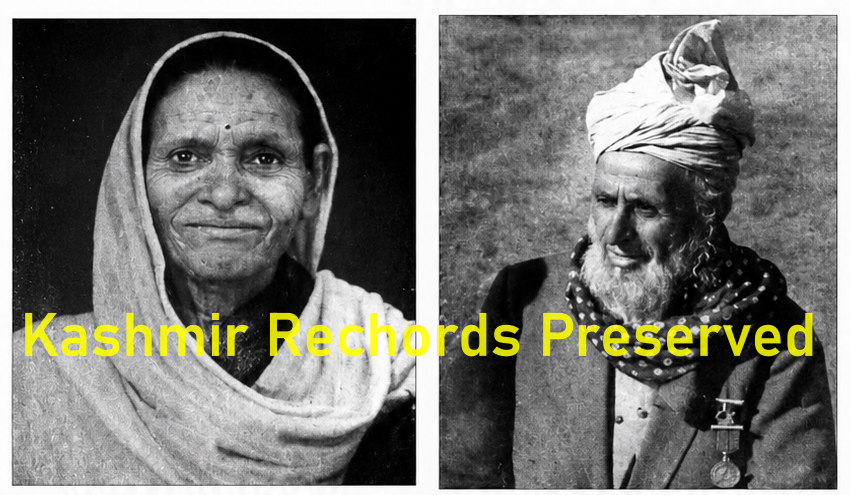
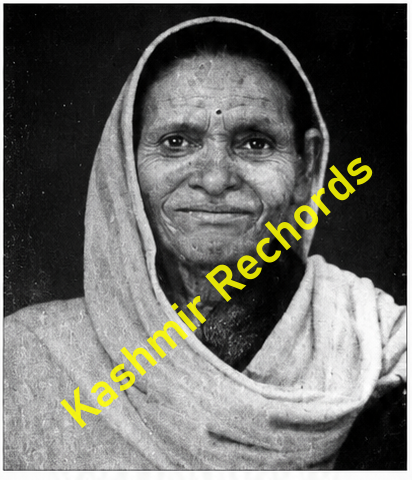
For her exceptional service to the Nation, Mali Bee was awarded the Padma Shri in 1966, becoming the first woman from Jammu and Kashmir to receive one of India’s highest civilian honours.
Yet today, her name is scarcely known outside a handful of historians, old soldiers and residents of Rajouri.
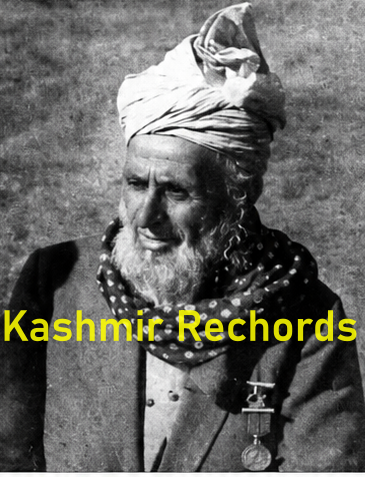
Even more remarkably, Jhanghar’s Maulvi Ghulam-ud-Din, was himself a national hero, decorated with the Ashok Chakra, India’s highest peacetime gallantry award.
A Frontier Village That Produced Heroes
The village of Jhangar occupies a special place in the military history of Jammu and Kashmir.
Situated in the Rajouri sector, it became one of the fiercest battlegrounds during the tribal invasion of 1947-48. The area later witnessed military activity during the wars of 1965 and 1971 as well.
For the people living there, patriotism was not a slogan. It was a matter of survival. Villagers routinely found themselves caught between infiltrators, military operations and enemy aggression. Every decision carried risks.It was in this atmosphere that Mali Bee and Ghulam-ud-Din emerged as extraordinary figures.
The Woman Who Chose the Nation Over Fear
Mali Bee was not educated in elite institutions. She held no public office. She possessed neither wealth nor influence. What she did possess was courage. At a time when infiltrators and hostile elements attempted to establish influence in border areas, Mali Bee stood firmly on the side of India. According to contemporary accounts, she rendered invaluable assistance that frustrated enemy designs and strengthened the hands of those defending the region.
Her patriotism came at a time when choosing the Nation often meant risking one’s life. The dangers were real. People suspected of helping Indian forces could face intimidation, violence or death. Yet Mali Bee never wavered. The Government of India eventually recognised her exceptional contribution by conferring upon her the Padma Shri in 1966.
The honour was more than an award. It was a national acknowledgement that extraordinary courage can emerge from the most ordinary circumstances. For Jammu and Kashmir, the recognition was historic.
A village woman from Rajouri had become one of the earliest and most distinguished female recipients of a national civilian honour from the erstwhile state.
An Extraordinary Ashok Chakra recipient
If Mali Bee’s story is inspiring, the story of her village-mate makes it even more remarkable. Maulvi Ghulam-ud-Din was not merely from Jhanghar. He too was a hero in his own right. A respected religious figure, he rendered exceptional service during critical periods of conflict and earned the admiration of both civilians and military personnel.
For his courage and dedication, he received the Ashok Chakra, India’s highest peacetime gallantry decoration.
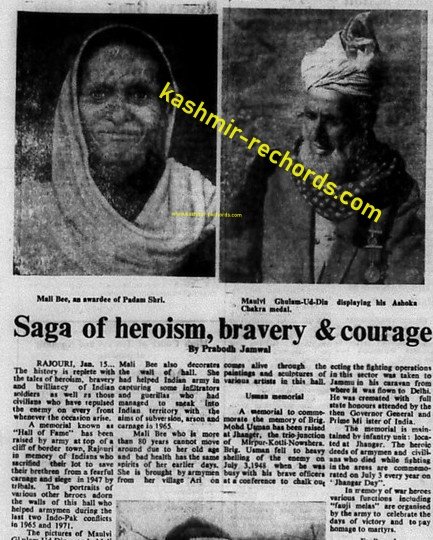
The image of the elderly Maulvi proudly displaying his Ashok Chakra in a 1986 newspaper feature ( Kashmir Times) is a powerful reminder of a generation that viewed service to the Nation as a sacred duty.
Together, Mali Bee and Ghulam-ud-Din formed a remarkable partnership.One received the Padma Shri. The other received the Ashok Chakra. Both served India in their own ways. Both became symbols of loyalty, sacrifice and courage. And both came from the same humble village.
Recognition Without Remembrance
The tragedy of their story lies not in what happened during their lifetimes but in what happened afterward.
Despite receiving some of the country’s highest honours, neither Mali Bee nor Ghulam-ud-Din occupies the place they deserve in Jammu and Kashmir’s public memory. There are no widely known biographies. Few educational institutions teach their story. Most young people in Jammu and Kashmir have never heard their names. Even official commemorations rarely mention them.
The passage of time has reduced their achievements to scattered references in archives, fading photographs and ageing newspaper reports.
Forgotten Face of Women’s Empowerment
The neglect of Mali Bee’s legacy is particularly unfortunate. Modern discourse rightly celebrates women achievers from Jammu and Kashmir in administration, sports, science and politics. Yet the story of a rural woman who displayed exceptional courage during one of the most turbulent periods in the region’s history receives little attention. Mali Bee embodied women’s empowerment long before the phrase entered public vocabulary.
She demonstrated that patriotism has no gender. She proved that courage does not depend on social status. And she showed that ordinary women can shape extraordinary history. Her life challenges the assumption that women were merely silent witnesses to the conflicts that shaped Jammu and Kashmir.
A Legacy Worth Reclaiming
The story of Mali Bee and Ghulam-ud-Din is not merely about two individuals.It is about a generation that placed national interest above personal safety.It is about ordinary citizens who became extraordinary patriots.And it is about the responsibility of society to remember those who helped build the Nation.As India continues to celebrate its heroes, the names of Mali Bee and Maulvi Ghulam-ud-Din deserve renewed recognition.Their contributions should find a place in school textbooks, public memorials, academic research and popular discourse.
Perhaps the most tragic aspect of their story is not what they endured during their lives, but what happened after. As decades passed, the names of Mali Bee and Ghulam-ud-Din slowly disappeared from public conversations. New generations grew up without hearing about them. Official commemorations became rare. Academic attention remained limited.
Today, when Jammu and Kashmir seeks to preserve its rich and diverse history, the story of Mali Bee and Maulvi Ghulam-ud-Din deserves renewed attention. Their lives challenge us to reconsider who we choose to remember.
*Dr. Rajesh Bhat is a veteran media professional, researcher and author with a Ph.D in Journalism and Mass Communication. He is deeply engaged in documenting the neglected socio-cultural and historical narratives of Jammu & Kashmir. As one of the founders of Kashmir Rechords Foundation, he works towards preserving archival heritage, recovering forgotten stories and bringing unsung personalities of the region into the public domain.