
(Kashmir Rechords Exclusive)
Was it a rogue statement… a political misadventure… or something far more calculated?
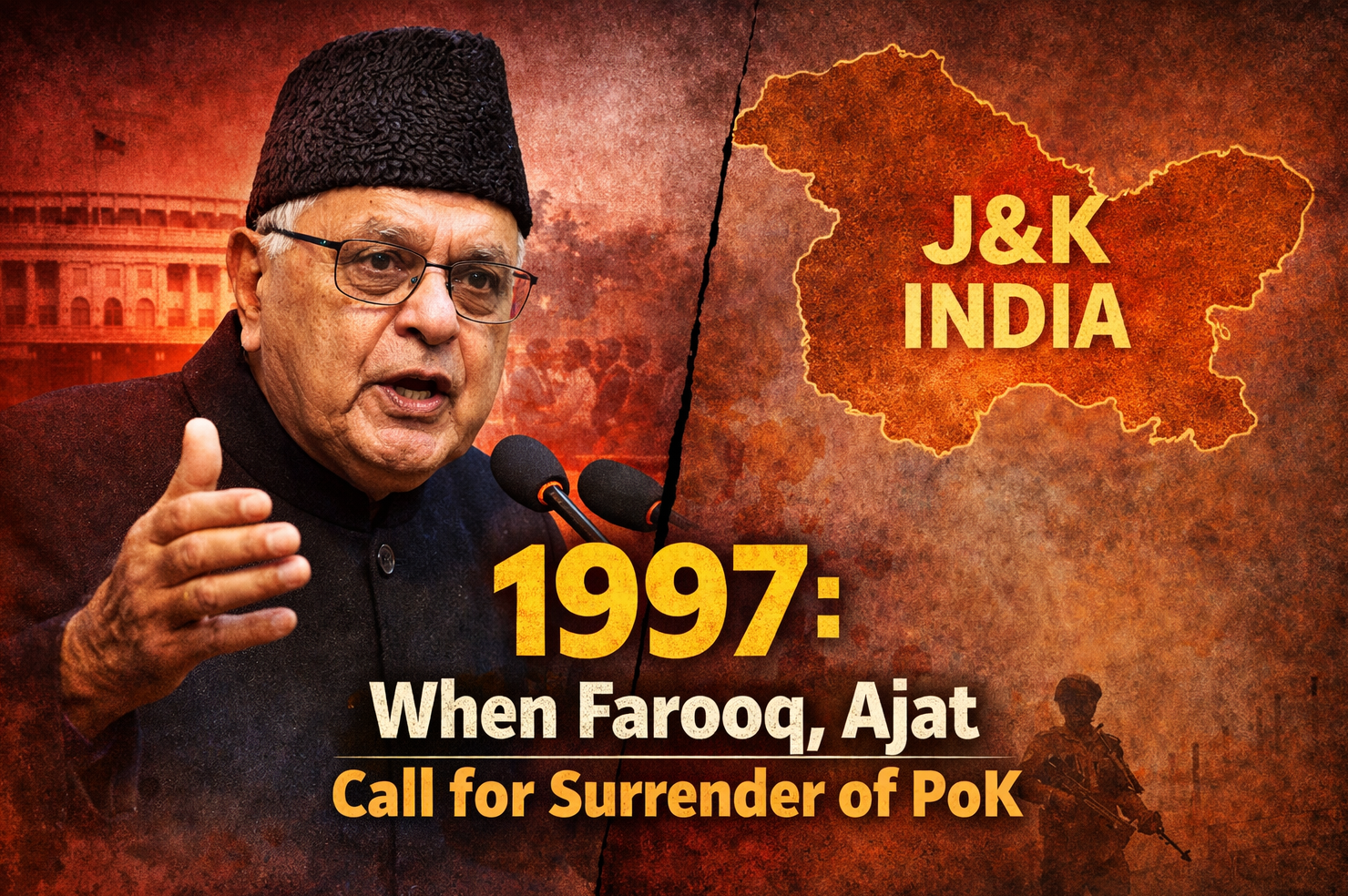
Nearly three decades later, a chilling question still lingers over the political corridors of 1997: Was there ever a serious attempt—formal or informal—to “hand over” Pakistan-Occupied Kashmir (PoK) to Pakistan in the name of “everlasting peace” in Jammu and Kashmir?
Archival inputs accessed by Kashmir Rechords reveal that what unfolded in early 1997 was not an isolated gaffe—but a political tremor that shook Parliament, embarrassed the Centre and ignited nationwide outrage.
The Chhindwara Bombshell
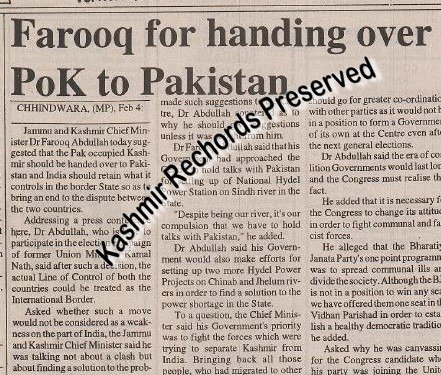
On February 4, 1997, during an election rally in Chhindwara, Madhya Pradesh, then Jammu & Kashmir Chief Minister Dr. Farooq Abdullah dropped a political bombshell.
He suggested that India should consider “handing over PoK” to Pakistan.
The remark was not just controversial—it cut directly against India’s long-standing sovereign position.
The ‘Scripted Echo’? Ajatshatru Singh Steps In
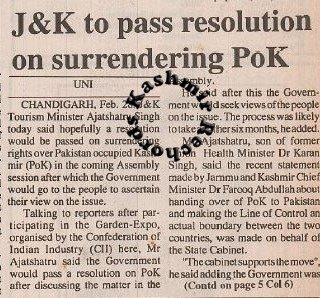
Barely weeks later, on February 28, 1997, J&K’s Tourism Minister Ajatshatru Singh escalated the situation.
At a press conference in Chandigarh, he declared that the J&K Government would soon move a resolution in the State Assembly to surrender PoK.
Was this coincidence—or coordination?
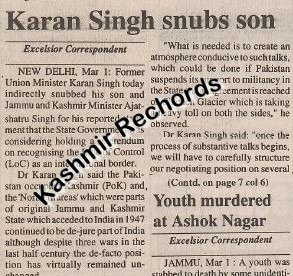
The controversy deepened because Ajatshatru Singh was no ordinary politician. He belonged to the Dogra royal lineage, the son of Dr Karan Singh, who swiftly rebuked his son the very next day, terming the statement highly irresponsible.
Delhi on Edge: Parliament Reacts
The statements triggered a political storm in New Delhi.
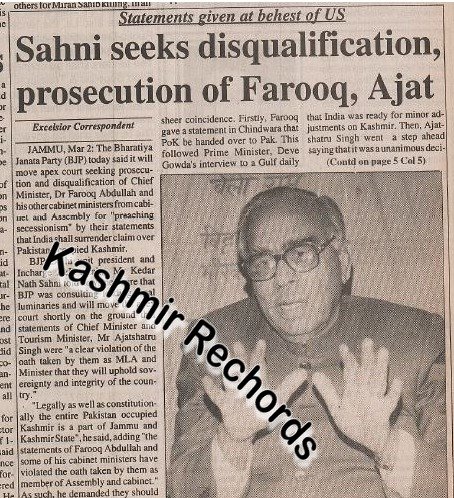
The Bharatiya Janata Party (BJP moved aggressively, accusing both leaders of “preaching secessionism.” Its Delhi unit chief, Kedar Nath Sahni who ushed to Jammu, later at a press conference on March 2, 1997, demanded the “Disqualification and Prosecution’’ of both Farooq Abdullah and Ajatshatru Singh.
Inside Parliament, the issue further exploded.
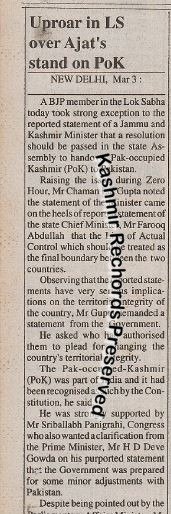
On March 3, 1997, BJP MP Chaman Lal Gupta raised the matter during Zero Hour, warning of serious implications for India’s territorial integrity.
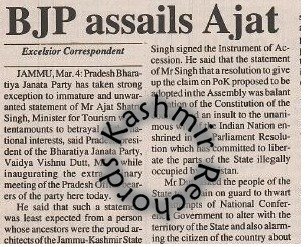
In Jammu, BJP MLA Vaid Vishno Dutt also slammed the statement as “illogical.”
Centre’s Embarrassment—and Swift Rejection
The controversy placed the Central Government in a deeply awkward position.
Prime Minister H. D. Deve Gowda, who shared cordial ties with Farooq Abdullah, was forced into damage control.
Key voices in the Union Government moved quickly.
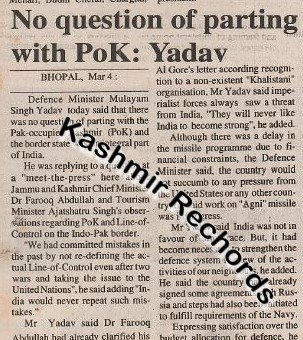
- Defence Minister Mulayam Singh Yadav declared in Bhopal:
“There is no question of parting with PoK.” - External Affairs Minister I. K. Gujral also distanced the Centre from the remarks.
The message was unambiguous: India’s position was non-negotiable.
The 1994 Resolution: A Direct Contradiction
What made the 1997 statements even more explosive was their direct contradiction to a unanimous Parliamentary stand.
On February 22, 1994, under Prime Minister P. V. Narasimha Rao, Parliament had passed a historic resolution asserting:
- Jammu & Kashmir is an integral part of India.
- Pakistan must vacate all territories under illegal occupation (PoK).
- Any interference would be firmly countered.
Against this backdrop, the 1997 remarks appeared not just controversial—but politically incendiary.
Calculated Trial Balloon—or Political Misfire?
The key question remains unresolved: Was this a trial balloon floated to test public sentiment? Or was there quiet encouragement from certain quarters? Or was it simply a miscalculated political gamble that collapsed under public backlash?
The sequence—Farooq’s statement followed by Ajatshatru’s escalation—has led many observers to suspect coordination rather than coincidence.
A Pattern That Never Fully Disappeared
Political analysts note that this was not an isolated episode.
Over the years, Farooq Abdullah has made similar remarks:
- Suggesting the Line of Control be converted into an international border
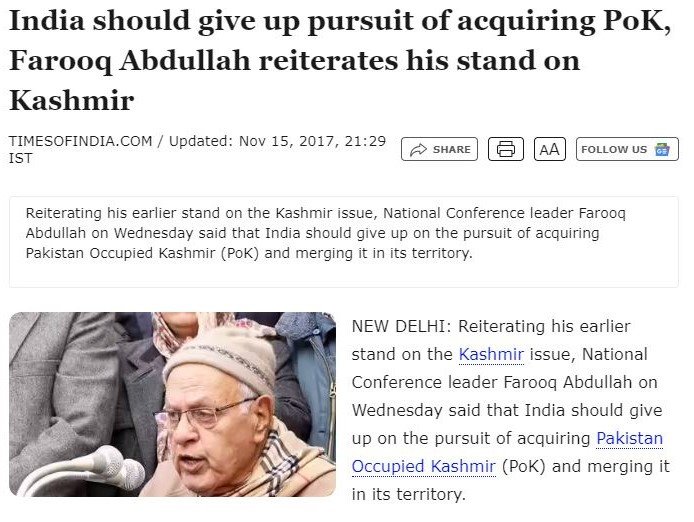
- Stating in November 2017 that India should “give up pursuit of PoK”
Each time, the remarks triggered debate—but never quite erased the memory of 1997.
The Unanswered Question
Nearly 30 years later, the episode still raises an unsettling possibility:
Was 1997 merely a political misstep—or a glimpse into a line of thinking that briefly surfaced at the highest levels?
The archives do not offer a definitive answer. But they do confirm one thing:
👉 For a brief moment, the idea of “surrendering PoK” was not just whispered—it was spoken aloud, defended and then fiercely rejected.