Was Jesus Christ in Kashmir during the “lost” years? Some scholars believe so. Did Jesus visit Kashmir as some books claim? Does a tomb – Rozabal, near Srinagar exists in his name as the story of one Hollywood film tried to project? Are you aware of a Kolkata based filmmaker Subhrajit Mitra who tried to trace Christ’s ‘India trail’ in his film “The Unknown Stories of the Messiah”? Did Christ visit India after his crucifixion? What is your take on all such issues?
Was Jesus buried at Rozabal, Srinagar?
Whatever could be the fact, the Rozabal shrine in downtown Srinagar is an object of curiosity. According to one theory, Jesus did not die at the Cross and was buried here carrying the name of Yuzu Assef. It is believed by some that a wandering mystic (Christ) travelled across India, lived in Buddhist monasteries, spoke against the iniquities of the country’s caste system and lived as a shepherd along the vast banks of the brooks in the beautiful vale of Kashmir.
On a routine visit to the tomb at Rozabal, one is greeted with a green signboard written in Urdu and English referring to it by the name of “Yuz Asaph”. It is situated in the thickly populated locality with a “Martyrs’ graveyard’’ on its one side and a Muslim shrine of Dastagir Sahib in its close vicinity. The Muslim shrine, unlike Rozabal tomb, is frequently visited by devotees. The management of
this Muslim shrine is believed taking care of Rozabal as well.
The period in the life of Christ from the age of 13 to 30 is amazingly vague in the Gospels and other chronicles on his life. However, the theory that he spent those years in Kashmir has provoked a section of the Christian community to term it as total heresy. Who term it just “fantasy and fiction.”
“The very essence of Christianity depends on Christ’s fructification and historically, Saint Helena found the original Cross while digging at the Mount Calvary,’’ some counter, who however opined that Christ may or may not have visited Kashmir but no Christian believes that his tomb exists in the Valley.
What do History Books say about Christ’s Kashmir Sojourn?
Hollywood’s interest in attributing Christ to Kashmir is not the first instance. The theory that Christ’s teachings had roots in Indian traditions has been around for more than a century. In 1894 a Russian doctor, Nicholas Notovitch in his book “The Unknown Life of Christ’’ claimed that while recovering from a broken leg in a Tibetan monastery in Ladakh, he had been shown evidence of Christ’s Indian wanderings. He claimed that he was shown a scroll recording a visit by young Jesus to India and Tibet. In 1908, Francis Younghusband, a traveller to Kashmir mentioned in his book `Kashmir’ about Rozabal and Christ connection.
Aziz Mohd a historian from Kashmir mentions Christ having lived in Ladakh monasteries and Kashmir in his book `Israr-e-Kashmir’.
Fida Hassnain, former director of archaeology, Kashmir, who has written books on the legend of Jesus in India, points out in one of his books that there was extensive traffic between the Mediterranean and India around the time of Jesus’ life.
Aziz Hajni, author of `Jesus Lived in India’ in his 160 page book argues that Jesus survived the crucifixion and travelled to Kashmir and died at a ripe age.
In 1995, a German religious expert, Holger Kersten, claimed that Jesus had been schooled by Buddhist monks to believe in non-violence and to challenge the priesthood. Kersten’s book remains a bestseller in India.
A website on Christ’s tomb in Kashmir claims to have ‘‘historical and well-documented proof’’ to establish that Christ visited Kashmir and has a tomb at Rozabal. Besides the existing works, the website mentions Bhavishya Maha Purana claiming that the manuscript carries the name of Jessu “ the teacher and founder of the religion, who was born miraculously, proclaimed himself the Saviour of the world and survived in Asia, for a long period.’’
J&K Archaeology department’s former Deputy Director opines that archeologically there is no proof of Christ having a tomb in Srinagar. “Kashmir has had a tradition of documenting history since times immemorial. There should have been at least some mention of Rozabal or Christ’s visit to the valley in Pt Kalhana’s Rajatarangini,” which is a point of reference for Kashmir’s history.
K N Pandita, former Director of Central Asian Studies, Kashmir University, is of the opinion that the issue remains an open subject and scholars ought to focus attention on a comprehensive and convincing research. According to him, the word Rozabal comprises two parts; Roza (of Arabic origin Rawzah meaning a garden or a spot) and Bal is a Kashmrised Sanskrit word used as place- suffix meaning where water is close by. “Perhaps the water stream once called mar ran close to present day Rozabal. But I believe that it was a Hindu or Buddhist shrine and later taken over.”
Once the stronghold of the militants, the Khanyar area of Srinagar that has Rozabal as one of the mohallas, however, dons the same everyday look even after so many sophisticated cameras zoom on its highly congested lanes and by lanes. Shopkeepers at Khanyar Chowk are nostalgic of those peaceful days when foreign tourists, mostly Christians in large numbers, would visit Kashmir and Rozabal on summer holidays and would generate employment for some unemployed youth in the city.
Many share that wish every four seasons of Kashmir!
In the aftermath of exile, concerted attempts have been made by the ivory-tower, pompous intellectuals of Kashmir to downplay and eliminate the notable literary champions of the Kashmiri Pandit community who have hammered their name in the annals of the valley’s brilliant literary tradition.
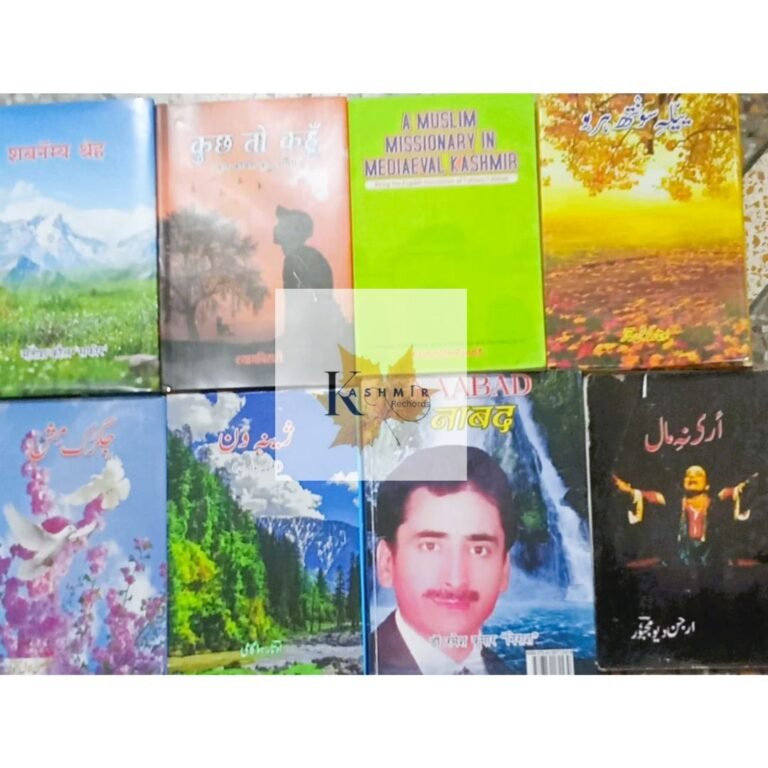
Academics of Kashmir in the decades following 1990’s violent social turbulence have consciously tried to portray the legendary Kashmiri Poetess Arin Mal as a figment of imagination, but evidence exists that brings to light endeavors at preserving and anthologizing her precious poetry. During the 18th century, Arin Mal is seen as the sole poet to have composed in the relinquished, and often now unheard – Vatschan genre of Kashmiri poetry – following in the footsteps of the love sick and hugely idolized Habba Khatoon – a past native of the same valley.
Fortunately, Arin Mal has had her verses of stupendous inspiration burrowed into history. Tracing her humble origins from Palhalan village, Baramulla – she was married off to an elite of the Kashmiri Pandit community, one BhawaniDas Kachroo, a resident of Rainawari, Srinagar. There is sufficient evidence of revenue records that certify her having lived and breathed a normal yet essentially, a deeply poetic life.
Immortalizing Arin Maal
Sri Arjan Dev Majboor, a celebrated intellectual undertook the herculean task of immortalizing Arin Maal. He and his ilk, have tied the loose threads of maligned history, and done justice to the profound life of the great poet.
For Detailed Reading:
To read further commentary on the forgotten tragedy of Arin Maal and her unsung contribution to Kashmiri literature, keep in touch with: https://kashmir-rechords.com.
The world is having an increased and value based interaction with Kashmir Shaivadarshana. This association has continuously been going on over a hundred years particularlyin the west and it seems that profound benefits of this discovery which lays stress on one’s own ability to recognise oneself and what the world knows as the Pratyabijna is a paradigm shift and seems to be a renaissance of sorts to which the world is earnestly responding to .
But is Shaivadarshana or Abhinavagupta relevant?
Providence by her grace chose Abhinavagupta (975-1050) A.D to accord glory to valley of Kashmir. He not only synthesised all schools of earlier Indian Shaiva and Buddhist philosophical traditions but lived his own postulates and profound spiritual truths he so brilliantly advocated. He was the single most colossal figure in the pre- medieval world who combined literature ,yoga, tantra philosophy etc, thereby according luster to an already existing shining and dynamic spiritual tradition. Abhinavagupta not only continued to augment the flow in the river of consciousness but imparted an exemplary volume and intensity to it. The spiritual treasure and corpus he created is and can guide us through these tumultuous waters that the human existence finds itself in. During these times when wars, genocides politics, economic crisis, poverty,depression and lack of respect for the planet have marred the quality of our life, when compassion from human heart has depleted, when cloning, artificial intelligence and robotics and their likely thrust in the days to come will take the ground under our feet and evaporate whatever is left of human consciousness, it is during this crisis Shaivadarshana and Abhinavagupta’s contribution creates hope and imparts sense to deal within an increasingly fragmenting and negatively changing world.
Before deliberating on Shaivadarshana and Abhinavagupta’srelevance to the present it is important to get an idea about spiritual cum existential river called Shaivadarshana. It is always an evolving field and is always a dynamic process combining Vedanta, its own ‘Agamic’ corpus and essential truths of Spanda and Pratyabijna which are unique to it. There is no distinction to be made on the basis of caste, colour, sex while making an outreach and accessibility of this treasure to the desirous. Thus the assumption that the Buddha’s teachings have provided a substratum to Shaivadarshana cannot be said to be not true.
Unfortunately in our process of discourse, there is always an urgency and immediacy to refer to texts and also most of which it seems to be in a mere verbal way. While quoting from the scriptures or commentaries is necessary, it is equally important to thoroughly examine the truth, context and import of these teachings. This like all manners of study does and should take time. The notable quality that makes Shaivadarshana unique is its adaptability across time and thatit combines both consciousness (Chaitanya) and dynamism (Spanda) to explain the inner and the outer. Hence in the Trika scheme of things that is the Individual, Shakti and the Absolute the transcendent contains the manifest. The dichotomy of thought processes propounded by the religions so far has felt short to explain the same. The same has been smoothened by Shaivadarshana and according to it Paramshiva is understood as the absolute, the ultimate consciousness that creates, maintains, destroys, conceals and reveals all existence and all experience. The goal of this tradition is to realize that one is Paramshiva who transcends everything physical, mental and emotional. Thus in the non dual Shaivic traditions of Kashmir there is a term “Samvitsamaavesha” which can be translated into immersion into supreme consciousness that suggests the realisation of identification with Paramshiva as the ultimate goal. Saivites who are essentially thus non dualistic understand the human being to be a contraction of Supreme Consciousness called Paramshiva and all meditative and other techniques are employed with an objective to retrace this contraction and to expand consciousness. Of course the words that the writer is using here are not the thing. You can call that by whatever name you will. The word is not the thing. Meditation or ritualistic practice may be important but perhaps more important is the perfected reasoning and liberated grace of Shiva, says (Muller Ortega)..
Deconditioning human mind
Krishnamurthy, a great thinker of our times although apparently never a Shaivite, has laid stress on the de-conditioning of human mind and researchers like Bakhtin supplement his seminal insight that even though one’s understanding may begin with one’s own culture and an exploration of how it has been shaped by the horizons of the past and various other cultures or any other world view, it can still pave way for the study of enhanced understanding. Fixed ideas or conditioning may thus have to be dissolved. Unmistakably Abhinavagupta time and again reaffirms that the Indian thought process even though it is scriptural, the scripture is ‘Apaurusheya” that is it can’t be attributed to anybody as it is also ‘ Anadi ‘ that is without beginning. Being aware of the same he on many occasions has demonstrated that Budha or Kapila both founders of Buddhism and Sankhya have derived from same eternal and authorless transmission.
Krishnamurthy calls the same as Choice less Awareness and in that ,the perception of truth gets unfolded. Now how does Shaivadarshana explain the manifestation that is the universe? This tradition unequivocally advocates that Absolute Reality’s Swabhava the Spanda Shakti unfolds the universe ofTattvas” and during the times of cosmic manifestation which is behind the interplay of 36 tattvas beginning with prithvi, jala,tejas, vayu and akash assumes a subtler organisation ,gets down to further subtler levels corresponding to five subtle elements for example gandha (smell),rasa (taste), rupa,(form) ,sparsha (touch) and shabda (sound). This subtlety moves onwards and onwards but the supreme principal (Para Tattva ) retains its pure ,peaceful and indestructible quality. The 37th tattva accords the innate power to these 36 tattvas just like the crystal even though it assumes different hues and colours but at the same retains its own essential nature. Says Abhinavagupta in Paramarthasara :“That the diversity in the universe with manifold bodies of gods, men, animals and plants is like a crystal assuming a multi coloured form. This naturally is the outcome of his innate powers and might’’.
Abhinavagupta could so proclaim as he does everything with authority but can the modern science verify this insight if it proceeds with its own processes and structure in place ? That is the moot point. This should neither be confused with some vital force theory on the basis of which science may try to undermine it nor should it in no way ,repeat no way undermine and belittle the scientific approach and mind. Infact unlike the present mode in which science operates through its methods, Shiavadarshana cannot be standardized on mass scale. Being highly individualistic it operates in one’s own field of consciousness and incorporates power of the self to guide and be the master of one’s own destiny. Considering this can there be an interface between science and Shaivadarshana to harness the human energy for bettering its condition?. The academic environment needs to ponder and build a consensus. Baljinath Pandita, a great Shaivite scholar of our age, in his noteworthy treatise “ History of Kashmir Shaivism’’ while referring to Ishwarpratyabijna of Utpaladeva mentions that subtle esoteric thought or nature of Kriya, of Paramshiva is the way and manner of the manifestation of movement, relativity, time, space etc. He further goes on to add that the Shaivite theory establishes that absolute existence shines through its own psychic lustre of what is called as pure “I” consciousness and lies beyond the scope of all worldly means of knowledge.Ideally the Ultimate Reality has been termed as Prakashvimarshmaya . That is the Ultimate Reality and its manifestation are
Undivided One and Vimarsha is the power of that Absolute Principle by which it gets aware of itself. In essence it can be said to be the highest or ultimate creativity .Now why does the individual self get caught up in the limited experience? Shaivas attribute this to Maya Tattva, where the word Maya here denotes to measure out . This mental classification of discrimination and division draws a veil or avarna over the self which otherwise is Paramshiva. Then writer may have said much of this in a mere verbal way that has come to us from the great masters, but if the students are caught young and under the care of very adept hands, the need for understanding the finer points of the Ultimate Reality explained to them, not only will they develop necessary wherewithal to deal with the complexities posed by modern times but they will contribute creatively also. This also means that the inertia or the negative doubt which the contemporary generation is experiencing and comes to believe this ignorance of division as truth will be delivered free of it and then perhaps we will set our priorities right which at the moment seem to be misplaced. Another challenge of our age is the phenomenon of “Obsolescence”. This can be gauged by the fact that the amount and kind of knowledge and application the world generates in the morning gets obsolete by the evening. Our current lifestyles and priorities seem to reinforce this beliefthat the world is there for exploitation and this forces us to stand fragmented and is giving rise to myriad imbalances. This instability which creates a visible disorder the way we conduct our life, forces us to appreciate the beauty of stillness which we so desperately are clamouring for. We surely can refer to Shloka 16th of Parmarth .That is this kala this niyati is something that is kala. I know that is vidya. I know it completely: this hex ad of cloaks which includes maya is known as the interior organ of the finite soul. Now analysing this with respect to the distress created by this phenomenon of obsolescence is the result of the very structure which forces us which in fact is our ignorance to relentlessly pursue things without a creative dimension and makes the stillness of our nature or simply the constitution of our existence as its victim. This is the mala which obscures the Chaitanya. Therefore. maintaining a continuity of the same all schools of Indian philosophical discourse and Shaivadarshana including its Aagamic texts beginning from Vigyan Bhairav Tantra onwards have laid stress on getting acquainted with what may be called the “quality of stillness” or simply the “Silence”. In this state the real perception takes birth. However, that is beyond words and is not a thing of discussion. It is here that creativity is said to bloom. This state where perception unifies this quality of Silence is
the state where one previously known as ‘Anu’ gets qualified to proclaim that he/she is ‘Paramshiva’. Even being in the realisation that one is taking up a journey towards the summit called Paramshiva is itself full of pleasant wonder, unfolding Rahasya after Rahasya or mystery along the way. Such an existence becomes a repository of ‘ Satyam Shivam Sundaram’. Such a realised existence treats the phenomenon of obsolescence as its own activity which is always peripheral while the core is resplendent with the power of the truth. To such an existence, the phenomenon of obsolescence is the very sugar of life and its ‘Svabhava’..
Shloka 24th of Paramarthasara perhaps illustrates this:-
That is how to know defilement. There is a supreme veil (Maya Mala) consisting of five ‘Kanchukas’ or ‘coverings’ and a gross external veil (Karma mala) in the form of a body. In this way, the self is enveloped by the three tier sheath. Upon getting enlightened, the perception of such a person shines forth through this sheath and one does not know thus of any division between one’s power and its projection as the world. To such an existence, this projection called universe and everything associated with it that resides in the heart and this heart knows it as supreme intelligence. This is the core of Abhinava’s ‘Pratyabijna’ . Thus there is no division between the empirical and the real self. Whatever follows in this state is beyond the scope of discourse. Alternatively it may also mean, even if one may have to perform the same action as one was performing before as an ‘Anu’, nevertheless its quality will be totally different. Thus, no dichotomy exists in Parmashiva’s Chit, Anand, Iccha, Gyana and Kriya shakti. However, having said this we may add that real perception does not happen in a vacuum. Humanity needs real preceptors or teachers who have the power to bestow their grace on us. At the moment, the contemporary world, having ignored this, is confronting the resultant mess it has created. Another formidable challenge that the writer would like to emphasize is the similarity between computers and the human brain. It seems to me the present and clear danger. Humanity has collectively failed to realise the implications of artificial intelligence replacing the human consciousness in the very near future. Can this rob us off our own self or consciousness? The way the development of computers is taking place at a faster pace, a corresponding decline and deterioration in human consciousness is also visible. The world needs to prioritize a strategy for the same. Shaivadarshana suggests a retreat not the kind to enforce a ban but to withdraw from the current meaninglessness to a life pregnant with meaning.It is also to put on record that Shaivadarshana has nothing to do with any organised religion or cultural conditioning. It is a movement in time, therefore, always a dynamic process. One can
pursue any religion but still be a Shaiva, because; being a Shaiva means to be at the core; thus the truth. The Writer makes it clear to the readers that they are at liberty to reject whatever has been said in this paper, because the writer believes that doubt can be central to life and an attitude of negation upon negation has the power to affirm truth. Self knowledge continues to be the liberating force always. Finally, the writer would like to emphasise some analogy vis- a- vis the condition of the world and human existence as portrayed in Gotham city in the movie series ‘Dark Knight Trilogy’. Here the protagonist portrayed by Bruce Wayne, tells his butler companion, Alfred, and quote :
“Master, why do we fall?” “So that we can rise again.” Pat comes the answer.
Understanding the condition, that we find ourselves in, would therefore implore and make a call from this platform: “Utishtha, Uthistha, uthistha….. Rise again, Oh! Shiva!… Rise again. Shiva, rise again!”.