Home Blog Page 19

Nonagenarian’s spiritual pursuit at Kashmir village

(By: R C Ganjoo)*

Pulwama and Anantnag, the two terror-affected districts in South Kashmir for the past many years, also have some inspiring stories about spirituality to tell. Murran is one such village in Pulwama district where Pandit Badrinath Bhat, a nonagenarian still lives with his family.  Despite several threats and upheavals, Pt. Badrinath never left Kashmir and his home even during the mass exodus of Kashmiri Pandits from the valley in 1990.

A retired Principal from a government school, Pt. Badrinath Bhat is a devotee of Kashmir’s one of the   greatest saints, Nidhan Kak, and feels comfortable in his native village with his own children and grandchildren.  Incidentally, Bhat is in possession of a pair of walnut-wood sandals (Khadau) of Yogi Nidhan Kak and he worships wooden sandals everyday lying in his Puja room. Nidhan Kak was born at village Sallar, a famous village of the Danchanpora Pargana (now District Anantnag) in mid-nineteenth century.

Yogi Nidhan Kak’s wooden Sandals ( Pic by Author)

 During a conversation with Badri Nath Bhat, this retired Principal had a lot to share about the political and spiritual account of both Anantnag and Pulwama districts. He narrated the story of how Sikh rule ended and was replaced by Dogra rule in Kashmir.

Nidhan Kak blesses Maharaja Gulab Singh

Quoting village elders, Badrinath Bhat  said Maharaja Gulab Singh  had entered the valley of Kashmir in November 1846 via Pir Panchal route, but on his way to Srinagar, was feeling disturbed. Gulab Singh was in search of spiritual strength behind him to achieve the throne of Kashmir.

He arrived at Ramoo, a famous village on the Mughal route, one mile away to the west of Harapora, where Nidhan Kak, the Yogi, was living in a cottage. The Yogi was a great saint of high spiritual order. His fame had spread around the adjacent villages to Harapora, Murran, Deeri, Ramoo and  in the whole belt of Murran area.

Gulab Singh came to know about Nidhan Kak and was eager to seek his blessings. At village Harapora, Maharaja changed his royal dress, but the yogi knew that Gulab Singh would be the saviour of the Kashmiris who had suffered continuously at the hands of Pathans and others.  According to Badrinath Bhat, Yogi Nidhan Kak blessed Gulab Singh, who later left with a great confidence to  conquer Sheikh Imam-ud-Din (1845-1846), who was appointed Governor of Kashmir after his father’s death by the Sikh ruler of Punjab.

Nidhan Kak’s sojourn from Sallar to Murran to Harapora

Sallar village has remained a high seat of ancient Kashmir culture and Shaivism. It is believed that Nidhan Kak was initiated into Yoga in this village by one local saint.  Later, in his thirties, he left for village Murran of Pulwama district to stay with a famous landlord family of Bhats. Nidhan Kak served Bhats as a domestic cook and simultaneously practised Sadhana for higher spiritual levels. One day, a woman of the Bhat family, during night hours, noticed their servant’s room was illuminating. She informed her husband about the same. To the surprise of the couple, Saint Nidhan Kak was sparkling even in pitch dark. Next morning, the Bhat family placed Nidhan Kak with all reverence on a seat. Now Nidhan Kak realized that time had come to leave for his hermitage, which he might have already chosen at village Harapora.

Harapora is a kilometer away from Murran, where Nidhan Kak spent days in a solitary spot surrounded by all species of wild shrubs and trees. Later, the Yogi set up his cottage on the bank of Hara-nag. There is a pit few feet deep inside the cottage and the Yogi used to remain rapt in his yogic posture in this pit. Presently, the Ashram is abounded with Chinar and “bran” trees and are believed to have been planted by Nidhan Kak himself.

   Nidhan Kak’s most devoted disciple was Swami Ram Krishen from Rainawari, Srinagar. It is said that in 1855, in the month of Magha, Nidhan Kak, left for Haridwar for his Ganga Yatra. He had informed his disciple about the exact date of his return to the Ashram. It was Magh Dashmi, the Bhimsen Dashmi; but the Yogi did not return even up to Aikadashi, (Bhimsen Kah). He waited and waited, but his guru did not return and the disciple, Ram Krishen, understood that he would never return, so he decided to cremate the belongings of Yogi. He did it on the Bhimsen Aikadashi in front of the Yogi’s cottage.

Settlement of Kashmiri Pandit families by Maharaja

It is said that Maharaja Gulab Singh got annoyed with Ram Krishen for not informing him about the passing away of the Yogi. The Maharaja left the throne in 1856 and passed away in 1858. Maharaja Gulab Singh had settled some Kashmiri Pandit families at Harapora and Deeri. The Harapora Pandits were called Babus (They were basically Kouls). They served the Ashram during the days of the Yogi and continued until the exodus of Kashmiri Pandits from the valley. The Yogi himself settled some Muslim families in Harapora and handed over to them the land granted to Ashram by the Maharaja. After the 1990 migration of the Pandits from the valley and surrounding villages of Harapora, only a few Pandit families of village Murran and some Muslim families of Harapora looked after Yogi’s Ashram.

Damage to Nidhan Kak’s cottage

  During the peak militancy years (1990 to 1996), the Yogi’s cottage suffered huge damage. Pandit Badrinath Bhat with the active cooperation of some devotees from Murran renovated the cottage and brought it to its original shape in May 2007. They also raised beautiful fencing around the Ashram premises.

Samadhi of Yogi Nidhan Kak

The walnut sandals of the Yogi were removed by Badrinath Bhat and put in his “Pooja room” in 1996. He worships them there. Pandit Badrinath Bhat, since his childhood days was devoted to Nidhan Kak. He says he learnt from his elders like Govind Kak of Murran, Sham Lal Deeri, Maharaj Krishen Deeri, Mohd. Akram Harapora, Lassi Bhat of Harapora, and gathered information from many other elders of Murran, Harapora, and Deeri. Govind Kak was an Ayurveda Vaidya of Murran who miraculously cured patients with the indigenous herbs. He too was a saintly person, very much devoted to Nidhan Kak. He lived up to one hundred years and passed away in 1948. It was he who had shared the historical account of Maharaja Gulab Singh’s visit to Harapora and Murran to Badrinath Bhat.

*R. C. Ganjoo is a senior journalist and columnist having more than 40 years’ experience of covering issues concerning national security, particularly Kashmir. He has worked with several prominent media groups and his articles have been published in many national and international publications. He has co-authored two books– “Operation Khatma’’ and “Farooq of Kashmir’’.

(The views, observations and opinions expressed in the above write up are strictly author’s own. Omission if any is regretful and Kashmir Rechords is open to any correction.)
Englishman’s 1847 travel to Kashmir (Part 4)

( By: Kanwal Krishan Lidhoo*)

Kashmir Rechords  in its previous three blogs dated 9th, 12th and 30th December 2023 had mentioned an Englishman’s visit to Jammu and Kashmir in 1847 recorded in the form of daily entries called ‘Roznamcha’ by one Pandit Kanhaya Lal Aashiq Dehalvi and later published under the title Sair-e-Kashmir and we had in three of the previous episodes brought to our readers very significant historical details regarding prevailing socio-political conditions. Not only do these details appeal to the common reader but the students of history also got invaluable insights into the geography and strategic situation of the formative phase of the rule of Dogra kings when they ruled the region called “Jammu Kashmir Ladakh and Tibbet Ha”.

The previous  three blogs carried the information about the travel from Englishman’s 1847 travel to Kashmir via Jammu  dated  9th December, to be accessed  at:https://kashmir-rechords.com/englishmans-1847-travel-to-kashmir-via-jammu/ , the   next  Englishman’s 1847 travel to Kashmir via Jammu, Rajouri, published on 12th December 2023, to be accessed at: https://kashmir-rechords.com/englishmans-1847-travel-to-kashmir-via-jammu-rajouri/ and part third of this travelogue inside Kashmir valley was published on  30th December 2023 to be accessed here at https://kashmir-rechords.com/englishmans-1847-travel-to-kashmir-part-3/.

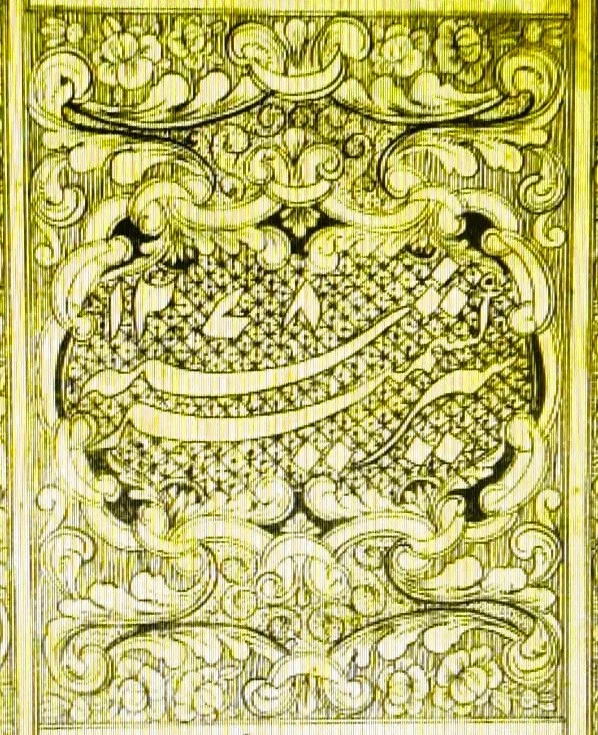
The book is a compendium of daily entries of his accounts in his diary during travel, which was undertaken by Pandit Kanhaya Lal Aashiq Dehalvi along with an Englishman named Mr. Winter Bedim. Pandit Kanhaya Lal Aashiq was a resident of Akbarabad Sialkot (now in Pakistan) who sought employment in the office of the then-British Agent in Lahore, Colonel Lawrence due to his proficiency in the English language.  Thus, he wrote this travelogue also for the Englishman, with whom he had traveled to Kashmir via Jammu.  “Sair-e- Kashmir 1278 AH” is written on the cover of the Book having 41 (forty-one) pages. The travelogue is between the periods of   April 1847 to June 1847.From here we are continuing with the fourth portion of the travelogue as follows:-

Thirst and Mountainous Tubers

We preferred to stay at Shahabad on 13th May, however went for an outing towards Banihal. The path towards Pir Panchal does not seem to be in such a bad condition. It is actually the mountainous people that traverse this path. There is an acute shortage of water in this area. I felt very thirsty but no water could be found anywhere. We were getting increasingly anxious and to add to our woes it was very annoying to see the mountainous people who were travelling alongside were munching at some strange looking green tuberous branches. Upon enquiring, they told us that it was the “Choukie Heddar” meaning (Sour tubers). “By consuming these one’s thirst is quenched to some degree’’. Fascinated as I was, I made them give me one or two tubers and began to munch at them myself. Although somewhat sour, they actually proved to be quite relieving. My thirst pacified to a great extent. As we climbed up further, the wind was so severe we could not carry further. Thus, we made a brief halt and returned to our programme of site seeing in Banihal area. The green paddy fields towards the other side looked so sparkling and green, it held us in awe. The area appeared to be fairly populated also. A short stroll and we were back at the camp.

Shahabad in Kashmir is known for its almonds and the area is famous for “Bulbul Hazaar Daastaan” (which may mean different things to different people. However, if the inference is sought to be made, it may mean either the place of origin of recitation of inspirational stories based on topics related to literature, humour and socio cultural participations).

Kokernag Waters— Power of Digestion

On 14th of May, having left Shahabad we arrived at a place called “Sauf” located in Islamabad (Anantnag) pargana, which stands at a distance of (6) Kos. The area is home to the remains of a geological era deposition of some sort of mining ore along with the remains of plant and animal fossil material.  A furnace also exists where certain type of clay is reportedly mixed with a deposition and the same helps in cleaning the dirt etc. The clay mountain as mentioned stands adjacent to a sort of mine. At a distance of (2) Kos from here stands the famous Kokernag spring. Since the area is cut off, it was very straining to approach this area on foot. The waters of this spring are crystal clear, refreshing and cool and are also beset with powers of digestion that are legendary. We had our lunch here. After consuming the full meal and drinking water of this spring we did not in any way feel our stomachs having got bloated.

Dadwan—No Medical facilities!

On 15th May 1847, as we moved a distance of (5) Kos from our earlier place we reached “Nabouk”. This place is situated at the base of a mountain which besides being a beautiful, refreshing and a place full of fragrance is also famous for a cascade whose gushing  pure and cool waters are pleasant to behold. There is no doctor to attend to the patients of this area and whenever anybody falls ill, he or she has to depend only on nature to get cured. We spent the full day at Nabouk  on 16th May and decided to see a  place called “Dadwan” at a distance of (7) kos. This place is on the up. Snow had still not melted at this spot and it was clear that snow continues to remain here for months. The road however is walkable up to a distance of (5) kos where after its condition gets intensely bad. Whatever distance we were able to cover by way of riding we did and thereafter we continued our movement on foot and towards the evening, we returned to our camp. At the culmination point of this ascent the sight of green fields at the base of these lofty snowy mountains presents a strangely fulfilling and beautiful sight. We stayed at “Nabouk” for the full day of 17th May.  As I was indisposed, I could not venture out. On 18th May 1847, we continued to stay at “Nabouk”, however we went to see a place called “Divsu” which stands at a distance of (7) kos. We must have hardly covered a distance of (5) kos, it started raining which halted our further movement and we returned to our place. Since this area is also a mountainous one, we got the chance to move on foot.

Kuther and Umadevi Springs at Acchabal

On the nineteenth of May 1847, after having traversed a distance of (9) kos we reached “Acchabal” and made a beeline for Kuther” and “Umadevi” springs. This place is home to a beautiful and ancient temple devoted to mother Godess “Uma Devi”. Other constructions have also come up at this temple site. Every traveller and devotee is served food at this place and a “Bhandara” is organised. The spring at Kuther is also amazing.

Acchabal is also a pleasant place in terms of weather. The atmosphere is lovely. A royal garden has been built around a spring. A large volume of water flows from it. A rugged and reinforced terrace has been built in the centre of this spring that remains submerged throughout. It was learnt that Emperor Shah Jehan used to sleep on this terrace. The excess water would be drained and emptied by directing the same through a binary canal system and whenever this terrace emerged the level of water thereafter would be maintained in a very calculated manner so that the terrace would not get submerged again. A royal bed would then be arranged at this place. The structure around this spring has been constructed out of such strong materials and cubical bricks that they stand up to this day. The vast garden houses a royal bath ( “Hamaam”) also.

  A ‘Faqir’ Bhola Nath resides here and this place which comes under his ‘Dharmarth’ and is supervised by him. He came out to be an interesting person. He often spends his own money towards the upkeep of this garden and other structures. He also takes care of the needs of every visitor and is a great host. Acchabal is also known as Sahibabad.

Mattan (Martand) Temple

On 20th May 1847 we left Acchabal for a distance of three kos towards Mattan also known as Martand. At a place in between at a distance of half a Kos is an ancient Shivalaya. The locals call it “Pandav Lari”. A large number of stone sculptures adore the walls of this ancient temple; however, these stone sculptures seem to have given away. A large and strongly built stonewall running around its periphery encloses a large premises within. It is believed that some ‘four thousand’ years ago King Lalityaditya of Kashmir built it and some two hundred fifty years before, a highly biased and fanatic Muslim king raised it to ground. He destroyed a number of other Hindu temples also. It was learnt that Maharaja Gulab Singh is coming to visit this place for a sacred bath but for some reason the programme stood suspended for a day or two. The ‘Saheb’ accordingly decided to visit certain local habitations and return in the evening for the meeting to take place.

Aish Muqam Ziyarat and observance of `Chilla’

On 21st May, we left Mattan and after covering a distance of seven Kos reached ‘Aish Muqam’. A Ziarat exists in a breathtakingly beautiful place here. A large house (Baladari) has been built near the entrance door. Out of its precincts the adjoining areas in the vicinity of this shrine appear lovely. Doors around its boundary wall still exist and couplets have been inscribed on them–

Every morning as the Sun bows down upon  the shrine of Dargah Zainadin, from the elevated Throne of Mirza Abdul Fateh, its rays spread light everywhere, illuminating all corners of the earth.
On another stone following was noticed:-
         In the year 624 Hijri, the saint Noor- ud- din passed away.
             And after ten more years, Zainuddin embarked on his final journey.
                                            
 
The pilgrim site is essentially a cave. It is believed that Sheikh Nooruddin and Zainuddin Rishis both observed “Chilla” the religious ritual of purification, fasting and committed worship.

Meeting with Maharaja Gulab Singh

On 22nd May 1847, we returned to Mattan after covering a distance of ten Kos and came to know of Maharaja Gulab Singh’s visit. This time we journeyed through Hapat Naar which made us cover an additional distance of three kos and thus we reached in the evening. The area is bountiful and endowed with greenery all around encompassing lovely scenery. At Mattan, Maharaja Gulab Singh had instructed reporter Lala Chand Mal to enquire our wellbeing and had left a message as to whenever the ‘Saheb’ (Mr. Bedim) wished a meeting could be arranged. The greetings were returned and a meeting was sought to be arranged as and when the Maharaja Sahab was free. So Lala Chand Mal returned with the message and on 23rd May, Dewan Thakur Das an emissary of Maharaja came and told us that the Maharaja Saheb would be meeting us in the evening. He again reappeared in the afternoon and took ‘Saheb’ along with him. Maharaja Saheb graciously welcomed ‘Saheb’ and made him sit in a chair. After customary exchange of wishes the talk veered around the probable route to be undertaken for further visitations inside the valley. It was finally agreed that we continue our journey via Dachan, Para,Olra and Pampore. ‘Saheb’ also expressed the desire to visit Baramulla and Gulmarg and after that the holy place of Amarnath also. At this point Maharaja Saheb disclosed that the Amarnath route will be under snow for a further period of two months or more and it will not be feasible to visit that place at this time of the year. However, the mountainous areas of Baramulla will be snow free within a week.

The whole conversation that was taking place shifted from English to Hindi and I was all along translating the same as per requirement. Mr Bedim bade courteous farewell to Maharaja Gulab Singh and his emissaries accompanied us to our place of stay.

                                                                       (To be continued)


 Jammu hosts Kashmir Samanbal – 2024

Jammu based Kashmir Cultural Trust, a charitable organization working for the promotion of national cultural heritage especially of the Union Territory of J&K organised  “Samanbal 2024’’, a two day literary and cultural festival at Writer’s Club of  J&K Academy premises Jammu on January 9 and January 10, 2024. About 50 prominent Kashmiri writers, scholars and cultural personalities from across the country took part in this cultural meet.

All Jammu based literary and cultural organizations actively involved in the proliferation and preservation of Kashmiri language among the migrant population as well as Kashmiri speaking areas of Jammu, viz “Samprati’’, “Naagraad”, “Vomed”, “Young Writers Guild “ and  “Samooh” Theatre and Literary Group registered their presence in this congregation which saw appreciable activity amidst the bone chilling cold that has engulfed Jammu this winter.

Nagri as an alternative script for Kashmiri

On the occasion, eminent Kashmiri scholar, Dr. R.L.Shant revisited the efforts undertaken in 1990s by involving personages and organisations to somehow preserve the inherited value system and heritage through Kashmiri language; be it Kashmiri Shaivism, Abhinavgupt’s philosophy, the scholarly traditions set up by historians like Pandit Kalhana and others and last but not the least Lal Ded’s spiritual output among the scattered diasporas. While pleading for inclusion of Kashmiri literary organizations to be represented in the literary affairs of Sahitya Akademi, he also made a fervent case for inclusion of “Nagri” as an alternative script for Kashmiri language.

Shri Bal Krishan Sanyasi, an eminent poet presented the keynote address. He emphasized the importance of mother tongue in social bonding and insisted that we need to find different ways to work to preserve Kashmiri. Shri Vijay Bakaya, former Chief Secretary of J&K and Ex. MLC who presided over the inaugural function, said unless we speak Kashmiri in our homes we cannot preserve it. He said we need to sensitise the parents to speak Kashmiri with children at home.

Two books, Kashmir: Nirva Sansahitya, edited jointly by Dr Roop Krishen Bhat and Shri M.K Santoshi and a drama book originally by Shakespeare in English and translated into Kashmiri by Dr. Gauri Shankar Raina were released on this occasion. Smt. Promila Kaul ably anchored this session.

Book Release function at Samanbal-2024

Literature in Exile

In the first session while an exhaustive  paper on “Literature in Exile’’ was presented by  noted broadcaster and author, Kanwal Krishan Lidhoo, it was followed by a paper by Shri R.L. Jowhar, presenting therein the details of the books published in exile during the past over three decades.  Historian and Professor of Kashmir University, Farooq Fayyaz,  who chaired the  session, highly appreciated the conceptual insights gathered  by Mentor of Kashmir Rechords, Sh Lidhoo, in his paper on “Literature in Exile’’. Dr. Sudhir Mahajan, eminent theatre personality of Jammu and Director of Samoh Theatre group based in Jammu gave a detailed account of Drama groups of Kashmir and Jammu who have been active for last three decades.

Poet Aseer Kishtwari highlighted the importance of preservation of mother tongue and appreciated Kashmir Cultural Trust for organising such important programmes.

The session was followed by short story readings in Kashmiri. Those who presented their short stories included Shri Makhan Lal Pandita, Shri Avtar Hugami, Dr Gauri Shankar Raina, Shri Rinku Koul and Engineer Vinod, which were highly appreciated.

Remembering Omkar Koul

Day two of the “Samanbal’ 2024 on January, 10, 2024 saw the session presided jointly by Prof Ashok Koul of Brown University Providence USA and Prof P.N.Trisal.

The paper on contribution of Omkar Koul to Linguistics in general was presented by Prof. Aejaz Sheikh, a professor of the Department of Linguistics, University of Kashmir. He elaborated on his contribution to Linguistics in general and said Omkar Koul had published more than 30 books and over 200 research papers. He had collaborated with world famous Linguists like Peter Hook, Braj Kachroo, Kashi Wali, Ruth, Laila Shadmith and Ludmilla Zakharin.

 Next paper was presented by Prof. Rattan Lal Talashi, formerly associated with Kashmir University. He spoke on Omkar Koul’s work and said he was the second scholar after Grierson who worked on this subject. Prof Afaq Aziz, another scholar from University of Kashmir spoke about his life, his education and his autographical work. He said Omkar Koul was a multifaceted personality whose contribution to Kashmiri language and linguistics is unparalleled. Shri Nisar Nadeem presented a review of Omkar Koul’s short stories and said the canvass of his works was global.

The second session was presided by Shri Tej K Rawal, a former broadcaster-poet and Sh. Hasrat Gadda a scholar of repute.  In this session Prof. Veena Gupta, a former Head of Dogri Department of Jammu University spoke about Omkar Koul’s contribution to Dogri and Punjabi languages and his association with Jammu University. Others who spoke about him were Shri Ali Shaida, Shri Amin Bhat, the presidents of Maraz Adbi Sangam and Adbi Markaz Kamraz of the valley of Kashmir ,Prof. Shad Ramzan, Prof Farooq Fayyaz, Poet Aseer Kishtwari and host of other delegates. The Mushaira was third and last session which was presided over by Ali Shaida and Shad Ramzan

Poet Satish Safeer speaking on the occasion of National Seminar on Life and Works of Omkar Koul

A mono-acting presentation was also made by a young and popular artiste Anil Chingari which was appreciated by all. A Kashmiri Mushiara, in which about 25 poets from the entire UT of J&K participated, was the highlight of the programme. Eminent poets like R L Jowhar, A K Naz, Dildar Mohan, Ali Shiada, Shad Ramzan, Afaq Aziz, BK Sanyasi, Santosh Nadaan, Kusum Dhar, Nancy Chetna, Aseer Kishtwari, Piarey Hatash, Nisar Nadeem, Satish Safeer, Engineer Vinod etc. participated. It was the largest Mushiara held in Jammu in recent times.  Ms. Deba Nazeer the youngest short story writer of Valley presented her short story also.

Dr. Roop Krishen Bhat, coordinator of the seminar

The seminar ended with a resolution by delegates from valley that next such seminar on Omkar Koul, the proud son of Kashmir shall be held in the Valley in coming summer. At the end, Dr. Roop Krishen Bhat, Managing Trustee Kashmir Cultural Trust and coordinator of seminar thanked all the participants and stakeholders like J&K Academy of Art Culture, Languages, and Sahitya Academy for their support.

 When Justice Kaul was asked to go back to Kashmir!

Ever heard of lawyers telling a Chief Justice to go back to his homeland? No? But this had happened with Justice Sanjay Kishen Kaul who recently  retired as the senior-most Judge of the Supreme Court.
In  February 2015, when Justice Sanjay Kishen Kaul  was the Chief Justice of Madras High Court,  he was asked by lawyers of Madras to move out of Tamil Nadu and go back to either Delhi or Kashmir, his native place and not to stay put in the Southern State .
 Anguished by slogans raised by lawyers even inside the Madras High Court on February 14, 2015, Chief Justice Sanjay Kishan Kaul had told the lawyers’ fraternity that he was prepared to go back, but was worried about the image of the court.
Times of India in its February 15, 2015 issue had carried a detailed story on this incident. Kashmir Rechords is reproducing the news clipping of that day for the benefit of esteemed readers.
 According to the news item, a section of lawyers were `disappointed’  with the choice of candidates for appointment as judges of the court, to which Chief Justice Kaul had told them that he would not work under threat and would not take instructions from anyone on the matter.
 The court campus had been witnessing rallies, fasts, dharnas and boycotts during the first week of February 2015 over two issues – one, lawyers were upset with a list of nine names forwarded to the Supreme Court for appointment as judges of the High Court; two, law students and sections of lawyers were up in arms against the proposal to shift a Law College.
Justice Sanjay Kishan Kaul (born 26 December 1958) is now a former judge who served as a judge of the Supreme Court of India since 2017 until upon his retirement in 2023. He also served as the first Puisne Judge, the senior-most after the Chief Justice of India. In addition, he has been the ex officio executive chairperson of National Legal Services Authority.

A Native of Srinagar

Justice Sanjay Kishen Kaul, attired in Kashmiri dress `Pheran'
A native of Srinagar, Sanjay Kishan Kaul was born on 26 December 1958 to a Kashmiri Pandit family. His great-great-grandfather, Suraj Kishan Kaul, was the Revenue Minister in the Regency Council of the then Princely State of Jammu and Kashmir. His great-grandfather, Sir Daya Kishan Kaul, was a statesman and diplomat who served as the Finance Minister of Jammu & Kashmir. His grandfather, Raja Upinder Kishen Kaul, had a distinguished career in public service.  Justice Kaul’s brother, Neeraj Kishan Kaul, was also a judge of the Delhi High court.
He had his earlier schooling from New Delhi. Later, Justice Kaul graduated in Economics (Hons.) from Delhi University, studying in St. Stephen’s College, Delhi. He then studied law from University of Delhi.
Before his retirement and as a five-judge Bench of the Supreme Court that upheld the abrogation of Article 370 on December 11, 2023, Justice Kaul had recommended setting up a Truth and Reconciliation Commission, along similar lines as in South Africa, to look into human rights violations by both state and non-state actors in J&K.

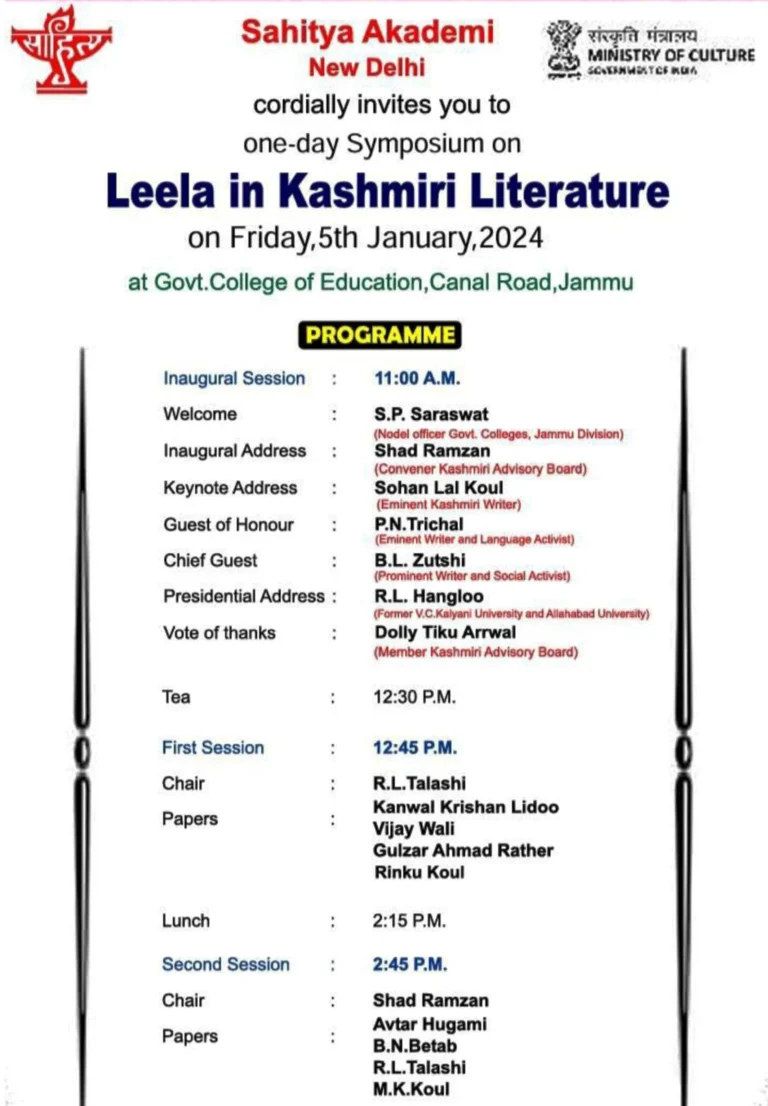
Sahitya Akademi’s efforts to preserve Kashmiri Leela

As part of its outreach programme, Sahitya Akademi New Delhi organised an impressive two day function at Jammu (January 5-6, 2024) to incorporate views vis-a-vis the current literary paradigms of Kashmir’s displaced writers community. The meet also carried forward the need to preserve the literary heritage handed over to the communities through “Kashmiri Leela – “the land’s native devotional poetic genre that has assumed spontaneity in the folk culture of Kashmir and an acceptance unsurpassed.

While distinguished guests like Prof. R.L.Hangloo, (Former Vice Chancellor of Kalyani and Allahabad University) an erudite scholar himself of the discipline of History presided over the function, Professor B.L.Zutshi (History, Kashmir and JNU Delhi) was the Chief Guest. Prof. P.N. Trisal was invited as a Guest of Honour.

  In his inaugural address, Convenor Sahitya Akademi Board, Professor Shad Ramzan laid bare the contours of the two-day programme and the objective behind carrying out such an exercise. Since the first day’s programme focused on Kashmiri Leela– an evolutionary tradition of more than one and a half millennia, the speaker’s addresses threw light on the robust activity and output generated under it from the thirteenth century onwards under this genre. Both Hindu and Muslim saint poets of Kashmir utilized this to espouse the ardent spiritual values cherished by the communities in Kashmir.

History of Kashmir Leela

Dr. Sohan Lal Kaul, an eminent writer traced the history of Kashmiri Leela from its very inception. His lecture also threw light on the global trends and a comparative study of this devotional experimentation as the unique identity of Kashmir nurtured by Lalleshwari, Nund Reshi up to the stalwart Leela poets like Master Zinda Koul. Dr. Rattan Talashi, an eminent scholar of Kashmiri highlighted the facets of Kashmiri Leela. Both papers were highly acclaimed

The first session  was presided over by prof. R.L Talashi. Prof.  M.Z. Azurda and Prof. Shad Ramzan were also present in the presidium.

Kashmir Rechords Director, Kanwal Krishan Lidhoo, a noted writer and broadcaster presenting his paper on Kashmiri Leelas

Arjan Dev Majboor’s Contribution

Around evening, the session ‘Nari Chetna’ (Female Awareness) revolved around contribution from Kashmir’s less talked yet equally brilliant segment of society – its women poets of today and yore who held fast to their reins of ancestral style and spontaneous delivery.

  Prominent poets such as Nancy Chetna, Kusum Dhar, Rajni Bahar and Santosh Shah Nadaan presented their recitations. Member Sahitya Akademi advisory board Smt. Dolly Tickoo Arwal herself an accomplished poet presented her story.

The convener Kashmiri Advisory Board along with all the members  thanked Professor Shalini Rana of Govt. College of Education Jammu who provided all the support and logistics to conduct this literary meet.

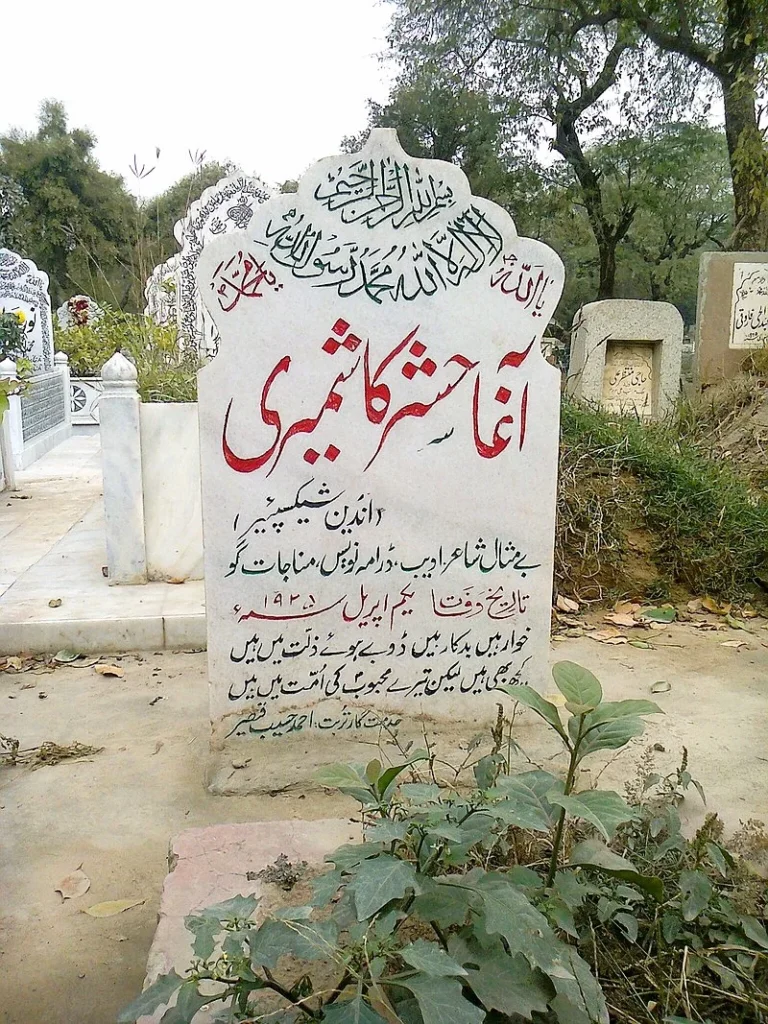
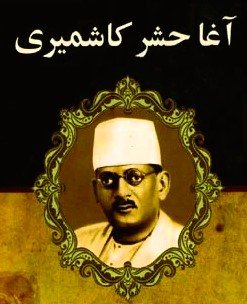
Was Agha Hashar Kashmiri called `Indian Shakespeare’?

The Indian Shakespeare is often considered Kalidasa, a classical Sanskrit writer, widely regarded as the greatest poet and dramatist in the Sanskrit language. But Agha Hashar Kashmiri is one such poet, dramatist and  an author who carries the epitaph of being the `Indian Shakespeare’ on his gravestone at Lahore where he was laid to rest in 1935.

    Born  in April 1879 as  Agha Muhammad Shah in Banaras State of British India, Agha Hashar  was his penname and “Kashmiri’’ attached to his name  for the reason that his father, Ghani Shah  had migrated from Kashmir to Benares in  mid-19th Century  in search of greener pastures.

Agha Muhammad Shah acquired his early education in Arabic and Persian. Later, he was sent to Jai Narayan Missionary School for further studies. However, he left his education incomplete, as he was inclined towards drama and poetry since his early childhood.

    There is a general belief that no history of Urdu drama can ever be complete without a mention of Agha Hashar Kashmiri’s works. None of his predecessors, contemporaries or even the successors could achieve the kind of respect and inimitable success that came to his share. 

Hashar Kashmiri as a Polyglot

Agha Hashar Kashmiri wrote plays in Urdu, Hindi, and Bangla. Some of these were solely created by him but his more important plays that he based on Shakespeare included Shaheed-e-Naaz, Said-e-Hawas, Safaid Khoon and Khwab-e-Hasti. Some of his plays that drew upon the stories of Ramayana and Mahabharata also proved very popular.

This Kashmiri-origin author, dramatist, poet and a writer remained associated with several theatre companies and each one of them valued his talent. He had a distinction to write plays for Alfred Theatrical Company on an initial salary of Rs 15 per month. “Mureed-e-Shak’’, one of his plays for the company was an adaptation of Shakespeare’s play “The Winter’s Tale’’. It proved to be a  grand success and thus fetched him wages of Rs 40 per month. He then wrote several more adaptations of Shakespeare’s plays.

Agha’s First Publication

Agha Hashar Kashmiri had started composing verse at a young age. He  wrote a play `Aaftaab-e-Mohabbat’ (published in 1897) when he was just 18 upon his moving to Bombay for his career as a playwright there.

“Yahudi Ki Ladki’’ (The Daughter of a Jew) (1913), became a classic in Parsi-Urdu theatre and was adapted several times in the silent film and early talkies eras.

Agha’s most popular plays are `Sita Banbas’, `Bilwa Mangal,’ and `Rustom O Sohrab’, a Persian folk story and tragedy. `Safed Khoon’ (White Blood) is his another notable Shakespeare-inspired plays.

Personal life

Agha Kashmiri  was married to Mukhtar Begum, a classical singer from Calcutta and elder sister of Farida Khanum – a Pakistani singer. With the help of his wife, Agha Kashmiri had introduced actor Rani Begum, daughter of their driver, to the show business. Rani later became an actor and dancer of the Pakistani film industry.

Apart from several books to his credit, Agha Hashar Kashmiri was master of Ghasal writing. His one of the popular ghazals is “Mein Chaman Mein Khush Nahin Hoon, Mere Aur Hain Iiraday”.

Agha Kashmiri died on 1 April 1935 in Lahore, British India.

Hassan Kashmiri—Lucknow’s playwright of yesteryears

Meet Our Unsung Heroes

Meet Ghulam Hassan Kashmiri …an unsung hero from Lucknow whose ancestors had settled in 18th century when Nawab of Awadh Asaf-ud-Daulah shifted base from Faizabad to Lucknow in 1775 and made the city his capital. While shifting his Capital, the Nawab had settled a large group of Kashmiris-both Hindus and Muslims in Lucknow.
 Ghulam Hassan Kashmiri belonged to that Kashmiri Muslim family who too had moved to Lucknow and got settled around Kashmiri Mohalla where Kashmiri Pandit families also set foot on Lucknow’s Soil during the same period.
An able actor and an ace  drama artist, Ghulam Hassan Kashmiri was engaged  with the drama unit of All India Radio’s Lucknow Station since its inauguration on April 2, 1938.   Hassan Kashmiri had an ability and art of writing and producing  radio plays as well.

Theatre Personality

Apart from Lucknow’s famous theatre personality, Ghulam Hassan Kashmiri had also associated himself with a group called  “Dast-e-Kashmiri Wazirganj’’, formed in early 1900s in Maqbara Alia Begum in Golaganj area. This group used to  mourn the events of Karbala and of Imam Husain and his family in a unique way, which is still popular in Lucknow and is a living tradition.
Throughout history, there have been countless individuals whose remarkable contributions have been overlooked, overshadowed or forgotten. These unsung heroes, often marginalized due to one reason or the other, have made significant impacts on society, yet their stories have remained largely untold. Amongst these unsung heroes is Ghulam Hassan Kashmiri of Lucknow, for the reason that nothing substantial has unfortunately been written about him.
 While much is being written on already established personalities of Jammu and Kashmir, it is time to shine a light on these overlooked figures, acknowledging their invaluable contributions and ensuring their place in the annals of history. Kashmir Rechords has decided to find such unsung heroes who have been marginalized but deserve recognition for their resilience and contributions to their communities and beyond.
In our last issues of “ Meet Our Unsung Heroes’’, we tried to highlight the contribution of  Vasudev Reh, a far-sighted poet and Kanwal Kishore Jalla, an unsung Ghazal singer from Kashmir who had remained underrepresented in historical records. Today, we have traced out Ghulam Hassan Kashmiri, who had carved a niche for himself in the art of acting and Radio dramas.
Kashmir Rechords appeals to all its esteemed readers, who might know such unsung heroes to contact us with authentic details and send the same on kashmirrechords@gmail.com or support@kashmir-rechords.com. We promise to publish them with due credit to the contributors by amplifying the stories of these unsung heroes. Such stories honour their legacies, inspire future generations, and strive for a more inclusive and accurate understanding of history. It is imperative that we actively preserve the stories of those who have been marginalized, ensuring that their contributions are no longer consigned to the shadows of history.

  State Subject to Domicile: The Journey of Indian Citizenship of  J&K Residents

 (From the Feudal Dogra State through Independent India to the Present-day Naya Bharat)

(By: Dr. S.N. Pandita*)

Introduction

From a State Subject to Permanent Resident and now to a Domicile has been nearly a century-long eventful journey for the natives of Jammu Kashmir and Ladakh as the citizens of India now Bharat. However, given the ethnic cleansing and genocide committed against the minority Pandit community (Hindus) this status now holds very little on ground for the exiled community of the Kashmiri Pandits within the Valley of Kashmir.
Nevertheless, a revisit to the landmark stages of this journey can likely be of some nostalgic interest to the older generation of the exiled KP community in general and for the younger generation, in particular, it is expected to hold some academic and intellectual interest; hence this recall for both the segments of the readers.
(Pic Source: Internet)

Dogra Rule & Outsiders Entering Kashmir

It all began with the advent of the Dogras in Kashmir. Soon after Maharaja Gulab Singh came to the throne of Kashmir in 1846, he appointed Dewan Jawala Shahi, a Khatri from Panjab, as his Prime Minister. With him came a train of Panjabis into the valley.  At the time, practically, there were no educated natives who could occupy various positions, both in the higher and lower ranks of administrative machinery in the State, Jawala Shahi inducted many of his qualified Panjabi favourites to occupy such positions.
(Dewan Jawala Shahi who was the Prime Minister of Kashmir in 1846. Picture Courtesy: Punjab Digital Library )
This arrangement continued through Maharaja Gulab Singh’s rule without a murmur even after the Prime Minister was changed.
Following his death in 1857, Maharaja Gulab Singh was succeeded by his son Maharaja Ranbir Singh who continued with this practice with some additional favour to the Bengalis who occupied several key positions particularly in the judiciary of the State until his death in 1885. Next arrived Maharaja Pratap Singh who had both the Panjabis and Bengalis in key positions of his administrative set-up. Such outsiders were commonly called as Gair Mulki. The result was the coming of many outsiders who received extensive land grants, were placed in many positions of trust and authority. Moreover, the commerce was monopolized mostly by the Panjabis and with the waves of Panjabi settlers immigrating into Kashmir the natives found themselves pushed into background, though the process was slow

Awareness, Protest & Agitation

However, the situation changed when two colleges of higher education and learning; the Sri Pratap College in Srinagar in 1905 and the other, the Prince of Wales College, in Jammu, in 1907 were setup that soon turned-out young college educated natives, mostly Kashmiri Pandit (KP) boys in Srinagar and few Dogras from Jammu   by sometime about 1912 onwards.
It were these young educated natives of the State who now aspired for employment opportunities in the administrative machinery of Jammu and Kashmir. In a way, the Kashmiri Pandits and the Dogra youth joined hands to press the demand for their share in the State’s   administration by way of employment in many suitable positions. The agitation was spearheaded mainly by the Kashmiri Pandits and the Dogras of Jammu. They were first to take to modern education, long before the Kashmiri Muslims became politically active. The main voices of these demands came from the KPs as they felt deprived of their share in the services. The Kashmiri Muslims were not in the picture at this stage.
In 1922, at the instance of Maharaj Kumar Hari Singh, the then Commander-in-Chief of the State Forces and a Senior Member of the State Council and also next in line to the throne constituted a committee to define the term ‘Hereditary State Subject’ and examine the entire question of naturalization in the State.
The heads of all the departments were directed to prepare a list of Mulkies, naturalized Mulkies and non-State Subjects in the State employment. At the time, a circular was also issued that under the signatures of the Maharaja, Pratap Singh, that prohibited a non-State Subject to acquire land in the State. The circular also put a moratorium on the employment of any non-State Subject in the employment of the State without the express permission of the Maharaja.
However, nothing much came out of this exercise without any confirmed official definition of the State Subject. But this nebulous situation forged a greater alliance between the Kashmiri Pandits and the Dogra Sadar Sabha to obligate the Maharaja on defining the term Hereditary State Subject.
In Jammu, the contest came to the fore in the Dogra versus the Panjabi controversy. In Kashmir, the British officers sided with the Kashmiri Pandits against their fight with the outsiders who were mostly Arya Samajis with whom was associated the name of Lala Lajpat Rai.  In fact, the Panjabis were an anathema to the British and, hence, their sympathies lay with the Kashmiri Pandits in their just demands.
It was here that Pandit Jia Lal Kilam, Pandit Shanker Koul, Pandit Jia Lal Koul and Pandit Jia Lal Jalali, all of them fresh from college between the years 1922 and 1924 raised the banner of agitation through outside press for securing the rights of the State Subjects. Pandit Jia Lal Kilam organised public meetings and held conferences both in Jammu and Srinagar under the banner of Dogra Sadar Sabha. This banner of revolt forged some sort of vague nationalism and the educated classes both from Jammu and Kashmir felt a kind of common kinship in this cause.
In 1925, an article appeared in Akhbar-i-Aam published by Pandit Gwash Lal Koul from Lahore highlighting the plight of native Kashmiris under the heading Unemployment in Kashmir. For writing this scathing piece against the Dogra Maharaja, a stern action was taken against Pandit Gwash Lal Koul, he galvanized the voice of educated Kashmiri Pandits to take up the matter further through the Indian Press and pleaded with the educated young Kashmiri Pandit men to carry out a relentless agitation for securing their exclusive employment rights to man the state administration.

State Subject Movement & Institution of the Commission

The State Subject Movement had very distinctive features as it amalgamated both the regions of Jammu and Kashmir on the issue. It was in one of the annual conferences of the Dogra Sadar Sabha held in Srinagar in October 1926 that Pandit Jia Lal Kilam moved a resolution demanding that only those persons be termed as Hereditary State Subjects whose ancestors had been residing in the state since the time of Maharaja Gulab Singh and be given preference in employment over those who were merely residing in the State from its formation in 1846.
This paved way to demand the constitution of a committee which was urged to define the term State Subject in the finality and as early as possible.  Maharaja Hari Singh appointed a Commission under the chairmanship of General Janak Singh, the then Revenue Minister to define the term. This Commission comprised both the officials and non-officials besides the representatives of the natives and outsiders with broad representation given to all the section of the population of the state including the Kashmiris, the Dogra and the Panjabis.

The First State Subject Notification

The Commission submitted its report in 1927 defining the term State Subject. Following this recommendation, the Private Secretary to Maharaja Hari Singh, P.K. Wattal (Pyare Krishen Wattal) issued a Circular Order dated January 31, 1927 by command of His Highness the Maharaja Bahadur that read:
“His Highness the Maharaja Bahadur has been pleased to command that in future in the case of every new entrant into State Service the authority empowered to make the appointment should certify that he has satisfied himself after due enquiries that the person appointed is a hereditary State subject. Further, that in the absence of such a certificate the Accountant General should not pass the pay bill of such State servant without the definite orders of His Highness in Council to the contrary.
“For the purpose of this order the term “Hereditary State Subject” will be held to mean and include all persons born and residing within the State before the commencement of the reign of His Highness the late Maharaja Gulab Singh Sahib Bahadur and also persons who settled therein before the commencement of Samvat 1942 (1885 AD) and have since been permanently residing therein. The certificate will be given after due enquiries by the Wazir Wazarat in whose charge the candidate for State service resides and the form of such certificate should be submitted by the Accountant General for the approval of His Highness in Council. In the meantime, this order will have effect from the date of issue, namely 31st January 1927.”

The Second State Subject Notification

(The State Subject Certificate makes a mention of a Govt Notification No 84 of the Judicial Department, April 20, 1927.Pic Kashmir Rechords)
A little less than three months later a Government Notification No: 84, of the Judicial Department, to this effect was issued on April 20, 1927 by the Judicial Minister Nazir Ahmed which read:
“ The following definition of the term “State Subject” has been sanctioned by His Highness the Maharaja Bahadur (vide Private Secretary letter No; 2354 dated 31st January 1927, to the Revenue Member of Council) and is hereby promulgated for general information:-
“Class I– All persons born and residing within the State before the commencement of the reign of His Highness the late Maharaja Gulab Singh Bahadur and also persons who settled therein before the commencement of Samvat year 1942 (1885 AD) and have since been permanently residing”.
“Class II– All persons other than those belonging to class I who settled within the State before the close of Samvat year 1968 (1911 AD) and have permanently resided and acquired immovable property therein”.
“Class III – All persons other than those belonging to class I and II permanently residing within the State who have acquired under a Rayatnama any immovable property therein or who may hereafter acquire such property under an Ijazatnama and may execute a Rayatnama after ten years’ continuous residence therein.”

Notes to The Notification

The Notification further carried two Notes and read:
Note (1) “In the matter of grants of State Scholarships, State land for agriculture and house building purpose and recruitment to State Service, State Subject of class I should receive preference over other classes and those of class II over class III subject, however, to the order dated 31st January 1927 of His Highness the Maharaja Bahadur regarding employment of hereditary State subjects in Government service”.
Note (2) “The descendants of the persons who have acquired the status of any class of the State subjects will be entitled to become the State subjects of the same class. For example, if A is declared a State subject of class II his sons and grandsons will ipso facto acquire the same status of class II and not of class I”

The Third State Subject Notification

Subsequently, vide another Notification dated June 27, 1931, one more Class of State Subject and one more qualifying Note was added as Class IV State Subject and Note 3.
The Class IV State subjects were defined as:
“Companies which have been registered as such within the State and which, being companies in which the Government are financially interested or as to the economic benefit to the State or to the financial stability of which the Government are satisfied, have by a special order of His Highness been declared to be State subjects”.
The Note 3 read:
 “The wife or a widow of a State Subject of any class shall acquire the status of her husband as State Subject of Class as her husband, so long as she resides in the State and does not leave the State for permanent residence out-side the State”.

State Subject Certificates for Employment Only

Evidently, the State Subject Certificates issued under the Notification dated 31st January 1927 of the Private Secretary to His Highness Maharaja Bahadur Hari Singh became paramount in securing employment in the state Government.
After the establishment of this definition in 1927, every entrant into the State Government service was required to produce a certificate of his being a hereditary State subject of Class I. Such certificates were issued by the Wazir Wazarat in whose jurisdiction the candidate happened to reside.

Curse for Pandits & Boon for Muslims

Parenthetically, it was the Kashmiri Pandits, whose untiring efforts including the agitation “Kashmir for Kashmiris” in the 20s of the last century led to the implementation of the State Subject Law, yet “ultimately the definition proved boon for the majority community”, the Muslims of the State and curse for the Kashmiri Pandits in the following decades because of the vicious communal politics that played out in the post-independence era.

Format & Purpose of Early State Subject Certificates

The earliest State Subject Certificates were simply titled: “Certificate of Hereditary State Subject”. These were essentially issued only for the purpose of employment of the candidate in the State Service. Such certificates expressly stated the name of the candidate and his residential address and also declared his being a candidate for employment in the particular department in which he had or would apply for employment and being a hereditary State Subject of Jammu and Kashmir territory “within the meaning of Private Secretary to His Highness the Maharaja Bahadur’s Notification No: Nil, dated 31st January 1927”.
Such certificates were issued by the Wazir  Wazarat on the basis of his enquiries and how he had satisfied himself that the candidate had fulfilled the criterions of the Notification dated 31st January 1927.
The present writer has perused two such certificates extant presently. The first one bears No: 71 issued on November 27, 1929 under the signatures of the then Wazir- Wazarat Sri Ram.
This certificate is issued on the attestations of Prof. Radha Krishen Bhan and Prof. Nand Lal Koul, both Professors at S.P. College, Srinagar and Pandit Jia Lal Kilam, then a Pleader at the Maharaja’s Court who later rose to become the Judge of the High Court of Jammu & Kashmir and came to be famously known as Justice Kilam.
In that sense this certificate is uniquely historical for being issued on the attestation of Pandit Jia Lal Kilam who was the main architect of the State Subject Law as detailed in the earlier parts of this paper.
The second certificate bears the title: “His Highness’ Government, Jammu And Kashmir” is issued on August 12, 1930 under the signature of Wazir Wazarat S.N. Raina. The certificate is issued on two criterions; firstly, on the record of Certificate No: 71 dated November 27, 1929 and also the Wazir Wazarat knew the applicant personally.
However, subsequent to the State Subject Notification dated   April 20, 1927 the candidates were also issued certificates of being State Subjects of Class I, II and III within the meaning of the Judicial Department Notification No: 84 dated the 20th April 1927 and Class IV vide Notification dated June 27, 1931. Such certificates allowed the candidate to acquire State land for agriculture and house building purposes and avail State Scholarships for educational purposes.
The fundamental criterion for the issuance of such certificates was that the candidate’s cast was not declared as Non-Agriculturist in Gazette dated June 29, 1934. Presently a State Subject Certificate of Class I category of Hereditary State Subject issued on January 29, 1937 by the Tehsildar Khas, Southern, Srinagar vide office File No; 1305 of 1937 still survives.

Permanent Residency Certificates

These definitions of State Subjects were later adopted and subsumed, essentially unchanged into the term “Permanent Residents” in the Jammu and Kashmir Constitution adopted on November 17, 1956 which came into effect on January 26, 1957 in conjunction to  Article 370 of the Indian Constitution adopted on  October 17, 1949. All persons who were State Subjects as on May 14, 1954 were deemed as Permanent Residents of the state.
From then onwards, while the validity of the State Subject certificates continued to remain effective a revised certificate of Permanent Residency also came into vogue as defined under Section 6 of the Constitution of Jammu and Kashmir. Such certificates were issued under the signature of Deputy Commissioner of the respective divisions of the state.

State Subject Certificates with Riders Issued to Kashmiri Pandits

( Permanent Resident Certificate issued for the purpose of seeking Government Employment only. Pic: Kashmir Rechords)
By late 70s of the last century, the main criterion on which such certificates were issued to Kashmiri Pandits were for the “Purpose of Training Only”. In the case of the female Kashmiri Pandit holders, an additional rider was put with the remarks “Valid till Marriage” subsequent to the incorporation of Article 35 A in the Indian Constitution adopted in sequel to the 1952 Delhi Agreement reached between Pandit Jawaharlal Nehru, the Prime Minister of India and Sheikh Mohammad Abdullah, the Prime Minister of Jammu and Kashmir on July 24, 1952.
( Permanent Resident Certificate of an unmarried Hindu girl with a rider “Valid Till Marriage”. Pic Source: Internet)

Annulling the State Subject & Permanent Residency Certificates

For subsequent several decades both the State Subject Certificates issued  during the Dogra Period of Maharaja Hari Singh and the Permanent Residency Certificates issued thereafter in independent India by the Government of Jammu and Kashmir for the  permanent residents of the State remained as valid documents until  they were annulled by scraping Articles 370 and 35 A of the Indian Constitution by a Parliamentary Act on August 5, 2019 along with which the State was also bifurcated into two Union Territories, the UT of Jammu and Kashmir and  the UT of Ladakh.

Birth of Domicile Certificates

Subsequent, administrative orders issued by the Government of the UT of Jammu and Kashmir replaced the State Subject Certificates and Permanent Residency Certificates with a common Domicile Certificates. According to the laid down rules and prescribed procedures all the holders of the State Subject Certificates and Permanent Residency Certificates were granted Domicile Certificates.

Domicile Certificates to Other Non- Permanent Resident Categories

(Domicile Certificate of Navin Choudhary, a bureaucrat from Bihar who had become J&K’s first non-local domicile in June 2020. Pic Source: Internet)
However, other non-permanent residents of the State, or outsiders have now also been made eligible to become Domiciles of Jammu and Kashmir subject to the laid down new criterions. These include all persons and their family members who serve in Jammu and Kashmir and belong to all the categories of the Indian Civil Services like, IAS, IPS, IFS, IRS etc ; persons and their family members belonging to military and para-military  forces;  any person who studies in Jammu and Kashmir up to class VII and necessarily  has passed Class 10 Examination of  any Educational Board be that of State or Central and persons who have a continuous residency of 15 years and more in the Union Territory shall also become eligible for Domicile Certificates of the Union Territory.

Introduction of Watermark Seal in Domicile Certificates of Exiled Kashmiri Pandits

It may be noted that all previously issued State Subject Certificates and Permanent Residency Certificates were issued on normal printed stationary of the Government without any Court of Arms of the Dogra insignia or the State logo of Jammu and Kashmir.
(Domicile Certificate of a Kashmiri Pandit migrant Student, issued by Relief and Rehabilitation Commissioner, Jammu under Clause 4-b. Pic: Kashmir Rechords)
However, the latest Domicile Certificates issued to the members of the exiled Kashmiri Pandit Community bear a printed watermark seal of the lion of the national Ashoka Pillar and the certificates are issued under the signatures of Relief & Rehabilitation Commissioner (Migrant)

State Subject Movement & Trinity of Jia Lals

Looking in retrospect it will be evident to readers that the crusade of awareness, protest and agitation that finally culminated in the promulgation of the State Subject Law was inaugurated by Kashmiri Pandits. However, what appears to be divinely coincidental is the fact that the Movement for State Subject that was started by four Kashmiri Pandits; and three of them were named Jia Lal (Kilam, Koul and Jalali). The fourth one was Shanker Koul.

* Dr S. N Pandita is a noted Author, Writer and Researcher with nine books and about 80 research papers to his credit. He has   attended five  International and 15 National Conferences; Scores of Seminars, Lectured at SAALG, British Library, London, PRASADA, University of Leicester, UK , Universities of Luton, Leeds, Birmingham, UK  &  Nehru Centre, London.  
 
     Academic qualification: Ph.D. (D. Phil); Bodleian Reader, Oxford. Principal Research Investigator, HLF-KBC Sir Aurel Stein Kashmir Heritage Project, U.K. ;
 
Awards & Recognition:  Atisha Award 2001; Man of The Year-2004, (American Biographical Institute); Listed to 2000 World Intellectuals, 2004 (  International Biographical Centre, Cambridge, UK)
 
Academic Field : History, Heritage, Culture, Language & Literature of Kashmir.( Inter-Disciplinary & Trans-Disciplinary Studies)
 
Specialization & Expertise: Collaborative Interface of Scholarship between the Western & Kashmiri Scholars during the 19th and 20th century. (Dogra Period) &  Currently Unknown and Defunct Kashmiri Numeral System developed and used during the Dogra Period.
 
* Dr. S. N Pandita asserts his Copyright on the entire text  of the article under the main heading “State Subject to Domicile: The Journey of Indian Citizenship of  &K Residents  (From the Feudal Dogra State through Independent India to the Present-day Naya Bharat)  as its  author.

Englishman’s 1847 travel to Kashmir (Part 3)

( By: Kanwal Krishan Lidhoo*)

Kashmir Rechords in its previous blogs dated 9th and 12th December 2023 had mentioned an Englishman’s visit to Jammu and Kashmir in 1847 recorded in the form of daily entries called ‘Roznamcha’ by one Pandit Kanhaya Lal Aashiq Dehalvi and later published under the title Sair-e-Kashmir and we had in two of the previous episodes brought to our readers very significant historical details regarding prevailing socio-political conditions. Not only do these details appeal to the common reader but the students of history also got invaluable insights into the geography and strategic situation of the formative phase of the rule of Dogra kings when they ruled the region called “Jammu Kashmir Ladakh and Tibbet Ha”.

The previous  two blogs carried the information about the travel from Englishman’s 1847 travel to Kashmir via Jammu  dated  9th December 2023, to be accessed  at:https://kashmir-rechords.com/englishmans-1847-travel-to-kashmir-via-jammu/ and  next  Englishman’s 1847 travel to Kashmir via Jammu, Rajouri, published on 12th December 2023, to be accessed at: https://kashmir-rechords.com/englishmans-1847-travel-to-kashmir-via-jammu-rajouri/

The book is a compendium of daily entries of his accounts in his diary during travel, which was undertaken by Pandit Kanhaya Lal Aashiq Dehalvi along with an Englishman named Mr. Winter Bedim. Pandit Kanhaya Lal Aashiq was a resident of Akbarabad Sialkot (now in Pakistan) who sought employment in the office of the then-British Agent in Lahore, Colonel Lawrence due to his proficiency in the English language.  Thus, he wrote this travelogue also for the Englishman, with whom he had traveled to Kashmir via Jammu.  “Sair-e- Kashmir 1278 AH” is written on the cover of the Book having 41 (forty-one) pages. The travelogue is between the periods of   April 1847 to June 1847.

From here we are continuing with the third portion of the travelogue as follows:-

On 9th May, 1947 we reached Kulgam which is at a distance of six kos from Acchabal. We would often come across springs and innumerable water bodies. Since Kulgam is situated in Devsar Pargana on the banks of the river called “Vishaw” the volume and flow of water at this place is very large. One Fatu Chowdhary (probably Fatehdin) came to see us.

On the 10th of May, 1847 we reached “Chowgam” where we camped. At about a distance of four kos lies a spring, rather a geyser that sprouts water at least one meter high into the air. Thus a constant stream of pure and clean water emanates from it. The local population whenever inclined to celebrate their happy occasions do come to the banks of this river and cook their delicacies. The powers of digestion of this water are legendary and are said to be such that one can devour a whole lamb. Due to personal reasons, however, I couldn’t test the powers of these waters. This spring is known as “Vasuk Naag”. On our return, we got caught up in a vicious hailstorm which caused such an indescribable suffering and threw everything into disarray. We got drenched in the rain and hailstorm and since we had no extra pair of clothes with us the cold also pounced on us severely. We did however finally make up to our place during the night where we warmed ourselves thoroughly. In between the” Chowgam” and “ Vasuk Naag” areas, we saw another spring at a place called “Razlu” but it is not as big as “VasukNaag”. At our place, an inherently warm person with a very cheerful disposition who works as a cook came to see us. This man is used to visit Lucknow and other places and has some experience in dealing with foreigners. Though he is Lachhi Ram he is rightly called Lateef. This man divulged the information that whosoever arranges for cooking a lamb doesn’t encounter any problem whatsoever. Our plight during the day may have been the result of the same. I admonished him about the fact that he could have warned us in advance.

Due to continuing rains and hailstorms that ensued we couldn’t move out of  “Chowgam” on the 11th, however, on the 12th of May 1847, we started our journey again and when we were about to reach “Shahbad”  we came across a spring known as “Bararat” and another one nearer to it known as “Kananag”. The locals of the village revealed to us that nearly every single fish residing in the spring is one-eyed which gives the spring its name. But I couldn’t notice any such thing. Later in the day when we were at a distance of about one kos from Shahbad the “Kaardaar” of the Shahbad area Noor Shah accompanied by the local “Kotwal” came to see us. Chats followed all the way to Shahbad and mainly centered on the details of running the administration. Upon reaching Shahbad we later proceeded towards an adjoining place called “Dooru”.

Camping at `Ver Naag’

We camped at this place and later proceeded to “Ver Naag”. The rest of the Indians call it “Beri Naag”. This place has the largest flow of clean water which presents an astonishingly wonderful and pleasing sight. A strong wall has been constructed around its periphery by the orders of King Jahangir. A Persian inscription stands engraved outside this periphery in a small hut.

The inscription mentioned above goes like this.-

“The ruler of the seven lands who is known for his legendary dispensation of justice Emperor  Shahenshah Abul Muzaffar Noor- u- din Jahangir son of legendary king Akbar the Great has in the fifteenth hundredth year visited this spring and on his majesty’s orders only could the work on the wall get completed. It is due to his Majesty King Jahangir King Shah Akbar Shah’s grace that this building has touched the skies. The wise king arranged this foundation around here in `Verinaag’. It is Almighty’s grace that on orders of the ruler of seven worlds such a cascade got built reminding us that the stream originating from heaven brought grace to Kashmir. The mysterious sounds emanating from heavens issuing forth through its waters finds mention in this inscription.”

Later in the day we returned to our abode and spent the night in the company of Noorshah Kaardaar.   (To be continued)

===

*Kanwal Krishan Lidhoo, an accredited translator of Kashmiri, Urdu, and Hindi by Sahitya Akademi New Delhi and Indian Institute of Languages Mysore,  is associated with the institution of All India Radio (AIR) where he worked as a Senior Producer. During his career of more than thirty years in AIR, (including Radio Kashmir Srinagar and Radio Kashmir, Jammu),  he has produced hundreds of programmes covering a wide range of topics and interests that range from ‘Features’, ‘Dramas’ , ‘Literary Magazines’ , ‘Current Affairs’ and overseen Music recordings. He also has the professional expertise of anchoring live shows and News.

His books of Translation include:

1. “Samay Matrika” … Translation of 10th century Sanskrit classic of the same name by Acharya Ksemendra of Kashmir.

2. Sahitya Akademi New Delhi’s “Hum Kaal Sindhi Afsana Sombran” a Kashmiri translation of Hindi scripted ” Samkaleen Hindi Kathayen”, and under publication “Navi Yogikie Vaaeris Dar” a Kashmiri translation of English scripted collection of Punjabi short stories of renowned Punjabi short story writer Mohinder Singh Sarna.

 3. Indian Institute of Languages publication “Hindustaenie Falsafekie Khad-o-Khal” …The Kashmiri translation of “Outlines of Indian Philosophy” by world-renowned Professor M.Hiriyanna.

4. The Writer of the Monograph on veteran and doyen of Kashmiri poetry, Makhan Lal Kanwal…. Sahitya Academy Publication, Delhi  

Kanwal Krishan Lidhoo is also a short story writer in Kashmiri. In addition, he has presented a number of essays in Kashmiri

December 28 and Kashmiri Pandits

December 28 holds an important significance in the history of Kashmiri Pandits following their exodus from Kashmir. It is on this day in 1991 that Panun Kashmir, besides raising other demands, adopted a Margdarshan Resolution for a separate homeland for Kashmiri Hindus within Kashmir. On the same day in 1993, the first ever World Kashmiri Pandit   Conference was held in New Delhi.
All India Jan Sangh President Prof Balraj Madhok was the chief speaker during Margdarshan 1991 seminar where he batted  for separate States for Jammu and Ladakh besides abrogation of Article 370.
While Article 370 has since been abrogated, Ladakh has been carved out as a Union Territory and Jammu is yet to get its due—-so are Kashmiri Pandits craving for a separate homeland!
A demand for a Union territory for Kashmiri Hindus was also raised during the first ever World Kashmiri Pandit Conference held in New Delhi on December 28, 1993. Resolutions like setting up of a Sharda University in exile and setting up of Kashmiri culture data resource base have remained confined to this conference only.
Kashmir Rechords is reproducing the newspaper cuttings of both December 28, 1991 and December 28, 1993 for the benefit of our esteemed readers.

P N Bhat—first journalist killed in Kashmir

(By: Dr. Rajesh Bhat)

Late Shri Prem Nath Bhat, the first journalist killed during Kashmir turmoil, has become the icon of Political Groups as well as individuals against religious fundamentalism and ethnic cleansing of a vulnerable minority like Kashmiri Pandits. In life as well as in death, he was able to forge a remarkable unity and was the torchbearer of service to humanity without the consideration of religious, political or other ideological differences. Late Sh Prem Nath Bhat ably fits into the definition of an awakened soul who besides possessing brilliant qualities of head and heart to lead, stayed put in Kashmir, thus defied the terrorists, who ultimately took his life.

 December 27, 1989 is a Black Day in the history of Indian Nation, when this great son of Kashmir was gunned down in open defiance of ethos of India and centuries’ old value system of Kashmir that was constantly showcased as a model one, which got blown to smithereens.

 While Tika Lal Taploo and Neelkanth Ganjoo where killed in  September and November 1989 respectively, Prem Nath Bhat was the third prominent Kashmiri Pandit who fell down to terrorists’ bullets. He was chosen because he took up the community’s cases on a pan–India level, built institutions, protected temples and properties and impressed upon authorities to remove the fear psychosis prevailing among Kashmiri Pandits in the wake of 1986 Anantnag riots. During 1989-90, when anti-national activities were at peak in the valley, Prem Nath Bhat was advised to leave Kashmir even by his Muslim well-wishers. However, as brave as he was, he did not pay much heed to these warnings and continued to stay put in Kashmir.

P. N Bhat’s last write-up

Sh Prem Nath Bhat was not only an Advocate, but also an accomplished journalist, having keen sense of socio-political issues and dangerously changing dynamics of Kashmir. Among the journalists of Kashmir, he was the first to who fell down to terrorists’ bullets.

Apart from functioning as a Correspondent for Daily Excelsior from Anantnag, he used to contribute by writing brilliant write-ups for Op-ed page and weekly magazine of the newspaper. He was deeply influenced by Saint Shri Rama Krishna Paramhans and his chief disciple, Swami Vivekananda, which is borne by the fact that he served humanity and lead socially reconstructive missions.

 Few days prior to his killing, we at Daily Excelsior had a chance to have a final meeting with him where he was a regular visitor and it is here that his journalistic acumen got known to friends and well-wishers alike. Incidentally, on last visit of his, he had handed over a written piece to be scheduled for inclusion around National Youth Day, coinciding with Swami Vivekananda’s birthday. And the same was published as a tribute to the memory of this great soul in Sunday Magazine of Daily Excelsior on January 7, 1990. It incidentally was his last write-up which was published posthumously. Kashmir Rechords is reproducing Sh Bhat’s last published write-up.

Born in 1932 in a middle-class family, Pandit Prem Nath Bhat was popularly known as ‘Bhat Sahab’. He studied at Amar Singh College and S P College Srinagar and used to actively participate in debates and social work.

 Kashmiri Pandit community observes 27th of December as Chetna Divas every year in memory of Late Prem Nath Bhat and other martyrs. Prem Nath Bhat Memorial Trust has been spearheading a movement for the passage of Temples and Shrine Bill also. It further acknowledges the contribution of journalists and accordingly confers an annual award in this respect.

Sharda Peetha—The Resurgence

(By:Kanwal Krishan Lidhoo)*

 In response to   Kashmir Rechords’ Blog dated December 20, 2023 under the title “Sharda Peetha- Victim of Willful Apathy’’, (to be accessed here : https://kashmir-rechords.com/sharda-peetha-victim-of-willful-apathy/) , some of our esteemed readers came up with their quality information and opinions. By incorporating these views, Kashmir Rechords believes that not only will great value be added but also hitherto unknown facts presented in the wake of renewed interest and shared objective to protect our heritage will also get a place under the Sun. Kashmir Rechords therefore is reproducing these views   and also attempting to assess the present position in terms of reclaiming the spirit of Sharda. It may be added that four exhaustive books containing comprehensive research material on Sharda will have to be accessed to. Interestingly one of the books has itself originated from historical Sharda Mai village in Pakistan Occupied Kashmir (PoK).

    Dr S N Pandita, noted historian and author of several books and research papers on Kashmir, has drawn attention  to  photograph of  a man in Kashmiri pheran and turban   in the foreground of  Sharda Temple doing rounds on social media. The photograph has been attributed to the year  1893 AD  when it was clicked by Sir Aurel Stein.  According to Dr Pandita, based on his extensive research, by accessing Stein’s photo-collection held at the Bodleian Library, University of Oxford in 2004 and subsequently used by him in the KBC- HLF, Sir Aurel Stein Kashmir Legacy & Heritage Project, supported by Oxford University, of which he was the Principal Research Investigator, it is mentioned that the photograph was taken by Sir Aural Stein in 1940 and not in 1893. Kashmir Rechords has accordingly amended the date.  

    While appreciating Kashmir Rechords’ write-up, Dr Vijay Sazawal, an eminent  policy analyst  having a keen sense of changing dynamics in Kashmir and a member of NGO accredited to United Nations Human Rights Council,  states that he got involved in Sharda  heritage site some two decades back when he had a chance to interact with the Speaker of PoJK Assembly.  His insights reveal that the place existed as a scholarly retreat, perhaps a discussion hall, a library, a stupa, or a temple – all very likely Buddhist in character and shape with Sanskrit as its main language. At some stage in time, the place took on Hindu character as Hinduism re-spread in the area. “It is my belief that it was Lalitadatya that built the only archeological building still standing there as its resemblance to the Martand Temple is uncanny.  Adi Shankaracharya visited there and many believe that there was actually no Goddess figure in the inner sanctum but a large sacred black rock that represented Goddess Sharda. The temple went into despair through the Muslim period, and when the first Britishers saw it just before the Dogra period, it was an abandoned place without any roof and much like how it is now. Subsequent explorers saw a makeshift roof and priests, probably catering to religious needs of Maharaja’s Army that was camped there on the other side of Kishenganga. The temple complex probably stayed that way until 1947, though some structures may have been added to shelter yatris who used to go there frequently given that one has to climb many steps to reach to the site.  The site was and is rather isolated because of its poor access which is actually a blessing’’.

   Dr Sazawal is also of the opinion that since no access presently is being accorded to pilgrims and researchers, the need for renewed interest will always fascinate the academic community as well as world communities. And it is in line with this that Kashmir Rechords laid hands on four quality books containing extensive and worthy material on Sharda.

“Aagar Naeb’’ authored by Moti Lal Saqi

One of the most wonderful books published in 1998 contains rarest of the rare facts about Kashmir. Scripted in original Kashmiri (Nastalique), it compiles almost every topic under the sun pertaining to Kashmir. While deliberating on renowned and famous polymath Al-Beruni, Moti Lal Saqi refers to the former’s account about Sharda as follows:

“The brilliance of Kashmiris forces us to agree that during Al-Beruni’s time, the opinion of Kashmiri scholars was tantamount to according certificates and during 11th century AD, Kashmir continued to be known as Sharda Desha. Whatever stood rejected by Kashmiris would not find acceptance anywhere’’—(Page No 107).    

Saqi further adds that in “Kitabul-Hind’’, Al-Beruni mentions about Sharda script and comes out with very interesting facts in this regard. “The common alphabet in use is Sidhmatrika about which it is said that it originated in Kashmir. Even though it is used to some extent in Varanasi, both regions are however considered origin of knowledge. Sharda script    was derived from Sidham which essentially is a version of Brahmi. Sidhmatrika script was used from Kangra to Kabul and Central India. Gurumukhi and Bodhi scripts are actually derived versions of Sidhmatrika (Sharda)’’—(Page No 108).

Sanskrit Scripture in Sharda lipi engraved on a stone found near Doabgah, Sopore, Kashmir,pertains to King Jaisimha, 1149 AD

Sharda—Tareekh Ke Irteqayee Marahil’’  (Sharda—Historical Stages of Its Evolution) – 2009, authored by  Khawaja Abdul Gani, R/o Khawaja Seeri, Tehsil Sharda, Dist Neelum ( PoK), published by Verinaag Publishers, Mirpur ( PoK)

This book ( Urdu)  compiles every other detail from whatever source, the author could lay his hands on, ranging from  Sharda Mahatmya to Raj Taranganis by Pt Kalhana, Jonaraja  and Shrivara and also  travelogues and research material from Col Bates, Buhler and Sir Aurel Stein and many other historical accounts. Most of the information contained in the book is useful, considering the fact that the same has been ascribed to some or the other source. The author on page 74 of the book mentions that, it is a pleasant surprise to note that in addition to Hindu pilgrims, the Muslim population of the area equally used to pay obeisance and offerings to the Shrine.  They also used to recite Sharda Vanadana while making circumambulations around the Temple area. A door to the Temple existed up to 1947 but as per author’s version, some ``Kaghan’’ tribal highwaymen from North-Western Front, probably Qabalis, destroyed the same.  The boundary wall of the shrine is mostly without a trace. The Book also quotes  Justice S N Kathju’s visit to the Shrine in 1935 wherein the noted Judge is said to have recorded that there may have been a  fabulous staircase, the construction of which is second to none. It appears that this staircase must have been destroyed when the area came under some earthquake. Justice Kathju is also on record to have mentioned that Sharda University must have existed only in the vicinity of this great temple. Justice Kathju puts on record, “I visited the Sharda Devi Shrine along with my late grandfather-in-law, Dr Bal Krishan Kaul in the summer of 1935. The Shrine is located on a hilltop like the Shrine of Jawala Ji. The steps leading to the top of the hill, appeared to be twisted as if they had been battered by an earthquake. The question as to when did the University township cease to exist, requires investigation. It was in the shrine itself that I first met late Pt Shridhar Joo Dhar, who had become my guide and philosopher in the closing year of his life’’…. ( Excerpts of the Article on Kashmir Tantrism by Justice S N Kathju, published in Shaivism.net.)

Remnants of Sharda Teerath (above) and Sharda village in the vicinity

 The author of “Sharda—Tareekh Ke Irteqayee Marahil’’ at page numbers 77 and 78 makes an important case for the Sharda sanctum sanctorum.  Quoting Brigadier Rattan Kaul, he says that the Central place of the temple is the same place where the Mother Goddess Sharda is said to have revealed herself to Muni Shandiliye and immediately absorbed herself in the pious spring, known as Amrit Kund.   As per the book, Stein is also said to have witnessed a slab ( 8X8 feet) covering this pious Kund. Many historians including Michael McQueen have opined that this stone slab incorporated 43 angles of Shri Chakra and it is the same place where Adi Guru Shankaracharya acquainted himself with this esoteric knowledge and brought it to the notice of the world. This stone no longer exists now and it is believed that the same may be lying embedded under the sanctum sanctorum. The Book also reveals a number of other insightful facts upon which the scholars can carry out further work.

`Sharda Peeth—Tareekh Ke Aayene Mein’ authored by Raja Nazar Booniyari, published from Baramulla, Kashmir.

This book more or less revolves around Sharda pilgrim site and seems to be a collection of verbatim quotes of predecessors including Khawaja Abdul Gani. Since the author’s 2019 visit to at Sharda, PoK where he interacted with the local populace, his travelogue juxtaposes the present socio-political oeuvre.

Brigadier Rattan Kaul’s recent book “Goddess Sarada(Sharada) of Kasmira (Kashmir)-Adi Shankaracharya Buddhism-Sharada Civilisation Connect-Facts And Myths centers around Adi Shankaracharya’s visit to Sharda Peeth where the myth and hard realities get interwoven to give marvelous interpretations to Advaita and Buddhist thought  processes  whose  synthesis and praxis  both got  nurtured in Kashmir.

Save Sharda Committee, Kashmir

It appears that the ways of the providence are stranger than fiction. As Sphinx rose from the ashes, so has the spirit of Sharda energised communities across Indian Sub-Continent to reclaim the glorious heritage associated with it. With fire in the heart, many individuals and organisations  have incessantly worked in this direction. The  impressive and the most prominent among them is Save Sharda Committee Kashmir . Its founder member, Mr Ravinder Pandita  has been in the forefront of the efforts to mobilise support both in India and Pakistan-Occupied Kashmir, so much so that he has created peace constituency even across Line of Control where  his efforts have been hailed by the general public and surprisingly supported by bureaucracy also. His efforts to  motivate  the activists for reclaiming Sharda in PoK is borne by the fact that  residents of Sharda tehsil  have submitted  representations to the Government and judiciary. It appears that there is an  urgency to save and reclaim Sharda Teerath most of which may be motivated by reaping the benefits of bringing the place on the international pilgrim tourist map but for Pakistan Army which seems to act like a spoke in the wheel for obvious reasons of the ideological baggage  that this institution still carries against India and its own inability to come to terms with changing  global trends.

Mr Ravinder Pandita has also taken up the matter with GOI for bringing an amendment in LoC permit rules by way of addendum to include annual pilgrimage to Sharda Peeth on the lines of Sikh pilgrimage to Nankana Sahib in Lahore that is held annually and now the Kartarpur yatra.  “We at Save Sharda Committee are pressing for cross LoC Heritage and  Religious tourism that should bring people closer. People of PoK should also be allowed pilgrimage to our part of Kashmir in J&K state’’, says Mr Pandita .

Mr Pandita got another shot in the arm when he received a positive reply to his representation from  Supreme Court of PoJK. The goodwill generated by Mr Pandita’s efforts have motivated the Civil Society at Sharda, PoK so much so that it is on his insistence that ritualistic pooja in absentia was performed by natives of Sharda village and peace enthusiasts many a time.  The visit of Dr. Ramesh Vankwani with a delegation of five Pakistani Hindu Council members on 24 June ‘2019 to Sharda Peeth was also historical and  in consultations with Save Sharda committee. A coordinated move by  Save Sharda Committee sent a Hong Kong based couple Venkataraman and Sujata, who performed Puja near Sharda on the banks of river Kishenganga on 4th Oct.’2019. It was the first ever puja since 1948 in Sharda Land.

The staircase leading to the Shrine.

The Save Sharda Committee  also got successful in installing the statue of Mother Sharda at Teetwal,  Jammu and Kashmir. A pilgrim site at Teetwal used to exist en-route Sharda Teerath before partition and now a newly constructed grand temple is visible even from PoK.

 Century’s Wait… Indian Railways Finally Does It!

(By: Dr. Rajesh Bhat)
Indian Railways with the completion of construction of all tunnels on Udhampur-Srinagar-Baramulla  (USB) Rail Link is finally going to fulfill the long and cherished dream of Dogra Rulers to connect the two diverse regions of their much–loved State, Jammu and Kashmir, which they governed with missionary zeal.
Northern Railways, in a press handout on December 21, 2023 has emphatically made clear that the tunnel links between Katra and Reasi stations stand successfully completed and thus the all-weather railway link is going to be functional anytime. The same undoubtedly is a proud accomplishment considering the difficult geo-physical contours including the rugged terrain which presented a real and formidable challenge. Also, the fact that all this stands completed in a record time to the best of international safety norms is no mean achievement. The construction of the 18-km stretch of this ambitious and vital project in Kashmir Valley between Qazigund and Anantnag was already completed in 2009.

Maharaja’s Cherished Dream

It was Maharaja Pratap Singh  who first stressed the importance of exploring  the possibility of a railway line connecting Jammu and  Srinagar in 1898 but financial constraints and non-availability of technical know-how  during his time scuttled his dream project for well over a century. 
Jammu-Suchetgarh-RS Pura Train
A railway link, however, did exist between Sialkot and Jammu which in fact was an extension of North Western Railways from Suchetgarh of the Sialkot District to the Jammu city. The work on this Railway line commenced in October 1888 and the line was declared open for traffic on 13th March, 1890.  It shows the earnestness of the then rulers to bring Jammu and Kashmir on the railway map of pre-partitioned India, but in 1947, as the State stood disconnected from the Indian rail grid, the necessity of a new railway line from Pathankot to Jammu was urgently felt. The same was finally completed in 1972.

The Sialkot Connection

The remnants of Jammu-Sialkot railway line existed till recent times which included old Railway Station building at Bikram Chowk, Jammu and has now been replaced by Kala Kendra Complex.  Nowadays, the Transport Yard, which has come into existence and is utilized for parking heavy trucks and other vehicles besides housing the workshop complex for JKSRTC Buses, is actually the part of this erstwhile railway station. However, the remnants of Railway Station Building at R S Pura do exist up to the present but the structure stands in a dilapidated condition.
R S Pura Railway Station on then Sialkot-Jammu Rail Line

When Lahore was Railway’s North Western Hqrs

The fact that Kashmir always stood as an important tourist destination in the scheme of the Railway Department even before 1939 is well documented in history. This is when North Western Railway Headquarters functioned from Lahore. Kashmir Rechords is reproducing   a document to this effect for the benefit of our esteemed readers.  The document in Urdu besides listing railway fares and accompanied road travel packages to Srinagar highlights the role of famous firm with pan-India presence—- Mesers N D Radha Krishan and Sons Railway Out Agents. The firm incidentally still stands rooted in the popular imagination of J&K’s Public. It is clear that the Department of Railways was aware of the Tourist potential and was active in encouraging tourist footfall in Kashmir. Attractive tour packages in this regard are clearly discernible in this document dated November 1939.
Since Government of India has been actively boosting joint ventures and projects and encouraging public-private participation in this regard, private firms are increasingly making their presence felt, be it the upkeep of railway stations or catering services. Considering that it becomes imperative for Indian Railways to further come up with attractive and competitive tour packages on the lines of private airlines to rope in as many tourists as possible, the necessary integral requirements to develop tourist infrastructure and assorted facilities will generate infinite employment opportunities and further augment this core sector of J&K’s economy.