Home Blog Page 15

Ruchir Koul:Bhaderwah’s Braveheart

(Kashmir Rechords Exclusive)

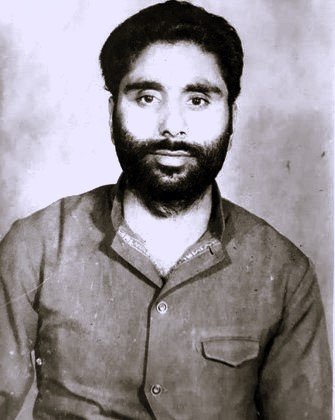
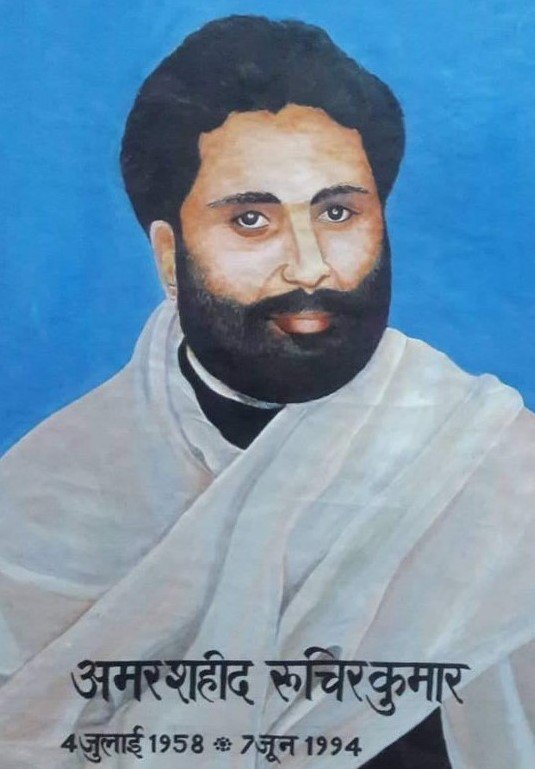
In the annals of the Kashmiri Pandit community, names like Tika Lal Taploo, Neelkanth Ganjoo and Prem Nath Bhat are often mentioned with reverence, each symbolizing the community’s enduring struggle and sacrifice. However, the story of Ruchir Kumar Koul from the picturesque town of Bhaderwah in the Jammu division remains largely unknown, despite his profound sacrifice thirty years ago on June 7, 1994. His legacy, cherished locally, deserves broader recognition for his ultimate act of courage in the face of terrorism. 

Early Life and Nationalistic Roots

Born on July 4, 1958, in the scenic town of Bhaderwah, Jammu and Kashmir, Ruchir Kumar Koul was instilled with a strong sense of nationalism from a young age. His parents, displaced from Kashmir during the 1947 tribal raid, found refuge in Bhaderwah. There, they rebuilt their lives, with Ruchir’s mother, Smt. Sukhmali Koul, becoming the first lady teacher in the area and establishing a school for girls. This earned them the moniker, “The Koul Family of Bhaderwah.” Little did they know that while fleeing from Kashmir to save their lives, they would eventually lose a son in Bhaderwah, the very place they had chosen as their new home after the 1947 displacement.

Ruchir’s upbringing was steeped in the values of community service and resilience, inspired by his family’s history and their association with the Rashtriya Swayamsevak Sangh (RSS). In 1989, he married a local girl from Bhaderwah, starting a family that would soon face unimaginable loss.
Standing Against Terrorism

The early 1990s were a period of intense turmoil in Kashmir, with Pakistani-sponsored terrorists spreading fear and violence. As this wave of terror reached the Doda district, Ruchir Kumar Koul emerged as a staunch defender of his community. He led a 41-day mass agitation, effectively shutting down shops, schools, and offices to draw attention to the plight of the local Hindu minority, who were at risk of being driven from their homes just as the Kashmiri Pandits had been.

The Ultimate Sacrifice

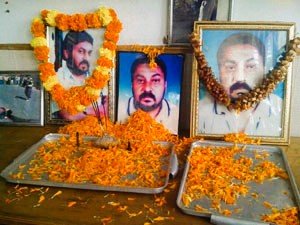
Despite multiple assassination attempts, Koul’s determination never wavered. On June 7, 1994, terrorists ambushed him as he worked in his fields alongside his wife. In a brutal attack, they shot him 30 to 40 times, killing him instantly. Ruchir died a hero, confronting his attackers with unwavering courage.
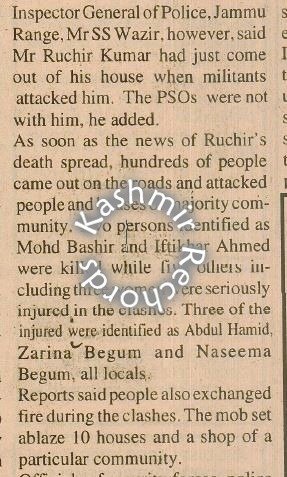
A portion of a news report dated June 8, 1994, highlighting the death of Ruchir Kumar Koul and communal clashes in Bhaderwah town soon after his killing.

A Legacy of Resilience

Ruchir Koul’s life was characterized by his patriotic fervour and steadfast faith. His family’s legacy of resilience continued through his wife, Sudershan, who faced the aftermath of his assassination with remarkable strength. 

 Overcome by grief, she attempted suicide but survived after extensive treatment. Determined to honour her husband’s memory, she raised their two young children, embodying the same spirit of endurance that Ruchir had demonstrated. 

Honouring a Hero

Today, Ruchir Kumar Koul’s sacrifice is commemorated annually on Martyr’s Day, June 7, in Bhaderwah town. However, his story remains a lesser-known chapter among the broader Kashmiri Pandit community. It is crucial to remember and honour such sacrifices, as they highlight the resilience and indomitable spirit of those who stood against terror and violence.

Ruchir Kumar Koul’s story, though not widely known, serves as a poignant reminder of the price paid by many to protect their homeland and community. His legacy, preserved by local remembrances and the efforts of organisations like the Panun Kashmir Movement in the beginning, besides a publication of an article on his life and works in a local daily in 2016, is all that is available in memory of this hero.

A write-up on Ruchir Kumar Koul that appeared in Sunday Magazine edition of Daiuly Excelsior, Jammu on June 12, 2016. The author  Manjeet Razdan is a former  President of Bhartiya Janta Party District Doda.

As we commemorate his sacrifice, let us ensure that the bravery of Ruchir Kumar Koul and others like him is never forgotten, but instead, honoured as a testament to their unwavering courage and love for their homeland. 

Kashmiri Bank Limited Faizabad: Kashmiri Pandit’s Financial Revolution in 1900 !

(By: Dr. Rajesh Bhat*)
In a remarkable revelation by Kashmir Rechords, a hidden chapter of Kashmiri Pandit excellence has come to light, showcasing their significant contributions to the banking sector in the early 20th century. Despite facing numerous displacements from their homeland, Kashmiri Pandits have consistently demonstrated their prowess across various fields, including art, culture, history, spirituality, bureaucracy, politics, and administration. This latest discovery underscores their foresight and innovation in banking, a domain where their achievements had remained largely undocumented until now.

A Visionary Banker: Pt. Iqbal Krishan Gurtu

In 1900, a Kashmiri Pandit named Iqbal Krishan Gurtu, B.A, established Kashmiri Bank Limited at  Faizabadthen part of the United Provinces. Registered under the Company Act of India, the bank was a trailblazer in the financial industry, introducing concepts that were ahead of their time. Pt. Gurtu, who served as the bank’s secretary, invested a substantial capital of Rs. One lakh and maintained a reserve fund of Rs. 30,000.

Pioneering Banking Practices across Undivided India

Kashmiri Bank Limited  Faizabad quickly expanded its operations, setting up sub-offices and commission branches across undivided India, including in prominent cities such as Allahabad, Bombay, Kanpur, Firozpur, Meerut, Lucknow, Delhi, and Lahore. One of the bank’s pioneering initiatives was its unique system of providing interest on term deposits, a concept very rarely introduced elsewhere in India, let alone in the Princely State of Jammu and Kashmir, where the concept of banking finds its mention only in the late 1930s.

The Kashmiri Bank Limited  Faizabad offered an attractive interest rate of seven percent on term deposits for one to two years, and half of that rate for deposits kept for six months. Interest payments were meticulously calculated to be paid on the second of January and the First of July, against proper receipts. Kashmiri Bank Limited actively advertised these innovative financial services in leading newspapers of that time, demonstrating the Kashmiri Pandit’s far-reaching vision in banking.

Archival Discoveries: Advertising Financial Innovations

Advertisements from the period, now part of the archival material available with Kashmir Rechords, reveal that the bank also kept its interest rates on deposit money floating. Customers were provided with free cheque and passbooks, and the bank accepted currency notes of all denominations for deposit. Additionally, loans against immovable property were issued following attestation and recommendations by reputed and trusted individuals.


An advertisement issued by Pandit Iqbal Krishan Gurtu, Secretary, Kashmiri Bank Limited, Faizabad that appeared in leading newspapers of Lucknow and Allahabad in 1903.

A Mysterious End and a Call for More Information

Despite these significant advancements, detailed records of Kashmiri Bank Limited’s operations beyond 1910 are scarce. The Bank’s advertisements and posters, predominantly in Urdu, cease after this period, leaving the subsequent fate of the bank shrouded in mystery. It is surprising that no one has cared to write on this subject or to take research to its logical conclusion all these years.

 Kashmir Rechords, which takes pride in this “breaking news” of the past, thus appeals to its esteemed readers to share any further information. The Kashmiri Bank Limited  Faizabad is a testament to the ingenuity and entrepreneurial spirit of the Kashmiri Pandits, a legacy that deserves recognition and celebration.

Celebrating a Legacy

This revelation not only highlights the historical contributions of the Kashmiri Pandits in the banking sector but also serves as an inspiration for future generations to acknowledge and build upon their rich heritage.

* Rajesh Bhat, Ph.D. in Mass Communication and Journalism brings over 35 years of experience as a writer, researcher, and academician in journalism, spanning both print and electronic media. He authored “Radio Kashmir in Times of Peace and War” and has worked with prestigious newspapers and publications including Kashmir Times, Daily Excelsior Jammu, and The Tribune, Chandigarh. Currently, he serves as a Faculty Member at the National Academy of Broadcasting and Multimedia, New Delhi.


Sunstroke and Strife: Kashmiri Pandits’ Struggle in the 1990 Heatwave

(By: K R Ishan)

As North India swelters under a relentless heat wave every summer, memories flood back for the Kashmiri Pandit community. This scorching heat evokes the harrowing summer of 1990 when thousands of Pandits were forced to leave their idyllic homeland of Kashmir—famous for its cool climate, verdant landscapes and serene brooks—and face the blistering plains of India. It was a transition from paradise to an inferno, a shift they were woefully unprepared for.

Fleeing Violence for Unfamiliar Terrains

In January 1990, the rise of militancy in Kashmir reached a terrifying peak, compelling an exodus of Kashmiri Pandits. Fleeing the violence that claimed the lives of many in their community, they sought refuge in unfamiliar regions like Jammu and Delhi. These places, with their oppressive heat, were a stark contrast to the cool, gentle summers of their native land. For many Pandits, the concept of a heatwave or sunstroke was as alien as the scorching temperatures they were suddenly exposed to.
Over 120 Casualties Due to Sunstroke

A Sun-Stroke Victim and his wailing relative at Jammu, 1990

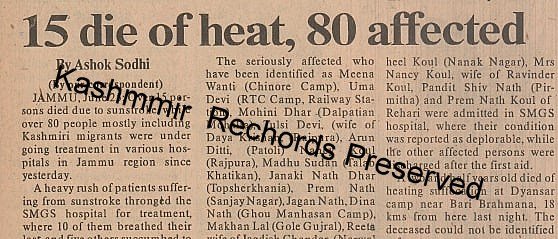
The summer of 1990 became a season of nightmares for the displaced Pandits. Reports from May, June, and July that year, analyzed by Kashmir Records, reveal a grim picture: over 120 Kashmiri Pandits succumbed to sunstrokes during their first severe summer away from home. Their bodies, unaccustomed to such extreme heat, were unable to cope, and the inadequate living conditions exacerbated their plight.

Living in Makeshift Camps

Newspaper obituaries and headlines from that year tell a story of immense suffering. In makeshift camps set up in Jammu and Delhi, families lived in tattered tents with no proper sanitation or potable water. Dehydration and cholera became rampant as people were forced to drink contaminated water and consume stale food. The lack of basic amenities like fans, coolers, or refrigerators made survival even more arduous. Many women, who had never left their cool, green villages, found themselves standing in long lines for meager rations under the punishing sun, only to be overcome by heatstroke.

The Elderly and Vulnerable

Elderly men and women, who had thrived in the gentle climate of Kashmir, were now battling not just the trauma of displacement but also the unforgiving summer heat. They had been uprooted from a land where the concept of heat-related illnesses was virtually nonexistent and thrust into an environment that proved fatal for many. The authorities’ failure to provide adequate shelter and resources further deepened the tragedy.

Eyewitness Account

Journalist Dr. Rajesh Bhat, who then worked as a special correspondent for Jammu’s leading newspaper, Daily Excelsior, was one of the newsmen who documented and reported the plight of Kashmiri Pandits. As he covered the unfolding tragedy, besides other things, he witnessed firsthand the devastating effects of the heatwave on the displaced Pandits. “The suffering was unimaginable,” Dr. Bhat recalls. “I saw families who had never experienced such extreme temperatures struggling to survive in tents that offered little protection from the sun. The heat was relentless, and the lack of basic necessities made the situation even more dire. Reporting on the deaths from sunstroke was heart-wrenching. It wasn’t just the militants they were fleeing from; it was as if they had escaped one form of death only to face another.”

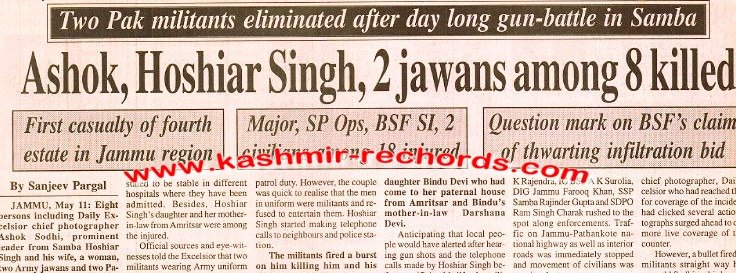
Alongside Dr. Bhat was photojournalist Ashok Sodhi, who dedicated his life to capturing the stark realities of the time. Late Ashok Sodhi, a respected figure in journalism, traversed the camps with Dr. Bhat, documenting the harsh conditions and human suffering through his lens. His photographs brought the plight of the Kashmiri Pandits to the forefront, providing a visual testimony that words alone could not convey. “Ashok’s photos told stories that needed to be seen and believed,” Dr. Bhat reminisces. “He had an eye for capturing the raw emotion and desperation in those camps. His work was instrumental in raising awareness and empathy for the displaced community.”

June 12, 1990: Seven more KPs die of Heatstroke and three of Cholera

A Chilling Chapter in History

The summer of 1990 remains a chilling chapter in the history of the Kashmiri Pandit community. As temperatures soar today, the survivors and their descendants are reminded of that devastating time. It is a poignant reminder of their resilience and the harsh realities they faced, a story of human endurance against both man-made and natural adversities. The efforts of individuals like Dr. Rajesh Bhat and Ashok Sodhi ensured that the world did not turn a blind eye to their suffering, preserving the legacy of their struggle for future generations.

Sarshar’s Kashmir Roots: Flourishing in Urdu Literature

(Kashmir Rechords Exclusive)

The modern generation of Kashmiris may not fully grasp the lifestyle of their ancestors a century ago, a time when trade, government employment, and a rich literary life dedicated to Urdu and Persian defined existence. This era was marked by bold experimentation, paving the way for modernity, rationality, and reformist attitudes, all while preserving cherished cultural values. At Kashmir Rechords, our focus is on reconnecting with our glorious past to add value in advancing our march in a continuously changing world experiencing dynamic shifts in politics, economy, technological prowess, and demographic and environmental impacts. 

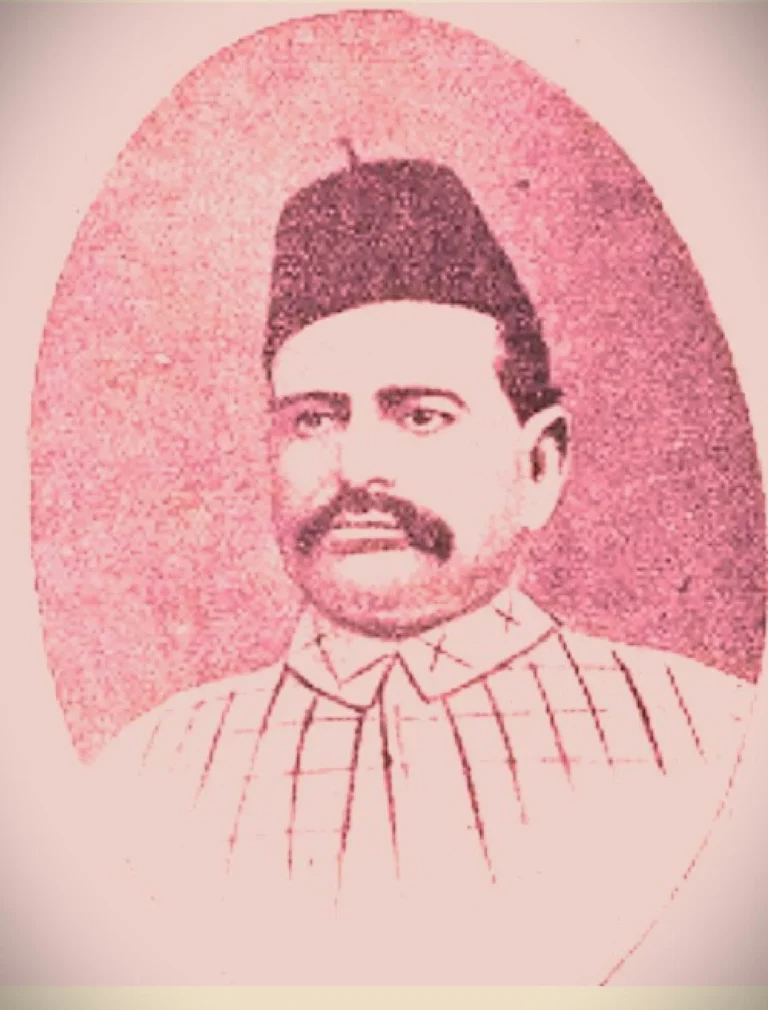
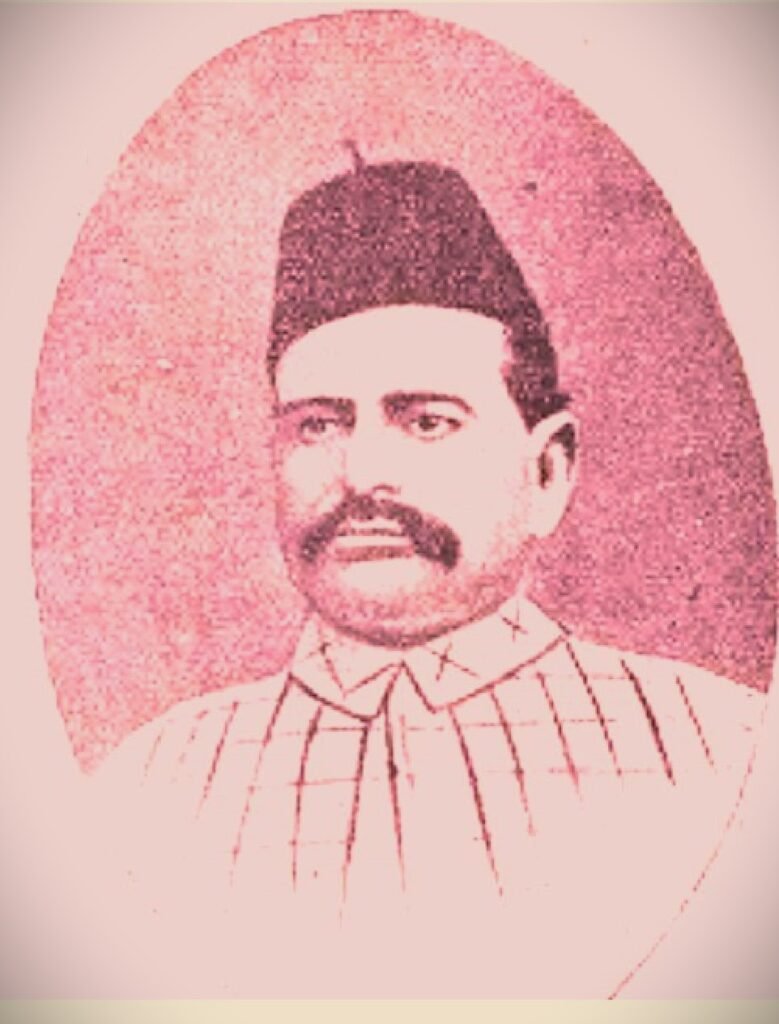
 Among the towering figures of this literary heritage is Pandit Rattan Nath Dhar ‘Sarshar’ (1846/47 to 1903), a colossal force in Urdu literature who elevated the language to new heights. Born into a Kashmiri Pandit family in Lucknow, Sarshar was a contemporary and close friend of Urdu stalwarts like Chakbast. He was well versed in Persian, Arabic, and English, mastering these languages and shaping his literary pursuits. His pen name, ‘Sarshar’, meaning ‘ecstatic’ or ‘delighted’, reflects his deep affection for his birthplace. Growing up in an environment that celebrated diverse traditions and harmonious coexistence, Sarshar absorbed the essence of Kashmiri life, which later permeated his literary creations. 

Sarshar As Editor

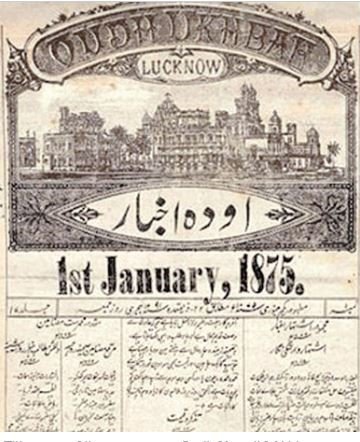
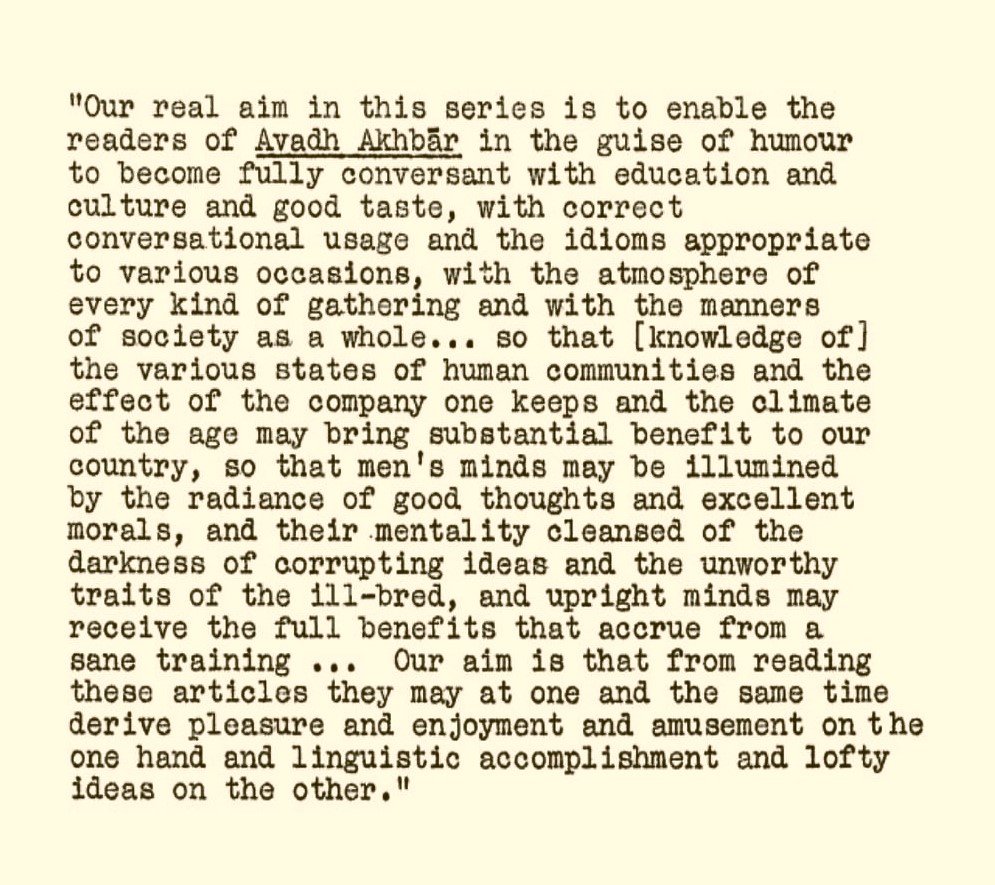
The Front Page of Avadh Akhbaar, dateline January 1, 1875, (Source Internet)

Sarshar’s contributions are perhaps best illustrated through his role at Avadh Akhbar,” (also known as Oudh Ukhbar), a leading Urdu newspaper of Lucknow, founded in 1858,  where he served as editor under the auspices of publisher Munshi Naval Kishore. His innovative approach, including the publication of serialized stories, significantly boosted the newspaper’s popularity. This pioneering shift towards more prose and fiction in Urdu journalism is a testament to Sarshar’s foresight and creativity. 

Sarshar’s Fasana-e-Azad,

One of Sarshar’s most notable works is Fasana-e-Azad, the second Urdu novel, which emerged from the success of his serialized articles in “Avadh Akhbar.” This novel not only captivated readers but also established the novel as a respected genre in Urdu literature. His other significant work, Fasana-i-Jadeed (A Modern Tale), later renamed Jam-e-Sarshar, depicted the changing cultural values in Lucknow and explored the perils of drinking, a vice that tragically affected Sarshar himself.

Rattan Nath Dhar Sarshar’s Fasana Azad, published by Sheikh Gulam Ali and Sons, Lahore, Peshawar, Hyderabad and Karachi.

Eminent writer Ram Babu Saxena, in his voluminous book “History of Urdu Literature” (First Edition 1927), whose foreword was written by none other than Sir Tej Bahadur Sapru, poignantly mentions Sarshar while tracing the origin and development of the language. This highlights Sarshar’s crucial role in shaping Urdu prose and fiction.

A page from Ram Babu Saksena’s History of Urdu Literature ( 1927)

Thesis on Sarshar

Feroz Hussain, a scholar and professor at Maulana Azad National Urdu University in Hyderabad, in his thesis Life and Works of Rattan Nath Sarshar” submitted to the University of London School of Asian and African Studies, writes that Sarshar conceived the idea of writing Fasana-i-Azad after the success of his articles contributed to “Avadh Akhbar” under the heading “Zarafat” (started in 1878). The unprecedented acceptance of the novel as a genre in Urdu can be largely attributed to Sarshar’s innovative contributions.

A page from Thesis on Sarshar submitted to University of London

Kashmir’s Influence

The influence of Kashmir on Sarshar’s work is unmistakable. The serene landscapes and rich cultural milieu of Kashmir provided a vivid and enchanting backdrop for many of his stories. Sarshar’s intimate knowledge of Kashmiri customs, traditions, and everyday life enabled him to depict the region with authenticity and heartfelt affection.

Through his evocative descriptions and nuanced character portrayals, Sarshar brought the essence of Kashmir to a broader audience. His stories not only celebrated the beauty and uniqueness of the land of his ancestors but also addressed the social issues and challenges faced by its people. Themes of social justice, cultural identity, and human relationships are woven seamlessly into his narratives, resonating with readers across generations. 

From Lucknow to Hyderabad

 Sarshar’s later years were marked by a move to Hyderabad State, where he was warmly received by Sir Kishan Pershad, the Prime Minister of Hyderabad. Unfortunately, his personal challenges curtailed his creative output, and he passed away in 1903 at the age of fifty-six. 

Reflecting on Sarshar’s legacy, it is evident that he left an indelible mark on Urdu literature. His work not only enriched the language but also bridged the past with the emerging modern world. Had he lived longer, it is tantalizing to imagine how he might have influenced the nascent Hindi film industry. 

Today, as we navigate dynamic shifts in politics, economy, and technology, the literary contributions of figures like Rattan Nath Dhar Sarshar serve as a reminder of the enduring power of storytelling and the importance of reconnecting with our cultural roots to guide our future progress.


Kashmir’s Prime Minister and his Sex Manual!

(KASHMIR RECHORDS EXCLUSIVE)

Kashmir has been a fertile ground for numerous contributions to the world in various fields, including art, literature, medicine, engineering, history, and academia. This land has produced many great individuals who have left their mark not only on the subcontinent but also on the entire world. Among these notable figures is Koka Pandit Kashmiri, also known as Pt. Kokkoka, a prominent sexologist and Prime Minister of Kashmir of yesteryears.

Koka Pandit and His Magnum Opus

Koka Pandit is credited with writing the Koka Shastra,” also known  to some as “Ratirahasya” (Secrets of Love), a seminal work on sex education and psychological issues. This text, written in Sanskrit in the 11th or 12th century, addresses topics that modern science and education are only beginning to incorporate into curriculums.

 Sylvan Levi, a renowned French Sanskrit Scholar (1863-1935), acknowledged Koka Pandit Kashmiri as the originator of Koka Shastra, though the exact date of its composition remains uncertain. Koka Shastra is not just a manual on sexual practices but a comprehensive guide that encompasses psychological and sociocultural aspects of sex and relationships. The text provides insights into medieval Indian society’s understanding of human sexuality, gender roles and interpersonal dynamics. This understanding has influenced subsequent works in the field and continues to be relevant in modern discussions about sex education.

Content and Structure of Koka Shastra

Koka Shastra, often considered Kashmir’s equivalent to the “Kama Sutra,” comprises fifteen chapters (pachivedes) and 800 verses. Unlike the Kama Sutra, which reflects ancient Hindu literature, Koka Shastra is tailored to medieval Indian society and its cultural milieu. The text covers various subjects, including:

1.Different physiques and types of genitals

2. Characteristics of Men and Women at different ages

3. Techniques of hugs and kisses

4. Various stages of love, from weight loss to fainting, and ultimately, death

  Pt. Koka’s work also classifies both men and women into four psychophysical types based on appearance and physical features. He explores erogenous zones and days conducive to sexual arousal for  both men and women.

Scholarly Acknowledgment and Influence

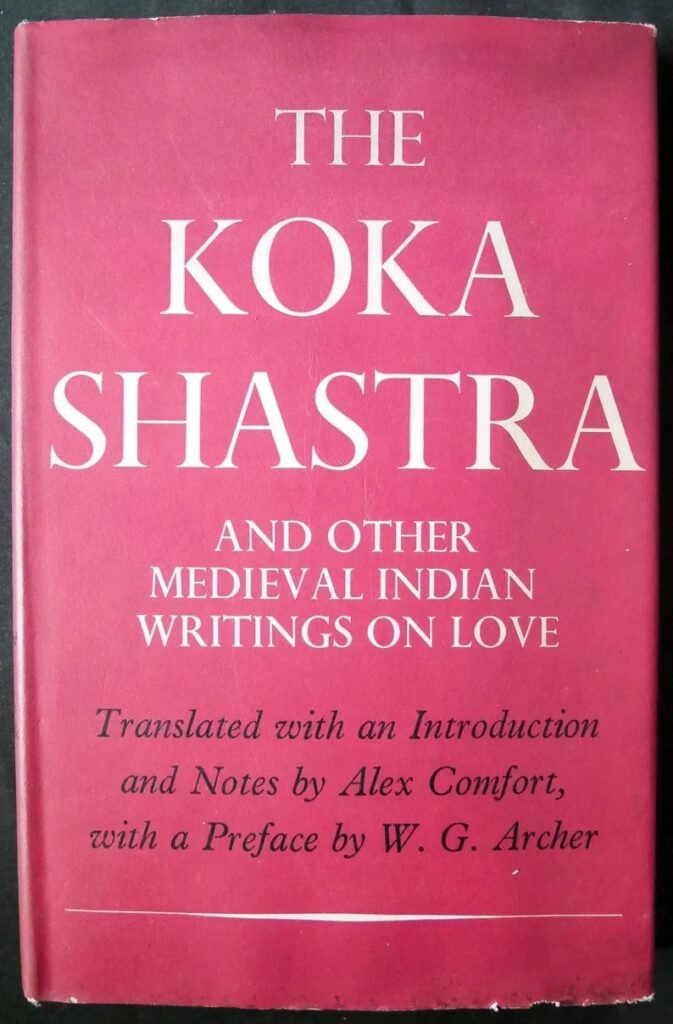
W. G. Archer, a British civil servant and art historian, noted that Kokkoka’s work focuses on maximizing sexual enjoyment and maintaining a woman’s happiness. Pt. Koka Ram drew from numerous sources, including Nandikeshvara, Gonikaputra, and Vatsyayana, to compile his treatise.

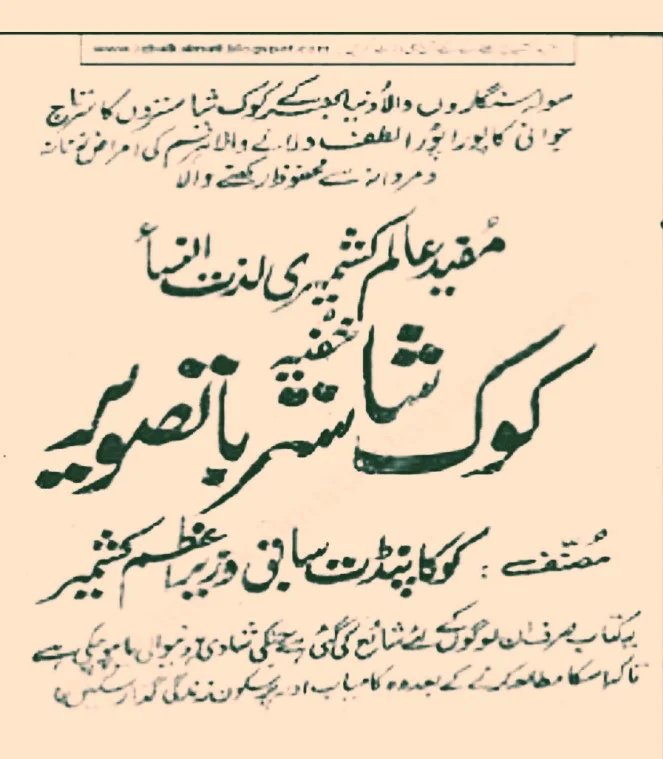
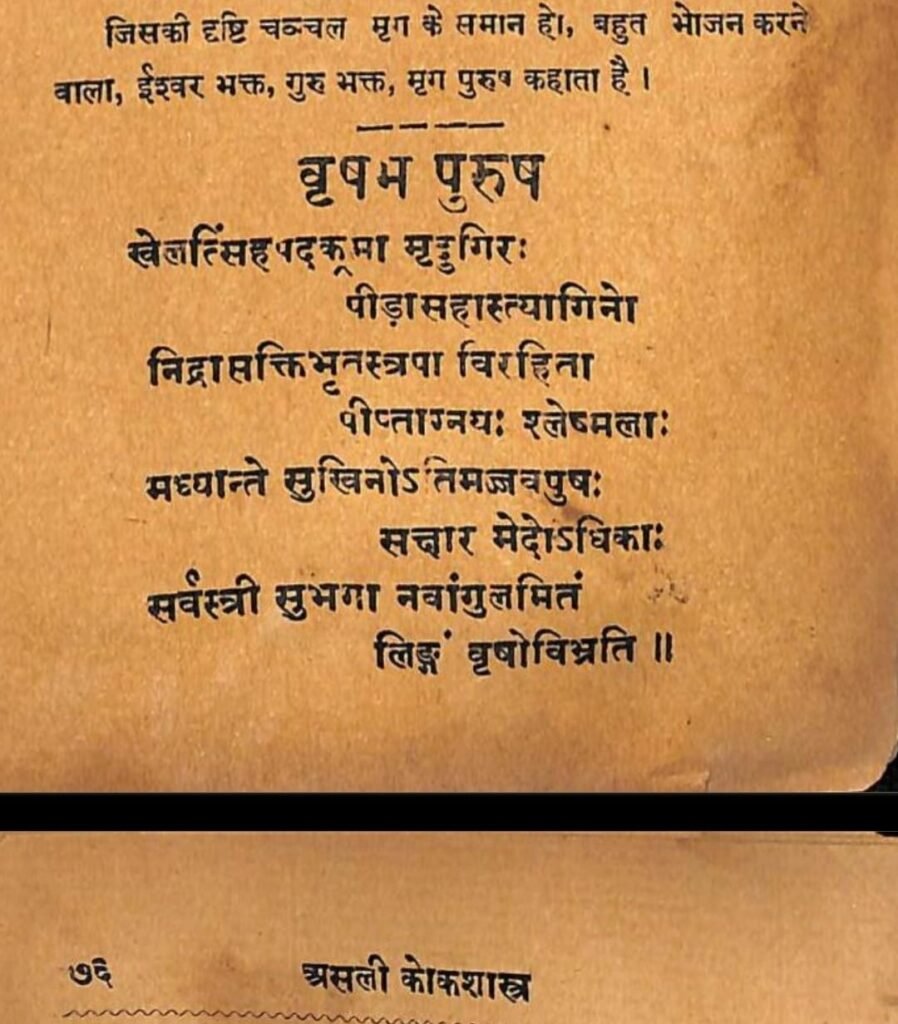
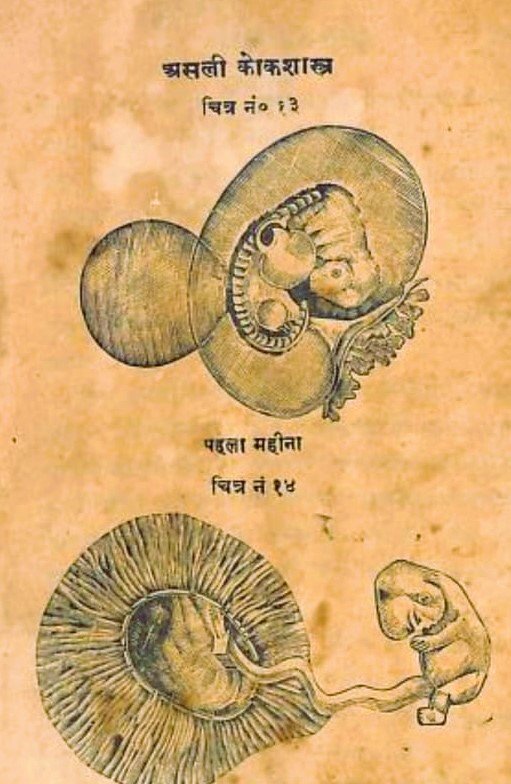
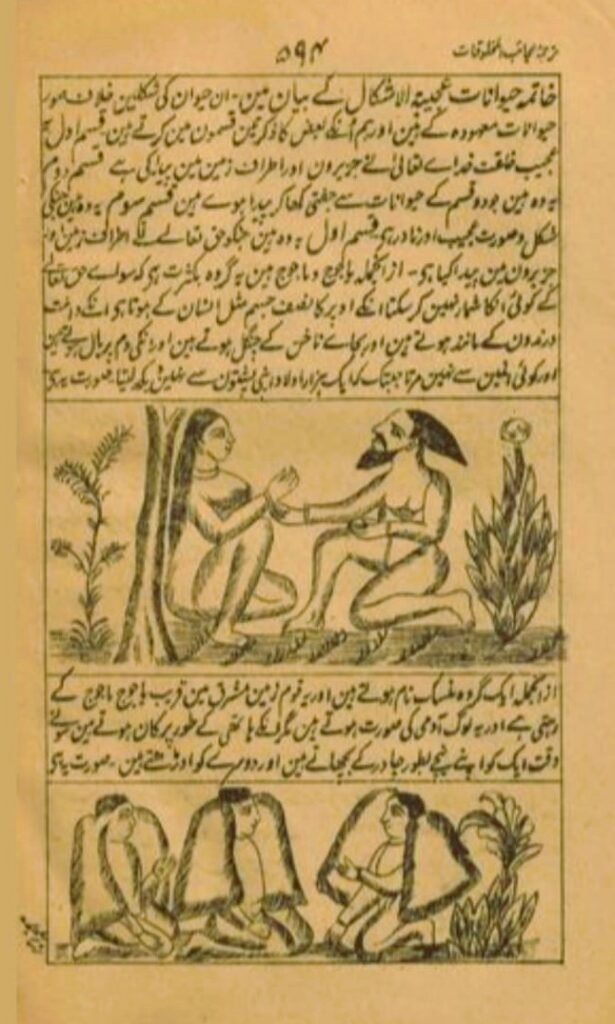
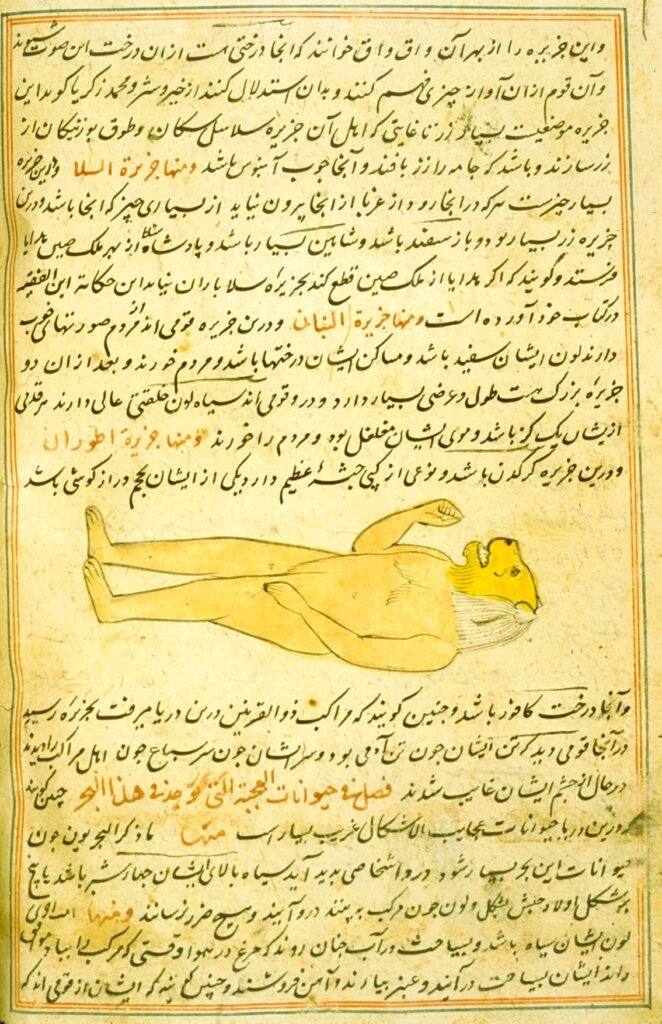
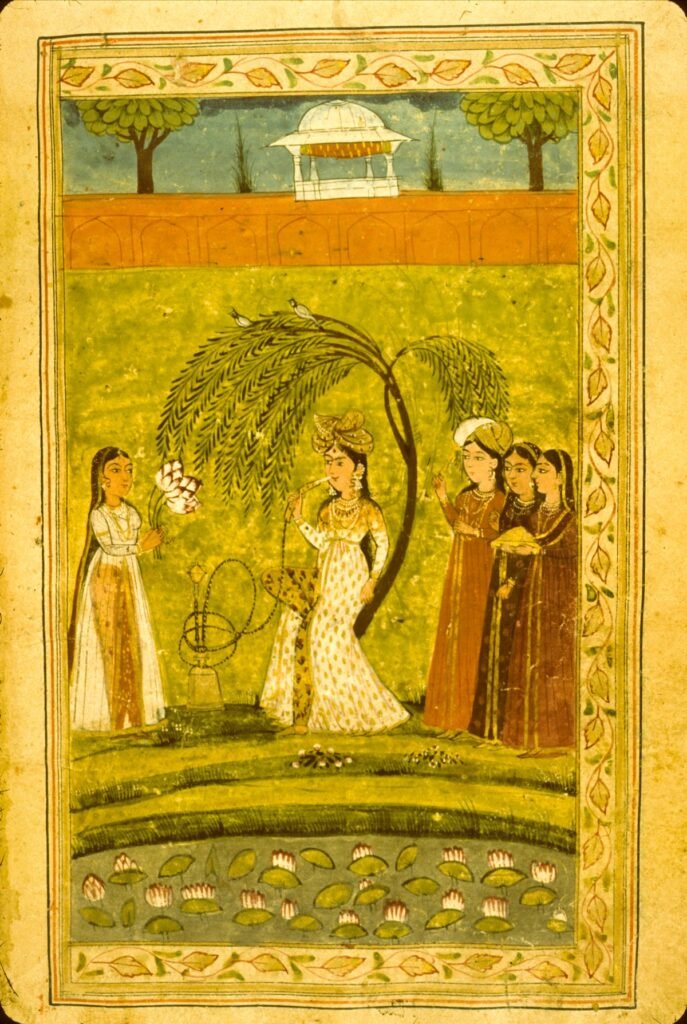
The various translations of Koka Shastra have included illustrations that help convey its teachings visually. These adaptations made the text more accessible and engaging, which is a strategy still used in modern educational materials. The use of artwork in Persian, Urdu and Hindi versions, for example, reflects an understanding of the importance of visual aids in enhancing comprehension and retention of information.

Translations and Global Reach

Over the past 300 years, Koka Shastra has been translated into several languages, including Arabic, Persian, Urdu, Hindi, and Turkish. Notable translations include:

1. “Lazzat Un Nisa in Persian, attributed to   Ziya Nakhshabi, 18th Century

2. “The Koka Shastra” by Alex Comfort in English (1964)
3. “Koka Shastra (Rati Rahasya)” translated by S. C. Upadhyaya
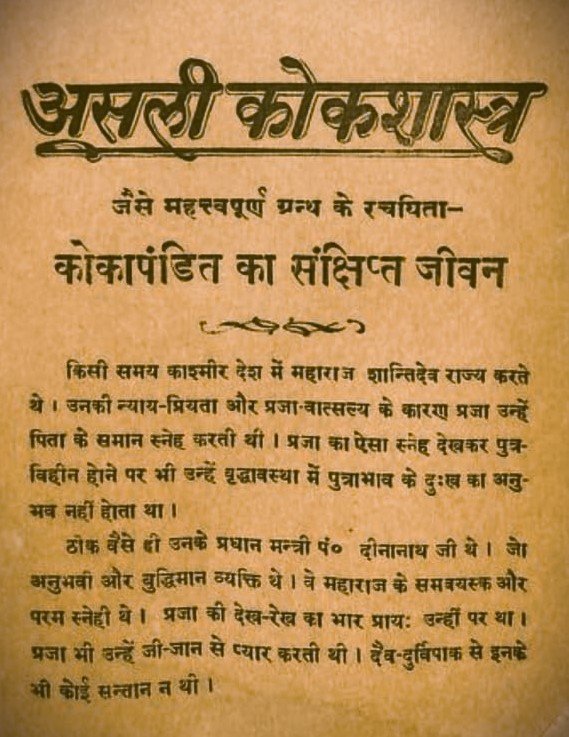
4 Asli Kok Shastra’’ (Hindi) by Acharaya Gautam, (1889)
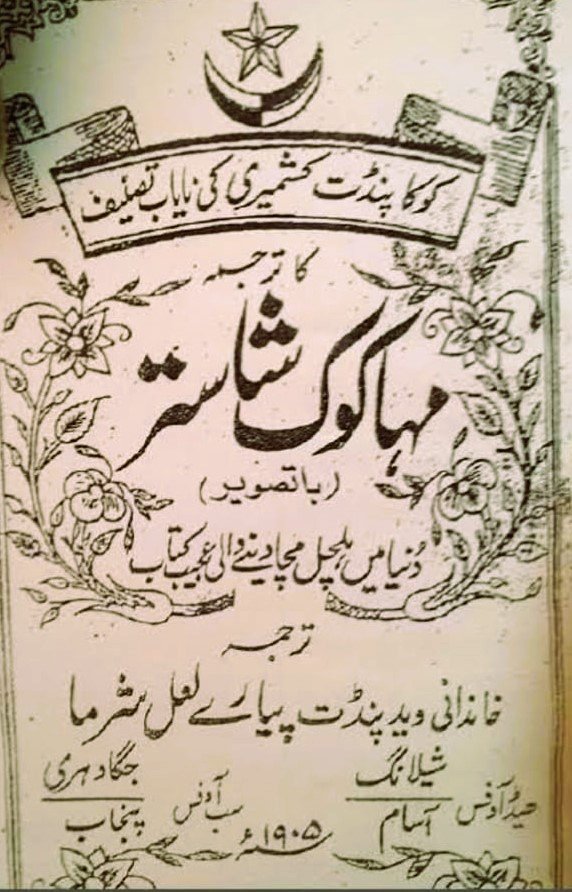
5. ``Maha Kok Shastra’’ (Urdu) by Pandit Pyare Lal Sharma (1905)
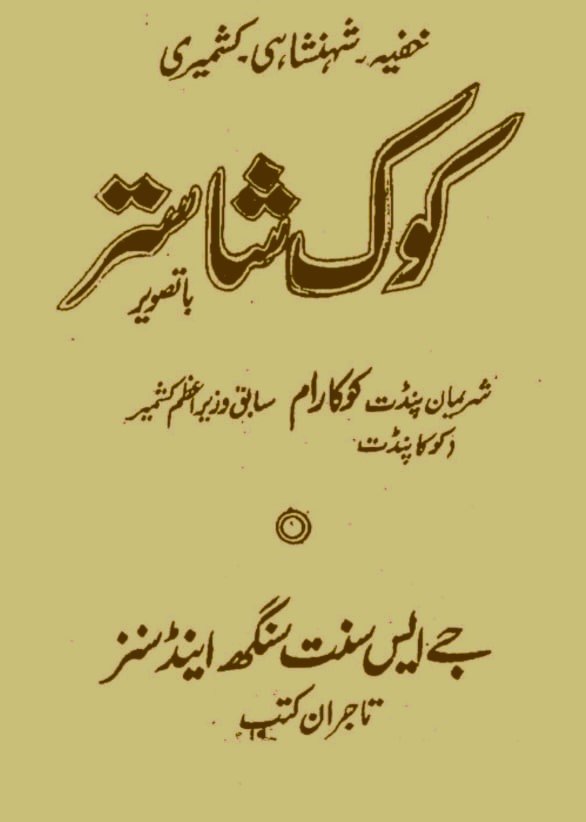
6.Kok Shastra’’ (Urdu), J S Sant Singh and Sons. 

  These translations often incorporated illustrations and commentaries, enhancing the text’s accessibility and appeal. Persian scholar Ziya Nakhshabī added watercolours and gilt typical of 18th-century Mughal art in his version. The first Hindi translation is believed to have been undertaken in the early 17th century, from which later Hindi, Persian, and Urdu versions derived.

Continued Legacy and Research

In the late 19th and early 20th century, many Urdu versions of Koka Shastra were produced for the Urdu-speaking population of undivided India. These versions often included elaborate historical accounts of Koka Shastra and its significance. Many carried hand-made pictures also and gave a full credit to Pt Koka Ram while addressing him as former Prime Minister of Kashmir.

Invitation for Further Contributions

Many concepts from Koka Shastra have found their way into modern literature on sex and relationships. The detailed exploration of different types of physical and emotional interactions provides a foundation that contemporary writers and educators build upon. By recognizing the historical context and contributions of texts like Koka Shastra, modern sex education can draw on a rich tradition of knowledge and integrate it with contemporary scientific understanding.

Kashmir Rechords intends to further explore to provide an overview of the life and work of Pt. Koka Ram Kashmiri, his motivation and the context in which he had to write Koka Shastra.  Since on a home turf, no work has been undertaken on this former Prime Minister of Kashmir, this write-up is thus open to further opinions, additions, and alterations, inviting readers to contribute to the ongoing exploration of this significant historical text.

By continuing to study and appreciate the contributions of historical figures like Pt. Koka Pandit Kashmiri, we can enrich our understanding of human sexuality and improve educational practices for future generations.

Drop your Comments in the Comment Box at the end of this article or write to us at kashmirrechords@gmail.com or support@kashmir-rechords.com

Assassination of Mirwaiz Farooq and Jagmohan’s Ouster

(Kashmir Rechords Exclusive)

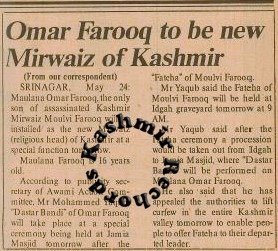
Thirty-four years ago, this day, on May 21, 1990, three young men visited the home of Kashmir’s head priest and prominent political leader, Mirwaiz Mohammad Farooq, in Srinagar. They fatally shot Mirwaiz Farooq and fled the scene. The assassination was orchestrated by Pakistan’s Inter-Services Intelligence (ISI), which had labelled Mirwaiz as an “Indian Agent.”
The murder sent shockwaves through Kashmir. Despite the peak support for the separatist movement at the time, there was a potential for a public backlash against armed militants suspected to be the culprits. However, instead of turning against the separatists, public anger was directed at the government. During a funeral procession from Shere-Kashmir Institute of Medical Sciences to Mirwaiz’s home, the Central Reserve Police Force (CRPF) fired upon the crowd near Hawal in Old City, resulting in at least 60 deaths and numerous injuries. This tragic event prompted the Central Government to recall Governor Jagmohan, against whom there was already significant propaganda fuelled by Pakistan and its sympathizers since he took office in January 1990.

Governor Jagmohan’s Account

In his book, My Frozen Turbulence in Kashmir,” Jagmohan defends his actions while dealing with Kashmir terrorism, stating that the calls for his ouster linking him to the incident were unjustified. He criticized his police chief J.S. Saxena and Additional DGP M.N. Sabharwal, arguing that a strong police presence could have prevented the killings of mourners. Jagmohan claimed that Sabharwal’s failure to accompany the procession or send adequate police protection was highly irresponsible, contributing to the tragedy.

Aftermath and Investigation

The week following the assassination was fraught with tension. Despite Jagmohan recommending handing over the case to the Central Bureau of Investigation (CBI), propaganda against him persisted, even in the national media. A notable instance was a Times of India report on May 25, 1990, which suggested Jagmohan was asked to step down, a claim he strongly refuted.
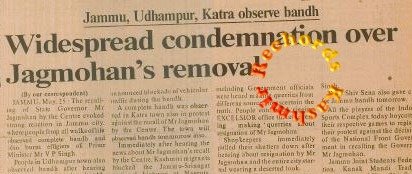
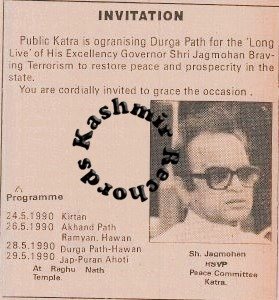
While most Kashmiri leaders and terrorist organizations supported Jagmohan’s removal, he retained substantial backing from the Jammu division, which observed a complete bandh when news of his ouster spread and people also prayed for his welfare at Holy town of Katra.
The CBI investigation revealed that the assassination was planned by Hizbul Mujahideen commanders Abdullah Bangroo and Rehman Shigan, and executed by operatives Ayub Dar, Javed Bhat, and Zahoor Bhat. Bangroo and Shigan were later killed in encounters with security forces, and Dar was sentenced to life imprisonment. After 33 years’ of assassination, on May 16, 2023, police arrested the remaining two operatives, Javed Ahmad Bhat and Zahoor Ahmad Bhat.

Mirwaiz Farooq: The Leader and His Legacy

Mirwaiz Farooq in the Studios of Radio Kashmir, Srinagar
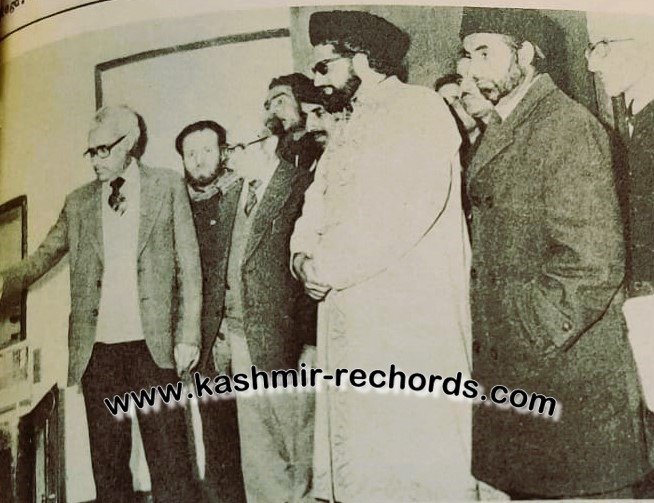
Mirwaiz Moulvi Mohammad Farooq Shah led the Awami Action Committee (AAC), a political party in Kashmir opposed to the dominant National Conference. Known for his stately presence and respected as a religious figure, Mirwaiz Farooq often gave talks on Radio Kashmir Srinagar. Journalist Aasha Khosa, in one of her write-ups, highlights his deep religious knowledge and the respect he commanded within the community. His family was known for its charitable acts, including helping those affected by a massive fire in downtown Srinagar.
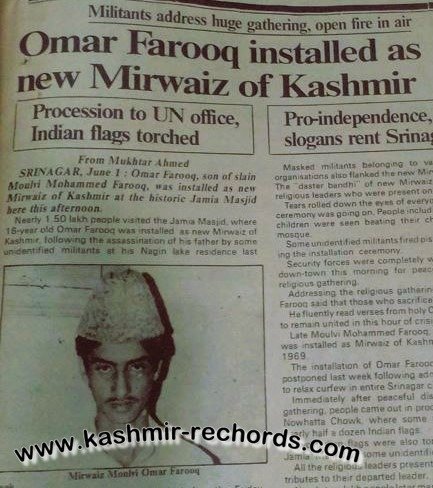
Mirwaiz Farooq’s legacy was inherited by his 17-year-old son, Omar Farooq, who was nominated as his successor soon after former’s assassination.  Omar Farooq was formally installed as new Mirwaiz of Kashmir on June 1, 1990.
Concerned for his safety, his mother  had sent him to Egypt for religious studies. Today, Mirwaiz Omar Farooq, known for his moderate views, continues to be a significant figure in Kashmir, despite constant surveillance by ISI and its agents in past.

Controversies and Accusations

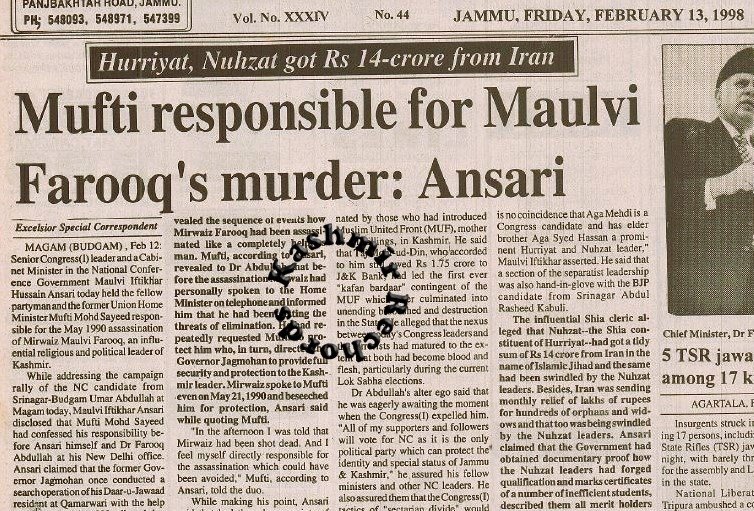
Eight years after the assassination, during a political speech, Shia leader Moulvi Iftikhar Hussain Ansari  accused former Union Home Minister Mufti Mohammad Sayeed of being responsible for Mirwaiz Farooq’s death. This claim has been a point of contention and speculation within the political landscape of Kashmir.
The assassination of Mirwaiz Mohammad Farooq remains a pivotal event in Kashmir’s tumultuous history, symbolizing the complex interplay of political, religious, and militant forces in the region.

===

Kashmiri Pandit, India in Secret Codes: Unveiling Kashmir Conspiracy

( Kashmir Rechords Exclusive)

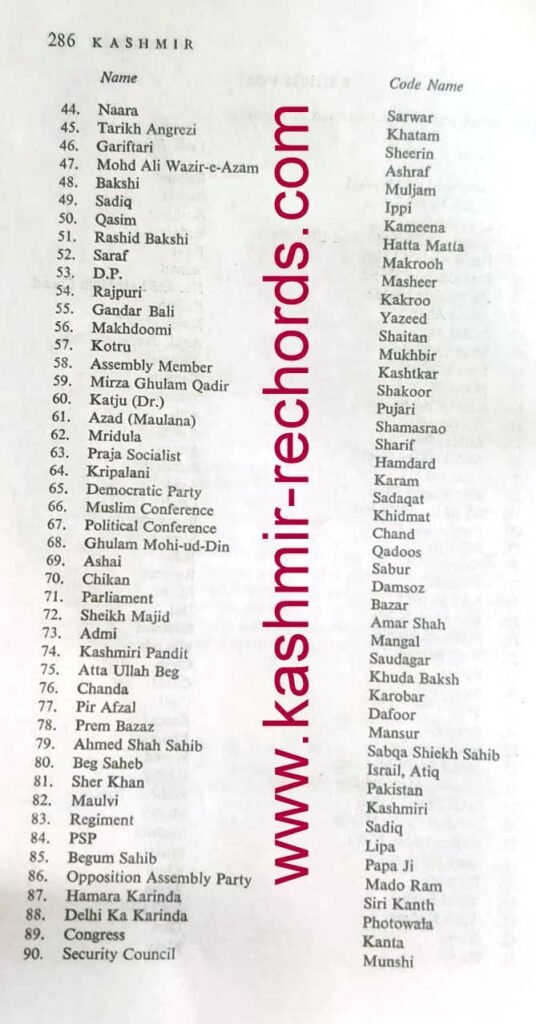
It was an era of different “End-to-End Encryption’’ when cheat codes were devised to carry out sabotage and further anti-India narrative in Kashmir.
The story dates back to the Kashmir Conspiracy, the mention of which has been ably and diligently made by B N Mullik, an Indian civil servant, spymaster and the second Director of the Intelligence Bureau of India.

In his Book on Kashmir, published by Allied Publishers in April 1971, B N Mullik, besides giving other accounts, mentions how Pakistani intelligence agencies through their sympathizers were using secret codes to pass on information.

  In the absence of WhatsApp, e-mail, or any other digital medium, they were using letters, stuffed with secret messages, mostly in Urdu, to carry forward their nefarious designs.

 Kashmiri Pandit was a “ Saudgar’’

 Mullik, who smashed this network, found interesting disclosures that he has carried in the Book.  As per the Book, Kashmiri Pandit in secret code language was addressed as “Saudagar’’, while “ India’’ was referred to as “ Baramulla’’, `Srinagar’ as Rampur’’ and “Pakistan’ as “Sopore.’’.’

Pakistani Coded words and deciphered by India

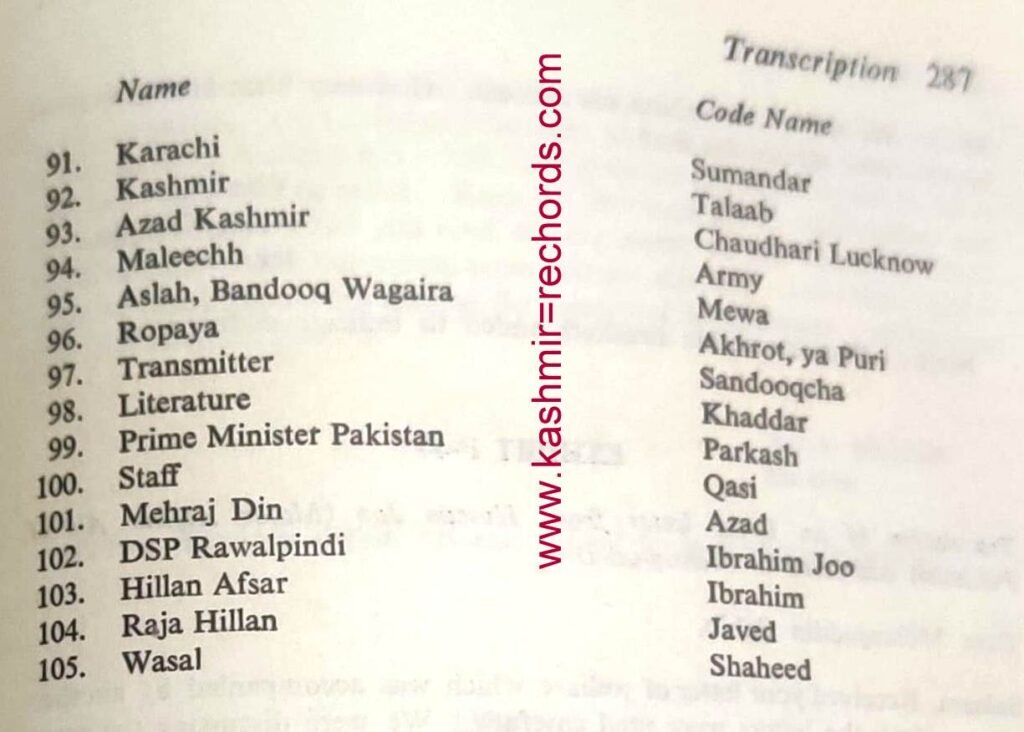
 India’s First Prime Minister Jawahar Lal Nehru was addressed as “Jaffar’’.  For saboteurs,   “ Kashmir’’ was “ Talab’’, while “ Azad Kashmir’’ (PoK) was referred to as “ Chaudhari Lucknow’’.

Mullik’s book mentions about 105 such names, which were in use but were deciphered by Indian Intelligence Agencies to smash the Pakistani Plan in the Kashmir Conspiracy Case.

Kashmir Rechords is reproducing some of such ‘’Cheat Codes’’ here.

The Untold Tragedy: Underreported Killings in Kashmir!

(Kashmir Rechords Exclusive)

In the tumultuous days of 1990, amidst the echoes of political unrest and communal tensions, Kashmir bore witness to a series of forgotten tragedies, overshadowed by the broader narrative of conflict. These unreported killings, etched in the annals of history, serve as poignant reminders of the human cost of strife and the silent suffering endured by ordinary Kashmiris.

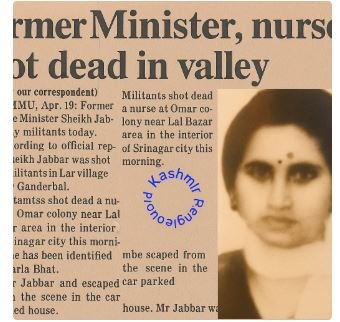
March 23, 1990, dawned with yet another sombre warning in Srinagar. Anti-India and anti-Kashmiri Pandit demonstrations continued to fill the streets, punctuated by ominous threats against the minority community. Yet, amidst the turmoil, a flicker of hope emerged as local Imams extended assurances of safety to the Kashmiri Pandits, urging their return to the valley. However, these promises proved hollow as the day unfolded. B.L. Karihaloo, a sweet shop employee, became the instant victim. He was shot at in the Bagat Kanipora area.

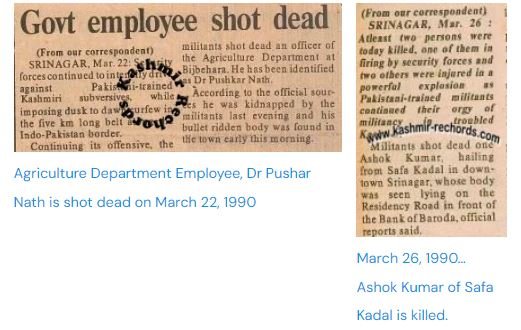
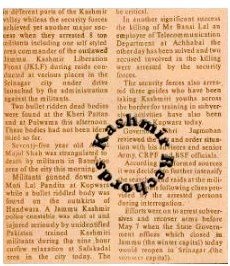
The following days bore witness to a relentless wave of violence. Dr. Pushkar Nath, an officer of the J&K Agriculture Department, fell prey to terrorists’ bullets in Bijbehara on March 22, 1990. Ashok Kumar, a resident of Safa Kadal, met a similar fate on March 26, 1990.

Agriculture Department Employee, Dr Pushar Nath is shot dead on March 22, 1990

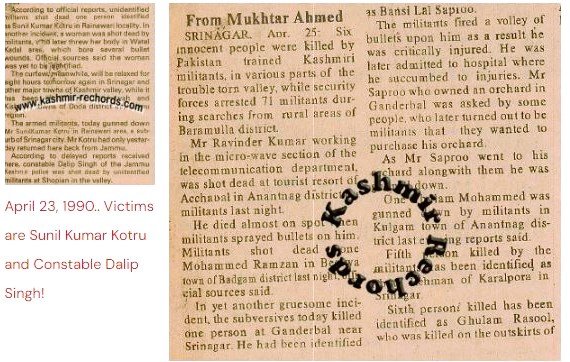
April 1990 brought no respite. On April 23, 1990, Sunil Kumar Kotru was killed in Rainawari locality while as a body of a J&K Police Constable, Dalip Singh was recovered from Shopian area.

Similarly, on April 26, 1990, six innocent lives were cruelly snuffed out in various parts of the valley. Among them were Ravinder Kumar, Bansi Lal Saproo, Mohd Ramzan, Ghulam Mohammad, Abdul Rehman, and Ghulam Rasool, each a casualty of senseless bloodshed.

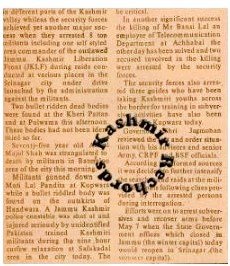
April 30, 1990 marked the demise of Moti Lal Pandita in Kupwara, adding to the growing toll of targeted killings.

 Surge in Atrocities

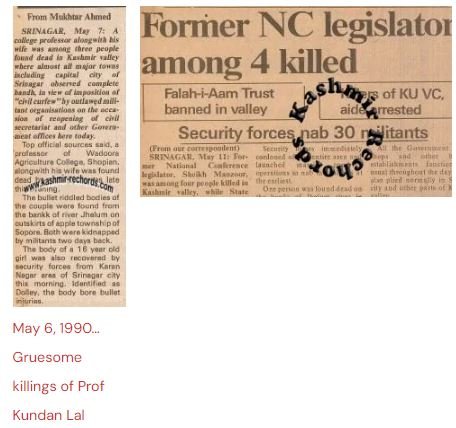
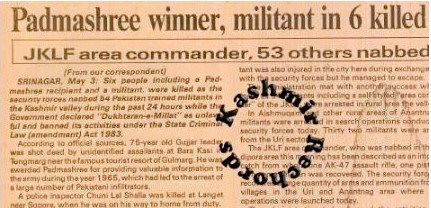
 The month of May 1990 saw a surge in atrocities, claiming the lives of individuals from diverse backgrounds. On May 3, a revered Gujjar leader, honoured with the Padma Shri, fell victim to assailants’ bullets in Bara Kasi in Tangmarg area of Kashmir. Chuni Lal Shalla, a dedicated Police Inspector, met a similar fate in Langet area near Sopore.

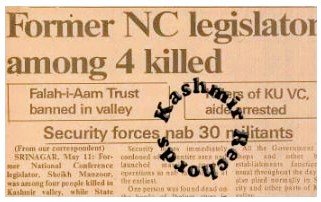
May 6, 1990 unfolded with the tragic discovery of Prof. Kundan Lal Ganjoo and his wife’s bodies in Sopore, alongside the lifeless form of a young girl named Dolly in Karan Nagar. The brutality reached its zenith on May 11, with the ruthless assassination of former National Conference legislator Sheikh Manzoor, a grim testament to the unchecked reign of terror.

These names, etched in sorrow, represent but a fraction of the countless lives lost in the crucible of conflict, their stories buried beneath the weight of indifference and silence. As we reflect on these forgotten souls, let us offer prayers for peace and reconciliation, striving to honor their memory amidst the clamour of history. (To be concluded)

His Pictures Were Speaking More Than Words!

0

Remembering Ashok Sodhi


  Four decades ago, the concept of photojournalism was new to Jammu. Few photographers, including Afzal Shah, Chander Sunder and Raju Kerni were there in this profession. And that was the era of 1987-88, when Ashok Sodhi had begun to capture different terrestrial and extra-terrestrial events, varied human moods and sufferings, pathos and tragedies, regular and offbeat shots   and would put all these frames efficiently before his readers.

 From a humble beginning in the otherwise glamorous media, Ashok Sodhi rose to the post of Chief Photographer, with the dent of his hardwork and courage to take the challenges and work on new assignments.  It was this very spirit in Ashok Sodhi that finally made him a martyr while on the job!
            Those journalists, who belong to the era of pre-militancy and remained too close to Ashok Sodhi, must be aware of the fact that this photojournalist, whose pictures were speaking more than the words, was a multi-faceted personality. He started his career in journalism as a proofreader and before handling the camera, was reporting crime and even covering hospital beat.
          Ashok Sodhi did not belong to the era of instant and modern digital photography.  During those days, it used to be a labyrinth and arduous exercise to set the focal length and camera apertures and artfully play with light and shade.  He would spend hours together in the dark room at Excelsior’s ground floor to develop and fix the prints before presenting the same to his Editor S D Rohmetra or   Associate Editor O N Koul, who would later provide the best caption to make Sodhi’s pictures newsworthy. He did the same when Arun Sharma or Sanjeev Pargal   were at times assigned the job to write a caption for his imaginative and professional pictures.
      And when digital photography became the order of the day, Ashok Sodhi did not lag behind. He adapted the new technology to remain the front-runner in the race.
  Capturing Kashmiri Pandits’ Sufferings

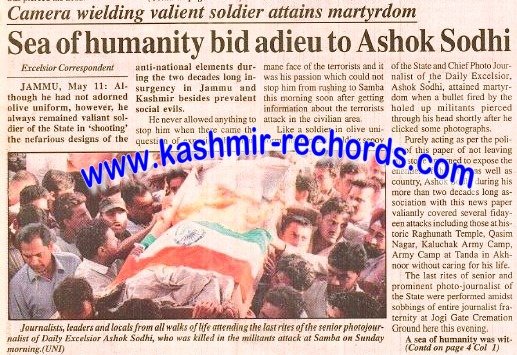
Ashok Sodhi was definitely a   multi-faceted personality, an artist who performed for different local tale-serials besides taking part in various forms of nukkad shows. A man full of emotions, Sodhi would feel the pinch of the human sufferings. In 1990, when migration of Kashmiri Pandits was at peak, Sodhi would visit every camp to capture the human sufferings. He did it many a time when humanity was in distress. And on May 11, 2008 when he and seven others fell to the bullets of the militants at Samba, it was not in fact the first time that Ashok Sodhi had visited the encounter site. His  former colleagues recall how he  had  earlier also covered half a dozen encounters including those at Vijaypur and Kaluchak and how Sodhi had gone too close into the danger zones in a bid to click the best available  shot.
 Working in the terror zone of Jammu and Kashmir, where encounters and blasts were the norm of the day, Sodhi, like other journalists, lived on the edge. Despite knowing that there was a thin line between life and death, he would always defy the gravity and rush into danger zones and would come out with a professional stuff.  But one such act proved fatal for him!

 Died for a Cause 

Ashok Sodhi was amongst those journalists who did not believe in job-hopping. He was always ready to help young photographers and even reporters who were there to adopt this glamorous profession. During 25 years’ of his commitment towards journalism, Ashok Sodhi mentored a number of photojournalists in Jammu and was darling of every mediaman. His public relations were so strong that he would   rarely miss an event and would even manage the pictures to the satisfaction of his colleagues and readers.  His death has definitely left a void in the media space.
Several years ago, the bullets he sustained, stopped him from further pressing the shutter button.  But   Sodhi’s work will live on to tell the stories in timeless images he captured during his journey as a photojournalist.  Sodhi died for a noble cause and would always be remembered for his bravery and commitment towards his job.

Chander’s Chronicles: Capturing Kashmir’s Soul Through History’s Lens

(Kashmir Rechords Exclusive)

Meet Chander Mohan Bhat, a native of the picturesque village of Murran nestled within the Pulwama district of Kashmir. For over three decades, Chander Mohan Bhat has served as a beacon of knowledge and insight, contributing extensively to local dailies with his writings that delve deep into the tapestry of Kashmir’s rich history, vibrant culture, and diverse heritage. His words not only shed light on the region’s storied past but also offer glimpses into the daily lives of its inhabitants, painting a vivid picture of the land and its people.

Before the advent of social media, Chander’s literary endeavors primarily found expression in the pages of traditional newspapers, where his articles on Kashmir’s heritage sites, pilgrimage destinations, and the workings of the Department of Posts, where he served as Assistant Director, garnered widespread acclaim. However, with the rise of social media platforms, Chander saw an opportunity to expand his horizons and reach a broader audience.

Kashmiri Pandits’ Oal

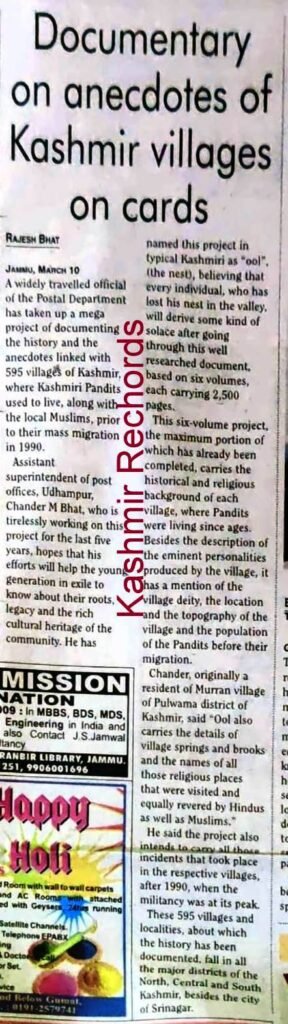
Harnessing the power of digital communication, Chander embarked on ambitious projects that would showcase the beauty and diversity of Kashmir in new and innovative ways. One such project, which he has been tirelessly working on for more than two decades, is a mega project “Oal’’—The Nest. Under this Project, he has been documenting history and anecdotes linked with 595  villages of Kashmir where Kashmiri Pandits used to live before the community’s mass migration of 1990.

The Initial Days… When Chander Mohan Bhat started working on Project `Oal’. The news was carried by The Tribune Chandigarh.

Motivated by a deep-rooted desire to preserve his homeland’s cultural and religious heritage, Bhat embarked on this journey of discovery, traversing rugged terrain and braving the uncertainties of a region marked by political turmoil.

As he ventured into the heart of Kashmir’s sacred sites, Chander Mohan Bhat encountered not only the physical remnants of centuries-old shrines but also the spiritual echoes of a bygone era. His encounters with locals, steeped in tradition and folklore, provided him with invaluable insights into the significance of these sites in the collective consciousness of the Kashmiri people. Yet, amidst the beauty and serenity of these hallowed grounds, Bhat also confronted the harsh realities of life in a conflict-ridden region, where tensions simmered beneath the surface, ready to erupt at a moment’s notice.

 Undeterred Despite Challenges

Despite the challenges he faced, Bhat remained undeterred, driven by a sense of duty to preserve the cultural heritage of his homeland for future generations. His meticulous documentation of each temple and shrine, accompanied by high-resolution images capturing their architectural splendor, serves as a testament to his unwavering dedication and passion for his craft. Bhat also recorded for posterity the high-resolution images and pictures of the floral wealth of Kashmir besides the assorted documentation of the environment and people inhabiting the places in Kashmir.

 Book on Life & Teachings of Prof Kaul

In addition to his work on Kashmir’s religious heritage, Bhat has also undertaken a deeply personal project centered on the life and teachings of Professor Brij Nath Kaul (May 17, 1942 to January 31, 2020), a revered figure in the Kashmiri spiritual community.

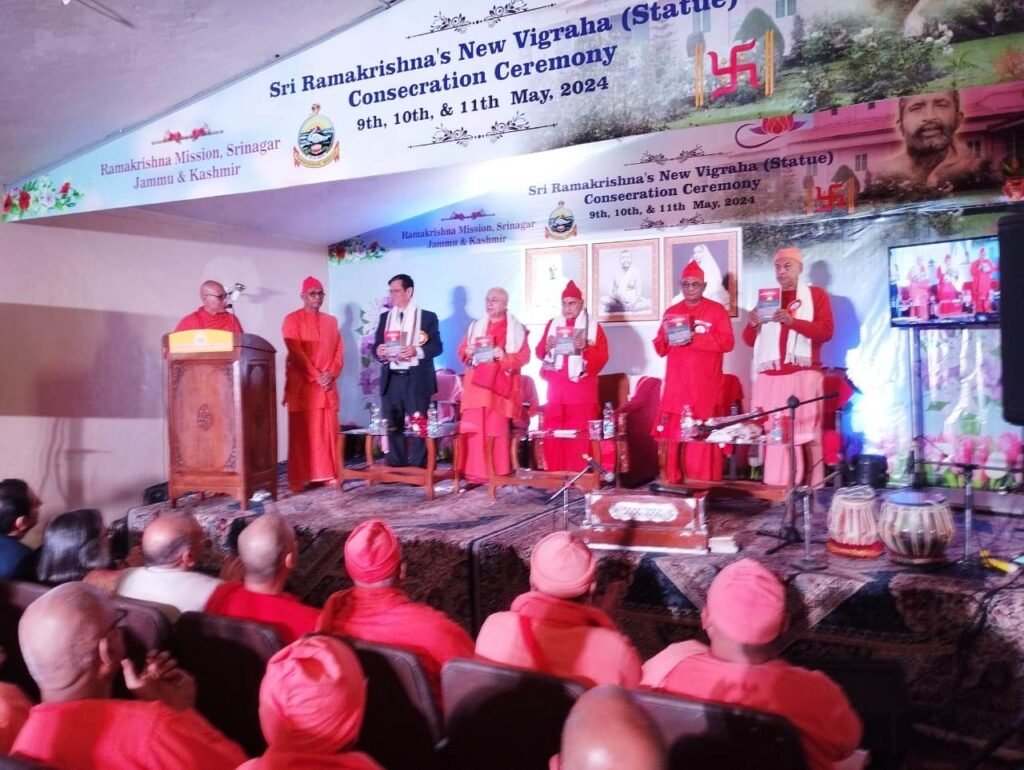
Through painstaking research and interviews with those who knew him best, Bhat has pieced together a compelling portrait of a man whose life was dedicated to the pursuit of spiritual enlightenment and the service of others. The book,  titled “ Professor Brij Nath Kaul—A Divine Soul ‘’  was released by Swami Gautmanandaji Maharaj, President of Ramakrishna Math and Ramakrishna Mission on May 10, 2024, at Ramakrishna Mission, Srinagar, Kashmir.

A Book Releasing Function “Professor Brij Nath Kaul—A Divine Soul’ at Ramakrishna Mission, Srinagar, Kashmir on May 10, 2024

  Professor Kaul’s own corpus of spiritual energy bestowed on him by his deeply religious parents kindled the devotional fire in him. Thus began his life’s story which appears to be the stuff of legends and has been told by Chander Mohan Bhat in a simple, lucid, and highly engaging narrative that is surely going to enthuse the readers of the book.

With two more books to his credit—Kashmir Shrines And Temples and Professor Brij Nath Koul - A Divine Soul, Bhat stands on the brink of sharing his passion and knowledge with the world. He has so far authored 18 books which include Murran My Village'', Ocean By Drops'', Mera Kashmir'', Fading Faces'', `` Kapal Mochan, Shopian Kashmir'' etc. Through his words, he hopes to not only educate and enlighten but also to inspire others to embrace the rich tapestry of culture and tradition that defines Kashmiri identity. His Book “Ancient History of Jammu and Kashmir” confirms his researching capability. Through his words, he hopes to not only educate and enlighten but also to inspire others to embrace the rich tapestry of culture and tradition that defines Kashmiri identity.
 While the first volume of ``Kashmir Shrines and Temples” is structured into five distinct sections, each delving into a specific aspect of the region’s religious heritage and cataloged over 600 shrines and temples scattered throughout Kashmir, the author progresses with the editing stage of the second volume of this book with further insights into these sacred locales, deepening their understanding of Kashmir’s profound spiritual legacy.

As he prepares to unveil his latest works shortly, Chander Mohan Bhat remains humbled by the opportunity to share his love for his homeland with the world. For him, social media is equally a tool for preserving and celebrating the rich heritage of Kashmir for generations to come.

Zadoo Brothers of Kashmir Who were Closely Associated With Subash Chandra Bose!

(Kashmir Rechords Desk)

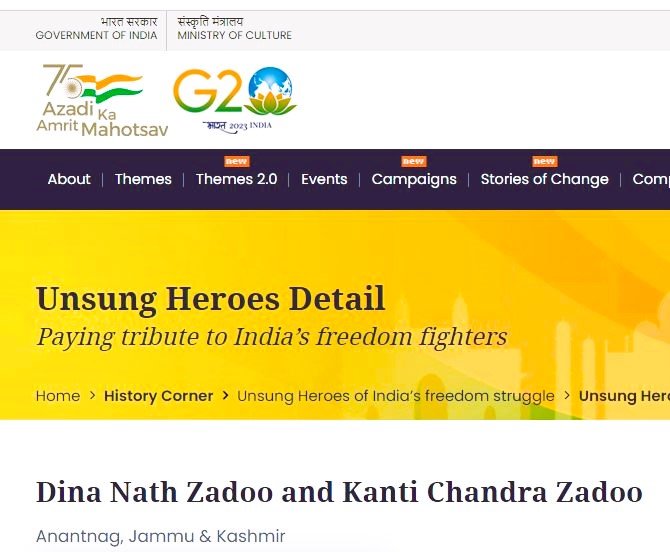
Two Zadoo Brothers from Anantnag district—Dina Nath and Kanti Chandra, who find their name  incorporated in the category of “ Unsung Heroes’’,   prepared by Government of India  during ``Azadi Ka Amrit Mahotsav’’,  were closely associated with  Netaji Subash Chandra Bose.

 Born in 1916 and 1918, respectively, to Prof. Jagaddhar Zadoo, the elder brother (Dina Nath Zadoo) had worked as the Captain in the Azad Hind Fauj. He fought at Malaysia. He died in 1986 in India.  His younger brother, Kanti Chandra Zadoo was the Personal Secretary of Netaji Subhash Chandra Bose.

Dina Nath Zadoo and Kanti Chandra Zadoo

   According to the inputs provided by Ministry of Culture, Kanti Chandra Zadoo is believed to have been on board the same aircraft, which mysteriously crashed in 1945, resulting in the death of both Subhash Chandra Bose and Kanti Chandra. (Although, for many people the death of Netaji has been a cause of disagreement in the history of Indian freedom struggle).

``Azadi Ka Amrit Mahotsav’’ was an initiative of the Government of India to celebrate and commemorate 75 years of independence and  to highlight the glorious history of its people, culture and achievements. Under the same initiative, in June 2023, Centre for Advance Research on Development and Change, in collaboration with Degree College Anantnag had orgainsed a lecture on “ Role of Kashmir in the India Freedom Struggle’’, to remember freedom fighters like Zadoo Brothers.

Noted writer, Avtar Mota in his Blog “Chinar Shade’’ also mentions about Zadoo Brothers and their association with Subash Chandra Bose. “Beyond a three or four references, no research has been done on this aspect at any point of time’’, he regrets.

Prof Jagaddhar Zadoo

 Dina Nath and Kanti Chandra were sons of an illustrious Professor Jagaddhar Zadoo, who was a Sanskrit scholar, and a master of oriental languages. Zadoos originally belonged to Zadipur, a village near Bijbehara, Anantnag in South Kashmir from where the family had migrated to Srinagar at the beginning of the 18th century. Their surname was linked to the village of their origin and remained with them thereafter.

“In 1921, their father joined the Jammu and Kashmir Research Department as head and worked there until 1924. And again from 1928-31, he worked as a professor of Sanskrit in Srinagar where he translated some portions of the Gilgit manuscript discovered in 1931 and brought out critical editions of Nilmat Purana jointly with Prof Kanji Lal.  His works instilled respect for the cultural heritage of the country in the heart and minds of the family members’’. (Source:https://amritmahotsav.nic.in/unsung-heroes-detail.htm?15264)

  Prof Zadoo was a part of the vibrant interface of scholarship between western scholars and Kashmiri Sanskrit scholars. His scholarship elevated him to the level of an excellent researcher and exposed them to International literary circles. He was the first Sanskrit scholar to work with Japanese scholar Momo Motokora on the Shaivite text. His unpublished autobiography in two volumes reveals the nationalistic approach of the Zadoo family.  Prof Jagaddhar Zadoo was the grandson of Pandit Keshav Bhat Zadoo,   the Royal Astrologer of Maharaja Ranbir Singh.

 Another Zadoo from Srinagar

 Pushkar Nath is another Zadoo from Srinagar, Kashmir whose name also figures in the list of Freedom Fighters of “ Azadi Ka Amrit Mahotsav’’ from Jammu and Kashmir.

Born on 15 April 1928 to Pt. Vasudev Zadoo and Smt. Devki Zadoo, Pushkar Nath studied the Science stream subjects for his graduation in Amar Singh College, Srinagar. He was attracted to the Progressive Group that started a Peace Brigade as first line of defence of Kashmir. Led by Pushkar Nath Zadoo, some volunteers went to Handwara to stall the march of invaders and to assist the units in the Handwara-Kupwara-Teetwal region. This area continued to see action until  1948.

Young men like Pushkar Zadoo were deployed to provide logistical support to the Indian forces and assisted in gathering of local information/intelligence. He was deployed on the Teetwal Front, where he died in action in July 1948.

Krishna Misri (Zadoo), who got herself enrolled as a volunteer in the women’s wing of’ National Militia’ set up by the supporters of the National Conference to fight the Invading tribal raiders during 1947, also belonged to Zadoo family.

As most of the members of the Zadoo family were intensely engaged in the freedom struggle and sacrificed their lives for the sake of their nation, hence the Zadoos of Kashmir are remembered as the icons of the freedom struggle.

N.B: (This write-up is open to any addition/ alteration.  Authentic Inputs from esteemed readers are most welcome).

Hakhu’s Hockey Haven

(Kashmir Rechords Exclusive)

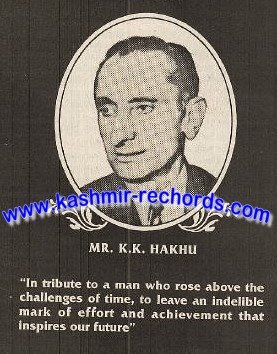
If Jammu City presently boasts of a high quality Astroturf laden Hockey Stadium, the credit for that definitely goes to the relentless efforts of Krishan Kumar Hakhu, the man who was wedded to the cause of Sports   in Jammu and Kashmir for decades together.

Popularly known as K K Hakhu, this son of the soil was incredibly passionate about the promotion of Sports in Jammu and Kashmir until his last breath. His dedication reflected the recognition of his significant role in promoting and nurturing sports in the erstwhile State.

K K Hakhu’s commitment to sports in Kashmir, particularly through his leadership of the Kashmir Wanderers Hockey Club since 1945, evidently left a lasting impact on the region’s sporting community.

Inside View of K K Hakhu Hockey Stadium, Jammu

 When Hakhu Defeated Politicians!

It is heartening to know that despite initial suggestions and manoeuvring to name Jammu’s Hockey  stadium after  some politicians, the decision to honor Hakhu’s contributions ultimately prevailed and K.K Hakhu Sports Stadium, opposite Jammu University Campus was named after him.

 Hakhu was originally from Sathu Barbarshah, Srinagar, Kashmir but had settled down at Exchange Road, Jammu where he breathed his last on January 14, 1997.

A recipient of so many awards, including  J&K Governor’s  Highest Sports Medal  and All India Surjit Singh Memorial Hockey Tournament Society Award,  Hakhu  had the honour  to start  Winter All India Indira Gold Cup  Hockey   tournament  in Jammu  in 1990  which  had enabled sports lovers to watch national and international hockey players in action.

Hakhu was, however, reportedly denied Padam Shree, despite his name having been recommended by the then State Chief Minister, Dr Farooq Abdullah for his relentless service to sports.

Besides Indira Gold Cup Hockey Tournament, Hakhu was a great organiser of Football matches also both in Kashmir and Jammu divisions and actively taking part in such matches. Organizing tournaments like the Indira Gold Cup Hockey demonstrates a deep commitment to fostering sportsmanship and athletic talent in the region.

K K Hakhu (Extreme Left) with Sheikh Mohd Abdullah. Photo Credit:Sohail Iqbal

 His legacy will likely continue to inspire future generations of sports enthusiasts in Jammu and Kashmir.

1996: When Kashmiri Pandits `dissociated’ from Lok Sabha Polls!

( Kashmir Rechords Archives)
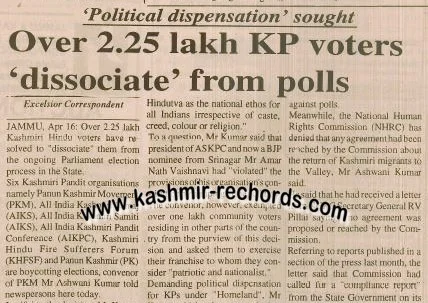
It was during 1996 Lok Sabha elections when  over 2.25 Lakh  Kashmiri Hindu voters  had reportedly  resolved to “dissociate’’ themselves  from the Parliament election process in the  then State of Jammu and Kashmir.
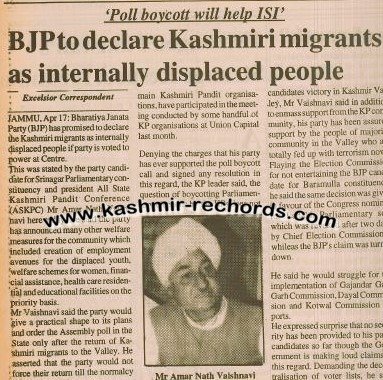
The call for boycotting the elections was given by six Kashmiri Pandit organisations, which included Panun Kashmir Movement (PKM), All India Kashmiri Samaj (AIKS), All India Kashmiri Samiti (AIKS), All India Kashmiri Pandit Conference (AIKPC), Kashmiri Hindu Fire Sufferers Forum (KHFSF) and Panun Kashmir (PK).  Panun Kashmir Movement ( PKM) convenor, now BJP leader, Mr Ashwani Kumar  Chrangoo  had disclosed the same during a Press Conference held in Jammu on April 16, 1996.
 For the benefit of readers, Kashmir Rechords is reproducing one of the newspaper cuttings of that Press Conference carried prominently by  many National and local dailies.
Justifying the `boycott’’ decision, Mr Ashwani Kumar Chrangoo had listed three main reasons “forcing’’ the community not to take part in the polls. Firstly, the situation, according to him was not conducive for holding any such polls. Secondly, no Kashmiri Pandit had a chance to be elected and thirdly, the electoral roll was not “authentic.”
  The PKM Convenor  had,  however, “advised’’ one lakh  community member voters residing  in other parts of the country  to  play a positive role  by exercising  their franchise  in favour of those  whom they consider “patriotic and nationalist’’.  

Vaishnavi Blamed for `Violation’

Ashwani Kumar Chrangoo during the same Press Conference had accused the president of ASKPC and a BJP nominee from Srinagar, Mr Amar Nath Vaishnavi for “violating” the provisions of his organisation’s constitution by jumping into the poll fray.
Demanding political dispensation for KPs under `’Homeland”, Mr Ashwani Kumar had regretted that the “community had been marginalised and reduced to non-entity by the political system that got established in the State’’.

Vaishnavi’s Response

Next day on April 17, 1996, the BJP nominee  from Srinagar, Mr Amar Nath Vaishnavi, who was accused of “violations’’ by jumping into the fray, had promised that his Party would declare the Kashmiri migrants as internally displaced people if  BJP  was voted to power at the  Centre. He had listed many other welfare measures for the community, which included creation of employment avenues for the displaced youth, welfare schemes for migrant women, financial assistance, and health care residential and educational facilities on the priority basis. 
Denying Mr Chrangoo’s  charges that his party  (ASKPC) had ever supported the poll boycott call and signed any resolution in this regard, Mr Vaishnavi had made it clear that the question of boycotting Parliamentary elections by Kashmiri Pandits did not  arise at all as such a move was bound to help the   subversive elements.