Home Blog Page 8

The Sikh Governor Who Revived Kashmir’s Fortunes

(Kashmir Rechords Exclusive)

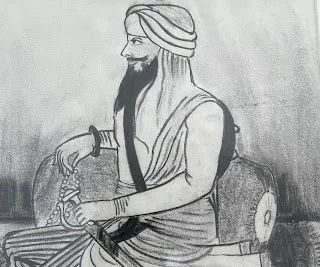
During the brief but eventful Sikh rule over Kashmir, the Valley saw ten governors appointed by the Lahore Darbar. Among them, one name still stands tall in the memory of the land — Colonel Mihan Singh (also recorded as Mehan Singh), widely regarded as the finest of them all. Serving from 1834 to 1841, his tenure was marked by integrity, efficiency and an uncommon empathy for the people.

When Col. Mihan Singh took charge in April 1834, Kashmir was in a dismal state — the economy lay in ruins, poverty and hunger were rampant, and trade had withered away. Yet, in just a few years, he steered the region towards recovery, leaving behind a legacy rare in the annals of governance.

A Team for the People

Mihan Singh was not alone in his mission. He surrounded himself with capable aides — Pandit Ganesh Dhar, a Kashmiri Pandit expert in revenue and administration, and Mohammad Afzal Qazi, a Punjabi Muslim officer. Together, they formed a formidable team that worked tirelessly to rebuild Kashmir’s industrial and agricultural base.

On the advice of Dhar and Qazi, the Governor abolished duties on essential commodities like grain, ensuring affordable food for the masses.

He imported grain and poultry from Punjab to combat shortages, and punished black-marketers without mercy. The Sikh Governor also reduced trade tariffs and offered loans to shawl factory owners, reviving the famed Kashmiri shawl industry. Besides opening trade routes to Ladakh, Punjab, British India, Afghanistan and Central Asia, the Governor’s administration built inns for traders and travellers, promoting commerce and cultural exchange.

Kashmir Rechords is proud to reproduce this account, originally penned by noted Kashmiri writer Jawaharkaul Ganhar and published in Kashmir Times on December 11, 1988 — a tribute to one of the rare administrators in Kashmir’s history who is remembered not for oppression, but for compassion and progress.
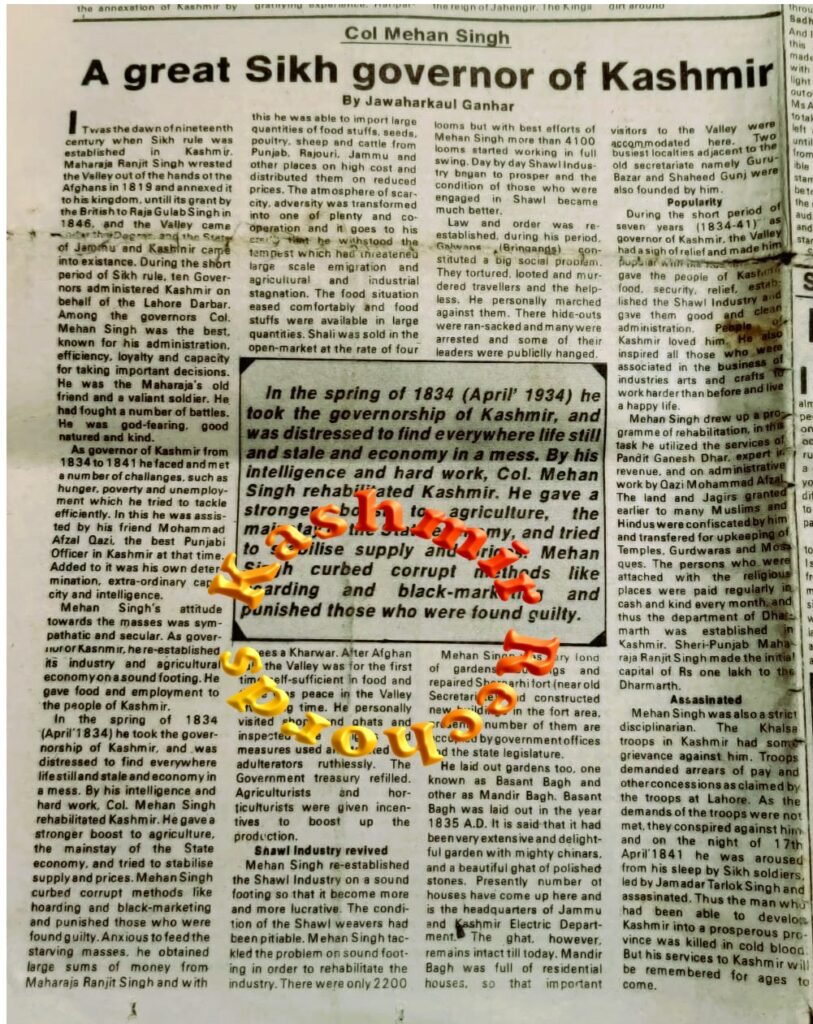
For the first time since Afghan rule, Kashmir had become self-sufficient in food. Peace had returned to the Valley after decades of turmoil. Mihan Singh used to personally inspect markets, enforcing proper weights and measures and cracked down on adulteration. Farmers and horticulturists received incentives, while the government treasury was replenished.

Cultural and Civic Contributions

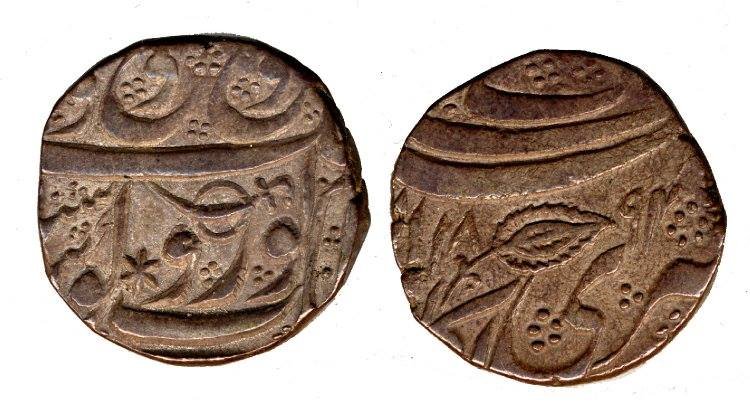
Mihan Singh’s governance extended beyond economics. He planted fine Chinar trees in a newly laid Basant Bagh (1835), established the Mandir Bagh and commissioned the compilation of the historical record ‘Tarikh-i-Kashmir’. In 1836, he even minted coins — a symbol of restored confidence in the State’s economy.
Respected by Historians

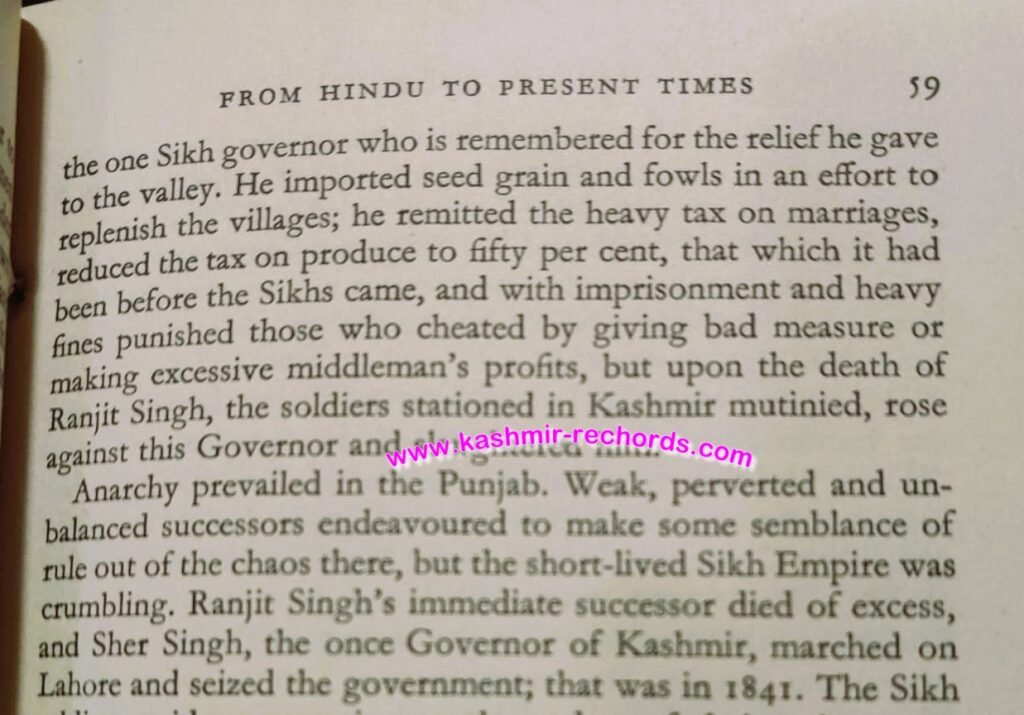
Sir Walter R. Lawrence, in his classic The Valley of Kashmir (1895), called him “the best of all the Sikh Governors” and praised his fairness, quick justice and effective reforms. Pearce Gervis, in This is Kashmir (1954), described him as “an enlightened ruler… remembered for the relief he gave to the Valley.”
A Tragic End!

Despite his achievements, Col. Mihan Singh’s life ended in betrayal. On the night of 17 April 1841, he was murdered in cold blood at his Srinagar residence in a conspiracy by mutinous soldiers. His trusted aide, Pandit Ganesh Dhar, met the same fate within a fortnight.

Today, about ten kilometers from Gujranwala stands Qila Mian Singh, a village believed to have been founded by the Colonel himself — a reminder of a man who left an imprint far beyond the Valley he once governed.

References for further reading:

https://www.britishmuseum.org/collection/term/BIOG150956

https://www.sikhnet.com/news/evaluation-sikh-rule-kashmir
https://en.wikipedia.org/wiki/Qila_Mihan_Singh

https://malicethoughts.blogspot.com/2021/07/kumedan-mihan-singh-sikh-governor-of.html?fbclid=IwAR2ymfECX25x8vdm0xF52U_4gJOIIGCr5ynCcorNLfwY8z4ee9C7K-_FuT0

British Missionary Who Preserved Kashmir’s Words,Wisdom

(Kashmir Rechords Exclusive)

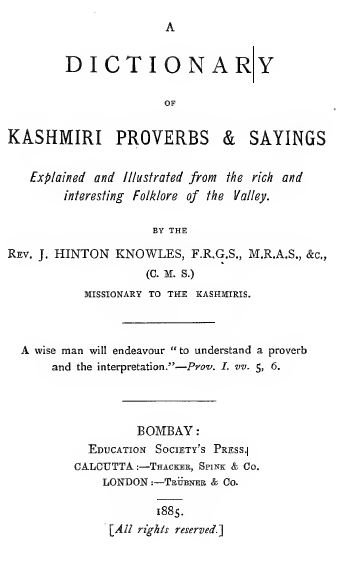
In the late 19th century, far from his home in England, a young British missionary named James Hinton Knowles arrived in the Kashmir Valley. Born in Clerkenwell, London, in 1856, Knowles came to Srinagar in 1880 under the Church Missionary Society. His mission was clear—to serve through education and health—but his heart soon became devoted to something more: the living language and folklore of the Kashmiri people.

During his eleven years in Kashmir, Knowles not only tended to the sick and guided young students at the Mission’s boys’ school—where he served as director from 1880 to 1891—but also immersed himself in the rhythms of local speech. He believed that proverbs carried “the real people’s speech,” a truth distilled over centuries, and he began collecting them with almost obsessive care.

This effort culminated in 1885 with his first great work, Kashmiri Proverbs and Sayings, followed in 1893 by Folktales of Kashmir, a treasury of over 100 traditional stories. Together, these volumes became invaluable cultural archives—works that still resonate in the Valley’s oral and literary tradition today.

Knowles’ proverb collection brims with local wisdom. Familiar sayings like Aki Tsat Sum Ta Sass Gav Kouli  (A single spark can burn down a forest), Anim Soi, Wavum Soi….. (As I sow, so shall I reap), Bir Balun Kath (A sheep without wool), and Hapath Yaraz (A week’s friend) are accompanied by the Kashmiri folk stories from which they sprang. He recorded not only the words, but the very circumstances in which they were spoken—by a learned Pandit, a chatty barber, or a weary coolie.

In his own preface, Knowles described the years of “labour, study and anxiety” behind the book. The work was not without challenge: the Kashmiri language lacked a proper dictionary and grammar; it was written in the Sharada script, known to only a small section of the population; and it varied so widely between Hindu and Muslim speakers that even transcribing the sounds into Roman script proved daunting. Yet, he persevered—acknowledging the invaluable help of local Muslim and Hindu friends who guided him in arranging the collection.

Every paisa earned from the book’s sale, Knowles pledged, went to support the struggling Medical Mission Hospital in Kashmir—a gesture as telling of his character as his scholarship.

James Hinton Knowles left Kashmir in the 1890s, eventually passing away in Ely, Cambridgeshire, on 22 December 1943. But his legacy endures in the proverbs still traded in everyday Kashmiri speech and the folktales that continue to charm readers more than a century later. Through his painstaking work, he became not merely an observer of the Valley’s culture but a guardian of its spoken soul.

Ban it, and they will read it.

Banning 25 Books in J&K: Shielding Minds or Selling Narratives?

The government’s recent ban on “secessionist” literature may have done the opposite of its intent — boosting online searches, reviving forgotten authors and giving critics fresh ammunition.

By:Kanwal Krishan Lidhoo*

They say the quickest way to make someone read a book is to tell them they can’t. Jammu & Kashmir’s recent ban on 25 titles — accused of promoting secessionism and false narratives — might just prove that old truth. Within days of the announcement, online searches for these books shot up, and names most people had never heard of began trending in niche reading circles. The irony? In an age where PDFs, Kindle editions and overseas libraries are just a click away, banning a book might be the most effective way to market it.

The Jammu & Kashmir Home Department’s move — followed by raids in to seize copies — has triggered a mixed response. The official justification is that these books distort history, glorify terrorists, vilify security forces and promote alienation, thereby influencing youth towards radicalization.

A notification signed by Principal Secretary Chandraker Bharti, on the orders of Lieutenant Governor Manoj Sinha, stated:

Certain literature propagates false narrative and secessionism… This literature would deeply impact the psyche of youth by promoting a culture of grievance, victimhood and terrorist heroism.”

Yet, the timing and practicality of the ban invite questions. Many of the titles have been in circulation for decades. Take Al-Jehad Fil Islam by Syed Abu Ala Maududi — published by Markazi Maktaba Islami, Delhi-6 and available in Kashmir since the 1980s, and some other books even stocked in public libraries through government purchases. If the aim is to prevent exposure, the horse may have bolted long ago.

The ban applies under Sections 152, 196, and 197 of the Bhartiya Nyaya Sanhita 2023, citing threats to India’s sovereignty and integrity. But while J&K shops are now forbidden from selling them, ironically they remain freely available elsewhere in India and online. This creates a paradox — a book inaccessible in Jammu and Kashmir can still be ordered from Delhi or downloaded in minutes.

In fact, the “forbidden fruit” effect seems to be in full swing. People who never knew these books existed now have the titles on their radar. Obscure authors risk being elevated to the status of “free-speech martyrs’’, their works gaining an audience they might never have reached otherwise.

Panun Kashmir leader Shailendra Aima summed up the irony in a Facebook post:

Writers like Arundhati Roy and A.G. Noorani have long been exposed for their biased takes… Their influence has waned. Their arguments have been countered and discredited in the court of public opinion. So what exactly has the state gained by banning them now, except making them relevant again?”

Critics argue the State could have taken another path — commissioning respected historians and scholars to dismantle the books’ claims point-by-point. J&K has no shortage of credible voices capable of providing fact-based counter-narratives. This approach might have undercut the books’ influence without giving them a publicity boost.

The deeper irony is that anyone truly inclined towards secessionism will have no difficulty finding these works online, often hosted in overseas archives beyond India’s legal reach. The ban, instead of shielding impressionable minds, may simply have served as a promotional campaign for the very narratives it sought to silence.

So, was this a miscalculated move? In the battle of ideas, persuasion often trumps prohibition. And by choosing the latter, the state may have scored a “self-goal” — amplifying voices it hoped to erase.

At Kashmir Rechords, we believe that truth, when told fearlessly, outlives every attempt to bury it.

Combating secessionism is rarely achieved through book bans; it is better served by drawing a broader, more compelling line of comparative viewpoints. Governments and engaged elements of civil society can always counter such narratives with informed, well-reasoned perspectives. This intellectual space, however, must not be extended to terrorist groups or individuals who use online platforms to propagate violence and toxic ideologies. A well-researched book, rich with facts and context, can effortlessly strip away the superficiality and distortions found in works the state seeks to ban.

  • *Kanwal Krishan Lidhoo is a noted Broadcaster, Author and acclaimed  Translator approved by Sahitya Akademi, New Delhi. He is a Founding Director of Kashmir Rechords Foundation.

Bansi Parimu: The Forgotten Flame of Kashmiri Modernism

(Kashmir Rechords Exclusive)

Has the visionary artist, activist and cultural conscience-keeper faded from the memory of his own people?

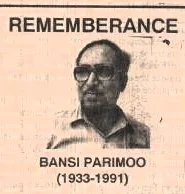
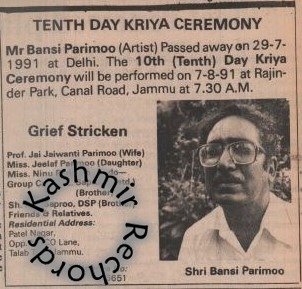
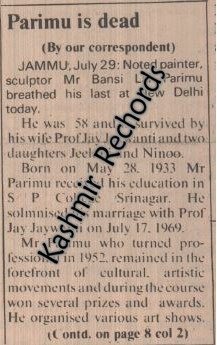
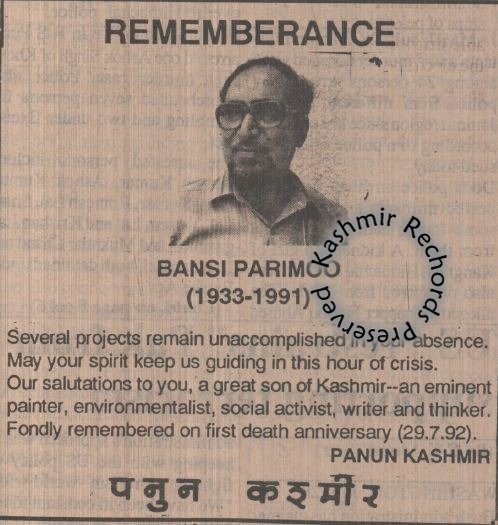
By all accounts, Bansi Parimu ( Parimoo), (1933–1991) was no ordinary painter. He was a modernist with a mission, a fierce cultural force, an environmental and social activist, and a voice that once echoed with the conscience of Kashmir. Through brush and belief, he embodied the soul of a homeland that now seems to have forgotten him.

His death anniversary, July 29, passed once again this year without public homage—no tribute, no commemorative exhibition, not even a whisper of remembrance from the circles that once lauded him. Particularly silent has been Panun Kashmir, the very organization that once recognized Parimu as a mentor and inspiration. Is this the inevitable fate of a displaced artist? Or are we witnessing a deeper decay—a cultural amnesia that has crept into our collective conscience?

The Making of a Modernist

Born on June 2, 1933 near Habba Kadal, Srinagar, Bansi Parimu was shaped by the natural beauty of Kashmir. The meadows, chinars, snow-covered peaks, and glimmering lakes formed the palette of his early years. His initial works—delicate, lyrical landscapes in oil and watercolor—reflected that beauty. But Parimoo would not remain confined to romantic realism for long.

As he matured artistically, his language evolved into bold figurative and abstract compositions, echoing deeper turmoil and truth. He was entirely self-taught, guided not by academic institutions but by a lifelong pursuit of observation, questioning and refinement—rooted in the Vedic principle of Neti-Neti (“Not this, not this”), a process of stripping away illusion to uncover essence.

More Than a Painter

Parimu was more than an artist—he was an institution unto himself. He edited and wrote for the influential weekly Criterion in Srinagar. He was an environmentalist who opposed the felling of chinars and the construction of a concrete bridge over the Jhelum. He was a cultural crusader who fought to preserve Kashmir’s visual and architectural heritage.

In 1986, during a public event attended by Union Minister S. B. Chavan, Parimu posed a piercing question that now rings prophetic:
“Why talk only of wildlife conservation? Why not protect the other endangered species—the Kashmiri Pandits?”

Exile, Expression, Elegy

In 1990, when the Kashmiri Pandit community was driven from the Valley, Parimu too fled—leaving behind not just a home, but a living heritage. He relocated to Delhi, a city alien to his sensibilities. There, amidst illness and heartbreak, he continued to paint—translating pain into poignant, powerful visuals.

His last exhibition, with help from theatre maestro M. K. Raina, received critical acclaim. The works on display were elegies of exile—haunting, raw and searing. Cobwebs of Apathy, Smeared Snow, Red Knows No Creed—these were not just titles; they were laments rendered in colour and form. Blood in the snow. Women in flames. A homeland unravelled.

He passed away on July 29, 1991, at the age of 58.

A Mentor Silenced by Silence

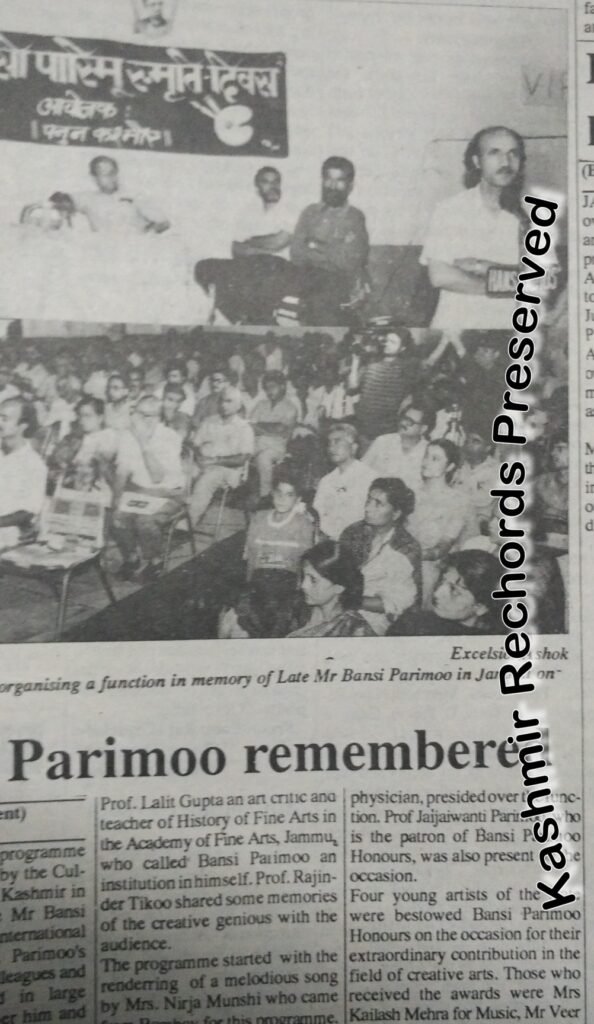
In the immediate aftermath of displacement, Parimu was hailed as a cultural beacon. Panun Kashmir spoke of him with reverence, events were held in his name, and the Bansi Parimoo Awards were instituted to encourage young talent. He was spoken of not just as an artist, but as a visionary—someone who saw art as resistance and identity.

Yet over the years, that reverence dimmed. The awards disappeared. Events dried up. His name faded from speeches and commemorations. Silence replaced celebration. Even those who once called him a mentor have let his legacy slip into obscurity.

Legacy That Still Whispers

Despite neglect in public memory, Parimu’s work lives on—in the National Gallery of Modern Art, the Lalit Kala Akademi, and private collections across the world. His art graced Republic Day tableaux, UNESCO publications, and Indian diplomatic missions. His vision transcended borders, his brush spoke to universals.

And yet, among his own people—especially within Kashmiri Pandit circles—he remains largely unspoken. As political slogans grow louder and communal rifts deepen, the quiet brilliance of Parimu’s legacy lies buried beneath the noise.

A Call to Remember

To forget Bansi Parimu is not just to neglect a painter. It is to disown a tradition of cultural resilience, artistic excellence and intellectual honesty. He stood for a Kashmir of depth, dialogue and dignity. A Kashmir where art questioned power and beauty carried truth.

We owe him remembrance—not as nostalgia, but as responsibility.
Let his colours speak . Let his canvases challenge us.
Let us remember Bansi Parimu—not just as a master artist—but as the conscience of a people who are still searching for home.


🔗 Explore Further

  • National Gallery of Modern Art – Online Collection
  • Lalit Kala Akademi – Artist Archives
  • Interviews with M.K. Raina on Bansi Parimu’s Final Years
  • https://autarmota.blogspot.com/2013/07/a-1964-untitled-oil-on-canvas-by-noted.html
  • https://www.artkyk.com/bansiparimu

🕯️ Closing Thought

To remember Bansi Parimu is to reclaim a part of Kashmir’s soul.
A soul that painted even in pain. A soul we must not forget.

🎶 Why AIR Banned Harmonium in 1940?

🎼 A Ban Too Bizarre to Believe

(By: Kanwal Krishan Lidhoo*)

Why would a musical instrument—beloved, popular and proudly Indian-made—be suddenly declared unfit, unholy and ultimately unplayable by the nation’s own broadcaster? What crime did the humble harmonium commit to deserve a formal burial inside All India Radio’s studios in 1940? The answer lies in a curious and often overlooked chapter of India’s cultural history—equal parts musical purism, colonial hangover and bureaucratic melodrama.

📻 July 23, 1927: Harmonium’s Prime Time Debut

Exactly 98 years ago, on July 23, 1927, the first-ever radio broadcast in India crackled through the airwaves from Bombay, under the Indian Broadcasting Company.

And right there in the studio, surrounded by microphones and musical hopes, was the harmonium—steady and reliable. In those early years, it was an essential part of AIR’s programming. But its reign would be short-lived.

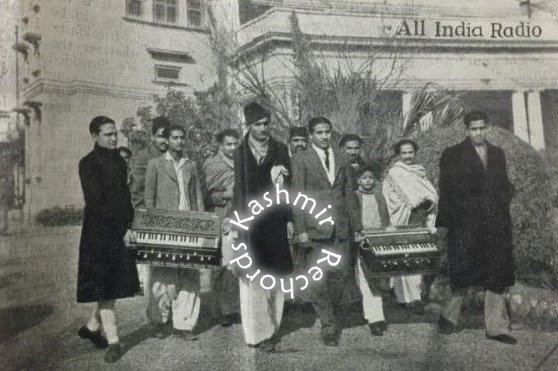
THE LAST RITES: Two Harmoniums used at AIR Lahore Station, make their final exit in 1940!

🎹 Why the Harmonium Was Declared a Musical Outcast

Back in 1915, India wasn’t just playing the harmonium—it was making it. We were among the world’s leading producers of this versatile little reed box. From homes to temples, classical mehfils to revolutionary gatherings, the harmonium had become a national fixture.

But just 25 years later, it was banished from All India Radio (then part of the colonial Information Department). The date was March 1, 1940, and the reason? It was declared “unsuitable for Indian classical music.” A polite way of saying: “You’re not good enough to be heard anymore.”

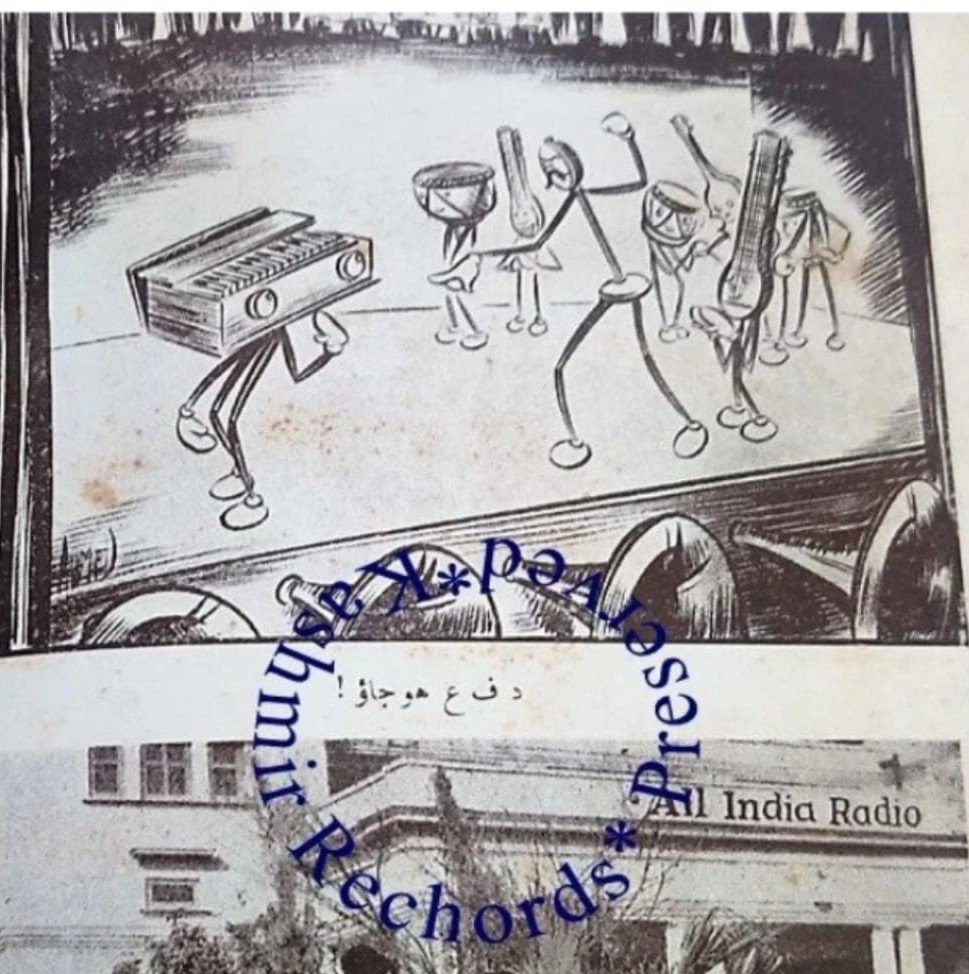
And so, with solemn sarcasm, AIR Lahore held a symbolic funeral. The harmonium, once central to every broadcast, was “laid to rest,” while cartoons appeared in newspapers showing other instruments telling it, “Harmonium Ka Jinaaza’‘ ,“Dafa ho jao!” (Go to hell!).

A Cartoon depicting ``Dafa Ho Jao”— Go to the Hell, You Harmonium from All India Radio!

🎶The British Ear Didn’t Approve

The ghost of this decision haunts Indian music history. The culprit behind the ban? A curious alliance between colonial purists and Indian traditionalists. John Foulds, a British composer and head of Western music at AIR, believed the harmonium failed to capture the microtones—those subtle emotional inflections—that Indian ragas demand.

Lionel Fielden, the first Controller of Broadcasting in India, took this critique seriously—especially after receiving similar complaints from Indian classical musicians. The harmonium, they said, couldn’t glide or bend a note the way a sitar or sarangi could. So Fielden signed the death warrant. AIR issued a directive. Harmonium: out. Permanently.

🎼Even Nehru and Coomaraswamy Didn’t Object

The harmonium’s fate wasn’t helped by India’s cultural elite. According to documents archived by www.kashmir-rechords.com, even Ananda Coomaraswamy, the revered philosopher and cultural historian, dismissed it as “non-Indian.” Jawaharlal Nehru, still a freedom fighter then, wasn’t particularly fond of it either.

To them, the harmonium represented colonial contamination—a European relic invading India’s sacred soundscape. B.V. Keskar, post-Independence Information & Broadcasting Minister and a student of the great musicologist V.N. Bhatkhande, upheld the ban with gusto. Even free India wasn’t ready to forgive the harmonium.

🔓A French Immigrant with an Indian Passport

Ironically, the harmonium had arrived in India as a savior. Invented in France in the 19th century, it proved to be the perfect replacement for bulky pipe organs and fragile harpsichords—both of which often arrived warped after sea voyages.

The harmonium was durable, portable, and most importantly, teachable. Indian artisans quickly learned to build them. Musicians adapted it to bhajans, ghazals, qawwalis, and even classical khayal performances. In a short time, it had gone from outsider to insider—until someone flipped the cultural script.

🎶 The Rise, Fall & Return of the Harmonium in Indian Broadcasting

YearEvent
1915India becomes a leading producer of harmoniums.
July 23, 1927First radio broadcast from Bombay. Harmonium plays live.
1940AIR bans the harmonium. Symbolic “funeral” held in Lahore.
1940–1970Harmonium remains blacklisted due to tonal purity concerns.
1970Ban lifted under pressure from critics and musicians.
TodayThrives across Indian music traditions, but solo AIR concerts still rare.

🎤Resurrection After Three Decades

It wasn’t until 1970—a full three decades later—that the ban began to loosen. Critics pointed out the absurdity of calling a widely-used, home-grown instrument “foreign.” They argued it was ideal for teaching the grammar of Indian music, accompanying choirs, and sustaining group performances. Why treat it like a musical untouchable?

And slowly, the harmonium returned—not as a soloist, but as a quiet, reliable companion.

📝Today: From Exile to Everywhere

The harmonium has since staged a quiet rebellion. You’ll hear it in Hindustani classical, Carnatic devotional, Ghazals, Qawwalis, Bhajans, Sikh Gurbani, church choirs, and even in modern fusion. It may still be sidelined in some AIR solo broadcasts, but its spirit thrives across India’s many soundscapes.

What was once shunned as foreign is now again integral to India’s musical soul.

The harmonium’s story is a reminder of how even music isn’t safe from politics, prejudice and posturing. But it also teaches us resilience. An instrument once exiled is now a quiet revolutionary, pushing back against purism with every note it plays.

So next time you hear the gentle wheeze of a harmonium under a raga or a prayer, remember—it’s not just sound. It’s survival.

So next time you hear the soft drone of a harmonium under a raga, a qawwal’s voice, or a soulful bhajan, remember: this little instrument survived burial, banishment and decades of snobbery. Not bad for an “outsider,” eh?

  • *Kanwal Krishan Lidhoo is a noted Broadcaster, Author and acclaimed  Translator approved by Sahitya Akademi, New Delhi. He is a Founding Director of Kashmir Rechords Foundation.

July 13, 1931: Kashmir’s Day of Communal Reckoning


(Kashmir Rechords Exclusive)

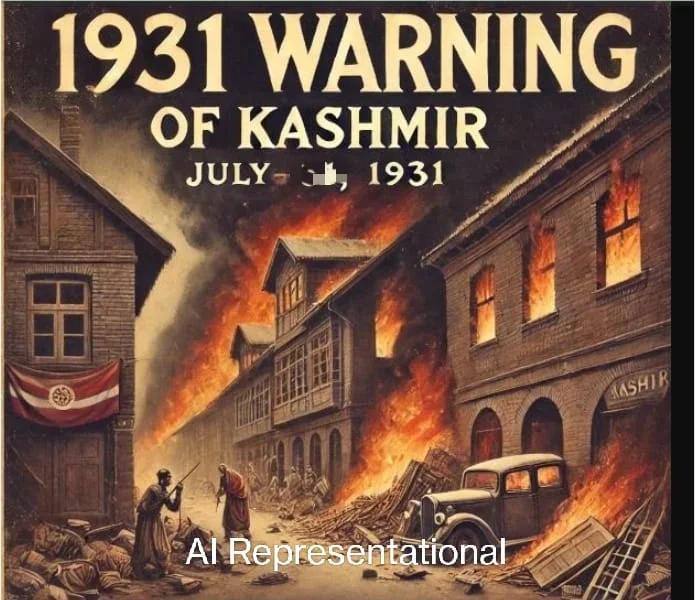
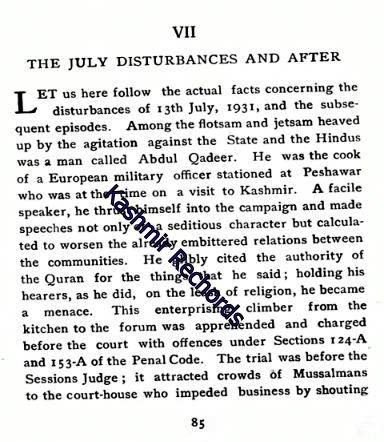
In the long and often manipulated history of Kashmir, few dates are as politically charged and historically misunderstood as July 13, 1931. What is today remembered in some quarters as “Martyrs’ Day” was, in truth, a turning point that set ablaze not just prison gates, but also communal harmony, centuries-old coexistence and the very fabric of Kashmiri society.

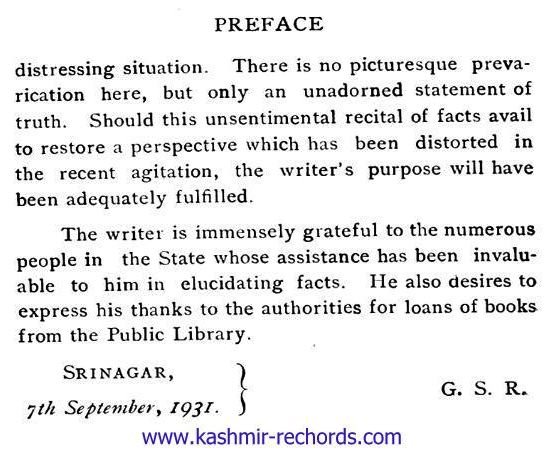
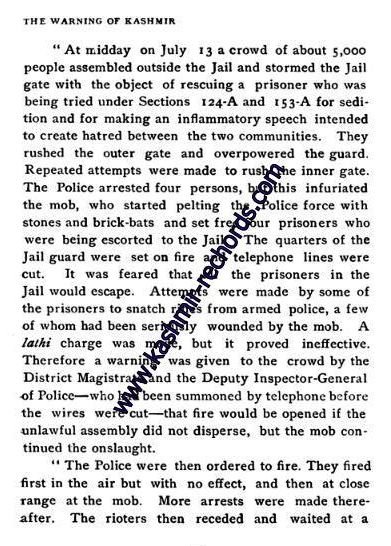
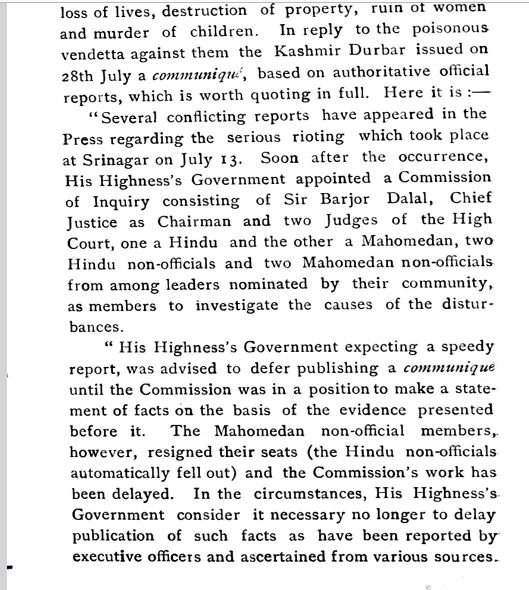
To understand the real story of that fateful day, one must sift through layers of propaganda, politics and purposeful erasure. Few sources illuminate this moment with clarity and courage like G.S. Raghavan’s seminal 1931 book, Warning of Kashmir. Published in October 1931, mere weeks after the carnage, by the Pioneer Press, Allahabad, the book is a blistering exposé of how misinformation, communal incitement and orchestrated violence engulfed the Valley.

A Spark Ignited by an Outsider

The backdrop to the July  1931 uprising was tense but not unprecedented. Kashmir under Maharaja Hari Singh was grappling with socio-political churn. But it was the arrival of Abdul Qadeer, a cook from Peshawar, that set the stage for communal ignition. Far from being a native or an organic voice of the Kashmiri people, Qadeer was a transient presence who, in a speech laden with religious fervor and venom, called for the destruction of the Dogra regime.

Quoting selectively from Islamic texts and framing the Dogra rule as a religious oppression, Qadeer’s rhetoric electrified and radicalized. He was arrested on charges of sedition (Sec 124-A) and incitement to communal hatred (Sec 153-A). To avoid tensions in the city, his trial was moved inside Srinagar Central Jail.

The Flashpoint: July 13, 1931

On the morning of the trial, a crowd of nearly 5,000 gathered outside the jail. What began as sloganeering quickly descended into an organized assault. Gates were stormed, prisoners freed, buildings set afire. Despite police warnings and initial restraint, escalating violence led to military firing, killing six rioters and injuring dozens. But this was just the beginning.

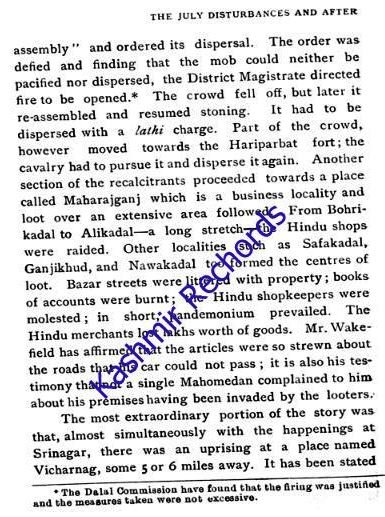
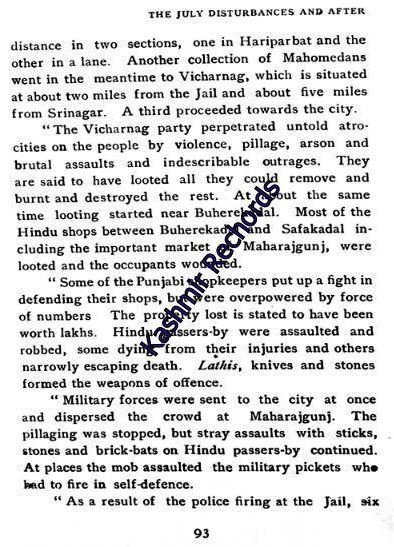
The mob frenzy spilled into the city, targeting Kashmiri Pandit neighborhoods and businesses. From Vicharnag and Safakadal to Maharajgunj, Hindu homes and shops were looted, torched and residents attacked. According to Warning of Kashmir, these were not spontaneous outbursts of grief or anger—they were coordinated acts of terror. Over 330 rioters were arrested, yet more than 200 were quietly released for “lack of evidence.”

A Community Under Siege

G.S. Raghavan’s careful documentation reveals a chilling undercurrent of communal targeting. Hindus—especially Kashmiri Pandits and Punjabi Hindu traders—were singled out, attacked in broad daylight and denied protection. In Vicharnag, described as a “hell of smoke and shrieks,” the devastation was particularly severe. While military forces attempted to restore order, fear and trauma gripped the Hindu community, which found itself abandoned by the narrative that was swiftly forming around the so-called “martyrs.”

This part of the story is often omitted from official memory. While Muslim losses and grievances became central to political mobilization, the Hindu casualties, displacements and destruction were either ignored or minimized—a historical injustice that continues to echo.

The External Hand, a Manufactured Crisis

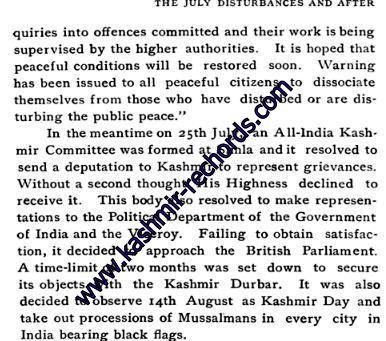
The political manipulation of the event was swift. Just twelve days later, on July 25, 1931, the All India Kashmir Committee was formed in Simla. Spearheaded by prominent Muslim leaders from outside the  Princely State, the committee demanded Kashmir be thrust into the national Muslim consciousness. August 14 was declared ‘Kashmir Day’, and Indian Muslims were urged to protest en masse.

This move, Raghavan argues, was a clear attempt to internationalize a local disturbance and turn it into a tool for larger political ambitions—not least by destabilizing the Maharaja’s regime and promoting religious separatism. Ironically, local Muslim leaders in Kashmir eventually urged these outside players to “leave Kashmir affairs well alone,” recognizing that external meddling was escalating the conflict.

Silencing the Truth: The Disappearance of a Book

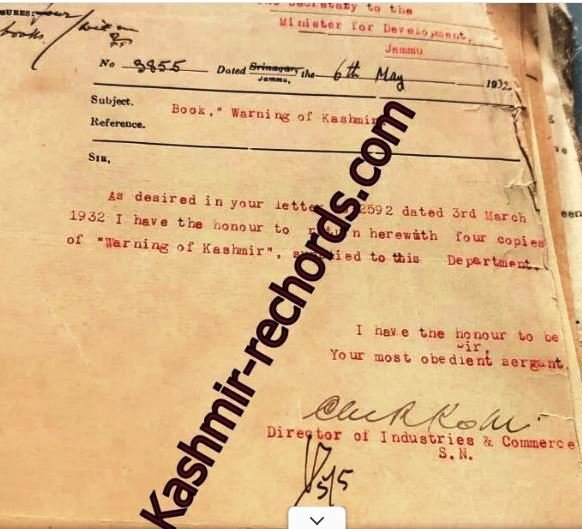
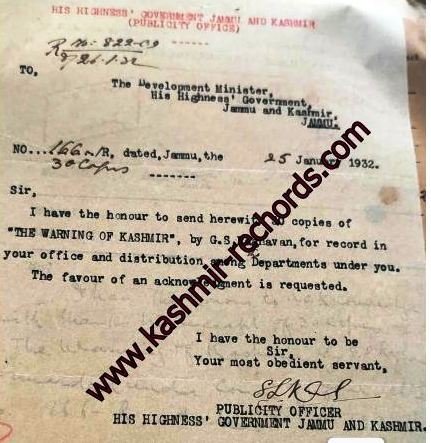
Warning of Kashmir was initially recognized by the Government of Jammu and Kashmir as a credible and necessary counter-narrative to emerging falsehoods. The book, widely circulated until 1947, was later systematically removed from public libraries and government archives after Partition—part of a sinister campaign to suppress uncomfortable truths.

Raghavan’s analysis makes it clear that the 1931 unrest wasn’t simply a clash between a Hindu ruler and Muslim subjects. It was the result of outside incitement, radical preaching, inept handling of a sedition trial and most tragically, a mob frenzy that unleashed hell on innocent Hindus—the forgotten victims in today’s telling.

The Politicization of Memory

In subsequent decades, July 13 came to be celebrated in the Valley as Martyrs’ Day, complete with public holidays and official commemorations—until the abrogation of Article 370 in 2019. But the question remains: Who were the real martyrs of July 13?

Were they the men who died storming a prison in support of a seditious preacher? Or the dozens of Kashmiri Hindus stabbed, burnt, looted and displaced in the carnage that followed? The continued one-sided remembrance obscures the full truth, reducing a deeply complex and painful episode to a politically expedient myth.

Why July 13 Still Matters

As Kashmir continues to struggle with its layered identity—between religion, regionalism and nationalism—reclaiming the full history of July 13, 1931 is not merely academic. It is a moral responsibility. A future rooted in peace and reconciliation must begin with acknowledging all victims, not just those who fit a narrative.

History must not be trimmed to suit politics. The Kashmiri Pandits and other Hindus who suffered on July 13 , 1931 ( Also called as Batte Loot ) must be brought back into the frame of remembrance—not just as victims of a riot, but as citizens betrayed by silence.

The Jagmohan Hangover

(Kashmir Rechords Exclusive)


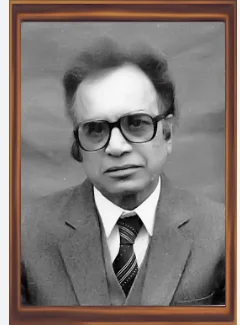
It seems the ghost of Governor Jagmohan continues to haunt some people’s WhatsApp groups and social media timelines more persistently than facts do. More than 35 years into exile, a determined anti-Jagmohan brigade—comprising those whose designs he dared to defeat, along with a curious section of the very community that suffered the 1990 tragedy—continues to blame him for the Kashmiri Pandit exodus. Apparently, holding the man who tried to prevent disaster responsible for the disaster itself remains a popular sport.All this, despite his second gubernatorial stint lasting barely four months—from January 19 to May 26, 1990—and coinciding with a period when Kashmir was already boiling over with militancy and targeted killings.


But why let facts get in the way of a good WhatsApp forward?


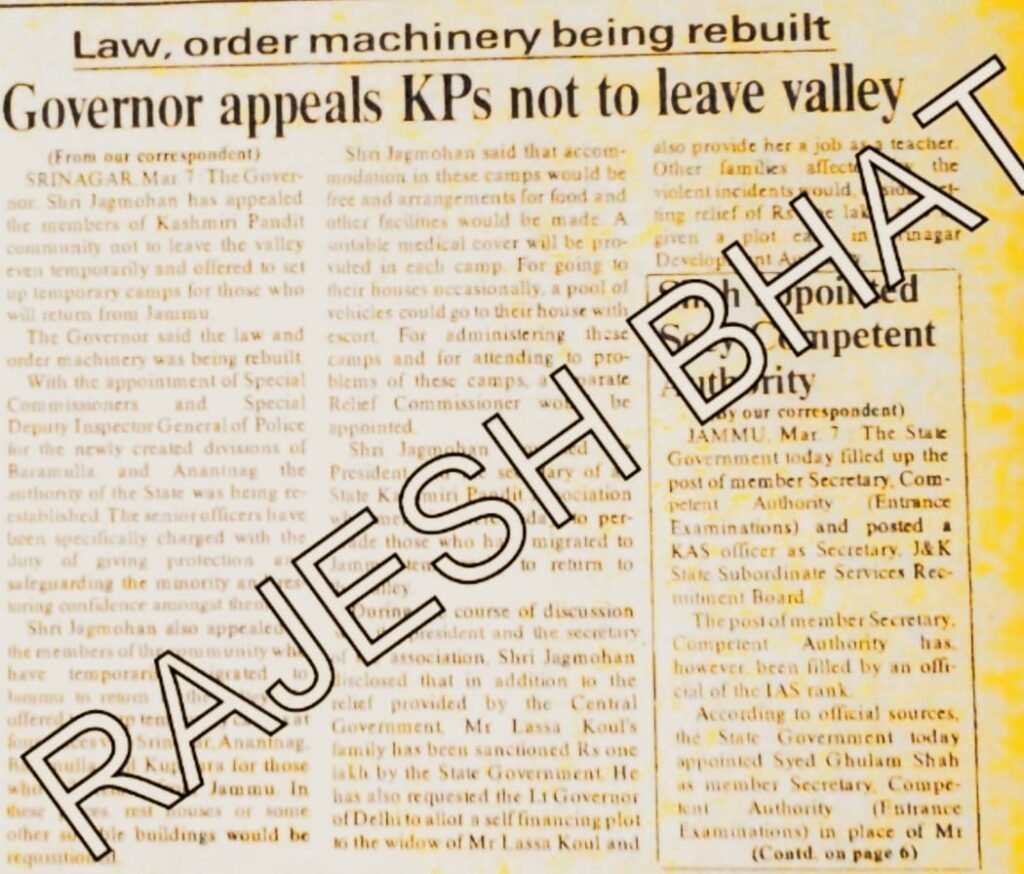
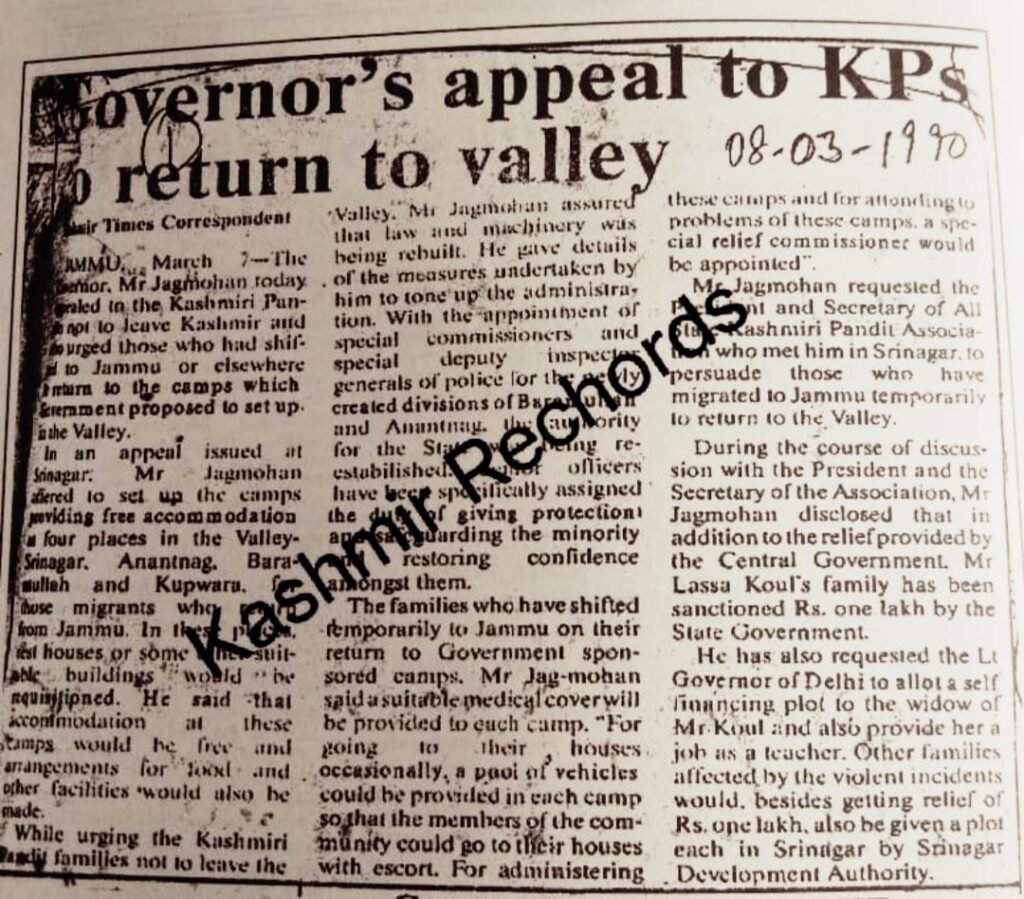
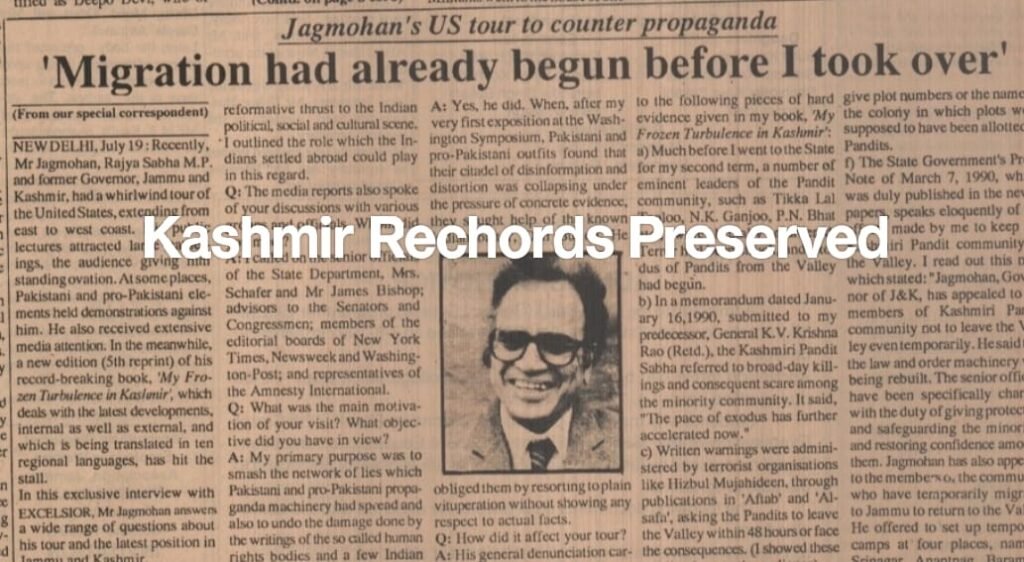
Kashmir Rechords, refusing to be swept away by echo chambers and half-baked narratives, took the liberty to dive into archival newspapers from early 1990. What surfaced from the yellowing pages of Kashmir Times, Daily Excelsior and other vernaculars was both telling and inconvenient—for those who thrive on blaming Jagmohan.


With invaluable help from Dr. Rajesh Bhat, who then manned the Kashmir Desk at Daily Excelsior, we unearthed crucial reports from March 1990, where Jagmohan appealed to Kashmiri Pandits not to leave the Valley and even urged those who had already left to return. Plans were rolled out for relief camps within Kashmir, meant to offer temporary shelter and security for returnees. Hardly the actions of a man orchestrating a mass migration.


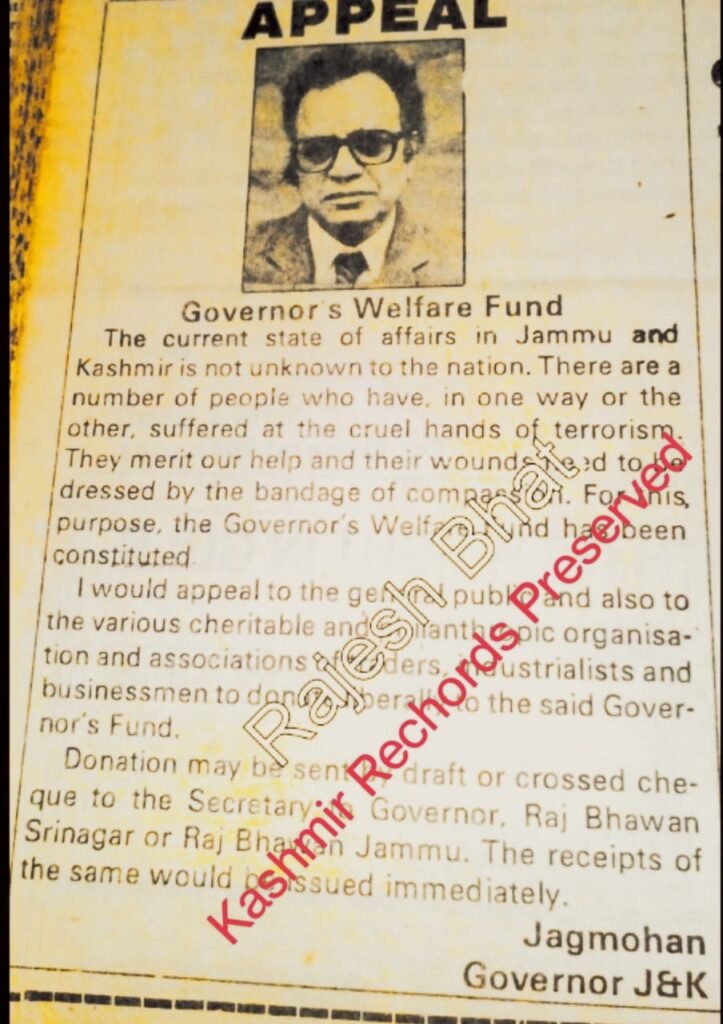
But wait, there’s more. He also made public appeals for donations—not for a particular community—but for all victims of terrorism, regardless of caste, creed, or religion. How secular of him—definitely not WhatsApp-worthy, right?


Another significant find—a newspaper clipping dated July 20 1990—quotes Jagmohan post his resignation, stating clearly:

“The migration had already begun before I took over.”


This, mind you, was after he’d left the post and was now representing India in the Rajya Sabha, traveling globally to put forth the country’s stance on Kashmir.


 Kashmir Rechords proudly shares these archival gems—not just to clear Jagmohan’s name, but to remind those still suffering from the “Jagmohan’s Hand Hangover” .


Of course, this  story and newspaper cuttings won’t trend. Because let’s face it—facts are slow, clumsy and boring. Unlike that juicy social media tale where Jagmohan single-handedly packed up an entire community, put them on trucks and drove them off into exile like a villain in a bad Bollywood script.


Maybe, just maybe, it’s time to exorcise this ghost once and for all.


Kashmir Rechords will keep sharing such stories—armed with newspaper clippings, archival reports and an allergy to revisionist fiction.

Because if we must tell stories, let’s at least try telling the truth—with a little sarcasm on the side.

Amarnath Vaishnavi: From Opposing Homeland to Championing It

(Kashmir Rechords Exclusive)

Amarnath Vaishnavi (August 24, 1925 – July 1, 2012), revered today as the “Father of the Kashmiri Pandit Community,” remains one of the most respected and towering figures in Kashmir’s socio-political history. As his birth centenary year is being observed with tributes from various socio-cultural organizations—especially among the Kashmiri Pandits—it’s worth revisiting a lesser-known, yet very significant chapter of his political journey: his initial opposition, and eventual support, for the Homeland demand!

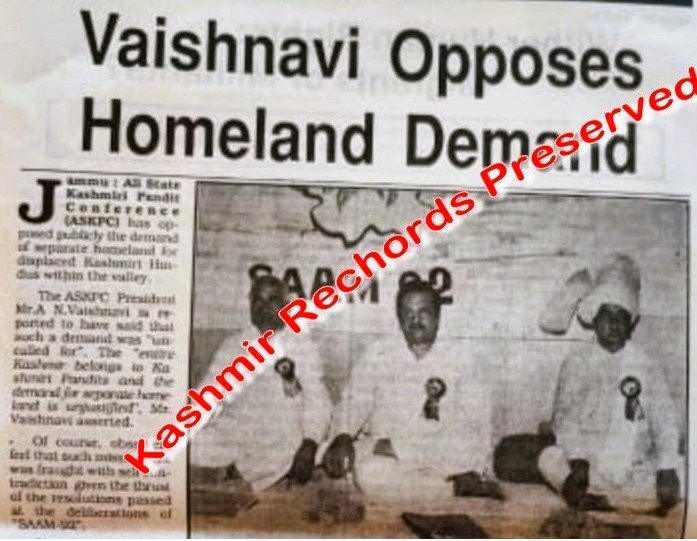
 When Panun Kashmir passed its historic Margdarshan Resolution in December 1991—demanding a Union Territory Homeland for displaced Hindus of Kashmir in the East and North of the Jhelum (Vitasta) River with full applicability of the Indian Constitution—Vaishnavi stood firmly against it. Despite his lifelong ideological proximity to the RSS-BJP camp, Vaishnavi believed that “the whole of Kashmir belongs to Kashmiri Pandits”, making any demand for a separate homeland “unjustified.”

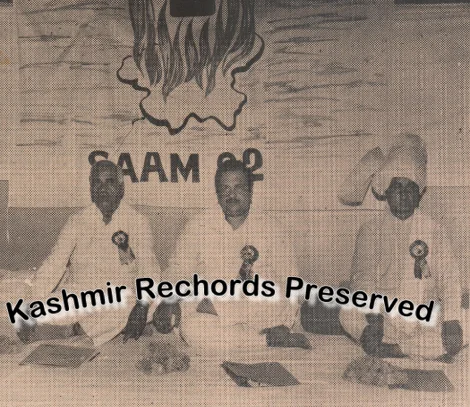
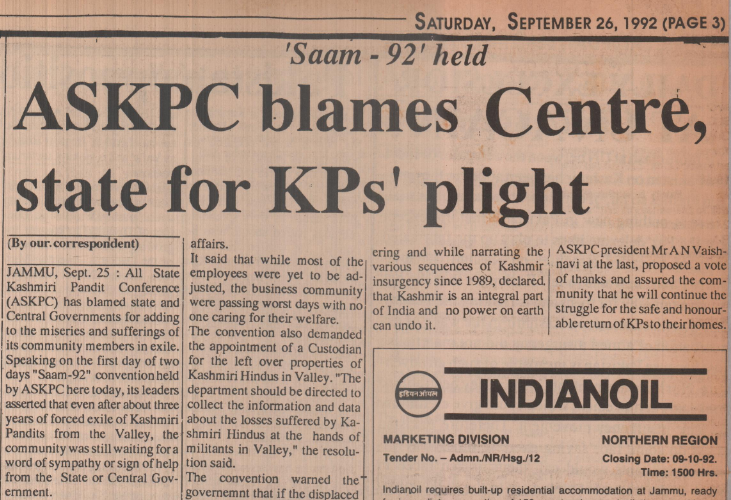
This opposition was not casual. It was officially voiced during the “Saam-92” Conference, organized by the All State Kashmiri Pandit Conference (ASKPC) on September 25-26, 1992, in Jammu—almost nine months after the Margdarshan Resolution. Vaishnavi, presiding over the conference alongside senior RSS leader Indresh Kumar, advocated for a “quasi-permanent rehabilitation” model instead—suggesting that Pandits be resettled in “geographically, climatically suitable and economically viable areas with minimum accommodation.” Former Prime Minister, Atal Behari Vajpayee who also attended Saam 92 on Day-2, had blamed Centre for the plight of Kashmiri Pandits.

 So, what prompted this stand (Opposing Homeland)? Was it political caution? Was it ideological conditioning? Or perhaps a strategic difference of approach? The real reasons remain open to interpretation.

But what makes this story remarkable is what followed nearly two decades later—a visible and heartfelt change of stance!.

On December 27, 2009, the same Amarnath Vaishnavi shared the dais with Panun Kashmir leader Dr Agnishekhar during a grand felicitation event for Madhya Pradesh Chief Minister Shivraj Singh Chouhan. The occasion? The Madhya Pradesh Assembly had, just a few months earlier (on July 24, 2009), passed a resolution endorsing the Homeland demand for Kashmiri Pandits. Vaishnavi didn’t just attend the event—he stood at the forefront, publicly felicitating Chouhan and lending moral legitimacy to the very cause he had once opposed.

Was it wisdom of age? Or a realization shaped by years of continued Pandit suffering and displacement? Whatever the reasons, his humility and readiness to reassess his position only enhanced his stature in the community.

Today, as his centenary rekindles memories, this transition—from initial resistance to endorsement of the Homeland demand—remains a telling reflection of Vaishnavi’s deep commitment to his community, even if it meant changing a long-held position.

His life and struggles are documented in The Chronicles of Kashmir’, but this particular aspect—the evolution of his stand on Homeland—remains one of the most poignant and untold truths that Kashmir Rechords feels proud to share with documentary proof and archival material.