Home Blog Page 37

Malika Pukhraj—-Jammu Wali!

The gifted singer whose musical voice echoed the earthly sounds of melody and became synonym with Dogra ethos, Malika Pukhraj (Jammu Wali), will always remain inextricable part of modern Dogra lore as well as the shared legacy of the sub-continent.

  Born in 1912, in village Mirpur near Akhnoor, Jammu, Malika Pukhraj needs no introduction! Her journey from Akhnoor to Kanak Mandi, Jammu to Lahore is itself very interesting! Kashmir Rechords is reproducing two  of her rarest  photographs to bring home the fact that she is, what she used to sing, “ Abhi to Mein Jawan Hoon’’— both in everyone’s thoughts and pictures”.

  Jammu Wali Malika Pukhraj had an opportunity  to sing during the coronation ceremony of Maharaja Hari Singh as she was bestowed with the honour of being a court singer at the young age of nine. However, her childish act (laughing in Maharaja’s darbar) was the turning point in her life, as the same was viewed as contempt, recalls noted journalist, Lalit Gupta in one of his writeups.

Journey from Jammu to Lahore

According to Gupta,  due to  some court intrigues, she had to leave Jammu for good at a very young age. At Lahore, she associated herself with All India Radio, Lahore, where she was every time addressed as “Malika Pukhraj Jammu Wali’’. The pictures produced by Kashmir Rechords dates back to January 1940. Pukhraj must have been 28 at that time!

   After partition, Malika Pukhraj lived in old Lahore City where she was  married to  Shabbir Husain Shah, a Government Officer. She had six children.  He daughter– Tahira Syed, having learnt singing under her mother’s strict discipline, also turned out to be a well-known Pakistani singer. Continuing in her style, Tahira  re-sung many of her mother’s famous songs, including her Dogri songs.

   Malika Pukhraj had visited Jammu for the last time in 1988 along with her daughter Tahira.


All India Radio’s Legend of Voice

In recognition of her contribution to music, she received Pakistan’s Presidential Pride of Performance Award in 1980. But before that, in 1977, All India Radio had awarded her with the ‘Legend of Voice’ award.

   Malika Pukhraj died at Islamabad on February 4, 2004, at the age of 90, but her Dogri songs, “nazm” recitations and ghazal renditions live on. She is remembered in the Jammu as a cultural icon and Lahore is still nostalgic with the resonance of her gayaki.

 On the top of it—- She was always addressed as “Malika Pukhraj—-Jammu Wali!’’

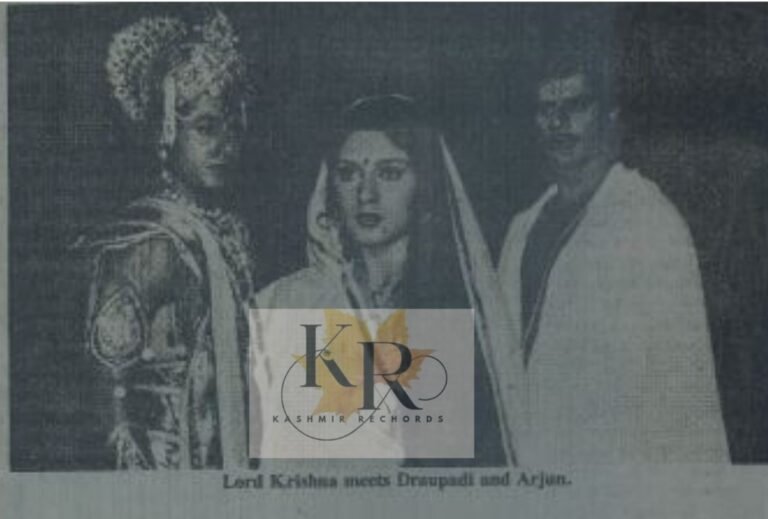
Shyama Zutshi—the first Kashmiri heroine who had joined Bollywood!

By: B Revti

Shyama Zutshi (1910-1953) and Zaira Wasim (born 23 October 2000) have something in common to share. While Shyama Zutshi was the first Kashmiri girl who joined Hindi films in 1934, Zaira Wasim is perhaps the last from the same cultural background/lineage.
 Both Shyama and Zaira have remained quite successful and sought after stars but suddenly moved out from films for nearly identical reasons. Shyama Zutshi is believed to have quit films as her fellow Kashmiri Actor, Chander Mohan Wattal used to tell her always to quit acting as the same was “not meant for Kashmiri girls’’.  As per some of the statements of  Zaira Wasim, Bollywood industry had  “conflicted with her religious identity and beliefs’’.

Shyama Zutshi: An  actor, freedom fighter

 Shyama Zutshi, a Kashmiri pandit, born at Anand Bhawan, Allahabad,  after passing her BA examination, had joined Hindi cinema.  She had acted in films like Shiv Bhakti (1934), Majnu (1935), Kaarwaan- e- Hayaat (1935) and Khooni Jadugar (1939) and had remained a prominent artist on the panel of All India Radio, Delhi. Her father, Ladli Prasad Zutshi was a freedom fighter.   Shyama was admitted to Sacred Heart Convent, Lahore by her mother Lado Rani. Fluent in EnglishGujaratiMarathiUrduKashmiri and Hindi, Shyama Zutshi  was also proficient in horse riding and  singing.

Her major hit was Karwan-E-Hayat (1935) in which she acted with K. L. SaigalT. R. RajakumariPahari Sanyal, and Rattan Bai.  She became a very successful actor, but with the influence from her elder sister Manmohini, she moved out from films and focused on politics and freedom struggle. Another reason for Shyama Zutshi to quit films was the advice from a fellow Kashmiri actor Chander Mohan Wattal who was a close friend of Zutshi family. Later, Shyama became a Women Congress leader and a frontline freedom fighter influenced by Mahatama  Gandhi‘s non-violent struggle along with her mother and three sisters (Chandra Kumari, Manmohini and Janak) . After some time Lado Rani arranged the marriage of Shyama in a well off Chopra family.

Shyama’s father, Ladli Prasad Zutshi was a prominent lawyer in Lahore and was the nephew of Pandit Motilal Nehru. Lado Rani infused the light of patriotism in her daughters by participating in the freedom movement.

Kashmiri actresses Yashodhara  Kathju and Zaira Wasim


Once Shyama Zutshi was out, another girl namely Yashodhara Kathju (niece of Pandit Nehru) was next in line of Kashmiri Pandit girls to join the Indian Film Industry. Chander Mohan Wattal tried to ensure that Yashodara alsoleaves the films but this girl was tough. She ignored all requests from Chander Mohan. Yashodhara Kathju acted in many films from 1942 to 1960. Chnderlekha (1948) and Talaaq (1958) were her milestone films. She married a Navy officer Suraj Prakash Chopra and lived a very unnoticed quiet life. The other Kashmiri girl of modern times and National Award-winning actor, Zaira Wasim announced her “disassociation” from the field of acting in 2019. Since then, she has often shared posts on social media in support of her religion

 When death had stalked Amarnath pilgrims in 1996!

By B Revti

Death had stalked Swami Amarnath ji pilgrims in August 1996 as never before scores of people had perished due to the unseasonal snowfall and the torrential rains that had begun with the movement of pilgrims from Pahalgam, the base camp of Amarnath to the holy cave shrine.

 Bad weather had made it impossible to carry on with the rescue operations, as authorities, who were caught unawares, failed to rescue the stranded pilgrims, who later died mainly of cold.

  From the year 1991 to 1996, the annual pilgrimage to the holy cave shrine of Amarnath was held under the threat of militant groups operating in Jammu and Kashmir. But in 1996, when the militants had reportedly “assured’’ that they would not interfere in the pilgrimage, the number of pilgrims swelled from the previous years. The erstwhile State of Jammu and Kashmir was also going for the elections around the same time in 1996.

It was Shiva’s Tandav

Due to the clear and dry weather, the pilgrimage in 1996 had in fact begun in July itself.  The dry weather had continued up to August 20. It abruptly turned violent! Between August 21 and 25, one lakh pilgrims were simultaneously moving either up or down  from the base camp to the holy cave and no one had predicted  that  the tragedy was a step away  on the tedious track. Soon after August 25, there was unusually heavy snowfall along with severe blizzards along the yatra route. The Yatris, over 250 in number, had died due to exhaustion, exposure, freezing, and other factors.

Due to the clear and dry weather, the pilgrimage in 1996 had in fact begun in July itself.  The dry weather had continued up to August 20. It abruptly turned violent! Between August 21 and 25, one lakh pilgrims were simultaneously moving either up or down  from the base camp to the holy cave and no one had predicted  that  the tragedy was a step away  on the tedious track. Soon after August 25, there was unusually heavy snowfall along with severe blizzards along the yatra route. The Yatris, over 250 in number, had died due to exhaustion, exposure, freezing, and other factors.Government of hiding the facts and accusing the Government for laxity. Gowda’s Home Minister,  Inderjit Gupta had admitted the lapses leading to the tragic incident.

Nitish Sengupta Committee

The then State Government  had constituted a committee headed by the retired IAS officer Nitish Sengupta to conduct a probe. The Committee had opined that the heavy casualties were due to excessive flow of the pilgrims, State Government’s `priority’ in election being held at the same time and thus the consequent inability to face the crises.

 Ice lingam was not fully visible in 1996

The reports assessed by Kashmir Rechords, suggest that in 1996,  the holy  lingam was down from its normal eight  feet to just three 3 feet. Worried  about the same,  the then  state government officials  had flown up a 10-ft-high picture of the lingam to the icy cave and pasted it there on August 21.

 Nature believed it was time for irony. The next day freezing rain and snow began to fall. It continued for three days, and temperatures plunged to well below zero.  For the pilgrims (more than one lakh moving on the track), it turned into a seemingly endless march of death. More than 214 died on the road to Amarnath, while others had lost life at base camps and hospitals.  It was like Shiva’s tandav nritya (dance of death)

Army and Air Force helicopters had ferried survivors to hospitals in Srinagar. The tragedy had also brought out the best in the people of Kashmir.  All along the route, local Muslims had opened their houses to dazed pilgrims, giving them food and shelter.

A myth, lie that Maliks had found Amarnath Cave!

(Kashmir Rechords Desk)

Eminent Kashmiri Pandit historian and scholar,  Prof ML Koul in his book “The Amarnath pilgrimage- History and Facts’’ categorically  states that, “ it is a mere myth, a fib, lie and fabrication that the holy cave of Swami  Amarnath Ji  was discovered by a Kashmiri Muslim Malik family in 1845 A.D.

    In his book, released in Jammu in 2009, Prof Koul notes in one of the chapters that “Maliks of Batakoot are those who proved stubborn beyond limits and failed to reconcile to the Mughal conquest of Kashmir and to avoid annihilation, hid themselves at a distant place in the mountainous region away from the gaze of the Mughal soldiers”.

   The Book mentions that, “as Maliks lost their ancestral occupation and had become rudderless and vagrant, the Dogra rulers, in view of their history, harnessed their services as guides to the pilgrims’ en-route to the Holy Cave of Amarnath”.

   The eminent author states that Maliks were assigned the additional jobs of maintenance of the rough track, rising of small sheds on the routes and physical safety of the pilgrims. In lieu of their services they were paid a sufficient part of the offerings that the devotees offered to the icy lingam in the holy cave.
  Indian Express in its August 5, 2009 issue of the paper   had carried a detailed story on Prof Koul’s book release function. Kashmir Rechords, from its archives, is reproducing a newspaper cutting for the benefit of the esteemed readers.

Swami Amarnath Yatra culminates every year on Raksha Bandhan which coincides on Shravan Purnima.

1943 Swami Amarnath Yatra

Swami Amarnath Yatra, which culminates every year on Raksha Bandhan, has remained the most revered and popular pilgrimage particularly during Dogra kings, who would accord utmost importance to the Yatra and ensure foolproof measures for its successful culmination under the Dharamarth Department, Srinagar. 

   Some of the official files relating to Amarnath Yatra of 1942-43 have been preserved by the Department of Archaeology, Archives and Museums (J&K) at Jammu. After having accessed them by Kashmir Rechords, the files reveal interesting data related to the Yatra. There used to be no prior registration of pilgrims, as is presently in vogue. Further, the pilgrimage was being undertaken only via Pahalgam-Chandanwari-Sheshnag route and not through Sonmarg- Baltal track, which is now being frequently used by pilgrims.

Darshan only on “Shravan Purnima’’

Unlike nowadays, the pilgrims would have Darshan of the holy ice lingam at the cave shrine only on “Shravan Purnima” which coincides on the day of Raksha Bandhan. However, arrangements for the smooth conduct of this annual pilgrimage were being made well in advance before the first week of July every year.

Amarnath Yatra of 1943

As per a records, the Amarnath Yatra in 1943 comprised a good number of devotees from all parts of the erstwhile State, mostly Kashmiri Pandits  and Sadhus. It started on August 2 from the historical Dashmi Akhara, Srinagar, and pilgrims had darshan on Sunday, August 15. The “Charri Mubarak” (holy mace) was back in Pahalgam on August 17.

 About 7,000 pilgrims had performed darshan of Lord Shiva that year as against 2,050 in 1942. The records further reveal that 800 ponies, 1,200 coolies and 150 palkies were put in use to help devotees undertake hassle-free darshan of the lingam. That year, Shivdev Singh, Wazir-e-Wazarat, Anantnag, was the Camp Officer

   Use of Kangris, Pulhours

Prior to the commencement of the Yatra, the officer in charge, Dharamarth Department, had on July 12, 1943, requisitioned for adequate number of jackets, Kangris, charcoal and Pulhours (shoes made of grass).

There was officially no loss of human life, although Lahore-based Urdu dailies Milap and Hamdard had reported in their issues dated August 23, 1943 that four pilgrims had died while performing Yatra. The news was, however, contradicted by State’s Publicity Officer, SL Kaul.

Shocking: killing of Hangul, Ibex was once permitted in Kashmir!

Killing of Hangul (Stag) and Ibex— the rare and endangered species was once permitted in Kashmir! Sounds strange— but that is the harsh reality. Even hunting was considered a game and there existed “Department of Hunting’’ that had set certain rules and regulations for hunters visiting Kashmir. Thanks to the enactment of Jammu and Kashmir Wildlife (Protection) Act, 1978,  that the killing a wildlife was legally stopped.

     Prior to enactment of Jammu and Kashmir Wildlife (Protection) Act, 1978, hunting was considered as a `game’ in Jammu and Kashmir and hunters from far off countries like France, Italy, England and America used to visit the erstwhile State of Jammu and Kashmir. The hunters would with pride take photographs of the killed animals and mention about their “performance’’ publically. Local hunters were helping them in their “mission’’

   Kashmir Rechords is in possession of one such write-up, written in April 1951 along with a photograph of dead Hanguls, Ibexes and bears on display. As per the contents of the write-up (in Urdu),  “Mehkama Shikaar’’—The Hunting Department had permitted killing of “Parinda’, `Charinda” and `Darinda’ in Kashmir, besides fishing. The licence holder hunters would move in search of their prey between September 15 to March 15 every year. They would carry adequate packed food and ammunition on their horse backs as well.


Hanguls were in abundance in and around Srinagar

 As per the records, Hanguls, (now declared endangered species) were found in abundance 30 miles in and around Srinagar.  They were being frequently spotted in Bandipura, Khanmoh, Laam, Verinaag and Ganderbal areas. A Hangul, with its horns less than 35 inches, were not allowed to be hunted. Hanguls normally shed their horns in April and by July, they are back with the new ones.

  In the write-up reproduced here, the author claims to have killed a 51 inch long horned Hangul in Dachigaam area besides another one with 45 inch long horn. Hunters were, however, not allowed to kill more than two Hanguls per year.

 Hunting  of Ibex

Like Hangul, killing an Ibex was also allowed in Kashmir. The two-horned Ibex, having length of horns less than 32 inches, was not permitted to be killed. The hunter would, however, kill three grown-up Ibexes in a year. Ibexes were found in abundance in Baltistan, Gilgat, Ladakh and Skardu—all parts of erstwhile State of Jammu and Kashmir.  


After the enactment of Jammu & Kashmir Reorganization Act, 2019 by the Parliament, the Central Act, i.e. Wildlife Protection Act repealed the Jammu & Kashmir Wildlife (Protection) Act, 1978. The Department has now the increasing responsibility from the “Game Regulation’’ to the Wildlife Conservation.

N.B: For those interested to know more about this interesting story, contact us at: kashmirrechords@gmail.com or support@kashmir-rechords.com

Who was poet Tribhavan Nath Zutshi from Kashmir?

(Kashmir Rechords Team)

Famous Persian and Urdu poet, Tribhavan Nath Zutshi, `Zar’, had his roots in Kashmir.  Born in 1871 at Meerut, his intellectual capabilities had helped him in carving a niche for both himself and his son, Dr. Anand Mohan Zutshi “Gulzar”.

Popularly known as  Allama Pandit,  Tribhavan  Nath Zutshi “Zar”  Dehlivi  was also  known to the people  and his admirers  as  Yaadgar-e-Daag, for his quality as a  poet and Urdu and Persian scholar of par excellence.

Tribhavan Nath Zutshi “Zar” Sahab’s ancestors had come from Kashmir to Delhi during the rule of Mughal Emperor Jahangir (1605-1627).  However, somehow, they could not stay for a long time in the imperial city and again went back to their native place in Kashmir. In the Mutiny of 1857, this Zutshi family moved to Meerut from Delhi where Tribhuwan Nath was born in 1871.  His father was Prithvi Nath Zutshi and his mother was Shyam Rani. 

Bazar Sita Ram of Chandni Chowk, Delhi

The Zutshi family then again shifted back to Delhi in their ancestral haveli in Bazaar Sita Ram, Chandni Chowk from Meerut where Tribhuwan Nath had his early schooling.  Sita Ram was one of the members of Zutshi clan and it was after his name that that a bazar of Chandhi Chowk was named.

 Tribhuvan  had a great inclination towards learning Urdu and Persian language right from his childhood days.  As per family traditions, he learnt Urdu, Arabic and Persian language under the able guidance of Maulvi Rahim Baksh who used to live at Shahji Ka Chatta at that time and later on became Sir Rahim Baksh and Prime Minister of Bhawalpur State.  This Bhawalpur state acceded to Pakistan after the partition of the country in 1947.

Zutshi-Daag meeting

Between 1882 and 1883, young Tribhuwan Nath used to go to Hakim Ajmal Khan’s house to take medicines for his ailing father where the famous Urdu poet of those days, Nawab Mirza “Daag” also used to come almost daily to play “Chauser”.

These frequent meeting at the residence of Hakim Ajmal Khan brought Tribhavan Nath Zutshi very close to the famous poet “Daag” and very soon he became a most favourite “Shagird” of “Daag”.

Even as  Tribhuwan Nath started composing Urdu poetry from a very young age under the able guidance of “Daag”, he soon blossomed into a well refined Urdu poet with no match among the other contemporary Urdu poets of his times in Delhi.

Initially, he started composing his poems under the pen name or ‘takhallus‘ “Shameem” mainly based on romanticism.  But after meeting Pandit Amar Nath Madan “Sahir”, who was living in Bazaar Sita Ram around 1924 and was mainly doing the translation work of Hindu religious books in Urdu, his whole concept towards life changed.

Use of `Zar’ as a penname

He then started composing Urdu couplets under a new pen name “Zar” containing high philosophical thoughts.  Due to his profound knowledge of Arabic and Persian language, people used to call him as Hazrat Maulvi out of sheer respect.  He composed over a lakh of Urdu couplets and translated all the three “Geetas” in poetic form in chaste Urdu under the penname ` Zar’. 

Tribhuwan Nath did his Matriculation from Mahendra College, Patiala around 1887 where his uncle Rai Bahadur Manohar Nath Zutshi was posted as a judge.  He did his F.A. and B.A. subsequently from Government Azad College, Lahore and studied Arabic and Persian in St. Stephen’s College Delhi and then in Oriental College Lahore under the guidance of Mohammad Hussain.

After completing his studies, Tribhavan Nath started his service as an Accountant in Lahore around 1894.  Later,  he took up a job as a Lecturer in an Engineering College at a place Gujrat in Punjab, which has become now a part of Pakistan.  There, he had a row over some trivial matter with the Principal of the college who was an English man.  In a fit of rage, he slapped the Principal of the college.  This ugly incident became a turning point in his life, as he had to resign from his job in 1924.  Consequently, he came back to Delhi where he joined the Indraprastha College Delhi in 1931 as a teacher of Urdu and Persian language from where he retired in 1956 at the ripe age of 85 years.  From 1924 to 1931, he served as an Associate Professor in Delhi University.

 Coronation of King George V

Tribhavan Nath Zutshi had the proud privilege of attending the special Darbar in Delhi in 1911 in which the coronation ceremony of King George V took place.  He married twice. Tribhavan Nath’s first wife died at young age. His second wife was Raj Dulari who was also a poet of repute and was known as `Victoria Ji’.  Her pen name was “Bezaar.  Victoria ji had four sons and two daughters.  The sons were Jag Mohan, Ratan Mohan, Jawahar Mohan and Dr. Anand Mohan whereas Brij Rani and Anila were her daughters.  The most peculiar characteristic of this Zutshi family is that it produced five reputed Urdu poets.

 In 1937, Delhi Literary Society gave him the title `Kadre-ul-Kalam Allama-e-fun’ in recognition to his outstanding contribution in promoting Urdu, Arabic and Persian language. The Ministry of Education of the Central Government gave him scholarship until his death for his valuable work in the field of Urdu literature.

He died in Delhi in his ancestral Haveli in Bazaar Sita Ram on 7 October 1965 after a prolonged illness at the ripe age of 94 years. To commemorate his death, a special number of Nidai Itihad in Urdu edited by Warsi Aziz was brought out on 1 November 1965.

He made a distinct place for himself in the field of Urdu poetry writing and literature by sheer hard work and dedication.  The lovers of Urdu literature in the subcontinent still take his name with great respect and admiration for his valuable contributions as a poet and as a teacher of Arabic and Persian language. 

His son Jawahar Mohan Zutshi now lived in Rajaji Puram, Lucknow and another son, Dr. Anand Mohan Zutshi “Gulzar” who was  himself an internationally by renowned Urdu poet, was known as  Gulzar Dehlvi, 93,  who passed away on 12 June 2020 at his Noida home.

Bhagawan Gopi Nath Ji of Kashmir

The Saint of All Times

By: B.Revti

The Book “Bhagawan Gopi Nath Ji of Kashmir—The Saint of All Times’’ (Vol II) is a wonderful book worth reading.  Written by Prof Kashi Nath Dhar, the then Director Shri Parmananda Research Institute, Srinagar in April 1981, the Book is based on 175 pages with interesting anecdotes. The  author has tried to project Bhagawan Ji as he was. Prof Dhar  has  also tried to prove a mirror to Bhagwan Ji’s seraphic personality.  

Bhagawan Ji is first saint having influenced Indian masses

Though Kashmir has been the home of many exalted Saints, strangely enough none seems to have produced any impact on the Indian masses; they were hardly known outside Kashmir except Lalleshwari whose Vakhs are extant in some parts of India. It can safely be recorded that the magnetic personality of Kashmiri Saints and their message did not at all cross the mountain-barriers of their land of birth, Prof  Dhar mentions that  Bhagwan Gopi Nath Ji is  in fact the first  Saint of Kashmir who is influencing the Indian masses and in whose sacred memory centres have  being established in India. The first Centre was established in Prayagraj (Allahabad) during the Kumbh Mela in 1977, followed by another Spiritual Centre in the vast domain of Aghoreshwara in Kreem Kund Varanasi, besides smaller Centres in other places, including two in the Union Capital.

Aghoreshwar Bhagwan Ram whose mention has been made in this  book while   speaking to an audience of about 10,000 people in January 1979  said that Bhagwan Gopi Nath Ji was a Mahapursha. In his speech delivered at Bhagwan Gopi Nath Ji’s “Shivar” at the Vishwa Hindu Sammelan, he is quoted as having said that  that he had his first  acquaintance with Bhagwan Ji by reading “Bhagwan Gopi Nath Ji special number’’ in the “Chandi” Journal of all India fame, and since that time he has been so dominated by him that wherever in meditation he concentrated on his Guru or Ista Deva (titular deity) the image of Bhagwan Ji with a Kashmiri style turban on, appears before his vision.

The Book mentions about the Vishwa Hindu Sammelan, where some Kashmiris had requested Bhagwan Ram to help them out of their worldly difficulties. His reply was  that Bhagwan Gopi Nath  Ji was a potent Spiritual force working in higher Spiritual planes and that he alone could solve their problems and advised them to invoke only his (Bhagwan Ji’s) grace. Maharaj Gagan Giri Baba of Kolhapur (who has an Ashram in Khapoli as well), the most famous mystic Saint of Maharashtra- a highly evolved Soul mentions in the book that Bhagwan Ji was a Mahat — the  one in harmony with universal Consciousness.

  Bhagawan Ji’s Australian devotees

The Book mentions about Australian devotees of Bhagwan Gopi Nath Ji, who had started a Bhagwan Gopi Nath Ji Centre in Winmalee N.S.W. (Australia) to propagate “Bhagwan Consciousness”. The foreign devotees believe that it will be Superior to that mission undertaken by Kashmir Bikhshus of Mahayana Buddhism, which they carried to Central Asia and Tibet some thousand years back, and will show surprising results.

Though Bhagwan Ji’s Australian devotees have had first contacts with Bhagwan Gopi Nath Ji Ashram in 1975 only, he has been very kind to them and has kindled Tattva Gyana in them (vide Chapter V-Exchange of letters).

  Theories about religious processes followed by Bhagawan Ji.

The Book makes a mention about different theories regarding the religious creed and religious processes followed by Bhagwan Ji. Some say that he was in Shambhav Awastha (mentioned in Shaivism). Others say that he was a Vaishnava! Yet others say that he was a Shakta. Some people call him an Aghoreshwar, others an Avadhoot, a Jeewan Mukhta, or a Videha.

The Book makes it categorically clear  that none is qualified to say about the state (Avastha) Bhagwan Ji was in, unless one is himself a realized Soul. He has himself defined the state he was in, when he recited Shloka 6. Chapter XV of Bhagawad Gita in response to a query in this connection (vide page 92 of Bhagwan Ji’s Biography Vol. I). Only those in an advanced state of Consciousness may be able to divine the depths of Spirituality of Bhagwan Ji.

 The author of the Book—Prof Kashi Nath Dhar has researched well to produce the treatise full of content and meaning. The Book carries some rare photographs as well. Kashmir Rechords is reproducing some of  them here.

Those interested can know more about the contents of the Book by contacting us at kashmirrechords@gmail.com or support@kashmir-rechords.com