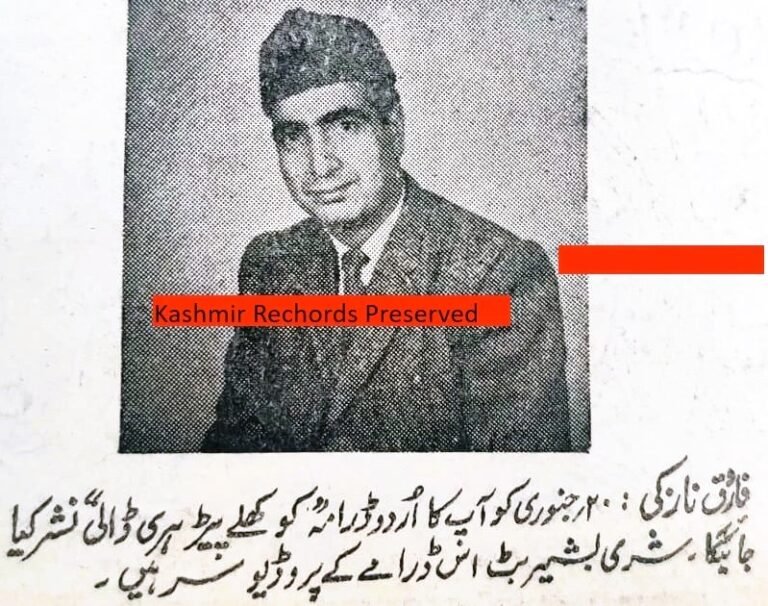
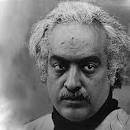
Are laureates cultivated or do they appear on their own? Both statements can be true or false at the same time. But there appears to be a strong relationship between the environment and a tradition in the family that cultivates quality literature. One’s inclination and the output combined with prevailing creative atmosphere in the family or otherwise can many a time produce great literary figures. This appears to be true in respect of Farooq Nazki, a multi-dimensional personality who has been a witness and an active participant in the vicissitudes that have dotted his colourful life.
His journey, we are told, has started as a cub reporter and his instincts would naturally align with what was then a pre-dominantly reconstructive socio-political movement and not less than a silent revolution of sorts of questioning beliefs, situations and had a streak of rebellism against obscurantism, inequalities, exploitation and corruption. Interestingly, this seemed to be a world phenomenon and was predominantly visible in societies which had just freed themselves from the clutches of imperialism. This movement dubbed as the ‘Progressive Movement’, is in fact only evolving and is said to be metamorphosing into other forms.
Farooq Nazki associated himself with the movers and shakers of this movement and it set the direction for his future literary endeavors. His father, Ghulam Rasool Nazki may have initiated him into the world of literature but his journey was purely carried by him on his shoulders like the lone pilgrim. This pilgrim tasted the waters of all streams and imbibed the light of all thoughts (Agnostic as well as Gnostic.)
The Blossoming
It has been a relentless journey .The passion that essentially arises out of suffering blossoms into flowers and is the engine that drives creativity. Farooq Nazki is a poet, broadcaster, a playwright and a noted literary figure of repute in both Urdu and Kashmiri besides proving his mettle as an administrative and political functionary also. He has donned many a hat and carried them deftly.
While much has already been written and said about Farooq Nazki, his family and his works, the trail he has left goes on projecting aspects of his colourful personality unknown to the world.
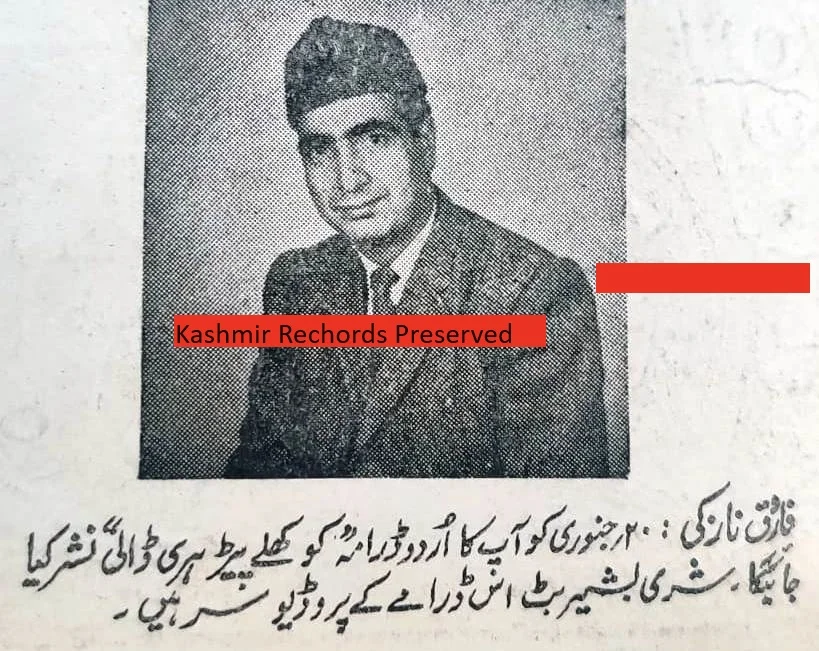
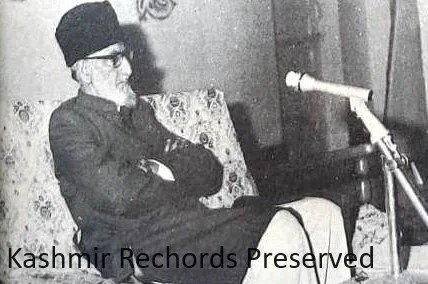
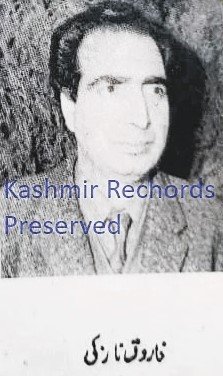
Kashmir Rechords is in possession of very candid moments of this multi-dimensional personality’s periods of struggle, the aspects which are mainly hidden from the world. The black and white photographs of his younger life when he was growing in the shadows of his illustrious father Mir Ghulam Rasool Nazki speak for themselves about the vicissitudes, associations, agonies and the ecstasies combined with highs and lows of his life.
Through these rare photographs, Kashmir Rechords pays a tribute to this living legend.
The origin of Kashmiri Panchang, variously called as “ Jantari’’ or “Neshpatra’’ dates back to antiquity. Not only was Kashmir an important centre of spiritual learning but related schools of thought also found a fertile ground to grow.
One such related school of thought that took birth in Kashmir delivered its world class tradition of astrology.
Though Indians have had no love for historiography, the Bhrigu Samhita, the ultimate reference book of the discipline is the testimony to the tradition of predictive astrology being followed in India and incidentally Kashmir, which produced its first historian Kalhana, also makes mentions of a brilliant tradition of astrology prevalent in Kashmir.
Al-Biruni’s Accounts
Even as there are other very important historical documents which testify to the continuity of this important tradition in Kashmir, the most important historic account by a foreigner Al-Biruni in his book “Kitab-ul-Hind” raises this to such an exalted level pertaining to Kashmir that we cannot remain without mentioning some of the observations made by this great historian:-
“I studied the Jantari of Shaka-la (modern Sialkot) pertaining to the year 951 AD. It has come from Kashmir. This Jantari says that Sapt Rishis are staying since many years in Anirudha Moon House which exists in three and one- third degree in the constellation and extends up to 16 and two- third degrees. Saptrishis are still one full `burj’ and 20 degrees forward……. This creates a sense of wonder and no doubt anybody who does not live among Hindus of Kashmir, cannot fathom the concepts and everything they have churned out.’’
This statement of Al- Biruni testifies to the fact that how much learned he himself was about the intricacies of astrology—a school of thought which reached its zenith in Kashmir where Jantris were compiled, formulated and despatched across lands. Kashmiri Panchangs were considered to be the most trustworthy astrological treatises.
Kashmir Panchang’s Gandhaar Connection
Noted Kashmiri scholar and historian, Moti Lal Saqi in his famous book “Aager Neb’’ mentions that `Jantari’’ as a unique product came out of Kashmir only and it is very difficult to accord a date to its origin. Saqi further while referring to Rajtarangni, mentions that it was King Meghwahana who brought and settled Brahmins from Gandhaar and elsewhere in Kashmir’s Bijbehara town around 5th Century AD. It is possible that many astrologers accompanied these Brahmins where they institutionalized this important feature of Kashmir and thus Kashmiri Jantari continues to be named as “Vijeshwar Panchang’’ linked to Bijbehara town. Other notable names in this regard are of Swami Aftab Kak and Shri Kanth Jyotshi, besides others.
Kashmir’s Bijbehara continues to lay its claim on the World famous Panchangs—the Kashmiri Jantaris— although they are presently published from Jammu and elsewhere. Pt Prem Nath Shastri, the great learned Pandit and social reformer did a yeoman’s service to make it available to all and sundry when he pioneered to get it printed for distribution on a large scale some decades back.
Non-Hindus of Kashmir as well as India and the World, also make a bee line for obtaining a copy of this almanac of dates and occasions, both auspicious and otherwise, for round the clock consultations. Sh Omkar Nath Shastri, who is presently the publisher of Vijeshwar Panchang is on record to convey that the year 2024-25 will be 341st issue of the famed Panchang in continuity .
For people of my age who left Kashmir in 1990, Atal Dulloo continued to be our star—– a feeling of enthusiasm—, for a reason that the Competition Success Review (CSR), the then famous magazine for competitive examinations, had carried his success story after he qualified the much coveted Indian Administrative Service (IAS) in 1989.
Since the publication of this interview in April 1990 edition, the magazine continues to be in my possession…. A prized one indeed— because Atal Dulloo belonged to Kashmir where he had equally served in various capacities. All these years, this 1989 batch IAS Officer, a B-Tech Civil Engineer, who is presently Secretary in the Department of Border Management, Ministry of Home Affairs, continued to be a source of inspiration for future IAS aspirants as well.
This October 24, Atal Dulloo will turn 57. He continues to be a torchbearer in working towards a valued goal, like his seniors—-Iqbal Khandey or Khursheed Ganai or for that matter, 2013 batch topper Shah Faesal, who remained in the limelight for other reasons also.
CSR Magazine
Competition Success Review, then commonly known as CSR used to be a monthly general knowledge magazine in India. It was those days, popular among students preparing for competitive examinations. The magazine, covers current affairs and news on national and international issues. On an average, five to seven candidates are selected from Jammu and Kashmir every year for the coveted IAS.
From 2002 to 2022, around 80 Officers have been selected from Jammu and Kashmir for various cadres.
Ghulam Rasool Santosh was Everything in Nothing— a painter, a mystic poet, a writer, a playwright a weaver, a calligrapher and above all a Kashmiri Shaivite.
Born in 1929 as Ghulam Rasool in a Kashmiri Muslim family at Chinkral Mohalla, Habba Kadal, he was forced to give up schooling after his father’s death and as a result took up several odd jobs like silk weaving, signboard painting and white washing walls. Slowly, he returned to painting and joined the Progressive Arts Association in Kashmir started by Sayed Haider Raza who was then mobilizing Kashmiri painters. In 1954, he won a scholarship to study Fine Arts under a celebrated Indian painter, N. S. Bendre in the city of Baroda, Gujarat.
Adding name of his wife Santosh to personify the man- woman union
Around the same time, Ghulam Rasool did what was considered unusual and unacceptable in conservative Kashmiri society. He married his childhood Kashmiri friend, Ms Santosh and assumed her name to become Ghulam Rasool Santosh.
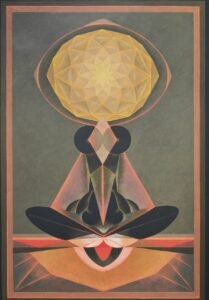
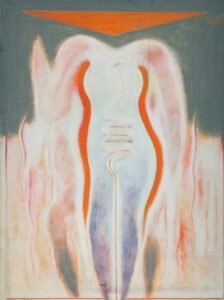
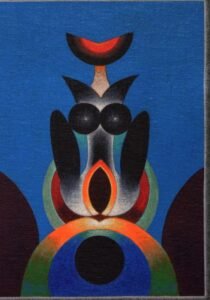
Santosh was greatly influenced by another one of Mother India’s most illustrious painter— S. H Raza, whose Geometric Abstraction revolved around a “Bindu’’ and the concept of “Tantra’’. Santosh was thus influenced by concept of Shiv Darshana. His natural affinity to delve deep into Tantra paintings admittedly produced wonderful results. His paintings centered around the theme of dimensional circles, cubes, triangles and Santosh not only accorded an academic base to these paintings but also explored the hidden spiritual meanings and messages.
These themes mainly revolved around Shiv and Shakti and the inspiration behind these was his utmost devotion for the Universal Mother seated at Hari Parbat, known from the ancient times as `Predumana Peeth’’ or “ `Sharika Peeth’’.
Towards the end, his whole focus was on interpretation of `Shri Chakra’ and its spiritual significance but unfortunately, this could not fructify, as he along with lakhs of Kashmiris had to abandon his homeland.
Considering the current situation, it is unlikely that another Santosh may emerge from Kashmir, as the very soul of Kashmir stands brutalised as on date. But since strange are the ways of the Divine, the seed may lie embedded to sprout in the womb of future.
Santosh’s life and works
In early 1960s, Ghulam Rasool Santosh had studied Tantric (mystical) art and Kashmir Shaivism. In 1964, he adopted this style to create some of the best examples of modern Tantric paintings. His paintings are known for the vibrancy of colours, neat lines, spiritual energy and sensuousness. His paintings have been exhibited in notable international shows. Santosh also wrote plays, poetry and essays in Kashmiri. He was also an authority on Kashmir Shaivism, and was one of the very few people who could read and write the ancient, and almost-extinct, Kashmiri script called Sharda.
Santosh’s canvas represented a Projection of Shunya
According to a booklet brought out by Indian Council for Cultural Relations (ICCR) , Santosh is quoted to have lived with the belief that his canvas represented a projection of Shunya, the void which is incalculable in time and dimension, Anadi and Ananta {without beginning to end}. “The surrounding dark oceans in terms of which you describe the borders of my canvas are the ever unfathomable, unreachable of the fundamental unfathomable, infinite aspects of the fundamental creative force which lies beyond the pale of wisdom, thought and imagination. The canvas itself, therefore, is symbolic as it portrays the omnipresence of infinite in the finite. But space cannot be defined without a minimum of three directions or three lines, which formulate a triangle, which is Mula Trikona. The initial nature of all pervading creative force is Shabda Brahma, primordial sound which is ever and ceaselessly vibrant.”
In search of Inspiration at Amarnath Cave
In 1960, Santosh took a visit to the Amarnath cave in the hope finding inspiration to write an inter-faith romance. However, he came back with an experience of a philosophical tradition that would become the fulcrum of his thought process and embrace his inner sanctum. The 8th century tantric philosophy of Kashmir Shaivism became his leitmotif. He started studying Tantric Art -imagery and philosophy and created his own cosmic corollaries incorporating the cosmic egg form, the vertical symmetry, the ovoid shape as well as the phallic. This why he said: “My paintings are based on the male and female concept of Shiva and Shakti and therefore construed as tantra.”
Kashmir Shaivism had influenced Santosh in terms of colours. It spoke of Prakash Vimarsha as it considered colour a form of light. Therefore, Santosh started treating colour as light. The orange colour in his paintings referenced a connection to tantra in the form of sindoor. Santosh had meditative practices, so deep was his understanding that his paintings reflected those powers of energy. Santosh had over 30 solo shows in India, U.S.A., Canada, Japan, Hong Kong and Singapore, besides exhibiting his paintings in national international group shows.
Honoured with Padma Shri by the President of India, he was also awarded the National Award twice and the Artist of the Year Award in New Delhi in 1984. His works belong to Museums all over the world.
Santosh as a mystic poet
Many few people must be aware of the fact that apart from a painter, Santosh was also a great mystic poet. He wrote an important poem in 1963 `Do Rukh’ (twin faced) which employed the metaphor of one’s eyes being transplanted behind the skull. The poem was symbolic of liberating one’s thought process from the constraints of time, space or dimension on the one hand, and implying on the other than one may have left one’s destination behind.
Santosh at a Mushaira organised by All India Radio.
Santosh loved reciting his poetry over Radio Kashmir. In 1972, he had participated in All India Poetic Symposium at New Delhi. In 1978, he received the Sahitya Akademi award for his collection of poems in Kashmiri, titled ‘Be suakh Ruh’ On March 10, 1997, Santosh left for heavenly abode— away from Kashmir, The same year, he was awarded posthumously Doctorate of Literature (Litt.D.) by University of Jammu
Asha Khosa, one of the seasoned and veteran journalist from Kashmir is by default very passionate about the issues facing the Kashmiri Pandit community. She is of the opinion that instead of harping on past glory, we Kashmiri Pandits should focus on most relevant and pressing issues facing our community. Her concern is shared by every Kashmiri Pandit, including another noted community Journalist, Avtar Bhat.
But while deliberating on these issues, which are infinite, it appears that the present and clear danger and the number one issue is the preservation and propagation of Kashmiri language among Kashmiri Pandits. Kashmiri Pandits will continue to exist only when they will carry the strength of Kashmiri language with them. We are all aware that day-to-day conversation in Kashmiri is the most effective tool to preserve the language but it is also felt that nobody among the young of our community is inclined to do, as they do not seem to be interested. Remember: Migration has nothing to do with learning or unlearning of the mother tongue. We see thousands of labourers and their families ,working in every nook and corner of India since ages , including Jammu and Kashmir—but they continue to speak their mother tongue with all fluency.
The Curse
The Kashmiri adage “Koshur Chu Pardaruk” (Kashmiri benefits others but not his community) seems to apply in this case. Like Jews, we may have become the part of international diaspora and made our dwellings all over the globe but unlike them, we have abandoned the language since we do not have the will to identify the strategy to implement any blueprint for its preservation and revival.
The cost of ignoring the language
If Kashmiri continues to be the language of Kashmiri Pandits only then is a possibility of our survival howsoever miniscule we are otherwise by all estimates the Community will not survive beyond fifty years. A sham ritual may continue to be the odd activity here and there like burning of ‘Isband’ in the ‘Kangri’ against the loud pounding of DJs but no Rav (Roff) and Vanvun will ring in the ear. Thus, Kashmiri Pandits will cease to exist and consequently will have no claim over Kashmir.
The present scenario of language related activity
Visit every book release function at Jammu or elsewhere where plenty of these functions are organised. It is the same faces adoring different functions at different venues. No young man or woman is part of this activity. The same select group of people (over the age of fifty) goes on presenting poetries, stories or narrations ad infinitum but no new talent is honed. There is nobody among young Kashmiri Pandits who can be called a budding Kashmiri writer, poet or a commentator etc.
Erasing Kashmiri means erasing ourselves
So a great language, which has shaped and preserved the great civilizational ethos of Kashmiri Pandits, a language that traces its origin to antiquity, which finds mention in devotional poetry of seventh century “Chumma Sampraday” and Shitikantha’s devotional imploring to Lord Shiva will come to an end and so will the Kashmiri Pandits. The writing is clear on the wall
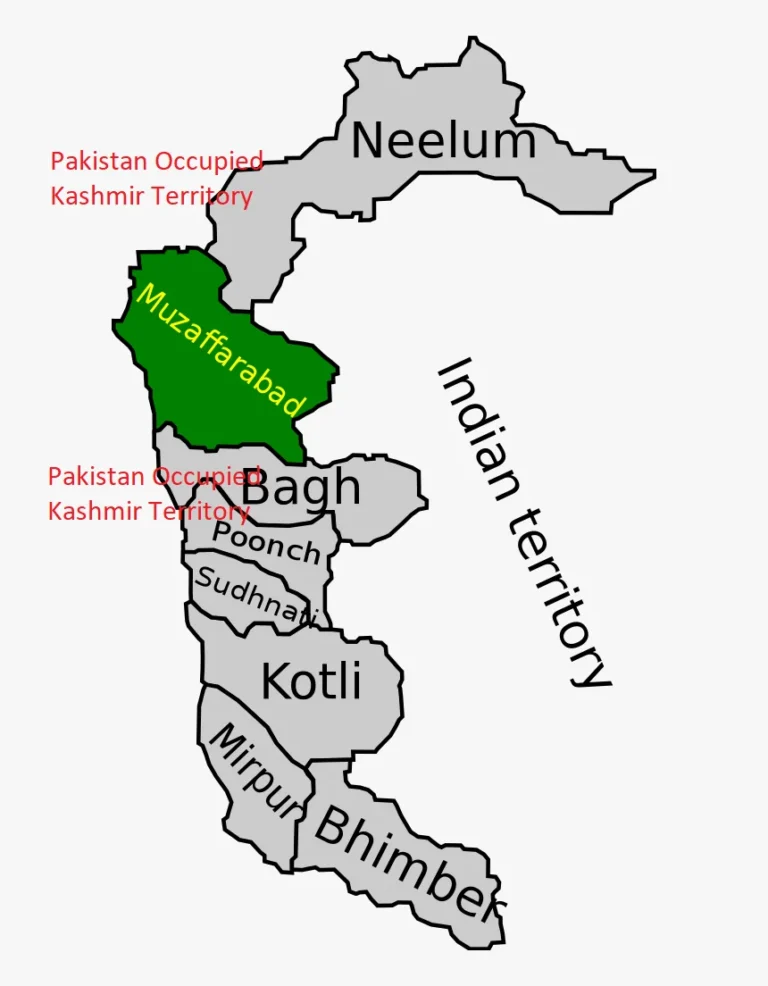
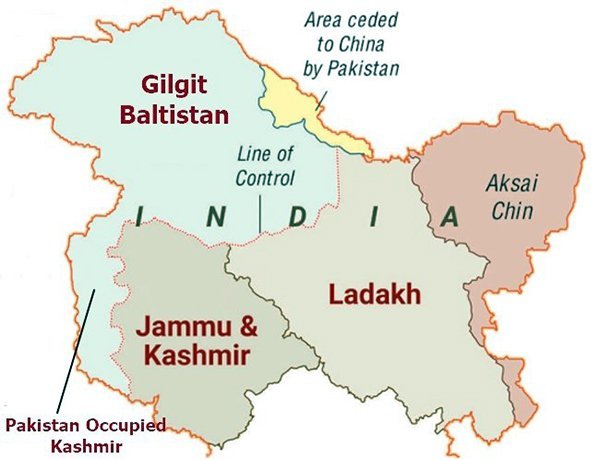
Politics is a complex in nature in Pakistan Occupied Kashmir (POK). Three categories—— Constitutional Status of POK, Pakistan’s National Islamic Ideology and Pakistan’s internal politics, broadly determines it. This complexity has been happening since 1948.
Pakistan Occupied Kashmir is, fortunately, not a colony of Pakistan. It is also not a Province of Pakistan. The stark reality, however, remains that POK is dependent on Pakistan for its existence and survival. These critical dependency factors include Pakistan’s patronage, budgetary provisions and Administrative control by the Pakistani bureaucracy in delivering as per the Pakistan Government dikaits. In the process, Pakistan has an overall control over the natural resources of Pakistan Occupied Kashmir.
It is the well documented and historically proven reputation of the Pakistani Civil Servants that they have been good servants but bad masters. Their role and contribution in electioneering process has been of two kinds. That has been pre-election and during the elections, by means of bogus vote-listing, printing, stuffing and counting, besides inclusion of ‘ghost voters’, and to declare winners against targeted predetermined losers. This has been going on in POK at the behest of Pakistani bureaucracy, which always works all the time in Pakistan as well as in POK.
Ruling Party in Pakistan is always ruling party in POK
The ruling party sets the pace of this petty puerile practice. The absolutist authoritarian governments of Pakistan, whatever be the ruling political party or opposition, seeks to and succeeds in imposing its will, and if possible, writ in POK also. That is why the ruling party in Pakistan is also, always, the ruling party in POK!
Thus, the genuine POK political parties are invariably at the losing end, because the Government of Pakistan controls the so-called Government of POK by means of massive masterminded politico-bureaucratic manipulation from Islamabad.
Futuristically speaking, the Future belongs to the youth. The Muslim Leagues are a spent force, despite their raving rhetoric. Their collective leadership comprises the ‘by-passed’ sick, ailing and utterly exhausted individuals. It needs stress-free restful retirement, at home or in safe havens abroad. All said and done, one simply cannot forget that the most youthful, healthy and patriotic collective leadership is in the Pakistan Armed Forces. Failed political power play in Pakistan invariably creates a power vacuum, which attracts the most powerful patriots.
The present political situation appears to be the same in Turkey…. That is why, over the past some months, particularly, after the nullification of Article 370 by India in Jammu and Kashmir, both Turkey and Pakistan seem to have come closer. It is the reason that Turkey and Pakistan share the same opinion and seem to be close friends. The reason is their internal conflict, both at political and social level.
As Pakistan seems to get in a disintegration mode, Turkey too faces the same challenges. Both Pakistan and Turkey are critically in need of crises management as well as damage control and repair, by means of national integration, defence and security and Islamic Tauheed.
The story of Kashmiri Pandits and the most unfortunate exodus that this community had to undergo in Independent India and who are facing extinction and acknowledged ethnic cleansing has been narrated, commented and counter- debated by a plethora of writers, commentators, journalists, film producers and what not. To this long list belongs 1975- Uttar Pradesh born Ashok Kumar Pandey, who is considered an expert on Kashmir post 1990 and has already written two notable books on Kashmir — “Kashmirnama’’ and “Kashmir Aur Kashmiri Pandit”. Both these books, written in Hindi are interesting to read but must have not been so much discussed, especially by the Kashmiri Pandit community themselves—- possibly for the reason that Ashok Pandey holds a particular view many Kashmiri Pandits may not subscribe to. But the fact is that both his two books on Kashmir and Kashmiri Pandits offer extremely valuable insights on our understanding of dynamics in Kashmir. Thus every Kashmiri Pandit needs to read, analyze and make an independent opinion on the book that highlights their plight. The author seems to be open to any honest criticism.
Basne Aur Bikharne Ke 1500 Saal
In “ Kashmir Aur Kashmiri Pandits”, Ashok Pandey relies heavily on Pandit Jia Lal Kilam’s wonderful book titled “ History of Kashmiri Pandits” (June 1955 edition), a pioneering work (prior to even Bamzai’s and others) on Kashmiri Pandits, the forgotten but illustrious children of Mother India. Basne Aur Bikharne Ke 1500 Saal is the tag-line of his book.
Ashok Pandey may be holding his own opinion on the current political situation in India but nevertheless, he has treated the issues of Kashmiri Pandits with utmost concern and compassion. He seems to be aware of the plight, the loss of heritage and the utmost odds against which Kashmiri Pandits have to claim an honorable existence in their aboriginal land and to wriggle out of the predicament created by the current situation facing them.
This book also delves into the tumultuous history of Kashmir, seeking the whereabouts of Kashmiri Pandits and analyzing the socio-political processes that unfolded amidst the rise of Islam, religious conversions and the mental and social formation of Kashmiri Pandits, as well as the complex relationships between Muslims and Kashmiri Pandits.
The author has made a courageous attempt to put forward the story of Kashmiri Pandits and how the situations worsened and reached exodus. Pandey talks about the atrocities committed against Kashmiri Hindus and their forced exodus from the Valley. Discussing in detail the circumstances that led to the displacement of Pandits in nineties, this book establishes a dialogue with the displaced Pandits as well as those Kashmiri Pandits who never left Kashmir.
This is the first book to include the narrative of Pandits still living in the valley, both before and after the abrogation of Article 370, for which the author claims to have travelled to different areas of Kashmir and interacted extensively with Pandit families.
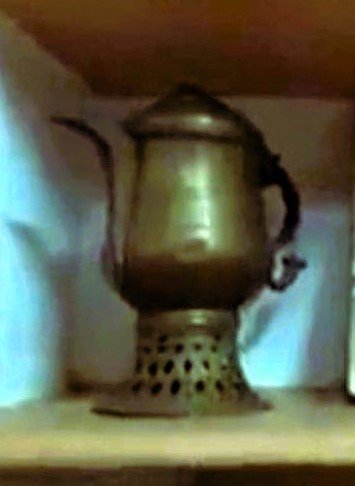
A renovated old house at village Banga Khatkar Kalan some 40 kilometers from Jallandhar, Punjab has assumed the status of no less than that of a shrine. This building which has now been renovated and converted into a museum, has a unique feature, as it houses the items of daily use belonging to Shaheed Bhagat Singh. Apart from iron buckets, utensils, brass glasses, thalis, manjas (Cots), a charkha (spinning wheel) and a typewriter, there is a unique thing on the display….. That is a Kashmiri Samavar!
Served as home to one of the greatest revolutionary and freedom fighter that India has produced, this ancient house on Nawanshahar Banga road has given identity to the rechristened District now known as Shaheed Bhagat Singh Nagar District. The unique feature of this house are the items of daily use which are displayed in cupboards in a manner they existed and were used in the then Punjab.
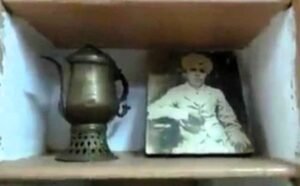
For Kashmiris especially Pandits and also Muslims, the visit instils a greater degree of pride and love for the Shaheed- e- Azam when they notice an exquisite Samavar made of pure brass adoring the cupboard meant for displaying the items. Interestingly, on its right side is kept a Black and White photograph of adolescent Bhagat Singh with a turban and coat as worn by North Indians during those days. Every Kashmiri can identify with this as our forefathers also put on the same outfit borne by old photographs if at all they happen to be in anyone’s possession.
Brass Samavar makes Kashmiris nostalgic
The Brass Samavar makes the Kashmiri culture come alive in this great house. Nostalgia also grips Kashmiri Pandits when they see this big kettle/tea pot rarely used outside Kashmir to be among the most important part of the heritage called Shaheed-e-Azam Bhagat Singh’s House.
It also throws light on Shaheed- e-Azam’s thought process and the unique aspect of his personality which on one hand was tremendously aware of all the geo-political developments that were prevalent in the region, his love for freedom of India for which he executed the historical strategies and on the other hand Shaheed- e- Azam also possessed a tender heart that accorded a great appreciation to aesthetics, Punjab’s own culture and a great respect for cultures of other parts of India combined with a farsightedness unseen to this day.
There is, however, no known record about this Samavar on display in the museum. Infact, few years back, Punjab’s Tourism department had failed to provide full description of things preserved in the ancestral house of martyr Bhagat Singh at Khatkar Kalan. Former Tourism Minister, Navjot Singh Sidhu, during his visit on October 2, 2017 had directed the department to give full description of things preserved in the ancestral house. A detailed story was carried by Hindustan Times that month along with the photographs of some of the rare items.
In March 2016, when the renovation of the house was being done, the department had appealed to the public to hand over any belongings of the martyr or his family so that they could be preserved. The house, which was in dire need of renovation, was repaired by the department for the first time since 1984 when it was handed to the government by the village panchayat. Before that, the local panchayat used to take care of it. After the renovation, it was opened to the public and many things were kept in the house, but the department had failed to give any descriptions, including that of this unique Kashmiri Samavar on display.