Home Blog Page 33

Urdu Satire That We Miss

 (By: Kanwal Krishan Lidhoo)
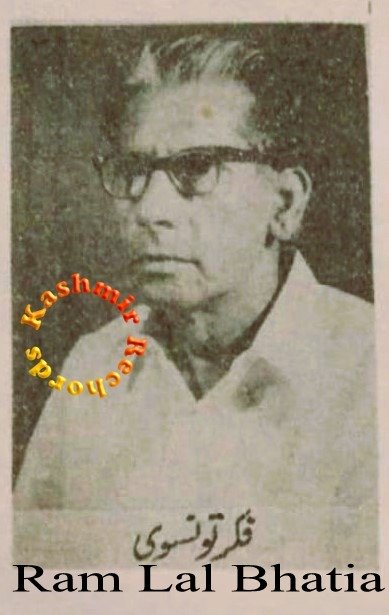
The present generation of modern men and women clawing in their hands their metal bricks which flicker shades of blue and red in their faces, their attention having long deserted them could never be able to comprehend the sublime romance of Urdu language with its stories so terribly unique and genres so fulfilling, the jewels of the insights contained therein remain unfortunately hidden from them.

There may have been a trickling down of Urdu poetry that supposedly may have satiated their senses a bit but the enormous joy and laughter that Urdu satire with its originality and stand aloneness of its Indian identity brings forth, that seems to be hidden from them indefinitely. Time was when last drop of the juice was sucked by the readers when they came across a Fikr Taunsvi essay, or a one-liner that would be a treasure of humour and satire for days to savour or cherish. Born as Ram Lal Bhatia on 7th October 1918 to a shopkeeper Dhanpat Rai in Taunsa, now Pakistan he had to migrate to India and passed away in 1987.

Noted Urdu writer and critique K.K. Khullar writes about him  “By far the greatest satirist in modern Urdu prose he challenges comparison with Swift and Shaw. If his words are barbed, his humour is vivacious drawn as it is from real life”. The intensity of his humour according to Khullar was such that as a general rule he never wished anyone a Happy New Year on the plea that happiness is an occasional episode in the general drama of pain, which the life is. He therefore wished friends and foes a `Less Unhappy New Year’ .

Fikr Taunsvi’s rare gift to Urdu lovers

Fikr Taunsvi unfortunately seems to have passed into obscurity but the fact remains that by not making him an important part of our reading habit we are missing something so profound and very deep empathetic human attributes.

Kashmir Rechords can proudly claim to have in its possession a very rare book about this great Urdu literary giant. This book is a special edition published by “Chingari “the fortnightly Urdu magazine that used to be published from Delhi during 1970s and was essentially the baby of progressive writers. Fikr Taunsvi himself edited major portions of the book. This book actually is a treasure house of Urdu literature that can ignite passions and has the potential to stir movements even at this stage. The progressive writers of that era who ate, slept and breathed revolution generally suffered for getting their works published, however, the fire in their heart made them somehow gift to history a brilliant compendium of satirical essays.

The book is actually the team effort and labour of love of all these illustrious men and women of whom a mention is being made and the book contains rare jewels carved out by them. This list in addition to Fikr Taunsvi includes the greats like Rattan Nath Sarshar, Ismat Chugtai, Safdar Mirzapuri, Khwaja Hassan Nizami, Haji Laq Laq, Shawkat Thanvi, Saadat Hassan Manto, Khawaja Ahmad Abbas, Ibn Insha, Mujtaba Hussain, Jahan Qadr Chugtai besides others.  The book is printed in stencil style and its font is calligraphic unlike the standardised Urdu font of modern day computer software.

After going through the book, everybody is sure to exclaim long live Urdu!.

BP Sharma— J&K’s Walking Encyclopedia

( Kashmir Rechords Exclusive)

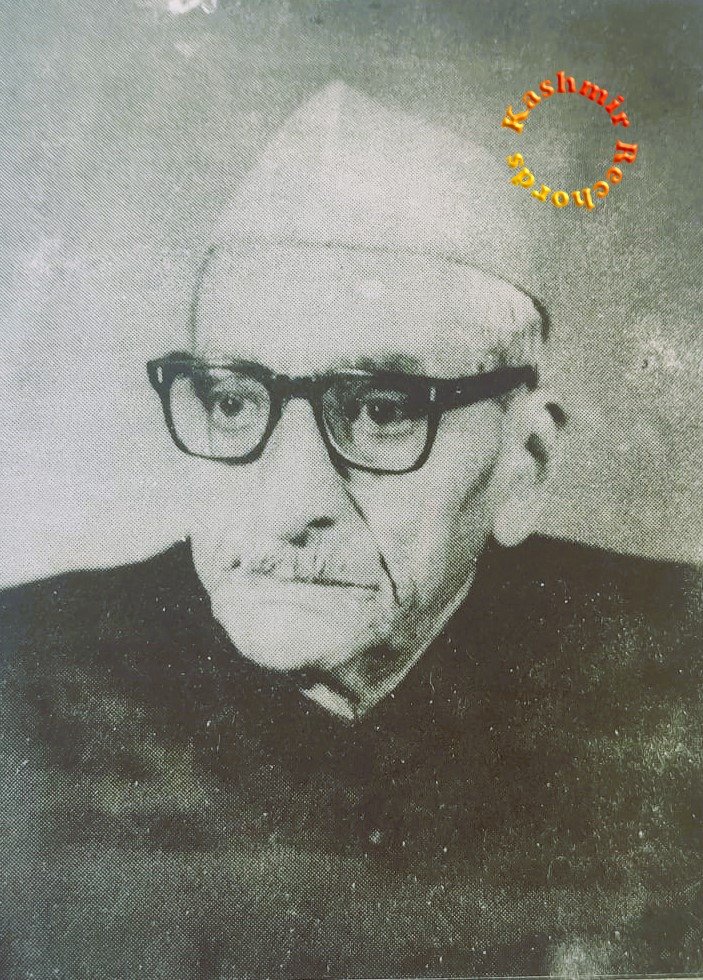
Meet Baldev Prasad Sharma of Jammu and Kashmir who was listed in the Limca Book of Records for becoming the oldest working journalist for having worked  even at the age of 92.  Born on January 1, 1909, Baldev Prasad Sharma, popularly known as `B P Sharma’, the  Walking Encyclopaedia of J&K,  died on January 23, 2005 at the age of 97. Blessed with the rare qualities of head and heart, B P Sharma had to his credit over 70 years of distinguished service as  a mediaperson and a Research Scholar.  A doyen of Dogra Culture, B P Sharma had begun his journalistic career as early as 1927 when he was still a student of Class 10 at Srinagar

Kashmir Rechords is reproducing  here a portion of a  write-up by noted Dogri, Hindi and Sanskrit scholar, Late Dr S P Shrivatsa on the life and works of Mr B.P Sharma, the Doyen of Dogra Culture.  

Pioneer of Journalism

Born in Srinagar in a Dogra Brahmin family, B P Sharma had completed his schooling from Sri Pratap High School Srinagar and then joined Sri Pratap College, Srinagar for higher studies. He had finished his graduation in the first class from University of Punjab, Lahore, in 1931.

Dr S P Shrivatsa , a   well-known Dogri , Hindi and Sanskrit scholar from Jammu, in one of his write-ups ( published in Kashmir Today magazine,  August-Sept 1993), had termed B P Sharma as  the pioneer of English journalism in the State, having launched the “Kashmir Times” as a weekly newspaper from Srinagar on September 24, 1934.  According to Shrivatsa, Sharma was the first Dogra to head the Information Service of the then State of J&K as Principal Information Officer. He was also the first Station Director of Radio Kashmir Jammu, from where he had retired in January 1967.  He had also worked at All India Radio Stations at Calcutta, Bhopal and Indore.

Sharma’s contribution towards Dogri language

Apart from working with State-run media organisations, B P Sharma, during his longest journalistic career, had also worked for Reuters, Times of India, Hindustan Times and The Tribune.  He had done much research into the language of Dogri and unearthed several documents to prove that Dogri was an ancient language with its own grammar. He had also written series of articles about political and historical developments in Jammu and Kashmir during the pre and post-Independence era. He had the history of all important events at his fingertips. As a member of the Sahitya Academy for many years, he contributed much towards the development of the Dogri language.

B P Sharma had also contributed towards publication of the book “The Stamps of Jammu and Kashmir”, which was authored by Frits Staal, a Professor at University of California, Berkeley, and published by the New York Collectors Club in 1983. The book carries a series of articles about the postal system under the Dogra rulers.

Challenging Grierson

According to Dr S P Shrivatsa, B P Sharma was the first scholar to have “challenged’’ the statement of the well-known linguist, Sir George Abraham Grierson, who in his “Linguist Survey of India” had said that neither the Dogri type nor any printed book in Dogri was in existence at a time he had visited Jammu.  B P Sharma had proved that about 20 Dogri books, some of them in Dogri type were actually printed years before Grierson had come to Jammu.

His tireless service in digging the history of Dogri language and culture brought him the distinction of being elected unanimously as President of Dogri Research Institute, Jammu, in 1978. He remained President of this prestigious Institute for over a decade.

B P Sharma had unearthed the elusive “Lilawati”, a treatise on Mathematics, being a Dogri translation of the Sanskrit “Lilawati” of the famous Indian astronomer and Mathematician, Shri Bhaskaracharya. This Dogri book was printed at the “Vidya Vilas Press”, Jammu, in 1873. Sharma had  also established that the old Takri script which was used for writing Dogri, was got modified and improved by Maharaja Ranbir Singh, so much so that it was actually brought at par with the Devnagri script.

 B P Sharma had also served the Sahitya Akademy as a member of its Dogri Advisory Board for nine years.

Sharma as a Researcher

Another remarkable research in the history of journalism in Jammu and Kashmir conducted by  B P Sharma   had established that the first newspaper was started from Jammu in  1867. “Vidya Vilas”, a bilingual  weekly newspaper,  had  two columns per page, one half in Hindi and the other half in Urdu. Its editor was Vainkat Ram Shastri. It was the journal of “Vidya Vilas Sabha”, a literary and cultural organisation of which Maharaja Ranbir Singh himself was the patron.

Ashok Kak—- Kashmir’s Cultural Icon

(By: Kanwal Krishan Lidhoo)

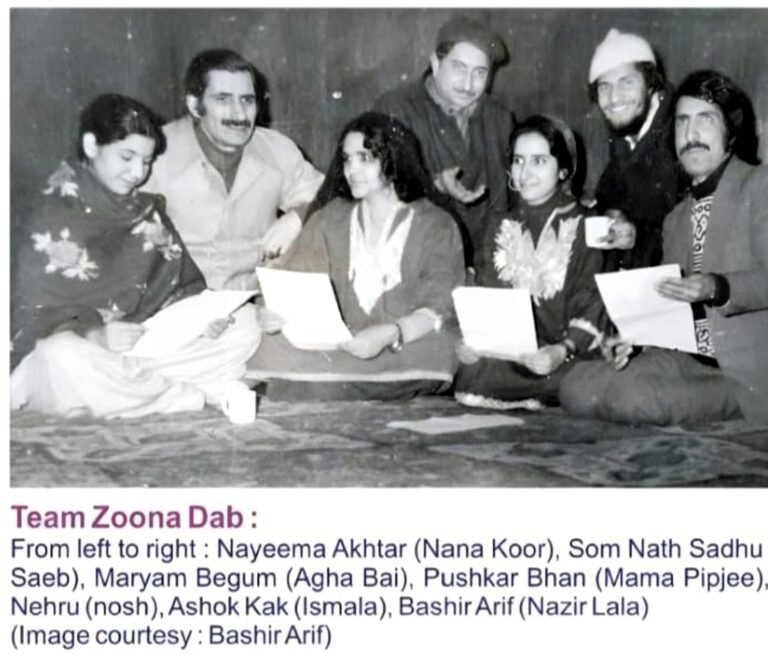
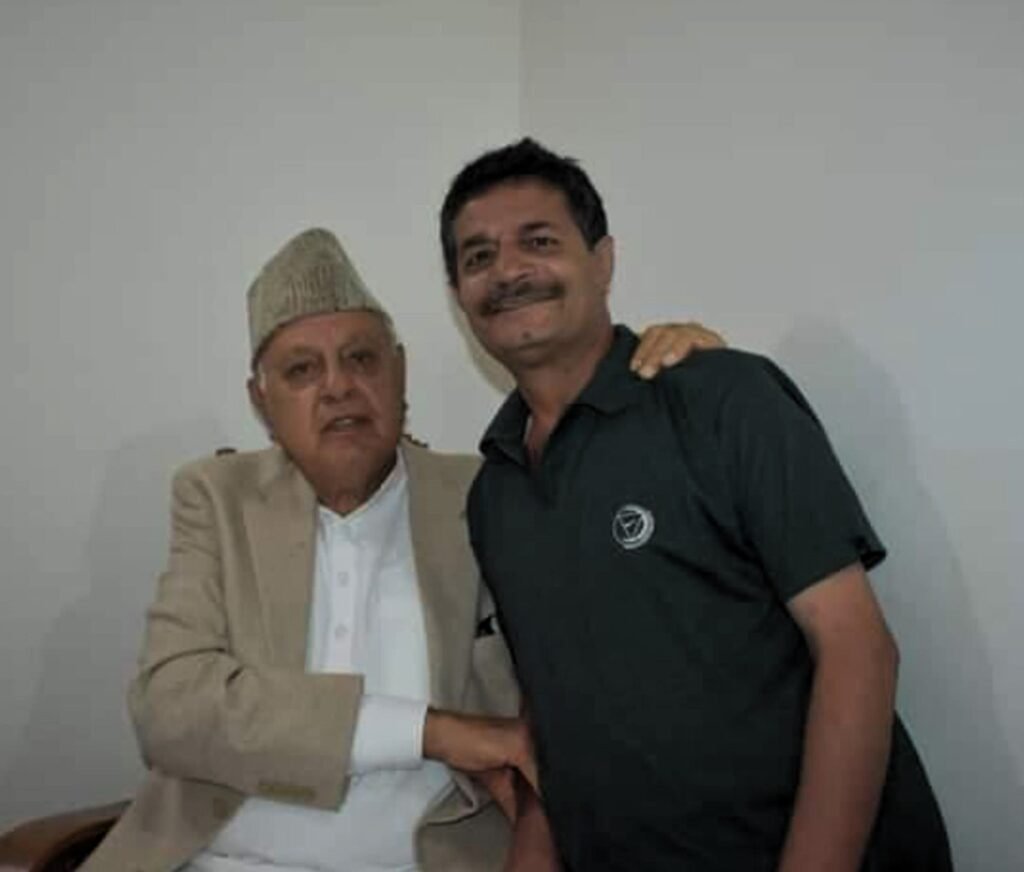
Among one of the surviving artists of Kashmir’s exalted and most popular daily radio soap opera “Zoondab” which has now become the cultural statement of sorts, the artist, Ashok Kak known as “Ismaal” the affable, meek and wayward simpleton, adolescent who served as the domestic help to “Aga Saeb” is respected as a cultural icon in Kashmir so much so that he chose to remain and serve in Kashmir during the period post 1990s. He continues to breathe life into the roles he is assigned.

 Zoondab’s Ismaal

Not only has he been part of the healthy infotainment provided by Radio Kashmir (now All India Radio) Srinagar, he has independently made forays into the whole process of drama production and donned the roles of writer, producer and the artist respectively. His character in the Zoondab, which made him a star, is now part of the folklore of Kashmir. His journey as `Ismaal’ in the most popular Zoondab is continuing. Spotted by Kashmir’s broadcasting legends Som Nath Sadhu, Pran Kishore, Bansi Nirdosh and others, Ashok Kak was offered the role of an adolescent domestic help initially. A specific drooling and dialogue dragging style invented as a cliché “LAGAY BALAAY” by him endeared him to Kashmiris of all age groups. Everyone would imitate and copy him. Ashok Kak was so consumed by the passion and the adulation; he could not think anything else but the dramas. His total commitment coupled with his  dedication took him to every nook and corner in Kashmir valley and outside where he presented his craft mainly as a comedian. His puns and satires were unique and legendary. He got fixed as the stock character in the serial Zoondab, which continuously ran for decades. Radio Kashmir Srinagar felt the need to absorb him as a permanent staffer, a position he richly deserved and earned. The journey since then has been eventful. Countless dramas written and presented by him both for the audio and the visual medium besides exploring their potential through the medium of theatre have become hot topics for academic research. His experimentations in a highly evolving field like theatre and dramas have made him a professional in this field and his adaptations have enabled him to stay relevant.

Ashok Kak performing on a stage.

Ashok Kak as Drama  Writer

Some of his dramas besides his first written drama ‘Mokjar’ which  have carved a niche in Kashmir’s cultural landscape include ‘Anokhay Lal’ , ‘Gari Pethie Zaamtur’, ‘Kanjoos’, ‘Adrie Zaet’,  `Intequaam’, ‘ Drama Te Haqeeqat’ besides many others.

Broadcasters Rafiq Masoodi and Satish Vimal at a book release function of `Poshe Vear’ written by Ashok Kak

His visions were broadened and after familiarising himself with the developments in the field of drama in India and elsewhere he has imbibed the craft so much so that he is sought as a counsel by the established drama groups in Kashmir.

 Ashok Kak has worked hard to get to the position he is enjoying in the hearts of Kashmiris but very few accolades have come his way. He continues to be the underrated Drama legend in the eyes of the government, though the civil society in Kashmir respects him as a cultural icon.

A Kashmiri Pandit diplomat, a spy and a Historian of yesteryears buried in Delhi !

www.kashmir-rechords.com
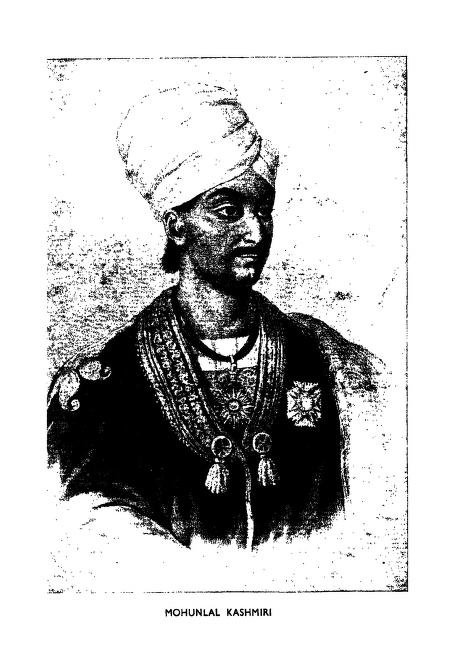
Pandit Mohan Lal Kashmiri  alias Mirza Quli Kashmiri alias Agha Hassan Jan Kashmiri

Pandit Mohan Lal Kashmiri  alias Mirza Quli Kashmiri alias Agha Hassan Jan Kashmiri—–  sounds interesting! But that is how this polyonymous from Zutshi clan had  lavishly lived and  typified  himself  in first half of 19th century as a traveller, a spy, a writer, a diplomat, a polymath, a polyglot    and a  scholar  but  ultimately had to spend his last phase of  life in obscurity!

   In 1845, when Queen Victoria had invited Agha Hassan Jan Kashmiri alias Mirza Quli Kashmiri to the Royal Hall in London, it was to the surprise of all to know that this genius, who was functioning as a spy and had assumed Agha Hassan Jan Kashmiri as pseudonym, declared his real name as Pandit Mohan Lal Kashmiri. This revelation had stunned everyone.

Researches based upon the life and works of Pandit Mohan Lal Kashmiri connect him to the Zutshi Pandits of Kashmir. His ancestor, Pandit Lachdii Ram Zutshi had in fact migrated from Kashmir to live in Delhi during the reign of Emperor Shahjahan. The extended Zutshi family was since then living in Sita Ram Bazar of Delhi where this Polyonymous Mohan Lal was born in 1812.

 It was in Delhi English College where this young Mohan Lal under the encouragement of his father Brahm Nath Zutshi (also known as Budh Singh) had received his education in both English and Persian.

 Brahm Nath Zutshi had a Sikh mother who would affectionately call him as Budh Singh. This Budh Singh was married to a Pandit wife, who belonged to Kouls of Gwalior and was bestowed by two sons– Pandit Mohan Lal and his younger brother Pandit Kedar Nath. While Mohan Lal had assumed multi-dimensional personality, his younger brother, Kedar Nath, who died in 1855,   was a Deputy Collector in Ambala, Punjab Province.

Mohan Lal Kashmiri as a Spy

Fate often acts in strange ways and so did it for Mohan Lal. In 1831, the British East India Company had appointed Sir Alexander Burnes as its chief spy to gather information in the countries lying between India and the Caspian. His deputation was a part of great design of the British to penetrate into Afghanistan, Central Asian Sultanates and Tibet. It was the British Secret Service, which selected through Charles Travelyan, this very brilliant and ambitious student, Mohan Lal Zutshi (Kashmiri) to accompany Sir Alexander Burnes. Having joined the British Secret Service in 1831 at a tender age of 19, Mohan Lal assumed the name of Mirza Quli Kashmiri as the Persian interpreter to Sir Alexander Burnes.

The first task of Pandit Mohan Lal, (now Mirza Quli Kashmiri) was to recruit his agents to bring about defections among the Afghan resistance movement. He accomplished this extraordinary task with great tact and intelligence. Posing himself as a Kashmiri Muslim, Mohan Lal Zutshi had married a girl from the Royal House to facilitate him in spying.

 Mohan Lal Kashmiri as a traveller

Both Sir Alexander Burnes and Pandit Mohan Lal explored Central Asia between 1832 to 1834 for procuring political and military intelligence. During his travels, this Kashmiri Pandit, now Mirza Quli Kashmiri would first seek a wife from the influential family of the region so that his matrimonial alliance would provide him with ample protection. Many of his marriages were outcome of sheer compulsions of reaching inner circles of Britishers’ adversaries. He had also married in royal families of Afghanistan and Iran.

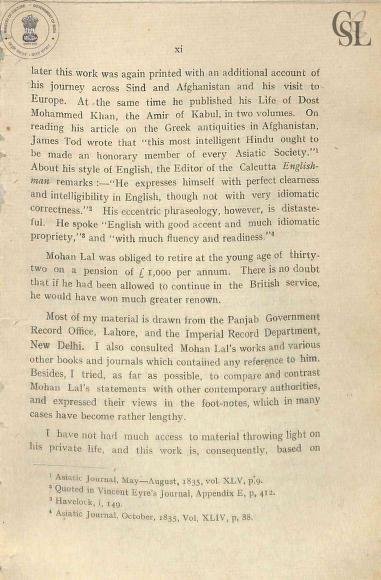
 After his return from Central Asia, Pandit Mohan Lal published a journal of his tour in 1834. Twelve years later, this work was re-published with the addition of his travels in Europe. At this same time, he had also published a work on the life of Dost Mohammad Khan, the Amir of Kabul, in two volumes.

 After his Central Asian tour, Mohan Lal Kashmiri alias Mirza Quli Kashmiri was promoted as the Commercial Agent for the British on the Indus and Political Assistant to Sir Burnes in Kabul. During the first Anglo-Afghan War, he was instrumental in setting up and expanding the British intelligence network in Afghanistan. On November 2, 1841, the residence of Sir Alexander Burnes in Kabul was stormed by a mob and both Alexander and his brother Charles were killed. But Pandit Mohan Lal saved his life by posing himself as Mirza Quli Kashmiri. He was awarded the Order of the Empire and made a Knight of the Persian Lion.

Later, during his interaction with the Shia Muslims of Iran, he had felt highly impressed with Persian history and culture and  embraced Islam. It was here he assumed another name to identify himself as Agha Hassan Jan Kashmiri.

In 1843, Mohan Lal retired at the age of 32, disappointed that he had not been properly rewarded for his contributions to the British cause in the First Anglo-Afghan War. He later embarked on a long journey to Egypt, England, Scotland, Ireland, Belgium and Germany. After his European tour in 1846, he published a revised work of his travels in Central Asian countries and Europe.

( Pages from Life and works of `Mohan Lal Kashmiri’ by Hari Ram Gupta, Minerva Book Shop, Lahore- 1943)

Hyderi Begum —  Last wife of Mohan Lal Kashmiri

His favourite Wife, Haidri Begum, the last one, was a Shia Muslim and a scholar. During the turmoil in 1857, she maintained a daybook, recording vividly the happenings and events in Delhi describing the atrocities committed by the British on the last Mughal Emperor. Her diary was later seized and confiscated by the British Government in India.
Hyderi Begum as painted by German artist Paul Fischer

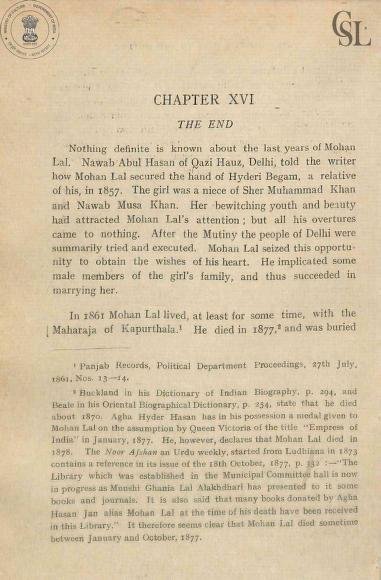
 Mohan Lal Kashmiri’s later years were spent in obscurity and financial troubles. He became a highly frustrated and isolated person because of his total boycott by his own community members, followed by his death in 1877 at the age of 65. He is believed to have been buried in Delhi in his garden called  `Lal Bagh’, near Azadpur. There is no tomb, but only a platform, said to contain the bodies of both Agha Hassan Jan (Mohan Lal) Kashmiri and his favourite wife Hyderi Begum. Hari Ram Gupta, Mohan Lal Kashmir’s biographer,  in his book “Life and Works of Mohan Lal Kashmiri’’,   gives a detailed account of   this unique personality who lived life on his own terms and conditions.

(A page from Life and works of `Mohan Lal Kashmiri’ by Hari Ram Gupta, Minerva Book Shop, Lahore- 1943)

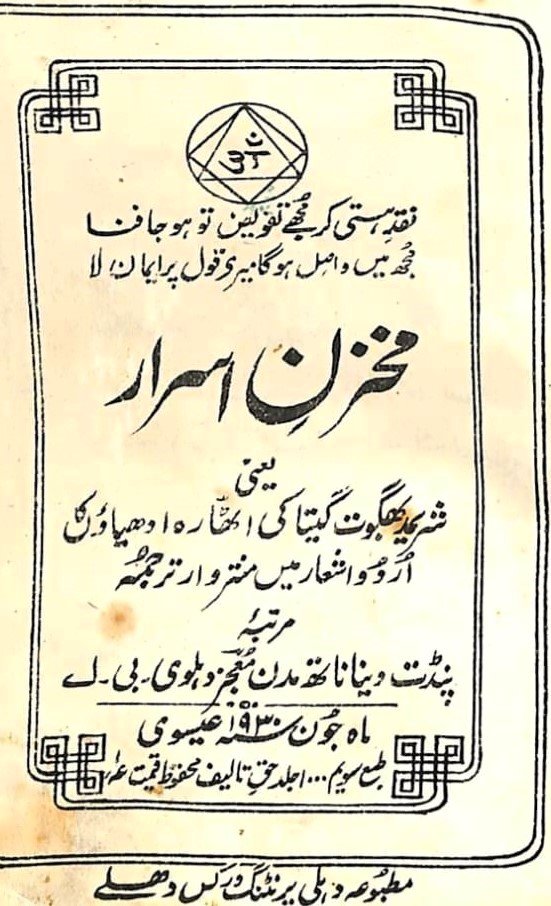
Makhzan Asrar—A Kashmiri Pandit’s Urdu gift

( By: Kanwal Krishan Lidhoo)

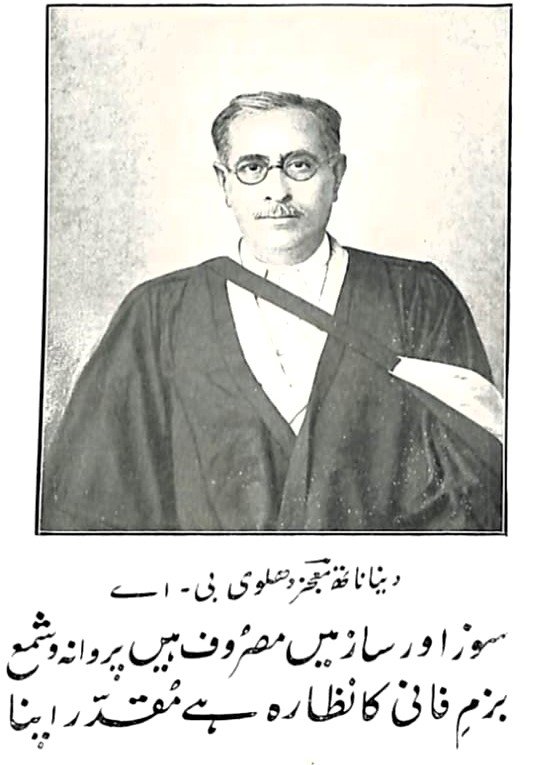
It is always a matter of immense joy when upon revisiting the history of an ethnic group that presently assembles everything in its power to somehow assert its identity and lays its hands on the invaluable gems passed as timeless inheritance by its elder members to be cherished and feel proud of. Present generation of Kashmiri Pandits living all over the globe may hardly know about one Pandit Dina Nath Madan Dehalvi who wrote by the pen name “Mouajazz” and completed one of the most brilliant poetic translation of Srimad Bhagvad Gita in Urdu.

The Treasure of Sacred Truths

Makhzan Asrar “also known as the ‘Treasure of Sacred Truths or Secrets” as already said is a poetic translation of Srimad Bhavad Gita in Urdu in its most impeccable form that was published by the author in late 1920s. Pandit Dina Nath Madan Mouajazz was a third generation Kashmiri Pandit living in Delhi and had an illustrious family lineage. His father Pandit Rai Bahadur Janki Nath Madan himself was a great scholar of three languages— Sanskrit, Persian and Urdu. He himself had compiled an unpublished brilliant commentary on Bhagvad Gita considered one of the best in Urdu till date and he also wrote “Brahm Darshan Granth” in Urdu which is considered a reference book on Hindu philosophy. His other son, Pandit Amar Nath Sahir was also an accomplished Urdu poet and writer.

This trio of father and sons so enriched the Urdu language that their works are still cherished by the scholars and intellectuals alike. The prose commentary compiled by the father thus served as a readymade substratum upon which Pandit Dina Nath Madan developed his brilliant poetic work.

Interchanging Sanskrit, Sufi Terminologies

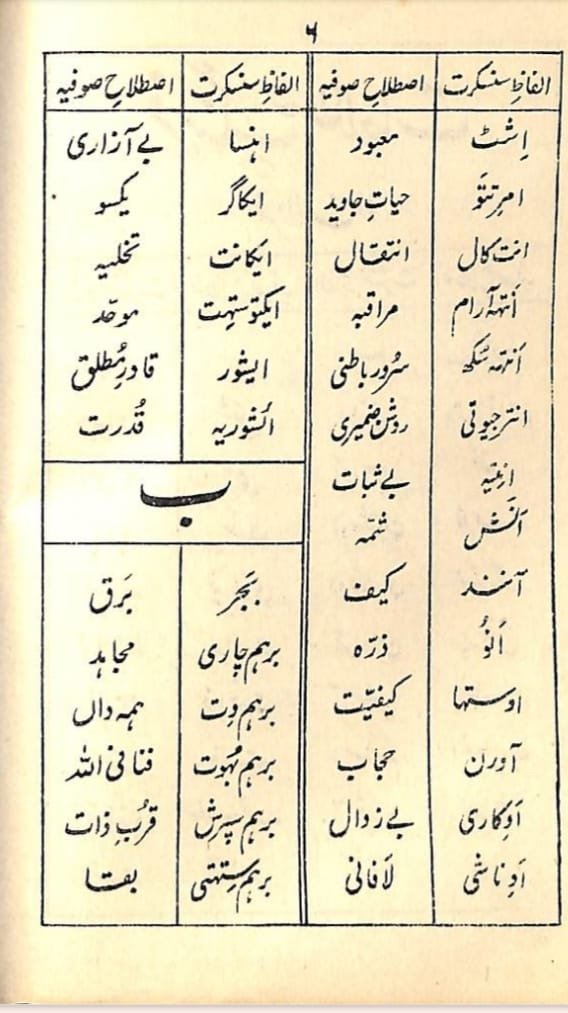
It was probably the first time in the age of the printed word that an exceptional experiment was carried out to blend Sanskrit and Sufi words in the most beautiful manner when profound and sacred truths of Srimad Bhagvad Gita were explored in a Sufi idiom or Islamic terminology and the underlying unity existing between them was explored. Thus, the subtlest and the most sacred truths of Hindu philosophy were explained to an audience and readers who found themselves comfortable in understanding those in a Sufi or Islamic idiom only. It also offered a wonderful and unique opportunity for those to get acquainted with Sanskrit vis-à-vis Sufi terminology to understand the significance of the ultimate truths as propounded in all religions. It thus was a novel experiment, which continues to carry the potential of synergising the efforts of different thought processes for the betterment of the humanity. In a way the conscientious and peace loving members of every religious community will have to revisit these gems of the past.

For the esteemed readers of Kashmir Rechords we have reproduced a list from the book of the above terminologies and it is very satisfying to see the copious application and use of these terms to understand the underlying unity of Sanatan and Islamic Sufi thought processes.

Hari Krishna Kaul–  A celebrated Kashmiri Writer

( Kashmir Rechords Exclusive)

Hari Krishna Kaul (1934-2009) has remained as one of the major Kashmiri playwrights of the modern era who started his literary career during his college days in early fifties, writing short stories in Hindi until mid-sixties. He then switched to Kashmiri, his mother tongue. His first collection of short stories in Kashmiri, Pata Laraan Parbat, was published in 1972 and immediately established him as an acclaimed writer. His only novel, Vyath Vyatha, was published in 2005. He was the recipient of many awards including the Sahitya Akademi Award for Kashmiri fiction in 2000.
 Hari Krishna Kaul’s plays, mostly broadcast over All India Radio, were about common people concerning larger issues of their life and existence. His famous play in Kashmiri “Yeli Watan Khur Chu Yevan’’ was perhaps the best example of such characters created by Kaul. Incidentally, this play was broadcast by All India Radio on its entire network simultaneously in different languages on 27th February, 1975. Kashmir Rechords is reproducing a gist of that  play, carried by several vernacular magazines nearly five decades ago.
Another example of memorable characters created by Hari Krishna Kaul was an old accountant of the humorous play Dastar, telecast over Doordarshan Srinagar. In mid-seventies, Kaul’s play Naatuk Kariv Band was first staged at Srinagar’s Tagore Hall. This play was a milestone in Kashmiri literature and was staged in Hindi besides  other Indian languages.
 The exodus of the Kashmiri Pandits from Kashmir valley in late eighties robbed Kaul the platform on which he presented his plays.  Kaul passed away on January 15, 2009.

Function at Sahitya Akademi

It was in recognition of his literary contribution that on July 19, 2019, a literary event was organised by Sahitya Akademi at  New Delhi to deliberate upon the valuable contribution of late Hari Krishana Kaul towards Kashmiri language and literature. Some scholars had an opportunity to speak on the occasion and to mention about his popularity of dramas that were famous even across the border. Those  who  had discussed various dimensions of the literary personality of Kaul included  Late  Autar Krishan Rehbar, Mushtaq Muntazir, Gauri Shankar Raina, Roshan Lal Roshan, Dr. Roop Kishan Bhat  and Dr. Rajesh Bhat

Book on Kaul

Hari Krishna Kaul published most of his work between 1972 and 2000. His short stories, shaped by the social crisis and political instability in Kashmir, explore – with an impressive eye for detail, biting wit, and deep empathy – themes of isolation, individual and collective alienation, corruption, and the social mores of a community that experienced a loss of homeland, culture, and language.
Parsa, in association with HarperCollins India is releasing his book “For Now, It is Night’’, translated from Kashmiri by Kalpana Raina, Tanveer Ajsi, Gowhar Fazili and Gowhar Yaqoob. The book brings a comprehensive selection of Kaul’s stories to English readers for the very first time. The book release function is slated for October 29, 2023 at Srinagar.
Kalpana Raina, translator, says: ‘My uncle, Hari Krishna Kaul, was a major fiction writer and dramatist. It is profoundly gratifying to bring this selection of his works  to a wider audience through this unique collaboration.
Rahul Soni, Associate Publisher, HarperCollins India, says : ‘It’s been a privilege to be involved with this translation.

Cricketers and Gladiators

(By: K K Lidhoo)

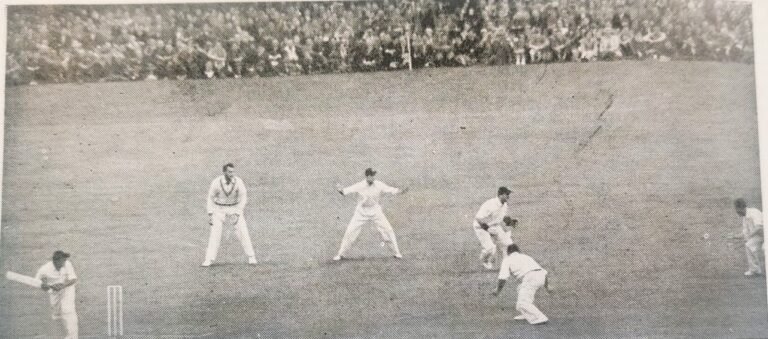
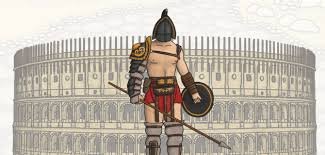
Roman kings in order to divert attention from pressing problems faced by the public and the likely unrest these would cause would organize the fatal and mortal combat of the Gladiators who were essentially slaves with good physique. Roman kings and aristocrats of the ruling hierarchy would invest in them; possess them as assets to be consumed in the bloody spectacle in arenas built specially for this purpose. Kings no longer exist and so does not the spectacle of violence associated with any sport say the least about the Gladiators. But since money is the new king, it does arrange the shows without blood of course, but the urges and the instincts remain the same.

The cricket fever is high as it is a billion dollar industry and India is the Mecca of cricket. It has assumed the cult like status in this part of the world the way football is at the world stage. While the competitiveness and the dynamics of money it has unleashed puts heavy strain on the performances of the players who unfortunately are seen more and more as Gladiators of the Roman circus rather than the masters of the relaxing spectacle they used to present.

 No Bedi, No Test

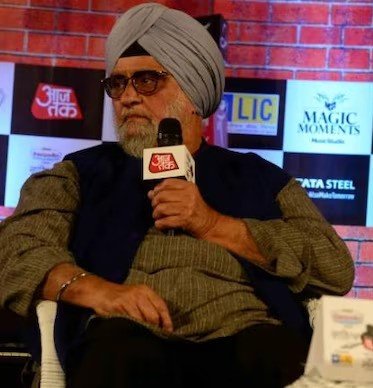
(Legendary spinner Bishen Singh Bedi was a coach for Jammu and Kashmir State’s Ranji and under-22 teams in 2011)

In the meantime, we lost Bishen Singh Bedi, the legendary Indian spinner who like his pals played cricket for the sheer joy of it. Bedi, who had  also coached J&K Cricket team in 2011, like many had always been critical of IPL and is on record, having said that the T20 cricket tournament is a platform for money laundering. We are referring to an era when the love for the game of cricket lay hidden in the hearts of Indians as an untapped resource to be exploited by the modern day agents who now deal in cricket’s merchandise on an unprecedented scale and convert it into show business that they rightly think feeds on addiction. Bishen Singh Bedi detested that. He could not somehow get over the adage associated with him “NO BEDI NO TEST”. Now there is a waiting list for the talent also! Will such show business sustain itself and increase its sphere to other sports? Yes, it is doing that even if somewhere the soul of cricket is lost. Cricket cannot be compared with other sports which intrinsically are constituted of aggression but then like all good things that spirit has also gone down the toilet and the Gentleman’s game is now not so gentle.

Kashmir Rechords for our esteemed readers and viewers tries to portray this predicament through the eyes of a common man who though enjoys the spectacle is also conscious of many disruptions it has caused

 And the Story Goes Like this

It was the same unfolding. The “Gladiators” would come out in the open. Before going for the kill, they would warm their bodies and swords. The crowd would be seen waiting in trepidation. It would have already betted on the fiercest hunk. The ‘Stadium’ would now replace the “Amphitheatre”. But the contours of the contest would now slightly change from between two to between two and eleven. The eleven would put every obstacle in the way of the two to prevent them from coveting the trophy in a scheme, which was turning more and more complex by the day. The “two” would earn “Runs” in singles, twos, fours and sixes and every team wanted tons of them .Two joker looking individuals would supervise the proceedings and their word was final. In these bloodless fights of the century, no blood would be shed except sweat and sledging.

And the Contest was called Gentleman’s Game

Today’s contest also had the foreboding of the same nerve wracking explosions. The onlookers would vent their feelings, outpour their frustrations, excitement and after the contest was over, spectators would run to their homes, debate about it endlessly till the next action which would come up in a day or two.

So Far So Good

The contest of the runs had started. The “Hulk” who was known to throw the fastest obstacle called ‘Missiles’ started running. He was known by the pet train running in his hometown. As he gathered speed, a deafening collective sound began to engulf the stadium. This was prior to what follows an orgasmic rush. Adrenaline flow was all over the place. Crescendo was reached followed by a collective sigh of release. The hulk had thrown it out. And it had gone over the fence. Contrary to the expectations it was the hulk who was being hit by a diminutive looking person all over the place.  An hour or so passed and the hulk got no victim on that date. The burden of expectations and the national pride was heavy and here he was failing terribly. That is when the animal inside got the better of him and compelled him to throw a ‘beamer’ the deadly missile at the opponent. The beamer also got hit and was nowhere to be seen! The national pride bit the dust. The match was lost. Oh! Catastrophe! A detailed report in tomorrow’s newspapers naturally occupied the front pages. The channels also known as “Mushrooms” continued to chew the cud for the entire day holding the national consciousness to ransom. A typical news report would reflect the following:-

The beamer thrown by our dear hulk tarnished what we call the “Gentleman’s Game”. He not only demeaned the nation but also was instrumental in getting himself disqualified in the most undignified manner. There is no scope for this foolishness in today’s cut throat competitions. The Hulk has transgressed at a time when it is most expected of him to conduct like a gentleman. He should have been aware that he is being idolised by the majority of the youth of the nation. Aggression is alright but it has its limits”….etc. etc.

The matter found its way to the selection committee which consciously avoided taking cognisance of the defence by the Hulk. Reasons were many, foremost among them the money, the television coverage and the rights associated with every operation of this big enterprise. The Hulk had to be sacrificed and that is what had happened. His playing career got culled. The Gentleman’s game was definitely without blood spilling character but beneath that demeanour lay hidden thousands of sacrifices.

Kalhana’s Rajtarangini—how it got revealed?

(By: Kanwal Krishan Lidhoo)

(The author is indebted to Shri Ranjit Sita Ram Pandit, the author of “R A J T A R A N G I N I…THE SAGA OF KINGS OF KASHMIR’’

Kalhana’s Rajtarangini which has made Kashmir famous all over the world and accorded it unique credit  in terms of being the only region where there was an established tradition of historiography unlike anywhere in the subcontinent. Kalhana is not presumed to be the only historian. He definitely had predecessors whose accounts are unfortunately not forthcoming. Kalhana started working on Rajtarangini in Saka 1070 corresponding to 1148 A.D and completed it in 1150 A.D

Muslim, Christian Names associated with Rajtarangini

King Zain-ul-Abedin, the king of Kashmir, ( 1421 to 1472 A.D) the legendary Budshah was the first king who ordered the translation of this most important chronicle in Persian. He named it ” Bahr-ul-Asmar”. But only a portion of it could be translated.  After Kashmir was annexed by Mughal king Akbar he ordered one Abd-ul-Kaadir Al Badaaoni in 1594 A.D to work on its complete translation. Abul Fazal in his “ Ain-i-Akbari” while making an abstract of early history of Kashmir also makes a reference to Kalhana’s Rajtarangini. It was Haider Malik of Kashmir who belonged to a noble lineage in Kashmir, undertook the task of translation of Rajtarangini during Jahangir’s period and for the first time accorded Hijri dates to the line of Hindu kings mentioned by Kalhana.
French Physician Francoise Bernier, the only foreigner who visited Kashmir during the period 1664 onwards  refers to Haider Malik’s abridged Persian translation when he refers to “ histories of ancient kings of Kachemire”. Haider Malik’s translation after one hundred years again surfaces as a reference in missionary Le PiereTieffenthaler’s “Description de L’Inde’’, as summary of the ancient rulers of Kashmir.
During the early years of 19th century, British scholar and Orientalist Sir William Jone’s attention was drawn to Kalhana’s work in 1819. In 1823, by permission of the Sikh ruler of Kashmir Maharaja Ranjeet Singh one Moore Croft succeeded in obtaining an original manuscript of Rajtarangini in Kashmiri upon which Asiatic Society of Bengal published an edition in 1835.
However, the first complete translation from original Sanskrit manuscript of only first six cantos (Part of a poem) was completed in 1835 in French  by one M.Troyer, Principal of Kolkata Sanskrit college. It is from this version that Shri Yogesh Chander Dutta for the first time translated Rajtarangini into English during 1879-1887.

Rectification of Mistakes

The journey of Rajtarangini even though the Sanskrit manuscript was complete was not without travails. Successive translators wilfully omitted huge portions of the historical chronicle either by convenience or by design and attributed strange reasons for the same. This is elucidated by Shri Sita Ram Pandit the mention of whom has been made in the beginning of the write-up. Shri Pandit traces this strange development from the days of Prof. Buhler and even Sir Auriel Stein when he says (to quote)”The distinguished explorer and scholar Sir A. Stein made a deep study of Kalhana’s work but his method of translation does not give an adequate conception of the work as a literary composition to the readers unable to study the original. Further his main interest in the chronicle was archaeological and topographical and he omitted to translate verses which according to him are in “Kavya style” and which contain rhetoric descriptions or didactic matter of a wholly conventional type”.
Thus we see it is Shri Sita Ram Pandit who completes the translation in 1934 after following Sanskrit manuscript available with Sir Auriel Stein and Pandit Durga Prasada.

Moti Lal Saqi on Rajtarangini

Moti Lal Saqi in his world famous book on Kashmir history titled “Aagar Neb” while deliberating on Pandit Kalhana mentions that during the process of writing Rajtarangini he had to rely upon twelve more such chronicles to consult as reference books and authenticate his account. In addition to Nilmat Purana, he names some such important chronicles written by Murta, Hil Raja, Padaamaraj, chivlakar and Kshemendra beside others.

About Ranjit Sita Ram Pandit

Shri  Sita Ram Pandit was a great scholar of Sanskrit, politician and barrister from erstwhile Rajkot in Kathiawar region, presently Maharashtra.  Husband of Vijay Laxmi Pandit, sister of Jawahar Lal Nehru, the first Prime Minister of India. Besides Rajtarangini, he also translated Kalidasa’s  “Ritusamhara” and Vishakdatta’s  “Mudrarakshasa”.