Home Blog Page 29

Englishman’s 1847 visit to Baba Rishi, Bhadarkali Shrines

( By: Kanwal Krishan Lidhoo**)

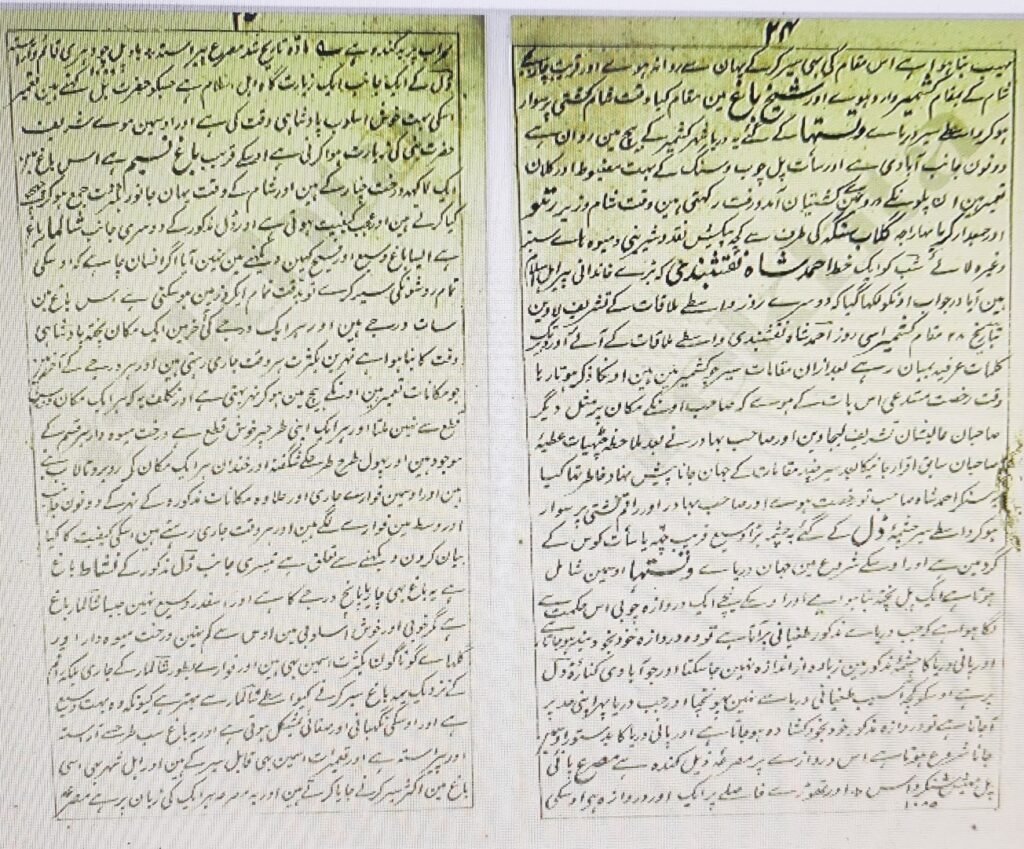
Kashmir Rechords in its previous  five  blogs had mentioned Englishman Mr. Winter Bedim’s visit to Jammu and Kashmir in 1847 recorded in the form of daily entries called ‘Roznamcha’ by one Pandit Kanhaya Lal Aashiq Dehalvi and later published  in the form of the  book under the title Sair-e-Kashmir. In the sixth and final part of the travelogue, we will begin with the visit of Mr. Bedim and party from Srinagar towards Baramulla and onwards with interesting anecdotes and experiences so far unknown to us. Here we begin with the last part of “Sair-e-Kashmir’’ :

On 31st May, 1947, a boat ride again towards the downward course of Jehlum or Vitasta took us to Sumbal which appeared to be about nine kos from Kashmir (read Srinagar). A spring with deep and sizeable volume of water known as Manasbal exists at this place and is said to be an ancient one.

On 1st of June, 1847, we left Sumbal for Mattan. ( Read it Pattan). Part of our journey of five kos by us was completed by boat and the remaining one by horse rides. We came across a shrine devoted to a holy man at Balhalas (A place named Palhalan misspelt as Balhalas). Further at a place called Pattan two very ancient temple structures exist. (Sugandesh temple built by king Kalsa of Kashmir) but nobody was able to provide the details regarding the same.

  (The author seems to have been confused about Tappereshwar temple, the ruins of which still lie nearer to Sumbal and resemble those of Martand Surya Mandir. Since the architectural style of this archaeological site with walls enclosing a large body of water with a raised platform roughly gives the impression of a temple similar to Martand sun temple the author thus  dubs it as Mattan)

 Visit to Baba Rishi Shrine, Gulmarag

On 2nd June, 1847, we set up for a visit to the Ziarat (Shrine) of a very famous and pious man of yore Baba Rishi. This Ziarat is at a distance of some six kos from Pattan. Only men are allowed as the entry of women stands prohibited at this shrine. The attendants at this Ziarat do not marry and a majority of them are the ones whom their parents had willed to be placed in the service at this place. The wishes of having their eldest child  as male whenever that gets  fulfilled, the  parents donate them in the service of this shrine by handing them over to the attendants. Sometimes these children remain there as followers.

On third of June 1847 after having made our way over a distance of approximately one kos towards the mountain top from Baba Rishi we reached Gulmarg. This is an area which is famous for diversely coloured and varied  flower types . We also came across un melt snow on these tops.

 As of now it being summer snow was still there and at places where there was no snow flowers red, yellow, white and dark seemed to be in full bloom. It seems as if they are getting their nourishment under snow. At that very moment as a ‘guz’ (approximately a metre) of thick snow was being cleared, flowers appeared to grow underneath it.

The amazing thing being that large patches of these diverse coloured flowers are seemingly arranged in beds of their own ilk. For example if the flowers happen to be of darker colour, a whole bed would be filled by these flowers only. The same would go for red and other colours. At this place nature appears to be its best gardener. The experience gathered by the writer at this moment was beyond description.

Visit to Baramulla, Uri

On the fourth June, 1847, we traversed a distance of six kos to reach Baramulla. This is a big town where one can find  eatables in abundance. The Deputy Kardar, Mathura Das got sick and thus we were assigned to the care of Kardar Gaddamal. At this place a large bridge has been erected over the river Vitasta  which blends perfectly in these wonderful environs. It was suggested that we move to Shankergarh and return via Nowshehra Baramulla as the travel on both these routes will be full of rewarding experience and the visit to the Uri bridge will also be interesting and therefore necessary. Since it was not possible to cross the bridge it was doubly suggested that the accompanying party of attendants would travel to Nowshehra first where it would be waiting for us near Uri bridge. In the meantime after having paid the necessary fare we would be meeting them on the other side of the bridge. The Kardar committed himself to this arrangement of transporting us along with our goods and necessary items.

On 5th of June, 1847 we began our travel to Uri via Yaboo. After having covered a distance of five kos, the journey ended at Shakargarh where we also camped. On the way at a place called Peerni one kos from Uri Sultan Zabardast Khan along with some gifts came to see the Sahab. The place is beset in lovely lush green environs with recurring cascades as well as rivulets .

On sixth June, the journey commenced forward to a place near the Uri bridge. It was difficult to fathom how the bridge would be crossed, but when mazdoors crossed the same deftly along with the baggage on their backs we promptly gathered necessary courage. When every one of them reached the other end only then did I and Sahab (Mr Bedim) venture to cross. At first I had thought of crossing the bridge with my shoes on but after a few steps as  my feet gave me trouble  I was compelled to hand them  over to an accompanying boatman and I with a great difficulty finally began crossing the bridge again. As soon as we reached the middle of this bridge it seemed that its ropes will yield and we will be hurtled down into the fast flowing river underneath. The whole rope structure the moment we set foot on it would dangle so precariously that it would send a shiver down our spine and make us tremble. The experienced fishermen however emboldened us to continue and assured that they are at our disposal should any untoward incident happen. This somehow strengthened our resolve and then with great caution and trepidation we finally did cross the bridge. Now let me make a mention about the bridge.

Ropeway Bridge

The layout of the ropeway bridge has been set out in a manner that its lower portion has been built with some very strong tree bark and so are the supporting ropeways. These both act as horizontal and vertical arms and support structures. Wooden planks have been set for walking at their base. One has to move forward by treading on every such plank. The portion at the lower end of this ropeway structure is very filthy and the side arms somewhat thicker. One has to move forward by holding the side arms by both hands while putting ones best foot forward on the lower connected planks. The ropeway being nearly seventy guz long, the structure dangles at each step giving rise to a tremendous sense of fear. The river which lays some twenty to twenty five metres below moves with such a ferocious speed,  its waters roar and splash against its banks higher and higher only to missile many metres into the air appearing to stand as tall as a mountain.

As one’s gaze catches the flow of water below one is paralysed by the thought that the ropeway may yield at any moment. Finally this treacherous ropeway was somehow crossed by us. We were greeted by the attendants along with our advance baggage at the other end. Thereafter we continued our journey by boarding the same carriages that were already arranged for on the designated route towards Uri.  At Uri, Raja Nawab Khan came to see Sahab. Some moments in this playful conversation were enjoyed by both.

On the morning of seventh June, 1847, elder brother of Raja Nawab Khan Ataullah Khan came to see Sahab. After exchange of necessary pleasantries and gifts etc. Mutual conversations took place in an atmosphere of camaraderie. After breakfast we left Uri for Baramulla and arrived at Naubahar at a distance of six kos. Some ancient stone structures caught our eye at two or three places along the way. At Naubahar, Raham Dil Khan Kochak, brother of Raja of Naubahar came to see us and disclosed that his elder brother Raja Naubahar being indisposed could not come to see us. The way forward from this place is hilly and the roads are bad.

On eighth of June we journeyed towards Baramulla. At a distance of half a kos we came across some ancient structures attributed to Pandav era. Sahab ( Mr Bedim) drew a drawing of these. The way forward being mountainous there was nothing worth mentioning. These buildings though very old stand tall to this day nevertheless they seem to have yielded at one or two places.

At a place some fifteen kos towards north west of Baramulla known as Sogam  it appears that the earth has been set on fire. Sahab decided to inspect this place also.

Visit to Handwara

On ninth June, 1847, we continued our stay at Baramulla and since nothing worthwhile did happen the same did not merit worth entry in the diary. However, I did go out to tour the bazaars and found the shops well stocked with food and other items. Some shortage of grain was however noticed. On tenth of June, 1847, we left Baramulla for a place called Handwara which is at a distance of nine kos from here. The Sun got very hot at a village “Mound” some five kos on the way. Thus we made a brief halt. Towards the afternoon we commenced our journey and arrived at Handwara in the evening. Kardar Radha Krishan was nowhere to be seen; however his attendant did come and explained the former’s absence on account of being busy in connection with the distribution of grains to public.

  Visit to Bhadarkali Shrine

On eleventh of June,  as we were travelling a distance of some seven Kos, at a place called Nahama we learned that a spring at a distance of further two kos lies at a place called Bhadarkali. We paid a visit to this place. The spring is worth a sight with clean waters bestowed with good digestive power. We spent some moments at this place and as was required and returned to Sogam which stands at a distance of half a kos from this place. The whole earth of this place seems to be scorched though not aflame. Some residents disclosed that some 30 years before the earth here started burning up and since then the same happens after every ten years. Though the same has now stopped, Sahab did inspect this place. The soil does not seem to have been mixed up with any sulphur etc. but some substance does exist which catches fire by coming into contact with air. We nonetheless returned to Bijhama for the night stay. In between Nadir Ali Khan son of Raja Muzaffar Kan came to see us and stayed for the night.

Twelfth June, 1847  was the day for our visit to Pachkote. For this we had to travel a distance of seven kos.  As nothing worthwhile came up that could have found its way in the diary nothing was entered. Here some soldiers from Maharaja Gulab Singh’s army are stationed and they do issue warnings against any transgression of law. But they certainly are not able to effectively deal with this. The way to the fort at “Karnah” which stands atop the hill is very steep. A small company of soldiers at Karnah is stationed but the writ of Maharajas soldiers does not run here.  This road leads up to Pachkot only. Even though the area is mountainous but it is not insurmountable. The population is lesser and so is the supply of provisions.

On thirteenth of June after travelling some four kos we reached Meelyal. Here we left our stuff and we moved some one and a half kos up to visit “Sotsar” springs. The water is crystal clean and actually sprouts from four independent springs lying side by side. One could, however, gather no information regarding the historicity of this place but nevertheless it definitely turned out to be an interesting place. The residents of Karnah stated that the local king is a nominal one without powers but he does operate from the fort and collects revenue for the Maharaja.. Strangely due to some unknown reasons the Maharaja invaded him. He does command the affiliation of some two thousand soldiers and if need be twenty thousand more soldiers can be called up for service by him. The place is treacherous and no arms are also available. The local king thus stands nowhere in comparison to Maharaja Gulab Singh but he is capable of protecting and defending his honour. The matters of revenue are resolved by splitting the same in equal halves. The land owning class pays half portion of the revenue accruing out of agricultural produce in addition to some money which additionally gets exchanged.

We stayed put at Meelyal on the fourteenth of June 1847 and after finishing the breakfast we went to see a fairly high mountain known as “Koh Darawah” at a distance of four kos. A road with the same name runs through this mountain.  Here we roamed to our heart’s fill and enjoyed the vast green spaces with abundant green trees. A strange sight unfolded in front of our eyes. From a distance we witnessed a creature which looked exactly like a golden animal. Its feather like hair was resplendent with luminous golden colours and the rays of sum seemed to emanate and reflect from it. I tried my best to capture it but could not lay my hands on it as it hid in the bushes. Additionally a flower of the size of a human palm existing in extremely right proportions exuding a strong perfume was also witnessed by us.

The beauty of the moment lay in the fact that the whole tract resembles a bouquet of colourful flowers which includes white ones and they all seem to revolve in spirals. Beholding of such a sight wherein every flower is arranged in a very huge bouquet is indeed a divine experience. To cut a long story short the evening here was spent in witnessing this strange and fulfilling spectacle of colours. We naturally drifted into a blissful sleep throught the night.

   Visit to Kupwara

We left Meelyal on the fifteenth of June and advancing over a distance of seven kos reached Kupwara in the evening. We stopped at a place called Chitrang in Trehgam where a spring filled with life giving powers was seen in its full glory. Here silk is also produced with the help of its waters and the standard rate for a seer of silk works out to be eight rupees and is slightly less than a kilogram. The silk worms feed voraciously on mulberry leaves, branches and leaves of which are spread out in a field and in a matter of fifteen days only these silkworms achieve an exponential growth. It is here the silk worms set themselves up for humans to produce silk from them. The raw silk develops in the pupa and is later woven as a coil or a pleat bundle. As soon as the weather favouring its development comes to an end the pupae are boiled in hot water and later dried. This is what is known as “Abrasium”. The same afterwards is woven as the silk thread. We left Kupwara on the sixteenth of June and proceeded towards “Lolab” an all pervading mountainous region.  And since nothing worthwhile came up nothing could be recorded in the diary.

Zain Lank in Wular lake

On the seventeenth of June 1947  after having left in the morning an uphill distance of about four kos was climbed. The remaining three kos were completed on foot on a highly dilapidated road which took us to Alsoo. (Read Aloosa). We boarded a boat on the next day I.e. the eighteenth June 1847 and left towards a spring in the midst of a large lake known as “Wular” Lake. For the luggage and accessories to reach “Bandipore” we directed the syce to load and proceed from a place called “ Bonakote “ the distance of which from Aloosa is approximately seven kos. In the meantime while taking a joy ride in the Wular Lake we came across an ancient structure in the midst of this lake. This is known as “Lank” (Zain Lank). Following is inscribed on it:-

To be present in the moment in a place like this  which is like a  mini island like patch in the midst of waters all around it, the depth of which cannot be fathomed and where the view of its banks eludes the eye is an amazing experience. It is said that as many as three hundred sixty villages exist in horizontal as well as vertical plane on its banks. From here we proceeded to Bandipora and after resting for a while we continued on horses to reach Bonakote. Our resolve to proceed further to “Gilgit” and “Gurez” areas got firm. But since rations on this long route are not forthcoming it was decided to arrange the stocking of provisions for about fifteen to sixteen days. Again as nothing of the sort could be found in a village like this, the onus of providing the same fell on Maharaja Gulab Singh’s Kardars who agreed to arrange them .

On account of being indisposed on the nineteenth of June, we preferred to stay at Banakote. Maharaja Gulab Singh’s Kardar Gurudat Singh appeared with rations worth four days for our onward journey and informed that these rations will suffice till Gurez, wherefrom further essentials worth ten days can be acquired for the trip to Jasora. “The rations for onward movement to Gilgit can be picked from Jasora itself.” He said.

The high official from Jasora, Ghulam Wazir accompanied by the Wazir of Gilgit both paid a visit. They were under obligation of presenting certain gifts along with horses to Maharaja at Kashmir (Srinagar). When we tried to enquire about our onward journey they told us that the whole extension to Gilgit from this place onwards is barren and unpopulated. Nothing grows here. Neither the firewood nor any water is available. Water is made by melting ice. Only three villages are known to exist even when Jasore is supposed to include fourteen hamlets of these villages. Similarly the area from Jasore to Gilgit is also spread over three to four huddles of villages which is to say that human habitations are seen at six or seven places only along this route and the population is very scant. It inter alia also suggests that there is no way to acquire any provisions on this long route. Wafadar Gurezwala  met us on this occasion. This elderly person used to be a landlord of some area in Gurez  but during the time of General Myan Singh he lost his suzerainty.

After leaving Bonakote and crossing an uphill distance of seven kos we reached “Pochi Baaz” in the evening. Nothing but mountains caught up our view. A stream however did run all along. Therefore considering it to be an ideal place to take rest we decided to camp here for the night. There was snow also. No tree or firewood was available. We did try to move into a nearby cliff to get some of it but the same was so dank that it hardly caught fire. I may mention a very interesting incident that took place here. Since the flow of water had been full some moments before and as soon as we finished our meals we required cleaning and washing our crockery, suddenly the stream had run dry. As there was no option we slept in such helpless state. And when morning broke we again noticed the stream full of water. This indeed was amazing. Eventually it became clear that it is actually the snow that feeds this stream and during the night when it is very cold the water freezes to melt again in the mornings and water flow is released again. The whole place is however very cold and the snowfall continues for over ten months.

On twenty first of June, 1947, we moved a distance of ten kos and managed to reach a place called “Dodkho”. No human habitations exist and as prudent it seemed we camped by the side of a big waterfall. The mountainous path is highly treacherous and lays covered with snow. One  therefore is forced to walk on foot.

Visit to Gurez Valley

On 22nd June after continuing our trek over five kos we reached “Dobroo” a village in Gurez valley. This valley is home to some four big and three small villages. The locals go in for some sort of agriculture here. However except for a cereal that goes by the name of “Tronya” and some variety of peas nothing else grows around here. Residents of the area use this Tronya to make their bread and consume it along with peas as mentioned. The mighty river Kishenganga flows with full roar at this place with its sweet and cold waters.

A flyover has been built over this river with an extension of a house where some twelve to thirteen soldiers employed in the service of Maharaja Gulab Singh reside . The way forward is hilly and the first village is “Danpora”. Jasora lies some ten kilometres to its west. Taking into consideration the logistics of our onward movement to Gilgit we decided to acquire our provisions for ten more days. At this moment all soldiers who acted as our guards except me bade farewell to Sahab. The locals here speak a language different from Kashmiri and this place seems to be the last frontier of Kashmir valley.

Trip to Dawar, Gilgit

And now begins the trip to the snowy and mountainous area of Gilgit.

 The day of twenty third June, 1847 was spent at Dawar and in anticipation of moving to Gilgit the next day, we bid adieu to everybody. Today Garbha Jamaadaar in the employment of Maharaja Sahab presented himself with eight days of rations and left. Tomorrow as Sahab Bahadur will be visiting Gilgit, others will head towards Kashmir (Srinagar).

On account of the rains on 24th we stayed put at Dawar. In the meantime a letter from Lieutenant Taylor addressed to Sahab was received asking the later to relieve Pandit Kanhaya Lal (myself) for directions to report at Srinagar  to complete some pending urgent government work. Sahab Bahadur therefore bade goodbye to me and decided to take the services of only six soldiers (deployed at Gurez fort) to accompany him to Gilgit.

On 25th of June, 1847, I along with other employees gathered for moving to Srinagar and left for Dodkho after travelling five kos and spent the night there.  On 26th June after having left Dodkho in the morning we arrived at the mountain top “Drethan” and at once I noticed that the mane of my horse had turned white for no apparent reason. Even though I did not happen to see any snow falling, this amazing scene unfolded before my eyes. Considering that I had put on four coats of clothing including my “Choga” (Cloak) and the covering garment over it plus an earmuff which exposed my eyes only to make me see a very short distance in front, I could not notice any snow. It was however given to understand that it indeed was snowing. We all made a huddle and decided to do things on priority. I suggested to them that during such weather disruptions it is always prudent to stay in a safe house and as soon this is over only then should we move further. The moment this snow freezes it turns into stone thereby ceasing all routes of escape. If the narrow passage linking this area to mainland gets frozen we all are going to perish in these harsh locales. Thus as far as possible we need to make an escape from here since it is always the peaks that receive the highest snow in comparison to the valley areas. Everybody understood and appreciated the suggestion and so we fled from this spot. I left my horse and started running and gave directions to my syce to continue the movement on horse as long as the poor animal is able to take him otherwise he should dump it in the first instance there and thereafter run to save his life. Running like this we somehow managed to cover a distance of three kos. Due to intense cold and the pain we had got it was not possible to continue further. After collecting firewood at this place we stoked some fire and warmed ourselves. Now every one of us had got together as planned and we all proceeded to Pochibaag. Fatigued as we were we still discussed whether it was possible to move ahead or not.  At this point I intervened and apprehended that the snowfall during the night may not allow us to escape from this place and we may remain dumped here. As nobody listened to me I told them to get lost whereupon they understood the gravity of the situation and agreed to move during the night and thus we made the much needed return journey of seven kos to Bonakote. Immediately I called for one Malik Sahab and ordered him to clear his Hamam where we could spend the night. We all went hungry as the things and other stuff was not received by us. In spite of this,  Malik Sahab proved to be a great host. He at once slaughtered a fat sheep. As no utensils for cooking the same lay with us we pierced a branch into it and began barbecuing it with the only available salt. We all had it to our heart’s fill and very little of it was left. Even though it was semi cooked and without the luxury of spices, it tasted so good that one is not able to forget the taste it left in my mouth till this day.

On 27th June 1847, the moment our stuff arrived in the morning we exchanged the coolies and proceeded towards Bandipora which lay at a distance of three kos from here. We dried our wet stuff here.

 On 28th after traversing seven kos by boat over Wullar we returned to Sumbal and spent the night there.

On 29th June, 1847 we again reached to Kashmir (Srinagar) and had a meeting with Lieutenant Taylor Sahab who put me up at Sheikhbaagh. I remained there for about two months to complete my governmental assignments. Thereafter I returned to my Board office s at Lahore.

Mention About Kashmir

Some mention about Kashmir is necessary. Kashmir in olden days was known by the name of Srinagar and only ardent pietists lived here. Except for Pandits nobody resided here. They did not know anything about sumptuous food. They depended upon plant life and survived on greens only. No rancour, jealousy or hatred existed among the population. This was a heavenly place. As one poet has put it.:-

In course of time Afghans and other mountainous people conquered it and afflicted much violence on people and desecrated and destroyed their places of worship and forcefully converted them to Islam. As a result only two communities Pandits and Muslims live here. However, Maharaja Ranjeet Singh lead three expeditions to conquer it, only to succeed the fourth time and ensured that Sikhs can move freely inside the territory of Kashmir, a land which is fertile and endowed with a salubrious climate. Thus Sikhs also began to reside in Kashmir. Further when the country came under Maharaja Gulab Singh every community began to live and thrive here.

The river “Vitasta” also known as “Jehlum” in Punjab flows through the city of Srinagar and accommodates the population on its both banks. The houses have been constructed in such a way that their doors or the rooms directly open or extend over its waters. These are often supported by wooden poles which have been embedded into the walls of polished stones of the walls of these houses. The extensions like these act as sitting rooms. People also bathe in such rooms to keep themselves safe from harsh winters and the impairing wind. Many rivulets and streams have been drawn from this river to every Mohalla and locality and market. Smaller boats known as “Shikaras” continuously roam and ferry people in these waters. A water channel even leads into the Dal Lake. As many as seven bridges have been constructed over this river. They are called “Kadal” in Kashmiri. These are “Hameera Kadal” , “Habba Kadal” ,”Aali Kadal” , “Zaina Kadal” , “Fateh Kadal” , “Nawa Kadal” and “Safa Kadal”. Rows upon rows of shops are seen alongside these bridges especially Zaina Kadal. The population of a full Mohalla is accommodated there. Shopkeepers sell every kind of goods in this bazaar.  Every house is seen to grow fruit trees and nowhere in the world do these fruits occur. It is learnt that the grapes of Kabul, pomegranate of Qandhar and the apples of Iran are somewhat superior but the variety of fruit that Kashmir grows has no equal anywhere in the world. This is known as “Glass”. It is such a small, sweet and rounded fruit which is red in colour and its softness is such that one cannot feel its peel. The irony is as soon as the fruit gets detached from the tree it attracts larvae to it. Thus it is in the fitness of things to enjoy this fruit as soon as it is plucked otherwise its freshness may be lost within two hours. The clustered fruit contains a thin cuticle which is not more than the dimension of human hair follicle.  In the same sweet and refreshing category of fruits, fall mulberry, grapes, apples and pears. These are extraordinary in their own way. The poor use it to sweeten their food items. These fruits in addition to being very tasty are digestible also. Whenever they are consumed after a full meal one gets a voracious appetite within no time. Additionally fruits like apricots, cherries plum and melon are sweet beyond description. One has to eat them to know their taste. And the extraordinary “Pashmina” of Kashmir has attained prominence like the sun and the same applies to everything in Kashmir. Thus the pen cannot make a mention about its grandeur. It is only seen to be believed.

It appears to me that to continue writing about the same will be a waste of time. A man whatever his taste for drinking if he so desires or whatever the religion he professes, he will achieve any goal he intends to set for himself. The solitude peculiar to this place is not found anywhere. The man who is driven to worldly pleasures will find that there is no better place for him to enjoy and if one happens to be poor one can carry on nicely with his life on a small budget. The extraordinary thing about this place is that one can fill one’s tummy with bread and meat on a meagre sum of one and a half rupees. If one intends to sustain oneself on fruits only one can do so without paying a penny. The writer has heard from English travellers that such a place does not exist even in England. The country of Britain thus stands nowhere in comparison to Kashmir.

Now I come to the end of it and hope my esteemed readers of these pages will always pray for my welfare and should they come across any inaccuracies and inconsistencies in them, they may kindly pardon me for the same. These pages have been penned down for travel enthusiasts only and not with the intention to demonstrate any writing capability or competence.

(CONCLUDED)
*N.B: The earlier five episodes of the travelogue can be assessed at:

In the previous  five blogs, Kashmir Rechords  carried the information about Englishman ( Mr. Bedim’s)  1847 travel to Kashmir via Jammu  dated  9th December, to be accessed  at: https://kashmir-rechords.com/englishmans-1847-travel-to-kashmir-via-jammu/  and  next  Englishman’s 1847 travel to Kashmir via Jammu, Rajouri, published on 12th December 2023, to be accessed at: https://kashmir-rechords.com/englishmans-1847-travel-to-kashmir-via-jammu-rajouri/. Part third of this travelogue inside Kashmir valley was published on 30th December 2023 to be accessed at https://kashmir-rechords.com/englishmans-1847-travel-to-kashmir-via-jammu. Part fourth of the travelogue was published on January 14, 2024 to be accessed here at https//Kashmir-rechords.com/englishmans-1847-travel-to-kashmir-via-jammu. Part V of the travelogue :“Englishman’s 1847 visit to Mattan, Anantnag, Srinagar” can be accessed at: https://kashmir-rechords.com/englishmans-1847-visit-to-mattan-anantnag-srinagar/  “Sair-e- Kashmir 1278 AH” is written on the cover of the Book having 41 (forty-one) pages. The travelogue is between the periods of   April 1847 to June 1847.

**Kanwal Krishan Lidhoo, an accredited translator of Kashmiri, Urdu and Hindi by Sahitya Akademi New Delhi and Indian Institute of Languages Mysore,  is associated with the institution of All India Radio (AIR) where he  worked as Senior most Producer. During his career of more than thirty years  in AIR, (including Radio Kashmir Srinagar and Radio Kashmir, Jammu),  he has produced hundreds of programmes covering a wide range of topics and interests that range from ‘Features’, ‘Dramas’ , ‘Literary Magazines’ , ‘Current Affairs’ and overseen Music recordings. He also has the professional expertise  of anchoring Live shows and News.His books of Translation include:1. “Samay Matrika” … Translation of 10th century Sanskrit classic of the same name by Acharya Ksemendra of Kashmir.2.Sahitya Akademi New Delhi’s “Hum Kaal Sindhi Afsana Sombran” a Kashmiri translation of Hindi scripted ” Samkaleen Hindi Kathayen”, and under publication “Navi Yogikie Vaaeris Dar” a Kashmiri translation of English scripted collection of Punjabi short stories of renowned Punjabi short story writer Mohinder Singh Sarna. 3. Indian Institute of Languages publication “Hindustaenie Falsafekie Khad-o-Khal” …The Kashmiri translation of “Outlines of Indian Philosophy” by world renowned Professor M.Hiriyanna.4.The Writer of the Monograph on veteran and doyen of Kashmiri poetry, Makhan Lal Kanwal…. Sahitya Academy Publication, Delhi.  Kanwal Krishan Lidhoo is also a  short story writer in Kashmiri. In addition, he has presented a number of essays in Kashmiri.
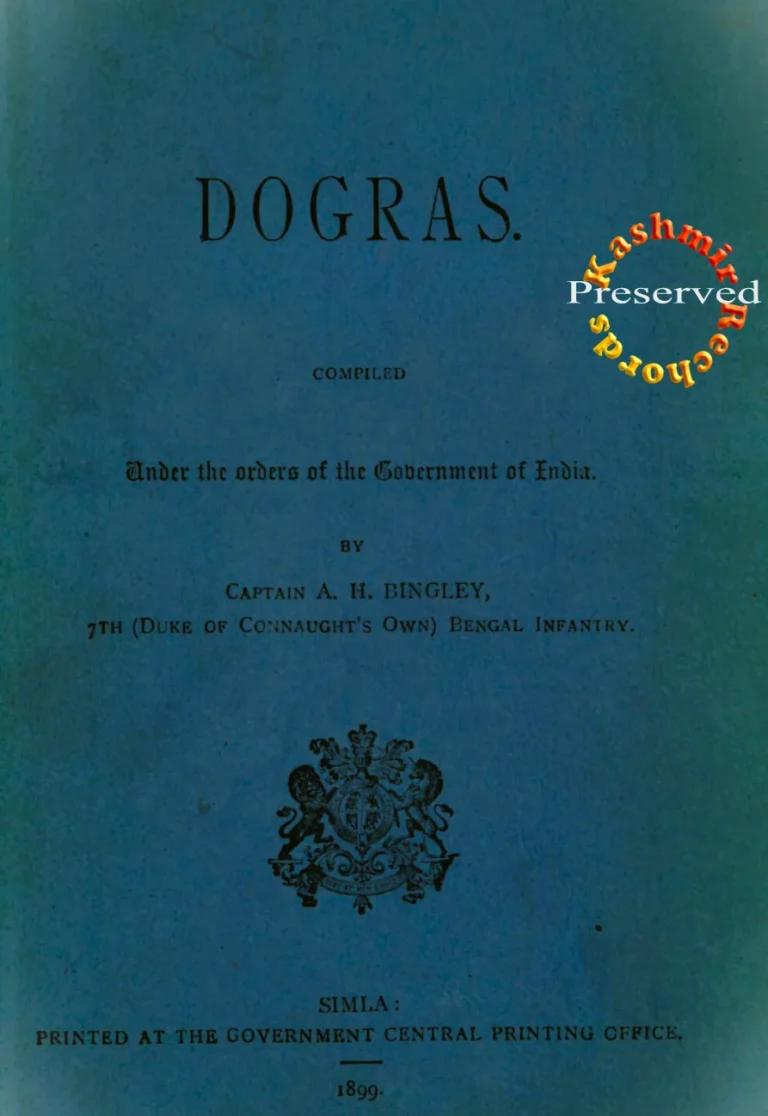
1899 British Army Captain’s Rare Book on Dogras

1899 British Army Captain’s Rare Book on Dogras

(By: Dr. Rajesh Bhat)
  Dogra soldiers stand out among other infantrymen because of their kind, benevolent and rather introvert nature, which has rightfully given them the title of ‘Gentleman Soldiers’ within the Indian Army fold. The battalions of the Dogra regiment have always been instrumental in exemplary gallant acts. A reserved man with considerable strength of character, Dogras have a high idea of ​​honour, of self-respect and the duty of a capital soldier. They have long been known as brave and faithful soldiers and loyalty to their salt is with them as the breath of their nostrils. This has been penned down by Captain A.H Bingley, 7th (Duke of Connaught’s Own) Bengal Infantry in his well-compiled Book `Dogras’, printed at Central Printing office Simla (Shimla) in 1899, under the orders of Government of India.
   In addition to the military character of Dogras, the author of this Class Handbook for the Indian Army, also speaks about history, region, customs, culture and festivals of Dogras spread in Jammu and Kashmir, Punjab and parts of Himachal Pradesh. The Book has been revised by A. B Longden in 1921 and further revised by Dr. Sukhdev Singh Charak who has added Dogra Art and Literature to its chapters. Kashmir Rechords is in its possession a rare edition of this book on Dogra History and Culture and shall share its contents in a series of write-ups.
This book had to be published in 1899 as the military needs motivated few Britishers to compile information on the Dogras.  The job was thus assigned to Captain A. H Bingley.  His fellow soldier, W. B Cunningham also contributed in its compilation.

 Dogra Soldiers in China, Burma

Captain Bingley states that unlike conservative Hindus of that time, Dogras have no objection to sea voyages or to Foreign Service.  He makes a mention of a number of them having served in China in 1860.  While some were in garrison at Suakim in 1896, a certain number of Dogras were enlisted in some of the Burma Battalions and in the Military Police.
Interested About the Book Pages? Contact Kashmir Rechords
    The fact that they being mostly hillmen, Captain Bingley says Dogras are specially valuable in the mountain warfare in which the Indian Army is so often engaged. “The records of the Punjab Frontier Force give ample testimony to the value of the Dogra soldier in numerous expeditions on the border. The troops of the Kashmir Durbar, which are largely composed of Dogras, distinguished themselves greatly in the Hunza-Nagar campaign of 1891, more especially at the capture of Nilt; and the high reputation they then established has been added to by their bravery and endurance in the defence of Chitral and in the memorable march to its relief’’.

Dogra Recruiting Ground

The author, who later rose to the position of Major General, Secretary to Government of India, focusses on the Dogra belt usually spread from near Akhnur (Akhnoor) to Chamba and Kangra and to the South and East of the Chenab in Jammu and Kashmir with a slight Dogra pigment in Bhadarwah.  In chapter V of the Book, he makes a special mention of Dogra Recruiting Grounds and the areas wherefrom people could be recruited into Army. He mentions about the territory along the border of Jummoo (Jammu), including areas of Pathankot, Shakargarh, Sialkot and Zafarwal and the region like Jasrota and Ravi Belt besides “Jullandhar district of Kangra belt’’ which  were inhabited by the Dogras, both Hindu and Mussalman. `Though originally a small tract around Jammu and Babaor, the Dugar Country and the tribe considerably expanded during many centuries of their existence’, says the Military Officer.

Aurel Stein’s Memorial Stone at Mohand Marg: A Journey of Installation to Vandalization and Re-installation

Known to Kashmiris and the world for his classic translation of the twelfth-century Chronicle of Sanskrit poet, Pandit Kalhana’s Rajatarangini, Sir Marc Aurel Stein has contributed to Kashmir what no one could even imagine.  Unfortunately, he has been treated  shabbily by certain disgruntled elements, under some sinister plan, who have not  even spared  an engraved  memorial stone bearing  his name and works at Mohand Marg where he used to camp to decode Kashmir’s  ancient manuscripts.

Stein’s Memorial of 1947, damaged in 2011

Original stone ( 1947) displayed and photographed at Tyndale Biscoe’s lawn in Sheikh Bagh, Srinagar, before being taken to Mohand Marg for installation. ( Pic Courtesy: Dr. S. N Pandita)

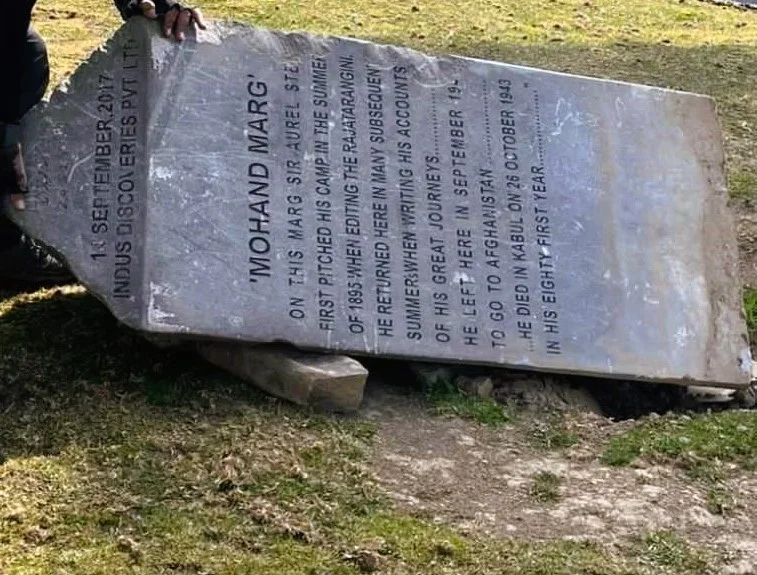
While in transit, the memorial stone was first time displayed and photographed in 1947 in Tyndale Biscoe’s residential lawn at Sheikh Bagh, flanked by Biscoe and Ram Chand Bali, Stein’s typist- cum- Camp Assistant. It was later taken to Mohand Marg for final installation there on August 15, 1947, coinciding with India’s Independence Day. Unfortunately, despite several attempts to target it, the disgruntled elements succeed in 2011 to hammer it to pieces. There is no trace of the original stone now.

Original memorial stone installed on August 15, 1947 at Mohand Marg.
Photo ( provided by Dr S. N Pandita) shows Ram Chand Bali on left with his 14 year old grandson, Jawahar Lal Bali on extreme right with two camp assistants and Mason who installed the memorial stone.
According to Dr S N Pandita, a noted researcher and author of `Aurel Stein in Kashmir’,  after  vandalising the original memorial stone, the  new tri-faced memorial stone with added Sanskrit epitaph was installed to replace the original dual face (Urdu and  English) stone installed on August 15, 1947,  four years after Stein's death. A Muslim guy etched the stone with Sanskrit orthography at his “Mashhoor Marble House” Khanyar, Srinagar.

Installing New Stone in 2017

Dr Pandita says the new stone was installed on his recommendations made during the September 2017 International Conference on Aurel Stein and Central Asia at Kashmir University. “It was during my Key Note address, I made the recommendation, which was fortunately adopted favourably’’, he said. The new stone, weighing 368 kilograms was taken on shoulders of 57 men by rotation over 19 days from Anderwan to top of the meadow (Mohand Marg), Dr Pandita informed, adding that  it was  later physically laid on 23rd December 2017 at the exact spot in the meadow where Stein would pitch his tent.

Trifaced stone being carried in 2017 up from Anderwan to Mohand Marg on shoulders and wood log trolley.( Pic Courtesy: Dr S. N Pandita)
Posing for a group photo after installation in 2017. Pic Courtesy: Dr. S. N Pandita

A Trifaced New Stone

(Unmutilated-2017)
Unmutilated in 2017

   Having nine books and about 80 research papers to his credit, Dr Pandita further informed that   the epitaph was etched on Panjal metamorphic stone, sponsored by Yasin Zargar, CEO and MD, Indus Discoveries, London, supported by University of Kashmir. Prof G.N.Khaki,  the then Director, Centre of Central Asian Studies, University of Kashmir and the Department of Tourism, J&K Govt, then headed by  Mahmud Shah. The Sanskrit orthography for etching was made by Apeksha Pandita, then a PG student in Delhi and translation from original English to Sanskrit  was made at Dr Pandita’s request by Prof. Dev Kanya Arya, of Delhi University.

(Unmutilated in 2017)

A significant support on the entire effort of reinstalling the memorial stone in 2017 had also come from the Kashmir Chapter of INTACH, headed by Saleem Beg.

Mutilating, Uprooting New Stone

Even after installing the new memorial stone with much fanfare, the same was also first mutilated by breaking two sides of its edges (English and Sanskrit side), possibly in 2021-2022 and further uprooting it in February 2023 by the very disgruntled elements who had broken the original one in 2011. Journalist R. C Gangoo’s picture with the stone ( carried by Kashmir Rechords on Janauary 20, 2024 https://kashmir-rechords.com/a-meadow-in-kashmir-where-aurel-stein-worked-on-rajatarangini/) is an ample proof that the new stone was already mutilated in July 2022. Thereafter, an attempt had been made to even uproot the stone.   

However, in February 2023 this mutilated and toppled down stone was again placed upright, thanks to the efforts of Mr Zargar and that of the J& K Government. The latest photograps show that the stone presently still exists there but with mutilated edges on the English and Sanskrit side.

Serenity of Mohand Marg

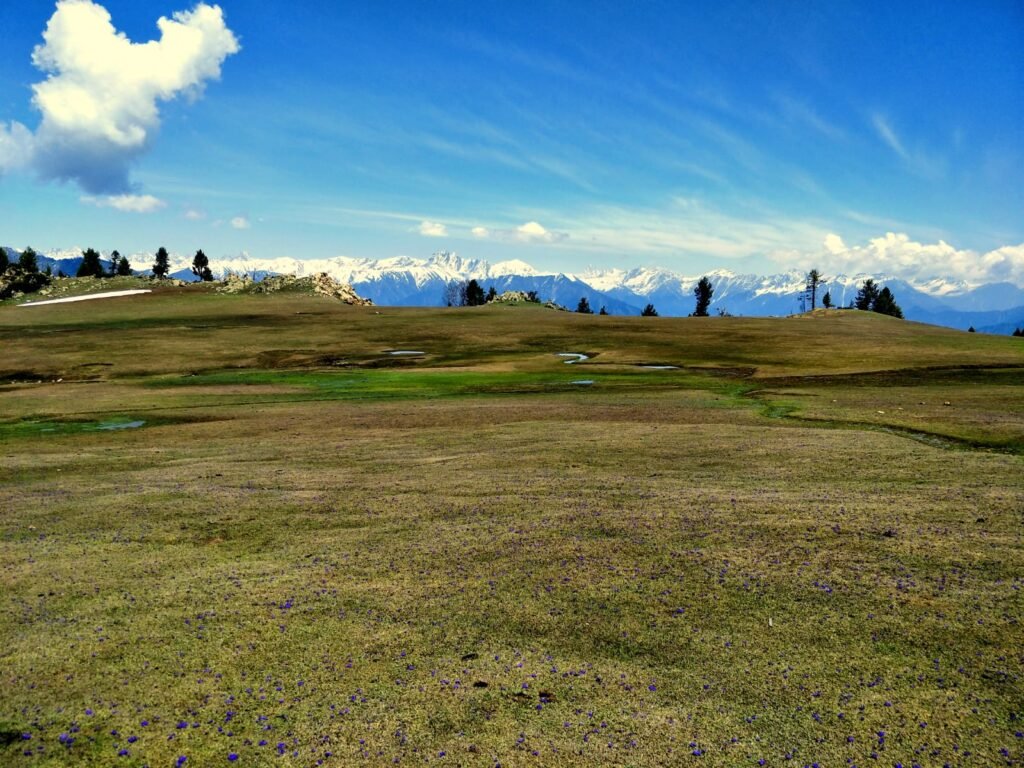
Dr S. N Pandita   describes Mohand Marg as an alpine grazing ground hidden in the mountains to North of Srinagar about 20 Kms along the road to Leh in the Sindh Valley. Small hillside settlements up the rocky crags open out across the mountainside to the Marg giving views of the Sindh Valley on one side and the Valley of Kashmir on the other. Trees skirt the Marg and slopes below. Flowers fill it in summer.

 The noted researcher informed that while peregrinating across Kashmir in connection with his antiquarian tours beginning 1892, Stein came across Mohand Marg for the first time in the summer of 1895 and the mere sight of the vast meadow flushed with flowers of blue and yellow tints seized his heart and mind both that he felt instantly in love with the meadow.  “Not long after it became his other home or what he called his “private alpine kingdom”. The Marg remained Stein’s private world where he could be at peace. There he would be alone, but never lonely. He called it as his kingdom that was scarcely matched by any King’’.

  Aurel Stein, according to Dr Pandita  was “so charmed by the vast expanse of the meadow and the sight of Mount Haramukh Peaks, sacred to Hindus in the front ,that his own work and response to nature epitomized in his beloved Mohand Marg. He termed the meadow as the best carpet in the world’’.

  “Stein simply fell in love with this paradise that he never preferred camping anywhere else in Kashmir as long the weather permitted him to stay at that altitude of 9000 ft above the sea- level. Once located, the Marg radically changed Stein’s inner orientation and he was thence no longer magnetized by Budapest and Europe. Regardless of the season and however strenuous his activities would be, Stein was never too tired or too pre-occupied to enjoy the atmosphere of the Marg’’.

“One result of so many years of life (intermittently nearly five decades) in and out from Marg, Stein found it difficult to work anywhere else.  It was impossible to give his attention properly to his written reports of his expeditions as long as he stayed away from the Marg. In fact, he completed writing the editions of his Rajatarangini and all the four expedition reports of his Central Asian explorations on the Marg’’.

Stein-`Marg Ka Babu’

To the locals, Aurel Stein was “Marg Ka Babu’’.  Dr Pandita says, “Stein longed to do without delay and that was to return to Mohand Marg and in doing so he even used delicate health reasons by way of excuses. He never left the Marg without a wrench in his heart but was always happy to return there and live in the tent pitched in the meadow. At the Marg, he enjoyed the dazzling views and breathed the pine – scented air that he called as “avalanche perfume”.

 The author of “Aurel Stain in Kashmir’’ recalls that villagers always identified him as “Marg Ka Babu”. “In short and to sum up Stein and Mohand Marg are synonymous. The two are inseparable. Since the time of Stein’s death in faraway Kabul in October 1943, Mohand Marg has remained forgotten and forlorn until a few years ago when steps were set afoot to revive his memory and legacy’’.

 “One wish that Stein had hoped for but remained unfulfilled was that he had wished to be cremated there if only death came to him in his beloved alpine paradise. That, however, was not to be. One companion who gave Stein a life- long company during his stays at Mohand Marg was his faithful dog Dash. Stein had seven of them in all during his entire life. But each was always Dash. Stein gave no other name to his dogs.’’

Stein’s love affair

Stein was a bachelor and confirmed monogamist and it is generally acknowledged that he had chosen Central Asia as his bride. “But given his affairs with Mohand Marg, one may say with his death Mohand Marg lost its first and only lover. If Central Asia was Stein’s bride, there is no doubt that Mohand  Marg was his open love affair as he eloped with her time and again uninterruptedly for nearly five decades’’.

 Aurel Stein left Mohand Marg in September 1943 never to return.  He died in Kabul at about 5 PM on November 26, 1943. “He was thankful to fate that at least after more than four decades later and after four Viceroys had supported his wish to explore Afghanistan, he saw Kabul but was not fated to explore Afghanistan. Since then, Mohand Marg continues to wait for its “Babu” to return.”, exclaims Dr Pandita.

A  Meadow in Kashmir where Aurel Stein worked on Rajatarangini

(By: R. C Ganjoo)*
  Ever since I took up journalism as my profession in 1982, I had been keenly desirous of paying a visit to Mohand Marg. It did not happen for many years. Eventually, a time came when my dream was realized and on July 2, 2022, I found myself at Wanghat in Kangan area of Kashmir along with a couple of my journalist friends. Wanghat is famous for its historical ruins of Hindu temples and Buddhist viharas. It is a site of archaeological significance. Mohand Marg on the other hand is a place where a   Hungarian-born archaeologist Sir Aurel Stein translated the famous Rajtarangani book from Sanskrit to English in the 1930s. Stein had spent many summers at Mohand Marg meadows translating the Rajatarangini.
  After covering the distance from Ganderbal to Wanghat in two hours, we met a local contact who was waiting there to receive us. During our discussion about the plan to visit Mohand Marg, the locals were not in favour of our adventure. They said it would be difficult to track 15 km to Mohand Marg, a steep climb with no arrangements for the trekking adventure. In case we made it, the return would take a month. Despite these discouraging signals, I wanted to visit my long-cherished spot.

Visit to Mohand Marg

The local Sarpanch informed us that we were first supposed to reach Anderwan village, the starting point of Mohand Marg. I had heard about Mohand Marg from elders, and later on, I read about its significance. Sir Marc Aurel Stein’s name always made me inquisitive to know why he had chosen this location situated at a height of 11000 feet in the woodland of the Himalayas, to translate Kalhan Pandit’s celebrated history Rajatarangini and add to it footnotes and appendages of unique scholarship.
The British archaeologist Sir Aurel Stein was born on 26 November 1862 in Hungary in a moderate Jewish family. He fell in love with this meadow (Mohand Marg) on his first visit to Kashmir on 8 June 1888, and continued to visit this place till April 1943. Stein spent several summers at Mohan Marg meadows translating the Rajatarangini into English.
  After completing his work, Stein erected a memorial at the place to commemorate his achievement. It suffered some damage later. From Mohand Marg, he made four major expeditions to Central Asia in 1900-1901, 1906-1908, 1913-1916, and 1930.
The local Sarpanch who was already briefed by my friends about our mission Mohand Marg, was thus extraordinarily careful to make our adventure a success.
   On arriving at Anderwan village on July 3, 2022, we found three horses with their keepers waiting for us. Giving instructions before mounting the horses, the local Sarpanch said we should take Paracetamol tablets and chew onion, otherwise while passing through the woods the fragrance of shrubs could cause dizziness. He had kept eatables like chapatis, vegetables, butter, salted tea, and water bottles with the horse keepers.
We started our expedition on horseback at 10 am. Just after completing the two-kilometer trek easily, gradually the uphill journey started on a tortuous route of scattered white stones. Here we were advised by the horse keepers to lean forward to make it easy for the horse to negotiate the narrow curves along the hilly terrain.
After covering seven km of uphill terrain in two hours, we reached Jabbad, a small highland where our friends and guides advised us to take some rest and snacks. The young boys accompanying us were college students but doing a part-time job as guides. Before taking snacks, the boys suggested we take Paracetamol tables and onion. I was carrying my medical kit and offered tablets to everyone. However, the boys were reluctant to take the tablets because they were acclimatized to the hilly environment.
  From Jabbad, the terrain was almost forbidding, but our strength was the company of our boys and our continuous conversation with them. They too were smart to keep our attention away from difficult terrain where horses too get scared while negotiating the narrow treks.
Finally, we were thrilled to reach our destination at 12 o’clock, trekking through the lush green meadow of densely lined pine trees. At once, I touched the tri-faced memorial stone with epitaphs in Urdu, English, and Sanskrit on the site of Sir Marc Aurel Stein’s camping ground at Mohand Marg erected in December 2017 by the Kashmir Chapter of INTACH, and the Department of Tourism, Government of Jammu & Kashmir. I felt emotionally sublimated after touching the memorial of a great scholar. I was happy I had at last achieved my decade-old mission of visiting Mohand Marg.
  The site is unique in its pristine beauty and solitude, and so close to nature. Our tiredness evaporated in thin air. As we set our feet on the spot we were seeking we felt as if we were on top of the world.
I was carrying with me a copy of Rajatarangini, translated by Stein for reference. Here, I found out that he had preferred this location because of its seclusion and the soothing fragrance of pine trees and flowers. The sky was cloudy. We got scared of the rain because there was no shelter anywhere in the vast lush green meadow. However, the clouds disappeared after dropping some raindrops. We were lucky to escape the vagary of nature. The bright sun rays made the meadow more attractive.
Author R. C. Ganjoo at Mohand Marg

  Stein’s unfulfilled wish!

Aurel Stein had spent several decades here absorbed in the pristine beauty of nature and in his scholarly exercise. Unfortunately, his last wish remained unfulfilled. He had desired that he should be “cremated” in his beloved Mohand Marg. Stein died of a massive heart attack in Kabul in 1943 at the age of 81. He had never married. He often expressed that the ‘thought of marriage never came to him’.
In Aurel Stein’s own words “from the high mountain plateau which my camp once more occupies, almost the whole of Kashmir lies before me, from the ice-capped peaks of the northern range to the long snowy line of the Pir Panjal, a little world of its own, enclosed by mighty mountain ramparts. “
Aurel-Stein-and his group at Mohand Marg-1940.

Pt. Mukund Ram Shastri’s assistance to Stein

  In 1899, Pandit Mukund Ram Shastri had assisted Stein in translating Rajatarangini in several ways till his great work was completed. Shastri was asked to give up the teaching job in a Christian missionary, at the request of Aurel Stein. King George V conferred upon him the title of Mahamahopadhyaya in 1912.
Pt. Mukund Ram Shastri
Pandit Mukund Ram Shastri died in 1921, leaving behind his authentic works of scholarship. He was well respected by western scholars. Grierson called him his ‘old friend’. Stein observed, “I shall always be glad to remember him among my friends’”. Dr. Hutzch records, “In him also I hope to have found at once a friend whom I shall never forget. To all those for whom Kashmir is not just a geographical denomination but a repository of learning and ideas, Pandit Mukund Ram Shastri will always be a guiding star.”
John Marshall once observed “Pandit Mukund Ram Shastri, about whom I can safely say that there is no Pandit in India of whom I have heard such consistent high praise from all with whom he has come in contact.”

*R. C. Ganjoo is a senior journalist and columnist having more than 40 years experience of covering issues concerning national security, particularly Kashmir. He has worked with several prominent media groups and his articles have been published in many national and international publications. He has co-authored two books– “Operation Khatma’’ and “Farooq of Kashmir’’.

(The views, observations and opinions expressed in above write up are strictly author’s own. Omission if any is regretful and Kashmir Rechords is open to any correction)

January 19, 1990 Rumour to Terrorise Kashmiris!

(Kashmir Rechords Desk)

Srinagar did not sleep on January 19, 1990 night for various reasons. While it was a darkest night in the history of India, as Kashmiri Pandits had to leave their homes and hearths, Kashmiri Muslims too had to face a trauma of another kind!  Rumourmongers had taken control of most of the mosques and all of a sudden switched on mikes and loudspeakers cautioning people against using tapped water as reservoirs had been `poisoned’ by the administration.

  Such announcements under a sinister design had created such  a chaos that people came out on the roads and resorted to protests blaming `Indian agents’ for `poisoning’ water. Even as the authorities switched off the power supply  but the mosque managers put on the battery back-ups to keep the people “informed” about rumours. Despite repeated and frantic announcements over Radio Kashmir Srinagar, people believed mosque loudspeakers   and not the administration. Even clamping of curfew in some areas did not stop people coming out on streets! Such was the impact of the well-designed rumour, that People drained every single drop of water they had stored. The objective of the `poisoned water’ rumour was to goad the public to defy curfew restrictions en masse and to create a fear among minorities, forcing them to flee.

Romanticising Rumours

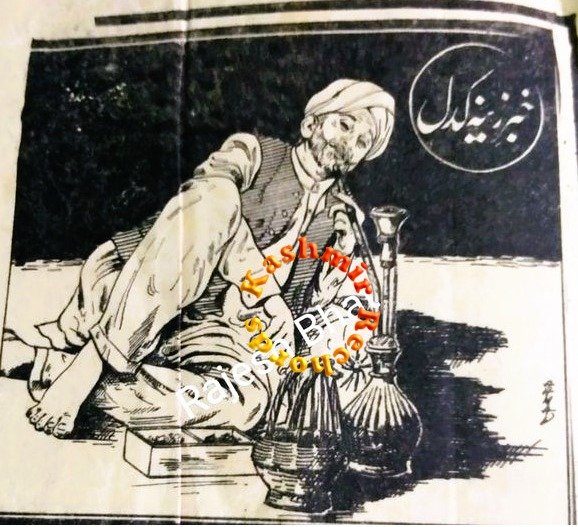
Rumour mongering is not something new to Kashmiris. They have been romanticising it since ages!   Even Kalhana in his Rajtarangani and many other western scholars had made a mention of typical `Kashmiri rumours’ and how people used to believe such stuff.   While some do it innocently, most of the time rumours have been used as a tool to meet the sinister designs of certain vested interests.  Remember “Khabar Zaina Kadal’’—the bridge that used to be a hub of fake news where from `Thok Gayih Ho’ (The spittle has gone from Zaina Kadal.)

It is not that rumourmongers exist in Kashmir only. In fact they are found everywhere across the globe. But in case of Kashmir, there is a documentary evidence of such rumours having been used as a political tool to induce fear in Kashmir, generate hysteria and confusion among individuals and organizations by overt and covert powers. This was exactly done on January 19, 1990 in order to meet the vested interests of all those who made many homeless and turned Kashmir into a hell.

  Historian, Khalid Bashir in his book, “Kashmir Looking Back in Time’’ says, “Kashmiris generally romanticise rumours and love exaggeration’’.  Bashir says “If Kashmirs  like a person they make him divine and if they dislike someone they make him look like a devil’s sibling.”

The author makes a mention of `Tarr’ or fabrication of news and rumour as a political tool. “Political leadership often used it in their propaganda. They used it as a tool to mount pressure or to push a certain narrative’’.

Jagmohan’s Turbulence

 In his book  `My Frozen Turbulence in Kashmir’,  former J&K Governor, Jagmohan  who too had become a victim of many such rumours, has written about how rumour-mongering in 1990 was used as a tool to defy and frustrate his government.  He makes a mention of January 26, 1990 rumour about `killings’ Kashmir Armed Police at the hands of para-military forces (See attached page 24)

 In another instance, he goes on to say “…in the second week of April 1990 when food packets were being distributed by the Army on behalf of the state government, during the curfew hours in Srinagar city, rumours were floated that these packets contained material, which when consumed, would cause frigidity amongst women and impotency among men, and that this was part of the overall conspiracy to reduce the population of the Muslims in the valley,”. The objective behind this rumour was to prevent the administration from coming close to the people.

 Jagmohan says administration had to counter such rumours by instructing police and members of the paramilitary forces to eat from the food packets and drink water from the municipal taps.

In the summer of 1993, Kashmir witnessed another season of Rumour mongering when `Balaie’ (ghosts) started “attacking” people!  These “ghosts” were akin to Naar-e-Tschour of 1977 and the rumour that Jan Sanghis were on the prowl and setting homes afire. Similarly, on January 17, 2016, people in Kashmir had to face another kind of worst rumour when thousands of parents carried  their kids  to hospitals as it was  made to believe that  the polio drops administered to them in the forenoon were `lethal’.

Khabar Zaina Kadal

Missionary Rev J Hinton Knowles, who spent a significant time of his life in Kashmir, too makes a mention of Kashmiris believing rumours than truth. “The Zaina Kadal or the fourth bridge of the city, used to be the place where false rumours were hatched, but now the newsmakers have moved to the first bridge, the Amira Kadal,” says Sir Walter Roper Lawrence, who was as a Settlement Officer in Kashmir in 1889. In his book `Valley of Kashmir’, Lawrence tells about Kashmiris’ love for rumour mongering.

He says, “though the wise knew that Khabr-i-Zaina Kadal was false, the majority were not wise, and much misery is caused to the villagers by the reports which emanate from the city.”

An undated picture of ancient Zaina Kadal wherefrom rumours used to emanate.

British missionary and educationist Tyndale Biscoe in his book, ` Kashmir in Sunshine and Shade’ also makes a mention of a rumour of the nineteenth century he had to confront. Biscoe was compelled to force his 130 students to swim in the waters of Jhelum as people had spread a message that there existed a “frightful creature’’ in the river, because of which they had stopped bathing in the river or doing any work along the riverbeds.

In a reference book “Kashmir: An Historical Introduction” by James P. Ferguson, Fellow of Royal Asiatic Society, Centaur Press, London: 1961 (P. 26), the author while quoting Pandit Kalhana  says “rumour  in Kashmir can be easily manufactured and spread, from the bathhouses on the river, the shops,  places of worship etc”. 

Kashmir-based author, Khalid Bashir makes a mention of a news item published by Kashmir Times in 1935, quoting Robert Macfield, a non –existent eminent geologist, warning that Shankaracharya Hill will erupt between July 15 and August 15. The news report had created panic and widespread migration of people to safer places, until another newspaper, The Civil and Military Gazette described the news as a cruel joke.

Rumour as a Weapon

Historically, rumours were used as weapons, by both people and the state. As Partap Singh succeeded his father Ranbir Singh, his younger brother Amar Singh was eyeing the Kashmir throne. To destabilize his brother, Amar Singh adversely briefed British about `anti-Muslim’ monarch and almost got him deposed.  Partap Singh had to write to the Viceroy in April 1889 saying it was his real brother who was circulating the worst rumours against him.

Rumourmongers resorted to false news in every regime to hit a target and it invariably had a purpose. Kashmiris were once fed with rumours that some leaves of Chinar trees embossed the name of Sheikh Mohd Abduallh!

In 1990, even as most of Kashmiris know in the heart of hearts that Jagmohan was not responsible for the exodus of Kashmiri Pandits, yet they sided with the rumourmongers and are not ready to accept the truth that most of the Kashmiri Pandits had moved out of Kashmir even before Jagmohan was posted as Governor of Jammu and Kashmir.

Rumours and Kashmir have had a long tryst with each other with the former causing panic in Kashmir many a time, leaving people wondrous and questioning. Those who spread rumours tend to derive amusement while converting “Al Kul’ (gourd plant) into a `Tul Kul’’ (Mulberry tree).  

  “Khaber kya chuk Karun (Don’t know what they are planning to do?)  has been the pet sentence of every Kashmiri in all seasons and  regimes!

Englishman’s 1847 visit to Mattan, Anantnag, Srinagar

(By: Kanwal Krishan Lidhoo)

Kashmir Rechords in its previous  four blogs had mentioned Englishman Mr. Winter Bedim’s visit to Jammu and Kashmir in 1847 recorded in the form of daily entries called ‘Roznamcha’ by one Pandit Kanhaya Lal Aashiq Dehalvi and later published  in the form of the  book under the title Sair-e-Kashmir. In thefifth part of the travelogue, we will begin with the visit of Mr. Bedim and party from Mattan town of Kashmir to Srinagar  with interesting anecdotes and their experiences so far unknown to us.

In his `Roznamcha’, Pandit Kanhaya Lal Aashiq Dehalvi mentions about a  hose or tank of Mattan (actually a spring) from which a stony passage leads to an adjoining tank which is very large and from here it passes towards a vast ground. It is this second hose or tank where people take a bath and they do not use the first tank for bathing purposes out of respect. This is called “Suraj Kund” and has the same status and reputation as that of “Gaya ji” where religious rituals (read Shraad) in honor of the dead elders are performed. A lot of fish reside in these waters and almost everybody feeds them. That is why they freely and fearlessly roam all around. The sight of fish feeding on a morsel of food droppings is strange. Scores of them pounce on it and make attempts to snatch the same. The constructions around the spring definitely project an aesthetic look and the whole place has become a nice tourist spot. A path inside the mountain at this place measuring round about twenty kos is rumored to directly lead to Kashmir (Read Srinagar), but as I ventured inside, I could hardly come up with a figure of hundred steps only. A large volume of water descends from above and floods this path filling and leveling it. As no breeze flows inside, this gives rise to uneasiness and suffocation. Only God should save a traveler facing these tribulations of flooding, the nasty smell of the torch and the suffocation caused by dampness arising out of paucity of air.

Anantnag, Malik Naag, Sona Naag

I stayed put in Mattan on 24th May 1847. Both I and Sahab (Mr. Bedim) went to see around over a distance of two and a half Kos. In Islamabad (Anantnag), two large springs exist side by side. The area is called Anantnag and a Hindu temple exists here. A large number of fish abound and nobody causes any harm to them. Thus, they continue to thrive here. A nearby spring is known by the name of “Malik Naag”. Its waters are relatively hot and reek of Sulphur. Sometimes, however, its waters get very hot. A spring adjacent to it is known as “Sona Naag”. Its waters are very cold and without any smell. What a strange thing to witness! Two identical springs, one very hot smelling of Sulphur and the other one with and odourless waters. Islamabad (Anantnag) is a large and a fairly populated town with a bazaar and good houses. Here “Pashmina” is washed and treated in a manner which no other place is seem to impart the effect to it like this place. Apart from this, a green hillock near this area also projects a beautiful look with a garden and one or two houses that have come up.

From `Brajbahara’ to Pampore via Awantipur

On 26th May 1847, starting from Kelvan, some two and a half kos alongside the riverfront, we finally reached “Brajbahara”. The river that flows through Brajbahara originates from Verinag referred to earlier as Shahbad. The town is large and well populated. Here we boarded a boat for “Awantipur”. This is a very ancient town, which acted as the royal seat of power to many of the kings of yore. Many of the antiquated structures in this capital are visible to this day. Riding a boat along the course of the river towards the evening, we reached Pampore. A famous spring alluded to” Lal Maeji” ( Lal Ded) exists here. Many stories are attributed to her. Undoubtly she was a great soul and must have performed many miracles. We also saw saffron being cultivated here. Apart from this place nowhere in Kashmir is this magnificent thing grown. I happened to see the saffron farms. The way the poets of the yore and present have described it, I, however, could not find their expression worth of any true value. It could not bring a smile, leave alone a pleasant expression even. However, when the same dries up, a delightful aroma and flavor emanates from it. That is why the poets have exaggerated the quality of smile brought forth by saffron.

  Stone idol at Pandrethan

A short walk through Pampore and we again travelled by boat over a distance of two and a half Kos and reached a place called Pandrethan. Many an ancient structure embedded in the ground becomes visible here. A large stone idol lays skelter on the riverbank. It is known as “Bhasmasur”, an “Asura” whom “Mahadev or Lord Shiva” reduced to ashes. It is made out of a large stone and is impressively awful. Here also, we moved around and later continued our journey towards Kashmir. In the evening, we arrived and stayed at “Sheikhbagh” and later went to see the “Vitasta” (the river) on boat. This river flows through the heart of Kashmir (Srinagar). Habitations galore on both its banks. Seven bridges built of stone and wood are very strong and resilient. Boats are used for transportations through the passages under these bridges. In the evening, Wazir Tannu and Jamadar Karma sent by Maharaja Gulab Singh brought some cash, fresh fruits and some sweetmeats. During the night, a letter from Ahmad Shah Naqshbandi, a hereditary Islamic spiritual leader was received. A reply was also forwarded to them detailing therein that they may visit us the next day.

Meeting with Ahmad Shah Naqshbandi

On 28th May 1847 at Srinagar, Ahmad Shah Naqshbandi came to see us. Words and expressions of mutual acknowledgement followed by conversations continued for a long time. The talk focused on the places to be visited around Kashmir (Srinagar).  As they prepared to leave, it was agreed that Sahab (Mr. Bedim) like all important and grand people will visit the house of Ahmad Shah Naqshbandi. After this interview, Sahab mentioned about the letters and gifts brought earlier and in a very graceful manner listed the detail of places to be visited in Kashmir (Srinagar). After this, Ahmad Shah took our leave and both Sahab (Mr. Bedim) and I, (Pandit Kanhaya Lal Aashiq) proceeded to enjoy the boat ride in Dal Lake. It is a huge water body extending over an area of approximately six or seven Kos. At the point where the river Vitasta enters in it, a solid span has been constructed and underneath it a door has been built in such a way that as and when the river gets flooded, the door automatically gets closed and the water from the river does not flood the lake beyond the required level and no harm or damage is caused to the habitations on the Dal lake. And once the water level recedes, the door automatically gets opened and the flow of water from the river into the lake is automatically maintained. The following is inscribed in Persian on the door:-

   “The Founder of the Span  Mahesh Shankar Das (1085 A.H)”

Another door nearby has the following inscription on it:-

  “This stands as part of the historical verse as the bridge got built and arranged by Choudhary (1086 A.H)’’

Dal lake and Hazratbal Shrine

A Muslim shrine on one side of the Dal Lake also exists and has been constructed in a very gracious manner and has a regal history. It houses the revered precious and pious hair strand belonging to the Prophet of Islam. Special prayers are held here in connection with the same. Naseem Bagh happens to be in its vicinity. This garden contains one-lakh chinar trees. (Figure seems to be exaggerated). Birds congregate in the evenings and it is an amazing experience to watch and listen to their chirping. The Dal as mentioned has the Shalimar garden on its other side. One has not seen such a visibly expansive and vast garden. Taking into account all hindrances that may be part of the adventure, it will take one full day to complete the rounds of the garden. The garden has been built on seven layers or levels. The houses that have been built at the end of each level allow a stream or water path to pass through them but the lavishness is such that no two houses are joined together in any manner and each house looks unique in its own way. Fruit and other types of trees have been grown and blooming flowers with smiles galore. As mentioned each of the houses in the garden holds a pool of water in the front. Fountains have been built in them. The water passages connecting these houses on both sides are also fitted with fountains allowing constant water flow through them at all times. The whole experience is seen to be believed.

The third side of the Dal Lake houses the Nishat Bagh. This garden has also been raised on four or five levels but does not appear to be as vast as Shalimar garden and in no way is it lesser in beauty and pleasant view. Fruit trees and diverse varieties of flowers have been grown in abundance and fountains on the pattern of Shalimar garden have also been fitted here. For the writer of this `Roznamcha’, a walk in this garden is enjoyed in a far better way than that of Shalimar. Since Shalimar garden is vast, its upkeep and cleaning usually gets difficult. In comparison, Nishat Bagh is neatly organized and is maintained in an orderly manner. Constructions are also worthy and compliment the needs of those who take a stroll in these gardens. City residents often come to visit this garden. This couplet comes upon everyone’s lips:-

  Subah Dar Bagh- e- Nishat  Va Sham Dar Bagh- e- Naseem       

(Mornings to be spent in the garden of joy and evenings in the garden of breeze)

In the middle of the Dal Lake, a construction on a raised platform structure known as Char Chinar has come up. Chinar trees around it seemed to be still growing. This platform seems to have given away. After completing our visit to all these places, we returned in the evening.

Visit to Shankaracharya hillock

On 29th May 1847, we visited Shankaracharya hillock. On top of this hillock is an ancient Shiva temple. The temple houses a fabulous Shivalinga which is sight worthy also. When Muslim rule was at its full might in Kashmir, this Shivalinga also suffered damage. It is believed that whosoever symbolically constructs a stone house here claims entry into a house in heaven. The writer also constructed a double storey house. On top of this hillock Srinagar city with all its crowds and people appear in full and magnificent view. Population of Srinagar city is large. In width it is small may be one and a half Kos, while it is five Kos long. After the visit we returned to our dwelling for rest. In the evening, we took a boat to visit the city areas. 

 Visit to Hari Parbat

On 30th May 1847, we went to see the shrine of Hari Parbat. On the way is the Ziyarat of Shah-e- Hamdan. Arches have been built in the wall in its rear and Hindus worship their Devi at this place. The two religions though contrary to each other exist side by side under one roof and are found complimenting in the most amicable and peace loving manner with each other. Near the Hari Parbat fort as mentioned a large mosque stands erect. Following is inscribed on its gates:-

The primary gate of the fort has the following inscription:-
We had a thorough walk inside the fort. The fort has been built on a hillock. Srinagar city appears in full view from here. The beauty of Dal Lake and Shalimar garden gets multiplied at this point. The first is a vast area of pure water and the other a pleasant garden. Up to the fourth level, this fort has been firmly built by ancient kings. A temple of Sharda Devi also exists here. The other six levels have been constructed for storing water and provisions. It can house more than a thousand soldiers and if need be more even up to thousands. In short, we returned to our place for rest and towards the evening visited Nishat Bagh. Sahab Bahadur (Mr. Bedim) enjoyed the same. In the evening, I went to a religious authority for discussion comprising of a very urgent and religious nature and met Razdan Sahab who is a descendant of a very learned family known throughout Punjab’’.

In the previous  four blogs, Kashmir Rechords  carried the information about Englishman ( Mr. Bedim’s)  1847 travel to Kashmir via Jammu  dated  9th December, to be accessed  at: https://kashmir-rechords.com/englishmans-1847-travel-to-kashmir-via-jammu/  and  next  Englishman’s 1847 travel to Kashmir via Jammu, Rajouri, published on 12th December 2023, to be accessed at: https://kashmir-rechords.com/englishmans-1847-travel-to-kashmir-via-jammu-rajouri/. Part third of this travelogue inside Kashmir valley was published on 30th December 2023 to be accessed at https://kashmir-rechords.com/englishmans-1847-travel-to-kashmir-via-jammu. Part fourth of the travelogue was published on January 14, 2024 to be accessed here at https//Kashmir-rechords.com/englishmans-1847-travel-to-kashmir-via-jammu.

 “Sair-e- Kashmir 1278 AH” is written on the cover of the Book having 41 (forty-one) pages. The travelogue is between the periods of   April 1847 to June 1847.

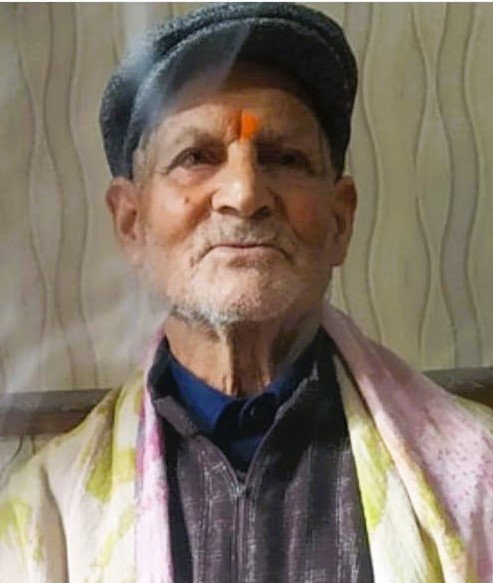
Nonagenarian’s spiritual pursuit at Kashmir village

(By: R C Ganjoo)*

Pulwama and Anantnag, the two terror-affected districts in South Kashmir for the past many years, also have some inspiring stories about spirituality to tell. Murran is one such village in Pulwama district where Pandit Badrinath Bhat, a nonagenarian still lives with his family.  Despite several threats and upheavals, Pt. Badrinath never left Kashmir and his home even during the mass exodus of Kashmiri Pandits from the valley in 1990.

A retired Principal from a government school, Pt. Badrinath Bhat is a devotee of Kashmir’s one of the   greatest saints, Nidhan Kak, and feels comfortable in his native village with his own children and grandchildren.  Incidentally, Bhat is in possession of a pair of walnut-wood sandals (Khadau) of Yogi Nidhan Kak and he worships wooden sandals everyday lying in his Puja room. Nidhan Kak was born at village Sallar, a famous village of the Danchanpora Pargana (now District Anantnag) in mid-nineteenth century.

Yogi Nidhan Kak’s wooden Sandals ( Pic by Author)

 During a conversation with Badri Nath Bhat, this retired Principal had a lot to share about the political and spiritual account of both Anantnag and Pulwama districts. He narrated the story of how Sikh rule ended and was replaced by Dogra rule in Kashmir.

Nidhan Kak blesses Maharaja Gulab Singh

Quoting village elders, Badrinath Bhat  said Maharaja Gulab Singh  had entered the valley of Kashmir in November 1846 via Pir Panchal route, but on his way to Srinagar, was feeling disturbed. Gulab Singh was in search of spiritual strength behind him to achieve the throne of Kashmir.

He arrived at Ramoo, a famous village on the Mughal route, one mile away to the west of Harapora, where Nidhan Kak, the Yogi, was living in a cottage. The Yogi was a great saint of high spiritual order. His fame had spread around the adjacent villages to Harapora, Murran, Deeri, Ramoo and  in the whole belt of Murran area.

Gulab Singh came to know about Nidhan Kak and was eager to seek his blessings. At village Harapora, Maharaja changed his royal dress, but the yogi knew that Gulab Singh would be the saviour of the Kashmiris who had suffered continuously at the hands of Pathans and others.  According to Badrinath Bhat, Yogi Nidhan Kak blessed Gulab Singh, who later left with a great confidence to  conquer Sheikh Imam-ud-Din (1845-1846), who was appointed Governor of Kashmir after his father’s death by the Sikh ruler of Punjab.

Nidhan Kak’s sojourn from Sallar to Murran to Harapora

Sallar village has remained a high seat of ancient Kashmir culture and Shaivism. It is believed that Nidhan Kak was initiated into Yoga in this village by one local saint.  Later, in his thirties, he left for village Murran of Pulwama district to stay with a famous landlord family of Bhats. Nidhan Kak served Bhats as a domestic cook and simultaneously practised Sadhana for higher spiritual levels. One day, a woman of the Bhat family, during night hours, noticed their servant’s room was illuminating. She informed her husband about the same. To the surprise of the couple, Saint Nidhan Kak was sparkling even in pitch dark. Next morning, the Bhat family placed Nidhan Kak with all reverence on a seat. Now Nidhan Kak realized that time had come to leave for his hermitage, which he might have already chosen at village Harapora.

Harapora is a kilometer away from Murran, where Nidhan Kak spent days in a solitary spot surrounded by all species of wild shrubs and trees. Later, the Yogi set up his cottage on the bank of Hara-nag. There is a pit few feet deep inside the cottage and the Yogi used to remain rapt in his yogic posture in this pit. Presently, the Ashram is abounded with Chinar and “bran” trees and are believed to have been planted by Nidhan Kak himself.

   Nidhan Kak’s most devoted disciple was Swami Ram Krishen from Rainawari, Srinagar. It is said that in 1855, in the month of Magha, Nidhan Kak, left for Haridwar for his Ganga Yatra. He had informed his disciple about the exact date of his return to the Ashram. It was Magh Dashmi, the Bhimsen Dashmi; but the Yogi did not return even up to Aikadashi, (Bhimsen Kah). He waited and waited, but his guru did not return and the disciple, Ram Krishen, understood that he would never return, so he decided to cremate the belongings of Yogi. He did it on the Bhimsen Aikadashi in front of the Yogi’s cottage.

Settlement of Kashmiri Pandit families by Maharaja

It is said that Maharaja Gulab Singh got annoyed with Ram Krishen for not informing him about the passing away of the Yogi. The Maharaja left the throne in 1856 and passed away in 1858. Maharaja Gulab Singh had settled some Kashmiri Pandit families at Harapora and Deeri. The Harapora Pandits were called Babus (They were basically Kouls). They served the Ashram during the days of the Yogi and continued until the exodus of Kashmiri Pandits from the valley. The Yogi himself settled some Muslim families in Harapora and handed over to them the land granted to Ashram by the Maharaja. After the 1990 migration of the Pandits from the valley and surrounding villages of Harapora, only a few Pandit families of village Murran and some Muslim families of Harapora looked after Yogi’s Ashram.

Damage to Nidhan Kak’s cottage

  During the peak militancy years (1990 to 1996), the Yogi’s cottage suffered huge damage. Pandit Badrinath Bhat with the active cooperation of some devotees from Murran renovated the cottage and brought it to its original shape in May 2007. They also raised beautiful fencing around the Ashram premises.

Samadhi of Yogi Nidhan Kak

The walnut sandals of the Yogi were removed by Badrinath Bhat and put in his “Pooja room” in 1996. He worships them there. Pandit Badrinath Bhat, since his childhood days was devoted to Nidhan Kak. He says he learnt from his elders like Govind Kak of Murran, Sham Lal Deeri, Maharaj Krishen Deeri, Mohd. Akram Harapora, Lassi Bhat of Harapora, and gathered information from many other elders of Murran, Harapora, and Deeri. Govind Kak was an Ayurveda Vaidya of Murran who miraculously cured patients with the indigenous herbs. He too was a saintly person, very much devoted to Nidhan Kak. He lived up to one hundred years and passed away in 1948. It was he who had shared the historical account of Maharaja Gulab Singh’s visit to Harapora and Murran to Badrinath Bhat.

*R. C. Ganjoo is a senior journalist and columnist having more than 40 years’ experience of covering issues concerning national security, particularly Kashmir. He has worked with several prominent media groups and his articles have been published in many national and international publications. He has co-authored two books– “Operation Khatma’’ and “Farooq of Kashmir’’.

(The views, observations and opinions expressed in the above write up are strictly author’s own. Omission if any is regretful and Kashmir Rechords is open to any correction.)

Englishman’s 1847 travel to Kashmir (Part 4)

( By: Kanwal Krishan Lidhoo*)

Kashmir Rechords  in its previous three blogs dated 9th, 12th and 30th December 2023 had mentioned an Englishman’s visit to Jammu and Kashmir in 1847 recorded in the form of daily entries called ‘Roznamcha’ by one Pandit Kanhaya Lal Aashiq Dehalvi and later published under the title Sair-e-Kashmir and we had in three of the previous episodes brought to our readers very significant historical details regarding prevailing socio-political conditions. Not only do these details appeal to the common reader but the students of history also got invaluable insights into the geography and strategic situation of the formative phase of the rule of Dogra kings when they ruled the region called “Jammu Kashmir Ladakh and Tibbet Ha”.

The previous  three blogs carried the information about the travel from Englishman’s 1847 travel to Kashmir via Jammu  dated  9th December, to be accessed  at:https://kashmir-rechords.com/englishmans-1847-travel-to-kashmir-via-jammu/ , the   next  Englishman’s 1847 travel to Kashmir via Jammu, Rajouri, published on 12th December 2023, to be accessed at: https://kashmir-rechords.com/englishmans-1847-travel-to-kashmir-via-jammu-rajouri/ and part third of this travelogue inside Kashmir valley was published on  30th December 2023 to be accessed here at https://kashmir-rechords.com/englishmans-1847-travel-to-kashmir-part-3/.

The book is a compendium of daily entries of his accounts in his diary during travel, which was undertaken by Pandit Kanhaya Lal Aashiq Dehalvi along with an Englishman named Mr. Winter Bedim. Pandit Kanhaya Lal Aashiq was a resident of Akbarabad Sialkot (now in Pakistan) who sought employment in the office of the then-British Agent in Lahore, Colonel Lawrence due to his proficiency in the English language.  Thus, he wrote this travelogue also for the Englishman, with whom he had traveled to Kashmir via Jammu.  “Sair-e- Kashmir 1278 AH” is written on the cover of the Book having 41 (forty-one) pages. The travelogue is between the periods of   April 1847 to June 1847.From here we are continuing with the fourth portion of the travelogue as follows:-

Thirst and Mountainous Tubers

We preferred to stay at Shahabad on 13th May, however went for an outing towards Banihal. The path towards Pir Panchal does not seem to be in such a bad condition. It is actually the mountainous people that traverse this path. There is an acute shortage of water in this area. I felt very thirsty but no water could be found anywhere. We were getting increasingly anxious and to add to our woes it was very annoying to see the mountainous people who were travelling alongside were munching at some strange looking green tuberous branches. Upon enquiring, they told us that it was the “Choukie Heddar” meaning (Sour tubers). “By consuming these one’s thirst is quenched to some degree’’. Fascinated as I was, I made them give me one or two tubers and began to munch at them myself. Although somewhat sour, they actually proved to be quite relieving. My thirst pacified to a great extent. As we climbed up further, the wind was so severe we could not carry further. Thus, we made a brief halt and returned to our programme of site seeing in Banihal area. The green paddy fields towards the other side looked so sparkling and green, it held us in awe. The area appeared to be fairly populated also. A short stroll and we were back at the camp.

Shahabad in Kashmir is known for its almonds and the area is famous for “Bulbul Hazaar Daastaan” (which may mean different things to different people. However, if the inference is sought to be made, it may mean either the place of origin of recitation of inspirational stories based on topics related to literature, humour and socio cultural participations).

Kokernag Waters— Power of Digestion

On 14th of May, having left Shahabad we arrived at a place called “Sauf” located in Islamabad (Anantnag) pargana, which stands at a distance of (6) Kos. The area is home to the remains of a geological era deposition of some sort of mining ore along with the remains of plant and animal fossil material.  A furnace also exists where certain type of clay is reportedly mixed with a deposition and the same helps in cleaning the dirt etc. The clay mountain as mentioned stands adjacent to a sort of mine. At a distance of (2) Kos from here stands the famous Kokernag spring. Since the area is cut off, it was very straining to approach this area on foot. The waters of this spring are crystal clear, refreshing and cool and are also beset with powers of digestion that are legendary. We had our lunch here. After consuming the full meal and drinking water of this spring we did not in any way feel our stomachs having got bloated.

Dadwan—No Medical facilities!

On 15th May 1847, as we moved a distance of (5) Kos from our earlier place we reached “Nabouk”. This place is situated at the base of a mountain which besides being a beautiful, refreshing and a place full of fragrance is also famous for a cascade whose gushing  pure and cool waters are pleasant to behold. There is no doctor to attend to the patients of this area and whenever anybody falls ill, he or she has to depend only on nature to get cured. We spent the full day at Nabouk  on 16th May and decided to see a  place called “Dadwan” at a distance of (7) kos. This place is on the up. Snow had still not melted at this spot and it was clear that snow continues to remain here for months. The road however is walkable up to a distance of (5) kos where after its condition gets intensely bad. Whatever distance we were able to cover by way of riding we did and thereafter we continued our movement on foot and towards the evening, we returned to our camp. At the culmination point of this ascent the sight of green fields at the base of these lofty snowy mountains presents a strangely fulfilling and beautiful sight. We stayed at “Nabouk” for the full day of 17th May.  As I was indisposed, I could not venture out. On 18th May 1847, we continued to stay at “Nabouk”, however we went to see a place called “Divsu” which stands at a distance of (7) kos. We must have hardly covered a distance of (5) kos, it started raining which halted our further movement and we returned to our place. Since this area is also a mountainous one, we got the chance to move on foot.

Kuther and Umadevi Springs at Acchabal

On the nineteenth of May 1847, after having traversed a distance of (9) kos we reached “Acchabal” and made a beeline for Kuther” and “Umadevi” springs. This place is home to a beautiful and ancient temple devoted to mother Godess “Uma Devi”. Other constructions have also come up at this temple site. Every traveller and devotee is served food at this place and a “Bhandara” is organised. The spring at Kuther is also amazing.

Acchabal is also a pleasant place in terms of weather. The atmosphere is lovely. A royal garden has been built around a spring. A large volume of water flows from it. A rugged and reinforced terrace has been built in the centre of this spring that remains submerged throughout. It was learnt that Emperor Shah Jehan used to sleep on this terrace. The excess water would be drained and emptied by directing the same through a binary canal system and whenever this terrace emerged the level of water thereafter would be maintained in a very calculated manner so that the terrace would not get submerged again. A royal bed would then be arranged at this place. The structure around this spring has been constructed out of such strong materials and cubical bricks that they stand up to this day. The vast garden houses a royal bath ( “Hamaam”) also.

  A ‘Faqir’ Bhola Nath resides here and this place which comes under his ‘Dharmarth’ and is supervised by him. He came out to be an interesting person. He often spends his own money towards the upkeep of this garden and other structures. He also takes care of the needs of every visitor and is a great host. Acchabal is also known as Sahibabad.

Mattan (Martand) Temple

On 20th May 1847 we left Acchabal for a distance of three kos towards Mattan also known as Martand. At a place in between at a distance of half a Kos is an ancient Shivalaya. The locals call it “Pandav Lari”. A large number of stone sculptures adore the walls of this ancient temple; however, these stone sculptures seem to have given away. A large and strongly built stonewall running around its periphery encloses a large premises within. It is believed that some ‘four thousand’ years ago King Lalityaditya of Kashmir built it and some two hundred fifty years before, a highly biased and fanatic Muslim king raised it to ground. He destroyed a number of other Hindu temples also. It was learnt that Maharaja Gulab Singh is coming to visit this place for a sacred bath but for some reason the programme stood suspended for a day or two. The ‘Saheb’ accordingly decided to visit certain local habitations and return in the evening for the meeting to take place.

Aish Muqam Ziyarat and observance of `Chilla’

On 21st May, we left Mattan and after covering a distance of seven Kos reached ‘Aish Muqam’. A Ziarat exists in a breathtakingly beautiful place here. A large house (Baladari) has been built near the entrance door. Out of its precincts the adjoining areas in the vicinity of this shrine appear lovely. Doors around its boundary wall still exist and couplets have been inscribed on them–

Every morning as the Sun bows down upon  the shrine of Dargah Zainadin, from the elevated Throne of Mirza Abdul Fateh, its rays spread light everywhere, illuminating all corners of the earth.
On another stone following was noticed:-
         In the year 624 Hijri, the saint Noor- ud- din passed away.
             And after ten more years, Zainuddin embarked on his final journey.
                                            
 
The pilgrim site is essentially a cave. It is believed that Sheikh Nooruddin and Zainuddin Rishis both observed “Chilla” the religious ritual of purification, fasting and committed worship.

Meeting with Maharaja Gulab Singh

On 22nd May 1847, we returned to Mattan after covering a distance of ten Kos and came to know of Maharaja Gulab Singh’s visit. This time we journeyed through Hapat Naar which made us cover an additional distance of three kos and thus we reached in the evening. The area is bountiful and endowed with greenery all around encompassing lovely scenery. At Mattan, Maharaja Gulab Singh had instructed reporter Lala Chand Mal to enquire our wellbeing and had left a message as to whenever the ‘Saheb’ (Mr. Bedim) wished a meeting could be arranged. The greetings were returned and a meeting was sought to be arranged as and when the Maharaja Sahab was free. So Lala Chand Mal returned with the message and on 23rd May, Dewan Thakur Das an emissary of Maharaja came and told us that the Maharaja Saheb would be meeting us in the evening. He again reappeared in the afternoon and took ‘Saheb’ along with him. Maharaja Saheb graciously welcomed ‘Saheb’ and made him sit in a chair. After customary exchange of wishes the talk veered around the probable route to be undertaken for further visitations inside the valley. It was finally agreed that we continue our journey via Dachan, Para,Olra and Pampore. ‘Saheb’ also expressed the desire to visit Baramulla and Gulmarg and after that the holy place of Amarnath also. At this point Maharaja Saheb disclosed that the Amarnath route will be under snow for a further period of two months or more and it will not be feasible to visit that place at this time of the year. However, the mountainous areas of Baramulla will be snow free within a week.

The whole conversation that was taking place shifted from English to Hindi and I was all along translating the same as per requirement. Mr Bedim bade courteous farewell to Maharaja Gulab Singh and his emissaries accompanied us to our place of stay.

                                                                       (To be continued)