Home Blog Page 28

   Use of Dogri in Medieval Era  

( Kashmir Rechords Exclusive in connection with International Mother Language Day)

Even as Dogri was included in the Eighth Schedule on December 23, 2003 after a lot of struggle, the fact is that Dogri language and script had been in use as a literary vehicle since the later mediaeval centuries.

  The territories presently occupied by the Dogras and their akin people who were passionate about their art, culture and language, have been inhabited by people at least from the early centuries of the Christian era. They left behind traces of art and architecture in stone and stucco and in sculptured material scattered all over the hills from Kangra to the Jehlum. Some of the stone pieces belonging to middle ages, and to much earlier centuries in the case of Chamba, bear inscriptions in Sanskrit, Sharda, conch-shell, and Takari scripts which reveal the prevalence of some literary activity in the Dogra hills much before the Muslim inroads.

  Amir Khusrau, a fifteenth century poet-scholar mentions the language of the Dugar in the list of dialects spoken in Northern India. That Dogri in Takari or Landa script had become a vehicle of literary compositions at least as early as the sixteenth century, is amply borne out by inscriptions on Pahari paintings of that century.

Vehicle of Official, Private Correspondence

In his book “Introduction To The History and Culture of the Dogras’’, Dr Sukhdev Singh Charak, an eminent Scholar and Author mentions that during 17th and 18th centuries, Dogri  was in extensive use as a vehicle of official and private correspondence and record. A number of official Pattas and agreements have been found in Takari or Dogri script. For instance, Dr Charak quotes a Patta written out by Mian Bhau Singh, the younger son of Raja Jagat Singh of Nurpur, assigning ‘Purohataito one Ganga Purohit of Haridwar. This reads like this:

As per Dr Charak’s book, Kings of the Dugar used to correspond with each other in Dogri and contracted long agreements and treaties in the same language. A number of such letters and treaties exchanged between the rulers of Jammu, Basohli, Jasrota, Bhadarwa, Nurpur, Chamba and Kangra have been discovered.  This clearly proves that Dogri language and script had been in use as a literary vehicle since the later mediaeval centuries. “A large number of folk songs and ballads (bars) have come down to us from the middle centuries. But it is strange that the Dogra people to the East of the Ravi did not show much literary activity, nor did they produce any Dogri literature in the present time’’, Dr Charak laments. He, however, makes a mention of Chamba area where Takari script was reformed to include vowel signs and the Dogri or Chamiali was written in that script during the nineteenth century. Contrary to it, in the Dogra territories to the west of the Ravi, a brisk literary activity was clearly visible. A court poet of Ranjit Dev, named Kavi Dev Datt had left behind some Dogri compositions as well as ballads in Bhasha and some works in Sanskrit. His Bhasha and Sanskrit works included Brijraj Panchasike, Datt Sangrah, Bhupat Viyog, Amrit Viyog and Kamal Nain Satotra. He composed his `Krishna Mahima Stotara’ in the reign of Brijraj Dev.

  Another literary luminary of the period of Ranjit Dev’s successors and Raja Gulab Singh was the Sanskrit poet-scholar Ganga Ram. A Dogri folk lyric ‘Kandia Barna is attributed to him. Pandit Kaka Ram Shastri kept the tradition of compositions in Sanskrit and Bhasha alive, all it was taken up by the scholars of Maharaja Ranbir Singh’s reign. Although much of the official work was done in Persian during Gulab Singh’s reign but Dogri continued to be the medium of private correspondence and commercial accounts. Some fresh ballads in Dogri, according to the book, were composed during this period, which were woven around the Dogra heroes like Mian Dido, Wazir Ram Singh, Raja Dhian Singh, Zorawar Singh and others.

 Literary works under Maharaja Ranbir Singh

While Nurpur, Chamba and Guler presented a few historical works in vernaculars, like Dalipranjani, the Jammu region saw a lively and rich literary activity under the patronage of Maharaja Ranbir Singh when hundreds of manuscripts in Sanskrit, Persian, Hindi and Arabic were collected and translated into Dogri and other languages for the benefit of all communities. Dogri received particular attention of the monarch. Its script was reformed and books were printed in it both in litho and typographic systems. A large number of books on religion, law, philosophy and technical sciences were written or translated into Dogri. Vernacular journalism also saw its beginning during Ranbir Singh’s reign.

Modern Dogri Literature

 Dr Charak says the modern Dogri literature is the product of twentieth century and the advent of the new era may be said to have ushered in with the popular songs of Lala Ramdhan and Pt. Hardatt who composed during the first quarter of the present century.  Pt. Hardatt’s songs, inspired by a passion for social reform, were printed and swayed the minds of the young generation with similar sentiments. A number of young poets started composing and writing in Dogri and a fresh stream of Dogri literature gushed forth. Many talented poets like Dinoo Bhai Pant, Parmanand Almast, Raghunath Singh Samyal, Ramnath Shastri, Kishan Smailpuri, Swami Brahma Nand and others enriched Dogri literature by their inspiring writings.

Decade of renaissance for Dogri

 According to Dr Charak, the period from 1944 to about 1954 can be called a decade of renaissance for Dogri literature which made the Dogras conscious of their culture and their political rights. At the end of this decade it was finally decided to adopt Devanagari script for Dogri instead of the old Takari script popularised by Maharaja Ranbir Singh.

   The Book on Dogras  makes a mention of  the middle of 1960s when a  younger generation of Dogra poets and writers sprang up with new aspirations and fresh modes. Several successful experimentalists wrote superb poetry, infused with ecstatic mysticism and rainbow fancy. Madhukar’s Dola Kun Thappia will ever remain an unrivalled composition from an inspired soul. Similarly, Ved Pal Deep’s “Uss Te hein Banjare Lok” is a composition of high water mark which could be attained by any talented Dogri poet. “His “Ghalibite utterances, his sincerity of diction narration of bitter truths of life blended with highly poetic imagery, will ever project him as the Ghalib of Dogri. He is the soul of ghazal as ghazal is his self’’, says Dr Charak.  He also praises Padma Sachdev’s innocent reminiscences of the past which touches every heart, “though she lacks much of poetic technique’’.   For Dr Charak, Narsing Dev Jamwal, the poet, artist, novelist, possesses a variegated personality, which presents a rare phenomenon in our hills. Charak’s book, written in 1979, further makes a mention of   Bandhu Sharma, Tara Smailpuri, Ved Rahi, Yash Sharma Abrol, and Ram Lal Sharma as outstanding poets. He quotes Dr. Karan Singh’s book Shadow and Sunlight, containing English and Hindi translation and notations of tunes of some famous folk songs of the Dogra region, as a noble experiment in the field.

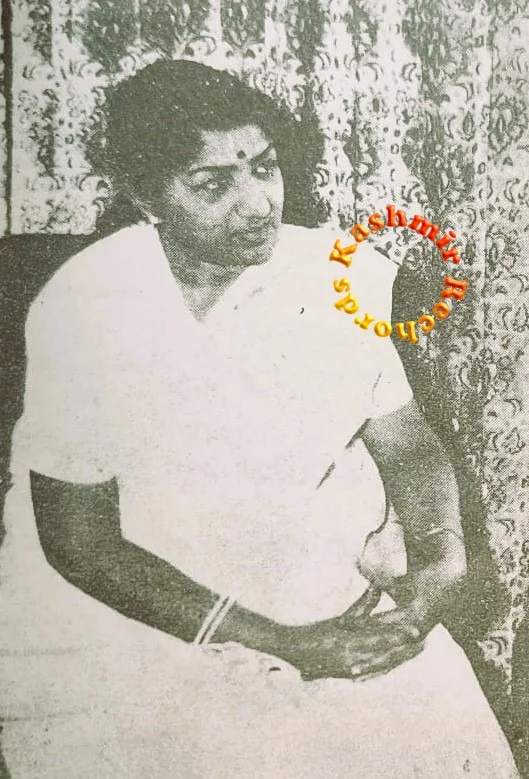
Young Padma Sachdev in the Studios of Radio Kashmir, Jammu.

   In this decade, all goners of modern literature were developed. Dogri theatre was evolved and plays like Namun Garn, Sarpanch and Alhar Goli Bir Sipahi were successfully staged. Fiction writing was also tried successfully in Dogri and it started with the publication of Bhagwat Prasad Sathe’s collection of short stories, entitled Pahala Phull. Short stories and novels have been written by Ved Rahi, Narendra Khajuria, Bandhu Sharma, Madan Mohan Sharma, R. K. Abrol, Om Goswami, Chanchal Sharma and Narsing Dev .Prose writing in various forms have also been cultivated, thereby enriching Dogri literature in various ways. Dogri magazines like Nami Chetna, Sheeraza, Phulwari and Hamara Sahitya    appeared from time to time.

The attainments of the Dogras in the field of art are, however, more spectacular. While Dogri literature had not been able to go out of regional popularity, Dogra painting won worldwide approbation.  Kashmir Rechords will shortly bring out a detailed write-up on Dogra paintings.

More Publications of Dr S S Charak

The unreported Anantnag riots of 1986!

(Kashmir Rechords Desk
Several decades ago, on February, 20, Anantnag riots of 1986 had begun from Wanpoh village of the  South Kashmir district, sowing the seeds for the mass exodus of Kashmiri Pandits from the valley, which ultimately  started germinating in 1990.
  On the fateful day of February 20, 1986, several  temples of Kashmiri Pandits situated in Wanpoh, Dayalgam and Luk Bhawan  villages were set on fire. The desecration of religious places of the minority community, besides looting and arson of their business establishments spread to other villages of the South Kashmir like Tral, Pulwama  and then finally engulfed entire Valley. The trend continued even after Maha Shivratri festival on March 8, 1986. Incidentally, this year also (2024), Maha Shivratri falls on March 8! 
The 1986 Kashmir Riots, also commonly referred to as the 1986 Anantnag Riots, were a series of attacks targeting Kashmiri Pandits. The attacks were undertaken at the behest of some religious fanatics, supported by political parties and their leaders.
Relying on   the factual and  exclusive newspaper reports/cuttings  of that year and as requested by our esteemed readers, particularly, not aware of Anantnag Riots of 1986, Kashmir Rechords is trying to bring out some of the facts related to those  ugly incidents of 1986.

Desecration of Al-Aqsa Mosque

   On February 3, 1986, there were reports that  Al-Aqsa mosque in Jerusalem, Israel  was allegedly desecrated. This  sparked widespread resentment in Kashmir for days together, as a result,  hooligans began to attack religious places of Kashmiri Pandits during the following days. In retaliation of reopening of Ram Janam Bhoomi temple  at Ayodhya during the same period, Hindu Temples were again  burned down and destroyed at  Wanpoh, Anantnag, Luk Bawan, Salar (Pahalgam Tehsil), Fatehpur, and  Sopore.  Adding fuel to the fire, Chief Minister Gul Shah announced the construction of a mosque inside Jammu Civil Secretariat. The move sparked widespread protests in Jammu as well. The State was divided between Jammu versus Kashmir.  The causality, as usual, was Kashmiri Pandit community as   the rioters  attacked Hindu-owned businesses and places of worship in Kashmir. Even the historic Akhara Building Complex of Srinagar was put on fire. The attacks sounded alarming bells, as most of the Kashmiri Pandits understood that very moment that  Kashmir was not now the place for their living!
Such was the scale of violence that even Army had to be called out at major towns of Kashmir.  Wills Trophy, which was to be hosted at Jammu, was postponed. Many Kashmiri Pandit leaders and organisations had registered their strong protest against loot, arson and desecration of their religious temples and shrines. Even President of India was requested to intervene.  
Anantnag, which faced the brunt of the violence, had multiple attacks on Hindu temples. Many Kashmiri Hindu-owned shops, homes and properties were attacked and targeted across Kashmir. These developments led to a large number of Kashmiri Hindus thinking of shifting to places outside Kashmir. Revenue records of that period,  suggest that a vast chunk of Kashmiri Pandits, soon after Anantnag riots and sensing the mood of locals,  purchased plots in areas like Chinore, Bantalab, Tope Sherkhania  in Jammu in 1986 itself.

 When DC, SP Anantnag were suspended

 Newspaper reports suggest that even administration was helping rioters in their nefarious designs. This is evident from the fact that on February 27, 1986, even Deputy Commissioner and Superintendent of Police, Anantnag had to be suspended for dereliction of their duties. Besides,   nine State Government officials, mostly teachers were terminated from their services.  Ironically, locals of Anantnag observed a complete hartal in entire Anantnag town against the suspension of DC and the SP.
As the situation continued to deteriorate, GM Shah Ministry was dismissed on March 7, 1986 and Jagmohan as the Governor, took over the charge of the State. He was praised by all and sundry for his efforts to restore law and order.
Call it a coincidence or  synchronicity—- In 1990, Jagmohan was again in the picture…but this time, accused of `engineering’ migration by the same very politicians who fanned Anantnag riots of 1986!

N.B: Esteemed readers are welcome/encouraged  to  add/register their experience/opinion on 1986 Anantnag riots in the `Comments’ Section.   

Kindly see what netizen Javed Baigh ( @JavedBeigh) has to say about Anantnag Riots of 1986.

Shankha Lipi findings at Akhnoor, Bhaderwah

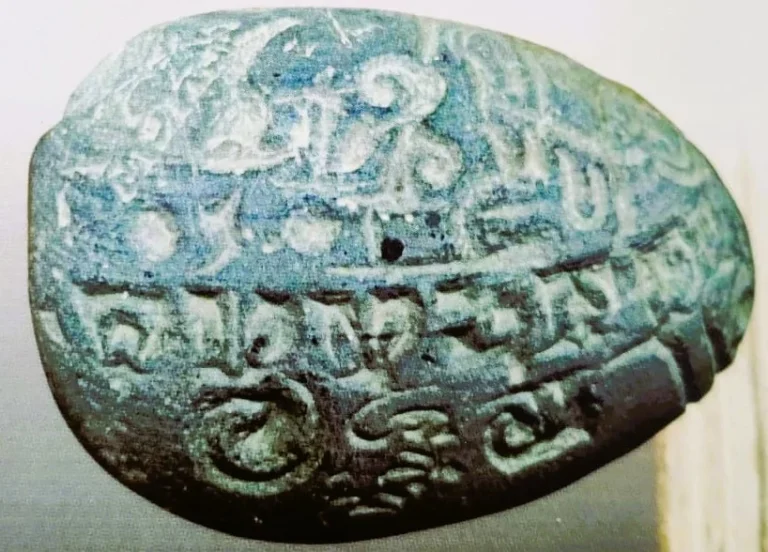
Shankha Lipi, also known as “Conch Script” or “Shell Script”, is a term used by scholars to describe ornate spiral characters that are thought to be Brahmi derivatives. The characters resemble conch shells or Shankhas and are found in inscriptions across north-central India dating back to between the 4th and 8th centuries. Interestingly, Shankha Lipi inscriptions have also been found from Akhnoor and Bhaderwah area of Jammu and Kashmir, establishing that in past also, both these towns were active pilgrimage centres.

 These ciphered ornate spiral characters assumed to be Brahmi derivative, have tentatively been assigned a new script family. Apart  from Akhnoor and Bhaderwah, Shankha Lipi inscriptions have also been found from Bihar, Maharashtra and Karnataka. Prominent sites with shell inscriptions include the Mundeshwari Temple in Bihar, the Udayagiri Caves in central India and  Mansar in Maharashtra. Shell inscriptions have also been  found  in Junagarh, Gujarat, and in Java and Borneo, Indonesia.

 Indian Council of Historical Research (ICHR) that is presently promoting and working on a project “Jammu, Kashmir and Ladakh Through the Ages’’ under the initiative of the   Ministry of Education, is bringing to the fact the age-old cultural ties of Jammu and Kashmir with the rest of India. Highlighting findings of Brahmi, Shankha Lipi and other scripts from Jammu and Kashmir, is a part of this great initiative.

Script of Devotion

Historians believe that shell (Shankha) inscriptions were engraved on temple pillars, freestanding columns and rock surfaces, the latter generally at sites with prominent cave shrines. The shell script was never used for long records or discursive texts but mostly for denoting   names or auspicious symbols or a combination of both. Shell letters have normally been found of the same size or slightly bigger than Brahmi letters, but in some cases they are gigantic, several metres high, as at the Udayagiri Caves.

The archaeological evidences unearthed at Manda, Akhnoor in 1960s point out that Jammu must have had exposure to the earliest system of writing in the sub-continent. The use Shankha Lipi, found on small round stones at Akhnoor, are now lying in the collection of Dogra Art Museum, Jammu. Shell inscriptions have also been found on stone boulders near Bhadarwah.

 According to Dr Lalit Gupta, a noted Scholar  and Art critic, “since Shankha Lipi, has been used for names and signatures by the pilgrims as record of their visits to famous pilgrimage centers, this affirms the belief  that  Ambaran (Akhnoor) and Bhadarwah  were active centers of pilgrimage in Jammu between 4th to 7th century CE’’.

Study on Shankha Lipi

The first detailed study of shell inscriptions was undertaken by noted academic Richard Salomon. The script is assumed to be a Brahmi derivative, but Salomon observed that shell script has diverged so far from the normal pattern as to be effectively a new script family. Salomon determined that there are a sufficient number of shell characters to represent the syllables of the Sanskrit language, and tentatively assigned sounds to some of characters. Prof B. N. Mukherjee subsequently proposed a system of decipherment based on a few key inscriptions using the assumptions that the script is an ornamental form of the contemporary Brahmi script through the centuries. Most of the Shankha Lipi inscriptions are from the Gupta period and are names of individuals, akin to ornamental signatures, although some predate the Gupta period.

Jammu’s Brahmi Inscriptions

According to Dr Lalit Gupta, post-Mauryan Brahmi inscription was first noticed in 1921 by R.C.Kak, the then Prime Minister of  the Princely State of Jammu and Kashmir and an archaeologist of repute. Dated between 3rd to 5th centuries CE by R.C. Kak, the Bathastal inscription is one of the oldest Brahami inscriptions in Jammu region.

   Dr Gupta, in one of his write-ups,  quotes epigraphist B.K.Kaul Dembi having placed and compared Bathastal cave inscription with coins of Indo-Bactrian kings Agathocles and Pantaleon, Rock inscription of Khanihara, near Dharamshala in Himachal Pradesh and Inscription of Kshatrapa King Sodasa, all belonging to Post-Mauryan Group of 184 BCE to the beginning of Christian era.

Second important inscription in Jammu region is the Bhadarwah Cave Inscription, inscribed inside a cave shrine (called as Gupt Ganga) on the bank of river Neru near Bhadarwah town. According to Dembi, it is perhaps the longest Brahmi inscription in the region and the second oldest Brahmi inscription from the Himalayan Valleys of Chenab region. Brahmi inscription has also been found inscribed on an iron trident at Sudhamahadev Shiva temple.

Lassa Kaul– Martyred in 1990, Abandoned in 2020!

(By: Kanwal Krishan Lidhoo)*

February 13, 1990: Director Doordarshan Kendra Srinagar, Lassa Kaul is shot dead by terrorists who considered him a stumbling block in meeting their nefarious designs. Rumours were then agog that some of his colleagues/insiders were involved in facilitating his murder by passing on the information to terrorists about his whereabouts and movements. More than three decades after his martyrdom, another set of insiders ensured that his name is abandoned from the annals of Prasar Bharati!

Giving his life in the line of duty, Lassa Kaul had worked both in Radio Kashmir Srinagar and Doordarshan Srinagar at a time when situation in Kashmir seemed to have attained the point of “No Return”. The then Governor, Jagmohan  who on January 19, 1990  was  assigned to set things in order after the elected Chief Minister abandoned  his position and responsibility,  found  it extremely difficult to  set things in order and fix the administrative machinery with its engine totally jammed. With great ache in his heart he records the same in his “Frozen Turbulence”.

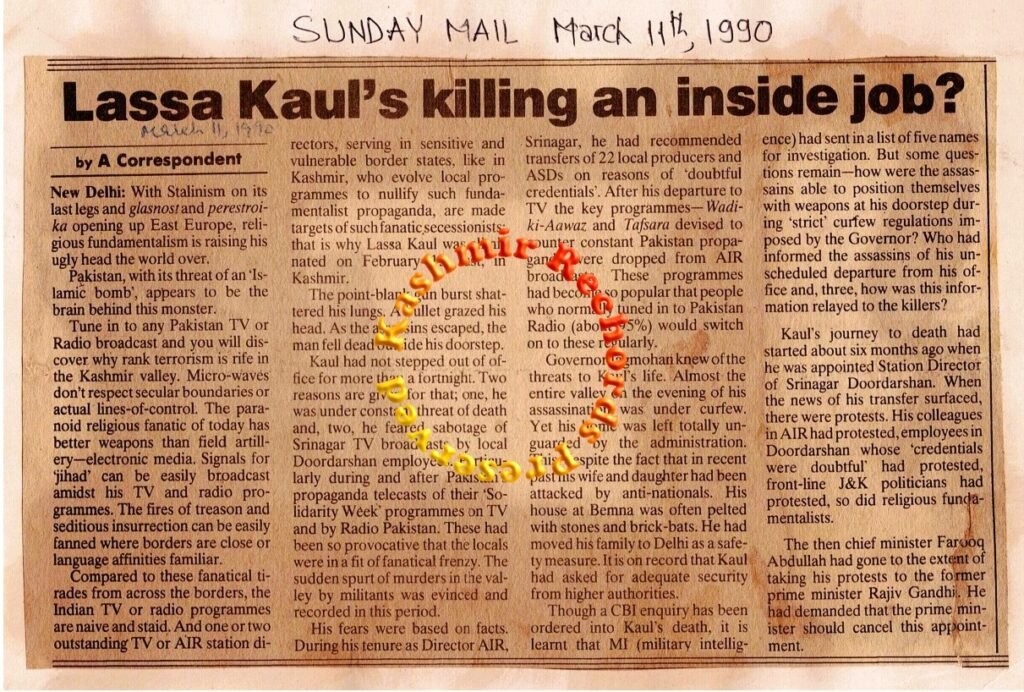
A news report published in Sunday Mail, dated March 11, 1990

The native Pandit minority of Kashmir is threatened, harassed and abused after its distinguished members fall to the bullets of militants. Nearly all of them are labelled as “Indian Agents” to be struck off from the discourse in Kashmir.

Local dailies having sensed the changing and shifting moods were adding the false narratives and perception of the alleged insurgency, actually generated by the managers across the borders and they for the reasons best known to them forgot the journalistic ethics and participated actively in this manufactured mass uprising and gladly became agent provocateurs.

 The only pro India media agency rather an institution of Government of India finds itself in a very difficult position to augment resources both human and material to run its daily broadcasts. This institution being headed by a brilliant Director who was incorruptible to the core and had the unwanted reputation to tolerate no nonsense, was all out to fix responsibility in Doordarshan Kendra Srinagar. He was definitely on a long mission to combat and confront a plethora of challenges facing him.

And then there were politicians who behaved more as hereditary fiefs rather than the servants of democracy to which they occasionally offer the customary lip service. These politicians were in the habit of finding faults in whatever the Government of India did.  If something did not serve their purpose, they wailed and put cogs in the wheel under the pious mission to serve Kashmiris.  Known for extracting their pound of flesh, they were also aware of the lack of will on part of the then Central Government leadership and thus took it for granted. These very ‘Leaders’ got irked by this Director of Doordarshan  Lassa Kaul when he mounted a series of scathing public grievance programmes and exposed their omissions and commissions before the very public they looted .

 Fighting Battle on Many Fronts

Lassa Kaul was thus fighting a battle on many fronts. Added to his vows was the fact that the writ of the state was not running during those crucial times. He had sensed the danger of it as all his fears were based on facts. Finding no one to listen to his distressed calls he for a while avoided being seen on the familiar routes and mostly imprisoned himself within the walls of his office which by now had become a fortification of sorts. The filial bond however gave way. He desperately wanted to attend to his very sick father and having already sent his family to Delhi, decided to visit the ailing father like the dutiful son he was on that fateful evening of thirteenth February, 1990…… The ambush of the evil terrorists had worked. Bullets pierced his head and abdomen. An illustrious son of the soil, a distinguished civilian, a loving innocent father to his children and an illustrious son to his parents laid his life for the country.

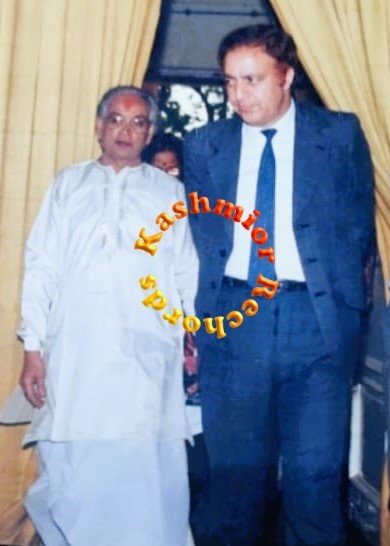
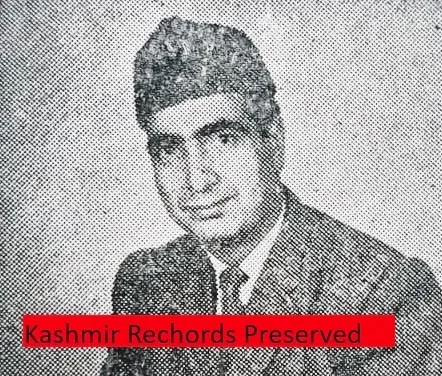
Lassa Kaul and T. N Dhar ( Middle), Station Engineer, in conversation with S. B Lal, Secretary, Ministry of Information and Broadcasting, Government of India at Radio Kashmir, Srinagar.

Lassa Kaul Award for National Integration

The government honoured him by instituting an award in his memory. The Special category award “Lassa Kaul Award for National Integration” would be given every year to the best such All India Radio programme.  The last Akashvani Annual Awards ceremony was held in 2019 when Shri Prakash Javadekar was the   Union Minister of Information & Broadcasting. Even prior to 2020, many attempts were made to do away with the Lassa Kaul National Integration Award. However, it was during the tenure of Fayyaz Sheheryar, who in the capacity of Director General, All India Radio firmly put his foot down and ensured that at no stage, during his tenure, this prestigious award gets scrapped. However, soon after Sheheryar’s superannuation in December 2019, Akashvani Annual Award Ceremony was altogether stopped for unknown reasons. Interestingly many professionals from Radio Kashmir Srinagar and Jammu, now rechristened Akashvani Srinagar/Jammu received all these years this prestigious award, thereby affirming the bond Jammu Kashmir shares with India.  Till 2019, Producers working in other Stations of All India Radio across the country have also won prestigious Lassa Kaul National Integration award during the Akashvani Annual Award Ceremonies when the   national consciousness would get stirred every year and the memory of this great son of Kashmir would be revisited. The tragedy would be lived on this occasion to affirm the belief “Lest We Forget” ……But forgotten he was!

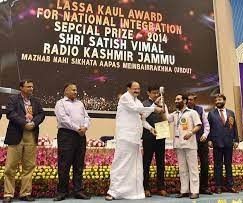
Former I&B Minister and Vice President, Shri Venkaiah Naidu giving away Lassa Kaul Award for National Integration to Satish Vimal of Radio Kashmir Jammu. Lassa Kaul Award for National Integration has since been abandoned by All India Radio! On the extreme right is former Director General of All India Radio, Fayyaz Sheheryar.

All India Radio abandons Lassa Kaul

It is tragic that Prasar Bharati’s institution of All India Radio has abandoned the annual presentation of this award altogether for the past four years!  It is more intriguing that in a proposal mooted in 2022-23, some of the ignorant and unprofessional top rung of Akashvani/Prasar Bharati, who seem to possess no idea what broadcasting is all about, had the temerity to do away with Lassa Kaul National Integration award! Ironically, there is also not a single portrait of Lassa Kaul available in any of Prasar Bharati’s offices in Jammu and Kashmir or even at main offices of Akashvani and Doordarshan Directorates or at Prasar Bharati Secretariat!  Same is the fate of M.L Manchanda, an Officer of All India Radio, Patiala, Punjab, who was abducted on 18th May 1992 by terrorists. His beheaded body was found in Patiala on 27th May 1992, while the head was found in Ambala.

Akashvani is an institution that swears day in and day out of aiding and fulfilling Prime Minister Narendra Modi’s dream of a prosperous and fabulous India with inbuilt messages and mission to honour the patriotic citizens. The irony being that Lassa Koul who was the one among the ranks of the institution of All India Radio and who  laid his life while fighting the enemies of Mother India should altogether be  abandoned and forgotten and  the discontinuation of presentation of  this prestigious award in his memory is indeed a pity. Perhaps neither the Honourable Prime Minister Narendra Modi nor his government is aware of this gross misconduct prevailing in All India Radio’s establishment. Even the present CEO Prasar Bharati, Gaurav Dwivedi must have been kept in dark while abandoning Lassa Kaul.

If it is so—- it must be then beyond All India Radio!

Pandit Lassa Koul is a national icon and will continue to be so.

===
*Kanwal Krishan Lidhoo, a Renowned Broadcaster and Author is an accredited translator of Kashmiri, Urdu and Hindi by Sahitya Akademi New Delhi and Indian Institute of Languages Mysore. He is a Patron of Kashmir Rechords and can be accessed at kklidhoo@gmail.com

 The Original  Sher-e-Kashmir!

( Kashmir Rechords Exclusive)

People may be attributing  Sheikh Mohd Abdullah, the founding leader of the National Conference as “Sher-e-Kashmir’’ or the Lion of Kashmir, but the fact unknown to most of us is that this title was initially bestowed upon by the people of Kashmir to a revolutionary  Kashmiri Pandit, Hargopal Kaul ( Khasta) for challenging the autocracy and raising the banner of revolt against the strong and powerful Ruler, Maharaja Ranbir Singh.

The multifaceted Kaul, who was also known as Khasta, (his penname),  wanted the upliftment of the people and conferment of basic civil rights and liberties upon them including freedom of the press. For that, he was arrested for openly “preaching’ sedition’’ and causing rebellion against the Maharaja.   To harass and torture him during those dark days, the undaunted Hargopal was put in an iron cage, meant to haul up a lion or to transport the animal king from one place to another.  When caged, he thereafter came to be known as “Sher-e-Kashmir”.

    There is a startling revelation of putting Hargopal Kaul in a lion’s cage by a prominent Advocate, Pyarelal Kaul in his book “Kashmir Trail and Travail’’, published in 1996. The author of the book incidentally claims to be a descendant of the Hargopal Kaul dynasty.

  Tortured at Bahu Fort

 According to the book, Kaul’s arrest was followed by the arrest of his younger brother, Saligram Kaul. Both were later convicted and sentenced to imprisonment for `committing sedition’. Bahu Fort, Jammu was converted into a special jail for them where they underwent the severest torture.

 The Author of the book says that Saligram Kaul had managed to disappear from the jail after five years through a tunnel dug out by him and fled to Delhi, then came to Punjab. “There, he took a strong line of criticism against Kashmir Durbar. Later, Hargopal Kaul was set free after six years. Both the brothers were given a rousing reception when they went back to Srinagar’’.

In Srinagar, Hargopal Kaul was given the appellation of “Sher-i-Kashmir” (Lion of Kashmir) by the people of Kashmir for his endless struggle and for serving Kashmiris in different ways and fields.

Long after the death of Sher-e-Kashmir Hargopal Kaul (1923), a section of Kashmiri Muslims later started calling Sheikh Mohamed Abdullah “Sher-e-Kashmir”. But the other Muslims of Kashmir, particularly the followers of Moulvi Mohamed Yusuf Shah, never accepted the title of “Sher-e-Kashmir” to Sheikh Abdullah. Instead, they nicknamed him Abdullah `Gaadah’ (fish), the author of “Kashmir Trail and Travail’’ claims.

Born in Lahore

Pandit Hargopal  Kaul Khasta, whose ancestors were Dattatreya Kauls of Rainawari, Srinagar Kashmir, was born in Lahore in 1848. His paternal grandfather, Gwasha Kaul, and great-grandfather Mahadeo Kaul had migrated to Lahore around the 1820s. His father Ramachandra Kaul had maintained a household both in Lahore and Kashmir.

After completing his studies, Hargopal started his career as a school teacher, first in Lahore and then in Patiala. Later, he switched over to journalism and started an Urdu weekly Ravi Benazir from Lahore. Although raised and educated in Lahore and Patiala, Khasta always nurtured a deep sense of love and reverence for his homeland, Kashmir.  This prompted him to return to Kashmir where his family built a house in the Nawa Kadal area of Srinagar.

Publication of Twarikh-i-Guldasta-i- Kashmir 

During his stay in Kashmir, Hargopal Kaul composed Twarikh-i-Guldasta-i- Kashmir (History of Kashmir) as he had access to government documents and records. This Book in Urdu was recorded by the Head of the Public Instructions department and was later first time published by Arya Press, Lahore, in 1877. His Twarikh-i-Guldasta-i- Kashmir gives us a historical account of Kashmir from ancient times to the period of Maharaja. The history is written in a free-flowing style in Urdu. The  Deebacha (prologue) to the book informs that the erudite Pandit  Hargopal had sent it to Col. Halride who was the Director of the Punjab Department of Education for his critical evaluation and comments.

It was during the same period that the first political nationalist consciousness in Kashmir emerged against imperial rule through the actions of Hargopal Khasta and his brother Saligram Kaul who opposed the injustices of the British policies. The duo raised their voice against autocracy and struggled for social and political issues for the transformation of Kashmiri society.

 His anti-imperialist activities, independent and revolutionary temperament made him an easy victim of the intrigues of Maharaja Ranbir Singh’s court and along with his brother Saligram Kaul, who was also a socio-politically active personality of the region.

During the period of his detention, Khasta wrote a political satire called Narsing Avtar and a masnavi entitled Gopal Nama in which he exposed the court intrigues in Kashmir. After his release, he went to Lahore and started writing in newspapers like The Reformer, Desh ki pukar, etc. He supported the endeavor towards female education and widow remarriage. Though he was working outside the State, his mind and heart were in Kashmir. From there, through his papers Ravi-Benazir and Subaha Kashmir, Khasta vigorously crusaded against the British by reporting on the political situation in Kashmir and advocated for granting full powers to Maharaja Pratap Singh. His consistent efforts through his writings exposed the British conspiracy against the Maharaja and proved helpful in the restoration of powers to Maharaja Pratap Singh.

Campaign for Women’s Education

After the appointment of Raja Suraj Kaul, a Kashmiri Pandit of Lahore, as the revenue member of the regency council, the political scenario changed in Kashmir and Khasta returned to the Valley to dedicate the rest of his life to social and educational reforms within the Kashmiri community and also outside it.

Khasta was a pioneer in the field of education. He founded a Hindu school for boys, later upgraded to Sri Pratap College by Christian missionary Annie Besant. The school played a commendable role in the spread of modern education in Kashmir. Khasta led the campaign for women’s education which was a social taboo in the valley during those days. He started a chain of girls’ schools at Nawakadal in Kashmir which was presided over by his daughter Padamavati.  A detailed document has been penned by  Dr. Ashraf Kashmiri on Pandit Hargopal Kaul, describing him as the Pioneer of Women’s Education in Kashmir.

Poet of Great Repute

Hargopal Kaul was also a poet of great repute who made effective use of his pen to express his nationalist feelings. Khasta penned down national and inspirational poetry with a progressive approach, both in Persian and Urdu, which will continue to inspire posterity. It was his tenacity and audacity that made him emerge from the several crises he faced for a new political dispensation in Jammu and Kashmir. An ardent patriot with a multidimensional personality, this great son of soil breathed his last in 1923.

Plane crash in J&K at `Dog’s Horn’

Kashmir Rechords Exclusive
A piece of tragic history lies buried under picturesque area of Kulgam, Kashmir district’s snow covered Houen Heng (Dog’s Horn) peak, 4200 meters above sea level.  Fifty-eight years ago, this day on  February 7,  1966,  a Fokker F 27 Indian Airline aircraft veered 12 miles off its course, crashing straight into the mountain, claiming all 37 people  on board. The flight included a number of top officers of the then Jammu and Kashmir Government!
Houen Heng ( Dog’s Horn) Peak
This  Fokker F-27, Series 200, aircraft, PH-SAB, owned by the Schreiner Airways of Holland and operated by the Indian Airlines Corporation on a charter contract had met with a fatal  accident shortly before noon on  February 7, 1966. The aircraft was on a scheduled flight from Srinagar to Delhi with intermediate stops at Jammu and Amritsar.  Soon after taking off from Srinagar for Jammu, it had  crashed on a hilltop Houen Heng, killing all the four   members of the crew and all 33 passengers on board.  The aircraft was completely destroyed.
Fokker F-27 aircraft, PH-SAB, owned by the Schreiner Airways

Probable Plane Crash Cause

According to the Bureau of Aircraft Accidents Archives, the cause of the accident was a navigational error. Capt. Duggal, who was flying the airplane, wanted to take a short cut over the hill.  While flying through clouds at an altitude insufficient to ensure safety, Capt Duggal had found himself at a spot, which resembled in its appearance the Banihal Pass. Changes in cloud formation and decreasing visibility had not permitted him a full and clear view of the mountain range, which lay across the route. Thus when he was near the point where it crashed, he thought that he was going to cross Banihal and even  sent this message to the airport, unknowing the fact that at that point,  he was 12 miles off his track and crashed at a point 12,364 ft above sea level.  The enquiry had held Capt Duggal responsible for the  haste  with an observation that “ a more careful and cautious pilot would, in the circumstances, have made sure of his direction and position by a reference to the Srinagar Airport where, in addition to the VOR, an Automatic Direction Finding facility was available’’.
   Erroneous navigation had taken the Captain to a point 12 miles west of his normal route. At this spot, the configuration of the mountain range had a deceptive similarity with the Banihal Pass, and because of this similarity, he hit the mountains of “False Banihal”, which are several thousand feet higher than the true Banihal. The pilot, as per the enquiry report, must have realized his error and his wrong position too late when he saw the high mountain in front of him while emerging from the clouds. He  must have even  attempted to climb but the aircraft hit the hill about 300 ft below the summit, breaking  it  into two main pieces which fell on either side of a big rock, while several smaller pieces were broken off and scattered over a considerable area on the hillside.

Houen Heng Peak

A picturesque Houen Heng Valley
The mountaineer’s greatest joy is in climbing mountains. In Pir Panjal range, there are many small and big mountain peaks on it. These include Bramshakri (4500m), Sondir Top (3700m) and infamous Houen Heng (4200m). Since this tragedy, Houen Heng, literally meaning, ‘dog’s horn’ has become a part of Kashmir folklore. People recount a civil society campaign to recover the corpses from their snowy graves, led by a local businessman who had lost his son in the crash. Time stands frozen at the picturesque Houen Heng valley as the plane debris beckon visitors to hear their tale.
   Interestingly, Houen Heng is neither the highest peak of district Kulgam nor the Pir Panjal. There are many trekking routes from several places that lead to Houen Heng. The hikers of the Jammu division climb this mountain either from Mohu valley or Gulab Garh. The mountain slope from the valley side is very steep. Other than professional mountaineers, very few can venture to trek on it from the front side.

The Multi-dimensional Farooq Nazki

Kashmir Rechords Exclusive

Are laureates cultivated or do they appear on their own? Both statements can be true or false at the same time. But there appears to be a strong relationship between the environment and a tradition in the family that cultivates quality literature. One’s inclination and the output combined with prevailing creative atmosphere in the family or otherwise can many a time produce great literary figures. This appears to be true in respect of Farooq Nazki, a multi-dimensional personality who breathed his last at a Katra Hospital on February 6, 2024.

 Farooq Nazki, who was a witness and an active participant in the vicissitudes that dotted his colourful life, had started as a cub reporter and his instincts would naturally align with what was then a pre-dominantly reconstructive socio-political movement and not less than   a silent revolution of sorts of questioning beliefs, situations and had a streak of rebellism against obscurantism, inequalities, exploitation and corruption. Interestingly, this seemed to be a world phenomenon and was predominantly visible in societies, which had just freed themselves from the clutches of imperialism. This movement dubbed as the ‘Progressive Movement’, is in fact only evolving and is said to be metamorphosing into other forms.

 Farooq Nazki, 83, had associated himself with the movers and shakers of this movement and it set the direction for his future literary endeavors. His father, Ghulam Rasool Nazki may have initiated him into the world of literature but his journey was purely carried by him on his shoulders like the lone pilgrim. This pilgrim tasted the waters of all streams and imbibed the light of all thoughts (Agnostic as well as Gnostic.)

A relentless Journey

It has been a relentless journey .The passion that essentially arises out of suffering blossoms into flowers and is the engine that drives creativity. Farooq Nazki was a poet, a broadcaster, a playwright and a noted literary figure of repute in both Urdu and Kashmiri besides proving his mettle as an administrative and political functionary also. He had donned many a hat and carried them deftly.

While much has already been written and said about Farooq Nazki, his family and his works, the trail he has left goes on projecting aspects of his colourful personality unknown to the world.

 Kashmir Rechords is in possession of very candid moments of this multi-dimensional personality’s periods of struggle, the aspects that are mainly hidden from the world. The black and white photographs of his younger life when he was growing in the shadows of his illustrious father Mir Ghulam Rasool Nazki speak for themselves about the vicissitudes, associations, agonies and the ecstasies combined with highs and lows of his life.

Through these rare photographs, Kashmir Rechords pays homage to this great son of the soil.

Lata Mangeshkar’s Dogri Songs and Her Jammu Visit

(Kashmir Rechords Exclusive)

February 6, 2024 marks the second death anniversary of legendary singer Lata Mangeshkar, who had a musical connection with the erstwhile State of Jammu-Kashmir, for having rendered her melodious voice to several immortal Dogri songs.

Her one of the eternal Dogri songs “Bhalla Sipahiya Dograiya…Rasliyan Rasliyan Dhara…Tera Bada Manda Lagda” dedicated to the Sipahis (soldiers) of Dogra regiment, is in fact played regularly in the barracks of Dogra regiment, considering the fact that the song depicts pain of a woman who is staying away from her Dogra soldier and requesting him to come back home located in the mountains.

A view of old Jammu City and Raghunath Temple Complex

Though over the years, many singers from Jammu and Himachal Pradesh have sung this song in their own way but it was the one sung by Legendary Lata Mangeshkar that still is the most liked and listened for its music and melodious voice, thanks to Padma Sachdev, the poet, who persuaded Lata to sing these songs and thus took Dogri language to great heights.

It is not that Lata Mangeshkar has sung only this song, she has tried with perfection other Dogri songs like “Tu Mallan Tu” that established her immortal connection with the Dogras and Dogri culture.

Apart from Dogri, Lata Mangeshkar has recorded songs in over thirty Indian languages and dialects and a few foreign languages, though primarily in Hindi, Bengali and Marathi.

Lata’s Visit to Jammu

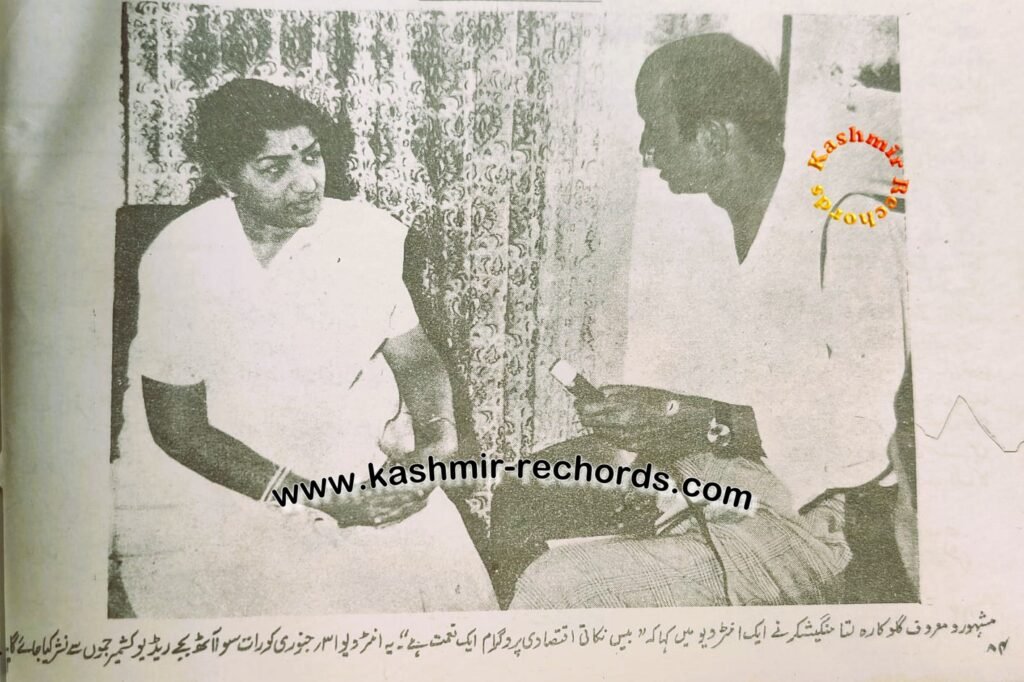
Lata Mangeshkar being interviewed by Rajinder Gupta at Jammu in 1976.

 There is a little mention of Lata Mangeshkar’s visit(s) to Jammu and Kashmir. However, records available with Kashmir Rechords trace  her one such visit to the City of Temples in January 1976.Radio Kashmir Jammu’s  Senior  Announcer, Rajinder Gupta had interviewed her—- not for her singing abilities but recording  her message on “Bees Nikati Iktisaadi Programme’’ (Twenty Point Programme) launched by the Government of India in 1975. In this interview, Lata Mangeshkar had termed the 20-Point Programme as a bone for the masses as it renewed the Nation’s commitment to eradicate poverty, raising productivity, reducing income inequalities and removing social and economic disparities.

 This interview was broadcast on 31 January 1976 at 8.15 pm over Radio Kashmir Jammu, now rechristened as Akashvani Jammu.

Radio Kashmir Jammu’s former Senior Programme Producer, Ravi Magotra, who vividly remembers broadcast of  this interview, told Kashmir Rechords that Mr Rajinder Gupta was one such announcer who was associated with Radio Jammu since its inception in 1947. Gupta had later established Urdu Newspaper Shiv Jyoti, published from Jammu.