Home Blog Page 26

When Kashmiris wanted India to `break’ Pakistan, Liberate PoK

(Bhutto’s Execution April 4, 1979)

 (Kashmir Rechords Excusive)
 Forty-five years ago on April 4, 1979, Zulfikar Ali Bhutto, Pakistan’s former President and deposed Prime Minister is hanged to death! The gruesome act puts Kashmir on fire! For the first time in the history of Kashmir, anti-Pakistan and anti-Jamat-e-Islami  demonstrators are held everywhere.  Effigies of Pakistani leaders and Pakistani flags are burnt.  Pakistan’s image in Kashmir is at lowest ebb.
 Even as Kashmiris and the entire Kashmiri leadership of that time forcefully raise the demand for liberating Pakistani Occupied Kashmir (PoK), the  then Indian leadership, headed by Prime Minister Murarji Desai fails to encash the golden opportunity.  Even Jammu and Kashmir Assembly raises the matter but the momentum is lost so much so that within a decade, strong  1979 anti-Pakistani wave in Kashmir turns into anti-India-storm by 1989!
It was for the first time that soon after the execution of Bhutto, Kashmiris had come out of their homes in thousands raising slogans like Pakistan Ko Tod Do (Break Pakistan) and Azad Kashmir Ko Wapas Lo” (Take Back Pakistan Occupied Kashmir). Such kind of demonstrations were witnessed mostly  in Jamat dominated  towns like Sopore, Anantnag, Shopian, Baramulla, Kupwara and Kulgam were people attacked and  destroyed property belonging to Jamat-e-Islami leaders. In some cases, agitating mobs physically assaulted Jamat leaders. In towns like Sopore, Police had to resort to even firing.
Public sentiment  and resentment against Pakistan was so much that even members of ruling National Conference demanded in J&K Assembly to get PoK  immediately liberated from Pakistan.  Newspapers of April 5/6, 1979 reported that People of the valley were sore at the foreign policy of India vis-a-vis Pakistan. This was   probably because top leaders like the Prime Minister and the Foreign Minister had not openly condemned the Pakistan government for Bhutto’s execution.

 Jamat-e-Islami attacked

Kashmiris had specifically targeted Jamati Islami   leadership for the reason that Jamat was sharing power with Gen Zia-ul-Haq, responsible for pronouncing death sentence upon Bhutto. This in spite of the fact that the leaders of the Jamait Islami in Kashmir were  trying to convince people that they are an entity quite apart and independent of similar organisations in India or Pakistan.
On April 6, 1979 the lone Jamat-e-Islami MLA  in J&K State Assembly, Syed Ali Shah Geelani,  alleged that  his party’s offices and properties of its prominent workers were attacked and burnt all through the valley since April 5, 1979. Some Jamat leaders were physically manhandled.
Before that, ruling National Conference members in Jammu Kashmir Assembly had made a forceful plea for the liberation of Pakistan Occupied Kashmir.
Participating in the discussion on an obituary reference made by the then Chief Minister Sheikh Mohd  Abdullah on the execution of Bhutto, a demand was made by Abdul Rahim Rather, Begum Zaffar Ali and Mr Ghulam-ud-Din.
They said that “our brethren” in Pakistan Occupied Kashmir (PoK) could no longer be left at the mercy of “lawless” government of Pakistan.
The demand for the liberation of PoK was also made by the leader of the Janata group, Abdul Rashid Kabli, and his group mate, Mr Tulsi Ram.

When Jammu & Kashmir had Its Own Currency Notes!

(Kashmir Rechords Exclusive)
The Erstwhile Princely State of Jammu and Kashmir had the unique distinction of having its own currency notes printed and circulated in 1877 AD during the reign of Maharaja Ranbir Singh.
The State used to issue these notes through its Treasury in 1877 (Samvat 1934).  These notes were being issued mainly for the payment to the State Treasuries of Land Revenue and other Government dues. The denominations ranged from a rupee to 1,000 rupees.
These notes used to bear the signatures of many Competent Authorities. In some notes, one finds the name of  Diwan Kirpa Ram as the chief signatory, while in a Twenty Rupee note, on its right corner, there is a mention of Mahesh Chander Vishvas in Nagari script.
A Twenty Rupee Currency Note of Princely State of Jammu and Kashmir, printed in 1877. Pic Courtesy: Rezwan Razack, Bangalore, India

  Shrikar and Sun Emblem

  All these currency notes of the Princely State of Jammu and Kashmir depicted the  Sun as an Emblem with the word ‘Shrikar’ written in bold  Nagari letters beneath it in the  Centre.  Once issued, the notes were then stamped with a seal impression below ‘Shrikar’.  This Persian seal reads ``Muhre Shrikar Qilimrau Jammun’’, meaning the “Land Revenue Seal of the Dominion of Jammu,” with the date 1934 (Samvat)  and the month in the oblong tables on its two sides.
   The Notes used to carry six circles— three circles each on the left and right sides in vertical lines.  These three circles carried the numeral value in Nastalique,  Nagari and Dogri scripts. Beneath the bold word Shrikar’ in Nagari, there is twice a mention of Jammu Kashmir and the date of printing these currency notes in Urdu.  However, most of the notes carry the Urdu dateline of  “Mah Vaisakh,  Samvat 1932’’. All these panels and circles were colored in pale gold and the rest in black.

Printing of Notes in Jammu

Such was the technology available in the State that these Currency Notes were printed in the State itself at   Vidyavilas Press, Jammu. The interesting part is that the Dogri inscription is found side by side along with Urdu and Hindi.  Also, these currency notes were printed on a Watermark Paper with the words `LESCHALLAS’.  The Watermark paper used to be provided by Wiggins Teape Paper Company formed in 1761 in London.
A Ten Rupee Note. Pic Courtesy: Rezwan Razack.

Dimension of Notes

All notes measured roughly  160 mm. x 230 mm with some variation due to the uneven paper cutting. However, the print of the note on the hand-made paper for all denominations was 131 mm x 205 mm.
These currency notes of Jammu and  Kashmir ceased to exist after 1947 when the Princely State acceded to the  Union of India.

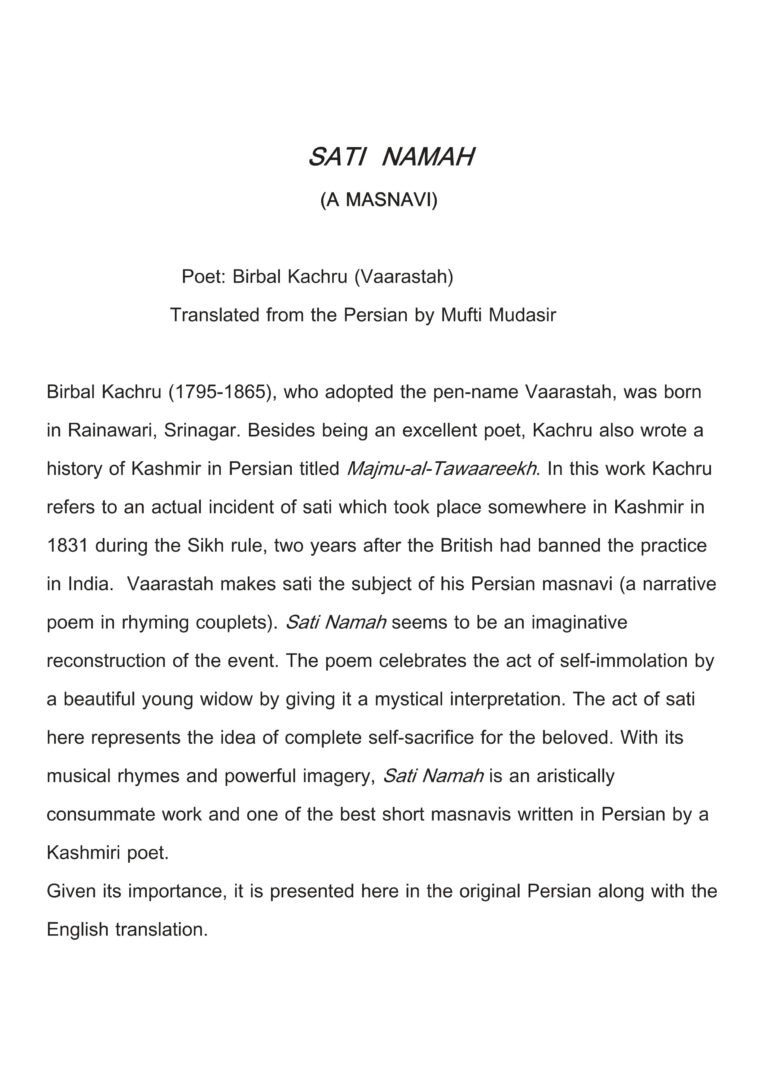
The Unheard  Sati Namah  by Pt. Birbal Kachru

( By: Kanwal Krishan Lidhoo)*

Continuing the tradition of according glory to Persian, the court language of the Mughals in the Indian subcontinent, Kashmiri Pandits have produced marvelous literature in this language, demonstrating their ability to add significance to anything close to their hearts. While Sanskrit was the language traditionally associated with this community, they had no qualms in accepting Persian, showcasing their mastery of this language and further demonstrating their capabilities as writers, poets, and historians. Their adeptness in learning the Persian language resulted in the creation of marvelous “Masnavis” in the tradition of classical Persian poets. Indeed, besides their grand works of literature, works by Kashmiri Pandits are also important sources of history and reflect the thought process of the times they lived in. Through their writings, they provide invaluable insights into the socio-cultural, political and intellectual landscape of their era. Their historical accounts, philosophical treatises, and reflections on society offer a window into the past, helping us understand the events, ideas, and values that shaped the world around them thereby making the works as indispensable sources for historians, researchers, and anyone interested in exploring the complexities of human experience.

 Depiction of Sati  incident in Kashmir

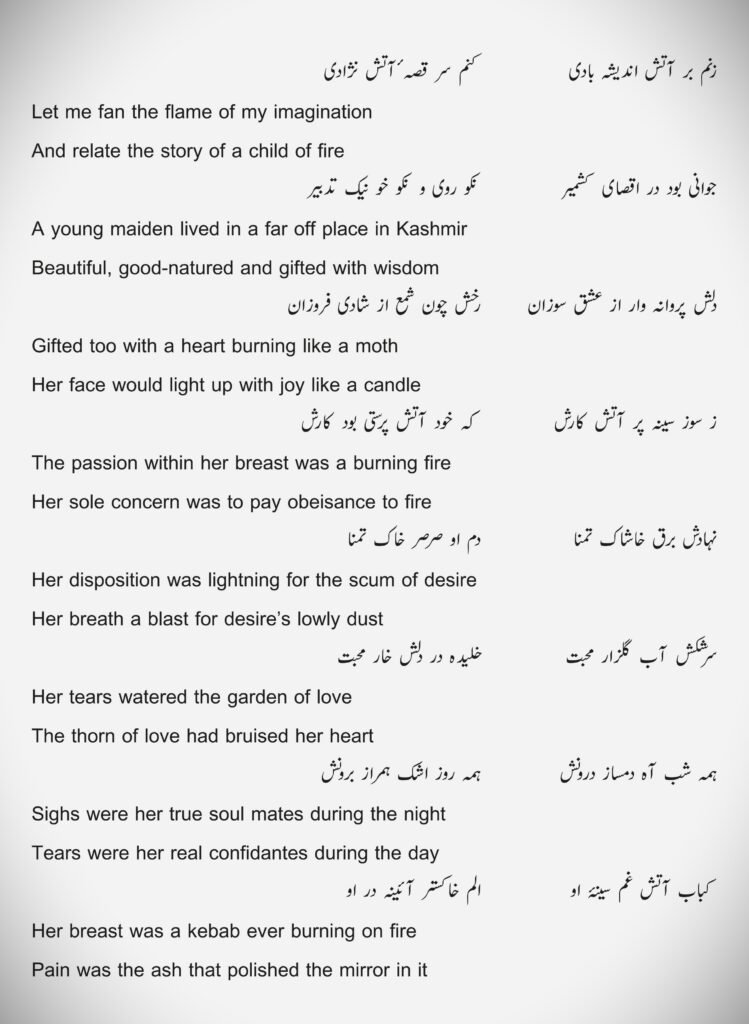
We are indebted to Rafi Ahmad Masoodi, Educationist, Academician  and History Enthusiast  who has prompted us at Kashmir Rechords to present a blog for our esteemed readers about the importance of a very valuable  Masvani poem titled “Sati Namah” by Pandit Birbal Kachru (1795-1865) born to Daya Ram Kachroo “Khushdil” of Kralyar Rainawari, Srinagar.  Essentially part of a historical document titled “Majmu-al Tawareekh. (Collection of Histories), “Sati Namah,” with its depiction of an actual incident in Kashmir during the 1831 period, which the poet blended with his own imagination offers valuable insights into the cultural and historical fabric of the region.  Mufti Mudasir, a brilliant and erudite scholar of both English and Persian from Kashmir has translated this Persian Masnavi into English. This aesthetically brilliant and enriched poem found place in the peer-reviewed journal of English literature and Language published by University of Kashmir Srinagar (P-177, ISSN 0975-6574, Vol. 29, Dec.2022).

  Alternatively  Pt Birbal Kachroo’s pen name was “Vaarastah” (Related or connected to). It adds an intriguing layer of meaning to his identity as a writer connected to his community and heritage. It’s indeed a commendable endeavor to present this important Masnavi as part of Kashmir’s glorious history, and it is hoped that the same will be appreciated by many who are interested in the cultural and literary heritage of the region.

Here we have included some of the  pages of the brilliant translation of Pt Birbal Kachrus’s  “Sati Namah” by Mufti Mudasir.

  • * Kanwal Krishan Lidhoo, an accredited translator of Kashmiri, Urdu and Hindi by Sahitya Akademi New Delhi and Indian Institute of Languages Mysore,  has remained associated with the institution of All India Radio (AIR) where he  worked as Senior most Producer. His books of Translation include “Samay Matrika” , the translation of 10th century Sanskrit classic of the same name by Acharya Ksemendra of Kashmir, Sahitya Akademi New Delhi’s “Hum Kaal Sindhi Afsana Sombran” a Kashmiri translation of Hindi scripted  “Samkaleen Hindi Kathayen”, and under publication “Navi Yogikie Vaaeris Dar” a Kashmiri translation of English scripted collection of Punjabi short stories of renowned Punjabi short story writer Mohinder Singh Sarna, Indian Institute of Languages publication “Hindustaenie Falsafekie Khad-o-Khal”, the Kashmiri translation of “Outlines of Indian Philosophy” by world renowned Professor M.Hiriyanna besides a  monograph on veteran and doyen of Kashmiri poetry, Makhan Lal Kanwal, (a Sahitya Academy Publication, Delhi)

When Another `Indian Agent’ Was Killed in Kashmir!

Kashmir Rechords Exclusive

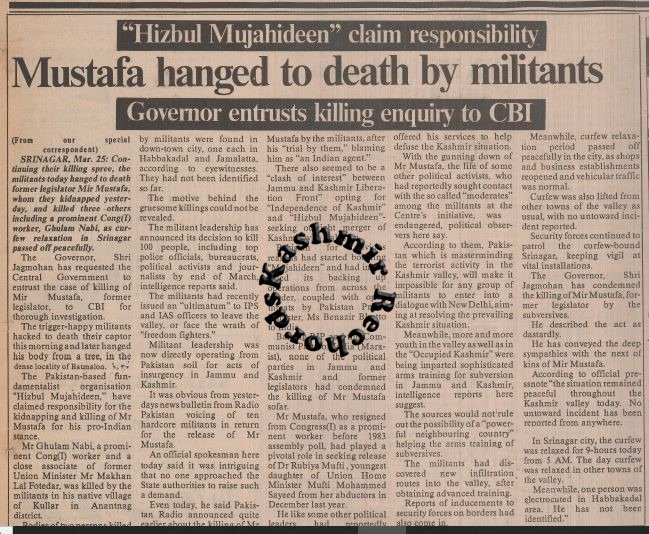
Thirty-four years ago, on March 25, 1990, another “ Indian Agent’’ was  killed! This time, the `Agent’ was  a former Legislator, Mir Mustafa, who was first kidnapped and later hanged to death by terrorists on a killing spree.

  As per the  relevant newspaper reports available with  the Kashmir Rechords,  before pronouncing a “death sentence’’, terrorists had “interrogated’’ the slain leader and made him  to `confess’ his `crime’.

Ghulam Mustafa Mir, popularly known as “Mir Mustafa’  was a  former member of the Jammu and Kashmir Legislative Assembly, representing  Chadoora constituency.

  On the fateful day of March 24, 1990, Mir Mustafa was abducted by terrorists  for being an “Indian Intelligence’’ Agent. It was Radio Pakistan, who was providing inputs to terrorists to execute their plans. That was evident from the fact that Radio Pakistan had initially demanded release of 10 terrorists in lieu of abducted Mir Mustafa.   As negotiations did not materialise, Mir Mustafa was killed and his body found lying  on March 25, 1990 in Batmaloo area, after dubbing him a `Mukhjbir’. Local and national dailies  had carried the  shocking incident of his death in their March 26, 1990 editions.

 Where are Mir Mustafa’s killers?


Even as his killers were identified after then Governor Jagmohan had handed over the case to CBI, it took 18 years after his death to sentence a former Hizbul Mujahedeen terrorist to 19-years rigorous imprisonment by a TADA court in February  2009. The court had   convicted Mohmmad Maqbool Tantray of conspiring with the other accused in kidnapping and killing of Mir Mustafa in 1990. Incidentally, authorities in June 1990 had released the pictures of three terrorists responsible for the killing of Mir Mustafa, whose whereabouts are, however, still unknown.

Mir Mustafa’s killing is  yet another instance where fair  justice has not been delivered to  the   nears and dears  of  Bhats, Taploos, Pandits,  Pirs , Ganjoos or Ranjoors  who were all  killed by terrorists  only for representing India in Kashmir.
Lest We Forget—Nadimarg Massacre

This newspaper cutting of Dateline March 25, 2003 is sufficient to recall what had happened that fateful day in Nadimarg village of Pulwama, Kashmir.

Remembering Abdul Sattar Ranjoor

( Kashmir Rechords Exclusive)
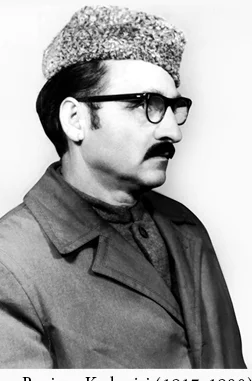
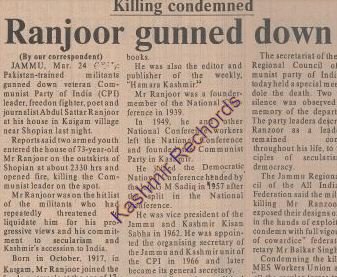
Circa March 1990: Kashmir Rechords in its  recent blogs  reported about the killing   of a   Telecom Engineer B K Ganjoo and  that of Deputy Director, Food and Supplies Kashmir A K Raina who were killed in the month of March 1990. During the same period, terrorists in Kashmir had killed leaders of other mainstream political parties as well. The killing  of   veteran Communist Party leader Abdul Sattar Ranjoor is one such instance.

On March 23, 1990, Communist Party leader Abdul Sattar Ranjoor was having an ordinary evening, sitting by the side of his wife at their home in Keegam, Shopian, and Kashmir. Terrorists had  entered the room with an intention to kill  Ranjoor at point blank range. Ranjoor   was shot dead because  of  his love for Kashmir and its people irrespective of their faith and belief.

Ranjoor was a secular and anti- communal. That is evident from the fact that he had fought for Ahmedia Muslims during his life. ( refer to is auto-biography).,  He took on fundamentalists of all faiths with equal disdain. Notwithstanding his deep engagement on socio-political front, Ranjoor had  immensely contributed to Kashmiri Literature. He  had started writing poetry while he was a teenager.

Denial of Justice, Recognition to a Martyr!

( Kashmir Rechords Exclusive)
His family was denied pension for five years after terrorists shot him dead while on duty!  Over three and a half decades after his death, the family is still not aware whether his killers have been brought to justice? His younger son is desperately fighting for recognising his father’s martyrdom! The martyr is  none other than Late A K Raina, the then  Deputy Director of Food & Supplies, J&K Government, Srinagar who was shot dead by terrorists in his Office Chambers on March 20, 1990.  Raina’s only fault was that he was in the line of duty and  wanted to ensure uninterrupted food supplies channel to the residents of Kashmir, who were otherwise facing hardships on account  of curfew, which was clamped in most parts of the Valley at that time.
 Despite continuous “ strict’’ curfew in Srinagar, terrorists had easily managed to enter his office, which was incidentally at a stone’s throw distance from Police Station Shaheed Ganj. On the same day, (March 20, 1990), terrorists had also killed a State Police constable, Jagan Nath and an Intelligence Bureau man, Joginder Singh in Kashmir. Mohd Yousuf of Qazigund, Kashmir and his two other family members were also critically injured by terrorists the same day, labelling them as Police Informers.

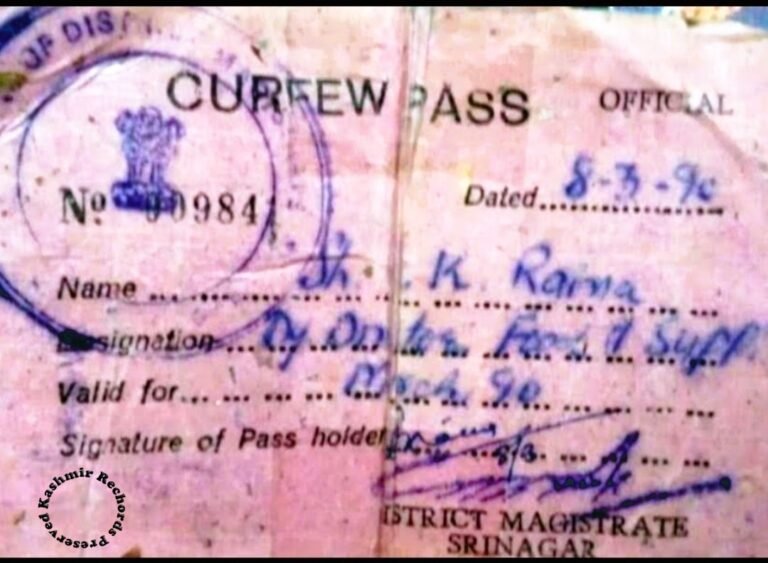
    A Curfew Pass!

In the killing of Mr A K Raina, terrorists wanted to ensure that Government gets crumbled and locals come out on streets once food channel is disturbed. This Kashmiri Pandit officer (A. K Raina) was an obstacle in their nefarious designs.
At the time of his death, Raina was just carrying a Curfew Pass in his pocket, issued by District Magistrate, Srinagar for the entire month of March 1990. …..And on the other hand, terrorists were openly brandishing highly sophisticated weapons. 
  According to his younger son Vivek Raina, the Curfew Pass was in his father’s coat pocket, which was later handed over to the family at the time of handing over the body. Vivek recalls that his father believed that “ Nobody can harm him as he had never hurt anyone and was an upright Officer’’. However, he was possibly unaware of the snakes in his backyard.
  Even as when his salary was not released on 14th March 1990 due to the turmoil in Kashmir,   Raina did not mind for that but ensured that food and supplies chain does not get affected in Kashmir.  Vivek recalls that since curfew was clamped most of the time, his father being on a higher post would always be on a Magisterial Duty.  Moreover, Food and Supplies was naturally categorised as “Essential Services” and he had to perform duty even at odd hours.
 On the fateful day of his killing, A K Raina had got up early in the morning and after a customary Puja ceremony, he had left for his office. It was a matter of few minutes soon after leaving his house that he was pumped volley of bullets in his office chambers.  On his way to a Hospital, he was declared as “ brought dead’’.

  Denial of Family Pension, Recognition

The Life had turned a hell for the family soon after their shifting to Jammu. The tragedy was further compounded  by the authorities at the helm of affairs  who  caused so many obstacles , as a result of which   the  family pension of Mr A K Raina was not  settled  for more than five years after his death!
 During the past two years, the Jammu and Kashmir government had named and dedicated so many schools and roads after martyrs and other eminent people. The initiative was a part of the decision to honor those who have died serving the nation. Vivek Raina has been requesting everyone to recognise the services of his father by dedicating at least a room after his name where he was shot dead. The administration has so far failed to do so despite several reminders from slain officer’s son even to the highest authorities at the Sate and Central level, including Lt Governor and Prime Minister.

  When Politicians  Failed to Highlight B K Ganjoo’s Killing!

( Kashmir Rechords Exclusive)
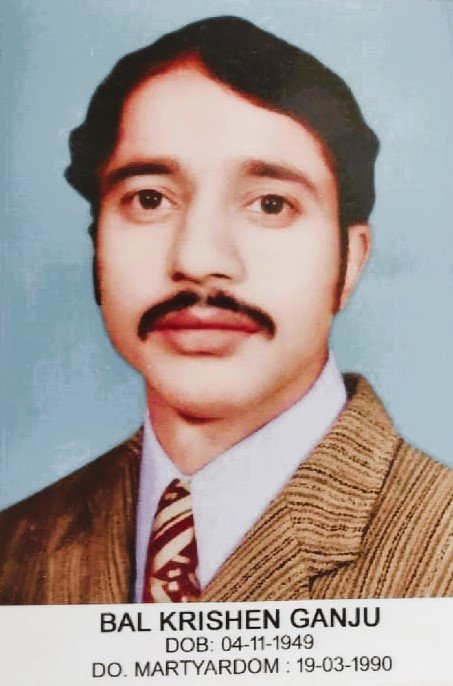
On March 19, 1990, Bal Krishan Ganjoo,  an Engineer working with Indian Telecommunication Department, was shot dead by terrorists on the same day when  “Multi- Party Political Leaders’’ of India were requesting  terrorists in Kashmir to shun the path of violence. The appeal fell on deaf ears  as terrorists continued with their target killings to scare away minorities.
  Newspaper reports of that day ( one available with Kashmir Rechords)  say that “militants had spread bullets on  B K Ganjoo from a deadly Kalashnikov rifle  near his   residence at  Chota Bazar, Srinagar and managed to escape in the adjoining locality in a car which was waiting for them at a distance’’.  B. K Ganjoo’s only fault was that he was a Kashmiri Pandit who wanted to ensure that telecommunication services did not get affected. He was thus on the hit-list of terrorists for his dedication towards his duty.
   It is believed that terrorists  had followed Ganjoo when he was on his way to  home. Upon entering the house, his wife  reportedly hid him in a barrel of rice kept in their attic. Terrorists had entered the house intending to kill Ganjoo, but they left after they could not find him. However, one of Ganjoo’s neighbours snitched to terrorists that Ganjoo was hiding in a rice barrel. Terrorists had gone back into his house and shot him dead inside the barrel.
 Vivek Ranjan Agnihotri in his 2022 The Kashmir Files has gone a step ahead in showing to the masses that Ganjoo’s wife was then forcefully fed the blood-soaked rice. Newspapers of March 20, 1990, having carried the gruesome incident, however, mention that one Dinesh Lal was critically injured during the shoot-out. The news item also mentions that with the killing of BK Ganjoo, more members of minority community had  started leaving the Valley in panic. Ganjoo was the second official of the Telecom Department who was killed in Srinagar during March 1990.
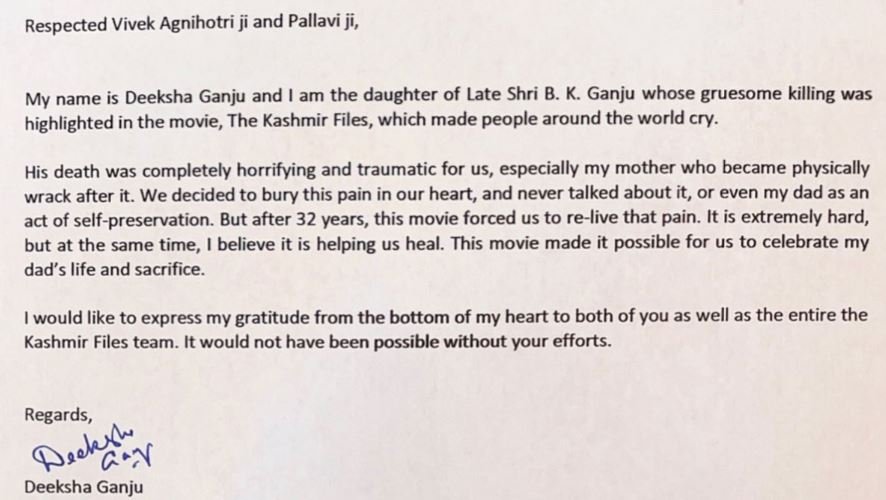
After the release of The Kashmir Files, B K Ganjoo’s daughter, Deeksha Ganjoo in a letter to  Vivek Agnihotri and Pallavi had expressed her gratitude for highlighting the killing of her father in the movie.  The letter was later shared by Agnihotri on his twitter account.

Multi-Party  Failure Meet on Kashmir

On the day when B K Ganjoo was killed, some  politicians of National Parties were already in Kashmir.  On the same day, they had released a joint statement, which was adopted by leaders of Janata Dal, Telegu Desam Party, Asom Gana Parishad, Bharatiya Janata Party (BJP) Communist Party of India (CPI), CPI-M, Congress-(I), besides State’s National Conference.
The leaders of these political parties had appealed to terrorists to“ abjure violence and uphold peace’’. However, the statement did not carry a single word about Kashmiri Pandits or that of B K Ganjoo’s killing.
As politicians failed to prevail upon terrorists to shun the path of violence, the latter had  instead resorted to more target killings during the last 10 days of March 1990. Kashmir Rechords will try to highlight those killings in its future Blogs.