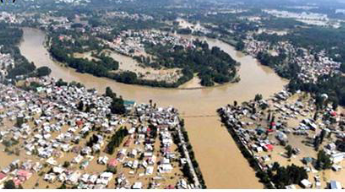
Kashmir Valley is one of the most flood hazard-prone Himalayan regions. The valley has witnessed significant flooding during 879 AD, 1841, 1893, 1903, 1929, 1948, 1951, 1957, 1959, 1992, 1996, 2002, 2006, 2010 and 2014. A threat of floods was looming large recently even this year also!
Some of the historical records testify the occurrence of 64 flood events in Kashmir from the early seventh century to 1951.
While everyone is aware of the 2014 floods in Kashmir that gravely hampered the societal set up, created panic among people, affected the economy and degraded the environment and ecological balance, there is a very interesting anecdote linked to the Kashmir Foods of 1951 when old census Reports came handy in fighting the floods!
In 1951, early melting of snows, followed by excessive rains, brought about a high flood in the river Jhelum that flows through the middle of Srinagar. The bunds protecting the city were in good shape and all was expected to be well. But as night was falling, a crack appeared near the 100-bed hospital, then housing the Jammu and Kashmir Archives.
A Trick That Worked!
An alert was sounded. All hands were soon on the spot to repair the damage. Unfortunately, sandbags were running short; the bund under great pressure started giving way. It was indeed a critical situation and the evacuation of the population was considered. But just at that moment, an idea occurred to a young engineer—-why not plug the leak with old census reports lying stacked in the State Archives?
This desperate remedy was tried and behold, these massive volumes did the trick. The breach was closed, the floodwaters were beaten back and, for sure, there was a chorus of praise for the census organisation!
There is a mention of this interesting episode in “Jammu and Kashmir—A Portrait of Population’’-— a book written by Sh J N Zutshi, Director of Census Operations, Jammu and Kashmir in July 1974.
A Page from the Book—“Jammu and Kashmir—A Portrait of Population’’-– written by Sh J N Zutshi, Director of Census Operations, Jammu and Kashmir. The Book published in 1974, carries valuable information about 1971 census of Jammu and Kashmir.
Zutshi says that even those who see the reports of a census from outside the covers only feel instantly awe-struck by their very physical proportions and encyclopaedic look. “The fact that some unsung and unwept Census Superintendent may have burnt his heart out in tabulating and analysing masses of data and presenting them in these bulky volumes is not considered a very relevant point. But the reality is that the same very census reports saved Srinagar from Floods in 1951!’’
It was March 1971 Parliamentary elections for the Fifth Lok Sabha when Kashmiri Pandits were finding themselves at the crossroads……..Their indecisiveness had pushed them in a struggle between “reactionary and communal forces’’ on one hand and “Progressive and Democratic Elements’’ on the other hand.
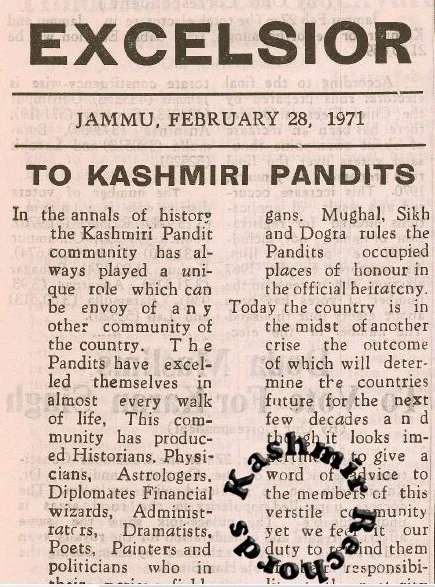
This awkward situation had prompted a leading newspaper of the State (Daily Excelsior) to issue an appeal to the entire community of Kashmiri Pandits, through its editorial dated February 28, 1971.
While hailing Kashmiri Pandits for their legacy and always having played a unique role in shaping the future of the Nation, the Editorial had hoped that “ a farsighted community’’ will choose a correct path and lend the weight on the side which is expected to strengthen Country’s freedom and impart her stability’’
Pandits of Srinagar Constituency
The newspaper had specifically mentioned about Srinagar Constituency where the “wisdom of the Pandits was on the test’’. The Editor had expressed his optimism that the members of this community would not be swayed by the cheap slogans’’.
The Editorial concluded with some of these lines… “ Though it looks impertinent to give a word of advice to the members of this versatile community, yet we feel it our duty to remind them of their responsibility…… We trust the Pandits would visualise the future of the country in proper perspective and act wisely after mature and careful consideration’’.
What had prompted the newspaper to issue an appeal to the community through its Editorial is not exactly known but experts opine that in 1971, Kashmiri Pandits were considered a force to reckon with and the political class of that era knew about their importance.
For some, Kashmiri Pandits may now be redundant in the present ongoing Lok Sabha elections of 2024, but this was not a case in 1971 when India went for General Elections held between first and 10th March to elect members of the Fifth Lok Sabha.
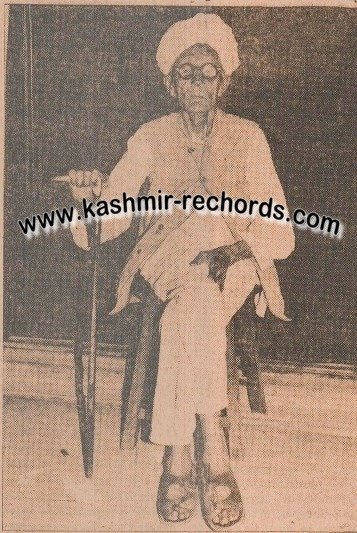
Dogri poet Basant Ram `Basant’ is another unsung hero about whom very little is known. Despite considering him “Nazir Akbarabadi’’ of Dogri by some, Basant Ram ‘Basant’ did not get his due recognition and hence remained “Unsung’’.
Except for one article written by renowned writer, Joteshwar Pathik in 1990 and a few of his songs recorded by Radio Kashmir Jammu, there is no record available about this son of the soil.
Efforts made by Kashmir Rechords found that when Basant Ram ‘Basant’ used to take the mike, no one else could venture to face the audience. Even after the poetic symposia were over, he was invited to recite his poems and this would go on till the mid- night and even after. Pathik in his 1990 write-up says: “This nonagenarian poet had no schooling and even did not know 3 Rs. Still he used to recite poetry without any interruption’’.
Pathik says those who must have read Nazir Akbarabadi, would know that Basant’s simple lucid style had given him a place along with other doyens like Mir, Ghalib, Zauq and may others. Nazir too had little schooling but his poetry was most popular among the people. He was a street poet and had greater audience than any other poet.
Ignored, Rejected
Pathik mentions that Basant too had a simple lucid style like that of Nazir Akbarabadi and he too had not been recognised by the critics. “He was always dismissed by the `doyens’ of Dogri as an illiterate versifier. But Basant neither bothered nor groused’’.
Born in 1898, Basant was satisfied and contented when Pathik had met him in 1990. He proudly says, “I have recited my poems before huge gatherings at Srinagar (when GM Bakshi was the Prime Minister of the State before 1963) and at the All India Dogri Writers Conference at New Delhi.”
Basant Ram ‘Basant’ passed the last days of his life in utter poverty and helplessness. Meek and weak, he even could not walk straight and no longer could participate in Mushairas and Kavi Sammelans.
There was only one book of poetry to his credit, which was edited by Tara Smailpuri in 1969. No institution ever bothered to honour him. “He was never awarded by the Cultural Academy or the Sahitya Academi because he had no godfathers to shower praise and evaluate his work’’, exclaims Pathik.
Appeal to Readers
Kashmir Rechords, in its efforts is trying to highlight the contribution of this unsung hero and thus appeals to all its esteemed readers, who might know about Basant Ram Basant to contact us with authentic details and send the same on kashmirrechords@gmail.com or support@kashmir-rechords.com. The readers may also forward the same message/write-up to their acquaintances in other groups/social media platforms so that further information is obtained to update story on this unsung hero from Jammu.
Bringing attention to these overlooked figures is crucial in reshaping historical narratives and acknowledging the diverse tapestry of human achievement. By amplifying the stories of these unsung heroes, we honour their legacies, inspire future generations, and strive for a more inclusive and accurate understanding of history. It is imperative that we actively seek out, celebrate, and preserve the stories of those who have been marginalized, ensuring that their contributions are no longer consigned to the shadows of history.
Readers can also share stories about similar unsung heroes with Kashmir Rechords. We promise to publish them with due credit to the contributors.
Kashmir’s rich tradition of humor is a notable aspect of its socio-cultural history. This tradition is evident in the works of literary giants like Kshemendra, who used satire as his primary form of expression. Kshemendra’s writings often addressed topics of interest through satirical narratives rather than the pure humor classified by language experts. His approach involved exploring socio-economic and political issues, presenting them in a light that highlighted their absurdities and contradictions.
The tradition of satire in Kashmiri literature has persisted through the ages and remains a prominent mode of expression today. Kashmiri humor often serves as a means of critiquing society and the powers that be, using wit and irony to expose flaws and injustices. This satirical tradition enriches the cultural landscape and continues to shape how issues are understood and discussed within the community.
Known for his satirical Newspaper Column “Khazar Sochta Hai Wular ke Kinare,” , the owner cum Editor of Roznama Aftab, Khawaja Sanaullah Bhat created memorable and humorous adages that resonated with the people of Kashmir. Bhat’s columns were known for their wit and incisive observations, exposing the hypocrisy of the political class and resonating with the masses. His humorous yet critical approach made him a hero among Kashmiris, and he played a significant role in shaping the region’s tradition of literary and satirical humor, particularly through his daily writings in his “Roznama Aftab” Urdu newspaper.
Kashmir’s renowned journalist, Yousuf Jameel who had worked with Aftab for over four years, recalls that the column was dictated to him by Khawaja Sahab umpteen times.
The Masthead of Roznama Aftab which used to carry the satirical column “Khazar Sochta Hai Wular ke Kinare”
Loved and Hated Figure
Bhat’s work showcased his talent for satire and his ability to critique the establishment through his anti-establishment writings. One such adage, which gained cult status in Kashmir, depicts brutal humor related to former Prime Minister Indira Gandhi’s famed twenty-point programme. The adage goes as follows: “I agar love you, Magar you don’t me.”
This phrase is so playful and a witty take on the empty political programme through a blend of English and Kashmiri language reflecting Editor’s talent for mixing humor and social commentary also. His ability to creatively criticize political programmes and leaders through his writings made him both a loved and hated figure in Kashmir. Ordinary Kashmiris loved him while the politicians hated this literary giant.
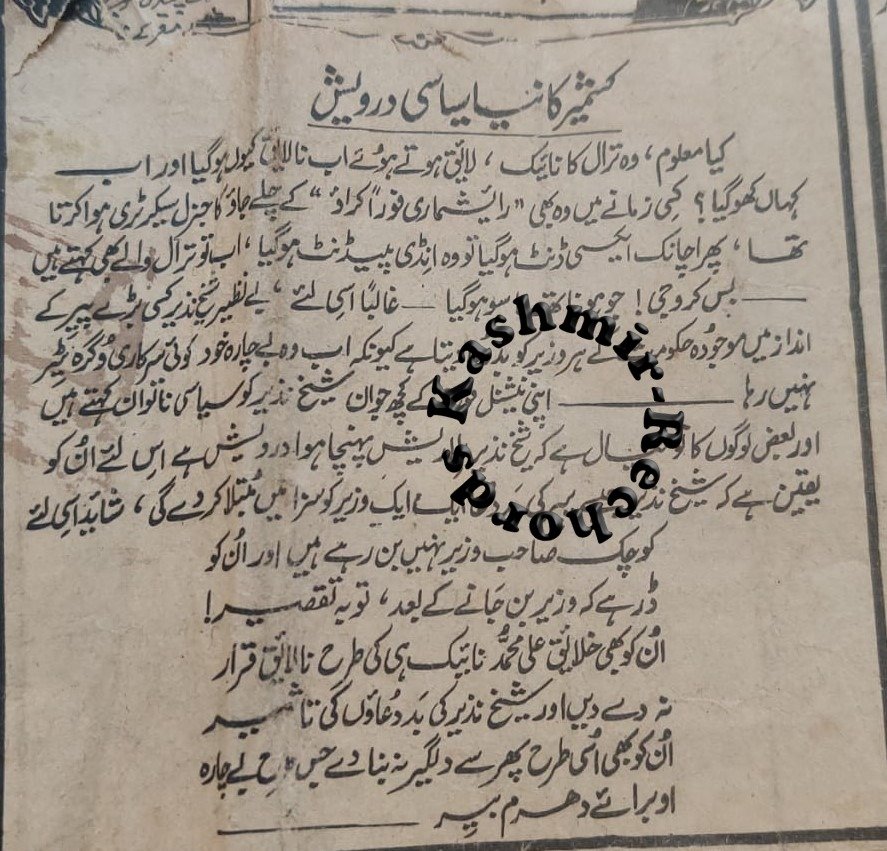
Kashmir Rechords is presenting one such column published in Aftab newspaper in 1983, under the heading “Kashmir Ka Naya Siyasi Darvesh’’. In this column, the columnist targets “Tral Ka Nayak’’ and it makes a wonderful reading!
Kashmir Ka Naya Siyasi Darvesh—-The Beauty of Bhat’s Writing!
The efforts of Kashmir Rechords in documenting conversations with individuals like Zareef Ahmad Zareef and Shahbaz Hakbari have helped preserve and share valuable information about this formidable literary figure, ensuring his legacy and impact on Kashmiri literature and humor are remembered and celebrated.
Unfortunately, in a world of “cut-paste’’ culture, Kashmir’s present media possibly lacks this kind of high quality incisive satire. Even as some writers at later stage tried their hands for writing “Khazar Sochta Hai Wular Ke Kinare’’, but they could not match the benchmark set by Kh Sanaullah Bhat.
* Kanwal Krishan Lidhoo, an accredited translator of Kashmiri, Urdu and Hindi by Sahitya Akademi New Delhi and Indian Institute of Languages Mysore, has remained associated with the institution of All India Radio (AIR) where he worked as Senior most Producer. His books of Translation include “Samay Matrika” , the translation of 10th century Sanskrit classic of the same name by Acharya Ksemendra of Kashmir, Sahitya Akademi New Delhi’s “Hum Kaal Sindhi Afsana Sombran” a Kashmiri translation of Hindi scripted “Samkaleen Hindi Kathayen”, and under publication “Navi Yogikie Vaaeris Dar” a Kashmiri translation of English scripted collection of Punjabi short stories of renowned Punjabi short story writer Mohinder Singh Sarna, Indian Institute of Languages publication “Hindustaenie Falsafekie Khad-o-Khal”, the Kashmiri translation of “Outlines of Indian Philosophy” by world renowned Professor M.Hiriyanna besides a monograph on veteran and doyen of Kashmiri poetry, Makhan Lal Kanwal, (a Sahitya Academy Publication, Delhi)
Like in other parts of the Country, it is the election time in Jammu and Kashmir also. Kashmir Rechords is trying to bring out some salient and interesting facts about Lok Sabha elections held in J&K:-
1. The first general elections in the independent India were held in 1951-52. However, due to the special status of Jammu and Kashmir, this erstwhile Princely State held its own Constituent Assembly elections in 1951.
2. Before 1967, members to the Lok Sabha from Jammu and Kashmir were nominated.
3. Anantnag and Ladakh Parliamentary Constituencies went uncontested in 1967.
4. Ghulam Mohd Mir, who was nominated in 1962, had organised a “Back Benchers Association’’ in Parliament in order to provide them opportunity to speak in the August House.
Heavy Polling in Jammu and Kashmir, 1967
5.In 1971 general elections, 52 candidates had filed nomination papers from Jammu and Kashmir. Out of them, 20 had later withdrawn.
6.In 1971, Dr Karan Singh and Inderjit Malhotra contested polls on Congress Ticket from (Doda-Udhampur-Kathua) and ( Jammu-Poonch) Constituencies respectively.
7. In 1977, Balraj Puri had contested election on a National Conference ticket.
8. In 1977 polls, election fever in Kashmir was at its high pitch.
9. Srinagar Constituency went uncontested in 1980 and 1989 elections.
1977 election fever in Kashmir.
10. In mid-term polls of 1980, 28 candidates were in the fray, while as in 1984 and 1989 General Elections 48 and 63 candidates respectively contested the polls.
11.In 1991, mid-term elections could not be held in J&K due to escalation in terrorist activities.
12. In 1996 elections, Amar Nath Vaishnavi fought election on a BJP ticket from Srinagar Constituency getting a total of 35911 votes. Sarla Taploo who was fielded from Anantnag, got 5740 votes while as BJP’s N.N Koul, who contested from Baramulla Constituency, obtained 12261 votes.
Election Symbols of Various Political Parties
In First Lok Sabha Election of India, Human Hand was the symbol of Forward Bloc, while as a Pair of Oxen was symbol of Congress. Oil Lamp was an election symbol of Jan Sangh.
Between 1952 and 1969, the Congress was represented by a pair of bullocks carrying a yoke. But when Indira Gandhi launched her own faction-INC (R) after being expelled from party by then Congress Party president S. Nijalingappa, Congress chose a new election symbol—A Cow with Sucking Calf’’. On the other hand, the “Old Congress” (which had the support of only a few MPs), retained the party symbol of a pair of bullocks. After splitting from the Congress (R) in 1977, Indira Gandhi created Congress (I) with a human hand as symbol .
The election symbol of the Bharatiya Janata Party ( BJP) has also changed over the years. From 1951 to 1977, the party was called as Bharatiya Jana Sangh with an oil lamp as its election symbol. In 1977, when it merged with other political parties to form Janata Party, it chose a farmer and plough symbol to represent it. After the dissolution of the Janata party, BJP was formed. The Party adopted `Lotus’ as its election symbol.
A Kashmiri Voter of yesteryears…When ballot boxes were in use
The history of Lok Sabha elections in Jammu and Kashmir reflects the region’s complex political journey, marked by its earlier unique status within the Indian Union and the efforts to integrate it fully into the Indian mainstream.
A pre-partition era chequebook of Jammu and Kashmir Bank, Muzaffarabad, (Kashmir) Branch was recently making the rounds on social media! That prompted Kashmir Rechords to make an attempt on the status of banking in Jammu and Kashmir before 1947.
The inputs gathered from different sources reveal that banking history of Jammu and Kashmir before 1947 is intertwined with the region’s political and economic landscape. Before the partition, the banking in the Princely State of Jammu and Kashmir was relatively underdeveloped compared to other parts of British India due to various socio-economic factors.
However, there were some prominent banking institutions operating in Jammu and Kashmir before 1947. One of the notable banks was the Jammu and Kashmir Bank, established on October 1, 1938 and still exists with hundreds of branches across India. Initially, J&K Bank started as a Semi-State-owned bank with the Maharaja of Jammu and Kashmir, Hari Singh as its major shareholder, having paid the capital of Rupees Five Lakh.
Jammu and Kashmir Bank introduced a new logo on August 24, 2006
The Bank was founded under letters patent issued by the Maharaja in the presence of Maharaja of ParmarRajputs, who was invited as an investor to become the Founding Director and another shareholder of the Bank. The bank commenced banking business on July 4, 1939, and was considered the first of its nature and composition as a state-owned bank in the country.
At the time of the partition, Jammu and Kashmir Bank had 10 branches in the entire undivided Princely State. However, after the Indo-Pakistan War of 1947–1948 and as the princely State of Jammu and Kashmir got divided, two of the J&K Bank branches of Muzaffarabad and Mirpur fell to the other side of the Line of Control along with cash and other assets.
Imperial Bank of India, Kashmir
Apart from J&K Bank, another notable Bank in Kashmir that existed before 1947, was the Imperial Bank of India, Srinagar Branch. This Bank was established on January 27, 1921, by merging three Presidency Banks into a single banking entity. Its Srinagar, Kashmir Branch was making a flourishing business even in 1947.
October 1947 Chequebook of Imperial Bank of India, Srinagar, Kashmir . Photo Courtesy: Saba Qizilbash
According to Saba Qizilbash of Dubai, United Arab Emirates, her Dalhousie-born maternal grandfather, Wajid Ali Khan was running an Optical Business in Srinagar before the partition and was also operating an account with Srinagar Branch of the Imperial Bank of India till October 1947. Saba is in possession of a very prized October 1947-year chequebook of her grandfather and treats it as a Medal of Honour. The Chequebook has both used and unused leaves.
National Bank of Lahore in Srinagar, Jammu
In addition to J&K Bank and Imperial Bank of India, National Bank of Lahore had also opened its two branches in the Princely State at Jammu and Srinagar. Records suggest that Traders Bank and Oriental Bank of Commerce had also its branches in undivided Jammu and Kashmir. All these Banks had also closed down their branches in J&K by 1947.
Note: Esteemed Readers are welcome to provide their inputs/ comments/further information on the Subject so that the write-up can be updated.
On April 6, 1990, Kashmir University Vice Chancellor, Prof. Mushir-ul-Haq, his Personal Secretary, Abdul Gani Zargar and Hindustan Machine Tools (HMT) General Manager, Mr. H L Khera are kidnapped by terrorists. Four days after their abduction, on April 10, 1990, all the three are brutally killed, as demands of the terrorists were not met.
Prof Mushir-ul-Haq
Despite frantic efforts, the then administration failed to save the trio. Newspaper reports of that time (reproduced by Kashmir Rechords) suspected some University Staff members were behind the abduction of their Vice Chancellor. This was further collaborated from the fact that a senior University Staffer had tried to mediate with the terrorists ( between April 7 to April 9, 1990) in order to meet their demands.
Faded from Public Memory
The loss of Prof. Haq, his Secretary and Mr. Khera sent shockwaves throughout the region, yet as time passed, their names have faded from public memory. Despite their significant contributions to society and education, their tragic demise has been overshadowed by other events as hardly anyone remembers them either on University Campus or at HMT establishments. More tragic is that their killers were acquitted after 19 years of their targeted and brutal killing as investigating agencies failed to prove the case!
Prof. Mushir-ul-Haq was not merely an academician; he was a visionary leader who believed in the transformative power of education. As the Vice Chancellor of Kashmir University, he had dedicated himself to fostering academic excellence and creating an environment conducive to learning and research. A Scholar of repute, Prof. Haq had spearheaded initiatives aimed at bridging the gap between academia and industry, ensuring that students received practical exposure and were equipped with the skills needed to thrive in the modern world.
Similarly, H.L. Khera, the General Manager, was a stalwart in his own right—a symbol of integrity, diligence, and professionalism. With decades of experience in administration and management, he had played a pivotal role in ensuring the smooth functioning of HMT’s day-to-day operations.
Beyond their professional accomplishments, Prof. Haq and Mr. Khera were known for their kindness, compassion, and willingness to help others. Yet, despite the profound impact of their loss, the memory of Prof. Mushir-ul-Haq and H.L. Khera seems to have faded from public consciousness. Barring a customary memorial lecture once in a blue moon, their names have been relegated to the sidelines, overshadowed by more recent events.
Seeking Justice: A Call for Accountability
In a deeply distressing turn of events, the families of H.L. Khera, Prof Musher-ul-Haq and his Secretary whose lives were tragically cut short by terrorists in Kashmir, have been dealt another blow. Despite the heinous nature of the crime and the glaring evidence pointing to the perpetrators, the killers were acquitted, leaving the families of the victims grappling with a profound sense of injustice.
On April 21, 2009, the Special Court, under the Terrorist and Disruptive Activities (Prevention) Act (TADA) in Jammu, acquitted those charged with Musher-ul-Haq’s murder after a trial, which had lasted nineteen years. The Presiding Officer ruled that one confession was inadmissible and expressed doubts about the voluntary nature of others. In the absence of any corroborating evidence, he dismissed the charges against all of the accused.
In honoring the memory of H.L. Khera and Musher-ul-Haq, let us not only remember their lives and their contributions to society but also reaffirm our commitment to justice, accountability, and peace. Let us stand in solidarity with all those families who have been affected by acts of terrorism in Kashmir all these years.
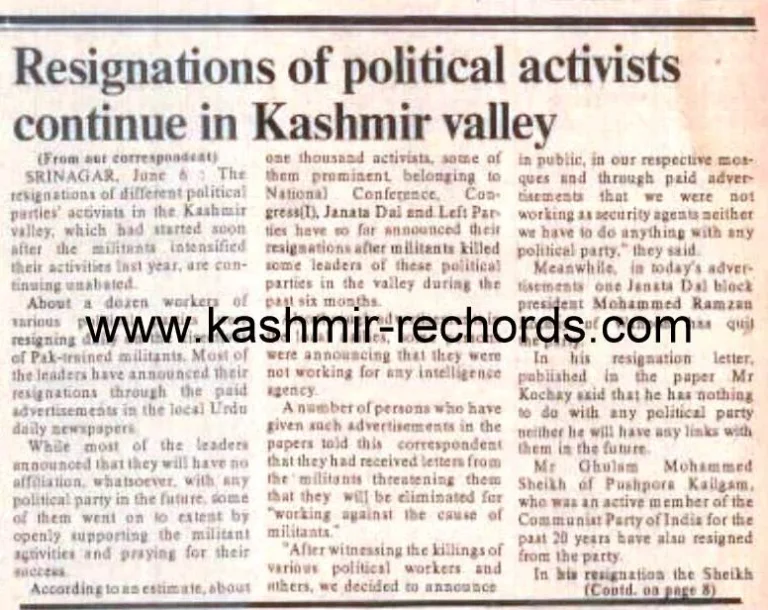
Whatever may be the reason, Kashmiri politicians are presently showing other shades and hues of their true colour. In 1990, they abruptly started quitting regional and national political parties on the `directions’ of militants and their organizations who were then ruling the roost in Kashmir. Now it is the other way round!
Interestingly, those who were then challenging the authority of India in Kashmir in 1990, their offsprings now publically pledge their loyalty to the sovereignty of the Union of India.
The Kashmiri Psyche
Arvind Gigoo occasionally presents himself as a maverick, showcasing his talent for crafting wry yet thoughtful satirical humor, undoubtedly infused with a discernible attribute of pathos.”
This professor of English possesses a profound understanding of the Kashmiri psyche, with no malice in his heart and that’s why his gifts of premonition are vivid…. In the early nineties, he penned an anecdote in his renowned book of aphorisms, which has since achieved cult status. In fact, he portrayed the predicament of those Kashmiris who flocked to newspaper offices and published notices emphasizing their disassociation from established mainstream political parties aligned with the Indian Constitution.
This, of course, was done to ward off potential attacks by fanatical terrorists who operated with impunity during that time, targeting those perceived to belong or associate with political organizations aligned with India. This strategy was formulated across the border and spearheaded by the who’s who of fundamentalist and separatist leadership. The movers and shakers of this strategy were, of course, late Sayed Ali Shah Geelani and others. During that period, newspapers were filled with numerous such notices, in anticipation of clearance certificates by militants, etc.
Situation in 1990
Arvind Gigoo immortalized one such situation in his famous book of aphorisms, “The Ugly Kashmiri” capturing it’s essence in his most inimitable style on page 63. A news clipping from his Book is presented here for our esteemed readers.
Real-life press releases and write-ups preserved at www.kashmirrechords.com belonging to that period consistently emphasized the detachment from political parties, both regional and national. These contemporaneous press clippings are reproduced to illustrate the events from the turbulent history of Kashmir during the decade beginning in the 1990s. In one such public notice, one Yasin Firdosi says… “Na mein Sher Hun, Na Bakra Hun..Na Nationali Hun, Na Congressi Hun…Na Jamati Hun, Na Gul Shahi Hun..Na Hamdani Hun..Na Mahazi Hun..Mein Sirf Yasin Firdosi Hun’’
Situation in 2024
The situation in the year 2024, leading up to the 18th Lok Sabha election (April to June), has witnessed a remarkable turnaround. Children and relatives of separatist leaders and elements are now observed rushing to newspaper offices to publish notices on their behalf. These notices emphatically assert their disassociation from separatist ideologies and affirm their unwavering faith in the Indian Constitution. They make it clear that they entirely disavow whatever beliefs or actions their parents may have stood for.
Time appears to have executed a complete reversal, finding itself at diametrically opposite points on its own scale. It commenced with a somber tone, yet it culminated joyfully and exceedingly optimistic, with the days ahead brimming with promise.