Home Blog Page 21

Dogra Legacy: From Cultural Fairs to Military Prowess

(Kashmir Rechords Exclusive)

In a fascinating glimpse into the past, a rare edition of Captain A.H. Bingley’s book “Dogras” provides  a detailed account of the valorous Dogra soldiers and their unique recruitment process. The book, originally printed in 1899 at the Central Printing Office in Shimla under the orders of the Government of India, was a comprehensive effort to compile information on the Dogras for their induction into the British Army.

A Cultural Insight into the Dogra Soldiers

Known for their bravery and loyalty, Dogra soldiers were traditionally selected at cultural Melas, fairs  and festivals. This method of recruitment was meticulously documented by Captain Bingley, a member of the 7th (Duke of Connaught’s Own) Bengal Infantry. His work not only highlights the military prowess of the Dogras but also delves into their history, customs, culture, and the regions they inhabited, including Jammu and Kashmir, Punjab and parts of Himachal Pradesh.

The book’s significance is further enhanced by its revisions. In 1921, A. B. Longden added to the original text, and later, Dr. Sukhdev Singh Charak included chapters on Dogra art and literature, making it an invaluable resource on Dogra history and culture.

Military Brilliance and Unique Recruitment

Captain Bingley emphasized the Dogras’ exceptional capabilities in mountain warfare, citing numerous expeditions on the Punjab frontier and their distinguished service in the Hunza-Nagar campaign of 1891 and the defence of Chitral. Unlike other conservative Hindus of the time, Dogras were open to sea voyages and foreign service, with many serving in China in 1860.

The book also highlights specific Dogra recruiting grounds, from Akhnoor to Chamba and Kangra, extending to the South and East of the Chenab in Jammu and Kashmir. It mentions territories along the border of Jammu, including Pathankot, Shakargarh, Sialkot, and Zafarwal, and regions like Jasrota and the Ravi Belt, inhabited by both Hindu and Muslim Dogras.

The Melas: A Unique Recruitment Ground

One of the book’s most intriguing revelations is the practice of recruiting Dogra soldiers at local fairs and Melas. These events, with both religious and commercial significance, were organized throughout the year in areas now part of Himachal Pradesh, Punjab, and Jammu and Kashmir. Notable recruitment fairs were held in the Kangra belt, Hoshiarpur area, and Jammu region, including places like Kangra, Jawala Mukhi, Dharmshalla, Parmandal, Mirpur, Ghagwal, Mansar, and Kana Chack.

However, the selection process faced challenges, as it was sometimes difficult to verify the character and antecedents of

recruits. Despite these limitations, this method highlighted the cultural strength and fighting skills of potential soldiers.

Changing Times and Practices

While some of these cultural and commercial fairs continue to be held, the recruitment process has evolved significantly. In the fast-changing modern lifestyle, the traditional practice of selecting soldiers at fairs has faded, replaced by more structured and formal recruitment methods.
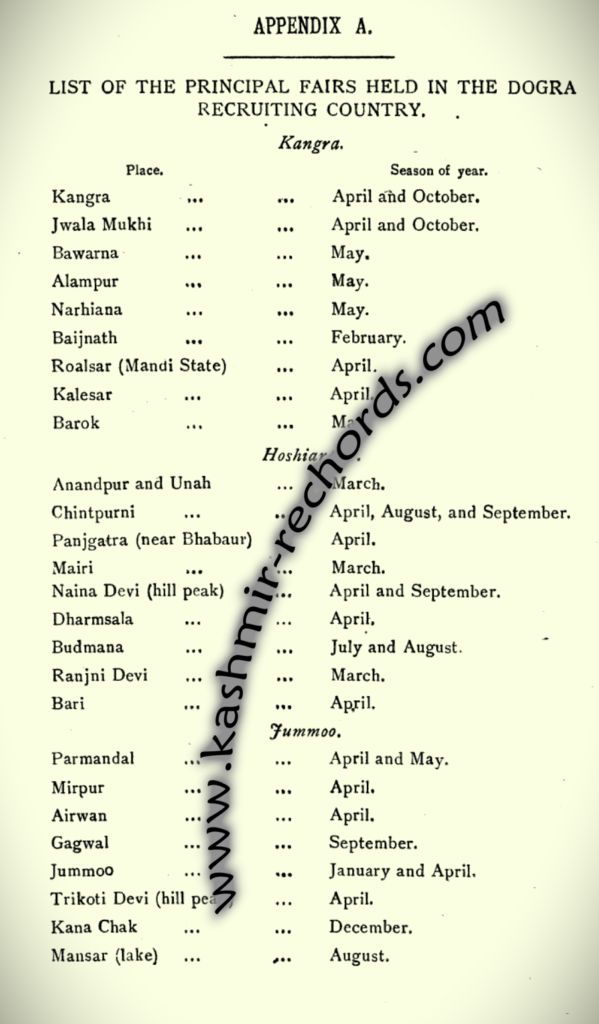
Kashmir Rechords, in possession of this rare edition, underscores the historical and cultural importance of Captain Bingley’s work. As the book finds renewed attention, it serves as a testament to the rich legacy and unique traditions of the Dogra soldiers, offering a window into a fascinating chapter of Military history.
Kashmir’s Quintessential Merchant and Philanthropist

(Kashmir Rechords Exclusive)
Kashmir Rechords is honoured to present the story of a remarkable yet relatively lesser-known historical figure from Kashmir. This individual was the wealthiest merchant of his era, renowned for his exceptional ability to unite people across religious, ethnic, and other divides. His legacy underscores the enduring importance of unity and development in our diverse society.

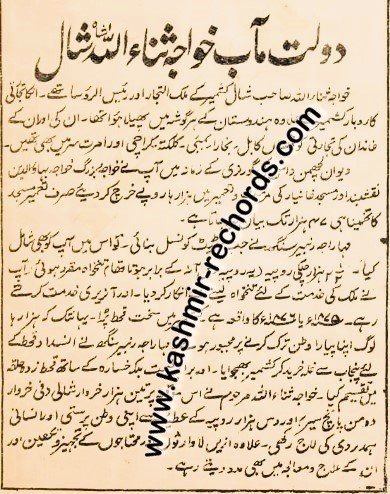
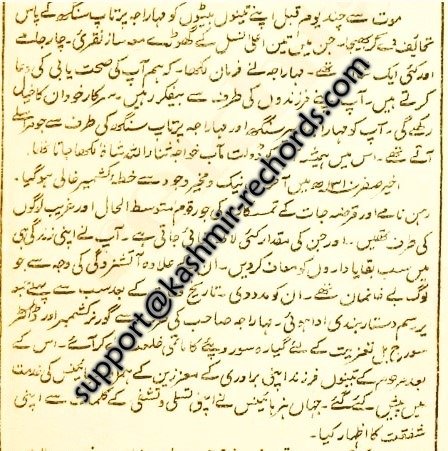
In his 1930 publication by Matba Kareemi Press, Lahore, noted Kashmiri-origin historian and journalist Muhammad Din Fauq highlights some prominent individuals  of 19th century from Kashmir who  had gained fame in British India. Preserved by Sundaraya Vigyan Kendram, Hyderabad, this book stands as a valuable historical document, listing illustrious Kashmiri Pandit and Muslim names side by side, reflecting the harmonious coexistence and mutual respect between the communities.

Fauq mentions his intent to inspire others by listing prominent Kashmiris who achieved success in their respective fields. Among them are notable figures like Pandit Bishamber Nath, Dr. Sir Mohd Iqbal, Daulati Aaliya, Raja Dina Nath, Khawaja Aziz Lucknowi, Tej Bahadur Sapru, Khawaja Sonaullah Shawl, and Justice Shamboo Nath Pandit.

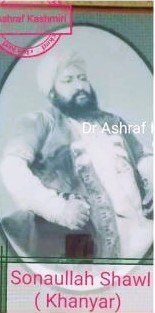
Pic Courtesy: Dr Ashraf Kashmiri

Khwaja Sonaullah Shawl: A Quintessential Kashmiri

A particularly notable figure is Khwaja Sonaullah Shawl, who never lost his connection to Kashmir despite his wide-reaching influence. Fauq terms him “Rayeesul-Raoosa,” meaning the richest among the rich. Shawl constructed residences in key cities such as Bukhara, Bombay, Calcutta, Karachi, Amritsar and Kabul. Renowned for his philanthropy, he donated substantial sums for the construction of Dargahs and mosques. When Maharaja Ranbir Singh established the first State Council in J&K, Shawl was included as a coveted member.

A Respected Trader and Philanthropist

Khawaja Sonaullah Shawl was one of the most respected traders of his era, with a chain of outlets in the region. A philanthropist, he was a friend of the Afghan ruler and was highly respected by the rulers back home. His surname, Shawl, reflects his prominence in Kashmir’s Shawl business.

A Page from Muhammad Din Fauq’s 1930 Book

Esteemed by the Dogra Maharajas

The Dogra Maharajas of Jammu and Kashmir held Shawl in great esteem. Maharaja Ranbir Singh (1857-1885) appointed him as a member of his State Council, offering a substantial salary of 2500 Chilki rupees, which Shawl declined, choosing to offer his honorary services instead. Maharaja Pratap Singh (1885-1925) and Amar Singh also held him in high regard, valuing his straightforward and truthful dealings.

Philanthropy During Kashmir Famine

During the terrible  Kashmir famine of 1877-1879, Shawl rose to the challenge, contributing three thousand kharwars of rice and ten thousand rupees to relief efforts. His generosity extended to respectful burials and treatment for the ill, showcasing his deep solidarity with his Kashmiri brethren.

Advocate for Knowledge and Learning

Shawl was a great admirer of learning, maintaining a private library with thousands of books in Persian, Urdu, Arabic, and English. He is credited with ameliorating and enlarging famous shrines in Srinagar.

Habba Kadal Fire and End of an Era

In around April-May 1893, a devastating fire  engulfed hundreds of households in Habba Kadal, Srinagar. Khwaja Sanaullah Shawl had gone to Punjab on a business trip. When he returned home, his heart was immensely saddened by the miserable condition of hundreds of residents of the Habba Kadal locality who had lost everything in the great fire. The victims included both Muslims and Kashmiri Pandits.

 The devastating fire Khawaja prompted Sonaulah Shawl to petition the Maharaja for the victims’ rehabilitation. He personally, as usual, donated in cash for their rehabilitation and assistance. The impact of the tragedy was heavy on his heart. He fell sick and towards the end of September 1893, corresponding to 1310 Hijri, ( as per Fauq’s Book), he breathed his last at his home. His passing marked the end of an era of unparalleled communal concord and enlightened leadership.

Descendants and Legacy

Shawl’s three sons, Khwaja Ghulam Hassan, Khwaja Nooruddin, and Khwaja Saududdin continued his legacy. Saududdin, however, played a significant role in the political awakenings of Kashmir, notably linked to the July 13, 1931 incident. His efforts in submitting a memorandum to Lord Reading, demanding rights for Muslim subjects, led to his externment to Kohala by Maharaja Pratap Singh’s soldiers. He was, however,  recalled by Maharaja Hari Singh from the British Territory in 1926.

In  his death,  Kashmir lost not just a prosperous merchant but a beacon of unity and harmony. Khwaja Sonaullah Shawl’s life epitomized the values of wisdom, faith, and communal harmony, leaving an indelible mark on Kashmir’s history.
Kargil Conflict and the Birth of PDP !

(Kashmir Rechords Desk)

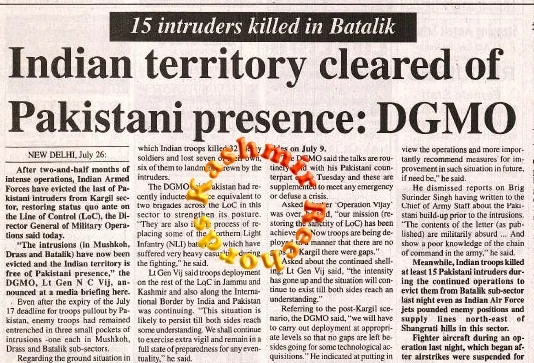
The last week of July 1999 is etched in the annals of Jammu and Kashmir’s history as a period of intense military engagement and significant political reconfiguration. Amidst the throes of the Kargil War, where the Indian Army was fervently pushing back Pakistani infiltrators in the rugged terrain of the Kargil sector, a notable political development was taking shape. Mufti Mohammad Sayeed, a prominent political figure and former Union Home Minister, chose this critical juncture to part ways with the Indian National Congress and establish his own regional political entity, the People’s Democratic Party (PDP).

The Kargil Conflict and India’s Triumph

Each year on July 26, India commemorates Kargil Vijay Diwas, celebrating the Nation’s victory over Pakistani forces in the Kargil War. The conflict, which saw intense fighting in the high-altitude region of Northern Kargil District in Ladakh, culminated in the successful eviction of Pakistani troops from strategically important mountain tops. This victory not only showcased the valour and resilience of the Indian Armed Forces but also marked a significant moment of national pride and unity.

The Birth of PDP

Just two days after the celebration of Kargil Vijay Diwas, on July 28, 1999, Mufti Mohammad Sayeed having already quit Congress, alongside his supporters, including his daughter Mehbooba Mufti, announced the formation of the People’s Democratic Party (PDP). This move was a strategic realignment in Jammu and Kashmir’s political landscape. Rumours at the time suggested that Mufti, leveraging his deep understanding of the Indian government’s handling of Kashmir affairs, aimed to create the PDP to challenge the dominance of the National Conference and bring about a new“ political order”.

The Political Landscape Post-1999

The PDP’s inception temporarily brought a new  but different dynamic to the politics of Jammu and Kashmir. Both Mufti Mohammad Sayeed and Mehbooba Mufti ascended to the position of Chief Minister, albeit through coalition governments with mainstream national parties. The PDP’s role in bringing about phases of relative “peace and stability’’ in Kashmir, though in piecemeal, was seen as a testament to its initial purpose, but not with much success.

The Shift Post-2019

Twenty-five years after these events, as the Nation celebrates Kargil Vijay Diwas, the political landscape of Jammu and Kashmir has undergone seismic shifts. The abrogation of Article 370 on August 5,  2019 dismantled the special status of Jammu and Kashmir, leading to the reorganization of the State into two Union Territories: Jammu and Kashmir, and Ladakh, with Kargil now part of the latter. This move has significantly altered the political dynamics, with the PDP struggling to find its footing in the new order.

1863: First Indian Calcutta High Court Judge Was a Kashmiri!

(Kashmir Rechords Exclusive)

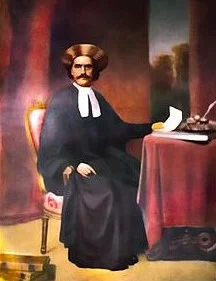
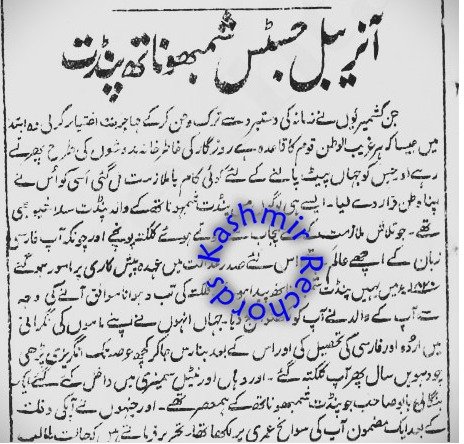
In an unprecedented achievement, Justice Shambunath Pandit, a Kashmiri Pandit, became the first Indian judge of the Calcutta High Court in 1863. His remarkable tenure, unfortunately cut short by his death in 1867 at the age of 47, left an indelible mark on India’s legal history.
Justice Shambunath Pandit—a Kashmiri Connection.

A Journey from Kashmir to Kolkata

Justice Shambunath Pandit’s story began with his father, Sadashiv Pandit, who migrated from Kashmir in the late 18th century. Moving through Punjab and the United Provinces (now Uttar Pradesh), Sadashiv finally settled in Bhowanipur, Kolkata. Shambunath’s early education in Urdu, Persian, and English took him to Lucknow and Benaras. By 14, he was back in Calcutta, excelling in literature at the Oriental Seminary.

A Pillar of Legal and Social Reform

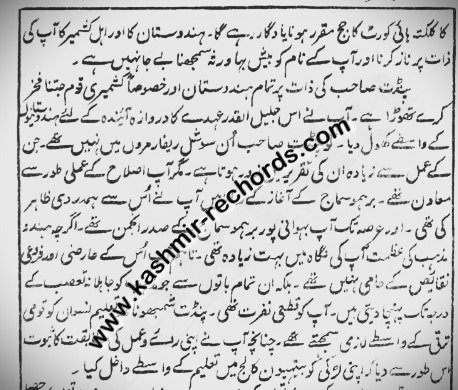
Justice Pandit’s contributions went beyond the courtroom. He was a founding member of the British Indian Association and played a key role in establishing the Jnan Prakasika Sabha (Truth Revealing Society), which evolved into the Bhowanipur Brahmo Samaj. His advocacy for female education was significant; he supported John Drinkwater Bethune’s school for girls and actively participated in Vidyasagar’s widow remarriage campaign.

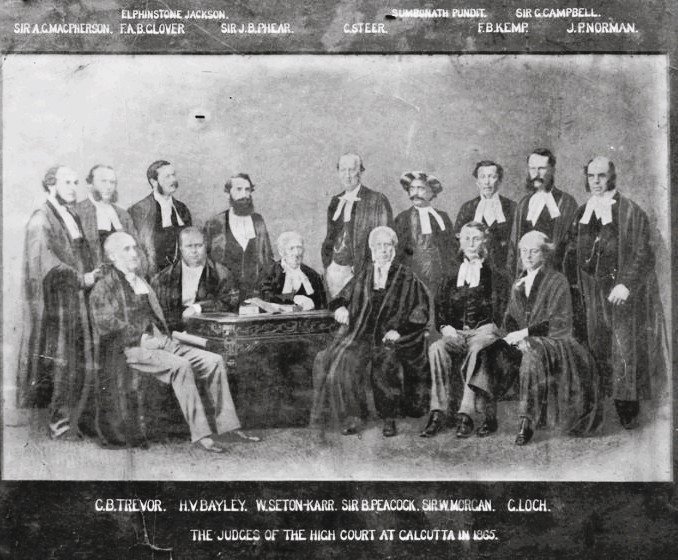
Justice Shambunath Pandit along with other Judges of Calcutta High Court—1865. ( Pic Courtesy:: https://www.calcuttahighcourt.gov.in/)

A Distinguished Legal Career

Starting as an Assistant to the Sadar Court Record-keeper, Justice Pandit quickly rose through the legal ranks. He published notable works, including “Notes and Comments on Bacon’s Essays,” and became a distinguished criminal lawyer. Appointed as Junior Government Pleader in 1853 and Senior Government Pleader in 1861, he joined the Calcutta High Court as a judge in 1863, making significant legal contributions, particularly in resuming Lakhiraj lands.

Legacy and Recognition in Kolkata

Justice Pandit’s legacy endures in Kolkata, where a major government hospital, setup in 1902 and a prominent road are named after him. His commitment to social progress and charitable disposition were well-regarded, spending a third of his income on medicines for the poor and supporting orphans and underprivileged students

Constructed in 1902, Shambunath Pandit Hospital still exists in Kolkata!

The First of Many Legal Luminaries

Appointed on February 2, 1863, Justice Pandit paved the way for future legal giants like Justice Dwarka Nath Mitter, Sir Ashutosh Mookerjee, and Justice P.B. Chakravartti, the first Indian permanent Chief Justice of the Calcutta High Court. The Calcutta High Court, established alongside the High Courts of Bombay and Madras, remains a cornerstone of India’s judicial system.

An Untimely Demise

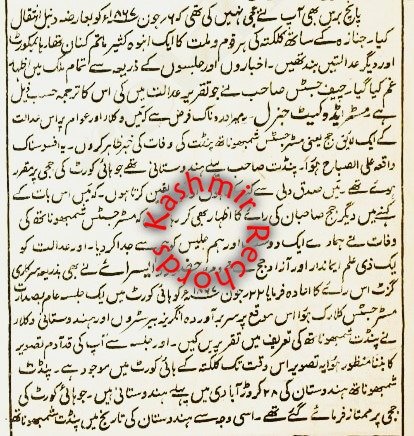
Justice Pandit’s life was tragically cut short when he succumbed to a carbuncle on June 6, 1867. His passing was deeply mourned by the judges of the High Court, his friends, and admirers. He left behind two sons, Pran Nath Pandit and Bishambhar Nath Pandit, continuing his distinguished lineage.

Justice Shambunath Pandit’s trailblazing journey from a Kashmiri family to a revered High Court judge underscores his enduring legacy in Indian history.
When Kashmiri Pandits United to Aid 1903 Kashmir Flood Victims!

By: Kanwal Krishan Lidhoo*
The heart fills with joy when reflecting on the unity and compassion demonstrated by Kashmiri Pandits living across British India during the early 20th century. When they learned about the plight of their Kashmiri brethren, who were devastated by the notorious floods of July 1903 followed by a severe drought, plunging the entire valley into extreme destitution and misery, they galvanized themselves to provide succor. Their efforts transcended considerations of caste, community, and religion, showcasing a deep love for their ancestral land even though they had been physically distant for centuries.

The Catastrophe of 1903

The floods of July, 23, 1903, marked a catastrophic event for Kashmir, with the entire city of Srinagar submerged, transforming it into a vast lake the likes of which have never been seen before (including the floods of the year 2014). This natural disaster was followed by a severe drought that  further compounded the suffering of the valley’s inhabitants. In response to these calamities, the Kashmiri Pandit community living outside Kashmir  that time, organized a large-scale relief effort. They launched a campaign to seek and collect donations from their community members and extended networks across India. This pan-India mobilization highlighted the indomitable spirit and unbreakable bond that the Kashmiri Pandits maintained with their homeland. Despite their geographical separation, their connection to Kashmir remained profoundly strong.

Relief to All Kashmiris

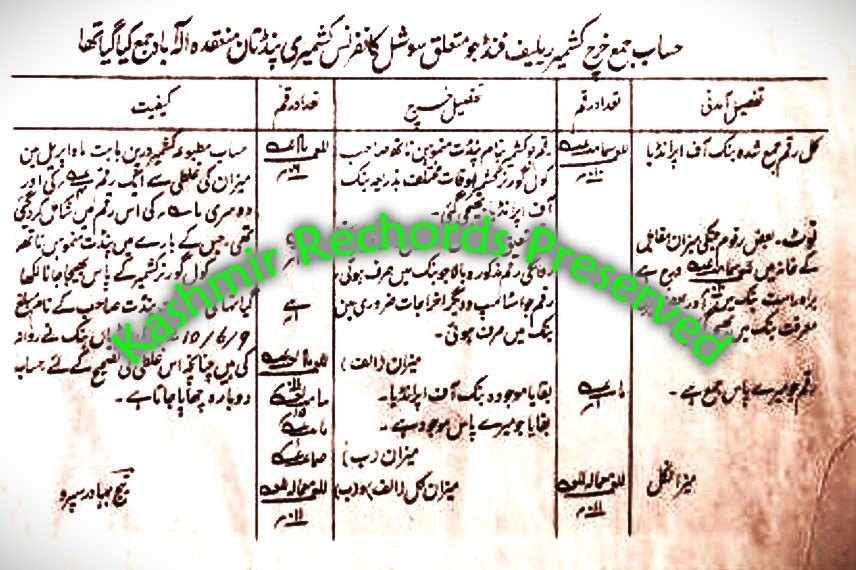
A document (1905) highlighting the efforts of Kashmiri Pandits living outside India to provide relief to their brethren back home.
The fostering of unity within the community for their devastated  Kashmiri brethren projected an empathy and cohesiveness rarely seen. Their motive was clear: to assert their sense of belonging to Kashmir and provide relief to all Kashmiris, irrespective of caste, community, or religion. This spirit of solidarity and humanitarianism extended beyond immediate relief. It also fostered a sense of cultural and emotional continuity with their ancestral land, reinforcing their identity and heritage.
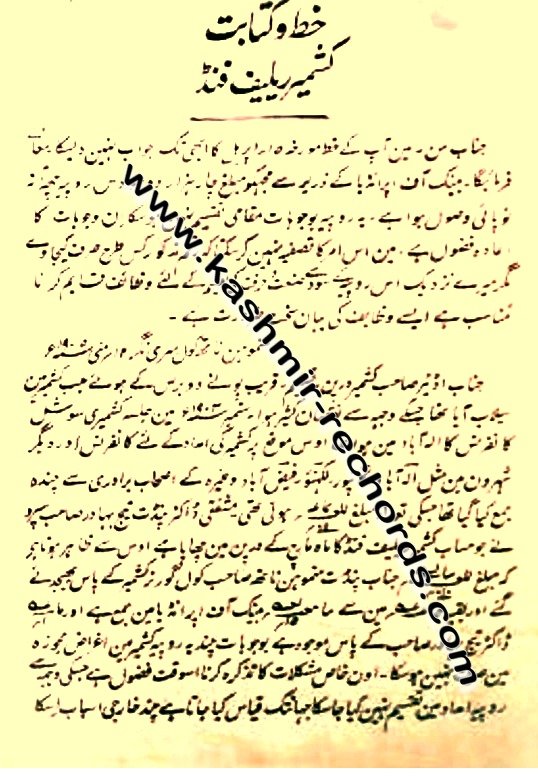
(Fascimile of correspondence between Pandit Manmohan Koul, Governor of Kashmir and Tej Bahadur Saproo of Allahabad)
A similar situation repeated itself years later when Kashmiri Pandits living abroad rose to the occasion,  trying to mobilize resources to support the educational and medical needs of  some of their community members who were victims of forced migration from Kashmir. This demonstrated a continuity of the values of compassion, unity, and resilience that the community upheld.

Leadership and Coordination

Returning to the floods of 1903, historical records available with Kashmir Rechords reveal that it was the quality leadership and efforts of the then  Governor of Kashmir, Pandit Manmohan Nath Koul and the renowned Kashmiri Advocate from Allahabad,  Pt Tej Bahadur Sapru,  who played a crucial role in galvanizing the Kashmiri Pandit community for this noble cause. Their leadership ensured that the relief efforts were well-coordinated and effective. A special Kashmir Relief Fund Account was created in  the Upper India Bank Limited, Allahabad  of the then United Provinces where the collected money (which was more than ten thousand rupees) was deposited and subsequently disbursed through the office of the Governor of Kashmir. Donations continued to pour in until May 1905, reflecting the sustained commitment of the community.
Rare documents from that period, analyzed  by Kashmir Rechords, present formidable correspondence between,  Sri Pratap Singh, the  Maharaja Bahadur of Jammu and Kashmir, and Governor of Kashmir. In one of the communications  dated  May 5, 1905, Maharaja Pratap Singh  inquired about the remaining   corpus of funds collected by Kashmiri Pandits within and outside Kashmir that had not yet been distributed. The Governor of Kashmir, Pandit Manmohan Koul responded by informing the Maharaja that he had a remaining amount of over  500 rupees, 6 annas, and 9 payas with him.
In a subsequent communication dated May 31, 1905, Maharaja Pratap Singh directed Governor of Kashmir to forward the  undisbursed relief  amount to the management committee of Hindu College, Srinagar.
Maharaja Pratap Singh noted:-

“The college has come up recently and I am a promoter of this college. And now, since the challenges of floods of 1903 and drought have been neutralized, those who have collected and made available the donations want this amount to be provided to help this Hindu College. Fortunately, the situation has improved, and as such, there is no longer a need for the relief fund.’’

An Enduring Connection

The series of events and actions underscore the enduring connection and responsibility that Kashmiri Pandits felt towards their homeland. Their collective efforts not only alleviated immediate suffering but also contributed to the long-term educational and social infrastructure of Kashmir. In all this, one notices that while a Kashmiri Pandit may be taken out of Kashmir, Kashmir cannot be taken away from a Kashmiri Pandit. The legacy of their commitment and compassion continues to inspire and resonate through history.
*Kanwal Krishan Lidhoo is a noted Broadcaster, Author and acclaimed  Translator approved by Sahitya Akademi, New Delhi. He is a Founding Director of Kashmir Rechords Foundation.

The Failed Agra Summit: How a Kashmiri-Origin Bureaucrat Thwarted Musharraf’s Plans

(Kashmir Rechords Desk)
Twenty-three years ago, on July 16, 2001, as Pakistan and India neared the signing of a potentially historic document favoring Pakistan on Kashmir matters, a bureaucrat of Kashmiri Pandit ancestry intervened, thwarting General Pervez Musharraf’s efforts to persuade Prime Minister Atal Bihari Vajpayee to sign a joint declaration against New Delhi’s interests.


A “Hidden Hand’’

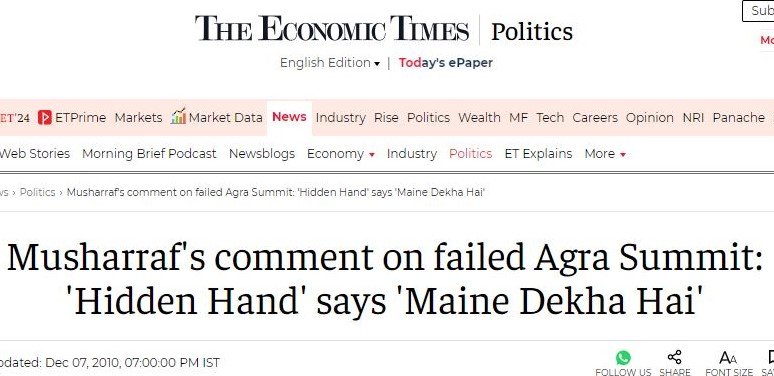
Despite three unsuccessful attempts to draft the joint declaration, this Kashmiri Pandit bureaucrat ensured that India’s interests were safeguarded, ultimately leading to the collapse of the Agra Summit and leaving Musharraf disappointed. Nine years later, Musharraf himself revealed that Indian External Affairs Ministry official Vivek Katju was the “Hidden Hand” responsible for scuttling the summit. According to Musharraf, Katju, then serving in the Ministry of External Affairs, insisted on referencing the Shimla Agreement of 1972, preventing the summit from recognizing Kashmir as a key issue.
The Economic Times (above) and The Hindustan Times’ Reports on Vivek Katju’s “Hidden Hand”

\Musharraf lamented that had Katju not influenced Prime Minister Vajpayee, the Agra Summit could have concluded in favour of Pakistani interests. In his autobiography “In the Line of Fire,” Musharraf criticized Katju’s negotiating style and demeanor, accusing him of adopting a hardline stance detrimental to the peace process.

Vivek Katju Profile

Vivek Katju, born in 1949, is a retired Indian diplomat who served with distinction in the Indian Foreign Service (IFS), holding various crucial positions both domestically and abroad. His tenure included ambassadorial roles in Afghanistan and Myanmar, where he significantly shaped India’s bilateral relations.
Musharraf’s criticism of Katju highlights the challenges inherent in high-stakes diplomatic negotiations, particularly when dealing with entrenched historical and political issues. Despite differing viewpoints, Katju’s role was pivotal in representing India’s interests and navigating the complexities of Indo-Pak relations.

A Tale of Two Somnath Zutshis!

(Kashmir Rechords Exclusive)

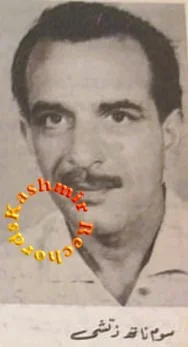
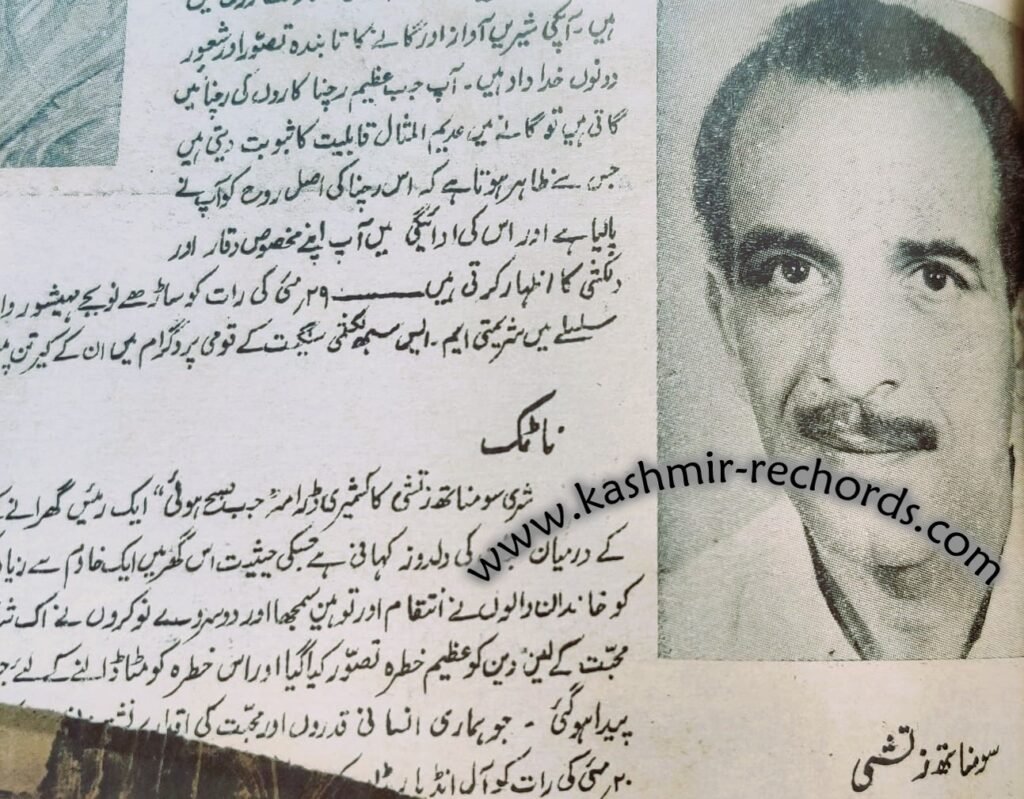
If you’re familiar with Charles Dickens’ “A Tale of Two Cities,” you might find the story of the two Somnath Zutshis equally intriguing. These two men, one from Srinagar and the other from Calcutta, share not only their name and surname but also almost identical professional capabilities, leading to a great deal of confusion in the digital world. This has overshadowed their significant contributions to the arts of translation, writing for radio, theatre, and cinema, keeping their achievements unsung.

The Srinagar Somnath Zutshi

Somnath Zutshi from Srinagar, Kashmir, was a contemporary of the nonagenarian Pran Kishore and  Dinanath Nadim, a prominent Kashmiri poet of the 20th century. Despite his considerable contributions, the dates of birth and death attributed to him often get confused with those of his Calcutta namesake. By the time the Calcutta-born Zutshi was born, the Srinagar-based Zutshi had already started his literary journey, crafting short stories.

Initially writing in Urdu, the Srinagar Somnath Zutshi later switched to Kashmiri. He served as the Secretary of the Progressive Writers Association of Kashmir and, alongside Dina Nath Nadim, pioneered Kashmiri short story writing. From the inception of Radio Kashmir, Srinagar, on July 1, 1948, Zutshi began writing short stories. Despite his application for a permanent position at Radio Kashmir, he never secured a berth.

One of Zutshi’s notable works, “Yeli Phol Gaash” (translated into English as “When the Light Dawned” and included in Neerja Mattoo’s book “The Greatest Kashmiri Short Stories Ever Told”), features the character Rasul, inspired by the progressive genre’s short stories of that era. This period saw frequent visits from notable progressive writers, poets, and painters like Rajinder Singh Bedi, Khwaja Ahmed Abbas, Balraj Sahni, S H Raza, and Devinder Satyarthi, who acted as catalysts for creative activity in the valley.

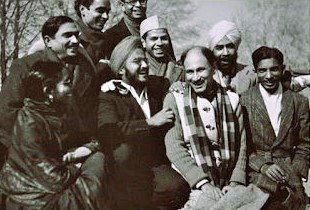
Dateline Srinagar, 1947: Somnath Zutshi with Rajinder Singh Bedi and other eminent writers. ( Courtesy: Chinar Shades)
Zutshi also wrote dramas in Kashmiri. His radio drama “Viji Vaav” won first prize in the All India Radio Drama competition of 1955. Additionally, he was instrumental in creating counter-propaganda dramas during the 1965 and 1971 wars with Pakistan, as mentioned in the book “Radio Kashmir in Times of Peace and War.” He received the Sahitya Akademi Award in 2003 for his short story “Yeli Fol Gaash.” As a translator, he brought Franz Kafka’s “The Trial” and Nikolai Gogol’s “The Inspector General” into Kashmiri, earning the Soviet Land Nehru Award for his translation of Gogol in 1974.

The Calcutta Somnath Zutshi

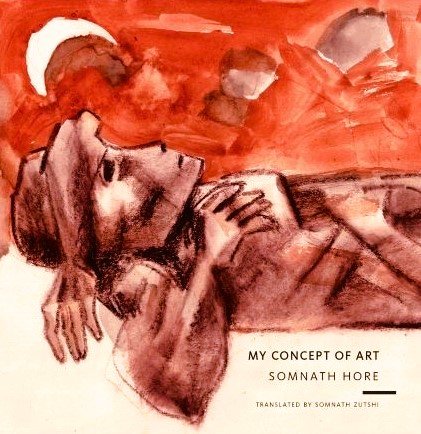
On the other hand, Somnath Zutshi from Calcutta (1944-2014) was primarily a psychoanalyst by training but wrote extensively for and about cinema. He translated works by Banaphool, Mrinal Sen, and Somnath Hore. Hore (1921–2006) was a renowned Bengali sculptor and printmaker whose sketches, sculptures, and prints were reactions to major historical crises and events in twentieth-century Bengal, such as the Bengal Famine of 1943 and the Tebhaga movement.

Conclusion

The two Somnath Zutshis, despite their different backgrounds and areas of focus, have both made significant contributions to their respective fields. Yet, their similar names and professional abilities have led to persistent confusion, preventing each from receiving the recognition they deserve. This tale of two remarkable men highlights the complexities of identity and legacy in our interconnected world.

Chalant: Jaanbaaz Kishtwari’s Unique Singing Style

  (Kashmir Rechords Exclusive)
Kishtwar, a region nestled in the Jammu province of Jammu and Kashmir (J&K), is celebrated for its rich history and vibrant contributions to spiritual, literary, and fine art traditions. This area has cultivated a unique cultural identity through its synthesis of influences from both the Jammu and Kashmir regions, with a notable inclination towards the latter.
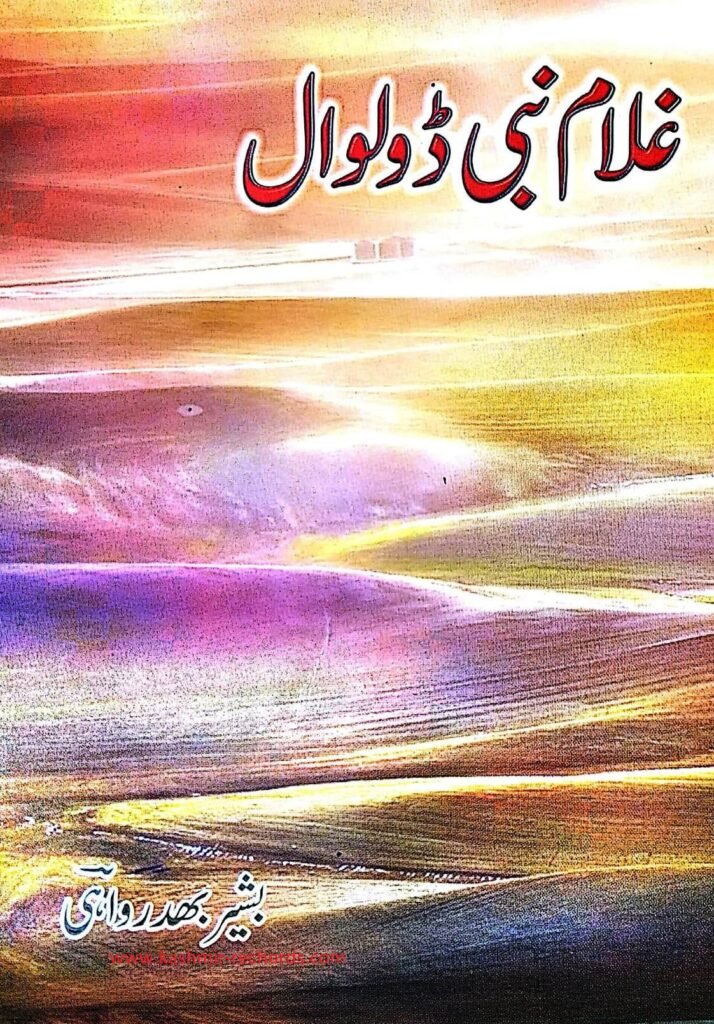
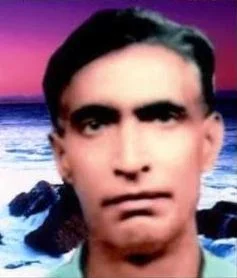
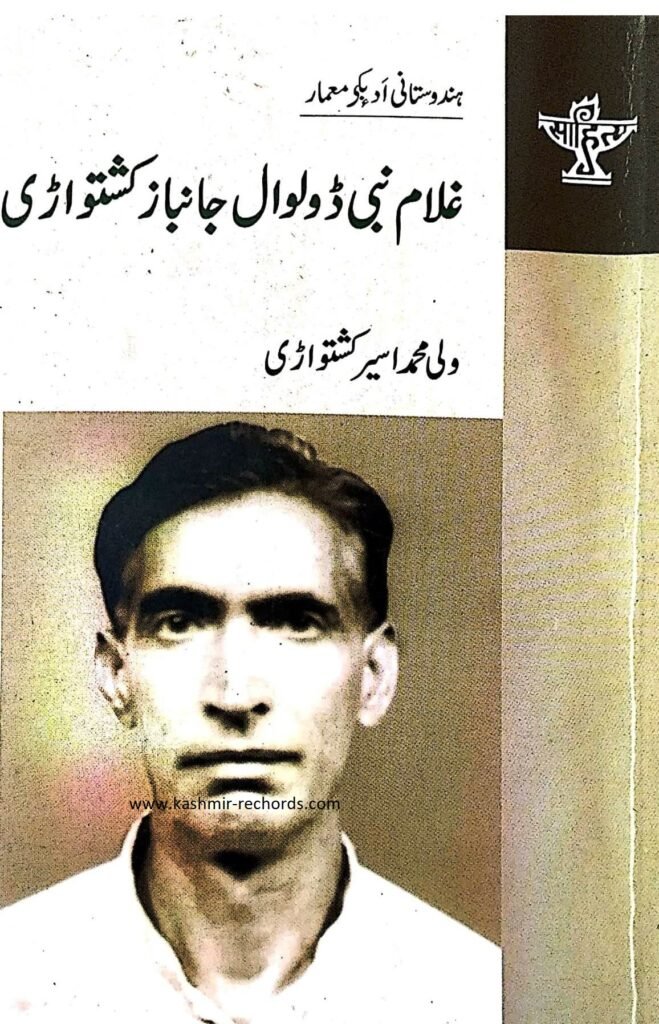
Ghulam Nabi Dolwal–A Sahitya Academy Publication
Among the notable figures of Kishtwar, Ghulam Nabi Dolwal, widely known as Jaanbaaz Kishtwari, stands out as a true renaissance man. His journey began in Dolwal village, from where he would rise to leave an indelible mark on the cultural landscape of Kishtwar. Wali Mohammad Aseer, an esteemed scholar in Kashmiri literature, meticulously documented Jaanbaaz Kishtwari’s life and contributions in a monograph published by Sahitya Akademi, New Delhi, in 2014. According to Aseer, Jaanbaaz Kishtwari (Dolwal) was the fifth-generation resident of Kishtwar, tracing his lineage back to Rehman Joo, who migrated from Vessu (Anantnag) to Dol village. This migration, and the subsequent move to Kishtwar, likely took place in the early part of the twentieth century.
From a young age, Ghulam Nabi Dolwal displayed a natural talent for singing and dancing, excelling in both disciplines. His innate abilities were further nurtured by the great poet Rasa Javedani of Bhaderwah, who regularly organized singing mehfils (gatherings) in his area. This mentorship fostered a profound bond between the two cultural giants, allowing Dolwal to hone his skills and expand his artistic horizons.
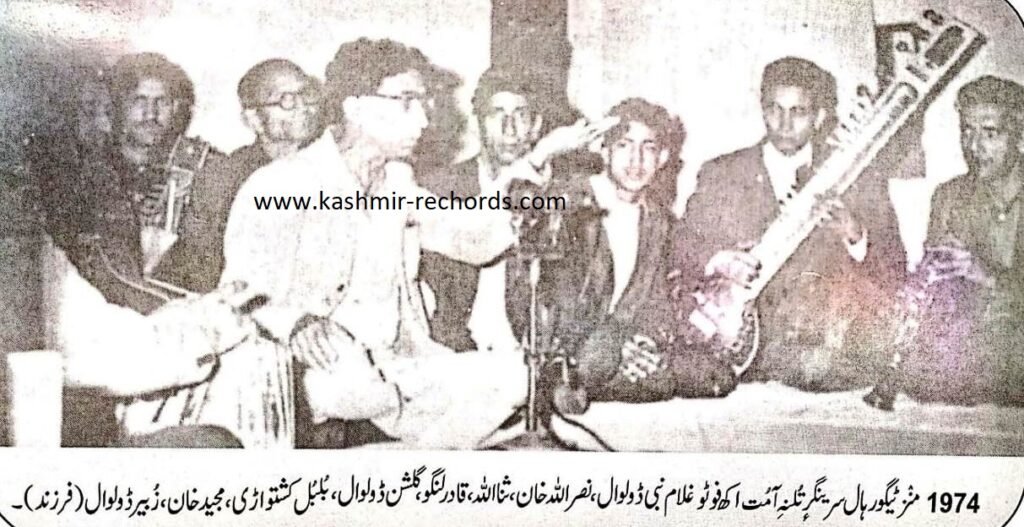
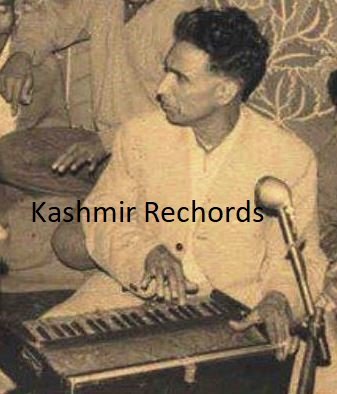
Circa 1974--- Janbaaz Kishtawri performing at Tagore Hall Srinagar.

Pioneer  of “Chalant

Jaanbaaz Kishtwari’s multifaceted talent as a poet, writer, and musician converged to create a unique legacy. His most significant contribution was the development of Chalant, a distinct singing style rooted in the folk traditions of the region. This innovative form of singing, characterized by its intricate details and emotive power, transcended geographical and temporal boundaries. Critics and audiences alike were captivated by Jaanbaaz Kishtwari’s Chalant, often comparing its profound impact to the ecstatic verses of Omar Khayyam.

Bashir Bhaderwahi, an eminent intellectual from Bhaderwah, provides further insight into the Chalant style in his monograph published by the J&K Academy of Art, Culture, and Languages. On page 39, Bhaderwahi suggests that Chalant may have origins in the ancient musical and dance traditions of the Doda and Kishtwar regions, areas historically inhabited by the Nagas. He draws parallels between Chalant and the Kud dance, a vibrant reflection of these ancient traditions. Through his revival and enhancement of Chalant, Ghulam Nabi Dolwal breathed new life into a tradition that had been dormant for hundreds of years, imbuing it with contemporary relevance and appeal.A Man of Harmony
Beyond his artistic achievements, Jaanbaaz Kishtwari was a man of progressive values. He passionately believed in the unity of all religions and championed the principles of coexistence and mutual respect. His poetic expressions beautifully encapsulated this philosophy:

Somebody calls Him Ram, Another Rehman
One calls Him Shyam and Another Subhan
One calls Him Krishna and Another Yazdan
One Allah and Another Bhagwan
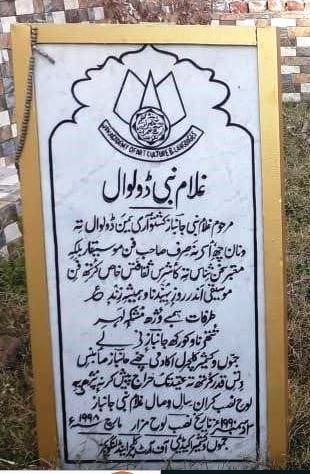
Ghulam Nabi Dolwal’s resting Place
In our modern age, figures like Jaanbaaz Kishtwari are rare and precious. Their contributions to cultural and spiritual life are invaluable, deserving of our utmost appreciation and protection, akin to the care we bestow upon the most precious jewels.