Home Blog Page 2

Shocking! Vivekananda was denied land in Kashmir

(Kashmir Rechords News Desk)

Very few people must be knowing that  Swami Vivekananda, one of the most popular monks and spiritual leaders of India was denied  a piece of land  for establishing  a Monastery and a Sanskrit College in Kashmir!

Looks unbelievable, but this  shocking incident dates back to Swami Vivekananda’s second  visit to Kashmir in 1898 when Maharaja Pratap Singh, who treated him with utmost respect, during the course of discussions, wanted him to choose a tract of land for establishing a Monastery in Kashmir in order to give young people training in non-dualism.

  Despite the selection of the land and the submission of the proposal to the British Resident for approval, the same was denied as the British Agent had refused to grant land for establishing a Monastery and a Sanskrit College in Kashmir for unknown reasons.  When the same was communicated to Swami Vivekananda, he had accepted the whole thing philosophically.

British Residency was established on  September 25,  1885 during the rule of Maharaja Pratap Singh. Sir Oliver St. John was appointed the first British Resident in Jammu and Kashmir.

Vivekananda :A Biography

There is the mention of this  shocking incident in a Book “Vivekananda :A Biography’’, written by Swami Nikhilananda at page number 271. According to the Book, published by Advaita Ashrama, Calcutta in January 1953, Swami Vivekananda during his stay in Kashmir (August 8 to September 30, 1898), had felt an intense desire for meditation and solitude. Upon the insistence of Maharaja of Kashmir, the land was identified but   a month later, following the refusal to grant the same, Swami’s devotion was later directed to Kali, the divine Mother.

Apart from this incident, the biographer also elaborately discusses Swami’s visit to many parts of Kashmir, including Kheer Bhawani Tulmulla, visit to Amarnath Cave, stay in Srinagar and his meetings with different sections of society there.     

It was first time on 10 September 1897, when this great saint visited Srinagar for a short duration. The Swami had left Srinagar for Baramulla and reached Murree on October 8 and from there to Rawalpindi on October 16, 1897.

Swami Vivekananda in the company of his disciples and Kashmiri Pandits

 The second visit of Swami Vivekananda to Kashmir (June to October, 1898) was more eventful. This time a party of Europeans was accompanying him. Prominent among them was Sister Nivedita. During this period,  he visited many places of religious and historical importance like Shankaracharya Hill, Hari Parbat, Martand, Panderthan, temples of Avantipora, Bijbehara, Mughul Gardens of Nishat and Shalimar, besides  shrines of Shri Amarnath Ji Cave and Mata Kheer Bhawani in Tulmulla. The period from June 22 to July 15, 1898 was spent by Vivekananda and his western disciples in houseboats (dungas) on the Jhelum, in and around Srinagar.

The party had left Kashmir on October 11, 1898 and came down to Lahore. Swami Ji reached Belur Math on October 18, 1898.

(Swami Vivekananda’s 1898 Kashmir Visit. Left to Right: Jesophine McLeod, Mrs Ole Bull, Vivekananda and Sister Nivedita)

About the Biographer

Swami Nikhilananda (1895–1973), the author of `Vivekanda: The Biography” was  born as  Dinesh Chandra Das Gupta. He  was a direct disciple of Sri Sarada Devi. In 1933, he founded the Ramakrishna-Vivekananda Centre of New York, a branch of Ramakrishna Mission, and remained its head until his death in 1973. An accomplished writer and thinker, Nikhilananda’s greatest contribution was the translation of Sri Sri Ramakrishna Kathamrita from Bengali into English, published under the title `The Gospel of Sri Ramakrishna’ (1942)

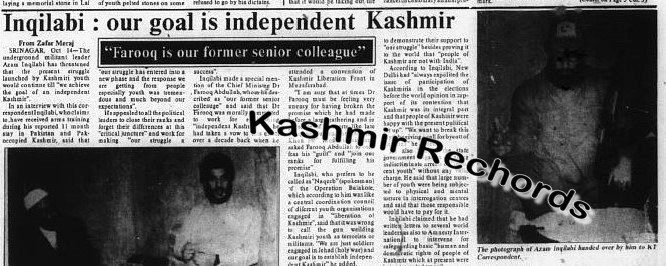
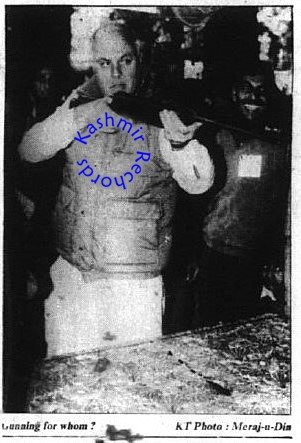
When NC Lauded JKLF and Sought to Reignite the Plebiscite Front

A stunning political U-turn buried in old newspaper archives reveals how the National Conference almost abandoned mainstream politics at the peak of militancy.
(Kashmir Rechords Archival Desk)

Kashmir, February 1990.
Streets under siege. Militants dictating the day. Government authority collapsing. And as the Valley burned, an earthquake quietly rocked mainstream politics—one so dramatic that most contemporary observers either forgot it or never knew it happened!

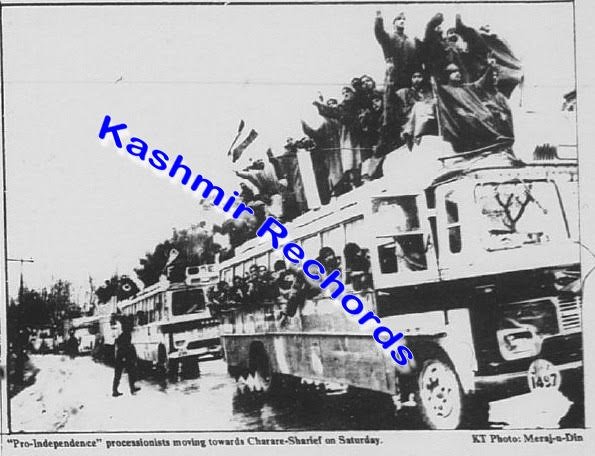
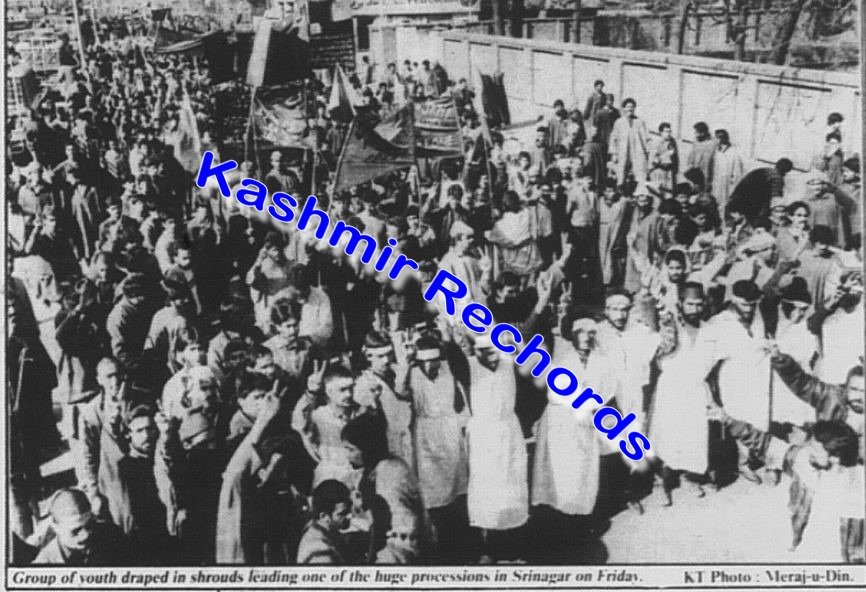
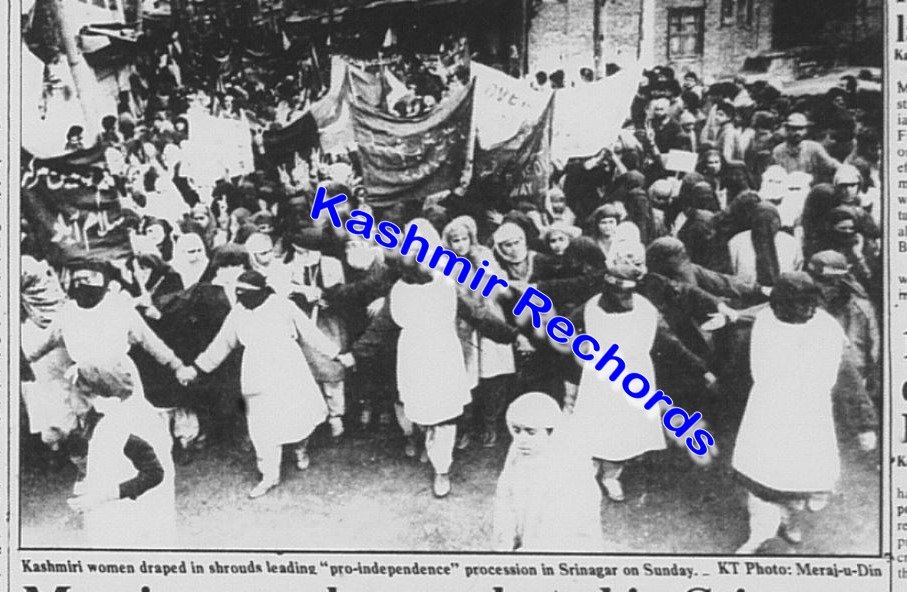
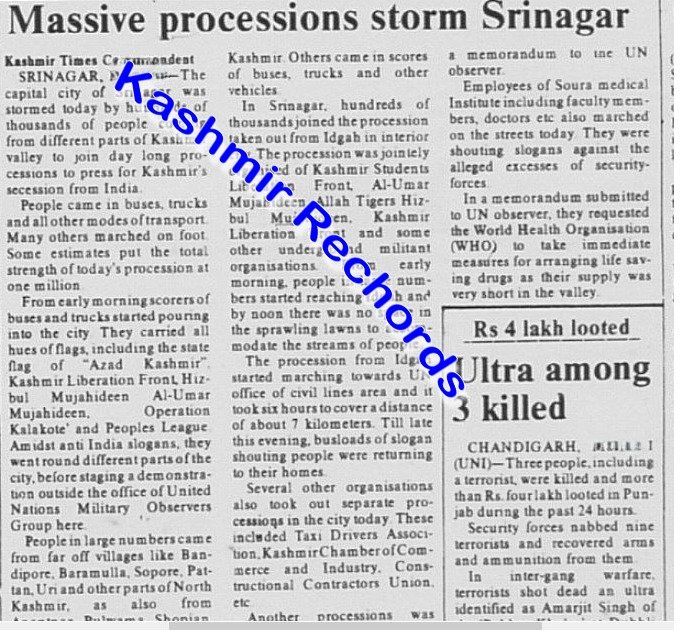
Newspaper reports dated February 21, 1990, accessed by Kashmir Rechords, expose a sensational political moment: The National Conference (NC) dissolved its entire Kashmir unit and openly backed militants of the Jammu & Kashmir Liberation Front (JKLF)—even calling them Mujahideen.

Even more explosive:
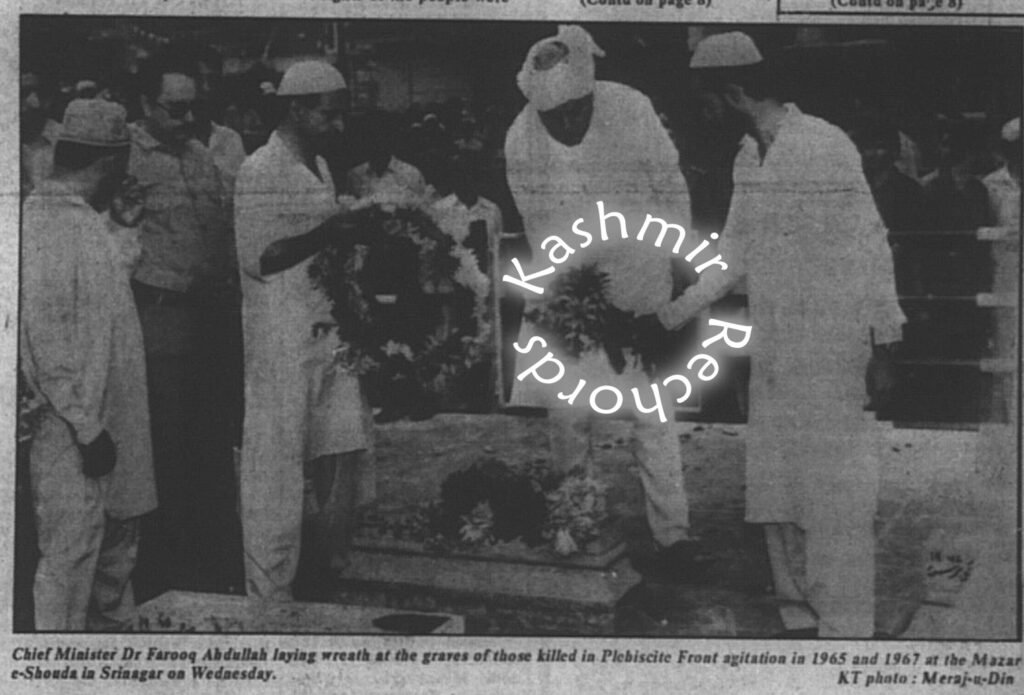
NC leaders proposed reviving the Plebiscite Front, the same separatist platform that had once challenged India’s sovereignty over Kashmir.

This happened barely 15 years after the Plebiscite Front had been merged back into the NC following the 1975 Indira–Sheikh Accord. And yet, in the chaos of 1990, history seemed ready to reverse itself.

The Day NC Hit Reset: February 21, 1990

In a press statement in Srinagar, Abdul Salam Deva, a senior NC leader and former minister, dropped the bombshell:

“There is no alternative but to respect the genuine aspirations of the people.”

Within minutes, NC’s Kashmir provincial unit, youth wing and local committees stood dissolved.
In their place: Mahaz-e-Rai Shumari — the Plebiscite Front’s original name.

Deva declared the party’s intent to:

  • Work jointly with JKLF militants,
  • Follow their calls, and
  • Support their “freedom movement.”

The announcement read like a complete ideological surrender to the militant wave sweeping the Valley.

A Throwback to the Sheikh Era

To understand the gravity of this political U-turn, one must revisit the past.

What Was the Plebiscite Front?

  • Formed in 1955 by loyalists of Sheikh Abdullah after his arrest in 1953.
  • Led by Mirza Afzal Beg.
  • Demanded a UN-supervised plebiscite to decide whether J&K would accede to India or Pakistan.
  • Dominated Valley politics until 1975.
  • Dissolved after the Indira–Sheikh Accord when Sheikh Abdullah returned as Chief Minister.

To announce its revival in 1990—a year of unprecedented militancy—was nothing short of political defection from constitutional politics.

“Follow the Mujahideen” — NC’s Stunning Directive

Perhaps the most shocking line reported from the February 21 meeting was this:

NC workers were asked to unite with JKLF activists (called ‘Mujahideen’) and follow their directions.

This wasn’t political ambivalence; it was political surrender.

At a time when militancy was peaking, the ruling party’s cadre was being instructed to align with those who had taken up arms.

Warnings to Farooq Abdullah

The meeting also issued an extraordinary warning to former Chief Minister Farooq Abdullah:

Do not ignore the “sentiments and aspirations of the people”…
…and do not fall prey to “vested interests,” as Sheikh Abdullah once did.

It was an open rebuke to the party’s national president—rare in any political setup, unprecedented in NC’s history.

Delhi Blamed, Militants Praised

The statement went further:

  • Accused New Delhi of adopting a colonial attitude,
  • Claimed the Centre had always trampled human and democratic rights,
  • And extended full support to the JKLF-led separatist movement.

The militants were praised for:

maintaining communal harmony — a tradition “Kashmir has shown to the world.”

That such assertions came from NC’s provincial leadership in 1990 is politically explosive even today.

Five Days Later: The Dramatic Resignation

If the February 21, 1990 declaration was dramatic, what followed was Shakespearean.

On February 26, 1990, just five days after call for reviving the Plebiscite Front and praising militants, Abdul Salam Deva suddenly resigned:

  • Quit the National Conference,
  • Gave up politics altogether,
  • And proclaimed he had “no affiliation whatsoever with any political party.”

It was a stunning exit at a time when the Valley’s politics were entering a dark tunnel.

In his resignation note, Deva traced his political journey:

  • Muslim Conference: 1946–1955
  • Plebiscite Front: 1955–1975
  • National Conference: 1975–1989

His departure symbolised the disintegration of mainstream politics under the shadow of the gun.

The Forgotten Story That Changes How We Remember 1990

When the NC returned to power later, and even today in the Union Territory era, hardly anyone recalls that for a brief yet extraordinary moment in 1990:

  • The party dissolved itself in Kashmir,
  • Tried to resurrect the Plebiscite Front,
  • Praised militants publicly,
  • And formally aligned with the JKLF’s separatist movement.

It was a moment when the mainstream blinked.

A moment when fear, chaos and political opportunism collided.

A moment now resurfacing—thanks to old newspaper archives—as one of the most sensational and politically explosive chapters of Kashmir’s modern history.

Kashmir 1990 : When Terrorists Hunted IB Officers!

(Kashmir Rechords Exclusive)

On the freezing morning of January 15, 1990, a routine bus ride in Srinagar turned into a scene of horror that still haunts Kashmir’s conflict narrative. Moti Lal Bhan, an upright and quietly efficient Intelligence Bureau (IB) officer, boarded the Khanda-Nowgam-Srinagar shuttle bus unaware that this would be the last journey of his life.

At Natipora, three armed youth led by the dreaded Bitta Karate stormed the bus and ordered Bhan to get down. He protested. A fellow passenger, Mohammad Akbar Wani, alleged to be “ IB Informer’’, intervened, pleading with the gunmen to leave Bhan alone. The response was chilling—Wani was shot dead on the spot. Moments later, Bhan was shot point-blank in the head. No one in the bus dared move. No one came forward.

Instead, as chilling reports later suggested, some local photojournalists were alerted for a “photo-session” of the bodies .

Bhan’s “crime” was simple: he had helped apprehend Abdul Ahad Waza, a Pakistan-trained militant. For that, he was marked for death.

This is just one story—one among dozens.

1990: When IB Officers Stood Alone

The National Investigation Agency (NIA)—India’s federal counter-terror arm—was established only in December 2008, born from the ashes of the 26/11 Mumbai attacks. But in 1990, during the first wave of militancy, there was no such shield.

There was mostly the Intelligence Bureau (IB)—India’s century-old internal intelligence unit. And in Kashmir, they stood alone, exposed and hunted.

What happened in those early months of 1990 remains one of the most tragic and least-told chapters of India’s national security history.

Militant groups—backed, trained and guided from across the border—had chalked out a sinister plan: eliminate intelligence officers first.
And they succeeded. Worse, insiders allegedly leaked details of IB field officers to terror networks, sealing their fate.

Kashmir’s newspapers of that time prominently carried images  and stories of slain officers—an open tactic to terrorise minorities and cripple India’s national machinery in the Valley.

Here are some of the most heart-wrenching stories from those dark days.

A: January 2, 1990 — The First Blow: R.N.P. Singh

Just days into the new year, R.N.P. Singh, Assistant Central Intelligence Officer, was shot dead in Anantnag, Kashmir.
He had stepped out like any other day. He returned home only as a lifeless body. He was killed right on the footpath. Instead of rushing to help, locals celebrated.

This killing marked the opening act of what would become a systematic campaign. He was reportedly gunned down by “JKLF” militant Manzoor Darzi.

B: January 8, 1990 — The Beeru Execution: Krishan Gopal Chouhan

Beeru in Budgam was a militant stronghold, and Sub-Inspector Krishan Gopal Chouhan, running a lone IB operation there, had become a thorn in their side.

On a bustling street, a man in a Pheran stalked him.A Kalashnikov appeared. Five bullets ended his life.

Within hours, the terrorists struck again in Rawalpora, killing Inspector Hameedullah Bhat of the State’s counter-espionage unit. By then, several civilians too had been executed on mere suspicion of being “informers’’.

The message was clear: terror would rule.

C: February 14, 1990 — The Gowkadal Horror: Tej Krishen Razdan

Valentine’s Day 1990 became a day of mourning.

Tej Krishen Razdan, a technical officer posted at IB’s Gupkar Road unit, had visited home at Badyar to see his ailing parents. On his return, using public transport like any other Kashmiri, he was forced off a mini-bus at Gowkadal and shot dead by two young militants.

Then began a shameful spectacle. His blood-soaked body was dragged to Red Cross Chowk, put on public display. Onlookers did not flinch.
Even the shopkeepers did not move.

When a police jeep finally arrived, the driver pleaded with locals to help lift the body. Nobody stepped forward. The driver had to drag the martyr’s body alone.

E: The Eid Homecoming That Turned into Death: Rafiq Ahmed Wani

Rafiq Ahmed Wani, an IB security assistant serving in Assam, came home to Srinagar’s ShalaKadal to celebrate Eid.
Militants shot him dead in his own home.

A Fatal Mistake: The 1989 DG Conference

The killings of IB officers can also be traced to an ill-timed decision—a DG-level conference organised at Centaur Hotel, Srinagar, in mid-1989.

The high-profile event blew the cover of IB’s presence and network in the Valley.
Terror groups quickly mapped identities.Within months, IB officers became the first targets.

1990 vs. Today — A Different Battlefield

Much blood has flown since those grim months of 1990.
Today, the national security landscape has changed dramatically.

Agencies like NIA, SIA and strengthened state intelligence units operate with modern tools, legal backing and—most importantly—local support, something IB officers tragically lacked in 1990.

They fight terrorism with coordination, equipment and fearlessness that their predecessors could only dream of.

But the price paid by those early IB officers—the forgotten sentinels—must never be erased from memory.

When a Snake Spared Indira Gandhi!

0
(Kashmir Rechords Archival Desk)

A 40-year-old newspaper clipping reveals an astonishing claim: an infant Indira Gandhi was once spared by a mysterious, multi-headed snake in Kashmir.

Yes—incredible, unbelievable, yet printed boldly on November 14, 1984, by Jammu & Kashmir’s leading English daily, Daily Excelsior.
A boxed news item on a prominent page carried the sensational testimony of an eyewitness who swore he saw it all unfold—in the presence of Jawaharlal Nehru, Kamla Nehru and their Kashmiri Pandit family priest.

At a time when the Nehru family often visited their ancestral homeland, Jawaharlal Nehru and Kamla Nehru travelled to the celebrated Achhabal Gardens in South Kashmir around 1918, carrying with them their new-born daughter — Indira Priyadarshini, only a few months old.

The infant was placed gently on a small wooden cot, covered lightly with a muslin cloth, as the young couple and their family priest walked a few steps away, admiring the Mughal-era terraced lawns.

What happened next defies belief — yet was printed as fact in the Daily Excelsior on November 14, 1984.

The Multi-Headed Serpent

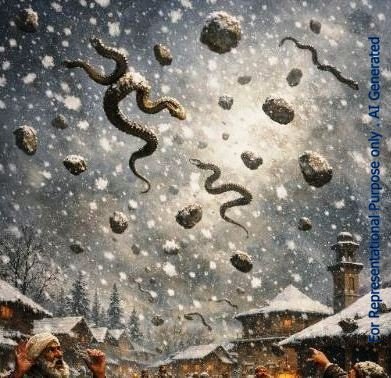
According to the eyewitness, a multi-headed snake suddenly approached the sleeping child.
Kamla Nehru saw it first — and screamed.
Jawaharlal rushed forward, horrified.
But the priest remained calm.

He told them the serpent was a divine sign, insisting that neither panic nor force be used.
In an astonishing moment, the priest asked the Nehrus to prostrate before the snake.

And so they did — Jawaharlal Nehru, Kamla Nehru and the priest himself bowed to the serpent.

Without harming the child, the snake slowly slithered back into the grass, vanishing as mysteriously as it had appeared.

The Eyewitness Steps Forward

The dramatic tale was narrated decades later by Amarnath Sadhu, a 77-year-old Kashmiri Pandit whose contractor father had taken him to the gardens that very day.
Then a shy ten-year-old boy, Sadhu recalled watching the Nehru family from a distance — and witnessing the stunning scene unfold.

He told the newspaper, Daily Excelsior in 1984:

“Since that day, I consider Mrs Gandhi as Bharat Mata.”

Sadhu retired as an Accountant in the Education Department — but carried the memory of that incident all his life.

Why This Story Matters?

Despite extensive research by acclaimed authors like Pupul Jayakar and Katherine Frank, this serpent incident never entered the official narrative.
Not a single reference exists in the holdings of the Nehru Memorial Museum & Library, PM Museum, or other major archives.

Yet this 1984 newspaper account — now resurrected by Kashmir Rechords — suggests that the early life of India’s future Prime Minister may have held mysteries and near-mythical moments lost to time.

History remembers Indira Gandhi as the Iron Lady — but this resurfaced tale hints that destiny may have been watching over her from the very beginning, under a muslin cloth in a Kashmir garden.

From SKIMS to Red Fort: How Militancy Has Repeatedly Infiltrated Kashmir’s Medical Fraternity

0

WHEN THE WHITE COAT TURNS GREY

(Kashmir Rechords Archival Desk)

The recent arrests of Kashmiri-origin doctors in the Red Fort blast conspiracy—stretching from Faridabad and Lucknow to Pathankot and Srinagar—have once again exposed a troubling undercurrent in Kashmir’s conflict narrative: the ease with which some medical professionals have drifted, been dragged, or been willingly drawn into the orbit of militancy.
Even militants themselves have often prefixed their nom de guerre with “Doctor”—not because they possessed a degree, but because the title carried credibility, trust and influence in Kashmiri society.

This pattern is not new. It has a trail more than three decades long, full of contradictions—doctors who healed the injured by day and ideologised insurgents by night; doctors who acted as mediators between the government and militants; doctors who protected militants, treated them secretly in hospital wards; and doctors who were themselves kidnapped, shot dead, or punished for defying militant diktats.

The 2025 case is only the latest reminder.

A History Written in Hospital Corridors

From the very beginning of militancy in 1989, medical institutions—particularly SKIMS, SMHS and Bone & Joint Hospital—became shadow theatres of insurgency. Militants sought treatment there covertly; sympathetic staff helped them; and those who resisted often paid with their lives.
The medical fraternity enjoyed unparalleled respect, which is precisely why militants found it useful to infiltrate or influence it.

No figure symbolises this complex overlap more sharply than Dr Abdul Ahad Guru, the famed cardiac surgeon who performed the first open-heart surgery at SKIMS. Revered professionally, he also became literary  “Dr Guru,” the ideological guide of the banned Jammu and Kashmir Liberation Front (JKLF).
This was not a title invented by militants—he was genuinely a doctor and a respected public intellectual who, in the first phase of the insurgency, enjoyed extraordinary influence.
He visited Saudi Arabia in 1991; he was detained multiple times under the Public Safety Act; he was released under public pressure.


But on 31 March 1993, he was abducted by  the very gunmen whom he supported. His body was found the next day, triggering valley-wide protests and a bandh openly announced by JKLF.
His killing remains one of the most politically charged assassinations of that early insurgent era, with JKLF giving a call for entire Kashmir shut-down, triggering panic, disrupting life and forcing authorities to clamp curfew.

That same period saw a series of doctor-related tragedies, many of them documented by Human Rights Watch, Amnesty International, and contemporary newspapers.

Doctors as Victims, Doctors as Suspects

Dr Farooq Ahmad Ashai, known for his criticism of  alleged human-rights violations, was shot dead on 18 February 1993. Human Rights Watch recorded that he was shot while travelling in a car marked with a red cross. Local rumours painted him as a militant sympathiser—illustrating how lives fell between official suspicion and militant coercion.

Sarla Bhat, a young nurse at SKIMS, was kidnapped from her hostel and murdered on 18 April 1990—one of the earliest militant actions aimed at intimidating Kashmiri Pandit medical staff and asserting control over the Institute, which at that time was crawling with militant activity.

Dr Rafiq Ahmad Veda, a senior doctor at SMHS Hospital, was arrested on 17 May 1990 for alleged links with  Pakistani handlers. His arrest provoked an unprecedented doctors’ strike that paralysed Srinagar’s healthcare system.

Dr Surinder Dhar, Head of Chest Diseases Hospital, was abducted on 31 March 1992 after he refused to treat an injured militant without notifying the police.

At the same time, militants began adopting “Doctor” as a battlefield alias because of the inherent weight the title carried. Saifullah Mir, widely known as “Doctor Saif”, though not medically trained, was one such Hizbul Mujahideen commander who supposedly tended to wounded militants.
For militants, the prefix wasn’t academic—it was psychological warfare.

The New Face of an Old Pattern: Red Fort Blast Case

The terror module busted in November 2025 shows that the doctor-militancy nexus has not vanished; it has merely transformed its methods—from covert medical help in hospitals to online radicalisation, inter-state movement, encrypted communication and operational roles.

Among those arrested or implicated in the Red Fort blast investigation:

Dr Shaheena Shahid, a medical practitioner with an academic background, accused of being a recruiter linked to Jaish-e-Mohammed’s women’s wing (allegations under investigation).
Dr Umar-un-Nabi, a Kashmiri doctor whom investigators suspect was connected to the explosive-laden Hyundai i20 that blew up near Red Fort on 10 November 2025.
Dr Adeel Majeed Rather and Dr Muzammil Shakeel, whose arrests widened the probe across multiple states.

The profession is again facing uncomfortable scrutiny—because the symbolism of a white coat offers both camouflage and credibility to militant networks.

Why Doctors? The Inconvenient Truth

Three threads have remained constant across the decades:

  1. Credibility: Doctors command trust. A radicalised or compromised doctor can move unnoticed across checkpoints, social circles and institutions.
  2. Access: Hospitals, especially during the 1990s, were safe spaces for militants seeking treatment, refuge or contact.
  3. Influence: A doctor’s word in Kashmiri society carries weight—making them ideal mediators, facilitators or ideological influencers.

It is this mix of access, respect and authority that made doctors valuable to militant groups then—and continues to do so now.

The White Coat, Once Again in Question

The re-emergence of doctors in terror-related investigations unsettles public faith, not just in the profession but in the fragile relationship between medicine and conflict in Kashmir.
From Dr Guru to the SKIMS kidnappings, from “Doctor Saif” to the Red Fort blast module, the story has been one of a profession repeatedly pulled into the grey zones of insurgency—sometimes willingly, sometimes under threat, and sometimes fatally.

The 2025 arrests are not an entirely new chapter—they are a continuation of a long, complicated, and deeply troubling story.
When the conflict reaches the corridors of medicine, a society loses not only healers—it loses its last refuge of neutrality.

When Nehru Broke His Silence on Kashmir’s Accession with India!

1

For the first time since the upheaval of Partition, Prime Minister Pandit Jawaharlal Nehru addressed a stunned Nation on November 2, 1947, breaking his silence on the tribal invasion of Jammu and Kashmir. Speaking from All India Radio’s Delhi Station, Nehru delivered a historic broadcast that shaped the course of the subcontinent’s history.

Kashmir Rechords has unearthed one of the rarest archival treasures of that era — the full transcribed version of Nehru’s broadcast. The document provides gripping insight into how India’s first Prime Minister revealed the unfolding crisis and announced decisions that would secure Kashmir’s future.

Opening his address with “Friends and Comrades…”, Nehru while declaring “ We Shall Keep Our Pledge” warned the Nation of the horrors faced by Kashmir as well-armed tribal raiders from Pakistan swept down from the Abbottabad–Mansehra axis. In hundreds of trucks, these forces overran Muzaffarabad and were advancing rapidly toward Srinagar, leaving behind destruction and civilian killings.

Nehru described the frantic developments of October 26, 1947, when the Defence Committee met under immense pressure while the raiders neared Srinagar’s outskirts. By evening, the Instrument of Accession had been signed by Maharaja Hari Singh. “We decided to accept this accession and to send troops by air,” Nehru declared, revealing India’s decisive step to secure Kashmir.

He credited the National Conference volunteers, led by Sheikh Mohammad Abdullah, for maintaining order in Srinagar at a time when the State administration, police, and military had collapsed. “There was no administration left, no police, no troops. And yet Srinagar functioned,” Nehru said, praising both Sheikh Abdullah’s leadership and the Maharaja’s crucial decision to appoint him as head of the administration.

Nehru’s tone hardeed when he directly accused Pakistan of allowing or facilitating the invasion. “All of these men have come across from Pakistan territory. Is this not a violation of international law?” he asked, marking the first official and open denunciation of Pakistan’s involvement.

Yet, when speaking about the people of Kashmir, Nehru’s voice softened. He reaffirmed India’s moral and military pledge: “We have given our word to the people of Kashmir to protect them against the invader — and we shall keep our pledge.” He spoke of Kashmir’s wishes, its aspirations, and the promise of a referendum once peace returned.

The November 1947 broadcast remains a defining moment in India’s early history — a moment when a deeply divided nation looked to its Prime Minister for clarity and assurance. Through this rediscovered transcript, Kashmir Rechords brings back the voice of India’s conscience, transmitted through war-time tension from a fragile New Delhi to a wounded Valley.

For a digital copy of the full transcribed and published version of Nehru’s address, readers may contact:📧 kashmirrechords@gmail.com 📧 support@kashmirrechords.com

For another article, based on Nehru’s unique pictures,
Click Here:

Kashmir Rechords remembers Nehru through rare pictures

3
(Kashmir Rechords Desk)

Pandit Jawaharlal Nehru’s birthday falls on November 14 and the day is every year celebrated as Children’s Day.  As the first Prime Minister of the Independent India (1947–64), Nehru established the Parliamentary government and became noted for his nonaligned policies in foreign affairs. 

Nehru has been a multi-dimensional personality—a  Prime Minister, a writer, a historian,  a socialist and  above all from Kashmir ancestry. Even if he is criticised for some reasons, including the so-called Kashmir mess,  but the fact is that  Nehru played a leading role in the development of the internationalist outlook of the Indian Independence struggle.

While much has already been debated, deliberated and  written on Nehru,   Kashmir Rechords from its archives,  in its humble way, is producing some of the rare pictures of Jawahar Lal Nehru  as a tribute to this great leader on his birth anniversary.

Nehru with World personalities

Nehru in speech mode

Nehru with Indira

Nehru as a Sportsman 

Poetry, write-ups

Nehru with his two nieces–Nayantara Pandit (left) and Chandralekha ( right)–daughters of Vijaylakshmi Pandit.

For another Article— Nehru on Kashmir Accession, Click Here:

When a Kashmiri Pandit Youth was Murdered in 1987!

(Kashmir Rechords Exclusive)

The year was 1987. Kashmir was simmering. The scars of the Anantnag riots of 1986 — when shrines and temples of Kashmiri Pandits were vandalized — were still fresh. The State’s law and order machinery was in disarray, shaken further by the controversial closure of the Darbar Move in October that year. Amid this charged atmosphere, the small, vulnerable community of Kashmiri Pandits once again found itself caught in the crossfire of growing communal overtones.

And then, one day in November, tragedy struck — quietly, cruelly and almost unnoticed.

A young man, only 25, was murdered in broad daylight in an old Srinagar locality.

But who was this youth? And why does almost no one remember him today?

Kashmir Rechords recently unearthed a forgotten newspaper clipping dated November 10, 1987, reporting the brutal killing of Ashok Kumar Ganjoo, a young Kashmiri Pandit who had married just two years earlier. The report mentioned that Ashok Ganjoo was on his way to his in-laws’ home at Sathu Barbar Shah, concerned about the well being of his six-month-old daughter, when he was attacked.

According to the newspaper, the assailant — later identified by the police as Ramzan Sheikh — confronted Ashok Ganjoo on the road and stabbed him in the chest. He was rushed to the hospital but succumbed to his injuries soon after.

Police said there was no prior enmity between the two. No clear motive was established.

But for the Kashmiri Pandit community, the message was chillingly clear.

Srinagar was tense that evening. The shock rippled through the narrow lanes of the old city and the small Pandit households that were already living in fear. The All India Kashmiri Pandit Conference (AIKPC) convened an urgent meeting under the chairmanship of H.N. Jattu, condemning what they called an “inhuman” act. They demanded a Judicial Commission headed by a High Court judge to probe the murder.

That was nearly four decades ago.

Whether such a Commission was ever set up, or what became of the investigation, remains a mystery. No public record traces what happened to the accused. No answers were ever made known.

What remains today is a haunting silence — and the fading memory of a young man whose death, in hindsight, seemed like a grim prelude to what awaited the entire community just two years later.

Was the killing of Ashok Kumar Ganjoo a random crime? Or was it, as some in the community later feared, a forewarning — a “test dose” — before the larger tragedy of 1990?

History may never tell us for sure. But somewhere in the forgotten pages of a 1987 newspaper, his name still speaks — a silent reminder of a time when the storm was only beginning to gather.