Home Blog Page 18

A Fallen Star: The Tragic Story of Dr. Deepak Mathu, IPS

0

What makes this story even more heartbreaking is that it wasn’t terrorists from across the border who claimed Dr. Mathu’s life, but some of  his own colleagues—people he trusted, people he worked with.

(By: Dr. Rajesh Bhat)
In the troubled landscape of Jammu and Kashmir, where militancy has claimed countless lives, the loss of talented individuals has often been overlooked. The mountains and valleys of this conflicted land have witnessed unimaginable grief, especially for those like Dr. Deepak Mathu, a bright star among the Kashmiri Pandits, whose life was tragically cut short under suspicious circumstances. His story, however, isn’t just one of a life lost to terrorism, but of a young man’s dreams, ambitions, and ultimately, betrayal by those he trusted.

A Brilliant Soul with Great Ambition

Dr. Mathu was not just any ordinary soul. He was a brilliant mind, a kind heart, and a man with a vision for the Nation. Born to devoted parents, he grew up with a fierce desire to make a difference. After completing his Medical Degree with distinction, he could have easily settled into a prestigious career as a doctor. But his ambitions were far greater. Determined to serve the Nation, he set his sights on the Indian Administrative Service (IAS), eventually earning a place in the Indian Police Service (IPS) cadre for Jammu and Kashmir. His future was bright, and his path was one that would have surely led to greatness.

But tragically, his life took an unexpected and devastating turn!

The Mysterious Death

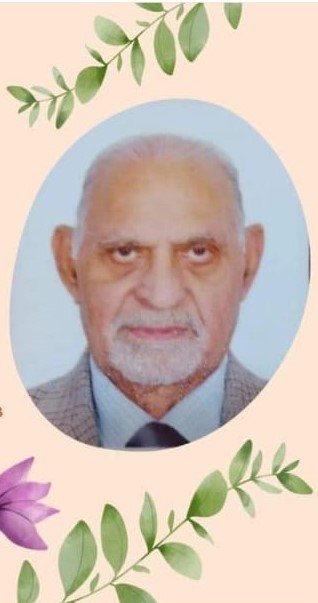
In the early 1990s, amid the growing unrest in Srinagar, Dr. Mathu, an IPS Officer, posted in Srinagar,  was found dead under mysterious circumstances. His family, devastated by the loss, refused to believe that his death was a mere accident. The circumstances surrounding his passing raised too many questions, and it soon became clear that his life had been snuffed out as part of a sinister conspiracy. What makes this story even more heartbreaking is that it wasn’t terrorists from across the border who claimed Dr. Mathu’s life, but some of  his own colleagues—people he trusted, people he worked with.

A Father’s Unyielding Quest for Justice

For his father, the quest for justice became an unrelenting pursuit. Days turned into weeks, and weeks into months, as he knocked on every door of authority, hoping to unearth the truth behind his son’s death. Yet, every effort was met with cold bureaucracy, frustrating delays, and the callousness of a system that often fails to protect its best and brightest. Despite his tireless efforts, Dr. Mathu’s father was left without answers.

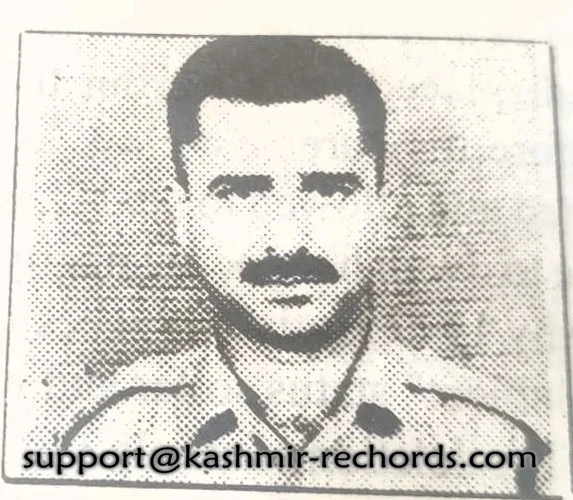
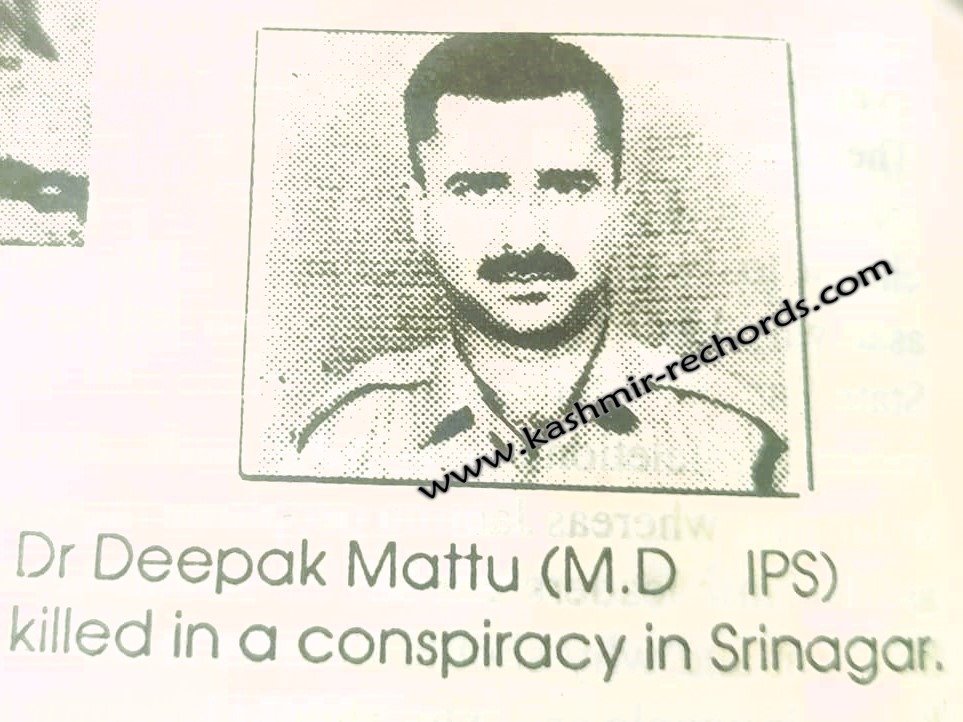
But his love for his son never waned. Even in the face of this crushing silence, Dr. Mathu’s parents found a way to honor their fallen hero. For months after his death, they would visit newspaper offices, carrying their son’s photograph—dressed proudly in his police uniform—hoping that the world would remember their son not just as another victim of the militancy, but as a man of honor, integrity, and boundless potential.

The Pain of Betrayal

The killing of innocents, especially those by conspiracy, is a betrayal of the highest order. It’s a wound that cuts deeper than any other. While terrorism in Kashmir has taken the lives of many, the cold-blooded conspiracy that claimed the life of Dr. Mathu is a reminder of a different kind of darkness—the kind that grows within. His death was not just a loss to his family, but to the Nation, to the people he had set out to protect.

Dr. Deepak Mathu  was a man who had the world at his feet, a son who made his parents proud, and a patriot who wanted to serve his country. His untimely death left a void that can never be filled. Unfortunately, most of us have forgotten him….But as long as his story is told, his memory will live on—not just as a victim of a conspiracy, but as a symbol of what Kashmir, and indeed the entire Nation, lost during those dark days. His father’s quest for justice continues to echo in the hearts of those who still remember, a reminder that some wounds can never heal until the truth is known.
Annie Besant’s Warning  to Kashmiri Pandits in 1903!

Besant’s letter warned that without swift action, missionaries could seize the opportunity to establish their own college, steering Kashmiri youth away from their cultural roots. “Do you want your children to turn into ‘Native Christians’?

(Kashmir Rechords Exclusive)

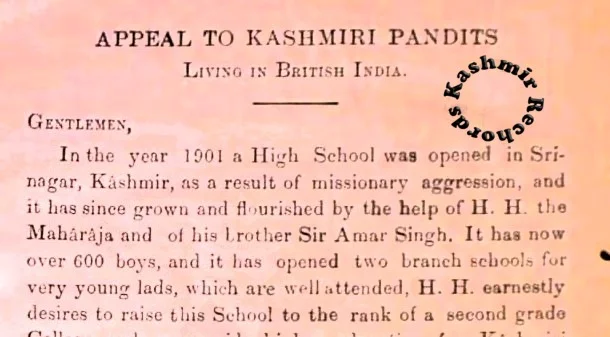
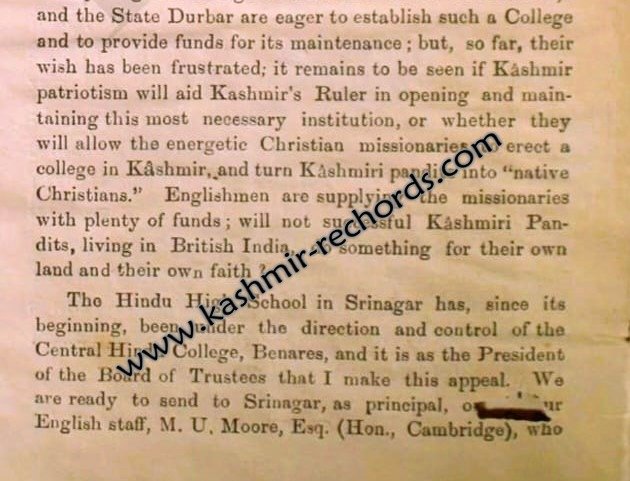
Over 120 years ago, in a powerful and impassioned letter, Annie Besant, President of the Board of Trustees of the Central Hindu College, Benares, made a heartfelt appeal to Kashmiri Pandits living in Undivided India! Her message was clear: rise to the occasion and support the establishment of a Hindu  college in Srinagar. “The time has come for Kashmiri Pandits to contribute to the education of their homeland, or risk seeing their youth steered towards foreign ideals by Christian missionaries, flush with funds from English donors,” she warned.

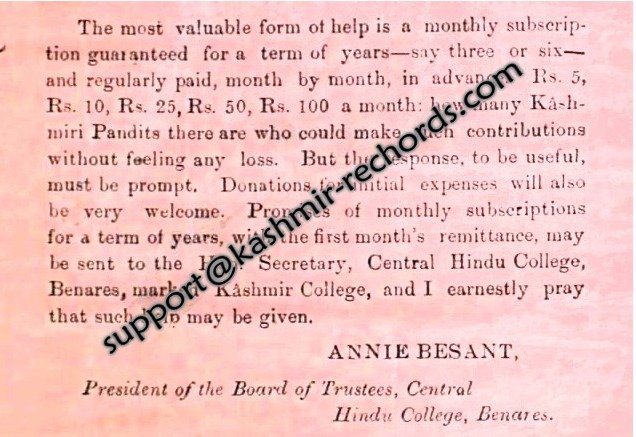
Besant’s letter, published and circulated in major newspapers and journals of the time, was a rallying cry to preserve the cultural and intellectual future of Kashmir. She highlighted the urgent need for funds to elevate the Hindu High School in Srinagar—established in 1901 with the support of Maharaja Pratap Singh and his brother Amar Singh—into a second-grade college. Without this, Kashmiri students had to travel to distant cities like Lahore for higher education, a privilege many could not afford. Kashmir Rechords is in possession of this prized archival letter and is reproducing some of its  excerpts here.

Kashmir  Education at a Crossroad

At the heart of Besant’s letter was the belief that the educational future of Kashmir was at a critical juncture. The lack of higher education in the Valley meant that non-Kashmiris filled most senior positions in the State, an issue that deeply concerned both the Maharaja and the State Durbar, she warned. To remedy this, they were determined to build and fund a college in Srinagar. However, progress was being stalled, and Besant’s letter sought the active support of the prosperous Kashmiri Pandit community living in British India to make this vision a reality.

Besant’s letter warned that without swift action, missionaries could seize the opportunity to establish their own college, steering Kashmiri youth away from their cultural roots. “Do you want your children to turn into ‘Native Christians’?” she asked in her letter, pointing to the urgent need for preserving the region’s traditions through education.

Annie Besant’s Plan: A Call for Contributions

Besant’s appeal focused on a practical solution: regular financial contributions from Kashmiri Pandits. She outlined the importance of guaranteed monthly subscriptions—whether Rs. 5, Rs. 10, Rs. 25, Rs. 50, or Rs. 100—to ensure the long-term success of the college. “Many of you can afford this without feeling any financial strain,” she reassured, urging the community to act swiftly.

Donations, along with the first month’s subscription, could be sent to the Honorary Secretary of the Central Hindu College, Benaras, clearly marked for the “Kashmir College Fund.” One-time donations for initial expenses were also welcome, but regular support was essential for ensuring the stability of the college in the years to come.

Empowering Kashmir’s Youth

Since its establishment in 1901, the Hindu High School in Srinagar had provided quality education to over 600 boys, with two additional branch schools serving younger students. The Maharaja, eager to promote higher education in his State, had worked tirelessly with the Durbar to raise the status of the school to that of a second-grade college. Yet, without sufficient funds, this vision was under threat.

At the time, Kashmiri students who wished to pursue higher education had no option but to leave the Valley for places like Lahore. For those unable to afford this, higher education remained a distant dream, and the local administration struggled to fill top government positions with qualified Kashmiri candidates. Annie Besant’s appeal came at a crucial moment, urging the community to take control of their own educational destiny.

The Legacy of Annie Besant’s Appeal

Following Besant’s passionate plea, a local managing committee was formed in Srinagar to oversee the efforts to establish the college.  There is a mention of the same in her letter. The committee included prominent figures like Dr. Bal Krishna Kaul, Rai Sahab Daya Krishna Kaul (Private Secretary to the Maharaja), Bhavani Das (Revenue Officer), Swami Baldev Ji and H.A. Wilson (Principal of the Srinagar Hindu High School), with Rishivara Mukherji serving as Honorary Secretary.

The Maharaja gladly obliged, and in 1905, the foundation of the Hindu College was laid. Initially operating from two rooms near the present-day Secretariat building, the college was eventually shifted to its permanent site in 1911.

The institution, later renamed Sri Pratap College, became affiliated with Panjab University, Lahore, marking the beginning of higher education in Kashmir. Besant’s efforts, combined with the support of the Kashmiri Pandit community, ensured that the youth of Kashmir could now pursue their academic aspirations without leaving their homeland. The future of Kashmiri education had been secured, and the cultural and intellectual heritage of the Valley was preserved for generations to come.

===

  • At Kashmir Rechords, we are committed to bringing you unique, untold stories from Jammu & Kashmir, grounded in authenticity and supported by solid evidence. Every write-up is carefully researched, verified through archival materials, documents, letters, photographs, and credible references.
  • With the unwavering support of our readers, we aim to make Kashmir Rechords a trusted repository of genuine historical insights, striking a meaningful chord with the rich heritage of Kashmir.

J&K `Sharabi Congress’ : Where Policy Meets Party!

(Kashmir Rechords Exclusive)

It’s election season in Jammu and Kashmir, and along with the heat of political rallies, there’s a delightful breeze of humour wafting through the region. As the erstwhile State preps for its first Union Territory polls, voters are not just talking about candidates—they’re swapping stories about the quirky characters and legendary “contenders” from days gone by.

Let’s introduce you to one such gem: the famous `Sharabi Congress’, a party that, well, was less about policy and more about party! The general secretary of this, shall we say, spirited group was none other than Ram Swaroop Chaudhary, a journalist by profession and an election candidate by obsession.

Chronic Contestants

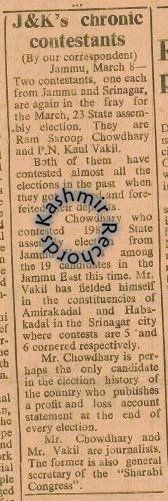
Now, here’s where it gets fun. Chaudhary, bless his dedication, was the type of candidate you couldn’t help but admire—even if his vote counts were the stuff of punchlines. He contested in everything from panchayat polls to Parliamentary elections, becoming a regular on the election scene. In fact, his relentless participation earned him the nickname “Chronic Contestant,” the man who seemed destined for the ballot, if not the victory podium. He  had a journalist counter-part from Kashmir, Mr P. N Kaul Vakil, who too had a distinction of contesting all elections from Kashmir, including the one held in 1987.

Records available with Kashmir Rechords reveal that Chaudhary contested elections from as early as 1983, when he tried his luck in the Jammu West constituency. In 1987, he made a bold strategic move and shifted to Jammu East, vying for an Assembly seat among 19 other hopefuls. But it wasn’t until the 1996 Parliamentary elections that Chaudhary truly made his mark—well, a small mark. He bagged an awe-inspiring 4,976 votes. To put that in perspective, in the 1987 Assembly polls, he managed to snag… drumroll… three whole votes! Hey, every vote counts, right?

Bottled Dreams

The cherry on top of this electoral cocktail was Chaudhary’s “bottle dream.” The man had his heart set on one symbol: a bottle. Every election, he’d approach the authorities, pleading for his permanent party symbol to be a bottle—his way of representing the drinking masses, or so he claimed. Unfortunately, his request was never met. He was every time granted different election symbol as an Independent Candidate.

Different Election Symbols granted to Sharabi Congress in various elections

According to noted Journalist, R C Ganjoo, Ram Swaroop’s  manifesto, too, was something straight out of an alternative universe. Among his bold promises? Lowering the drinking age to 18, providing a liquor tap for every family that wanted one, and setting up “drinking sheds” throughout his constituency. Visionary, right?

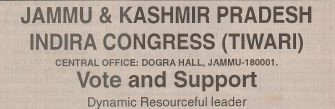
Now, while Chaudhary and his Sharabi Congress might have been the toast of J&K’s quirky political scene, they weren’t the only unique party in town. There was also Congress Tiwari—that  tried to make a splash in 1996 J&K elections too. Neither quite managed to leave an indelible mark, but their spirit of contesting never wavered.
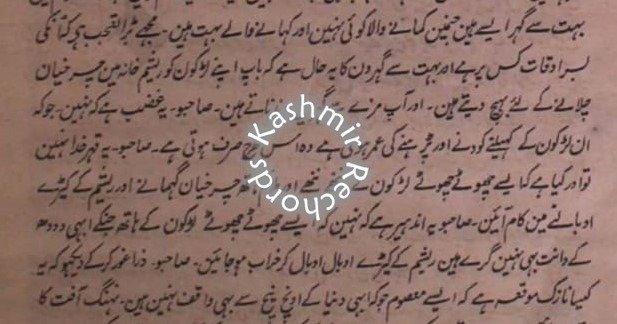
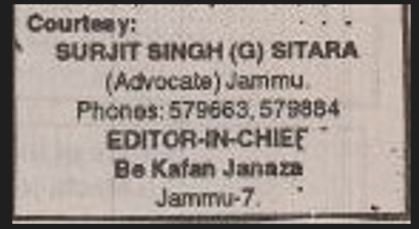
To top it all off, Chaudhary had an equally eccentric group of supporters. One such supporter was an Editor of a Jammu-based newspaper “ Be Kafan Janaza’’. Not only did this editor offer complimentary space in his own publication, but he even paid for advertisements  in other newspapers.

 Dharti Pakads

Of course, J&K isn’t unique in producing chronic contestants. Every state in India has its very own “Dharti Pakkads”—those candidates who cling to the political landscape year after year, poll after poll. The term itself stems from a gentleman who famously filed papers for every possible election, including Presidential ones. Their determination, like Chaudhary’s, is as solid as the ground they stand on, even if their voter base is as shaky as their election results.

So, as the Union Territory heads to the polls, remember the unsung heroes of democracy—the candidates who never give up, no matter how many votes they get. Cheers to them, and especially to Ram Swaroop who will forever be remembered as the man who dreamt of a bottle on the ballot.

Kashmiri Pandit Martyrs, C/o Rajinder Park Jammu

(Kashmir Rechords Exclusive)
Every year on September 14, Kashmiri Pandits observe Martyrdom Day to remember their leaders and loved ones lost in the conflict of 1989-1990. One name often evoked is Pt. Tika Lal Taploo, a prominent Pandit leader whose assassination on September 14, 1989, marked the beginning of a tragic chapter that culminated in the mass exodus of Kashmiri Pandits on January 19, 1990. However, the martyrdom of the community extends far beyond Taploo’s death. The true tragedy lies in the loss of countless Pandits who perished far from their homeland, denied the dignity of being cremated in the sacred land of their ancestors.

For the displaced community, it wasn’t just about losing their homes, but also the final connection to their heritage—the right to rest in their own land.

Rajinder Park: A Refuge for Grief and Last Rites

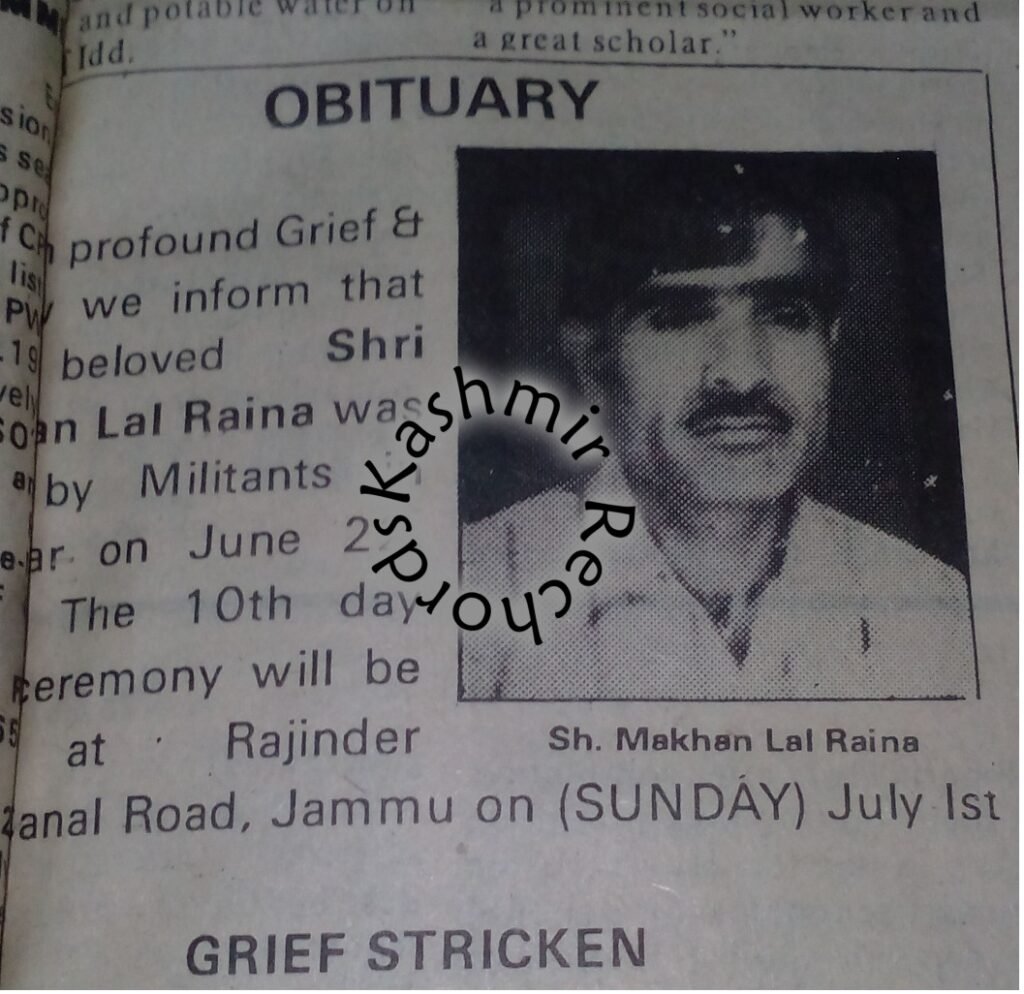
In the early 1990s, the Pandit community, thrust into exile in Jammu, faced an overwhelming dilemma. With no place to gather, no traditional cremation grounds, and a communication vacuum in an era before social media, they were left in disarray. Unlike today, when a death can be shared instantly on platforms like WhatsApp, Kashmiri Pandits relied on local newspapers to spread the heart-breaking news of terrorist killings in Kashmir. The absence of a central address, a shared space for collective grief, further deepened the community’s alienation.

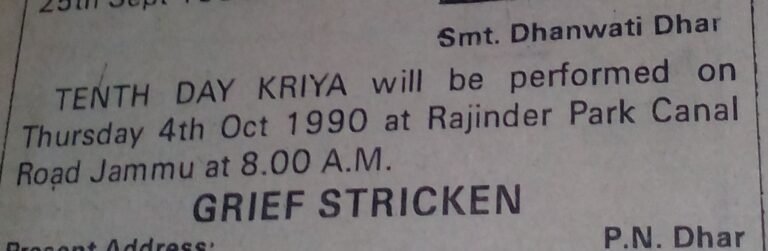
It was in this void that Rajinder Park, located on Jammu’s Canal Road, emerged as an unintended sanctuary. Originally a public space, it transformed into a vital gathering place where Kashmiri Pandits could come together, mourn their dead, and perform the last rites, the Tenth-Day Kriya. Families, who had fled the horrors of their homeland, now found themselves in Rajinder Park, a place that soon became symbolic of their new reality—an exile with no true home.

A Landmark of Resilience

For the older generation of Kashmiri Pandits, Rajinder Park is etched deeply in their memory. It became a witness to their collective sorrow, where the sounds of sobbing and whispered prayers replaced the serenity that once filled the park. It served as a space of solace, where families would honor their deceased and perform rituals, which were traditionally reserved for the sacred Ghats of Kashmir. In the absence of their homeland, Rajinder Park became the place where they could cling to their cultural traditions, even if it was in the heart of an unfamiliar city.

The park played this critical role for years until more formal Tenth Day Kriya Ghats were established at Muthi , Tawi Bridge in Jammu and at the banks of Chenab near Akhnoor Town. Yet, for many in the community, Rajinder Park remains more than a temporary refuge; it is a powerful reminder of those early years of displacement when Kashmiri Pandits were forced to navigate unimaginable grief and loss in exile.

While many of the younger generation may not know its significance, Rajinder Park Jammu  stands as a monument to the resilience, sacrifice, and endurance of the Kashmiri Pandit community. For those who lived through the harrowing events of 1990, the park is more than just a physical space—it is a testament to the strength of a people who, even in the depths of despair, found ways to preserve their dignity and cultural identity.

For every Kashmiri Pandit who died far from home, Rajinder Park, Jammu stands as a poignant reminder that their sacrifices, and the shared history of their community, will never be forgotten.

Lal Ded Chair Remains Unfulfilled: A Govt, UGC  Promise in Limbo

  • Even after Government’s announcement several years ago, the Lal Ded Chair remains unrealized, casting a shadow over efforts to honor Kashmir’s most revered mystic poet.
(Kashmir Rechords Exclusive)

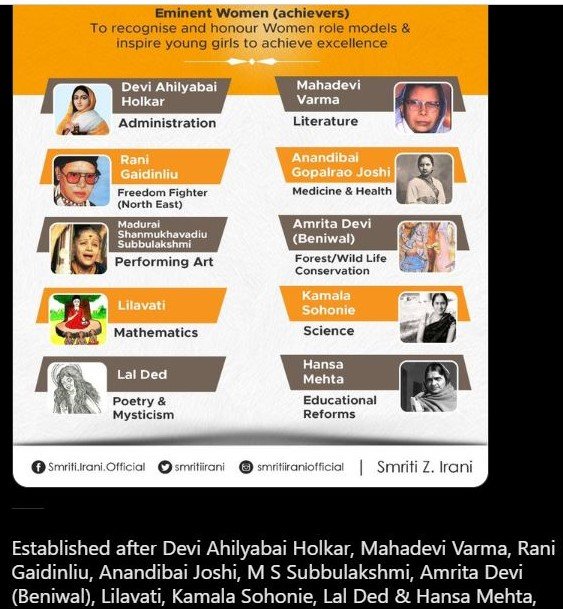
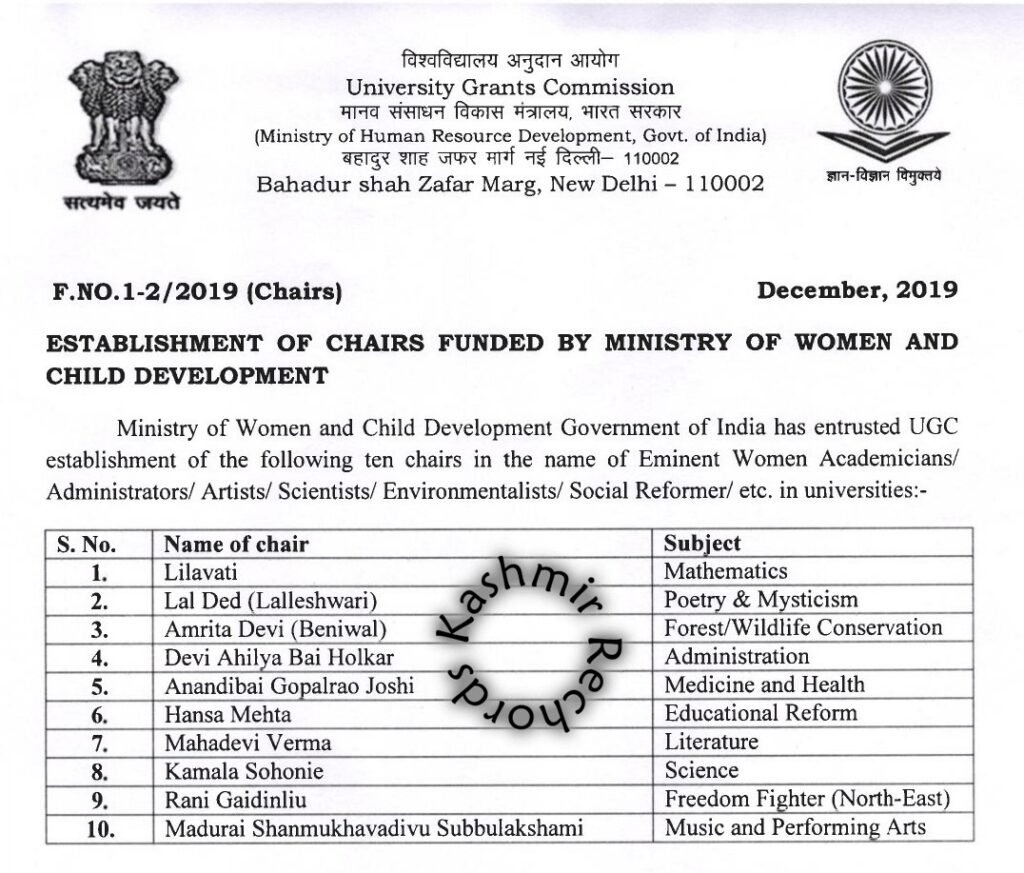
 As Kashmiri Pandits off-late observe the birth anniversary of one of their most revered figures, Lalleshwari—popularly known as Lal Ded—the long-promised recognition of her legacy through a dedicated academic chair remains unrealized. In December 2019,  Ms  Smriti Irani  in the capacity of  Union Minister for Women and Child Development, announced the establishment of 10 chairs named after eminent women across various fields.  The Chairs,  to be funded by the Ministry,  were supposed to be established by  University Grants Commission (UGC). Taking a cue  from his Ministerial Colleague, the  then Union Minister for Human Resource Development, Mr  Ramesh Pokhriyal ‘Nishank’  on March 16, 2020  announced the same in a written reply to  the Lok Sabha. Among them was the promise of a chair dedicated to Lalleshwari, the 14th-century mystic poet of Kashmir, who is hailed by all religious communities in the Valley. However, despite the passage of time, there has been no tangible progress on this initiative.

The announcement, made with much fanfare, was part of a broader move by the Ministry of Women and Child Development to inspire young women to pursue higher education by honoring female luminaries in India’s history. Along with Lalleshwari, other iconic women were included in this effort, such as freedom fighter Mahadevi Verma, singer M.S. Subbulakshmi, and Maratha queen Devi Ahilyabai Holkar.

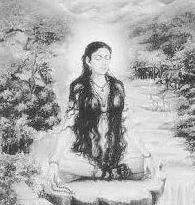
Lalleshwari holds a unique place in the socio-cultural and spiritual landscape of Kashmir. Her poetic verses, known as Vakhs, resonate with deep Shaivite philosophy, mystical symbolism, and spiritual enlightenment. She bridged divides, becoming a shared symbol of mysticism, revered by Hindus and Muslims alike. Yet, despite this towering influence, her academic recognition through the proposed UGC chair remains stalled.

The initiative, which promised to fund each chair with an annual financial allocation of ₹50 lakh, was intended to encourage research and knowledge production around women’s contributions to various fields, including literature, science, and social reform. Lalleshwari’s chair was specifically meant to highlight her contributions to poetry and mysticism.

Stalled Progress Amid Ongoing Celebrations

Even as devotees prepare Taher (a traditional  yellow rice dish) and recite her Vakhs to celebrate her Jayanti today, the absence of any substantial movement towards establishing the chair raises concerns about the government’s commitment to its promises. For many in the academic cicles, the chair was seen not only as a symbol of recognition but also as a way to preserve and advance Lalleshwari’s teachings for future generations.

The UGC, in collaboration with the universities, was tasked with appointing scholars and academics to lead these chairs. The criteria were clear: individuals with outstanding academic and scholarly track records, aged between 55 and 70, would be selected through a rigorous nomination process. Despite these guidelines being in place, the progress on appointing scholars to lead the Lal Ded Chair remains elusive.

A Symbolic Loss for Women-Centric Academia

The delay in setting up the Lal Ded Chair is emblematic of a larger issue: the slow pace at which women-centric academic initiatives materialize in India. This chair, like the others announced, was supposed to contribute to research and create spaces for dialogues, seminars, and publications that celebrate women’s historical contributions. Lalleshwari’s chair, in particular, was meant to explore the intersections of poetry, mysticism, and spiritual thought, potentially bridging ancient wisdom with modern academic discourse.

The fact that so many years have passed without any concrete developments is disappointing not only for the Kashmiri Pandit community but also for scholars and students who hoped to engage with her rich legacy through academic work.

H.N. Jattu: A Polarizing Leader Who Defied the Odds

(By: KR Ishan)

With the passing of veteran Kashmiri Pandit leader H.N. Jattu on September 3, 2024, an era quietly came to an end. A leader who straddled the pre- and post-migration worlds of Kashmiri Pandits, Jattu was no stranger to controversy. Throughout his life, he faced opposition both within his own community and from external forces, but he remained steadfast in his convictions.

Standing Tall Amid Crisis

As the president of the All India Kashmiri Pandit Conference (AIKPC), Jattu’s leadership was marked by bold and often dangerous decisions. On November 6, 1989, he held a press conference in Srinagar, raising alarms about the growing threats to Kashmiri Pandits. The Valley was already a tinderbox, and his warnings, though prescient, went largely unheard. Soon after, like many others, Jattu was forced to leave Kashmir, a departure fraught with internal criticism. Some accused him of stoking tensions, while others alleged that he had played into the hands of those exploiting Kashmir’s unrest.

One particularly damaging episode occurred in 1990 when a letter, allegedly signed by Kashmiri Pandit leaders, was published in Kashmir’s Urdu newspaper Alsafah, falsely blaming Jattu for actions he had not taken. This calculated move created confusion and dented his public image. Today, the controversial letter circulates on the internet, exploited by those who deny the plight and genocide of Kashmiri Pandits. Despite the backlash, Jattu remained undeterred in his advocacy for his people.

Calling for a Second Migration

Barely a year after the mass exodus of 1990, Jattu made another bold move. In 1991, citing growing hostility towards displaced Kashmiri Pandits in Jammu and the government’s inaction, he called on his community to prepare for yet another migration. He pointed to anti-Kashmiri Pandit rhetoric from certain political and regional factions, which had instilled fear among the already displaced. While Jattu’s concerns were not unfounded, this statement further fractured the ranks of the AIKPC.

The internal discord within the AIKPC reached its peak when J.N. Saproo, a former ally, ousted Jattu from the presidency on September 26, 1991. Saproo and the AIKPC’s general secretary, P.K. Kaul (Badgami), accused him of mishandling critical events, including the Somyar incident and the overall crisis of migration. Though this internal power struggle tarnished Jattu’s image, he refused to give up.

Rebuilding in Exile

After his political defeat within the AIKPC, Jattu shifted his focus to Delhi, where he continued to work for the displaced Kashmiri Pandit community. He led efforts to help families rebuild their lives, providing assistance in setting up businesses and securing livelihoods. His leadership in exile gave many families a renewed sense of purpose and identity during a time of great uncertainty.

In his later years, Jattu returned to Jammu, hoping to reconnect with the community he had once led. However, the landscape had changed. New organizations had emerged, each with its own agenda, leaving little space for Jattu’s return to prominence. Despite his desire to re-establish himself, the combination of his advancing age and the shifting political dynamics made it impossible for him to regain his former stature. Nevertheless, Jattu accepted this new reality with grace, remaining a respected elder in the community.

A Legacy of Defiance

Throughout his life, Jattu remained a polarizing figure. His strong stance on the 1990 exodus and his unrelenting criticism of political manipulations made him a target for many, both within and outside the Kashmiri Pandit community. Yet, he remained unwavering in his commitment to justice and the survival of his people.

H.N. Jattu’s legacy is one of resilience and defiance. Though his leadership was not without its controversies, he stood tall in the face of adversity. As the community bids farewell to this veteran leader, his contributions to the Kashmiri Pandit cause will be remembered as part of a long, difficult struggle for justice and survival in exile. In both life and death, Jattu embodied the spirit of a people who refused to be forgotten.

Political Resurgence or Marginalization? Kashmiri Pandits and the 2024 Assembly Elections

(By: K R Ishan)

As Jammu and Kashmir prepares for its first Assembly elections since the abrogation of Article 370, the political landscape reflects a blend of renewed aspirations and deep-seated apprehension. For Kashmiri Pandits (KPs), this election is not just a test of democracy, but a referendum on their political future, mirroring the fraught environment of the 1996 elections held amidst militancy.

1996: A Moment of Political Defiance

The 1996 elections, held after years of insurgency, saw an unprecedented political vacuum in the Valley, where the specter of violence hung heavy. Political assassinations and militancy created a climate of fear, forcing parties to scramble for candidates. Despite this, several Kashmiri Pandits entered the electoral race, reflecting a community’s resolve to reassert itself in the Valley. Political outfits like the Bharatiya Janata Party (BJP) and Congress fielded Pandit candidates in sensitive constituencies like Habba Kadal, Amirakadal, and Hazratbal. In Habba Kadal, KP votes were anticipated to be pivotal, but it was National Conference’s P. L. Handoo who ultimately emerged victorious, relying on support from local Muslims.

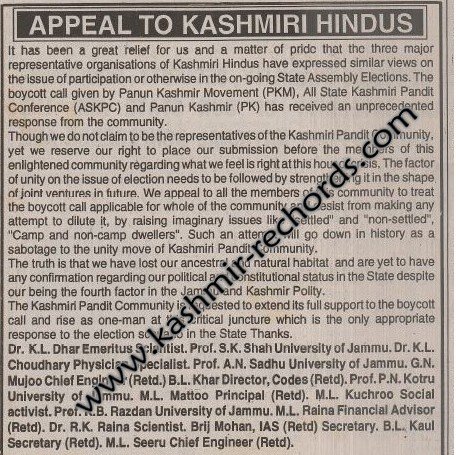
Much like today, KP organizations called for an election boycott in 1996, citing marginalization, an echo that has returned in 2024. However, there were Organizations like Kashmiri Pandit Sabha, Amphalla, Jammu who encouraged KPs to actively take part in the polls.

2024: A Deja Vu of Dilemma

In 2024, Kashmiri Pandits once again find themselves at a crossroads. Fourteen KP candidates, including two from the BJP, have filed nominations, but many within the community remain disillusioned. Some KP organizations have renewed their boycott calls, accusing the political system of paying lip service to their plight while doing little to acknowledge the genocide-like conditions they endured during the exodus of the 1990s.

While a few candidates aim to bridge divides and secure a dignified return of KPs to their ancestral homeland, the boycott movement  appears to be a strong, highlighting an entrenched belief that participation in elections could be interpreted as complicity in their ongoing marginalization.

The Genocide Recognition Demand: A Political Flashpoint

Central to the community’s discontent is the demand for official recognition of their exodus as genocide. Many KP organizations argue that meaningful political engagement cannot occur until this historical injustice is acknowledged. The Kashmiri Pandit Citizens’ Meet, held ahead of the 2024 polls, reiterated these concerns, calling the election process a “facade of normalcy” designed to ignore their grievances. For these leaders, the absence of genocide recognition is a non-negotiable point, and their boycott is a form of protest against a system they feel continues to marginalize them.

Habba Kadal: The Epicentre of KP Politics

Habba Kadal, a constituency with deep historical significance for Kashmiri Pandits, has once again become a key battleground. In 2024, six of the fourteen KP candidates are contesting from this seat, including BJP’s Ashok Kumar Bhat and Lok Jan Shakti Party’s Sanjay Saraf who  advocates for the return of KPs with dignity, emphasizing their role as “ambassadors of peace.”

However, the divide within the community remains stark. While some are eager to return to the political arena, others are firm in their rejection, questioning the sincerity of parties that have yet to address their long-standing grievances.

Political Resurgence or Continued Marginalization?

As the elections approach, the question of KP political relevance is once again in the spotlight. In 1996, some felt the community was losing its political clout—a sentiment that has only intensified over the years. Local Muslims, now driving many of the political agendas, have largely filled the vacuum once occupied by KPs.

For Kashmiri Pandits, the 2024 elections represent both an opportunity and a risk. On one hand, it offers a chance to regain their political voice in a region that has increasingly side-lined them. On the other, participation in a process that ignores their core demands could deepen their sense of alienation.

As the election campaign unfolds, the Kashmiri Pandit community remains in a state of flux—caught between a desire to re-engage politically and the fear of further marginalization. The participation of KP candidates may offer a glimmer of hope for a community longing to reclaim its place in Kashmir’s political fabric, but whether this marks the beginning of a political resurgence or the continuation of their exclusion remains an open question.

Breaking the Myth: Kashmiri Pandits in the Late 19th Century

(Kashmir Pandit Exclusive)

In the late 19th century, a myth took root that Kashmiri Pandits, a so called educated and affluent community, monopolized top bureaucratic positions under Maharaja Pratap Singh. Contrary to this belief, the majority of Kashmiri Pandits, between 1890 and 1910, were struggling with poverty and educational backwardness. Most were relegated to low-paying jobs, far removed from the narrative of success.

Pandit Gopi Nath Saheb, a leading figure in the Kashmiri Reform Association, shattered these misconceptions in a landmark speech in 1904. Addressing students at Hindu College, Srinagar, his bold words revealed a grim truth about the community’s condition, which had been overlooked. The speech, later published in influential periodicals edited by statesman Tej Bahadur Sapru, cast a glaring light on the struggles of Kashmiri Pandits.

A speech of Pt Gopi Nath Saheb, 1904

Spiritual and Economic Struggles

Pandit Gopi Nath’s fiery critique exposed a community gripped by spiritual and economic decline. He accused his fellow Pandits of succumbing to the burden of menial jobs, neglecting educational and entrepreneurial opportunities. The Kashmiri Reform Association, founded in 1903 under Pandit Jia Lal Shivpuri, aimed to combat these issues, advocating societal reforms to uplift the impoverished community.

At the time, many Kashmiri Pandits sought economic favours from Punjabi businessmen, abandoning their cultural identity by trading their traditional turbans for Punjabi attire. This cultural shift symbolized a community willing to sacrifice its heritage for survival.

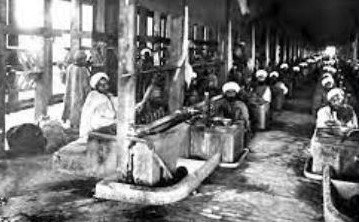
Kashmiri Pandits performing a menial job at a Silk Factory, Srinagar

Child Labour and the Silk Factory Scandal

One of the most heart-wrenching aspects of Pandit Gopi Nath’s speech was his criticism of child labour in the Srinagar Silk Factory.  Srinagar-based Kashmiri Pandit fathers, driven by poverty, were regularly sending children as young as ten to work in grueling conditions. These children toiled in boiling silkworm cocoons or spinning wheels for meager wages, deprived of education and a brighter future.

Kashmiri Pandits performing Child Labour at Silk Factory.

He also recalled the 1903 floods, when the destitution of Kashmiri Pandits became tragically evident. Most could not afford basic food grains from Rawalpindi. Meanwhile, Punjabi traders dominated markets like Amirakadal, Zainakadal, and Habbakadal, employing Kashmiri Pandits as commission agents—further reinforcing their economic dependence.

Decline of Education and Lost Opportunities

Gopi Nath’s lament extended to the decline of education among Kashmiri Pandits. While affluent Kashmiri Hindus and Muslims used to send their children to Lahore and Allahabad universities, only a handful of Pandits were pursuing studies in Kashmir. In 1904, only ten Kashmiri Pandits passed the Entrance Examination. By 1906, that number had plummeted to just four. Out of a population of over 60,000 Pandits, ( 1901 Census)  this stark decline reflected a crisis in education and aspirations.

Student Results of 1904, 1905 and 1906 from Kashmir.

For Gopi Nath, this was a tragedy of untold proportions. In his view, Kashmiri Pandits, rather than embracing professions like masonry, carpentry, vegetable selling  or tailoring, opted to remain idle, running dilapidated tuck shops that sold items like snuff powder, tobacco or soap—barely making enough to survive.

Selling Tabaco and sniffing powder!

A Call for Reform

Despite his criticisms, Pandit Gopi Nath was hopeful for change. He called on his community to break the cycle of poverty and leave behind the menial labour of the Silk Factory. Education, he believed, was the key to progress. He also urged the Kashmiri Reform Association to provide scholarships for deserving students and condemned the practice of marrying off young girls to much older widowers.

The speaker implored upon native Kashmiri Pandits, particularly living in Srinagar to find time to pay goodbye to menial silk-worm work in Silk factory. Instead, start reading for which his Association would provide financial assistance to the deserving students. He also laments the exploitation of innocent Kashmiri Pandits whose daughters aged 10 were forced to marry to a widower of 30.

Although the Kashmiri Reform Association was determined to uplift the community, Gopi Nath expressed reservations about the involvement of two prominent British educators like Mr. Moore, the principal of Hindu School, and Mr. Biscoe, the principal of Mission School. He felt their influence, though well-intentioned, could steer the association away from its mission of grassroots reform.

All about Mr Moore and Mr Biscoe

A Legacy of Resilience

Pandit Gopi Nath’s speech remains a timeless reminder of a community’s struggles and its enduring hope for a brighter future. His words not only exposed the harsh realities of his time but also inspired a movement for reform. The Kashmiri Pandit community, despite its hardships, forged a legacy of resilience that continues to inspire future generations.