
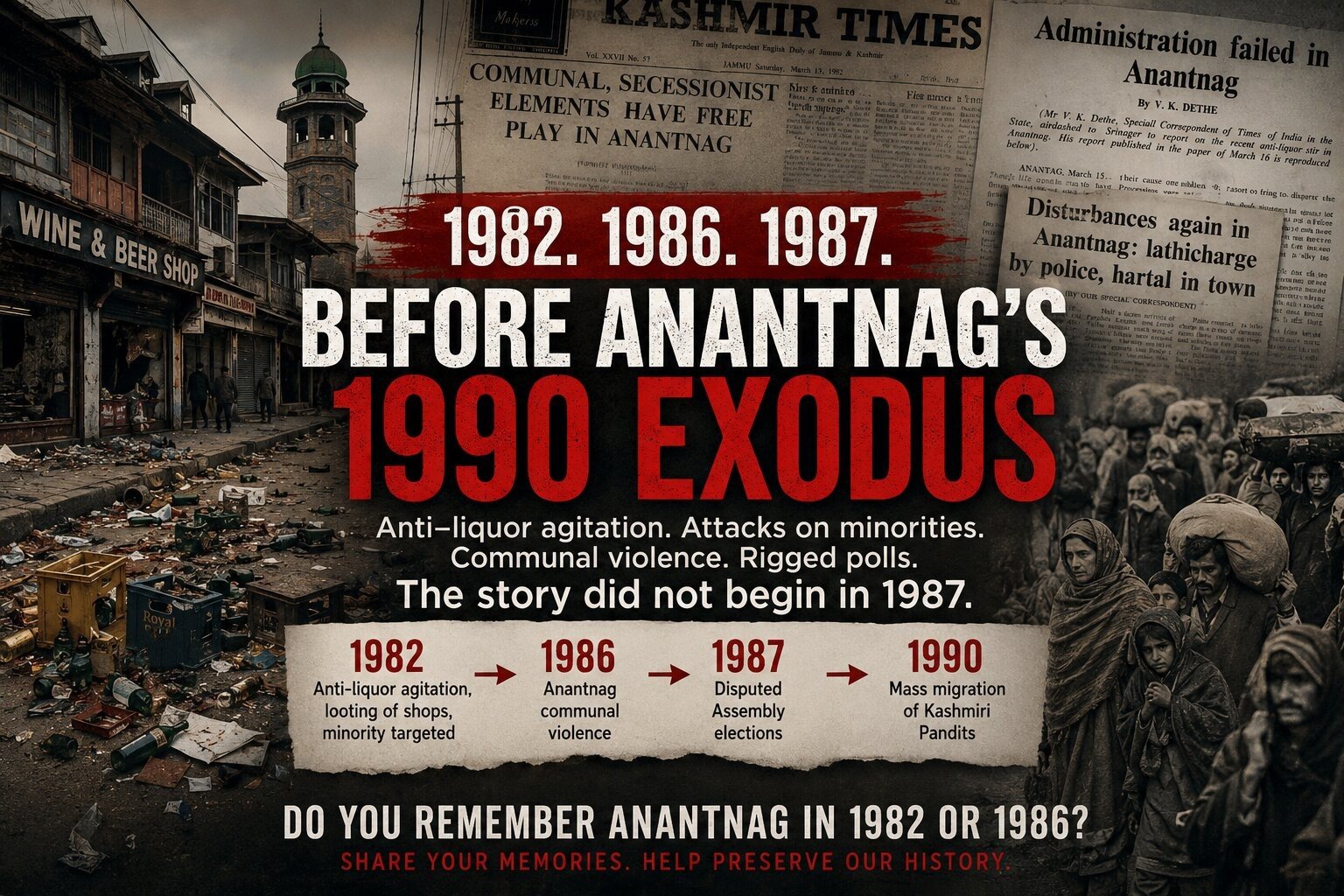
Kashmir Rechords Exclusive | From the Archives
The story of the Kashmiri Pandit exodus is often told backwards.
It begins in 1990, when a large section of the Valley’s Pandit community left their homes amid killings, threats, intimidation and an atmosphere of fear.
The explanation then often moves to 1987—the Assembly elections widely alleged to have been rigged, the political disillusionment that followed, and the subsequent rise of militancy.
All of that is an important part of the story. But it is not the whole story.
For if 1987 is treated as the point at which everything changed, it can inadvertently create another impression: that Kashmir was otherwise peaceful, that its minorities were secure, and that their troubles began only after the ‘rigged’ elections.
The experience of Anantnag tells us to look further back.
1982.
Four years before the infamous communal violence of 1986 and five years before the disputed 1987 polls, Anantnag was already witnessing violent political mobilisation and attacks on minority-owned businesses.
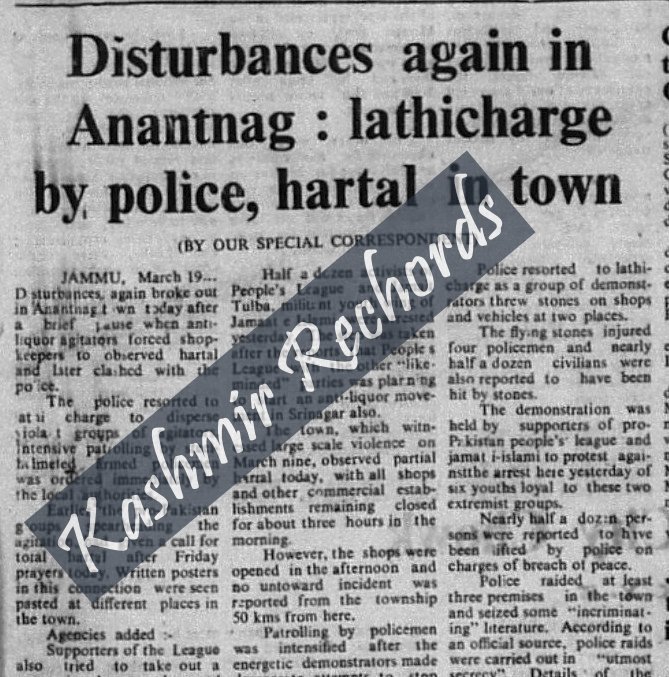
In March 1982, an anti-liquor agitation that began with picketing and demands for prohibition escalated into clashes, looting and damage to liquor shops.
A contemporary Times of India report by special correspondent V. K. Dethe, published after he was sent to Srinagar to report on the agitation, carried the headline: “Administration failed in Anantnag”
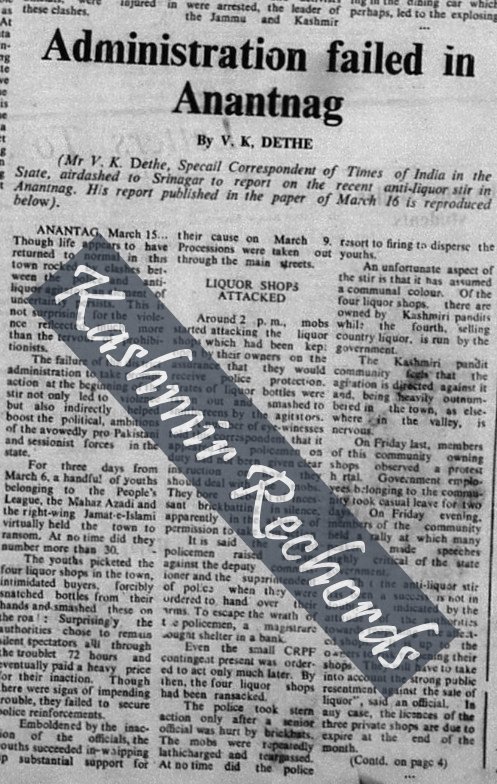
The report said that the agitation had assumed a “communal colour” and noted that of the four liquor shops in Anantnag, three were owned by Kashmiri Pandits. The shops were attacked and liquor bottles smashed, in addition to other retail and grocery shops belonging to Kashmiri Pandits
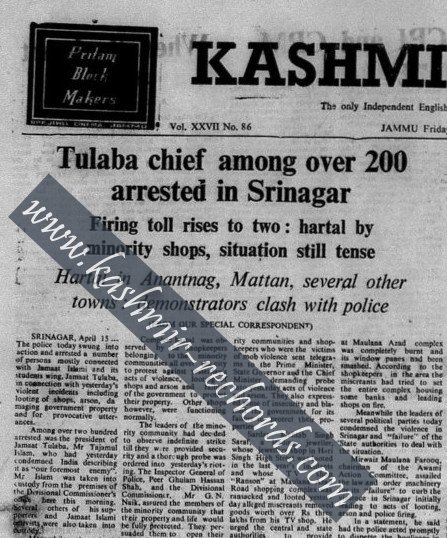
Another contemporary Kashmir Times report used even more striking language:
“COMMUNAL, SECESSIONIST ELEMENTS HAVE FREE PLAY IN ANANTNAG”
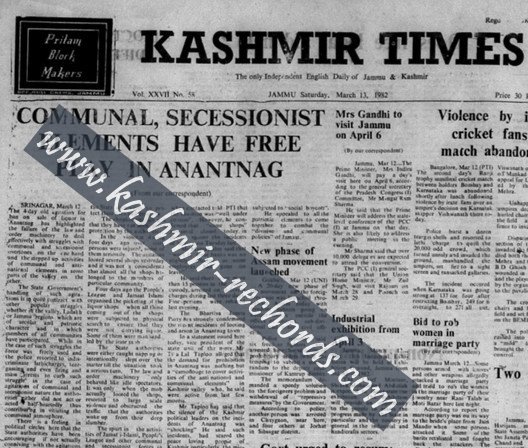
The same newspaper record spoke of the political mobilisation surrounding the agitation and the activities of separatist elements.
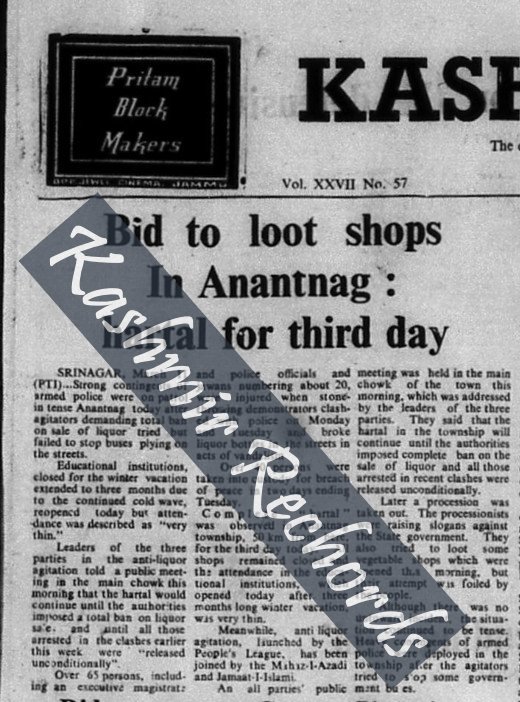
A subsequent report recorded renewed disturbances, arrests of activists associated with the People’s League and Jamaat-e-Islami, and attempts to extend the anti-liquor campaign to Srinagar. It also described the People’s League as pro-Pakistan.
The point is not that every person who participated in the anti-liquor agitation was communal or separatist.
Nor does a newspaper report describing an organisation as pro-Pakistan, by itself, establish direction from Pakistan.
The point is simpler—and historically important:
These political currents, communal anxieties and minority insecurities were already visible in Anantnag in 1982. They did not suddenly appear after 1987.
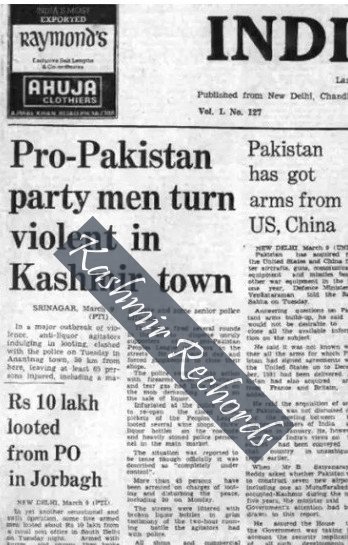
Even Indian Express carried the main-lead story in its March 10, 1982, quoting PTI.
1984
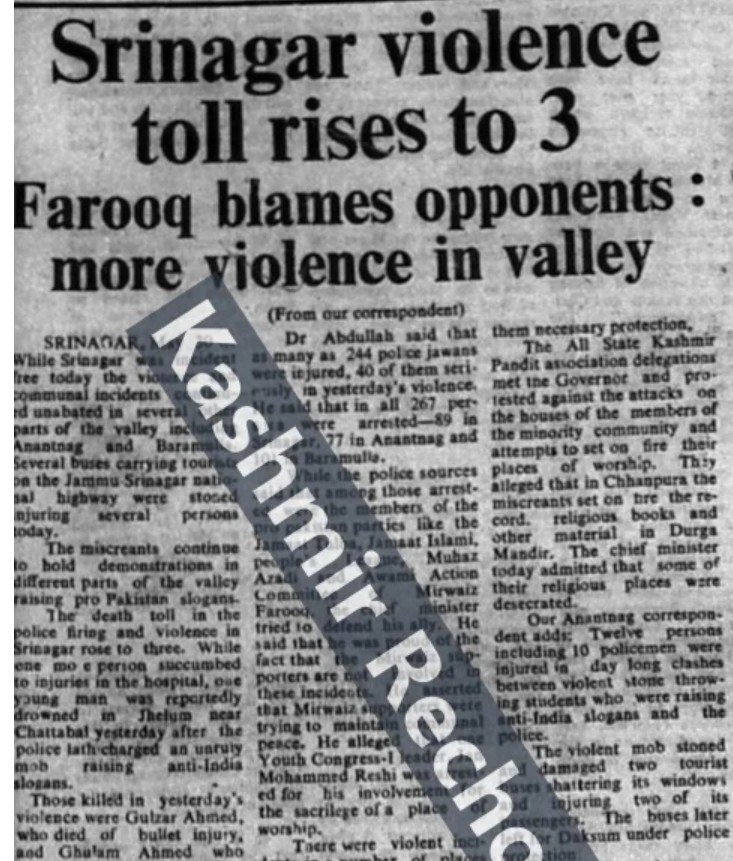
The archival newspaper clipping dated May 31, 1984 challenges one of the most frequently repeated narratives about the origins of the Kashmir conflict. A common perception is that Kashmir’s troubles began with the 1987 Assembly elections, followed by the rise of militancy and, ultimately, the forced exodus of the Kashmiri Pandit community in 1990. However, this archival evidence also indicates that communal targeting and violence against the minority community predated 1987.
The report explicitly mentions that Kashmiri Pandit temples were attacked and that attempts were made to set them on fire. It states that the All State Kashmir Pandit Association protested these attacks and referred to assaults on temples and other religious places. The report also records widespread violence across Srinagar, Anantnag, Baramulla and other areas, curfews, police firing, destruction of property, and attacks on public transport.
Then came 1986
If 1982 was a warning, 1986 was far more devastating.
In February 1986, communal violence erupted in Anantnag and adjoining areas of South Kashmir. Kashmiri Pandit homes, shops and religious places and temples were attacked, looted, burnt or damaged. The violence was serious enough to contribute to the fall of the G. M. Shah government and the imposition of Governor’s Rule.
The significance of 1986 is difficult to overstate when viewed from the perspective of what happened four years later.
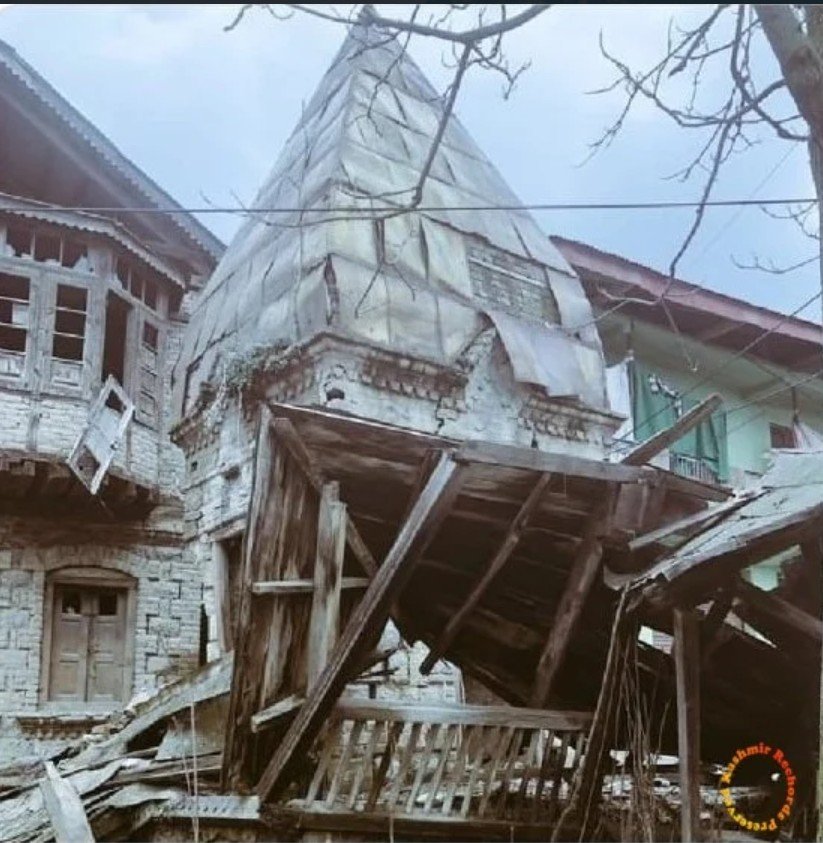
For many Pandit families, 1986 was not 1990—but it was no longer possible to believe that nothing had changed.
Recent scholarship based on fieldwork among displaced Pandits records that many respondents remembered 1986 as the point at which they first sensed a fundamental change in the ground reality. And Anantnag was at the centre of it.
Then came 1987
The following year brought the Assembly elections.
The alleged rigging of the elections, particularly the treatment of opposition candidates associated with the Muslim United Front, became a major political rupture. The events that followed are widely regarded as an important factor in the emergence and growth of militancy.
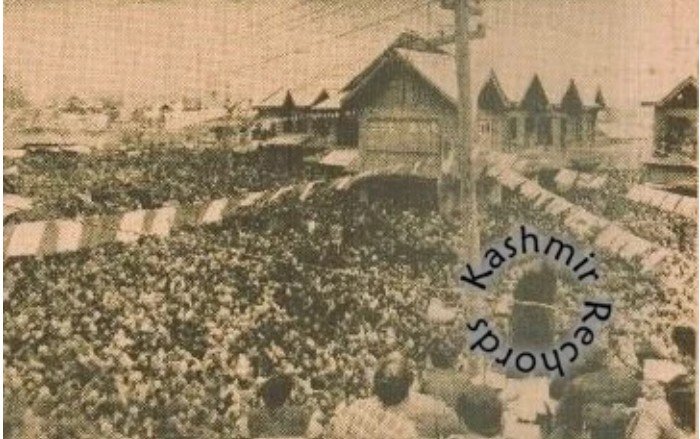
But there is a distinction worth making.1987 elections may have been a turning point. It was not necessarily the starting point.
By the time Kashmir went to the polls in 1987, Anantnag’s minorities had already experienced:
1982 — attacks on minority-owned liquor shops amid an anti-liquor agitation.
1984 & 1986 — major communal violence and attacks on minority homes, businesses and religious places.
1987 — disputed elections and the political crisis that followed.
1989–90 — armed militancy, targeted killings, threats and the mass migration of Kashmiri Pandits.
The sequence matters.
It does not diminish the importance of 1987. It simply prevents us from turning 1987 into a historical curtain that hides everything that happened before it.
What do you remember?
This is where the newspaper archive ends—and where memory begins.
The clippings tell us what journalists reported. But they cannot tell us everything.
Were you in Anantnag in 1982?
Do you remember the liquor agitation? The shops that were attacked?
The people who led the protests? The police response? The atmosphere in the town?
Did you or your family witness the communal violence of 1986?
Do you remember the homes, shops or temples that were attacked?
Do you remember families leaving temporarily—or beginning to think about leaving?
Do you remember what people were saying about the changing atmosphere in Anantnag before the 1987 elections?
And perhaps most importantly: What do you remember that the newspapers did not report?
Kashmir Rechords invites readers from Anantnag and elsewhere who witnessed these events—or whose parents and relatives did—to share their memories, photographs, letters, documents and newspaper cuttings.
A name. A shop. A village. A date. A conversation.
Even a small recollection may help reconstruct a chapter that has largely disappeared from public memory:1982. 1984.1986. 1987. 1990.
Perhaps the history of Anantnag—and of Kashmir—needs to be read not through one date, but through the spaces between them.Tell us what you remember.