Kashmir Rechords Exclusive | April–July 1981
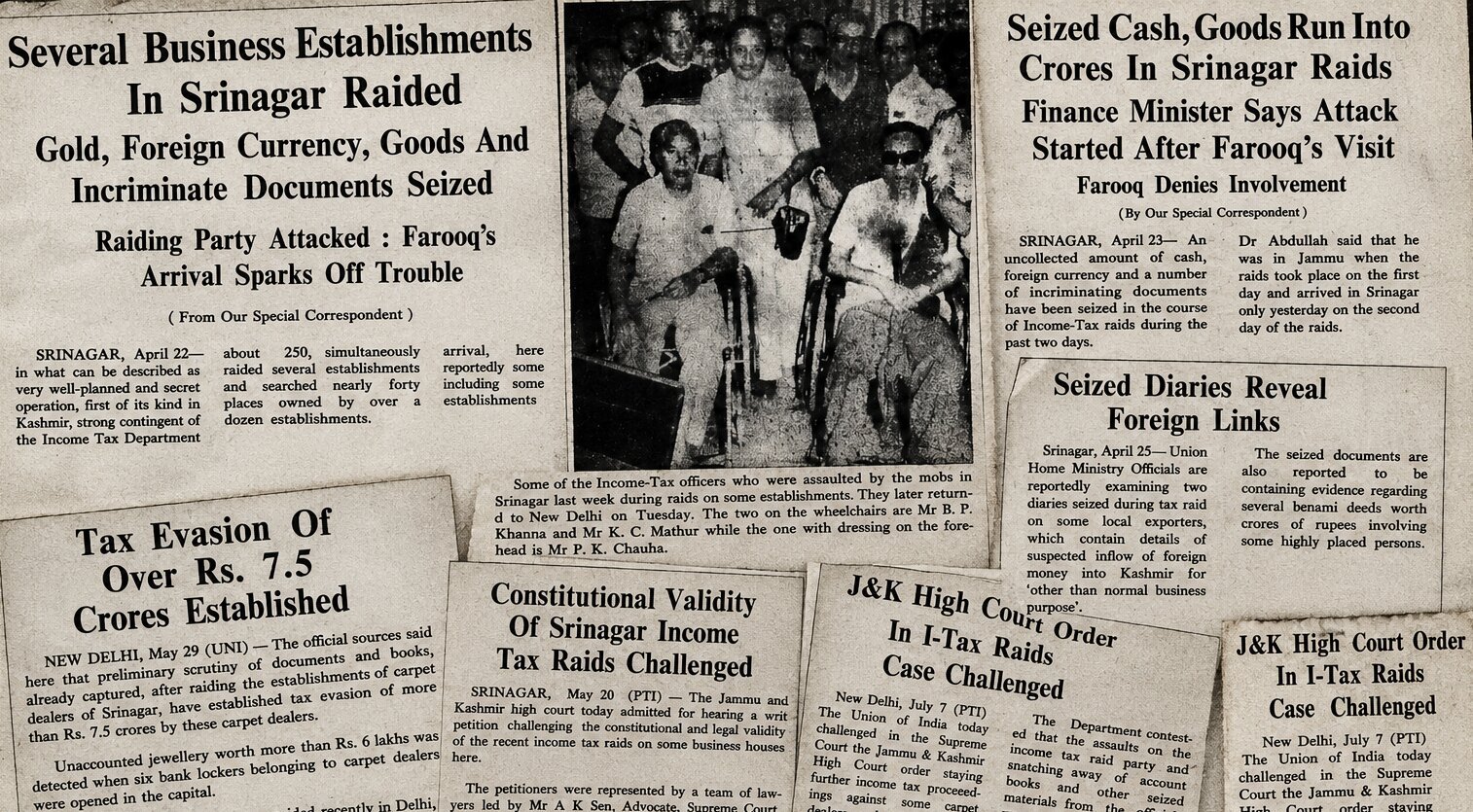
In April 1981, Srinagar witnessed an extraordinary Income-Tax operation that began as a raid on business establishments and soon turned into a confrontation involving crowds, the Police, the Farooq Abdullah episode, the Jammu & Kashmir High Court—and eventually the Supreme Court.
The operation had begun secretly and was described as the first of its kind in Kashmir.
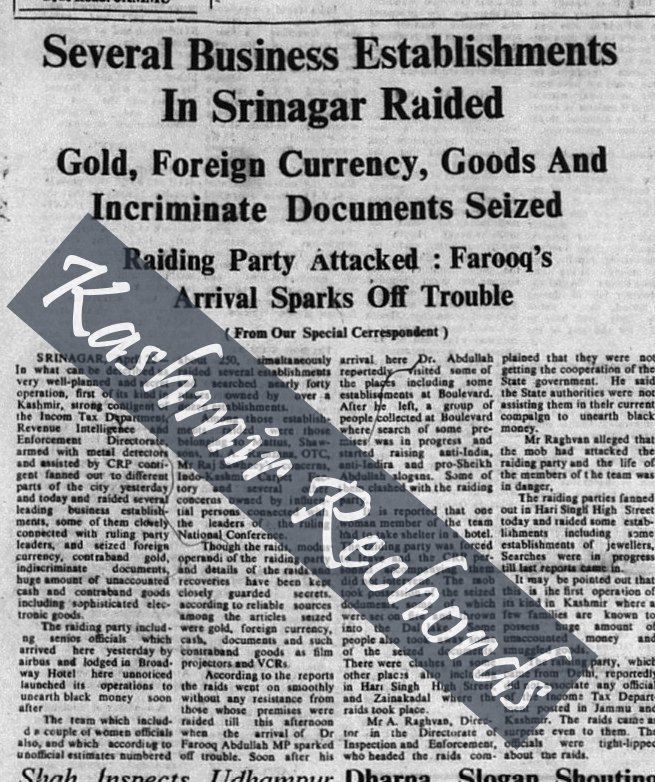
According to an April 22, 1981 newspaper report preserved in the Kashmir Rechords archive, Income-Tax and Revenue Enforcement officials, accompanied by a CRPF contingent and equipped with metal detectors, arrived in Srinagar and raided several business establishments. The raiding party had reportedly checked into the Broadway Hotel before beginning the operation.
Gold, foreign currency, cash, goods and what the report described as “incriminating documents” were seized.
When the raid turned violent
The operation soon ran into trouble.
According to the April 22 report, trouble began after Dr Farooq Abdullah arrived at one of the premises being searched. A crowd gathered and members of the raiding party were attacked.
As many as 20 members of the raiding party were reported injured, including two women officials. Some were subsequently taken for treatment.
Kashmir Rechords has preserved the contemporary photograph of the injured Income-Tax sleuths—an extraordinary visual record of an episode that quickly became much bigger than a tax raid.
The report said that some seized documents were snatched, some were burnt and others thrown into the Dal Lake. Similar trouble was reported at other locations, including Hari Singh High Street and Zainakadal.
The raiding party was eventually forced to withdraw from some premises.The human cost of the confrontation was considerable.
The photograph shows three of the injured officials identified in its original caption as P. B. Khanna, K. C. Mathur and P. K. Chauhan. Khanna and Mathur are seen in wheelchairs, while Chauhan has a dressing on his forehead.
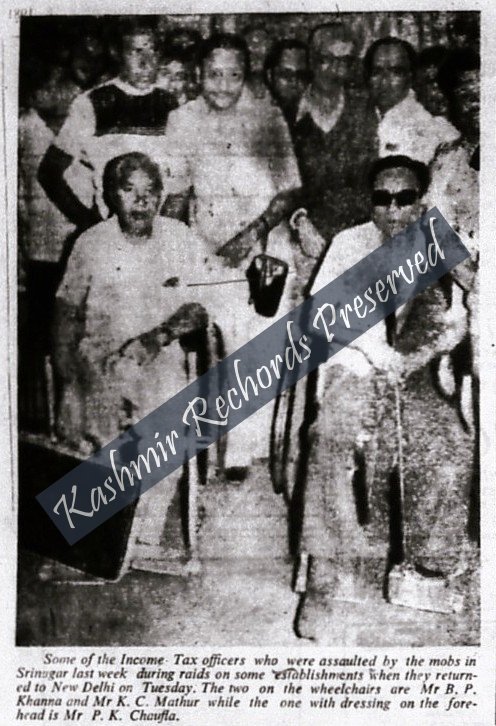
The caption records that they had been assaulted by mobs in Srinagar during the raids and had returned to New Delhi before being photographed.
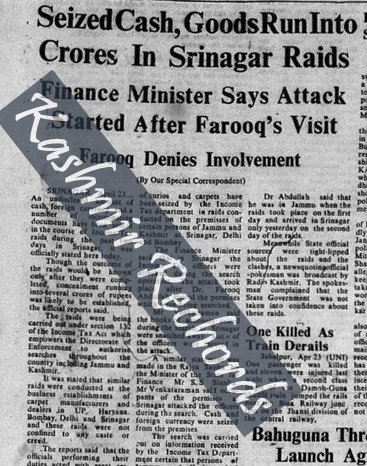
The following day, April 23, 1981, the issue reached Parliament.
A report quoting the Union Finance Minister said that the Income-Tax authorities had acted under Section 132 of the Income-Tax Act and that officials had been attacked after Farooq Abdullah’s visit to one of the premises. The Minister said cash, foreign currency and other material had been seized. Farooq Abdullah denied involvement.
Diaries and ‘foreign links‘
But the raids were producing more revelations.
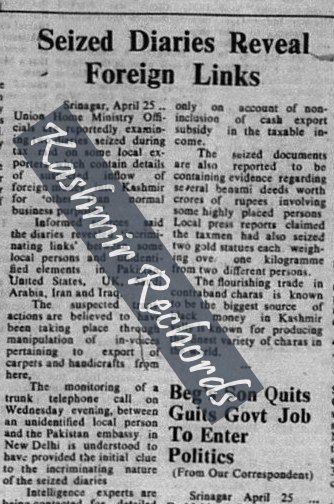
April 25, 1981 report carried the striking headline: “Seized Diaries Reveal Foreign Links.” It said diaries recovered during the searches were being examined for references to transactions involving Kashmir, Saudi Arabia, Iran and Iraq. The report also alleged that the records indicated manipulation of accounts and possible concealment of income.
The financial scale of the investigation was also beginning to emerge.
The same report suggested that tax evasion of around ₹5 crore might ultimately be established. Within a month, that figure had increased.
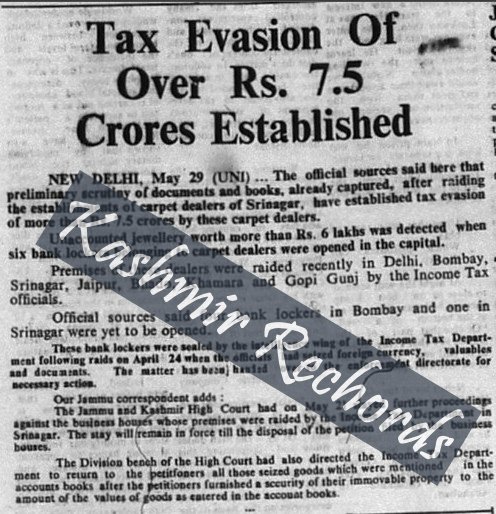
A May 29, 1981 report stated that preliminary scrutiny of documents and books seized from carpet dealers had established tax evasion of more than ₹7.5 crore. It also reported the discovery of unaccounted jewellery worth more than ₹6 lakh in six bank lockers belonging to carpet dealers. Four lockers in Bombay and one in Srinagar, it said, were still to be opened.
Constitutional Challenge of 1981 Srinagar Income Tax Raids
The raid did not end with the seizure of documents. It moved into the courtroom.
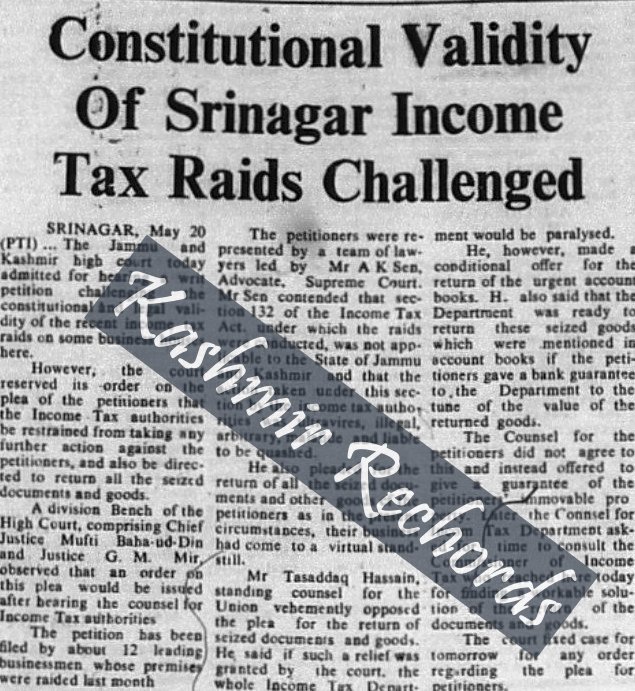
On May 20, 1981, the Jammu & Kashmir High Court admitted a writ petition challenging the constitutional and legal validity of the Income-Tax raids.
The petition was filed by about 12 leading businessmen whose premises had been raided. Their counsel, the eminent constitutional lawyer A. K. Sen, argued that Section 132 of the Income-tax Act—the search-and-seizure provision used by the authorities—was not applicable to Jammu & Kashmir.
The petitioners alleged that the action was: ultra vires, illegal, arbitrary and mala fide. They sought the return of their seized documents and goods and asked the court to restrain the Income-Tax Department from taking further action.
J&K High Court puts brakes on the raids
On May 21, 1981, the Jammu & Kashmir High Court stayed further proceedings against the Srinagar business houses whose premises had been raided.
The court also directed the Income-Tax Department to return seized goods which were mentioned in the petitioners’ account books, provided the petitioners furnished security in the form of immovable property for their value.
The matter reached the Supreme Court
The Union of India and the Income-Tax Department challenged the Jammu & Kashmir High Court’s order in the Supreme Court of India. The government argued that the High Court’s order had brought the investigation to a standstill.
The report stated that Income-Tax officials had carried out searches in April 1981 at eleven properties in Srinagar, Bombay, Delhi and Jaipur, and had seized valuables besides documents allegedly indicating concealment of crores of rupees by dealers and mill operators.
The Supreme Court vacation judge, Justice A. D. Koshal, issued notice and made the matter returnable within two weeks.
Thus, what had begun in Srinagar in April 1981, as a secret Income-Tax operation had, within weeks, become a much bigger battle—over money, seized records, political influence and the constitutional reach of the tax authorities in Jammu & Kashmir.
And perhaps the most evocative evidence of that turbulent April day is not a figure or a court order. It is the photograph of the injured tax sleuths preserved by Kashmir Rechords.
They had arrived in Srinagar looking for hidden wealth. They left with injuries—and a raid that had opened a much larger question about law, power and Kashmir.
Kashmir Rechords Archive Note
This feature is based exclusively on contemporary newspaper clippings preserved in the Kashmir Rechords archive. Figures and allegations are reproduced as reported at the time and should not be construed as subsequent judicial findings.
Help Keep Kashmir’s History Alive
Kashmir Rechords is built on deep research, painstaking archival work and the time spent unearthing material that might otherwise remain forgotten. In an age increasingly driven by reels, quick content and AI-generated narratives, preserving original records and keeping the tradition of serious research alive matters more than ever.
If you value this work, please contribute whatever you can. No contribution is too small. Your support helps us continue searching archives, retrieving forgotten material and bringing Kashmir’s documented past back to readers.
Scan the QR code given here to contribute and help keep Kashmir’s true stories alive.