
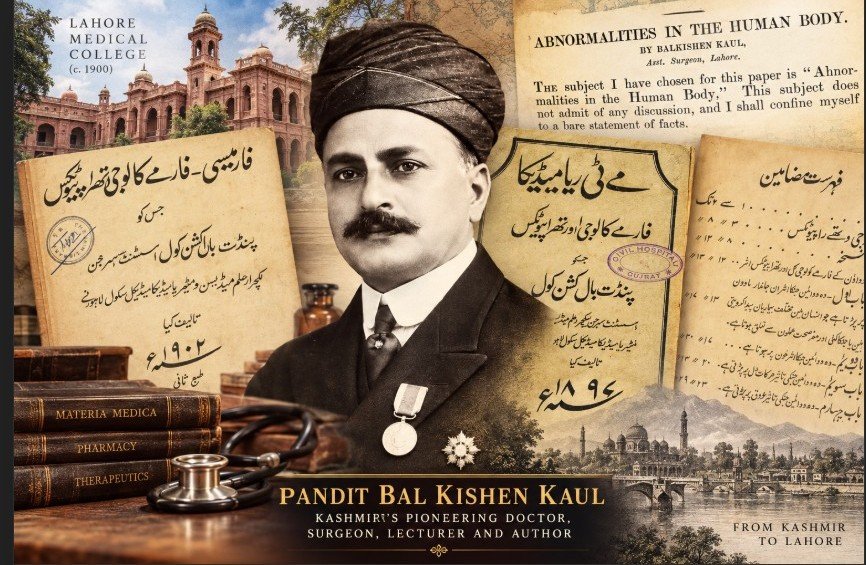
(Kashmir Rechords Exclusive)
More than a century ago, when modern medical education was still in its formative years in India, a young Kashmiri Pandit travelled to Lahore to enter a profession in which very few from his community had ventured.
His name was Pandit Bal Kishen Kaul.
He would go on to become a Surgeon, Medical teacher, author and senior academic at Lahore Medical College; publish a medical textbook in Urdu; participate in the First Indian Medical Congress; and eventually receive the honorific Rai Bahadur.
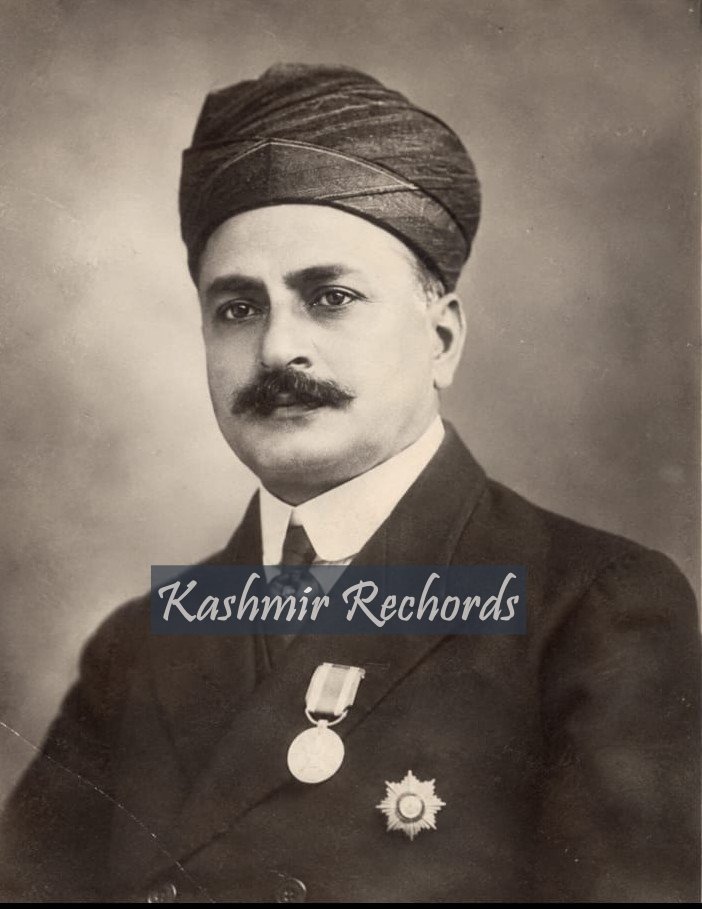
Yet despite this extraordinary record, his name has largely disappeared from the popular history of both Kashmir and Indian medicine.
The story becomes still more remarkable because a scholarly history of the Kashmiri Pandits identifies Bal Kishen Kaul (1866–1937) as “the first in the community” to become a doctor. The same source records that he served on the staff of Lahore Medical College. s
That makes Dr Kaul a figure of considerable importance in the history of the Kashmiri Pandit community’s entry into modern professional education.
The first doctor of KP community
The evidence currently available with Kashmir Rechords ( www.kashmir-rechords.com) makes this perhaps the most striking aspect of his story.
A study of Kashmiri Pandit history records:
Bal Kishen Kaul (1866–1937) became a doctor—the first in the community—and was on the staff of Lahore Medical College.
The wording is significant. This was not merely a Kashmiri Pandit who happened to practise medicine. He appears in the historical record as a pioneer of modern medicine within the community itself.
For Kashmir Rechords, this is an important discovery because it places a Kashmiri Pandit at the intersection of two major nineteenth-century transformations: the movement of Kashmiri Pandits into modern professional education and the emergence of Western medicine as an organised profession in India.
From Kashmir’s Pandit tradition to Lahore’s Medical world
Bal Krishan Kaul came from the prominent family of Raja Suraj Kaul, whose ancestry lay in Kashmir.
The 1912 Supplement to Who’s Who in India describes the family as belonging to an old Brahmin family of Kashmir and traces the family’s earlier service under the Sikh and British establishments. It identifies Bal Kishen as Suraj Kaul’s eldest son.
The family produced several distinguished sons.
But Bal Kishen chose medicine.
His career subsequently became firmly associated with Lahore. And Lahore, in the late nineteenth century, was no ordinary provincial town. It was developing into one of the great educational and intellectual centres of northern India.
It was here that Kaul built his professional life.
The Surgeon
An alumni of King Edward Medical University having completed MBBS in 1889, Dr Kaul by 1894, was already sufficiently established in the medical profession to present a paper at the First Indian Medical Congress at Calcutta.
The proceedings carry his name prominently: “ABNORMALITIES IN THE HUMAN BODY” By Bal Kishen Kaul, Asst. Surgeon, Lahore.
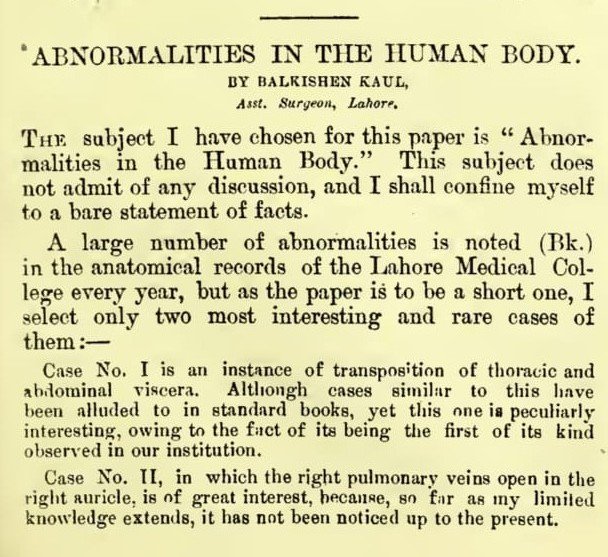
His paper was not a general essay. It recorded anatomical abnormalities observed in the human body, including observations concerning organs, nerves and anatomical structures.
The Lecturer
His career did not stop at clinical practice. The 1912 Supplement to Who’s Who in India records him as:
“Rai Saheb Bal Kishen Kaul” — Assistant Surgeon and Lecturer, Lahore Medical College.
By 1915, the Indian Biographical Dictionary gives him an even more impressive professional description:
“Senior Assistant Surgeon Rai Sahib Pundit Bal Kishen Kaul, Lecturer and Superintendent, Lahore Medical College.”
The Author: Medicine in Urdu
But Bal Kishan Kaul’s contribution went beyond his hospital and classroom.
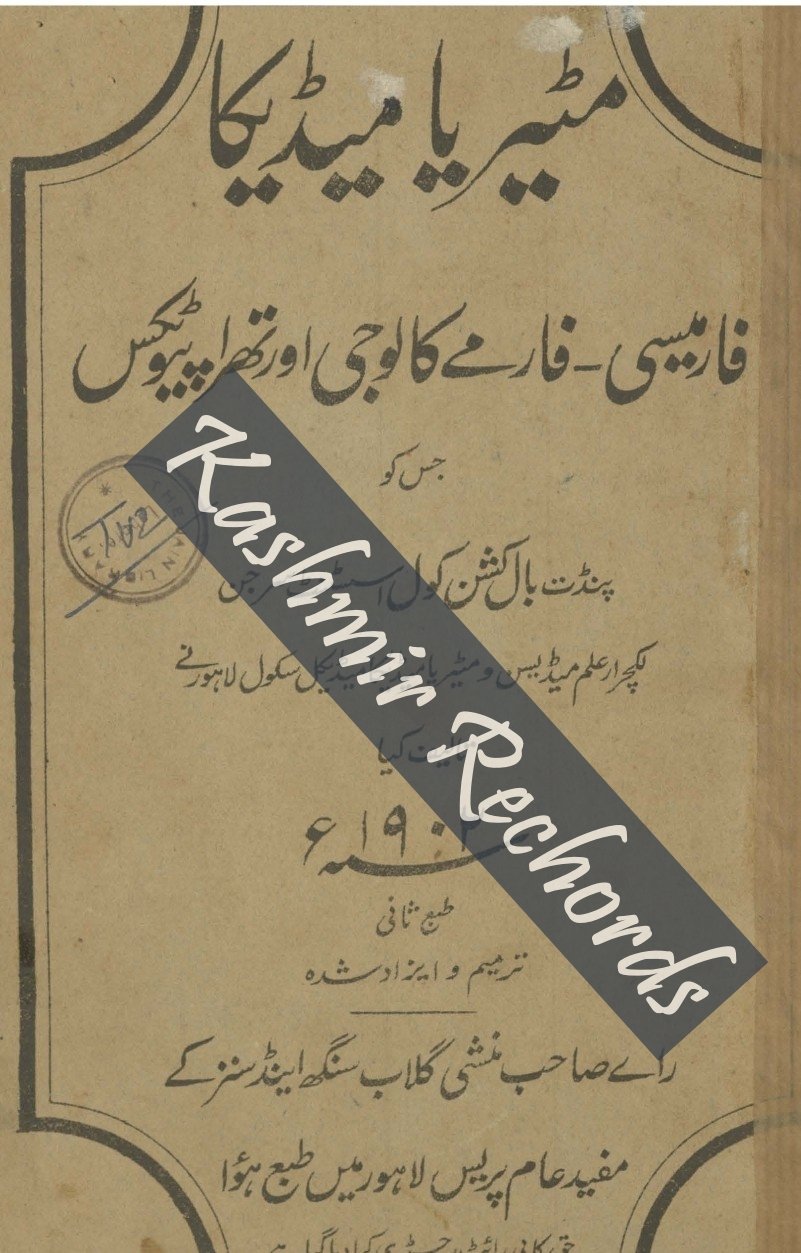
In 1897, he produced a medical book in Urdu. The surviving first-edition copy ( a facsimile of which is available with Kashmir Rechords) bears his name in Urdu and carries the date 1897, marked طبع اول — First Edition.
It was printed in Lahore.
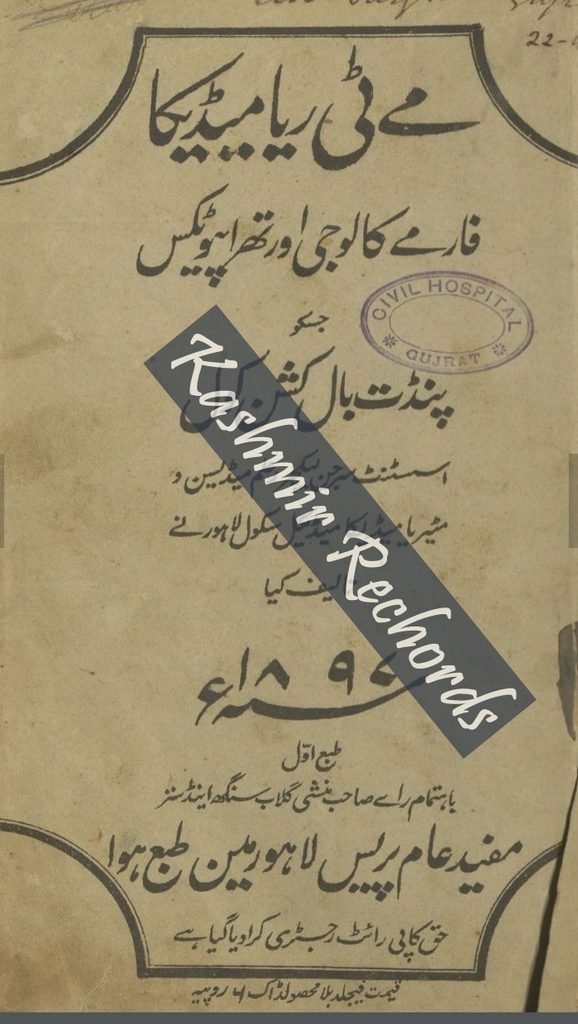
This is perhaps the most fascinating part of Kaul’s legacy.
He was trained within the modern medical system, but he chose to communicate medical knowledge through Urdu, making him not merely a doctor but a participant in the development of scientific and medical literature in an Indian language.
And the story did not end there.
1902: Dr Kaul enlarged his medical work
Five years later, Dr Kaul’s book appeared again.
The 1902 edition is explicitly marked: طبع ثانی — Second Edition
and: ترمیم و اضافہ شدہ — Revised and Enlarged
This is an important bibliographical fact.
Dr Kaul went back to his earlier work, revised it and enlarged it.
The two editions—1897 and 1902 ( copies of which are both available with Kashmir Rechords) thus provide a rare opportunity to study how medical knowledge was being presented to Urdu readers at the turn of the twentieth century.
For Kashmir Rechords, the books themselves are more than old medical texts.
They are physical evidence of a Kashmiri Pandit doctor’s intellectual engagement with modern science more than 125 years ago.
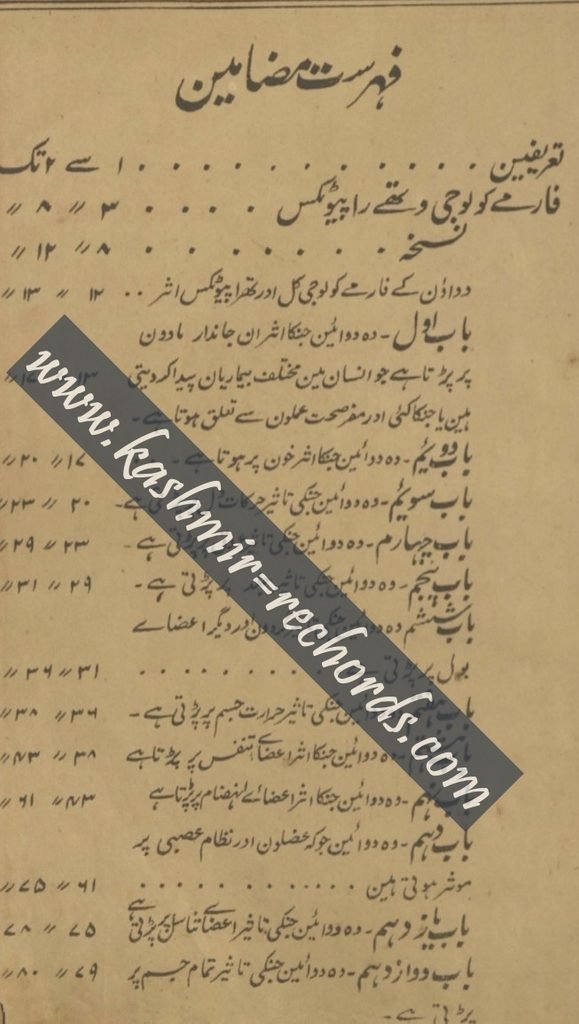
The Doctor Who Became a Medical Author
There is an unusual symmetry in Dr Kaul’s career. He was simultaneously:
the doctor — treating patients; the surgeon — identified as an Assistant Surgeon;
the scientist — presenting anatomical observations at the First Indian Medical Congress; the teacher — Lecturer at Lahore Medical College;
the academic administrator — eventually Superintendent; the author — publishing his medical work in Urdu;
and the public intellectual — participating in Lahore’s wider literary and scholarly environment.
A 1911 publication, The Song Divine, even acknowledges “Pandit Dr. Bal Kishen Kaul, R.S.” as the author’s former pupil and present colleague, thanking him for useful suggestions and literary material.
That reference adds another dimension to his personality.
A prominent Kashmiri Pandit in Lahore
Dr Kaul’s professional standing was also reflected in the honours bestowed upon him.
The 1915 Indian Biographical Dictionary lists him as:
“Senior Assistant Surgeon Rai Sahib Pundit Bal Kishen Kaul, Lecturer and Superintendent, Lahore Medical College.”
The 1912 biographical record also places him within the prominent Kaul family of Lahore, Punjab and Kashmir. His father, Raja Suraj Kaul, had held important administrative positions, including service in Kashmir State and membership of the Viceroy’s and Punjab Councils.