
( Kashmir Rechords Archives)
There are moments in history when a political leader says something in the heat of a legislative debate that reveals more than years of political speeches.
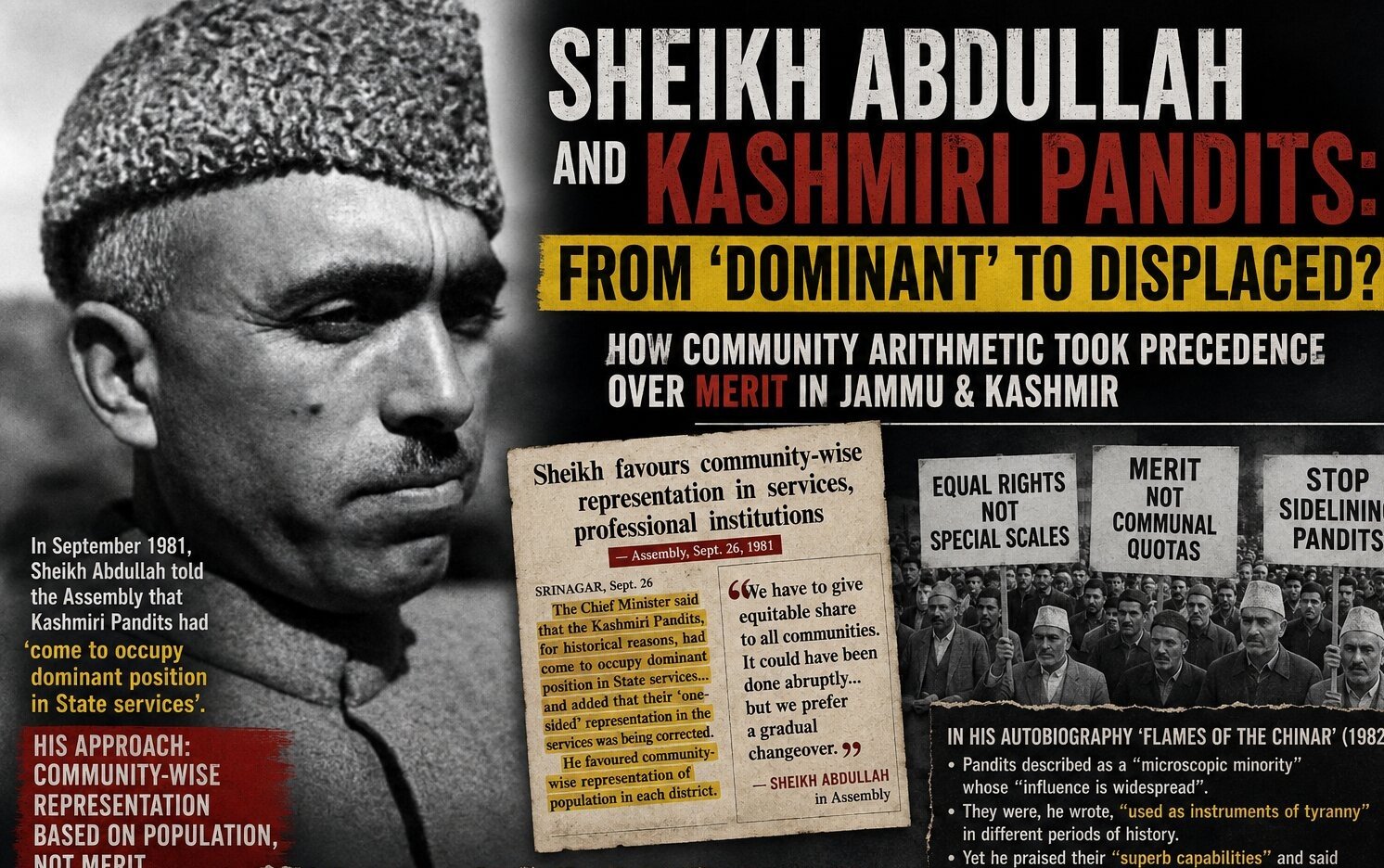
For Kashmiri Pandits, one such moment came on September 26, 1981, when Sheikh Mohammad Abdullah, then Chief Minister of Jammu and Kashmir, spoke in the Legislative Assembly about their representation in government services and professional institutions. (Kashmir Rechords is the first to bring to light a chapter of history that has remained largely unexplored, unreported and outside public discourse).
Sheikh Abdullah’s argument was stark: Kashmiri Pandits had, he said, “for historical reasons” come to occupy a dominant position in State services. Their “one-sided” representation, he declared, was being corrected.
He favoured community-wise representation based on population in each district, so that every community could receive an “equitable share.”
That statement deserves to be examined closely—not merely as an administrative proposal, but as a window into how Sheikh Abdullah viewed the Kashmiri Pandit community.
For critics of his policy, the disturbing implication was obvious: instead of asking who was best qualified for a government position, the State would increasingly ask how many members of a particular community already occupied such positions.
In other words, merit appeared to be giving way to community arithmetic.
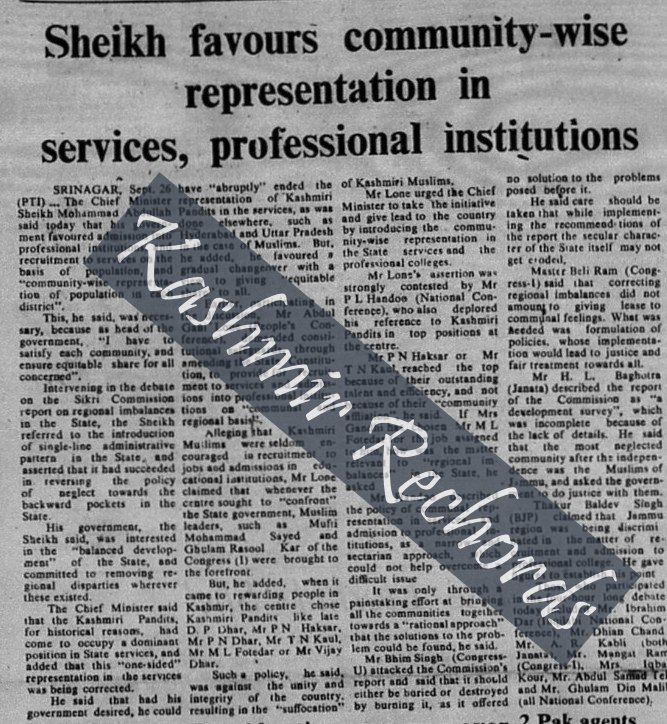
Chief Minister’s words in the Assembly
The contemporary newspaper report is unusually revealing.
Sheikh Abdullah acknowledged that Kashmiri Pandits had historically occupied a prominent place in State services. But rather than defending the principle of open competition, he said that this “one-sided” representation was being corrected.
He favoured representation “community-wise” according to population.
He further argued that his government could have abruptly ended Kashmiri Pandits’ representation but preferred a gradual changeover.
That last phrase is important.
It means that the policy was not one of instant exclusion. Shaikh Abdullah was not calling for Pandits to be removed from government service merely because they were Pandits.
But it does reveal something else:He regarded their existing representation as something that had to be reduced or redistributed.
And the mechanism he proposed was not simply better education, wider recruitment or equal competition.
It was community-wise representation according to population.
That is precisely where the question of merit arises.
When did community become more important than the individual?
Imagine two equally qualified candidates appearing for a government post.
Under a purely merit-based system, the State asks:Who is more qualified?
Under Abdullah’s proposed community-wise approach, another question enters: How many people from each community are already represented?
That may be defended as affirmative action or correction of historical deprivation. But it is no longer a system based exclusively on individual merit. And that is why the 1981 statement deserves serious scrutiny.
The issue is not whether Kashmiri Muslims had historically suffered discrimination. They undoubtedly had. The issue is whether the remedy for that discrimination should have been to treat Kashmiri Pandit representation itself as an imbalance requiring correction. That is a very different proposition.
The “dominant Pandit” narrative
To understand Sheikh Abdullah’s thinking, one must go back to the narrative he developed about Kashmiri Pandits.
In Flames of the Chinar, his chapter devoted specifically to the community is titled:“The Role of Kashmiri Pandits”
He begins by acknowledging their importance:
“On Kashmir’s political canvas, the Kashmiri Pandits occupy a prominent place; no description of Kashmir can be complete without an account of their achievements.”
But almost immediately he adds that although they constituted a “microscopic minority,” their influence was widespread. Then comes the much harsher formulation: “In fact, during different periods of history they were used as instruments of tyranny.”
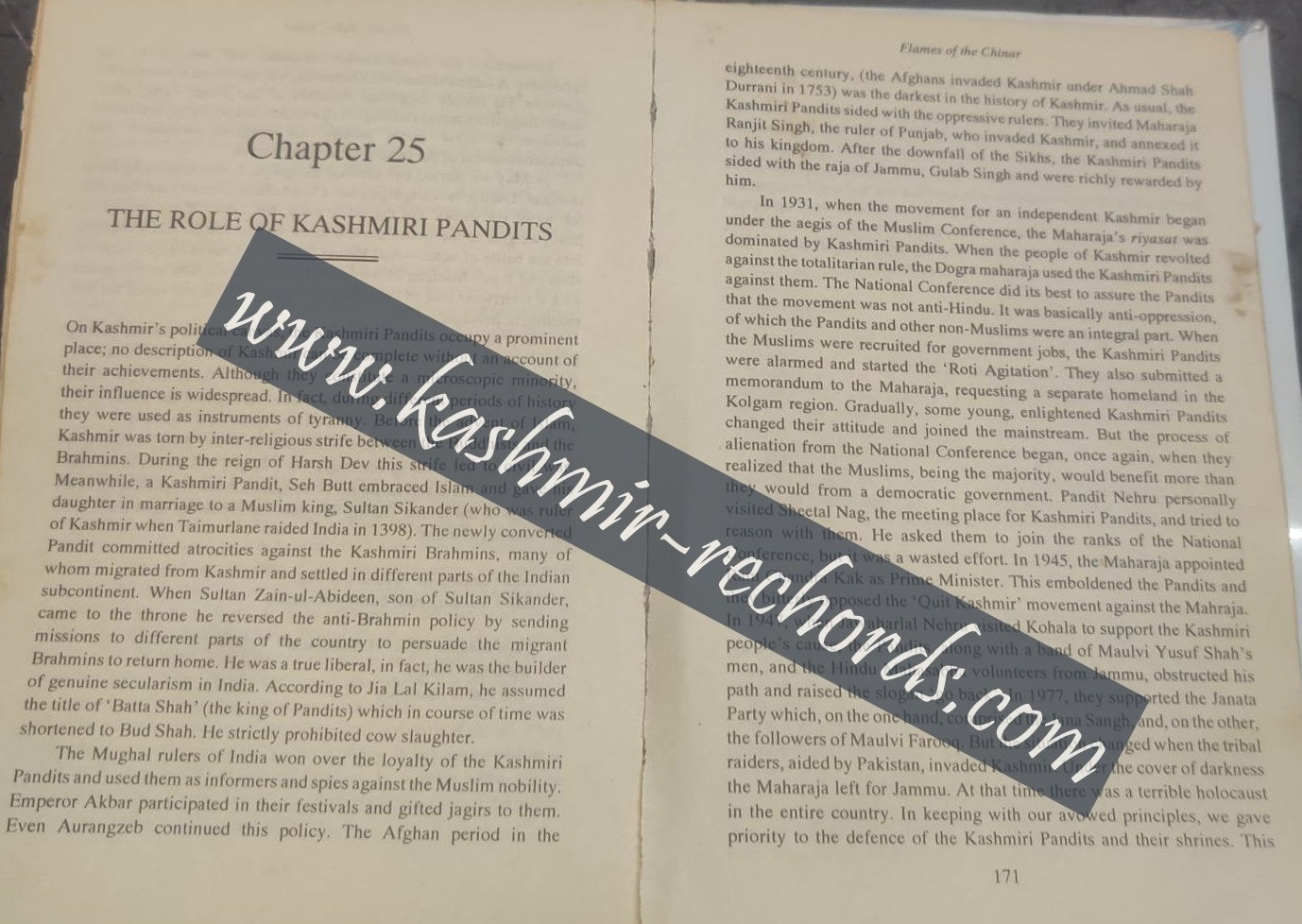
This is not simply a historical observation about particular individuals.
Sheikh Abdullah constructs a broad narrative in which Kashmiri Pandits, because of their education and administrative presence, became associated with the ruling establishment that governed the Muslim majority.
That narrative became important because it supplied a historical justification for what Abdullah was saying in 1981.
But were Kashmiri Pandits really the “ruling class”?
Here a distinction is essential.
There is abundant historical evidence that Kashmiri Pandits were disproportionately represented in certain branches of administration, particularly clerical and revenue work.
But disproportionate representation is not synonymous with political sovereignty.
The Dogra Maharaja was the ruler. The Pandit clerk was not.
The Dogra state was a monarchy headed by the Dogra ruling family of Jammu.
Kashmiri Pandits were recruited extensively into clerical, revenue and other administrative positions, partly because sections of the community had acquired educational and linguistic qualifications that made them suitable for such employment.
The famous statistics about Pandit employment,, therefore, require context.
A community could be over-represented in government employment while still being a tiny, economically diverse minority, containing clerks, teachers, small employees and ordinary families alongside a much smaller number of successful professionals.
To convert occupational concentration into the image of an all-powerful “Pandit establishment” is therefore a substantial political simplification.
Even Sheikh’s own examples expose the problem
There is an extraordinary irony in Flames of the Chinar.
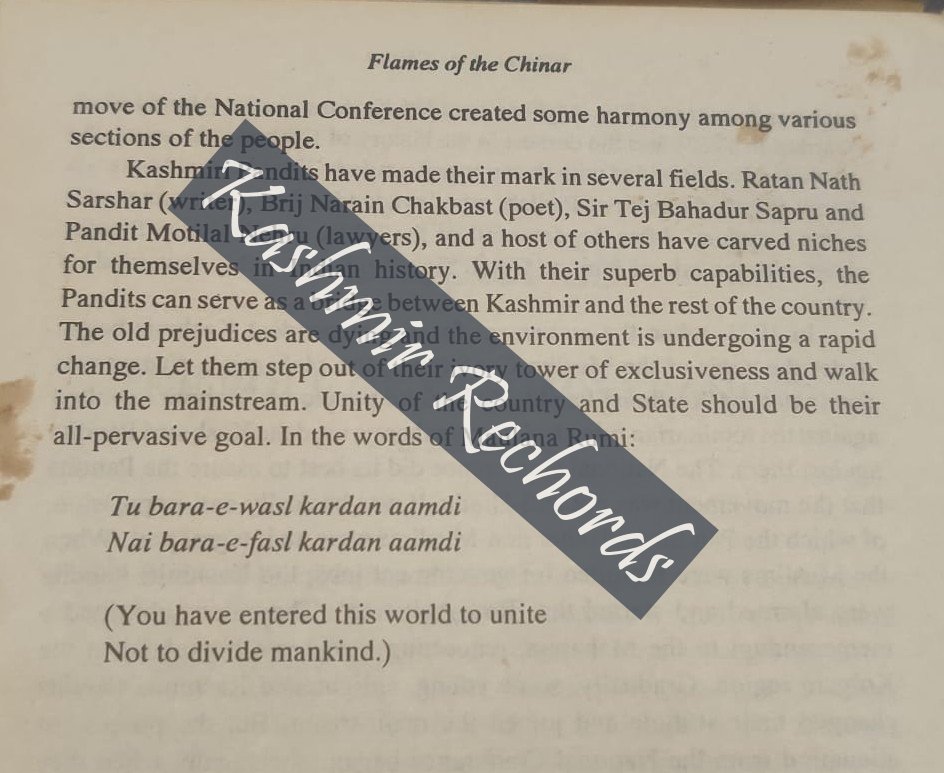
When Sheikh Abdullah wants to demonstrate the achievements of Kashmiri Pandits, he invokes some of the most celebrated names associated with the community:
Ratan Nath Sarshar. Brij Narain Chakbast.Sir Tej Bahadur Sapru. Pandit Motilal Nehru.
He writes that they had:
“carved niches for themselves in Indian history.”
And then comes an even more generous assessment:
“With their superb capabilities, the Pandits can serve as a bridge between Kashmir and the rest of the country.”
There is, however, a crucial geographical and social qualification.
Several of these personalities belonged to the Kashmiri Pandit diaspora that had established itself outside the Valley generations earlier.
Sarshar’s literary career was centred in Lucknow. Chakbast was born in Faizabad and grew up in Lucknow. Tej Bahadur Sapru was born in Aligarh and became one of India’s most eminent lawyers at Allahabad.
Motilal Nehru was born in Agra and built his legal and political career outside Kashmir.
These men unquestionably demonstrate the extraordinary intellectual achievements of Kashmiri Pandits.
But they cannot be used as straightforward evidence of the socio-economic position of the ordinary Kashmiri Pandit living in Kashmir.
That distinction is often lost in the political narrative.
The Pandit who became a symbol of “privilege”
This is perhaps the most important transformation to examine.
The ordinary Kashmiri Pandit could be:
- a clerk; a teacher; a schoolmaster; a small government employee;
- a priest; a shopkeeper; a professional; or simply an ordinary villager.
Yet the community’s historic success in education and government employment could be aggregated into a single political category: “Pandit representation.”
Once that happened, the achievements of the community’s most successful members could become evidence against the community as a whole.
The question became not: “Is this individual qualified?”
but: “Has this community already had too much?”
That is the fundamental danger of community-based political arithmetic.
September 1981: the policy becomes explicit
This is why Sheikh Abdullah’s Assembly statement is so important.
By 1981, the argument had moved beyond historical criticism.
The Chief Minister was speaking about actual recruitment to government services and professional institutions. He said the historical “one-sided” representation of Kashmiri Pandits was being corrected.
He advocated community-wise representation according to population.
And he preferred a “gradual changeover.”
That language is significant. It suggests that Abdullah did not envisage a dramatic purge. Rather, the system would be progressively altered.
And in such a system, the community that had previously enjoyed a disproportionate presence would inevitably see its share decline. The process did not require exclusion. It required changing the rules of representation.
Was this affirmative action—or communal preference?
That is the question history must confront honestly.
Supporters could—and did—argue that the policy was necessary because Muslims had been deprived for generations.
But there is another legitimate question: Why should the child of a Kashmiri Pandit clerk be held responsible for the historical privileges, if any, enjoyed by another Pandit several generations earlier?
Likewise:
Why should the child of a poor Kashmiri Muslim be denied an opportunity merely because his community had historically been represented in greater numbers?
A genuinely just system has to deal with both problems.
It must correct historical deprivation without transforming inherited community identity into inherited guilt or inherited entitlement.
That is where merit becomes indispensable.
Sheikh Abdullah’s autobiography makes 1981 speech even more revealing
The Assembly speech was made in 1981.
The autobiographical manuscript was completed in 1982, shortly before Abdullah’s death, and later appeared in English as Flames of the Chinar.
That sequence is important. The autobiography was not the youthful Sheikh Abdullah speaking in the emotional atmosphere of the 1930s.
It was the retrospective account of a veteran politician looking back over the history of Kashmir.
And what does he say about Pandits?
He acknowledges their achievements—but repeatedly returns to the idea that they had acquired an influence disproportionate to their numbers.
He writes about their role under different rulers.
He recounts their opposition to Muslim recruitment. He discusses the Roti Agitation. He criticises sections of the community for opposing the Quit Kashmir movement.
He portrays their political alienation from the National Conference as connected to their fear that democracy would empower the Muslim majority.
Thus the 1981 speech was not an isolated administrative remark. It appears to have rested on a much deeper political conception of the Pandit community.
Yet Abdullah also claims to have protected the Pandits
A fair account must include this.
In the same chapter, Abdullah says that when tribal raiders invaded Kashmir in 1947, the National Conference gave:
“priority to the defence of the Kashmiri Pandits and their shrines.”
He presents this as evidence of his movement’s commitment to communal harmony.
This makes the historical picture more complicated.
Abdullah cannot accurately be portrayed as someone who simply wanted Pandits driven out of Kashmir. His own account contradicts that.
He wanted them to remain part of Kashmir.
He praised their achievements. He described them as capable of serving as a bridge between Kashmir and India.
But he simultaneously believed that their historical position in administration was excessive and needed correction.
That is a much more nuanced—and perhaps more uncomfortable—conclusion.
The “ivory tower”
Sheikh Abdullah’s concluding advice to the Pandits is equally revealing.
He asks them to: “step out of their ivory tower of exclusiveness and walk into the mainstream.”
But who defined the mainstream?
And why were Kashmiri Pandits, one of Kashmir’s oldest communities, being asked to enter a mainstream as though they had historically stood outside it?
This is where the politics of Kashmiriyat becomes complicated.
If Kashmiri Pandits were an integral component of Kashmir’s historical civilisation, then their numerical smallness could not logically make their culture, heritage or belonging proportionately smaller.A minority does not become less Kashmiri because it is a minority.
Paradox of Sheikh Abdullah
Perhaps the most revealing way to understand Sheikh Abdullah’s position is to place his own words against each other.
He called the Pandits a:“microscopic minority”, but said their influence was widespread.
He described their historical role as that of: “instruments of tyranny”
yet acknowledged their extraordinary accomplishments.
He said they possessed: “superb capabilities” and could be a:
“bridge between Kashmir and the rest of the country.”
But in the Assembly he described their representation in State services as: “one-sided” and advocated: “community-wise representation”
based upon population.
This is not a simple story of hatred. It is a story of political ambivalence.
From Pandit achievement to Pandit liability
And that may ultimately be the most consequential aspect of Abdullah’s approach.
A community’s educational success can be celebrated.
But once that success is converted into a political argument that the community has become “dominant,” its achievement itself can become a reason for reducing its institutional representation.
That is where the line between affirmative action and communal preference becomes blurred.
And that is why the 1981 Assembly debate deserves to be revisited.
The question is not whether Muslims deserved greater representation.
They did.
The question is whether greater representation for the historically disadvantaged had to come at the expense of the principle that a qualified individual should be judged primarily on merit rather than community arithmetic.
History’s unanswered question
Sheikh Abdullah’s defenders may argue that his policy was an attempt to undo generations of Muslim exclusion.
His critics may see it as a calculated political strategy to consolidate Muslim-majority power.
Both interpretations deserve examination. But the primary evidence permits one conclusion that cannot easily be dismissed:
By 1981, Sheikh Abdullah was openly advocating a system in which community and population would play a determining role in representation in government services and professional institutions, while explicitly identifying Kashmiri Pandits’ historically disproportionate representation as something that needed to be corrected.
Whether one calls that social justice, affirmative action, communal balancing or institutional sidelining depends partly on one’s political interpretation.
But one thing is certain: It was not a purely merit-based philosophy.
And that is why the September 1981 speech deserves to be placed at the beginning of any serious examination of Sheikh Abdullah’s attitude toward Kashmiri Pandits.
His autobiography, completed the following year, then provides the historical narrative through which he himself sought to explain why he thought that way.
Kashmir Rechords takeaway
The story of Kashmiri Pandits cannot honestly be written as though they were an all-powerful community that ruled Kashmir.
Nor can the genuine educational and administrative discrimination suffered by Kashmiri Muslims under Dogra rule be denied.
The historical truth lies somewhere more complicated.
Kashmiri Pandits were a tiny minority who achieved a remarkable concentration in education, clerical employment and the professions. That achievement was gradually transformed into a political narrative of disproportionate “dominance.” Under Sheikh Abdullah, that narrative became the basis for advocating community-wise redistribution of State opportunities.
The tragedy is that a Kashmiri Pandit could consequently come to be judged not merely as an individual, but as a representative of a community whose historical “share” was considered excessive.
And when community arithmetic enters the selection of individuals, merit inevitably ceases to be the sole measure.
That is the uncomfortable question Sheikh Abdullah’s own words leave behind:
Was Kashmir correcting a historical wrong—or replacing one form of inequality with another?
Kashmir Rechords believes the answer should be sought not in political slogans, but in the words of Sheikh Abdullah himself, the contemporary record of the Assembly, and the actual statistics of State employment.
That is where the historical verdict belongs.