
(Kashmir Records Exclusive)
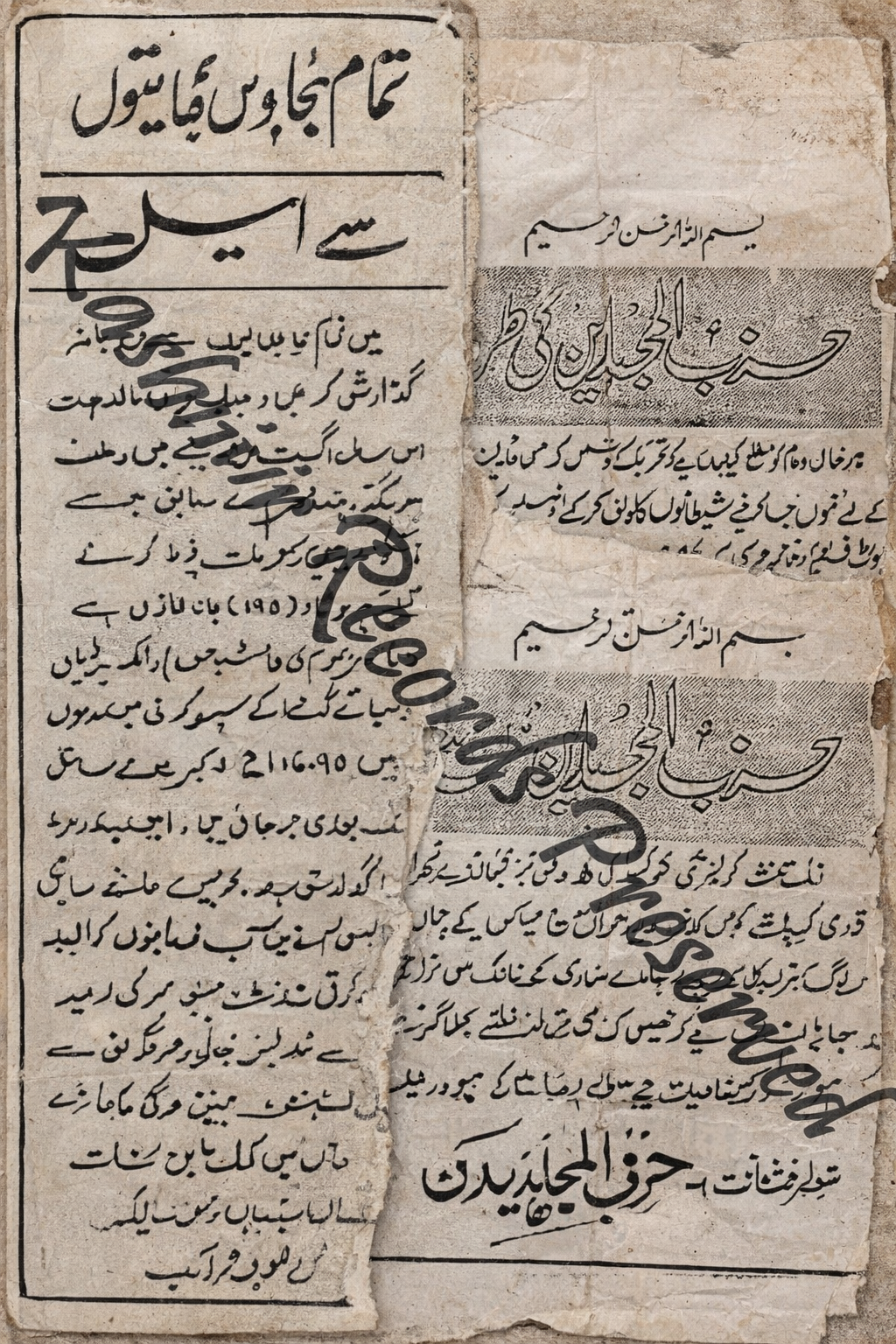
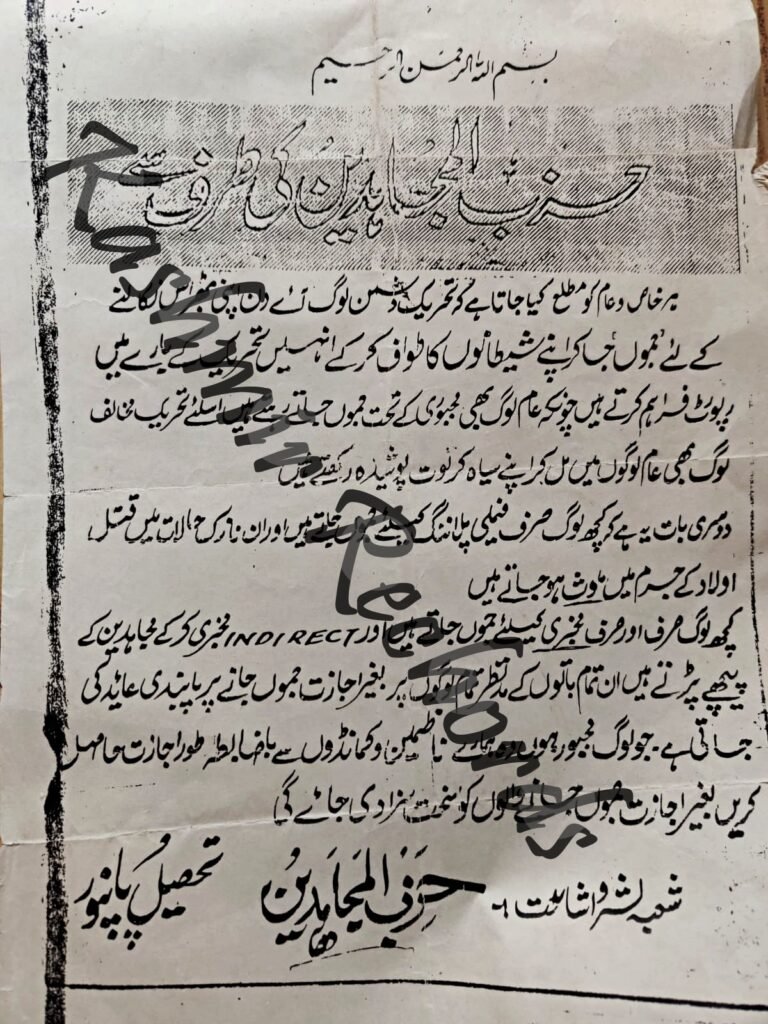
“In the name of Allah, the Most Gracious, the Most Merciful…”
The words appeared at the top of a poster—formal, almost pious. But what followed was not a prayer. It was an order.
In the early 1990s, Kashmir was not merely passing through unrest—it was living under a parallel authority. Militants, particularly the Hizbul Mujahideen, had begun to dictate not just politics or ideology, but the rhythms of everyday life. Movement, speech, even personal choices—nothing was untouched.
A Valley Where Leaving Required Permission
Across towns and villages, posters were pasted on walls, electric poles and shop shutters. The message was unmistakable: no one could leave the Valley for Jammu without permission.
Travel, once routine, had become an act of defiance.
Those who dared to step out without approval risked being branded informers—collaborators with Indian forces. And in those times, such labels were often a death sentence.
One such poster, circulated widely in places like Pampore, warned Kashmiri Muslims against travelling to Jammu. It alleged that those crossing the Valley were secretly passing information to security agencies. The language was stark, the warning severe: stop—or face consequences.
The message went further. It declared that the ”conflict was not just the responsibility of militants, but of every individual in Kashmir”. ”Anyone seen as supporting Indian forces, in any manner, would be treated as a traitor.”
Even Personal Lives Came Under Scrutiny
The posters did not stop at movement. They intruded into the most intimate corners of life.
Kashmiri Muslim Women were accused of travelling to Jammu for family planning procedures—an act the posters described as “killing children in the womb.” The diktat was clear: such actions were unacceptable.
Residents were instructed to seek permission from local “Area Commanders” before travelling. Cooperation with Indian forces was forbidden. Support for the militant cause was expected—not requested.
In a Valley where fear travelled faster than news, compliance became a survival instinct.
A Kashmiri Pandit Son’s Appeal in Print
Amid this atmosphere of control and fear, one small newspaper clipping tells a story that is both haunting and deeply human.
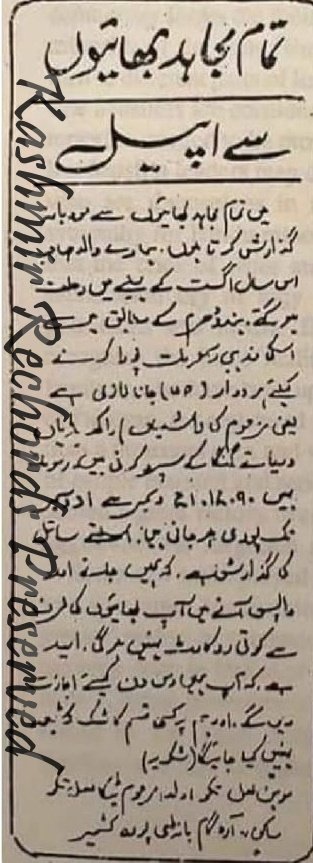
It is the story of Mohan Lal Tikoo, a Kashmiri Pandit from Aragam in Bandipore, Kashmir—one of the few who had chosen to stay back even as his community left Kashmir en masse.
In December 1990, grieving the loss of his father, Tikoo faced a dilemma no son should ever encounter: He needed permission to perform his father’s last rites.
With no other avenue available, he turned to the only authority that seemed to matter at the time—the militants themselves.
His appeal appeared in the Urdu daily Srinagar Times on December 11, 1990. It was not a protest. It was a plea.
He wrote that, according to Hindu tradition, he was duty-bound to carry his father’s ashes to Haridwar and immerse them in the sacred Ganga. He requested permission to leave the Valley between December 21 and December 31, 1990 assuring that he would return, and cause no disturbance.
It was a deeply personal request—yet it had to be made publicly, almost like a petition for mercy.
In that moment, grief was secondary. Permission was everything.
When Authority Extended to Birth Itself
The reach of militant diktats extended even further—to the question of life itself.
At the time, voices aligned with the broader separatist sentiment openly opposed family welfare measures. Calls were made for larger families, framed as part of a larger struggle.
There were even reports of financial incentives being announced—cash rewards for couples with five or seven children. Promises were made to support the upbringing of newborns.
In a conflict where identity and numbers were seen as strength, even childbirth became political. Kashmir Rechords has already carried a detailed story on it : Kashmir 1990: When Militants Banned Family Planning at Gunpoint which can be read in our full report here:
Echoes That Still Remain
The posters have faded. The ink has blurred. The walls that once carried them have long been repainted.
But the stories remain.
They speak of a time when ordinary people navigated extraordinary pressures—when leaving home required approval, when mourning required permission, and when silence often meant survival.
The clipping of Mohan Lal Tikoo is not just a document. It is a reminder—of how deeply conflict can enter the personal, and how, even in the harshest times, humanity finds a way to speak… even if only through a newspaper column.