
(Kashmir Rechords Report)
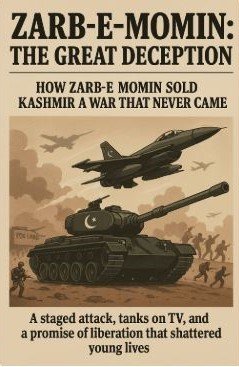
It was December 1989 when Pakistan launched its biggest-ever military exercise, Zarb-e-Momin, creating an imaginary war-like situation under a carefully crafted plan that pitted two fictional countries against each other: Fox Land, representing India and Blue Land, representing Pakistan. The exercise was no innocent drill; it was designed with a calculated and rather sinister purpose—to portray India before the world as the “aggressor,” and to send a powerful psychological signal to Kashmiri militants that Pakistan was fully behind them, ready to take on India and assured of victory regardless of India’s strength.
Zarb-e-Momin did not arise in isolation. It was, in fact, the psychological follow-up to an earlier covert strategy: Operation Topac, conceived in the late 1980s under General Zia-ul-Haq. Operation Topac formed the backbone of Pakistan’s proxy-war blueprint in Kashmir. Its hidden strategy was straightforward but devastating: ignite separatist sentiment, arm and train Kashmiri youth and foreign fighters and internationalise the Kashmir issue by projecting the unrest as a spontaneous people’s uprising rather than a Pakistan-backed intervention.
As this covert programme expanded, Kashmir further slipped rapidly into full-scale insurgency around 1988–89. Groups such as the `JKLF’ and later more hardline Islamist organisations, took up arms. Pakistan’s training camps, infiltration routes, weapons supply and sanctuary across the Line of Control transformed local anger into a structured militant movement. The proxy war had stepped out of the shadows and onto the streets of the Valley.
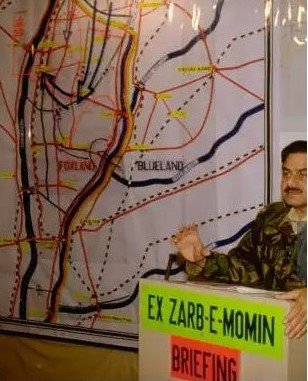
It was precisely at this moment of peak volatility that Pakistan unveiled Zarb-e-Momin. Officially, it was a military simulation to test Pakistan Army’s “offensive defence” doctrine and its integration with the Air Force. But to militants in the Valley, and to many ordinary Kashmiris, the exercise conveyed something far more potent: the impression that Pakistan was preparing not just to support them covertly but to stand behind them with tanks, fighter jets and massive troop strength.
The Pakistani press of the time went out of its way to reinforce this illusion. On December 10, 1989, newspapers dramatically reported that Pakistan’s “full-scale war exercise” had entered its crucial phase. They described how, at dawn, “Fox Land” (clearly India) had launched an “offensive” in the Chor, Rahim Yar Khan and Bahawalpur sectors to seize strategic territory from “Blue Land” (Pakistan). According to these reports, Fox Land had deployed sizeable infantry formations supported by armoured units. Blue Land was shown as retaliating with force and brilliance, outsmarting the aggressor and demonstrating superior military capability.
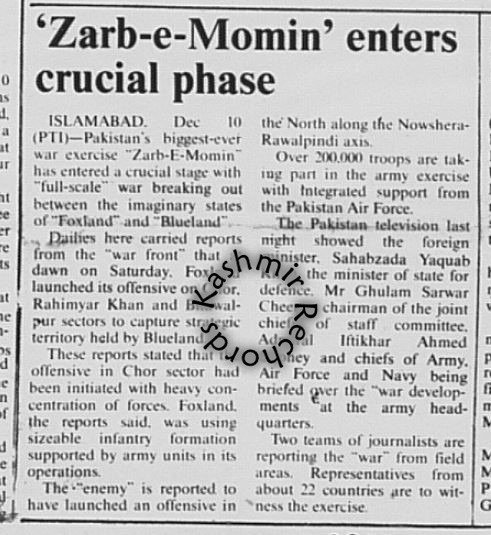
This psychological theatre was not restricted to newspapers. Pakistan Television carried continuous “war briefings” featuring the Foreign Minister Sahabzada Yaqub Khan, the Minister of State for Defence, Ghulam Sarwar Cheema, the Chairman of the joint chiefs of staff, and the Army, Navy and Air Force chiefs. Two teams of journalists were despatched to “frontline positions” to file dramatic field reports. Representatives from over twenty countries were invited to witness what Pakistan presented as a realistic war scenario, carefully orchestrated to show India as the first attacker.
In Kashmir’s already charged environment, this spectacle had immense impact. Zarb-e-Momin became a psychological instrument—not merely a military rehearsal but a promise in disguise. Militants interpreted it as a sign that Pakistan’s regular army was preparing to intervene if the insurgency gained momentum. Many young Kashmiris genuinely believed that if they “held on,” Pakistan’s tanks and fighter jets, showcased on Pakistan’s national television, would one day cross the border to “liberate” them. For a generation entering militancy, it appeared that Pakistan’s State Power stood firmly behind them and that India, however strong, could ultimately be defeated.
With hindsight, that belief appears tragically misplaced. Pakistan never escalated beyond calibrated proxy warfare. No armoured columns rolled into Kashmir. No liberation offensive materialised. Zarb-e-Momin’s fiery display remained exactly that—a display. Yet the illusion it created was powerful enough to draw hundreds more into militancy, strengthening the spiral of conflict.
The psychological expectation that Pakistan cultivated—Operation Topac’s covert preparation reinforced by Zarb-e-Momin’s public theatrics—helped push Kashmir deeper into a prolonged and devastating vortex. The people of Jammu and Kashmir paid the heaviest price: decades of violence, displacement, grief, fractured communities and a lost generation.
In the end, many argue that Pakistan’s strategy amounted to selling a dream it never intended to fulfil—befooling the very population in whose name the proxy war was waged. The combination of covert promises and overt theatrics, beginning with Zarb-e-Momin in December 1989, shaped one of the darkest chapters in the region’s history.